North America Acoustic Insulation Market

North America Acoustic Insulation Market by Material Type (Glass Wool, Rock Wool, Foamed Plastic, Elastomeric Foam, Others), End-use Industry (Building & Construction, Transportation, Oil & Gas and Petrochemical, Energy & Utilities, Industrial & OEM), and Country - Forecast to 2030




OVERVIEW
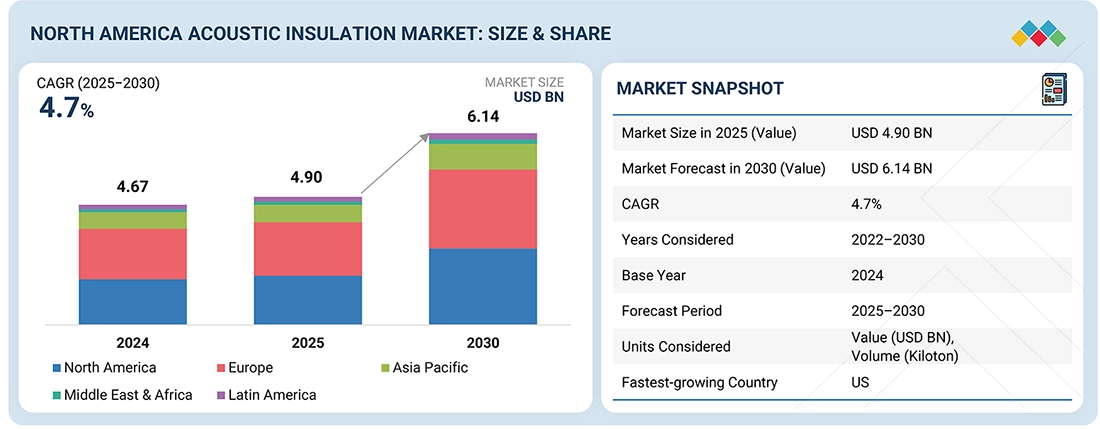
Source: Secondary Research, Interviews with Experts, MarketsandMarkets Analysis
The North America acoustic insulation market is projected to grow from USD 4.90 billion in 2025 to USD 6.14 billion by 2030, at a CAGR of 4.7% during the forecast period. North America has experienced a significant surge in demand for soundproofing materials, driven by several converging factors. Increased urbanization and higher population density in major cities have led to elevated noise levels in residential, industrial, and commercial areas. Additionally, a robust construction industry—characterized by the rise of high-rise buildings, the development of modern office spaces, and a trend toward mixed-use developments—has further fueled this demand. Many states and local jurisdictions are also implementing strict building codes and "green building certification" criteria, such as LEED, which has contributed to the unprecedented need for soundproofing solutions.
KEY TAKEAWAYS
-
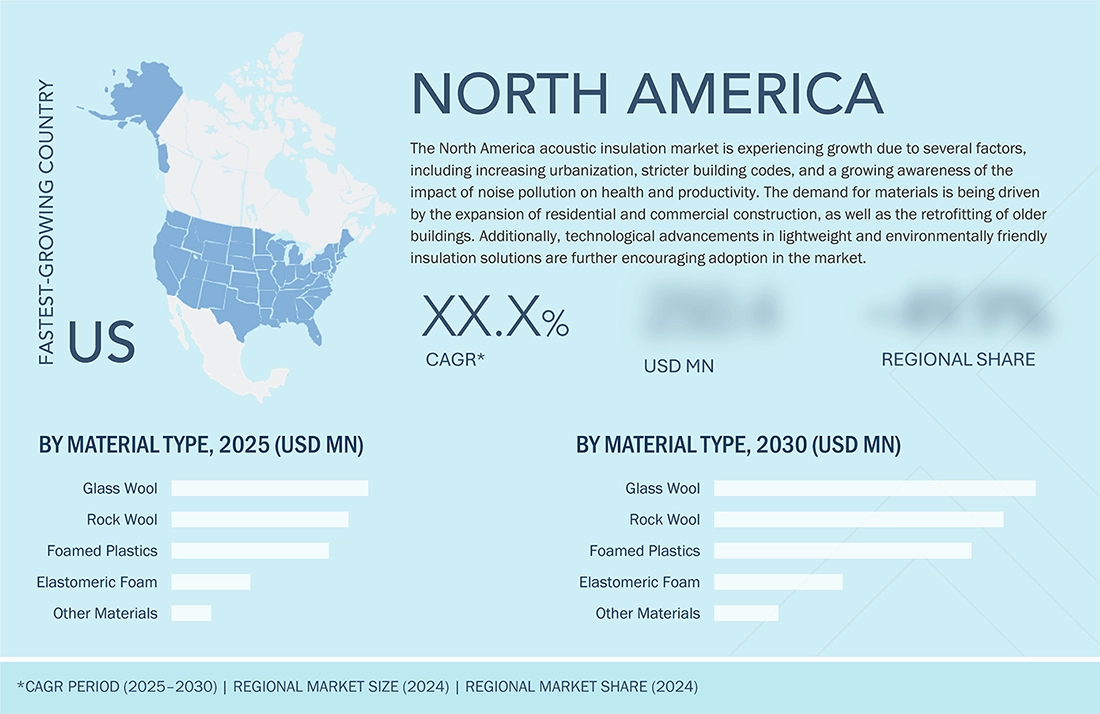
By CountryThe US is expected to account for the largest market share of 83% in 2025.
-
By Material TypeThe rock wool material type is expected to be the fastest-growing, with a CAGR of 5.0% during the forecast period.
-
By End-Use IndustryThe building & construction end-use industry is expected to register the highest CAGR of 5.0% during the forecast period.
-
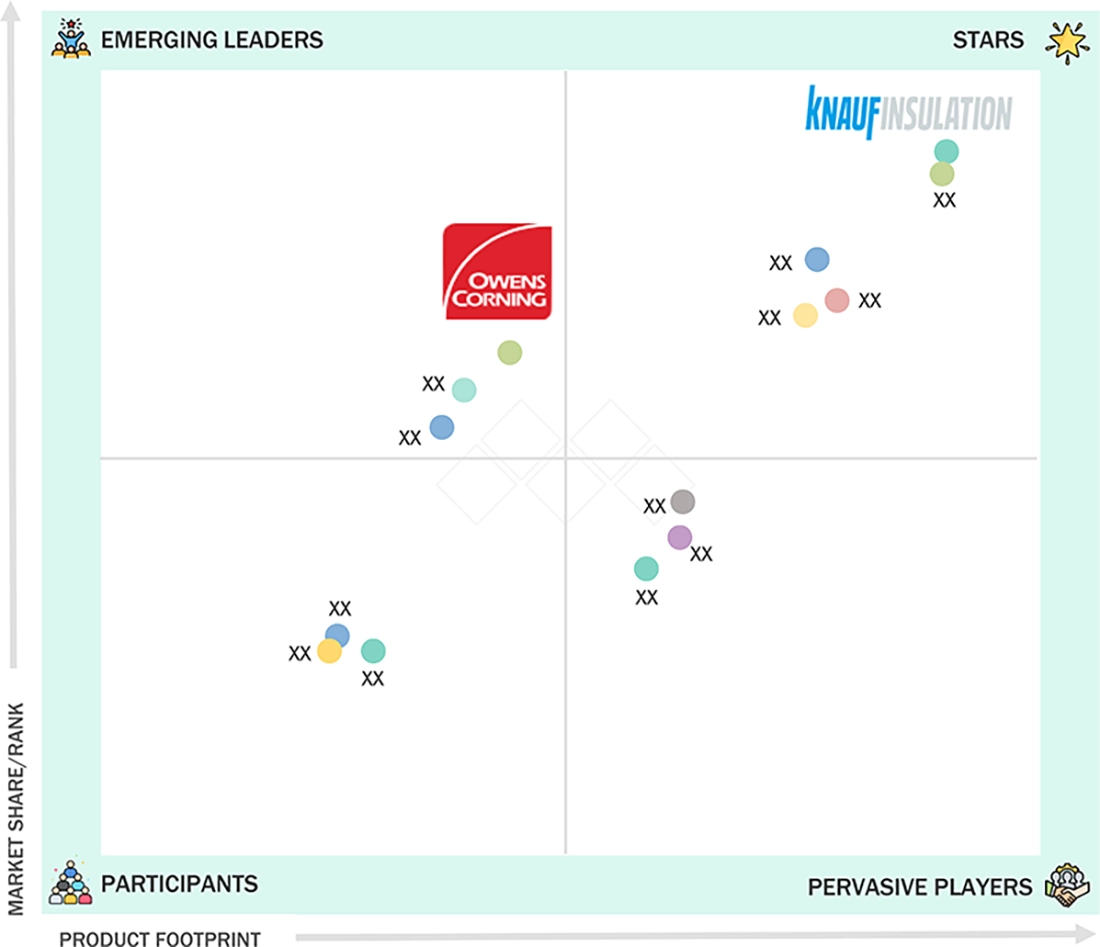
COMPETITIVE LANDSCAPE- KEY PLAYERSCompanies such as Knauf Insulation, Huntsman International LLC, and Owens Corning, among others, were identified as some of the star players in the North America acoustic insulation market, given their strong market share and product portfolios.
-
COMPETITIVE LANDSCAPE- STARTUPSCellecta, International Cellulose Corporation, and 3M, among others, have distinguished themselves among startups and SMEs by securing strong footholds in specialized niche areas, underscoring their potential as emerging market leaders.
Acoustic insulation, also known as sound insulation, refers to materials and solutions that reduce the transmission of sound between areas. This type of insulation can be applied to walls, ceilings, floors, and mechanical systems. The primary purpose of acoustic insulation is to enhance comfort and privacy for individuals. Several factors have contributed to the growth of the acoustic insulation market, including the increase in urban populations, the surge in high-density housing construction, and a growing awareness of the negative effects of noise pollution, such as stress and hearing loss. Additionally, strict sustainability standards have encouraged more people to invest in acoustic insulation materials.
TRENDS & DISRUPTIONS IMPACTING CUSTOMERS' CUSTOMERS
The acoustic insulation market is experiencing significant disruption due to emerging trends in technology, sustainability, and construction innovation. One major shift is the move towards eco-friendly and recyclable insulation materials, such as cellulose, natural fibers, and bio-based foams. This shift is driven by stricter environmental regulations and consumer demand for greener building solutions. Additionally, the integration of smart building technologies is transforming the market. Modern acoustic systems now incorporate sensors and digital monitoring tools that allow for real-time monitoring and optimization of the indoor sound environment. Furthermore, lightweight composite materials and insulation enhanced with nanotechnology offer improved sound absorption and better thermal efficiency, setting new performance standards. The rapid adoption of modular and prefabricated construction methods has also influenced product development, focusing on ease of installation and the creation of multifunctional insulation panels. Following the surge in remote work during the COVID-19 pandemic, demand for acoustic solutions tailored for home offices has increased. Additionally, the heightened emphasis on enhancing automotive and electric vehicle design is pushing manufacturers to minimize previously unrecognized sources of noise. These disruptions are reshaping the competitive landscape, increasingly favoring companies that innovate in three critical areas: sustainability, smart integration, and advanced material science.
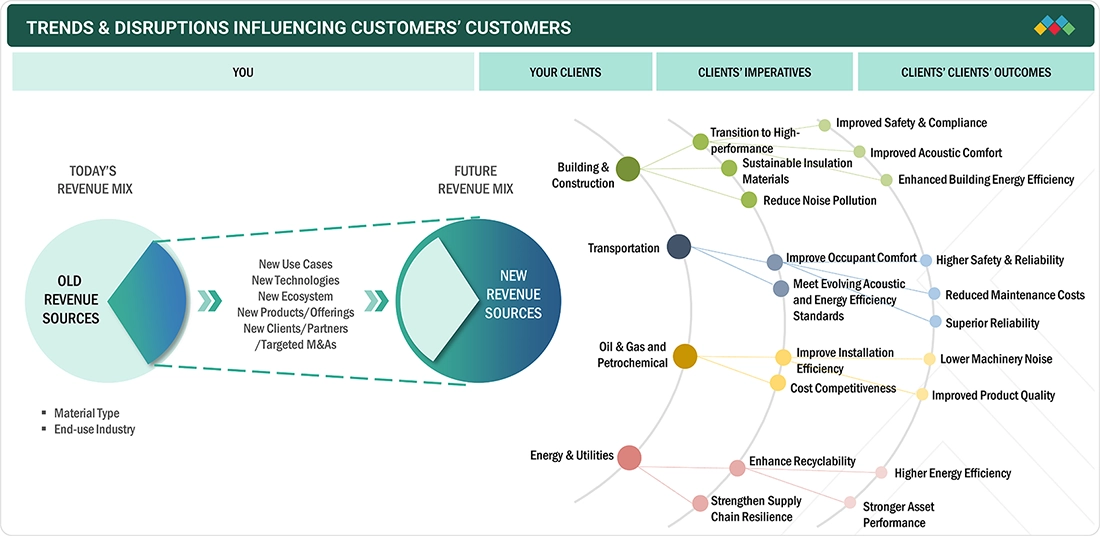
Source: Secondary Research, Interviews with Experts, MarketsandMarkets Analysis
MARKET DYNAMICS

Level
-
Growing urbanization and infrastructure development

-
Rising health issues associated with noise pollution


Level
-
Slowdown in North America construction industry

-
Fluctuating raw material prices due to volatility in crude oil prices


Level
-
Aerogel, potential high-performance substitute for glass wool

-
Increased infrastructural spending


Level
-
Proper disposal and recycling techniques required

-
Low awareness of acoustic insulation in developing countries

Source: Secondary Research, Interviews with Experts, MarketsandMarkets Analysis
Driver: Growing urbanization and infrastructure development
Rapid urbanization and infrastructure developments are some of the prominent factors that are fueling the market for acoustic insulation in North America. As cities grow and more people crowd into urban areas, there has been an immense need for quieter and more pleasant living and working conditions. The urban regions have seen an influx of residential as well as commercial complexes, transport centers, and industrial developments. All these have created a substantial need for efficient noise control measures. Moreover, large projects like airports, highways, and transport networks have emerged as prominent sources of noise, thus triggering intense interest in highly advanced acoustic insulation materials.
Restraint: Slowdown in North America construction industry
The slowdown in the North America construction industry is significantly impacting the demand for acoustic insulation. This decline is primarily due to lower spending on new projects, driven by higher interest rates, inflation, and ongoing supply chain issues. Consequently, demand for various construction materials, including acoustic insulation, decreases in the short term. Additionally, many large construction projects that could have driven demand for acoustic insulation are either being postponed or scaled back due to rising labor and material costs. While renovation activity remains robust, it is insufficient to offset the losses from the slowdown in new project work. Furthermore, uncertainty in the acoustic insulation market is exacerbated by a lack of funding for infrastructure construction projects.
Opportunity: Aerogel, potential high-performance substitute for glass wool
The emergence of aerogel as an advanced alternative to traditional glass wool presents a strong opportunity to penetrate the North America acoustic insulation market. Renowned for its exceptional thermal and acoustic insulation properties, aerogel offers superior sound absorption, a lightweight structure, and remarkable durability, making it ideal for modern construction, automotive, and aerospace applications. Its ultra-low density and high porosity enable greater noise reduction with thinner layers, aligning with the growing demand for energy efficiency and space optimization. As sustainability and performance criteria become increasingly stringent, aerogel's capability to deliver acoustic efficiency while also providing environmental benefits positions it as a next-generation solution. This innovative material has the potential to significantly transform the insulation landscape in the region.
Challenge: Proper disposal and recycling techniques required
The North America market is increasingly facing challenges related to the proper disposal and recycling of acoustic insulation materials. The recycling of traditional insulation products, such as glass wool and mineral wool, is not widespread due to their composite structures and binding agents, which make them difficult to recycle. As a result, these materials are often sent to landfills. Additionally, removing old or contaminated insulation during renovation projects can release fibers and pollutants, posing a threat to the environment and human health. Manufacturers are under pressure to comply with stringent waste management and sustainability regulations, prompting them to develop either recyclable or biodegradable products that still deliver excellent acoustic performance. Establishing a robust recycling network and creating collection points for insulation products throughout the region are crucial steps. This initiative will significantly reduce the environmental impact of insulation while simultaneously supporting the circular economy within the insulation industry.
NORTH AMERICA ACOUSTIC INSULATION MARKET: COMMERCIAL USE CASES ACROSS INDUSTRIES
| COMPANY | USE CASE DESCRIPTION | BENEFITS |
|---|---|---|
 |
Utilized in residential, commercial, and industrial buildings for wall, ceiling, and HVAC acoustic control applications. | Provides superior sound absorption with sustainable ECOSE technology, improving indoor air quality and reducing environmental impact. |
|
|
Applied in automotive, aerospace, and construction sectors for noise and vibration reduction in structural components. | Offers durable polyurethane foam systems that combine excellent acoustic performance with thermal insulation and lightweight strength. |
 |
Widely used in home and office insulation, recording studios, and infrastructure projects to manage airborne and impact noise. | Delivers high sound transmission loss and energy efficiency through advanced fiberglass technology, ensuring quieter, more comfortable spaces. |
Logos and trademarks shown above are the property of their respective owners. Their use here is for informational and illustrative purposes only.
MARKET ECOSYSTEM
Suppliers of raw materials, such as Argosy International and Basaltex, provide the essential inputs for production. In contrast, companies like Huntsman International LLC, Knauf Insulation, and Owens Corning drive innovation through R&D and high-quality manufacturing. JBC Technologies and Foam Supplies Inc. serve as distributors and ensure timely delivery of products across various regions. In sectors such as construction, automotive, and oil and gas, end consumers utilize these materials to meet their acoustic and thermal requirements. Overall, the value added at different stages ranges from 15% to 40%, highlighting the crucial role of innovation and supply chain management in the growth of the market.
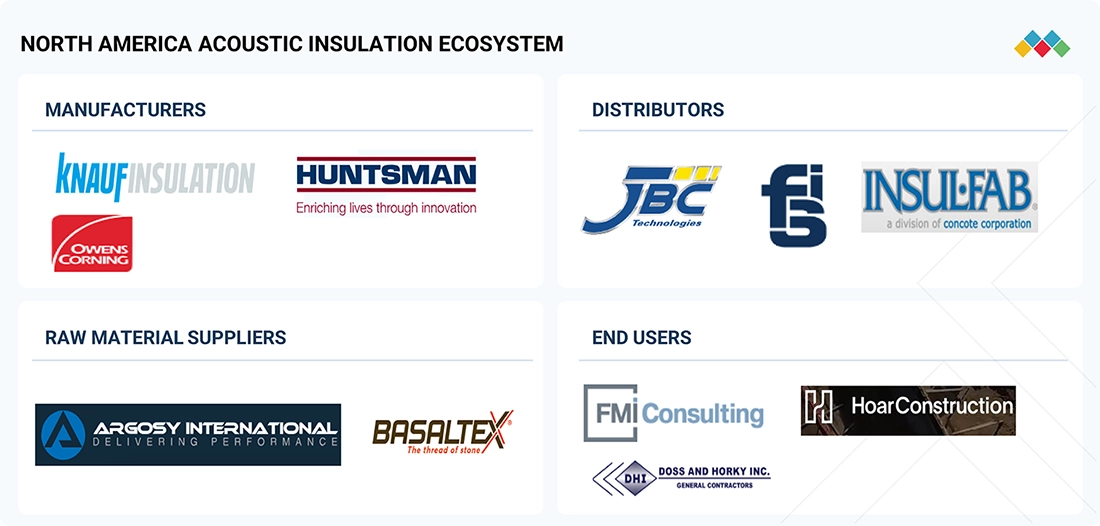
Logos and trademarks shown above are the property of their respective owners. Their use here is for informational and illustrative purposes only.
MARKET SEGMENTS
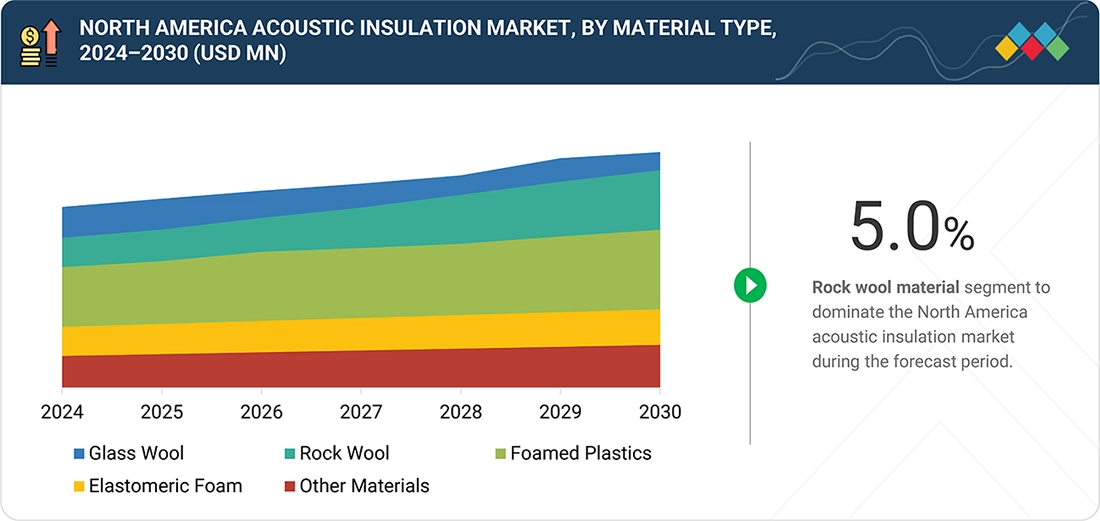
Source: Secondary Research, Interviews with Experts, MarketsandMarkets Analysis
North America Acoustic Insulation Market, by Material Type
In the North American acoustic insulation market, glass wool stands out as the leading choice due to its exceptional performance, cost-effectiveness, and versatility. It excels at sound absorption and thermal insulation, making it suitable for residential, commercial, and industrial construction projects. The material's desirable characteristics—such as its unobtrusiveness, ease of installation, and fireproofing—have further increased its popularity among builders and contractors. Additionally, the production of glass wool from recycled glass aligns well with the region's growing emphasis on sustainability and the pursuit of environmentally friendly certifications like LEED. Moreover, glass wool manufacturers have established extensive distribution networks and have built a strong familiarity with their products. This combination has reinforced glass wool's dominance as the preferred material for sound insulation across North America.
North America Acoustic Insulation Market, by End-use Industry
The acoustic insulation market in North America is primarily dominated by the building & construction sector. This sector is significantly influenced by urban development, the demand for energy-efficient buildings, and various noise control regulations. Urbanization and rapid construction activities in both residential and commercial sectors have driven a substantial demand for soundproofing materials, as these materials help meet comfort improvement requirements in accordance with strict building codes. In modern architecture, acoustic insulation is becoming the standard and is widely used in walls, ceilings, floors, and HVAC systems to manage noise transmission. Furthermore, sustainable insulation materials that offer both thermal and acoustic benefits are increasingly promoted through green building initiatives, such as the LEED certification program. Renovation activities are also gaining momentum, supported by government incentives for energy-efficient construction. As a result, the building and construction sector continues to be the primary driver of acoustic insulation demand in North America.
REGION
US to be fastest-growing region in North America plasticizers during forecast period
The US is the leading country in the North America acoustic insulation market, holding a significant share primarily due to its dynamic construction industry, strict enforcement of building codes, and rapid development of urban infrastructure. The extensive use of soundproofing materials in the building sector can be attributed to the adoption of modern noise control systems in residential, commercial, and industrial buildings, which are the most in-demand types of construction. The US market is further bolstered by a large number of manufacturers, ongoing renovation projects, and stringent energy-efficiency standards and building codes. Additionally, the growing emphasis on sustainability and occupant comfort has accelerated the use of acoustic insulation in both new constructions and renovations. This trend has helped the US maintain its position as the leading country in the regional market.
NORTH AMERICA ACOUSTIC INSULATION MARKET: COMPANY EVALUATION MATRIX
Knauf Insulation holds the top position in the North America acoustic insulation market, due to its steadfast commitment to innovation, sustainability, and product quality. The company is renowned for its glass mineral wool and fiberglass acoustic insulation products, which offer exceptional sound absorption and thermal insulation properties. With its groundbreaking ECOSE Technology, which utilizes a bio-based binder free of formaldehyde, Knauf has not only improved indoor air quality but also reduced its carbon footprint, aligning with the growing trend of eco-friendly building practices. Additionally, Knauf's strong distribution network, customer-focused approach, and active involvement in research and development enable it to deliver high-quality insulation systems for residential, commercial, and industrial applications.
Source: Secondary Research, Interviews with Experts, MarketsandMarkets Analysis
KEY MARKET PLAYERS
- Saint Gobain (France)
- Knauf Insulation (US)
- Armacell International (Germany)
- Soprema (France)
- Rockwool (Denmark)
- Huntsman (US)
- Owens Corning (US)
- Kingspan Group (Ireland)
- BASF SE (Germany)
- Johns Manville (US)
MARKET SCOPE
| REPORT METRIC | DETAILS |
|---|---|
| Market Size in 2025 (Value) | USD 4.90 Billion |
| Market Forecast in 2030 (Value) | USD 6.14 Billion |
| Growth Rate | CAGR of 4.7% from 2025-2030 |
| Years Considered | 2022–2030 |
| Base Year | 2024 |
| Forecast Period | 2025–2030 |
| Units Considered | Value (USD Million/Billion), Volume (Kiloton) |
| Report Coverage | Revenue Forecast, Company Ranking, Competitive Landscape, Growth Factors, and Trends |
| Segments Covered |
|
| Region Covered | North America |
WHAT IS IN IT FOR YOU: NORTH AMERICA ACOUSTIC INSULATION MARKET REPORT CONTENT GUIDE
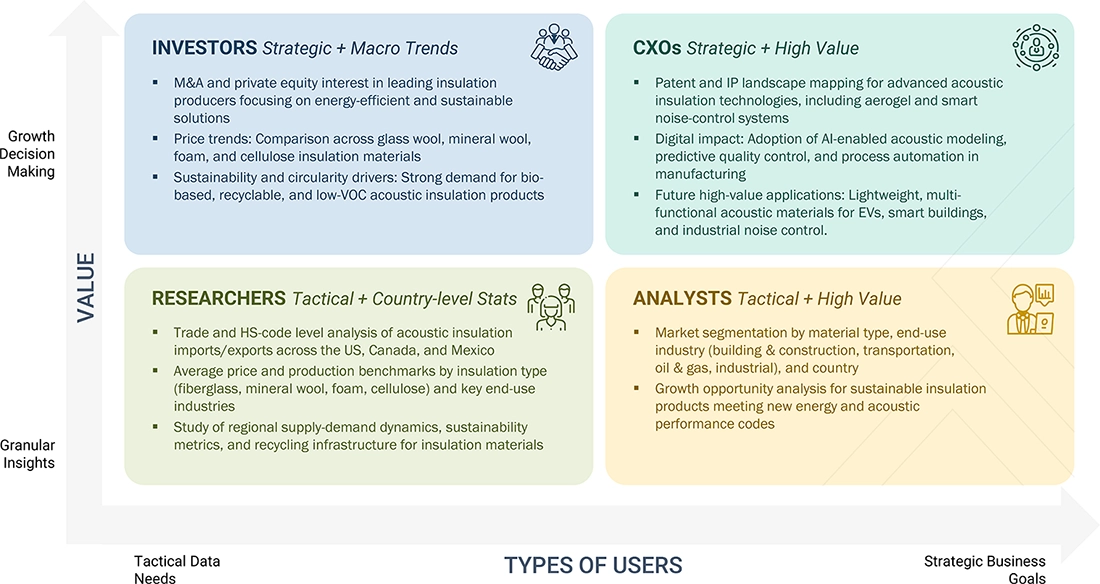
DELIVERED CUSTOMIZATIONS
We have successfully delivered the following deep-dive customizations:
| CLIENT REQUEST | CUSTOMIZATION DELIVERED | VALUE ADDS |
|---|---|---|
| US-based Acoustic Insulation Manufacturer |
|
|
| Construction Materials & Solutions Provider |
|
|
| Automotive & Transportation OEM |
|
|
| Raw Material Supplier (Fiberglass, Mineral Wool, Foam, Aerogel) |
|
|
| Building Contractor/Acoustic Design Consultant |
|
|
RECENT DEVELOPMENTS
- January 2021 : Armacell and smartMELAMINE, a joint venture of the German TITK Group and the Slovenian listed company Melamin d.d., announced their cooperation agreement. Armacell will specify and commercialize smartMELAMINE's non-wovens made from melamine resins. This material is an excellent thermal and acoustic insulator for the transportation industry, thus increasing the company’s presence in the automotive industry.
- August 2020 : Armacell launched ArmaGel DT. ArmaGel product delivers good thermal and acoustic solutions to customers around the globe with an excellent quality/cost ratio.
- January 2020 : Saint-Gobain acquired Sonex in Brazil, a company specialized in the manufacture and supply of acoustic ceiling systems, marketed in particular under the Sonex, Nexacustic, and Fiberwood brands. This acquisition strengthened the group’s position in Brazil.
Table of Contents
 Exclusive indicates content/data unique to MarketsandMarkets and not available with any competitors.
Methodology
The study involved four major activities in estimating the market size of the North America acoustic insulation market. Exhaustive secondary research was done to collect information on the market, the peer market, and the grandparent market. The next step was to validate these findings, assumptions, and sizing with industry experts across the value chain through primary research. Both top-down and bottom-up approaches were employed to estimate the complete market size. Thereafter, the market breakdown and data triangulation procedures were used to estimate the market size of the segments and subsegments.
Secondary Research
In the secondary research process, various secondary sources have been referred to for identifying and collecting information for this study. These secondary sources include annual reports, press releases, investor presentations of companies, white papers, certified publications, trade directories, articles from recognized authors, gold standard and silver standard websites, and databases. Secondary research has been used to obtain key information about the value chain of the industry, monetary chain of the market, the total pool of key players, market classification and segmentation according to industry trends to the bottom-most level, and regional markets. It was also used to obtain information about the key developments from a market-oriented perspective.
Primary Research
The North America acoustic insulation market comprises several stakeholders in the value chain, which include manufacturers, and end users. Various primary sources from the supply and demand sides of the North America acoustic insulation market have been interviewed to obtain qualitative and quantitative information. The primary interviewees from the demand side include key opinion leaders in construction sector. The primary sources from the supply side include manufacturers, associations, and institutions involved in the North America acoustic insulation industry. Primary interviews were conducted to gather insights such as market statistics, data of revenue collected from the products and services, market breakdowns, market size estimations, market forecasting, and data triangulation. Primary research also helped in understanding the various trends related to material, end-use industry, and region. Stakeholders from the demand side, such as CIOs, CTOs, and CSOs were interviewed to understand the buyer’s perspective on the suppliers, products, component providers, and their current usage of North America acoustic insulation and outlook of their business, which will affect the overall market.
Market Size Estimation
The top-down and bottom-up approaches have been used to estimate and validate the size of the North America acoustic insulation market.
- The key players in the industry have been identified through extensive secondary research.
- The supply chain of the industry has been determined through primary and secondary research.
- All percentage shares, splits, and breakdowns have been determined using secondary sources and verified through primary sources.
- All possible parameters that affect the markets covered in this research study have been accounted for, viewed in extensive detail, verified through primary research, and analyzed to obtain the final quantitative and qualitative data.
- The research includes the study of reports, reviews, and newsletters of the key market players, along with extensive interviews for opinions with leaders such as directors and marketing executives.
Data Triangulation
After arriving at the total market size from the estimation process, the overall market has been split into several segments and sub-segments. To complete the overall market engineering process and arrive at the exact statistics for all the segments and sub-segments, the data triangulation and market breakdown procedures have been employed, wherever applicable. The data has been triangulated by studying various factors and trends from both the demand and supply sides. Along with this, the market size has been validated by using both the top-down and bottom-up approaches and primary interviews. Hence, for every data segment, there have been three sources—top-down approach, bottom-up approach, and expert interviews. The data was assumed correct when the values arrived from the three sources matched.
Market Definition
Acoustic insulation is a lightweight bulky material that absorbs sound wave and enhance work environment. Acoustic insulation absorbs sound when it enters buildings through the walls and ceilings, reducing echo in homes, workplaces, and other spaces. It's also utilized in automobiles and aircraft to lessen engine noise that enters the passenger cabin. It lessens reverberation across the room, which aids in sound absorption in auditoriums and concert halls.
Key Stakeholders
- Senior Management
- End User
- Finance/Procurement Department
- R&D Department
- Manufacturers
- Raw Material Suppliers
Report Objectives
- To define, describe, and forecast the size of the North America acoustic insulation market, in terms of value and volume.
- To provide detailed information regarding the major factors (drivers, opportunities, restraints, and challenges) influencing the growth of the market
- To estimate and forecast the market size based on type, end-use industry, and region.
- To strategically analyze micromarkets with respect to individual growth trends, prospects, and their contribution to the overall market
- To analyze opportunities in the market for stakeholders and provide a competitive landscape of market leaders.
- To track and analyze recent developments such as expansions, new product launches, partnerships & agreements, and acquisitions in the market.
- To strategically profile key market players and comprehensively analyze their core competencies.
Available Customizations
Along with the given market data, MarketsandMarkets offers customizations according to the company’s specific needs. The following customization options are available for the report:
Regional Analysis
- Further breakdown of a region with respect to a particular country or additional application
Company Information
- Detailed analysis and profiles of additional market players
Tariff & Regulations
- Regulations and Impact on North America acoustic insulation market


Personalize This Research
- Triangulate with your Own Data
- Get Data as per your Format and Definition
- Gain a Deeper Dive on a Specific Application, Geography, Customer or Competitor
- Any level of Personalization
Let Us Help You
- What are the Known and Unknown Adjacencies Impacting the North America Acoustic Insulation Market
- What will your New Revenue Sources be?
- Who will be your Top Customer; what will make them switch?
- Defend your Market Share or Win Competitors
- Get a Scorecard for Target Partners

Custom Market Research Services
We Will Customise The Research For You, In Case The Report Listed Above Does Not Meet With Your Requirements
Get 10% Free CustomisationTESTIMONIALS

We at Nissan Chemicals Corporation have been clients of MarketsandMarkets for more than a year now. We recently consulted MarketsandMarkets for a study, the team at MarketsandMarkets was extremely professional and organized. The business insights were very detailed and aligned well with our expectations that really helped us formulate the Business Plans and device new strategies for development themes. MarketsandMarkets offers a unique combination of expertise and dedicated engagement model. Their research findings have helped us in designing our Pricing Strategy which will make it easier for us to predict the future sales and profits for the next ten years. We look forward to working with MarketsandMarkets in the future.
VP of Strategy & New Business Development
Leading Specialty Chemical Company
The MarketsandMarkets Engagement Model, composed of both the Knowledge Store and advisory custom research, has greatly helped us in understanding our markets and making strategic decisions. The Knowledge Store is a fast way to allow everyone in our organization to understand more about most any market they are interested in. The ability to then get custom research done and get answers to specific strategic questions and market insight has been spectacular. The Markets and Markets team feel more like colleagues than vendors and their services have helped us change our culture where statements of things like growth opportunities and competitive position are always backed by industry research.

Rich Gibson,
Director, Corporate Strategy
Milliken & Company,
Leading Industrial Manufacturer of specialty chemical, floor covering, performance and protective textile materials, and healthcaremilliken.com
MarketsandMarkets is a trusted resource that helps us to better understand markets that are near-adjacencies-whether its technology, value chain or geography. Their Knowledge Store platform provides a dashboard of markets and their characteristics which is easy to use and saves us time.
Adam Shaw,
Market Development and Strategy Manager
AdvanSix Inc. USA,
An American Leader in Chemicalswww.advansix.com
The Knowledge Store from MarketsandMarkets is a valuable tool which has helped my team acquire greater insight in to the end markets that our business serves. This has enabled us to help our company build stronger strategies throughout our planning process.
TOSHIO KINOSHITA
Senior Chif Consultion Research & Consulting Division
Mitsubishi Chemical Research Corporation,
Leading Manufacturer of Chemical Productswww.mitsubishichem-res.co.jp/en/

We recently engaged with MarketsandMarkets for a study, the team not only clearly understood our business objectives but was also extremely professional in the way they handled the entire project. The study was efficiently conducted in a phase-wise manner, and the engagement model furnished us with high-quality business insights that far exceeded our expectations at each phase. We were especially happy that MarketsandMarkets could provide us with both, an English as well as a Japanese version of the study. A special thanks to the Analyst Team and Client Services Team, whose fluency in Japanese enhanced our comfort level, as we could converse with them in our preferred language.
Independent entrepreneurs
Arrow Precision
We approached MarketsandMarkets for study on Proppants Market, and their work exceeded our expectations. The study conducted was comprehensive and enabled us to view the market through the various dimensions. In addition, the team was extraordinarily responsive throughout the process and resolved our queries on time. I strongly recommend MarketsandMarkets and will certainly consider them for additional market assessments we will need in the future.
Global engineering company, Japan
Deputy Manager,
Strategic Planning OfficeThe high-quality insights shared by the MarketsandMarkets team helped us understand the pharmaceutical plant designers in a specific geography. It also captured the risks that we may likely face in communicating with our potential partners. The study would enable us identify partners, which would impact our future growth.






Growth opportunities and latent adjacency in North America Acoustic Insulation Market