North America Automated Storage and Retrieval System Market

North America Automated Storage and Retrieval System Market by Type (Unit Load ASRS, Mini Load ASRS, Mid Load ASRS, Vertical Lift Module (VLM), Vertical Carousel, Horizontal Carousel) & Payload (<500 kg, 500-1,500 kg, 1,500 kg) - Forecast to 2030




OVERVIEW
Source: Secondary Research, Interviews with Experts, MarketsandMarkets Analysis
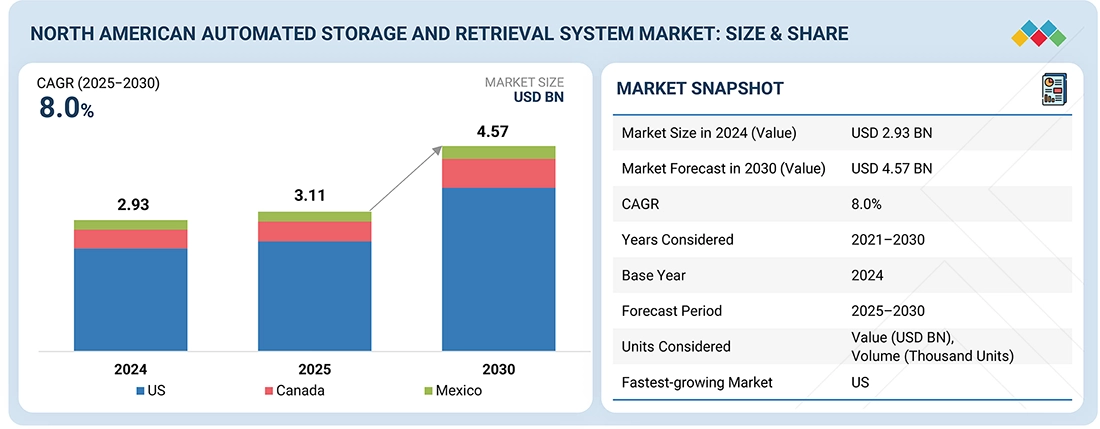
The North America automated storage and retrieval system (ASRS) market is expected to grow from USD 3.11 billion in 2025 to USD 4.57 billion by 2030, at a CAGR of 8.0%. The North America ASRS market is gaining strong momentum as companies accelerate warehouse automation to boost throughput, counter labor shortages, and manage the soaring demands of e-commerce and fulfillment. Growth is further propelled by rising investments in high-density storage, cold chain modernization, and robotics-enabled distribution centers across the US and Canada.
Market Size & Forecast
KEY TAKEAWAYS
-
BY COUNTRYThe US is expected to dominate the North America ASRS industry, accounting for a 78.6% share in terms of value by 2025.
-
BY TYPEBy type, the unit load segment is expected to dominate the North America ASRS market in 2025.
-
BY PAYLOAD CAPACITYBy payload capacity, the >1,500 kg segment is expected to witness high growth during the forecast period.
-
BY INDUSTRYBy industry, the logistics segment is expected to register the highest CAGR of 11.0% during the forecast period.
-
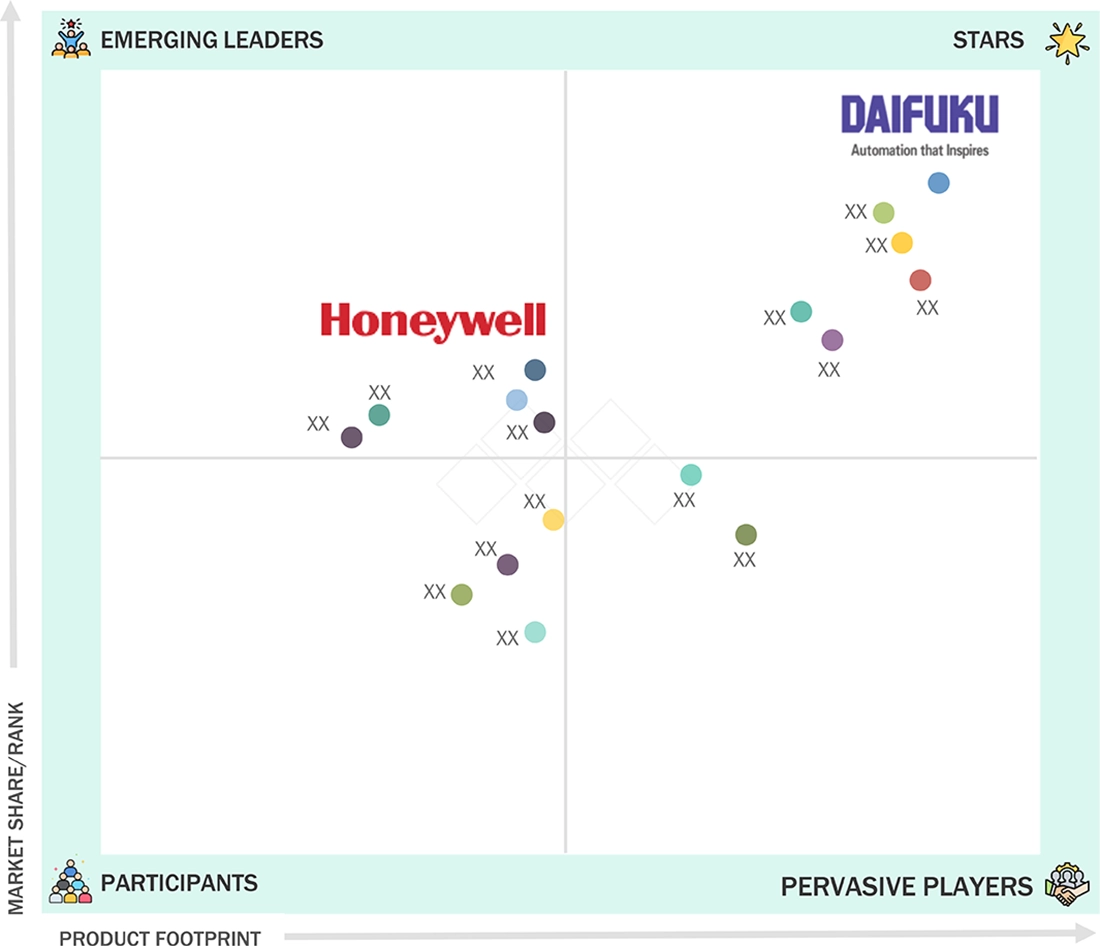
COMPETITIVE LANDSCAPE (KEY PLAYERS)Daifuku Co., Ltd., SSI SCHAEFER, and TGW Logistics Group GmbH were identified as star players in the North America ASRS companies , due to their strong market share and extensive product portfolios.
-
COMPETITIVE LANDSCAPE (STARTUPS/SMES)Honeywell International Inc., Stanley Black & Decker, Inc., and Jungheinrich AG have distinguished themselves among startups and SMEs by securing strong footholds in specialized niche areas, underscoring their potential as emerging market leaders.
The North America ASRS market is experiencing robust growth as enterprises prioritize warehouse automation to enhance productivity, reduce operating costs, and manage surging SKU volumes across their fulfillment networks. The expanding demand for real-time inventory visibility, space optimization, and temperature-controlled storage is accelerating adoption across various sectors, including food & beverage, pharmaceuticals, e-commerce, and logistics.
TRENDS & DISRUPTIONS IMPACTING CUSTOMERS' CUSTOMERS
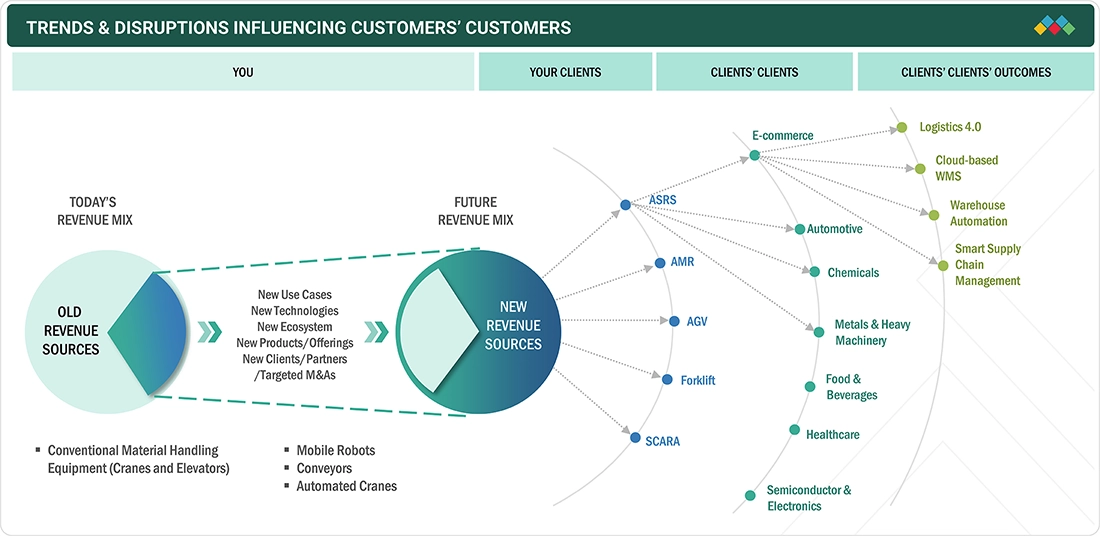
The North America ASRS market is experiencing accelerated growth as warehouses, logistics operators, and manufacturers adopt higher levels of automation to address labor shortages, rising SKU complexity, and increasing fulfillment demands. End users across e-commerce, automotive, food & beverage, pharmaceuticals, and 3PL sectors are deploying ASRS to optimize space utilization, ensure accuracy, and maintain high-velocity order processing. Rapid warehouse digitalization, enabled by advanced WMS platforms, robotics integration, AI-driven inventory control, and real-time visibility, continues to reshape operating models and reduce dependency on manual labor. These disruptions are transforming supply chain strategies across the region, driving strong investment in high-density, intelligent storage solutions and reinforcing sustained growth for ASRS providers in the US, Canada, and Mexico.
Source: Secondary Research, Interviews with Experts, MarketsandMarkets Analysis
MARKET DYNAMICS

Level
-
Rising emphasis on efficient space utilization in warehouses

-
Increasing deployment of automation technology in booming e-commerce sector


Level
-
High installation and maintenance costs

-
Risks of data security and cyber threats


Level
-
Rising implementation of strict guidelines for medical intralogistics

-
Increasing availability of modular and cost-effective ASRS solutions for SMEs


Level
-
Complexities and technical issues associated with ASRS setup

-
Challenges in adapting to ever-evolving technologies and customer demands

Source: Secondary Research, Interviews with Experts, MarketsandMarkets Analysis
Driver: Rising emphasis on efficient space utilization in warehouses
North America warehouses are facing unprecedented pressure to maximize storage density as real estate costs soar and urban distribution centers shrink in available footprint. ASRS solutions enable vertical space optimization and high-density storage layouts, allowing operators to store more inventory without facility expansion. This push toward space efficiency is driving widespread adoption of unit-load, mini-load, and cube-based ASRS across e-commerce, 3PL, and cold storage facilities.
Restraint: High installation and maintenance costs
Despite strong interest in automation, many North America companies remain cautious due to the high upfront capital costs associated with ASRS hardware, software, and integration. Long-term maintenance requirements, skilled labor needs, and periodic system upgrades further increase lifecycle expenses, creating barriers for small and mid-sized warehouses. These financial constraints slow adoption, particularly in industries with tight margins or unstable demand patterns.
Opportunity: Rising implementation of strict guidelines for medical intralogistics
The North America healthcare sector is increasingly adopting ASRS to comply with stringent regulations governing traceability, storage integrity, and contamination-free handling of pharmaceuticals and medical devices. ASRS solutions offer controlled environments, accuracy, and automated audit trails that align with FDA, GMP, and healthcare distribution standards. As hospitals, drug distributors, and medical device manufacturers modernize intralogistics, ASRS adoption is poised for strong growth.
Challenge: Complexities and technical issues associated with ASRS setup
ASRS deployments in North America often involve intricate integration with existing WMS platforms, conveyors, robotics, and facility layouts, making implementation technically demanding. System downtime, calibration issues, and coordination across multiple vendors can delay go-live schedules and increase commissioning risks. These complexities require specialized engineering expertise, making many operators hesitant to pursue full-scale automation without strong technical support.
North America Automated Storage and Retrieval System Market: COMMERCIAL USE CASES ACROSS INDUSTRIES
| COMPANY | USE CASE DESCRIPTION | BENEFITS |
|---|---|---|
 |
Automated Library System (ALS) with four-aisle miniload and one-aisle unit-load ASRS storing 7M+ volumes in a 50 ft vault at the University of Chicago Library, integrated with robotic cranes and 12 pick stations for rapid access. | 50%+ higher storage capacity, <5-minute retrieval, consistent preservation environment, and space and cost savings compared to traditional shelving. |
 |
ASRS reconfiguration with new R-H10 crane and rack to double storage and retrieval capacity for large truck cabins at Peterbilt Motors’ 600,000 sq. ft. US facility, completed without production disruption. | Doubled ASRS capacity, minimized downtime and capex, enhanced scalability for demand spikes, and seamless integration with existing automation. |
 |
AutoStore ASRS with 15,000 ambient bins and 4,000 chilled bins, plus automated picking and conveyor zones, enabling e-grocery fulfillment for 22,000+ SKUs at The GIANT Company’s US e-commerce facility. | Higher productivity, faster delivery times, lower fulfillment costs, and improved service levels for e-grocery expansion. |
 |
Cube-based ASRS with 22 R5 robots, 51,000 bins, and 4 ports integrated with Kommand AS + Deposco WMS at Rogers Sporting Goods' 203,000 sq. ft. Missouri distribution center. | 24-hour order cycle, 50% faster retail replenishment, improved labor productivity and accuracy, and expanded storage in limited footprint. |
Logos and trademarks shown above are the property of their respective owners. Their use here is for informational and illustrative purposes only.
MARKET ECOSYSTEM
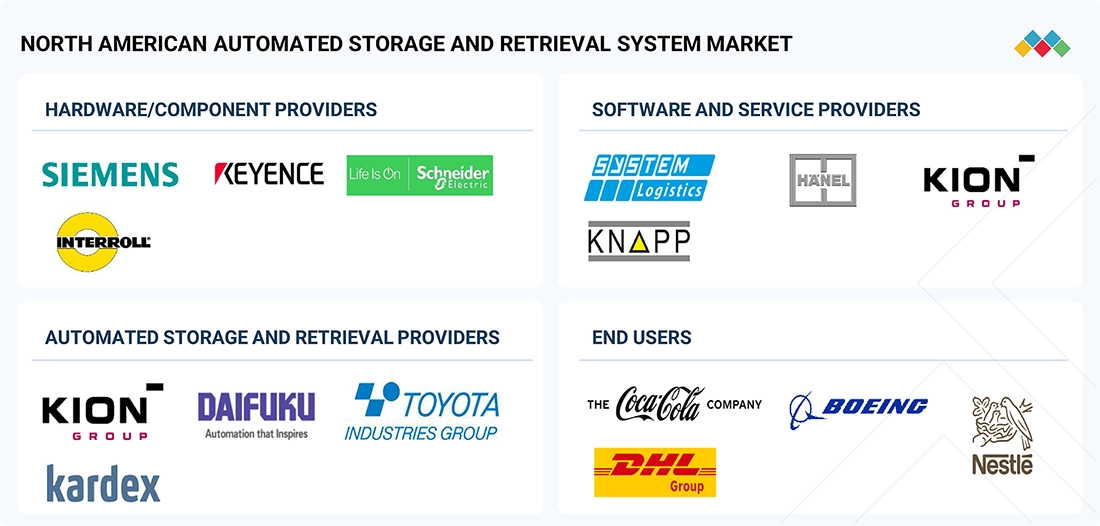
The North America ASRS ecosystem is built on a layered structure that includes hardware and component suppliers providing sensors, controls, and automation modules essential for system operation. Software and service providers enable integration, warehouse optimization, and lifecycle support, ensuring that ASRS solutions function seamlessly within broader digital supply chain environments. System manufacturers and automation integrators deliver high-density storage technologies, robotic retrieval systems, and turnkey automation solutions tailored to distribution, manufacturing, and cold chain requirements. End users across industries such as e-commerce, logistics, food & beverage, and aerospace continue to drive demand as they prioritize speed, accuracy, and space efficiency in warehouse and production operations.
Logos and trademarks shown above are the property of their respective owners. Their use here is for informational and illustrative purposes only.
MARKET SEGMENTS

Source: Secondary Research, Interviews with Experts, MarketsandMarkets Analysis
North America Automated Storage and Retrieval System Market, by Type
The unit load segment holds the largest share of the North America ASRS market due to its widespread use in pallet handling, large-scale warehousing, and high-throughput manufacturing environments. Its ability to manage heavy loads, support deep-lane storage, and operate reliably in 24/7 facilities makes it the preferred choice for mature automation adopters. Growing investment in cold storage, automotive production, and large distribution centers further reinforces its dominant market position.
North America Automated Storage and Retrieval System Market, by Payload Capacity
The >1,500 kg segment is expected to witness high growth as industries with heavy-load requirements, such as metals, heavy machinery, automotive, and aerospace industries, upgrade to more advanced ASRS solutions. The increasing demand for resilient, automated pallet handling systems that can manage oversized or bulky goods is accelerating their adoption. Additionally, the expansion of nearshoring-driven manufacturing in North America boosts the need for high-capacity storage automation, driving strong segment growth.
North America Automated Storage and Retrieval System Market, by Industry
The food & beverages industry is expected to dominate the North America ASRS market in 2025, driven by stringent regulatory requirements, strong demand for temperature-controlled storage, and high product turnover. ASRS enables improved hygiene, traceability, and inventory accuracy, which are the critical capabilities for modern cold chain and packaged food operations. Rapid expansion of grocery e-commerce, fresh food distribution, and automated replenishment networks further solidifies this segment’s leading position.
REGION
The US is projected to lead the North America automated storage and retrieval system market during the forecast period
The US is set to dominate the North America ASRS market due to its early adoption of warehouse automation and the presence of a highly developed logistics and manufacturing ecosystem. Significant capital investment in smart warehouses, robotics-enabled fulfillment, and high-throughput storage systems continues to accelerate market growth nationwide. Moreover, the country’s strong e-commerce expansion and demand for faster, more efficient supply chain operations position the US as the primary driver of ASRS adoption in the region.

North America Automated Storage and Retrieval System Market: COMPANY EVALUATION MATRIX
In the North America ASRS market matrix, Daifuku holds a leading position driven by its extensive automation portfolio, deep integration capabilities, and strong presence across large manufacturing and distribution environments. The company’s proven reliability and continuous investment in advanced ASRS technologies reinforce its status as the dominant player in the region. Honeywell, positioned as an emerging leader, is rapidly expanding its footprint through innovative, software-driven warehouse automation solutions and growing influence in e-commerce and 3PL fulfillment operations.
Source: Secondary Research, Interviews with Experts, MarketsandMarkets Analysis
KEY MARKET PLAYERS
- Daifuku Co., Ltd. (Japan)
- Murata Machinery, Ltd. (Japan)
- SSI SCHAEFER (Germany)
- TGW Logistics Group (Austria)
- Kardex (Switzerland)
- BEUMER Group (Germany)
- Honeywell International Inc (US)
- KION GROUP AG (Germany)
- KNAPP AG (Austria)
- KUKA AG (Germany)
MARKET SCOPE
| REPORT METRIC | DETAILS |
|---|---|
| Market Size in 2024 (Value) | USD 2.93 Billion |
| Market Forecast in 2030 (Value) | USD 4.57 Billion |
| Growth Rate | CAGR of 8.0% from 2025–2030 |
| Years Considered | 2021–2030 |
| Base Year | 2024 |
| Forecast Period | 2025–2030 |
| Units Considered | Value (USD Million/Billion), Volume (Thousand Units) |
| Report Coverage | Revenue Forecast, Company Ranking, Competitive Landscape, Growth Factors, and Trends |
| Segments Covered |
|
| Regional Scope | North America (US, Canada, & Mexico) |
WHAT IS IN IT FOR YOU: North America Automated Storage and Retrieval System Market REPORT CONTENT GUIDE

DELIVERED CUSTOMIZATIONS
We have successfully delivered the following deep-dive customizations:
| CLIENT REQUEST | CUSTOMIZATION DELIVERED | VALUE ADDS |
|---|---|---|
| ASRS Technology Landscape Mapping for North America |
|
|
| Benchmarking of North American ASRS Providers |
|
|
| Industry Opportunity Assessment for ASRS Adoption |
|
|
| ASRS Workload Optimization & Integration Analysis |
|
|
| North American Warehouse Modernization & Automation Roadmap Study |
|
|
RECENT DEVELOPMENTS
- January 2025 : KION Group announced a collaboration with NVIDIA and Accenture to use AI robots, digital twins, and Omniverse simulation technology to enhance warehouse design and optimize ASRS-enabled fulfillment environments. The partnership focuses on accelerating deployment of intelligent warehouses using automated forklifts, smart cameras, and advanced robotics solutions.
- April 2024 : TGW Logistics and OPEX Corporation entered a strategic partnership combining TGW’s 50+ years of intralogistics expertise with OPEX’s Infinity ASRS technology. The collaboration supports joint development of next-generation ASRS systems and expands access to new customer groups across the US and Europe through TGW’s LivePick platform.
- March 2024 : KNAPP introduced a new freezer-compatible OSR shuttle system for North America after extensive beta testing involving 2 million+ cycles. The solution enhances cold-chain ASRS performance through higher-density storage, safer automated pallet handling, and improved building energy efficiency—addressing labor shortages in harsh environments.
- January 2024 : Honeywell and Hai Robotics partnered to integrate Hai’s ACR-based tote and case-handling robots with Honeywell’s Momentum WES platform, enabling flexible ASRS solutions for North America distribution centers. The collaboration aims to improve space utilization, boost picking productivity, and support automation in both brownfield warehouses and retail micro-fulfillment sites.
Table of Contents
 Exclusive indicates content/data unique to MarketsandMarkets and not available with any competitors.
Methodology
The study involved four major activities in estimating the current size of the North America automated storage & retrieval system market. Exhaustive secondary research has been done to collect information on the market, peer market, and parent market. To validate these findings, assumptions, and sizing with industry experts across the value chain through primary research has been the next step. Both top-down and bottom-up approaches have been employed to estimate the complete market size. After that, market breakdown and data triangulation methods have been used to estimate the market size of segments and subsegments. Two sources of information—secondary and primary—have been used to identify and collect information for an extensive technical and commercial study of the North America automated storage & retrieval system market.
Secondary Research
Various secondary sources have been referred to in the secondary research process to identify and collect information important for this study. The secondary sources include annual reports, press releases, and investor presentations of companies; white papers; journals and certified publications; and articles from recognized authors, websites, directories, and databases. Secondary research has been conducted to obtain key information about the industry’s supply chain, the market’s value chain, the total pool of key players, market segmentation according to the industry trends (to the bottom-most level), regional markets, and key developments from market- and technology-oriented perspectives. The secondary data has been collected and analyzed to determine the overall market size, further validated by primary research..
Primary Research
Extensive primary research was conducted after gaining knowledge about the current scenario of the automated storage & retrieval system market through secondary research. Several primary interviews were conducted with experts from the demand and supply sides across North America. This primary data was collected through questionnaires, emails, and telephonic interviews.
Market Size Estimation
Both top-down and bottom-up approaches have been used to estimate and validate the total size of the North America automated storage & retrieval system market. These methods have also been used extensively to estimate the size of various subsegments in the market. The following research methodology has been used to estimate the market size:
- Major players in the industry and markets have been identified through extensive secondary research.
- The industry’s value chain and market size (in terms of value) have been determined through primary and secondary research processes.
- All percentage shares, splits, and breakdowns have been determined using secondary sources and verified through primary sources.
Data Triangulation
After arriving at the overall size of the automated storage & retrieval system market from the market size estimation process explained above, the total market has been split into several segments and subsegments. Data triangulation and market breakdown procedures have been employed, wherever applicable, to complete the overall market engineering process and arrive at the exact statistics for all segments and subsegments of the market. The data has been triangulated by studying various factors and trends from both the demand and supply sides. Along with this, the market size has been validated using both top-down and bottom-up approaches.
Market Definition
The Automated Storage & Retrieval System market develops, produces, and implements sophisticated systems to automate the storage and retrieval of goods in industrial, commercial, and logistics environments. Unit-load, mini-load, vertical lift modules (VLM), carousels, and Mid load ASRS solutions include automated storage & retrieval systems with the latest technologies of robotics, machine learning, and advanced sensors for optimized storage density, increased retrieval speed, and minimum human intervention. With the growing trend of Industry 4.0, an increasing focus on efficient inventory management, and a rapidly growing trend toward automation to minimize operational costs, ASRS has become an essential component of modern warehousing, manufacturing, and supply chain operations that support higher productivity and accuracy in material handling processes.
Key Stakeholders
- Associations, forums, and alliances related to automated storage and retrieval systems
- Assembly and packaging vendors
- Electronic hardware equipment manufacturers
- Companies from verticals such as automotive, chemicals, aviation, semiconductor & electronics, e-commerce, retail, food & beverages, healthcare, and metals & heavy machinery
- Integrated device manufacturers (IDMs)
- Original device manufacturers (ODMs)
- Original equipment manufacturers (OEMs)
- Original technology designers and suppliers
- Raw material suppliers
- Research institutes and organizations
- Standard organizations and regulatory authorities related to the material-handling industry
- System integrators
Report Objectives
- To define, describe, and forecast the automated storage & retrieval system market, in terms of value, by type, payload capacity, industry, and region.
- To provide detailed information regarding the major factors influencing the growth of the market, namely, drivers, restraints, opportunities, and challenges.
- To strategically analyze micromarkets with respect to individual growth trends, prospects, and contributions to the total market.
- To analyze the probable impact of the recession on the market in the future.
- To study the complete value chain of the automated storage & retrieval system ecosystem, along with market trends and use cases.
- To analyze opportunities in the market for stakeholders by identifying high-growth segments of the market.
- To strategically profile key players and comprehensively analyze their core competencies along with detailing the competitive landscape for market leaders.
- To analyze competitive developments such as product launches, acquisitions, partnerships, and expansions in the North America automated storage & retrieval system market.
- To benchmark market players using the company evaluation quadrant, which analyzes players based on various parameters within broad business categories and product strategies.
Available Customizations
With the given market data, MarketsandMarkets offers customizations according to the company’s specific needs. The following customization options are available for the report:
Company Information
- Detailed analysis and profiling of additional market players (up to 5)
Key Questions Addressed by the Report
What is the projected market value of the North America Automated Storage and Retrieval System market by 2030?
The North America Automated Storage and Retrieval System market is projected to reach USD 4.57 billion by 2030, growing from USD 2.93 billion in 2024 at a CAGR of 8.0% during the forecast period.
Which regions are covered in the North America ASRS market analysis?
The North America ASRS market analysis covers key countries including the United States, Canada, and Mexico, reflecting strong adoption of warehouse automation across these regions.
What are the key segments of the North America ASRS market?
The market is segmented by type such as unit load, mini load, mid load, vertical lift module, and carousel systems, along with payload capacities including less than 500 kg, 500–1,500 kg, and more than 1,500 kg.
Which segment holds the largest share in the North America ASRS market?
The unit load ASRS segment holds the largest market share due to its extensive use in pallet handling, large-scale warehousing, and high-throughput industrial applications.
Who are the key players operating in the North America Automated Storage and Retrieval System market?
Key players in the market include Daifuku Co., Ltd., SSI SCHAEFER, TGW Logistics Group, Kardex, BEUMER Group, Honeywell International Inc., KION Group AG, KNAPP AG, and KUKA AG, highlighting a competitive and innovation-driven landscape.


Personalize This Research
- Triangulate with your Own Data
- Get Data as per your Format and Definition
- Gain a Deeper Dive on a Specific Application, Geography, Customer or Competitor
- Any level of Personalization
Let Us Help You
- What are the Known and Unknown Adjacencies Impacting the North America Automated Storage and Retrieval System Market
- What will your New Revenue Sources be?
- Who will be your Top Customer; what will make them switch?
- Defend your Market Share or Win Competitors
- Get a Scorecard for Target Partners

Custom Market Research Services
We Will Customise The Research For You, In Case The Report Listed Above Does Not Meet With Your Requirements
Get 10% Free CustomisationTESTIMONIALS

Tetsuya Ohhira
Business Development Manager-Technology Business
Nikon Corporation,
Leading Japanese MNC specializing in optics and imaging productswww.nikon.com
MarketsandMarkets™ response
is quick. Their attitude is flexible and positive. Analyst Insights are globally considered and
significant. Client Services quickly respond to our inquiry and demand. Their wide range of global
surveys help us make our strategic plan.
We hope Knowledge Store will be easier to search
for a report.
VP - Marketing & Business Development
Leading Provider of Process Control Solutions
We engaged with MarketsandMarkets on a study to perform an analysis and recommend a Go-To-Market strategy for metrology and process control in the semiconductor market. The study was tailored to our targets and needs with well-defined milestones. Our overall experience with the MarketsandMarkets team was very good throughout the project in all aspects including the analysis methodologies used, the quality and depth of primary and secondary data sets, the professionalism and flexibility of the team and the ability to meet the target schedule and milestones. We want to thank MarketsandMarkets team for a job well done.
Growth opportunities and latent adjacency in North America Automated Storage and Retrieval System Market






Colin
Apr, 2026
The unit load ASRS segment is leading how important is it for handling high-volume, heavy-load operations in modern warehouses.
Clark
Apr, 2026
The logistics segment is growing the fastest will ASRS soon become a standard requirement for 3PL and e-commerce fulfillment centers.