North America Building Information Modeling Market

North America Building Information Modeling Market by Design & Modeling Software, Construction Simulation & Scheduling Software, AEC Professionals, On-premises, Facility & Asset Management Software, and Training & Certification - Forecast to 2030




OVERVIEW
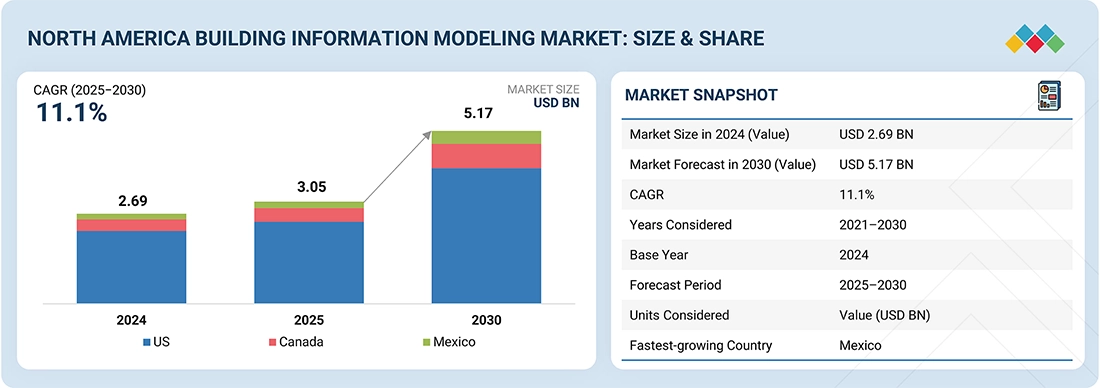
Source: Secondary Research, Interviews with Experts, MarketsandMarkets Analysis
The building information modeling (BIM) market in North America is expected to grow from USD 3.05 billion in 2025 to USD 5.17 billion by 2030, at a CAGR of 11.1% from 2025 to 2030. Rising investment in federal and state infrastructure programs, increasing adoption of digital twin and BIM-enabled lifecycle management, growing focus on sustainable and energy-efficient building practices, and the expanding need for real-time collaboration, productivity enhancement, and advanced project visualization across AEC stakeholders are some of the major drivers propelling the BIM market in North America during the forecast period.
Market Size & Forecast
KEY TAKEAWAYS
-
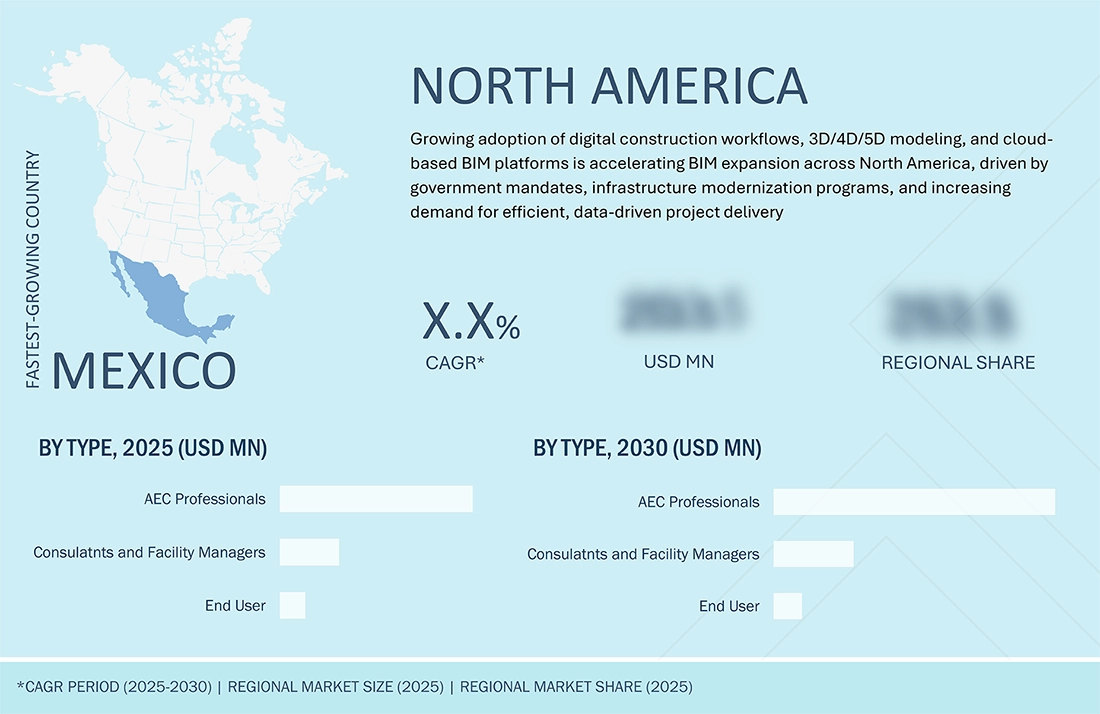
BY COUNTRYMexico is projected to register the highest growth of 15.1% during the forecast period.
-
BY OFFERING TYPEBy offering type, the software segment dominated the market, accounting for ~66% share of the market in 2024.
-
BY DEPLOYMENT TYPEBy deployment type, the on-premises segment accounted for a share of ~69% of the market in 2024.
-
BY END USERBy end user, the AEC professionals segment is projected to grow at the fastest rate of 12% from 2025 to 2030.
-
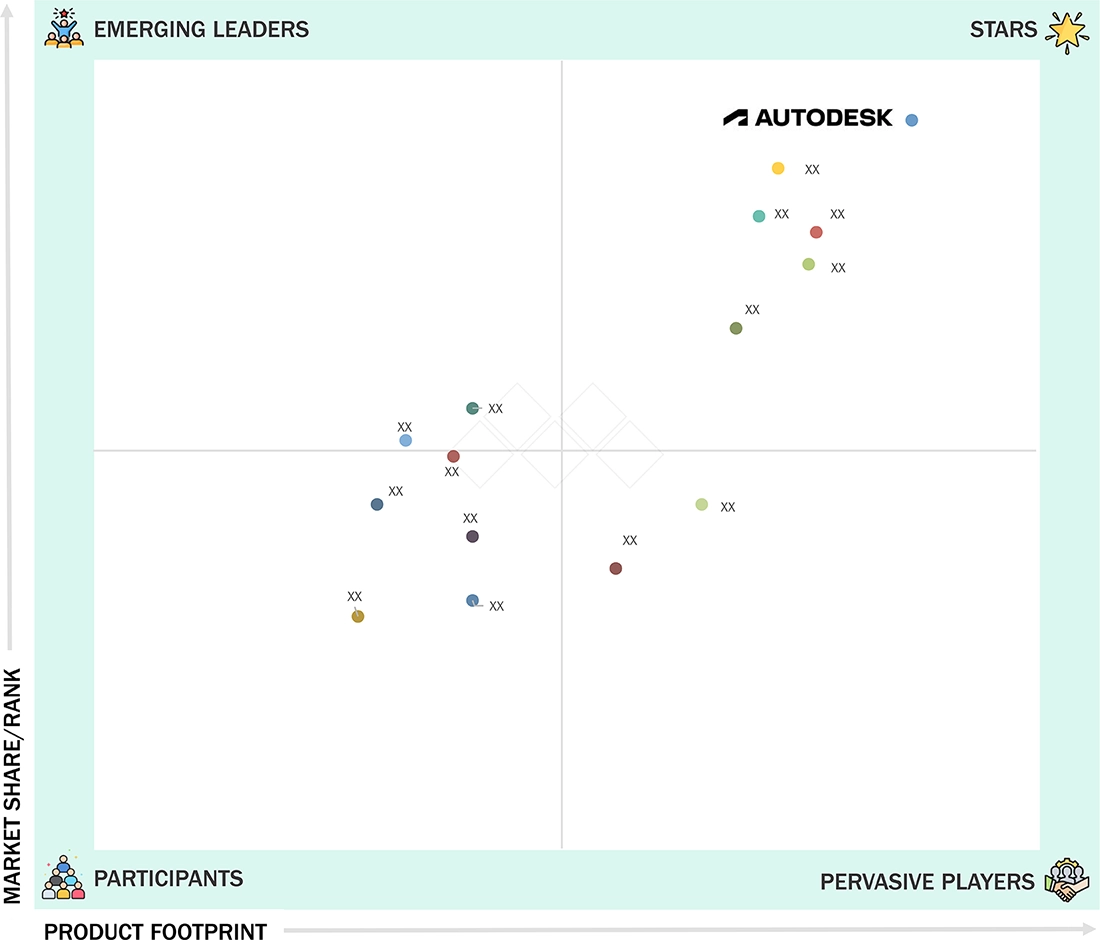
COMPETITIVE LANDSCAPEAutodesk Inc., Dassault Systèmes, and Bentley Systems, Incorporated were identified as star players in the BIMA market in North America, given their strong market share and product footprint.
-
COMPETITIVE LANDSCAPETejjy Incorporation, Sanveo Inc., and VIATechnik have distinguished themselves among startups and SMEs by securing strong footholds in specialized niche areas, underscoring their potential as emerging market leaders.
The BIM market in North America is witnessing strong growth, driven by rising digital transformation across the architecture, engineering, and construction sectors to enhance design accuracy, coordination, and project delivery. Key trends include the rapid shift toward cloud-based BIM platforms, enabling real-time collaboration; the increasing integration of BIM with digital twins, IoT, and AI-driven analytics; and a growing emphasis on sustainable and energy-efficient building practices across the region. Additionally, federal and state-level mandates, infrastructure modernization programs, and large-scale public transit and utility projects are accelerating BIM adoption, while the increasing demand for lifecycle management, facility operations optimization, and data-driven asset management is further expanding market opportunities.
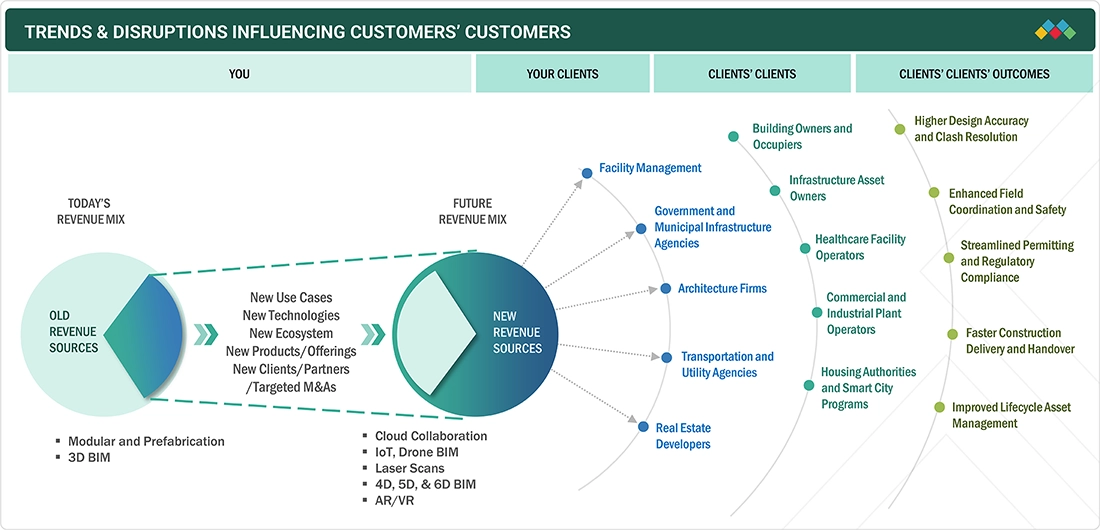
TRENDS & DISRUPTIONS IMPACTING CUSTOMERS' CUSTOMERS
Trends and disruptions such as cloud collaboration, modular construction, AR/VR integration, drones, and laser scanning are reshaping customer business in the BIM market, driving improved project efficiency, safety, and facility management while shifting revenue from traditional design services to digital and technology-enabled solutions.
Source: Secondary Research, Interviews with Experts, MarketsandMarkets Analysis
MARKET DYNAMICS

Level
-
Strong government mandates for BIM adoption in public infrastructure (DOTs, transit, & federal facilities)

-
Rapid expansion of large-scale commercial, industrial, and infrastructure projects requiring integrated digital workflows


Level
-
High upfront investment for advanced BIM software, licenses, and enterprise integration

-
Shortage of skilled BIM, VDC, and digital construction professionals across region


Level
-
Rising integration of BIM with digital twins, IoT-enabled smart buildings, and connected jobsite technologies

-
Increasing use of AR and VR tools in design coordination, safety planning, and field visualization


Level
-
Variability in BIM standards and implementation guidelines across states and agencies

-
Complex interoperability issues between different BIM software platforms and legacy systems

Source: Secondary Research, Interviews with Experts, MarketsandMarkets Analysis
Driver: Strong government mandates for BIM adoption in public infrastructure (DOTs, transit, & federal facilities)
Successful implementation of modern building and infrastructure projects across North America depends heavily on accurate design coordination, real-time collaboration, and efficient project visualization. With multiple stakeholders, including architects, engineers, contractors, DOT agencies, and federal project teams working across distributed locations, projects face a heightened risk of misalignment, design conflicts, and schedule disruptions. Traditional 2D workflows cannot provide the precision and transparency required for large, multi-phase developments such as highways, transit networks, airports, and public buildings. BIM addresses these challenges by offering a unified cloud-based environment where all stakeholders can view, coordinate, and validate a shared 3D digital model. This capability is strongly supported by government-driven BIM requirements, infrastructure modernization programs, and public sector investment, which together accelerate BIM adoption across the region.
Restraint: High upfront investment for advanced BIM software, licenses, and enterprise integration
One of the primary barriers to adopting building information modeling in North America is the substantial initial investment required to transition from traditional workflows. BIM implementation typically involves costs associated with software subscriptions, cloud collaboration platforms, hardware upgrades, staff training, data hosting, and integration with existing enterprise systems. For many small and mid-sized contractors or design firms, these expenses can appear prohibitive, especially when internal stakeholders are uncertain about near-term ROI. Organizations shifting from CAD-based or siloed documentation processes often face additional operational disruption, making the move to BIM-enabled workflows seem costly despite the long-term benefits of enhanced productivity and reduced rework.
Opportunity: Rising integration of BIM with digital twins, IoT enabled smart buildings, and connected jobsite technologies
With North America’s AEC sector rapidly embracing digital transformation, major opportunities emerge from integrating BIM with advanced technologies such as IoT sensors, AI analytics, connected equipment, drones, and digital twins. Government agencies, universities, and private enterprises are expanding investments in digital skills programs, data-driven construction workflows, and smart building initiatives. These efforts aim to boost BIM maturity, enhance team productivity, reduce design and construction conflicts, and support long-term asset performance. By embedding BIM across planning, construction, commissioning, and facility operations, organizations can close existing skill gaps, accelerate project timelines, and build a scalable digital ecosystem capable of supporting future infrastructure and sustainability initiatives.
Challenge: Variability in BIM standards and implementation guidelines across states and agencies
Despite growing adoption, the construction industry in North America continues to experience inconsistent BIM implementation across states, agencies, and project types. Unlike regions with unified national BIM frameworks, the US and Canada operate under fragmented guidelines, with each DOT, municipality, or federal agency following its own standards. This inconsistency limits seamless model-based coordination, complicates interoperability, and slows down contractor onboarding. Many firms still rely on legacy paper-based workflows or partial digital practices, creating bottlenecks in data exchange, real-time collaboration, and model compliance. Cultural resistance to change and entrenched processes further intensify these challenges, slowing the overall pace of BIM standardization in the region.
North America Building Information Modeling Market: COMMERCIAL USE CASES ACROSS INDUSTRIES
| COMPANY | USE CASE DESCRIPTION | BENEFITS |
|---|---|---|
 |
BIM used for multi-discipline coordination across architectural, structural, and MEP systems in a highly complex skyscraper, enabling precise modeling, clash detection, and compliance with stringent safety and building requirements. | Streamlined design coordination, improved project accuracy, minimized clashes, enhanced visualization for stakeholders, and reduced delays during construction. |
 |
BIM deployed to integrate HVAC, MEP, medical equipment layouts, and healthcare-specific room planning, allowing real-time coordination across design and construction teams. | Increased field-to-office coordination, reduced rework, improved compliance with healthcare standards, faster construction cycles, and better cost management. |
 |
BIM used to design and coordinate dense MEP systems, mechanical routing, and utility sequencing in a constrained plant environment, enabling high-precision engineering and efficient construction workflows. | Improved design efficiency, minimized construction clashes, optimized interdisciplinary coordination, and enhanced long-term maintenance planning. |
 |
BIM and digital twin models applied to plan sustainable winery design, perform energy analysis, optimize equipment layouts, and streamline facility management for LEED-Platinum certification. | Enhanced project visualization, improved energy efficiency, reduced operational costs, stronger sustainability planning, and better lifecycle management. |
 |
BIM used to design and coordinate life-support systems, filtration pipelines, structural reinforcements, and architectural modifications inside a historic train station building. | Better asset management, reduced rework, safer integration of complex systems, faster installation, and improved construction efficiency in a heritage structure. |
Logos and trademarks shown above are the property of their respective owners. Their use here is for informational and illustrative purposes only.
MARKET ECOSYSTEM
The BIM ecosystem in North America comprises a broad network of software providers, service integrators, and end users across architecture, engineering, construction, and facility operations. BIM platforms enable advanced design, visualization, model-based coordination, and lifecycle management, while contractors, owners, and public agencies rely on these tools to enhance collaboration, reduce project risks, and improve construction efficiency. This interconnected ecosystem supports digital transformation across buildings and infrastructure projects, driving higher adoption of cloud-based workflows, data-driven insights, and digital twins. As BIM maturity accelerates, the ecosystem continues to foster innovation, streamline project delivery, and optimize asset performance throughout the entire lifecycle.
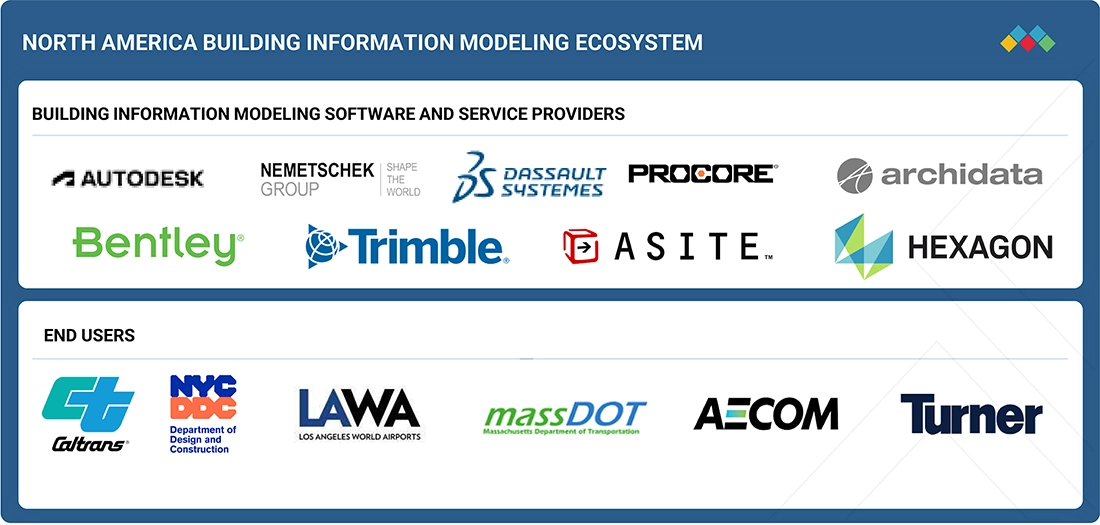
Logos and trademarks shown above are the property of their respective owners. Their use here is for informational and illustrative purposes only.
MARKET SEGMENTS
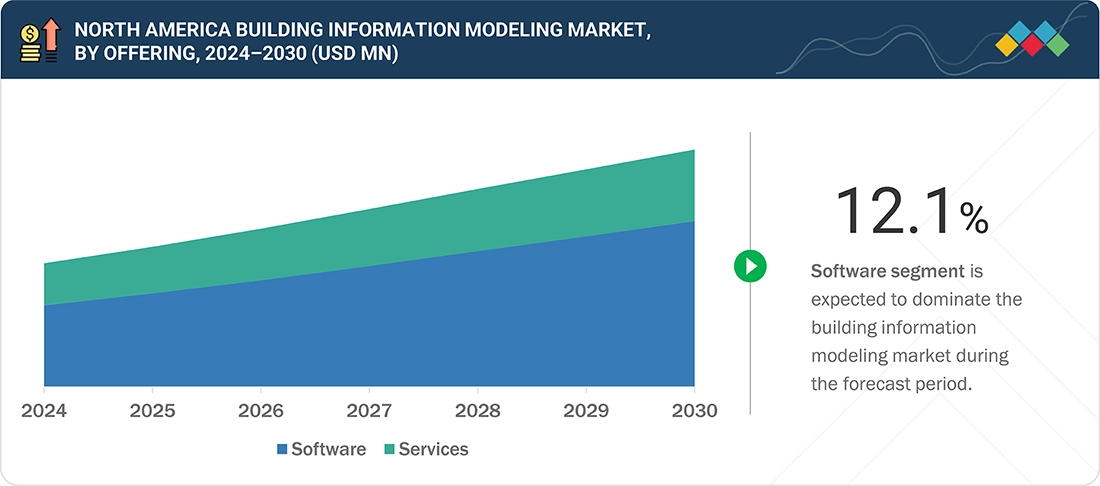
Source: Secondary Research, Interviews with Experts, MarketsandMarkets Analysis
North America Building Information Modeling Market, by Offering
BIM software dominated the North America market in 2024, serving as the foundation for design, visualization, clash detection, and model-based coordination across AEC workflows. Its critical role in improving accuracy, reducing design conflicts, and supporting data-driven decision-making drives strong and recurring adoption among architects, engineers, contractors, and owners. The growing integration of BIM with cloud platforms, AI-enabled automation, and digital twins further enhances its value by enabling real-time collaboration, predictive insights, and smarter project planning across the region.
North America Building Information Modeling Market, by Project Lifecycle
The construction phase is expected to witness the fastest growth throughout the forecast period, fueled by increasing reliance on BIM for scheduling, site coordination, cost control, quality inspections, and clash-free installation. Real-time model updates and integrated workflows significantly reduce field rework and accelerate project timelines. In addition, rising priority for safety compliance, sustainability requirements, and faster delivery of public infrastructure projects is driving broader BIM deployment during the construction stage in North America.
North America Building Information Modeling Market, by Deployment Type
On-premises deployment continues to remain important in North America, particularly among large enterprises, DOTs, airports, and government agencies that prioritize stringent data security, regulatory compliance, and full control over sensitive project information. Many organizations still favor on-premises systems due to their compatibility with existing IT infrastructure and established internal workflows. However, hybrid deployment models are gaining traction as firms balance security needs with the flexibility of cloud-based collaboration.
North America Building Information Modeling Market, by End User
AEC professionals represent the largest end-user segment in the BIM market in North America, as architects, engineers, and contractors rely extensively on BIM for accurate design modeling, clash detection, field coordination, and efficient project delivery. Their central role across every phase of the construction lifecycle results in the highest adoption levels among all stakeholder groups. Increasing digital maturity, widespread use of cloud collaboration tools, and expanding mandates across public-sector projects further reinforce AEC professionals as the leading BIM user base.
North America Building Information Modeling Market, by Vertical
Civil infrastructure is projected to record the highest CAGR in North America, driven by rising BIM adoption in large-scale transportation, highways, bridges, airports, water utilities, and urban development projects. Digital modeling, advanced coordination, and lifecycle asset management significantly enhance project reliability, reduce downtime, and optimize construction costs. Growing investment in smart cities, climate-resilient infrastructure, and federally funded modernization programs is further accelerating BIM penetration within the infrastructure vertical.
REGION
Mexico to exhibit highest CAGR in the North America BIM market during the forecast period
Mexico is projected to register the fastest CAGR in the BIM market in North America from 2025 to 2030, supported by rapid urban growth, increasing investment in transportation and public infrastructure, and expanding government initiatives to modernize construction workflows. Major projects, including those involving highways, rail modernization, airports, water infrastructure, and large commercial developments, are driving demand for digital planning and model-based coordination. As project complexity increases, stakeholders across Mexico are increasingly adopting BIM to improve design accuracy, reduce rework, strengthen cost control, and streamline construction timelines. Furthermore, the growing emphasis on sustainable building practices, coupled with government-driven digital transformation programs, is accelerating the adoption of BIM and enhancing Mexico’s contribution to regional market growth.
North America Building Information Modeling Market: COMPANY EVALUATION MATRIX
The company evaluation matrix benchmarks vendors based on their market share strength and product footprint across the North America market. Leading players, such as Autodesk, dominate the Stars quadrant due to their extensive portfolios and high regional penetration. Emerging leaders and participants represent fast-growing vendors expanding their capabilities, driving innovation and competition within the BIM ecosystem.
Source: Secondary Research, Interviews with Experts, MarketsandMarkets Analysis
KEY MARKET PLAYERS
- Autodesk Inc. (US)
- Trimble Inc. (US)
- Nemetschek Group (Germany)
- Dassault Systèmes (France)
- Bentley Systems, Incorporated (US)
- Procore Technologies, Inc. (US)
- Schneider Electric (France)
- Asite (UK)
- Hexagon AB (Sweden)
- Archidata Inc. (Canada)
- ACCA software S.p.A. (Italy)
- FARO (US)
MARKET SCOPE
| REPORT METRIC | DETAILS |
|---|---|
| Market Size in 2024 (Value) | USD 2.69 BN |
| Market Forecast in 2030 (Value) | USD 5.17 BN |
| Growth Rate | CAGR of 11.1% from 2025–2030 |
| Years Considered | 2021–2030 |
| Base Year | 2024 |
| Forecast Period | 2025–2030 |
| Units Considered | Value (USD Billion) |
| Report Coverage | Revenue Forecast, Company Ranking, Competitive Landscape, Growth Factors, and Trends |
| Segments Covered |
|
| Regional Scope | North America (US, Canada, & Mexico) |
WHAT IS IN IT FOR YOU: North America Building Information Modeling Market REPORT CONTENT GUIDE
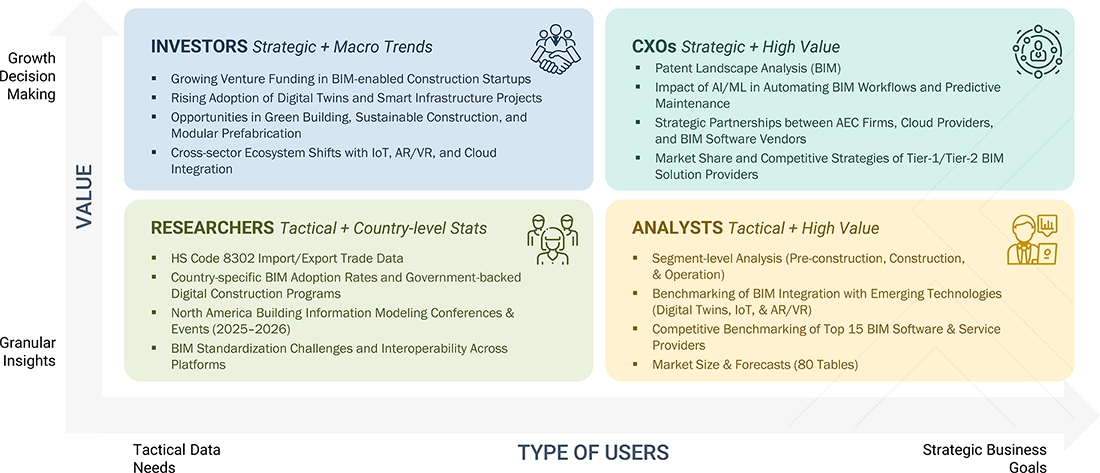
DELIVERED CUSTOMIZATIONS
We have successfully delivered the following deep-dive customizations:
| CLIENT REQUEST | CUSTOMIZATION DELIVERED | VALUE ADDS |
|---|---|---|
| North America Construction Firm | Competitive benchmarking of leading BIM platforms used in North America construction workflows, including adoption maturity, feature depth, and integration capabilities. |
|
| North America Engineering Consultant | Cost-benefit analysis of cloud vs. on-premises BIM deployments with emphasis on US and Canada data security, compliance, and IT integration requirements. |
|
| North America Contractor | Evaluation of BIM adoption for modular, prefabrication, and off-site construction processes across the US and Canada. |
|
| North America Government Agency | Assessment of BIM adoption roadmap for DOTs, transit authorities, and public infrastructure agencies, including compliance mandates and digital twin integration. |
|
| North America Utility Company | Analysis of BIM-enabled asset management and facility maintenance strategies for power, water, and energy infrastructure. |
|
RECENT DEVELOPMENTS
- January 2025 : Autodesk introduced customized design technology solutions tailored for the public sector in India. As part of this initiative, the company launched the BIM Package for Viksit Bharat, a specialized, ready-to-deploy BIM suite developed to support Indian engineers, architects, and policymakers, in alignment with the nation’s Viksit Bharat vision.
- December 2024 : Asite introduced a connector with Autodesk Construction Cloud, a suite of software and services that integrates advanced technology, a builder's network, and predictive insights for construction teams. This integration strengthens collaboration across project teams by allowing seamless, bi-directional exchange of construction documents between Asite and Autodesk Build or Autodesk Docs.
- October 2024 : Bentley Systems, Incorporated formed a strategic partnership with Google to integrate Google's high-quality geospatial content into Bentley's software and digital twin platform, aiming to enhance the design, construction, and operation of infrastructure.
Table of Contents
 Exclusive indicates content/data unique to MarketsandMarkets and not available with any competitors.
Methodology
The study involved major activities in estimating the current market size for the North America Building Information Modeling Market. Exhaustive secondary research was done to collect information on the building information modeling industry. The next step was to validate these findings, assumptions, and sizing with industry experts across the value chain using primary research. Different approaches, such as top-down and bottom-up, were employed to estimate the total market size. After that, the market breakdown and data triangulation procedures were used to estimate the market size of the segments and subsegments of the North America Building Information Modeling Market.
Secondary Research
The secondary research for this study involved gathering information from a wide range of credible sources. These included company annual reports, investor presentations, press releases, whitepapers, certified publications, and articles from reputable associations and government publications. Additional data was obtained from corporate filings, professional and trade associations, journals, and industry-recognized authors. Research from consortia, councils, and gold- and silver-standard websites, directories, and databases also contributed to the qualitative framework. Key global sources such as the International Trade Centre (ITC) and the International Monetary Fund (IMF) were consulted to support and validate the market analysis.
Primary Research
Extensive primary research was conducted after understanding and analyzing the North America Building Information Modeling Market scenario through secondary research. Several primary interviews were conducted with key opinion leaders from demand- and supply-side vendors across North America. Approximately 20% of the primary interviews were conducted with the demand side and 80% with the supply side. Primary data was collected through questionnaires, e-mails, and telephonic interviews. Various departments within organizations, such as sales, operations, and administration, were contacted to provide a holistic viewpoint in the report.
Market Size Estimation
Both top-down and bottom-up approaches were used to estimate and validate the total size of the North America Building Information Modeling Market. These methods were also used extensively to estimate the size of various subsegments in the market. The research methodology used to estimate the market size includes the following:
Data Triangulation
After arriving at the overall size of the North America Building Information Modeling Market through the process explained above, the overall market has been split into several segments. Data triangulation procedures have been employed to complete the overall market engineering process and arrive at the exact statistics for all the segments, wherever applicable. The data has been triangulated by studying various factors and trends from the demand and supply sides. The market has also been validated using top-down and bottom-up approaches.
Market Definition
Building information modeling (BIM) is a digital process that involves creating and managing intelligent 3D models to support the planning, design, construction, and operation of buildings and infrastructure. It integrates data-rich models with real-time collaboration, allowing AEC (architecture, engineering, and construction) professionals to make more informed decisions throughout the project lifecycle, enhancing efficiency, reducing rework, and improving cost and time outcomes.
Key Stakeholders
- Raw material suppliers
- Original equipment manufacturers (OEMs)
- Original design manufacturers (ODM)
- Research institutes
- Building information modeling solution providers
- Forums, alliances, and associations
- Governments and financial institutions
- Analysts and strategic business planners
- AEC Professionals
- Distributors
- End users
Report Objectives
- To describe and forecast the size of the North America Building Information Modeling (BIM) market, in terms of offering type, deployment type, project lifecycle, vertical, and end user, in terms of value
- To provide detailed information regarding the drivers, restraints, opportunities, and challenges influencing the growth of the North America Building Information Modeling Market
- To provide an overview of the value chain pertaining to the building information modeling ecosystem and the average subscription prices of North America building information modeling solutions
- To provide a detailed overview of the impact of AI/Gen AI and the impact of the US 2025 tariff on the North America Building Information Modeling Market
- To provide information about the key technological trends, trade analysis, and patents related to the North America Building Information Modeling Market
- To benchmark the market players using the proprietary company evaluation matrix framework, which analyzes them on various parameters within the broad categories of market ranking/share and product portfolio
- To analyze competitive developments, such as partnerships, acquisitions, agreements, collaborations, and product launches
- To strategically profile key players and analyze their market share, ranking, and core competencies
Available customizations:
With the market data given, MarketsandMarkets offers customizations according to the company’s specific needs. The following customization options are available for the report:
Company Information
- Detailed analysis and profiling of additional market players (up to 7)
Key Questions Addressed by the Report
What is the projected size of the North America BIM market?
The market is projected to grow from USD 3.05 billion in 2025 to USD 5.17 billion by 2030, at a CAGR of 11.1%, driven by digital transformation in construction.
What are the key drivers of the BIM market in North America?
Growth is driven by government infrastructure investments, BIM mandates, and increasing demand for real-time collaboration and digital project visualization.
Which segment dominates the BIM market?
The software segment holds the largest share (~66%) due to its core role in design, modeling, and coordination across AEC workflows.
Which end-user segment is growing the fastest?
AEC (architecture, engineering, and construction) professionals are the fastest-growing users, driven by increasing reliance on BIM for lifecycle project management.
What are the major opportunities in the BIM market?
Opportunities include integration with digital twins, IoT-enabled smart buildings, AI analytics, and AR/VR for enhanced visualization and lifecycle management.


Personalize This Research
- Triangulate with your Own Data
- Get Data as per your Format and Definition
- Gain a Deeper Dive on a Specific Application, Geography, Customer or Competitor
- Any level of Personalization
Let Us Help You
- What are the Known and Unknown Adjacencies Impacting the North America Building Information Modeling Market
- What will your New Revenue Sources be?
- Who will be your Top Customer; what will make them switch?
- Defend your Market Share or Win Competitors
- Get a Scorecard for Target Partners

Custom Market Research Services
We Will Customise The Research For You, In Case The Report Listed Above Does Not Meet With Your Requirements
Get 10% Free CustomisationTESTIMONIALS

Tetsuya Ohhira
Business Development Manager-Technology Business
Nikon Corporation,
Leading Japanese MNC specializing in optics and imaging productswww.nikon.com
MarketsandMarkets™ response
is quick. Their attitude is flexible and positive. Analyst Insights are globally considered and
significant. Client Services quickly respond to our inquiry and demand. Their wide range of global
surveys help us make our strategic plan.
We hope Knowledge Store will be easier to search
for a report.
VP - Marketing & Business Development
Leading Provider of Process Control Solutions
We engaged with MarketsandMarkets on a study to perform an analysis and recommend a Go-To-Market strategy for metrology and process control in the semiconductor market. The study was tailored to our targets and needs with well-defined milestones. Our overall experience with the MarketsandMarkets team was very good throughout the project in all aspects including the analysis methodologies used, the quality and depth of primary and secondary data sets, the professionalism and flexibility of the team and the ability to meet the target schedule and milestones. We want to thank MarketsandMarkets team for a job well done.






Growth opportunities and latent adjacency in North America Building Information Modeling Market