North America Disaster Recovery as a Service (DRaaS) Market

North America DRaaS Market by Service Type (Backup & Restore, Real-Time Replication, Data Protection, and Professional Services), Deployment Mode (Public Cloud and Private Cloud), Organization Size, Vertical and Region - Forecast to 2032




OVERVIEW
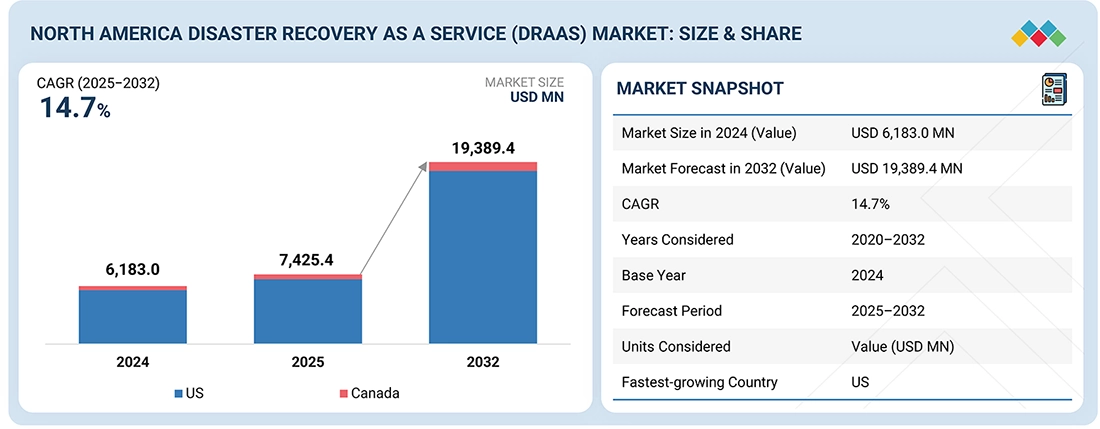
Source: Secondary Research, Interviews with Experts, MarketsandMarkets Analysis
The North America Disaster Recovery as a Service (DRaaS) market is projected to reach USD 19,389.4 million by 2032 from USD 7,425.4 million in 2025, at a CAGR of 14.7%. Growth in this market is driven by increased exposure to ransomware, stricter regulatory and audit requirements for immutable recovery architectures, and enterprises' efforts to modernize their legacy disaster recovery environments. DRaaS adoption is accelerating as organizations prioritize sub-minute recovery objectives, cross-region resilience within cloud ecosystems, and consumption-based recovery models that eliminate the cost and complexity of maintaining idle secondary infrastructure.
KEY TAKEAWAYS
-
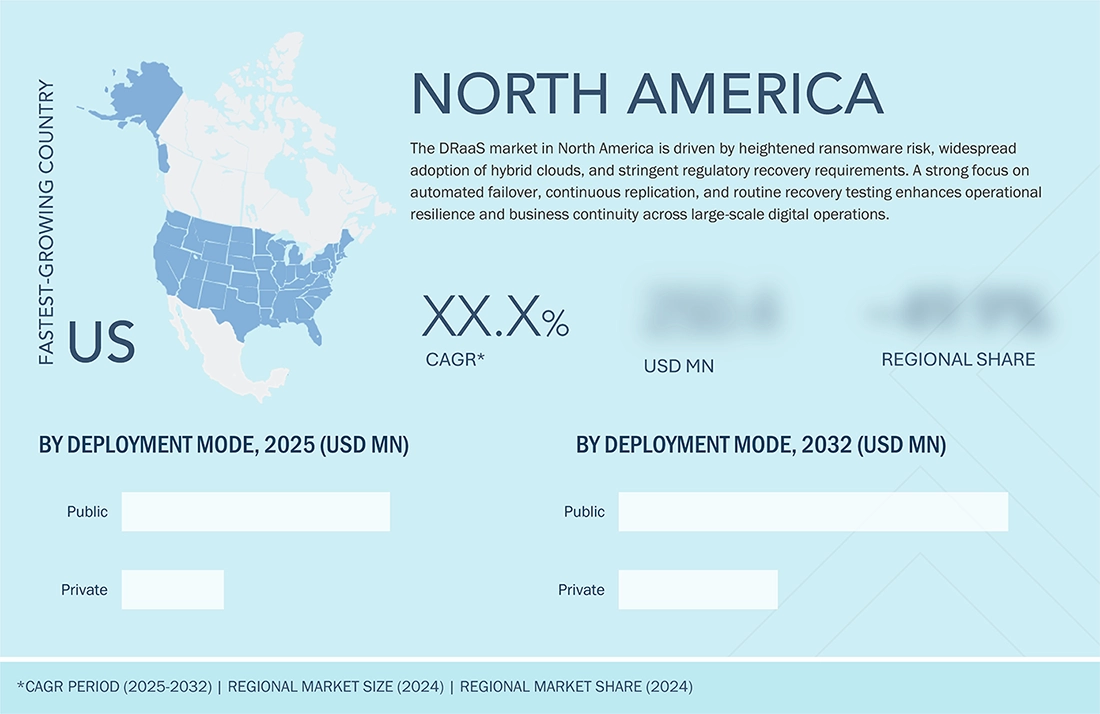
BY COUNTRYThe US is expected to lead the DRaaS market in North America, as escalating ransomware incidents and stricter cyber disclosure mandates accelerate enterprise adoption of cloud-native recovery.
-
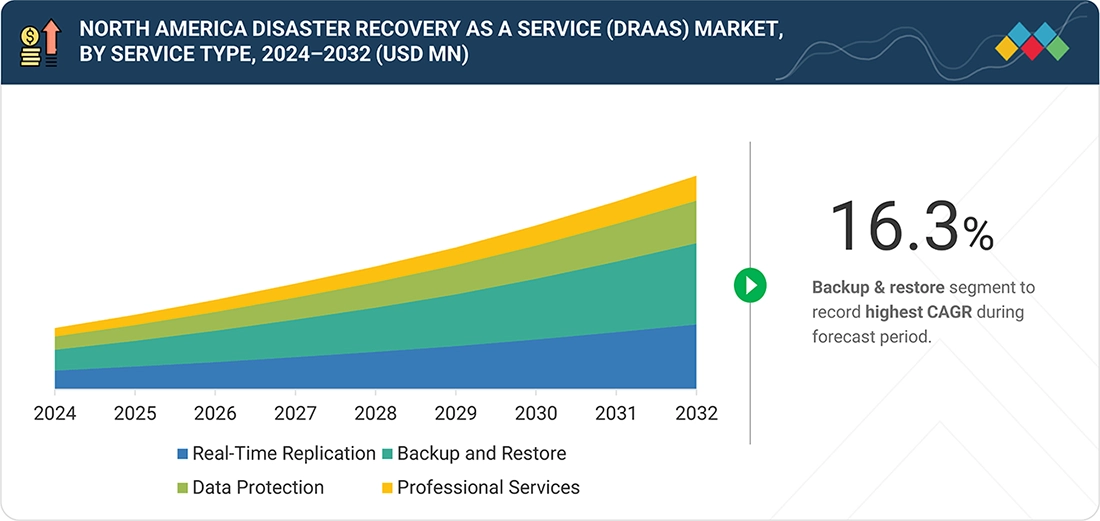
BY SERVICE TYPEBy service type, the backup & restore segment is expected to grow at the highest rate of 16.3% during the forecast period.
-
BY DEPLOYMENT MODEBy deployment mode, the public cloud segment is expected to account for the largest market size of USD 13,670.5 million by 2032.
-
BY VERTICALBy vertical, the retail & consumer goods segment is expected to register the highest CAGR of 16.2% during the forecast period.
-
BY ORGANIZATION SIZEBy organization size, the SMEs segment is expected to witness the highest growth rate as ransomware exposure, lean IT teams, and limited capital budgets accelerate demand for cloud-delivered DRaaS, automated failover, and recovery testing that removes the need for dedicated secondary infrastructure.
-
COMPETITIVE LANDSCAPE - KEY PLAYERSAWS, Microsoft, VMware, IBM, and 11:11 Systems are among the major players in the market, collaborating with enterprises to deliver cloud-based replication, automated failover, isolated recovery environments, and compliance-ready resilience across hybrid and multi-cloud architectures.
-
COMPETITIVE LANDSCAPE - STARTUPS/SMEsRackWare, Cohesity, and Hystax have distinguished themselves among startups and SMEs due to their robust product portfolios and effective business strategies.
The DRaaS market in North America is gaining momentum as enterprises with mature hybrid and multi-cloud footprints face heightened exposure to ransomware, SEC-driven cyber disclosure obligations, and strict contractual uptime commitments. Organizations are prioritizing continuous replication, automated regional failover, and immutable recovery environments to meet aggressive recovery objectives. DRaaS is increasingly being adopted as a governed resilience layer that enables audit-ready recovery and cost-efficient continuity without the need for maintaining dedicated secondary infrastructure.
TRENDS & DISRUPTIONS IMPACTING CUSTOMERS' CUSTOMERS
The section highlights the key drivers shaping the Disaster Recovery as a Service (DRaaS) market in North America. The report will also examine the changing needs of the IT & ITeS, BFSI, retail, and consumer goods sectors as businesses attempt to manage their increased vulnerability to cyber risks. It will address the complexities of hybrid applications and the audits required to determine their recovery validation. The above changes support companies' objectives to recover faster and reduce their dependence on secondary infrastructure for recovery, thus increasing the availability of services and providing a higher level of compliance readiness.
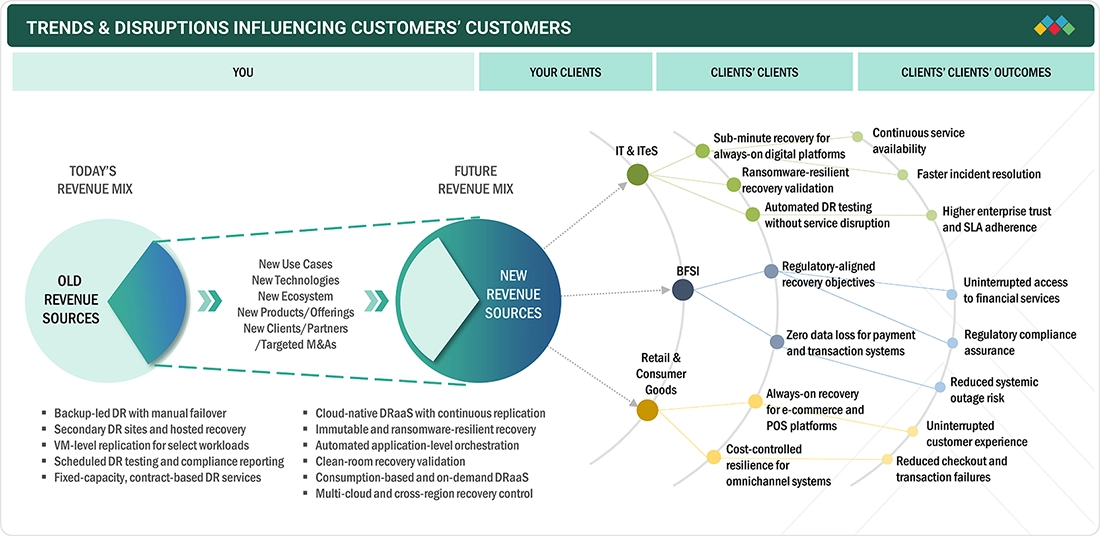
Source: Secondary Research, Interviews with Experts, MarketsandMarkets Analysis
MARKET DYNAMICS

Level
-
Ransomware-driven recovery mandates and regulatory accountability in North America

-
Cloud modernization and data center exit strategies


Level
-
Loss of direct recovery control in provider-managed DRaaS models

-
Legacy application dependencies limiting cloud-based recovery readiness


Level
-
Audit-ready recovery assurance and continuous validation services

-
Cyber insurance requirements creating demand for validated DRaaS recovery evidence


Level
-
Achieving security and compliance parity across hybrid recovery environments

-
Operational complexity of coordinating recovery across multi-cloud providers

Source: Secondary Research, Interviews with Experts, MarketsandMarkets Analysis
Driver: Ransomware-driven recovery mandates and regulatory accountability in North America
The Disaster Recovery-as-a-Service (DRaaS) market in North America is influenced by high levels of sustained ransomware activity, mandatory reporting of cybersecurity incidents under various legislative regimes, and heightened accountability from executive/senior management on the ability to recover from a cyber attack. Businesses are now shifting their focus away from traditional file backup to a provable recoverability approach to meet government regulations and fulfill their uptime guarantees. The availability of cloud-native DRaaS solutions helps organizations when setting their Recovery Time Objectives (RTOs). The reduction in reliance upon the capital-intensive nature of secondary sites will also allow enterprises to align their investments into DRaaS with how they operate in hybrid and multi-cloud environments.
Restraint: Loss of direct recovery control in provider-managed DRaaS models
The primary concern for most companies utilizing DRaaS providers is their reliance on third-party service providers. During a disaster event, customers depend on their DRaaS provider to meet Recovery Point Objectives and execute their recovery plan. Unfortunately, many customers only discover that their DRaaS provider lacks the capabilities to meet these demands during a major disaster. Additionally, many organizations prefer to have some control over how quickly they recover from a major outage.
Opportunity: Audit-ready recovery assurance and continuous validation services
North American organizations can benefit greatly from DRaaS solutions that provide Automated Recovery Assurance through continuous verification rather than mere infrastructure duplication or replication. Organizations are requiring automation for testing, as well as cleanroom recovery validation and evidence-based reporting to meet their regulatory, insurance, and customers' expectations. Therefore, vendors that combine Automated Recovery with Regulatory Compliance Testing can capture higher-value engagements across regulated and digital-first industries.
Challenge: Achieving security and compliance parity across hybrid recovery environments
Maintaining security and compliance parity in North America has been challenging, particularly due to the prevalence of hybrid and multi-cloud architectures, which introduce complexity to encryption, access control, and auditing across multiple recovery environments. If there is a breach of security during a recovery event, it exposes the customer to potential loss of regulatory responsibilities and damage to their reputation. Providers need to establish multiple layers of control over their security practices and conduct continual testing, while also providing complete transparency about their compliance processes through scalable reporting.
NORTH AMERICA DISASTER RECOVERY AS A SERVICE (DRAAS) MARKET: COMMERCIAL USE CASES ACROSS INDUSTRIES
| COMPANY | USE CASE DESCRIPTION | BENEFITS |
|---|---|---|
 |
Allegany Insurance Group simplified its disaster recovery strategy with iland | Witnessed continuous data availability and business uptime | Gained platform control and flexibility | Predictable pricing with no hidden fees was offered | Provided seamless integration with Veeam | Innovative and comprehensive service offered in line with the company’s objectives |
 |
Memorial Hospital safeguards patient data with disaster recovery in the Microsoft Azure Cloud | Avoided USD 7–10 million in secondary data center costs | Achieved 30–60 minute recovery time during outages | Ensured HIPAA-compliant protection of patient data | Maintained high availability of Epic EHR systems | Eliminated on-premises hardware and supply chain dependencies | Improved resilience against cyber and weather-related disruptions |
 |
Western Union and IBM deliver High-Availability File Transfer and Rapid Disaster Recovery | 5-minute disaster recovery time objective, 95% faster recovery than legacy approach | Instant failover ensuring continuous availability for critical file transfers | 24/7 SLA compliance for transaction-intensive operations | Real-time file replication across active data centers |
 |
University of Louisville transitioned from Tape-based Backup to a DRaaS Model within 24 hours | Transitioned from tape-based backup to DRaaS within 24 hours | Eliminated manual and time-intensive DR testing processes | Reduced disaster recovery operating costs by shifting from CapEx to OpEx | Enabled rapid recovery using Veeam Cloud Connect for VMware workloads |
 |
MSP InfoStream ensured disaster recovery confidence with Axcient Cloud Backup | Full speed data download and upload – no throttling | 24 hours to 100% recovery | 0% of data lost after ransomware | Proactive cloud backups in preparation for a hurricane disaster |
Logos and trademarks shown above are the property of their respective owners. Their use here is for informational and illustrative purposes only.
MARKET ECOSYSTEM
The Disaster Recovery as a Service (DRaaS) market in North America comprises a diverse range of stakeholders collaborating to enable businesses to recover from disasters in a resilient and cost-effective manner. Public and private cloud vendors support regionally distributed failover infrastructure. Data movers enable high-frequency replication across hybrid estates. DRaaS providers orchestrate testing and managed recovery, delivering scalable resilience that reduces reliance on secondary infrastructure across complex, multi-cloud environments.
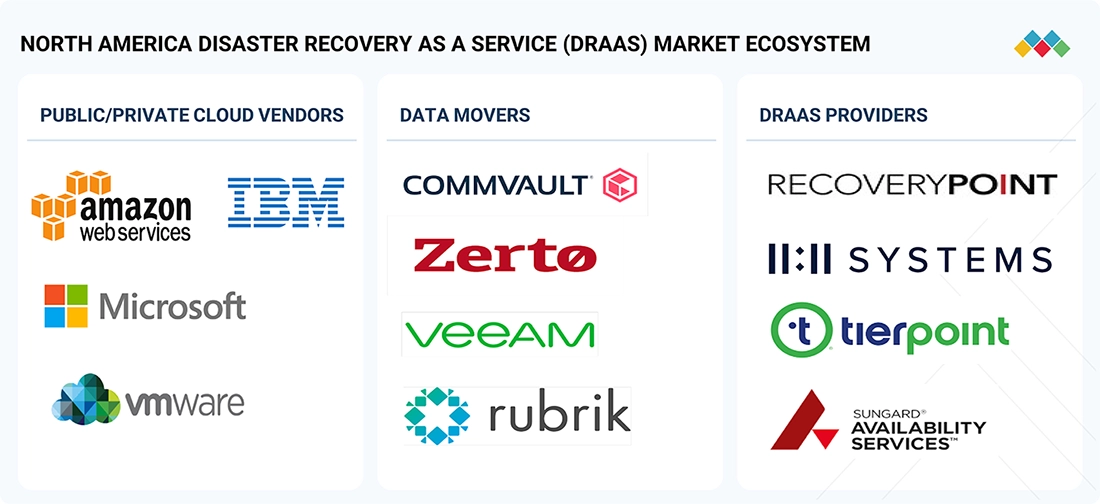
Logos and trademarks shown above are the property of their respective owners. Their use here is for informational and illustrative purposes only.
MARKET SEGMENTS
Source: Secondary Research, Interviews with Experts, MarketsandMarkets Analysis
North America Disaster Recovery as a Service (DRaaS) Market, By Service Type
By service type, the real-time replication segment is estimated to account for the second-largest share of the Disaster Recovery as a Service market in North America, As demand grows for quick restoration of service and little to no data loss; continuous replication will support the near-zero recovery objectives, automate regional failover and achieve the consistency that mission-critical applications need in Transaction-Intensive Workloads in hybrid/multi-cloud environments.
North America Disaster Recovery as a Service (DRaaS) Market, By Deployment Mode
By deployment mode, the private cloud segment is expected to record the fastest growth, as it offers a dedicated environment for recovering and restoring data after an incident or disaster. The private cloud also helps organizations meet their data-residency requirements by maintaining separate recovery sites with the flexibility to set tailored recovery objectives. It provides full audit alignment with failover systems for compliance-based deployments and critical systems operating across multiple hybrid environments.
North America Disaster Recovery as a Service (DRaaS) Market, By Vertical
By vertical, the BFSI segment is estimated to account for the largest market share due to increased government regulations on corporate activities and the requirements for cyber resilience and enforced operational continuity standards. The DRaaS model enables financial institutions to conduct validated recovery tests and maintain regulatory compliance documentation, thereby ensuring the continuous availability of their critical systems.
North America Disaster Recovery as a Service (DRaaS) Market, By Organization Size
By organization size, the large enterprises segment is estimated to lead the North America Disaster Recovery as a Service market. Large enterprises have multiple operational sites, including many different, often remote, geographically dispersed data centers, private clouds, and public clouds. DRaaS will enable organizations to create consistent execution across their geographic locations, regularly validate their recovery plans, and ensure compliance across both enterprise-wide and regional-based environments.
REGION
US to dominate North America Disaster Recovery as a Service (DRaaS) market during forecast period
As the US has the most advanced cloud infrastructure within North America, due to its extensive data center footprint and mature Enterprise IT environment, it is estimated to account for the largest share of the North America DRaaS market. Additionally, many organizations develop hybrid and multi-cloud architectures with increasing levels of cloud revenue dependency, and therefore, an increasing demand for validated cloud-based recovery. There is also an established base of partner ecosystems that reinforce the attractiveness of the US as the largest region for DRaaS commercially. Further, continued investments by enterprises further enhance the commercial appeal of the US DRaaS market.
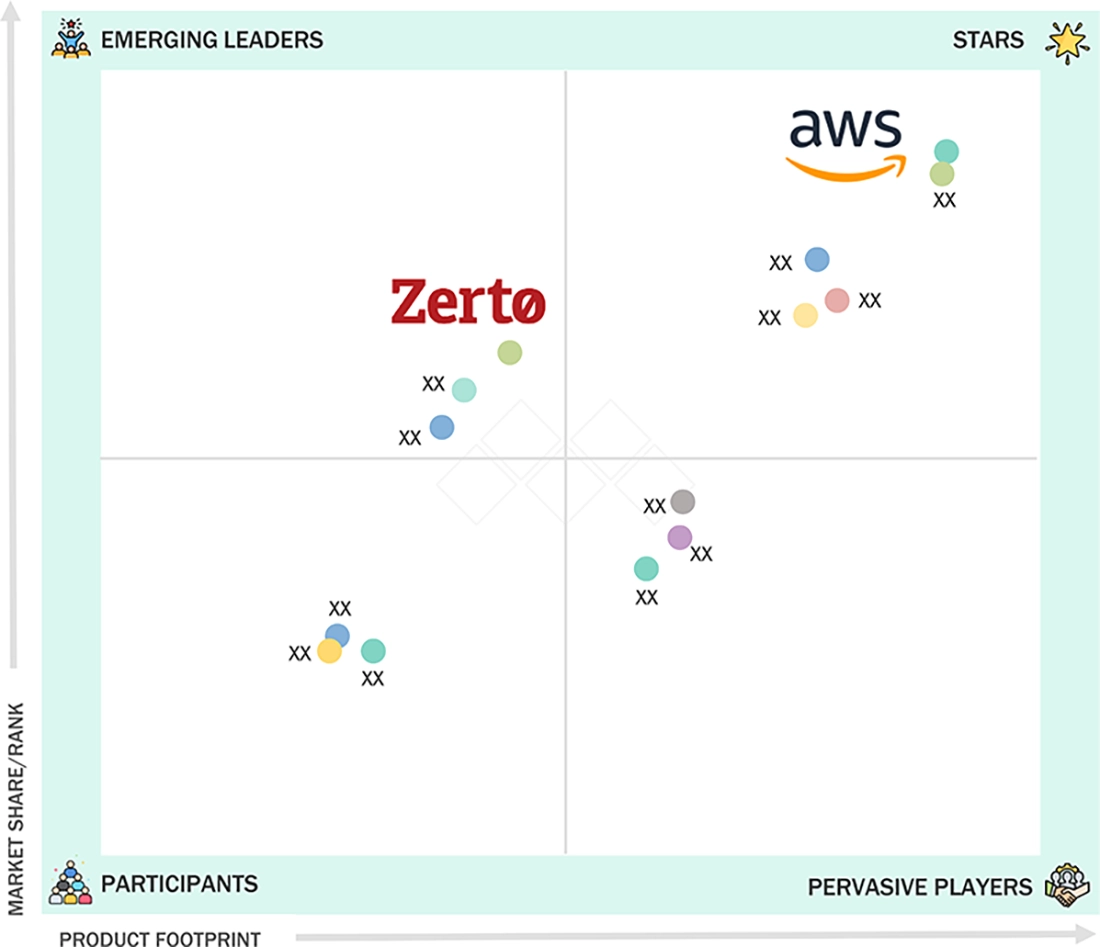
NORTH AMERICA DISASTER RECOVERY AS A SERVICE (DRAAS) MARKET: COMPANY EVALUATION MATRIX
In the North America Disaster Recovery as a Service market matrix, AWS (Star) supports companies that need to recover and maintain their critical assets in the best way possible with its native cloud resilience services, global region coverage, and seamless integration with compute, storage, and network services. Zerto (Emerging Leader) is making progress with its use of continuous replication, along with an emphasis on how applications can be restored. AWS has the highest scale and deepest cloud infrastructure, and Zerto is rapidly moving toward being a leader by providing enterprise-level, precise recovery and simplified operations for its customers.
Source: Secondary Research, Interviews with Experts, MarketsandMarkets Analysis
KEY MARKET PLAYERS
- AWS (US)
- Microsoft (US)
- VMware (US)
- IBM (US)
- 11:11 Systems (US)
- Recovery Point Systems (US)
- Intervision Systems (US)
- TierPoint (US)
- Infrascale (US)
- Zerto (US)
- C&W Business (US)
- Carbonite (US)
- DXC Technology (US)
- Evolve IP (US)
- Expedient (US)
- Flexential (US)
- Quorum (US)
- Unitrends (US)
- Arcserve (US)
- Rackware (US)
- Druva (US)
- PheonixNAP (US)
- Cohesity (US)
- AssureStore Limited (US)
- Hystax (US)
MARKET SCOPE
| REPORT METRIC | DETAILS |
|---|---|
| Market Size in 2024 (Value) | USD 6,183.0 Million |
| Market Forecast in 2032 (Value) | USD 19,389.4 Million |
| Growth Rate | CAGR of 14.7% from 2025 to 2032 |
| Years Considered | 2020-2032 |
| Base Year | 2024 |
| Forecast Period | 2025-2032 |
| Units Considered | Value (USD Million) |
| Report Coverage | Revenue forecast, company ranking, competitive landscape, growth factors, and trends |
| Segments Covered |
|
| Countries Covered | US and Canada |
WHAT IS IN IT FOR YOU: NORTH AMERICA DISASTER RECOVERY AS A SERVICE (DRAAS) MARKET REPORT CONTENT GUIDE
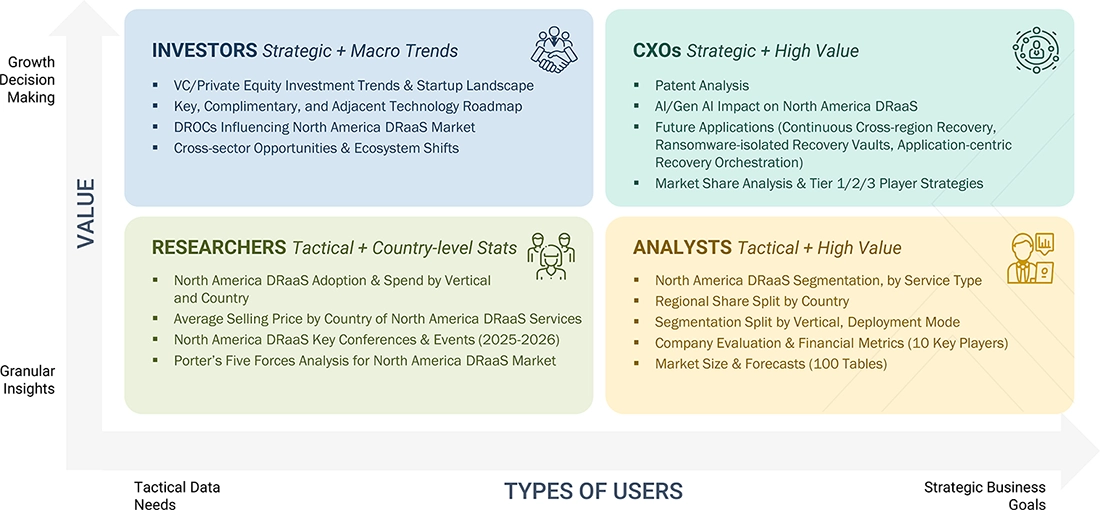
DELIVERED CUSTOMIZATIONS
We have successfully delivered the following deep-dive customizations:
| CLIENT REQUEST | CUSTOMIZATION DELIVERED | VALUE ADDS |
|---|---|---|
| Leading BFSI Firm (US) | Additional Vendor Mapping: Evaluation of DRaaS providers offering isolated recovery vaults, regulatory-aligned recovery objectives, and audit-ready controls | Clarified competitive white spaces, refined BFSI-focused value propositions, and strengthened differentiation against established providers |
| Global Retail & Consumer Goods Enterprise (US) | Hybrid Stack Assessment: Analysis of DRaaS platforms supporting application-centric recovery, cloud-to-cloud failover, and data governance | Accelerated go-to-market strategy, sharpened messaging for revenue-critical workloads, and improved alignment with enterprise buyer priorities |
RECENT DEVELOPMENTS
- November 2025 : Assured Data Protection expanded its disaster recovery portfolio with a Zerto-powered service for VMware and mixed environments. The offering delivers near-zero recovery objectives, automated failover, and operational flexibility, supporting enterprises navigating infrastructure transitions while maintaining consistent recovery assurance and reduced downtime risk.
- July 2025 : ICICI Lombard partnered with Amazon Web Services to implement an automated, cloud-native disaster recovery setup using the AWS Hyderabad region. Reported by Analytics India Magazine, the deployment enabled cross-region replication, automated failover, regulatory compliance, and uninterrupted access to business-critical applications during service disruptions.
- June 2025 : Cohesity and 11:11 Systems expanded their partnership with the launch of a fully managed Clean Room Recovery service. Announced by Channel Insider, the offering combines Cohesity’s data security platform with 11:11 Systems’ managed recovery expertise to provide isolated recovery environments, rapid ransomware response, and end-to-end cyber incident recovery for enterprises.
- June 2025 : CrashPlan and Microsoft deepened their partnership through integration with Microsoft 365 Backup Storage. Announced via Business Wire, the collaboration enables enterprise-grade disaster recovery with rapid, large-scale restores, stringent recovery objectives, and unified governance for Microsoft 365 workloads.
- April 2025 : Elastio partnered with JetSweep to strengthen DRaaS and ransomware protection. The collaboration integrates ransomware recovery assurance with AWS-based disaster recovery, enabling validated clean recovery points, rapid failover, and reduced downtime for enterprises facing advanced cyber threats.
Table of Contents
 Exclusive indicates content/data unique to MarketsandMarkets and not available with any competitors.
Methodology
This research study involved extensive secondary sources, directories, and paid databases to identify and collect information useful for this technical, market-oriented, and commercial study of the North America Disaster Recovery as a Service (DRaaS) Market. In-depth interviews were conducted with various primary respondents, including key industry participants, subject matter experts, C-level executives of key market players, and industry consultants, to obtain and verify critical qualitative and quantitative information and assess the market prospects. The following figure highlights the market research methodology in developing this report on the North America Disaster Recovery as a Service (DRaaS) Market.
Secondary Research
The market size of companies offering DRaaS was based on the secondary data available through paid and unpaid sources and by analyzing the product portfolios of major companies in the ecosystem and rating the companies based on their product capabilities and business strategies. In the secondary research process, various sources were referred to for identifying and collecting information for the study. The secondary sources included annual reports, press releases, investor presentations of companies, product data sheets, white papers, journals, certified publications, articles from recognized authors, government websites, directories, and databases.
Secondary research was mainly used to obtain key information about the industry’s supply chain, the total pool of key players, market classification and segmentation according to industry trends to the bottom-most level, regional markets, and key developments from both market- and technology-oriented perspectives, all of which were further validated by primary sources.
Primary Research
In the primary research process, various primary sources from both the supply and demand sides were interviewed to obtain qualitative and quantitative information on the market. The primary sources from the supply side included various industry experts, including Chief Experience Officers (CXOs); Vice Presidents (VPs); directors from business development, marketing, and product development/innovation teams; and related key executives from DRaaS vendors, industry associations, independent consultants, and key opinion leaders.
Primary interviews were conducted to gather insights, such as market statistics, the latest trends disrupting the market, new use cases implemented, data on revenue collected from products and services, market breakups, market size estimations, market forecasts, and data triangulation. Primary research also helped in understanding various trends related to technology, service type, deployment, and region. Stakeholders from the demand side, such as Chief Information Officers (CIOs), Chief Technology Officers (CTOs), Chief Security Officers (CSOs), the installation teams of governments/end users using DRaaS, and digital initiatives project teams, were interviewed to understand the buyer’s perspective on suppliers, products, service providers, and their current use of solutions, which would affect the overall North America Disaster Recovery as a Service (DRaaS) Market.
Market Size Estimation
Both top-down and bottom-up approaches were used to estimate and forecast the North America Disaster Recovery as a Service (DRaaS) Market and other dependent submarkets. The bottom-up procedure was deployed to arrive at the overall market size using the revenues and offerings of the key companies in the market. With data triangulation methods and validation through primary interviews, this study determined and confirmed the exact value of the overall parent market size. The overall market size was then used in the top-down procedure to estimate the size of other individual markets via percentage splits of the market segments.
Key players in the market were identified through secondary research, and their revenue contributions in respective countries were determined through primary and secondary research.
This entire procedure included the study of the annual and financial reports of top market players and extensive interviews for key insights from industry leaders, such as Chief Executive Officers (CEOs), VPs, directors, and marketing executives.
All percentage splits and breakups were determined using secondary sources and verified through primary sources.
Data Triangulation
After arriving at the overall market size, the market was split into several segments and subsegments—using the market size estimation processes as explained above. Where applicable, data triangulation and market breakdown procedures were employed to complete the overall market engineering process and determine each market segment's and subsegment's exact statistics. The data was triangulated by studying various factors and trends from government agencies’ demand and supply sides.
Market Definition
Disaster Recovery as a Service (DRaaS) refers to a cloud model that enables replicating enterprise data and applications on a third-party virtual or cloud environment to ensure business continuity during artificial or natural disasters. It is mainly facilitated by System Integrators (SIs) and Managed Service Providers (MSPs). DRaaS is based on three crucial aspects: disaster planning/management, business continuity, and backup.
Key Stakeholders
- Cloud service providers (CSPs)
- Colocation providers
- Technology service providers
- Data center managed service providers
- Government organizations
- Networking companies
- Consultants/consultancies/advisory firms
- Support and maintenance service providers
- Telecom service providers
- Information Technology (IT) infrastructure providers
- System Integrators (SIs)
- Regional associations
- Independent software vendors
- Value-added resellers and distributors
Report Objectives
- To describe and forecast the North America Disaster Recovery as a Service (DRaaS) Market based on service types, deployment modes, organization size, verticals, and regions
- To strategically analyze the market subsegments with respect to individual growth trends, prospects, and contributions to the total North America Disaster Recovery as a Service (DRaaS) market
- To provide detailed information related to the major factors influencing the growth of the North America Disaster Recovery as a Service (DRaaS) market (drivers, restraints, opportunities, and challenges)
- To strategically analyze macro and micro markets with respect to growth trends, prospects, and their contributions to the overall North America Disaster Recovery as a Service (DRaaS) market
- To analyze industry trends, patents & innovations, and pricing data related to the North America Disaster Recovery as a Service (DRaaS) Market
- To analyze the impact of recession impact on service types, deployment modes, organization size, verticals, and region in the North America Disaster Recovery as a Service (DRaaS)
- To analyze the opportunities in the market for stakeholders and provide details of the competitive landscape for major players in the North America Disaster Recovery as a Service (DRaaS)
- To profile key players in the market and comprehensively analyze their market share/ranking and core competencies in the North America Disaster Recovery as a Service (DRaaS)
- To track and analyze competitive developments, such as mergers and acquisitions, new product developments, and partnerships and collaborations in the North America Disaster Recovery as a Service (DRaaS) market
Available Customizations
With the given market data, MarketsandMarkets offers customizations per the company’s specific needs. The following customization options are available for the report:
Product Analysis
- The product matrix provides a detailed comparison of the product portfolio of each company.
Geographic Analysis
- Further breakup of the North America Disaster Recovery as a Service (DRaaS) Market
Company Information
- Detailed analysis and profiling of five additional market players
Key Questions Addressed by the Report
What is the current size of the North America Disaster Recovery as a Service (DRaaS) market?
The North America Disaster Recovery as a Service (DRaaS) market is valued at USD 7,425.4 million in 2025 and is projected to reach USD 19,389.4 million by 2032, growing at a CAGR of 14.7% during the forecast period.
What is driving the growth of the North America DRaaS market?
Market growth is driven by increasing ransomware attacks, stricter compliance requirements, rising adoption of hybrid and multi-cloud environments, and growing demand for automated disaster recovery and business continuity solutions.
Which deployment mode dominates the North America DRaaS market?
The public cloud deployment mode holds the largest market share due to its scalability, cost efficiency, and ability to provide rapid disaster recovery for cloud-native and hybrid workloads.
Which country leads the North America Disaster Recovery as a Service (DRaaS) market?
The United States leads the North America DRaaS market, supported by advanced cloud infrastructure, high enterprise cloud adoption, and strong investments in cybersecurity and business resilience.
What are the key trends in the North America DRaaS market?
Key trends include the adoption of continuous replication, automated failover, immutable backup storage, isolated recovery environments, and AI-driven disaster recovery orchestration to minimize downtime and strengthen cyber resilience.


Personalize This Research
- Triangulate with your Own Data
- Get Data as per your Format and Definition
- Gain a Deeper Dive on a Specific Application, Geography, Customer or Competitor
- Any level of Personalization
Let Us Help You
- What are the Known and Unknown Adjacencies Impacting the North America DRaaS Market
- What will your New Revenue Sources be?
- Who will be your Top Customer; what will make them switch?
- Defend your Market Share or Win Competitors
- Get a Scorecard for Target Partners

Custom Market Research Services
We Will Customise The Research For You, In Case The Report Listed Above Does Not Meet With Your Requirements
Get 10% Free CustomisationTESTIMONIALS






Growth opportunities and latent adjacency in North America DRaaS Market