North America Industrial Communication Market

North America Industrial Communication Market by Fieldbus, Industrial Ethernet, Wireless, IO-Link, Router & WAP, Switch, Gateway, Communication Interface & Converter, Controller & Connector and Power Supply Device - Forecast to 2030




OVERVIEW
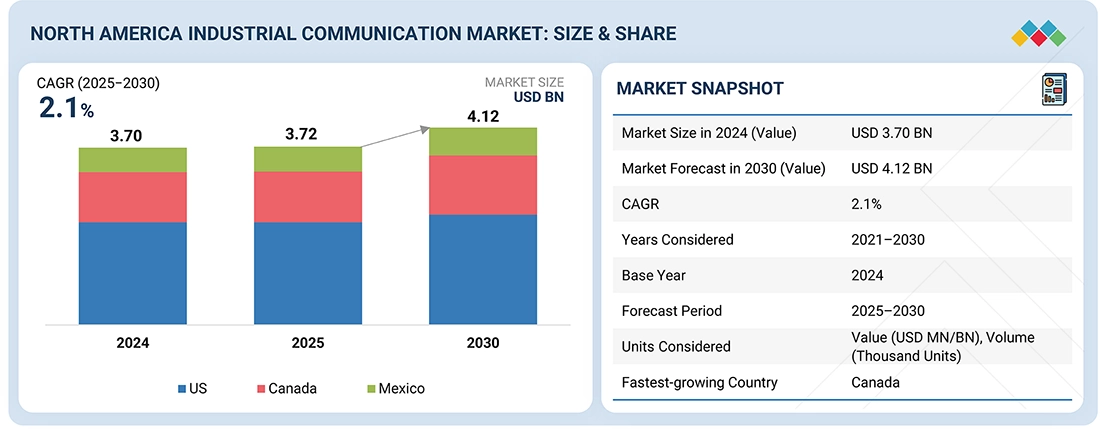
Source: Secondary Research, Interviews with Experts, MarketsandMarkets Analysis
The North America industrial communication market is projected to grow from USD 3.72 billion in 2025 to USD 4.12 billion by 2030, at a CAGR of 2.1%. The market in North America is expanding rapidly as manufacturers, energy firms, and logistics providers speed up the adoption of IIoT, industrial Ethernet, and private 5G to update operations and enhance real-time connectivity. Strong investments in automation, smart factories, EV production, and cybersecurity standards further drive demand for advanced, reliable industrial networking solutions across the region.
Market Size & Forecast
KEY TAKEAWAYS
-
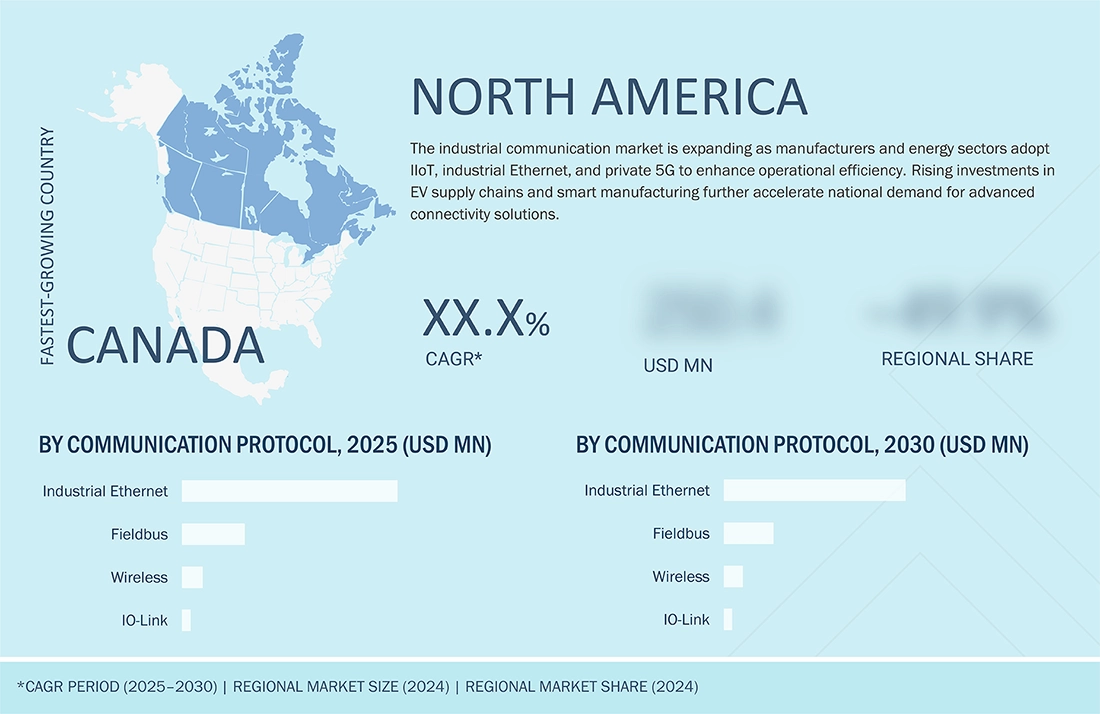
BY COUNTRYThe US is projected to lead the North America industrial communication market, capturing a 57.6% share by volume in 2025.
-
BY OFFERINGThe services segment is expected to exhibit the highest CAGR during the forecast period.
-
BY COMMUNICATION PROTOCOLBy communication protocol, the industrial Ethernet segment is expected to hold the largest market share by 2030.
-
BY INDUSTRYBy industry, the pharmaceuticals & medical devices segment is expected to register the highest CAGR of 4.4% during the forecast period.
-
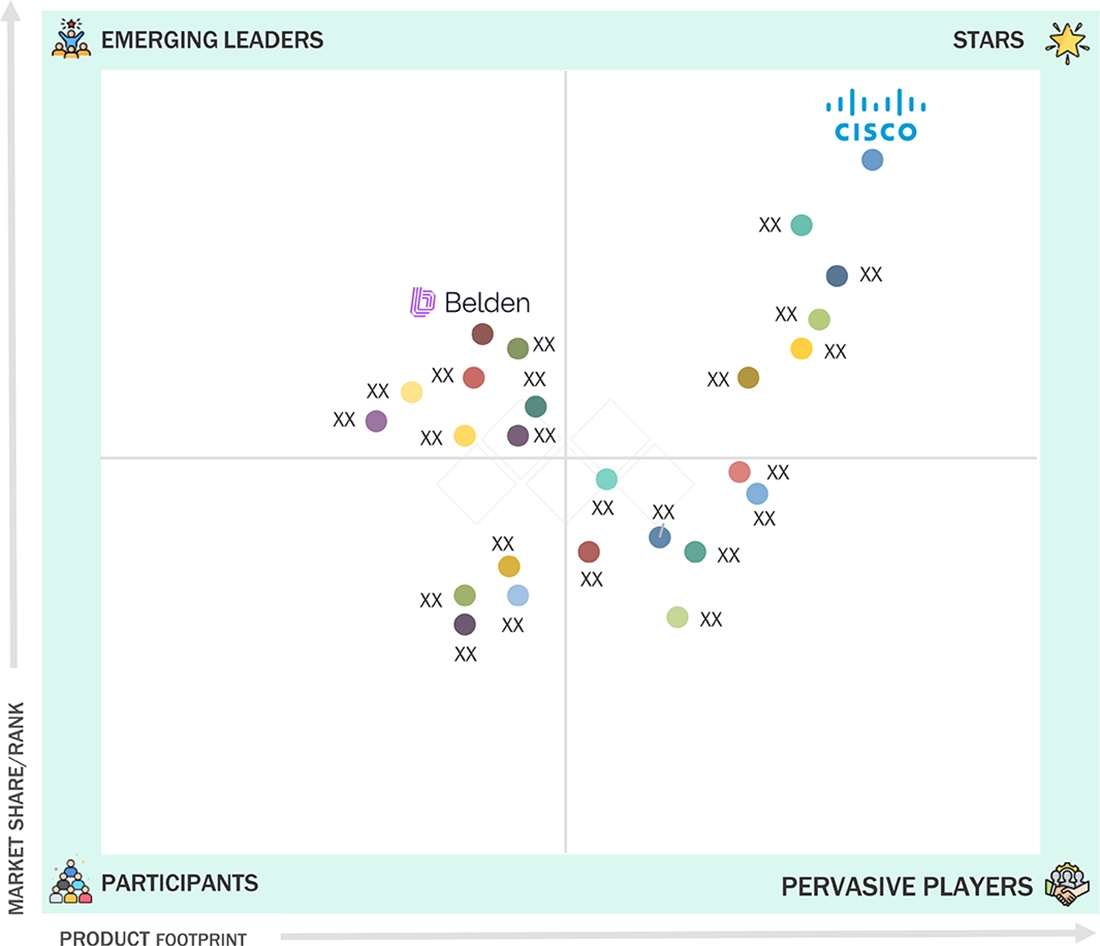
COMPETITIVE LANDSCAPE (KEY PLAYERS)Cisco Systems, Inc., Siemens, and Rockwell Automation were identified as some of the star players in the North America industrial communication market, given their strong market share and product footprint.
-
COMPETITIVE LANDSCAPE (STARTUPS/SMES)Belden Inc., ABB, and Honeywell International Inc. among others, have distinguished themselves among startups and SMEs by securing strong footholds in specialized niche areas, underscoring their potential as emerging market leaders
The North America industrial communication market is experiencing strong growth fueled by rapid digital transformation across manufacturing, automotive, energy, and logistics sectors. Companies are increasingly deploying IIoT networks, industrial Ethernet, and private 5G to improve operational visibility, reduce downtime, and enable connected factory ecosystems. Growing investments in automation, EV and battery production, and smart infrastructure are further speeding up adoption.
TRENDS & DISRUPTIONS IMPACTING CUSTOMERS' CUSTOMERS
The North America industrial communication market is undergoing a transformation due to rapid advancements in edge computing, industrial artificial intelligence, private 5G networks, and intelligent manufacturing ecosystems. This evolution prompts a transition from traditional communication technologies to high-performance, data-centric solutions. As industries progress toward connected electric vehicle ecosystems, autonomous systems, intelligent buildings, and Industry 4.0 operations, the demand for reliable, secure, and scalable communication infrastructure is increasing. This shift is further supported by prominent end users such as ExxonMobil, Tesla, and Lockheed Martin, whose evolving requirements influence more comprehensive value-chain adoption and the development of next-generation connectivity solutions.
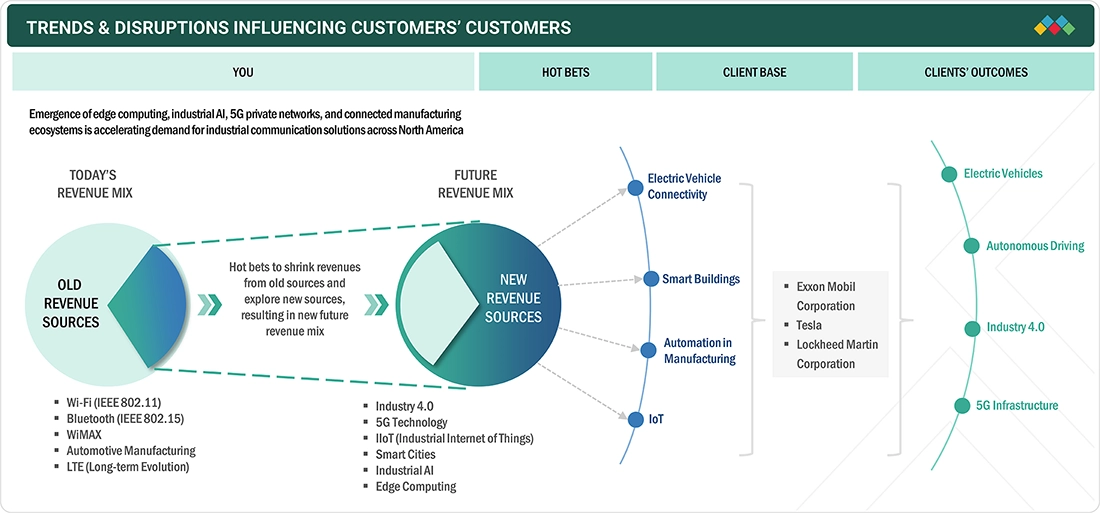
Source: Secondary Research, Interviews with Experts, MarketsandMarkets Analysis
MARKET DYNAMICS

Level
-
Growing need for scalable, faster, reliable, and interoperable communication protocols in North America

-
Increasing use of digital twin technology to safely monitor smart manufacturing operations


Level
-
Lack of standardization in industrial communication protocols and interfaces


Level
-
Lucrative opportunities offered by 5G for Industrial IoT development

-
Growing demand for wireless networks


Level
-
Threats related to cybersecurity

-
Challenges associated with exposure of equipment to harsh conditions

Source: Secondary Research, Interviews with Experts, MarketsandMarkets Analysis
Driver: Growing need for scalable, faster, reliable, and interoperable communication protocols in North America
North America industries are rapidly modernizing, thereby generating a significant demand for communication protocols capable of supporting high-speed data exchange, real-time monitoring, and large-scale automation. As factories progressively integrate robotics, AI-driven operations, and connected machinery, older systems are increasingly unable to meet interoperability and latency standards. This movement toward Industry 4.0 is hastening the adoption of advanced industrial Ethernet, IIoT protocols, and secure wireless technologies throughout the region.
Restraint: Lack of standardization in industrial communication protocols and interfaces
A significant challenge in North America is the coexistence of multiple proprietary protocols, which results in integration difficulties and impedes large-scale digital transformation. Manufacturers are required to make substantial investments in custom gateways, adapters, and engineering resources to facilitate the connection of diverse systems. This absence of unified standards enhances operational complexity and extends deployment timelines for industrial communication solutions.
Opportunity: Lucrative opportunities offered by 5G for Industrial IoT development
The deployment of private 5G networks across North America offers substantial opportunities for industries that necessitate ultra-low latency, extensive device connectivity, and highly secure wireless infrastructure. 5G technology facilitates advanced functionalities such as autonomous robotics, remote operations, digital twins, and AI-enhanced predictive maintenance. As more enterprises implement edge computing and smart factory initiatives, 5G is poised to serve as a fundamental enabler of next-generation industrial communication systems.
Challenge: Threats related to cybersecurity
The convergence of IT and OT networks exposes industrial environments to a growing range of cyber threats, making security a critical challenge in North America. Increased connectivity through IIoT devices and cloud platforms expands the attack surface, putting critical infrastructure at risk. Companies must invest in advanced cybersecurity frameworks, continuous monitoring, and zero-trust architectures to safeguard industrial operations.
NORTH AMERICA INDUSTRIAL COMMUNICATION MARKET: COMMERCIAL USE CASES ACROSS INDUSTRIES
| COMPANY | USE CASE DESCRIPTION | BENEFITS |
|---|---|---|
 |
Industrial IoT connectivity deployment at a maple syrup farm in Quebec using rugged switches, routers, and LoRaWAN to network sensors measuring sap levels, pipe effectiveness, and tree moisture across 800m in harsh sub-zero environments | Real-time monitoring, reduced manual inspection costs, optimized harvest timing, proactive issue detection, improved operational scalability, and secure remote access |
 |
Integrated automation and industrial communication infrastructure for Electra Battery Materials’ EV Battery Materials Park in Ontario, using PlantPAx DCS, networked drives, motor control, and secure industrial networking | End-to-end traceability, improved ESG compliance, enhanced operator safety, data-driven performance optimization, and faster development of a sustainable EV supply chain |
 |
Automated palletizing solution using Alvey 910 robotic palletizer at Bee Sweet Citrus in California to handle multiple citrus varieties and packaging patterns amid labor shortages | Up to 80% reduction in palletizing labor, increased throughput, higher worker safety, 5–6-year ROI, and scalable automation for expanding production lines |
 |
Modernized OT network at the Grand Prairie, Texas switchgear plant using SCALANCE, RUGGEDCOM, redundant ring topologies, and unified monitoring across 45 CNC cells for deterministic industrial communication | Network downtime reduced from 3,083 to 15.4 hours/year, 98% faster reconfiguration, 50% performance boost, improved cybersecurity, and better diagnostics for proactive maintenance |
|
|
Cloud-based asset management deployment (Brightly Asset Essentials & Origin) across 12 NA manufacturing sites, consolidating seven CMMS systems for unified maintenance workflows and capital planning | Centralized asset visibility, streamlined maintenance, reduced inefficiencies, improved spare-parts management, and stronger data-driven decision-making across facilities |
Logos and trademarks shown above are the property of their respective owners. Their use here is for informational and illustrative purposes only.
MARKET ECOSYSTEM
The North America industrial communication market ecosystem is distinguished by robust collaboration among technology developers, component and software providers, distributors, and a diverse range of industrial end users. Research and Development initiatives are concentrated on advancing industrial networking, automation, and Industrial Internet of Things (IIoT) technologies, while solution providers offer resilient hardware, software, and connectivity platforms to facilitate modernized manufacturing and operational environments. Distributors hold a vital position in enabling comprehensive market access and integration across industrial facilities, and end users actively promote adoption through increased investments in smart factories, interconnected equipment, and secure, high-performance communication infrastructure.
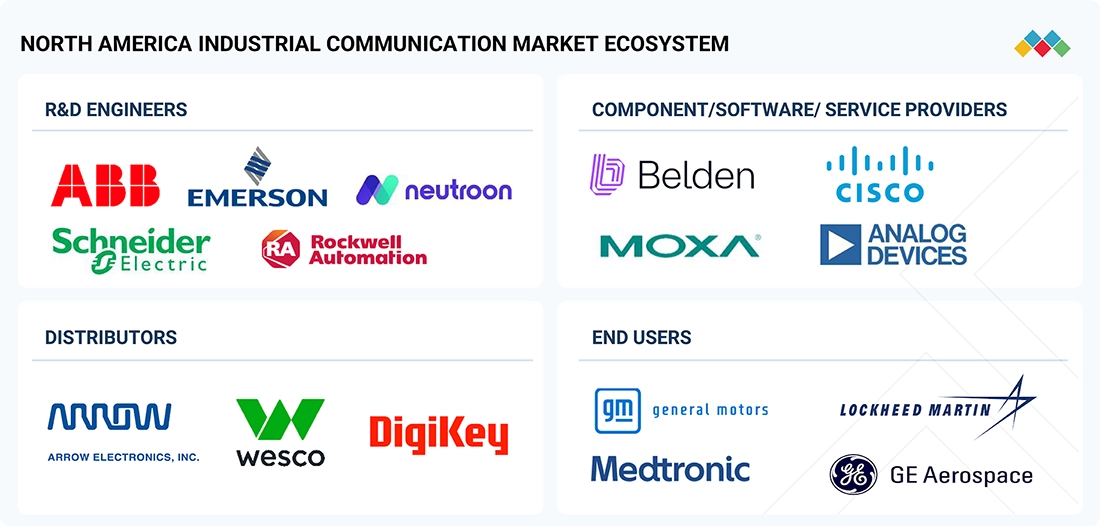
Logos and trademarks shown above are the property of their respective owners. Their use here is for informational and illustrative purposes only.
MARKET SEGMENTS
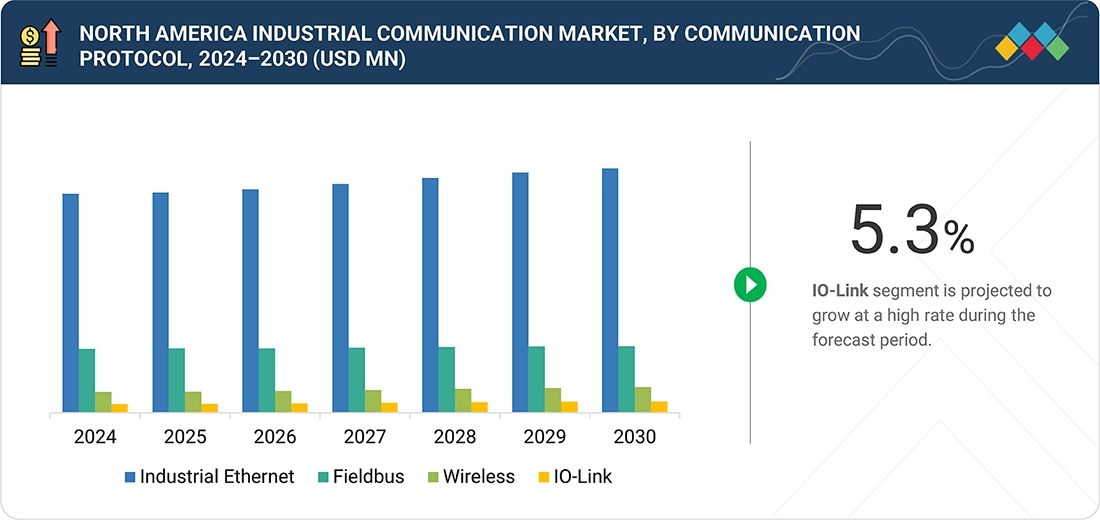
Source: Secondary Research, Interviews with Experts, MarketsandMarkets Analysis
North America Industrial Communication Market, By Offering
The services segment is expected to witness the highest CAGR, as organizations across North America increasingly necessitate integration, deployment, and maintenance support for sophisticated industrial communication networks. Modernizing legacy operational technology (OT) systems and implementing IIoT, cybersecurity, and private 5G solutions requires specialized expertise, thereby promoting substantial service adoption. The continual demands for remote monitoring, predictive maintenance, and lifecycle management further contribute to the rapid expansion of this segment.
North America Industrial Communication Market, By Communication Protocol
Industrial Ethernet is poised to dominate the market because of its high reliability, scalability, and capacity to support real-time data exchange across various industrial operations. As manufacturers move toward Industry 4.0 and implement advanced automation, Ethernet-based protocols like EtherNet/IP and PROFINET are becoming essential infrastructure. Additionally, the increasing use of connected machinery, robotics, and digital twins further solidifies Industrial Ethernet’s leadership in North America.
North America Industrial Communication Market, By Industry
The automotive industry will dominate the market due to its rapid adoption of automation, robotics, and IIoT-enabled production lines across major US and Canadian manufacturing plants. Increasing EV and battery manufacturing capacity further drives demand for high-performance communication networks to support precise processes. Automakers’ focus on real-time quality control, predictive maintenance, and connected factory ecosystems strengthens the automotive sector’s leading position.
REGION
The US is projected to lead the North America industrial communication market during the forecast period
The US is expected to lead the North America industrial communication market due to its strong manufacturing base, rapid adoption of Industry 4.0 technologies, and significant investments in automation and IIoT infrastructure. The country’s robust ecosystem of technology providers, industrial automation companies, and advanced manufacturing facilities speeds up the deployment of high-performance communication networks. Additionally, growth in sectors such as automotive, aerospace, energy, and logistics further enhances the US role as the main driver of market expansion.
NORTH AMERICA INDUSTRIAL COMMUNICATION MARKET: COMPANY EVALUATION MATRIX
In the North America industrial communication market landscape, Cisco Systems, Inc. dominates with its wide-ranging networking portfolio, strong cybersecurity features, and extensive presence in industrial automation and connected manufacturing environments. Its technological strength and large customer base make it the main driver of advanced industrial communication adoption in the region. Belden Inc., as an emerging leader, is quickly growing its influence through robust industrial Ethernet solutions and specialized communication technologies. Its increasing focus on innovation and sector-specific offerings are strengthening its role in North America’s evolving industrial communication ecosystem.
Source: Secondary Research, Interviews with Experts, MarketsandMarkets Analysis
KEY MARKET PLAYERS
- Cisco Systems, Inc. (US)
- Siemens (Germany)
- Rockwell Automation (US)
- OMRON Corporation (Japan)
- Moxa Inc. (Taiwan)
- SICK AG (Germany)
- Schneider Electric (France)
- ABB (Switzerland)
- Belden Inc. (US)
- Honeywell International Inc. (US)
MARKET SCOPE
| REPORT METRIC | DETAILS |
|---|---|
| Market Size in 2024 (Value) | USD 3.70 Billion |
| Market Forecast in 2030 (Value) | USD 4.12 Billion |
| Growth Rate | CAGR of 2.1% from 2025-2030 |
| Years Considered | 2021-2030 |
| Base Year | 2024 |
| Forecast Period | 2025-2030 |
| Units Considered | Value (USD Million/Billion), Volume (Thousand Units) |
| Report Coverage | Revenue forecast, company ranking, competitive landscape, growth factors, and trends |
| Segments Covered |
|
| Regional Scope | North America (US, Canada, Mexico) |
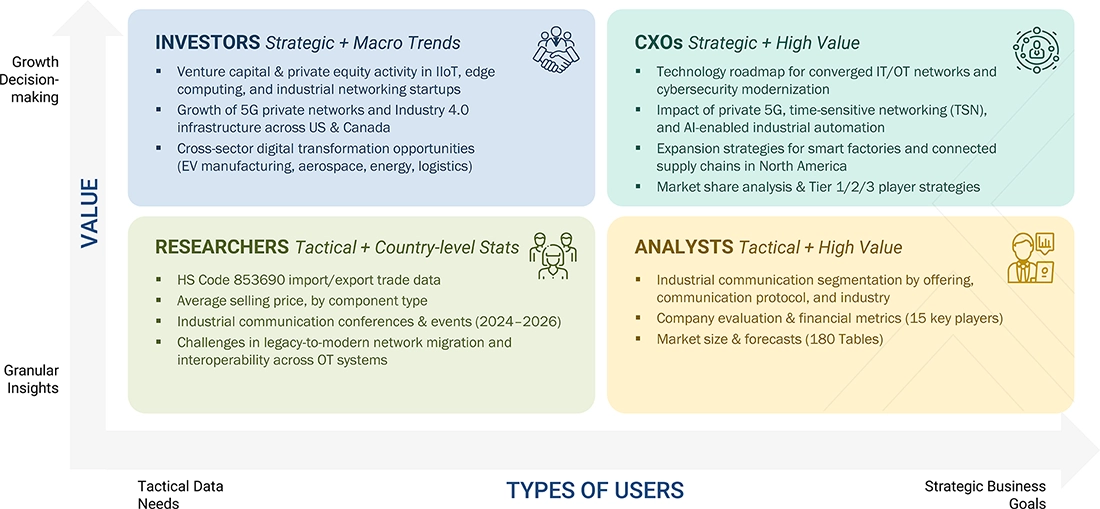
WHAT IS IN IT FOR YOU: NORTH AMERICA INDUSTRIAL COMMUNICATION MARKET REPORT CONTENT GUIDE
DELIVERED CUSTOMIZATIONS
We have successfully delivered the following deep-dive customizations:
| CLIENT REQUEST | CUSTOMIZATION DELIVERED | VALUE ADDS |
|---|---|---|
| Market Mapping of Industrial Communication Technologies |
|
|
| Benchmarking of Key Industrial Communication Vendors |
|
|
| Industry-Specific Opportunity Assessment (Automotive, Energy, Aerospace) | Evaluated digitalization maturity, network modernization needs, and IIoT readiness across major North American manufacturing and infrastructure sectors |
|
| IT–OT Convergence & Network Modernization Study |
|
|
| 5G & Private Wireless Impact Analysis |
|
|
RECENT DEVELOPMENTS
- November 2025: Belden Inc. introduced new industrial-grade connectivity and cybersecurity products, including an Industrial Access Point that supports deterministic, low-latency Wi-Fi 7, along with a range of ruggedized fiber and Ethernet cables designed for automation and smart infrastructure applications across North America and worldwide.
- October 2025: Cisco Systems unveiled its new 8223 AI router, claiming industry-leading bandwidth (51.2 Tb/s), designed to connect AI-heavy data centers across sites and support large-scale, real-time industrial communication needs.
- September 2025: Belden Inc. and distributor RS Components announced the availability of Belden’s DataTuff Industrial Ethernet cables designed for heavy-duty industrial environments. These cables enable high-volume data transfer, robust reliability, and long-term durability, supporting stable networks for IIoT, automation, and mission-critical operations.
- July 2024: Cisco and Rockwell Automation announced a collaboration to accelerate the digital transformation of the industrial market in North America, focusing on integrating secure networking with industrial automation for enhanced connectivity and efficiency in manufacturing environments.
Table of Contents
 Exclusive indicates content/data unique to MarketsandMarkets and not available with any competitors.
Methodology
The study involved major activities in estimating the current market size for the North America Industrial Communication Market. Exhaustive secondary research was done to collect information on the market. The next step was to validate these findings, assumptions, and sizing with industry experts across the value chain using primary research. Different approaches, such as top-down and bottom-up, were employed to estimate the total market size. After that, the market breakup and data triangulation procedures were used to estimate the market size of the segments and subsegments of the North America Industrial Communication Market.
Secondary Research
The secondary research for this study involved gathering information from various credible sources. These included company annual reports, investor presentations, press releases, whitepapers, certified publications, and articles from reputable associations and government publications. Additional data was obtained from corporate filings, professional and trade associations, journals, and industry-recognized authors. Research from consortiums, councils, and gold- and silver-standard websites, directories, and databases also contributed to the qualitative framework. Key global sources such as the International Trade Centre (ITC) and the International Monetary Fund (IMF) were consulted to support and validate the market analysis.
Primary Research
Extensive primary research was accomplished after understanding and analyzing the North America Industrial Communication Market scenario through secondary research. Several primary interviews were conducted with key opinion leaders from demand- and supply-side vendors across North America. Approximately 20% of the primary interviews were conducted with the demand side and 80% with the supply side. Primary data was collected through questionnaires, e-mails, and telephonic interviews. Various departments within organizations, such as sales, operations, and administration, were contacted to provide a holistic viewpoint in the report.
Market Size Estimation
Both top-down and bottom-up approaches were used to estimate and validate the total size of the North America Industrial Communication Market. These methods were also used extensively to estimate the size of various subsegments in the market. The research methodology used to estimate the market size includes the following:
Data Triangulation
After arriving at the overall size of the North America Industrial Communication Market through the process explained above, the overall market has been split into several segments. Data triangulation procedures have been employed to complete the overall market engineering process and arrive at the exact statistics for all the segments, wherever applicable. The data has been triangulated by studying various factors and trends from the demand and supply sides. The market has also been validated using top-down and bottom-up approaches.
Market Definition
Industrial communication is the interaction of information and data between control systems, machines, and human beings within industries, making the operations automated, reliable, and efficient. Industrial communication is the backbone of the modern process industries and manufacturing through real-time monitoring, control, and coordination among equipment and systems. In contrast to general-purpose communications networks, industrial communication systems are intended to fulfill the particular needs of industrial environments, such as high reliability, low latency, and durability under harsh conditions, making them crucial for implementing Industry 4.0 and smart factory strategies.
Key Stakeholders
- Brand Product Manufacturers/Original Equipment Manufacturers (OEMs)/Original Device Manufacturers (ODMs)
- Industrial Communications Product Manufacturers
- Semiconductor Component Suppliers/Foundries
- Industrial Communication Material and Component Suppliers
- Manufacturing Equipment Suppliers
- System Integrators
- Technology/IP Developers
- Consulting and Market Research Service Providers
- Industrial Communications and Material-related Associations, Organizations, Forums, and Alliances
- Venture Capitalists and Startups
- Research and Educational Institutes
- Distributors and Resellers
- End Users
Report Objectives
- To define, describe, and forecast the North America Industrial Communication Market size, by offering, communication protocol, and industry, in terms of value
- To define, describe, and forecast the North America Industrial Communication Market size, by component (gateways and switches), in terms of volume
- To provide detailed insights regarding drivers, restraints, opportunities, and challenges influencing the growth of the market
- To analyze emerging applications and standards in the North America Industrial Communication Market
- To examine manufacturers of industrial communication solutions, their strategies, production plans, and the overall value chain, including material and component suppliers
- To strategically analyze the micromarkets with respect to individual growth trends, prospects, and contributions to the overall market
- To analyze the market opportunities for stakeholders and provide a comprehensive competitive landscape analysis
- To provide a detailed overview of the industrial communication ecosystem
- To provide a detailed overview of the impact of AI/Gen AI, macroeconomic outlook for all regions, and the 2025 US tariff impact on the North America Industrial Communication Market
- To provide information about the key technology trends, trade analysis, and patents related to the North America Industrial Communication Market
- To strategically analyze average selling price trends, trends impacting customer business, regulatory landscape, patent landscape, Porter’s five forces, import and export scenarios, trade landscape, and case studies pertaining to the market under study
- To benchmark the market players using the proprietary company evaluation matrix framework, which analyzes them on various parameters within the broad categories of market ranking/share and product portfolio
- To analyze competitive developments, such as partnerships, acquisitions, expansions, collaborations, and product launches, in the market
- To strategically profile key players and analyze their market share, ranking, and core competencies
Available Customizations
With the market data given, MarketsandMarkets offers customizations according to the company’s specific needs. The following customization options are available for the report:
Company Information
- Detailed analysis and profiling of additional market players (up to 7)
Key Questions Addressed by the Report
What is the projected market size of the North America industrial communication market?
The North America industrial communication market is projected to grow from USD 3.72 billion in 2025 to USD 4.12 billion by 2030, at a CAGR of 2.1%.
Which country dominates the North America industrial communication market?
The United States dominates the market, accounting for the largest share due to strong industrial automation and IIoT adoption.
Which segment by communication protocol leads the market?
The industrial Ethernet segment leads the market due to its reliability, scalability, and ability to support real-time data exchange in smart manufacturing environments.
Which offering segment is expected to grow the fastest?
The services segment is expected to grow at the highest CAGR due to increasing demand for integration, maintenance, and deployment of advanced industrial communication systems.
Who are the key players in the North America industrial communication market?
Key players include Cisco Systems, Siemens, Rockwell Automation, ABB, and Honeywell.


Personalize This Research
- Triangulate with your Own Data
- Get Data as per your Format and Definition
- Gain a Deeper Dive on a Specific Application, Geography, Customer or Competitor
- Any level of Personalization
Let Us Help You
- What are the Known and Unknown Adjacencies Impacting the North America Industrial Communication Market
- What will your New Revenue Sources be?
- Who will be your Top Customer; what will make them switch?
- Defend your Market Share or Win Competitors
- Get a Scorecard for Target Partners

Custom Market Research Services
We Will Customise The Research For You, In Case The Report Listed Above Does Not Meet With Your Requirements
Get 10% Free CustomisationTESTIMONIALS

Tetsuya Ohhira
Business Development Manager-Technology Business
Nikon Corporation,
Leading Japanese MNC specializing in optics and imaging productswww.nikon.com
MarketsandMarkets™ response
is quick. Their attitude is flexible and positive. Analyst Insights are globally considered and
significant. Client Services quickly respond to our inquiry and demand. Their wide range of global
surveys help us make our strategic plan.
We hope Knowledge Store will be easier to search
for a report.
VP - Marketing & Business Development
Leading Provider of Process Control Solutions
We engaged with MarketsandMarkets on a study to perform an analysis and recommend a Go-To-Market strategy for metrology and process control in the semiconductor market. The study was tailored to our targets and needs with well-defined milestones. Our overall experience with the MarketsandMarkets team was very good throughout the project in all aspects including the analysis methodologies used, the quality and depth of primary and secondary data sets, the professionalism and flexibility of the team and the ability to meet the target schedule and milestones. We want to thank MarketsandMarkets team for a job well done.






Growth opportunities and latent adjacency in North America Industrial Communication Market