North America Night Vision Device Market

North America Night Vision Device Market by Product Type (Cameras, Goggles, Scopes, Binoculars & Monoculars), Technology (Thermal Imaging, Image Intensification, Infrared Illumination, Digital Imaging), Mounting (Stationary, Portable) - Forecast to 2030




OVERVIEW
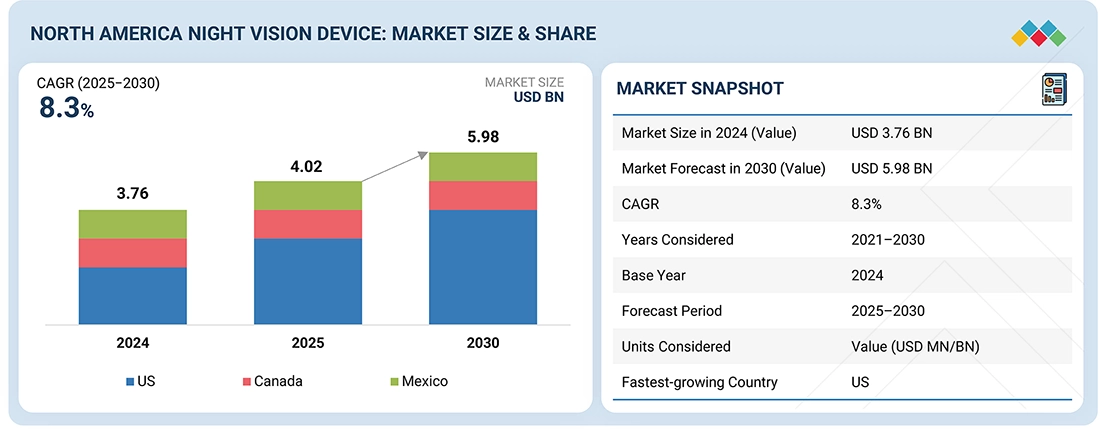
Source: Secondary Research, Interviews with Experts, MarketsandMarkets Analysis
The North America night vision device market is projected to grow from USD 4.02 billion in 2025 to USD 5.98 billion by 2030, registering a CAGR of 8.3%. Market expansion is driven by increasing procurement of night vision and thermal imaging systems for defense modernization, border surveillance, and tactical law enforcement missions across North America. Advancements in digital night-vision, sensor fusion, and AI-assisted threat detection are enhancing situational awareness, targeting accuracy, and mission safety. Additionally, growing federal spending, homeland security programs, and the rising adoption of night-vision technology in commercial security, wildlife monitoring, and outdoor activities continue to accelerate market growth across the region.
Market Size & Forecast
KEY TAKEAWAYS
-
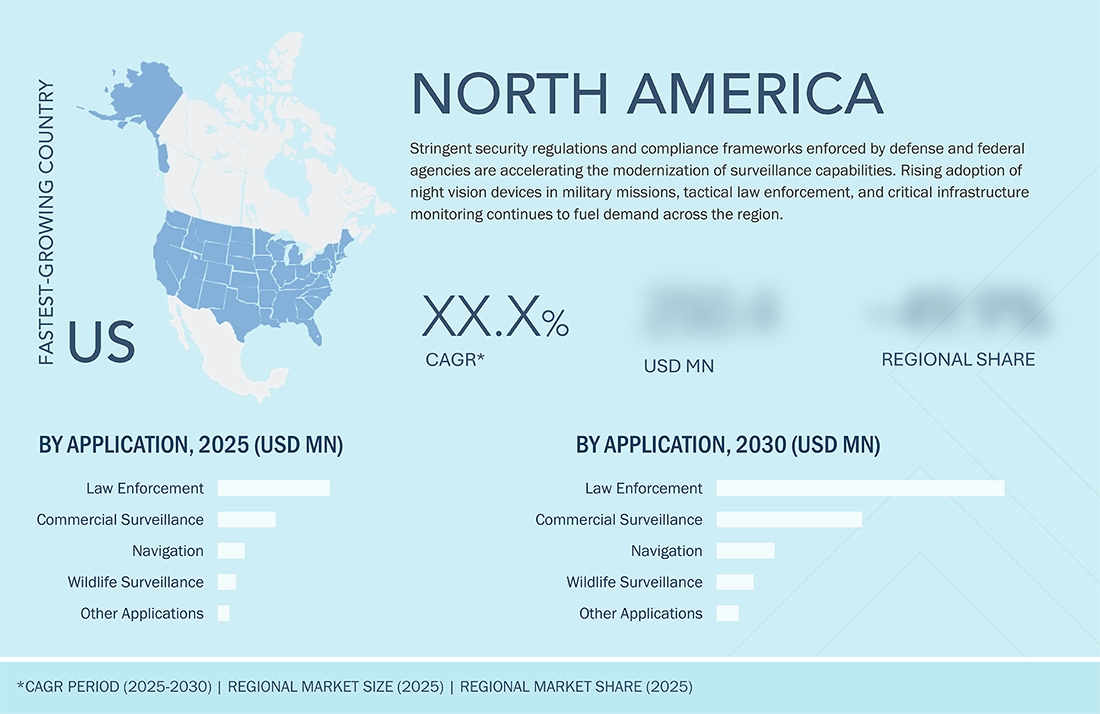
BY COUNTRYThe US leads the North America market in 2024 with a market share of 62.8%.
-
BY APPLICATIONThe law enforcement segment is projected to grow at the highest CAGR of 9.3% from 2025 to 2030.
-
BY DEVICE TYPECameras are projected to witness a high CAGR during the forecast period.
-
COMPETITIVE LANDSCAPETeledyne FLIR LLC and L3Harris Technologies, Inc. were identified as key players in the North America market, given their strong market share and extensive product portfolio.
The North America night vision devices market is poised for strong growth as defense agencies, law enforcement units, and security organizations increasingly adopt advanced imaging solutions for surveillance, border protection, and tactical operations. Rising demand for enhanced low-light visibility and long-range detection is accelerating the deployment of night-vision, thermal, and fusion-based optics across military missions and critical infrastructure monitoring. As national security modernization intensifies and commercial applications expand into wildlife monitoring, search-and-rescue, and outdoor activities, night-vision devices are emerging as a key enabler of high-precision, real-time visibility in challenging environments.
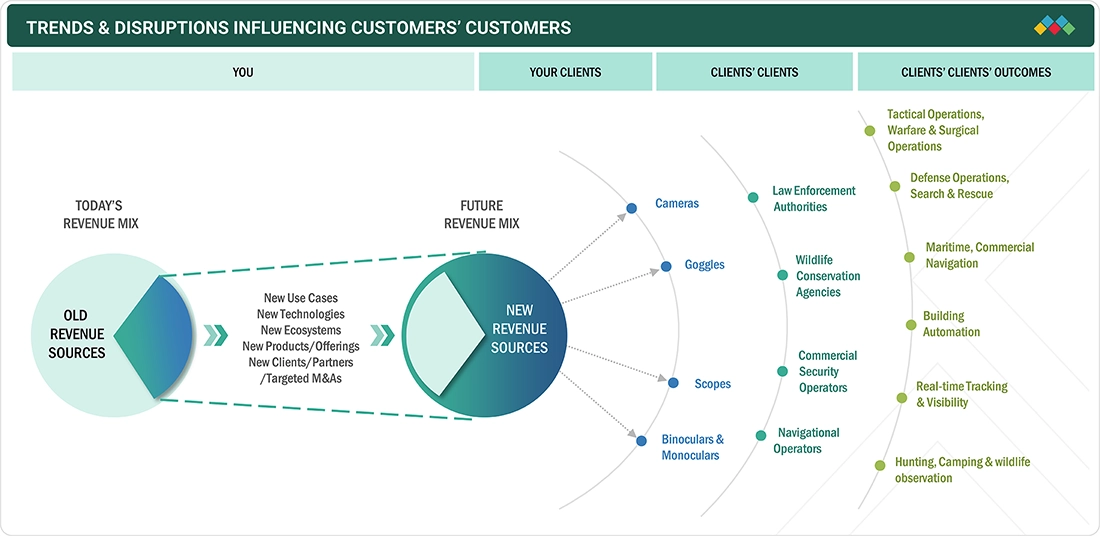
TRENDS & DISRUPTIONS IMPACTING CUSTOMERS' CUSTOMERS
The North America night vision devices market is increasingly transforming customer operations as defense agencies and law enforcement units scale adoption of advanced systems for surveillance, border protection, and mission execution. Military modernization programs in the US and Canada are driving the shift from traditional analog tubes to digital and thermal-fusion optics, improving target identification and operational readiness. AI-enhanced imaging, low-light sensors, and lighter rugged designs are enabling faster decision-making with greater range and clarity in field conditions. The rising deployment of border patrol, critical infrastructure security, and public safety is reducing mission risk, improving response efficiency, and enhancing situational awareness across nighttime operations. This technology evolution is accelerating the adoption of next-generation NV and strengthening long-term demand across North America.
Source: Secondary Research, Interviews with Experts, MarketsandMarkets Analysis
MARKET DYNAMICS

Level
-
Growing law-enforcement and border security initiatives to boost procurement volumes

-
Increasing demand for thermal and multispectral imaging to improve situational awareness


Level
-
High ownership and deployment cost limiting adoption for cost-sensitive agencies and consumers


Level
-
Emerging use-cases in smart cities, infrastructure monitoring, and public safety to widen adoption

-
Rising demand for AI-enabled analytics and software layers to unlock recurring revenue streams


Level
-
Interoperability issues between legacy military systems and modern night vision devices

Source: Secondary Research, Interviews with Experts, MarketsandMarkets Analysis
Driver: Growing law-enforcement and border security initiatives to boost procurement volumes
North America is witnessing increased investment in surveillance and tactical equipment due to heightened border security operations along the US, Mexico, and Canada frontiers. Law enforcement agencies, state police units, and federal departments are upgrading their night-vision systems to enhance patrol efficiency, threat detection, and nighttime response capabilities. This continuous procurement pipeline directly accelerates demand for night-vision devices across the region.
Restraint: High ownership and deployment cost limiting adoption for cost-sensitive agencies and consumers
Advanced thermal and fusion-based night vision systems have high acquisition, maintenance, and lifecycle costs, often limiting their deployment to larger police departments, specialized wildlife units, and select civilian buyers. Budget limitations, particularly in local law enforcement and community security programs, hinder large-scale rollouts. This cost barrier tempers overall adoption despite rising operational need.
Opportunity: Emerging use-cases in smart cities, infrastructure monitoring, and public safety to widen adoption
North America cities are increasingly integrating surveillance, emergency response, and traffic monitoring systems under smart-city frameworks. Night-vision devices offer additional value through round the clock visibility, enabling better incident detection, perimeter security, and crowd monitoring. Growing urban safety initiatives can unlock new commercial demand beyond traditional military and tactical sectors.
Challenge: Interoperability issues between legacy military systems and modern night vision devices
A large inventory of older devices remains active in US military and law enforcement deployments, making integration with digital or fusion-based systems complex and costly. Compatibility limitations in optics, power modules, and data interfaces hinder the transition to new technology. This creates operational friction and delays adoption of next-generation night-vision platforms across North America.
north-america-night-vision-device-market: COMMERCIAL USE CASES ACROSS INDUSTRIES
| COMPANY | USE CASE DESCRIPTION | BENEFITS |
|---|---|---|
 |
Teledyne FLIR offers night vision and thermal imaging solutions for defense, law enforcement, border security, and industrial monitoring applications. Its portfolio includes handheld/weapon-mounted thermal devices, multi-spectral imaging systems, and UAV-compatible payloads. The company also enables integration with surveillance platforms, sensors, and AI-based imaging analytics. | Enhances target detection and situational awareness in low-light environments | Improves mission efficiency with advanced thermal clarity and long-range surveillance | Enables rapid decision-making through real-time imaging, analytics, and system interoperability across ground and aerial platforms |
 |
L3Harris delivers high-performance night vision goggles, binoculars, and fusion-based night vision systems for military and special operations. The company offers rugged, lightweight digital Night Vision Goggles with thermal fusion, augmented reality overlays, and integrated communication support for tactical missions. | Improves soldier mobility and operational readiness during night operations | Reduces risk through high-resolution low-light vision and real-time battlefield awareness | Supports scalable modernization programs with modular, upgradeable systems for defense agencies |
 |
Raytheon develops advanced night vision for surveillance, armored vehicles, and aircraft platforms. Its solutions include long-range thermal sights and multi-sensor targeting units with AI-assisted tracking and detection. | Increases target acquisition accuracy and engagement efficiency | Enhances defense capabilities with long-distance surveillance and precision imaging | Enables multi-domain operational advantage through AI-supported identification and robust platform integration |
Logos and trademarks shown above are the property of their respective owners. Their use here is for informational and illustrative purposes only.
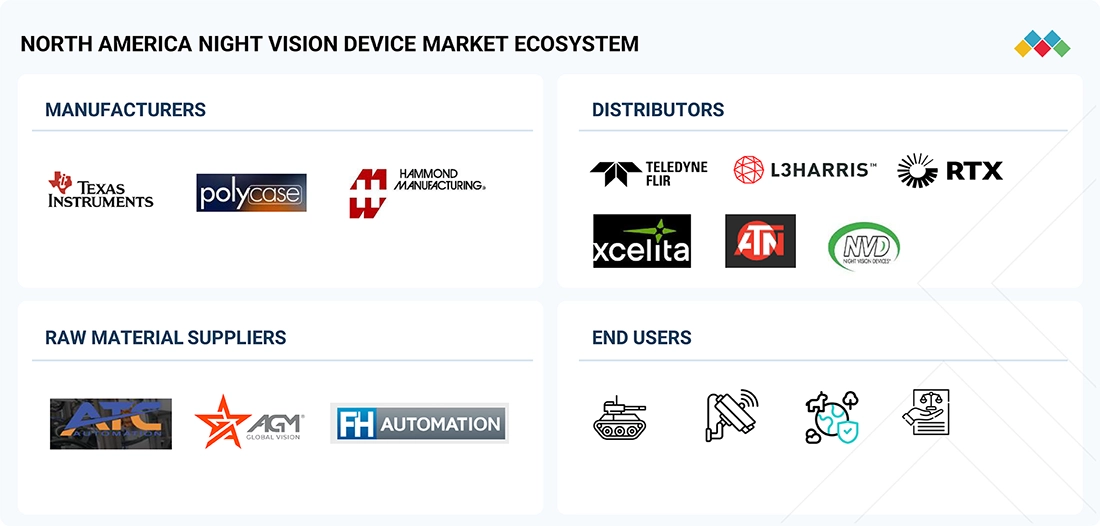
MARKET ECOSYSTEM
The North America Night Vision Devices Market ecosystem consists of an interconnected network of night-vision OEMs, thermal imaging manufacturers, component suppliers, and defense & security end users, enabling advanced low-light operational capabilities. Key device manufacturers and solution providers such as Teledyne FLIR, L3Harris Technologies, Raytheon, SIONYX, deliver night-vision scopes, goggles, monoculars, binoculars, and fused thermal-digital systems for tactical and surveillance applications. Leading end users, including the military, border patrol units, police departments, special forces, and critical infrastructure operators, continue to drive large-scale procurement as they strengthen night-time reconnaissance, perimeter monitoring, and mission readiness. Growing adoption across defense modernization programs, homeland security initiatives, and public-safety operations is accelerating the deployment of advanced night-vision technologies across North America.
Logos and trademarks shown above are the property of their respective owners. Their use here is for informational and illustrative purposes only.
MARKET SEGMENTS

Source: Secondary Research, Interviews with Experts, MarketsandMarkets Analysis
North America Night Vision Device Market, By Device Type
The cameras category leads the North America night-vision devices market due to its critical role in long-range observation, automated surveillance, and evidence-grade imaging. Government agencies and private security operators are increasingly favoring night-vision and thermal cameras for the persistent monitoring of borders, energy facilities, ports, and defense perimeters. The segment also benefits from rapid upgrades in digital night-vision sensors, network-enabled systems, boosting procurement volumes, and recurring retrofit demand across the region.
North America Night Vision Device Market, By Technology
The thermal imaging segment is expected to grow at a significant CAGR in the North America night-vision device market, supported by rising adoption in law enforcement, border patrol, wildfire monitoring, and industrial inspection. Unlike image-intensified devices, thermal systems detect heat signatures, enabling visibility through smoke, fog, and complete darkness. This increasing integration of night vision devices in handheld units, drones, vehicles, and fixed surveillance networks is further accelerating demand, positioning thermal imaging as a rapidly expanding technology segment across the region.
North America Night Vision Device Market, By Application
The law enforcement segment holds the largest share of the North America night-vision devices market, driven by sustained procurement from police departments, special tactical units, highway patrol, and federal investigative agencies. Countries in North America are the base of several law enforcement agencies and aerospace & defense companies. Night-vision cameras, scopes, and wearable goggles are widely used for surveillance, pursuit operations, search and rescue missions, and threat detection in low-light conditions. Strategic funding for the modernization of public safety equipment and increasing deployment of NV and thermal optics in urban policing continue to reinforce this segment’s dominant position in the regional market.
REGION
US to hold largest market share North America Night Vision Device Market during forecast period
The US is expected to hold the largest market share. The country’s position as one of the largest hubs for military & defense, as well as law enforcement, is the main reason for its dominance in the night vision device market. The country is considered one of the most developed in North America, particularly in terms of infrastructure and advanced technologies, including artificial intelligence (AI), the Internet of Things (IoT), and wireless connectivity. These technologies have significantly contributed to advancements in night vision devices. The US has various law enforcement agencies, including the Federal Bureau of Investigation (FBI), the United States Department of Defense (DoD), the Central Intelligence Agency (CIA), and US Customs and Border Protection (CBP). All these factors drive the market growth in the US.
north-america-night-vision-device-market: COMPANY EVALUATION MATRIX
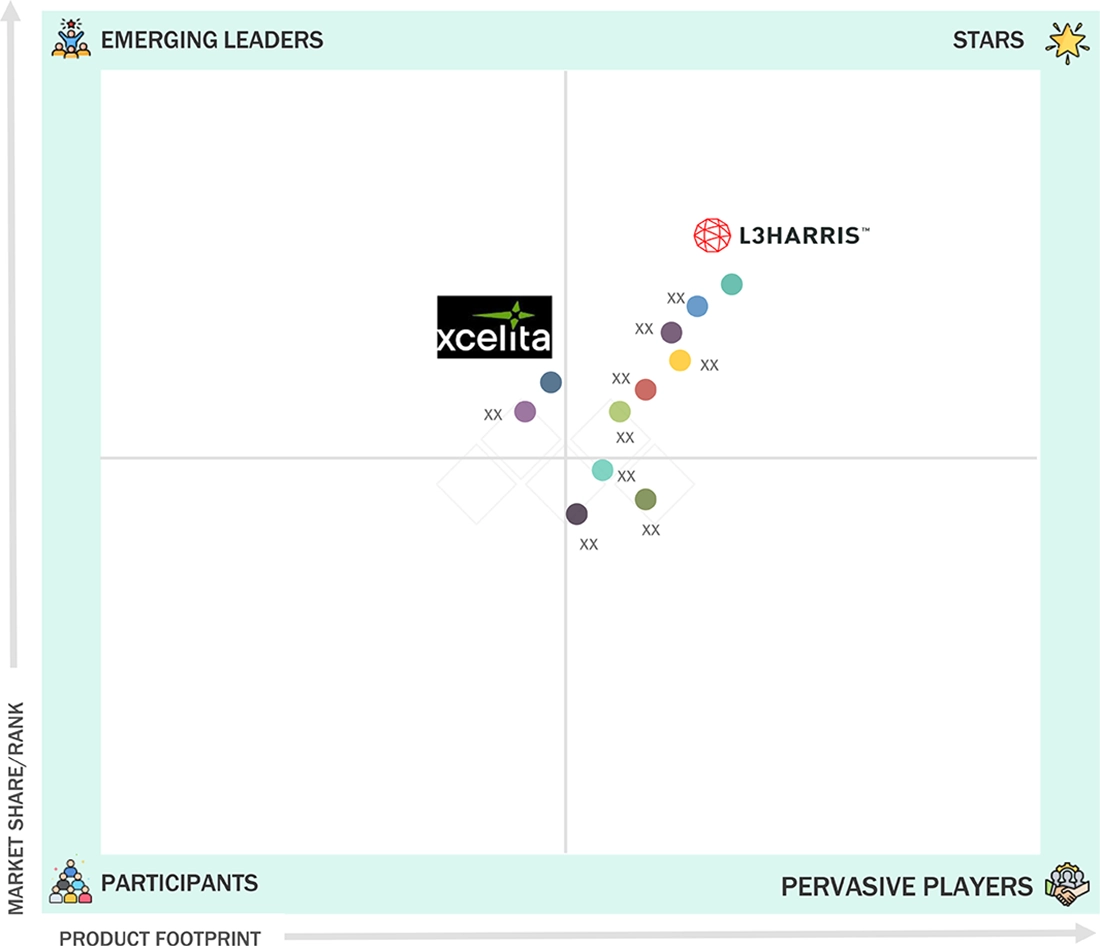
In the North America Night Vision Devices Market matrix, L3Harris (Star) leads with a robust portfolio encompassing advanced image intensification systems, fused thermal-NV goggles, and high-reliability optics. Its strong engagement with US DoD procurement programs, proven battlefield performance, and continuous innovation in lightweight, low-power night-vision modules position the company as a cornerstone supplier in military and homeland security modernization efforts. Excelitas Technologies (Emerging Leader) is strengthening its market position through growing adoption of its infrared illumination components and thermal sensing modules, supported by expanding OEM partnerships and integration into surveillance, imaging, and portable NV devices.
Source: Secondary Research, Interviews with Experts, MarketsandMarkets Analysis
KEY MARKET PLAYERS
- Teledyne FLIR LLC (US)
- L3 Harris Technologies, Inc. (US)
- RTX (US)
- ATN (American Technology Network Corp) (US)
- Excelitas Technologies Corp. (US)
- BAE Sytems (UK)
- Thales (France)
- Leonardo S.p.A. (Italy)
- Lynred (France)
- EOTECH, LLC (US)
MARKET SCOPE
| REPORT METRIC | DETAILS |
|---|---|
| Market Size in 2024 (Value) | USD 3.76 Billion |
| Market Forecast in 2030 (Value) | USD 5.98 Billion |
| Growth Rate | CAGR of 8.3% from 2025-2030 |
| Years Considered | 2021-2030 |
| Base Year | 2024 |
| Forecast Period | 2025-2030 |
| Units Considered | Value (USD Billion) |
| Report Coverage | Revenue forecast, company ranking, competitive landscape, growth factors, and trends |
| Segments Covered |
|
| Countries Covered | US, Canada, Mexico |
WHAT IS IN IT FOR YOU: north-america-night-vision-device-market REPORT CONTENT GUIDE
DELIVERED CUSTOMIZATIONS
We have successfully delivered the following deep-dive customizations:
| CLIENT REQUEST | CUSTOMIZATION DELIVERED | VALUE ADDS |
|---|---|---|
| Border Security & Homeland Surveillance Authority |
|
|
| Commercial Security & Infrastructure Monitoring Firm |
|
|
| Wildlife & Outdoor Equipment Distributor |
|
|
RECENT DEVELOPMENTS
- January 2025 : The US Army awarded L3Harris Technologies, Inc. a USD 263 million order for continued ENVG-B production under the second IDIQ order. The system enhances situational awareness and enables connectivity to the Integrated Tactical Network, providing advanced night-vision capabilities.
- October 2024 : L3Harris and Palantir have entered a strategic partnership to accelerate the development of advanced technologies and drive digital transformation. The collaboration combines L3Harris’ sensors and software-defined systems with Palantir’s Artificial Intelligence Platform (AIP), enhancing resilient connectivity and enabling faster, informed decision-making across joint all-domain operations.
- June 2024 : Teledyne FLIR LLC launched the Hadron 640+ and radiometric Hadron 640R+ dual camera modules with enhanced thermal sensitivity. These ITAR-free, SWaP-optimized systems are designed for integration into unmanned aerial systems (UAS), unmanned ground vehicles (UGVs), and robotic platforms, supporting day and night vision capabilities via dual thermal and visible imaging.
Table of Contents
 Exclusive indicates content/data unique to MarketsandMarkets and not available with any competitors.
Methodology
The research has involved four major steps in estimating the North America Night Vision Device Market size. Exhaustive secondary research has been done to collect important information about the market and peer markets. The next step has been to validate these findings and assumptions and size them with the help of primary research with industry experts across the value chain. Both top-down and bottom-up approaches have been used to estimate the market size. After this, the market breakdown and data triangulation approaches have been adopted to estimate the market sizes of segments and subsegments.
Secondary Research
Various secondary sources have been referred to in the secondary research process to identify and collect the information required for this study. These sources include annual reports, press releases, investor presentations of companies, white papers, and articles from recognized authors. Secondary research has been done to obtain key information about the market’s value chain, the pool of key market players, market segmentation according to industry trends, regional outlook, and developments from market and technology perspectives.
In the North America Night Vision Device Market report, the market size has been estimated using top-down and bottom-up approaches and several other dependent submarkets. The major players in the market have been identified using extensive secondary research, and their presence in the market has been determined using secondary and primary research. All the percentage splits and breakdowns have been determined using secondary sources and verified through primary sources.
Primary Research
Extensive primary research has been conducted after understanding the North America Night Vision Device Market scenario through secondary research. Several primary interviews have been conducted with key opinion leaders from demand- and supply-side vendors across North America. Approximately 40% of the primary interviews have been conducted with the demand-side vendors and 60% with the supply-side vendors. Primary data has been collected mainly through telephonic interviews, which consist of 80% of the total primary interviews; questionnaires and emails have also been used to collect the data.
After successful interaction with industry experts, brief sessions have also been conducted with highly experienced independent consultants to reinforce the findings of our primary research. This, along with the in-house subject-matter experts’ opinions, has led us to the findings as described in the report. The breakdown of primary respondents is as follows:
Market Size Estimation
In the complete market engineering process, top-down and bottom-up approaches and several data triangulation methods have been used to estimate and forecast the overall market segments and subsegments listed in this report. The key players in the market have been identified through secondary research, and their market shares in the respective regions have been determined through primary and secondary research. This entire procedure includes the study of annual and financial reports of the top market players and extensive interviews for key insights (quantitative and qualitative) with industry experts (CEOs, VPs, directors, and marketing executives).
All percentage shares, splits, and breakdowns have been determined using secondary sources and verified through primary sources. All the parameters affecting the markets covered in this research study have been accounted for, viewed in detail, verified through primary research, and analyzed to obtain the final quantitative and qualitative data. This data has been consolidated and supplemented with detailed inputs and analysis from MarketsandMarkets and presented in this report.
Bottom-Up Approach
- Companies offering night vision devices have been identified, and their product mapping with respect to different parameters, such as technology, device type, mounting type, and application, has been carried out.
- The market size has been estimated based on the demand for different types of night vision devices from different industries. The anticipated change in demand for night vision devices offered by these companies and company revenues have been analyzed and estimated.
- Primary research has been conducted with a few major players operating in the North America Night Vision Device Market to validate the market size.
- The size of the North America Night Vision Device Market has then been validated through secondary sources, which include the International Trade Centre (ITC), the World Trade Organization, and the World Economic Forum.
- The CAGR at which the North America Night Vision Device Market is estimated to grow has been calculated considering the historical and future market trends and understanding the adoption rate of night vision devices from different industries.
- The estimates at every level have been verified and cross-checked through discussions with key opinion leaders, such as corporate executives (CXOs), directors, sales heads, and domain experts in MarketsandMarkets.
- Various paid and unpaid information sources, such as company websites, annual reports, press releases, research journals, magazines, white papers, and databases, have also been studied.
Top-Down Approach
- Focusing initially on the R&D investments and expenditures made in the night vision devices ecosystem, and further splitting the market based on technology, device type, mounting type, application, and region and listing the key developments
- Identifying leading players in the North America Night Vision Device Market through secondary research and verifying them through brief discussions with industry experts
- Analyzing revenue, product mix, geographic presence, and key industries for which all identified players serve products to estimate and arrive at percentage splits for all key segments
- Discussing splits with industry experts to validate the information and identify key growth pockets across all key segments
- Breaking down the total market based on verified splits and key growth pockets across all segments
Data Triangulation
After arriving at the overall market size from the estimation process explained above, the overall market has been split into several segments and subsegments. The data triangulation procedure has been employed wherever applicable to complete the overall market engineering process and arrive at the exact statistics for all segments and subsegments. The data has been triangulated by studying various factors and trends from both the demand and supply sides. Additionally, the market size has been validated using top-down and bottom-up approaches.
Market Definition
A night vision device is an electro-optic instrument designed to enhance a person's ability to see in low-light or night-time conditions, where natural light is insufficient for human vision. These devices capture and amplify available light or other forms of electromagnetic radiation, such as infrared or thermal radiation, to make objects and scenes visible in the dark. They utilize various technologies, including image intensification, thermal imaging, and digital and infrared illumination, to capture and amplify existing ambient light or thermal radiation, making objects visible in the dark. Examples of night vision devices include night vision goggles, monoculars, binoculars, scopes, and cameras. They are used in various fields, such as night driving or flying, night security & surveillance, law enforcement, military, navigation, entertainment, hidden-object detection, wildlife observation, and search & rescue.
Key Stakeholders
- Night vision device manufacturers
- Night vision device suppliers
- Night vision device integrators
- Night vision device distributors
- Technology investors
- Governments and financial institutions
- Research organizations
- Analysts and strategic business planners
- Venture capitalists, private equity firms, and startups
- Aerospace & defense institutes and universities
- Component suppliers and distributors
- Logistics and shipment companies
Report Objectives
- To define, describe, and forecast the North America Night Vision Device Market based on technology, device type, mounting type, application, and region, in terms of value
- To forecast the North America Night Vision Device Market based on technology, device type, and application, in terms of volume
- To provide detailed information regarding the major drivers, restraints, opportunities, and challenges influencing market growth
- To strategically analyze micromarkets with respect to individual growth trends, prospects, and contributions to the total market
- To study the complete value chain and allied industry segments, and perform a market value chain analysis
- To strategically profile the key players and comprehensively analyze their market shares and core competencies
- To provide ecosystem analysis, case study analysis, patent analysis, technology analysis, pricing analysis, Porter’s five forces analysis, key stakeholders and buying criteria, key conferences and events, regulatory landscape, and US tariff impact analysis
- To analyze the opportunities for stakeholders and describe the competitive landscape of the market
- To analyze competitive developments, such as collaborations, agreements, contracts, partnerships, mergers and acquisitions, and product launches in the market
Available Customizations
With the given market data, MarketsandMarkets offers customizations according to the specific requirements of companies. The following customization options are available for the report:
- Detailed analysis and profiling of additional market players based on various blocks of the supply chain
Key Questions Addressed by the Report
What is the projected market size of the North America night vision device market?
The North America night vision device market is projected to grow from USD 4.02 billion in 2025 to USD 5.98 billion by 2030, at a CAGR of 8.3%
Which country leads the North America night vision device market?
The United States leads the market, accounting for the largest share due to strong defense and law enforcement investments.
Which segment by device type is expected to grow significantly?
The cameras segment is expected to witness strong growth due to its widespread use in surveillance, border monitoring, and long-range observation.
Which application segment dominates the market?
The law enforcement segment dominates the market due to increasing demand for surveillance, public safety, and tactical operations.
Who are the key players in the North America night vision device market?
Key players include Teledyne FLIR LLC, L3Harris Technologies, RTX Corporation, Excelitas Technologies, and BAE Systems.


Personalize This Research
- Triangulate with your Own Data
- Get Data as per your Format and Definition
- Gain a Deeper Dive on a Specific Application, Geography, Customer or Competitor
- Any level of Personalization
Let Us Help You
- What are the Known and Unknown Adjacencies Impacting the North America Night Vision Device Market
- What will your New Revenue Sources be?
- Who will be your Top Customer; what will make them switch?
- Defend your Market Share or Win Competitors
- Get a Scorecard for Target Partners

Custom Market Research Services
We Will Customise The Research For You, In Case The Report Listed Above Does Not Meet With Your Requirements
Get 10% Free CustomisationTESTIMONIALS

Tetsuya Ohhira
Business Development Manager-Technology Business
Nikon Corporation,
Leading Japanese MNC specializing in optics and imaging productswww.nikon.com
MarketsandMarkets™ response
is quick. Their attitude is flexible and positive. Analyst Insights are globally considered and
significant. Client Services quickly respond to our inquiry and demand. Their wide range of global
surveys help us make our strategic plan.
We hope Knowledge Store will be easier to search
for a report.
VP - Marketing & Business Development
Leading Provider of Process Control Solutions
We engaged with MarketsandMarkets on a study to perform an analysis and recommend a Go-To-Market strategy for metrology and process control in the semiconductor market. The study was tailored to our targets and needs with well-defined milestones. Our overall experience with the MarketsandMarkets team was very good throughout the project in all aspects including the analysis methodologies used, the quality and depth of primary and secondary data sets, the professionalism and flexibility of the team and the ability to meet the target schedule and milestones. We want to thank MarketsandMarkets team for a job well done.






Growth opportunities and latent adjacency in North America Night Vision Device Market