North America Precision Farming Market

North America Precision Farming Market by Automation & Control Systems, Cloud-based Software, System Integration & Consulting Services, Guidance Technology, Variable Rate Technology, Yield Monitoring, Variable Rate Application - Forecast to 2032




OVERVIEW
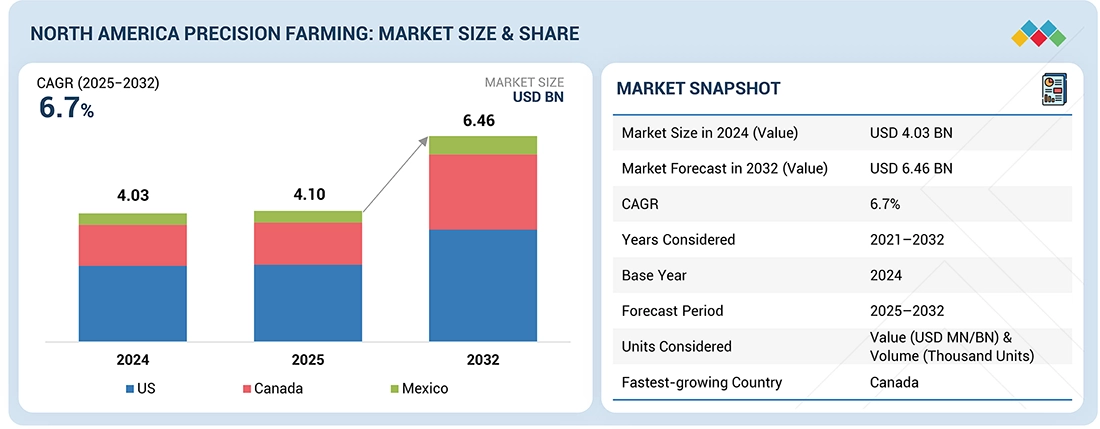
Source: Secondary Research, Interviews with Experts, MarketsandMarkets Analysis
The North America precision farming market size is projected to grow from USD 4.10 billion in 2025 to USD 6.46 billion by 2032, at a CAGR of 6.7%. Growth is driven by labour shortages, climate variability, and the need to boost crop productivity. The rapid adoption of IoT sensors, GPS/GNSS guidance, AI-based analytics, drones, and variable-rate technology is accelerating the shift toward automated, data-driven farming. Government support through USDA programs, broadband expansion, and sustainability initiatives further strengthens adoption. Emerging opportunities in autonomous machinery, carbon-smart farming, and advanced soil and crop monitoring are continuing to shape the region’s transition toward connected digital agriculture.Explore the US Precision Farming Market size, share, and trends in North America, highlighting technology adoption, yield optimization, and sustainable farming growth.
Market Size & Forecast
KEY TAKEAWAYS
-
By CountryThe US precision farming market accounted for a 68.6% revenue share in 2024.
-
By OfferingBy offering, the software segment is expected to register the highest CAGR of 9.7%.
-
By TechnologyBy technology, the guidance technology segment dominated the market in 2024.
-
By ApplicationBy application, the weather tracking & forecasting segment is expected to grow at the highest CAGR of 9.5% during the forecast period.
-
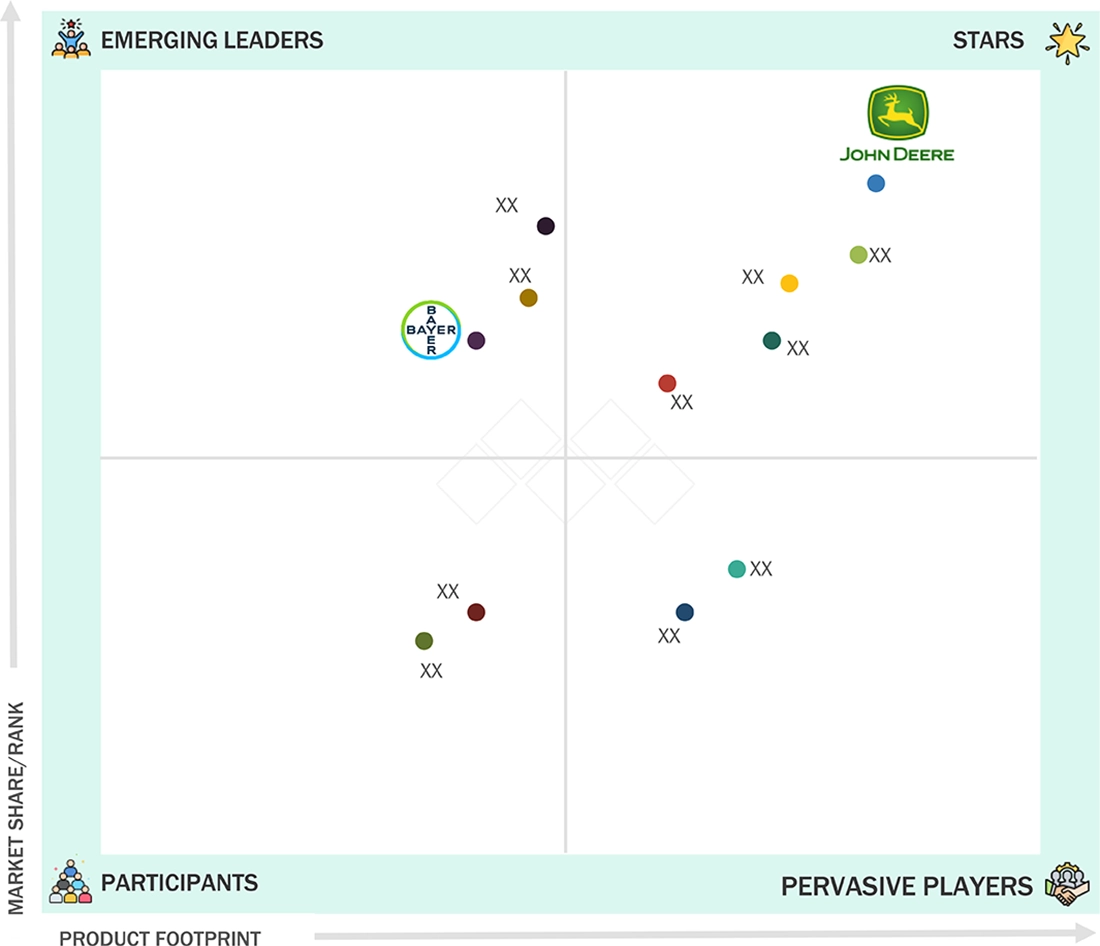
Competitive LandscapeJohn Deere, Trimble, AGCO Corporation, CNH Industrial, and Topcon were identified as some of the star players in the precision farming market (North America), given their strong market share and product footprint.
-
Competitive LandscapeStartups such as Farmers Edge, Sentera, Taranis, Hummingbird Technologies, and Augmenta have gained traction in precision farming by building strong capabilities in advanced sensing, real-time analytics, and AI-driven diagnostics, highlighting their potential as emerging market leaders.
The North America precision farming market share is witnessing steady expansion, driven by the region’s strong adoption of GPS/GNSS guidance systems, IoT-based sensors, autonomous machinery, and data-driven decision-support tools. Farmers across the US and Canada are increasingly adopting precision technologies to optimize inputs, address labor shortages, and improve yield performance amid rising climate variability. New developments such as partnerships between equipment OEMs, agritech software providers, and drone imaging companies are accelerating digital integration on farms. Investments in AI-powered analytics, variable rate technology, and advanced soil and crop monitoring systems are further transforming the region’s agricultural landscape, pushing North America toward more connected, efficient, and sustainable farming practices.
TRENDS & DISRUPTIONS IMPACTING CUSTOMERS' CUSTOMERS
The impact on consumers’ business in the North American precision farming market stems from evolving grower needs and technology-driven disruptions. Large commercial farms, cooperatives, and agribusinesses are the primary users of precision farming solutions, with a focus on yield optimization, input efficiency, and automation as key areas of emphasis. Shifts toward autonomous machinery, AI-driven agronomy, remote sensing, and digital field monitoring have a significant influence on farm productivity, operational costs, and decision-making. Increasing sustainability requirements and improvements in connectivity further shape adoption patterns. These changes, in turn, drive demand for advanced precision farming platforms, variable rate technologies, and integrated hardware–software ecosystems, reshaping the region’s agricultural growth trajectory.
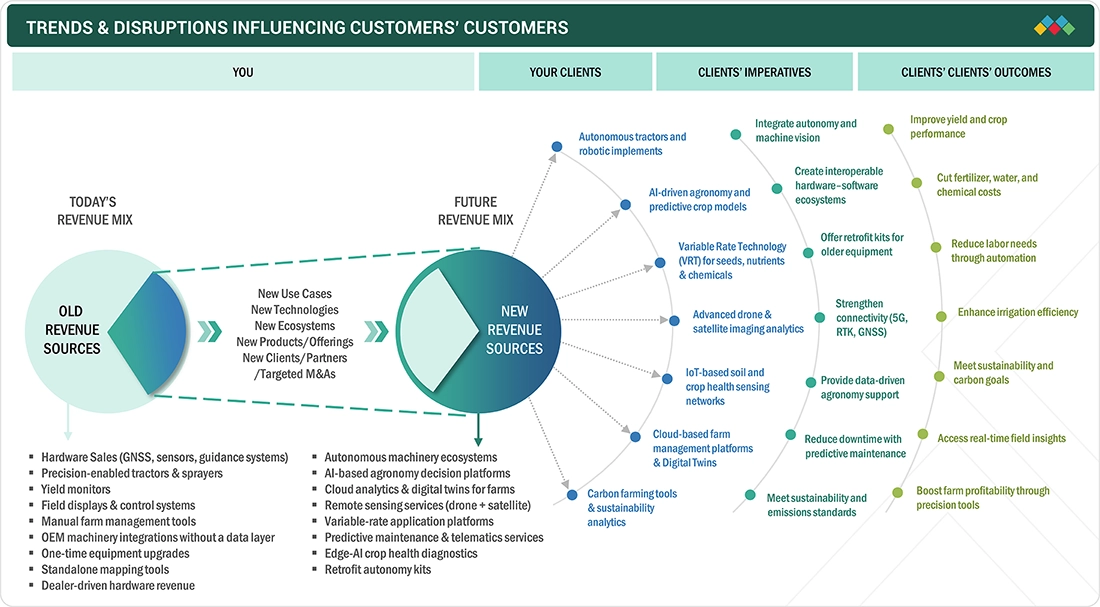
Source: Secondary Research, Interviews with Experts, MarketsandMarkets Analysis
MARKET DYNAMICS

Level
-
Technological advancements fueling data-driven and efficient farming

-
Growing emphasis on sustainable agricultural practices


Level
-
High initial investment and technology costs

-
Lack of technical knowledge and skilled workforce


Level
-
Adoption of variable rate application (VRA) in precision farming

-
Increasing use of data analytics to optimize farming operations


Level
-
Lack of standardized policies and regulations

-
Data privacy issues and security concerns

Source: Secondary Research, Interviews with Experts, MarketsandMarkets Analysis
Driver: Technological advancements fueling data-driven and efficient farming
Technological innovation is a major growth driver in the North American precision farming market. Farmers are rapidly adopting GNSS/GPS guidance systems, IoT-based soil and crop sensors, drones, and AI-driven analytics to improve field accuracy and optimize input use. These technologies enable real-time insights, automated operations, and smarter resource allocation, helping growers reduce waste and maximize productivity. Advancements in cloud-based farm management platforms, digital twins, and autonomous machinery are further pushing the region toward highly connected and data-driven agriculture, significantly enhancing operational efficiency across large and small farms.
Restraint: High installation and monitoring costs
Despite strong adoption potential, the high upfront cost of precision farming systems remains a significant barrier, particularly for small and mid-sized farms. Hardware components, such as GNSS receivers, advanced sensors, drones, and variable-rate equipment, require substantial investment, along with ongoing maintenance and subscription fees for analytics platforms. Connectivity infrastructure—especially in rural areas—further adds to deployment costs. As a result, many growers hesitate to transition to fully integrated precision systems, slowing market expansion in cost-sensitive segments across North America.
Opportunity: Adoption of variable rate application (VRA) in precision farming
Variable Rate Application (VRA) presents a strong growth opportunity in North America as farmers seek to optimize input use amid rising fertilizer and chemical costs. VRA enables zone-based application of seeds, nutrients, and pesticides, improving efficiency and reducing environmental impact. Integration of AI-generated prescription maps, soil analytics, and sensor-based adjustments is making VRA more accurate and accessible. As sustainability pressures increase and input prices fluctuate, VRA adoption is expected to accelerate, creating substantial opportunities for equipment manufacturers, software providers, and agronomy service firms.
Challenge: Lack of standardized policies and regulations
The absence of uniform standards and regulatory frameworks poses a significant challenge to the adoption of precision farming in US. Data ownership, privacy concerns, interoperability between platforms, and inconsistent guidelines for digital agriculture technologies create uncertainty for both farmers and technology providers. Variation in state-level agricultural policies, broadband expansion programs, and sustainability requirements further complicate deployment. Without clearer, standardized regulations, stakeholders face difficulties in integrating systems seamlessly and scaling precision farming solutions across diverse farming operations.
NORTH AMERICA PRECISION FARMING MARKET: COMMERCIAL USE CASES ACROSS INDUSTRIES
| COMPANY | USE CASE DESCRIPTION | BENEFITS |
|---|---|---|
 |
Cargill-supported growers utilize drone fleets and satellite multispectral imagery to detect early-stage stress, pest pressure, and nutrient deficiencies across thousands of acres. AI-based algorithms analyze imagery to create prescription maps for targeted interventions. | Earlier issue detection, reduced crop loss, optimized chemical usage, and improved yield consistency across contracted farms. |
 |
Row-crop growers deploy Variable Rate Technology (VRT) using historical yield maps, soil electrical conductivity data, and real-time sensor data. VRT-enabled fertilizer rigs tailor nutrient application to each field zone, ensuring the right dose in the right place. | 15–25% savings in fertilizer costs, improved nutrient efficiency, healthier soil structure, and increased profitability per acre. |
 |
Cranberry growers deploy AI-driven field analytics, drone-based mapping, and bog-level microclimate sensors to optimize bloom timing, forecast yield, and schedule harvest windows accurately. Connected harvest machinery ensures uniform fruit quality. | Improved berry size and color, reduced timing-related losses, and increased market-grade output. |
 |
Berry farms use computer-vision systems mounted on scouting vehicles and drones to assess plant health, berry ripeness, canopy density, and disease hotspots. Automated alerts help growers intervene precisely where needed. | Enhanced quality control, reduced pesticide application, and improved harvest planning for premium-grade berries. |
 |
Mixed-crop growers adopt advanced farm management platforms integrating equipment data, crop models, weather intelligence, and in-field scouting reports. Decision-support dashboards guide day-to-day operational planning and input allocation. | Stronger operational efficiency, reduced equipment downtime, and improved profitability through unified digital farm management. |
Logos and trademarks shown above are the property of their respective owners. Their use here is for informational and illustrative purposes only.
MARKET ECOSYSTEM
The North America precision farming ecosystem comprises a strong network of R&D institutes, hardware manufacturers, software innovators, and major equipment OEMs working together to advance digital agriculture. Universities and research bodies drive innovation in remote sensing, soil science, and automation, while hardware component providers supply sensors, GPS units, drones, and imaging systems. Software companies enable AI-driven analytics and farm management platforms, and leading OEMs, such as John Deere, Trimble, AGCO, and CNH Industrial, integrate these technologies into connected, autonomous farming solutions.
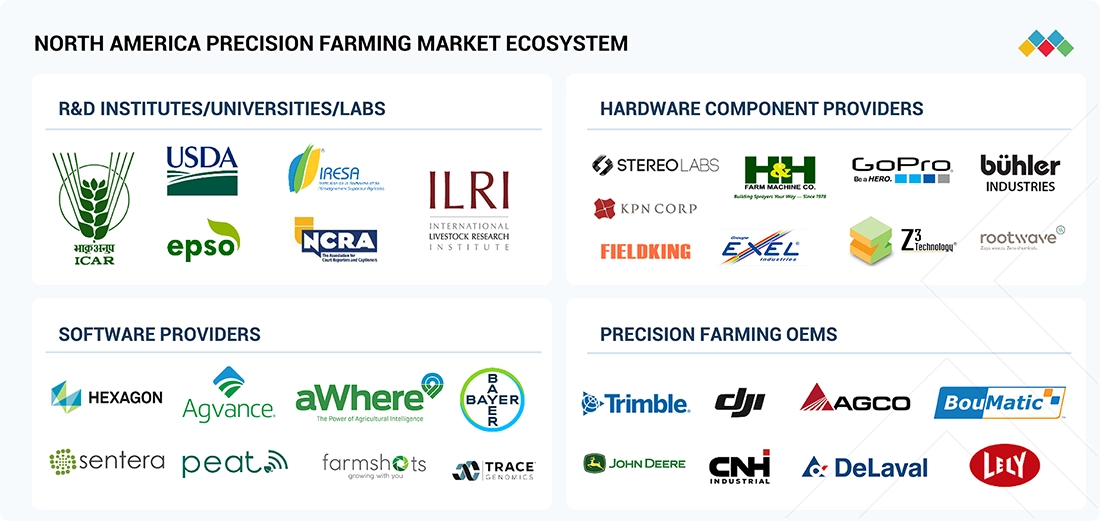
Logos and trademarks shown above are the property of their respective owners. Their use here is for informational and illustrative purposes only.
MARKET SEGMENTS
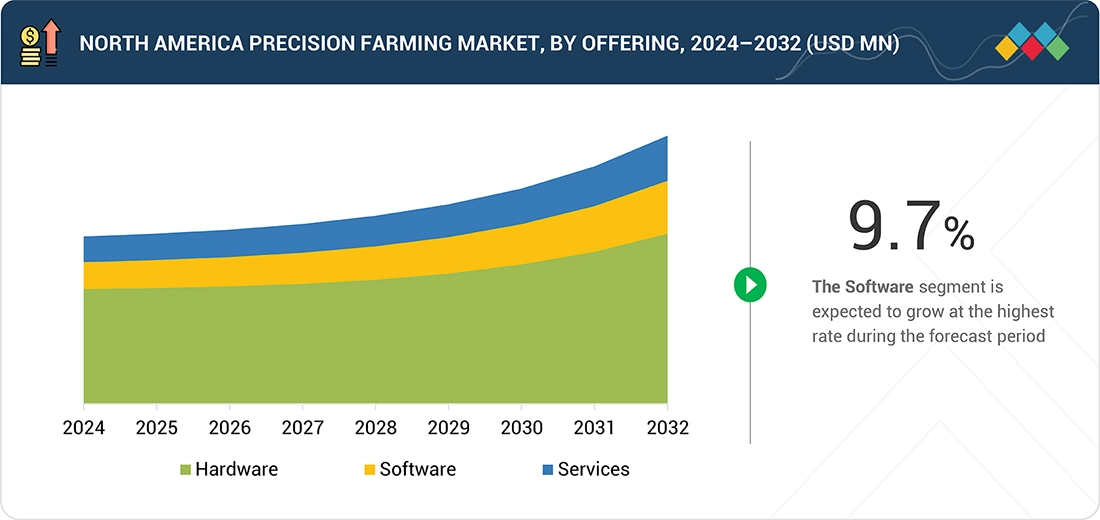
Source: Secondary Research, Interviews with Experts, MarketsandMarkets Analysis
North America Precision Farming Market, By Offering
As of 2024, hardware accounted for the largest share of the North American precision farming market, driven by strong adoption of GNSS/GPS receivers, sensors, automation controllers, and field monitoring devices across large commercial farms. Despite its dominant base, software is projected to be the fastest-growing segment through 2032, supported by rising demand for cloud-based farm management platforms, AI-driven agronomy tools, and real-time analytics. Precision farming services are also expanding steadily as growers seek expert advisory, system integration, and predictive maintenance support. Together, these offerings reflect a shift from equipment-led adoption to integrated digital ecosystems that enhance productivity and resource efficiency.
North America Precision Farming Market, By Technology
Guidance technology held the largest share of the North America precision farming market, supported by widespread adoption of GPS/GNSS-based steering systems and auto-guidance solutions across large-scale farms. While guidance tools remain foundational for reducing overlaps and improving operational accuracy, variable rate technology (VRT) is projected to be the fastest-growing segment through 2032. Its strong outlook is driven by increasing demand for precise input application, soil variability mapping, and nutrient optimization. Remote sensing technologies—including drone imaging and satellite analytics—are also expanding rapidly as growers prioritize data-rich insights for real-time crop monitoring and decision-making. Together, these technologies are accelerating the region’s transition toward fully digital, automated, and resource-efficient agriculture.
North America Precision Farming Market, By Application
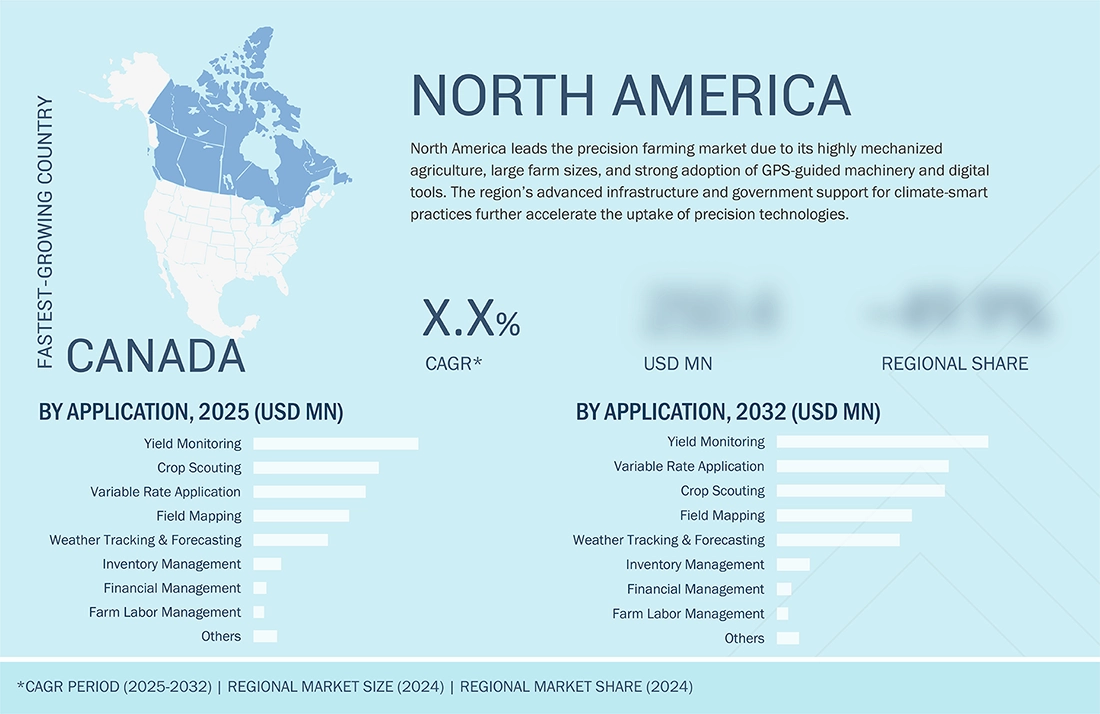
Yield monitoring accounted for the largest share of the North America precision farming market size and will continue to lead through 2032, supported by strong adoption of yield sensors, GPS-enabled combines, and data-driven harvest analytics. Yield monitoring remains crucial for assessing field performance and informing input decisions. However, weather tracking & forecasting is projected to be the fastest-growing application, driven by rising climate variability and the need for real-time weather intelligence. Field mapping and variable rate application (VRA) are also expanding steadily as farmers adopt soil mapping, nutrient modeling tools, and prescription-based input management. These applications collectively support the region’s transition toward predictive, efficient, and climate-resilient farming.
REGION
The US accounts for the largest market share in the North America precision farming market during forecast period
North America leads the precision farming market, driven by advanced agricultural infrastructure, high technology adoption, and strong support programs for digital agriculture. The US precision farming accounts for the largest market share, supported by its extensive commercial farming operations, widespread use of GPS/GNSS guidance systems, AI-enabled analytics, variable-rate technology, and a strong OEM presence from companies such as John Deere, Trimble, AGCO, and CNH Industrial. Canada, meanwhile, is the fastest-growing market in the region, benefiting from rapid digitalization of agriculture, government-backed sustainability programs, and increasing adoption of remote sensing, soil monitoring, and autonomous machinery. The region’s focus on addressing labor shortages, improving resource efficiency, and meeting carbon neutrality targets further accelerates the adoption of precision farming across both countries, reinforcing North America’s position as the most mature and innovation-driven market globally.
NORTH AMERICA PRECISION FARMING MARKET: COMPANY EVALUATION MATRIX
In the North American precision farming market size matrix, John Deere (Star) leads with a dominant market share and an expansive product footprint, supported by its advanced guidance systems, autonomous machinery, and integrated digital farming platforms, which are widely adopted across large commercial farms. AGCO and Trimble (Emerging Leaders) are strengthening their position with specialized precision technologies, including VRT platforms, GNSS solutions, and interoperable data ecosystems that cater to a diverse range of farm sizes. While John Deere continues to lead through scale, innovation, and a comprehensive equipment–software ecosystem, companies such as AGCO and Trimble demonstrate strong potential to move further toward the leaders’ quadrant as demand accelerates for automation, AI-driven agronomy, and connected farm solutions across the region.
Source: Secondary Research, Interviews with Experts, MarketsandMarkets Analysis
KEY MARKET PLAYERS
- Deere & Company (US)
- Trimble Inc. (US)
- AGCO Corporation (US)
- Raven Industries, Inc. (US)
- CNH Industrial (UK/Netherlands)
- Ag Leader Technology (US)
- Topcon Agriculture (Japan/US)
- Climate LLC (US)
- Kubota Corporation (Japan)
- TeeJet Technologies (US)
- Lutron (US)
- Farmers Edge Inc. (Canada)
- DroneDeploy (US)
- Sentera, Inc. (US)
- AeroVironment, Inc. (US)
MARKET SCOPE
| REPORT METRIC | DETAILS |
|---|---|
| Market Size in 2025 (Value) | USD 4.10 Billion |
| Market Forecast in 2032 (Value) | USD 6.46 Billion |
| Growth Rate | CAGR of 6.7% from 2025-2032 |
| Years Considered | 2021-2032 |
| Base Year | 2024 |
| Forecast Period | 2025-2032 |
| Units Considered | Value (USD Million/Billion) & Volume (Thousand Units) |
| Report Coverage | Revenue forecast, company ranking, competitive landscape, growth factors, and trends |
| Segments Covered |
|
| Regions Covered | North America (US, Canada, Mexico) |
WHAT IS IN IT FOR YOU: NORTH AMERICA PRECISION FARMING MARKET REPORT CONTENT GUIDE
DELIVERED CUSTOMIZATIONS
We have successfully delivered the following deep-dive customizations:
| CLIENT REQUEST | CUSTOMIZATION DELIVERED | VALUE ADDS |
|---|---|---|
| Leading Farm Equipment OEM | Competitive benchmarking of precision agriculture hardware (GNSS guidance systems, sensors, variable-rate controllers) across US/Canada |
|
| Agritech Software Platform |
|
|
| Drone & Imagery Provider |
|
|
| Irrigation Technology Manufacturer |
|
|
| Input Supplier (Seed/Fertilizer/Chemical) |
|
|
RECENT DEVELOPMENTS
- May 2025 : The partnership between CNH Industrial N.V. and Starlink provided satellite internet access to farmers in remote areas, enhancing precision farming technologies through autonomous tractors and AI-driven weed detection, utilizing Starlink’s network of over 7,000 satellites for real-time data and cloud operations.
- March 2025 : Deere & Company launched SmartDetect Digital, a safety system for mid-size and large wheel loaders that uses stereo cameras and machine learning to detect people and objects, send instant alerts, and connect with the John Deere Operations Center for weekly insights and near-miss reports.
- February 2025 : Ag Leader Technology introduced RightPath, a passive implement steering system that utilizes tractor guidance lines to steer implements, enhancing input accuracy, reducing crop damage and operator fatigue, and supporting multiple GPS correction sources.
- February 2025 : Topcon Agriculture partnered with Bonsai Robotics to enhance precision farming for permanent crops by combining Bonsai’s vision-based navigation with Topcon’s autosteering and telematics systems for automated operations, data-driven decisions, and advanced harvesting.
- August 2024 : Bayer AG introduced FieldView Drive 2.0, offering faster and more secure real-time wireless data transfer and prescription delivery to equipment, enhancing efficiency, compatibility, and supporting Bayer’s focus on sustainable digital farming.
Table of Contents
 Exclusive indicates content/data unique to MarketsandMarkets and not available with any competitors.
Methodology
The study involved major activities in estimating the current size of the North America Precision Farming Market. Exhaustive secondary research has been done to collect information on the market, peer market, and parent market. To validate these findings, assumptions, and sizing with industry experts across the supply chain through primary research has been the next step. Both top-down and bottom-up approaches have been employed to estimate the complete market size. After that, market breakdown and data triangulation methods have been used to estimate the market size of segments and subsegments. Secondary and primary sources have been used to identify and collect information for an extensive technical and commercial study of the North America Precision Farming Market.
Secondary Research
Secondary research for this study involved gathering information from various credible sources such as company reports, white papers, journals, and industry publications. This process helped in understanding the supply and value chains, identifying key players, analyzing market segmentation and regional trends, and tracking major market and technology developments. The data collected was used to estimate the overall market size, which was later validated through primary research.
Primary Research
Extensive primary research was conducted after gaining knowledge about the current scenario of the North America Precision Farming Market through secondary research. This primary data was collected through questionnaires, emails, and telephonic interviews.
Market Size Estimation
The bottom-up procedure has been employed to arrive at the overall size of the North America Precision Farming Market.
- Analyzed major precision farming hardware, software, and service providers, studied their portfolios, and understood products/solutions/services based on their features and functions
- Analyzed the segmental revenue and scope revenue of the companies profiled in the study
- Arrived at the North America Precision Farming Market size by adding the scope revenue of key manufacturers in the market
- Conducted multiple discussions with key opinion leaders to understand different precision farming offering (hardware, software, and service), technology, applications, and current trends in the market, and analyzed the breakup of the scope of study by major precision farming hardware, software, and service providers
The top-down approach has been used to estimate and validate the total size of the North America Precision Farming Market.
- The size of the North America Precision Farming Market was estimated through the data sanity of major companies offering precision farming products/solutions/services.
- The country-level penetration split was analyzed for each region to estimate the market size.
- The market size for the Europe offering (hardware, software, and service) was determined by understanding the penetration split of each offering in each region.
- The market size for the Europe application segments was estimated by analyzing the penetration split of each offering for each application.
- The market size for the Europe technology segments was estimated by analyzing the penetration split of each offering for each technology.
Data Triangulation
After arriving at the overall market size using the market size estimation processes as explained above, the market has been split into several segments and subsegments. To complete the entire market engineering process and arrive at the exact statistics of each market segment and subsegment, data triangulation and market breakdown procedures have been employed, wherever applicable. The data has been triangulated by studying various factors and trends from the demand and supply sides in the North America Precision Farming Market.
Market Definition
Precision farming, also referred to as precision agriculture, is a modern farm management approach that utilizes advanced technologies to monitor and enhance agricultural operations. It focuses on aligning field inputs with specific crop requirements. Technologies such as satellite positioning systems, including global positioning system (GPS), remote sensing, and variable rate technology (VRT), are used to manage crops efficiently and optimize the use of resources such as fertilizers, pesticides, and water.
Key Stakeholders
- Precision farming component providers
- Precision farming integrators and installers
- Precision farming solution providers
- Product manufacturers
- Precision farming-related associations, organizations, forums, and alliances
- Government and corporate bodies
- Research institutes and organizations
- Venture capitalists, private equity firms, and start-ups
- Distributors and traders
- OEMs
- End users
- Market research and consulting firms
- Agri-food buyers
- Agriculture technology providers
Report Objectives
- To define, describe, and forecast the size of the North America Precision Farming Market, by offering, technology, application, and region, in terms of value
- To describe and forecast the size of the North America Precision Farming Market, by offering, in terms of volume
- To provide detailed information regarding the drivers, restraints, opportunities, and challenges influencing the market’s growth
- To strategically analyze micromarkets with respect to individual growth trends, prospects, and contributions to the total market
- To provide ecosystem analysis, value chain, trends/disruptions impacting customer business, technology analysis, pricing analysis, technology analysis, key stakeholders & buying criteria, case study analysis, trade analysis, patent analysis, Porter’s five forces, key conferences & events, AI impact, impact of 2025 US tariff, and regulations related to the North America Precision Farming Market
- To analyze the opportunities in the market for stakeholders by identifying high-growth segments and detailing the competitive landscape for market players
- To strategically profile key players and comprehensively analyze their market rankings, core competencies, company valuation, and financial metrics, and product/brand comparison, along with detailing the competitive landscape for the market leaders
- To analyze the competitive developments, such as product launches, software launches, agreements, collaborations, joint ventures, and acquisitions, carried out by market players
- To map the competitive intelligence based on company profiles, key player strategies, and game-changing developments, such as product developments, collaborations, and acquisitions
- To benchmark players within the market using the competitive leadership mapping framework, which analyzes market players on various parameters within the broad categories of business strategy excellence and strength of product portfolio.
Available customizations:
With the given market data, MarketsandMarkets offers customizations according to the company‘s specific needs. The following customization options are available for the report.
Company Information
- Detailed analysis and profiling of additional market players (up to five)
Key Questions Addressed by the Report
What is the current and projected size of the North America precision farming market?
The market is projected to grow from USD 4.10 billion in 2025 to USD 6.46 billion by 2032, at a CAGR of 6.7%, driven by increasing adoption of smart agriculture technologies.
What are the key drivers of the precision farming market in North America?
Major drivers include labor shortages, climate variability, and the need to improve crop productivity through data-driven and automated farming solutions.
Which technologies are widely used in precision farming?
Key technologies include GPS/GNSS guidance systems, IoT sensors, AI-based analytics, drones, and variable rate technology for optimized farm operations.
Which segment holds the largest market share?
Guidance technology dominates the market due to its widespread use in auto-steering and precision navigation across large-scale farms.
What are the fastest-growing applications in this market?
Weather tracking & forecasting and variable rate applications are among the fastest-growing segments due to rising demand for real-time insights and efficient resource utilization.


Personalize This Research
- Triangulate with your Own Data
- Get Data as per your Format and Definition
- Gain a Deeper Dive on a Specific Application, Geography, Customer or Competitor
- Any level of Personalization
Let Us Help You
- What are the Known and Unknown Adjacencies Impacting the North America Precision Farming Market
- What will your New Revenue Sources be?
- Who will be your Top Customer; what will make them switch?
- Defend your Market Share or Win Competitors
- Get a Scorecard for Target Partners

Custom Market Research Services
We Will Customise The Research For You, In Case The Report Listed Above Does Not Meet With Your Requirements
Get 10% Free CustomisationTESTIMONIALS

Tetsuya Ohhira
Business Development Manager-Technology Business
Nikon Corporation,
Leading Japanese MNC specializing in optics and imaging productswww.nikon.com
MarketsandMarkets™ response
is quick. Their attitude is flexible and positive. Analyst Insights are globally considered and
significant. Client Services quickly respond to our inquiry and demand. Their wide range of global
surveys help us make our strategic plan.
We hope Knowledge Store will be easier to search
for a report.
VP - Marketing & Business Development
Leading Provider of Process Control Solutions
We engaged with MarketsandMarkets on a study to perform an analysis and recommend a Go-To-Market strategy for metrology and process control in the semiconductor market. The study was tailored to our targets and needs with well-defined milestones. Our overall experience with the MarketsandMarkets team was very good throughout the project in all aspects including the analysis methodologies used, the quality and depth of primary and secondary data sets, the professionalism and flexibility of the team and the ability to meet the target schedule and milestones. We want to thank MarketsandMarkets team for a job well done.






Growth opportunities and latent adjacency in North America Precision Farming Market