North America Smart Lighting Market

North America Smart Lighting Market by Lights and Luminaries, Lighting Controls, DALI, Power over Ethernet (PoE), Power Line Communications (PLC), Wired Hybrid Protocols, Zigbee, Bluetooth Low Energy (BLE), 6LoWPAN, and EnOcean - Forecast to 2030




OVERVIEW
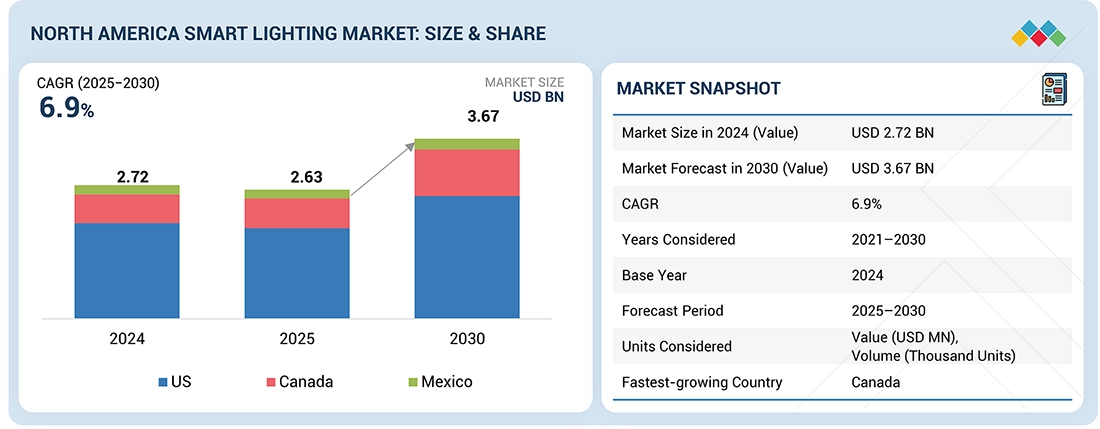
Source: Secondary Research, Interviews with Experts, MarketsandMarkets Analysis
The North American smart lighting market is projected to reach USD 3.67 billion by 2030, up from USD 2.63 billion in 2025, at a CAGR of 6.9% from 2025 to 2030. This growth is driven by the increasing adoption of intelligent lighting solutions across commercial, industrial, and municipal sectors. Market expansion is supported by stringent energy-efficiency regulations, carbon-reduction targets, and rebate programs introduced by US and Canadian authorities. Rising smart-building investments and the modernization of public infrastructure, including street lighting, campuses, and transportation hubs, are accelerating the transition from conventional lighting to IoT-enabled connected systems across the region.
Market Size & Forecast
KEY TAKEAWAYS
-
By CountryBy country, the US is expected to dominate the market with a share of 70.2% in 2025.
-
By OfferingBy offering, the services segment is expected to be the fastest-growing during the forecast period.
-
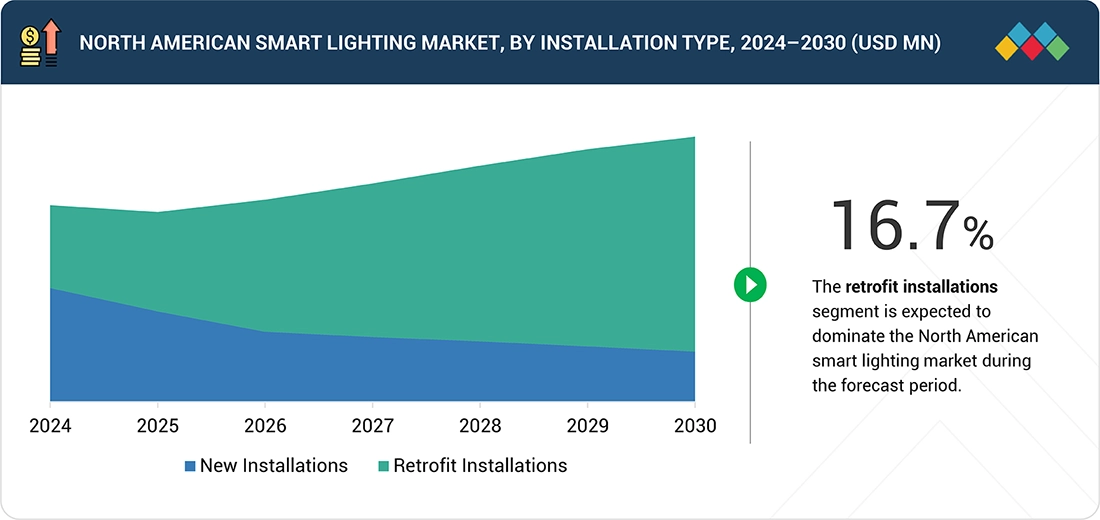
By Installation TypeBy installation type, the retrofit installation segment is projected to grow at a CAGR of 16.7% from 2025 to 2030.
-
By End-use ApplicationBy end-use application, the indoor segment is expected to dominate the market during the forecast period.
-
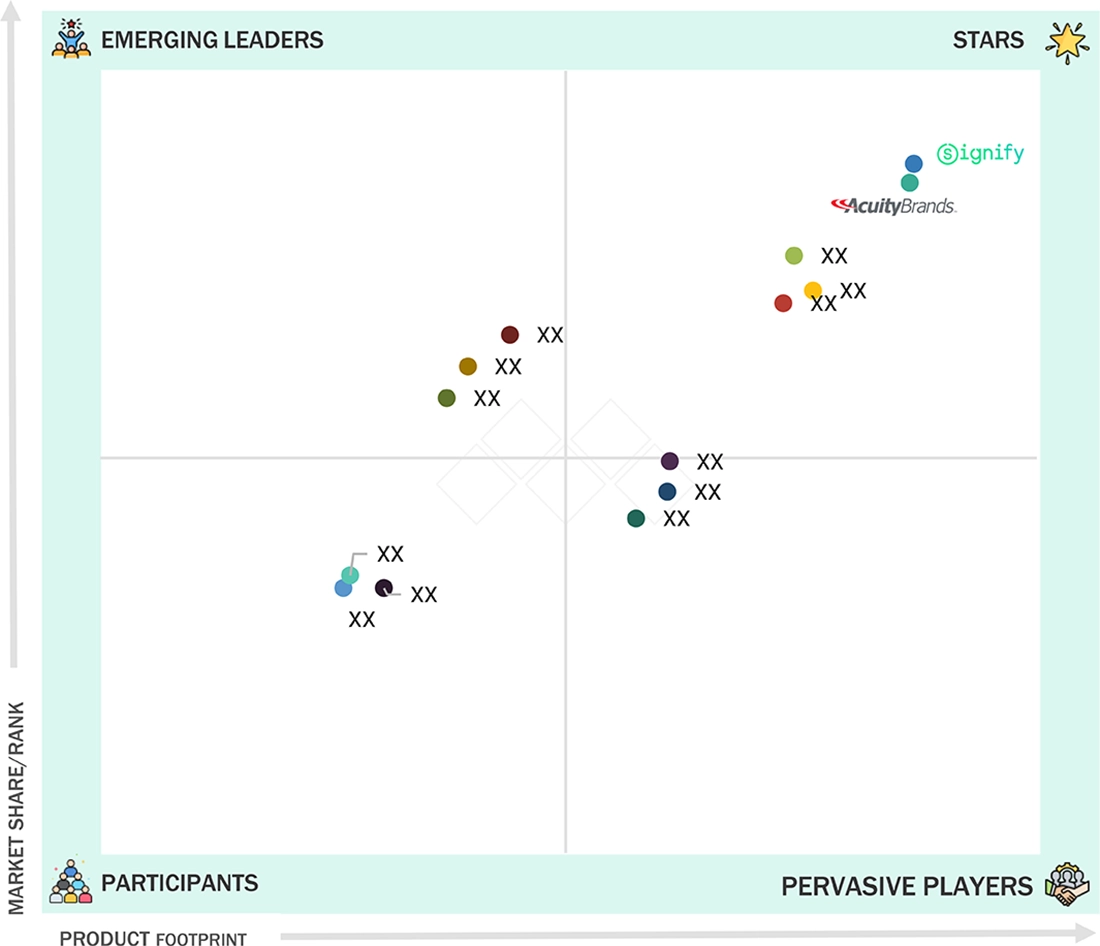
Competitive LandscapeSignify Holdings, Acuity, Inc., and HLI Solutions, Inc. (Current Lighting Solutions), were identified as some of the star players in the North American smart lighting market, given their strong market share and product footprint.
-
Competitive LandscapeLIFX, Nanoleaf, and Avi-on Labs, among others, among others, have distinguished themselves among startups and SMEs by securing strong footholds in specialized niche segments of the North American smart lighting market.
The North American smart lighting market is witnessing strong and sustained growth, driven by rising focus on energy savings, carbon-reduction commitments, and widespread digital transformation across commercial buildings and public infrastructure. Demand is increasing for connected LED luminaires, wireless lighting controls, PoE-based systems, and human-centric lighting that improve workplace comfort, reduce operating costs, and enable ESG-aligned reporting. Rapid expansion of smart buildings, along with modernization of airports, retail stores, healthcare facilities, universities, and logistics hubs, is accelerating the shift from legacy fixtures to intelligent lighting networks.
TRENDS & DISRUPTIONS IMPACTING CUSTOMERS' CUSTOMERS
The North American smart lighting market is rapidly transitioning from traditional LED luminaires to fully integrated, connected lighting systems that utilize IoT-based controls. Federal and state energy-efficiency regulations, ESG-driven building upgrades, and large-scale smart-city programs are accelerating adoption across commercial buildings, logistics facilities, retail environments, and public infrastructure. End users increasingly expect smart lighting to deliver real-time analytics, predictive maintenance, occupancy-based automation, and human-centric lighting benefits rather than simple illumination. Vendors are responding with PoE lighting networks, wireless and Matter-compatible ecosystems, cloud-based lighting management, and open-protocol control platforms. This shift is redefining revenue models in favor of data-driven value.
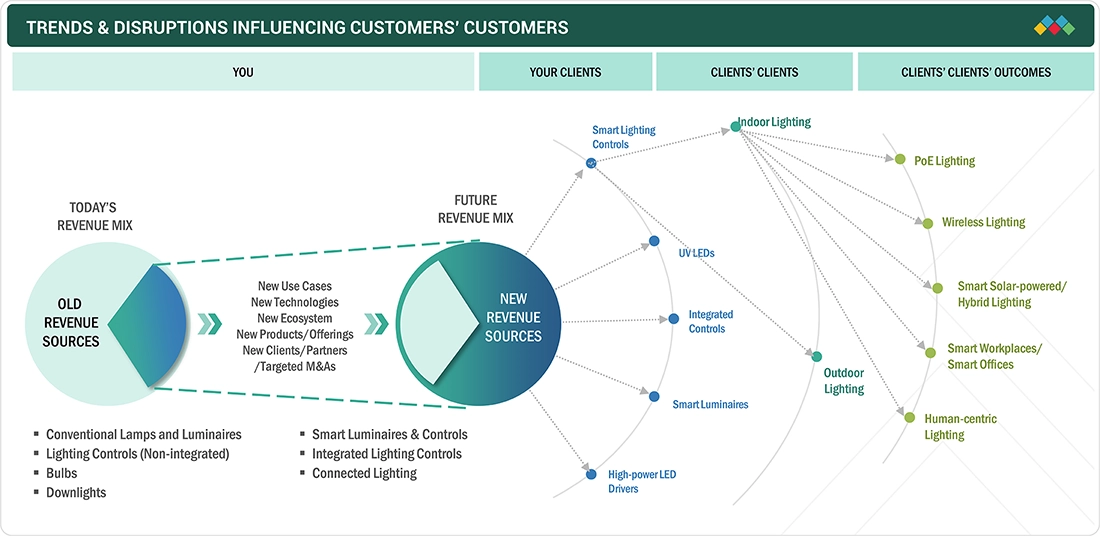
Source: Secondary Research, Interviews with Experts, MarketsandMarkets Analysis
MARKET DYNAMICS

Level
-
Growing smart-city investments across major US and Canadian metros

-
Rising enterprise focus on human-centric and data-driven lighting


Level
-
High upfront retrofit cost across legacy building stock

-
Procurement complexity and inconsistent approvals for public projects


Level
-
Large-scale commercial renovation and real-estate modernization wave

-
Accelerating adoption of PoE, Matter, and wireless ecosystems


Level
-
Cybersecurity and data-privacy concerns in connected lighting

Source: Secondary Research, Interviews with Experts, MarketsandMarkets Analysis
Driver: Growing smart-city investments across major US and Canadian metros
Smart-city programs are accelerating across large cities such as New York, Los Angeles, Toronto, Chicago, and Vancouver, driving the modernization of roadway and public-space lighting. Municipalities are prioritizing adaptive LED streetlighting, remote monitoring, and sensor-based illumination to reduce electricity consumption and maintenance costs. Government incentives and climate-action goals are supporting transition from legacy sodium-vapor lamps to connected outdoor lighting. The recurring nature of city-wide modernization creates long-term revenue visibility for smart-lighting vendors.
Restraint: High upfront retrofit cost across legacy building stock
While smart lighting offers long-term savings, the capital expenditure required to upgrade legacy wiring, fixtures, and controls remains a major barrier. Older commercial buildings and public facilities often require extensive rewiring and compatibility adjustments to support intelligent lighting networks. Budget constraints among SMBs, schools, and small municipalities delay conversion timelines even when payback is proven. This financial challenge slows market penetration compared with new-build projects.
Opportunity: Large-scale commercial renovation and real-estate modernization wave
Corporate relocations, retail upgrades, airport expansions, and hospitality renovations are fueling rapid adoption of connected indoor lighting. Property owners are shifting toward energy-efficient luminaires, smart sensors, and centralized building-management integration to improve operational performance and occupant experience. Government sustainability mandates and green-building certifications are further accelerating adoption. This creates recurring multi-year opportunities for vendors targeting commercial and institutional real-estate portfolios.
Challenge: Cybersecurity and data-privacy concerns in connected lighting
As lighting infrastructure becomes part of larger building-automation and IoT ecosystems, exposure to cyber vulnerabilities increases. IT departments must ensure secure device onboarding, encrypted data transfers, and strict access control to prevent unauthorized network entry. Enterprises and public institutions also face compliance requirements related to cloud connectivity and occupant data processing. These security obligations raise deployment complexity, especially in critical facilities such as hospitals, airports, and government buildings.
NORTH AMERICA SMART LIGHTING MARKET: COMMERCIAL USE CASES ACROSS INDUSTRIES
| COMPANY | USE CASE DESCRIPTION | BENEFITS |
|---|---|---|
 |
Deployment of nLight and Distech networked lighting systems across US corporate offices, universities, airports, and industrial campuses using integrated sensors and IoT controls. | 25–45% reduction in lighting energy costs, enhanced occupant comfort, and improved space-utilization analytics through centralized building-management integration. |
 |
Installation of Daintree wireless lighting controls and intelligent LED fixtures in retail chains and logistics warehouses across the U.S. and Canada. | Up to 60% reduction in operational expenditure through automated dimming and daylight harvesting, lower maintenance, and optimized warehouse workflow visibility. |
 |
Deployment of smart controls, tunable-white luminaires, and Ketra lighting ecosystems in luxury residential, hospitality, and commercial office environments. | Human-centric lighting improving mood, productivity, and guest experience, alongside simplified control via app, voice, and centralized building automation systems. |
 |
Implementation of Decora Smart systems and GreenMAX lighting controls in K-12 schools, universities, and healthcare facilities across the US and Canada. | Streamlined classroom and facility lighting management, reduced energy consumption, and improved regulatory compliance for lighting quality and safety standards. |
 |
Modernization of outdoor area and parking-lot lighting for US industrial parks and commercial complexes using IoT-enabled luminaires and SmartCast Wireless controls. | 30–55% cut in outdoor lighting electricity costs, enhanced nighttime visibility and safety, and reduced maintenance service frequency through remote monitoring. |
Logos and trademarks shown above are the property of their respective owners. Their use here is for informational and illustrative purposes only.
MARKET ECOSYSTEM
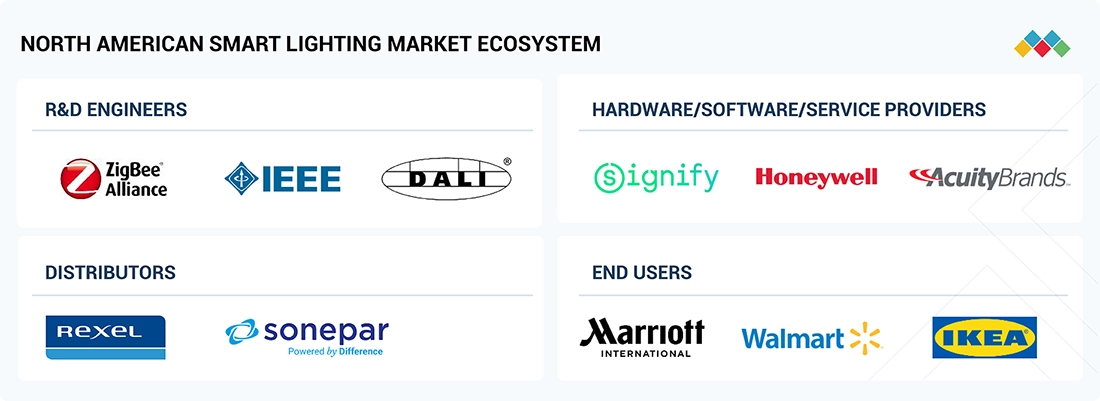
The North American smart lighting ecosystem is shaped by collaboration among standards bodies, solution providers, distributors, and large end users. Organizations such as the Zigbee Alliance, IEEE, and the DALI Alliance ensure interoperability and certification for connected lighting deployments. Leading vendors, including Signify, Honeywell, and Acuity Brands, deliver smart luminaires, wireless controls, and IoT-based lighting platforms across commercial and public sectors. Distributors like Rexel and Sonepar provide deep market reach by supplying products to contractors, developers, and municipalities. Major adopters such as Marriott, IKEA, and Walmart drive large-scale deployments through retail, hospitality, and smart-building upgrades.
Logos and trademarks shown above are the property of their respective owners. Their use here is for informational and illustrative purposes only.
MARKET SEGMENTS
Source: Secondary Research, Interviews with Experts, MarketsandMarkets Analysis
North American Smart Lighting Market, by Offering
As of 2024, smart lighting hardware accounts for the largest revenue share in the North American market, driven by high-volume upgrades to connected LED luminaires, sensors, control modules, and IoT-enabled fixtures across commercial campuses and public infrastructure. Corporate decarbonization programs, state-mandated energy efficiency codes, and utility rebate schemes are accelerating the replacement of legacy lighting. Strong demand for human-centric, adaptive lighting, particularly across workplaces, hospitals, and academic environments, continues to reinforce hardware leadership. Accordingly, hardware remains the dominant component category in North America’s smart lighting revenue mix.
North America Smart Lighting Market, by Installation Type
Retrofit installations are projected to experience the fastest growth in the North American smart lighting market, as enterprises, retailers, logistics operators, and municipalities convert existing buildings into connected lighting ecosystems. Compliance with ESG reporting, zero-carbon roadmaps, building performance standards, and ASHRAE/Title 24 regulations is accelerating the modernization of outdated infrastructure. Retrofit upgrades across airports, office campuses, distribution centers, and roadway lighting networks allow rapid deployment without major structural redesign. As a result, retrofits are emerging as the most scalable and fastest-growing installation pathway in North America.
North American Smart Lighting Market, by Communication Technology
In 2024, wired communication held the largest share of the North American smart lighting sector, supported by strong adoption of DALI-2, 0–10V, and BACnet-based controls in commercial and institutional environments. High deployment across hospitals, data centers, universities, airports, government buildings, and transportation hubs solidifies the dominance of wired connectivity. Consequently, wired communication remains the most established and widely trusted approach for smart lighting control across North America.
North American Smart Lighting Market, by Distribution Channel
The online distribution channel is expected to record the fastest growth in the North American smart lighting market as buyers increasingly shift toward e-commerce platforms for connected lighting components, sensors, and automation bundles. A broader assortment, transparent pricing, installation add-on services, and product comparison tools are enhancing digital adoption among both residential customers and commercial procurement teams. Leading manufacturers and distributors in the US and Canada are expanding direct-to-consumer and B2B e-commerce models to reduce reliance on brick-and-mortar electrical wholesalers. With the rise of digital transformation in facility management and small business purchasing, online platforms are emerging as a key accelerator of smart-lighting distribution across North America.
North American Smart Lighting Market, by End-use Application
Indoor applications held the largest market share in the North American smart lighting market in 2024, supported by widespread adoption across corporate offices, education campuses, healthcare facilities, hospitality chains, logistics hubs, and large retail networks. Organizations are prioritizing connected LED luminaires and automation systems to reduce energy consumption, enhance worker comfort, and improve operational intelligence through analytics-based lighting control. Human-centric lighting, adaptive illumination, and occupancy-based automation are becoming standard requirements in commercial interiors, especially in WELL- and LEED-certified buildings.
REGION
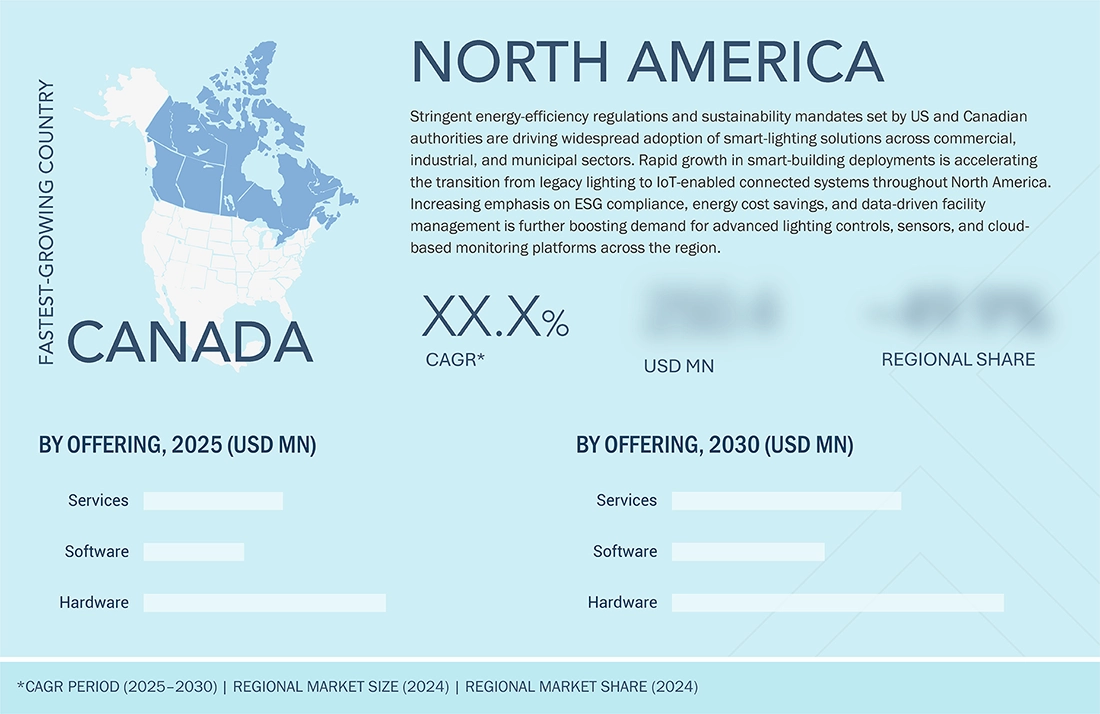
Canada to be fastest-growing country in North American smart lighting market during forecast period
Canada is emerging as the fastest-growing smart lighting market in North America, driven by strong federal and provincial initiatives supporting energy efficiency, carbon-neutral buildings, and smart-city development. Major metropolitan areas, such as Toronto, Vancouver, and Montreal, are leading large-scale upgrades to connected LED street lighting and municipal lighting infrastructure. Rapid modernization across commercial offices, retail facilities, airports, and universities is accelerating the adoption of smart luminaires, advanced lighting controls, and IoT-based automation to enhance energy performance and occupant well-being. Government rebate programs, green-building incentives, and infrastructure funding under Canada’s Climate Action and Clean Growth plans are further boosting nationwide momentum for deployment.
NORTH AMERICA SMART LIGHTING MARKET: COMPANY EVALUATION MATRIX
In the North American smart lighting market matrix, Signify Holding and Acuity Brands lead (Star) with strong market presence and broad connected-lighting portfolios, driving large-scale deployment across commercial buildings, retail environments, and public infrastructure. Both companies continue to steer market direction through innovation in connected luminaires, LED technologies, cloud-based lighting management, and analytics-driven control ecosystems.
Source: Secondary Research, Interviews with Experts, MarketsandMarkets Analysis
KEY MARKET PLAYERS
- Signify Holding
- Acuity Inc.
- HLI Solutions, Inc. (Current Lighting Solutions)
- Cree Lighting USA, LLC.
- Hubbell
- Eaton
- Lutron
- Leviton Manufacturing Co., Inc.
- Honeywell International Inc.
- SAVANT TECHNOLOGIES LLC. (GE Lighting)
- Schneider Electric
- ams-OSRAM AG
- Nanoleaf
- Schréder
- LIFX
MARKET SCOPE
| REPORT METRIC | DETAILS |
|---|---|
| Market Size in 2024 (Value) | USD 2.72 Billion |
| Market Forecast in 2030 (Value) | USD 3.67 Billion |
| Growth Rate | CAGR of 6.9% from 2025–2030 |
| Years Considered | 2021–2030 |
| Base Year | 2024 |
| Forecast Period | 2025–2030 |
| Units Considered | Value (USD Million), Volume (Thousand Units) |
| Report Coverage | Revenue Forecast, Company Ranking, Competitive Landscape, Growth Factors, and Trends |
| Segments Covered |
|
| Countries Covered | US, Canada, and Mexico |
WHAT IS IN IT FOR YOU: NORTH AMERICA SMART LIGHTING MARKET REPORT CONTENT GUIDE
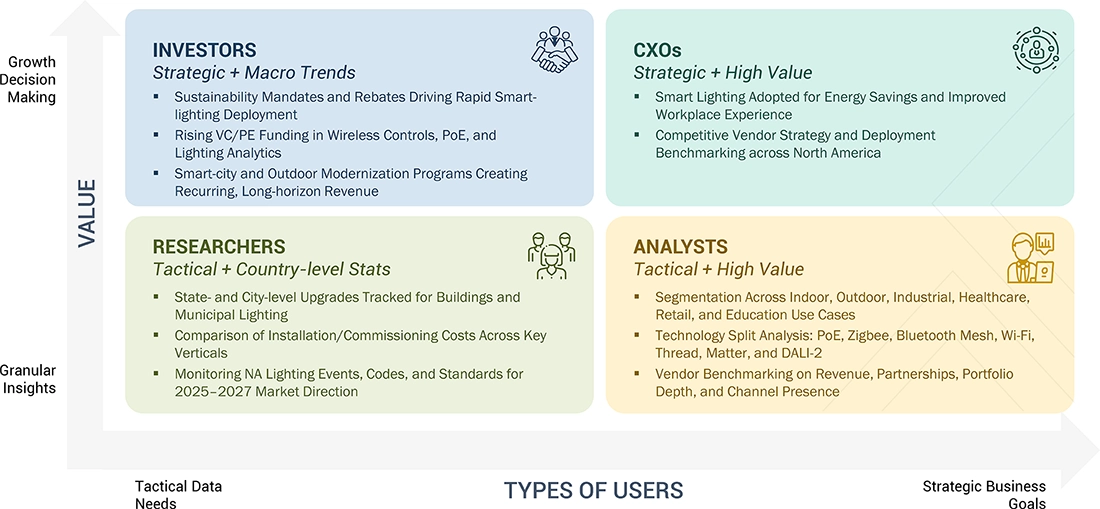
DELIVERED CUSTOMIZATIONS
We have successfully delivered the following deep-dive customizations:
| CLIENT REQUEST | CUSTOMIZATION DELIVERED | VALUE ADDS |
|---|---|---|
| Leading Smart Lighting OEM |
|
|
| Retail & Hospitality Chain Operator |
|
|
| Facility Management Company |
|
|
RECENT DEVELOPMENTS
- June 2025 : GE Lighting (Savant) has launched its expanded GE Cync smart lighting portfolio for the North American market, featuring Matter-ready smart switches, upgraded GE Reveal LED bulbs, and new outdoor lighting systems, to accelerate residential and small commercial smart home adoption.
- February 2025 : Cree Lighting USA expanded its regional sales and distribution footprint across key US states to improve availability of connected LED luminaires and controls, supporting large retrofit projects in municipal, retail, and industrial environments.
Table of Contents
 Exclusive indicates content/data unique to MarketsandMarkets and not available with any competitors.
Methodology
The research study involved 4 major activities in estimating the size of the North America smart lighting market. Exhaustive secondary research has been done to collect important information about the market and peer markets. The validation of these findings, assumptions, and sizing with the help of primary research with industry experts across the supply chain has been the next step. Both top-down and bottom-up approaches have been used to estimate the market size. Post which the market breakdown and data triangulation have been adopted to estimate the market sizes of segments and sub-segments.
Secondary Research
In the secondary research process, various secondary sources have been referred to for identifying and collecting information required for this study. The secondary sources include annual reports, press releases, investor presentations of companies, white papers, and articles from recognized authors. Secondary research has been mainly done to obtain key information about the market’s value chain, the pool of key market players, market segmentation according to industry trends, regional outlook, and developments from both market and technology perspectives.
Primary Research
In primary research, various primary sources from both supply and demand sides have been interviewed to obtain qualitative and quantitative insights required for this report. Primary sources from the supply side include experts such as CEOs, vice presidents, marketing directors, manufacturers, technology and innovation directors, end users, and related executives from multiple key companies and organizations operating in the North America smart lighting market ecosystem. After interacting with industry experts, brief sessions were conducted with highly experienced independent consultants to reinforce the findings from our primary. This, along with the in-house subject matter experts’ opinions, has led us to the findings as described in the remainder of this report. The breakdown of primary respondents is as follows:
Market Size Estimation
The bottom-up procedure has been employed to arrive at the overall size of the North America smart lighting market.
- Identification of major companies providing North America smart lighting hardware, software, and services
- Identification of key segments within the North America smart lighting market across different geographical regions
- Estimation of the market size in various regions by analyzing the adoption of North America smart lighting solutions across different industries
- Determination of market share estimates for deployments in different end-use application segments by assessing the demand for North America smart lighting products and solutions
- Tracking ongoing and upcoming developments in North America smart lighting products
- Compilation of regional market size data for each segment to derive regional market estimates
- Conducting interviews with multiple key leaders to comprehend the North America smart lighting market scope, product demand, future market growth, and potential impact of economic downturns
- Verification and validation of estimates through cross-checking with primary sources, discussions with leaders, and consultation with domain experts at MarketsandMarkets
- Analysis of various paid and unpaid information sources, including annual reports, press releases, white papers, and databases
The top-down approach has been used to estimate and validate the total size of the North America smart lighting market.
- Focusing, initially, on the top-line investments and spending in the ecosystems of various industries. Tracking further splits based on product launches, advancements in North America smart lighting technologies, North America smart lighting solutions and software used for various industrial applications, and developments in the key market areas
- Representing and developing the information related to market revenue offered by key hardware, software, and service providers
- Carrying out multiple on-field discussions with key opinion leaders across each major company involved in the development of hardware and software components and services pertaining to North America smart lighting
- Estimating the geographic split using secondary sources based on factors such as the number of players in a specific country and region, types of products, levels of services offered, and types of software implemented.
Data Triangulation
After arriving at the overall market size—using the market size estimation processes as explained above—the market has been split into several segments and subsegments. To complete the entire market engineering process and arrive at the exact statistics of each market segment and subsegment, data triangulation and market breakdown procedures have been employed, wherever applicable. The data has been triangulated by studying various factors and trends from the demand and supply sides of the North America smart lighting market.
Market Definition
North America smart lighting systems combine automation technologies with connectivity features and intelligent control aspects to deliver enhanced efficiency and improved experience paired with convenience. The system contains LED luminaires, sensors, and wire-based or wireless communication systems to allow remote monitoring and scheduling adjustments based on occupancy status, daylight exposure, and user settings. Users can operate North America smart lighting systems through mobile applications, voice commands, and centralized automation networks which enable full control of brightness adjustments, color temperature settings, and hue transformation features. These devices play an essential role in residential, commercial, and industrial sectors, helping to reduce energy consumption while aiding sustainability efforts.
Key Stakeholders
- Raw material and component suppliers
- Communication network providers
- North America smart lighting device manufacturers
- Original equipment manufacturers
- Semiconductor component suppliers
- Analysts and strategic business planners
- Venture capitalists and start-ups
- Research laboratories and intellectual property (IP) companies
- Technology standards organizations, forums, alliances, and associations
- Hardware vendors
- Software integrators
- North America smart lighting solutions-related service providers
- End users
- Government bodies such as regulatory authorities and policymakers
Report Objectives
- To define, estimate, and forecast the North America smart lighting market based on hardware, software, and services offerings, wired and wireless communication technologies, indoor and outdoor applications, online and offline sales distribution channels, and new and retrofit installation types
- To describe and forecast the North America smart lighting market size, in terms of volume, by hardware offering
- To provide detailed insights regarding drivers, restraints, opportunities, and challenges influencing the growth of the market
- To analyse emerging applications and standards in the North America smart lighting market
- To examine manufacturers of North America smart lighting products, their strategies, production plans, and the overall supply chain, including material and component suppliers
- To strategically analyse the micromarkets1 with respect to individual growth trends, prospects, and contributions to the overall market
- To analyse the market opportunities for stakeholders, and provide a comprehensive competitive landscape analysis
- To provide a detailed overview of the North America smart lighting value chain and ecosystem
- To provide a detailed overview of impact of AI/Gen AI on North America smart lighting market
- To provide information about the key technology trends, trade analysis, and patents related to the North America smart lighting market
- To benchmark the market players using the proprietary company evaluation matrix framework, which analyses them on various parameters within the broad categories of market ranking/share and product portfolio
- To analyse competitive developments, such as partnership, acquisitions, agreements, collaborations, and product launches
- To strategically profile key players and analyse their market share, ranking, and core competencies
This research report categorizes the North America smart lighting market based on offering, communication technology, installation type, distribution channel, end-use application, and region.
Available Customizations
With the given market data, MarketsandMarkets offers customizations according to the specific requirements of companies. The following customization options are available for the report:
- Detailed analysis and profiling of additional market players based on various blocks of the supply chain
Key Questions Addressed by the Report
What is the projected value of the North America smart lighting market?
The North America smart lighting market is projected to reach USD 3.67 billion by 2030 from USD 2.63 billion in 2025, growing at a CAGR of 6.9%.
Which region or country dominates the North America smart lighting market?
The United States dominates the North America smart lighting market due to strong adoption across commercial, residential, and public infrastructure sectors
Which segment leads the North America smart lighting market by offering?
The hardware segment holds the largest share in the market, driven by increasing deployment of connected LED luminaires, sensors, and control systems.
Which segment is expected to grow the fastest in the market?
The outdoor application segment is expected to grow at the highest CAGR due to rising adoption of smart street lighting and public infrastructure projects.
Who are the key players in the North America smart lighting market?
Key players include Signify Holding, Acuity Brands, Hubbell, Cree Lighting, Lutron, Leviton Manufacturing, Eaton, and Honeywell International.


Personalize This Research
- Triangulate with your Own Data
- Get Data as per your Format and Definition
- Gain a Deeper Dive on a Specific Application, Geography, Customer or Competitor
- Any level of Personalization
Let Us Help You
- What are the Known and Unknown Adjacencies Impacting the North America Smart Lighting Market
- What will your New Revenue Sources be?
- Who will be your Top Customer; what will make them switch?
- Defend your Market Share or Win Competitors
- Get a Scorecard for Target Partners

Custom Market Research Services
We Will Customise The Research For You, In Case The Report Listed Above Does Not Meet With Your Requirements
Get 10% Free CustomisationTESTIMONIALS

Tetsuya Ohhira
Business Development Manager-Technology Business
Nikon Corporation,
Leading Japanese MNC specializing in optics and imaging productswww.nikon.com
MarketsandMarkets™ response
is quick. Their attitude is flexible and positive. Analyst Insights are globally considered and
significant. Client Services quickly respond to our inquiry and demand. Their wide range of global
surveys help us make our strategic plan.
We hope Knowledge Store will be easier to search
for a report.
VP - Marketing & Business Development
Leading Provider of Process Control Solutions
We engaged with MarketsandMarkets on a study to perform an analysis and recommend a Go-To-Market strategy for metrology and process control in the semiconductor market. The study was tailored to our targets and needs with well-defined milestones. Our overall experience with the MarketsandMarkets team was very good throughout the project in all aspects including the analysis methodologies used, the quality and depth of primary and secondary data sets, the professionalism and flexibility of the team and the ability to meet the target schedule and milestones. We want to thank MarketsandMarkets team for a job well done.






Growth opportunities and latent adjacency in North America Smart Lighting Market