PAN-based Carbon Fiber Market

PAN-based Carbon Fiber Market By Modulus (Standard, Intermediate, High), By Application (Composites, Non-Composites), By End-use Industry and Region - Forecast To 2030




OVERVIEW
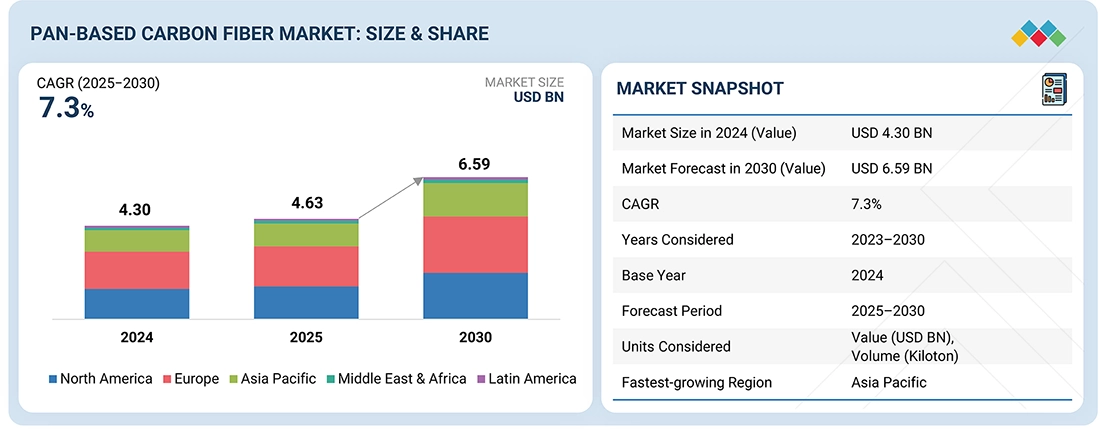
Source: Secondary Research, Interviews with Experts, MarketsandMarkets Analysis
The carbon fiber market is projected to reach USD 6.59 billion by 2030 from USD 4.63 billion in 2025, at a CAGR of 7.3% from 2025 to 2030. The PAN-based carbon fiber market is mainly driven by the increasing demand for lightweight materials in high-performance applications, advancements in manufacturing processes, and growing investments in infrastructural projects. The growing adoption of lightweight and high-performance materials is driving the use of PAN-based carbon fiber in various end-use industries to improve efficiency, performance, and durability.
KEY TAKEAWAYS
-
By RegionThe Asia Pacific region is expected to register the highest CAGR of 8.1% during forecast period.
-
By ModulusBy modulus, the intermediate modulus segment is expected to register the highest CAGR of 8.3% during forecast period.
-
By ApplicationBy application, the composites segment is expected to register the highest CAGR of 7.3% during forecast period.
-
By End-Use IndustryBy end-use industry, the wind energy segment is projected to register the highest growth rate during the forecast period.
-
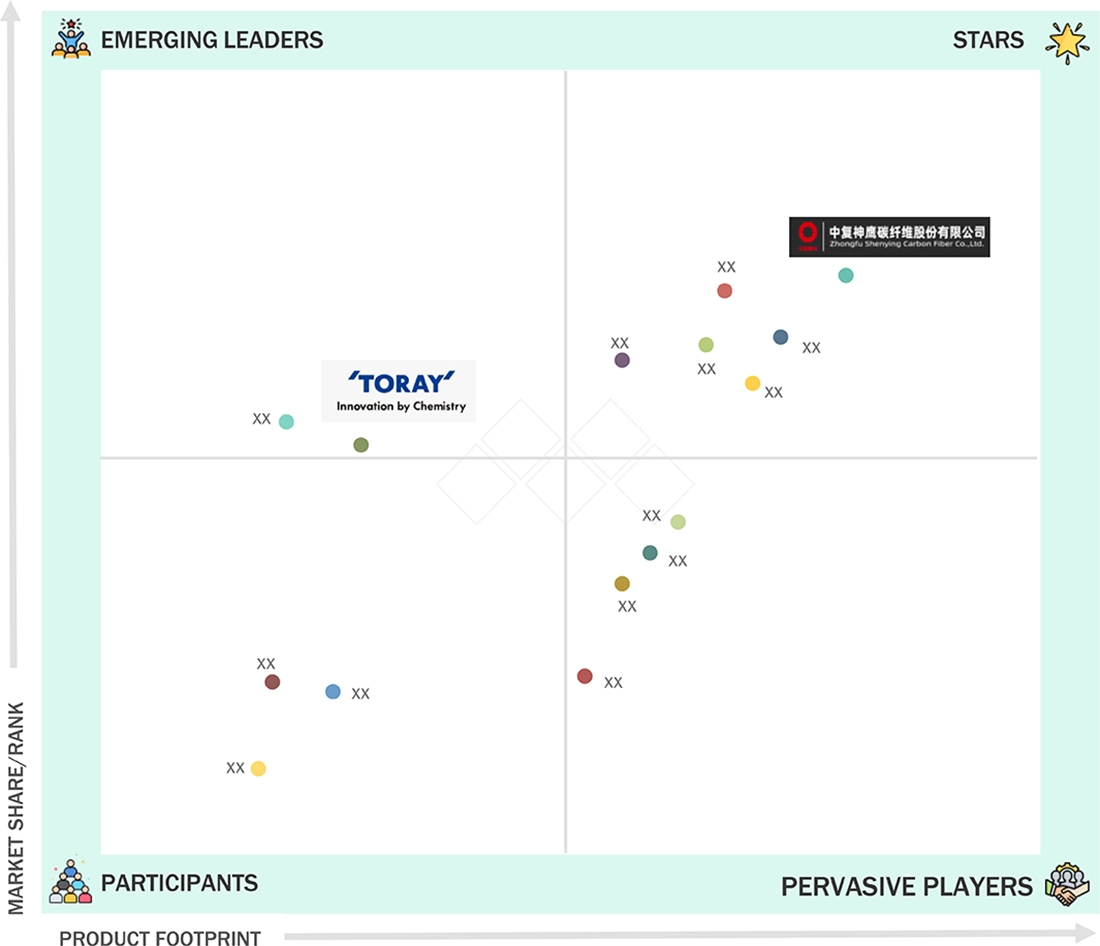
Competitive Landscape - Key PlayersToray Industries, Inc., Teijin Limited, Mitsubishi Chemical Carbon Fiber & Composites, Hexcel Corporation, SGL Carbon SE were identified as some of the star players in the PAN-based carbon fiber market, given their strong market share and product footprint.
-
Competitive Landscape - StartupsWeihai Guangwei Composites Co., Ltd., Sinofibers Technology Co., Ltd., and Kingfa Science & Technology, among others, have distinguished themselves among startups and SMEs by securing strong footholds in specialized niche areas, underscoring their potential emerging market leaders.
The PAN-based carbon fiber market is experiencing significant growth, driven by the increasing demand for lightweight, high-strength, and corrosion-resistant materials across various end-use industries. The market growth is fueled by the aerospace and defense industry, which uses it extensively for fuel-efficient aircraft structures, the automotive sector for vehicle lightweighting to improve fuel economy and electric vehicle range, and the wind energy sector for manufacturing longer, more durable turbine blades. Advancements in recycling technologies, 3D printing integration, and sustainable production methods are also increasing the demand for PAN-based carbon fiber in various applications.
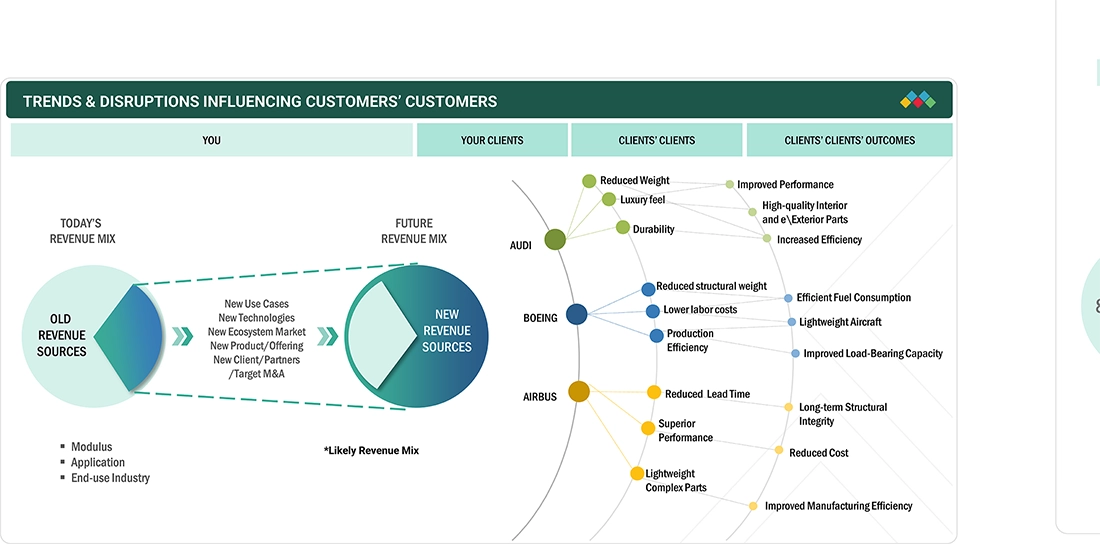
TRENDS & DISRUPTIONS IMPACTING CUSTOMERS' CUSTOMERS
Changes in customer trends or disruptions impact consumers’ businesses. These shifts impact the revenues of end users. Consequently, the revenue impact on end users is expected to affect the revenues of PAN-based carbon fiber suppliers, which, in turn, impacts the revenues of PAN-based carbon fiber manufacturers.
Source: Secondary Research, Interviews with Experts, MarketsandMarkets Analysis
MARKET DYNAMICS

Level
-
Growth in manufacturing of satellite parts

-
High usage in aerospace & defense industry


Level
-
High production cost

-
Lack of standardization in manufacturing technologies


Level
-
Increased investments in development of low-cost coal-based PAN-based carbon fibers

-
Potential opportunities in new applications


Level
-
Production of low-cost PAN-based carbon fiber

-
Capital-intensive production and complex manufacturing process

Source: Secondary Research, Interviews with Experts, MarketsandMarkets Analysis
Driver: Increased use in wind energy industry
The increasing demand for PAN-based carbon fiber in the wind energy industry is the major factor driving market growth. Wind turbine blades are key components in wind power generation systems. PAN-based carbon fibers are widely used in the structural spar caps of long wind turbine blades. PAN-based carbon fiber and PAN-based carbon fiber composites are used to manufacture wind blades as they reduce the weight of the turbine blade, resulting in increased length, which enables higher electricity generation. PAN-based carbon fibers provide the best combination of stiffness, strength, and weight, helping manufacturers to produce larger blades and thus provide higher energy output. Due to its corrosion resistance properties, PAN-based carbon fiber has helped the wind energy industry grow by enabling wind turbines to work in the toughest environments.
Restraint: High production cost
The high cost of PAN-based carbon fiber is mostly associated with the cost of raw materials or precursors used in the production. The most commonly used precursor for PAN-based carbon fiber manufacturing is the exceptionally costly precursor polyacrylonitrile (PAN), which necessitates a highly complex and detailed manufacturing process. PAN-based carbon fiber production is still relatively limited in scale compared to metals such as steel and aluminum, which leads to inefficiencies and a significant amount of waste. It requires specialized equipment and skilled personnel to ensure the material’s quality and consistency.
Opportunity: Potential opportunities in new applications
The demand for PAN-based carbon fiber composites is increasing in wind energy, offshore, automotive, sporting goods, pipes & tanks, and construction industries. In the wind energy industry, PAN-based carbon fiber is recognized as the only material suitable for developing larger and more powerful generators. Apart from composite applications, PAN-based carbon fibers can also be used in commercial supercapacitors due to their environmentally friendly nature, low specific gravity, biodegradability, sustainability, low cost, and easy processing. PAN-based carbon fibers function as both the electrode-active material and current collector during the fabrication of supercapacitors. PAN-based carbon fibers can easily be integrated with wearable electronic textiles by simple weaving procedures, which has boosted their demand in the development of wearable supercapacitors.
Challenge: Capital-intensive production and complex manufacturing process
PAN-based carbon fiber manufacturing is highly capital-intensive and requires heavy investments. New technologies need to be developed to produce low-cost PAN-based carbon fiber and PAN-based carbon fiber-reinforced plastic to commercialize end products. Production and development projects are undertaken to reduce the manufacturing costs of PAN-based carbon fiber products through advanced technologies and process solutions. According to some industry experts, the production process of PAN-based carbon fiber is complex and lengthy compared to other alternative products. The development of low-cost and simpler technologies for the commercial production of low-cost fiber composites is a major challenge for governments, research laboratories, and PAN-based carbon fiber producers globally.
pan-based-carbon-fiber-market: COMMERCIAL USE CASES ACROSS INDUSTRIES
| COMPANY | USE CASE DESCRIPTION | BENEFITS |
|---|---|---|
 |
Utilizes carbon fiber composites in aircraft fuselage and wings for commercial and defense aviation programs | Lightweight structure for fuel efficiency, high tensile strength, fatigue and corrosion resistance |
 |
Applies carbon fiber in EV body panels, interior components, and structural reinforcements | Improved range through weight reduction, enhanced performance, structural rigidity |
 |
Uses carbon fiber in wind turbine blades for large offshore and onshore models | Increased stiffness-to-weight ratio, extended blade length potential, higher energy efficiency |
 |
Integrates carbon fiber composites in automotive chassis and body structures (e.g., BMW i-series) | Lightweighting for better acceleration and fuel economy, durability, reduced CO2 emissions |
 |
Employs carbon fiber reinforced polymers in aircraft wings, tail assemblies, and fuselage | High mechanical performance, corrosion resistance, reduced maintenance, longer lifespan |
Logos and trademarks shown above are the property of their respective owners. Their use here is for informational and illustrative purposes only.
MARKET ECOSYSTEM
The PAN-based carbon fiber ecosystem analysis involves identifying and analyzing interconnected relationships among various stakeholders, including raw material suppliers, manufacturers, distributors, and end users. The raw material suppliers provide polymers, such as polyacrylonitrile, to carbon fiber manufacturers. The distributors and suppliers establish contact between the manufacturing companies and end users to streamline the supply chain, increasing operational efficiency and profitability.
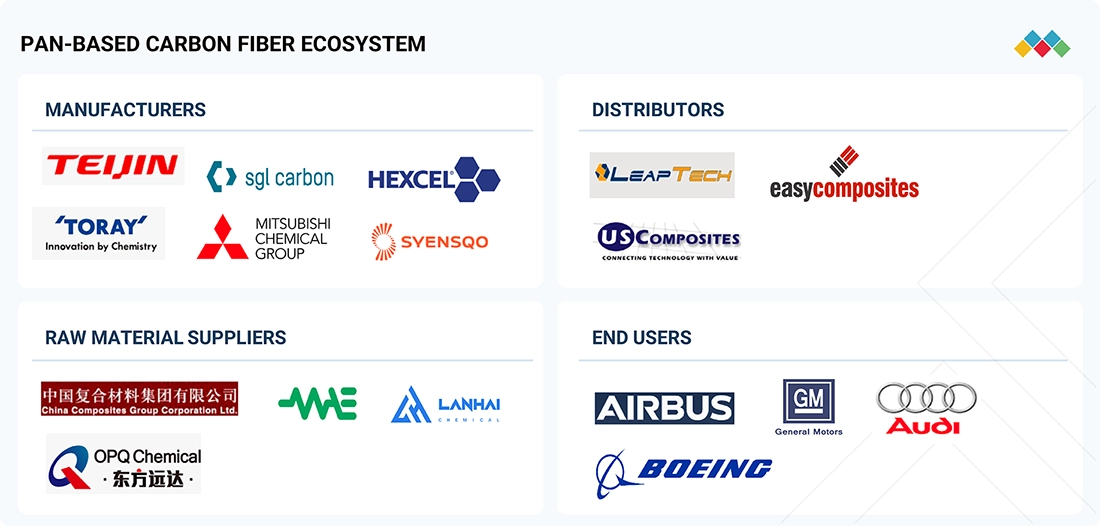
Logos and trademarks shown above are the property of their respective owners. Their use here is for informational and illustrative purposes only.
MARKET SEGMENTS
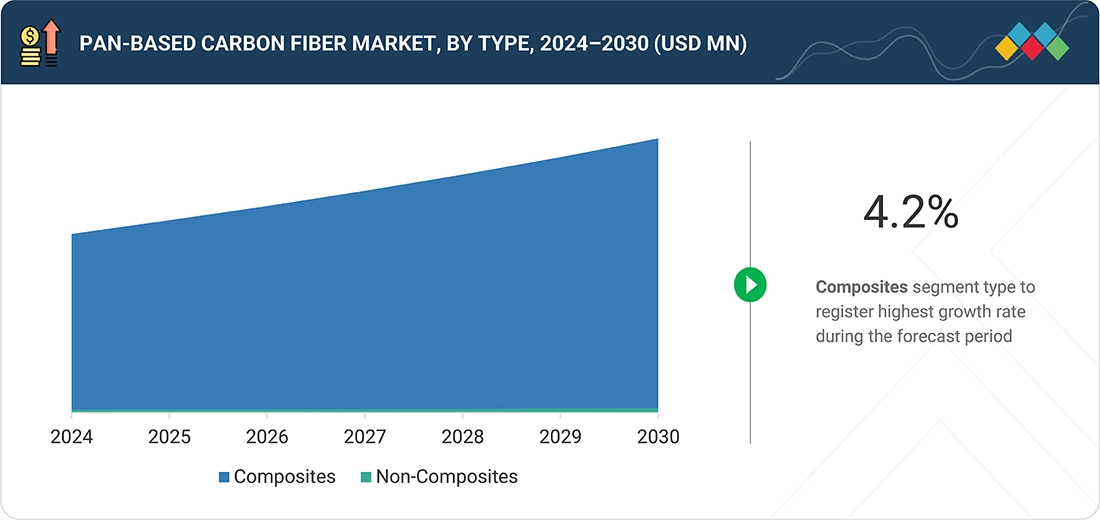
Source: Secondary Research, Interviews with Experts, MarketsandMarkets Analysis
PAN-based Carbon Fiber Market, By Modulus
Standard modulus PAN-based carbon fiber dominated the overall PAN-based carbon fiber market in 2024 due to its tensile strength of 500-700 Ksi. These are the most cost-effective fibers measured by tensile strength or modulus per unit cost. It is the most commonly used grade across industries and available in tow sizes from 1K to 24K. Standard modulus PAN-based carbon fiber is used in sporting goods, automotive, aerospace, and general-purpose tubing applications. Some of the major manufacturers provides an industry-standard standard modulus PAN-based carbon fiber that possesses excellent processing characteristics for filament winding, weaving, and prepregging.
PAN-based Carbon Fiber Market, By Application
The composites application led the overall PAN-based carbon fiber market in 2024. PAN-based carbon fiber composites are valued for their superior strength, rigidity, tensile properties, and low weight, making them ideal for aerospace & defense, automotive, wind energy, sporting goods, medical, construction, and marine industries. In aerospace, they replace metals like aluminum and titanium to reduce weight in next-generation aircraft; in the automotive industry, they enhance fuel efficiency through lightweight components. The applications PAN-based carbon fiber composites extend to large wind turbine blades for efficiency, FRP, CNG, and hydrogen tanks for NGVs and FCEVs, and high-performance sporting equipment such as rackets, golf clubs, helmets, and shoes. They are available in forms like prepregs, molding compounds, and woven fabrics, and offer high stiffness, impact strength, corrosion resistance, and thermal stability.
PAN-based carbon fiber Market, By End-use Industry
In 2024, the aerospace & defense industry dominated the PAN-based carbon fiber market due to its critical need for lightweight, high-strength materials that improve fuel efficiency, reduce emissions, and enhance performance and safety in aircraft and defense systems. PAN-based carbon fiber is widely used in the structural components of aircraft and advanced weaponry, lightweight armor, and ballistic protection, boosting mobility and survivability. Strong investments in next-generation aerospace technologies and the high value placed on durability and structural integrity drive the demand for PAN-based carbon fiber composites.
REGION
Asia Pacific to be fastest-growing region in global PAN-based carbon fiber market during forecast period
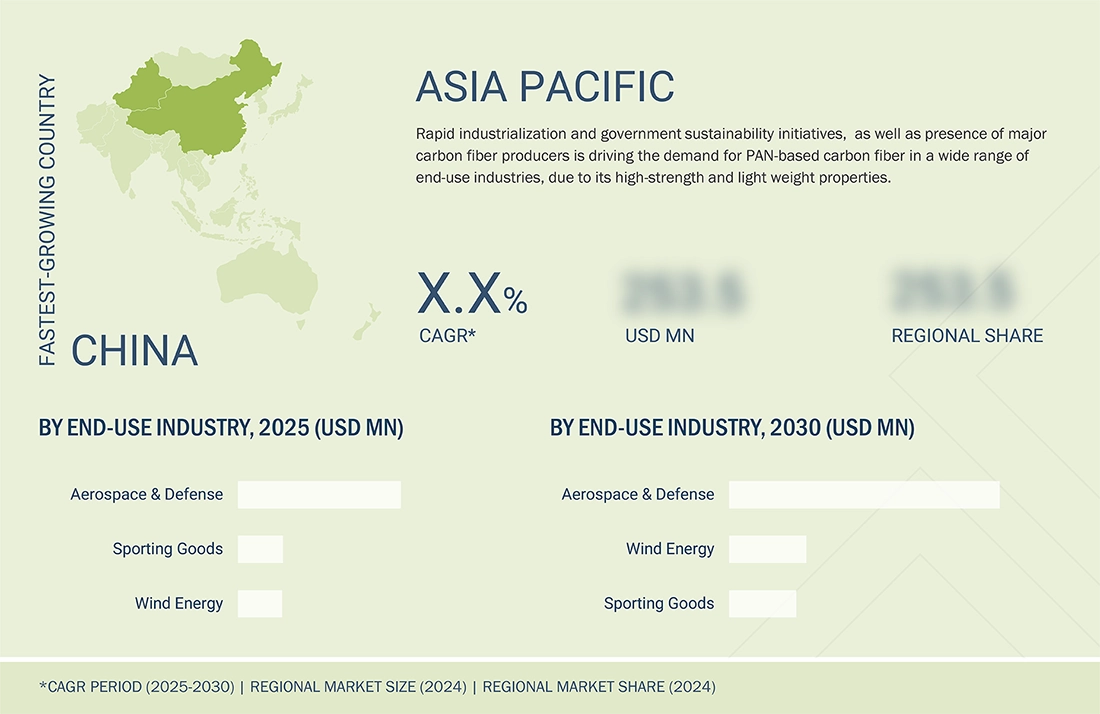
The Asia Pacific region is expected to register the highest CAGR in the PAN-based carbon fiber market during the forecast period. This is due to industrialization in major countries such as China, Japan, and South Korea. These countries are experiencing significant growth in industries such as automotive, aerospace & defense, wind energy, sporting goods, and construction & infrastructure, which rely on PAN-based carbon fiber for its strength, lightweight properties, and durability. Due to growing environmental issues, consumers are shifting toward sustainable solutions. This has increased the demand for electric vehicles. The region is witnessing huge demand for PAN-based carbon fiber from the automotive industry for the production of electric vehicles, which helps improve battery efficiency and vehicle performance.
pan-based-carbon-fiber-market: COMPANY EVALUATION MATRIX
In the PAN-based carbon fiber market matrix, Toray Industries, Inc. (Star) leads with a strong market share and extensive product footprint. The company's products are widely adopted in aerospace & defense, automotive, sporting goods, and wind energy industries. Zhongfu Shenying Carbon Fiber Co., Ltd. (Emerging Leader) is gaining visibility as it focuses on innovation and backs this with high performance PAN-based carbon fibers for wind blades, sports, pressure vessels, and the construction sector. While Toray Industries, Inc. dominates through scale and a diverse portfolio, Zhongfu Shenying Carbon fiber Co., Ltd. shows significant potential to move toward the leaders’ quadrant as demand for PAN-based carbon fiber continues to rise.
Source: Secondary Research, Interviews with Experts, MarketsandMarkets Analysis
KEY MARKET PLAYERS
MARKET SCOPE
| REPORT METRIC | DETAILS |
|---|---|
| Market Size in 2024 (Value) | USD 4.30 Billion |
| Market Forecast in 2030 (value) | USD 6.59 Billion |
| Growth Rate | CAGR of 7.3% from 2025-2030 |
| Years Considered | 2023-2030 |
| Base Year | 2024 |
| Forecast Period | 2025-2030 |
| Units Considered | Value (USD Billion), Volume (Kiloton) |
| Report Coverage | Revenue forecast, company ranking, competitive landscape, growth factors, and trends |
| Segments Covered |
|
| Regions Covered | North America, Asia Pacific, Europe, Latin America, Middle East & Africa |
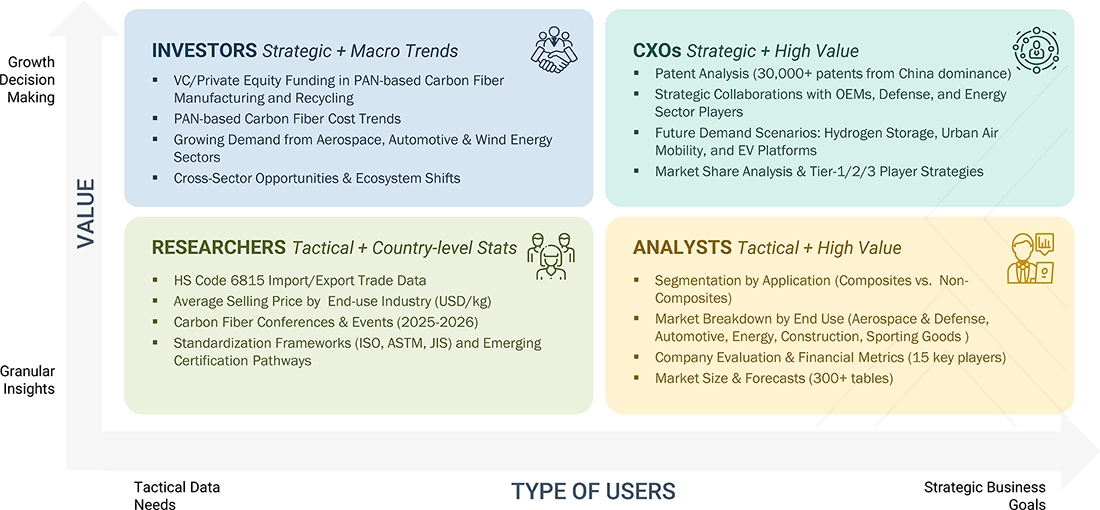
WHAT IS IN IT FOR YOU: pan-based-carbon-fiber-market REPORT CONTENT GUIDE
DELIVERED CUSTOMIZATIONS
We have successfully delivered the following deep-dive customizations:
| CLIENT REQUEST | CUSTOMIZATION DELIVERED | VALUE ADDS |
|---|---|---|
| Leading OEM |
|
|
| Composite Component Manufacturers |
|
|
| Raw Material Suppliers |
|
|
| End-users (Aerospace, Automotive, Wind, Construction) |
|
|
RECENT DEVELOPMENTS
- March 2024 : Hexcel Corporation launched a new HexTow continuous carbon fiber, IM9 24K, providing the market with lightweight, strong, and durable carbon fiber with enhanced value for the world’s most advanced aerospace composite applications.
- February 2024 : Syensqo partnered with Trillium Renewable Chemicals to develop sustainable raw materials for carbon fiber applications. Trillium's bio-based acrylonitrile (Bio-ACN) is being evaluated by Syensqo for its potential in carbon fiber manufacturing, aiming to advance sustainable solutions from bio-based or recycled sources.
- January 2024 : Toray Industries, Inc. launched a high-performance carbon fiber that is 20% stronger than other fibers in the TORAYCA MX series. TORAYCA M46X exhibits a high tensile modulus exceeding 350 GPa, making it suitable for demanding applications where weight is a major concern.
Table of Contents
 Exclusive indicates content/data unique to MarketsandMarkets and not available with any competitors.
Methodology
The study involves two major activities in estimating the current market size for the PAN-based Carbon Fiber Market. Exhaustive secondary research was done to collect information on the market, peer market, and parent market. The next step was to validate these findings, assumptions, and sizing with industry experts across the value chain through primary research. Both top-down and bottom-up approaches were employed to estimate the complete market size. After that, market breakdown and data triangulation were used to estimate the market size of segments and subsegments.
Secondary Research
Secondary sources referred to for this research study include financial statements of companies offering carbon fiber and information from various trade, business, and professional associations. Secondary research has been used to obtain critical information about the industry’s value chain, the total pool of key players, market classification, and segmentation according to industry trends to the bottom-most level and regional markets. The secondary data was collected and analyzed to arrive at the overall size of the PAN-based Carbon Fiber Market, which was validated by primary respondents.
Primary Research
Extensive primary research was conducted after obtaining information regarding the PAN-based Carbon Fiber Market scenario through secondary research. Several primary interviews were conducted with market experts from both the demand and supply sides across major countries of North America, Europe, Asia Pacific, the Middle East & Africa, and Latin America. Primary data was collected through questionnaires, emails, and telephonic interviews. The primary sources from the supply side included various industry experts, such as chief experience officers (CXOs), vice presidents (VPs), business development/marketing directors, product development/innovation teams, related key executives from the carbon fiber industry, system integrators, component providers, distributors, and key opinion leaders. Primary interviews were conducted to gather insights such as market statistics, data on revenue collected from the products and services, market breakdowns, market size estimations, market forecasting, and data triangulation. Primary research also helped in understanding the various trends related to raw material type, fiber type, modulus, product type, application, end-use industry, and region. Stakeholders from the demand side, such as CIOs, CTOs, CSOs, and installation teams of the customers/end users who are seeking carbon fiber services, were interviewed to understand the buyer’s perspective on the suppliers, products, component providers, and their current usage of carbon fiber and future outlook of their business which will affect the overall market.
Market Size Estimation
The research methodology used to estimate the size of the PAN-based Carbon Fiber Market includes the following details. The market sizing was undertaken from the demand side. The market was upsized based on the demand for carbon fiber in different applications at the regional level. Such procurements provide information on the demand aspects of the carbon fiber industry for each application. For each application, all possible segments of the PAN-based Carbon Fiber Market were integrated and mapped.
Data Triangulation
After arriving at the overall size from the market size estimation process explained above, the total market was split into several segments and subsegments. The data triangulation and market breakdown procedures explained below were implemented, wherever applicable, to complete the overall market engineering process and arrive at the exact statistics for various market segments and subsegments. The data was triangulated by studying various factors and trends from the demand and supply sides. Along with this, the market size was validated using both the top-down and bottom-up approaches.
Market Definition
Carbon fiber is a long, thin strand of material made from carbon. It is produced by baking precursors, such as polyacrylonitrile (PAN), pitch, and rayon, in an inert atmosphere to dissociate elements other than carbon through a process called pyrolysis. Carbon fiber is lightweight and has excellent strength, low specific gravity, excellent modulus of elasticity, and high corrosion resistance. There are different types of carbon fibers, including high-strength (HS)/standard modulus, intermediate modulus, and high-modulus, each with varying mechanical properties. Carbon fibers used as composite materials are used to make aircraft & spacecraft parts, bicycle frames, pipes & tanks, wind blades, golf shafts, badminton rackets, automobile springs, sailboat masts, automotive structural parts, and various other parts where lightweight and high strength are required. Non-composite applications of carbon fiber include filtration materials, conductive electrodes in batteries and supercapacitors, heat shields, industrial brushes, and electrical components, utilizing its strength, conductivity, and heat resistance in various industries.
Stakeholders
- Carbon Fiber Manufacturers
- Carbon Fiber Distributors and Suppliers
- Universities, Governments, and Research Organizations
- Associations and Industrial Bodies
- R&D Institutes
- Environmental Support Agencies
- Investment Banks and Private Equity Firms
- Research and Consulting Firms
Report Objectives
- To define, describe, and forecast the PAN-based Carbon Fiber Market size in terms of volume and value
- To provide detailed information regarding the key factors, such as drivers, restraints, opportunities, and challenges influencing the market growth
- To analyze and project the global PAN-based Carbon Fiber Market by raw material type, fiber type, modulus, product type, application, end-use industry, and region
- To forecast the market size concerning five main regions (along with country-level data), namely, North America, Europe, Asia Pacific, the Middle East & Africa, and Latin America, and analyze the significant region-specific trends
- To strategically analyze micromarkets with respect to individual growth trends, prospects, and contributions of the submarkets to the overall market
- To analyze the market opportunities and the competitive landscape for stakeholders and market leaders
- To assess recent market developments and competitive strategies, such as agreements, contracts, acquisitions, and product developments/product launches, to draw the competitive landscape
- To strategically profile the key market players and comprehensively analyze their core competencies
Key Questions Addressed by the Report
What are the key applications driving demand in the PAN Based Carbon Fiber Market?
Major applications include aerospace & defense components, automotive structural parts, wind turbine blades, sporting goods, and industrial equipment.
Who are the leading companies in the PAN Based Carbon Fiber Market?
Key players include Toray Industries, Teijin Limited, Hexcel Corporation, SGL Carbon, and Mitsubishi Chemical Corporation.
What factors are driving the growth of the PAN Based Carbon Fiber Market?
Growth is driven by increasing demand for lightweight, high-strength materials in transportation, renewable energy expansion, and performance sports equipment.
Which challenges are faced by manufacturers in the PAN Based Carbon Fiber Market?
Challenges include high production costs, energy-intensive manufacturing processes, and limited global production capacity.
Which end-use industries are expected to exhibit the highest CAGR in the PAN Based Carbon Fiber Market?
Aerospace & defense, automotive (especially EV and high-performance vehicles), and wind energy sectors are expected to exhibit the highest CAGR.


Personalize This Research
- Triangulate with your Own Data
- Get Data as per your Format and Definition
- Gain a Deeper Dive on a Specific Application, Geography, Customer or Competitor
- Any level of Personalization
Let Us Help You
- What are the Known and Unknown Adjacencies Impacting the PAN-based Carbon Fiber Market
- What will your New Revenue Sources be?
- Who will be your Top Customer; what will make them switch?
- Defend your Market Share or Win Competitors
- Get a Scorecard for Target Partners

Custom Market Research Services
We Will Customise The Research For You, In Case The Report Listed Above Does Not Meet With Your Requirements
Get 10% Free CustomisationTESTIMONIALS

We at Nissan Chemicals Corporation have been clients of MarketsandMarkets for more than a year now. We recently consulted MarketsandMarkets for a study, the team at MarketsandMarkets was extremely professional and organized. The business insights were very detailed and aligned well with our expectations that really helped us formulate the Business Plans and device new strategies for development themes. MarketsandMarkets offers a unique combination of expertise and dedicated engagement model. Their research findings have helped us in designing our Pricing Strategy which will make it easier for us to predict the future sales and profits for the next ten years. We look forward to working with MarketsandMarkets in the future.
VP of Strategy & New Business Development
Leading Specialty Chemical Company
The MarketsandMarkets Engagement Model, composed of both the Knowledge Store and advisory custom research, has greatly helped us in understanding our markets and making strategic decisions. The Knowledge Store is a fast way to allow everyone in our organization to understand more about most any market they are interested in. The ability to then get custom research done and get answers to specific strategic questions and market insight has been spectacular. The Markets and Markets team feel more like colleagues than vendors and their services have helped us change our culture where statements of things like growth opportunities and competitive position are always backed by industry research.

Rich Gibson,
Director, Corporate Strategy
Milliken & Company,
Leading Industrial Manufacturer of specialty chemical, floor covering, performance and protective textile materials, and healthcaremilliken.com
MarketsandMarkets is a trusted resource that helps us to better understand markets that are near-adjacencies-whether its technology, value chain or geography. Their Knowledge Store platform provides a dashboard of markets and their characteristics which is easy to use and saves us time.
Adam Shaw,
Market Development and Strategy Manager
AdvanSix Inc. USA,
An American Leader in Chemicalswww.advansix.com
The Knowledge Store from MarketsandMarkets is a valuable tool which has helped my team acquire greater insight in to the end markets that our business serves. This has enabled us to help our company build stronger strategies throughout our planning process.
TOSHIO KINOSHITA
Senior Chif Consultion Research & Consulting Division
Mitsubishi Chemical Research Corporation,
Leading Manufacturer of Chemical Productswww.mitsubishichem-res.co.jp/en/

We recently engaged with MarketsandMarkets for a study, the team not only clearly understood our business objectives but was also extremely professional in the way they handled the entire project. The study was efficiently conducted in a phase-wise manner, and the engagement model furnished us with high-quality business insights that far exceeded our expectations at each phase. We were especially happy that MarketsandMarkets could provide us with both, an English as well as a Japanese version of the study. A special thanks to the Analyst Team and Client Services Team, whose fluency in Japanese enhanced our comfort level, as we could converse with them in our preferred language.
Independent entrepreneurs
Arrow Precision
We approached MarketsandMarkets for study on Proppants Market, and their work exceeded our expectations. The study conducted was comprehensive and enabled us to view the market through the various dimensions. In addition, the team was extraordinarily responsive throughout the process and resolved our queries on time. I strongly recommend MarketsandMarkets and will certainly consider them for additional market assessments we will need in the future.
Global engineering company, Japan
Deputy Manager,
Strategic Planning OfficeThe high-quality insights shared by the MarketsandMarkets team helped us understand the pharmaceutical plant designers in a specific geography. It also captured the risks that we may likely face in communicating with our potential partners. The study would enable us identify partners, which would impact our future growth.






Growth opportunities and latent adjacency in PAN-based Carbon Fiber Market