Passive RF Analyzers, RF Sensing, and SIGINT Market Size, Share & Trends

Passive RF Analyzers, RF Sensing, and SIGINT Market Size, Share, Growth & Trends by System Type (Passive RF Analyzers, SIGINT Systems, Spectrum Monitoring Systems), Platform (Ground-based, Vehicle Mounted, Manpack, Airborne), Deployment, Application - Global Forecast to 2032




Passive RF Analyzers, RF Sensing, and SIGINT Market OVERVIEW
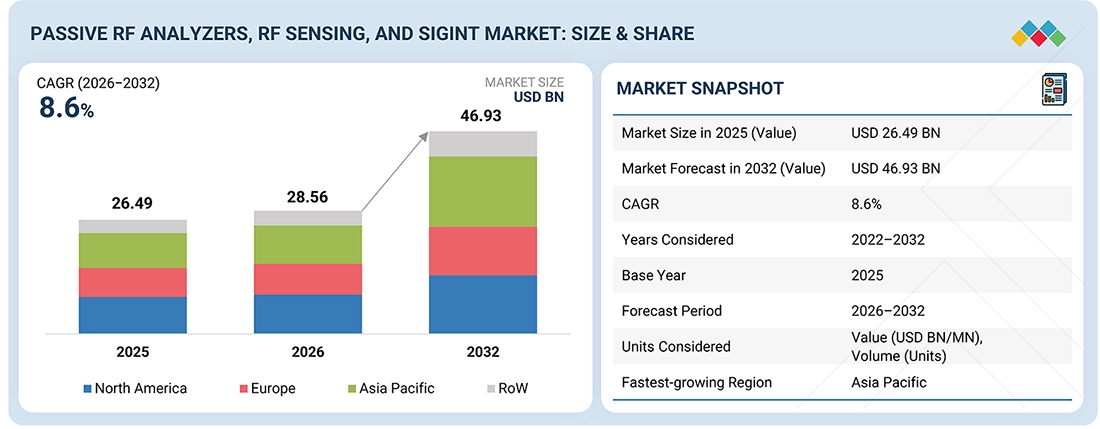
The passive RF analyzers, RF sensing, and SIGINT market size is projected to reach USD 46.93 billion by 2032 from USD 28.56 billion in 2026, at a CAGR of 8.6% from 2026 to 2032. The growth of the market is driven by increasing demand for real-time spectrum awareness, threat detection, and RF intelligence across defense and security applications. Additionally, rising adoption of counter-UAS, electronic warfare, border security, maritime surveillance, and critical infrastructure protection, along with advances in AI-enabled signal processing and direction finding, is further supporting market growth globally.
REPORT SCOPE
| REPORT METRIC | DETAILS |
|---|---|
| Market Size in 2025 (Value) | USD 26.49 Billion |
| Market Forecast in 2026 (Value) | USD 28.56 Billion |
| Market Forecast in 2032 (Value) | USD 46.93 Billion |
| Growth Rate | CAGR of 8.6% from 2026-2032 |
| Years Considered | 2022-2032 |
| Base Year | 2025 |
| Forecast Period | 2026-2032 |
| Units Considered | Value (USD Million/Billion), Volume (Units) |
| Report Coverage | Revenue forecast, company ranking, competitive landscape, growth factors, and trends |
| Top Companies |
|
| Growth Drivers |
|
| Segments Covered |
|
| Regions Covered | North America, Asia Pacific, Europe, and ROW |
KEY TAKEAWAYS
-
BY REGIONThe Asia Pacific is anticipated to register the highest CAGR of 10.5% during the forecast period, supported by rising defense modernization, growing electronic warfare requirements, and increasing investments in RF intelligence and spectrum monitoring capabilities.
-
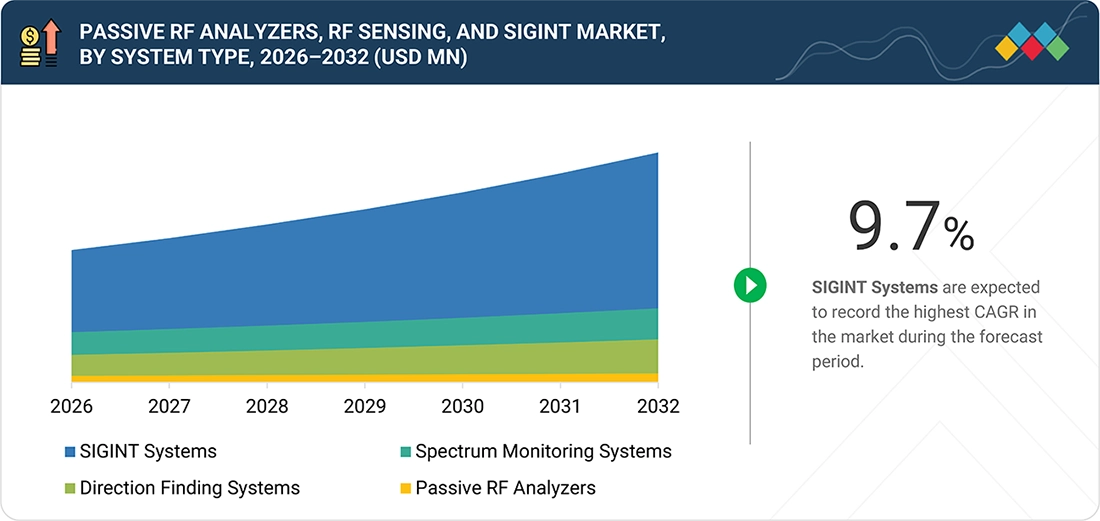
BY SYSTEM TYPESIGINT Systems are expected to account for the largest share of the system-type segment, at ~61% in 2026, driven by increasing requirements for signal interception, collection, processing, and intelligence generation across defense and security applications.
-
BY COMPONENTSoftware is projected to register the highest CAGR of 10.9% during the forecast period, driven by the increasing adoption of AI-enabled capabilities for signal classification, signal processing, spectrum visualization, and analytics across RF sensing and SIGINT systems.
-
BY PLATFORMGround-based systems are expected to account for the largest share of the platform segment.
-
BY DEPLOYMENTMobile systems are expected to account for the largest share of the deployment segment, at ~72% in 2026, driven by growing requirements for flexible RF monitoring, tactical signal detection, direction finding, and on-the-move spectrum awareness.
-
BY FREQUENCYUHF is projected to register the highest CAGR of 9.9% during the forecast period, supported by increasing demand for RF sensing, spectrum monitoring, SIGINT, and direction finding across tactical communications, counter-UAS, defense, and security applications.
-
BY APPLICATIONMilitary applications are expected to account for the largest share of the application segment, at ~44.0% in 2026, driven by increasing adoption of RF intelligence, electronic support, battlefield awareness, threat detection, and target identification capabilities.
-
COMPETITIVE LANDSCAPE (KEY PLAYERS)Northrop Grumman Corporation (US), RTX Corporation (US), BAE Systems plc (UK), Lockheed Martin Corporation (US), Leonardo S.p.A. (Italy), Thales Group (France), Elbit Systems Ltd. (Israel), and L3Harris Technologies, Inc. (US) are among the leading participants offering advanced RF sensing, SIGINT, electronic warfare, spectrum monitoring, and direction finding capabilities.
-
COMPETITIVE LANDSCAPE (STARTUPS/SMEs)Companies such as CRFS (UK), R2 Wireless (US), Signal Processing Technologies (US), HawkEye 360 (US), and SPT (US) are developing advanced RF sensing and signal intelligence capabilities for defense, security, and commercial applications.
The passive RF analyzers, RF sensing, and SIGINT industry is witnessing steady growth, driven by increasing demand for real-time spectrum awareness, threat detection, and RF intelligence. Rising adoption across defense, counter-UAS, border security, maritime surveillance, critical infrastructure, and public safety applications is supporting market expansion. Continuous advancements in AI-enabled signal processing, automated signal classification, direction finding, and software-defined architectures are improving detection and geolocation capabilities. Additionally, growing investments in electronic warfare, distributed RF sensing, and multi-domain surveillance systems are creating new opportunities across ground, airborne, naval, and space-based platforms.
Source: Secondary Research, Interviews with Experts, MarketsandMarkets Analysis
TRENDS & DISRUPTIONS IMPACTING CUSTOMERS' CUSTOMERS
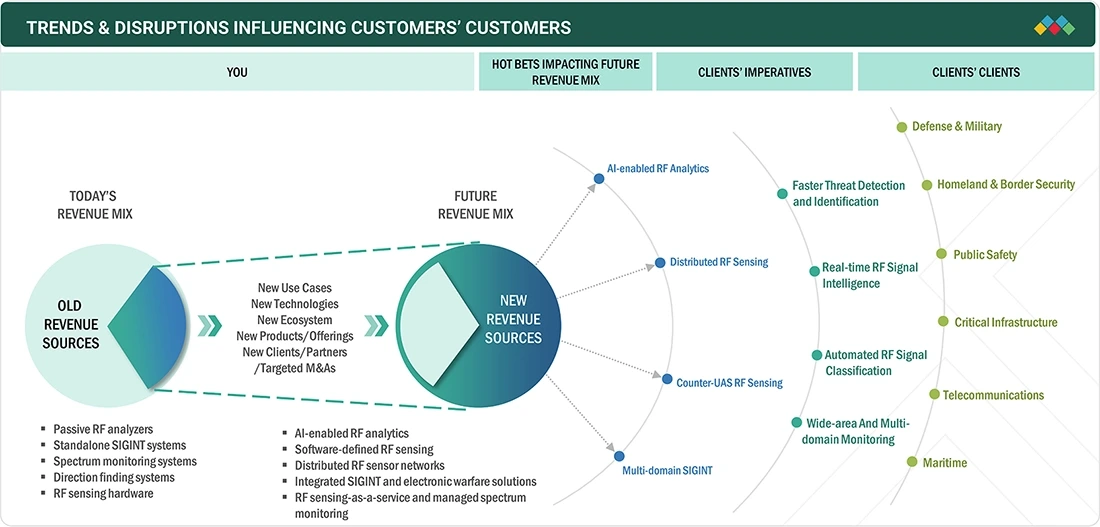
The passive RF analyzers, RF sensing, and SIGINT trends is undergoing a major revenue shift from traditional standalone RF analyzers, spectrum monitoring systems, direction-finding systems, and RF sensing hardware toward advanced software-defined and intelligence-driven solutions. The future revenue mix is increasingly centered around AI-enabled RF analytics, distributed RF sensing, counter-UAS RF sensing, and multi-domain SIGINT capabilities, fueled by growing demand across defense, homeland and border security, public safety, critical infrastructure, telecommunications, and maritime applications. This shift is driving companies to integrate automated signal classification, real-time RF intelligence, and wide-area monitoring to address increasingly complex electromagnetic environments.
Source: Secondary Research, Interviews with Experts, MarketsandMarkets Analysis
PASSIVE RF ANALYZERS, RF SENSING, AND SIGINT MARKET DYNAMICS

Level
-
Rising defense investments in electronic warfare (EW), SIGINT, and multi-domain ISR capabilities

-
Increasing military emphasis on electromagnetic spectrum superiority and spectrum awareness


Level
-
High procurement and lifecycle costs of advanced passive RF and SIGINT systems

-
Export controls and regulatory restrictions on advanced SIGINT technologies


Level
-
Expansion of distributed RF sensor networks for wide-area spectrum surveillance

-
Increasing adoption of passive RF technologies in commercial spectrum management and telecom monitoring


Level
-
Detecting and classifying Low Probability of Intercept (LPI) and Low Probability of Detection (LPD) signals

-
Processing high-volume RF data with low latency for real-time intelligence generation

Source: Secondary Research, Interviews with Experts, MarketsandMarkets Analysis
Driver: Rising defense investments in electronic warfare (EW), SIGINT, and multi-domain ISR capabilities
Rising defense investments in electronic warfare, SIGINT, and multi-domain ISR capabilities are driving demand for advanced passive RF analyzers and RF sensing systems. Defense forces are increasingly prioritizing electromagnetic spectrum superiority, real-time situational awareness, and rapid threat identification across contested environments. Growing procurement of airborne, ground-based, naval, and space-based intelligence systems is expanding deployment opportunities for passive RF technologies. Additionally, increasing requirements for persistent spectrum monitoring, electronic support, and signal intelligence are encouraging defense organizations to modernize legacy systems and adopt software-defined, AI-enabled RF sensing solutions.
Restraint: High procurement and lifecycle costs of advanced passive RF and SIGINT systems
High procurement and lifecycle costs of advanced passive RF and SIGINT systems remain a major restraint for market adoption. These systems require sophisticated RF front ends, receivers, antennas, signal processors, specialized software, and secure communications infrastructure, increasing initial investment requirements. Integration with existing defense and surveillance architectures can further increase deployment costs and system complexity. In addition, maintenance, software upgrades, cybersecurity requirements, and specialized personnel add to total lifecycle expenditure. These cost considerations can delay procurement decisions, particularly among budget-constrained defense organizations and public-sector security agencies.
Opportunity: Expansion of distributed RF sensor networks for wide-area spectrum surveillance
The expansion of distributed RF sensor networks presents significant opportunities for passive RF sensing and SIGINT solution providers. Networked sensors can provide persistent, wide-area spectrum surveillance while enabling multiple geographically dispersed systems to share and correlate RF observations. Integration with cloud-based processing, AI-enabled analytics, and centralized command-and-control platforms can improve emitter detection, classification, and geolocation capabilities. Growing requirements for border security, counter-UAS, critical infrastructure protection, maritime surveillance, and battlefield awareness are expected to accelerate deployment of distributed architectures and create new revenue opportunities for RF sensing providers.
Challenge: Detecting and classifying Low Probability of Intercept (LPI) and Low Probability of Detection (LPD) signals
Detecting and classifying Low Probability of Intercept (LPI) and Low Probability of Detection (LPD) signals remains a significant technical challenge for passive RF sensing and SIGINT systems. These signals are designed to minimize detectability through techniques such as low-power operation, wideband transmission, frequency agility, and complex waveforms. Increasing use of advanced communication and radar technologies is making signal identification more difficult in congested electromagnetic environments. Market participants must continuously improve receiver sensitivity, signal processing, AI-based classification, and direction-finding capabilities to detect sophisticated signals with limited observable characteristics.
PASSIVE RF ANALYZERS, RF SENSING, AND SIGINT MARKET GROWTH: COMMERCIAL USE CASES ACROSS INDUSTRIES
| COMPANY | USE CASE DESCRIPTION | BENEFITS |
|---|---|---|
 |
Provides RF sensing, electronic warfare, SIGINT, and spectrum awareness capabilities for defense platforms and multi-domain intelligence operations. | Enables rapid threat detection | Emitter identification | Situational awareness | Enhanced electromagnetic spectrum superiority |
 |
Develops advanced RF sensing, electronic warfare, radar, and electronic support capabilities for airborne, naval, and ground-based defense applications. | Improves threat detection | Signal identification | Platform survivability | Mission effectiveness |
 |
Provides passive RF sensing, SIGINT, electronic support, and spectrum warfare solutions for aircraft, unmanned platforms, naval systems, and ground operations. Its solutions support signal detection, identification, tracking, direction finding, and geolocation. | Enhances battlefield awareness | Threat identification | Electronic warfare effectiveness | Platform survivability |
 |
Provides monitoring receivers, direction finders, DF antennas, and spectrum monitoring systems for communications intelligence, interference hunting, critical infrastructure, telecommunications, and regulatory spectrum monitoring. | Enables continuous spectrum awareness | Interference localization | Unauthorized transmitter detection | Signal analysis | Improved spectrum management |
 |
Provides RF sensing, SIGINT, electronic warfare, and intelligence solutions for airborne, ground, maritime, and space-based defense missions. | Supports persistent RF surveillance | Signal collection and exploitation | Threat identification | Multi-domain situational awareness |
Logos and trademarks shown above are the property of their respective owners. Their use here is for informational and illustrative purposes only.
PASSIVE RF ANALYZERS, RF SENSING, AND SIGINT MARKET ECOSYSTEM
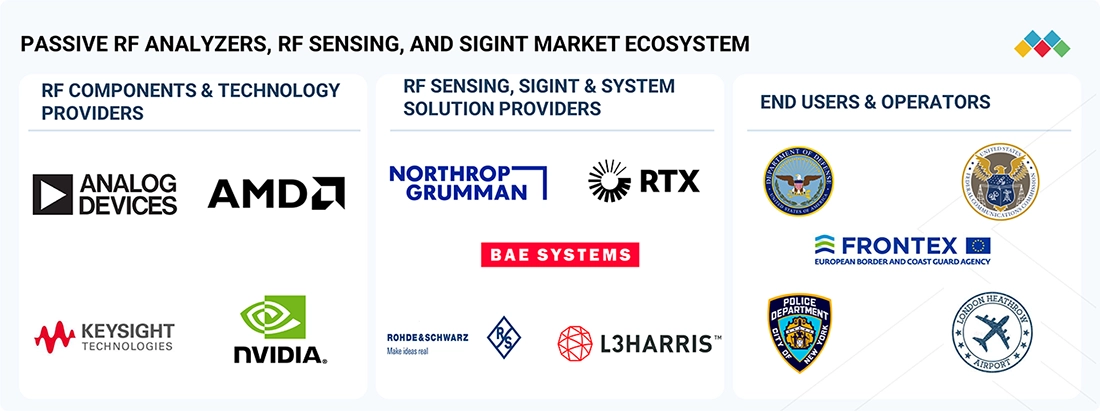
The passive RF analyzers, RF sensing, and SIGINT ecosystem comprises RF component and technology providers, RF sensing and SIGINT system solution providers, and end users and operators. Companies such as Analog Devices, AMD, NVIDIA, and Keysight Technologies supply RF, processing, and signal analysis technologies. System providers, including Northrop Grumman, RTX, BAE Systems, Rohde & Schwarz, and L3Harris Technologies, integrate these technologies into passive RF analyzers, SIGINT, spectrum monitoring, and direction-finding solutions. End users such as the US Department of Defense, Federal Communications Commission, New York Police Department, London Heathrow Airport, and Frontex drive demand across defense, public safety, spectrum management, airport security, and border surveillance applications.
Logos and trademarks shown above are the property of their respective owners. Their use here is for informational and illustrative purposes only.
PASSIVE RF ANALYZERS, RF SENSING, AND SIGINT MARKET SEGMENTS
Source: Secondary Research, Interviews with Experts, MarketsandMarkets Analysis
Passive RF Analyzers, RF Sensing, and SIGINT Market, By System Type
As of 2026, SIGINT Systems are expected to hold the largest share of the passive RF analyzers, RF sensing, and SIGINT market share and maintain their leading position during the forecast period. SIGINT systems enable the interception, collection, processing, classification, and analysis of RF signals for intelligence generation. Growing defense investments in electronic warfare, multi-domain ISR, battlefield awareness, and threat detection are driving demand for advanced SIGINT capabilities. Increasing adoption of software-defined receivers, AI-enabled signal processing, and networked intelligence architectures is further strengthening the deployment of SIGINT systems across ground, airborne, naval, and space-based platforms.
Passive RF Analyzers, RF Sensing, and SIGINT Market, By Component
Software is projected to register the highest CAGR during the forecast period. Growing demand for automated signal processing, signal classification, spectrum visualization, and AI-enabled analytics is increasing the software content of RF sensing and SIGINT solutions. Software enables faster identification of signals of interest, automated threat classification, and real-time analysis of increasingly complex electromagnetic environments. The transition toward software-defined architectures is further supporting demand for flexible and upgradeable solutions. Increasing integration of AI, machine learning, and advanced analytics is expected to create significant growth opportunities for software providers across defense, security, telecommunications, and critical infrastructure applications.
Passive RF Analyzers, RF Sensing, and SIGINT Market, By Platform
As of 2026, ground-based platforms are expected to hold the largest share of the passive RF analyzers, RF sensing, and SIGINT market. Ground-based systems support persistent spectrum monitoring, threat detection, direction finding, and RF intelligence across large geographic areas. Their deployment across military bases, borders, critical infrastructure, telecommunications networks, and security facilities supports widespread adoption. Growing requirements for continuous electromagnetic spectrum awareness and protection against unauthorized or hostile RF emissions are further driving demand. Increasing deployment of networked ground sensors and distributed RF monitoring architectures is also strengthening the role of ground-based platforms in RF intelligence operations.
Passive RF Analyzers, RF Sensing, and SIGINT Market, By Deployment
As of 2026, mobile systems are expected to hold the largest share of the deployment segment. Mobile RF sensing and SIGINT systems provide operational flexibility for tactical missions, interference detection, direction finding, counter-UAS operations, and temporary spectrum monitoring. Their ability to operate across changing environments supports deployment by defense forces, public safety agencies, border security organizations, and telecommunications operators. Growing demand for on-the-move situational awareness and rapid deployment is encouraging manufacturers to develop compact, ruggedized, and low-SWaP systems. Integration of software-defined receivers and real-time analytics is further enhancing the capabilities of mobile RF monitoring solutions.
Passive RF Analyzers, RF Sensing, and SIGINT Market, By Frequency
UHF is projected to register the highest CAGR during the forecast period. The increasing use of UHF frequencies across tactical communications, public safety networks, wireless systems, and unmanned platforms is driving demand for advanced RF monitoring and signal intelligence capabilities. UHF systems support applications including signal interception, emitter identification, direction finding, counter-UAS, and spectrum monitoring. Growing deployment of wireless communication systems and increasing electromagnetic congestion are further increasing the need for real-time monitoring and interference detection. Advancements in wideband receivers, software-defined radio, and automated signal classification are expected to drive growth in UHF-based RF sensing solutions.
Passive RF Analyzers, RF Sensing, and SIGINT Market, By Application
As of 2026, military applications are expected to hold the largest share of the passive RF analyzers, RF sensing, and SIGINT market trends. Increasing defense spending on electronic warfare, intelligence, surveillance, and reconnaissance is driving demand for passive RF technologies. These systems support battlefield awareness, electronic support, threat detection, target identification, and spectrum monitoring. Growing adoption of multi-domain operations is increasing requirements for RF intelligence across ground, airborne, naval, and space-based platforms. Additionally, the proliferation of sophisticated communication and radar systems is prompting defense organizations to strengthen their passive detection, signal classification, direction-finding, and RF geolocation capabilities.
PASSIVE RF ANALYZERS, RF SENSING, AND SIGINT BY REGION
Asia Pacific to be fastest-growing region in global passive RF analyzers, RF sensing, and SIGINT market during forecast period
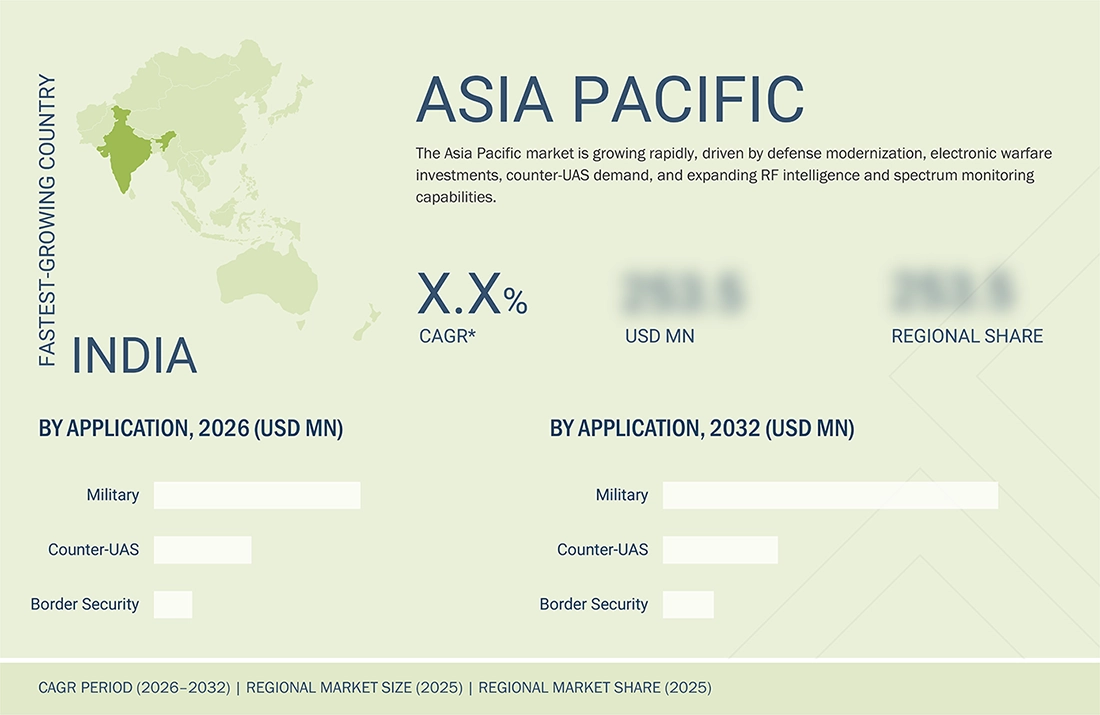
The Asia Pacific passive RF analyzers, RF sensing, and SIGINT market is experiencing strong growth, driven by rising defense modernization and increasing investments in electronic warfare and RF intelligence. Growing requirements for border security, counter-UAS, maritime surveillance, and multi-domain situational awareness are accelerating adoption across China, India, Japan, South Korea, and Australia. The increasing deployment of advanced communication infrastructure and spectrum-intensive technologies is driving demand for spectrum monitoring and RF sensing. Government initiatives to strengthen indigenous defense capabilities and investments in advanced SIGINT and RF sensing systems are further supporting market growth across the region.
PASSIVE RF ANALYZERS, RF SENSING, AND SIGINT MARKET: COMPANY EVALUATION MATRIX
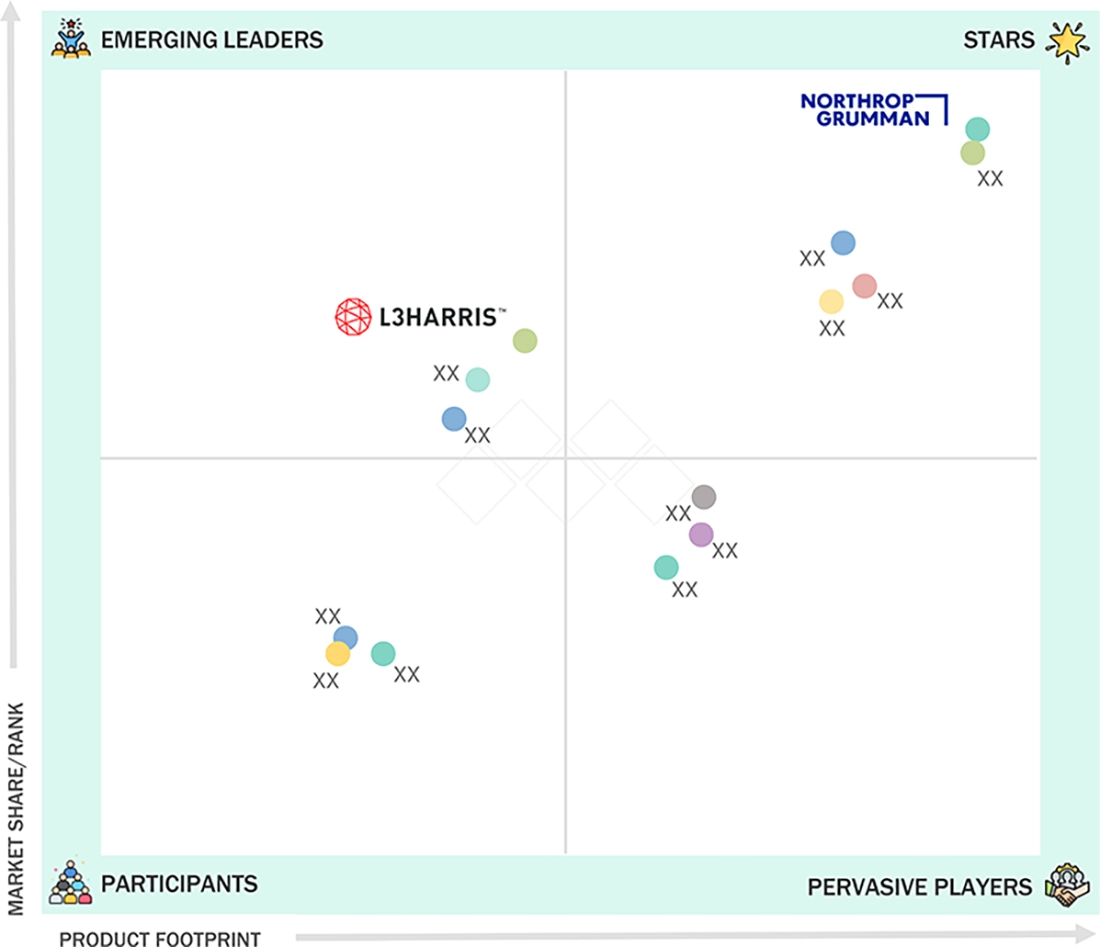
The passive RF analyzers, RF sensing, and SIGINT market matrix positions Northrop Grumman Corporation (Star) as a leading player, supported by its broad RF sensing, electronic warfare, and SIGINT capabilities. L3Harris Technologies, Inc. (Emerging Leader) is strengthening its position through advanced RF intelligence, electronic warfare, and multi-domain sensing solutions. Northrop Grumman benefits from a strong market presence and an extensive defense portfolio, while L3Harris is expanding its competitive position through continued technology development and solutions that support evolving RF sensing and intelligence requirements. Investments and funding in the passive RF analyzers, RF sensing, and SIGINT market are increasing as governments and defense organizations strengthen electronic warfare, intelligence, surveillance, and reconnaissance capabilities. Funding is primarily directed toward advanced RF sensing technologies, AI-enabled signal processing, software-defined architectures, and multi-domain intelligence systems. Government defense modernization programs, along with investments in counter-UAS, spectrum monitoring, electronic warfare, and secure communications, are strengthening the long-term growth prospects of the global market. Mergers and acquisitions in the passive RF analyzers, RF sensing, and SIGINT market are focused on strengthening technological capabilities, expanding solution portfolios, and enhancing multi-domain intelligence offerings. Companies are pursuing acquisitions, strategic partnerships, and joint development agreements to enhance expertise in RF sensing, signal processing, electronic warfare, and spectrum intelligence while accelerating the deployment of next-generation solutions. These activities enable market participants to broaden their customer base, improve system capabilities, and reinforce their competitive position across defense, security, telecommunications, and critical infrastructure applications.
Source: Secondary Research, Interviews with Experts, MarketsandMarkets Analysis
KEY MARKET PLAYERS - TOP PASSIVE RF ANALYZERS, RF SENSING, AND SIGINT COMPANIES
- Northrop Grumman Corporation
- RTX Corporation
- BAE Systems plc
- Lockheed Martin Corporation
- Leonardo S.p.A.
- Thales Group
- Elbit Systems Ltd.
- L3Harris Technologies, Inc.
- Rohde & Schwarz
- Saab AB
- Israel Aerospace Industries (IAI)
- HENSOLDT AG
- ASELSAN
- SPX Communication Technologies (TCI)
- Keysight Technologies
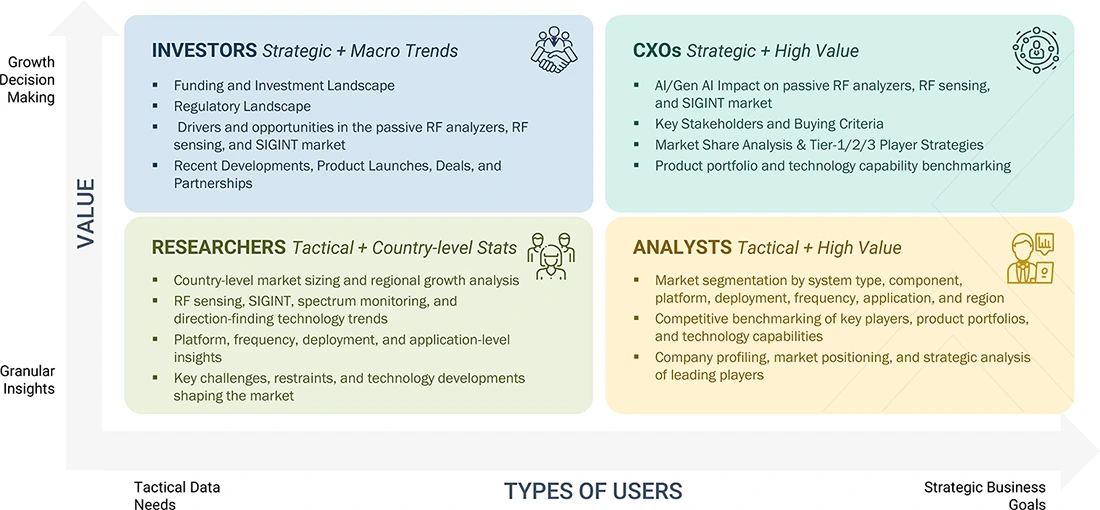
WHAT IS IN IT FOR YOU: PASSIVE RF ANALYZERS, RF SENSING, AND SIGINT MARKET REPORT CONTENT GUIDE
DELIVERED CUSTOMIZATIONS
We have successfully delivered the following deep-dive customizations:
| CLIENT REQUEST | CUSTOMIZATION DELIVERED | VALUE ADDS |
|---|---|---|
| Passive RF Analyzer Manufacturer |
|
|
| RF Sensing / SIGINT System Provider |
|
|
| Defense & Security Organization |
|
|
| Telecommunications Operator |
|
|
| Critical Infrastructure / Public Safety Operator |
|
|
RECENT DEVELOPMENTS
- March 2026 : BAE Systems launched SigWerx, an advanced electromagnetic spectrum technology suite designed to accelerate the development of software applications for electronic warfare, communications, navigation, SIGINT, and radar. The modular digital signal-processing toolkit supports faster development of mission-critical capabilities for increasingly complex electromagnetic environments.
- April 2026 : RTX’s Raytheon delivered its first Next Generation Jammer (NGJ) shipsets to the Royal Australian Air Force. The airborne electronic warfare system strengthens RF-based threat response by disrupting adversary radar and communication systems, supporting enhanced survivability and mission effectiveness.
- June 2026 : Rohde & Schwarz showcased next-generation SIGINT/EW and counter-UAS solutions at Eurosatory 2026, including solutions for detecting, classifying, and localizing electromagnetic emitters. The company highlighted integrated sensor fusion and spectrum intelligence for defense, security, and border protection applications.
- July 2026 : BAE Systems received a contract from Boeing to deliver EPAWSS electronic warfare systems for the Republic of Korea Air Force F-15K aircraft. The digital system provides 360-degree threat detection and countermeasures for operation in signal-dense electromagnetic environments.
Table of Contents
 Exclusive indicates content/data unique to MarketsandMarkets and not available with any competitors.
Methodology
The study involved major activities in estimating the current size of the passive RF analyzers, RF sensing, and SIGINT market. Exhaustive secondary research was conducted to collect information on the RF sensing, spectrum monitoring, and SIGINT industry. The next step was to validate these findings and assumptions with industry experts across the value chain through primary research. Different approaches, including top-down and bottom-up methods, were employed to estimate the total market size. Following this, market breakdown and data triangulation procedures were used to determine the market size of segments and subsegments.
Secondary Research
Secondary research for this study involved gathering information from various credible sources, including company reports, defense publications, government documents, white papers, journals, and industry publications. This process helped understand the supply and value chains, identify key players, analyze market segmentation and regional trends, and track major market and technology developments. The collected data was used to estimate the overall market size, which was subsequently validated through primary research.
Primary Research
Extensive primary research was conducted after gaining an understanding of the current state of passive RF analyzers, RF sensing, and the SIGINT market through secondary research. Several primary interviews were conducted with experts from the demand and supply sides across four major regions: North America, Asia Pacific, Europe, and RoW. This primary data was collected through questionnaires, emails, and telephonic interviews.
Breakdown of Primary Interviews
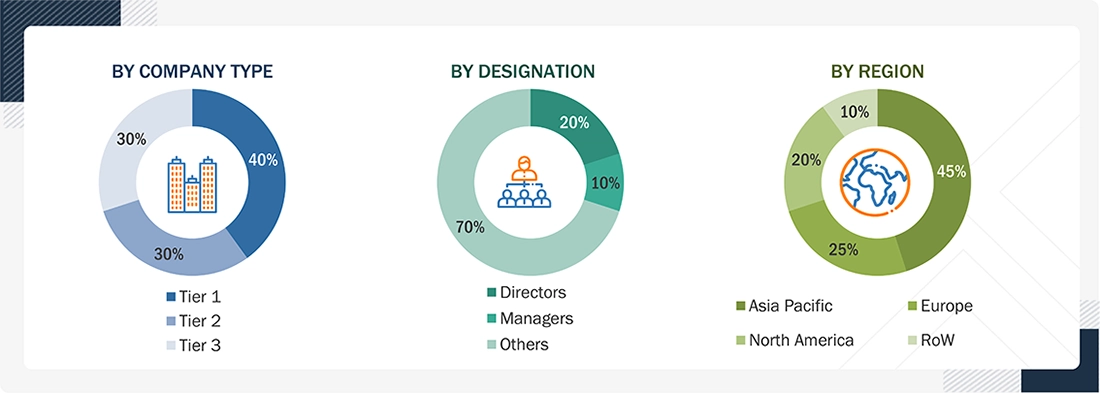
Notes: Other designations include product managers, sales managers, and marketing managers.
Tier 1 companies include market players with revenues above USD 500 million; tier 2 companies earn revenues between USD 100 million and USD 500 million; and tier 3 companies earn up to USD 100 million.
To know about the assumptions considered for the study, download the pdf brochure
Market Size Estimation
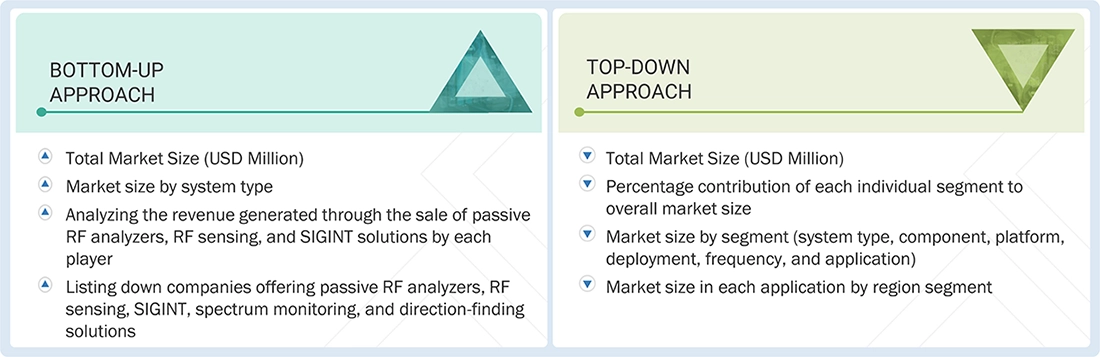
The bottom-up approach has been employed to determine the overall size of the passive RF analyzers, RF sensing, and SIGINT market.
- Identifying passive RF analyzer, RF sensing, SIGINT, spectrum monitoring, and direction-finding systems provided or expected to be offered by players in the value chain
- Tracking the major manufacturers and providers of passive RF analyzers, RF sensing, and SIGINT solutions across different regions
- Tracking the ongoing and upcoming product launches and different inorganic strategies, such as acquisitions, partnerships, and collaborations
- Estimating and forecasting the passive RF analyzers, RF sensing, and SIGINT market in each country and, thereby, region based on trade data, defense expenditure, and relevant macroeconomic indicators
- Conducting multiple discussions with key opinion leaders to understand the types of RF sensing and SIGINT systems deployed by market players and analyzing the breakdown of the scope of work carried out by each major company
- Verifying and cross-checking the estimates at every level by discussing with key opinion leaders, including CEOs, directors, and operations managers, and then finally with the domain experts at MarketsandMarkets
- Studying various paid and unpaid information sources, such as annual reports, press releases, white papers, defense publications, and others.
The top-down approach has been used to estimate and validate the total size of the passive RF analyzers, RF sensing, and SIGINT market.
- Focusing on top-line investments and expenditures being made in the ecosystems of various end users
- Calculating the market size considering revenues generated by major players through passive RF analyzers, RF sensing, SIGINT, spectrum monitoring, and direction finding solutions
- Segmenting each application of passive RF analyzers, RF sensing, and SIGINT solutions in each region and deriving the global market size based on region
- Acquiring and analyzing information related to revenues generated by players through their key product offerings
- Conducting multiple on-field discussions with key opinion leaders involved in the development of various RF sensing, SIGINT, spectrum monitoring, and direction finding systems
- Estimating the geographic split using secondary sources based on various factors, such as the number of players in a specific country and region and the types of RF systems deployed across defense, security, critical infrastructure, telecommunications, and commercial applications.
Passive RF Analyzers, RF Sensing, and SIGINT Market : Top-Down and Bottom-Up Approach
Data Triangulation
After arriving at the overall market size using the market size estimation processes as explained above, the market has been split into several segments and subsegments. Data triangulation and market breakdown procedures have been employed to complete the market engineering process and derive the exact statistics for each market segment and subsegment. The data has been triangulated by examining various factors and trends on the demand and supply sides across the passive RF analyzers, RF sensing, and SIGINT market.
Market Definition
The passive RF analyzers, RF sensing, and SIGINT market comprises systems, components, software, and services used to passively detect, capture, analyze, classify, monitor, and locate RF signals without actively transmitting signals. The market includes passive RF analyzers, SIGINT systems, spectrum monitoring systems, and direction-finding systems deployed across ground-based, vehicle-mounted, manpack, airborne, naval, and space-based platforms. Solutions support applications such as military intelligence, counter-UAS, border security, public safety, critical infrastructure protection, maritime surveillance, homeland security, telecom spectrum monitoring, and industrial RF monitoring. The market covers hardware, software, integration, deployment, training, and maintenance services.
Key Stakeholders
- RF Component and Semiconductor Suppliers
- RF Antenna Manufacturers
- RF Front-End and Receiver Manufacturers
- Passive RF Analyzer Manufacturers
- SIGINT System Integrators
- Spectrum Monitoring and Direction Finding Solution Providers
- Software and Analytics Providers
- Defense and Security Agencies
- Telecommunications Operators
- Critical Infrastructure Operators
- Research Institutions
- Distributors and Resellers
- Regulatory and Spectrum Management Bodies
- End-User Industries
Report Objectives
- To describe, segment, and forecast the size of the passive RF analyzers, RF sensing, and SIGINT market by system type, component, platform, deployment, frequency, application, and region, in terms of value.
- To describe, segment, and forecast the size of the passive RF analyzers, RF sensing, and SIGINT market by component, in terms of volume.
- To forecast the size of various market segments across North America, Europe, Asia Pacific, and the Rest of the World (RoW), in terms of value.
- To provide detailed information on the drivers, restraints, opportunities, and challenges influencing the market's growth.
- To provide a detailed overview of the market value chain and ecosystem, including component suppliers, system integrators, OEMs, defense organizations, and end users.
- To strategically analyze micromarkets with respect to individual growth trends, prospects, and their contribution to the overall market.
- To study industry trends through Porter's Five Forces analysis, macroeconomic outlook, value chain and ecosystem analyses, technology trends, AI-enabled signal intelligence, software-defined architectures, spectrum management developments, procurement trends, defense modernization initiatives, case studies, and regulatory frameworks influencing the market.
- To analyze opportunities for various stakeholders by identifying the high-growth segments of the market across military, homeland security, critical infrastructure, public safety, border security, telecom spectrum monitoring, industrial RF monitoring, and commercial applications.
- To benchmark the key market players and analyze their market position in terms of revenue, market share, product portfolio, technological capabilities, regional presence, and core competencies, and provide a detailed competitive landscape for market leaders.
- To analyze competitive developments, including product launches, technology demonstrations, defense contracts, partnerships, collaborations, mergers & acquisitions, investments, and business expansions, undertaken by companies operating in the market.
Available customizations:
With the given market data, MarketsandMarkets offers customizations according to the company‘s specific needs. The following customization options are available for the report.
Company Information
- Detailed analysis and profiling of additional market players (up to five)
Key Questions Addressed by the Report
What is the size of the Passive RF Analyzers, RF Sensing, and SIGINT Market?
The market is projected to grow from USD 28.56 billion in 2026 to USD 46.93 billion by 2032.
What is the expected CAGR of the Passive RF Analyzers, RF Sensing, and SIGINT Market?
The market is expected to grow at a CAGR of 8.6% from 2026 to 2032.
What are the key trends shaping the Passive RF Analyzers, RF Sensing, and SIGINT Market?
Key trends include the adoption of AI-enabled RF sensing, software-defined systems, automated signal classification, real-time RF analytics, and distributed spectrum monitoring. The software segment is expected to register a 10.9% CAGR.
What are the major growth drivers for the Passive RF Analyzers, RF Sensing, and SIGINT Market?
Major growth drivers include rising defense investments in electronic warfare, SIGINT, and multi-domain ISR, increasing electromagnetic spectrum operations, and growing demand for real-time threat detection and spectrum awareness.
Who are the leading companies in the Passive RF Analyzers, RF Sensing, and SIGINT Market?
Major companies include Northrop Grumman, RTX, BAE Systems, Lockheed Martin, Leonardo, Thales, Elbit Systems, and L3Harris Technologies.
Which industries and applications are driving demand for passive RF sensing and SIGINT solutions?
Defense and security are the major application areas, supported by demand from electronic warfare, intelligence, surveillance and reconnaissance, counter-UAS, border security, maritime surveillance, and critical infrastructure protection. Military applications account for approximately 44% of the market in 2026.
What does the Passive RF Analyzers, RF Sensing, and SIGINT Market report cover?
The report analyzes the market by system type, platform, deployment, application, component, frequency, and region. It also evaluates market trends, drivers, restraints, opportunities, challenges, and the competitive landscape.
Which region is expected to grow fastest in the Passive RF Analyzers, RF Sensing, and SIGINT Market?
Asia Pacific is expected to register the fastest growth, supported by defense modernization, electronic warfare investments, and increasing demand for RF intelligence systems. The region is projected to grow at approximately 10.5% CAGR.
Which system type is expected to hold the largest share of the market?
SIGINT Systems are expected to account for the largest system-type share, with approximately 61% of the market in 2026, driven by increasing requirements for signal interception, collection, processing, and intelligence generation.
Which deployment and technology segments show strong growth potential?
Mobile systems are expected to dominate deployment, accounting for approximately 72% share in 2026, while software is expected to be among the fastest-growing technology areas with a 10.9% CAGR.


Personalize This Research
- Triangulate with your Own Data
- Get Data as per your Format and Definition
- Gain a Deeper Dive on a Specific Application, Geography, Customer or Competitor
- Any level of Personalization
Let Us Help You
- What are the Known and Unknown Adjacencies Impacting the Passive RF Analyzers, RF Sensing, and SIGINT Market
- What will your New Revenue Sources be?
- Who will be your Top Customer; what will make them switch?
- Defend your Market Share or Win Competitors
- Get a Scorecard for Target Partners

Custom Market Research Services
We Will Customise The Research For You, In Case The Report Listed Above Does Not Meet With Your Requirements
Get 10% Free CustomisationTESTIMONIALS

Tetsuya Ohhira
Business Development Manager-Technology Business
Nikon Corporation,
Leading Japanese MNC specializing in optics and imaging productswww.nikon.com
MarketsandMarkets™ response
is quick. Their attitude is flexible and positive. Analyst Insights are globally considered and
significant. Client Services quickly respond to our inquiry and demand. Their wide range of global
surveys help us make our strategic plan.
We hope Knowledge Store will be easier to search
for a report.
VP - Marketing & Business Development
Leading Provider of Process Control Solutions
We engaged with MarketsandMarkets on a study to perform an analysis and recommend a Go-To-Market strategy for metrology and process control in the semiconductor market. The study was tailored to our targets and needs with well-defined milestones. Our overall experience with the MarketsandMarkets team was very good throughout the project in all aspects including the analysis methodologies used, the quality and depth of primary and secondary data sets, the professionalism and flexibility of the team and the ability to meet the target schedule and milestones. We want to thank MarketsandMarkets team for a job well done.






Growth opportunities and latent adjacency in Passive RF Analyzers, RF Sensing, and SIGINT Market