Permanent Modular Construction Market

Permanent Modular Construction Market by Material (Wood, Steel, Concrete), End-Use Industry (Residential, Office, Hospitality, Others), Region (North America, Europe, Asia Pacific, Middle East & Africa, South America) - Global Forecast to 2030




OVERVIEW
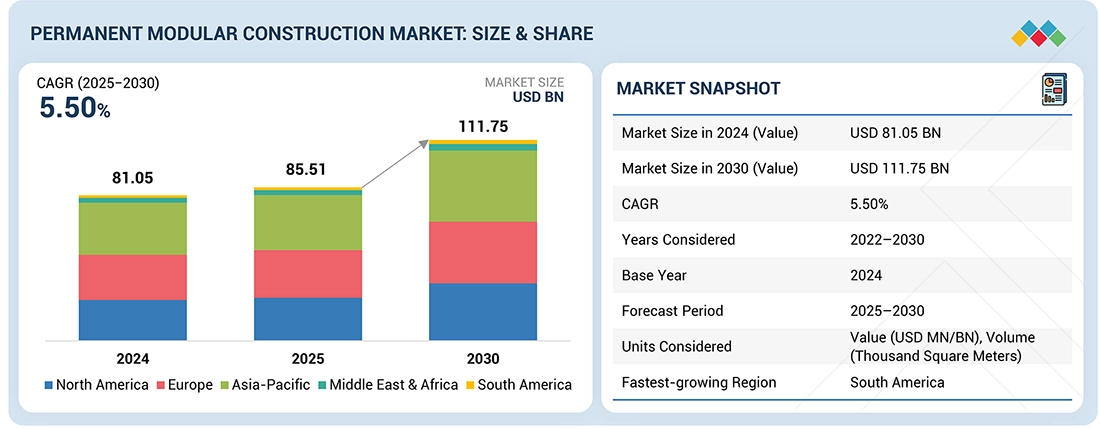
Source: Secondary Research, Interviews with Experts, MarketsandMarkets Analysis
The permanent modular construction market is projected to reach USD 111.75 billion by 2030 from USD 85.51 billion in 2025, at a CAGR of 5.50% from 2025 to 2030. The permanent modular construction business is on the rise due to the need for time-saving and cost-effective construction, labor shortages, and housing shortages & targets.
KEY TAKEAWAYS
-
By RegionAsia Pacific is the largest permanent modular construction market, with a market share of 35.9% in 2024.
-
By MaterialBy material, the steel segment is expected to grow at the fastest rate of 6.50% between 2025 and 2030.
-
By End-use IndustryBy end-use industry, the residential segment is expected to dominate the market, with a market share of 50.4% and a CAGR of 4.90%.
-
Competitive Landscape-Key playersATCO Ltd., Laing O’Rourke, Fluor Corporation, Lendlease Corporation, and Modulaire Group were identified as Star players in the market, as they have focused on innovation and have broad industry coverage, and strong operational & financial strength.
-
Competitive Landscape-StartupsHarbinger Production Inc., Blokable Inc., Broad Group, DuBox, and Guerdon, LLC, among others, have distinguished themselves among startups and SMEs due to their strong product portfolios and business strategies.
The permanent modular construction business is on the rise due to the need for time-saving and cost-effective construction, labor shortages, and housing shortages & targets. Furthermore, the population increase and urbanization, along with government incentives, are helping to drive the market.
TRENDS & DISRUPTIONS IMPACTING CUSTOMERS' CUSTOMERS
The permanent modular construction market is shifting toward faster project delivery, cost certainty, and standardized yet flexible building designs across residential, commercial, and institutional sectors. Growth is driven by labor shortages, sustainability mandates, and rising demand for rapid, high-quality infrastructure with minimal site disruption.
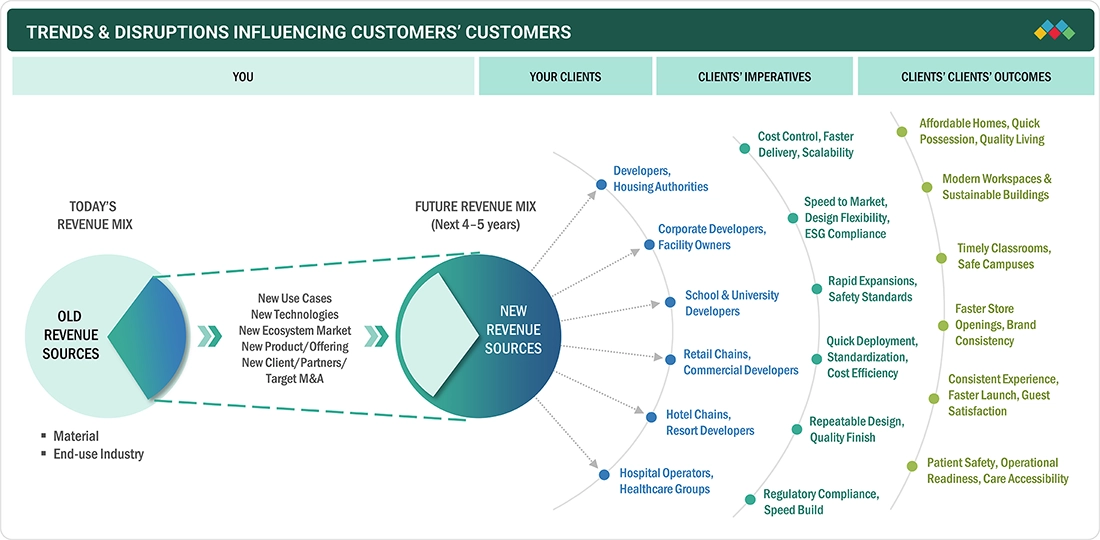
Source: Secondary Research, Interviews with Experts, MarketsandMarkets Analysis
MARKET DYNAMICS

Level
-
•Need for time-saving and cost-effective construction

-
•Shortage of labor


Level
-
•Risk of transportation and assembly issues in modular constructions

-
•Regulatory fragmentation


Level
-
•Population growth and urbanization

-
•Government incentives & policy reforms


Level
-
•Lack of customer awareness

-
•Negative perception of quality/durability

Source: Secondary Research, Interviews with Experts, MarketsandMarkets Analysis
Driver: Need for time-saving and cost-effective construction
The growing adoption of modular construction is powered largely by its ability to deliver buildings significantly faster and more economically than traditional site-built methods. In modular construction, modules are prefabricated off-site in factories while site work proceeds in parallel, which reduces overall timelines and lowers costs by 10–20% compared to traditional construction. Having tasks occur simultaneously reduces the need for labor, cuts down on material waste, and prevents delays on the job site. This leads to lower construction costs and more predictable budgets. For developers and public sector clients with tight deadlines or limited money, these savings and speed are very appealing. Finishing projects faster allows for earlier occupancy or usability, which improves return on investment and helps meet urgent infrastructure or housing needs.
Restraint:Risk of transportation and assembly issues in modular construction
Despite its advantages, modular construction carries a significant risk tied to transporting and assembling large prefabricated modules. Oversized modules must be carefully transported; any mishandling, poor weather, or tight urban roads can lead to damage or delays. Once on-site, precise alignment and structural integration are critical. Errors in module-to-foundation connections or poor load redistribution, especially in complex or high-rise projects, can compromise safety and performance. Practical, logistical, and regulatory hurdles in transport and assembly remain among the top restraints limiting broader adoption, especially across regions with uneven infrastructure or regulatory frameworks.
Opportunity: Population growth and urbanization
Urbanization and population growth present a significant opportunity for modular construction globally. According to the most recent global data, over 4 billion people already live in urban areas, accounting for more than half of the world’s population, and this share is projected to rise to approximately 68% by 2050. The rapid expansion of cities, particularly in emerging economies, is increasing demand for housing, schools, commercial facilities, and infrastructure. Modular construction, with its speed, flexibility, and cost-efficiency, is well-positioned to help meet this surge in demand. As built-up urban land expands faster than population growth, modular methods can help deliver high-density housing and urban infrastructure while reducing waste and environmental impact.
Challenge: Lack of customer awareness
A lack of customer awareness poses a structural challenge to the global permanent modular construction market. This challenge is evident in misperceptions about quality, confusion with "temporary" or "prefab" units, and a limited understanding of lifecycle benefits. Numerous industry stakeholders are familiar with traditional site-built construction and often lack an understanding of the specific workflows, rhythms, and needs associated with modular delivery. A report from the Modular Building Institute (MBI) reveals that 62% of customers are not aware of modular construction. This lack of awareness remains a significant challenge, slowing growth even when modular construction is technically viable and economically promising.
PERMANENT MODULAR CONSTRUCTION MARKET: COMMERCIAL USE CASES ACROSS INDUSTRIES
| COMPANY | USE CASE DESCRIPTION | BENEFITS |
|---|---|---|
 |
Executed the award-winning Dawson Creek supportive housing project using permanent modular construction with a strong focus on sustainability, energy efficiency, and community integration | Accelerated project completion | Lower environmental footprint | Durable, code-compliant permanent housing |
 |
Applied Design for Manufacture and Assembly (DFMA) and modular construction techniques for The Grange University Hospital in the UK, integrating prefabricated structural components and modules into a large permanent healthcare facility | Reduced construction timelines | Enhanced quality and safety | Improved cost certainty for complex hospital infrastructure |
 |
Delivered permanent modular construction for the Steveston Highway Affordable Supportive Housing Project in Canada, supplying factory-built modules to enable rapid delivery of long-term affordable and supportive housing | Faster housing delivery for vulnerable populations | Improved build quality through factory control | Reduced on-site disruption and construction time |
Logos and trademarks shown above are the property of their respective owners. Their use here is for informational and illustrative purposes only.
MARKET ECOSYSTEM
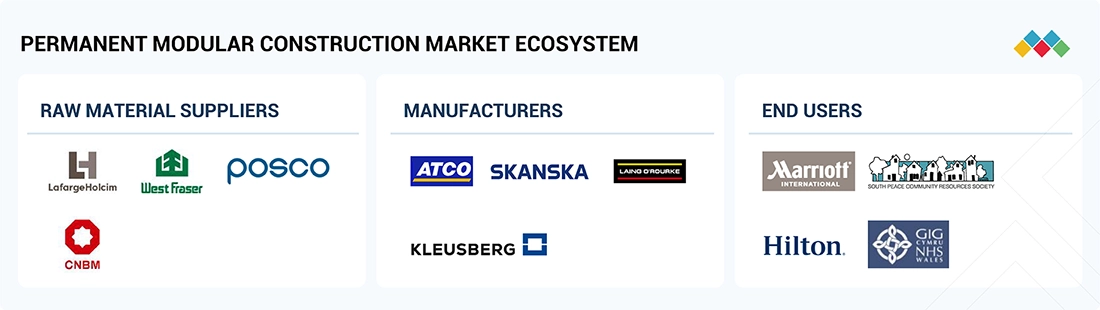
The key stakeholders within the ecosystem include raw material suppliers, permanent modular construction manufacturers, and end-users from various industries like residential, retail, hospitality, and education.
Logos and trademarks shown above are the property of their respective owners. Their use here is for informational and illustrative purposes only.
MARKET SEGMENTS
Source: Secondary Research, Interviews with Experts, MarketsandMarkets Analysis
Permanent Modular Construction Market, By Material
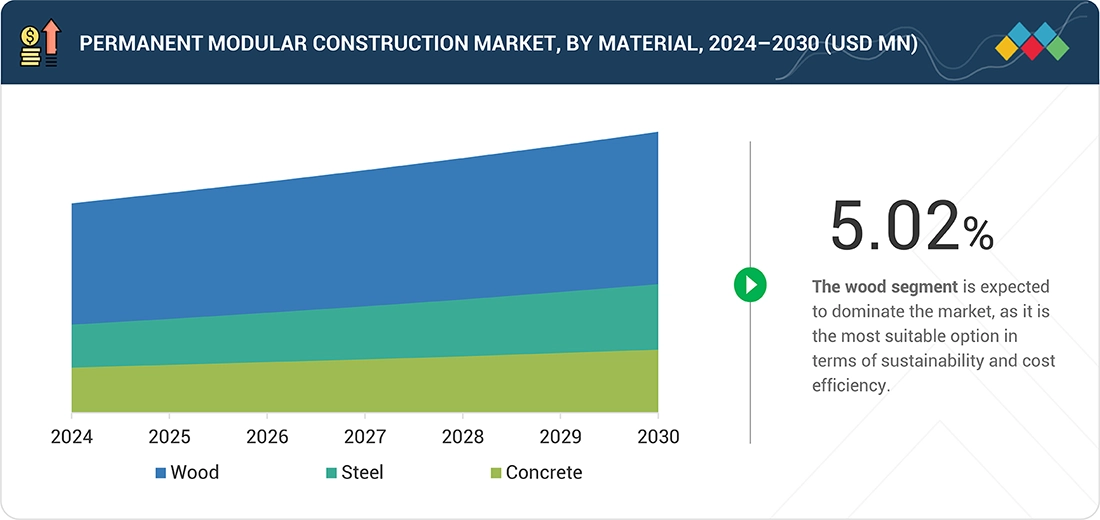
The wood segment is gaining traction in the permanent modular construction market because it aligns well with the demands for speed, sustainability, and cost-effectiveness. Processed wood products such as CLT and glulam are lighter, making them easier to manufacture, transport, and assemble on-site compared to steel or concrete modules. This lower weight also benefits construction by allowing for lighter foundations and the possibility of multi-storey buildings. Additionally, the adoption of timber is rising due to sustainability policies and green building objectives, as wood has a reduced embodied carbon footprint and serves as a carbon sink. Many governments in Europe and North America are actively promoting sustainable building codes and low-carbon construction policies, making wood an excellent option for permanent modular projects. Moreover, wood offers design flexibility and improved thermal performance, contributing to energy-efficient residential and commercial properties. Its compatibility with off-site construction, along with enhanced fire-resistance treatments and updated regulations, has boosted the confidence of developers, architects, and regulatory bodies, accelerating growth within the wood segment of permanent modular building construction.
Permanent Modular Construction Market, By End-use Industry
The market for permanent modular construction is growing in the residential sector due to significant housing shortages, budget concerns, and faster delivery times. Governments and municipalities across North America, Europe, and certain regions of Asia are prioritizing affordable, social, and supportive housing, as modular construction facilitates quicker building processes compared to traditional methods while offering better cost control. Accelerated urbanization and increasing populations are exerting pressure on cities to meet the demand for multi-family housing, where modular construction reduces on-site disruption and is well-suited for high-density developments. Additionally, developers face challenges with a lack of skilled labor and tighter project timelines, making factory-built housing a practical solution. The benefits of improved energy efficiency, sustainability, and government incentives for low-carbon and affordable housing further promote the adoption of modular construction, leading to a substantial growth in the residential segment of the permanent modular construction market.
REGION
Asia Pacific to be the largest region in the global permanent modular construction market during the forecast period
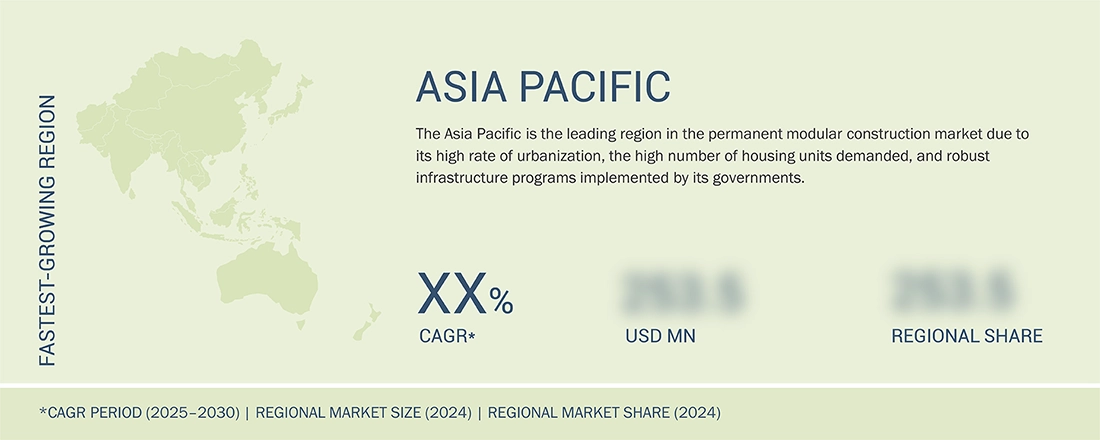
The Asia Pacific is the leading region in the permanent modular construction market due to its high rate of urbanization, high demand for housing units, and robust infrastructure programs implemented by its governments. There is an acute demand in countries such as China, India, Japan, Singapore, and Australia for affordable housing, schools, hospitals, and commercial buildings; permanent modular construction allows offering them quickly than mass constructions. The crowded population of the city slows down construction operations and is disruptive, whereas the modular approach enables simultaneous off-site and on-site construction. The governments of the region are heavily financing industrialized construction as part of policy requirements, standardized building frameworks, as well as public housing schemes. Other factors that further increase adoption include labor shortages, construction costs, and constrained project timelines. The Asia Pacific is also characterized by robust manufacturing ecosystems, high-quality prefabricated production, and low production costs, which enable large-scale modular production. These factors, coupled with the sustainability goals and the need for resilient and high-quality buildings, make the Asia Pacific the most dominant and the most rapidly expanding market for permanent modular buildings.
PERMANENT MODULAR CONSTRUCTION MARKET: COMPANY EVALUATION MATRIX
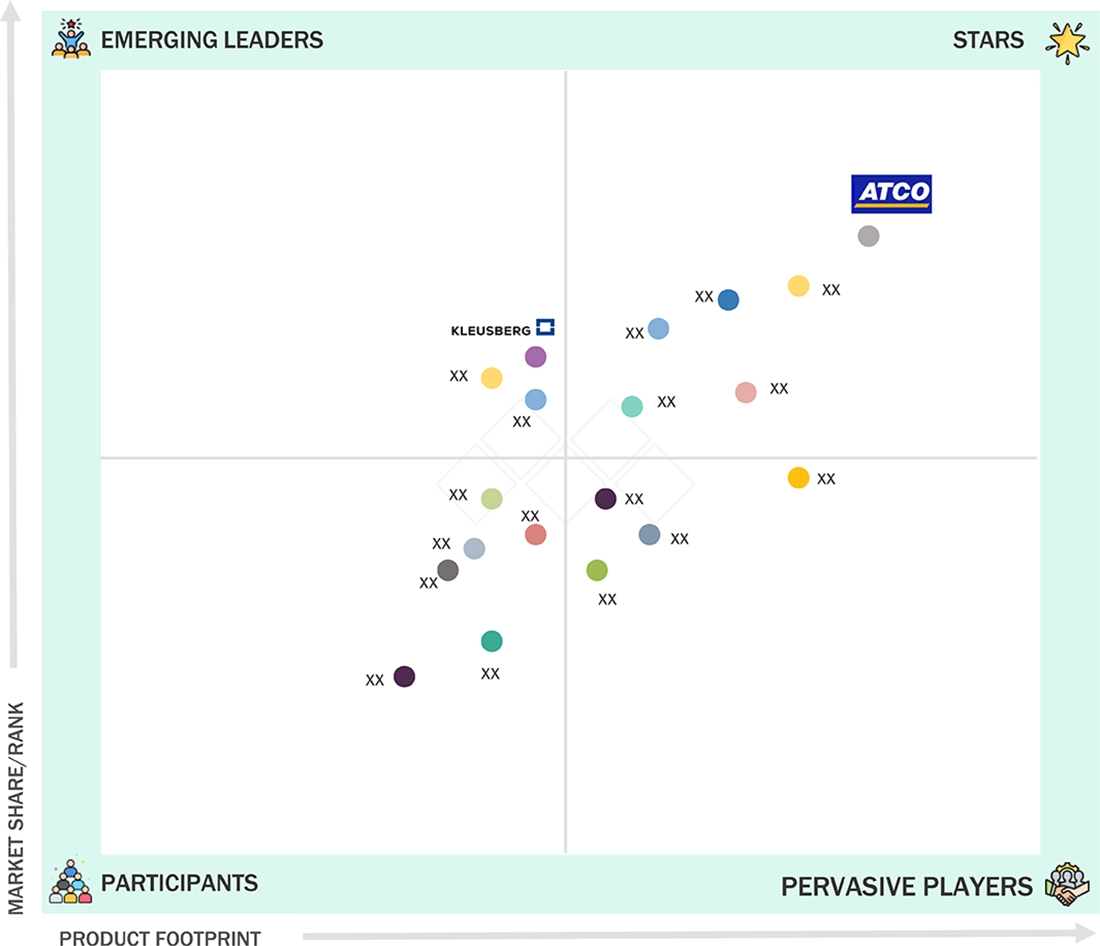
In the permanent modular construction market matrix, ATCO Ltd. (Star) leads with a strong market share and extensive product footprint, driven by its advanced products and huge international market presence. Kleusberg GmbH & Co. KG (Emerging Leader) is gaining visibility with its expertise, product innovations, and expansion. While ATCO Ltd. dominates through scale and a diverse portfolio, Kleusberg GmbH & Co. KG shows significant potential to move toward the leaders’ quadrant as demand for permanent modular construction continues to rise.
Source: Secondary Research, Interviews with Experts, MarketsandMarkets Analysis
KEY MARKET PLAYERS
- ATCO Ltd. (Canada)
- Laing O’Rourke (UK)
- Fluor Corporation (US)
- Lendlease Corporation (Australia)
- Modulaire Group (UK)
- Vinci S.A. (France)
- Kleusberg GmbH & Co. KG (Germany)
- Red Sea International Saudi Arabia)
- Bouygues Group (France)
- Skanska AB (Sweden)
MARKET SCOPE
| REPORT METRIC | DETAILS |
|---|---|
| Market Size in 2024 (Value) | USD 81.05 Billion |
| Market Size in 2030 (Value) | USD 111.75 Billion |
| Growth Rate | CAGR of 5.50% from 2025 to 2030 |
| Years Considered | 2022–2030 |
| Base Year | 2024 |
| Forecast Period | 2025–2030 |
| Units Considered | Value (USD Million/Billion), Volume (Thousand Square Meters) |
| Report Coverage | Revenue forecast, company ranking, competitive landscape, growth factors, and trends |
| Segments Covered |
|
| Regions Covered | North America, Europe, Asia Pacific, Middle East & Africa, South America |
WHAT IS IN IT FOR YOU: PERMANENT MODULAR CONSTRUCTION MARKET REPORT CONTENT GUIDE
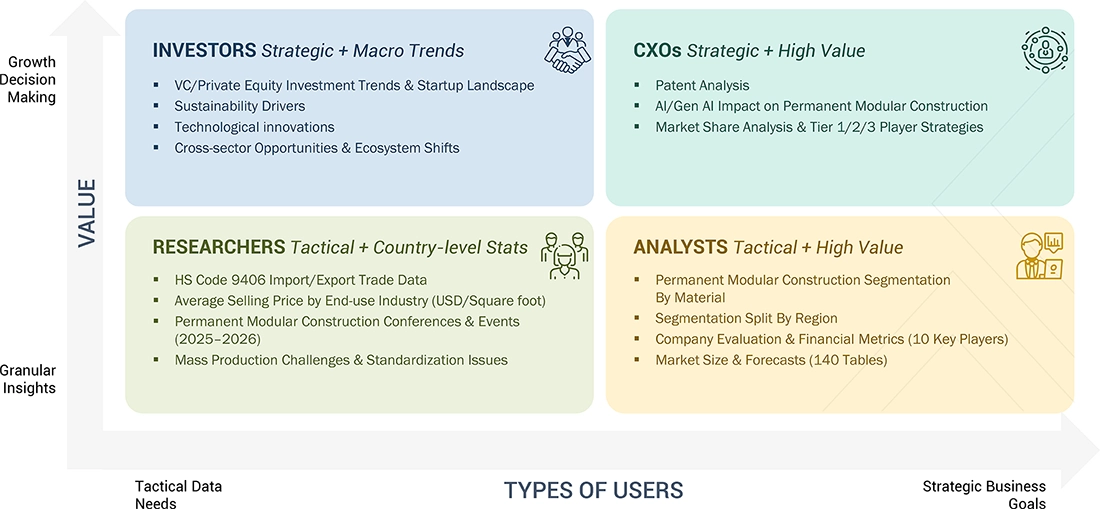
DELIVERED CUSTOMIZATIONS
We have successfully delivered the following deep-dive customizations:
| CLIENT REQUEST | CUSTOMIZATION DELIVERED | VALUE ADDS |
|---|---|---|
| Detailed study on relocatable modular construction | Study conducted the scope of relocatable modular construction. | Identified market opportunities in the relocatable modular construction in different regions. |
RECENT DEVELOPMENTS
- January 2023 : ATCO Structures, a part of the company Atco Ltd., completed the acquisition of Triple M Housing Ltd., securing a 100% ownership stake in the renowned North American manufacturer of prefabricated and modular residential homes.
- July 2022 : Robotics Australia Group and Laing O’Rourke entered into a partnership to integrate robotics-related technologies in modular construction.
- November 2021 : Modulaire Group acquired Alquibalat, S.L. (“Balat”) in Spain. As a leader in the Spanish market for both the rental and sale of modular buildings, Balat boasts a robust presence in the construction sector.
Table of Contents
 Exclusive indicates content/data unique to MarketsandMarkets and not available with any competitors.
Methodology
The study involved four major activities for estimating the current global size of the Permanent Modular Construction Market. Exhaustive secondary research was conducted to gather information on the market, the peer market, and the parent market. The next step was to validate these findings, assumptions, and sizes with the industry experts across the value chain of modular construction through primary research. Both the top-down and bottom-up approaches were employed to estimate the overall size of the Permanent Modular Construction Market. After that, market breakdown and data triangulation procedures were used to determine the size of different segments and sub-segments of the market.
Secondary Research
In the secondary research process, various secondary sources such as Hoovers, Factiva, Bloomberg BusinessWeek, and Dun & Bradstreet were referred to, to identify and collect information for this study on the Permanent Modular Construction Market. These secondary sources included annual reports, press releases & investor presentations of companies, white papers, certified publications, articles by recognized authors, regulatory bodies, trade directories, and databases.
Primary Research
Various primary sources from both the supply and demand sides of the Permanent Modular Construction Market were interviewed to obtain qualitative and quantitative information. The primary sources from the supply-side included industry experts, such as Chief Executive Officers (CEOs), vice presidents, marketing directors, sales professionals, and related key executives from various leading companies and organizations operating in the modular construction industry. The breakdown of the profiles of primary respondents is as follows:
Market Size Estimation
Both the top-down and bottom-up approaches were used to estimate and validate the global size of the Permanent Modular Construction Market. These approaches were also used extensively to estimate the size of various dependent segments of the market. The research methodology used to estimate the market size included the following details:
- The key players were identified through extensive secondary research.
- The industry’s supply chain and market size, in terms of value, were determined through primary and secondary research processes.
- All percentage shares, split, and breakdowns were determined using secondary sources and verified through primary sources.
- All possible parameters that affect the markets covered in this research study were accounted for, viewed in extensive detail, verified through primary research, and analysed to obtain the final quantitative and qualitative data.
- The research includes the study of reports, reviews, and newsletters of key industry players, along with extensive interviews with key officials, such as directors and marketing executives.
Data Triangulation
After arriving at the overall market size from the estimation process explained above, the total market was split into several segments and sub-segments. The data triangulation and market breakdown procedures were employed, wherever applicable, to complete the overall market engineering process and arrive at the exact statistics for all segments and sub-segments of the Permanent Modular Construction Market. The data was triangulated by studying various factors and trends from both the demand- and supply-side. In addition, the market size was validated by using both the top-down and bottom-up approaches. Then, it was verified through primary interviews. Hence, for every data segment, there are three sources—top-down approach, bottom-up approach, and expert interviews. The data were assumed to be correct when the values arrived at from the three sources matched.
Market Definition
The Permanent Modular Construction Market refers to the industry sector encompassing the design, fabrication, and assembly of building components in controlled factory environments for subsequent installation at construction sites. This approach to construction involves the prefabrication of standardized modules or components, which are then transported and assembled on-site to create structures ranging from residential homes and commercial buildings to industrial facilities and infrastructure projects.
Key Stakeholders
- Raw material suppliers
- Modular construction manufacturers
- Government & regulatory bodies
- Research organizations
- Associations and industry bodies
- Contractors, architects, and engineers
- End users
- Traders and distributors
Report Objectives
- To estimate and forecast the Permanent Modular Construction Market, in terms of value and volume.
- To provide detailed information about the major factors (drivers, restraints, opportunities, and challenges) influencing the market growth.
- To define, describe, and forecast the market size, based on type, material, end-use industry, and region.
- To forecast the market size along with segments and submarkets, in key regions: North America, Europe, Asia Pacific (APAC), Middle East & Africa (MEA), and South America along with their key countries.
- To strategically analyze micromarkets, with respect to individual growth trends, prospects, and their contribution to the total market.
- To analyze growth opportunities in the market for stakeholders and provide details on the competitive landscape for market leaders.
- To strategically profile key players and comprehensively analyze their market shares and core competencies.
- To analyze competitive developments, such as merger & acquisition, expansion & investment, agreement, and new product development in the Permanent Modular Construction Market.
Available Customizations
With the given market data, MarketsandMarkets offers customizations according to client-specific needs.
The following customization options are available for the modular construction report:
Product Analysis
- Product matrix, which offers a detailed comparison of the product portfolio of companies
Regional Analysis
- Further analysis of the Permanent Modular Construction Market for additional countries
Company Information
- Detailed analysis and profiling of additional market players (up to five)
Key Questions Addressed by the Report
What are the key applications of the Permanent Modular Construction Market?
The Permanent Modular Construction Market is widely used across industries such as automotive, construction, electronics, packaging, and industrial manufacturing where high-performance materials and components are essential.
What factors are driving the growth of the Permanent Modular Construction Market?
The growth of the Permanent Modular Construction Market is driven by rising industrial demand, expanding end-use industries, technological advancements, and increasing global manufacturing activities.
Which regions dominate the Permanent Modular Construction Market?
Asia-Pacific, North America, and Europe are major regions in the Permanent Modular Construction Market due to strong manufacturing bases, growing industrial infrastructure, and increasing investments in advanced materials.
Who are the major end-users in the Permanent Modular Construction Market?
Key end-users in the Permanent Modular Construction Market include automotive, aerospace, construction, electronics, consumer goods, and energy industries that require reliable and high-quality materials.
What challenges are affecting the Permanent Modular Construction Market?
Major challenges in the Permanent Modular Construction Market include fluctuating raw material prices, environmental regulations, supply chain disruptions, and the need for continuous innovation to stay competitive.


Personalize This Research
- Triangulate with your Own Data
- Get Data as per your Format and Definition
- Gain a Deeper Dive on a Specific Application, Geography, Customer or Competitor
- Any level of Personalization
Let Us Help You
- What are the Known and Unknown Adjacencies Impacting the Permanent Modular Construction Market
- What will your New Revenue Sources be?
- Who will be your Top Customer; what will make them switch?
- Defend your Market Share or Win Competitors
- Get a Scorecard for Target Partners

Custom Market Research Services
We Will Customise The Research For You, In Case The Report Listed Above Does Not Meet With Your Requirements
Get 10% Free CustomisationTESTIMONIALS

We at Nissan Chemicals Corporation have been clients of MarketsandMarkets for more than a year now. We recently consulted MarketsandMarkets for a study, the team at MarketsandMarkets was extremely professional and organized. The business insights were very detailed and aligned well with our expectations that really helped us formulate the Business Plans and device new strategies for development themes. MarketsandMarkets offers a unique combination of expertise and dedicated engagement model. Their research findings have helped us in designing our Pricing Strategy which will make it easier for us to predict the future sales and profits for the next ten years. We look forward to working with MarketsandMarkets in the future.
VP of Strategy & New Business Development
Leading Specialty Chemical Company
The MarketsandMarkets Engagement Model, composed of both the Knowledge Store and advisory custom research, has greatly helped us in understanding our markets and making strategic decisions. The Knowledge Store is a fast way to allow everyone in our organization to understand more about most any market they are interested in. The ability to then get custom research done and get answers to specific strategic questions and market insight has been spectacular. The Markets and Markets team feel more like colleagues than vendors and their services have helped us change our culture where statements of things like growth opportunities and competitive position are always backed by industry research.

Rich Gibson,
Director, Corporate Strategy
Milliken & Company,
Leading Industrial Manufacturer of specialty chemical, floor covering, performance and protective textile materials, and healthcaremilliken.com
MarketsandMarkets is a trusted resource that helps us to better understand markets that are near-adjacencies-whether its technology, value chain or geography. Their Knowledge Store platform provides a dashboard of markets and their characteristics which is easy to use and saves us time.
Adam Shaw,
Market Development and Strategy Manager
AdvanSix Inc. USA,
An American Leader in Chemicalswww.advansix.com
The Knowledge Store from MarketsandMarkets is a valuable tool which has helped my team acquire greater insight in to the end markets that our business serves. This has enabled us to help our company build stronger strategies throughout our planning process.
TOSHIO KINOSHITA
Senior Chif Consultion Research & Consulting Division
Mitsubishi Chemical Research Corporation,
Leading Manufacturer of Chemical Productswww.mitsubishichem-res.co.jp/en/

We recently engaged with MarketsandMarkets for a study, the team not only clearly understood our business objectives but was also extremely professional in the way they handled the entire project. The study was efficiently conducted in a phase-wise manner, and the engagement model furnished us with high-quality business insights that far exceeded our expectations at each phase. We were especially happy that MarketsandMarkets could provide us with both, an English as well as a Japanese version of the study. A special thanks to the Analyst Team and Client Services Team, whose fluency in Japanese enhanced our comfort level, as we could converse with them in our preferred language.
Independent entrepreneurs
Arrow Precision
We approached MarketsandMarkets for study on Proppants Market, and their work exceeded our expectations. The study conducted was comprehensive and enabled us to view the market through the various dimensions. In addition, the team was extraordinarily responsive throughout the process and resolved our queries on time. I strongly recommend MarketsandMarkets and will certainly consider them for additional market assessments we will need in the future.
Global engineering company, Japan
Deputy Manager,
Strategic Planning OfficeThe high-quality insights shared by the MarketsandMarkets team helped us understand the pharmaceutical plant designers in a specific geography. It also captured the risks that we may likely face in communicating with our potential partners. The study would enable us identify partners, which would impact our future growth.






Growth opportunities and latent adjacency in Permanent Modular Construction Market