



Piezoelectric Devices Market Size, Share and Trends
Report Code
SE 3950
Published in
Dec, 2024, By MarketsandMarkets™
Piezoelectric Devices Market Size, Share & Trends by Product (Sensors, Actuators, Motors, Generators, Transducers, Transformers, and Resonator), Material (Polymer, Crystal, Ceramic, and Composites), Element (Discs, Rings and Plates) - Global Forecast to 2030

USD 55.49 BN
MARKET SIZE, 2030

CAGR 7.7%
(2024-2030)

284
REPORT PAGES

217
MARKET TABLES
PIEZOELECTRIC DEVICES MARKET SIZE, SHARE & TRENDS
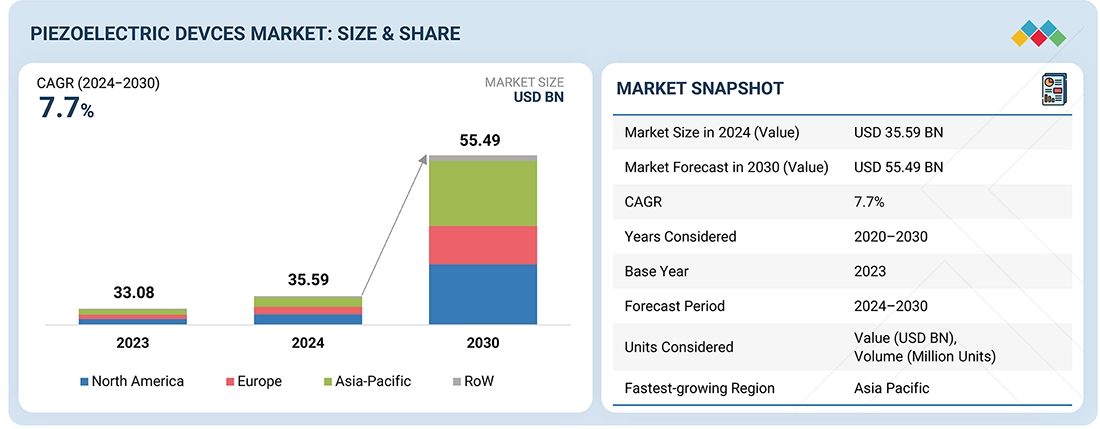
According to Marketsandmarkets, The global piezoelectric devices market size was valued at USD 35.59 billion in 2024 and is projected to reach USD 55.49 billion by 2030, growing at a CAGR of 7.7%. from 2024 to 2030. . The market is driven by the increasing product applications in industries, such as automotive, aerospace & defense, and consumer electronics.
PIEZOELECTRIC DEVICES MARKET SCOPE
| REPORT METRIC | DETAILS |
|---|---|
| Market Size in 2024 (Value) | USD 35.59 Billion |
| Market Forecast in 2030 (Value) | USD 55.49 Billion |
| Growth Rate | CAGR of 7.7% from 2024-2030 |
| Years Considered | 2024-2030 |
| Base Year | 2023 |
| Forecast Period | 2024-2030 |
| Units Considered | Value (USD Million/Billion), Volume (Million Units) |
| Report Coverage | Revenue forecast, company ranking, competitive landscape, growth factors, and trends |
| Top Companies |
|
| Growth Driver |
|
| Segments Covered |
|
| Regions Covered | North America, Asia Pacific, Europe, RoW |
KEY TAKEAWAYS
-
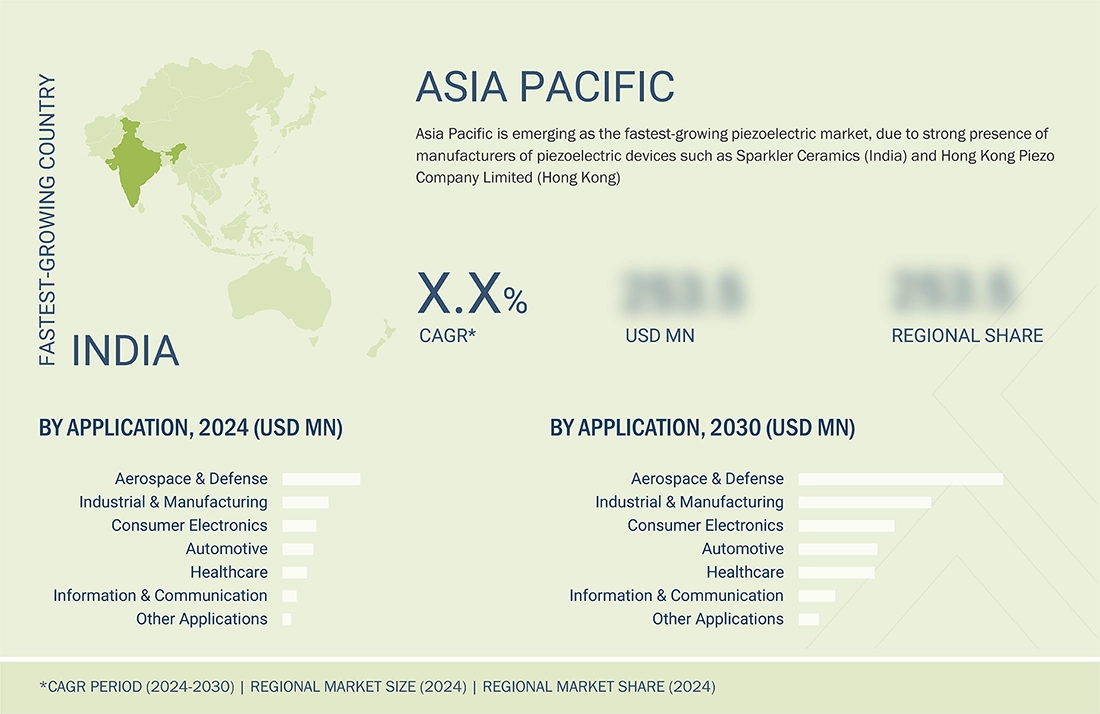
By RegionThe Asia Pacific piezoelectric devices market accounted for a 43.4% share in 2024.
-
By ProductBy product, the piezoelectric generators segment is expected to register the highest CAGR of 12.9%.
-
By MaterialBy material, the piezoelectric polymers segment is projected to grow at the fastest rate from 2024 to 2030.
-
By ElementBy element, the piezo discs segment is expected to dominate the market.
-
By ApplicationBy application, the healthcare segment will grow the fastest during the forecast period.
-
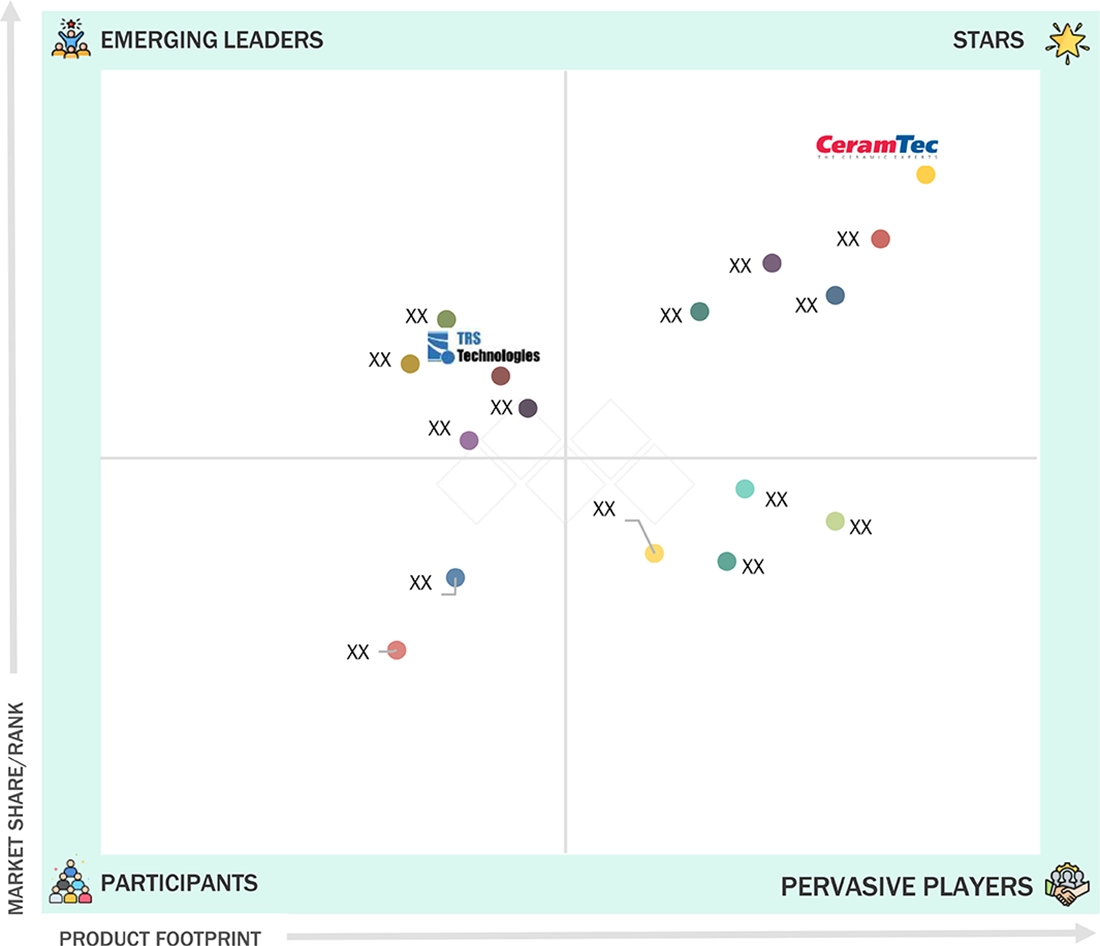
Competitive LandscapeCeramTec GmbH (Germany), CTS Corporation (US), Kistler Group (Switzerland), Physik Instrumente (PI) SE & Co. KG. (US), Aerotech (US) were identified as some of the star players in the piezoelectric device market (global), given their strong market share and product footprint.
-
Competitive LandscapePiezo Studio, Ionix AT, and Brain Scientific Inc., among others, have distinguished themselves among startups and SMEs by securing strong footholds in specialized niche areas, underscoring their potential as emerging market leaders
The piezoelectric devices industry is experiencing rapid expansion. The piezoelectric devices market growth is driven by the increasing product applications in industries, such as automotive, aerospace & defense, and consumer electronics. Piezoelectric sensors and actuators enhance vehicle performance and safety in the automotive sector. They are installed in systems for various applications, such as tire pressure monitoring, fuel injection, and engine management, enhancing efficiency and reliability, especially in electric and hybrid vehicles.
Source: Secondary Research, Interviews with Experts, MarketsandMarkets Analysis
TRENDS & DISRUPTIONS IMPACTING CUSTOMERS' CUSTOMERS
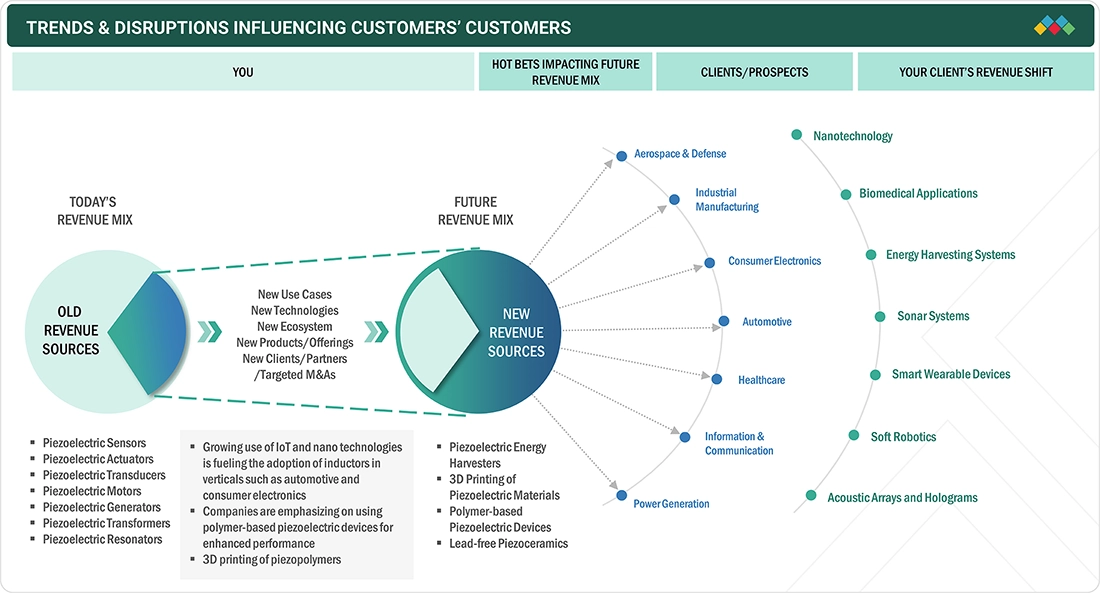
The piezoelectric devices market trends is undergoing a major revenue shift as the growing demand for piezoelectric devices in the aerospace & defense, industrial and manufacturing, automotive, healthcare, and consumer electronics sectors is driving the market. The technological revolution of the Industrial Internet of Things (IIoT) is expected to create lucrative opportunities for providers of piezoelectric devices to power smart devices, sensors, and transducers in the network. Adopting new hybrid technologies in the automotive sector has resulted in a high demand for piezoelectric devices for automotive safety and connectivity applications. The consumer electronics segment is witnessing the emergence of new technologies such as smart wearables and flexible electronics, thereby further contributing to the piezoelectric devices market growth.
Source: Secondary Research, Interviews with Experts, MarketsandMarkets Analysis
PIEZOELECTRIC DEVICES MARKET DYNAMICS

Drivers
Impact
Level
Level
-
Rising adoption of piezoelectric materials to enhance efficiency of aircraft structures

-
Increasing adoption of machine learning and deep learning algorithms


RESTRAINTS
Impact
Level
Level
-
High costs of templated grain growth (TGG) ceramics

-
Stringent government policies restricting use of lead-based piezoelectric materials


OPPORTUNITIES
Impact
Level
Level
-
Growing use of piezoelectric nanomaterials in electronic devices

-
Rising adoption of piezoelectric polymers in biomedical and surgical applications


CHALLENGES
Impact
Level
Level
-
Developing alternative materials to PZT ceramic materials with similar properties

Source: Secondary Research, Interviews with Experts, MarketsandMarkets Analysis
Driver:Rising adoption of piezoelectric materials to enhance efficiency of aircraft structures
Major players in the aerospace industry are often involved in manufacturing, selling, and servicing commercial aircraft, space vehicles, and satellites. This industry requires advanced solutions to enhance the efficiency, durability, and performance of aircraft, planes, helicopters, and submarines. One significant technology employed is piezoelectric actuators, which are used in active vibration-damping techniques. These actuators help monitor various mechanical structures and components of modern aircraft to prevent undesirable vibrations, reduce noise levels, lower fuel consumption, and minimize energy waste.
Restraint: High costs of templated grain growth (TGG) ceramics
The templated grain growth (TGG) process allows for the production of single crystals and textured ceramics with properties similar to single crystals. In TGG, the desired crystal nucleates and grows on aligned single-crystal template particles, which leads to an increased proportion of oriented material upon heating. The template particles must be anisometric in form to facilitate alignment during shaping. Additionally, these particles must be single crystals and chemically stable at the growth temperature to serve as preferred sites for epitaxy and subsequent oriented growth of the matrix.
Opportunity: Growing use of piezoelectric nanomaterials in electronic devices
Lead zirconate titanate (PZT) nanoparticles and nanopowder, which have a relative permittivity ranging from 300 to 20,000, exhibit a quick response time when utilized in detectors. These materials can be applied in circuits operating at low and high voltages, and they demonstrate excellent mechanical and acoustic coupling. PZT nanoparticles and nanopowder are commonly used in piezoelectric resonators, ultrasonic transducers, and infrared (IR) spectroscopy as inorganic ferroelectric agents with piezoelectric properties. Their chemical inertness and physical strength make them one of the most prevalent piezoelectric compounds.
Challenge: Developing alternative materials to PZT ceramic materials with similar properties
PZT is the primary piezoelectric ceramic used in the development of piezoelectric products. However, its toxicity significantly threatens its dominance in this field, prompting urgent global efforts to identify environmentally friendly alternatives. The recognition of lead toxicity creates a challenge in finding substitute materials for the numerous products that rely on PZT for their functionality. According to the RoHS directive, any homogeneous component containing more than 0.1% lead by weight is subject to restrictions. This regulation is crucial, as some of the best piezoelectric materials contain up to 60% lead, potentially limiting their use in everyday applications in the future. Consequently, PZT has been identified as a substance of very high concern (SVHC).
PIEZOELECTRIC DEVICES MARKET SIZE, SHARE AND TRENDS, 2025 TO 2030: COMMERCIAL USE CASES ACROSS INDUSTRIES
| COMPANY | USE CASE DESCRIPTION | BENEFITS |
|---|---|---|
 |
CeramTec develops and manufactures a wide array of piezoceramic materials and components for industrial, medical, automotive, and energy sectors. | Their piezoelectric solutions are fundamental to high-resolution ultrasonic imaging (medical ultrasound), ultrasound surgical tools, flow measurement (smart meters), level detection, ultrasonic cleaning/welding, proximity sensing, and non-destructive testing |CeramTec is also leading in environmentally-friendly, lead-free piezoceramics for compliance in sensitive medical and industrial applications |
 |
CTS Corporation offers custom and standard piezoelectric devices, including bulk/multilayer ceramics and built-to-print sensors/transducers, for diverse industries. | CTS piezoelectric products are widely used in med-tech (diagnostics, therapies), aerospace (acoustics, sensing), industrial measurement (flow, vibration), and underwater acoustics |Their expertise spans sensors, actuators, and transducer assemblies for demanding commercial and industrial applications, enabling precision and reliability for OEMs and system integrators |
 |
Kistler develops advanced piezoelectric sensors, notably for measuring force, pressure, and acceleration in dynamic environments. | Their piezoelectric sensing technology (e.g., PiezoStar) enables simultaneous measurement of multiple physical parameters, used in automotive testing, industrial process control, medical diagnostics (e.g., radiology equipment), and aerospace| The integrated signal conditioning and data acquisition allows real-time analysis, making Kistler a leader in precision measurement and instrumentation markets. |
 |
PI manufactures precision motion and nanopositioning systems powered by piezoelectric technology, such as linear/rotation stages, hexapods, and actuators. | Their piezo-based motion solutions are crucial in semiconductor production, high-end microscopy, optics/photonics research, and robotics | The combination of proprietary piezo actuators, control electronics, and software enables sub-nanometer positioning and dynamic control, widely adopted by research, biomedical, and advanced manufacturing sectors. |
 |
Aerotech produces automation and motion control systems using piezoelectric actuators, used for smart manufacturing, especially in edge AI inference and defect detection. | Aerotech’s piezo-driven positioning stages and systems deliver high-speed, high-precision motion for semiconductor, electronics, and materials processing industries |In combination with AI, their systems drive real-time defect analysis, predictive maintenance, and productivity gains in advanced factory environments |
Logos and trademarks shown above are the property of their respective owners. Their use here is for informational and illustrative purposes only.
PIEZOELECTRIC DEVICES MARKET ECOSYSTEM
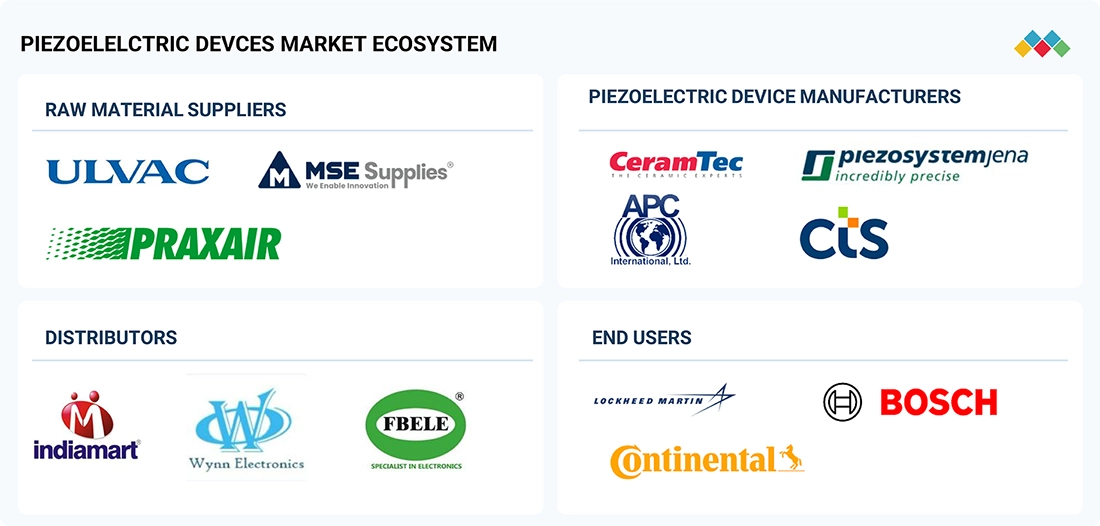
The piezoelectric devices ecosystem mainly consists of raw material suppliers, manufacturers, suppliers & distributors, and end users. Raw material suppliers provide essential components such as ceramics and crystals. Manufacturers ensure the availability of high-quality raw materials and optimize the processing, following which the suppliers offer logistic and inventory management. Finally, end users, for example, aerospace & defense and automotive industries, install them for applications, such as sensors and actuators, to drive innovation
Piezoelectric Sensor Market
The Piezoelectric Sensor Market is growing as industries increasingly adopt high-sensitivity sensing technologies for vibration, pressure, force, acceleration, and acoustic measurements. Piezoelectric sensors are widely used in automotive, healthcare, aerospace & defense, industrial machinery, consumer electronics, and structural health monitoring applications due to their fast response, compact design, and reliability in dynamic measurement environments. The growing adoption of IoT-enabled monitoring, predictive maintenance, industrial automation, and smart manufacturing is creating new opportunities for the Piezoelectric Sensor Market. Advancements in miniaturized sensors, wireless connectivity, and advanced piezoelectric materials are further supporting market expansion across emerging applications.
Piezo Market
The Piezo Market is experiencing steady growth due to increasing demand for piezoelectric components in automotive, consumer electronics, healthcare, industrial automation, aerospace, and telecommunications applications. Piezoelectric materials and devices are widely used for sensing, actuation, vibration control, ultrasonic imaging, and precision motion systems because of their high sensitivity, fast response, and compact size. Advancements in smart sensors, IoT-enabled devices, medical diagnostics, and automated manufacturing are further expanding opportunities in the Piezo Market, while growing adoption of miniaturized and energy-efficient piezoelectric technologies is supporting long-term market growth.
Piezoelectric Elements Market
The Piezoelectric Elements Market is expanding with increasing demand for compact, responsive, and energy-efficient components across automotive, healthcare, consumer electronics, aerospace & defense, and industrial applications. Piezoelectric elements convert mechanical energy into electrical energy and vice versa, making them essential for sensors, actuators, ultrasonic devices, vibration control, and precision motion systems. The growing adoption of IoT, industrial automation, predictive maintenance, and advanced medical equipment is creating new opportunities for the Piezoelectric Elements Market. Technological advancements in piezoelectric ceramics, polymers, and composite materials are further improving sensitivity, durability, and miniaturization, supporting the continued growth of the Piezoelectric Elements Market across diverse end-use industries..
Logos and trademarks shown above are the property of their respective owners. Their use here is for informational and illustrative purposes only.
PIEZOELECTRIC DEVICES MARKET SEGMENTS
Source: Secondary Research, Interviews with Experts, MarketsandMarkets Analysis
Piezoelectric devices Market, By Product
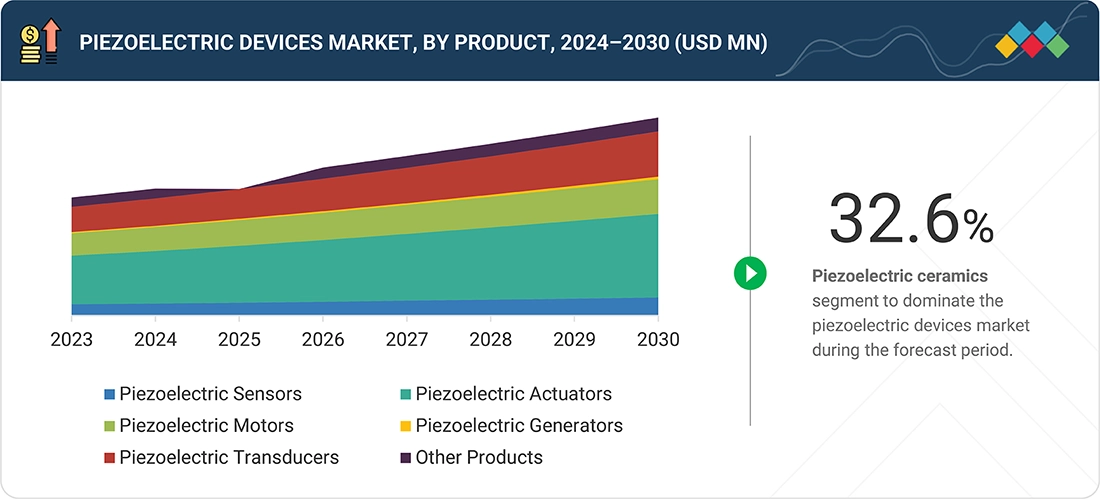
Piezoelectric generators segment to record highest CAGR during forecast period. Piezoelectric generators are used to produce and store energy when subjected to mechanical stress. They work on the direct and reverse piezoelectric effects. In the direct piezoelectric effect, the electric charge is displaced when the piezoelectric material undergoes mechanical deformation. Piezoelectric generators can produce high-voltage outputs and low-electrical currents. These generators offer several advantages, such as simple design, compact structure, high stability, high durability, and maintenance-free. Owing to this, they are widely used in applications, such as wireless electronic devices, energy harvesting systems, and embedded MEMS devices. Additionally, they are used as a power generation source for portable and low-power-consuming devices, such as munitions and wireless sensors that monitor automobile tire pressure.
Piezoelectric devices Market, By Material
Piezoelectric ceramics will dominate the piezoelectric devices market analysis during the forecast period. The primary reason is the rising demand for ceramic-based lead zirconate titanate (PZT), which provides immense displacement and gives a huge voltage, increasing their demand. Direct and converse piezoelectric effects are strong in piezoelectric ceramics. Piezoelectric ceramics have high piezoelectric sensitivity and may take on various forms. Lead zirconate titanate (PZT) is a commonly used piezoelectric ceramic material.
Piezoelectric devices Market, By Element
Piezo Discs segment held largest markets size in 2024. This is due to the increased adoption of piezoelectric discs in major applications such as high-intensity ultrasound treatment equipment and sensors compared with piezoelectric rings and plates. Moreover, they are available in different sizes and are compatible with metals such as gold, silver, and nickel.
Piezoelectric devices Market, By Application
Healthcare segment to register highest CAGR in piezoelectric devices market during forecast period. The healthcare sector is completely dependent on advanced techniques, such as imaging, diagnostic scanning, and robotic surgeries, to serve patients. Therefore, medical device manufacturers understand the advantages of incorporating piezoelectric components and materials in life-saving medical devices, such as respirators, ventilators, and atomization systems. Piezoelectric devices are widely used in the healthcare sector, from which one of the primary applications of piezoelectric materials is applied in ultrasound imaging.
REGION
Asia Pacific to be fastest-growing region in global AI server market during forecast period
Asia Pacific to witness highest CAGR in piezoelectric devices market between 2024 and 2030. The growth of the piezoelectric devices market growth analysis in Asia Pacific can be attributed to the robust presence of piezoelectric device manufacturers in countries, such as China, Japan, and South Korea, who offer low-cost and highly efficient piezoelectric devices. Additionally, the market will be driven by the rising adoption of portable electronic devices, including laptops, smartphones, and smartwatches, the increasing deployment of digital technologies in industrial & manufacturing sectors, and the growing use of information & communication technologies in transportation & healthcare industries.
PIEZOELECTRIC DEVICES MARKET SIZE, SHARE AND TRENDS, 2025 TO 2030: COMPANY EVALUATION MATRIX
In the piezoelectric devices companies matrix, CeramTec GmbH (Star) leads with a strong market share and extensive product footprint, This is one of the leading players in terms of developments such as product launches, innovative technologies, and the adoption of strategic growth plans. TRS Technologies, Inc. (Emerging Leader) is gaining visibility The company hold a small share of the market. However, the company have innovative product and service portfolios.
Source: Secondary Research, Interviews with Experts, MarketsandMarkets Analysis
PIEZOELECTRIC DEVICES MARKET KEY PLAYERS
- CeramTec GmbH
- CTS Corporation
- Kistler Group
- Huawei Technologies Co., Ltd.
- Physik Instrumente (PI) SE & Co. KG.
- Piezosystem jena
- KEMET Corporation
- Piezo Technologies
- APC International, Ltd.
- Mad City Labs, Inc
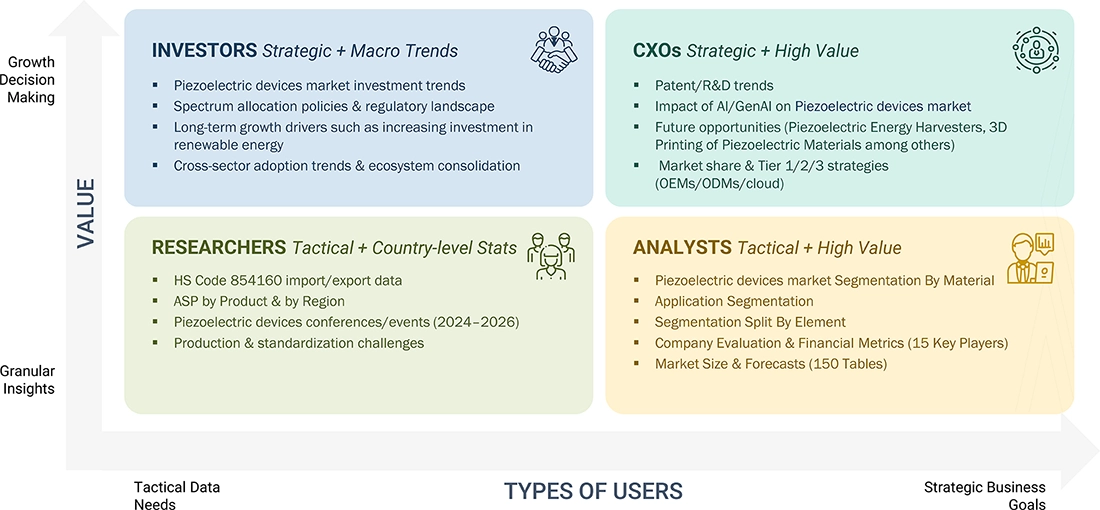
WHAT IS IN IT FOR YOU: PIEZOELECTRIC DEVICES MARKET SIZE, SHARE AND TRENDS, 2025 TO 2030 REPORT CONTENT GUIDE
DELIVERED CUSTOMIZATIONS
We have successfully delivered the following deep-dive customizations:
| CLIENT REQUEST | CUSTOMIZATION DELIVERED | VALUE ADDS |
|---|---|---|
| Consumer Electronics OEMs |
|
|
| Industrial & Robotics Companies |
|
|
RECENT DEVELOPMENTS IN PIEZOELECTRIC DEVICES MARKET
- June 2024 : CeramTec GmbH (Germany) launched the ceramic substrate Sinalit. It is an enabler for more diversity in solutions and more sustainability. The properties of silicon nitride enable performance improvements in many areas and strengthen them. It contributes to a successful energy transition in electromobility or new energies.
- February 2024 : Aerotech (US), one of the global leaders in precision motion control and automation, expanded its partnership with Korean distributor ANI Motion Tech. The latest joint venture is a new manufacturing and research facility in Korea’s Songdo Knowledge Information Industrial Complex.
- January 2023 : Kistler Group (Switzerland) launched a piezoelectric sensor solution specially designed for angled structures such as airplane wings. The new cylindrical accelerometer 8775A meets various requirements in aerospace applications, such as high sensitivity, low noise threshold, and low weight.
- COLUMN 'A' SHOULD BE IN TEXT FORMAT AND NOT DATE FORMAT :
Table of Contents
 Exclusive indicates content/data unique to MarketsandMarkets and not available with any competitors.
TITLE
PAGE NO
1
INTRODUCTION
25
2
RESEARCH METHODOLOGY
31
3
EXECUTIVE SUMMARY
44
4
PREMIUM INSIGHTS
48
5
MARKET OVERVIEW
Surging piezoelectric innovations redefine efficiency across aerospace, healthcare, and electronics markets.
51
5.1
INTRODUCTION
5.2
MARKET DYNAMICS
5.2.1
DRIVERS
5.2.1.1
RISING ADOPTION OF PIEZOELECTRIC MATERIALS TO ENHANCE EFFICIENCY OF AIRCRAFT STRUCTURES
5.2.1.2
INCREASING INVESTMENT IN RENEWABLE ENERGY
5.2.1.3
ESCALATING ADOPTION OF ADVANCED DRIVING AIDS AND SENSING TECHNOLOGIES
5.2.2
RESTRAINTS
5.2.2.1
HIGH COSTS OF TEMPLATED GRAIN GROWTH (TGG) CERAMICS
5.2.2.2
LIMITED APPLICATIONS OF PIEZOELECTRIC CERAMICS
5.2.2.3
STRINGENT GOVERNMENT POLICIES RESTRICTING USE OF LEAD-BASED PIEZOELECTRIC MATERIALS
5.2.3
OPPORTUNITIES
5.2.3.1
GROWING USE OF PIEZOELECTRIC NANOMATERIALS IN ELECTRONIC DEVICES
5.2.3.2
RISING ADOPTION OF PIEZOELECTRIC POLYMERS IN BIOMEDICAL AND SURGICAL APPLICATIONS
5.2.3.3
BURGEONING DEMAND FOR POLYMER-BASED PIEZOELECTRIC SENSORS AND FILMS IN AEROSPACE AND OTHER INDUSTRIES
5.2.3.4
SURGING DEPLOYMENT OF PIEZOELECTRIC SENSORS AND POLYMERS IN HEALTHCARE DEVICES
5.2.3.5
EMERGENCE OF 3D PRINTING TECHNOLOGY
5.2.4
CHALLENGES
5.2.4.1
DEVELOPING ALTERNATIVE MATERIALS WITH PROPERTIES SIMILAR TO PZT CERAMIC MATERIALS
5.3
SUPPLY CHAIN ANALYSIS
5.4
TRENDS/DISRUPTIONS IMPACTING CUSTOMER BUSINESS
5.5
ECOSYSTEM ANALYSIS
5.6
PORTER’S FIVE FORCES ANALYSIS
5.6.1
THREAT OF NEW ENTRANTS
5.6.2
THREAT OF SUBSTITUTES
5.6.3
BARGAINING POWER OF SUPPLIERS
5.6.4
BARGAINING POWER OF BUYERS
5.6.5
INTENSITY OF COMPETITIVE RIVALRY
5.7
KEY STAKEHOLDERS AND BUYING CRITERIA
5.7.1
KEY STAKEHOLDERS IN BUYING PROCESS
5.7.2
BUYING CRITERIA
5.8
CASE STUDY ANALYSIS
5.8.1
GERMAN AEROSPACE CENTER ADOPTS KISTLER GROUP’S ADVANCED PIEZOELECTRIC SENSORS TO PERFORM VIBRATION TESTS
5.8.2
PI CERAMIC’S PIEZO DISCS, PLATES, AND FOCUS BOWLS IMPROVE SUCCESS IN MINIMALLY INVASIVE AND TREATMENT METHODS
5.8.3
ONERA LEVERAGES PIEZOTRONIC ACCELEROMETERS FROM PCB PIEZOTRONICS FOR VIBRATION MEASUREMENTS
5.8.4
PIEZO STRAIN SENSORS HELP IMPROVE NOISE IMMUNITY IN GROUND VIBRATION TESTING OF AIRCRAFT
5.8.5
SPANISH CLINIC LEVERAGES KISTLER GROUP’S PIEZOELECTRIC FORCE PLATES FOR DIAGNOSTICS AND TREATMENT DEVELOPMENT
5.9
INVESTMENT AND FUNDING SCENARIO
5.10
TECHNOLOGY ANALYSIS
5.10.1
KEY TECHNOLOGIES
5.10.1.1
MICRO-ELECTRO-MECHANICAL SYSTEMS
5.10.2
COMPLEMENTARY TECHNOLOGIES
5.10.2.1
ENERGY HARVESTING TECHNOLOGIES
5.10.3
ADJACENT TECHNOLOGIES
5.10.3.1
PYROELECTRIC TECHNOLOGIES
5.11
TRADE ANALYSIS
5.11.1
IMPORT SCENARIO (HS CODE 854160)
5.11.2
EXPORT SCENARIO (HS CODE 854160)
5.12
PATENT ANALYSIS
5.13
TARIFF AND REGULATORY LANDSCAPE
5.13.1
TARIFF ANALYSIS
5.13.2
REGULATORY BODIES, GOVERNMENT AGENCIES, AND OTHER ORGANIZATIONS
5.13.3
REGULATIONS
5.13.4
STANDARDS
5.14
KEY CONFERENCES AND EVENTS, 2025
5.15
PRICING ANALYSIS
5.15.1
AVERAGE SELLING PRICE TREND OF PIEZOELECTRIC DEVICES, BY PRODUCT, 2020–2023
5.15.2
AVERAGE SELLING PRICE TREND OF PIEZOELECTRIC DEVICES, BY REGION, 2020–2023
5.16
IMPACT OF GEN AI/AI ON PIEZOELECTRIC DEVICES MARKET
6
MODE OF OPERATION OF PIEZOELECTRIC DEVICES
Unlock piezoelectric devices' dual effects for innovative energy and sensing solutions.
90
6.1
INTRODUCTION
6.2
DIRECT PIEZOELECTRIC EFFECT
6.3
CONVERSE PIEZOELECTRIC EFFECT
7
PIEZOELECTRIC DEVICES MARKET, BY PRODUCT
Market Size & Growth Rate Forecast Analysis to 2030 in USD Million and Units | 40 Data Tables
92
7.1
INTRODUCTION
7.2
PIEZOELECTRIC SENSORS
7.2.1
INCREASING USE IN PORTABLE CONSUMER DEVICES AND WEARABLES TO CONTRIBUTE TO SEGMENTAL GROWTH
7.3
PIEZOELECTRIC ACTUATORS
7.3.1
RISING APPLICATION IN MODERN HIGH-TECH FIELDS TO BOLSTER SEGMENTAL GROWTH
7.3.2
STACK ACTUATORS
7.3.3
STRIPE ACTUATORS
7.3.4
SHEAR ACTUATORS
7.3.5
TUBE ACTUATORS
7.4
PIEZOELECTRIC MOTORS
7.4.1
HIGH EFFICIENCY AND COST-EFFECTIVENESS OVER CONVENTIONAL DC MOTORS TO BOOST SEGMENTAL GROWTH
7.5
PIEZOELECTRIC GENERATORS
7.5.1
INCREASING USE AS POWER GENERATION SOURCE FOR PORTABLE AND LOW-POWER-CONSUMING DEVICES TO DRIVE MARKET
7.5.2
SINGLE-LAYER
7.5.3
MULTI-LAYER
7.6
PIEZOELECTRIC TRANSDUCERS
7.6.1
ROBUST DESIGN AND LOW ENERGY CONSUMPTION ATTRIBUTES TO FOSTER SEGMENTAL GROWTH
7.7
OTHER PRODUCTS
8
PIEZOELECTRIC DEVICES MARKET, BY MATERIAL
Market Size & Growth Rate Forecast Analysis to 2030 in USD Million | 18 Data Tables
119
8.1
INTRODUCTION
8.2
PIEZOELECTRIC CRYSTALS
8.2.1
USE AS TINY BATTERIES AND TO DETECT HIGH-FREQUENCY ULTRASOUND WAVES TO BOOST SEGMENTAL GROWTH
8.3
PIEZOELECTRIC CERAMICS
8.3.1
ADOPTION TO CONVERT MECHANICAL COMPRESSION OR TENSION TO CONTRIBUTE TO SEGMENTAL GROWTH
8.3.2
SOFT CERAMICS
8.3.3
HARD CERAMICS
8.4
PIEZOELECTRIC POLYMERS
8.4.1
APPLICATION SCOPE IN MEDICAL SECTOR DUE TO BIOCOMPATIBILITY TO BOOST SEGMENTAL GROWTH
8.5
PIEZOELECTRIC COMPOSITES
8.5.1
EXTENSIVE USAGE AS FILLERS TO ACCELERATE SEGMENTAL GROWTH
9
PIEZOELECTRIC DEVICES MARKET, BY ELEMENT
Market Size & Growth Rate Forecast Analysis to 2030 in USD Million | 2 Data Tables
133
9.1
INTRODUCTION
9.2
PIEZOELECTRIC DISCS
9.2.1
HIGH EFFICIENCY AND LOW POWER CONSUMPTION ATTRIBUTES TO ACCELERATE SEGMENTAL GROWTH
9.3
PIEZOELECTRIC RINGS
9.3.1
ESCALATING ADOPTION IN HEALTHCARE AND ULTRASONIC APPLICATIONS TO FUEL SEGMENTAL GROWTH
9.4
PIEZOELECTRIC PLATES
9.4.1
INCREASING USE TO MEASURE ACCELERATION, FORCE, PRESSURE, AND STRAIN TO AUGMENT SEGMENTAL GROWTH
10
PIEZOELECTRIC DEVICES MARKET, BY APPLICATION
Market Size & Growth Rate Forecast Analysis to 2030 in USD Million | 30 Data Tables
137
10.1
INTRODUCTION
10.2
AEROSPACE & DEFENSE
10.2.1
ADOPTION OF PIEZOELECTRIC MATERIALS DUE TO ABILITY TO WITHSTAND VIBRATIONS AND SHOCKS TO CONTRIBUTE TO SEGMENTAL GROWTH
10.3
INDUSTRIAL & MANUFACTURING
10.3.1
REQUIREMENT FOR PIEZOELECTRIC SENSORS FOR MATERIAL HANDLING AND SORTING TO BOOST SEGMENTAL GROWTH
10.4
AUTOMOTIVE
10.4.1
USE OF SENSORS TO DEVELOP SMART AND SAFE VEHICLES TO FUEL SEGMENTAL GROWTH
10.5
HEALTHCARE
10.5.1
RELIANCE ON ADVANCED TECHNOLOGIES TO DELIVER OPTIMAL CARE TO AUGMENT SEGMENTAL GROWTH
10.5.2
IMAGING DEVICES
10.5.3
DIAGNOSTIC EQUIPMENT
10.5.4
SURGICAL TOOLS
10.6
INFORMATION & COMMUNICATION
10.6.1
ADOPTION OF PIEZOELECTRIC COMPONENTS IN SONAR APPLICATIONS TO DRIVE MARKET
10.7
CONSUMER ELECTRONICS
10.7.1
TREND TOWARD MINIATURE DEVICES WITH IMPROVED FUNCTIONALITIES TO BOLSTER SEGMENTAL GROWTH
10.7.2
WEARABLE DEVICES
10.7.3
ELECTRONIC DEVICES
10.8
OTHER APPLICATIONS
11
PIEZOELECTRIC DEVICES MARKET, BY REGION
Comprehensive coverage of 10 Regions with country-level deep-dive of 11 Countries | 66 Data Tables.
160
11.1
INTRODUCTION
11.2
NORTH AMERICA
11.2.1
MACROECONOMIC OUTLOOK FOR NORTH AMERICA
11.2.2
US
11.2.2.1
THRIVING CONSUMER ELECTRONICS AND MILITARY INDUSTRIES TO CONTRIBUTE TO MARKET GROWTH
11.2.3
CANADA
11.2.3.1
RISING INITIATIVES TO BOOST PRODUCTION OF LITHIUM BATTERY CELLS AND ELECTRIC VEHICLES TO DRIVE MARKET
11.2.4
MEXICO
11.2.4.1
RAPID ADVANCES IN INDUSTRIAL MANUFACTURING TO STIMULATE MARKET GROWTH
11.3
EUROPE
11.3.1
MACROECONOMIC OUTLOOK FOR EUROPE
11.3.2
GERMANY
11.3.2.1
RAPID TECHNOLOGICAL ADVANCES IN AUTOMOTIVE SECTOR TO FOSTER MARKET GROWTH
11.3.3
FRANCE
11.3.3.1
INCREASING MOTOR VEHICLE PRODUCTION TO CONTRIBUTE TO MARKET GROWTH
11.3.4
UK
11.3.4.1
THRIVING AEROSPACE & DEFENSE INDUSTRY TO BOOST DEMAND FOR PIEZOELECTRIC DEVICES
11.3.5
ITALY
11.3.5.1
RISING GOVERNMENT INITIATIVES TO PROMOTE ENERGY EFFICIENCY TO SPUR MARKET GROWTH
11.3.6
REST OF EUROPE
11.4
ASIA PACIFIC
11.4.1
MACROECONOMIC OUTLOOK FOR ASIA PACIFIC
11.4.2
JAPAN
11.4.2.1
RISING EMPHASIS ON RESEARCH AND DEVELOPMENT OF PIEZOELECTRIC MATERIALS TO ACCELERATE MARKET GROWTH
11.4.3
CHINA
11.4.3.1
RAPID EXPANSION OF MANUFACTURING SECTOR TO CONTRIBUTE TO MARKET GROWTH
11.4.4
INDIA
11.4.4.1
INCREASING FUNDING FOR INDUSTRIAL MANUFACTURING FACILITIES TO AUGMENT MARKET GROWTH
11.4.5
SOUTH KOREA
11.4.5.1
STRONG PRESENCE OF CONSUMER ELECTRONICS AND AUTOMOBILE MANUFACTURERS TO SPUR MARKET GROWTH
11.4.6
REST OF ASIA PACIFIC
11.5
ROW
11.5.1
MACROECONOMIC OUTLOOK FOR ROW
11.5.2
MIDDLE EAST & AFRICA
11.5.2.1
THRIVING AUTOMOTIVE INDUSTRY TO CONTRIBUTE TO MARKET GROWTH
11.5.2.2
GCC COUNTRIES
11.5.2.3
AFRICA & REST OF MIDDLE EAST
11.5.3
SOUTH AMERICA
11.5.3.1
INCREASING INVESTMENT IN MANUFACTURING SECTOR TO BOLSTER MARKET GROWTH
12
COMPETITIVE LANDSCAPE
Gain insights into market dominance and strategic maneuvers of industry leaders and emerging players.
201
12.1
OVERVIEW
12.2
KEY PLAYER STRATEGIES/RIGHT TO WIN, 2021–2024
12.3
REVENUE ANALYSIS, 2021–2023
12.4
MARKET SHARE ANALYSIS, 2023
12.5
COMPANY VALUATION AND FINANCIAL METRICS, 2024
12.6
BRAND COMPARISON
12.7
COMPANY EVALUATION MATRIX: KEY PLAYERS, 2023
12.7.1
STARS
12.7.2
EMERGING LEADERS
12.7.3
PERVASIVE PLAYERS
12.7.4
PARTICIPANTS
12.7.5
COMPANY FOOTPRINT: KEY PLAYERS, 2023
12.7.5.1
COMPANY FOOTPRINT
12.7.5.2
REGION FOOTPRINT
12.7.5.3
PRODUCT FOOTPRINT
12.7.5.4
MATERIAL FOOTPRINT
12.7.5.5
APPLICATION FOOTPRINT
12.8
COMPANY EVALUATION MATRIX: STARTUPS/SMES, 2023
12.8.1
PROGRESSIVE COMPANIES
12.8.2
RESPONSIVE COMPANIES
12.8.3
DYNAMIC COMPANIES
12.8.4
STARTING BLOCKS
12.8.5
COMPETITIVE BENCHMARKING: STARTUPS/SMES, 2023
12.8.5.1
DETAILED LIST OF KEY STARTUPS/SMES
12.8.5.2
COMPETITIVE BENCHMARKING OF KEY STARTUPS/SMES
12.9
COMPETITIVE SCENARIO
12.9.1
PRODUCT LAUNCHES
12.9.2
DEALS
13
COMPANY PROFILES
In-depth Company Profiles of Leading Market Players with detailed Business Overview, Product and Service Portfolio, Recent Developments, and Unique Analyst Perspective (MnM View)
223
13.1
KEY PLAYERS
13.1.1
CERAMTEC GMBH
13.1.1.1
BUSINESS OVERVIEW
13.1.1.2
PRODUCTS/SOLUTIONS/SERVICES OFFERED
13.1.1.3
RECENT DEVELOPMENTS
13.1.1.3.1
PRODUCT LAUNCHES
13.1.1.3.2
DEALS
13.1.1.3.3
EXPANSIONS
13.1.1.4
MNM VIEW
13.1.1.4.1
KEY STRENGTHS/RIGHT TO WIN
13.1.1.4.2
STRATEGIC CHOICES
13.1.1.4.3
WEAKNESSES/COMPETITIVE THREATS
13.1.2
CTS CORPORATION
13.1.3
KISTLER GROUP
13.1.4
PHYSIK INSTRUMENTE (PI) SE & CO. KG.
13.1.5
AEROTECH
13.1.6
PIEZOSYSTEM JENA
13.1.7
KEMET CORPORATION
13.1.8
PIEZO TECHNOLOGIES
13.1.9
APC INTERNATIONAL, LTD.
13.1.10
MAD CITY LABS, INC
13.2
OTHER PLAYERS
13.2.1
TE CONNECTIVITY
13.2.2
MIDE TECHNOLOGY CORP.
13.2.3
OMEGA PIEZO TECHNOLOGIES
13.2.4
PCB PIEZOTRONICS, INC.
13.2.5
PIEZOMOTOR
13.2.6
PIEZOMECHANIK DR. LUTZ PICKELMANN GMBH
13.2.7
DYTRAN INSTRUMENTS, INC.
13.2.8
PIEZO SOLUTIONS
13.2.9
ELPA RESEARCH INSTITUTE
13.2.10
HOERBIGER MOTION CONTROL GMBH
13.2.11
CENTRAL ELECTRONICS LIMITED
13.2.12
HONG KONG PIEZO CO LTD.
13.2.13
TRS TECHNOLOGIES, INC.
13.2.14
SPARKLER CERAMICS PVT. LTD.
13.2.15
PIEZOTECH ARKEMA
13.2.16
SOLVAY
14
APPENDIX
276
14.1
INSIGHTS FROM INDUSTRY EXPERTS
14.2
DISCUSSION GUIDE
14.3
KNOWLEDGESTORE: MARKETSANDMARKETS’ SUBSCRIPTION PORTAL
14.4
CUSTOMIZATION OPTIONS
14.5
RELATED REPORTS
14.6
AUTHOR DETAILS
LIST OF TABLES
TABLE 1
PIEZOELECTRIC DEVICES MARKET: RISK ANALYSIS
TABLE 2
ROLE OF COMPANIES IN PIEZOELECTRIC DEVICES ECOSYSTEM
TABLE 3
PORTER’S FIVE FORCES ANALYSIS
TABLE 4
INFLUENCE OF STAKEHOLDERS ON BUYING PROCESS FOR TOP THREE APPLICATIONS (%)
TABLE 5
KEY BUYING CRITERIA FOR TOP THREE APPLICATIONS
TABLE 6
IMPORT DATA FOR HS CODE 854160-COMPLIANT PRODUCTS, BY COUNTRY, 2019–2023 (USD THOUSAND)
TABLE 7
EXPORT DATA FOR HS CODE 854160-COMPLIANT PRODUCTS, BY COUNTRY, 2019–2023 (USD THOUSAND)
TABLE 8
LIST OF MAJOR PATENTS, 2021-2023
TABLE 9
MFN TARIFF FOR HS CODE 854160-COMPLIANT PRODUCTS EXPORTED BY CHINA, 2023
TABLE 10
MFN TARIFF FOR HS CODE 854160-COMPLIANT PRODUCTS EXPORTED BY US, 2023
TABLE 11
NORTH AMERICA: REGULATORY BODIES, GOVERNMENT AGENCIES, AND OTHER ORGANIZATIONS
TABLE 12
EUROPE: REGULATORY BODIES, GOVERNMENT AGENCIES, AND OTHER ORGANIZATIONS
TABLE 13
ASIA PACIFIC: REGULATORY BODIES, GOVERNMENT AGENCIES, AND OTHER ORGANIZATIONS
TABLE 14
ROW: REGULATORY BODIES, GOVERNMENT AGENCIES, AND OTHER ORGANIZATIONS
TABLE 15
LIST OF KEY CONFERENCES AND EVENTS, 2025
TABLE 16
PIEZOELECTRIC DEVICES MARKET, BY PRODUCT, 2020–2023 (USD MILLION)
TABLE 17
PIEZOELECTRIC DEVICES MARKET, BY PRODUCT, 2024–2030 (USD MILLION)
TABLE 18
PIEZOELECTRIC DEVICES MARKET, BY PRODUCT, 2020–2023 (MILLION UNITS)
TABLE 19
PIEZOELECTRIC DEVICES MARKET, BY PRODUCT, 2024–2030 (MILLION UNITS)
TABLE 20
PIEZOELECTRIC SENSORS: PIEZOELECTRIC DEVICES MARKET, BY MATERIAL, 2020–2023 (USD MILLION)
TABLE 21
PIEZOELECTRIC SENSORS: PIEZOELECTRIC DEVICES MARKET, BY MATERIAL, 2024–2030 (USD MILLION)
TABLE 22
PIEZOELECTRIC SENSORS: PIEZOELECTRIC DEVICES MARKET, BY APPLICATION, 2020–2023 (USD MILLION)
TABLE 23
PIEZOELECTRIC SENSORS: PIEZOELECTRIC DEVICES MARKET, BY APPLICATION, 2024–2030 (USD MILLION)
TABLE 24
PIEZOELECTRIC SENSORS: PIEZOELECTRIC DEVICES MARKET, BY REGION, 2020–2023 (USD MILLION)
TABLE 25
PIEZOELECTRIC SENSORS: PIEZOELECTRIC DEVICES MARKET, BY REGION, 2024–2030 (USD MILLION)
TABLE 26
PIEZOELECTRIC ACTUATORS: PIEZOELECTRIC DEVICES MARKET, BY MATERIAL, 2020–2023 (USD MILLION)
TABLE 27
PIEZOELECTRIC ACTUATORS: PIEZOELECTRIC DEVICES MARKET, BY MATERIAL, 2024–2030 (USD MILLION)
TABLE 28
PIEZOELECTRIC ACTUATORS: PIEZOELECTRIC DEVICES MARKET, BY APPLICATION, 2020–2023 (USD MILLION)
TABLE 29
PIEZOELECTRIC ACTUATORS: PIEZOELECTRIC DEVICES MARKET, BY APPLICATION, 2024–2030 (USD MILLION)
TABLE 30
PIEZOELECTRIC ACTUATORS: PIEZOELECTRIC DEVICES MARKET, BY REGION, 2020–2023 (USD MILLION)
TABLE 31
PIEZOELECTRIC ACTUATORS: PIEZOELECTRIC DEVICES MARKET, BY REGION, 2024–2030 (USD MILLION)
TABLE 32
PIEZOELECTRIC MOTORS: PIEZOELECTRIC DEVICES MARKET, BY MATERIAL, 2020–2023 (USD MILLION)
TABLE 33
PIEZOELECTRIC MOTORS: PIEZOELECTRIC DEVICES MARKET, BY MATERIAL, 2024–2030 (USD MILLION)
TABLE 34
PIEZOELECTRIC MOTORS: PIEZOELECTRIC DEVICES MARKET, BY APPLICATION, 2020–2023 (USD MILLION)
TABLE 35
PIEZOELECTRIC MOTORS: PIEZOELECTRIC DEVICES MARKET, BY APPLICATION, 2024–2030 (USD MILLION)
TABLE 36
PIEZOELECTRIC MOTORS: PIEZOELECTRIC DEVICES MARKET, BY REGION, 2020–2023 (USD MILLION)
TABLE 37
PIEZOELECTRIC MOTORS: PIEZOELECTRIC DEVICES MARKET, BY REGION, 2024–2030 (USD MILLION)
TABLE 38
PIEZOELECTRIC GENERATORS: PIEZOELECTRIC DEVICES MARKET, BY MATERIAL, 2020–2023 (USD MILLION)
TABLE 39
PIEZOELECTRIC GENERATORS: PIEZOELECTRIC DEVICES MARKET, BY MATERIAL, 2024–2030 (USD MILLION)
TABLE 40
PIEZOELECTRIC GENERATORS: PIEZOELECTRIC DEVICES MARKET, BY APPLICATION, 2020–2023 (USD MILLION)
TABLE 41
PIEZOELECTRIC GENERATORS: PIEZOELECTRIC DEVICES MARKET, BY APPLICATION, 2024–2030 (USD MILLION)
TABLE 42
PIEZOELECTRIC GENERATORS: PIEZOELECTRIC DEVICES MARKET, BY REGION, 2020–2023 (USD MILLION)
TABLE 43
PIEZOELECTRIC GENERATORS: PIEZOELECTRIC DEVICES MARKET, BY REGION, 2024–2030 (USD MILLION)
TABLE 44
PIEZOELECTRIC TRANSDUCERS: PIEZOELECTRIC DEVICES MARKET, BY MATERIAL, 2020–2023 (USD MILLION)
TABLE 45
PIEZOELECTRIC TRANSDUCERS: PIEZOELECTRIC DEVICES MARKET, BY MATERIAL, 2024–2030 (USD MILLION)
TABLE 46
PIEZOELECTRIC TRANSDUCERS: PIEZOELECTRIC DEVICES MARKET, BY APPLICATION, 2020–2023 (USD MILLION)
TABLE 47
PIEZOELECTRIC TRANSDUCERS: PIEZOELECTRIC DEVICES MARKET, BY APPLICATION, 2024–2030 (USD MILLION)
TABLE 48
PIEZOELECTRIC TRANSDUCERS: PIEZOELECTRIC DEVICES MARKET, BY REGION, 2020–2023 (USD MILLION)
TABLE 49
PIEZOELECTRIC TRANSDUCERS: PIEZOELECTRIC DEVICES MARKET, BY REGION, 2024–2030 (USD MILLION)
TABLE 50
OTHER PRODUCTS: PIEZOELECTRIC DEVICES MARKET, BY MATERIAL, 2020–2023 (USD MILLION)
TABLE 51
OTHER PRODUCTS: PIEZOELECTRIC DEVICES MARKET, BY MATERIAL, 2024–2030 (USD MILLION)
TABLE 52
OTHER PRODUCTS: PIEZOELECTRIC DEVICES MARKET, BY APPLICATION, 2020–2023 (USD MILLION)
TABLE 53
OTHER PRODUCTS: PIEZOELECTRIC DEVICES MARKET, BY APPLICATION, 2024–2030 (USD MILLION)
TABLE 54
OTHER PRODUCTS: PIEZOELECTRIC DEVICES MARKET, BY REGION, 2020–2023 (USD MILLION)
TABLE 55
OTHER PRODUCTS: PIEZOELECTRIC DEVICES MARKET, BY REGION, 2024–2030 (USD MILLION)
TABLE 56
PIEZOELECTRIC DEVICES MARKET, BY MATERIAL, 2020–2023 (USD MILLION)
TABLE 57
PIEZOELECTRIC DEVICES MARKET, BY MATERIAL, 2024–2030 (USD MILLION)
TABLE 58
PIEZOELECTRIC CRYSTALS: PIEZOELECTRIC DEVICES MARKET, BY PRODUCT, 2020–2023 (USD MILLION)
TABLE 59
PIEZOELECTRIC CRYSTALS: PIEZOELECTRIC DEVICES MARKET, BY PRODUCT, 2024–2030 (USD MILLION)
TABLE 60
PIEZOELECTRIC CRYSTALS: PIEZOELECTRIC DEVICES MARKET, BY REGION, 2020–2023 (USD MILLION)
TABLE 61
PIEZOELECTRIC CRYSTALS: PIEZOELECTRIC DEVICES MARKET, BY REGION, 2024–2030 (USD MILLION)
TABLE 62
PIEZOELECTRIC CERAMICS: PIEZOELECTRIC DEVICES MARKET, BY PRODUCT, 2020–2023 (USD MILLION)
TABLE 63
PIEZOELECTRIC CERAMICS: PIEZOELECTRIC DEVICES MARKET, BY PRODUCT, 2024–2030 (USD MILLION)
TABLE 64
PIEZOELECTRIC CERAMICS: PIEZOELECTRIC DEVICES MARKET, BY REGION, 2020–2023 (USD MILLION)
TABLE 65
PIEZOELECTRIC CERAMICS: PIEZOELECTRIC DEVICES MARKET, BY REGION, 2024–2030 (USD MILLION)
TABLE 66
PIEZOELECTRIC POLYMERS: PIEZOELECTRIC DEVICES MARKET, BY PRODUCT, 2020–2023 (USD MILLION)
TABLE 67
PIEZOELECTRIC POLYMERS: PIEZOELECTRIC DEVICES MARKET, BY PRODUCT, 2024–2030 (USD MILLION)
TABLE 68
PIEZOELECTRIC POLYMERS: PIEZOELECTRIC DEVICES MARKET, BY REGION, 2020–2023 (USD MILLION)
TABLE 69
PIEZOELECTRIC POLYMERS: PIEZOELECTRIC DEVICES MARKET, BY REGION, 2024–2030 (USD MILLION)
TABLE 70
PIEZOELECTRIC COMPOSITES: PIEZOELECTRIC DEVICES MARKET, BY PRODUCT, 2020–2023 (USD MILLION)
TABLE 71
PIEZOELECTRIC COMPOSITES: PIEZOELECTRIC DEVICES MARKET, BY PRODUCT, 2024–2030 (USD MILLION)
TABLE 72
PIEZOELECTRIC COMPOSITES: PIEZOELECTRIC DEVICES MARKET, BY REGION, 2020–2023 (USD MILLION)
TABLE 73
PIEZOELECTRIC COMPOSITES: PIEZOELECTRIC DEVICES MARKET, BY REGION, 2024–2030 (USD MILLION)
TABLE 74
PIEZOELECTRIC DEVICES MARKET, BY ELEMENT, 2020–2023 (USD MILLION)
TABLE 75
PIEZOELECTRIC DEVICES MARKET, BY ELEMENT, 2024–2030 (USD MILLION)
TABLE 76
PIEZOELECTRIC DEVICES MARKET, BY APPLICATION, 2020–2023 (USD MILLION)
TABLE 77
PIEZOELECTRIC DEVICES MARKET, BY APPLICATION, 2024–2030 (USD MILLION)
TABLE 78
AEROSPACE & DEFENSE: PIEZOELECTRIC DEVICES MARKET, BY PRODUCT, 2020–2023 (USD MILLION)
TABLE 79
AEROSPACE & DEFENSE: PIEZOELECTRIC DEVICES MARKET, BY PRODUCT, 2024–2030 (USD MILLION)
TABLE 80
AEROSPACE & DEFENSE: PIEZOELECTRIC DEVICES MARKET, BY REGION, 2020–2023 (USD MILLION)
TABLE 81
AEROSPACE & DEFENSE: PIEZOELECTRIC DEVICES MARKET, BY REGION, 2024–2030 (USD MILLION)
TABLE 82
INDUSTRIAL & MANUFACTURING: PIEZOELECTRIC DEVICES MARKET, BY PRODUCT, 2020–2023 (USD MILLION)
TABLE 83
INDUSTRIAL & MANUFACTURING: PIEZOELECTRIC DEVICES MARKET, BY PRODUCT, 2024–2030 (USD MILLION)
TABLE 84
INDUSTRIAL & MANUFACTURING: PIEZOELECTRIC DEVICES MARKET, BY REGION, 2020–2023 (USD MILLION)
TABLE 85
INDUSTRIAL & MANUFACTURING: PIEZOELECTRIC DEVICES MARKET, BY REGION, 2024–2030 (USD MILLION)
TABLE 86
AUTOMOTIVE: PIEZOELECTRIC DEVICES MARKET, BY PRODUCT, 2020–2023 (USD MILLION)
TABLE 87
AUTOMOTIVE: PIEZOELECTRIC DEVICES MARKET, BY PRODUCT, 2024–2030 (USD MILLION)
TABLE 88
AUTOMOTIVE: PIEZOELECTRIC DEVICES MARKET, BY REGION, 2020–2023 (USD MILLION)
TABLE 89
AUTOMOTIVE: PIEZOELECTRIC DEVICES MARKET, BY REGION, 2024–2030 (USD MILLION)
TABLE 90
HEALTHCARE: PIEZOELECTRIC DEVICES MARKET, BY PRODUCT, 2020–2023 (USD MILLION)
TABLE 91
HEALTHCARE: PIEZOELECTRIC DEVICES MARKET, BY PRODUCT, 2024–2030 (USD MILLION)
TABLE 92
HEALTHCARE: PIEZOELECTRIC DEVICES MARKET, BY REGION, 2020–2023 (USD MILLION)
TABLE 93
HEALTHCARE: PIEZOELECTRIC DEVICES MARKET, BY REGION, 2024–2030 (USD MILLION)
TABLE 94
INFORMATION & COMMUNICATION: PIEZOELECTRIC DEVICES MARKET, BY PRODUCT, 2020–2023 (USD MILLION)
TABLE 95
INFORMATION & COMMUNICATION: PIEZOELECTRIC DEVICES MARKET, BY PRODUCT, 2024–2030 (USD MILLION)
TABLE 96
INFORMATION & COMMUNICATION: PIEZOELECTRIC DEVICES MARKET, BY REGION, 2020–2023 (USD MILLION)
TABLE 97
INFORMATION & COMMUNICATION: PIEZOELECTRIC DEVICES MARKET, BY REGION, 2024–2030 (USD MILLION)
TABLE 98
CONSUMER ELECTRONICS: PIEZOELECTRIC DEVICES MARKET, BY PRODUCT, 2020–2023 (USD MILLION)
TABLE 99
CONSUMER ELECTRONICS: PIEZOELECTRIC DEVICES MARKET, BY PRODUCT, 2024–2030 (USD MILLION)
TABLE 100
CONSUMER ELECTRONICS: PIEZOELECTRIC DEVICES MARKET, BY REGION, 2020–2023 (USD MILLION)
TABLE 101
CONSUMER ELECTRONICS: PIEZOELECTRIC DEVICES MARKET, BY REGION, 2024–2030 (USD MILLION)
TABLE 102
OTHER APPLICATIONS: PIEZOELECTRIC DEVICES MARKET, BY PRODUCT, 2020–2023 (USD MILLION)
TABLE 103
OTHER APPLICATIONS: PIEZOELECTRIC DEVICES MARKET, BY PRODUCT, 2024–2030 (USD MILLION)
TABLE 104
OTHER APPLICATIONS: PIEZOELECTRIC DEVICES MARKET, BY REGION, 2020–2023 (USD MILLION)
TABLE 105
OTHER APPLICATIONS: PIEZOELECTRIC DEVICES MARKET, BY REGION, 2024–2030 (USD MILLION)
TABLE 106
PIEZOELECTRIC DEVICES MARKET, BY REGION, 2020–2023 (USD MILLION)
TABLE 107
PIEZOELECTRIC DEVICES MARKET, BY REGION, 2024–2030 (USD MILLION)
TABLE 108
NORTH AMERICA: PIEZOELECTRIC DEVICES MARKET, BY APPLICATION, 2020–2023 (USD MILLION)
TABLE 109
NORTH AMERICA: PIEZOELECTRIC DEVICES MARKET, BY APPLICATION, 2024–2030 (USD MILLION)
TABLE 110
NORTH AMERICA: PIEZOELECTRIC DEVICES MARKET, BY PRODUCT, 2020–2023 (USD MILLION)
TABLE 111
NORTH AMERICA: PIEZOELECTRIC DEVICES MARKET, BY PRODUCT, 2024–2030 (USD MILLION)
TABLE 112
NORTH AMERICA: PIEZOELECTRIC DEVICES MARKET, BY MATERIAL, 2020–2023 (USD MILLION)
TABLE 113
NORTH AMERICA: PIEZOELECTRIC DEVICES MARKET, BY MATERIAL, 2024–2030 (USD MILLION)
TABLE 114
NORTH AMERICA: PIEZOELECTRIC DEVICES MARKET, BY COUNTRY, 2020–2023 (USD MILLION)
TABLE 115
NORTH AMERICA: PIEZOELECTRIC DEVICES MARKET, BY COUNTRY, 2024–2030 (USD MILLION)
TABLE 116
US: PIEZOELECTRIC DEVICES MARKET, BY APPLICATION, 2020–2023 (USD MILLION)
TABLE 117
US: PIEZOELECTRIC DEVICES MARKET, BY APPLICATION, 2024–2030 (USD MILLION)
TABLE 118
CANADA: PIEZOELECTRIC DEVICES MARKET, BY APPLICATION, 2020–2023 (USD MILLION)
TABLE 119
CANADA: PIEZOELECTRIC DEVICES MARKET, BY APPLICATION, 2024–2030 (USD MILLION)
TABLE 120
MEXICO: PIEZOELECTRIC DEVICES MARKET, BY APPLICATION, 2020–2023 (USD MILLION)
TABLE 121
MEXICO: PIEZOELECTRIC DEVICES MARKET, BY APPLICATION, 2024–2030 (USD MILLION)
TABLE 122
EUROPE: PIEZOELECTRIC DEVICES MARKET, BY APPLICATION, 2020–2023 (USD MILLION)
TABLE 123
EUROPE: PIEZOELECTRIC DEVICES MARKET, BY APPLICATION, 2024–2030 (USD MILLION)
TABLE 124
EUROPE: PIEZOELECTRIC DEVICES MARKET, BY PRODUCT, 2020–2023 (USD MILLION)
TABLE 125
EUROPE: PIEZOELECTRIC DEVICES MARKET, BY PRODUCT, 2024–2030 (USD MILLION)
TABLE 126
EUROPE: PIEZOELECTRIC DEVICES MARKET, BY MATERIAL, 2020–2023 (USD MILLION)
TABLE 127
EUROPE: PIEZOELECTRIC DEVICES MARKET, BY MATERIAL, 2024–2030 (USD MILLION)
TABLE 128
EUROPE: PIEZOELECTRIC DEVICES MARKET, BY COUNTRY, 2020–2023 (USD MILLION)
TABLE 129
EUROPE: PIEZOELECTRIC DEVICES MARKET, BY COUNTRY, 2024–2030 (USD MILLION)
TABLE 130
GERMANY: PIEZOELECTRIC DEVICES MARKET, BY APPLICATION, 2020–2023 (USD MILLION)
TABLE 131
GERMANY: PIEZOELECTRIC DEVICES MARKET, BY APPLICATION, 2024–2030 (USD MILLION)
TABLE 132
FRANCE: PIEZOELECTRIC DEVICES MARKET, BY APPLICATION, 2020–2023 (USD MILLION)
TABLE 133
FRANCE: PIEZOELECTRIC DEVICES MARKET, BY APPLICATION, 2024–2030 (USD MILLION)
TABLE 134
UK: PIEZOELECTRIC DEVICES MARKET, BY APPLICATION, 2020–2023 (USD MILLION)
TABLE 135
UK: PIEZOELECTRIC DEVICES MARKET, BY APPLICATION, 2024–2030 (USD MILLION)
TABLE 136
ITALY: PIEZOELECTRIC DEVICES MARKET, BY APPLICATION, 2020–2023 (USD MILLION)
TABLE 137
ITALY: PIEZOELECTRIC DEVICES MARKET, BY APPLICATION, 2024–2030 (USD MILLION)
TABLE 138
REST OF EUROPE: PIEZOELECTRIC DEVICES MARKET, BY APPLICATION, 2020–2023 (USD MILLION)
TABLE 139
REST OF EUROPE: PIEZOELECTRIC DEVICES MARKET, BY APPLICATION, 2024–2030 (USD MILLION)
TABLE 140
ASIA PACIFIC: PIEZOELECTRIC DEVICES MARKET, BY APPLICATION, 2020–2023 (USD MILLION)
TABLE 141
ASIA PACIFIC: PIEZOELECTRIC DEVICES MARKET, BY APPLICATION, 2024–2030 (USD MILLION)
TABLE 142
ASIA PACIFIC: PIEZOELECTRIC DEVICES MARKET, BY PRODUCT, 2020–2023 (USD MILLION)
TABLE 143
ASIA PACIFIC: PIEZOELECTRIC DEVICES MARKET, BY PRODUCT, 2024–2030 (USD MILLION)
TABLE 144
ASIA PACIFIC: PIEZOELECTRIC DEVICES MARKET, BY MATERIAL, 2020–2023 (USD MILLION)
TABLE 145
ASIA PACIFIC: PIEZOELECTRIC DEVICES MARKET, BY MATERIAL, 2024–2030 (USD MILLION)
TABLE 146
ASIA PACIFIC: PIEZOELECTRIC DEVICES MARKET, BY COUNTRY, 2020–2023 (USD MILLION)
TABLE 147
ASIA PACIFIC: PIEZOELECTRIC DEVICES MARKET, BY COUNTRY, 2024–2030 (USD MILLION)
TABLE 148
JAPAN: PIEZOELECTRIC DEVICES MARKET, BY APPLICATION, 2020–2023 (USD MILLION)
TABLE 149
JAPAN: PIEZOELECTRIC DEVICES MARKET, BY APPLICATION, 2024–2030 (USD MILLION)
TABLE 150
CHINA: PIEZOELECTRIC DEVICES MARKET, BY APPLICATION, 2020–2023 (USD MILLION)
TABLE 151
CHINA: PIEZOELECTRIC DEVICES MARKET, BY APPLICATION, 2024–2030 (USD MILLION)
TABLE 152
INDIA: PIEZOELECTRIC DEVICES MARKET, BY APPLICATION, 2020–2023 (USD MILLION)
TABLE 153
INDIA: PIEZOELECTRIC DEVICES MARKET, BY APPLICATION, 2024–2030 (USD MILLION)
TABLE 154
SOUTH KOREA: PIEZOELECTRIC DEVICES MARKET, BY APPLICATION, 2020–2023 (USD MILLION)
TABLE 155
SOUTH KOREA: PIEZOELECTRIC DEVICES MARKET, BY APPLICATION, 2024–2030 (USD MILLION)
TABLE 156
REST OF ASIA PACIFIC: PIEZOELECTRIC DEVICES MARKET, BY APPLICATION, 2020–2023 (USD MILLION)
TABLE 157
REST OF ASIA PACIFIC: PIEZOELECTRIC DEVICES MARKET, BY APPLICATION, 2024–2030 (USD MILLION)
TABLE 158
ROW: PIEZOELECTRIC DEVICES MARKET, BY APPLICATION, 2020–2023 (USD MILLION)
TABLE 159
ROW: PIEZOELECTRIC DEVICES MARKET, BY APPLICATION, 2024–2030 (USD MILLION)
TABLE 160
ROW: PIEZOELECTRIC DEVICES MARKET, BY PRODUCT, 2020–2023 (USD MILLION)
TABLE 161
ROW: PIEZOELECTRIC DEVICES MARKET, BY PRODUCT, 2024–2030 (USD MILLION)
TABLE 162
ROW: PIEZOELECTRIC DEVICES MARKET, BY MATERIAL, 2020–2023 (USD MILLION)
TABLE 163
ROW: PIEZOELECTRIC DEVICES MARKET, BY MATERIAL, 2024–2030 (USD MILLION)
TABLE 164
ROW: PIEZOELECTRIC DEVICES MARKET, BY REGION, 2020–2023 (USD MILLION)
TABLE 165
ROW: PIEZOELECTRIC DEVICES MARKET, BY REGION, 2024–2030 (USD MILLION)
TABLE 166
MIDDLE EAST & AFRICA: PIEZOELECTRIC DEVICES MARKET, BY APPLICATION, 2020–2023 (USD MILLION)
TABLE 167
MIDDLE EAST & AFRICA: PIEZOELECTRIC DEVICES MARKET, BY APPLICATION, 2024–2030 (USD MILLION)
TABLE 168
MIDDLE EAST & AFRICA: PIEZOELECTRIC DEVICES MARKET, BY REGION, 2020–2023 (USD MILLION)
TABLE 169
MIDDLE EAST & AFRICA: PIEZOELECTRIC DEVICES MARKET, BY REGION, 2024–2030 (USD MILLION)
TABLE 170
SOUTH AMERICA: PIEZOELECTRIC DEVICES MARKET, BY APPLICATION, 2020–2023 (USD MILLION)
TABLE 171
SOUTH AMERICA: PIEZOELECTRIC DEVICES MARKET, BY APPLICATION, 2024–2030 (USD MILLION)
TABLE 172
PIEZOELECTRIC DEVICES MARKET: OVERVIEW OF STRATEGIES ADOPTED BY KEY PLAYERS, JANUARY 2021–NOVEMBER 2024
TABLE 173
PIEZOELECTRIC DEVICES MARKET: DEGREE OF COMPETITION, 2023
TABLE 174
PIEZOELECTRIC DEVICES MARKET: REGION FOOTPRINT
TABLE 175
PIEZOELECTRIC DEVICES MARKET: PRODUCT FOOTPRINT
TABLE 176
PIEZOELECTRIC DEVICES MARKET: MATERIAL FOOTPRINT
TABLE 177
PIEZOELECTRIC DEVICES MARKET: APPLICATION FOOTPRINT
TABLE 178
PIEZOELECTRIC DEVICES MARKET: DETAILED LIST OF KEY STARTUPS/SMES
TABLE 179
PIEZOELECTRIC DEVICES MARKET: COMPETITIVE BENCHMARKING OF KEY STARTUPS/SMES
TABLE 180
PIEZOELECTRIC DEVICES MARKET: PRODUCT LAUNCHES, JANUARY 2021–NOVEMBER 2024
TABLE 181
PIEZOELECTRIC DEVICES MARKET: DEALS, JANUARY 2021–NOVEMBER 2024
TABLE 182
CERAMTEC GMBH: COMPANY OVERVIEW
TABLE 183
CERAMTEC GMBH: PRODUCTS/SOLUTIONS/SERVICES OFFERED
TABLE 184
CERAMTEC GMBH: PRODUCT LAUNCHES
TABLE 185
CERAMTEC GMBH: DEALS
TABLE 186
CERAMTEC GMBH: EXPANSIONS
TABLE 187
CTS CORPORATION: COMPANY OVERVIEW
TABLE 188
CTS CORPORATION: PRODUCTS/SOLUTIONS/SERVICES OFFERED
TABLE 189
CTS CORPORATION: DEALS
TABLE 190
CTS CORPORATION: OTHER DEVELOPMENTS
TABLE 191
KISTLER GROUP: COMPANY OVERVIEW
TABLE 192
KISTLER GROUP: PRODUCTS/SOLUTIONS/SERVICES OFFERED
TABLE 193
KISTLER GROUP: PRODUCT LAUNCHES
TABLE 194
KISTLER GROUP: OTHER DEVELOPMENTS
TABLE 195
PHYSIK INSTRUMENTE (PI) SE & CO. KG.: COMPANY OVERVIEW
TABLE 196
PHYSIK INSTRUMENTE (PI) SE & CO. KG.: PRODUCTS/SOLUTIONS/SERVICES OFFERED
TABLE 197
PHYSIK INSTRUMENTE (PI) SE & CO. KG.: PRODUCT LAUNCHES
TABLE 198
PHYSIK INSTRUMENTE (PI) SE & CO. KG.: DEALS
TABLE 199
PHYSIK INSTRUMENTE (PI) SE & CO. KG: EXPANSIONS
TABLE 200
PHYSIK INSTRUMENTE (PI) SE & CO. KG: OTHER DEVELOPMENTS
TABLE 201
AEROTECH: COMPANY OVERVIEW
TABLE 202
AEROTECH: PRODUCTS/SOLUTIONS/SERVICES OFFERED
TABLE 203
AEROTECH: PRODUCT LAUNCHES
TABLE 204
AEROTECH: DEALS
TABLE 205
PIEZOSYSTEM JENA: COMPANY OVERVIEW
TABLE 206
PIEZOSYSTEM JENA: PRODUCTS/SOLUTIONS/SERVICES OFFERED
TABLE 207
PIEZOSYSTEM JENA: PRODUCT LAUNCHES
TABLE 208
KEMET CORPORATION: COMPANY OVERVIEW
TABLE 209
KEMET CORPORATION: PRODUCTS/SOLUTIONS/SERVICES OFFERED
TABLE 210
KEMET CORPORATION: PRODUCT LAUNCHES
TABLE 211
PIEZO TECHNOLOGIES: COMPANY OVERVIEW
TABLE 212
PIEZO TECHNOLOGIES: PRODUCTS/SOLUTIONS/SERVICES OFFERED
TABLE 213
APC INTERNATIONAL, LTD.: COMPANY OVERVIEW
TABLE 214
APC INTERNATIONAL, LTD.: PRODUCTS/SOLUTIONS/SERVICES OFFERED
TABLE 215
MAD CITY LABS, INC: COMPANY OVERVIEW
TABLE 216
MAD CITY LABS, INC: PRODUCTS/SOLUTIONS/SERVICES OFFERED
LIST OF FIGURES
FIGURE 1
PIEZOELECTRIC DEVICES MARKET SEGMENTATION
FIGURE 2
PIEZOELECTRIC DEVICES MARKET: RESEARCH DESIGN
FIGURE 3
PIEZOELECTRIC DEVICES MARKET SIZE ESTIMATION METHODOLOGY
FIGURE 4
PIEZOELECTRIC DEVICES MARKET: BOTTOM-UP APPROACH
FIGURE 5
PIEZOELECTRIC DEVICES MARKET: TOP-DOWN APPROACH
FIGURE 6
PIEZOELECTRIC DEVICES MARKET: DATA TRIANGULATION
FIGURE 7
PIEZOELECTRIC DEVICES MARKET: RESEARCH ASSUMPTIONS
FIGURE 8
PIEZOELECTRIC DEVICES MARKET: RESEARCH LIMITATIONS
FIGURE 9
PIEZOELECTRIC GENERATORS SEGMENT TO EXHIBIT HIGHEST CAGR DURING FORECAST PERIOD
FIGURE 10
PIEZOELECTRIC CERAMICS SEGMENT TO DOMINATE MARKET BETWEEN 2024 AND 2030
FIGURE 11
HEALTHCARE SEGMENT TO RECORD HIGHEST CAGR FROM 2024 TO 2030
FIGURE 12
ASIA PACIFIC TO EXHIBIT HIGHEST CAGR IN PIEZOELECTRIC DEVICES MARKET DURING FORECAST PERIOD
FIGURE 13
RAPID URBANIZATION AND DIGITALIZATION TO CREATE LUCRATIVE OPPORTUNITIES FOR PLAYERS IN PIEZOELECTRIC DEVICES MARKET
FIGURE 14
PIEZOELECTRIC ACTUATORS SEGMENT TO HOLD LARGEST MARKET SHARE IN 2029
FIGURE 15
AEROSPACE & DEFENSE SEGMENT TO ACCOUNT FOR LARGEST MARKET SHARE IN 2030
FIGURE 16
PIEZOELECTRIC POLYMERS SEGMENT TO REGISTER HIGHEST CAGR DURING FORECAST PERIOD
FIGURE 17
AEROSPACE & DEFENCE SEGMENT AND CHINA TO HOLD LARGEST SHARES OF PIEZOELECTRIC DEVICES MARKET IN ASIA PACIFIC IN 2024
FIGURE 18
CHINA TO EXHIBIT HIGHEST CAGR IN GLOBAL PIEZOELECTRIC DEVICES MARKET FROM 2024 TO 2030
FIGURE 19
DRIVERS, RESTRAINTS, OPPORTUNITIES, AND CHALLENGES
FIGURE 20
IMPACT ANALYSIS: DRIVERS
FIGURE 21
IMPACT ANALYSIS: RESTRAINTS
FIGURE 22
IMPACT ANALYSIS: OPPORTUNITIES
FIGURE 23
IMPACT ANALYSIS: CHALLENGES
FIGURE 24
SUPPLY CHAIN ANALYSIS
FIGURE 25
TRENDS/DISRUPTIONS IMPACTING CUSTOMER BUSINESS
FIGURE 26
PIEZOELECTRIC DEVICES ECOSYSTEM
FIGURE 27
PORTER’S FIVE FORCES ANALYSIS
FIGURE 28
INFLUENCE OF STAKEHOLDERS ON BUYING PROCESS FOR TOP THREE APPLICATIONS
FIGURE 29
KEY BUYING CRITERIA FOR TOP THREE APPLICATIONS
FIGURE 30
INVESTMENT AND FUNDING SCENARIO, 2021–2024
FIGURE 31
IMPORT DATA FOR HS CODE 854160-COMPLIANT PRODUCTS, BY COUNTRY, 2019–2023
FIGURE 32
EXPORT DATA FOR HS CODE 854160-COMPLIANT PRODUCTS, BY COUNTRY, 2019–2023
FIGURE 33
PATENTS APPLIED AND GRANTED, 2013–2023
FIGURE 34
AVERAGE SELLING PRICE TREND OF PIEZOELECTRIC DEVICES, BY PRODUCT, 2020–2023
FIGURE 35
AVERAGE SELLING PRICE TREND OF PIEZOELECTRIC DEVICES, BY REGION, 2020–2023
FIGURE 36
IMPACT OF GEN AI/AI ON PIEZOELECTRIC DEVICES MARKET
FIGURE 37
DIRECT PIEZOELECTRIC EFFECT
FIGURE 38
CONVERSE PIEZOELECTRIC EFFECT
FIGURE 39
PIEZOELECTRIC ACTUATORS SEGMENT TO ACCOUNT FOR LARGEST MARKET SHARE IN 2030
FIGURE 40
PIEZOELECTRIC CERAMICS SEGMENT TO DOMINATE MARKET FOR PIEZOELECTRIC ACTUATORS DURING FORECAST PERIOD
FIGURE 41
HEALTHCARE SEGMENT TO EXHIBIT HIGHEST CAGR IN MARKET FOR PIEZOELECTRIC TRANSDUCERS FROM 2024 TO 2030
FIGURE 42
PIEZOELECTRIC POLYMERS SEGMENT TO EXHIBIT HIGHEST CAGR FROM 2024 TO 2030
FIGURE 43
PIEZOELECTRIC ACTUATORS SEGMENT TO DOMINATE MARKET FOR PIEZOELECTRIC CERAMICS DURING FORECAST PERIOD
FIGURE 44
ASIA PACIFIC TO REGISTER HIGHEST CAGR IN MARKET FOR PIEZOELECTRIC COMPOSITES FROM 2024 TO 2030
FIGURE 45
PIEZO DISCS SEGMENT TO DOMINATE PIEZOELECTRIC DEVICES MARKET BETWEEN 2024 AND 2030
FIGURE 46
HEALTHCARE SEGMENT TO RECORD HIGHEST CAGR IN PIEZOELECTRIC DEVICES MARKET BETWEEN 2024 AND 2030
FIGURE 47
PIEZOELECTRIC ACTUATORS SEGMENT TO CAPTURE LARGEST SHARE OF MARKET FOR AUTOMOTIVE IN 2030
FIGURE 48
ASIA PACIFIC TO HOLD LARGEST SHARE OF MARKET FOR CONSUMER ELECTRONICS IN 2030
FIGURE 49
ASIA PACIFIC TO REGISTER HIGHEST CAGR DURING FORECAST PERIOD
FIGURE 50
NORTH AMERICA: PIEZOELECTRIC DEVICES MARKET SNAPSHOT
FIGURE 51
EUROPE: PIEZOELECTRIC DEVICES MARKET SNAPSHOT
FIGURE 52
ASIA PACIFIC: PIEZOELECTRIC DEVICES MARKET SNAPSHOT
FIGURE 53
PIEZOELECTRIC DEVICES MARKET: REVENUE ANALYSIS OF TWO KEY PLAYERS, 2021–2023
FIGURE 54
MARKET SHARE ANALYSIS OF COMPANIES OFFERING PIEZOELECTRIC DEVICES, 2023
FIGURE 55
COMPANY VALUATION, 2024
FIGURE 56
FINANCIAL METRICS, 2024
FIGURE 57
BRAND COMPARISON
FIGURE 58
PIEZOELECTRIC DEVICES MARKET: COMPANY EVALUATION MATRIX (KEY PLAYERS), 2023
FIGURE 59
PIEZOELECTRIC DEVICES MARKET: COMPANY FOOTPRINT
FIGURE 60
PIEZOELECTRIC DEVICES MARKET: COMPANY EVALUATION MATRIX (STARTUPS/SMES), 2023
FIGURE 61
CERAMTEC GMBH: COMPANY SNAPSHOT
FIGURE 62
CTS CORPORATION: COMPANY SNAPSHOT
Methodology
The study involved four major activities in estimating the current size of the piezoelectric devices market—exhaustive secondary research collected information on the market, peer, and parent markets. The next step was to validate these findings, assumptions, and sizing with industry experts across the supply chain through primary research. Both top-down and bottom-up approaches were employed to estimate the complete market size. After that, market breakdown and data triangulation were used to estimate the market size of segments and subsegments.
Secondary Research
Various secondary sources have been referred to in the secondary research process to identify and collect information important for this study. The secondary sources include annual reports, press releases, and investor presentations of companies; white papers; journals and certified publications; and articles from recognized authors, websites, directories, and databases. Secondary research has been conducted to obtain critical information about the industry’s supply chain, the market’s value chain, the total pool of key players, market segmentation according to the industry trends (to the bottom-most level), regional markets, and key developments from market- and technology-oriented perspectives. The secondary data has been collected and analyzed to determine the overall market size, further validated by primary research.
List of major secondary sources
|
Source |
Web Link |
|
International Organization of Motor Vehicle Manufacturers (OICA) |
|
|
Kraftfahrt-Bundesamt (KBA) - Federal Motor Transport Authority |
|
|
German Association of the Automotive Industry (VDA) |
|
|
General Aviation Manufacturers Association (GAMA) |
|
|
Society of Motor Manufacturers and Traders (SMMT) |
|
|
World Trade Organization (WTO) |
|
|
International Trade Centre (ITC) |
Primary Research
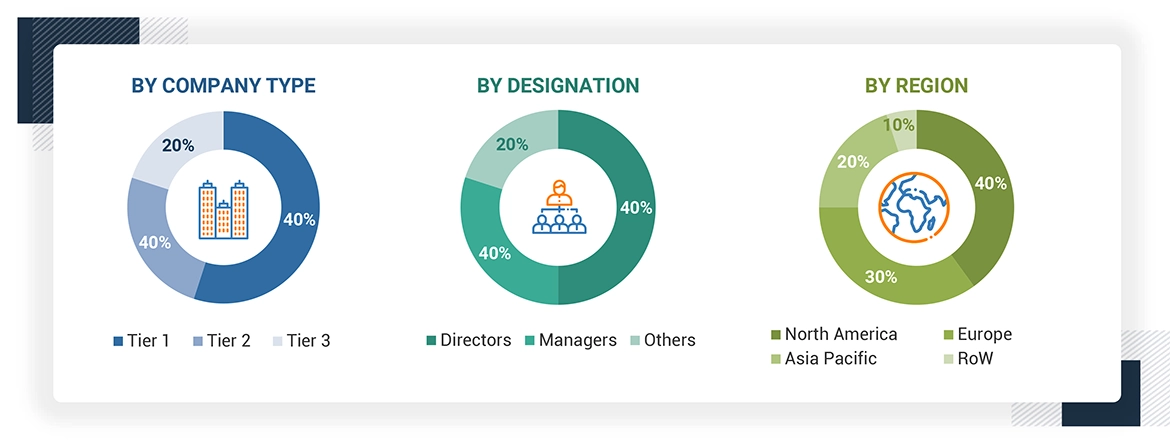
In the primary research process, various primary sources from both the supply and demand sides were interviewed to obtain qualitative and quantitative information for this report. The primary sources from the supply side included industry experts, such as Chief Executive Officers (CEOs), Vice Presidents (VPs), marketing directors, technology and innovation directors, and related key executives from various key companies and organizations operating in the supply chain market. After the complete market engineering (calculations for market statistics, market breakdown, market size estimations, market forecasting, and data triangulation), extensive primary research was conducted to gather information and verify and validate the critical numbers arrived at. Primary research was also conducted to identify the segmentation types, industry trends, competitive landscape of supply chain solutions offered by various market players, and key market dynamics, such as drivers, restraints, opportunities, challenges, industry trends, and key player strategies.
In the complete market engineering process, the top-down and bottom-up approaches were extensively used, along with several data triangulation methods, to perform the market estimation and market forecasting for the overall market segments and subsegments listed in this report. Extensive qualitative and quantitative analysis was performed on the complete market engineering process to list the key information/insights throughout the report.
To know about the assumptions considered for the study, download the pdf brochure
Market Size Estimation
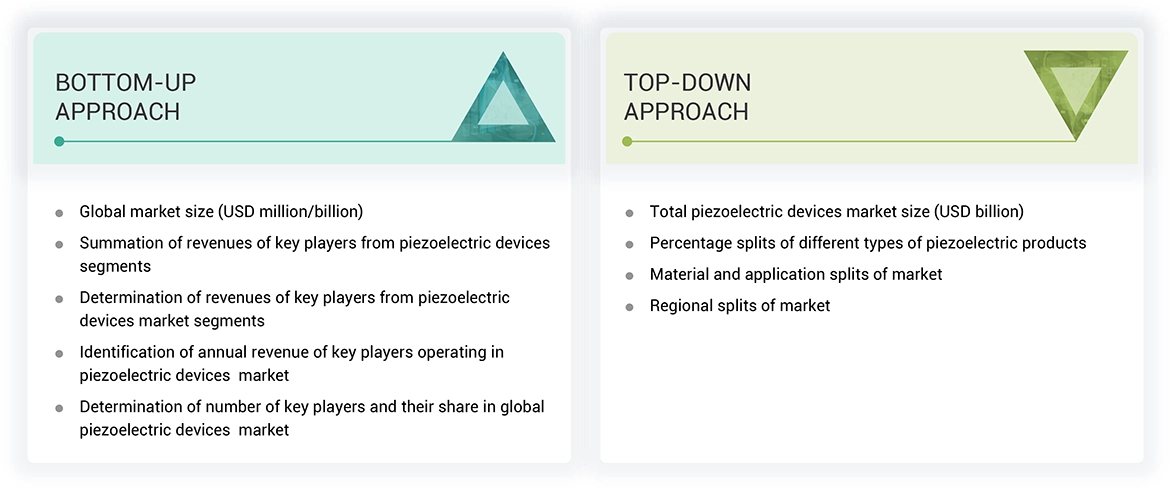
In the complete market engineering process, top-down and bottom-up approaches and several data triangulation methods have been used to estimate and forecast the overall market segments and subsegments listed in this report. Key players in the market have been identified through secondary research, and their market shares in the respective regions have been determined through primary and secondary research. This entire procedure includes the study of annual and financial reports of the top market players and extensive interviews for key insights (quantitative and qualitative) with industry experts (CEOs, VPs, directors, and marketing executives).
All percentage shares, splits, and breakdowns have been determined using secondary sources and verified through primary sources. All the parameters affecting the markets covered in this research study have been accounted for, viewed in detail, verified through primary research, and analyzed to obtain the final quantitative and qualitative data. This data has been consolidated and supplemented with detailed inputs and analysis from MarketsandMarkets and presented in this report. The following figure represents this study’s overall market size estimation process.
Piezoelectric Devices Market : Top-Down and Bottom-Up Approach
Data Triangulation
After arriving at the overall market size from the above estimation process, the market has been split into several segments and subsegments. The data triangulation procedure has been employed wherever applicable to complete the overall market engineering process and arrive at the exact statistics for all segments and subsegments. The data has been triangulated by studying various factors and trends from both the demand and supply sides. Additionally, the market size has been validated using top-down and bottom-up approaches.
Market Definition
Piezoelectricity is defined as the ability of certain materials to produce an electric charge on the application of mechanical stress. Therefore, piezoelectric devices are defined as devices that can produce electrical energy from mechanical energy. For example, they convert vibrations, pressure, force, and acceleration into electricity. Such devices are commonly referred to as energy harvesters and can be used in applications where external power is unavailable, and batteries are not feasible.
Key Stakeholders
- Raw Materials Suppliers
- Technology Investors
- Original Equipment Manufacturers (OEMs)
- Third-party Service Providers
- Government Labs
- In-house Testing Labs
- System Integrators
- Distributors, Resellers, and Traders
- Research Institutions & Organizations, Piezoelectric Technology Forums, Alliances, and Consortium & Associations
- End Users
Report Objectives
- To describe, segment, and forecast the piezoelectric devices market, by material, element, and application, in terms of value
- To describe and forecast the piezoelectric devices market, by product, in terms of value and volume
- To describe and forecast the market for four key regions, namely North America, Europe, Asia Pacific, and the Rest of the World (RoW), in terms of value
- To describe elements with varied shapes and operation modes of piezoelectric devices
- To provide detailed information regarding the market dynamics (drivers, restraints, opportunities, and challenges) influencing the growth of the piezoelectric devices market
- To provide a detailed overview of the supply chain and ecosystem pertaining to the piezoelectric devices, along with their average selling prices
- To strategically analyze the ecosystem, tariffs & regulations, patent landscape, trade landscape, and case studies pertaining to the market under study
- To strategically analyze micromarkets with regard to individual growth trends, prospects, and contributions to the overall market
- To analyze opportunities in the market for stakeholders and provide a competitive landscape of the market
- To analyze competitive developments such as product launches & developments, expansions, partnerships, contracts, and acquisitions in the piezoelectric devices market
- To strategically profile the key players in the piezoelectric devices market and comprehensively analyze their market ranking and core competencies
- To analyze the impact of Impact of Gen AI/AI on the market and macroeconomic outlook for each region
Available Customizations
With the given market data, MarketsandMarkets offers customizations according to the specific requirements of companies. The following customization options are available for the report:
- Detailed analysis and profiling of additional market players (up to 5)
- Additional country-level analysis of the piezoelectric devices market
Product Analysis
- Product matrix provides a detailed comparison of the product portfolio of each company in the piezoelectric devices market.
Key Questions Addressed by the Report
What is the current size of the Piezoelectric Devices Market?
The global Piezoelectric Devices Market is projected to grow from USD 35.59 billion in 2024 and is projected to reach USD 55.49 billion by 2030, growing at a CAGR of 7.7%. from 2024 to 2030
What is the expected CAGR of the Piezoelectric Devices Market?
The market is expected to grow at a CAGR of 7.7% during 2024–2030, driven by increasing adoption across industrial, automotive, aerospace, and healthcare applications.
What are the key growth drivers of the Piezoelectric Devices Market?
Major drivers include rising adoption of piezoelectric materials in aircraft structures, increasing demand for sensors and actuators, medical device applications, and industrial automation.
What are the major trends in the Piezoelectric Devices Market?
Key trends include miniaturization of devices, smart sensors, energy harvesting solutions, advanced actuators, and integration of piezoelectric technology in IoT applications.
Which region dominates the Piezoelectric Devices Market?
Asia Pacific is expected to hold a significant market share due to strong manufacturing growth, electronics production, and increasing industrial automation.
Which region is expected to witness significant growth?
North America and Europe are expected to grow due to advancements in aerospace, healthcare technology, automotive systems, and smart infrastructure.
Which product segment is driving market growth?
Piezoelectric sensors and actuators are major growth contributors due to their wide use in automotive, aerospace, industrial, and consumer electronics applications.
Who are the leading companies in the Piezoelectric Devices Market?
Key players include CeramTec GmbH CTS Corporation, Kistler Group, Huawei Technologies Co., Ltd., Physik Instrumente (PI) SE & Co. KG., Piezosystem jena,KEMET Corporation, Piezo Technologies, APC International, Ltd.,Mad City Labs, Inc
Which industries are adopting piezoelectric devices?
Major industries include aerospace & defense, automotive, healthcare, consumer electronics, industrial manufacturing, and telecommunications.
What factors are creating future opportunities in the Piezoelectric Devices Market?
Future opportunities include smart materials, vibration control systems, energy harvesting technologies, precision manufacturing, and increasing demand for advanced sensing solutions.
Fact checked
Personalize This Research
- Triangulate with your Own Data
- Get Data as per your Format and Definition
- Gain a Deeper Dive on a Specific Application, Geography, Customer or Competitor
- Any level of Personalization
Let Us Help You
- What are the Known and Unknown Adjacencies Impacting the Piezoelectric Devices Market
- What will your New Revenue Sources be?
- Who will be your Top Customer; what will make them switch?
- Defend your Market Share or Win Competitors
- Get a Scorecard for Target Partners

Custom Market Research Services
We Will Customise The Research For You, In Case The Report Listed Above Does Not Meet With Your Requirements
Get 10% Free CustomisationTESTIMONIALS

Tetsuya Ohhira
Business Development Manager-Technology Business
Nikon Corporation,
Leading Japanese MNC specializing in optics and imaging productswww.nikon.com
MarketsandMarkets™ response
is quick. Their attitude is flexible and positive. Analyst Insights are globally considered and
significant. Client Services quickly respond to our inquiry and demand. Their wide range of global
surveys help us make our strategic plan.
We hope Knowledge Store will be easier to search
for a report.
VP - Marketing & Business Development
Leading Provider of Process Control Solutions
We engaged with MarketsandMarkets on a study to perform an analysis and recommend a Go-To-Market strategy for metrology and process control in the semiconductor market. The study was tailored to our targets and needs with well-defined milestones. Our overall experience with the MarketsandMarkets team was very good throughout the project in all aspects including the analysis methodologies used, the quality and depth of primary and secondary data sets, the professionalism and flexibility of the team and the ability to meet the target schedule and milestones. We want to thank MarketsandMarkets team for a job well done.
- Canada Piezoelectric Devices Market
- Mexico Piezoelectric Devices Market
- US Piezoelectric Devices Market
- Germany Piezoelectric Devices Market
- France Piezoelectric Devices Market
- UK Piezoelectric Devices Market
- Italy Piezoelectric Devices Market
- Japan Piezoelectric Devices Market
- China Piezoelectric Devices Market
- India Piezoelectric Devices Market
- South Korea Piezoelectric Devices Market
- Rest Of Europe Piezoelectric Devices Market
- Rest Of Asia Pacific Piezoelectric Devices Market
Growth opportunities and latent adjacency in Piezoelectric Devices Market






George
Apr, 2026
If I invest now, am I entering a high-growth, innovation-driven market, or is this still a niche segment with limited scalability and slower adoption.
Walter
Apr, 2026
What kind of ROI timeline should I expect if I invest in companies developing piezoelectric materials or devices.