Road Safety Market

Road Safety Market by Offering (Traffic Monitoring & Control, ANPR/ANPR, Incident Detection & Response, Smart Signs & Signals, Sensors, Cameras, Road Safety Audits), Application (Accident Prevention, Work Zone Safety) - Global Forecast to 2031




OVERVIEW
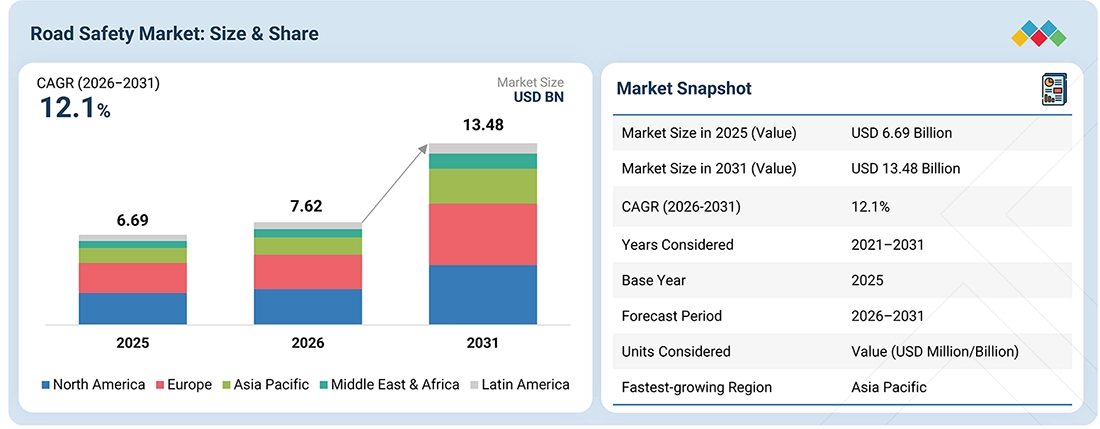
Source: Secondary Research, Interviews with Experts, MarketsandMarkets Analysis
The road safety market is shifting toward a more technology-enabled, proactive safety ecosystem as governments, highway authorities, and law-enforcement agencies increase investment in automated enforcement, intelligent sensing, incident detection, and connected road infrastructure. The market is estimated at USD 7.62 billion in 2026 and is projected to reach USD 13.48 billion by 2031, registering a CAGR of 12.1% during the forecast period. Growth is being supported by the continuing global road-safety burden, with approximately 1.16 million people dying annually from road traffic crashes, while more than half of fatalities involve vulnerable road users such as pedestrians, cyclists, and motorcyclists. Increasing adoption of AI-powered video analytics, ANPR/ALPR, automated speed and red-light enforcement, pedestrian and VRU detection, and real-time incident management is shifting the market from conventional monitoring toward proactive safety and prevention. At the same time, connected-road technologies such as V2X are expanding the scope of road safety through applications including forward-collision warnings, pedestrian warnings, wrong-way alerts, emergency-vehicle alerts, and work-zone warnings.
KEY TAKEAWAYS
-
BY REGIONAsia Pacific is poised to register the highest growth rate of 14.8% over the forecast period.
-
BY OFFERINGBy offering, the solutions segment is estimated to account for the largest share of 75.3% in 2026.
-
BY ENFORCEMENT TYPEBy enforcement type, the automated enforcement segment is projected to account for the largest market size with the highest CAGR of 13%.
-
BY APPLICATIONBy application, the violation management segment is estimated to account for the largest market share.
-
BY END USERBy end user, the smart city integrators segment is expected to account for the highest CAGR of 14.3% during the forecast period.
-
COMPETITIVE LANDSCAPE - Key PlayersMajor market players like Siemens, Motorola Solutions, and SWARCO have adopted organic and inorganic strategies, including partnerships and investments. These companies have entered into several agreements and partnerships to meet growing demand for road safety across innovative applications.
-
COMPETITIVE LANDSCAPE - StartupsCompanies like Syntell, Acusensus, and Sensys Gatso Group, among others, have distinguished themselves among startups and SMEs by securing strong footholds in specialized niches, underscoring their potential as emerging market leaders.
The road safety market is shifting from standalone enforcement equipment to integrated, AI-enabled, connected safety solutions. Automated speed and red-light enforcement, ANPR/ALPR, AI-based video analytics, intelligent sensors, and real-time incident detection are increasingly being combined with traffic-control and communication infrastructure to improve enforcement coverage and enable faster responses to safety-critical events. At the same time, connected intersections and V2X technologies are creating new safety applications by allowing vehicles, roadside infrastructure, pedestrians, and other road users to exchange information and receive warnings about potential hazards. USDOT identifies applications such as pedestrian-in-crosswalk warnings, emergency-vehicle alerts, reduced-speed warnings, wrong-way-entry warnings, and work-zone worker advisories as key V2X safety use cases. These developments are expanding opportunities across automated enforcement, pedestrian and VRU protection, work-zone safety, accident prevention, emergency response, and connected road infrastructure.
TRENDS & DISRUPTIONS IMPACTING CUSTOMERS' CUSTOMERS
The trends and disruptions framework highlights a shift in the road safety market from reactive enforcement and post-incident response toward proactive, connected, and data-driven safety management. Revenue opportunities are increasingly expanding across AI-powered video analytics, automated enforcement, predictive road-safety analytics, connected intersections, V2X communication, intelligent sensing, and vulnerable-road-user protection. This shift is being driven by the need to identify unsafe driving behavior and road hazards in real time, particularly in high-risk environments such as intersections, highways, pedestrian crossings, and work zones. As a result, road authorities are deploying AI-enabled systems for speed and red-light enforcement, vehicle identification, accident and incident detection, pedestrian and cyclist detection, and driver-behavior monitoring. Connected technologies are further extending these capabilities by enabling vehicles and infrastructure to exchange safety information and provide advance warnings for collisions, road hazards, emergency vehicles, reduced-speed zones, and work zones. The commercial impact is therefore moving beyond conventional enforcement hardware toward integrated software, analytics, connected infrastructure, and managed services that can support continuous road-safety monitoring and proactive accident prevention.
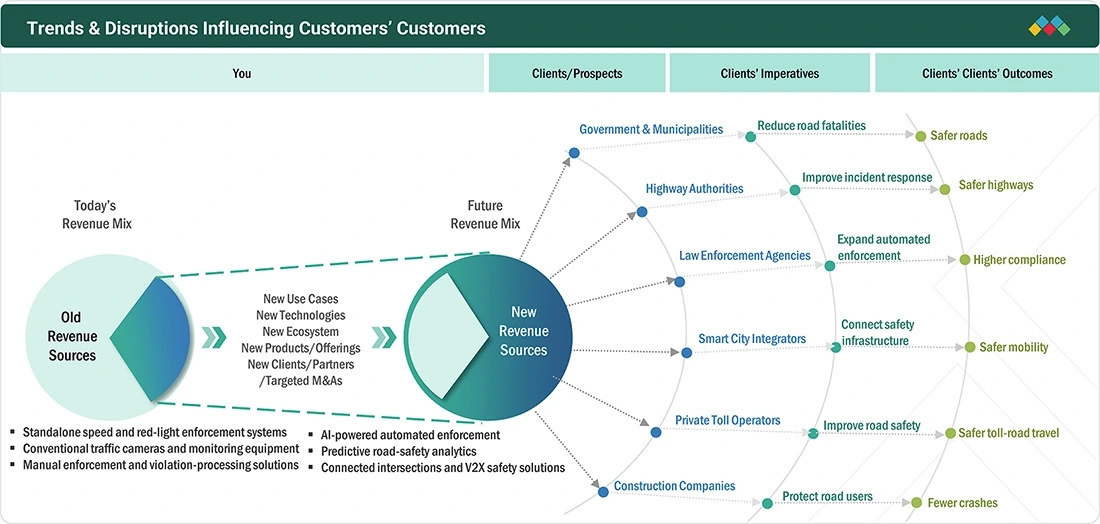
Source: Secondary Research, Interviews with Experts, MarketsandMarkets Analysis
MARKET DYNAMICS

Level
-
Increasing government focus on reducing road fatalities and serious injuries

-
Growing deployment of automated speed and red-light enforcement


Level
-
High upfront investment and operating costs for advanced road-safety infrastructure

-
Interoperability challenges across cameras, sensors, communications, and legacy systems


Level
-
Expansion of AI-enabled predictive road-safety analytics and proactive accident prevention

-
Growing deployment of connected intersections and V2X-based safety applications


Level
-
Ensuring accuracy and reliability of AI-based detection systems under varying weather, lighting, and traffic conditions

-
Addressing cybersecurity and privacy risks associated with connected cameras, vehicles, and infrastructure

Source: Secondary Research, Interviews with Experts, MarketsandMarkets Analysis
Driver: Increasing government focus on reducing road fatalities and serious injuries
Governments and road authorities are increasing investments in technologies and infrastructure designed to reduce road fatalities and serious injuries and improve compliance with traffic-safety requirements. The continuing global burden of road traffic injuries is encouraging authorities to strengthen enforcement, improve hazardous-road monitoring, and deploy technology-enabled safety measures across highways and urban road networks. This is supporting demand for automated enforcement, intelligent traffic monitoring, incident detection, pedestrian and vulnerable-road-user protection, and connected road-safety infrastructure. As governments pursue road-safety targets and evidence-based interventions, they increasingly incorporate technology into broader road-safety programs rather than deploying it only as standalone enforcement equipment.
Restraint: High upfront investment and operating costs for advanced road-safety infrastructure
Advanced road-safety deployments often require substantial investment in cameras, sensors, roadside equipment, communication networks, computing infrastructure, software platforms, installation, system integration, and ongoing maintenance. Costs can increase further when authorities upgrade existing infrastructure or deploy systems across large highway and urban networks. Beyond initial capital expenditure, road agencies may need to allocate recurring budgets for equipment maintenance, software updates, data management, connectivity, calibration, and technical support. These financial requirements can slow adoption, particularly among jurisdictions with constrained transportation budgets or limited funding for technology-intensive road-safety programs.
Opportunity: Expansion of AI-enabled predictive road-safety analytics and proactive accident prevention
The increasing availability of video, traffic, vehicle, incident, and infrastructure data is creating opportunities for AI-enabled predictive road-safety analytics. Advanced analytics can identify unsafe traffic patterns, near-miss events, abnormal driving behavior, congestion-related risks, and locations with elevated accident potential, enabling authorities to shift from reactive incident response to proactive prevention. AI-based computer vision and machine learning can also support continuous monitoring of intersections, highways, pedestrian crossings, and work zones. This creates opportunities for analytics platforms, edge processing, predictive risk assessment, and decision-support solutions that help road authorities prioritize safety interventions.
Challenge: Ensuring accuracy and reliability of AI-based detection systems under varying weather, lighting, and traffic conditions
AI-based road-safety systems must maintain reliable detection and classification performance across changing environmental and operational conditions. Rain, fog, snow, darkness, glare, occlusion, high traffic density, unusual vehicle configurations, and changing road layouts can affect camera and computer-vision performance. False positives or missed detections can reduce operational confidence and may have significant implications for enforcement and safety-critical applications. Vendors therefore need to continuously improve model training, sensor fusion, edge processing, calibration, validation, and system monitoring to maintain consistent performance across diverse road environments.
ROAD SAFETY MARKET: COMMERCIAL USE CASES ACROSS INDUSTRIES
| COMPANY | USE CASE DESCRIPTION | BENEFITS |
|---|---|---|
 |
Victoria Police deployed JENOPTIK’s mobile distracted-driving enforcement solution to detect mobile-phone use and seatbelt violations using camera-based technology and AI analytics. The system supports automated identification of unsafe driver behavior and evidence generation for enforcement. | Improved detection of distracted driving and seatbelt violations, more efficient enforcement, and enhanced road-user safety through automated evidence collection and analytics. |
 |
Kapsch TrafficCom, together with SCAIL, is deploying India’s first C-ITS project on a highway near New Delhi. The system provides connected-vehicle warnings for roadworks, maintenance vehicles, hazardous locations, traffic queues, and temporary virtual signage using real-time connectivity and AI-based situational awareness. | Earlier warnings of road hazards, improved work-zone safety, faster driver response, and enhanced protection of road users through connected infrastructure. |
 |
Sensys Gatso provides automated traffic enforcement as a managed service, combining speed, red-light, school-zone, and work-zone enforcement with hardware, software, data, analytics, and citation processing. Municipal and government authorities have deployed its solutions to improve traffic safety and driver compliance. | Higher enforcement coverage, improved compliance with speed limits, reduced risky driving behavior, and lower operational burden for public authorities through managed enforcement services. |
 |
Verra Mobility manages automated speed and red-light enforcement programs for government and transportation agencies. In Hawaii, the company expanded its program under a 10-year contract to 187 dual-enforcement cameras across major islands, following reported reductions in red-light violations and crashes at existing sites. | Improved traffic-law compliance, reduced dangerous driving, expanded automated enforcement coverage, and enhanced safety at high-risk intersections and roadways. |
 |
Teledyne FLIR thermal cameras are used for pedestrian detection and automatic emergency braking applications, particularly in darkness, glare, fog, and other challenging visibility conditions. Their thermal sensing technology can complement radar and visible cameras to improve vulnerable road user detection. | Improved nighttime and adverse-weather pedestrian detection, earlier AEB response, enhanced vulnerable-road-user protection, and reduced limitations of conventional vision sensors. |
Logos and trademarks shown above are the property of their respective owners. Their use here is for informational and illustrative purposes only.
MARKET ECOSYSTEM
The road safety system ecosystem is increasingly organized around technology, solution, and service providers. Technology and solution providers include companies offering automated enforcement systems, ANPR/ALPR, traffic monitoring and control, incident detection and response, intelligent sensing, pedestrian and vulnerable road-user protection, connected and cooperative road-safety solutions, and AI-powered analytics. Their differentiation increasingly depends on detection accuracy, real-time processing, interoperability, integration with existing traffic infrastructure, and the ability to support multiple safety applications through integrated platforms. Services providers complement these solutions through consulting, system integration, installation, maintenance, outsourced enforcement operations, analytics as a service, back-office processing, training, and road-safety audits. Their role is particularly important in complex deployments where road authorities and law-enforcement agencies need to integrate cameras, sensors, roadside units, communication networks, traffic signals, enforcement platforms, and legacy systems while maintaining reliability, scalability, cybersecurity, and regulatory compliance.
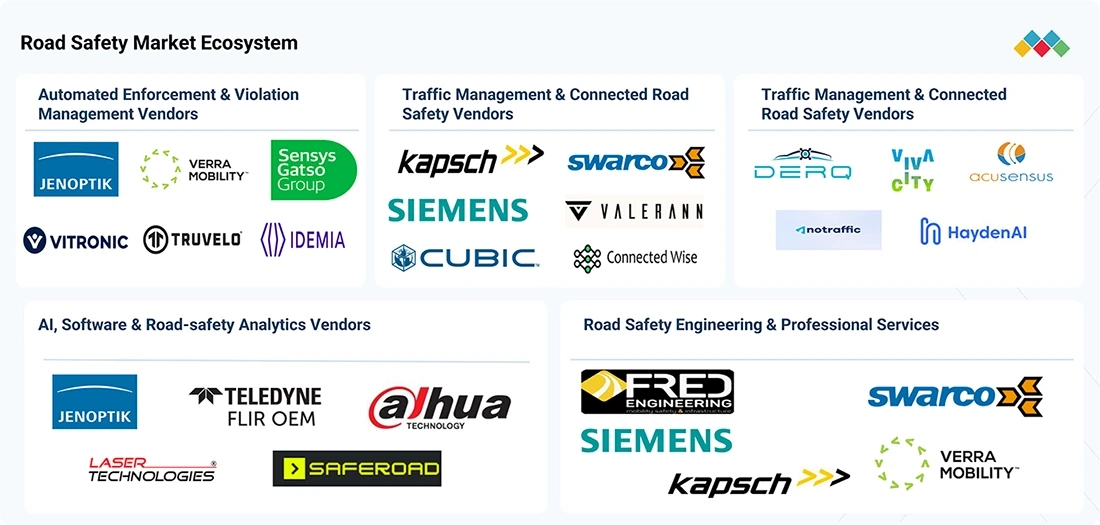
Logos and trademarks shown above are the property of their respective owners. Their use here is for informational and illustrative purposes only.
MARKET SEGMENTS
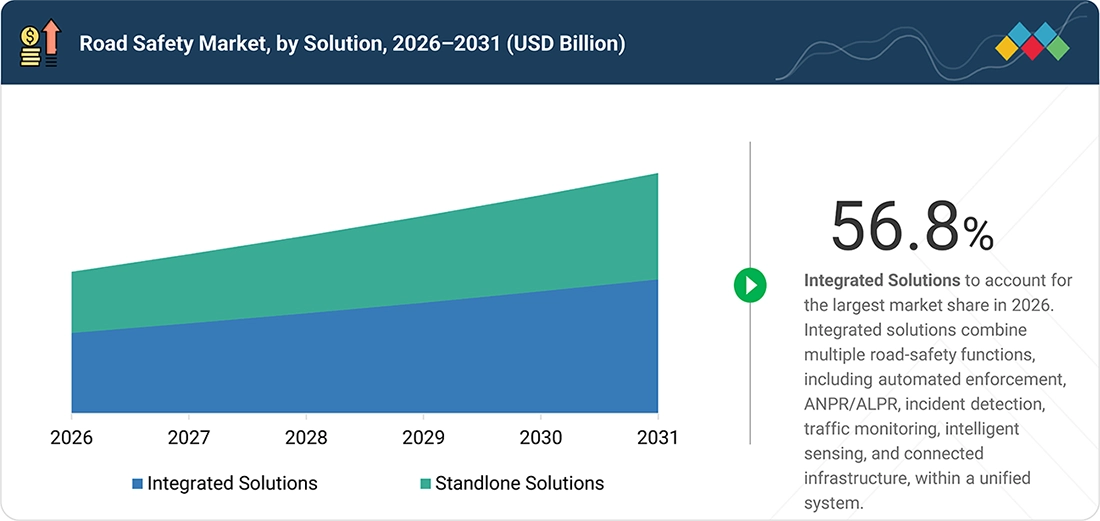
Source: Secondary Research, Interviews with Experts, MarketsandMarkets Analysis
Road Safety Market, By Enforcement Type
The automated enforcement segment is expected to dominate the road safety market in 2026, driven by the increasing adoption of speed cameras, red-light enforcement systems, and license plate recognition technologies. These solutions enable efficient, accurate, and cost-effective traffic law enforcement, reducing reliance on manual intervention while improving compliance and overall road-safety outcomes.
Road Safety Market, By Offering
The solutions segment, comprising hardware and software, is expected to account for the largest market share in 2026, as integrated technologies are increasingly required for effective road-safety deployments. Hardware components such as cameras and sensors, combined with software and analytics platforms, enable real-time monitoring, automated enforcement, incident detection, and predictive safety insights, supporting broader adoption across regions.
Road Safety Market, By Application
The violation management application is expected to dominate the road safety market in 2026, as road authorities increasingly adopt automated technologies to detect, document, and process traffic violations. These solutions streamline enforcement, reduce manual intervention, improve compliance, and support efficient violation processing, making them a key component of modern road-safety operations.
Road Safety Market, By End User
The government & municipalities segment is expected to hold the largest market share in 2026, supported by increasing public-safety initiatives, growing investments in traffic and road infrastructure, regulatory requirements, and large-scale deployment of road monitoring, automated enforcement, traffic management, and road-safety systems.
REGION
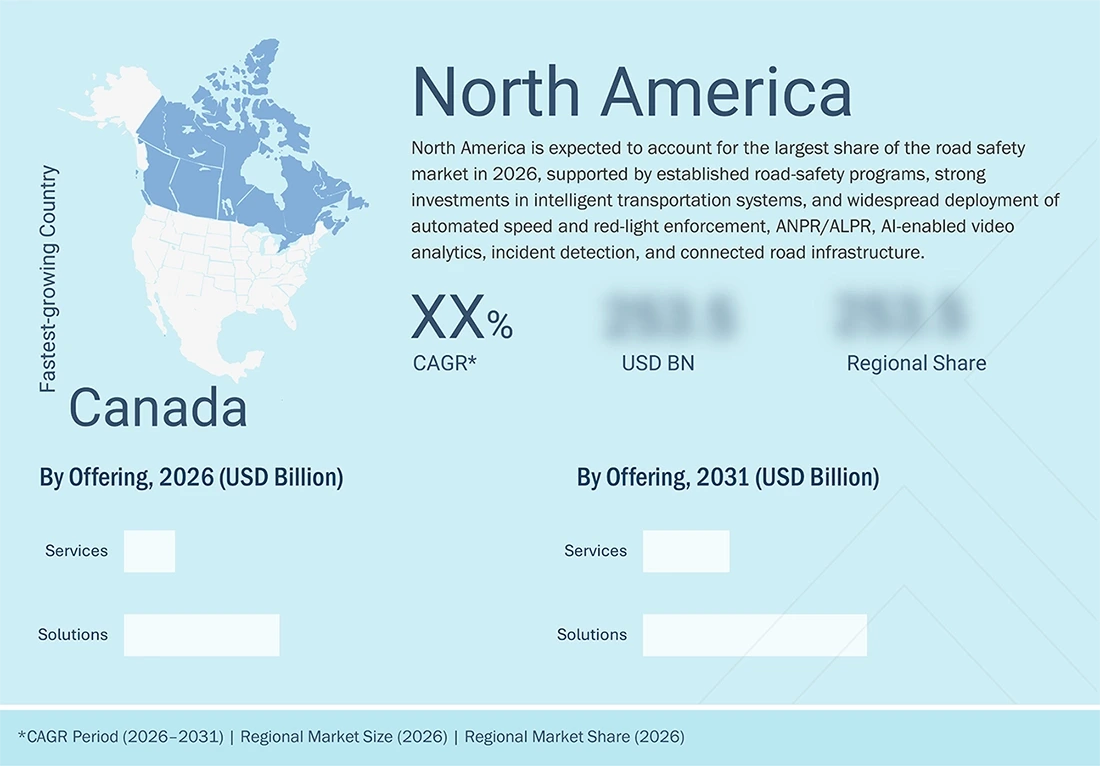
North America to dominate the road safety market in 2026
North America is expected to represent the largest regional market for road safety in 2026, supported by established road-safety programs, significant investments in intelligent transportation infrastructure, and widespread adoption of automated enforcement and traffic-monitoring technologies. Government agencies, highway authorities, and law-enforcement organizations across the US and Canada are increasingly deploying speed and red-light enforcement, ANPR/ALPR, AI-powered video analytics, incident detection, intelligent traffic signals, and connected road infrastructure. The region’s mature ITS ecosystem, established regulatory frameworks, and increasing deployment of V2X and connected-vehicle technologies further support adoption of advanced road-safety solutions. Growing investments in proactive accident prevention, vulnerable-road-user protection, work-zone safety, and real-time traffic monitoring are expected to accelerate the transition from conventional enforcement toward integrated and technology-enabled road-safety systems.
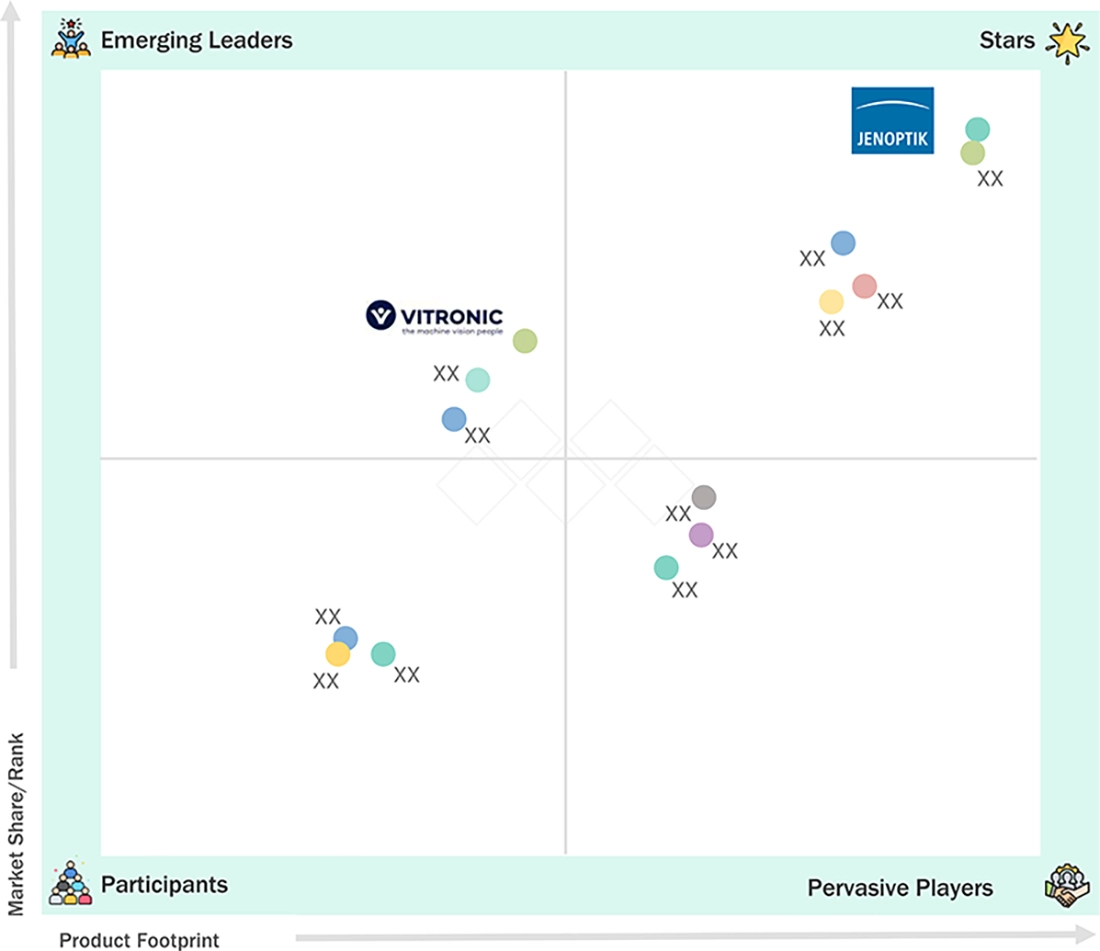
ROAD SAFETY MARKET: COMPANY EVALUATION MATRIX
JENOPTIK is positioned among the leading players in the road safety market because of its strong capabilities in automated traffic enforcement, speed and red-light enforcement, ANPR, mobile enforcement, and AI-enabled violation detection. Kapsch TrafficCom is a leading integrated road-safety and intelligent transportation provider, supported by capabilities in traffic management, incident detection, connected infrastructure, and C-ITS/V2X technologies that enable real-time road-safety applications across highways and urban environments.
Source: Secondary Research, Interviews with Experts, MarketsandMarkets Analysis
KEY MARKET PLAYERS
- Jenoptik (Germany)
- Siemens (Germany)
- Kapsch TrafficCom (Austria)
- Sensys Gatso Group (Sweden)
- Motorola Solutions (US)
- Verra Mobility (US)
- SWARCO (Austria)
- IDEMIA (France)
- Cubic Corporation (US)
- Conduent (US)
- VITRONIC (Germany)
- Dahua Technology (China)
- Laser Technology (US)
- Syntell (South Africa)
- Connected Wise LLC (US)
MARKET SCOPE
| REPORT METRIC | DETAILS |
|---|---|
| Market Size in 2025 (Value) | USD 6.69 Billion |
| Market Size in 2026 (Value) | USD 7.62 Billion |
| Market Forecast in 2031 (Value) | USD 13.48 Billion |
| Growth Rate | 12.10% |
| Years Considered | 2021–2031 |
| Base Year | 2025 |
| Forecast Period | 2026–2031 |
| Units Considered | Value (USD Million/Billion) |
| Report Coverage | Revenue forecast, company ranking, competitive landscape, growth factors, and trends. |
| Segments Covered |
|
| Regions Covered | North America, Asia Pacific, Europe, Latin America, Middle East & Africa |
WHAT IS IN IT FOR YOU: ROAD SAFETY MARKET REPORT CONTENT GUIDE
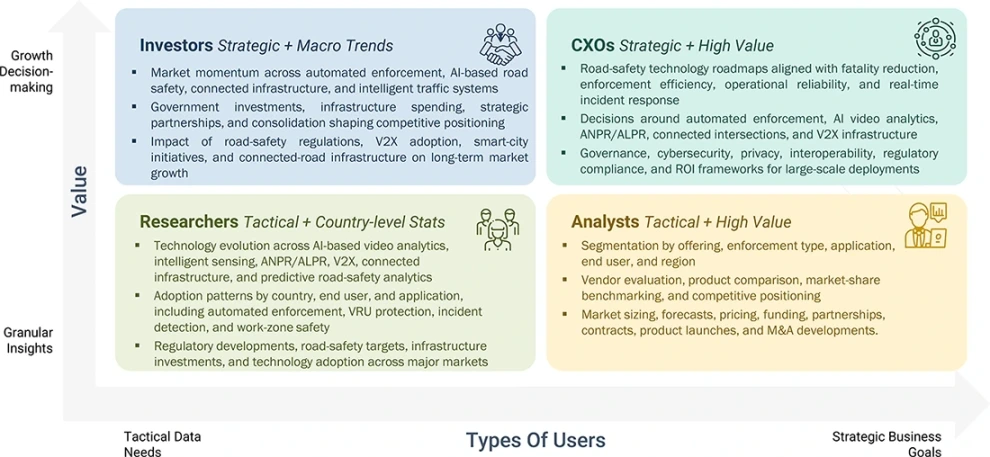
DELIVERED CUSTOMIZATIONS
We have successfully delivered the following deep-dive customizations:
| CLIENT REQUEST | CUSTOMIZATION DELIVERED | VALUE ADDS |
|---|---|---|
| Detailed market segmentation for the Indonesia road safety market |
|
|
| Company-specific competitive benchmarking (Aselsan) |
|
|
| Competitive landscape mapping in MEA region |
|
|
RECENT DEVELOPMENTS
- August 2026: Sensys Gatso Group (Sweden) was selected by the Minnesota Department of Transportation for a work-zone safety camera pilot. The USD 800,000 program combines mobile speed-enforcement technology with driver-education messaging to address speeding in active highway work zones and improve protection for road workers and motorists.
- July 2026: Jenoptik (Germany) agreed to deploy mobile speed- and noise-enforcement systems for the City of Santa Fe, New Mexico. The automated program combines traffic enforcement with noise-pollution monitoring, extending Jenoptik’s road-safety enforcement work in the United States.
- May 2026: Kapsch TrafficCom (Austria) announced a connected-vehicle project on a major expressway near New Delhi, India, in partnership with Superwave Communication And Infrasolution Limited. The country’s first Cooperative Intelligent Transport Systems (C-ITS) project will use real-time connectivity and AI-enabled video sensors to identify safety-critical events, including stopped vehicles, congestion, and road workers, and provide safety information to drivers.
- October 2025: Jenoptik (Germany) signed a contract with TrafficTech Middle East and the Greater Amman Municipality in Jordan to install traffic-safety enforcement systems across Amman and its highways. The project includes 41 TraffiStar SR591 red-light and speed-enforcement cameras, nine VECTOR SR P2P average-speed devices, and integration with Jenoptik’s FlowTris back-office platform.
- May 2025: Kapsch TrafficCom (Austria) and Autobahn GmbH des Bundes completed the first phase of a connected-infrastructure project to improve safety on German motorways. A total of 1,000 ITS Roadside Stations were installed on mobile barrier panels to transmit warnings directly to approaching vehicles about construction zones, helping alert drivers to roadworks and reduce accident risk.
Table of Contents
 Exclusive indicates content/data unique to MarketsandMarkets and not available with any competitors.
Methodology
The research study for the road safety market involved extensive secondary sources, directories, journals, and paid databases. Primary sources included industry experts from core and related industries, preferred road safety providers, third-party service providers, consulting service providers, end users, and other commercial enterprises. In-depth interviews with primary respondents, including key industry participants and subject matter experts, were conducted to obtain and verify critical qualitative and quantitative information and assess the market’s prospects.
Secondary Research
In the secondary research process, the study referred to various authoritative and industry sources to identify and collect information. The secondary sources included annual reports; investor presentations; company press releases; product documentation; technical specifications; government publications; regulatory documents; transportation and road-safety databases; procurement and tender documents; and certified publications and standards related to road safety, intelligent transportation systems, traffic enforcement, connected vehicles, and road infrastructure. Relevant information was also collected from organizations and institutions such as the World Health Organization (WHO), United Nations Economic Commission for Europe (UNECE), United Nations Road Safety Collaboration (UNRSC), World Bank, International Transport Forum (ITF), International Organization for Standardization (ISO), International Telecommunication Union (ITU), Institute of Transportation Engineers (ITE), Intelligent Transportation Society of America (ITS America), European Commission, European Road Safety Observatory (ERSO), Federal Highway Administration (FHWA), National Highway Traffic Safety Administration (NHTSA), US Department of Transportation (USDOT), and European Transport Safety Council (ETSC). Government and regulatory sources from major countries and regions were also reviewed, including the US Department of Transportation, Transport Canada, the European Union and national transport ministries, the UK Department for Transport, India's Ministry of Road Transport and Highways (MoRTH), and relevant state and municipal transportation authorities. Technical standards and guidance related to automated enforcement, intelligent transportation systems, connected and cooperative mobility, V2X communication, vulnerable road users, traffic-control systems, road infrastructure, vehicle safety, and data management were also considered, including standards and publications from ISO, SAE International, IEEE, ETSI, and other recognized transportation and technology organizations. The analysis also reviewed company-level information from leading road-safety technology providers to assess product portfolios, product launches, partnerships, contracts, deployments, technology developments, geographic presence, and competitive strategies.
Secondary research was used to gather key information on the industry’s value chain, the market’s monetary chain, the overall pool of key players, market classification and segmentation aligned with industry trends to the bottom-most level, regional markets, and key developments from market- and technology-oriented perspectives.
Primary Research
Primary research for the road safety market was conducted with a diverse set of stakeholders across the supply and demand sides of the market to validate market assumptions, technology adoption trends, pricing structures, purchasing criteria, and competitive dynamics. Interviews were targeted toward company executives, technology and innovation leaders, system integrators, road-safety solution providers, enforcement technology vendors, highway and transportation authorities, law-enforcement agencies, and other industry experts. The discussions focused on the adoption of automated enforcement, ANPR/ALPR, AI-based video analytics, incident detection, traffic monitoring, connected road infrastructure, pedestrian and VRU protection, and road-safety services.
The primary research process was designed to understand how road-safety technologies are evaluated, purchased, deployed, and operated across different end-user groups. Discussions with government and municipal stakeholders, highway authorities, and law-enforcement agencies provided insights into procurement processes, regulatory requirements, deployment priorities, system integration requirements, and operational challenges. Industry participants provided perspectives on technology roadmaps, product development, competitive positioning, pricing structures, contract models, recurring service opportunities, and the transition from standalone enforcement equipment toward integrated road-safety platforms.
Primary interviews also examined the key demand drivers and adoption barriers influencing the market. Stakeholders highlighted factors such as increasing road fatalities, government road-safety initiatives, stricter traffic enforcement, smart-city investments, expansion of intelligent transportation systems, and the growing availability of AI-enabled sensing and analytics. Discussions also assessed implementation challenges, including infrastructure readiness, interoperability with legacy systems, data privacy and security, regulatory approvals, public acceptance, budget constraints, system maintenance, and the availability of skilled personnel. Stakeholder research on automated enforcement similarly indicates that public acceptance, perceived legitimacy, and evidence of safety benefits can influence deployment decisions.
The research further evaluated technology-specific adoption and commercial use cases across automated speed enforcement, red-light enforcement, ANPR/ALPR, AI-powered violation detection, driver behavior monitoring, incident detection and response, smart traffic signals, road-weather monitoring, connected intersections, V2X communication, and VRU protection. Interviews assessed the maturity of these technologies, current commercial deployments, expected adoption timelines, and the extent to which AI, computer vision, edge computing, IoT sensors, and connected infrastructure are changing conventional road-safety operations. Evidence from recent research on AI-powered enforcement also indicates growing deployment of automated systems for real-time violation detection and their potential influence on driver behavior and traffic safety.
The findings from primary research were subsequently triangulated with secondary research, company disclosures, government publications, regulatory documents, industry standards, procurement information, and other authoritative sources. Primary interview inputs were used to validate market segmentation, estimate technology and solution adoption, assess vendor positioning, identify emerging applications, and refine assumptions about market growth and demand potential. The research also supported the bottom-up assessment of market opportunities by evaluating the typical composition of hardware, software, services, and managed-service contracts across different road-safety applications and end users. This combined approach helped ensure that the final market estimates and forecasts reflect both quantitative market indicators and qualitative insights from participants directly involved in the road-safety ecosystem.
Breakdown of Primary Research
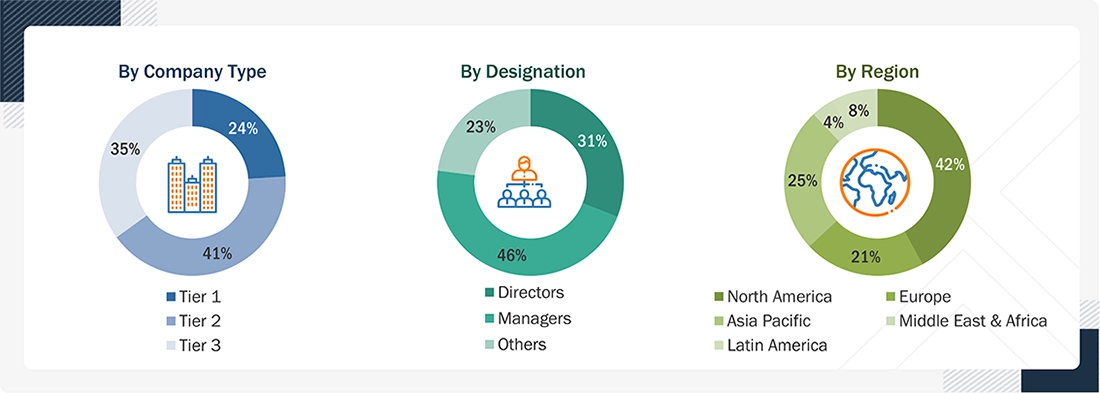
Note: Three tiers of companies are defined based on their total revenue for the year ended 31st December 2025; Tier 1 companies’ revenue is more than USD 500 million; Tier 2 companies' revenue ranges between USD 500 million and 100 million; and Tier 3 companies’ revenue is less than USD 100 million
Source: MarketsandMarkets Analysis
To know about the assumptions considered for the study, download the pdf brochure
Market Size Estimation
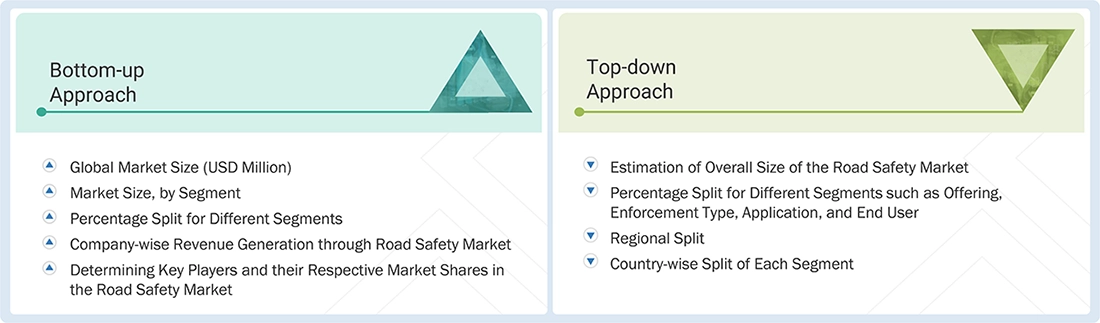
The top-down and bottom-up approaches were used to estimate and forecast the road safety market and its dependent submarkets. This multi-layered analysis was further reinforced through data triangulation, which incorporated primary and secondary research inputs. The market figures were also validated against the existing MarketsandMarkets repository for accuracy.
Data Triangulation
The market was divided into several segments and subsegments after determining the overall market size using the market size estimation processes described above. To complete the overall market engineering process and determine the exact statistics for each market segment and subsegment, data triangulation and market segmentation procedures were employed, wherever applicable. The overall market size was then used in the top-down approach to estimate the size of other individual markets by applying percentage splits to the market segmentation.
Market Definition
The road safety market comprises technologies, solutions, and services designed to prevent road crashes, detect unsafe driving and road conditions, and improve the safety of vehicles and road users. It includes automated enforcement, ANPR/ALPR, incident detection, traffic monitoring, intelligent sensing, pedestrian and vulnerable road-user protection, and connected road-safety systems. The market also covers AI-enabled analytics, V2X applications, safety-specific traffic infrastructure, and related managed and professional services. It excludes general traffic management, mobility, tolling, and transportation solutions where road safety is not the primary purchased function.
Position sensors play a crucial role across automotive and electric vehicles, manufacturing and industrial automation, robotics, aerospace & defense, healthcare equipment, packaging machinery, and consumer electronics. These solutions enable precise motion measurement, position feedback, equipment control, automation, and safety functions. Position sensors are commonly integrated into steering and braking systems, actuators, motors, machine tools, robotic systems, material-handling equipment, and automated production lines. A typical position-sensing system may consist of a sensing element, signal-conditioning or processing circuitry, output interface, and associated control electronics, with its configuration varying according to the sensing technology, measurement range, accuracy requirements, application, and operating environment.
Key Stakeholders
- Government agencies
- Road safety Original Equipment Manufacturers (OEMs)
- Road safety service providers
- System integrators
- Consulting firms
- Research organizations
- Resellers and distributors
- Managed service providers
- Regulatory authorities and associations
- Information Technology (IT) service providers
- Consultants/Consultancies/Advisory firms
- Training providers
Report Objectives
- To define, describe, and forecast the road safety market by offering, enforcement type, application, and end user
- To provide detailed information related to major factors (drivers, restraints, opportunities, and industry-specific challenges) influencing the market growth
- To analyze the micro markets with respect to individual growth trends, prospects, and their contribution to the total market
- To analyze the opportunities in the market for stakeholders by identifying the high-growth segments of the road Safety market
- To analyze opportunities in the market and provide details of the competitive landscape for stakeholders and market leaders
- To forecast the market size of segments for five main regions: North America, Europe, Asia Pacific, the Middle East & Africa, and Latin America
- To profile the key players and comprehensively analyze their market ranking and core competencies
- To analyze competitive developments, such as partnerships, product launches, and mergers & acquisitions, in the road safety market
Available customizations:
With the given market data, MarketsandMarkets offers customizations as per your company’s specific needs. The following customization options are available for the report:
Product analysis
- Brand/product comparative analysis of additional vendors
Geographic analysis
- Inclusion of additional European countries, with breakdown by offering, enforcement type, application, and end user segments
- Inclusion of additional Asia Pacific countries, with breakdown by offering, enforcement type, application, and end user segments
- Inclusion of additional Middle Eastern & African countries, with breakdown by offering, enforcement type, application, and end user segments
- Inclusion of additional Latin American countries, with breakdown by offering, enforcement type, application, and end user segments
Company information
- Detailed analysis and profiling of additional market players (up to five)
Key Questions Addressed by the Report
What are the key technologies driving the road safety market?
Technologies such as ANPR, red light enforcement, speed detection systems, V2X communication, and AI-powered traffic management platforms are key to modern road safety solutions. These technologies help monitor traffic flow, enforce regulations, reduce accidents, and enhance overall roadway safety and efficiency.
Which factors are contributing to the growth of the global road safety market?
The market’s growth is driven by increasing urbanization, stricter government regulations, rising road accidents, and the adoption of smart city initiatives. Investments in intelligent traffic management, AI-based monitoring, and public awareness campaigns are also accelerating the demand for modern road safety solutions globally.
Which regions are expected to dominate the road safety market in the next five years?
Due to stringent regulations and advanced infrastructure, North America and Europe are expected to maintain dominance. However, Asia Pacific will likely witness the fastest growth, driven by rapid urbanization, large-scale infrastructure projects, and government efforts to reduce accident rates across developing nations.
What role do public-private partnerships play in road safety implementation?
Public-private partnerships enable governments to collaborate with technology vendors and service providers, ensuring cost-effective deployment of safety solutions. PPPs help reduce public funding pressures, improve implementation speed, and enhance long-term maintenance of road safety infrastructure through shared responsibilities and investment models.
What are the major challenges faced by the road safety market?
High capital investment, integration issues with existing systems, public resistance to enforcement technologies, and data privacy concerns are significant challenges. Moreover, maintaining advanced equipment in harsh weather and ensuring continuous calibration further complicates large-scale adoption, especially across developing regions.


Personalize This Research
- Triangulate with your Own Data
- Get Data as per your Format and Definition
- Gain a Deeper Dive on a Specific Application, Geography, Customer or Competitor
- Any level of Personalization
Let Us Help You
- What are the Known and Unknown Adjacencies Impacting the Road Safety Market
- What will your New Revenue Sources be?
- Who will be your Top Customer; what will make them switch?
- Defend your Market Share or Win Competitors
- Get a Scorecard for Target Partners

Custom Market Research Services
We Will Customise The Research For You, In Case The Report Listed Above Does Not Meet With Your Requirements
Get 10% Free CustomisationTESTIMONIALS
- US Road Safety Market
- Canada Road Safety Market
- UK Road Safety Market
- Germany Road Safety Market
- France Road Safety Market
- Italy Road Safety Market
- Spain Road Safety Market
- China Road Safety Market
- Japan Road Safety Market
- India Road Safety Market
- South Korea Road Safety Market
- UAE Road Safety Market
- South Africa Road Safety Market
- Qatar Road Safety Market
- Brazil Road Safety Market
- Mexico Road Safety Market
- Argentina Road Safety Market
- Rest Of Latin America Road Safety Market
- Ksa Road Safety Market
Growth opportunities and latent adjacency in Road Safety Market






David
Sep, 2014
Interested in road safety market.
emrah
May, 2015
Interested in road safety market and related topics.
Maheswor
Jul, 2014
Interested in road safety market.
Jimmy
Jun, 2016
Interested in automation in ticket vending machine market.
Vincent
May, 2019
Collision avoidance (AEB - automatic emergency braking) market for heavy duty trucks and buses.
Daniel
May, 2019
Interested in road safety market.
Angelika
Apr, 2017
Understanding road safety market structure in Europe region.