



Smart Transportation Market Size, Share, Growth, Latest Trends
Report Code
TC 2365
Published in
Jun, 2026, By MarketsandMarkets™
Smart Transportation Market by Transportation Mode (Roadways, Railways, Airways, Maritime, By End User (Government, Commercial Organizations) - Global Forecast to 2032

USD 400.92 BN
MARKET SIZE, 2032

CAGR 14.7%
(2026-2032)

300
REPORT PAGES

55
MARKET TABLES
OVERVIEW
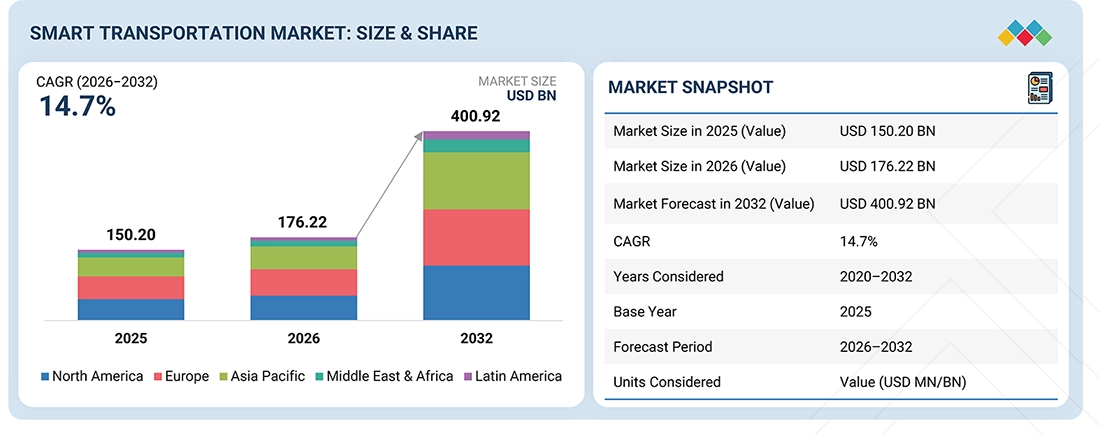
Source: Secondary Research, Interviews with Experts, MarketsandMarkets Analysis
The smart transportation market is projected to grow from USD 176.22 billion in 2026 to USD 400.92 billion by 2032 at a compound annual growth rate (CAGR) of 14.7% from 2026 to 2032. Smart transportation leverages cutting-edge technologies such as artificial intelligence (AI), data analytics, sensors, and communication networks to revolutionize how people and goods move, aiming for greater efficiency, safety, and sustainability. It spans four significant segments: roadways, railways, airways, and maritime. In roadways, innovations like autonomous vehicles (AVs) and intelligent traffic systems are reducing congestion and optimizing urban mobility, as demonstrated by Waymo’s autonomous taxis in US cities.
Market Size and Forecast:
- Market Size Value in 2025: USD 150.20 Billion
- Market Size Value in 2026: USD 176.22 Billion
- Revenue Forecast in 2032: USD 400.92 Billion
- Growth Rate: CAGR of 14.7 % from 2025 to 2032
- Data available from 2020 to 2032
- Base year: 2025
- Forecast period: 2026-2032
- Largest Growing Region: Asia Pacific
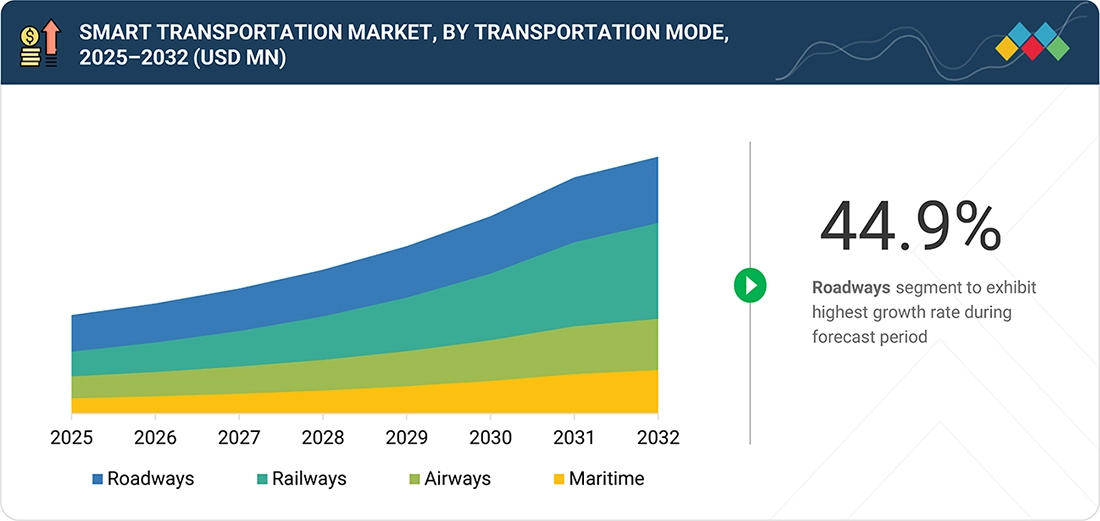
- The Smart Transportation Roadways Segment growing at a CAGR of 44.9 %
KEY TAKEAWAYS
-
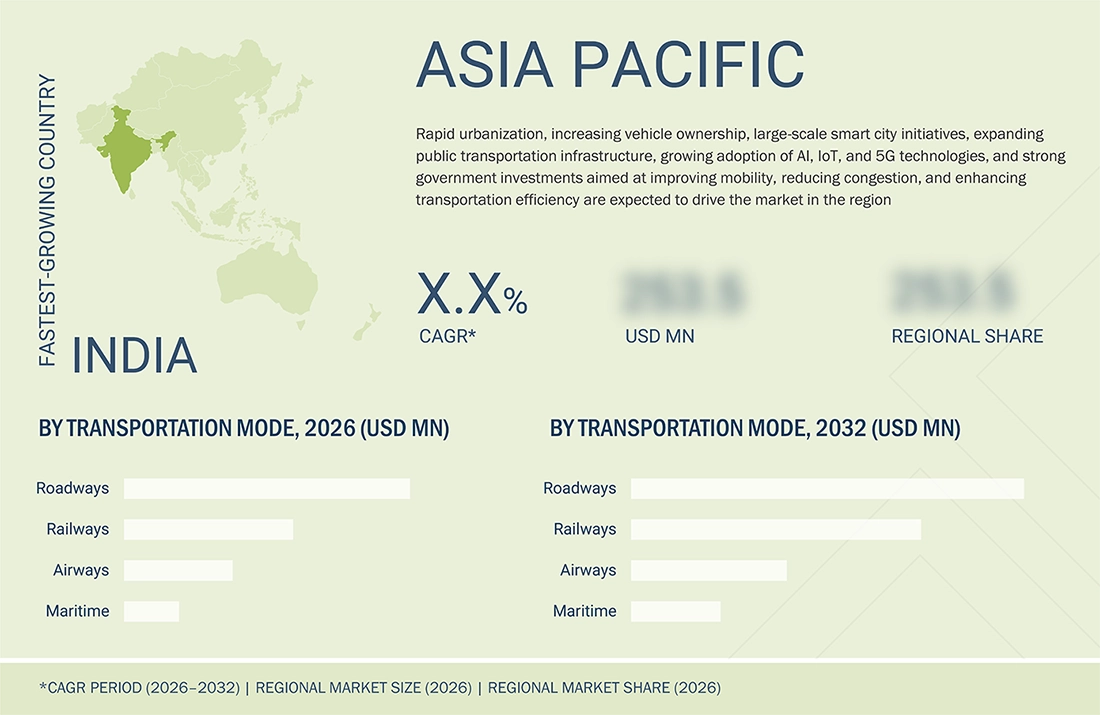
By RegionBy region, Asia Pacific is likely to be the fastest-growing regional market for smart transportation from 2026 to 2032.
-
By Transportation ModeBy transportation mode, the railways segment is expected to register the highest CAGR of 22.5% from 2026 to 2032.
-
By End UserBy end user, the government segment is estimated to dominate the smart transportation market in 2026.
-
Competitive Landscape (Key Players)Hitachi, Thales Group, Siemens, Alstom, and Huawei were identified as some star players in the smart transportation market, given their strong market share and product footprint.
Smart transportation is transforming how cities, transit operators, and logistics providers manage mobility, traffic flow, and passenger movement across connected transport networks. Earlier, transportation systems depended heavily on manual monitoring, fragmented operations, and fixed infrastructure that offered limited visibility into vehicle movement, congestion patterns, and commuter demand. However, the rising need for safer roads, efficient public transit, reduced emissions, and seamless multimodal travel has accelerated the adoption of intelligent transportation technologies such as GPS, telematics, V2X, AI-enabled traffic analytics, and real-time fleet management platforms. Across urban transit systems, highways, rail networks, airports, and logistics corridors, smart transportation solutions are becoming essential for route optimization, predictive maintenance, traffic control, fare management, and passenger experience enhancement. The growing deployment of connected vehicles, smart sensors, cloud platforms, and automated control systems is further strengthening the shift toward safer, more efficient, and data-driven mobility ecosystems.
TRENDS & DISRUPTIONS IMPACTING CUSTOMERS' CUSTOMERS
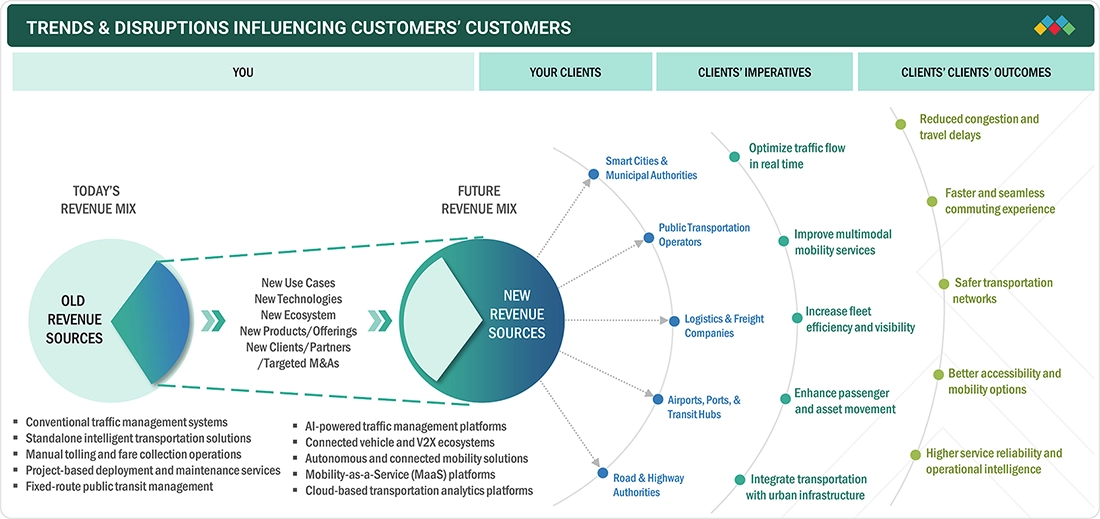
The smart transportation market is shifting from traditional traffic management and manual transit operations toward connected, data-driven mobility ecosystems. As cities and operators prioritize efficiency, safety, and sustainability, advanced technologies such as AI-based traffic platforms, V2X, connected vehicles, MaaS, and cloud analytics are enabling real-time optimization, multimodal integration, and improved commuter experiences across transport networks.
Source: Secondary Research, Interviews with Experts, MarketsandMarkets Analysis
MARKET DYNAMICS

Drivers
Impact
Level
Level
-
Increasing demand for autonomous and connected vehicles

-
Technological advancements to enhance customer experience


RESTRAINTS
Impact
Level
Level
-
Data privacy and cybersecurity concerns in connected transport networks

-
Lack of uniform standards & interoperability


OPPORTUNITIES
Impact
Level
Level
-
AI-enabled traffic and fleet optimization

-
Expansion of multimodal mobility platforms


CHALLENGES
Impact
Level
Level
-
High initial cost of deployment

-
Regulatory complexity across modes and geographies

Source: Secondary Research, Interviews with Experts, MarketsandMarkets Analysis
Driver: Increasing demand for autonomous and connected vehicles
The increasing demand for autonomous vehicles is a key driver of the smart transportation market, fueled by technological advancements and shifting consumer preferences. As urban populations grow, the need for efficient, safe, and sustainable transportation solutions becomes more pressing. Autonomous vehicles, powered by advanced sensors and artificial intelligence, promise to optimize traffic flow, reduce congestion, and enhance safety by minimizing human errors. Cities are investing in smart infrastructure to integrate autonomous vehicles into existing transport systems, aligning with sustainability goals by reducing carbon emissions through electric self-driving vehicles. The rise of Mobility-as-a-Service (MaaS) platforms further accelerates this shift, providing seamless access to various transport modes, including autonomous options. Public-private partnerships are also emerging to pilot autonomous vehicle programs, demonstrating their practical benefits in real-world scenarios while evolving regulations pave the way for continued market growth.
Restraint: Data privacy and cybersecurity concerns in connected transport networks
The increasing connectivity of transportation systems introduces significant cybersecurity and data privacy challenges. Smart transportation platforms rely on continuous data exchange between vehicles, infrastructure, operators, and passengers, making them potential targets for cyberattacks. Unauthorized access to transportation networks can disrupt operations, compromise passenger safety, and expose sensitive personal and operational data. Concerns surrounding data collection, storage, and sharing are prompting stricter regulatory requirements and compliance obligations for transportation stakeholders. The growing use of connected vehicles, cloud platforms, and IoT-enabled infrastructure further expands the attack surface across transportation ecosystems. Addressing these risks requires substantial investments in cybersecurity technologies, encryption, network monitoring, and threat detection capabilities. Failure to maintain robust security measures can undermine public trust and delay technology adoption. As transportation networks become increasingly digitalized, cybersecurity and privacy concerns remain critical restraints affecting market growth.
Opportunity: AI-enabled traffic and fleet optimization
Artificial intelligence (AI) is creating substantial opportunities for enhancing transportation efficiency and operational performance. AI-powered traffic management platforms analyze real-time and historical data to predict congestion, optimize signal timing, and improve traffic flow across urban transportation networks. Fleet operators are using AI-driven analytics to optimize route planning, reduce fuel consumption, minimize vehicle downtime, and improve asset utilization. Predictive maintenance solutions help identify potential equipment failures before they occur, reducing operational disruptions and maintenance costs. AI also supports dynamic demand forecasting, enabling transportation providers to allocate resources more effectively and improve service reliability. As transportation systems generate increasing volumes of data, AI technologies are becoming critical for transforming raw information into actionable insights. The growing focus on operational efficiency, sustainability, and cost optimization is expected to drive significant investments in AI-enabled transportation solutions over the coming years.
Challenge: High initial cost of deployment
The deployment of smart transportation infrastructure often requires substantial upfront investment, creating a significant challenge for transportation authorities and operators. Implementation typically involves installing intelligent traffic management systems, communication networks, sensors, cameras, connected infrastructure, and advanced software platforms. In addition to hardware and software expenses, organizations must invest in system integration, workforce training, maintenance, and cybersecurity measures. Budget constraints can be particularly challenging for municipalities and transportation agencies in developing regions where infrastructure funding is limited. The long return-on-investment period associated with large-scale transportation modernization projects may also delay decision-making and implementation. Although smart transportation technologies can generate long-term operational savings and efficiency improvements, the high initial capital requirements remain a barrier to widespread adoption. Overcoming this challenge will require innovative financing models, public-private partnerships, and government support programs.
SMART TRANSPORTATION MARKET SIZE, SHARE, GROWTH, LATEST TRENDS: COMMERCIAL USE CASES ACROSS INDUSTRIES
| COMPANY | USE CASE DESCRIPTION | BENEFITS |
|---|---|---|
 |
Siemens Mobility delivers intelligent transportation solutions through advanced traffic management systems, adaptive traffic signal control, connected roadside infrastructure, AI-driven analytics, and integrated mobility platforms. Transportation authorities and city governments deploy these solutions to monitor traffic conditions, optimize signal timing, manage congestion, and improve multimodal transportation operations. The platform combines real-time traffic data, sensors, cameras, and predictive analytics to support efficient traffic flow management, incident detection, and long-term transportation planning across urban and regional networks. | Reduced traffic congestion and travel delays | Improved traffic flow and road network efficiency | Enhanced incident detection and response capabilities | Better transportation planning through real-time and predictive insights |
 |
Thales provides smart transportation solutions through intelligent rail signaling, urban transit management, fare collection systems, passenger information platforms, and integrated transportation control centers. Rail operators, metro agencies, and transportation authorities utilize these technologies to optimize train operations, improve passenger mobility, and enhance network reliability. The platform integrates operational data, communication systems, and analytics to support real-time monitoring, predictive maintenance, capacity management, and seamless passenger experiences across transportation ecosystems. | Improved transit reliability and operational performance | Enhanced passenger safety and travel experience | Increased transportation network capacity and utilization | Reduced maintenance costs through predictive operations |
 |
Huawei offers smart transportation solutions powered by IoT, AI, cloud computing, 5G connectivity, and intelligent transportation management platforms. Cities, highway operators, airports, and public transit agencies deploy these solutions to manage traffic operations, monitor transportation assets, enable connected vehicle ecosystems, and support smart mobility initiatives. The platform leverages real-time data collection, video analytics, and digital infrastructure to improve transportation efficiency, optimize resource allocation, and strengthen operational visibility across complex transportation environments. | Real-time transportation asset and traffic visibility | Improved operational efficiency and resource utilization | Enhanced road safety and traffic incident management | Data-driven decision-making for smart mobility initiatives |
Logos and trademarks shown above are the property of their respective owners. Their use here is for informational and illustrative purposes only.
MARKET ECOSYSTEM
The smart transportation ecosystem spans multiple layers, including platform providers, system integrators, solution and service providers, and regulatory bodies. Leading technology vendors and mobility specialists support this market with capabilities in traffic management, fleet optimization, mapping, analytics, and connected infrastructure, while standards and privacy regulators shape deployment through compliance, interoperability, cybersecurity, and data protection requirements.
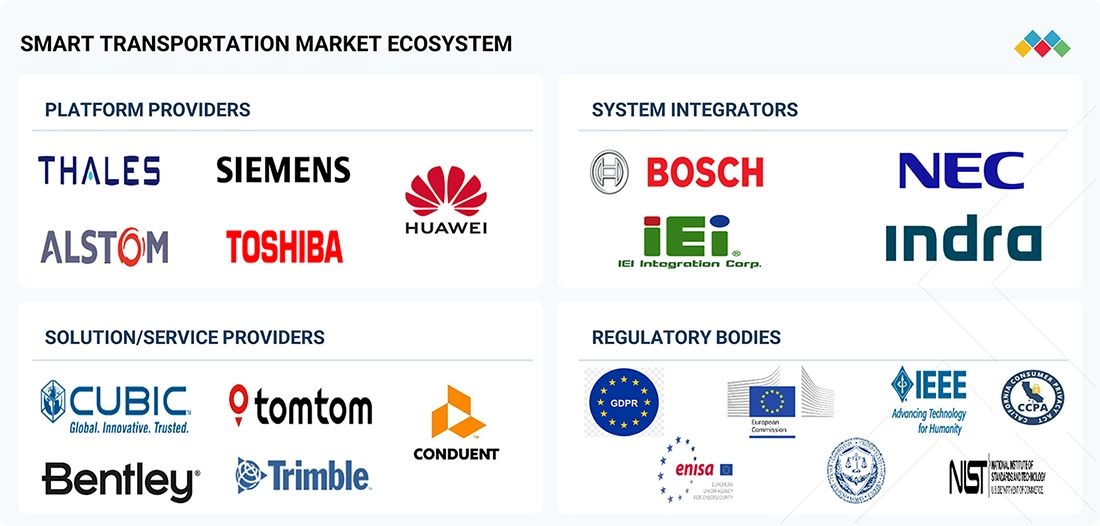
Logos and trademarks shown above are the property of their respective owners. Their use here is for informational and illustrative purposes only.
MARKET SEGMENTS
Source: Secondary Research, Interviews with Experts, MarketsandMarkets Analysis
Smart Transportation Market, By Transportation Mode
Roadways account for the largest share of the smart transportation market, owing to their extensive role in passenger and freight mobility worldwide. Roads serve as the primary mode of transportation for people, commercial vehicles, public transit systems, and last-mile logistics, making them a critical focus area for transportation modernization initiatives. Governments and transportation authorities are increasingly investing in intelligent transportation systems (ITS), smart traffic management platforms, adaptive traffic signals, electronic toll collection, connected vehicle infrastructure, and real-time monitoring solutions to address growing urban congestion and road safety concerns. The widespread deployment of IoT sensors, cameras, GPS-enabled fleet management systems, vehicle-to-everything (V2X) communication, and AI-powered traffic analytics has significantly enhanced the efficiency and visibility of roadway networks. In addition, the rapid growth of connected and autonomous vehicles, smart highways, mobility-as-a-service (MaaS) platforms, and electric vehicle ecosystems is further accelerating digital transformation across road transportation. Compared to railways, airways, and waterways, roadway infrastructure has a broader geographic footprint and higher daily utilization, resulting in greater demand for smart transportation solutions. As cities continue to pursue sustainable mobility and smart city initiatives, roadway transportation is expected to remain the leading segment in the smart transportation market.
Smart Transportation Market, By End User
Commercial organizations are projected to be the fastest-growing end-user segment in the smart transportation market due to their increasing focus on operational efficiency, cost optimization, sustainability, and customer experience. Businesses across logistics, e-commerce, ride-hailing, fleet management, retail, manufacturing, and corporate mobility are rapidly adopting smart transportation technologies to improve asset utilization, streamline transportation operations, and enable real-time decision-making. The growing demand for intelligent fleet management, route optimization, predictive maintenance, connected vehicle solutions, and AI-powered analytics is driving significant investments in smart mobility platforms. Furthermore, the rapid expansion of e-commerce and last-mile delivery services has heightened the need for advanced transportation systems that can reduce delivery times, improve visibility across supply chains, and lower fuel consumption. The integration of IoT, telematics, cloud-based transportation management systems, and electric vehicle infrastructure is further accelerating adoption among commercial enterprises. As organizations increasingly prioritize digital transformation and sustainable mobility strategies, commercial users are expected to emerge as the fastest-growing segment within the smart transportation market.
REGION
Asia Pacific to grow at fastest rate in global smart transportation market during forecast period
The smart transportation market in the Asia Pacific region is witnessing the fastest growth rate, fueled by swift urbanization, technological progress, and expanding government efforts to enhance transportation infrastructure. The region’s substantial population, rising middle class, and increasing economic activities are crucial to this growth. In nations such as China, India, and Japan, intelligent transportation technologies like self-driving cars, electric transportation, and sophisticated traffic management systems are becoming increasingly popular. Governments are significantly investing in upgrading infrastructure, advancing clean energy initiatives, and tackling urban congestion challenges. For instance, China's intelligent transportation sector is experiencing swift growth, featuring projects such as the creation of smart cities and the rollout of self-driving buses and taxis. India is investing in smart traffic management systems to tackle the mobility challenges of its increasing urban population. The need for electric vehicles (EVs) and associated infrastructure, like charging stations, is also increasing in the Asia Pacific region. The emergence of Mobility-as-a-Service (MaaS) platforms and advancements in urban air mobility (UAM) enhance the market. The region’s regulatory backing and increasing investments from private and public sectors are anticipated to sustain this significant growth trend in the years ahead. Consequently, Asia Pacific is set to dominate the market as nations in the region swiftly embrace and incorporate intelligent transportation solutions into their infrastructures.
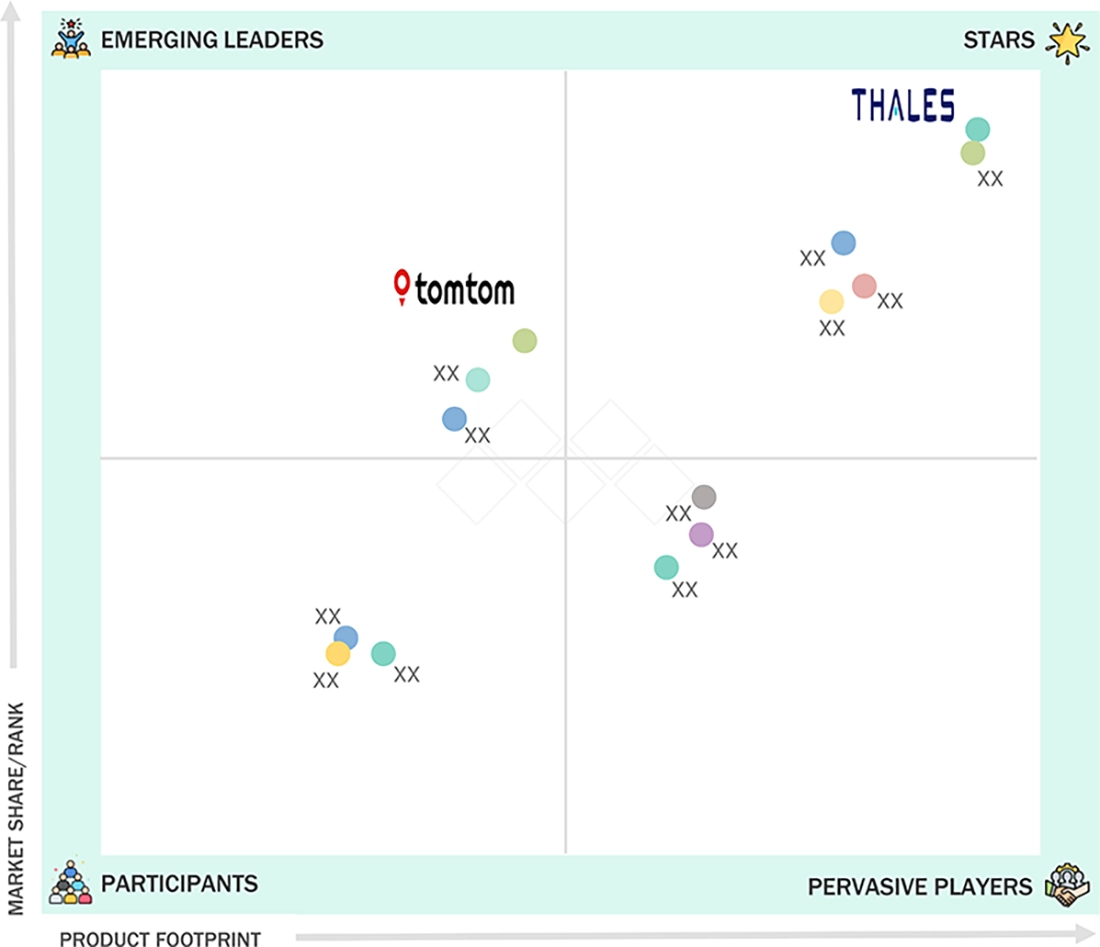
SMART TRANSPORTATION MARKET SIZE, SHARE, GROWTH, LATEST TRENDS: COMPANY EVALUATION MATRIX
The two firms that occupy the top positions in the smart transportation market matrix are Thales and Bosch due to their comprehensive portfolios spanning intelligent transportation systems (ITS), traffic management platforms, rail signaling solutions, connected mobility technologies, and smart ticketing systems. Their strong global presence, extensive transportation expertise, and continued investments in digital mobility, automation, and transportation safety strengthen their leadership positions. TomTom is regarded as an emerging leader in the market owing to its innovations in digital mapping, real-time traffic intelligence, navigation technologies, and location-based services. The company has introduced advanced mobility data platforms, connected vehicle solutions, and geospatial analytics capabilities that enhance route optimization, traffic efficiency, and data-driven decision-making across automotive, logistics, urban mobility, and smart city environments.
Source: Secondary Research, Interviews with Experts, MarketsandMarkets Analysis
KEY MARKET PLAYERS
- Thales Group (France)
- Huawei (China)
- Siemens (Germany)
- Cisco (US)
- DNV (Norway)
- Cubic (US)
- Alstom (France)
- Toshiba (Japan)
- Veson Nautical (US)
- NEC Corporation (Japan)
- Bentley Systems (US)
- Indra (Spain)
- Trimble (US)
- TomTom (Netherlands)
- Conduent (US)
- Kapsch (Austria)
- Hitachi (Japan)
- Descartes (Canada)
MARKET SCOPE
| REPORT METRIC | DETAILS |
|---|---|
| Market Size in 2025 (Value) | USD 150.20 Billion |
| Market Size in 2026 (Value) | USD 176.22 Billion |
| Market Forecast in 2032 (Value) | USD 400.92 Billion |
| Growth Rate | CAGR of 14.7% from 2026 to 2032 |
| Years Considered | 2020-2032 |
| Base Year | 2025 |
| Forecast Period | 2026-2032 |
| Units Considered | Value (USD Million/Billion) |
| Report Coverage | Revenue forecast, company ranking, competitive landscape, growth factors, and trends |
| Segments Covered |
|
| Regions Covered | North America, Europe, Asia Pacific, Middle East & Africa, Latin America |
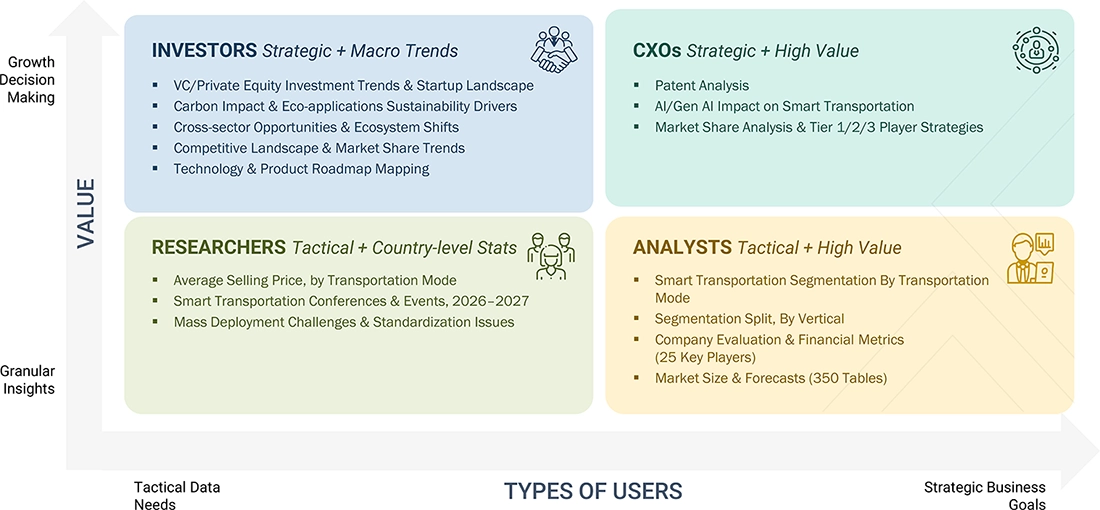
WHAT IS IN IT FOR YOU: SMART TRANSPORTATION MARKET SIZE, SHARE, GROWTH, LATEST TRENDS REPORT CONTENT GUIDE
DELIVERED CUSTOMIZATIONS
We have successfully delivered the following deep-dive customizations:
| CLIENT REQUEST | CUSTOMIZATION DELIVERED | VALUE ADDS |
|---|---|---|
| Leading Service Provider (US) |
|
|
| Company Information | Detailed analysis and profiling of additional market players (up to 5) |
|
RECENT DEVELOPMENTS
- June 2026 : Indra Group announced it will deploy its smart mobility platform with Grupo Alsa and Saudi Hafil for Qiddiya City’s intercity bus network, enabling real-time monitoring and control of 156 buses, including 126 electric vehicles, to improve punctuality, safety, and congestion management.
- May 2026 : Kapsch TrafficCom announced India’s first Cooperative Intelligent Transport Systems (C-ITS) project on a highway near New Delhi, bringing connected-vehicle technology to road users to improve safety and traffic efficiency.
- April 2026 : Siemens Mobility is modernizing rail operations through major fleet and signaling investments, including the handover of the first electric freight locomotives for Indian Railways and a new maintenance depot in Visakhapatnam. The project supports more efficient, sustainable, and digitally enabled rail freight movement.
Table of Contents
 Exclusive indicates content/data unique to MarketsandMarkets and not available with any competitors.
TITLE
PAGE NO
1
INTRODUCTION
46
2
EXECUTIVE SUMMARY
52
3
PREMIUM INSIGHTS
58
4
MARKET OVERVIEW AND INDUSTRY TRENDS
Surging investments in smart cities and AI drive transformative growth in connected transportation markets.
61
4.1
INTRODUCTION
4.2
MARKET DYNAMICS
4.2.1
DRIVERS
4.2.1.1
INCREASING DEMAND FOR AUTONOMOUS AND CONNECTED VEHICLES
4.2.1.2
TECHNOLOGICAL ADVANCEMENTS TO ENHANCE CUSTOMER EXPERIENCE
4.2.1.3
RISING GOVERNMENT FUNDING FOR SUSTAINABLE TRANSPORTATION INFRASTRUCTURE
4.2.1.4
ACCELERATING SMART CITY INVESTMENTS DRIVING INTELLIGENT TRANSPORTATION ADOPTION
4.2.2
RESTRAINTS
4.2.2.1
DATA PRIVACY AND CYBERSECURITY CONCERNS IN CONNECTED TRANSPORT NETWORKS
4.2.2.2
LACK OF UNIFORM STANDARDS AND INTEROPERABILITY
4.2.3
OPPORTUNITIES
4.2.3.1
AI-ENABLED TRAFFIC AND FLEET OPTIMIZATION
4.2.3.2
EXPANSION OF MULTIMODAL MOBILITY PLATFORMS
4.2.4
CHALLENGES
4.2.4.1
HIGH INITIAL COST OF DEPLOYMENT
4.2.4.2
REGULATORY COMPLEXITY ACROSS MODES AND GEOGRAPHIES
4.3
INTERCONNECTED MARKETS AND CROSS-SECTOR OPPORTUNITIES
4.3.1
SMART CITY MARKET
4.3.2
CONNECTED VEHICLE MARKET
4.3.3
ELECTRIC VEHICLE INFRASTRUCTURE MARKET
4.3.4
MOBILITY-AS-A-SERVICE (MAAS) MARKET
4.3.5
DIGITAL RAILWAY MARKET
4.3.6
AIRPORTS AND AVIATION SECTOR
4.3.7
PORTS AND MARITIME SECTOR
4.3.8
LOGISTICS AND FREIGHT SECTOR
4.3.9
PUBLIC SAFETY AND EMERGENCY RESPONSE SECTOR
4.4
TRATEGIC MOVES BY TIER-1/2/3 PLAYERS
5
INDUSTRY TRENDS
Uncover strategic shifts driving intelligent urban mobility and smart logistics innovations.
69
5.1
PORTER’S FIVE FORCES ANALYSIS
5.1.1
THREAT OF NEW ENTRANTS
5.1.2
THREAT OF SUBSTITUTES
5.1.3
BARGAINING POWER OF SUPPLIERS
5.1.4
BARGAINING POWER OF BUYERS
5.1.5
INTENSITY OF COMPETITIVE RIVALRY
5.2
MACROECONOMICS INDICATORS
5.2.1
INTRODUCTION
5.2.2
GDP TRENDS AND FORECAST
5.2.3
TRENDS IN INTELLIGENT URBAN MOBILITY AND TRAFFIC MANAGEMENT INDUSTRY
5.2.4
TRENDS IN SMART LOGISTICS AND FREIGHT TRANSPORTATION INDUSTRY
5.3
SUPPLY CHAIN ANALYSIS
5.4
ECOSYSTEM ANALYSIS
5.5
PRICING MODEL ANALYSIS
5.5.1
INDICATIVE PRICING ANALYSIS OF KEY PLAYERS, BY SERVICE, 2025
5.6
KEY CONFERENCES AND EVENTS, 2026-2027
5.7
TRENDS/DISRUPTIONS IMPACTING CUSTOMERS’ BUSINESSES
5.8
INVESTMENT AND FUNDING SCENARIO
5.9
CASE STUDY ANALYSIS
5.9.1
DEPLOYING APPYWAY TRAFFIC SUITE & D-TROS FOR SUSTAINABLE KERBSIDE MANAGEMENT AT LAMBETH COUNCIL
5.9.2
DEPLOYING NEURAL LABS AI-BASED INTELLIGENT TRANSPORTATION SYSTEMS WITH THALES SENTINEL EMS
5.9.3
DIGITALIZING RAIL TRAFFIC MANAGEMENT WITH SIEMENS MOBILITY
5.9.4
DEPLOYING TRANSCORE OPEN ROADS TOLLING SYSTEM FOR UNIVERSITY OF AKRON
5.9.5
LEVERAGING INRIX DATA-DRIVEN TRANSPORTATION SOLUTIONS FOR NASHVILLE
5.9.6
DEPLOYING AZITEK WAREHOUSE DIGITAL TWIN FOR REAL-TIME ASSET VISIBILITY AND PROCESS AUTOMATION
5.10
IMPACT OF 2025 US TARIFF - SMART TRANSPORTATION MARKET
5.10.1
INTRODUCTION
5.10.2
KEY TARIFF RATES
5.10.3
PRICE IMPACT ANALYSIS
5.10.3.1
STRATEGIC SHIFTS AND EMERGING TRENDS
5.10.4
IMPACT ON COUNTRIES/REGIONS
5.10.4.1
US
5.10.4.2
EUROPE
5.10.4.3
ASIA PACIFIC
5.10.5
IMPACT ON END-USER INDUSTRIES
5.10.5.1
PUBLIC TRANSPORTATION AUTHORITIES
5.10.5.2
AUTOMOTIVE & CONNECTED VEHICLE MANUFACTURERS
5.10.5.3
RAIL TRANSPORTATION OPERATORS
5.10.5.4
TRANSPORTATION INFRASTRUCTURE DEVELOPERS
6
STRATEGIC DISRUPTIONS: DIGITAL AND AI ADOPTION
Unlock transformative potential with AI-driven innovations shaping future smart transportation ecosystems.
95
6.1
KEY EMERGING TECHNOLOGIES
6.1.1
VEHICLE-TO-EVERYTHING (V2X)
6.1.2
AI & ML
6.1.3
AUTONOMOUS VEHICLES
6.1.4
GIS
6.1.5
ADJACENT TECHNOLOGIES
6.1.5.1
AUGMENTED REALITY (AR)
6.1.5.2
SMART SENSORS & CAMERAS
6.1.5.3
ROBOTICS
6.1.6
COMPLEMENTARY TECHNOLOGIES
6.1.6.1
5G/6G CONNECTIVITY
6.1.6.2
DIGITAL TWIN
6.1.6.3
ADAS
6.1.6.4
BLOCKCHAIN
6.2
TECHNOLOGY/PRODUCT ROADMAP FOR SMART TRANSPORTATION MARKET
6.2.1
SHORT-TERM ROADMAP (2023–2025)
6.2.2
MID-TERM ROADMAP (2026–2028)
6.2.3
LONG-TERM ROADMAP (2029–2032)
6.3
PATENT ANALYSIS
6.4
IMPACT OF AI/GEN AI ON SMART TRANSPORTATION MARKET
6.4.1
TOP USE CASES AND MARKET POTENTIAL
6.4.2
BEST PRACTICES IN SMART TRANSPORTATION PROCESS
6.4.3
CASE STUDIES OF AI IMPLEMENTATION IN SMART TRANSPORTATION MARKET
6.4.4
INTERCONNECTED ADJACENT ECOSYSTEM AND IMPACT ON MARKET PLAYERS
6.4.5
CLIENTS’ READINESS TO ADOPT GENERATIVE AI IN SMART TRANSPORTATION
7
REGULATORY LANDSCAPE
Navigate complex regulations and standards shaping the future of smart transportation.
107
7.1
REGULATORY BODIES, GOVERNMENT AGENCIES, AND OTHER ORGANIZATIONS
7.2
INDUSTRY STANDARDS
8
CUSTOMER LANDSCAPE & BUYING BEHAVIOR
Uncover hidden stakeholder influences and unmet industry needs shaping buying decisions.
111
8.1
DECISION-MAKING PROCESS
8.2
KEY STAKEHOLDERS & BUYING CRITERIA
8.2.1
KEY STAKEHOLDERS IN BUYING PROCESS
8.2.2
BUYING CRITERIA
8.3
ADOPTION BARRIERS & INTERNAL CHALLENGES
8.4
UNMET NEEDS FROM VARIOUS END-USE INDUSTRIES
9
SMART TRANSPORTATION MARKET, BY TRANSPORTATION MODE
Market Size & Growth Rate Forecast Analysis to 2032 in USD Million | 102 Data Tables
116
9.1
INTRODUCTION
9.1.1
TRANSPORTATION MODES: SMART TRANSPORTATION MARKET DRIVERS
9.2
ROADWAYS
9.2.1
SOLUTIONS
9.2.1.1
SMART TICKETING
9.2.1.2
PARKING MANAGEMENT
9.2.1.3
TRAFFIC MANAGEMENT
9.2.1.4
PASSENGER INFORMATION
9.2.1.5
INTELLIGENT MOBILITY SOLUTIONS (IMS)
9.2.1.6
FREIGHT & FLEET MANAGEMENT
9.2.1.7
OTHER ROADWAY SOLUTIONS
9.2.2
SERVICES
9.2.2.1
CONSULTING
9.2.2.2
DEPLOYMENT & INTEGRATION
9.2.2.3
SUPPORT & MAINTENANCE
9.3
RAILWAYS
9.3.1
SOLUTIONS
9.3.1.1
RAILWAY SMART TICKETING
9.3.1.2
PASSENGER INFORMATION SYSTEMS (PIS)
9.3.1.3
FREIGHT MANAGEMENT
9.3.1.4
RAIL TRAFFIC MANAGEMENT
9.3.1.5
RAIL ASSET MANAGEMENT
9.3.1.6
OTHER RAILWAY SOLUTIONS
9.3.2
SERVICES
9.3.2.1
CONSULTING
9.3.2.2
DEPLOYMENT & INTEGRATION
9.3.2.3
SUPPORT & MAINTENANCE
9.4
AIRWAYS
9.4.1
SOLUTIONS
9.4.1.1
SMART TICKETING
9.4.1.2
AIRWAY PASSENGER INFORMATION
9.4.1.3
AIRPORT SECURITY SOLUTIONS
9.4.1.4
FREIGHT MANAGEMENT
9.4.1.5
AIR TRAFFIC MANAGEMENT (ATM)
9.4.1.6
OTHER AIRWAY SOLUTIONS
9.4.2
SERVICES
9.4.2.1
CONSULTING
9.4.2.2
DEPLOYMENT & INTEGRATION
9.4.2.3
SUPPORT & MAINTENANCE
9.5
MARITIME
9.5.1
SOLUTIONS
9.5.1.1
PORT & TERMINAL OPERATIONS
9.5.1.2
MARITIME TRAFFIC MANAGEMENT
9.5.1.3
PASSENGER INFORMATION SYSTEMS (PIS)
9.5.1.4
OTHER MARITIME SOLUTIONS
9.5.2
SERVICES
9.5.2.1
CONSULTING
9.5.2.2
DEPLOYMENT & INTEGRATION
9.5.2.3
SUPPORT & MAINTENANCE
10
SMART TRANSPORTATION MARKET, BY END USER
Market Size & Growth Rate Forecast Analysis to 2032 in USD Million | 6 Data Tables
170
10.1
INTRODUCTION
10.1.1
END USERS: SMART TRANSPORTATION MARKET DRIVERS
10.2
GOVERNMENT
10.3
COMMERCIAL ORGANIZATIONS
11
SMART TRANSPORTATION MARKET, BY REGION
Comprehensive coverage of 7 Regions with country-level deep-dive of 13 Countries | 516 Data Tables.
175
11.1
INTRODUCTION
11.2
NORTH AMERICA
11.2.1
US
11.2.1.1
EXPANSION OF SMART TRANSPORTATION INITIATIVES, SUCH AS INTELLIGENT TRAFFIC SYSTEMS AND CONNECTED VEHICLE TECHNOLOGIES, TO ADDRESS CONGESTION AND IMPROVE MOBILITY TO DRIVE MARKET
11.2.2
CANADA
11.2.2.1
RISING VEHICLE NUMBERS AND URBAN CONGESTION, ALONG WITH ADVANCEMENTS IN SMART TRANSPORTATION INFRASTRUCTURE, TO PROPEL MARKET
11.3
EUROPE
11.3.1
UK
11.3.1.1
NEED TO IMPROVE EFFICIENCY OF EXISTING TRANSPORTATION INFRASTRUCTURE TO FUEL DEMAND FOR SMART TRANSPORTATION SOLUTIONS
11.3.2
GERMANY
11.3.2.1
ROBUST ECONOMY AND TECHNOLOGICAL ADVANCEMENTS AND NEED TO OPTIMIZE USE OF ROADS, TRANSPORTATION, TRAVEL DATA, TRAFFIC MANAGEMENT, AND SYSTEM INTEGRATION TO BOOST MARKET GROWTH
11.3.3
FRANCE
11.3.3.1
STRONG HOLD ON INFRASTRUCTURE DEVELOPMENT AND PRESENCE OF MAJOR PLAYERS TO ACCELERATE MARKET GROWTH
11.3.4
ITALY
11.3.4.1
GROWING ADOPTION OF IOT AND ANALYTICS AND 'SMARTER ITALY' PROGRAM BY ITALIAN MINISTRY OF ECONOMIC DEVELOPMENT TO BOLSTER MARKET GROWTH
11.3.5
REST OF EUROPE
11.4
ASIA PACIFIC
11.4.1
CHINA
11.4.1.1
STRONG TRANSPORTATION NETWORK, INCREASING INVESTMENTS, AND FASTER ECONOMIC DEVELOPMENT TO ACCELERATE MARKET GROWTH
11.4.2
JAPAN
11.4.2.1
HIGHER ADOPTION OF TRANSPORTATION TECHNOLOGIES AND NEED TO IMPROVE SAFETY, OPERATIONAL EFFICIENCY, AND PASSENGER COMFORT TO BOOST MARKET
11.4.3
INDIA
11.4.3.1
NEED FOR SMART MOBILITY SOLUTIONS TO MANAGE TRANSIT TO PROPEL MARKET
11.4.4
REST OF ASIA PACIFIC
11.5
MIDDLE EAST & AFRICA
11.5.1
KSA
11.5.1.1
INCREASING GOVERNMENT INITIATIVES TO DRIVE MARKET
11.5.2
UAE
11.5.2.1
TECHNOLOGICAL ADVANCEMENTS AND GOVERNMENT INITIATIVES TO IMPROVE TRANSPORTATION INFRASTRUCTURE TO BOOST MARKET GROWTH
11.5.3
REST OF MIDDLE EAST & AFRICA
11.6
LATIN AMERICA
11.6.1
BRAZIL
11.6.1.1
SIGNIFICANT SCOPE FOR DEVELOPMENT OF ADVANCED RAILWAY INFRASTRUCTURE TO BOOST MARKET GROWTH
11.6.2
MEXICO
11.6.2.1
INCREASED DEMAND FOR IMPROVED TRANSPORTATION INFRASTRUCTURE TO FUEL MARKET GROWTH
11.6.3
REST OF LATIN AMERICA
12
COMPETITIVE LANDSCAPE
Discover top strategies and market dominance trends shaping key players across transportation sectors.
345
12.1
INTRODUCTION
12.2
KEY PLAYER STRATEGIES/RIGHT TO WIN, 2023–2026
12.3
MARKET SHARE ANALYSIS, 2025
12.4
REVENUE ANALYSIS OF LEADING PLAYERS, 2021-2025
12.5
BRAND/PRODUCT COMPARISON
12.6
COMPANY VALUATION AND FINANCIAL METRICS
12.7
COMPANY EVALUATION MATRIX, BY ROADWAY, 2025
12.7.1
STARS
12.7.2
EMERGING LEADERS
12.7.3
PERVASIVE PLAYERS
12.7.4
PARTICIPANTS
12.8
COMPANY EVALUATION MATRIX, BY RAILWAY, 2025
12.8.1
STARS
12.8.2
EMERGING LEADERS
12.8.3
PERVASIVE PLAYERS
12.8.4
PARTICIPANTS
12.9
COMPANY EVALUATION MATRIX, BY AIRWAY, 2025
12.9.1
STARS
12.9.2
EMERGING LEADERS
12.9.3
PERVASIVE PLAYERS
12.9.4
PARTICIPANTS
12.10
COMPANY EVALUATION MATRIX, BY MARITIME, 2025
12.10.1
STARS
12.10.2
EMERGING LEADERS
12.10.3
PERVASIVE PLAYERS
12.10.4
PARTICIPANTS
12.10.5
COMPANY FOOTPRINT: KEY PLAYERS, 2025
12.10.5.1
COMPANY FOOTPRINT
12.10.5.2
REGION FOOTPRINT
12.10.5.3
TRANSPORTATION MODE FOOTPRINT
12.10.5.4
END USER FOOTPRINT
12.11
COMPETITIVE SCENARIO
12.11.1
PRODUCT LAUNCHES
12.11.2
DEALS
13
COMPANY PROFILES
In-depth Company Profiles of Leading Market Players with detailed Business Overview, Product and Service Portfolio, Recent Developments, and Unique Analyst Perspective (MnM View)
375
13.1
KEY PLAYERS
13.1.1
THALES GROUP
13.1.1.1
BUSINESS OVERVIEW
13.1.1.2
PRODUCTS/SOLUTIONS/SERVICES OFFERED
13.1.1.3
RECENT DEVELOPMENTS
13.1.1.3.1
DEALS
13.1.1.4
MNM VIEW
13.1.1.4.1
RIGHT TO WIN
13.1.1.4.2
STRATEGIC CHOICES
13.1.1.4.3
WEAKNESSES AND COMPETITIVE THREATS
13.1.2
HUAWEI
13.1.3
SIEMENS
13.1.4
ALSTOM
13.1.5
HITACHI
13.1.6
CISCO
13.1.7
DNV
13.1.8
CUBIC
13.1.9
TOSHIBA
13.1.10
VESON NAUTICAL
13.1.11
ALMAVIVA
13.1.12
NEC CORPORATION
13.1.13
BENTLEY SYSTEMS
13.1.14
INDRA
13.1.15
TRIMBLE
13.1.16
TOMTOM
13.1.17
CONDUENT
13.1.18
KAPSCH
13.1.19
DESCARTES
13.1.20
WÄRTSILÄ
13.1.21
BOSCH
13.1.22
IEI INTEGRATION CORP.
13.1.23
SCHNEIDER ELECTRIC
13.1.24
TRANSCORE
13.2
OTHER PLAYERS
13.2.1
BASSNET
13.2.2
EKE-ELECTRONICS
13.2.3
AITEK
13.2.4
INRIX
13.2.5
TAGMASTER
13.2.6
ATSUKÈ
13.2.7
PARK+
13.2.8
APPYWAY
13.2.9
EFFTRONICS SYSTEMS
14
RESEARCH METHODOLOGY
443
14.1
RESEARCH DATA
14.1.1
SECONDARY DATA
14.1.1.1
KEY DATA FROM SECONDARY SOURCES
14.1.2
PRIMARY DATA
14.1.2.1
BREAKDOWN OF PRIMARY PROFILES
14.1.2.2
KEY DATA FROM PRIMARY SOURCES
14.1.2.3
KEY INDUSTRY INSIGHTS
14.2
MARKET BREAKUP AND DATA TRIANGULATION
14.3
MARKET SIZE ESTIMATION
14.3.1
TOP-DOWN APPROACH
14.3.2
BOTTOM-UP APPROACH
14.3.3
SMART TRANSPORTATION MARKET ESTIMATION: DEMAND-SIDE ANALYSIS
14.4
MARKET FORECAST
14.5
RESEARCH ASSUMPTIONS
14.6
LIMITATIONS
15
APPENDIX
455
15.1
DISCUSSION GUIDE
15.2
KNOWLEDGESTORE: MARKETSANDMARKETS’ SUBSCRIPTION PORTAL
15.3
CUSTOMIZATION OPTIONS
15.4
RELATED REPORTS
15.5
AUTHOR DETAILS
LIST OF TABLES
TABLE 1
INCLUSIONS AND EXCLUSIONS
TABLE 2
USD EXCHANGE RATES, 2021–2025
TABLE 3
PORTER’S FIVE FORCES’ IMPACT ON SMART TRANSPORTATION MARKET
TABLE 4
GDP PERCENTAGE CHANGE, BY KEY COUNTRY, 2021–2029
TABLE 5
SMART TRANSPORTATION MARKET: ECOSYSTEM
TABLE 6
INDICATIVE PRICING ANALYSIS OF KEY PLAYERS, BY SOLUTION, 2025
TABLE 7
SMART TRANSPORTATION MARKET: LIST OF KEY CONFERENCES AND EVENTS, 2025–2026
TABLE 8
US ADJUSTED RECIPROCAL TARIFF RATES
TABLE 9
SMART TRANSPORTATION MARKET: LIST OF TOP PATENTS, 2026
TABLE 10
TOP USE CASES AND MARKET POTENTIAL
TABLE 11
SMART TRANSPORTATION MARKET: CASE STUDIES RELATED TO GEN AI IMPLEMENTATION
TABLE 12
LIST OF REGULATORY BODIES, GOVERNMENT AGENCIES, AND OTHER ORGANIZATIONS
TABLE 13
KEY REGULATIONS IN SMART TRANSPORTATION MARKET
TABLE 14
KEY INDUSTRY STANDARDS IN SMART TRANSPORTATION
TABLE 15
INFLUENCE OF STAKEHOLDERS ON BUYING PROCESS
TABLE 16
KEY BUYING CRITERIA
TABLE 17
SMART TRANSPORTATION MARKET, BY TRANSPORTATION MODE, 2020–2025 (USD MILLION)
TABLE 18
SMART TRANSPORTATION MARKET, BY TRANSPORTATION MODE, 2026–2032 (USD MILLION)
TABLE 19
SMART TRANSPORTATION MARKET, BY ROADWAY, 2020–2025 (USD MILLION)
TABLE 20
SMART TRANSPORTATION MARKET, BY ROADWAY, 2026–2032 (USD MILLION)
TABLE 21
ROADWAYS: SMART TRANSPORTATION MARKET, BY REGION, 2020–2025 (USD MILLION)
TABLE 22
ROADWAYS: SMART TRANSPORTATION MARKET, BY REGION, 2026–2032 (USD MILLION)
TABLE 23
SMART TRANSPORTATION MARKET, BY ROADWAYS SOLUTION, 2020–2025 (USD MILLION)
TABLE 24
SMART TRANSPORTATION MARKET, BY ROADWAYS SOLUTION, 2026–2032 (USD MILLION)
TABLE 25
SMART TICKETING: SMART TRANSPORTATION MARKET, BY REGION, 2020–2025 (USD MILLION)
TABLE 26
SMART TICKETING: SMART TRANSPORTATION MARKET, BY REGION, 2026–2032 (USD MILLION)
TABLE 27
PARKING MANAGEMENT: SMART TRANSPORTATION MARKET, BY REGION, 2020–2025 (USD MILLION)
TABLE 28
PARKING MANAGEMENT: SMART TRANSPORTATION MARKET, BY REGION, 2026–2032 (USD MILLION)
TABLE 29
TRAFFIC MANAGEMENT: SMART TRANSPORTATION MARKET, BY REGION, 2020–2025 (USD MILLION)
TABLE 30
TRAFFIC MANAGEMENT: SMART TRANSPORTATION MARKET, BY REGION, 2026–2032 (USD MILLION)
TABLE 31
PASSENGER INFORMATION: SMART TRANSPORTATION MARKET, BY REGION, 2020–2025 (USD MILLION)
TABLE 32
PASSENGER INFORMATION: SMART TRANSPORTATION MARKET, BY REGION, 2026–2032 (USD MILLION)
TABLE 33
INTELLIGENT MOBILITY SOLUTIONS (IMS): SMART TRANSPORTATION MARKET, BY REGION, 2020–2025 (USD MILLION)
TABLE 34
INTELLIGENT MOBILITY SOLUTIONS (IMS): SMART TRANSPORTATION MARKET, BY REGION, 2026–2032 (USD MILLION)
TABLE 35
FREIGHT & FLEET MANAGEMENT: SMART TRANSPORTATION MARKET, BY REGION, 2020–2025 (USD MILLION)
TABLE 36
FREIGHT & FLEET MANAGEMENT: SMART TRANSPORTATION MARKET, BY REGION, 2026–2032 (USD MILLION)
TABLE 37
OTHER ROADWAY SOLUTIONS: SMART TRANSPORTATION MARKET, BY REGION, 2020–2025 (USD MILLION)
TABLE 38
OTHER ROADWAY SOLUTIONS: SMART TRANSPORTATION MARKET, BY REGION, 2026–2032 (USD MILLION)
TABLE 39
SMART TRANSPORTATION MARKET, BY ROADWAYS SERVICE, 2020–2025 (USD MILLION)
TABLE 40
SMART TRANSPORTATION MARKET, BY ROADWAYS SERVICE, 2026–2032 (USD MILLION)
TABLE 41
ROADWAYS CONSULTING: SMART TRANSPORTATION MARKET, BY REGION, 2020–2025 (USD MILLION)
TABLE 42
ROADWAYS CONSULTING: SMART TRANSPORTATION MARKET, BY REGION, 2026–2032 (USD MILLION)
TABLE 43
ROADWAYS DEPLOYMENT & INTEGRATION: SMART TRANSPORTATION MARKET, BY REGION, 2020–2025 (USD MILLION)
TABLE 44
ROADWAYS DEPLOYMENT & INTEGRATION: SMART TRANSPORTATION MARKET, BY REGION, 2026–2032 (USD MILLION)
TABLE 45
ROADWAYS SUPPORT & MAINTENANCE: SMART TRANSPORTATION MARKET, BY REGION, 2020–2025 (USD MILLION)
TABLE 46
ROADWAYS SUPPORT & MAINTENANCE: SMART TRANSPORTATION MARKET, BY REGION, 2026–2032 (USD MILLION)
TABLE 47
SMART TRANSPORTATION MARKET, BY RAILWAY, 2020–2025 (USD MILLION)
TABLE 48
SMART TRANSPORTATION MARKET, BY RAILWAY, 2026–2032 (USD MILLION)
TABLE 49
RAILWAYS: SMART TRANSPORTATION MARKET, BY REGION, 2020–2025 (USD MILLION)
TABLE 50
RAILWAYS: SMART TRANSPORTATION MARKET, BY REGION, 2026–2032 (USD MILLION)
TABLE 51
RAILWAYS SOLUTIONS: SMART TRANSPORTATION MARKET, BY RAILWAYS SOLUTION, 2020–2025 (USD MILLION)
TABLE 52
RAILWAYS SOLUTIONS: SMART TRANSPORTATION MARKET, BY RAILWAYS SOLUTION, 2026–2032 (USD MILLION)
TABLE 53
RAILWAY SMART TICKETING: SMART TRANSPORTATION MARKET, BY REGION, 2020–2025 (USD MILLION)
TABLE 54
RAILWAY SMART TICKETING: SMART TRANSPORTATION MARKET, BY REGION, 2026–2032 (USD MILLION)
TABLE 55
PASSENGER INFORMATION SYSTEMS (PIS): SMART TRANSPORTATION MARKET, BY REGION, 2020–2025 (USD MILLION)
TABLE 56
PASSENGER INFORMATION SYSTEMS (PIS): SMART TRANSPORTATION MARKET, BY REGION, 2026–2032 (USD MILLION)
TABLE 57
FREIGHT MANAGEMENT: SMART TRANSPORTATION MARKET, BY REGION, 2020–2025 (USD MILLION)
TABLE 58
FREIGHT MANAGEMENT: SMART TRANSPORTATION MARKET, BY REGION, 2026–2032 (USD MILLION)
TABLE 59
RAIL TRAFFIC MANAGEMENT: SMART TRANSPORTATION MARKET, BY REGION, 2020–2025 (USD MILLION)
TABLE 60
RAIL TRAFFIC MANAGEMENT: SMART TRANSPORTATION MARKET, BY REGION, 2026–2032 (USD MILLION)
TABLE 61
RAIL ASSET MANAGEMENT: SMART TRANSPORTATION MARKET, BY REGION, 2020–2025 (USD MILLION)
TABLE 62
RAIL ASSET MANAGEMENT: SMART TRANSPORTATION MARKET, BY REGION, 2026–2032 (USD MILLION)
TABLE 63
OTHER RAILWAYS SOLUTIONS: SMART TRANSPORTATION MARKET, BY REGION, 2020–2025 (USD MILLION)
TABLE 64
OTHER RAILWAYS SOLUTIONS: SMART TRANSPORTATION MARKET, BY REGION, 2026–2032 (USD MILLION)
TABLE 65
SMART TRANSPORTATION MARKET, BY RAILWAYS SERVICE, 2020–2025 (USD MILLION)
TABLE 66
SMART TRANSPORTATION MARKET, BY RAILWAYS SERVICE, 2026–2032 (USD MILLION)
TABLE 67
RAILWAYS CONSULTING: SMART TRANSPORTATION MARKET, BY REGION, 2020–2025 (USD MILLION)
TABLE 68
RAILWAYS CONSULTING: SMART TRANSPORTATION MARKET, BY REGION, 2026–2032 (USD MILLION)
TABLE 69
RAILWAYS DEPLOYMENT & INTEGRATION: SMART TRANSPORTATION MARKET, BY REGION, 2020–2025 (USD MILLION)
TABLE 70
RAILWAYS DEPLOYMENT & INTEGRATION: SMART TRANSPORTATION MARKET, BY REGION, 2026–2032 (USD MILLION)
TABLE 71
RAILWAYS SUPPORT & MAINTENANCE: SMART TRANSPORTATION MARKET, BY REGION, 2020–2025 (USD MILLION)
TABLE 72
RAILWAYS SUPPORT & MAINTENANCE: SMART TRANSPORTATION MARKET, BY REGION, 2026–2032 (USD MILLION)
TABLE 73
SMART TRANSPORTATION MARKET, BY AIRWAY, 2020–2025 (USD MILLION)
TABLE 74
SMART TRANSPORTATION MARKET, BY AIRWAY, 2026–2032 (USD MILLION)
TABLE 75
AIRWAYS: SMART TRANSPORTATION MARKET, BY REGION, 2020–2025 (USD MILLION)
TABLE 76
AIRWAYS: SMART TRANSPORTATION MARKET, BY REGION, 2026–2032 (USD MILLION)
TABLE 77
SMART TRANSPORTATION MARKET, BY AIRWAYS SOLUTION, 2020–2025 (USD MILLION)
TABLE 78
AIRWAYS SOLUTIONS: SMART TRANSPORTATION MARKET, BY AIRWAYS SOLUTION, 2026–2032 (USD MILLION)
TABLE 79
AIRWAYS SMART TICKETING: SMART TRANSPORTATION MARKET, BY REGION, 2020–2025 (USD MILLION)
TABLE 80
AIRWAYS SMART TICKETING: SMART TRANSPORTATION MARKET, BY REGION, 2026–2032 (USD MILLION)
TABLE 81
AIRWAY PASSENGER INFORMATION: SMART TRANSPORTATION MARKET, BY REGION, 2020–2025 (USD MILLION)
TABLE 82
AIRWAY PASSENGER INFORMATION: SMART TRANSPORTATION MARKET, BY REGION, 2026–2032 (USD MILLION)
TABLE 83
AIRPORT SECURITY SOLUTIONS: SMART TRANSPORTATION MARKET, BY REGION, 2020–2025 (USD MILLION)
TABLE 84
AIRPORT SECURITY SOLUTIONS: SMART TRANSPORTATION MARKET, BY REGION, 2026–2032 (USD MILLION)
TABLE 85
AIRWAYS FREIGHT MANAGEMENT: SMART TRANSPORTATION MARKET, BY REGION, 2020–2025 (USD MILLION)
TABLE 86
AIRWAYS FREIGHT MANAGEMENT: SMART TRANSPORTATION MARKET, BY REGION, 2026–2032 (USD MILLION)
TABLE 87
AIR TRAFFIC MANAGEMENT (ATM): SMART TRANSPORTATION MARKET, BY REGION, 2020–2025 (USD MILLION)
TABLE 88
AIR TRAFFIC MANAGEMENT (ATM): SMART TRANSPORTATION MARKET, BY REGION, 2026–2032 (USD MILLION)
TABLE 89
OTHER AIRWAYS SOLUTIONS: SMART TRANSPORTATION MARKET, BY REGION, 2020–2025 (USD MILLION)
TABLE 90
OTHER AIRWAY SOLUTIONS: SMART TRANSPORTATION MARKET, BY REGION, 2026–2032 (USD MILLION)
TABLE 91
SMART TRANSPORTATION MARKET, BY AIRWAYS SERVICE, 2020–2025 (USD MILLION)
TABLE 92
SMART TRANSPORTATION MARKET, BY AIRWAYS SERVICE, 2026–2032 (USD MILLION)
TABLE 93
AIRWAYS CONSULTING: SMART TRANSPORTATION MARKET, BY REGION, 2020–2025 (USD MILLION)
TABLE 94
AIRWAYS CONSULTING: SMART TRANSPORTATION MARKET, BY REGION, 2026–2032 (USD MILLION)
TABLE 95
AIRWAYS DEPLOYMENT & INTEGRATION: SMART TRANSPORTATION MARKET, BY REGION, 2020–2025 (USD MILLION)
TABLE 96
AIRWAYS DEPLOYMENT & INTEGRATION: SMART TRANSPORTATION MARKET, BY REGION, 2026–2032 (USD MILLION)
TABLE 97
AIRWAYS SUPPORT & MAINTENANCE: SMART TRANSPORTATION MARKET, BY REGION, 2020–2025 (USD MILLION)
TABLE 98
AIRWAYS SUPPORT & MAINTENANCE: SMART TRANSPORTATION MARKET, BY REGION, 2026–2032 (USD MILLION)
TABLE 99
SMART TRANSPORTATION MARKET, BY MARITIME, 2020–2025 (USD MILLION)
TABLE 100
SMART TRANSPORTATION MARKET, BY MARITIME, 2026–2032 (USD MILLION)
TABLE 101
SMART TRANSPORTATION MARKET, BY MARITIME SOLUTION, 2020–2025 (USD MILLION)
TABLE 102
MARITIME SOLUTIONS: SMART TRANSPORTATION MARKET, BY MARITIME SOLUTION, 2026–2032 (USD MILLION)
TABLE 103
PORT & TERMINAL OPERATIONS: SMART TRANSPORTATION MARKET, BY REGION, 2020–2025 (USD MILLION)
TABLE 104
PORT & TERMINAL OPERATIONS: SMART TRANSPORTATION MARKET, BY REGION, 2026–2032 (USD MILLION)
TABLE 105
MARITIME TRAFFIC MANAGEMENT: SMART TRANSPORTATION MARKET, BY REGION, 2020–2025 (USD MILLION)
TABLE 106
MARITIME TRAFFIC MANAGEMENT: SMART TRANSPORTATION MARKET, BY REGION, 2026–2032 (USD MILLION)
TABLE 107
MARITIME PASSENGER INFORMATION SYSTEMS (PIS): SMART TRANSPORTATION MARKET, BY REGION, 2020–2025 (USD MILLION)
TABLE 108
MARITIME PASSENGER INFORMATION SYSTEMS (PIS): SMART TRANSPORTATION MARKET, BY REGION, 2026–2032 (USD MILLION)
TABLE 109
OTHER MARITIME SOLUTIONS: SMART TRANSPORTATION MARKET, BY REGION, 2020–2025 (USD MILLION)
TABLE 110
OTHER MARITIME SOLUTIONS: SMART TRANSPORTATION MARKET, BY REGION, 2026–2032 (USD MILLION)
TABLE 111
SMART TRANSPORTATION MARKET, BY MARITIME SERVICE, 2020–2025 (USD MILLION)
TABLE 112
SMART TRANSPORTATION MARKET, BY MARITIME SERVICE, 2026–2032 (USD MILLION)
TABLE 113
MARITIME CONSULTING: SMART TRANSPORTATION MARKET, BY REGION, 2020–2025 (USD MILLION)
TABLE 114
MARITIME CONSULTING: SMART TRANSPORTATION MARKET, BY REGION, 2026–2032 (USD MILLION)
TABLE 115
MARITIME DEPLOYMENT & INTEGRATION: SMART TRANSPORTATION MARKET, BY REGION, 2020–2025 (USD MILLION)
TABLE 116
MARITIME DEPLOYMENT INTEGRATION: SMART TRANSPORTATION MARKET, BY REGION, 2026–2032 (USD MILLION)
TABLE 117
MARITIME SUPPORT & MAINTENANCE: SMART TRANSPORTATION MARKET, BY REGION, 2020–2025 (USD MILLION)
TABLE 118
MARITIME SUPPORT & MAINTENANCE: SMART TRANSPORTATION MARKET, BY REGION, 2026–2032 (USD MILLION)
TABLE 119
SMART TRANSPORTATION MARKET, BY END USER, 2020–2025 (USD MILLION)
TABLE 120
SMART TRANSPORTATION MARKET, BY END USER, 2026–2032 (USD MILLION)
TABLE 121
GOVERNMENT: SMART TRANSPORTATION MARKET, BY REGION, 2020–2025 (USD MILLION)
TABLE 122
GOVERNMENT: SMART TRANSPORTATION MARKET, BY REGION, 2026–2032 (USD MILLION)
TABLE 123
COMMERCIAL ORGANIZATIONS: SMART TRANSPORTATION MARKET, BY REGION, 2020–2025 (USD MILLION)
TABLE 124
COMMERCIAL ORGANIZATIONS: SMART TRANSPORTATION MARKET, BY REGION, 2026–2032 (USD MILLION)
TABLE 125
SMART TRANSPORTATION MARKET, BY REGION, 2020–2025 (USD MILLION)
TABLE 126
SMART TRANSPORTATION MARKET, BY REGION, 2026–2032 (USD MILLION)
TABLE 127
NORTH AMERICA: SMART TRANSPORTATION MARKET, BY TRANSPORTATION MODE, 2020–2025 (USD MILLION)
TABLE 128
NORTH AMERICA: SMART TRANSPORTATION MARKET, BY TRANSPORTATION MODE, 2026–2032 (USD MILLION)
TABLE 129
NORTH AMERICA: SMART TRANSPORTATION MARKET, BY ROADWAY, 2020–2025 (USD MILLION)
TABLE 130
NORTH AMERICA: SMART TRANSPORTATION MARKET, BY ROADWAY, 2026–2032 (USD MILLION)
TABLE 131
NORTH AMERICA: SMART TRANSPORTATION MARKET, BY ROADWAYS SOLUTION, 2020–2025 (USD MILLION)
TABLE 132
NORTH AMERICA: SMART TRANSPORTATION MARKET, BY ROADWAYS SOLUTION, 2026–2032 (USD MILLION)
TABLE 133
NORTH AMERICA: SMART TRANSPORTATION MARKET, BY ROADWAYS SERVICE, 2020–2025 (USD MILLION)
TABLE 134
NORTH AMERICA: SMART TRANSPORTATION MARKET, BY ROADWAYS SERVICE, 2026–2032 (USD MILLION)
TABLE 135
NORTH AMERICA: SMART TRANSPORTATION MARKET, BY RAILWAY, 2020–2025 (USD MILLION)
TABLE 136
NORTH AMERICA: SMART TRANSPORTATION MARKET, BY RAILWAY, 2026–2032 (USD MILLION)
TABLE 137
NORTH AMERICA: SMART TRANSPORTATION MARKET, BY RAILWAYS SOLUTION, 2020–2025 (USD MILLION)
TABLE 138
NORTH AMERICA: SMART TRANSPORTATION MARKET, BY RAILWAYS SOLUTION, 2026–2032 (USD MILLION)
TABLE 139
NORTH AMERICA: SMART TRANSPORTATION MARKET, BY RAILWAYS SERVICE, 2020–2025 (USD MILLION)
TABLE 140
NORTH AMERICA: SMART TRANSPORTATION MARKET, BY RAILWAYS SERVICE, 2026–2032 (USD MILLION)
TABLE 141
NORTH AMERICA: SMART TRANSPORTATION MARKET, BY AIRWAY, 2020–2025 (USD MILLION)
TABLE 142
NORTH AMERICA: SMART TRANSPORTATION MARKET, BY AIRWAY, 2026–2032 (USD MILLION)
TABLE 143
NORTH AMERICA: SMART TRANSPORTATION MARKET, BY AIRWAYS SOLUTION, 2020–2025 (USD MILLION)
TABLE 144
NORTH AMERICA: SMART TRANSPORTATION MARKET, BY AIRWAYS SOLUTION, 2026–2032 (USD MILLION)
TABLE 145
NORTH AMERICA: SMART TRANSPORTATION MARKET, BY AIRWAYS SERVICE, 2020–2025 (USD MILLION)
TABLE 146
NORTH AMERICA: SMART TRANSPORTATION MARKET, BY AIRWAYS SERVICE, 2026–2032 (USD MILLION)
TABLE 147
NORTH AMERICA: SMART TRANSPORTATION MARKET, BY MARITIME, 2020–2025 (USD MILLION)
TABLE 148
NORTH AMERICA: SMART TRANSPORTATION MARKET, BY MARITIME, 2026–2032 (USD MILLION)
TABLE 149
NORTH AMERICA: SMART TRANSPORTATION MARKET, BY MARITIME SOLUTION, 2020–2025 (USD MILLION)
TABLE 150
NORTH AMERICA: SMART TRANSPORTATION MARKET, BY MARITIME SOLUTION, 2026–2032 (USD MILLION)
TABLE 151
NORTH AMERICA: SMART TRANSPORTATION MARKET, BY MARITIME SERVICE, 2020–2025 (USD MILLION)
TABLE 152
NORTH AMERICA: SMART TRANSPORTATION MARKET, BY MARITIME SERVICE, 2026–2032 (USD MILLION)
TABLE 153
NORTH AMERICA: SMART TRANSPORTATION MARKET, BY END USER, 2020–2025 (USD MILLION)
TABLE 154
NORTH AMERICA: SMART TRANSPORTATION MARKET, BY END USER, 2026–2032 (USD MILLION)
TABLE 155
NORTH AMERICA: SMART TRANSPORTATION MARKET, BY REGION, 2020–2025 (USD MILLION)
TABLE 156
NORTH AMERICA: SMART TRANSPORTATION MARKET, BY REGION, 2026–2032 (USD MILLION)
TABLE 157
US: SMART TRANSPORTATION MARKET, BY TRANSPORTATION MODE, 2020–2025 (USD MILLION)
TABLE 158
US: SMART TRANSPORTATION MARKET, BY TRANSPORTATION MODE, 2026–2032 (USD MILLION)
TABLE 159
US: SMART TRANSPORTATION MARKET, BY ROADWAY, 2020–2025 (USD MILLION)
TABLE 160
US: SMART TRANSPORTATION MARKET, BY ROADWAY, 2026–2032 (USD MILLION)
TABLE 161
US: SMART TRANSPORTATION MARKET, BY ROADWAYS SOLUTION, 2020–2025 (USD MILLION)
TABLE 162
US: SMART TRANSPORTATION MARKET, BY ROADWAYS SOLUTION, 2026–2032 (USD MILLION)
TABLE 163
US: SMART TRANSPORTATION MARKET, BY ROADWAYS SERVICE, 2020–2025 (USD MILLION)
TABLE 164
US: SMART TRANSPORTATION MARKET, BY ROADWAYS SERVICE, 2026–2032 (USD MILLION)
TABLE 165
US: SMART TRANSPORTATION MARKET, BY RAILWAY, 2020–2025 (USD MILLION)
TABLE 166
US: SMART TRANSPORTATION MARKET, BY RAILWAY, 2026–2032 (USD MILLION)
TABLE 167
US: SMART TRANSPORTATION MARKET, BY RAILWAYS SOLUTION, 2020–2025 (USD MILLION)
TABLE 168
US: SMART TRANSPORTATION MARKET, BY RAILWAYS SOLUTION, 2026–2032 (USD MILLION)
TABLE 169
US: SMART TRANSPORTATION MARKET, BY RAILWAYS SERVICE, 2020–2025 (USD MILLION)
TABLE 170
US: SMART TRANSPORTATION MARKET, BY RAILWAYS SERVICE, 2026–2032 (USD MILLION)
TABLE 171
US: SMART TRANSPORTATION MARKET, BY AIRWAY, 2020–2025 (USD MILLION)
TABLE 172
US: SMART TRANSPORTATION MARKET, BY AIRWAY, 2026–2032 (USD MILLION)
TABLE 173
US: SMART TRANSPORTATION MARKET, BY AIRWAYS SOLUTION, 2020–2025 (USD MILLION)
TABLE 174
US: SMART TRANSPORTATION MARKET, BY AIRWAYS SOLUTION, 2026–2032 (USD MILLION)
TABLE 175
US: SMART TRANSPORTATION MARKET, BY AIRWAYS SERVICE, 2020–2025 (USD MILLION)
TABLE 176
US: SMART TRANSPORTATION MARKET, BY AIRWAYS SERVICE, 2026–2032 (USD MILLION)
TABLE 177
US: SMART TRANSPORTATION MARKET, BY MARITIME, 2020–2025 (USD MILLION)
TABLE 178
US: SMART TRANSPORTATION MARKET, BY MARITIME, 2026–2032 (USD MILLION)
TABLE 179
US: SMART TRANSPORTATION MARKET, BY MARITIME SOLUTION, 2020–2025 (USD MILLION)
TABLE 180
US: SMART TRANSPORTATION MARKET, BY MARITIME SOLUTION, 2026–2032 (USD MILLION)
TABLE 181
US: SMART TRANSPORTATION MARKET, BY MARITIME SERVICE, 2020–2025 (USD MILLION)
TABLE 182
US: SMART TRANSPORTATION MARKET, BY MARITIME SERVICE, 2026–2032 (USD MILLION)
TABLE 183
US: SMART TRANSPORTATION MARKET, BY END USER, 2020–2025 (USD MILLION)
TABLE 184
US: SMART TRANSPORTATION MARKET, BY END USER, 2026–2032 (USD MILLION)
TABLE 185
CANADA: SMART TRANSPORTATION MARKET, BY TRANSPORTATION MODE, 2020–2025 (USD MILLION)
TABLE 186
CANADA: SMART TRANSPORTATION MARKET, BY TRANSPORTATION MODE, 2026–2032 (USD MILLION)
TABLE 187
CANADA: SMART TRANSPORTATION MARKET, BY ROADWAY, 2020–2025 (USD MILLION)
TABLE 188
CANADA: SMART TRANSPORTATION MARKET, BY ROADWAY, 2026–2032 (USD MILLION)
TABLE 189
CANADA: SMART TRANSPORTATION MARKET, BY ROADWAYS SOLUTION, 2020–2025 (USD MILLION)
TABLE 190
CANADA: SMART TRANSPORTATION MARKET, BY ROADWAYS SOLUTION, 2026–2032 (USD MILLION)
TABLE 191
CANADA: SMART TRANSPORTATION MARKET, BY ROADWAYS SERVICE, 2020–2025 (USD MILLION)
TABLE 192
CANADA: SMART TRANSPORTATION MARKET, BY ROADWAYS SERVICE, 2026–2032 (USD MILLION)
TABLE 193
CANADA: SMART TRANSPORTATION MARKET, BY RAILWAY, 2020–2025 (USD MILLION)
TABLE 194
CANADA: SMART TRANSPORTATION MARKET, BY RAILWAY, 2026–2032 (USD MILLION)
TABLE 195
CANADA: SMART TRANSPORTATION MARKET, BY RAILWAYS SOLUTION, 2020–2025 (USD MILLION)
TABLE 196
CANADA: SMART TRANSPORTATION MARKET, BY RAILWAYS SOLUTION, 2026–2032 (USD MILLION)
TABLE 197
CANADA: SMART TRANSPORTATION MARKET, BY RAILWAYS SERVICE, 2020–2025 (USD MILLION)
TABLE 198
CANADA: SMART TRANSPORTATION MARKET, BY RAILWAYS SERVICE, 2026–2032 (USD MILLION)
TABLE 199
CANADA: SMART TRANSPORTATION MARKET, BY AIRWAY, 2020–2025 (USD MILLION)
TABLE 200
CANADA: SMART TRANSPORTATION MARKET, BY AIRWAY, 2026–2032 (USD MILLION)
TABLE 201
CANADA: SMART TRANSPORTATION MARKET, BY AIRWAYS SOLUTION, 2020–2025 (USD MILLION)
TABLE 202
CANADA: SMART TRANSPORTATION MARKET, BY AIRWAYS SOLUTION, 2026–2032 (USD MILLION)
TABLE 203
CANADA: SMART TRANSPORTATION MARKET, BY AIRWAYS SERVICE, 2020–2025 (USD MILLION)
TABLE 204
CANADA: SMART TRANSPORTATION MARKET, BY AIRWAYS SERVICE, 2026–2032 (USD MILLION)
TABLE 205
CANADA: SMART TRANSPORTATION MARKET, BY MARITIME, 2020–2025 (USD MILLION)
TABLE 206
CANADA: SMART TRANSPORTATION MARKET, BY MARITIME, 2026–2032 (USD MILLION)
TABLE 207
CANADA: SMART TRANSPORTATION MARKET, BY MARITIME SOLUTION, 2020–2025 (USD MILLION)
TABLE 208
CANADA: SMART TRANSPORTATION MARKET, BY MARITIME SOLUTION, 2026–2032 (USD MILLION)
TABLE 209
CANADA: SMART TRANSPORTATION MARKET, BY MARITIME SERVICE, 2020–2025 (USD MILLION)
TABLE 210
CANADA: SMART TRANSPORTATION MARKET, BY MARITIME SERVICE, 2026–2032 (USD MILLION)
TABLE 211
CANADA: SMART TRANSPORTATION MARKET, BY END USER, 2020–2025 (USD MILLION)
TABLE 212
CANADA: SMART TRANSPORTATION MARKET, BY END USER, 2026–2032 (USD MILLION)
TABLE 213
EUROPE: SMART TRANSPORTATION MARKET, BY TRANSPORTATION MODE, 2020–2025 (USD MILLION)
TABLE 214
EUROPE: SMART TRANSPORTATION MARKET, BY TRANSPORTATION MODE, 2026–2032 (USD MILLION)
TABLE 215
EUROPE: SMART TRANSPORTATION MARKET, BY ROADWAY, 2020–2025 (USD MILLION)
TABLE 216
EUROPE: SMART TRANSPORTATION MARKET, BY ROADWAY, 2026–2032 (USD MILLION)
TABLE 217
EUROPE: SMART TRANSPORTATION MARKET, BY ROADWAYS SOLUTION, 2020–2025 (USD MILLION)
TABLE 218
EUROPE: SMART TRANSPORTATION MARKET, BY ROADWAYS SOLUTION, 2026–2032 (USD MILLION)
TABLE 219
EUROPE: SMART TRANSPORTATION MARKET, BY ROADWAYS SERVICE, 2020–2025 (USD MILLION)
TABLE 220
EUROPE: SMART TRANSPORTATION MARKET, BY ROADWAYS SERVICE, 2026–2032 (USD MILLION)
TABLE 221
EUROPE: SMART TRANSPORTATION MARKET, BY RAILWAY, 2020–2025 (USD MILLION)
TABLE 222
EUROPE: SMART TRANSPORTATION MARKET, BY RAILWAY, 2026–2032 (USD MILLION)
TABLE 223
EUROPE: SMART TRANSPORTATION MARKET, BY RAILWAYS SOLUTION, 2020–2025 (USD MILLION)
TABLE 224
EUROPE: SMART TRANSPORTATION MARKET, BY RAILWAYS SOLUTION, 2026–2032 (USD MILLION)
TABLE 225
EUROPE: SMART TRANSPORTATION MARKET, BY RAILWAYS SERVICE, 2020–2025 (USD MILLION)
TABLE 226
EUROPE: SMART TRANSPORTATION MARKET, BY RAILWAYS SERVICE, 2026–2032 (USD MILLION)
TABLE 227
EUROPE: SMART TRANSPORTATION MARKET, BY AIRWAY, 2020–2025 (USD MILLION)
TABLE 228
EUROPE: SMART TRANSPORTATION MARKET, BY AIRWAY, 2026–2032 (USD MILLION)
TABLE 229
EUROPE: SMART TRANSPORTATION MARKET, BY AIRWAYS SOLUTION, 2020–2025 (USD MILLION)
TABLE 230
EUROPE: SMART TRANSPORTATION MARKET, BY AIRWAYS SOLUTION, 2026–2032 (USD MILLION)
TABLE 231
EUROPE: SMART TRANSPORTATION MARKET, BY AIRWAYS SERVICE, 2020–2025 (USD MILLION)
TABLE 232
EUROPE: SMART TRANSPORTATION MARKET, BY AIRWAYS SERVICE, 2026–2032 (USD MILLION)
TABLE 233
EUROPE: SMART TRANSPORTATION MARKET, BY MARITIME, 2020–2025 (USD MILLION)
TABLE 234
EUROPE: SMART TRANSPORTATION MARKET, BY MARITIME, 2026–2032 (USD MILLION)
TABLE 235
EUROPE: SMART TRANSPORTATION MARKET, BY MARITIME SOLUTION, 2020–2025 (USD MILLION)
TABLE 236
EUROPE: SMART TRANSPORTATION MARKET, BY MARITIME SOLUTION, 2026–2032 (USD MILLION)
TABLE 237
EUROPE: SMART TRANSPORTATION MARKET, BY MARITIME SERVICE, 2020–2025 (USD MILLION)
TABLE 238
EUROPE: SMART TRANSPORTATION MARKET, BY MARITIME SERVICE, 2026–2032 (USD MILLION)
TABLE 239
EUROPE: SMART TRANSPORTATION MARKET, BY END USER, 2020–2025 (USD MILLION)
TABLE 240
EUROPE: SMART TRANSPORTATION MARKET, BY END USER, 2026–2032 (USD MILLION)
TABLE 241
EUROPE: SMART TRANSPORTATION MARKET, BY COUNTRY, 2020–2025 (USD MILLION)
TABLE 242
EUROPE: SMART TRANSPORTATION MARKET, BY COUNTRY, 2026–2032 (USD MILLION)
TABLE 243
UK: SMART TRANSPORTATION MARKET, BY TRANSPORTATION MODE, 2020–2025 (USD MILLION)
TABLE 244
UK: SMART TRANSPORTATION MARKET, BY TRANSPORTATION MODE, 2026–2032 (USD MILLION)
TABLE 245
UK: SMART TRANSPORTATION MARKET, BY ROADWAY, 2020–2025 (USD MILLION)
TABLE 246
UK: SMART TRANSPORTATION MARKET, BY ROADWAY, 2026–2032 (USD MILLION)
TABLE 247
UK: SMART TRANSPORTATION MARKET, BY ROADWAYS SOLUTION, 2020–2025 (USD MILLION)
TABLE 248
UK: SMART TRANSPORTATION MARKET, BY ROADWAYS SOLUTION, 2026–2032 (USD MILLION)
TABLE 249
UK: SMART TRANSPORTATION MARKET, BY ROADWAYS SERVICE, 2020–2025 (USD MILLION)
TABLE 250
UK: SMART TRANSPORTATION MARKET, BY ROADWAYS SERVICE, 2026–2032 (USD MILLION)
TABLE 251
UK: SMART TRANSPORTATION MARKET, BY RAILWAY, 2020–2025 (USD MILLION)
TABLE 252
UK: SMART TRANSPORTATION MARKET, BY RAILWAY, 2026–2032 (USD MILLION)
TABLE 253
UK: SMART TRANSPORTATION MARKET, BY RAILWAYS SOLUTION, 2020–2025 (USD MILLION)
TABLE 254
UK: SMART TRANSPORTATION MARKET, BY RAILWAYS SOLUTION, 2026–2032 (USD MILLION)
TABLE 255
UK: SMART TRANSPORTATION MARKET, BY RAILWAYS SERVICE, 2020–2025 (USD MILLION)
TABLE 256
UK: SMART TRANSPORTATION MARKET, BY RAILWAYS SERVICE, 2026–2032 (USD MILLION)
TABLE 257
UK: SMART TRANSPORTATION MARKET, BY AIRWAY, 2020–2025 (USD MILLION)
TABLE 258
UK: SMART TRANSPORTATION MARKET, BY AIRWAY, 2026–2032 (USD MILLION)
TABLE 259
UK: SMART TRANSPORTATION MARKET, BY AIRWAYS SOLUTION, 2020–2025 (USD MILLION)
TABLE 260
UK: SMART TRANSPORTATION MARKET, BY AIRWAYS SOLUTION, 2026–2032 (USD MILLION)
TABLE 261
UK: SMART TRANSPORTATION MARKET, BY AIRWAYS SERVICE, 2020–2025 (USD MILLION)
TABLE 262
UK: SMART TRANSPORTATION MARKET, BY AIRWAYS SERVICE, 2026–2032 (USD MILLION)
TABLE 263
UK: SMART TRANSPORTATION MARKET, BY MARITIME, 2020–2025 (USD MILLION)
TABLE 264
UK: SMART TRANSPORTATION MARKET, BY MARITIME, 2026–2032 (USD MILLION)
TABLE 265
UK: SMART TRANSPORTATION MARKET, BY MARITIME SOLUTION, 2020–2025 (USD MILLION)
TABLE 266
UK: SMART TRANSPORTATION MARKET, BY MARITIME SOLUTION, 2026–2032 (USD MILLION)
TABLE 267
UK: SMART TRANSPORTATION MARKET, BY MARITIME SERVICE, 2020–2025 (USD MILLION)
TABLE 268
UK: SMART TRANSPORTATION MARKET, BY MARITIME SERVICE, 2026–2032 (USD MILLION)
TABLE 269
UK: SMART TRANSPORTATION MARKET, BY END USER, 2020–2025 (USD MILLION)
TABLE 270
UK: SMART TRANSPORTATION MARKET, BY END USER, 2026–2032 (USD MILLION)
TABLE 271
GERMANY: SMART TRANSPORTATION MARKET, BY TRANSPORTATION MODE, 2020–2025 (USD MILLION)
TABLE 272
GERMANY: SMART TRANSPORTATION MARKET, BY TRANSPORTATION MODE, 2026–2032 (USD MILLION)
TABLE 273
GERMANY: SMART TRANSPORTATION MARKET, BY ROADWAY, 2020–2025 (USD MILLION)
TABLE 274
GERMANY: SMART TRANSPORTATION MARKET, BY ROADWAY, 2026–2032 (USD MILLION)
TABLE 275
GERMANY: SMART TRANSPORTATION MARKET, BY ROADWAYS SOLUTION, 2020–2025 (USD MILLION)
TABLE 276
GERMANY: SMART TRANSPORTATION MARKET, BY ROADWAYS SOLUTION, 2026–2032 (USD MILLION)
TABLE 277
GERMANY: SMART TRANSPORTATION MARKET, BY ROADWAYS SERVICE, 2020–2025 (USD MILLION)
TABLE 278
GERMANY: SMART TRANSPORTATION MARKET, BY ROADWAYS SERVICE, 2026–2032 (USD MILLION)
TABLE 279
GERMANY: SMART TRANSPORTATION MARKET, BY RAILWAY, 2020–2025 (USD MILLION)
TABLE 280
GERMANY: SMART TRANSPORTATION MARKET, BY RAILWAY, 2026–2032 (USD MILLION)
TABLE 281
GERMANY: SMART TRANSPORTATION MARKET, BY RAILWAYS SOLUTION, 2020–2025 (USD MILLION)
TABLE 282
GERMANY: SMART TRANSPORTATION MARKET, BY RAILWAYS SOLUTION, 2026–2032 (USD MILLION)
TABLE 283
GERMANY: SMART TRANSPORTATION MARKET, BY RAILWAYS SERVICE, 2020–2025 (USD MILLION)
TABLE 284
GERMANY: SMART TRANSPORTATION MARKET, BY RAILWAYS SERVICE, 2026–2032 (USD MILLION)
TABLE 285
GERMANY: SMART TRANSPORTATION MARKET, BY AIRWAY, 2020–2025 (USD MILLION)
TABLE 286
GERMANY: SMART TRANSPORTATION MARKET, BY AIRWAY, 2026–2032 (USD MILLION)
TABLE 287
GERMANY: SMART TRANSPORTATION MARKET, BY AIRWAYS SOLUTION, 2020–2025 (USD MILLION)
TABLE 288
GERMANY: SMART TRANSPORTATION MARKET, BY AIRWAYS SOLUTION, 2026–2032 (USD MILLION)
TABLE 289
GERMANY: SMART TRANSPORTATION MARKET, BY AIRWAYS SERVICE, 2020–2025 (USD MILLION)
TABLE 290
GERMANY: SMART TRANSPORTATION MARKET, BY AIRWAYS SERVICE, 2026–2032 (USD MILLION)
TABLE 291
GERMANY: SMART TRANSPORTATION MARKET, BY MARITIME, 2020–2025 (USD MILLION)
TABLE 292
GERMANY: SMART TRANSPORTATION MARKET, BY MARITIME, 2026–2032 (USD MILLION)
TABLE 293
GERMANY: SMART TRANSPORTATION MARKET, BY MARITIME SOLUTION, 2020–2025 (USD MILLION)
TABLE 294
GERMANY: SMART TRANSPORTATION MARKET, BY MARITIME SOLUTION, 2026–2032 (USD MILLION)
TABLE 295
GERMANY: SMART TRANSPORTATION MARKET, BY MARITIME SERVICE, 2020–2025 (USD MILLION)
TABLE 296
GERMANY: SMART TRANSPORTATION MARKET, BY MARITIME SERVICE, 2026–2032 (USD MILLION)
TABLE 297
GERMANY: SMART TRANSPORTATION MARKET, BY END USER, 2020–2025 (USD MILLION)
TABLE 298
GERMANY: SMART TRANSPORTATION MARKET, BY END USER, 2026–2032 (USD MILLION)
TABLE 299
FRANCE: SMART TRANSPORTATION MARKET, BY TRANSPORTATION MODE, 2020–2025 (USD MILLION)
TABLE 300
FRANCE: SMART TRANSPORTATION MARKET, BY TRANSPORTATION MODE, 2026–2032 (USD MILLION)
TABLE 301
FRANCE: SMART TRANSPORTATION MARKET, BY ROADWAY, 2020–2025 (USD MILLION)
TABLE 302
FRANCE: SMART TRANSPORTATION MARKET, BY ROADWAY, 2026–2032 (USD MILLION)
TABLE 303
FRANCE: SMART TRANSPORTATION MARKET, BY ROADWAYS SOLUTION, 2020–2025 (USD MILLION)
TABLE 304
FRANCE: SMART TRANSPORTATION MARKET, BY ROADWAYS SOLUTION, 2026–2032 (USD MILLION)
TABLE 305
FRANCE: SMART TRANSPORTATION MARKET, BY ROADWAYS SERVICE, 2020–2025 (USD MILLION)
TABLE 306
FRANCE: SMART TRANSPORTATION MARKET, BY ROADWAYS SERVICE, 2026–2032 (USD MILLION)
TABLE 307
FRANCE: SMART TRANSPORTATION MARKET, BY RAILWAY, 2020–2025 (USD MILLION)
TABLE 308
FRANCE: SMART TRANSPORTATION MARKET, BY RAILWAY, 2026–2032 (USD MILLION)
TABLE 309
FRANCE: SMART TRANSPORTATION MARKET, BY RAILWAYS SOLUTION, 2020–2025 (USD MILLION)
TABLE 310
FRANCE: SMART TRANSPORTATION MARKET, BY RAILWAYS SOLUTION, 2026–2032 (USD MILLION)
TABLE 311
FRANCE: SMART TRANSPORTATION MARKET, BY RAILWAYS SERVICE, 2020–2025 (USD MILLION)
TABLE 312
FRANCE: SMART TRANSPORTATION MARKET, BY RAILWAYS SERVICE, 2026–2032 (USD MILLION)
TABLE 313
FRANCE: SMART TRANSPORTATION MARKET, BY AIRWAY, 2020–2025 (USD MILLION)
TABLE 314
FRANCE: SMART TRANSPORTATION MARKET, BY AIRWAY, 2026–2032 (USD MILLION)
TABLE 315
FRANCE: SMART TRANSPORTATION MARKET, BY AIRWAYS SOLUTION, 2020–2025 (USD MILLION)
TABLE 316
FRANCE: SMART TRANSPORTATION MARKET, BY AIRWAYS SOLUTION, 2026–2032 (USD MILLION)
TABLE 317
FRANCE: SMART TRANSPORTATION MARKET, BY AIRWAYS SERVICE, 2020–2025 (USD MILLION)
TABLE 318
FRANCE: SMART TRANSPORTATION MARKET, BY AIRWAYS SERVICE, 2026–2032 (USD MILLION)
TABLE 319
FRANCE: SMART TRANSPORTATION MARKET, BY MARITIME, 2020–2025 (USD MILLION)
TABLE 320
FRANCE: SMART TRANSPORTATION MARKET, BY MARITIME, 2026–2032 (USD MILLION)
TABLE 321
FRANCE: SMART TRANSPORTATION MARKET, BY MARITIME SOLUTION, 2020–2025 (USD MILLION)
TABLE 322
FRANCE: SMART TRANSPORTATION MARKET, BY MARITIME SOLUTION, 2026–2032 (USD MILLION)
TABLE 323
FRANCE: SMART TRANSPORTATION MARKET, BY MARITIME SERVICE, 2020–2025 (USD MILLION)
TABLE 324
FRANCE: SMART TRANSPORTATION MARKET, BY MARITIME SERVICE, 2026–2032 (USD MILLION)
TABLE 325
FRANCE: SMART TRANSPORTATION MARKET, BY END USER, 2020–2025 (USD MILLION)
TABLE 326
FRANCE: SMART TRANSPORTATION MARKET, BY END USER, 2026–2032 (USD MILLION)
TABLE 327
ITALY: SMART TRANSPORTATION MARKET, BY TRANSPORTATION MODE, 2020–2025 (USD MILLION)
TABLE 328
ITALY: SMART TRANSPORTATION MARKET, BY TRANSPORTATION MODE, 2026–2032 (USD MILLION)
TABLE 329
ITALY: SMART TRANSPORTATION MARKET, BY ROADWAY, 2020–2025 (USD MILLION)
TABLE 330
ITALY: SMART TRANSPORTATION MARKET, BY ROADWAY, 2026–2032 (USD MILLION)
TABLE 331
ITALY: SMART TRANSPORTATION MARKET, BY ROADWAYS SOLUTION, 2020–2025 (USD MILLION)
TABLE 332
ITALY: SMART TRANSPORTATION MARKET, BY ROADWAYS SOLUTION, 2026–2032 (USD MILLION)
TABLE 333
ITALY: SMART TRANSPORTATION MARKET, BY ROADWAYS SERVICE, 2020–2025 (USD MILLION)
TABLE 334
ITALY: SMART TRANSPORTATION MARKET, BY ROADWAYS SERVICE, 2026–2032 (USD MILLION)
TABLE 335
ITALY: SMART TRANSPORTATION MARKET, BY RAILWAY, 2020–2025 (USD MILLION)
TABLE 336
ITALY: SMART TRANSPORTATION MARKET, BY RAILWAY, 2026–2032 (USD MILLION)
TABLE 337
ITALY: SMART TRANSPORTATION MARKET, BY RAILWAYS SOLUTION, 2020–2025 (USD MILLION)
TABLE 338
ITALY: SMART TRANSPORTATION MARKET, BY RAILWAYS SOLUTION, 2026–2032 (USD MILLION)
TABLE 339
ITALY: SMART TRANSPORTATION MARKET, BY RAILWAYS SERVICE, 2020–2025 (USD MILLION)
TABLE 340
ITALY: SMART TRANSPORTATION MARKET, BY RAILWAYS SERVICE, 2026–2032 (USD MILLION)
TABLE 341
ITALY: SMART TRANSPORTATION MARKET, BY AIRWAY, 2020–2025 (USD MILLION)
TABLE 342
ITALY: SMART TRANSPORTATION MARKET, BY AIRWAY, 2026–2032 (USD MILLION)
TABLE 343
ITALY: SMART TRANSPORTATION MARKET, BY AIRWAYS SOLUTION, 2020–2025 (USD MILLION)
TABLE 344
ITALY: SMART TRANSPORTATION MARKET, BY AIRWAYS SOLUTION, 2026–2032 (USD MILLION)
TABLE 345
ITALY: SMART TRANSPORTATION MARKET, BY AIRWAYS SERVICE, 2020–2025 (USD MILLION)
TABLE 346
ITALY: SMART TRANSPORTATION MARKET, BY AIRWAYS SERVICE, 2026–2032 (USD MILLION)
TABLE 347
ITALY: SMART TRANSPORTATION MARKET, BY MARITIME, 2020–2025 (USD MILLION)
TABLE 348
ITALY: SMART TRANSPORTATION MARKET, BY MARITIME, 2026–2032 (USD MILLION)
TABLE 349
ITALY: SMART TRANSPORTATION MARKET, BY MARITIME SOLUTION, 2020–2025 (USD MILLION)
TABLE 350
ITALY: SMART TRANSPORTATION MARKET, BY MARITIME SOLUTION, 2026–2032 (USD MILLION)
TABLE 351
ITALY: SMART TRANSPORTATION MARKET, BY MARITIME SERVICE, 2020–2025 (USD MILLION)
TABLE 352
ITALY: SMART TRANSPORTATION MARKET, BY MARITIME SERVICE, 2026–2032 (USD MILLION)
TABLE 353
ITALY: SMART TRANSPORTATION MARKET, BY END USER, 2020–2025 (USD MILLION)
TABLE 354
ITALY: SMART TRANSPORTATION MARKET, BY END USER, 2026–2032 (USD MILLION)
TABLE 355
ASIA PACIFIC: SMART TRANSPORTATION MARKET, BY TRANSPORTATION MODE, 2020–2025 (USD MILLION)
TABLE 356
ASIA PACIFIC: SMART TRANSPORTATION MARKET, BY TRANSPORTATION MODE, 2026–2032 (USD MILLION)
TABLE 357
ASIA PACIFIC: SMART TRANSPORTATION MARKET, BY ROADWAY, 2020–2025 (USD MILLION)
TABLE 358
ASIA PACIFIC: SMART TRANSPORTATION MARKET, BY ROADWAY, 2026–2032 (USD MILLION)
TABLE 359
ASIA PACIFIC: SMART TRANSPORTATION MARKET, BY ROADWAYS SOLUTION, 2020–2025 (USD MILLION)
TABLE 360
ASIA PACIFIC: SMART TRANSPORTATION MARKET, BY ROADWAYS SOLUTION, 2026–2032 (USD MILLION)
TABLE 361
ASIA PACIFIC: SMART TRANSPORTATION MARKET, BY ROADWAYS SERVICE, 2020–2025 (USD MILLION)
TABLE 362
ASIA PACIFIC: SMART TRANSPORTATION MARKET, BY ROADWAYS SERVICE, 2026–2032 (USD MILLION)
TABLE 363
ASIA PACIFIC: SMART TRANSPORTATION MARKET, BY RAILWAY, 2020–2025 (USD MILLION)
TABLE 364
ASIA PACIFIC: SMART TRANSPORTATION MARKET, BY RAILWAY, 2026–2032 (USD MILLION)
TABLE 365
ASIA PACIFIC: SMART TRANSPORTATION MARKET, BY RAILWAYS SOLUTION, 2020–2025 (USD MILLION)
TABLE 366
ASIA PACIFIC: SMART TRANSPORTATION MARKET, BY RAILWAYS SOLUTION, 2026–2032 (USD MILLION)
TABLE 367
ASIA PACIFIC: SMART TRANSPORTATION MARKET, BY RAILWAYS SERVICE, 2020–2025 (USD MILLION)
TABLE 368
ASIA PACIFIC: SMART TRANSPORTATION MARKET, BY RAILWAYS SERVICE, 2026–2032 (USD MILLION)
TABLE 369
ASIA PACIFIC: SMART TRANSPORTATION MARKET, BY AIRWAY, 2020–2025 (USD MILLION)
TABLE 370
ASIA PACIFIC: SMART TRANSPORTATION MARKET, BY AIRWAY, 2026–2032 (USD MILLION)
TABLE 371
ASIA PACIFIC: SMART TRANSPORTATION MARKET, BY AIRWAYS SOLUTION, 2020–2025 (USD MILLION)
TABLE 372
ASIA PACIFIC: SMART TRANSPORTATION MARKET, BY AIRWAYS SOLUTION, 2026–2032 (USD MILLION)
TABLE 373
ASIA PACIFIC: SMART TRANSPORTATION MARKET, BY AIRWAYS SERVICE, 2020–2025 (USD MILLION)
TABLE 374
ASIA PACIFIC: SMART TRANSPORTATION MARKET, BY AIRWAYS SERVICE, 2026–2032 (USD MILLION)
TABLE 375
ASIA PACIFIC: SMART TRANSPORTATION MARKET, BY MARITIME, 2020–2025 (USD MILLION)
TABLE 376
ASIA PACIFIC: SMART TRANSPORTATION MARKET, BY MARITIME, 2026–2032 (USD MILLION)
TABLE 377
ASIA PACIFIC: SMART TRANSPORTATION MARKET, BY MARITIME SOLUTION, 2020–2025 (USD MILLION)
TABLE 378
ASIA PACIFIC: SMART TRANSPORTATION MARKET, BY MARITIME SOLUTION, 2026–2032 (USD MILLION)
TABLE 379
ASIA PACIFIC: SMART TRANSPORTATION MARKET, BY MARITIME SERVICE, 2020–2025 (USD MILLION)
TABLE 380
ASIA PACIFIC: SMART TRANSPORTATION MARKET, BY MARITIME SERVICE, 2026–2032 (USD MILLION)
TABLE 381
ASIA PACIFIC: SMART TRANSPORTATION MARKET, BY END USER, 2020–2025 (USD MILLION)
TABLE 382
ASIA PACIFIC: SMART TRANSPORTATION MARKET, BY END USER, 2026–2032 (USD MILLION)
TABLE 383
ASIA PACIFIC: SMART TRANSPORTATION MARKET, BY REGION, 2020–2025 (USD MILLION)
TABLE 384
ASIA PACIFIC: SMART TRANSPORTATION MARKET, BY REGION, 2026–2032 (USD MILLION)
TABLE 385
CHINA: SMART TRANSPORTATION MARKET, BY TRANSPORTATION MODE, 2020–2025 (USD MILLION)
TABLE 386
CHINA: SMART TRANSPORTATION MARKET, BY TRANSPORTATION MODE, 2026–2032 (USD MILLION)
TABLE 387
CHINA: SMART TRANSPORTATION MARKET, BY ROADWAY, 2020–2025 (USD MILLION)
TABLE 388
CHINA: SMART TRANSPORTATION MARKET, BY ROADWAY, 2026–2032 (USD MILLION)
TABLE 389
CHINA: SMART TRANSPORTATION MARKET, BY ROADWAYS SOLUTION, 2020–2025 (USD MILLION)
TABLE 390
CHINA: SMART TRANSPORTATION MARKET, BY ROADWAYS SOLUTION, 2026–2032 (USD MILLION)
TABLE 391
CHINA: SMART TRANSPORTATION MARKET, BY ROADWAYS SERVICE, 2020–2025 (USD MILLION)
TABLE 392
CHINA: SMART TRANSPORTATION MARKET, BY ROADWAYS SERVICE, 2026–2032 (USD MILLION)
TABLE 393
CHINA: SMART TRANSPORTATION MARKET, BY RAILWAY, 2020–2025 (USD MILLION)
TABLE 394
CHINA: SMART TRANSPORTATION MARKET, BY RAILWAY, 2026–2032 (USD MILLION)
TABLE 395
CHINA: SMART TRANSPORTATION MARKET, BY RAILWAYS SOLUTION, 2020–2025 (USD MILLION)
TABLE 396
CHINA: SMART TRANSPORTATION MARKET, BY RAILWAYS SOLUTION, 2026–2032 (USD MILLION)
TABLE 397
CHINA: SMART TRANSPORTATION MARKET, BY RAILWAYS SERVICE, 2020–2025 (USD MILLION)
TABLE 398
CHINA: SMART TRANSPORTATION MARKET, BY RAILWAYS SERVICE, 2026–2032 (USD MILLION)
TABLE 399
CHINA: SMART TRANSPORTATION MARKET, BY AIRWAY, 2020–2025 (USD MILLION)
TABLE 400
CHINA: SMART TRANSPORTATION MARKET, BY AIRWAY, 2026–2032 (USD MILLION)
TABLE 401
CHINA: SMART TRANSPORTATION MARKET, BY AIRWAYS SOLUTION, 2020–2025 (USD MILLION)
TABLE 402
CHINA: SMART TRANSPORTATION MARKET, BY AIRWAYS SOLUTION, 2026–2032 (USD MILLION)
TABLE 403
CHINA: SMART TRANSPORTATION MARKET, BY AIRWAYS SERVICE, 2020–2025 (USD MILLION)
TABLE 404
CHINA: SMART TRANSPORTATION MARKET, BY AIRWAYS SERVICE, 2026–2032 (USD MILLION)
TABLE 405
CHINA: SMART TRANSPORTATION MARKET, BY MARITIME, 2020–2025 (USD MILLION)
TABLE 406
CHINA: SMART TRANSPORTATION MARKET, BY MARITIME, 2026–2032 (USD MILLION)
TABLE 407
CHINA: SMART TRANSPORTATION MARKET, BY MARITIME SOLUTION, 2020–2025 (USD MILLION)
TABLE 408
CHINA: SMART TRANSPORTATION MARKET, BY MARITIME SOLUTION, 2026–2032 (USD MILLION)
TABLE 409
CHINA: SMART TRANSPORTATION MARKET, BY MARITIME SERVICE, 2020–2025 (USD MILLION)
TABLE 410
CHINA: SMART TRANSPORTATION MARKET, BY MARITIME SERVICE, 2026–2032 (USD MILLION)
TABLE 411
CHINA: SMART TRANSPORTATION MARKET, BY END USER, 2020–2025 (USD MILLION)
TABLE 412
CHINA: SMART TRANSPORTATION MARKET, BY END USER, 2026–2032 (USD MILLION)
TABLE 413
JAPAN: SMART TRANSPORTATION MARKET, BY TRANSPORTATION MODE, 2020–2025 (USD MILLION)
TABLE 414
JAPAN: SMART TRANSPORTATION MARKET, BY TRANSPORTATION MODE, 2026–2032 (USD MILLION)
TABLE 415
JAPAN: SMART TRANSPORTATION MARKET, BY ROADWAY, 2020–2025 (USD MILLION)
TABLE 416
JAPAN: SMART TRANSPORTATION MARKET, BY ROADWAY, 2026–2032 (USD MILLION)
TABLE 417
JAPAN: SMART TRANSPORTATION MARKET, BY ROADWAYS SOLUTION, 2020–2025 (USD MILLION)
TABLE 418
JAPAN: SMART TRANSPORTATION MARKET, BY ROADWAYS SOLUTION, 2026–2032 (USD MILLION)
TABLE 419
JAPAN: SMART TRANSPORTATION MARKET, BY ROADWAYS SERVICE, 2020–2025 (USD MILLION)
TABLE 420
JAPAN: SMART TRANSPORTATION MARKET, BY ROADWAYS SERVICE, 2026–2032 (USD MILLION)
TABLE 421
JAPAN: SMART TRANSPORTATION MARKET, BY RAILWAY, 2020–2025 (USD MILLION)
TABLE 422
JAPAN: SMART TRANSPORTATION MARKET, BY RAILWAY, 2026–2032 (USD MILLION)
TABLE 423
JAPAN: SMART TRANSPORTATION MARKET, BY RAILWAYS SOLUTION, 2020–2025 (USD MILLION)
TABLE 424
JAPAN: SMART TRANSPORTATION MARKET, BY RAILWAYS SOLUTION, 2026–2032 (USD MILLION)
TABLE 425
JAPAN: SMART TRANSPORTATION MARKET, BY RAILWAYS SERVICE, 2020–2025 (USD MILLION)
TABLE 426
JAPAN: SMART TRANSPORTATION MARKET, BY RAILWAYS SERVICE, 2026–2032 (USD MILLION)
TABLE 427
JAPAN: SMART TRANSPORTATION MARKET, BY AIRWAY, 2020–2025 (USD MILLION)
TABLE 428
JAPAN: SMART TRANSPORTATION MARKET, BY AIRWAY, 2026–2032 (USD MILLION)
TABLE 429
JAPAN: SMART TRANSPORTATION MARKET, BY AIRWAYS SOLUTION, 2020–2025 (USD MILLION)
TABLE 430
JAPAN: SMART TRANSPORTATION MARKET, BY AIRWAYS SOLUTION, 2026–2032 (USD MILLION)
TABLE 431
JAPAN: SMART TRANSPORTATION MARKET, BY AIRWAYS SERVICE, 2020–2025 (USD MILLION)
TABLE 432
JAPAN: SMART TRANSPORTATION MARKET, BY AIRWAYS SERVICE, 2026–2032 (USD MILLION)
TABLE 433
JAPAN: SMART TRANSPORTATION MARKET, BY MARITIME, 2020–2025 (USD MILLION)
TABLE 434
JAPAN: SMART TRANSPORTATION MARKET, BY MARITIME, 2026–2032 (USD MILLION)
TABLE 435
JAPAN: SMART TRANSPORTATION MARKET, BY MARITIME SOLUTION, 2020–2025 (USD MILLION)
TABLE 436
JAPAN: SMART TRANSPORTATION MARKET, BY MARITIME SOLUTION, 2026–2032 (USD MILLION)
TABLE 437
JAPAN: SMART TRANSPORTATION MARKET, BY MARITIME SERVICE, 2020–2025 (USD MILLION)
TABLE 438
JAPAN: SMART TRANSPORTATION MARKET, BY MARITIME SERVICE, 2026–2032 (USD MILLION)
TABLE 439
JAPAN: SMART TRANSPORTATION MARKET, BY END USER, 2020–2025 (USD MILLION)
TABLE 440
JAPAN: SMART TRANSPORTATION MARKET, BY END USER, 2026–2032 (USD MILLION)
TABLE 441
INDIA: SMART TRANSPORTATION MARKET, BY TRANSPORTATION MODE, 2020–2025 (USD MILLION)
TABLE 442
INDIA: SMART TRANSPORTATION MARKET, BY TRANSPORTATION MODE, 2026–2032 (USD MILLION)
TABLE 443
INDIA: SMART TRANSPORTATION MARKET, BY ROADWAY, 2020–2025 (USD MILLION)
TABLE 444
INDIA: SMART TRANSPORTATION MARKET, BY ROADWAY, 2026–2032 (USD MILLION)
TABLE 445
INDIA: SMART TRANSPORTATION MARKET, BY ROADWAYS SOLUTION, 2020–2025 (USD MILLION)
TABLE 446
INDIA: SMART TRANSPORTATION MARKET, BY ROADWAYS SOLUTION, 2026–2032 (USD MILLION)
TABLE 447
INDIA: SMART TRANSPORTATION MARKET, BY ROADWAYS SERVICE, 2020–2025 (USD MILLION)
TABLE 448
INDIA: SMART TRANSPORTATION MARKET, BY ROADWAYS SERVICE, 2026–2032 (USD MILLION)
TABLE 449
INDIA: SMART TRANSPORTATION MARKET, BY RAILWAY, 2020–2025 (USD MILLION)
TABLE 450
INDIA: SMART TRANSPORTATION MARKET, BY RAILWAY, 2026–2032 (USD MILLION)
TABLE 451
INDIA: SMART TRANSPORTATION MARKET, BY RAILWAYS SOLUTION, 2020–2025 (USD MILLION)
TABLE 452
INDIA: SMART TRANSPORTATION MARKET, BY RAILWAYS SOLUTION, 2026–2032 (USD MILLION)
TABLE 453
INDIA: SMART TRANSPORTATION MARKET, BY RAILWAYS SERVICE, 2020–2025 (USD MILLION)
TABLE 454
INDIA: SMART TRANSPORTATION MARKET, BY RAILWAYS SERVICE, 2026–2032 (USD MILLION)
TABLE 455
INDIA: SMART TRANSPORTATION MARKET, BY AIRWAY, 2020–2025 (USD MILLION)
TABLE 456
INDIA: SMART TRANSPORTATION MARKET, BY AIRWAY, 2026–2032 (USD MILLION)
TABLE 457
INDIA: SMART TRANSPORTATION MARKET, BY AIRWAYS SOLUTION, 2020–2025 (USD MILLION)
TABLE 458
INDIA: SMART TRANSPORTATION MARKET, BY AIRWAYS SOLUTION, 2026–2032 (USD MILLION)
TABLE 459
INDIA: SMART TRANSPORTATION MARKET, BY AIRWAYS SERVICE, 2020–2025 (USD MILLION)
TABLE 460
INDIA: SMART TRANSPORTATION MARKET, BY AIRWAYS SERVICE, 2026–2032 (USD MILLION)
TABLE 461
INDIA: SMART TRANSPORTATION MARKET, BY MARITIME, 2020–2025 (USD MILLION)
TABLE 462
INDIA: SMART TRANSPORTATION MARKET, BY MARITIME, 2026–2032 (USD MILLION)
TABLE 463
INDIA: SMART TRANSPORTATION MARKET, BY MARITIME SOLUTION, 2020–2025 (USD MILLION)
TABLE 464
INDIA: SMART TRANSPORTATION MARKET, BY MARITIME SOLUTION, 2026–2032 (USD MILLION)
TABLE 465
INDIA: SMART TRANSPORTATION MARKET, BY MARITIME SERVICE, 2020–2025 (USD MILLION)
TABLE 466
INDIA: SMART TRANSPORTATION MARKET, BY MARITIME SERVICE, 2026–2032 (USD MILLION)
TABLE 467
INDIA: SMART TRANSPORTATION MARKET, BY END USER, 2020–2025 (USD MILLION)
TABLE 468
INDIA: SMART TRANSPORTATION MARKET, BY END USER, 2026–2032 (USD MILLION)
TABLE 469
MIDDLE EAST & AFRICA: SMART TRANSPORTATION MARKET, BY TRANSPORTATION MODE, 2020–2025 (USD MILLION)
TABLE 470
MIDDLE EAST & AFRICA: SMART TRANSPORTATION MARKET, BY TRANSPORTATION MODE, 2026–2032 (USD MILLION)
TABLE 471
MIDDLE EAST & AFRICA: SMART TRANSPORTATION MARKET, BY ROADWAY, 2020–2025 (USD MILLION)
TABLE 472
MIDDLE EAST & AFRICA: SMART TRANSPORTATION MARKET, BY ROADWAY, 2026–2032 (USD MILLION)
TABLE 473
MIDDLE EAST & AFRICA: SMART TRANSPORTATION MARKET, BY ROADWAYS SOLUTION, 2020–2025 (USD MILLION)
TABLE 474
MIDDLE EAST & AFRICA: SMART TRANSPORTATION MARKET, BY ROADWAYS SOLUTION, 2026–2032 (USD MILLION)
TABLE 475
MIDDLE EAST & AFRICA: SMART TRANSPORTATION MARKET, BY ROADWAYS SERVICE, 2020–2025 (USD MILLION)
TABLE 476
MIDDLE EAST & AFRICA: SMART TRANSPORTATION MARKET, BY ROADWAYS SERVICE, 2026–2032 (USD MILLION)
TABLE 477
MIDDLE EAST & AFRICA: SMART TRANSPORTATION MARKET, BY RAILWAY, 2020–2025 (USD MILLION)
TABLE 478
MIDDLE EAST & AFRICA: SMART TRANSPORTATION MARKET, BY RAILWAY, 2026–2032 (USD MILLION)
TABLE 479
MIDDLE EAST & AFRICA: SMART TRANSPORTATION MARKET, BY RAILWAYS SOLUTION, 2020–2025 (USD MILLION)
TABLE 480
MIDDLE EAST & AFRICA: SMART TRANSPORTATION MARKET, BY RAILWAYS SOLUTION, 2026–2032 (USD MILLION)
TABLE 481
MIDDLE EAST & AFRICA: SMART TRANSPORTATION MARKET, BY RAILWAYS SERVICE, 2020–2025 (USD MILLION)
TABLE 482
MIDDLE EAST & AFRICA: SMART TRANSPORTATION MARKET, BY RAILWAYS SERVICE, 2026–2032 (USD MILLION)
TABLE 483
MIDDLE EAST & AFRICA: SMART TRANSPORTATION MARKET, BY AIRWAY, 2020–2025 (USD MILLION)
TABLE 484
MIDDLE EAST & AFRICA: SMART TRANSPORTATION MARKET, BY AIRWAY, 2026–2032 (USD MILLION)
TABLE 485
MIDDLE EAST & AFRICA: SMART TRANSPORTATION MARKET, BY AIRWAYS SOLUTION, 2020–2025 (USD MILLION)
TABLE 486
MIDDLE EAST & AFRICA: SMART TRANSPORTATION MARKET, BY AIRWAYS SOLUTION, 2026–2032 (USD MILLION)
TABLE 487
MIDDLE EAST & AFRICA: SMART TRANSPORTATION MARKET, BY AIRWAYS SERVICE, 2020–2025 (USD MILLION)
TABLE 488
MIDDLE EAST & AFRICA: SMART TRANSPORTATION MARKET, BY AIRWAYS SERVICE, 2026–2032 (USD MILLION)
TABLE 489
MIDDLE EAST & AFRICA: SMART TRANSPORTATION MARKET, BY MARITIME, 2020–2025 (USD MILLION)
TABLE 490
MIDDLE EAST & AFRICA: SMART TRANSPORTATION MARKET, BY MARITIME, 2026–2032 (USD MILLION)
TABLE 491
MIDDLE EAST & AFRICA: SMART TRANSPORTATION MARKET, BY MARITIME SOLUTION, 2020–2025 (USD MILLION)
TABLE 492
MIDDLE EAST & AFRICA: SMART TRANSPORTATION MARKET, BY MARITIME SOLUTION, 2026–2032 (USD MILLION)
TABLE 493
MIDDLE EAST & AFRICA: SMART TRANSPORTATION MARKET, BY MARITIME SERVICE, 2020–2025 (USD MILLION)
TABLE 494
MIDDLE EAST & AFRICA: SMART TRANSPORTATION MARKET, BY MARITIME SERVICE, 2026–2032 (USD MILLION)
TABLE 495
MIDDLE EAST & AFRICA: SMART TRANSPORTATION MARKET, BY END USER, 2020–2025 (USD MILLION)
TABLE 496
MIDDLE EAST & AFRICA: SMART TRANSPORTATION MARKET, BY END USER, 2026–2032 (USD MILLION)
TABLE 497
MIDDLE EAST & AFRICA: SMART TRANSPORTATION MARKET, BY REGION, 2020–2025 (USD MILLION)
TABLE 498
MIDDLE EAST & AFRICA: SMART TRANSPORTATION MARKET, BY REGION, 2026–2032 (USD MILLION)
TABLE 499
KSA: SMART TRANSPORTATION MARKET, BY TRANSPORTATION MODE, 2020–2025 (USD MILLION)
TABLE 500
KSA: SMART TRANSPORTATION MARKET, BY TRANSPORTATION MODE, 2026–2032 (USD MILLION)
TABLE 501
KSA: SMART TRANSPORTATION MARKET, BY ROADWAY, 2020–2025 (USD MILLION)
TABLE 502
KSA: SMART TRANSPORTATION MARKET, BY ROADWAY, 2026–2032 (USD MILLION)
TABLE 503
KSA: SMART TRANSPORTATION MARKET, BY ROADWAYS SOLUTION, 2020–2025 (USD MILLION)
TABLE 504
KSA: SMART TRANSPORTATION MARKET, BY ROADWAYS SOLUTION, 2026–2032 (USD MILLION)
TABLE 505
KSA: SMART TRANSPORTATION MARKET, BY ROADWAYS SERVICE, 2020–2025 (USD MILLION)
TABLE 506
KSA: SMART TRANSPORTATION MARKET, BY ROADWAYS SERVICE, 2026–2032 (USD MILLION)
TABLE 507
KSA: SMART TRANSPORTATION MARKET, BY RAILWAY, 2020–2025 (USD MILLION)
TABLE 508
KSA: SMART TRANSPORTATION MARKET, BY RAILWAY, 2026–2032 (USD MILLION)
TABLE 509
KSA: SMART TRANSPORTATION MARKET, BY RAILWAYS SOLUTION, 2020–2025 (USD MILLION)
TABLE 510
KSA: SMART TRANSPORTATION MARKET, BY RAILWAYS SOLUTION, 2026–2032 (USD MILLION)
TABLE 511
KSA: SMART TRANSPORTATION MARKET, BY RAILWAYS SERVICE, 2020–2025 (USD MILLION)
TABLE 512
KSA: SMART TRANSPORTATION MARKET, BY RAILWAYS SERVICE, 2026–2032 (USD MILLION)
TABLE 513
KSA: SMART TRANSPORTATION MARKET, BY AIRWAY, 2020–2025 (USD MILLION)
TABLE 514
KSA: SMART TRANSPORTATION MARKET, BY AIRWAY, 2026–2032 (USD MILLION)
TABLE 515
KSA: SMART TRANSPORTATION MARKET, BY AIRWAYS SOLUTION, 2020–2025 (USD MILLION)
TABLE 516
KSA: SMART TRANSPORTATION MARKET, BY AIRWAYS SOLUTION, 2026–2032 (USD MILLION)
TABLE 517
KSA: SMART TRANSPORTATION MARKET, BY AIRWAYS SERVICE, 2020–2025 (USD MILLION)
TABLE 518
KSA: SMART TRANSPORTATION MARKET, BY AIRWAYS SERVICE, 2026–2032 (USD MILLION)
TABLE 519
KSA: SMART TRANSPORTATION MARKET, BY MARITIME, 2020–2025 (USD MILLION)
TABLE 520
KSA: SMART TRANSPORTATION MARKET, BY MARITIME, 2026–2032 (USD MILLION)
TABLE 521
KSA: SMART TRANSPORTATION MARKET, BY MARITIME SOLUTION, 2020–2025 (USD MILLION)
TABLE 522
KSA: SMART TRANSPORTATION MARKET, BY MARITIME SOLUTION, 2026–2032 (USD MILLION)
TABLE 523
KSA: SMART TRANSPORTATION MARKET, BY MARITIME SERVICE, 2020–2025 (USD MILLION)
TABLE 524
KSA: SMART TRANSPORTATION MARKET, BY MARITIME SERVICE, 2026–2032 (USD MILLION)
TABLE 525
KSA: SMART TRANSPORTATION MARKET, BY END USER, 2020–2025 (USD MILLION)
TABLE 526
KSA: SMART TRANSPORTATION MARKET, BY END USER, 2026–2032 (USD MILLION)
TABLE 527
UAE: SMART TRANSPORTATION MARKET, BY TRANSPORTATION MODE, 2020–2025 (USD MILLION)
TABLE 528
UAE: SMART TRANSPORTATION MARKET, BY TRANSPORTATION MODE, 2026–2032 (USD MILLION)
TABLE 529
UAE: SMART TRANSPORTATION MARKET, BY ROADWAY, 2020–2025 (USD MILLION)
TABLE 530
UAE: SMART TRANSPORTATION MARKET, BY ROADWAY, 2026–2032 (USD MILLION)
TABLE 531
UAE: SMART TRANSPORTATION MARKET, BY ROADWAYS SOLUTION, 2020–2025 (USD MILLION)
TABLE 532
UAE: SMART TRANSPORTATION MARKET, BY ROADWAYS SOLUTION, 2026–2032 (USD MILLION)
TABLE 533
UAE: SMART TRANSPORTATION MARKET, BY ROADWAYS SERVICE, 2020–2025 (USD MILLION)
TABLE 534
UAE: SMART TRANSPORTATION MARKET, BY ROADWAYS SERVICE, 2026–2032 (USD MILLION)
TABLE 535
UAE: SMART TRANSPORTATION MARKET, BY RAILWAY, 2020–2025 (USD MILLION)
TABLE 536
UAE: SMART TRANSPORTATION MARKET, BY RAILWAY, 2026–2032 (USD MILLION)
TABLE 537
UAE: SMART TRANSPORTATION MARKET, BY RAILWAYS SOLUTION, 2020–2025 (USD MILLION)
TABLE 538
UAE: SMART TRANSPORTATION MARKET, BY RAILWAYS SOLUTION, 2026–2032 (USD MILLION)
TABLE 539
UAE: SMART TRANSPORTATION MARKET, BY RAILWAYS SERVICE, 2020–2025 (USD MILLION)
TABLE 540
UAE: SMART TRANSPORTATION MARKET, BY RAILWAYS SERVICE, 2026–2032 (USD MILLION)
TABLE 541
UAE: SMART TRANSPORTATION MARKET, BY AIRWAY, 2020–2025 (USD MILLION)
TABLE 542
UAE: SMART TRANSPORTATION MARKET, BY AIRWAY, 2026–2032 (USD MILLION)
TABLE 543
UAE: SMART TRANSPORTATION MARKET, BY AIRWAYS SOLUTION, 2020–2025 (USD MILLION)
TABLE 544
UAE: SMART TRANSPORTATION MARKET, BY AIRWAYS SOLUTION, 2026–2032 (USD MILLION)
TABLE 545
UAE: SMART TRANSPORTATION MARKET, BY AIRWAYS SERVICE, 2020–2025 (USD MILLION)
TABLE 546
UAE: SMART TRANSPORTATION MARKET, BY AIRWAYS SERVICE, 2026–2032 (USD MILLION)
TABLE 547
UAE: SMART TRANSPORTATION MARKET, BY MARITIME, 2020–2025 (USD MILLION)
TABLE 548
UAE: SMART TRANSPORTATION MARKET, BY MARITIME, 2026–2032 (USD MILLION)
TABLE 549
UAE: SMART TRANSPORTATION MARKET, BY MARITIME SOLUTION, 2020–2025 (USD MILLION)
TABLE 550
UAE: SMART TRANSPORTATION MARKET, BY MARITIME SOLUTION, 2026–2032 (USD MILLION)
TABLE 551
UAE: SMART TRANSPORTATION MARKET, BY MARITIME SERVICE, 2020–2025 (USD MILLION)
TABLE 552
UAE: SMART TRANSPORTATION MARKET, BY MARITIME SERVICE, 2026–2032 (USD MILLION)
TABLE 553
UAE: SMART TRANSPORTATION MARKET, BY END USER, 2020–2025 (USD MILLION)
TABLE 554
UAE: SMART TRANSPORTATION MARKET, BY END USER, 2026–2032 (USD MILLION)
TABLE 555
LATIN AMERICA: SMART TRANSPORTATION MARKET, BY TRANSPORTATION MODE, 2020–2025 (USD MILLION)
TABLE 556
LATIN AMERICA: SMART TRANSPORTATION MARKET, BY TRANSPORTATION MODE, 2026–2032 (USD MILLION)
TABLE 557
LATIN AMERICA: SMART TRANSPORTATION MARKET, BY ROADWAY, 2020–2025 (USD MILLION)
TABLE 558
LATIN AMERICA: SMART TRANSPORTATION MARKET, BY ROADWAY, 2026–2032 (USD MILLION)
TABLE 559
LATIN AMERICA: SMART TRANSPORTATION MARKET, BY ROADWAYS SOLUTION, 2020–2025 (USD MILLION)
TABLE 560
LATIN AMERICA: SMART TRANSPORTATION MARKET, BY ROADWAYS SOLUTION, 2026–2032 (USD MILLION)
TABLE 561
LATIN AMERICA: SMART TRANSPORTATION MARKET, BY ROADWAYS SERVICE, 2020–2025 (USD MILLION)
TABLE 562
LATIN AMERICA: SMART TRANSPORTATION MARKET, BY ROADWAYS SERVICE, 2026–2032 (USD MILLION)
TABLE 563
LATIN AMERICA: SMART TRANSPORTATION MARKET, BY RAILWAY, 2020–2025 (USD MILLION)
TABLE 564
LATIN AMERICA: SMART TRANSPORTATION MARKET, BY RAILWAY, 2026–2032 (USD MILLION)
TABLE 565
LATIN AMERICA: SMART TRANSPORTATION MARKET, BY RAILWAYS SOLUTION, 2020–2025 (USD MILLION)
TABLE 566
LATIN AMERICA: SMART TRANSPORTATION MARKET, BY RAILWAYS SOLUTION, 2026–2032 (USD MILLION)
TABLE 567
LATIN AMERICA: SMART TRANSPORTATION MARKET, BY RAILWAYS SERVICE, 2020–2025 (USD MILLION)
TABLE 568
LATIN AMERICA: SMART TRANSPORTATION MARKET, BY RAILWAYS SERVICE, 2026–2032 (USD MILLION)
TABLE 569
LATIN AMERICA: SMART TRANSPORTATION MARKET, BY AIRWAY, 2020–2025 (USD MILLION)
TABLE 570
LATIN AMERICA: SMART TRANSPORTATION MARKET, BY AIRWAY, 2026–2032 (USD MILLION)
TABLE 571
LATIN AMERICA: SMART TRANSPORTATION MARKET, BY AIRWAYS SOLUTION, 2020–2025 (USD MILLION)
TABLE 572
LATIN AMERICA: SMART TRANSPORTATION MARKET, BY AIRWAYS SOLUTION, 2026–2032 (USD MILLION)
TABLE 573
LATIN AMERICA: SMART TRANSPORTATION MARKET, BY AIRWAYS SERVICE, 2020–2025 (USD MILLION)
TABLE 574
LATIN AMERICA: SMART TRANSPORTATION MARKET, BY AIRWAYS SERVICE, 2026–2032 (USD MILLION)
TABLE 575
LATIN AMERICA: SMART TRANSPORTATION MARKET, BY MARITIME, 2020–2025 (USD MILLION)
TABLE 576
LATIN AMERICA: SMART TRANSPORTATION MARKET, BY MARITIME, 2026–2032 (USD MILLION)
TABLE 577
LATIN AMERICA: SMART TRANSPORTATION MARKET, BY MARITIME SOLUTION, 2020–2025 (USD MILLION)
TABLE 578
LATIN AMERICA: SMART TRANSPORTATION MARKET, BY MARITIME SOLUTION, 2026–2032 (USD MILLION)
TABLE 579
LATIN AMERICA: SMART TRANSPORTATION MARKET, BY MARITIME SERVICE, 2020–2025 (USD MILLION)
TABLE 580
LATIN AMERICA: SMART TRANSPORTATION MARKET, BY MARITIME SERVICE, 2026–2032 (USD MILLION)
TABLE 581
LATIN AMERICA: SMART TRANSPORTATION MARKET, BY END USER, 2020–2025 (USD MILLION)
TABLE 582
LATIN AMERICA: SMART TRANSPORTATION MARKET, BY END USER, 2026–2032 (USD MILLION)
TABLE 583
LATIN AMERICA: SMART TRANSPORTATION MARKET, BY COUNTRY, 2020–2025 (USD MILLION)
TABLE 584
LATIN AMERICA: SMART TRANSPORTATION MARKET, BY COUNTRY, 2026–2032 (USD MILLION)
TABLE 585
BRAZIL: SMART TRANSPORTATION MARKET, BY TRANSPORTATION MODE, 2020–2025 (USD MILLION)
TABLE 586
BRAZIL: SMART TRANSPORTATION MARKET, BY TRANSPORTATION MODE, 2026–2032 (USD MILLION)
TABLE 587
BRAZIL: SMART TRANSPORTATION MARKET, BY ROADWAY, 2020–2025 (USD MILLION)
TABLE 588
BRAZIL: SMART TRANSPORTATION MARKET, BY ROADWAY, 2026–2032 (USD MILLION)
TABLE 589
BRAZIL: SMART TRANSPORTATION MARKET, BY ROADWAYS SOLUTION, 2020–2025 (USD MILLION)
TABLE 590
BRAZIL: SMART TRANSPORTATION MARKET, BY ROADWAYS SOLUTION, 2026–2032 (USD MILLION)
TABLE 591
BRAZIL: SMART TRANSPORTATION MARKET, BY ROADWAYS SERVICE, 2020–2025 (USD MILLION)
TABLE 592
BRAZIL: SMART TRANSPORTATION MARKET, BY ROADWAYS SERVICE, 2026–2032 (USD MILLION)
TABLE 593
BRAZIL: SMART TRANSPORTATION MARKET, BY RAILWAY, 2020–2025 (USD MILLION)
TABLE 594
BRAZIL: SMART TRANSPORTATION MARKET, BY RAILWAY, 2026–2032 (USD MILLION)
TABLE 595
BRAZIL: SMART TRANSPORTATION MARKET, BY RAILWAYS SOLUTION, 2020–2025 (USD MILLION)
TABLE 596
BRAZIL: SMART TRANSPORTATION MARKET, BY RAILWAYS SOLUTION, 2026–2032 (USD MILLION)
TABLE 597
BRAZIL: SMART TRANSPORTATION MARKET, BY RAILWAYS SERVICE, 2020–2025 (USD MILLION)
TABLE 598
BRAZIL: SMART TRANSPORTATION MARKET, BY RAILWAYS SERVICE, 2026–2032 (USD MILLION)
TABLE 599
BRAZIL: SMART TRANSPORTATION MARKET, BY AIRWAY, 2020–2025 (USD MILLION)
TABLE 600
BRAZIL: SMART TRANSPORTATION MARKET, BY AIRWAY, 2026–2032 (USD MILLION)
TABLE 601
BRAZIL: SMART TRANSPORTATION MARKET, BY AIRWAYS SOLUTION, 2020–2025 (USD MILLION)
TABLE 602
BRAZIL: SMART TRANSPORTATION MARKET, BY AIRWAYS SOLUTION, 2026–2032 (USD MILLION)
TABLE 603
BRAZIL: SMART TRANSPORTATION MARKET, BY AIRWAYS SERVICE, 2020–2025 (USD MILLION)
TABLE 604
BRAZIL: SMART TRANSPORTATION MARKET, BY AIRWAYS SERVICE, 2026–2032 (USD MILLION)
TABLE 605
BRAZIL: SMART TRANSPORTATION MARKET, BY MARITIME, 2020–2025 (USD MILLION)
TABLE 606
BRAZIL: SMART TRANSPORTATION MARKET, BY MARITIME, 2026–2032 (USD MILLION)
TABLE 607
BRAZIL: SMART TRANSPORTATION MARKET, BY MARITIME SOLUTION, 2020–2025 (USD MILLION)
TABLE 608
BRAZIL: SMART TRANSPORTATION MARKET, BY MARITIME SOLUTION, 2026–2032 (USD MILLION)
TABLE 609
BRAZIL: SMART TRANSPORTATION MARKET, BY MARITIME SERVICE, 2020–2025 (USD MILLION)
TABLE 610
BRAZIL: SMART TRANSPORTATION MARKET, BY MARITIME SERVICE, 2026–2032 (USD MILLION)
TABLE 611
BRAZIL: SMART TRANSPORTATION MARKET, BY END USER, 2020–2025 (USD MILLION)
TABLE 612
BRAZIL: SMART TRANSPORTATION MARKET, BY END USER, 2026–2032 (USD MILLION)
TABLE 613
MEXICO: SMART TRANSPORTATION MARKET, BY TRANSPORTATION MODE, 2020–2025 (USD MILLION)
TABLE 614
MEXICO: SMART TRANSPORTATION MARKET, BY TRANSPORTATION MODE, 2026–2032 (USD MILLION)
TABLE 615
MEXICO: SMART TRANSPORTATION MARKET, BY ROADWAY, 2020–2025 (USD MILLION)
TABLE 616
MEXICO: SMART TRANSPORTATION MARKET, BY ROADWAY, 2026–2032 (USD MILLION)
TABLE 617
MEXICO: SMART TRANSPORTATION MARKET, BY ROADWAYS SOLUTION, 2020–2025 (USD MILLION)
TABLE 618
MEXICO: SMART TRANSPORTATION MARKET, BY ROADWAYS SOLUTION, 2026–2032 (USD MILLION)
TABLE 619
MEXICO: SMART TRANSPORTATION MARKET, BY ROADWAYS SERVICE, 2020–2025 (USD MILLION)
TABLE 620
MEXICO: SMART TRANSPORTATION MARKET, BY ROADWAYS SERVICE, 2026–2032 (USD MILLION)
TABLE 621
MEXICO: SMART TRANSPORTATION MARKET, BY RAILWAY, 2020–2025 (USD MILLION)
TABLE 622
MEXICO: SMART TRANSPORTATION MARKET, BY RAILWAY, 2026–2032 (USD MILLION)
TABLE 623
MEXICO: SMART TRANSPORTATION MARKET, BY RAILWAYS SOLUTION, 2020–2025 (USD MILLION)
TABLE 624
MEXICO: SMART TRANSPORTATION MARKET, BY RAILWAYS SOLUTION, 2026–2032 (USD MILLION)
TABLE 625
MEXICO: SMART TRANSPORTATION MARKET, BY RAILWAYS SERVICE, 2020–2025 (USD MILLION)
TABLE 626
MEXICO: SMART TRANSPORTATION MARKET, BY RAILWAYS SERVICE, 2026–2032 (USD MILLION)
TABLE 627
MEXICO: SMART TRANSPORTATION MARKET, BY AIRWAY, 2020–2025 (USD MILLION)
TABLE 628
MEXICO: SMART TRANSPORTATION MARKET, BY AIRWAY, 2026–2032 (USD MILLION)
TABLE 629
MEXICO: SMART TRANSPORTATION MARKET, BY AIRWAYS SOLUTION, 2020–2025 (USD MILLION)
TABLE 630
MEXICO: SMART TRANSPORTATION MARKET, BY AIRWAYS SOLUTION, 2026–2032 (USD MILLION)
TABLE 631
MEXICO: SMART TRANSPORTATION MARKET, BY AIRWAYS SERVICE, 2020–2025 (USD MILLION)
TABLE 632
MEXICO: SMART TRANSPORTATION MARKET, BY AIRWAYS SERVICE, 2026–2032 (USD MILLION)
TABLE 633
MEXICO: SMART TRANSPORTATION MARKET, BY MARITIME, 2020–2025 (USD MILLION)
TABLE 634
MEXICO: SMART TRANSPORTATION MARKET, BY MARITIME, 2026–2032 (USD MILLION)
TABLE 635
MEXICO: SMART TRANSPORTATION MARKET, BY MARITIME SOLUTION, 2020–2025 (USD MILLION)
TABLE 636
MEXICO: SMART TRANSPORTATION MARKET, BY MARITIME SOLUTION, 2026–2032 (USD MILLION)
TABLE 637
MEXICO: SMART TRANSPORTATION MARKET, BY MARITIME SERVICE, 2020–2025 (USD MILLION)
TABLE 638
MEXICO: SMART TRANSPORTATION MARKET, BY MARITIME SERVICE, 2026–2032 (USD MILLION)
TABLE 639
MEXICO: SMART TRANSPORTATION MARKET, BY END USER, 2020–2025 (USD MILLION)
TABLE 640
MEXICO: SMART TRANSPORTATION MARKET, BY END USER, 2026–2032 (USD MILLION)
TABLE 641
OVERVIEW OF STRATEGIES DEPLOYED BY KEY MARKET PLAYERS, 2023–2026
TABLE 642
SMART TRANSPORTATION MARKET: DEGREE OF COMPETITION
TABLE 643
SMART TRANSPORTATION MARKET: REGION FOOTPRINT
TABLE 644
SMART TRANSPORTATION MARKET: TRANSPORTATION MODE FOOTPRINT
TABLE 645
SMART TRANSPORTATION MARKET: END USER FOOTPRINT
TABLE 646
PRODUCT LAUNCHES, JUNE 2023–MAY 2026
TABLE 647
DEALS, JANUARY 2023–MAY 2026
TABLE 648
THALES GROUP: COMPANY OVERVIEW
TABLE 649
THALES GROUP: PRODUCTS/SOLUTIONS/SERVICES OFFERED
TABLE 650
THALES GROUP: DEALS
TABLE 651
HUAWEI: COMPANY OVERVIEW
TABLE 652
HUAWEI: PRODUCTS/SOLUTIONS/SERVICES OFFERED
TABLE 653
HUAWEI: PRODUCT LAUNCHES
TABLE 654
HUAWEI: DEALS
TABLE 655
SIEMENS: COMPANY OVERVIEW
TABLE 656
SIEMENS: PRODUCTS/SOLUTIONS/SERVICES OFFERED
TABLE 657
SIEMENS: DEALS
TABLE 658
ALSTOM: COMPANY OVERVIEW
TABLE 659
ALSTOM: PRODUCTS/SOLUTIONS/SERVICES OFFERED
TABLE 660
ALSTOM: DEALS
TABLE 661
HITACHI: COMPANY OVERVIEW
TABLE 662
HITACHI: PRODUCTS/SOLUTIONS/SERVICES OFFERED
TABLE 663
HITACHI: DEALS
TABLE 664
CISCO: COMPANY OVERVIEW
TABLE 665
CISCO: PRODUCTS/SOLUTIONS/SERVICES OFFERED
TABLE 666
CISCO: DEALS
TABLE 667
DNV: COMPANY OVERVIEW
TABLE 668
DNV: PRODUCTS/SOLUTIONS/SERVICES OFFERED
TABLE 669
DNV: DEALS
TABLE 670
DNV: EXPANSIONS
TABLE 671
CUBIC: COMPANY OVERVIEW
TABLE 672
CUBIC: PRODUCTS/SOLUTIONS/SERVICES OFFERED
TABLE 673
CUBIC: PRODUCT LAUNCHES
TABLE 674
CUBIC: DEALS
TABLE 675
CUBIC: EXPANSIONS
TABLE 676
TOSHIBA: COMPANY OVERVIEW
TABLE 677
TOSHIBA: PRODUCTS/SOLUTIONS/SERVICES OFFERED
TABLE 678
TOSHIBA: DEALS
TABLE 679
VESON NAUTICAL: COMPANY OVERVIEW
TABLE 680
VESON NAUTICAL: PRODUCTS/SOLUTIONS/SERVICES OFFERED
TABLE 681
VESON NAUTICAL: PRODUCT LAUNCHES
TABLE 682
VESON NAUTICAL: DEALS
TABLE 683
VESON NAUTICAL: EXPANSIONS
TABLE 684
FACTOR ANALYSIS
LIST OF FIGURES
FIGURE 1
SMART TRANSPORTATION MARKET SEGMENTATION
FIGURE 2
YEARS CONSIDERED
FIGURE 3
MARKET SCENARIO
FIGURE 4
GLOBAL SMART TRANSPORTATION MARKET, 2020–2032
FIGURE 5
MAJOR STRATEGIES ADOPTED BY KEY PLAYERS IN SMART TRANSPORTATION MARKET, 2021–2026
FIGURE 6
DISRUPTIONS INFLUENCING GROWTH OF SMART TRANSPORTATION MARKET
FIGURE 7
HIGH-GROWTH SEGMENTS IN SMART TRANSPORTATION MARKET, 2026–2032
FIGURE 8
ASIA PACIFIC TO REGISTER HIGHEST CAGR IN SMART TRANSPORTATION MARKET DURING FORECAST PERIOD
FIGURE 9
ADVANCEMENTS IN BLE, ULTRA-WIDEBAND (UWB), WI-FI RTT, RFID, AND AI-POWERED ANALYTICS TO DRIVE SMART TRANSPORTATION MARKET
FIGURE 10
GOVERNMENT ACCOUNTED FOR LARGEST MARKET SHARE IN 2026
FIGURE 11
ROADWAYS TO ACCOUNT FOR LARGEST MARKET SHARE IN 2026
FIGURE 12
GOVERNMENT IS SET TO DOMINATE SMART TRANSPORTATION MARKET IN 2026
FIGURE 13
DRIVERS, RESTRAINTS, OPPORTUNITIES, AND CHALLENGES: SMART TRANSPORTATION MARKET
FIGURE 14
SMART TRANSPORTATION MARKET: PORTER’S FIVE FORCES ANALYSIS
FIGURE 15
SMART TRANSPORTATION MARKET: SUPPLY CHAIN ANALYSIS
FIGURE 16
KEY PLAYERS IN SMART TRANSPORTATION MARKET ECOSYSTEM
FIGURE 17
AVERAGE SELLING PRICE OF SMART TRANSPORTATION MARKET, BY KEY PLAYER, 2025
FIGURE 18
SMART TRANSPORTATION MARKET: DISRUPTIONS IMPACTING CUSTOMERS’ BUSINESSES
FIGURE 19
INVESTMENT IN LEADING GLOBAL SMART TRANSPORTATION, BY NUMBER OF DEALS AND FUNDING (USD MILLION)
FIGURE 20
SMART TRANSPORTATION MARKET: PATENTS APPLIED AND GRANTED, 2017–2026
FIGURE 21
INFLUENCE OF STAKEHOLDERS ON BUYING PROCESS
FIGURE 22
KEY BUYING CRITERIA
FIGURE 23
RAILWAYS SEGMENT TO GROW AT HIGHEST CAGR DURING FORECAST PERIOD
FIGURE 24
SERVICES SEGMENT TO GROW AT HIGHER CAGR DURING FORECAST PERIOD
FIGURE 25
SMART TICKETING SEGMENT TO GROW AT HIGHEST CAGR DURING FORECAST PERIOD
FIGURE 26
CONSULTING SEGMENT TO GROW AT HIGHEST CAGR DURING FORECAST PERIOD
FIGURE 27
SERVICES SEGMENT TO GROW AT HIGHER CAGR DURING FORECAST PERIOD
FIGURE 28
RAILWAY SMART TICKETING SEGMENT TO GROW AT HIGHEST CAGR DURING FORECAST PERIOD
FIGURE 29
SUPPORT & MAINTENANCE SEGMENT TO GROW AT HIGHEST CAGR DURING FORECAST PERIOD
FIGURE 30
SERVICES SEGMENT TO GROW AT HIGHER CAGR DURING FORECAST PERIOD
FIGURE 31
SMART TICKETING SEGMENT TO GROW AT HIGHEST CAGR DURING FORECAST PERIOD
FIGURE 32
SUPPORT & MAINTENANCE SEGMENT TO GROW AT HIGHEST CAGR DURING FORECAST PERIOD
FIGURE 33
SERVICES SEGMENT TO GROW AT HIGHER CAGR DURING FORECAST PERIOD
FIGURE 34
PASSENGER INFORMATION SEGMENT TO GROW AT HIGHEST CAGR DURING FORECAST PERIOD
FIGURE 35
CONSULTING SEGMENT TO GROW AT HIGHEST CAGR DURING FORECAST PERIOD
FIGURE 36
COMMERCIAL ORGANIZATIONS TO GROW AT HIGHER CAGR DURING FORECAST PERIOD
FIGURE 37
EUROPE: MARKET SNAPSHOT
FIGURE 38
ASIA PACIFIC: MARKET SNAPSHOT
FIGURE 39
SHARES OF LEADING COMPANIES IN SMART TRANSPORTATION MARKET, 2025
FIGURE 40
REVENUE ANALYSIS FOR LEADING PLAYERS, 2021–2025
FIGURE 41
SMART TRANSPORTATION MARKET: BRAND/PRODUCT COMPARISON
FIGURE 42
COMPANY VALUATION: 2025
FIGURE 43
FINANCIAL METRICS OF KEY VENDORS: 2025
FIGURE 44
COMPANY EVALUATION MATRIX, BY ROADWAY, 2025
FIGURE 45
COMPANY EVALUATION MATRIX, BY RAILWAY, 2025
FIGURE 46
COMPANY EVALUATION MATRIX, BY AIRWAY, 2025
FIGURE 47
COMPANY EVALUATION MATRIX, BY MARITIME, 2025
FIGURE 48
SMART TRANSPORTATION MARKET: COMPANY FOOTPRINT
FIGURE 49
THALES GROUP: COMPANY SNAPSHOT
FIGURE 50
HUAWEI: COMPANY SNAPSHOT
FIGURE 51
SIEMENS: COMPANY SNAPSHOT
FIGURE 52
ALSTOM: COMPANY SNAPSHOT
FIGURE 53
HITACHI: COMPANY SNAPSHOT
FIGURE 54
CISCO: COMPANY SNAPSHOT
FIGURE 55
SMART TRANSPORTATION MARKET: RESEARCH DESIGN
FIGURE 56
BREAKDOWN OF PRIMARY INTERVIEWS, BY COMPANY TYPE, DESIGNATION, AND REGION
FIGURE 57
KEY INSIGHTS FROM INDUSTRY EXPERTS
FIGURE 58
DATA TRIANGULATION
FIGURE 59
MARKET SIZE ESTIMATION METHODOLOGY - APPROACH 1 (SUPPLY-SIDE): REVENUE FROM SMART TRANSPORTATION SOLUTIONS/SERVICES
FIGURE 60
MARKET SIZE ESTIMATION METHODOLOGY - APPROACH 2, BOTTOM-UP (SUPPLY-SIDE): COLLECTIVE REVENUE FROM ALL SMART TRANSPORTATION SOLUTIONS/SERVICES
FIGURE 61
MARKET SIZE ESTIMATION METHODOLOGY - DEMAND-SIDE ANALYSIS
FIGURE 62
MARKET SIZE ESTIMATION USING BOTTOM-UP APPROACH
FIGURE 63
LIMITATIONS
Methodology
This research study involved extensive secondary sources, directories, and databases, such as Dun & Bradstreet (D&B) Hoovers and Bloomberg BusinessWeek, to identify and collect valuable information for a technical, market-oriented, and commercial study of the smart transportation market. The primary sources were mainly industry experts from the core and related industries and preferred suppliers, manufacturers, distributors, service providers, technology developers, alliances, and organizations related to all segments of the value chain of this market. In-depth interviews were conducted with primary respondents, including key industry participants, subject matter experts, C-level executives of key market players, and industry consultants, to obtain and verify critical qualitative and quantitative information.
Secondary Research
In the secondary research process, various secondary sources were referred to to identify and collect information for the study. The secondary sources included annual reports, press releases, investor presentations of companies, white papers, certified publications, and articles from recognized associations and government publishing sources. Several journals and associations, such as the 27th IEEE International Conference on Intelligent Transportation Systems (IEEE ITSC 2024) and ICTA 2024: 9th International Conference on Sustainable Transportation & Smart Innovations, were also referred to. Secondary research was used to obtain key information about industry insights, the market’s monetary chain, the overall pool of key players, market classification and segmentation according to industry trends to the bottom-most level, regional markets, and key developments from both the market and technology-oriented perspectives.
Primary Research
In the primary research process, various primary sources from both the supply and demand sides were interviewed to obtain qualitative and quantitative information for the report. The primary sources from the supply side included industry experts, such as Chief Executive Officers (CEOs), Chief Technology Officers (CTOs), Chief Operating Officers (COOs), Vice Presidents (VPs), marketing directors, technology and innovation directors, and related key executives from various key companies and organizations operating in the smart transportation market. The primary sources from the demand side included smart transportation end users, consultants/specialists, chief information officers (CIOs), and subject-matter experts from enterprises and government associations.
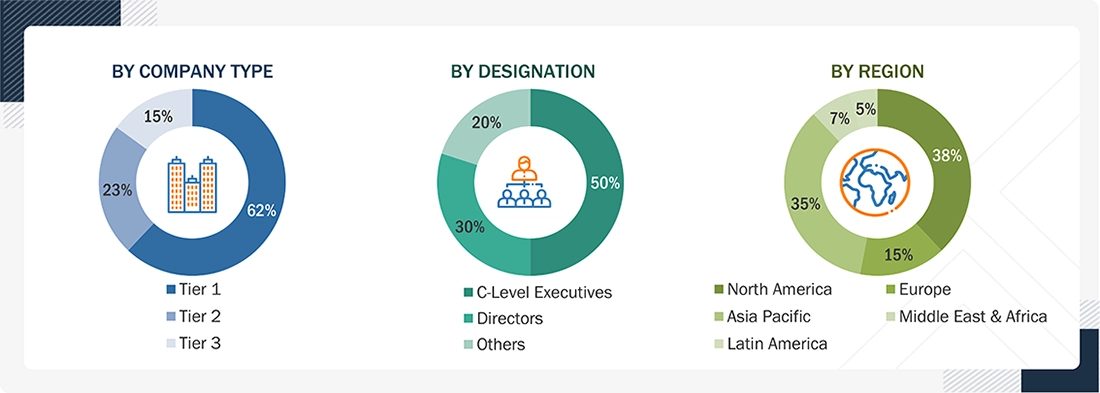
Note: Tier 1 companies’ revenue is more than USD 1 billion; Tier 2 companies ‘revenue ranges between USD 500 million and 1 billion; and Tier 3 companies’ revenue ranges between USD 100 million and USD 500 million. Other designations include sales managers, marketing managers, and product managers.
To know about the assumptions considered for the study, download the pdf brochure
Market Size Estimation
Multiple approaches were adopted to estimate and forecast the size of the smart transportation market. The first approach involves estimating market size by summing up the revenue generated by companies through the sale of smart transportation.
Both top-down and bottom-up approaches were used to estimate and validate the total size of the smart transportation market. These methods were extensively used to estimate the size of various segments in the market. The research methodology used to estimate the market size includes the following:
- Key players in the market were identified through extensive secondary research.
- In terms of value, the industry’s supply chain and market size were determined through primary and secondary research processes.
- All percentage shares, splits, and breakups were determined using secondary sources and verified through primary sources.
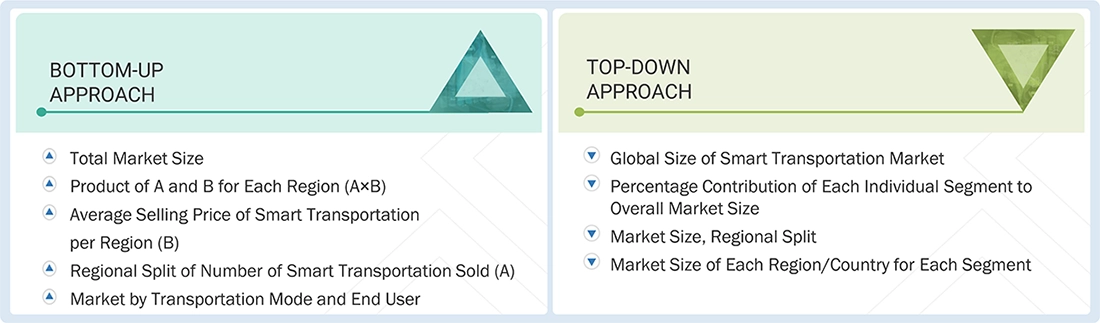
Data Triangulation
After arriving at the overall market size, the smart transportation market was divided into several segments and subsegments. A data triangulation procedure was used to complete the overall market engineering process and arrive at the exact statistics for all segments and subsegments, wherever applicable. The data was triangulated by studying various factors and trends from the demand and supply sides. Along with data triangulation and market breakdown, the market size was validated by the top-down and bottom-up approaches.
Market Definition
Smart transportation refers to an advanced transportation system that integrates technology, data, and innovation to improve the efficiency, safety, accessibility, and sustainability of all modes of transport, such as roadways, railways, maritime, and airways. This transportation system involves an Information and Communication Technology (ICT)-driven framework designed to optimize the efficiency, safety, and sustainability of transportation systems across all modes, such as road, rail, air, water, and urban transit. It integrates advanced technologies such as IoT, AI, cloud computing, big data analytics, and intelligent communication networks to enhance the movement of people and goods through data-driven decision-making and automation.
With the advancement of disruptive technologies such as artificial intelligence (AI), machine learning (ML), the Internet of Things (IoT), and big data analytics, smart transportation aims to provide innovative services related to various modes of transportation and traffic management. These technologies enable users to be better informed and make safer, smarter use of transportation networks.
Key Stakeholders
- Transportation Service Providers
- Solution Vendors
- Networking and Communication Service Providers
- Original Equipment Manufacturers (OEMs)
- Transportation Agencies
- Public Transportation Departments
- Managed Service Providers (MSPs)
- System Integrators
- Consultancy Firms/Advisory Firms
- Investors and Venture Capitalists
- Independent Software Vendors
- Value-added Resellers (VARs) and Distributors
- Governments and Urban Planning Agencies
- Rail Infrastructure Suppliers
- Railway Management Companies (private/public)
- Shipping Operators
- Maritime Technology Vendors
- Airport Authorities
- Airport Technology Vendors
- Transport Operators
- Transport Infrastructure Planners
Report Objectives
- To determine and forecast the smart transportation market by transportation mode (roadways, railways, airways, maritime), solutions, services, end-user, and region from 2026 to 2032, and analyze the various macroeconomic and microeconomic factors that affect the market growth
- To forecast the size of the market segments with respect to five main regions: North America, Europe, Asia Pacific (APAC), Latin America, and the Middle East & Africa (MEA)
- To provide detailed information about the major factors (drivers, restraints, opportunities, and challenges) influencing the growth of the market
- To analyze each submarket with respect to individual growth trends, prospects, and contributions to the overall market
- To analyze the opportunities in the market for stakeholders by identifying the high-growth segments of the market
- To profile the key market players; provide a comparative analysis on the basis of business overviews, regional presence, product offerings, business strategies, and key financials; and illustrate the competitive landscape of the market
- To track and analyze competitive developments, such as mergers and acquisitions, product developments, partnerships and collaborations, and research and development (R&D) activities, in the market
Available customizations:
With the given market data, MarketsandMarkets offers customizations as per the company’s specific needs. The following customization options are available for the report:
Country-wise information
- Analysis for additional countries (up to five)
Company Information
- Detailed analysis and profiling of additional market players (up to 5)
Key Questions Addressed by the Report
How did tariff uncertainties influence public-private partnerships in smart transportation initiatives?
The trade environment made funding commitments more volatile, causing some cities and transit authorities to reconsider large-scale smart infrastructure projects. Private technology providers became more cautious in long-term bids, often building tariff contingencies into contracts. This shift created friction in project planning cycles, with both sides weighing cost risks against the urgency of transportation modernization efforts.
What is the definition of the smart transportation market?
Smart transportation refers to an advanced transportation system that integrates technology, data, and innovation to improve the efficiency, safety, accessibility, and sustainability of all modes of transport, such as roadways, railways, maritime, and airways. involves to an Information and Communication Technology (ICT) driven framework designed to optimize the efficiency, safety, and sustainability of transportation systems across all modes, such as road, rail, air, water, and urban transit. It integrates advanced technologies such as IoT, AI, cloud computing, big data analytics, and intelligent communication networks to enhance the movement of people and goods through data-driven decision-making and automation.
With the advancement of disruptive technologies, such as artificial intelligence (AI)/machine learning (ML), Internet of Things (IoT), and big data and analytics, smart transportation aims to provide innovative services related to different modes of transportation and traffic management, enabling users to be better informed and make safer and smarter use of transportation networks.
With the advancement of disruptive technologies, such as artificial intelligence (AI)/machine learning (ML), Internet of Things (IoT), and big data and analytics, smart transportation aims to provide innovative services related to different modes of transportation and traffic management, enabling users to be better informed and make safer and smarter use of transportation networks.
What is the market size of the smart transportation market?
The Smart Transportation market is projected to grow from USD 129.72 billion in 2024 to USD 276.65 billion by 2029 at a compound annual growth rate (CAGR) of 16.4% from 2024 to 2029.
What are the major drivers in the smart transportation market?
The major drivers in the smart transportation market are the Increasing demand for Autonomous and Connected Vehicles, Technological advancements to enhance customer experience, Growing government initiatives and Public Private Partnership models for smart transportation, the Rising urban population, and high demographic rates.
Who are the key players operating in the smart transportation market?
The key players profiled in the smart transportation market include Thales Group (France), Huawei (China), Siemens (Germany), Cisco (US), DNV (Norway), Cubic (US), Alstom (France), Toshiba (Japan), Veson Nautical (US), NEC Corporation (Japan), Bentley Systems (US), Indra (Spain), Trimble (US), TomTom (Netherlands), Conduent (US), Kapsch (Austria), Hitachi (Japan), and Descartes (Canada).
What are the key technology trends in the smart transportation market?
The key technology trends include intelligent traffic management systems, innovative ticketing solutions, passenger information systems, vehicle-to-everything (V2X) communication, Internet of Things (IoT) integration, artificial intelligence (AI) and machine learning, blockchain for secure transactions, geographic information systems (GIS), and advanced data analytics.
Fact checked
Personalize This Research
- Triangulate with your Own Data
- Get Data as per your Format and Definition
- Gain a Deeper Dive on a Specific Application, Geography, Customer or Competitor
- Any level of Personalization
Let Us Help You
- What are the Known and Unknown Adjacencies Impacting the Smart Transportation Market
- What will your New Revenue Sources be?
- Who will be your Top Customer; what will make them switch?
- Defend your Market Share or Win Competitors
- Get a Scorecard for Target Partners

Custom Market Research Services
We Will Customise The Research For You, In Case The Report Listed Above Does Not Meet With Your Requirements
Get 10% Free CustomisationTESTIMONIALS
- US Smart Transportation Market
- Canada Smart Transportation Market
- UK Smart Transportation Market
- Germany Smart Transportation Market
- France Smart Transportation Market
- Italy Smart Transportation Market
- China Smart Transportation Market
- Japan Smart Transportation Market
- India Smart Transportation Market
- UAE Smart Transportation Market
- Brazil Smart Transportation Market
- Mexico Smart Transportation Market
Growth opportunities and latent adjacency in Smart Transportation Market






mithun
Jun, 2013
Need a market intelligence report for Parking management in GCC region.
Marlon
Mar, 2019
Understand the market dynamics on Public Transportation sector.