Satellite Propellant Tanks Market Size, Share & Trends

Satellite Propellant Tanks Market Size, Share and Trends by Capacity (<5, 5-50, 51-100, 101-250, 251-500, 501-1000, >1000 L), Propellant (Chemical, Electric, Cold-Gas), Architecture (Positive-Expulsion, PMD, HPV), Material, Mass, Orbit, and Region - Global Forecast to 2032




SATELLITE PROPELLANT TANKS OVERVIEW
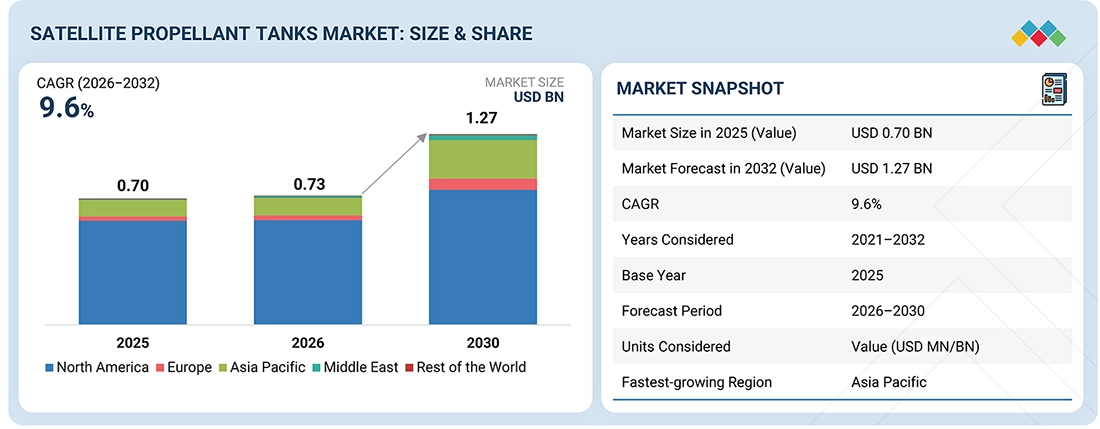
According to Marketsandmarkets, The global Satellite Propellant Tanks Market size was valued at USD 0.73 billion in 2026 and is projected to reach USD 1.27 billion by 2032, growing at a CAGR of 9.6% from 2026 to 2032. The demand is fueled by the increasing number of satellite launches across LEO, MEO, and GEO, along with the rising need for efficient propulsion systems to support orbit control, station keeping, collision avoidance, and longer mission durations.
REPORT SCOPE
| REPORT METRIC | DETAILS |
|---|---|
| Market Size in 2025 (Value) | USD 0.70 BN |
| Market Forecast in 2032 (Value) | USD 1.27 BN |
| Growth Rate | CAGR of 9.6% |
| Years Considered | 2021–2032 |
| Base Year | 2025 |
| Forecast Period | 2026–2032 |
| Units Considered | Value (USD MN/BN) |
| Report Coverage | Revenue forecast, company ranking, competitive landscape, growth factors, and trends |
| Segments Covered |
|
| Regions Covered | North America, Asia Pacific, Europe, Middle East, Rest of the World |
Market Size & Forecast
KEY TAKEAWAYS
-
By RegionNorth America is estimated to account for a 81.2% revenue share in 2026.
-
By CapacityThe 5-50 L segment is expected to record the highest CAGR of 10.6% between 2026 and 2032.
-
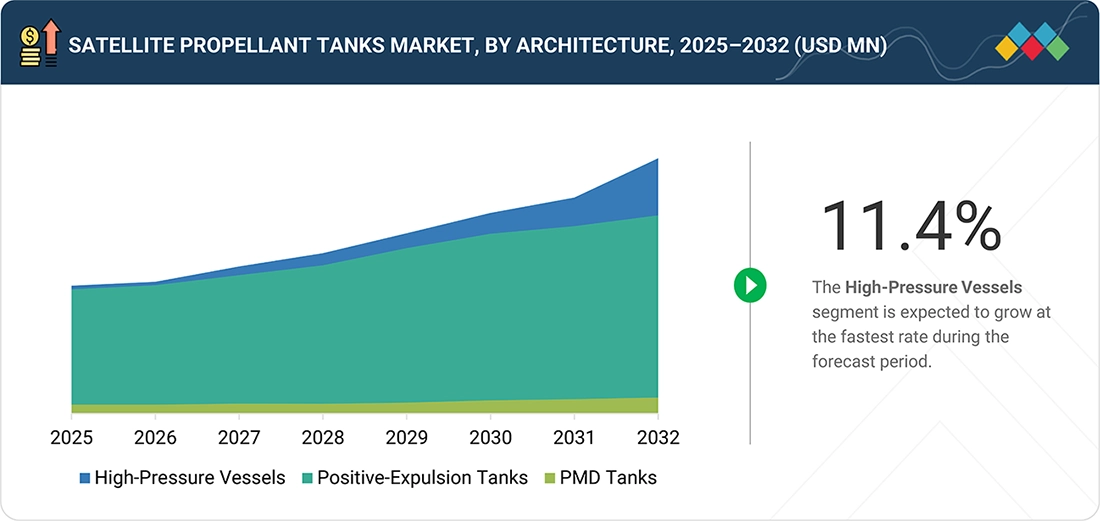
By ArchitectureHigh-pressure vessels are expected to be the fastest-growing segment during the forecast period.
-
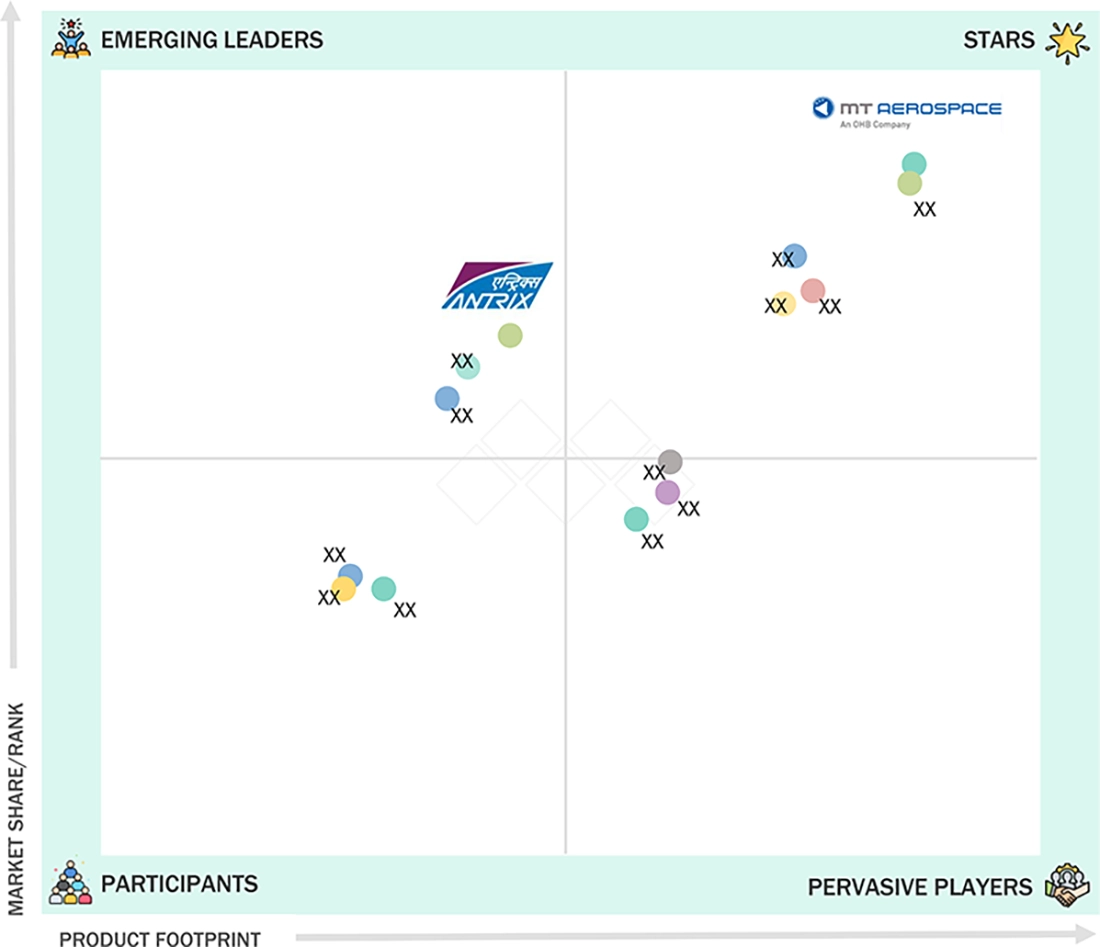
Competitive LandscapeMT Aerospace AG, Northrop Grumman, and Airbus were identified as stars in the satellite propellant tanks market, given their strong market share and product footprint.
The Satellite Propellant Tanks Industry is driven by the increasing complexity of satellite missions, including greater maneuverability, multi-orbit operations, and precise station-keeping needs. As satellites are expected to make more in-orbit adjustments and operate in congested environments, the demand for reliable and high-performance propellant tank systems grows. This encourages manufacturers to develop tanks that support efficient fuel use, long-term storage, and consistent propulsion performance.
Source: Secondary Research, Interviews with Experts, MarketsandMarkets Analysis
TRENDS & DISRUPTIONS IMPACTING CUSTOMERS' CUSTOMERS
The impact on customers’ customers in the satellite propellant tanks market mainly results from the increasing need for more efficient and lightweight propulsion solutions that can support longer missions. With the growth of LEO constellations, servicing satellites, and deep space missions, operators are increasingly relying on advanced propulsion systems and dependable propellant storage. Simultaneously, innovations like composite overwrapped pressure vessels, additive manufacturing for structural components, and modular tank designs are gradually transforming how these systems are constructed and integrated. As a result, there is higher demand for scalable, high-performance tank systems. Operators are also looking for improved fuel efficiency and propulsion options that support flexible, longer satellite operations at reduced costs.

Source: Secondary Research, Interviews with Experts, MarketsandMarkets Analysis
MARKET DYNAMICS

Level
-
Increasing satellite launch volumes

-
Need for in-orbit maneuvering


Level
-
Long qualification cycles

-
Limited visibility into component-level pricing


Level
-
Shift toward green propellants

-
Rapid adoption of electric propulsion


Level
-
Balancing weight reduction with structural integrity

-
Ensuring material compatibility across propellant types

Source: Secondary Research, Interviews with Experts, MarketsandMarkets Analysis
Driver: Increasing satellite launch volumes
The rising number of satellite launches is directly increasing demand for propellant tanks, as each satellite needs efficient fuel storage for operations and maneuvering. This trend is driven by growth in commercial constellations, defense programs, and space exploration activities.
Restraint: Long qualification cycles
Strict testing and certification standards greatly lengthen the time required to bring propellant tanks to market. This hampers innovation, raises costs, and creates barriers for new competitors entering the industry.
Opportunity: Shift toward green propellants
The move to environmentally friendly propellants opens new chances for manufacturers to create safer, more efficient tank solutions. This change is also driven by regulatory pressure and the industry’s emphasis on sustainability.
Challenge: Balancing weight reduction with structural integrity
Reducing the weight of propellant tanks is crucial for increasing satellite efficiency and lowering launch costs, but it must not sacrifice strength and safety. Achieving this balance requires advanced materials, precise engineering, and strict manufacturing standards.
SATELLITE PROPELLANT TANKS MARKET: COMMERCIAL USE CASES ACROSS INDUSTRIES
| COMPANY | USE CASE DESCRIPTION | BENEFITS |
|---|---|---|
 |
Satellite operators with aging GEO assets require life extension solutions to maintain mission continuity without full satellite replacement. Northrop Grumman’s Mission Extension Vehicle (MEV) enables on-orbit servicing by docking with existing satellites and providing propulsion, attitude control, and station-keeping support using integrated propellant tank and pressure vessel systems. | Improves satellite lifespan without replacement, reduces capital expenditure, and enhances asset utilization. Supports reliable long-duration operations with high structural integrity, leak prevention, and thermal stability, ensuring mission continuity. |
 |
GEO satellite platforms require high-pressure propellant tanks capable of supporting long mission durations while maintaining structural integrity under thermal cycling and launch constraints. Airbus’ Eurostar platform integrates advanced metallic and composite tank configurations optimized for weight reduction and fatigue resistance. | Enhances mission life and operational reliability while reducing launch mass. Improves fuel efficiency and lifecycle durability, enabling sustained GEO operations and strengthening performance in long-duration satellite missions. |
 |
Large-scale LEO constellations require compact, lightweight, and cost-efficient propulsion tank systems that can be produced at high volumes. SpaceX’s Starlink program integrates krypton-based electric propulsion tanks designed for scalability and efficient mass production across thousands of satellites. | Enables high-volume manufacturing with reduced per-unit cost while maintaining safety and performance standards. Supports scalable constellation deployment, improves operational efficiency, and ensures consistent propulsion performance across large satellite fleets. |
Logos and trademarks shown above are the property of their respective owners. Their use here is for informational and illustrative purposes only.
MARKET ECOSYSTEM
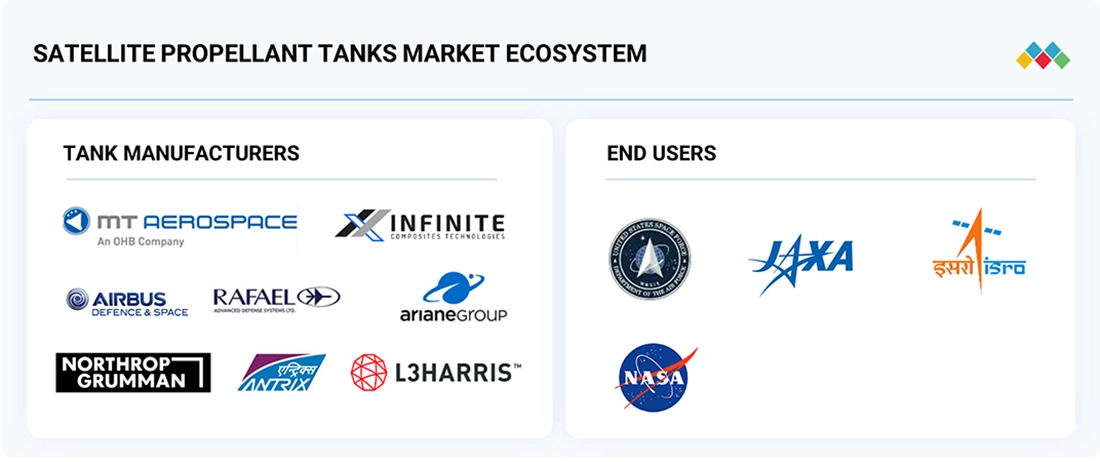
The satellite propellant tanks market includes a mix of tank manufacturers and propulsion-focused aerospace companies like MT Aerospace AG, Airbus, Northrop Grumman, L3Harris Technologies, Inc., and ArianeGroup. These players support different spacecraft programs through tank design, the use of composite materials, and integration with propulsion systems, working closely with end users such as defense organizations, civil space agencies, and government programs that launch satellites for communication, navigation, and space exploration. This close coordination across the ecosystem helps ensure reliable fuel storage, better weight efficiency, and stable propulsion performance for long-duration missions.
Logos and trademarks shown above are the property of their respective owners. Their use here is for informational and illustrative purposes only.
MARKET SEGMENTS
Source: Secondary Research, Interviews with Experts, MarketsandMarkets Analysis
Satellite Propellant Tanks Market, By Satellite Mass
Small satellites (1–1,200 kg) lead the market due to the rapid growth of LEO constellations and commercial deployments. These satellites need compact, lightweight propulsion systems, boosting demand for efficient tanks. High launch volumes are driving this segment’s dominance.
Satellite Propellant Tanks Market, By Architecture
High-pressure vessels dominate the market because they are widely used for propellant storage and pressurization in modern satellite propulsion systems. They ensure reliable fuel delivery and are compatible with lightweight composite designs. Their use is growing with advanced propulsion systems and small satellite platforms.
Satellite Propellant Tanks Market, By Capacity
The 5–50 L segment leads the market as it caters to small and medium satellites. These tanks provide enough propellant while keeping weight efficiency. Growth in small satellite launches is boosting demand in this segment.
Satellite Propellant Tanks Market, By Material
Titanium alloys are dominant because of their high strength, corrosion resistance, and ability to withstand high pressure. They are commonly used in satellite tanks for long-duration missions. Their reliability makes them a preferred material choice.
Satellite Propellant Tanks Market, By Propellant
Chemical propellants hold the largest share because they are widely used for orbit raising, station-keeping, and attitude control. Their reliable and proven performance makes them the preferred choice for most missions. The use of green propellants also supports this segment.
Satellite Propellant Tanks Market, By Orbit
LEO dominates the market because of the growth in large satellite constellations. Frequent maneuvers and shorter mission cycles increase propellant consumption. This is fueling higher demand for propellant tanks in LEO satellites.
REGION
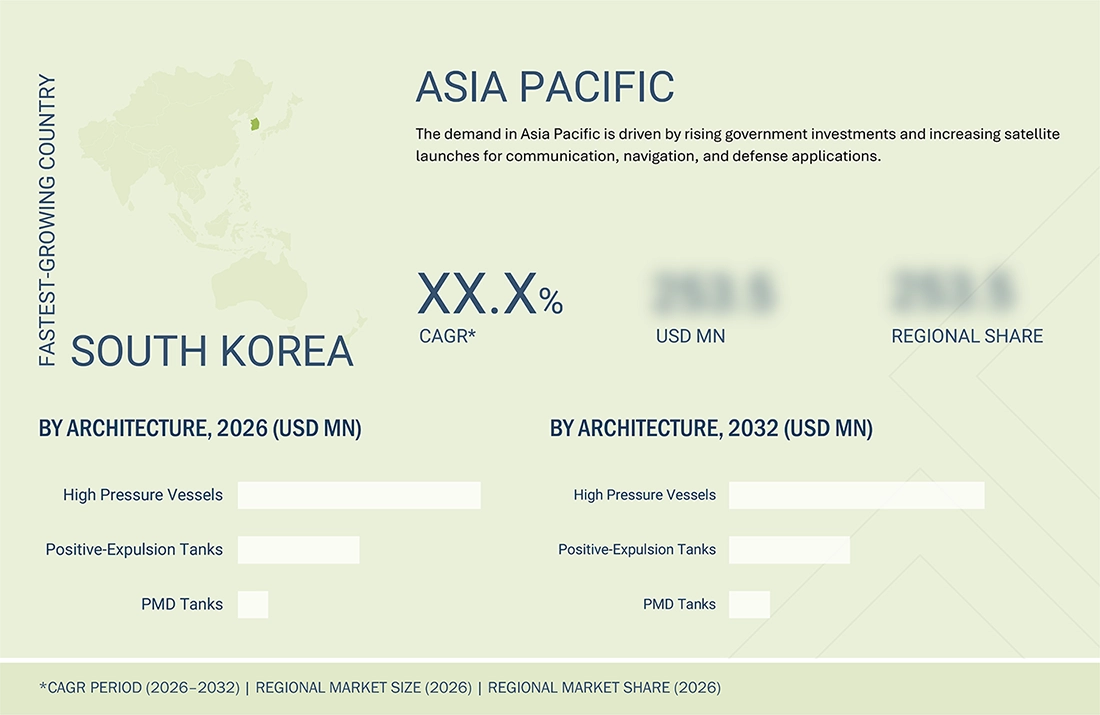
Asia-Pacific to be fastest-growing region during forecast period
The Asia Pacific satellite propellant tanks market is expected to grow at the fastest rate during the forecast period. The demand is driven by the rapid build-out of LEO constellations and defense space programs in China, India, South Korea, and Japan, along with increased investment in local satellite manufacturing. Regional agencies focus on reducing reliance on foreign systems, which encourages domestic production of propulsion subsystems, including propellant tanks.
SATELLITE PROPELLANT TANKS MARKET: COMPANY EVALUATION MATRIX
In the satellite propellant tanks market, MT Aerospace AG (Star) leads with a strong market presence and solid manufacturing capabilities, mainly due to its experience in lightweight structures, composite materials, and precise tank production for space applications. Antrix (Emerging Leader) is gradually strengthening its position by participating more in satellite programs and increasing its focus on propulsion-related components within India’s space ecosystem.
Source: Secondary Research, Interviews with Experts, MarketsandMarkets Analysis
KEY MARKET PLAYERS - TOP SATELLITE PROPELLANT TANKS COMPANIES
- MT Aerospace AG (Germany)
- Airbus (Netherlands)
- Northrop Grumman (US)
- ArianeGroup (France)
- L3Harris Technologies, Inc. (US)
- RAFAEL Advanced Defense Systems Ltd. (Israel)
- Infinite Composites Technologies (US)
- Moog Inc. (US)
- Nammo AS (Norway)
- Scorpius Space Launch Company (US)
- Antrix Corporation Limited (India)
- IHI Aerospace Co., Ltd. (Japan)
- Applied Aerospace & Defense (US)
- Vivace International Corporation (US)
- Eaton (Ireland)
WHAT IS IN IT FOR YOU: SATELLITE PROPELLANT TANKS MARKET REPORT CONTENT GUIDE
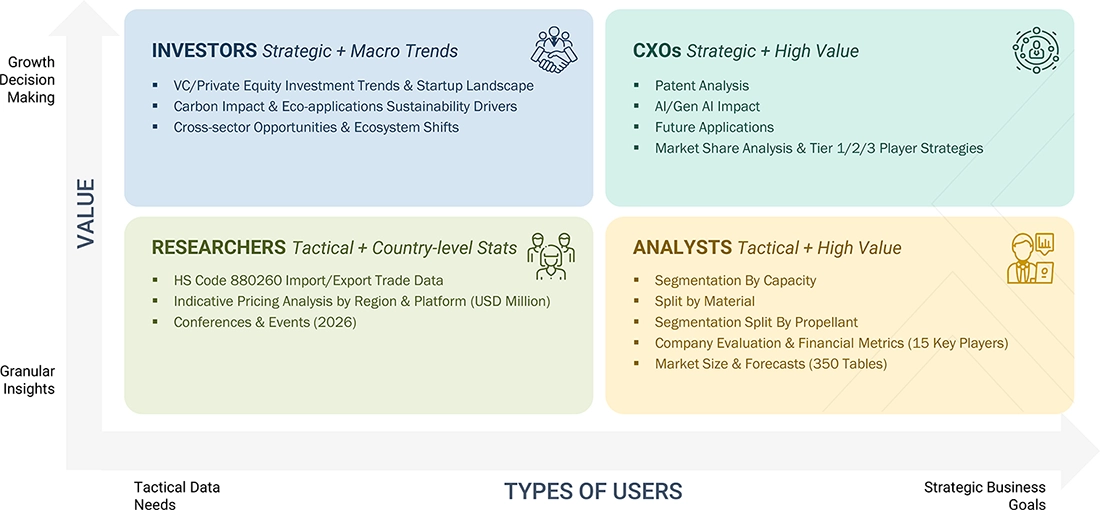
DELIVERED CUSTOMIZATIONS
We have successfully delivered the following deep-dive customizations:
| CLIENT REQUEST | CUSTOMIZATION DELIVERED | VALUE ADDS |
|---|---|---|
| Leading Manufacturer | Additional segment breakdown for countries | Additional country-level market sizing tables for segments/sub-segments covered at the regional/global level to gain an understanding of market potential by each country |
| Emerging Leader | Additional company profiles | Competitive information on targeted players to gain granular insights on direct competition |
| Regional Market Leader | Additional country market estimates | Additional country-level deep dive for a more targeted understanding of the total addressable market |
RECENT DEVELOPMENTS
- March 2025 : The US Space Force awarded a contract to Northrop Grumman for the Tetra-6 mission to demonstrate a refueling payload under the Elixir program. The work includes testing refueling modules and fuel transfer systems in orbit, supporting satellite servicing and propellant transfer capabilities.
- January 2024 : Infinite Composites Technologies partnered with Leonid Capital Partners to accelerate the development of next-generation composite pressure vessels for aerospace and space missions, leveraging their Army Phase 2 SBIR contract. This financing enables the scaling of high-pressure lightweight tanks suitable for both government and commercial space applications.
- May 2025 : Moog Inc. secured a contract from the Air Force Research Laboratory (AFRL) at Edwards Air Force Base to develop a novel multimodal propulsion system that leverages a single propellant and fuel tank for both chemical and electric satellite propulsion, enhancing mission flexibility and adaptability for dynamic space operations. The work supports national security space missions and advances satellite propellant tank integration within adaptive propulsion architectures.
Table of Contents
 Exclusive indicates content/data unique to MarketsandMarkets and not available with any competitors.
Methodology
The study involved four major activities in estimating the current size of the satellite propellant tanks market. Exhaustive secondary research was done to collect information on the satellite propellant tanks market, its adjacent markets, and its parent market. The next step was to validate these findings, assumptions, and sizing with industry experts across the value chain through primary research. Demand-side analysis was conducted to estimate the overall market size. After that, market breakdown and data triangulation procedures were employed to estimate the sizes of various segments and subsegments within the satellite propellant tanks market.
Secondary Research
During the secondary research process, various sources were consulted to identify and collect information for this study. Secondary sources included government sources, such as SIPRI; corporate filings, including annual reports, press releases, and investor presentations from companies; white papers, journals, and certified publications; and articles from recognized authors, directories, and databases.
Primary Research
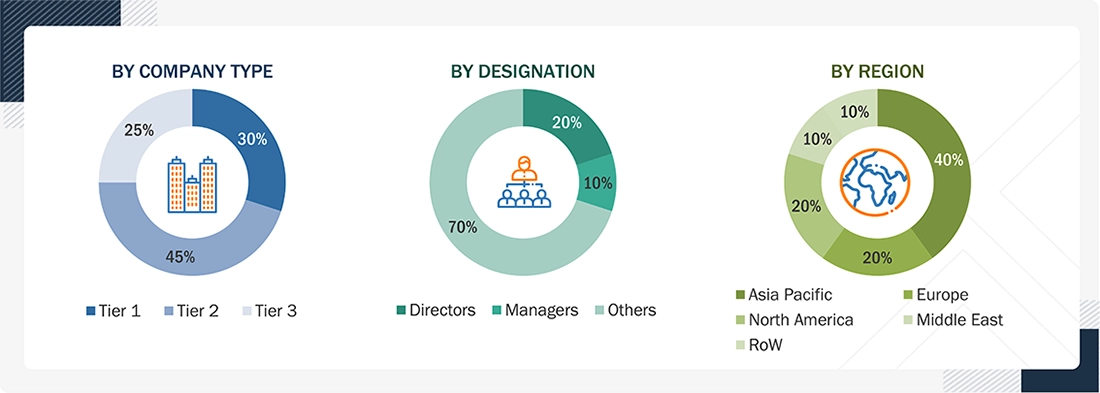
Extensive primary research was conducted after acquiring information regarding the satellite propellant tanks market scenario through secondary research. Several primary interviews were conducted with market experts from the demand and supply sides across major countries of North America, Europe, Asia Pacific, and the Rest of the world. Primary data was collected through questionnaires, emails, and telephonic interviews.
To know about the assumptions considered for the study, download the pdf brochure
Market Size Estimation
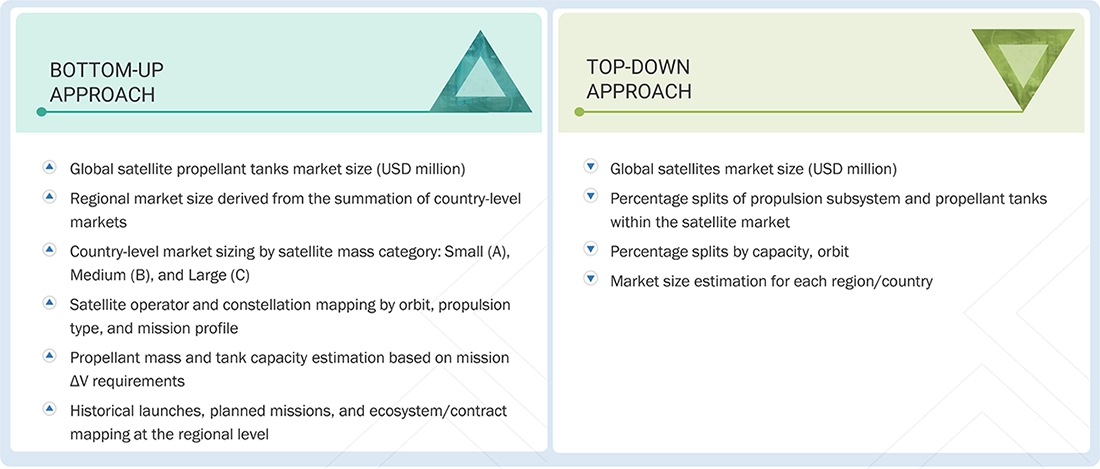
The top-down and bottom-up approaches were used to estimate and validate the size of the satellite propellant tanks market. The research methodology used to estimate the size of the market included the following details:
- Key players in the satellite propellant tanks market were identified through secondary research, and their market shares were determined through a combination of primary and secondary research. This included a study of the annual and financial reports of the top market players, as well as extensive interviews with leaders, including directors, engineers, marketing executives, and other key stakeholders of leading companies operating in the market.
- All percentage shares, splits, and breakdowns were determined using secondary sources and verified through primary sources.
- All possible parameters that affect the markets covered in this research study were accounted for, viewed in extensive detail, verified through primary research, and analyzed to obtain the final quantitative and qualitative data on the satellite propellant tanks market. This data was consolidated, enhanced with detailed inputs, analyzed by MarketsandMarkets, and presented in this report.
Satellite Propellant Tanks Market : Top-Down and Bottom-Up Approach
Data Triangulation
After determining the overall market size, the total market was divided into several segments and subsegments. The data triangulation and market breakdown procedures explained below were implemented, wherever applicable, to complete the overall market engineering process and arrive at the estimated market numbers for the market segments and subsegments. The data was triangulated by studying various factors and trends from the demand and supply sides. Additionally, the market size was validated using top-down and bottom-up approaches.
Market Definition
Satellite propellant tanks are space-qualified storage vessels used on satellites to hold and deliver propellants for orbit raising, station-keeping, attitude control, and end-of-life maneuvers. It is analyzed by capacity (total internal volume per tank), material type (all-metal shells such as titanium or aluminum, and hybrid metal-plus-CFRP overwrapped designs), and tank type/architecture (PMD surface-tension tanks, positive-expulsion diaphragm tanks, and no-internal-device tanks commonly used for gas propellants like xenon).
Key Stakeholders
- Government and Research Organizations
- Satellite Propellant Tanks Manufacturers
- Satellite and Spacecraft Manufacturers
- Satellite Propulsion System Providers
- Defense and National Security Agencies
- Civil Space Agencies
- Commercial Satellite Operators
- Launch Service Providers
- Raw Material and Advanced Materials Suppliers
- Academic Institutions and Research Universities
Report Objectives
- To define, describe, and forecast the size of the satellite propellant tanks market based on Architecture, Satellite Mass, Propellant, Satellite Orbit, Material, Capacity, and region
- To forecast the size of the various segments of the Satellite Propellant Tanks market based on five regions—North America, Europe, Asia Pacific, the Middle East, and the Rest of the World, along with key countries in each region
- To identify and analyze key drivers, restraints, opportunities, and challenges influencing the growth of the market
- To identify industry trends, market trends, and technology trends prevailing in the market
- To analyze micro markets with respect to individual technological trends, prospects, and their contribution to the overall market
- To provide a detailed competitive landscape of the market and analyze competitive growth strategies such as product launches and developments, contracts, partnerships, agreements, and collaborations adopted by key players in the market
- To identify the detailed financial positions, product portfolios, and key developments of leading companies in the market
- To strategically profile key market players and comprehensively analyze their market rank and core competencies
Available customizations:
MarketsandMarkets offers the following customizations for this market report:
- Additional country-level analysis of the satellite propellant tanks market
- Profiling of other market players (up to five)
Product Analysis
- Product matrix, which provides a detailed comparison of the product portfolio of each company in the satellite propellant tanks market
Key Questions Addressed by the Report
What is the current market size of the satellite propellant tanks market?
The satellite propellant tanks market is valued at USD 0.73 billion in 2026.
Which region dominates and which region is growing fastest in the market?
North America holds a significant share of the market, while Asia Pacific is expected to witness the highest growth due to increasing investments in space programs and satellite launches.
What are the key segments of the satellite propellant tanks market?
The market is segmented by capacity, propellant type, architecture, material, mass, orbit, and region, with LEO orbit and high-pressure vessels emerging as major growth segments.
Which segment is expected to dominate the market during the forecast period?
The Low Earth Orbit segment is expected to dominate due to the rapid expansion of satellite constellations and increasing demand for communication and Earth observation satellites.
Who are the key players in the satellite propellant tanks market?
Major companies operating in this market include MT Aerospace AG, Airbus, Northrop Grumman, ArianeGroup, and L3Harris Technologies, Inc., focusing on innovation and strategic collaborations.


Personalize This Research
- Triangulate with your Own Data
- Get Data as per your Format and Definition
- Gain a Deeper Dive on a Specific Application, Geography, Customer or Competitor
- Any level of Personalization
Let Us Help You
- What are the Known and Unknown Adjacencies Impacting the Satellite Propellant Tanks Market
- What will your New Revenue Sources be?
- Who will be your Top Customer; what will make them switch?
- Defend your Market Share or Win Competitors
- Get a Scorecard for Target Partners

Custom Market Research Services
We Will Customise The Research For You, In Case The Report Listed Above Does Not Meet With Your Requirements
Get 10% Free CustomisationTESTIMONIALS
- Canada Satellite Propellant Tanks Market
- US Satellite Propellant Tanks Market
- UK Satellite Propellant Tanks Market
- Germany Satellite Propellant Tanks Market
- Italy Satellite Propellant Tanks Market
- Russia Satellite Propellant Tanks Market
- France Satellite Propellant Tanks Market
- China Satellite Propellant Tanks Market
- India Satellite Propellant Tanks Market
- Japan Satellite Propellant Tanks Market
- South Korea Satellite Propellant Tanks Market
- Australia Satellite Propellant Tanks Market
- UAE Satellite Propellant Tanks Market
- Saudi Arabia Satellite Propellant Tanks Market
- Israel Satellite Propellant Tanks Market
- Turkey Satellite Propellant Tanks Market
Growth opportunities and latent adjacency in Satellite Propellant Tanks Market






User
May, 2026
Does the report analyze how defense satellite programs and commercial constellations are influencing propulsion system demand?.
Mark
May, 2026
Does the report provide insights into advanced technologies like composite overwrapped pressure vessels and additive manufacturing?.