Saudi Arabia Fleet Management Market

Saudi Arabia Fleet Management Market by Solution (Operation Management, Vehicle Maintenance & Diagnostics, Performance Management, Fleet Analytics & Reporting), Fleet Type (Passenger Cabs, Commercial Vehicles, Public Transport) - Forecast to 2030




OVERVIEW
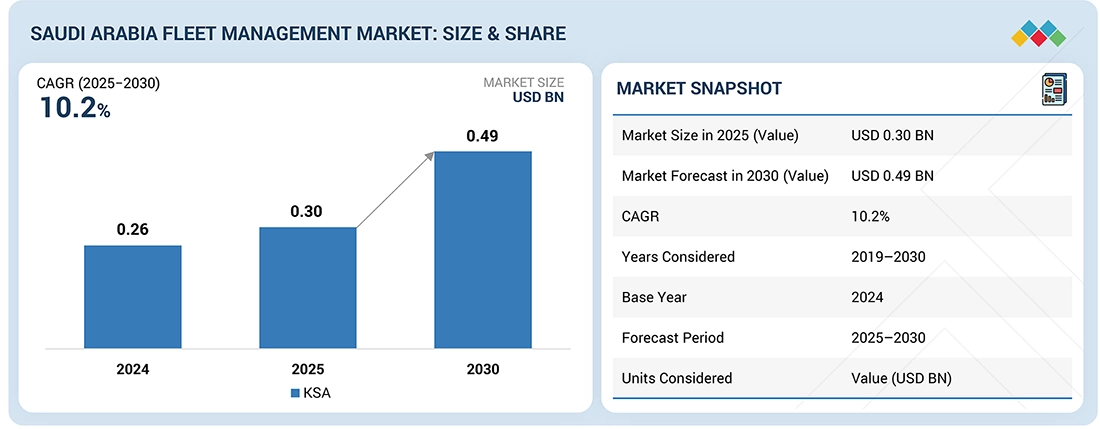
Source: Secondary Research, Interviews with Experts, MarketsandMarkets Analysis
The fleet management market in Saudi Arabia is estimated to be valued at USD 0.30 billion in 2025 and reach USD 0.49 billion by 2030 at a CAGR of 10.2%. Growth is supported by government initiatives under Vision 2030, which emphasize digital transformation, road safety, and improved logistics efficiency. Rising adoption of telematics for real-time tracking, compliance with transport regulations, and fuel cost optimization is driving demand for advanced fleet solutions. The expansion of e-commerce, growing commercial transport needs, and rapid fleet modernization are further boosting the adoption of asset visibility solutions. Operators are also being pushed to adopt platforms that support battery performance insights and intelligent route planning due to increasing interest in EVs and hybrid vehicles in major cities.
KEY TAKEAWAYS
-
By ComponentService components are projected to register the highest CAGR of 12.4%.
-
By Fleet TypeThe commercial vehicles segment is projected to grow at the fastest rate from 2025 to 2030.
-
By PowertrainThe internal combustion engine (ICE) segment is estimated to dominate the market.
-
By VerticalThe construction & mining segment is projected to grow the fastest during the forecast period.
-
Competitive LandscapeZain KSA, Solera, ORBCOMM were identified as some of the star players in the Saudi Arabia Fleet Management market, given their strong market share and product footprint.
The fleet management market in Saudi Arabia is expanding rapidly as automation technologies become increasingly embedded within core transportation and logistics operations. Automated systems are being integrated into maintenance scheduling, dispatching, routing, and journey planning by organizations across Saudi Arabia to boost workflow efficiency and reduce manual administrative tasks. The shift toward automated and data-driven workflows is accelerating as fleets seek to make better decisions, reduce operational costs, and improve planning accuracy. Growing expectations for real-time visibility, predictive maintenance, and streamlined compliance management, supported by national digital transformation initiatives, are strengthening the business case for modern fleet management platforms.
TRENDS & DISRUPTIONS IMPACTING CUSTOMERS' CUSTOMERS
Customer impact in the fleet management market in Saudi Arabia is being shaped by changing operational needs, wider use of digital technologies, and stronger regulatory requirements. Key users such as logistics fleets & public transport operators are adopting fleet management systems, which help improve service reliability and vehicle safety. Growing pressure to control operating costs, reduce asset misuse, and protect cargo is driving demand for integrated telematics and data-driven platforms. At the same time, solution providers are expanding beyond traditional software and hardware revenue models. Video-based safety solutions, advanced telematics, and services linked to electric vehicles and sustainability goals are included in new offerings. These shifts are influencing how fleet operators improve performance & deliver timely, reliable services, supporting continued demand growth across Saudi Arabia.
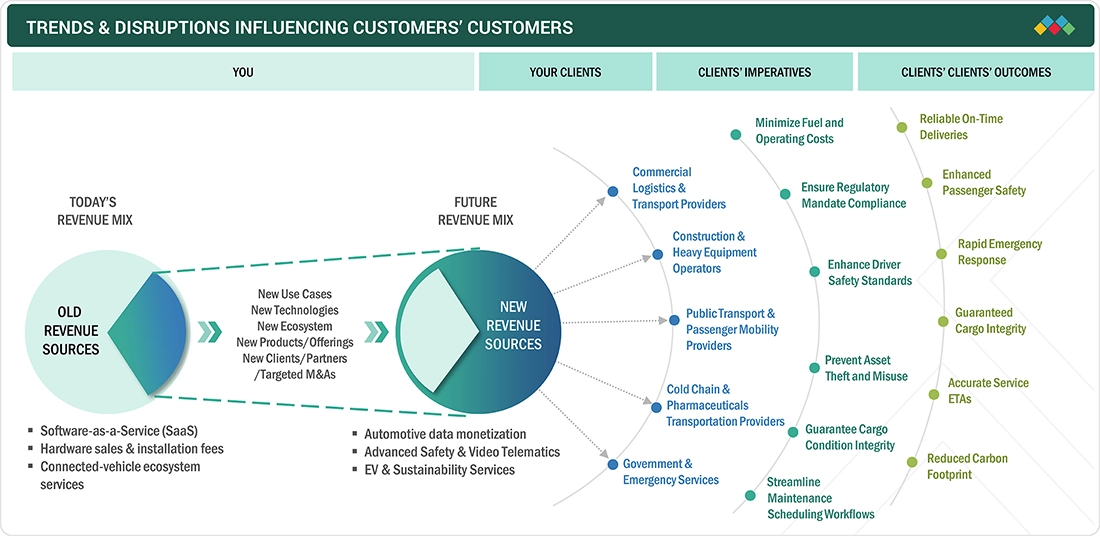
Source: Secondary Research, Interviews with Experts, MarketsandMarkets Analysis
MARKET DYNAMICS

Level
-
Vision 2030 Government Infrastructure Investment

-
Mega-Project Logistics Demands (NEOM & Red Sea Project)


Level
-
Last-Mile Delivery Infrastructure Gaps & Geographic Challenges

-
Regulatory Complexity & WASL Compliance Burden


Level
-
Made-in-Saudi Solutions & Local Technology Preference

-
Regional Fulfillment Hub Expansion & Decentralized Logistics


Level
-
Infrastructure Standardization & Interoperability Gaps

-
Digital Transformation & Technology Adoption Barriers

Source: Secondary Research, Interviews with Experts, MarketsandMarkets Analysis
Driver: Vision 2030 Government Infrastructure Investment Mandates
Saudi Arabia's Vision 2030 and the National Industrial Development and Logistics Program (NIDLP) are channeling over USD 36 billion into modernizing national logistics infrastructure. This comprehensive overhaul encompasses ports, rail, and the establishment of 59 integrated logistics zones. Crucially, a significant portion of the logistics allocation is dedicated to last-mile capacity, facilitating the development of micro-fulfillment hubs and secondary city distribution networks. These strategic investments have yielded a 23% increase in last-mile capacity and elevated the Kingdom’s Logistics Performance Index ranking to 38th globally. Consequently, this robust infrastructure supports the growth of tech-driven fleet platforms. It also enables the expansion of advanced multimodal solutions across the Saudi Arabia enterprise and startup ecosystem.
Restraint: Last-Mile Delivery Infrastructure Gaps & Geographic Challenges
Even with notable capacity expansion, last-mile delivery remains the most costly and operationally challenging part of the Saudi logistics chain. Inconsistent or incomplete address data, informal location descriptions, and limited use of standardized geocoding cause route deviations. Studies indicating failure rates of up to 40% highlight the significant amount of time and fuel wasted on unsuccessful or repeated trips. In addition, urban congestion in major cities and sparse road networks in remote regions create a dual challenge, where both dense and long-haul last-mile routes are hard to optimize. These issues constrain the ROI of fleet management tools unless they are tightly integrated with mapping, address validation, and intelligent routing tailored to Saudi conditions.
Opportunity: Regional Fulfillment Hub Expansion & Decentralized Logistics
Despite capacity expansion, last-mile delivery remains the most resource-intensive segment of the Saudi logistics chain. Inconsistent address data and informal location descriptions frequently lead to route deviations, with delivery failure rates reaching 40%. This inefficiency results in significant fuel waste and operational delays. The dual challenge of urban congestion and sparse remote road networks complicates routing optimization for both dense and long-haul cycles. These obstacles limit the return on investment for fleet management tools unless they are integrated with localized mapping, address validation, and intelligent routing algorithms specifically tailored to Saudi geographic conditions.
Challenge: Infrastructure Standardization & Interoperability Gaps
Saudi Arabia’s fleet management landscape is constrained by a lack of unified national standards for data exchange and system interoperability. Different telematics and platform providers rely on proprietary device protocols, while integration rules for the national Wasl system can differ by use case. Simultaneously, V2X communication between vehicles, infrastructure, and control centers is not governed by a single technical standard, making it difficult to deploy cross-fleet, cross-city solutions at scale. This fragmentation drives up integration and maintenance costs, increases project timelines, and reinforces supplier lock-in, rather than building on a shared, interoperable foundation.
SAUDI ARABIA FLEET MANAGEMENT MARKET: COMMERCIAL USE CASES ACROSS INDUSTRIES
| COMPANY | USE CASE DESCRIPTION | BENEFITS |
|---|---|---|
 |
Deployed Trimble TMW.suite TMS for 3PL fleet optimization and real-time visibility across expanded operations | Transformed operations with seamless integration, real-time reporting, enhanced decision-making, improved responsiveness to customer needs, and adapted to market demands instantly |
 |
Integrated webfleet telematics solution with premium tires and maintenance services for EV fleet management | Greater safety and efficiency through state-of-the-art telematics, EV battery monitoring with charging alerts, reduced vehicle downtime, and increased operational profitability |
 |
Utilized Solera SmartDrive for fleet optimization, routing, and safety analytics | Improved routing efficiency, reduced operational costs, enhanced driver safety through performance monitoring and coaching, optimized fuel management and maintenance |
Logos and trademarks shown above are the property of their respective owners. Their use here is for informational and illustrative purposes only.
MARKET ECOSYSTEM
The fleet management ecosystem in Saudi Arabia brings together telematics and platform providers, hardware and device manufacturers, service operators, and regulatory bodies to deliver end-to-end fleet visibility, safety, and efficiency. Platform vendors aggregate vehicle, driver, and infrastructure data while device makers supply gateways, cameras, and sensors. Service providers offer implementation, maintenance, leasing, and managed operations, and regulators set compliance, emissions, and safety requirements. Rapid electrification, expanding connectivity, and AI-based analytics are driving new capabilities such as charger-aware routing, predictive maintenance, and driver coaching. These advances are enabling cost reductions and higher uptime across logistics, transit, construction, and emergency fleets.
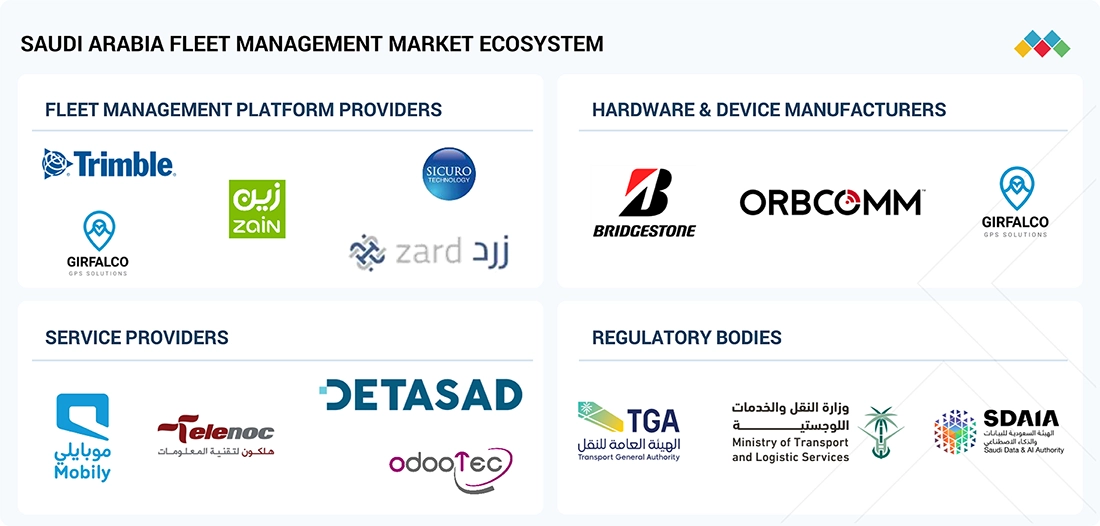
Logos and trademarks shown above are the property of their respective owners. Their use here is for informational and illustrative purposes only.
MARKET SEGMENTS
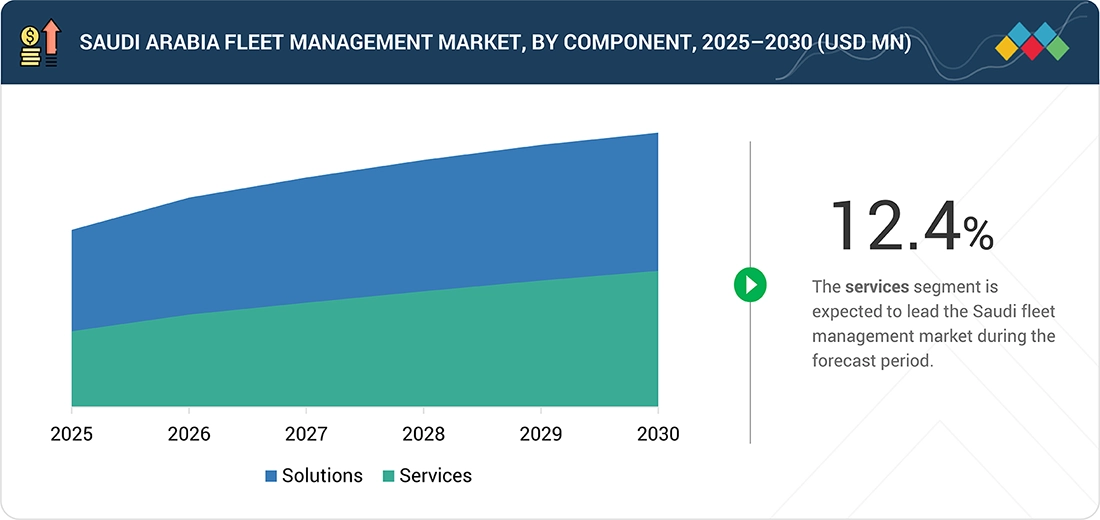
Source: Secondary Research, Interviews with Experts, MarketsandMarkets Analysis
Saudi Arabia Fleet Management Market, by Component
By component, the solutions segment is expected to hold the largest market share in the fleet management market in Saudi Arabia. Fleet tracking systems provide high-precision, real-time location data, enabling managers to monitor vehicle status and facilitate rapid, informed decision-making. This visibility is essential for resolving operational contingencies and maintaining delivery schedules. Geofencing technologies augment these capabilities by establishing virtual perimeters that trigger automated alerts upon entry or exit, thereby improving security protocols and regulatory compliance. Sophisticated routing and scheduling algorithms optimize vehicle trajectories to minimize idle time and maximize fuel efficiency. The integration of these digital solutions enhances overall operational performance, yielding higher productivity and reduced overhead. The adoption of comprehensive fleet management platforms continues to be accelerated by the convergence of increased efficiency and improved customer satisfaction, serving as a primary catalyst for domestic market expansion.
Saudi Arabia Fleet Management Market, by Fleet Type
The commercial vehicles segment is projected to record the highest growth rate in the fleet management market in Saudi Arabia during the forecast period. The deployment of telematics, route optimization, and driver-assist solutions has been accelerated by the rapid expansion of e-commerce and last-mile delivery across the kingdom. At the same time, the accelerated electrification of delivery fleets and national zero-emission transport targets is increasing the need for EV-specific solutions. Stricter city-level emissions zones, congestion charges, and access restrictions in major cities are prompting operators to modernize their fleets further. The combination of operational cost savings, regulatory pressure, and technology-driven efficiency improvements positions commercial vehicles as the fastest-growing fleet type in Saudi Arabia.
Saudi Arabia Fleet Management Market, by Powertrain
Electric vehicle powertrains are expected to register the highest CAGR in the fleet management market in Saudi Arabia, as fleet electrification creates a surge in demand for specialized telematics and energy management solutions. Operators require battery state of charge and health monitoring, smart charging orchestration, and predictive battery maintenance to maintain uptime and control costs. Regulatory pressure, state incentives, corporate decarbonization targets, and OEM electrification roadmaps accelerate the replacement of internal combustion vehicles in delivery, transit, and municipal fleets. Additionally, rising deployment of EV chargers and integration with grid services increases the value of fleet-level energy optimization platforms. Together, operational savings, regulatory drivers, and technology needs will propel rapid growth in EV-focused fleet solutions.
Saudi Arabia Fleet Management Market, by Vertical
Commercial logistics is expected to hold the largest share of the fleet management market in Saudi Arabia during the forecast period because the rapid expansion of e-commerce and omnichannel distribution drives large, high-utilization vehicle fleets. Logistics operators prioritize solutions that reduce fuel and labor costs, improve asset utilization, and ensure timely last-mile delivery. Additionally, electrification pilots in delivery fleets increase demand for EV-specific diagnostics and smart charging. Regulatory pressures on emissions and safety, combined with tight margins that reward Total Cost of Ownership reductions and predictive maintenance, accelerate the adoption of integrated fleet platforms across the commercial logistics vertical.
SAUDI ARABIA FLEET MANAGEMENT MARKET: COMPANY EVALUATION MATRIX
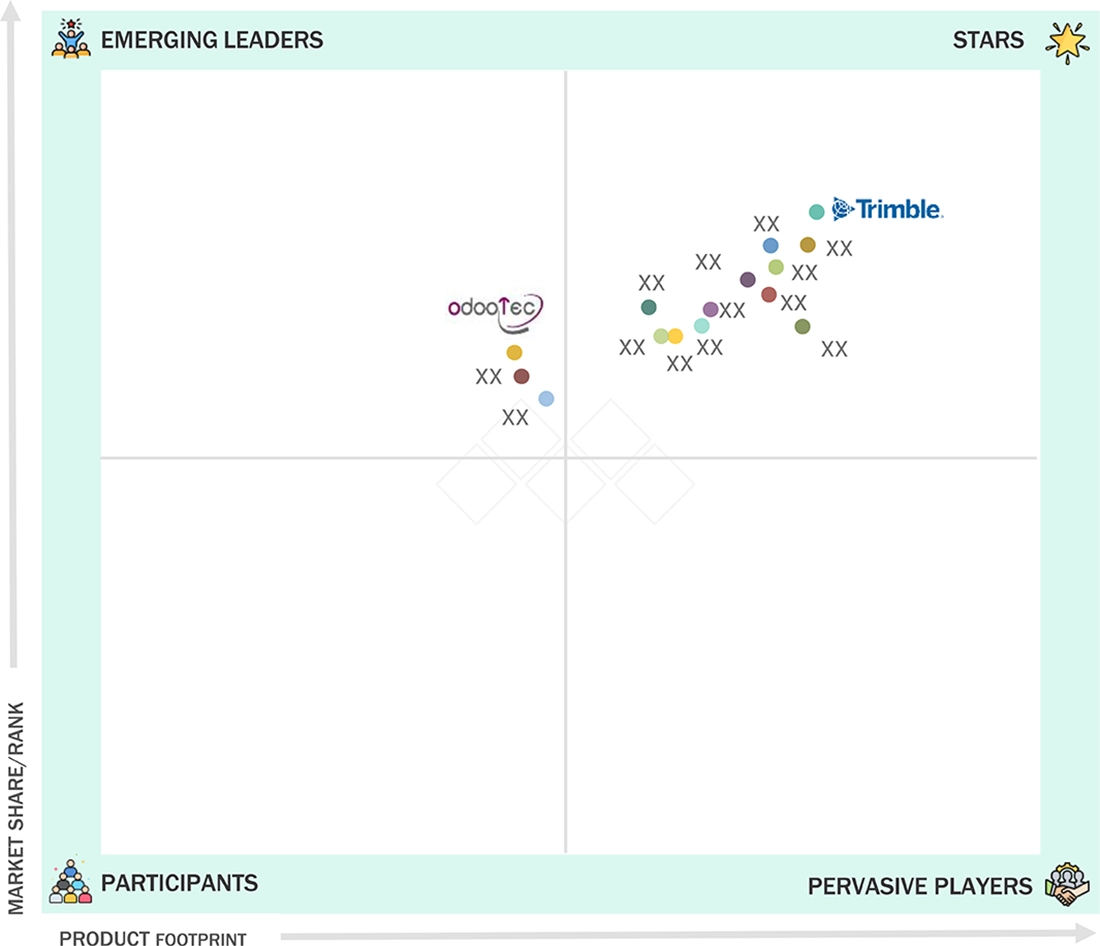
In the fleet management market in Saudi Arabia, Trimble (Star) continues to hold a strong leadership position. This position is supported by broad product coverage and advanced tracking capabilities. Adoption is growing across logistics, construction, and large commercial fleets operating across the Kingdom. ODOOTEC is positioned as an emerging leader. The company is gaining momentum by strengthening analytics-based fleet optimization tools. Its offerings appeal to small and mid-sized operators that seek cost-effective and compliance-ready solutions. Local adaptability is a key differentiator in the Saudi market.
Source: Secondary Research, Interviews with Experts, MarketsandMarkets Analysis
KEY MARKET PLAYERS
- Trimble (US)
- Bridgestone (Japan)
- Inseego (US)
- Solera (US)
- ORBCOMM (US)
- Teletrac Navman (US)
- Zain KSA (Saudi Arabia)
- Mobily (Saudi Arabia)
- DETASAD (Saudi Arabia)
- ODOOTEC (Saudi Arabia)
- Telenoc (Saudi Arabia)
- Helcon IT (Saudi Arabia)
- Sicuro Technology (Saudi Arabia)
- Girfalco (Saudi Arabia)
- Zard (Saudi Arabia)
MARKET SCOPE
| REPORT METRIC | DETAILS |
|---|---|
| Market Size, 2024 (Value) | USD 0.26 Billion |
| Market Forecast, 2030 (Value) | USD 0.49 Billion |
| Growth Rate | CAGR of 10.2% from 2025 to 2030 |
| Years Considered | 2019–2030 |
| Base Year | 2024 |
| Forecast Period | 2025–2030 |
| Units Considered | Value (USD Million/Billion) |
| Report Coverage | Revenue forecast, company ranking, competitive landscape, growth factors, and trends |
| Segments Covered |
|
WHAT IS IN IT FOR YOU: SAUDI ARABIA FLEET MANAGEMENT MARKET REPORT CONTENT GUIDE
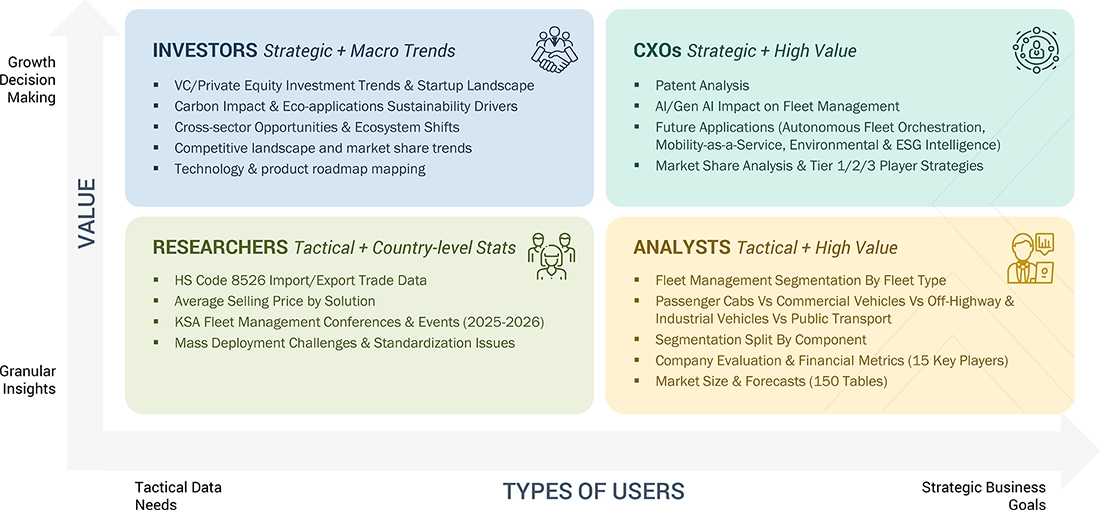
DELIVERED CUSTOMIZATIONS
We have successfully delivered the following deep-dive customizations:
| CLIENT REQUEST | CUSTOMIZATION DELIVERED | VALUE ADDS |
|---|---|---|
| EV Fleet Operator |
|
|
| Construction & Mining Operator |
|
|
| Commercial Logistics/Freight Carrier |
|
|
| Public Transport Authority |
|
|
| Ride-hailing/Passenger Cabs |
|
|
RECENT DEVELOPMENTS
- February 2025 : Folk Maritime Services Company partnered with ORBCOMM to deploy the Middle East’s first smart dry container fleet. As a Saudi feeder and regional liner operator, Folk Maritime became the first container shipping line in the region to adopt ORBCOMM’s smart container monitoring technology. The deployment improved cargo protection and increased end to end supply chain visibility.
- April 2024 : Zain KSA launched the first fully Saudi made fleet management system for the business sector. The solution uses tracking devices that are designed, manufactured, and assembled locally. It runs on Zain Cloud with local data hosting. The launch positioned Zain KSA as the first telecom operator to deliver a fleet platform under the Made in Saudi Program. The initiative supports Vision 2030 digital transformation goals.
- February 2024 : Bridgestone launched its global fleet management solution Webfleet in the UAE. The launch was completed in partnership with Al Masaood Group and Nasser Bin Abdullatif Alserkal. This move supports Bridgestone’s regional strategy for sustainable mobility. Webfleet serves more than 60,000 customers globally. The platform supports productivity, driver support, safety, compliance, and sustainable fleet operations.
- COLUMN 'A' SHOULD BE IN TEXT FORMAT AND NOT DATE FORMAT :
- Apr-25 : Azuga launched upgraded AI dashcams and enhanced safety features for real-time driver monitoring. The update improves incident detection, risk scoring, and fleet safety visibility, supporting US operators seeking stronger proactive safety management.
- 2025 : Zonar Systems introduced its new Zonar Ignition operations platform after merging with GPS Trackit. The platform integrates workflows, diagnostics, and asset monitoring, improving operational visibility for fleet operators across logistics, construction, and service sectors.
- 2025 : Verra Mobility advanced its mobility and compliance solutions, expanding digital fleet services supporting EV charging, tolling automation, and safety programs. The company strengthened its role in simplifying on-road transactions and regulatory processes for US fleets.
- Mar-25 : Zebra Technologies completed its acquisition of Photoneo, enhancing its machine vision and automation capabilities. This strengthens Zebra’s role in connected fleet ecosystems through improved imaging, sensing, and real-time operational intelligence.
- 2025 : Tenna LLC secured its position in the 2025 Inc. 5000 rankings, reflecting strong adoption of its construction fleet asset management platform. The company continues expanding capabilities for equipment tracking, utilization, and operational efficiency.
- Feb-25 : Trimble finalized the sale of its transportation telematics division to Platform Science and became a strategic investor in the combined business. The move sharpens Trimble’s portfolio focus while expanding platform integration opportunities.
- 2025 : Samsara continued scaling AI-driven safety, automation, and asset intelligence features, strengthening its connected operations platform. Upgrades focused on predictive insights, equipment visibility, and improved compliance workflows for diverse US fleet operators.
- Dec-24 : Zebra Technologies announced its intent to acquire Photoneo, expanding toward advanced machine vision solutions. This move set the foundation for stronger automation and sensing capabilities addressing complex fleet and logistics environments.
- Oct-24 : Azuga introduced new equipment tracking capabilities designed for construction and field service fleets. The enhancements improve asset visibility, reduce loss, and support efficient equipment allocation on active job sites.
- Oct-24 : Teletrac Navman received industry recognition for innovation in fleet safety and telematics. The company’s solutions demonstrated improved visibility, compliance automation, and safety outcomes for US fleet operators.
- Jun-24 : Verra Mobility partnered with EV charging providers to simplify charging access and payments for US fleet operators. The collaboration strengthens EV readiness and supports fleets transitioning toward electrification.
- Dec-24 : Motive rolled out enhanced fraud-prevention controls for the Motive Card, reducing fuel theft and unauthorized spending. The feature strengthens cost control and operational oversight for fleet finance managers.
- Nov-24 : Motive showcased new AI-powered safety and productivity enhancements at its Vision conference, reinforcing its focus on predictive risk mitigation and connected fleet intelligence.
- Nov-24 : Wheels joined the United Nations Global Compact, strengthening its ESG commitments and aligning its mobility programs with global sustainability and governance principles.
- Nov-24 : Samsara announced major product and ecosystem updates centered on connected safety, compliance automation, and asset intelligence, expanding its influence across the US fleet operations market.
- Dec-24 : Zonar Systems announced its merger with GPS Trackit, combining capabilities to deliver more integrated telematics, workflow automation, and asset monitoring solutions across varied fleet categories.
- 2024–2025 : Solera expanded its claims, repair, and telematics platforms with new automation capabilities. The enhancements strengthen Solera’s end-to-end fleet lifecycle management solutions for operators seeking efficiency and digitalization.
- Sep-24 : Trimble announced the planned sale of its transportation telematics business to Platform Science, enabling greater focus on core technologies and accelerating open-platform collaboration opportunities.
- Mar-24 : Holman expanded its fleet and automotive service network by acquiring Leith Automotive. The move strengthens Holman’s vehicle lifecycle and service capabilities for large enterprise fleets.
- Mar-24 : Verizon Connect enhanced its Reveal EV platform with an EV Suitability Tool and new integrations, supporting faster electrification decisions and improved EV management for US commercial fleets.
- Jun-24 : Samsara expanded its smart trailer ecosystem through new sensor and data integrations with Continental, strengthening equipment visibility and maintenance intelligence for logistics fleets.
- 2024 : Verra Mobility expanded its digital tolling, compliance, and mobility solutions, enhancing automation for rental, commercial, and service fleets across the US.
- 2024 : Tenna LLC earned placement in the 2024 Inc. 5000 list, demonstrating strong market growth and increasing adoption of its construction equipment telematics solutions.
Table of Contents
 Exclusive indicates content/data unique to MarketsandMarkets and not available with any competitors.
Methodology
This research study involved extensive secondary sources, directories, and databases, such as Dun & Bradstreet (D&B) Hoovers and Bloomberg BusinessWeek, to identify and collect information useful for a technical, market-oriented, and commercial study of the Saudi Arabia Fleet Management Market. The primary sources have been mainly industry experts from the core and related industries and preferred suppliers, manufacturers, distributors, service providers, technology developers, alliances, and organizations related to all segments of the value chain of this market. In-depth interviews have been conducted with primary respondents, including key industry participants, subject matter experts, C-level executives of key market players, and industry consultants, to obtain and verify critical qualitative and quantitative information.
Secondary Research
The market for companies offering fleet management solutions and services to different verticals has been estimated and projected based on the secondary data made available through paid and unpaid sources, as well as by analyzing their product portfolios in the ecosystem of the Saudi Arabia Fleet Management Market. It also involved rating company products based on their performance and quality. In the secondary research process, various sources such as the International Journal of Advanced Research (IJAR), EA Journals, and the International Journal of Technology, Innovation, and Management (IJTIM) have been referred to for identifying and collecting information for this study the Saudi Arabia Fleet Management Market. The secondary sources included annual reports, press releases investor presentations of companies, white papers, journals, and certified publications and articles by recognized authors, directories, and databases. Secondary research has been mainly used to obtain critical information about the supply chain of the market, the total pool of key players, market classification, segmentation according to industry trends to the bottommost level, regional markets, and key developments from both market- and technology-oriented perspectives that primary sources have further validated.
Primary Research
In the primary research process, various primary sources from both the supply and demand sides were interviewed to obtain qualitative and quantitative information on the market. The primary sources from the supply side included various industry experts, including Chief Experience Officers (CXOs); Vice Presidents (VPs); directors from business development, marketing, and product development/innovation teams; related critical executives from fleet management solution vendors, SIs, professional service providers, and industry associations; and key opinion leaders. Primary interviews were conducted to gather insights, such as market statistics, revenue data collected from solutions and services, market breakups, market size estimations, market forecasts, and data triangulation. Primary research also helped understand various trends related to technologies, applications, deployments, and regions. Stakeholders from the demand side, such as Chief Information Officers (CIOs), Chief Technology Officers (CTOs), Chief Strategy Officers (CSOs), and end users using fleet management solutions, were interviewed to understand the buyer’s perspective on suppliers, products, service providers, and their current usage of fleet management solutions which would impact the overall Saudi Arabia Fleet Management Market.
Market Size Estimation
Multiple approaches were adopted to estimate and forecast the size of the Saudi Arabia Fleet Management Market. The first approach involves estimating market size by summing up the revenue generated by companies through the sale of fleet management offerings.
Both top-down and bottom-up approaches were used to estimate and validate the total size of the Saudi Arabia Fleet Management Market. These methods were extensively used to estimate the size of various segments in the market. The research methodology used to estimate the market size includes the following:
- Key players in the market have been identified through extensive secondary research.
- Regarding value, the industry’s supply chain and market size have been determined through primary and secondary research processes.
- All percentage shares, splits, and breakups have been determined using secondary sources and verified through primary sources.
Data Triangulation
After arriving at the overall market size, the Saudi Arabia Fleet Management Market was divided into several segments and subsegments. A data triangulation procedure was used to complete the overall market engineering process and arrive at the exact statistics for all segments and subsegments, wherever applicable. The data was triangulated by studying various factors and trends from the demand and supply sides. Along with data triangulation and market breakdown, the market size was validated by the top-down and bottom-up approaches.
Market Definition
Fleet management encompasses the activities necessary to maintain a fleet's optimal efficiency, punctuality, and financial adherence. It constitutes the systematic approach adopted by fleet managers for overseeing fleet operations, involving continuous monitoring of activities and strategic decision-making in areas such as asset management, dispatch, and routing, as well as the acquisition and disposal of vehicles.
Key Stakeholders
- Fleet Managers
- IT Departments
- Drivers
- Digital maps providers
- Automotive suppliers
- Government Agencies
- Investment Firms
- Fleet management Alliances/Groups
Report Objectives
- To determine, segment, and forecast the Saudi Arabia Fleet Management Market by component, fleet type, vertical, and region in terms of value
- To provide detailed information about the major factors (drivers, restraints, opportunities, and challenges) influencing the growth of the market
- To study the complete value chain and related industry segments and perform a value chain analysis of the market landscape
- To strategically analyze the macro and micro-markets concerning individual growth trends, prospects, and contributions to the total market
- To analyze the industry trends, pricing data, patents, and innovations related to the market
- To analyze the opportunities for stakeholders by identifying the high-growth segments of the market
- To profile the key players in the market and comprehensively analyze their market share/ranking and core competencies
- To track and analyze competitive developments, such as mergers and acquisitions, product launches & developments, partnerships, agreements, collaborations, business expansions, and R&D activities
Available Customizations
With the given market data, MarketsandMarkets offers customizations as per the company’s specific needs. The following customization options are available for the report:
Country-wise information
- Analysis for additional countries (up to five)
Company Information
- Detailed analysis and profiling of additional market players (up to 5)
Key Questions Addressed by the Report
What is the projected size of the Saudi Arabia Fleet Management Market by 2030?
The Saudi Arabia Fleet Management Market is projected to grow from USD 0.30 billion in 2025 to USD 0.49 billion by 2030, at a CAGR of 10.2% during the forecast period.
What are the key factors driving the Saudi Arabia Fleet Management Market?
Market growth is driven by Vision 2030 initiatives, digital transformation, telematics adoption, logistics expansion, fleet modernization, and demand for fuel-efficient and compliant fleet operations.
Who are the key players operating in the Saudi Arabia Fleet Management Market?
Top List of Key Players in Saudi Arabia Fleet Management Market include Trimble (US), Bridgestone (Japan), Inseego (US), Solera (US), ORBCOMM (US), Teletrac Navman (US), Zain KSA (Saudi Arabia), Mobily (Saudi Arabia), DETASAD (Saudi Arabia), ODOOTEC (Saudi Arabia), Telenoc (Saudi Arabia), Helcon IT (Saudi Arabia), Sicuro Technology (Saudi Arabia), Girfalco (Saudi Arabia), and Zard (Saudi Arabia).
What are the major technology trends shaping the Saudi Arabia Fleet Management Market?
Key trends include AI-powered fleet analytics, predictive maintenance, EV fleet management, battery performance monitoring, smart charging, real-time tracking, and intelligent route optimization.
What opportunities are emerging in the Saudi Arabia Fleet Management Market?
Growing adoption of electric vehicles, connected fleets, AI-driven analytics, and smart transportation projects is creating significant market opportunities.


Personalize This Research
- Triangulate with your Own Data
- Get Data as per your Format and Definition
- Gain a Deeper Dive on a Specific Application, Geography, Customer or Competitor
- Any level of Personalization
Let Us Help You
- What are the Known and Unknown Adjacencies Impacting the Saudi Arabia Fleet Management Market
- What will your New Revenue Sources be?
- Who will be your Top Customer; what will make them switch?
- Defend your Market Share or Win Competitors
- Get a Scorecard for Target Partners

Custom Market Research Services
We Will Customise The Research For You, In Case The Report Listed Above Does Not Meet With Your Requirements
Get 10% Free CustomisationTESTIMONIALS






Growth opportunities and latent adjacency in Saudi Arabia Fleet Management Market