Technical Ceramics Market

Technical Ceramics Market by Material (Oxide, Non-Oxide), Product Type (Monolithic Ceramics, Ceramic Coatings), End-use Industry (Electronics & Semiconductor, Automotive, Energy & Power, Medical, Military & Defense), and Region - Global Forecast to 2031




OVERVIEW

Source: Secondary Research, Interviews with Experts, MarketsandMarkets Analysis
The technical ceramics market is projected to reach USD 20.27 billion by 2031 from USD 14.03 billion in 2026, recording a CAGR of 7.6% during the same period. The market experiences steady growth, driven by the rising demand for high-performance materials in advanced industrial applications. As the electronics & semiconductor, automotive, medical, and energy & power industries continue to advance, the demand for materials that can withstand extreme temperatures, mechanical pressures, and corrosive environments continues to grow. Technical ceramics possess exceptional properties, including high thermal resistance, electrical insulation, and wear resistance, making them indispensable in these applications. Furthermore, the rapid growth in semiconductor production, the proliferation of electric vehicles, and the escalating investments in renewable energy technologies are also fueling the demand. Ongoing innovations in material engineering and precision manufacturing techniques are further widening the application space for these materials.
Market Size and Forecast:
- Market Size Value in 2026: USD 14.03 Billion
- Revenue Forecast in 2031: USD 20.27 Billion
- Growth Rate: CAGR of 7.6% from 2026 to 2031
- Data available from 2023 to 2031
Key Market Trends and Insights
- Segment Acceleration: The non-oxide ceramics segment is projected to register the fastest growth at a 8.3% CAGR, while ceramic matrix composites are accelerating at 8.6% CAGR and the medical end-use segment leads with the highest growth of 9.5% CAGR during 2026–2031.
-
Growth Opportunities: The market is expected to expand from USD 14.03 billion in 2026 to USD 20.27 billion by 2031 (7.6% CAGR), with strong opportunities arising from applications in semiconductors, electric vehicles, and renewable energy systems requiring high-performance materials.
- Growth Drivers: Growth is driven by rising demand for materials with superior thermal resistance, electrical insulation, and wear resistance, along with increasing adoption across electronics, automotive, medical, and energy industries operating in extreme conditions.
- Market Share Analysis: Asia Pacific dominates the market with 42.3% share in 2025, while leading players such as CoorsTek, CeramTec, KYOCERA, Morgan Advanced Materials, and 3M maintain strong positions through advanced material innovations and diversified application portfolios.
KEY TAKEAWAYS
-
By RegionBy region, Asia Pacific captured a 42.3% share of the chnical ceramics market in 2025.
-
By MaterialBy material, the non-oxide segment is expected to register the highest CAGR of 8.3% from 2026 to 2031, in terms of value.
-
By Product TypeBy product type, the ceramic matrix composites segment is likely to record a CAGR of 8.6% during the forecast period, in terms of value.
-
By End-use IndustryBy end-use industry, the medical segment is anticipated to exhibit the highest CAGR of 9.5% between 2026 and 2031, in terms of value.
-
Competitive Landscape - Key PlayersKey players profiled in the report include CoorsTek, Inc. (US), CeramTec GmbH (Germany), KYOCERA Corporation (Japan), Morgan Advanced Materials plc (UK), 3M (US), Saint-Gobain Performance Ceramics & Refractories (France), Niterra Co., Ltd. (Japan), AGC Ceramics (Japan), Paul Rauschert GmbH & Co. KG. (Germany), and Elan Technology (Georgia).
-
Competitive Landscape- StartupsJyoti Ceramics (India), Techno Cera Industries (India), Superior Technical Ceramics (US) are a few start-ups/SMEs in this industry.
Technical ceramics are designed to perform under extreme conditions and are often referred to as advanced or engineering materials. They are distinguished from conventional types by their superior durability and precision. As they contain compounds such as oxides, carbides, and nitrides, these substances withstand heat far beyond what most metals tolerate. Their structure gives rise to remarkable stiffness, often outmatching steel in wear resistance. While commonly used in electronics to insulate parts, they also play key roles in applications where failure is not an option. Despite being brittle, their resistance to chemical degradation makes them suitable for use in engines or medical implants. Wherever intense stress, heat, or electricity exists, one likely finds these materials at work behind the scenes. These factors contribute to the growth of the technical ceramics market.
TRENDS & DISRUPTIONS IMPACTING CUSTOMERS' CUSTOMERS
The technical ceramics market is experiencing rapid growth due to the rising demand for high-performance materials in industries that require materials capable of withstanding extreme conditions. Improvements in materials engineering have led to the creation of ceramics that are more robust, exhibit superior thermal conductivity, and withstand wear and corrosion. Innovations in manufacturing techniques, such as additive manufacturing, have enabled the design of complex shapes in ceramics, making the process more cost-efficient. The growing demand for ceramics in the semiconductor and electronics industries has driven the development of ultra-pure ceramics. Moreover, the trends in electric vehicles, renewable power generation, and medical devices have further fueled the growth in the technical ceramics market. The market has also shown signs of sustainability, where there has been a need for more efficient production techniques and recyclable materials. Competition has also forced players in the market to innovate and collaborate.

Source: Secondary Research, Interviews with Experts, MarketsandMarkets Analysis
MARKET DYNAMICS

Level
-
Increased demand for technical ceramics in extreme environments

-
Focus on innovation in medical and electronic technologies


Level
-
High costs and time associated with customized technical ceramics

-
Slow fiber production


Level
-
Reliance on nano-engineered ceramics to enhance thermal, electrical, and mechanical performance

-
Innovations of technical ceramics


Level
-
Limited resources driving up costs

-
Complexity and expenditure limiting entry of technical ceramics in diverse applications

Source: Secondary Research, Interviews with Experts, MarketsandMarkets Analysis
Driver: Increased demand for technical ceramics in extreme environments
One major driver for the technical ceramics market is the rising demand for technical ceramics in extreme environments. Industries such as aerospace, automotive, energy, and electronics demand materials that perform optimally even in extreme environments. Extreme environments include high temperatures, high mechanical pressures, corrosive environments, and chemically aggressive environments. Technical ceramics possess high thermal stability, high hardness, and high resistance to wear, oxidation, and chemical corrosion. Therefore, these materials can function optimally even in extreme environments. As industrial processes become more complex and performance requirements rise, the demand for technical ceramics in extreme environments is bound to grow.
Restraint: Higher costs and time associated with customized technical ceramics
The high cost and time required for the development and production of customized technical ceramics can be considered a major factor restraining the technical ceramics market growth. Unlike conventional materials, technical ceramics often require specialized materials and processing techniques, as well as advanced manufacturing technology, which in turn, increases production costs. Furthermore, in the case of customizing materials for a specific application, there is a high likelihood of requiring a series of rigorous design, testing, and validation activities. Moreover, there is a high likelihood of requiring more time to produce technical ceramics, which makes these materials less favorable for applications requiring faster turnaround times. Small- and medium-sized enterprises may face challenges in employing these materials due to cost constraints. Though these materials offer high performance benefits, the high cost and time involved in producing customized materials make them difficult to adopt across various industries.
Opportunity: Reliance on nano-engineered ceramics to enhance thermal, electrical, and mechanical performance
Nanotechnology is opening new opportunities for growth in the technical ceramics market due to its ability to produce new materials that have better performance characteristics. The use of nanoparticles is enhancing the properties of technical ceramics by ensuring that the materials are stronger and tougher. Nanotechnology is also overcoming some of the challenges that have been associated with technical ceramics in the past, such as brittleness. The new developments are also expanding the application of technical ceramics in new and growing industries, such as electronics, health care, energy, and aerospace. The use of nanostructured technical ceramics is growing in the production of semiconductor components, implants for health care purposes, and high-efficiency energy systems due to their high level of precision and reliability. Nanotechnology is also ensuring that technical ceramics have better composition and microstructure, which is enhancing the overall functionality of the products. Therefore, due to the role of nanotechnology in driving new developments and innovations in technical ceramics, it is also expected to play a critical role in the future.
Challenge: Limited resources driving up costs
The unavailability of critical raw materials is one of the major challenges to the growth of the technical ceramics market, as it can increase production costs. Technical ceramics require raw materials, such as alumina, zirconia, silicon carbide, and rare earths, which demand higher purity levels. The unavailability of these raw materials can increase the production costs. The unavailability of raw materials can be attributed to geopolitical issues, mining challenges, and stringent environmental regulations. The unavailability of these raw materials can increase production costs, which is one of the major challenges to the growth of the technical ceramics market. The availability of defect-free raw materials can also be considered one of the major challenges to the growth of the technical ceramics market.
TECHNICAL CERAMICS MARKET: COMMERCIAL USE CASES ACROSS INDUSTRIES
| COMPANY | USE CASE DESCRIPTION | BENEFITS |
|---|---|---|
 |
Utilizes technical ceramics in engine components, sensors, and exhaust systems | Enhances fuel efficiency | Reduces emissions | Improves durability under extreme conditions |
 |
Incorporates technical ceramics in semiconductor equipment and substrates | Ensures thermal stability and electrical insulation | Improves device reliability |
 |
Applies technical ceramics in turbine components and thermal barrier coatings | Provides high-temperature resistance | Reduces weight | Improves fuel efficiency |
 |
Uses technical ceramics in battery systems and power electronics | Enhances thermal management and energy efficiency | Extends battery life |
Logos and trademarks shown above are the property of their respective owners. Their use here is for informational and illustrative purposes only.
MARKET ECOSYSTEM
The technical ceramics ecosystem comprises participants such as raw material suppliers, technical ceramics manufacturers, and end users, such as electrical, automotive, and healthcare, along with regulatory bodies who are responsible for defining quality and environmental standards, R&D organizations, who are responsible for developing new materials, and sustainability-focused organizations who are responsible for promoting best practices in this field. By understanding these interdependencies, companies would be able to improve their competitive position in the global technical ceramics market.

Logos and trademarks shown above are the property of their respective owners. Their use here is for informational and illustrative purposes only.
MARKET SEGMENTS
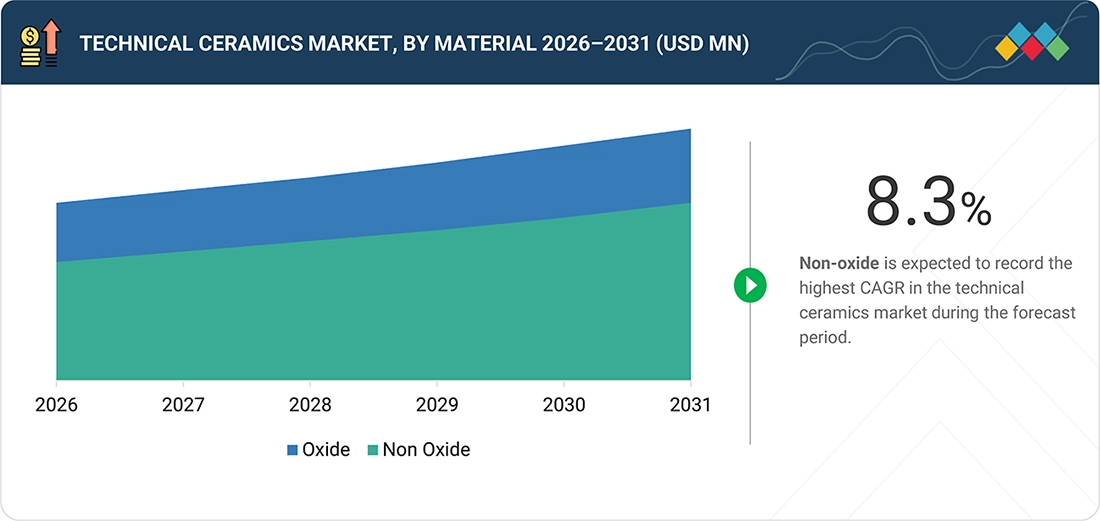
Source: Secondary Research, Interviews with Experts, MarketsandMarkets Analysis
Technical Ceramics Market, By Material
The technical ceramics market for oxide ceramics is the largest, which can lead to their extensive use, cost-effectiveness, and established manufacturing techniques. In the oxide ceramics category, alumina holds the largest market share, attributable to its favorable properties, including hardness, electrical insulation, thermal stability, and resistance to wear and corrosion. Alumina ceramics are widely used in many fields, including the automotive, medical, and electronics industries. They have numerous applications as substrates, insulators, and for wear resistance. Alumina ceramics have a relatively low cost compared with other advanced ceramics, and their ease of processing and readily available raw materials contribute to their largest market share in the oxide ceramics category.
Technical Ceramics Market, By Product Type
Due to the wide use across different industries, monolithic ceramics hold the highest share of the technical ceramics market. Monolithic ceramics provide consistent performance across material composition, mechanical strength, thermal, wear, and corrosion resistance. Their simple manufacturing techniques and cost benefits over other complex ceramics also contribute to the large-scale use of monolithic ceramics. Ceramic coatings and other product types are expected to witness the highest growth over the coming years due to their potential to improve component performance in terms of wear, heat, and corrosion resistance without compromising component weight. The growing need for performance improvements and longer component lifetimes in industries such as aerospace, automotive, and power generation is accelerating the use of ceramic coatings.
Technical Ceramics Market, By End-use Industry
In the end-use industry segment, the energy & power segment has been identified as the third-largest consumer of technical ceramics. This can be attributed to the significant use of these materials in power generation plants, electrical grids, and renewable power plants. The use of these materials in these areas is justified as they withstand high temperatures, provide electrical insulation, and perform well in adverse conditions. At the same time, the medical segment has also been identified as the fastest-growing segment in the technical ceramics market. This can be attributed to the significant use of these materials in implants, dentistry, and medical devices. These materials are biocompatible, durable, and can withstand adverse chemical reactions. These factors, along with the increase in investments in medical technology, has also contributed to the segmental growth.
REGION
Asia Pacific to be fastest-growing region in technical ceramics market during forecast period
The Asia Pacific region is expected to be the fastest-growing in technical ceramics market, driven by steady growth in manufacturing activity. The region has been further boosted by the steady growth in industrial activity. In this context, India has started to witness significant growth, establishing itself as the second-fastest-growing market. The growth in this market is linked to the growth of key industries such as electronics and renewable energy, as well as to the development of manufacturing activities. All these industries are witnessing significant growth in the country, which has further fueled the demand for technical ceramics.

TECHNICAL CERAMICS MARKET: COMPANY EVALUATION MATRIX
KYOCERA Corporation (Star) is a major manufacturer of technical ceramics. The company has regional R&D facilities and has developed a broad and fully integrated global manufacturing base. It has extensive experience with high-performance fine ceramics and offers its customers high-performance solutions for automotive, semiconductor, industrial, and healthcare markets. Through its extensive R&D investment and focus on material innovations, thermal management, reduction in size of technical ceramic components, and development of next-generation semiconductors and industrial ceramic components, it continues to grow its presence in the high-growth advanced manufacturing sectors. Elan Technology (Emerging Leader) is consistently expanding through continued investment in precision ceramic manufacturing capacity and development of engineered ceramic solutions based on customer applications. Elan Technology uses its application role based expertise to develop engineered ceramic blends and advanced component designs and to satisfy the increasing demand from medical product, aerospace, semiconductor, and industrial equipment markets.

Source: Secondary Research, Interviews with Experts, MarketsandMarkets Analysis
KEY MARKET PLAYERS
- KYOCERA Corporation(Japan)
- CoorsTek, Inc. (US)
- CeramTec GmbH (Germany)
- Morgan Advanced Materials plc (UK)
- Saint-Gobain Performance Ceramics & Refractories (France)
- 3M (US)
- Niterra Co., Ltd. (Japan)
- AGC Ceramics Co., Ltd. (Japan)
- Paul Rauschert GmbH & Co. KG. (Germany)
- Elan Technology (US)
- OC Oerlikon Management AG (Switzerland)
MARKET SCOPE
| REPORT METRIC | DETAILS |
|---|---|
| Market Size in 2025 (Value) | USD 13.08 BN |
| Market Forecast in 2031 (Value) | USD 20.27 BN |
| CAGR | 7.6% |
| Years Considered | 2023–2031 |
| Base Year | 2025 |
| Forecast Period | 2026–2031 |
| Units Considered | Value (USD MN/BN), Volume (Kiloton) |
| Report Coverage | Revenue forecast, company ranking, competitive landscape, growth factors, and trends |
| Segments Covered |
|
| Regions Covered | North America, Europe, Asia Pacific, South America, and the Middle East & Africa |
WHAT IS IN IT FOR YOU: TECHNICAL CERAMICS MARKET REPORT CONTENT GUIDE

DELIVERED CUSTOMIZATIONS
We have successfully delivered the following deep-dive customizations:
| CLIENT REQUEST | CUSTOMIZATION DELIVERED | VALUE ADDS |
|---|---|---|
| Asia Pacific-based technical ceramics manufacturer |
|
|
| Europe-based technical ceramics manufacturer |
|
|
RECENT DEVELOPMENTS
- September 2025 : Kyocera entered a collaboration with Kyoto Fusioneering to jointly develop advanced ceramics.
- August 2025 : Niterra Co., Ltd. completed its aacquisition of Toshiba Materials Co., Ltd., subsequently rebranding it as Niterra Materials Co., Ltd. The acquisition expands Niterra’s advanced ceramic materials capabilities.
- April 2025 : CeramTec expanded its medical ceramics manufacturing facility in Marktredwitz, Germany.
Table of Contents
 Exclusive indicates content/data unique to MarketsandMarkets and not available with any competitors.
Methodology
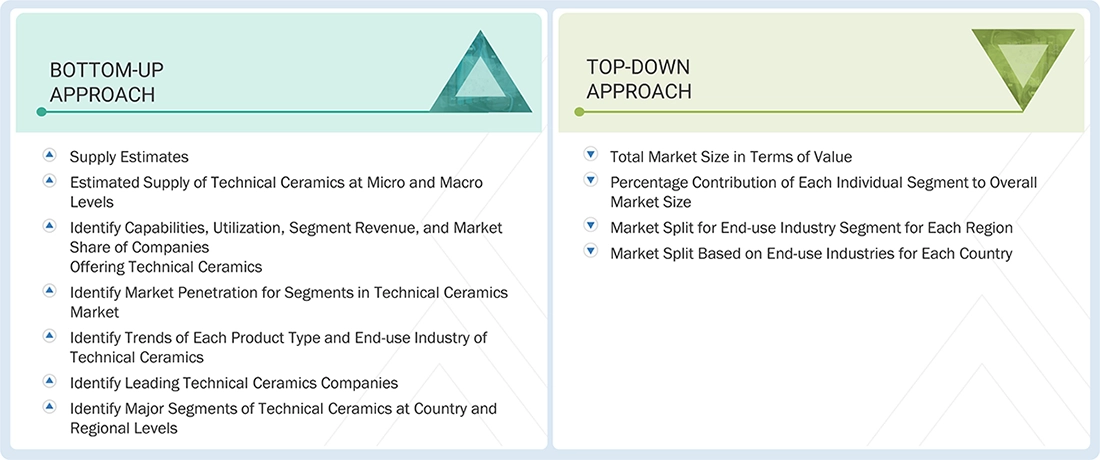
The study involved four major activities to estimate the current size of the global technical ceramics market. Exhaustive secondary research was carried out to collect information on the market, the peer product market, and the parent product group market. The next step was to validate these findings, assumptions, and sizes with the industry experts across the value chain of technical ceramics through primary research. The top-down and bottom-up approaches were employed to estimate the overall size of the technical ceramics market. After that, market breakdown and data triangulation procedures were used to determine the size of different segments and sub-segments of the market.
Secondary Research
The market for companies offering technical ceramics is arrived at by secondary data available through paid and unpaid sources, analyzing the product portfolios of major companies in the ecosystem, and rating the companies by their performance and quality. Various secondary sources, such as Business Standard, Bloomberg, the World Bank, and Factiva, were referred to identify and collect information for this study on the technical ceramics market.
In the secondary research process, various secondary sources were referred to identify and collect information related to the study. Secondary sources included annual reports, press releases, and investor presentations of door vendors, forums, certified publications, and whitepapers. The secondary research was used to obtain critical information on the industry’s value chain, the total pool of key players, market classification, and segmentation from the market and technology-oriented perspectives.
Primary Research
In the primary research process, various primary sources from the supply and demand sides were interviewed to obtain qualitative and quantitative information for this report. The primary sources from the supply side included industry experts, such as Chief Executive Officers (CEOs), Vice Presidents (VPs), marketing directors, technology and innovation directors, and related key executives from several key companies and organizations operating in the technical ceramics market.
After the complete market engineering (calculations for market statistics, market breakdown, market size estimations, market forecasting, and data triangulation), extensive primary research was conducted to gather information and verify and validate the critical numbers arrived at. Primary research was also conducted to identify the segmentation types, industry trends, competitive landscape of technical ceramics offered by various market players, and key market dynamics, such as drivers, restraints, opportunities, challenges, industry trends, and key player strategies.
In the complete market engineering process, the top-down and bottom-up approaches and several data triangulation methods were extensively used to perform the market estimation and market forecasting for the overall market segments and subsegments listed in this report. Extensive qualitative and quantitative analysis was performed on the complete market engineering process to list the key information/insights throughout the report.
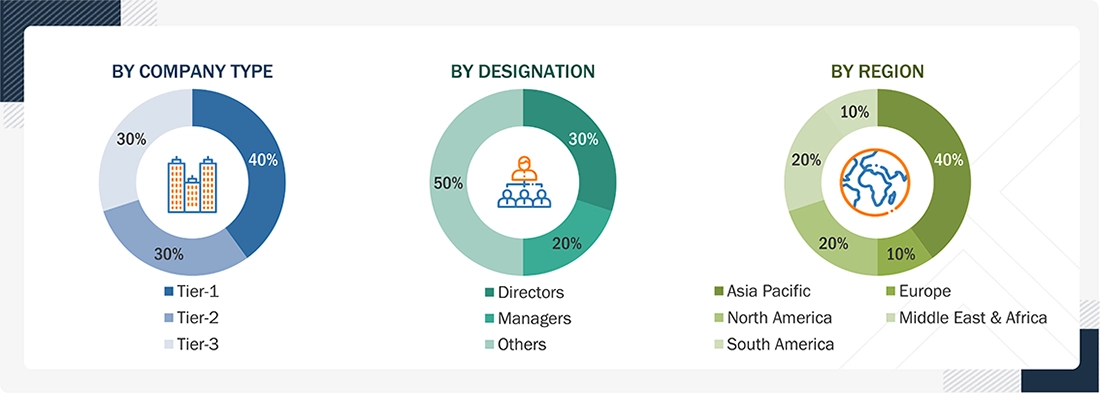
Notes: Other designations include sales, marketing, and product managers.
Tier 1: >USD 1 Billion; Tier 2: USD 500 million–1 Billion; and Tier 3: <USD 500 million.
To know about the assumptions considered for the study, download the pdf brochure
Market Size Estimation
The top-down and bottom-up approaches were used to estimate and validate the size of the global technical ceramics market. These approaches were also used extensively to estimate the size of various dependent market segments. The research methodology used to estimate the market size included the following:
Data Triangulation
After arriving at the overall market size using the market size estimation processes, the market was split into several segments and subsegments. The data triangulation and market breakup procedures were employed, wherever applicable, to complete the overall market engineering process and arrive at the exact statistics of each market segment and subsegment. The data was triangulated by studying various factors and trends from both the demand and supply sides.
Market Definition
Technical ceramics are based on the manufacture of technically sophisticated ceramic materials that have improved mechanical, thermal, electrical, chemical, and wear-resistant properties compared with other materials. Technical ceramics are produced using purified inorganic and non-metallic substances with extreme attention paid to the precision of the manufacturing process. This degree of control enables manufacturers to achieve consistent results in the manufacturing process and the resulting product. Oxides and non-oxides (e.g., alumina, zirconia, silicon carbide, silicon nitride, aluminum nitride, boron carbide, and titanates) comprise the two categories used as technical ceramic materials. Technical ceramics are useful in a combination of applications, from harsh environments to extremely high-performance applications to those requiring high strength. The technical ceramics market caters to different end-use industries, such as electronics/semi-conductors, automotive, aerospace/defense, medical devices, industrial equipment, energy, chemical processing, and telecommunications. In these industries, technical ceramics are used in components such as substrates, insulators, seals, bearings, cutting tools, wear parts, implant components, and thermal management systems.
Key Stakeholders
- Technical ceramics manufacturers
- Raw material suppliers
- Converters & processors
- Distributors and traders
- Industry associations and regulatory bodies
- End users
Report Objectives
- To define, describe, and predict the Big Data market by offering (by type, by deployment, and services), business function, data type, vertical, and region.
- To provide detailed information related to major factors (drivers, restraints, opportunities, and industry-specific challenges) influencing market growth
- To analyze opportunities in the market and provide details of the competitive landscape for stakeholders and market leaders
- To forecast the market size of segments with respect to five main regions: North America, Europe, Asia Pacific, the Middle East & Africa, and Latin America
- To analyze each submarket with respect to individual growth trends, prospects, and contributions to the overall Big Data market
- To analyze competitive developments, such as partnerships, new product launches, mergers & acquisitions, in the Big Data market
- To analyze the competitive developments, such as partnerships, product launches, mergers, and acquisitions, in the Big Data market
- To analyze the impact of macroeconomic factors on the Big Data market across all regions.
Available customizations:
With the given market data, MarketsandMarkets offers customizations according to client-specific needs.
The following customization options are available for the technical ceramics market report:
Product Analysis
- A product matrix that gives a detailed comparison of the product portfolio of each company
Regional Analysis
- A further breakdown of the technical ceramics market for additional countries
Company Information
- Detailed analysis and profiling of additional market players (up to five)


Personalize This Research
- Triangulate with your Own Data
- Get Data as per your Format and Definition
- Gain a Deeper Dive on a Specific Application, Geography, Customer or Competitor
- Any level of Personalization
Let Us Help You
- What are the Known and Unknown Adjacencies Impacting the Technical Ceramics Market
- What will your New Revenue Sources be?
- Who will be your Top Customer; what will make them switch?
- Defend your Market Share or Win Competitors
- Get a Scorecard for Target Partners

Custom Market Research Services
We Will Customise The Research For You, In Case The Report Listed Above Does Not Meet With Your Requirements
Get 10% Free CustomisationTESTIMONIALS

We at Nissan Chemicals Corporation have been clients of MarketsandMarkets for more than a year now. We recently consulted MarketsandMarkets for a study, the team at MarketsandMarkets was extremely professional and organized. The business insights were very detailed and aligned well with our expectations that really helped us formulate the Business Plans and device new strategies for development themes. MarketsandMarkets offers a unique combination of expertise and dedicated engagement model. Their research findings have helped us in designing our Pricing Strategy which will make it easier for us to predict the future sales and profits for the next ten years. We look forward to working with MarketsandMarkets in the future.
VP of Strategy & New Business Development
Leading Specialty Chemical Company
The MarketsandMarkets Engagement Model, composed of both the Knowledge Store and advisory custom research, has greatly helped us in understanding our markets and making strategic decisions. The Knowledge Store is a fast way to allow everyone in our organization to understand more about most any market they are interested in. The ability to then get custom research done and get answers to specific strategic questions and market insight has been spectacular. The Markets and Markets team feel more like colleagues than vendors and their services have helped us change our culture where statements of things like growth opportunities and competitive position are always backed by industry research.

Rich Gibson,
Director, Corporate Strategy
Milliken & Company,
Leading Industrial Manufacturer of specialty chemical, floor covering, performance and protective textile materials, and healthcaremilliken.com
MarketsandMarkets is a trusted resource that helps us to better understand markets that are near-adjacencies-whether its technology, value chain or geography. Their Knowledge Store platform provides a dashboard of markets and their characteristics which is easy to use and saves us time.
Adam Shaw,
Market Development and Strategy Manager
AdvanSix Inc. USA,
An American Leader in Chemicalswww.advansix.com
The Knowledge Store from MarketsandMarkets is a valuable tool which has helped my team acquire greater insight in to the end markets that our business serves. This has enabled us to help our company build stronger strategies throughout our planning process.
TOSHIO KINOSHITA
Senior Chif Consultion Research & Consulting Division
Mitsubishi Chemical Research Corporation,
Leading Manufacturer of Chemical Productswww.mitsubishichem-res.co.jp/en/

We recently engaged with MarketsandMarkets for a study, the team not only clearly understood our business objectives but was also extremely professional in the way they handled the entire project. The study was efficiently conducted in a phase-wise manner, and the engagement model furnished us with high-quality business insights that far exceeded our expectations at each phase. We were especially happy that MarketsandMarkets could provide us with both, an English as well as a Japanese version of the study. A special thanks to the Analyst Team and Client Services Team, whose fluency in Japanese enhanced our comfort level, as we could converse with them in our preferred language.
Independent entrepreneurs
Arrow Precision
We approached MarketsandMarkets for study on Proppants Market, and their work exceeded our expectations. The study conducted was comprehensive and enabled us to view the market through the various dimensions. In addition, the team was extraordinarily responsive throughout the process and resolved our queries on time. I strongly recommend MarketsandMarkets and will certainly consider them for additional market assessments we will need in the future.
Global engineering company, Japan
Deputy Manager,
Strategic Planning OfficeThe high-quality insights shared by the MarketsandMarkets team helped us understand the pharmaceutical plant designers in a specific geography. It also captured the risks that we may likely face in communicating with our potential partners. The study would enable us identify partners, which would impact our future growth.
- US Technical Ceramics Market
- CANADA Technical Ceramics Market
- MEXICO Technical Ceramics Market
- GERMANY Technical Ceramics Market
- FRANCE Technical Ceramics Market
- SPAIN Technical Ceramics Market
- UK Technical Ceramics Market
- ITALY Technical Ceramics Market
- CHINA Technical Ceramics Market
- JAPAN Technical Ceramics Market
- INDIA Technical Ceramics Market
- SOUTH KOREA Technical Ceramics Market
- SOUTH AFRICA Technical Ceramics Market
- BRAZIL Technical Ceramics Market
- ARGENTINA Technical Ceramics Market
Growth opportunities and latent adjacency in Technical Ceramics Market






Gaurang
May, 2016
Interested in this report..
Papantonopoulos
Feb, 2015
Data on innovative technology commercialization in Technical Ceramics segment in the Eastern Europe..
Edith
Apr, 2015
Detail raw material and value chain analysis in Technical Ceramics industry segment..