Trainer Aircraft Market Size & Growth

Trainer Aircraft Market by Aircraft Type (Fixed-Wing, Rotary-Wing), Propulsion Type (Conventional Fuel-Powered Trainers, Electrified Trainers), Seat Configuration, End User, and Region - Global Forecast to 2032




TRAINER AIRCRAFT MARKET OVERVIEW
According to Marketsandmarkets, the Trainer Aircraft Market Size is projected to grow from USD 13.82 billion in 2026 to USD 21.22 billion by 2032, growing at a CAGR of 7.4% from 2026 to 2032. In terms of volume, deliveries are expected to increase from 1,598 units in 2026 to 2,192 units by 2032. The market is gaining momentum as civil and military operators expand their pilot-training capacity, retire older training fleets, and invest in modern aircraft for structured pilot development. Demand is further supported by the adoption of glass cockpits, advanced avionics, enhanced safety systems, and training platforms that prepare pilots for commercial aviation, rotary-wing missions, and frontline military operations.
MARKET SCOPE
| REPORT METRIC | DETAILS |
|---|---|
| Market Size in 2025 | USD 13.39 Billion |
| Market Size in 2026 | USD 13.82 Billion |
| Market Forecast in 2032 | USD 21.22 Billion |
| CAGR | 7.4% |
| Years Considered | 2021–2032 |
| Base Year | 2025 |
| Forecast Period | 2026–2032 |
| Units Considered | Value (USD Billion/Million)/Volume (Units) |
| Report Coverage | Revenue and Volume Forecast, Company Ranking, Competitive Landscape, Growth Factors, and Trends |
| Top Companies |
|
| Growth Drivers |
|
| Segments Covered |
|
| Regions Covered | North America, Europe, Asia Pacific, Latin America, Middle East, and Africa |
KEY TRAINER AIRCRAFT MARKET TAKEAWAYS
-
By RegionAsia Pacific is expected to register the highest CAGR during the forecast period.
-
By Aircraft TypeBy aircraft type, the fixed-wing trainer aircraft segment is projected to register the largest market share, over 90%, during the forecast period.
-
By Propulsion TypeBy propulsion type, electrified trainers are expected to have the highest CAGR of 9.1% during the forecast period.
-
By Seat ConfigurationsBy seat configuration, the two-seats segment is estimated to account for 57.2% market share in 2026.
-
Competitive Landscape - Key CompaniesMajor trainer aircraft manufacturers are pursuing product upgrades, defence procurement programmes, partnerships with flight-training institutions, and regional distribution agreements to expand their market presence. Companies such as Textron Aviation, Pilatus Aircraft, Leonardo S.p.A., Diamond Aircraft Industries, and Airbus Helicopters are strengthening their positions through advanced aircraft platforms, wider training applications, and participation in civil and military fleet-modernization initiatives.
-
Competitive Landscape - Startups/SMEsSpecialized and mid-sized manufacturers such as Evektor Aircraft, Zlin Aircraft, Flight Design, Bye Aerospace, and Dynali Helicopter Company are building relevance through niche trainer platforms, lower operating-cost aircraft, electric aviation developments, and tailored solutions for flight schools, private academies, and regional training operators.
The Trainer Aircraft Industry is being supported by the need to expand civil and military pilot pipelines, replace aging training fleets, and strengthen flight-training capacity across aviation academies and defense forces. Demand is also increasing for aircraft with glass cockpits, modern avionics, improved safety features, and training capabilities that better prepare pilots for airline, helicopter, and frontline military operations.
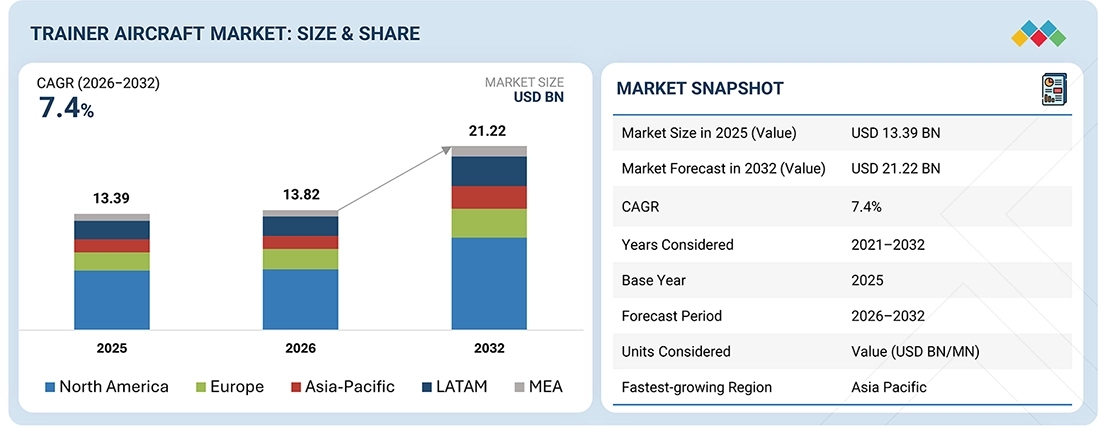
Source: Secondary Research, Interviews with Experts, MarketsandMarkets Analysis
TRENDS & DISRUPTIONS IMPACTING CUSTOMERS' CUSTOMERS
Trainer aircraft market dynamics are shifting from traditional one-purpose aircraft with basic equipment to more intelligent machines that will enhance the effectiveness of the training process, increase efficiency, and prepare pilots for better performance. Demand drivers in the future will be glass cockpits, mission-training integration, simulation, real-time recording of flight data, safety technologies, and clean propulsion solutions. More and more civil academies, airline training centers, air forces, helicopter operators, law enforcement agencies, and OEMs are looking for aircraft that will perform multiple phases of training, saving on fuel consumption, operation costs, complexity of the fleet, and reducing the time of preparation of pilots to fly on operational aircraft. Major trends include electric and hybrid electric trainers for initial training, cockpit commonality with high-technology aircraft, flexible turboprops, better arrangement of the cockpit between instructor and trainee, and connected solutions for aircraft and pilot performance evaluation.
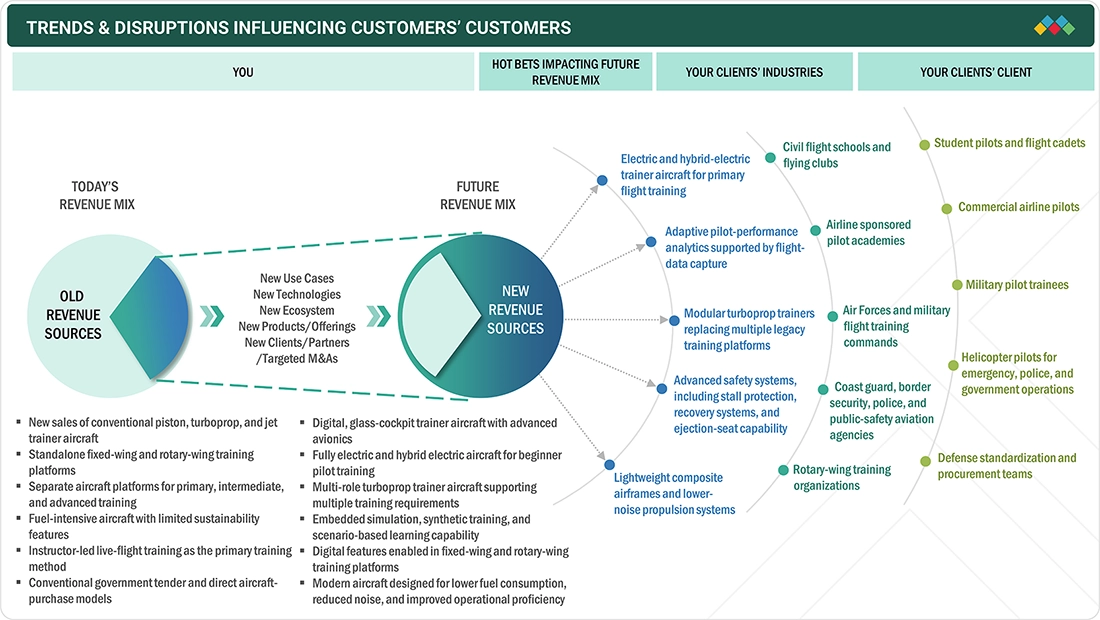
Source: Secondary Research, Interviews with Experts, MarketsandMarkets Analysis
TRAINER AIRCRAFT MARKET DYNAMICS

Level
-
Growing demand for military pilot training driven by increasing defense modernizations

-
Growth in global commercial aviation leading to increase in pilot training requirements


Level
-
High acquisition and lifecycle cost of advanced trainer aircraft

-
Lengthy Procurement Cycles and Defense Budget Constraints


Level
-
Development of hybrid-electric and sustainable trainer aircraft

-
Rising demand for indigenous aerospace manufacturing and technology transfer


Level
-
Increasing complexity in aligning trainer aircraft with modern fighter training requirements

-
Maintaining aircraft availability amid increasing fleet utilization

Source: Secondary Research, Interviews with Experts, MarketsandMarkets Analysis
Driver: Growing demand for military pilot training driven by increasing defense modernizations
Rising trends in defense modernization efforts are driving the demand for skilled military pilots. There is rising investment by air forces in modern fleets of trainers in order to train pilots for combat, transport, surveillance, and rotary-wing missions.
Restraint: High acquisition and lifecycle cost of advanced trainer aircraft
The high cost of acquisition, maintenance, and operations of modern trainer aircraft can be a limitation in their procurement, especially for smaller air forces, flight schools, and government organizations that are financially constrained.
Opportunity:Development of hybrid-electric and sustainable trainer aircraft
Hybrid-electric and sustainable trainer aircraft present opportunities to cut fuel costs, emissions, and overall operating costs. These types of planes may become popular for primary flight training in civil aviation with further advancements in technology and certifications.
Challenge:Increasing complexity in aligning trainer aircraft with modern fighter training requirements
Current fighters employ very complex avionics, mission systems, and controls; therefore, it is not easy to mimic their behavior at an affordable price level using trainer aircraft.
TRAINER AIRCRAFT MARKET: COMMERCIAL USE CASES ACROSS INDUSTRIES
| COMPANY | USE CASE DESCRIPTION | BENEFITS |
|---|---|---|
 |
HAL enhances training of military pilots with domestically manufactured HTT-40 and HJT-36 Yashas trainers. The aircraft are configured to provide basic training and enhance pilot capabilities. | Boosts native pilot training program | Encourages self-sustainability in military flight training | Allows streamlined approach for developing from basic to intermediate flight training |
 |
The company develops advanced military trainer aircraft, including the L-39 Skyfox, to support various training levels for defense. Its aircraft helps in smoother transition of rookies to advanced modern aircraft through necessary training impartation. | Aids in the training of military pilots at various levels| Converts military pilots for first line fighter aircraft, | Enhances the skills in tactical flying, formation flying and weapons training | Reduces expenses by employing dedicated trainer aircraft instead of front-line combat aircraft |
 |
Pilot training for military environment is facilitated by trainer helicopters, namely, H125. H135 and H145. These helicopters are used by armed forces for basic training and advanced pilot instructions. Such platforms helps cadets to develop required flying skills. | Provides required rotary-wing training for pilots | Facilitates smooth transition to operational military helicopters | Standardizes training across defense organizations | Improves availability of fleet through full lifecycle support |
Logos and trademarks shown above are the property of their respective owners. Their use here is for informational and illustrative purposes only.
TRAINER AIRCRAFT MARKET ECOSYSTEM
The trainer aircraft market ecosystem consists of aircraft manufacturers, system suppliers, training organizations, procurement organizations, and customers. Aircraft manufacturers like Textron Aviation, Pilatus Aircraft, Leonardo S.p.A., Diamond Aircraft Industries, Airbus Helicopters, and Robinson Helicopter Company provide newly built fixed-wing and rotary-wing aircraft to be used in training civil and military pilots. These aircraft include engines, propellers/rotors, avionics, control systems, landing gear, safety systems, instructor and trainee seating systems, as well as training systems provided by specialist aerospace organizations. These aircraft are used by flight schools, airline training academy, air force training command, helicopter training center, police aviation, coast guard and other government agencies for ab initio, basic, intermediate, advanced, and conversion training. Other members of the ecosystem include simulator companies, aircraft dealers, finance/leasing companies, regulatory and certification organizations, defense procurement organizations, maintenance organizations, and spare parts suppliers.
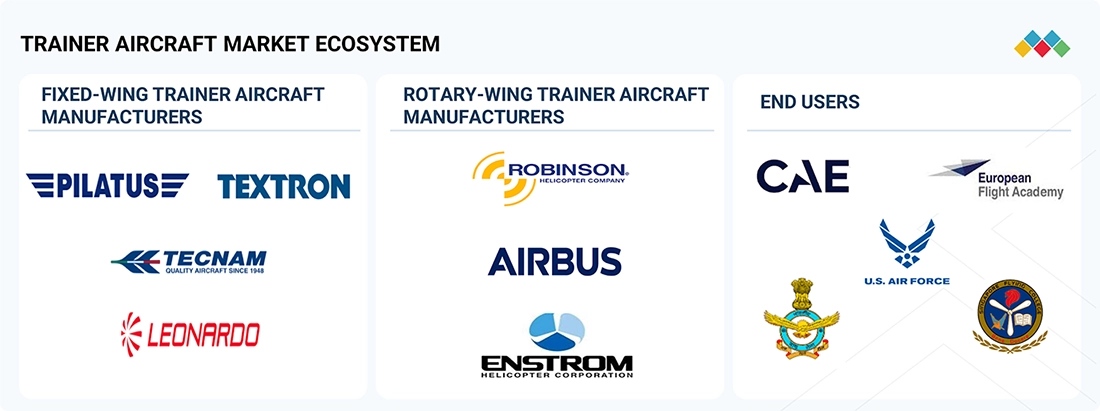
Logos and trademarks shown above are the property of their respective owners. Their use here is for informational and illustrative purposes only.
TRAINER AIRCRAFT MARKET SEGMENTS
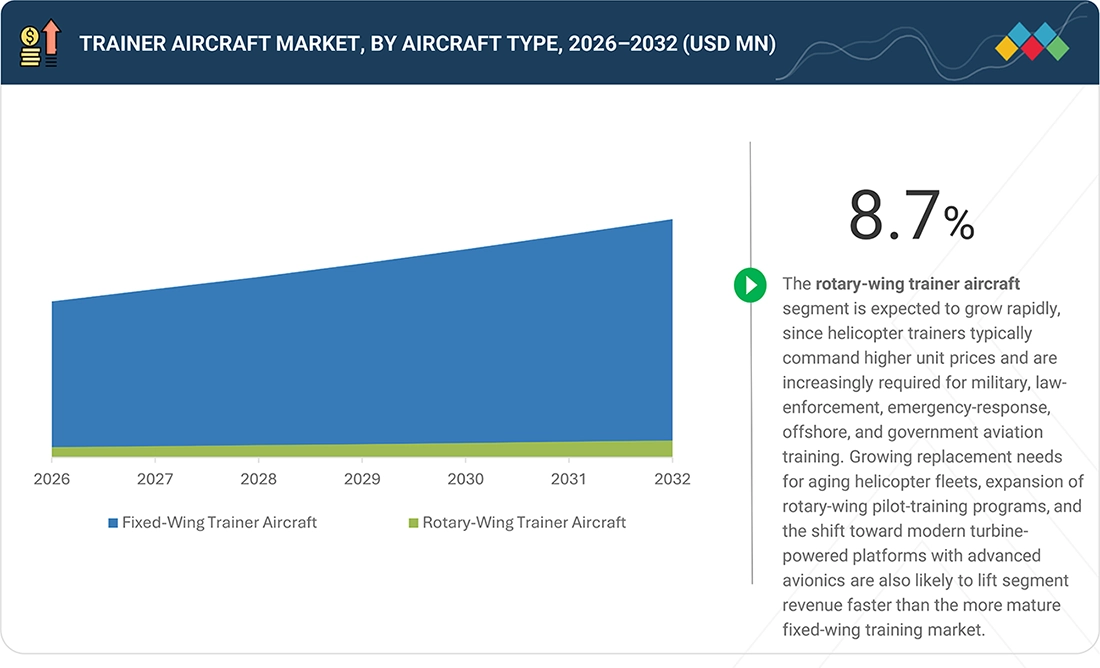
Source: Secondary Research, Interviews with Experts, MarketsandMarkets Analysis
Trainer Aircraft Market, By Aircraft Type
The market is categorized based on fixed-wing trainer aircraft and rotary-wing trainer aircraft. The former category of aircraft finds extensive application in primary, basic, intermediate, and advanced pilot-training courses, while the latter category finds application in pilot training for helicopters.
Trainer Aircraft Market, By Propulsion Type
The market includes conventional and electrified trainer aircraft. Conventionally fueled platforms, such as piston, turboprop, turbine, and jet-powered platforms, dominate the market, while electrified platforms, such as electric and hybrid platforms, are gaining popularity in civil entry-level training due to lower consumption of fuel, operating costs, and emissions.
Trainer Aircraft Market, By Seat Configuration
Trainer aircraft are segmented into single-seaters, two-seaters, three-to four-seaters, and other seat-configuration aircraft. Among these types of aircraft, two-seater aircraft are important in pilot training, as they offer instructors a chance to guide the pilot during live flight lessons.
Trainer Aircraft Market, By End User
Main end users include civil flight schools, airline academies, military organizations, government organizations, law enforcement organizations, private flying organizations, and individuals. Demand from these different end users varies according to their objectives, with civil users concerned with pilot certification and the airline pathway, while military and government organizations purchase them for training purposes.
TRAINER AIRCRAFT MARKET REGION
Asia Pacific to be fastest-growing region in trainer aircraft market during forecast period
The Asia Pacific region is likely to witness the fastest growth in the trainer aircraft segment because it is both developing its civilian aviation sector and building its military pilot training pipeline. The growing order book of major airlines and the booming domestic air traffic have resulted in the necessity for the recruitment of more new civilian pilots, and this is driving the acquisition of entry-level and multi-engine fleets by airlines and civilian academies. On the other hand, countries such as India, China, South Korea, Indonesia, Japan, and Australia are developing their aerospace industries, replacing old military trainers, and improving their training facilities for jet, turboprop, and helicopter training.
TRAINER AIRCRAFT MARKET: COMPANY EVALUATION MATRIX
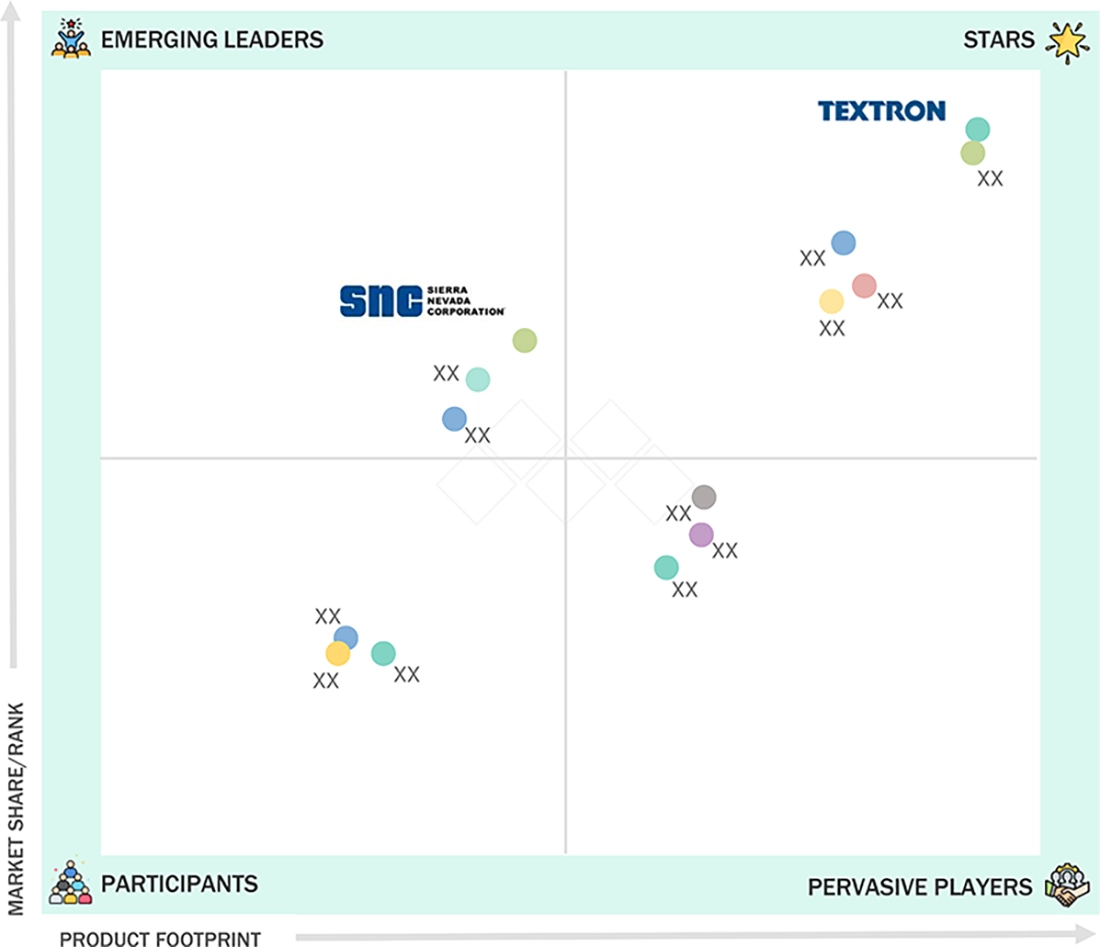
In the trainer aircraft market matrix, Textron Aviation (Star) can be positioned strongly because of its presence across both civil and military pilot-training requirements. Its portfolio combines the Cessna Skyhawk, widely used for entry-level flight instruction, with the Beechcraft T-6C, a military trainer designed for training stages from pilot screening to advanced operational instruction. This gives Textron a broad customer base, a substantial installed fleet, and reach across civil aviation academies and Air Force training programs.
Source: Secondary Research, Interviews with Experts, MarketsandMarkets Analysis
KEY TRAINER AIRCRAFT MARKET PLAYERS
List of Top Trainer Aircraft Market Companies
- Textron Inc. (US)
- Pilatus Aircraft (Switzerland)
- Leonardo S.p.A (Italy)
- Hindustan Aeronautics Limited (India)
- Turkish Aerospace industries (Turkey)
- Hongdu Aviation Industry Group (China)
- Tecnam S.p.A (Italy)
- Diamond Aircraft Industries (Austria)
- Piper Aircraft (US)
- Cirrus Aircraft (US)
- Airbus SE (France)
- Robinson Aircraft Company (US)
- Enstrom Helicopter Corporation (US)
- AERO Vodochody AEROSPACE as (Czech Republic)
- Russian Helicopters (Russia)
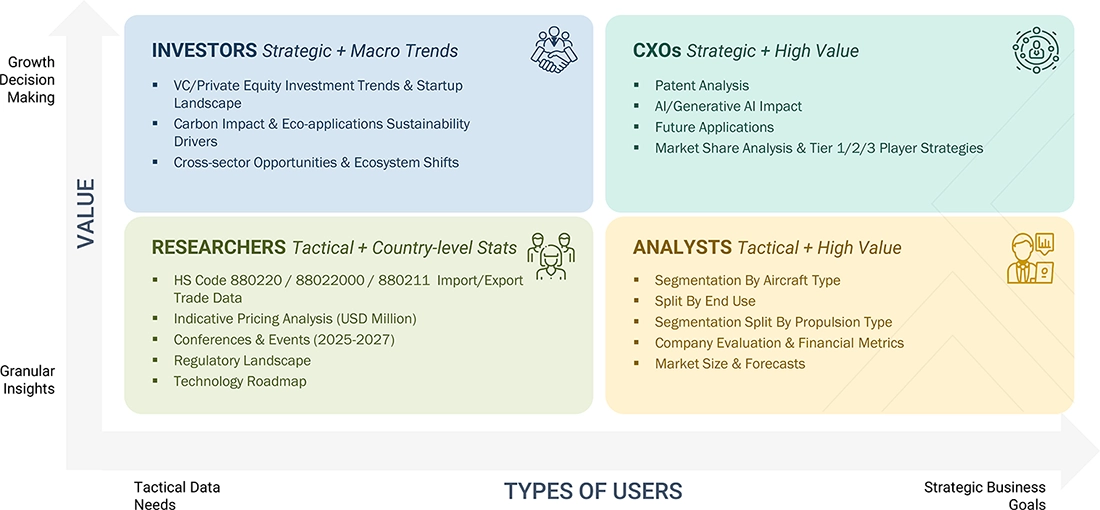
WHAT IS IN IT FOR YOU: TRAINER AIRCRAFT MARKET REPORT CONTENT GUIDE
DELIVERED CUSTOMIZATIONS
We have successfully delivered the following deep-dive customizations:
| CLIENT REQUEST | CUSTOMIZATION DELIVERED | VALUE ADDS |
|---|---|---|
| Leading Manufacturer | Additional segment breakdown for countries | Additional country-level market sizing tables for segments/subsegments covered at the regional/global level to gain an understanding of market potential by each country |
| Emerging Leader | Additional company profiles | Competitive information on targeted players to gain granular insights into direct competition |
| Regional Market Leader | Additional country market estimates | Additional country-level deep dive for a more targeted understanding of the total addressable market |
RECENT DEVELOPMENTS
- May 2026 : Canada’s ITPS ordered six M-346 T Block 20 lead-in fighter trainers from Leonardo, with options for another six. The aircraft are planned to enter service at ITPS’s North Bay tactical-training centre from 2029, supporting training demand from multiple international air forces. This is significant because it expands M-346 beyond direct government procurement into the outsourced tactical-training services model.
- April 2026 : Textron received a renewed five-year sustaining engineering and programme-management contract for more than 700 T-6 aircraft. This reinforces the company’s recurring aftermarket, fleet availability, engineering, and lifecycle-support business.
- November 2025 : Belgium selected the PC-7 MKX Training System, comprising 18 aircraft, an integrated ground-based training system, and a 20-year training-service contract. Deliveries are planned to begin in 2027 from Pilatus Aircrafts.
Table of Contents
 Exclusive indicates content/data unique to MarketsandMarkets and not available with any competitors.
Methodology
The study involved four key activities to estimate the current size of the trainer aircraft market. Extensive secondary research was undertaken to collect information on the trainer aircraft market, related markets, and the broader parent market. The findings, assumptions, and preliminary market estimates were then validated through primary interviews with industry experts across the value chain. A demand-side analysis was conducted to determine the overall market size. Finally, data triangulation was used to estimate the size of individual segments and subsegments within the trainer aircraft market.
Secondary Research
During the secondary research phase, a wide range of sources was reviewed to identify and gather relevant information for the study. These sources included government databases such as SIPRI; corporate publications, including annual reports; industry trade associations such as the General Aviation Manufacturers Association (GAMA); press releases and investor presentations; white papers, journals, and certified publications; as well as articles from recognized authors and industry experts, and databases.
Primary Research
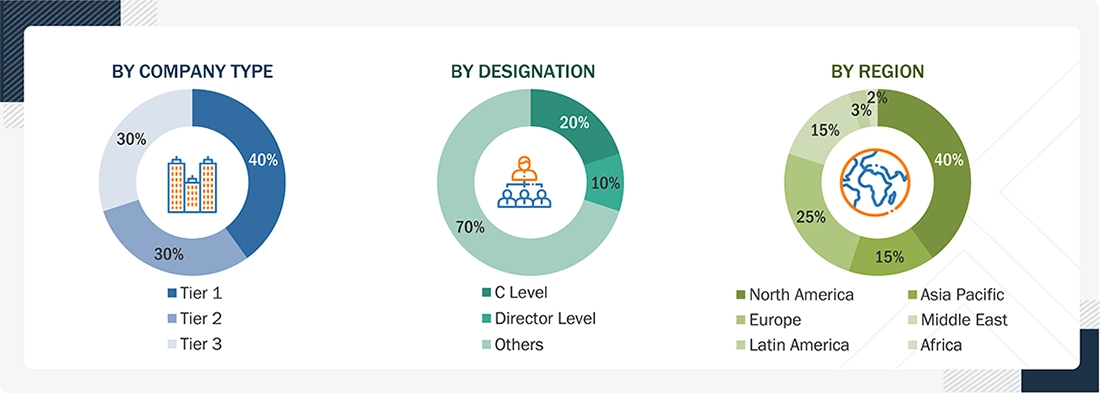
Extensive primary research was carried out after collecting initial market information through secondary sources. Several interviews were conducted with market experts representing both the demand and supply sides across key countries in North America, Europe, Asia Pacific, the Middle East, Latin America, and Africa. Primary information was gathered through questionnaires, email interactions, and telephonic interviews.
To know about the assumptions considered for the study, download the pdf brochure
Market Size Estimation
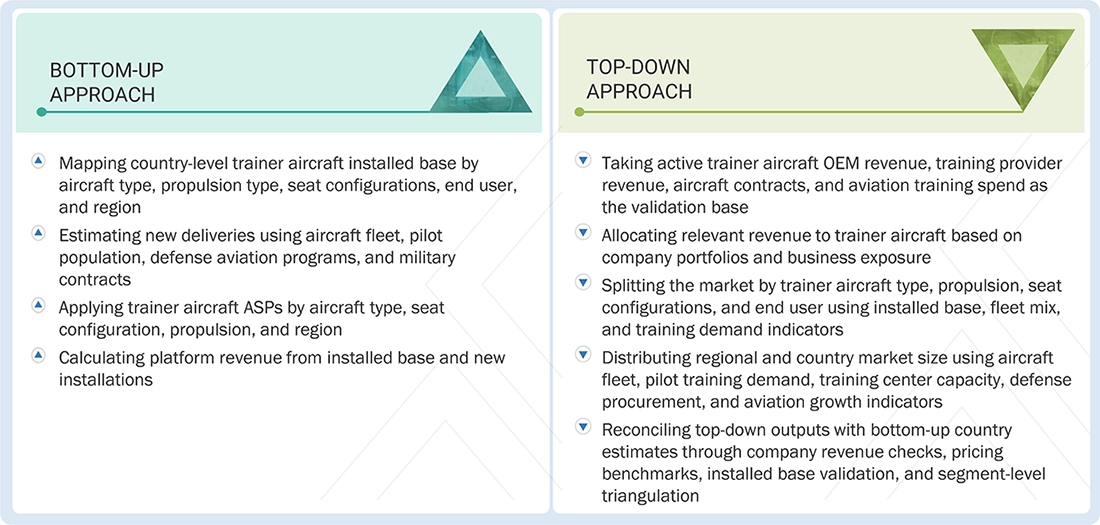
Top-down and bottom-up approaches were used to estimate and validate the size of the Trainer Aircraft market. The research methodology used to estimate the size of the market included the following details:
- Key players in the trainer aircraft market were identified through secondary research, and their market shares were determined through a combination of primary and secondary research. This included a study of the annual and financial reports of the top market players, as well as extensive interviews with leaders, including directors, engineers, marketing executives, and other key stakeholders of leading companies operating in the market.
- All percentage shares, splits, and breakdowns were determined using secondary sources and verified through primary sources.
- All possible parameters that affect the markets covered in this research study were accounted for, viewed in extensive detail, verified through primary research, and analyzed to obtain the final quantitative and qualitative data on the trainer aircraft market. This data was consolidated, enhanced with detailed input, analyzed by MarketsandMarkets, and presented in this report.
Trainer Aircraft Market : Top-Down and Bottom-Up Approach
Data Triangulation
After estimating the overall market size, the market was categorized into multiple segments and subsegments. The data triangulation and market breakdown methods described below were applied, wherever relevant, to complete the market engineering process and derive estimated values for each market segment and subsegment. The data was triangulated by assessing key factors and trends across both demand- and supply-side perspectives. In addition, the market estimates were cross-validated using top-down and bottom-up approaches.
Market Definition
The TRAINER AIRCRAFT MARKET includes the sale of newly manufactured fixed-wing and rotary-wing aircraft designed or configured for civil, military, government, and law-enforcement pilot training. It covers piston, turboprop, jet engine, and turbine-powered platforms used across primary, basic, advanced, and lead-in fighter training stages.
Key Stakeholders
- Trainer Aircraft OEMs
- Helicopter OEMs
- Aircraft Engine, Avionics, and Component Suppliers
- Flight Training Schools and Aviation Academies
- Military Training Commands and Air Forces
- Civil Aviation, Government, and Law Enforcement Agencies
- Defense Procurement and Aircraft Acquisition Agencies
- Aircraft Dealers and Distributors
- Simulator and Integrated Training Solution Providers
- Regulatory and Certification Bodies
Report Objectives
- To define, describe, and forecast the trainer aircraft market based on aircraft type, propulsion type, seat configuration, end user, and region in terms of value and volume
- To forecast the size of various segments of the market across North America, Europe, Asia Pacific, Latin America, the Middle East, and Africa in terms of value and volume
- To identify and analyze the drivers, restraints, opportunities, and challenges influencing the growth of the market
- To identify industry trends, market trends, and technology trends currently prevailing in the market
- To provide an overview of the regulatory landscape with respect to trainer aircraft across regions
- To analyze micro markets with respect to individual growth trends, prospects, and their contribution to the overall market
- To analyze opportunities in the market for stakeholders by identifying key market trends
- To profile key market players and comprehensively analyze their market share and core competencies
- To evaluate the degree of competition in the market by analyzing recent developments, such as contracts, agreements, and acquisitions adopted by leading market players
- To identify detailed financial positions, key products, and unique selling points of leading companies in the market
- To provide a detailed competitive landscape of the market, along with market share analysis and revenue analysis of key players
Available customizations:
MarketsandMarkets offers the following customizations for this market report:
- Additional country-level analysis of the trainer aircraft market
- Profiling of other market players (up to 5)
Product Analysis
- Product matrix, which provides a detailed comparison of the product portfolios of each company in the trainer aircraft market
Key Questions Addressed by the Report
How large is the global trainer aircraft market expected to become by 2032?
According to MarketsandMarkets, the global trainer aircraft market is projected to grow from USD 13.82 billion in 2026 to USD 21.22 billion by 2032, registering a CAGR of 7.4%. In terms of volume, aircraft deliveries are expected to increase from 1,598 units in 2026 to 2,192 units by 2032.
What are the primary factors driving the growth of the trainer aircraft market?
The market is driven by expanding civil and military pilot training programs, replacement of aging trainer fleets, defense modernization initiatives, rising demand for commercial airline pilots, and increasing adoption of aircraft equipped with glass cockpits, advanced avionics, enhanced safety systems, and mission-oriented training capabilities.
Which region is expected to experience the fastest growth in the trainer aircraft market?
Asia Pacific is expected to be the fastest-growing regional market, driven by expanding commercial aviation, increasing airline pilot demand, modernization of military training fleets, and investments in aviation infrastructure across countries such as India, China, Japan, South Korea, Indonesia, and Australia.
Which aircraft type dominates the trainer aircraft market?
Fixed-wing trainer aircraft dominate the market, accounting for more than 90% of total market share during the forecast period. They are extensively used for primary, basic, intermediate, and advanced pilot training across both civil aviation academies and military air forces.
Which propulsion technology is expected to grow the fastest?
Electrified trainer aircraft are projected to register the highest CAGR of 9.1%, driven by growing interest in reducing fuel consumption, lowering operating costs, minimizing emissions, and supporting sustainable pilot training programs, particularly for entry-level civil aviation.
Why do two-seat trainer aircraft account for the largest market share?
Two-seat trainer aircraft are preferred because they allow instructors to supervise and guide trainees during live flight instruction. Their configuration supports safe pilot development, real-time coaching, and efficient transition through different stages of flight training.
What major opportunity is emerging for trainer aircraft manufacturers?
The development of hybrid-electric and fully electric trainer aircraft presents significant growth opportunities by reducing fuel costs, operating expenses, and emissions while supporting sustainable aviation initiatives and modern flight school requirements.
What is the biggest challenge facing the trainer aircraft industry?
A major challenge is designing trainer aircraft capable of realistically replicating the advanced avionics, mission systems, and operational complexity of modern fighter aircraft while maintaining affordability for military organizations and flight training institutions.
How are technology trends transforming modern trainer aircraft?
The industry is adopting glass cockpits, integrated simulation systems, mission-training software, real-time flight data recording, connected aircraft analytics, hybrid-electric propulsion, cockpit commonality with frontline aircraft, and AI-enabled pilot performance evaluation to improve training effectiveness and reduce operational costs.
Which companies are recognized as leading players in the global trainer aircraft market?
Major companies include Textron Inc., Pilatus Aircraft, Leonardo S.p.A., Hindustan Aeronautics Limited (HAL), Turkish Aerospace Industries, and Hongdu Aviation Industry Group. Textron Aviation is recognized as a Star player due to its extensive portfolio spanning both civil pilot training aircraft, such as the Cessna Skyhawk, and military trainer platforms like the Beechcraft T-6C, serving aviation academies and defense organizations worldwide.


Personalize This Research
- Triangulate with your Own Data
- Get Data as per your Format and Definition
- Gain a Deeper Dive on a Specific Application, Geography, Customer or Competitor
- Any level of Personalization
Let Us Help You
- What are the Known and Unknown Adjacencies Impacting the Trainer Aircraft Market
- What will your New Revenue Sources be?
- Who will be your Top Customer; what will make them switch?
- Defend your Market Share or Win Competitors
- Get a Scorecard for Target Partners

Custom Market Research Services
We Will Customise The Research For You, In Case The Report Listed Above Does Not Meet With Your Requirements
Get 10% Free CustomisationTESTIMONIALS
- Canada Trainer Aircraft Market
- US Trainer Aircraft Market
- Czech Republic Trainer Aircraft Market
- France Trainer Aircraft Market
- Germany Trainer Aircraft Market
- Italy Trainer Aircraft Market
- Switzerland Trainer Aircraft Market
- UK Trainer Aircraft Market
- Australia Trainer Aircraft Market
- India Trainer Aircraft Market
- Indonesia Trainer Aircraft Market
- Japan Trainer Aircraft Market
- South Korea Trainer Aircraft Market
- Thailand Trainer Aircraft Market
- Argentina Trainer Aircraft Market
- Brazil Trainer Aircraft Market
- Mexico Trainer Aircraft Market
- Israel Trainer Aircraft Market
- Nigeria Trainer Aircraft Market
- Saudi Arabia Trainer Aircraft Market
- South Africa Trainer Aircraft Market
- Turkey Trainer Aircraft Market
- UAE Trainer Aircraft Market
- Rest Of Europe Trainer Aircraft Market
- Rest Of Asia Pacific Trainer Aircraft Market
- Rest Of Latam Trainer Aircraft Market
- Rest Of Africa Trainer Aircraft Market
- Rest Of Middle East Trainer Aircraft Market






Growth opportunities and latent adjacency in Trainer Aircraft Market