US Content Delivery Network Market

US Content Delivery Network Market by Offering [Solutions (Web Performance Optimization, Media Delivery, Cloud Security) & Services], Content Type (Static & Dynamic), Application Area (Media & Entertainment, Online Gaming) - Forecast to 2030




OVERVIEW
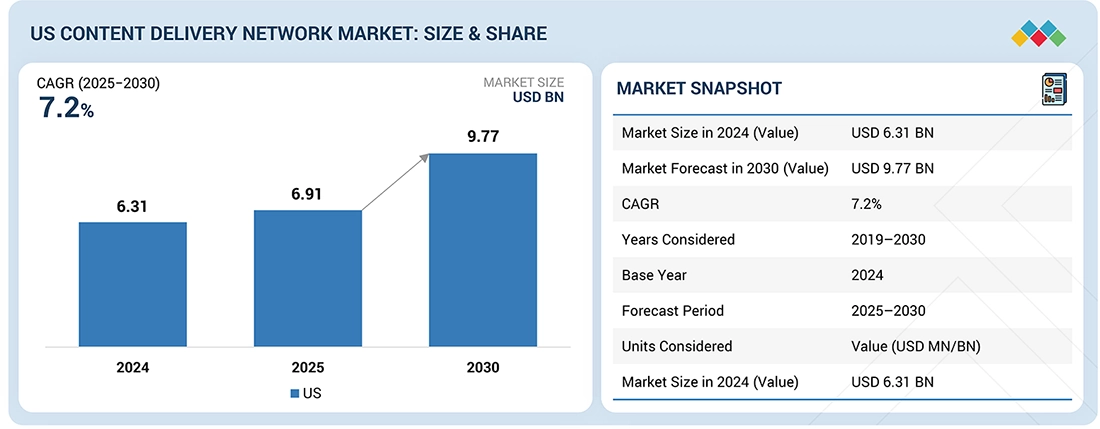
Source: Secondary Research, Interviews with Experts, MarketsandMarkets Analysis
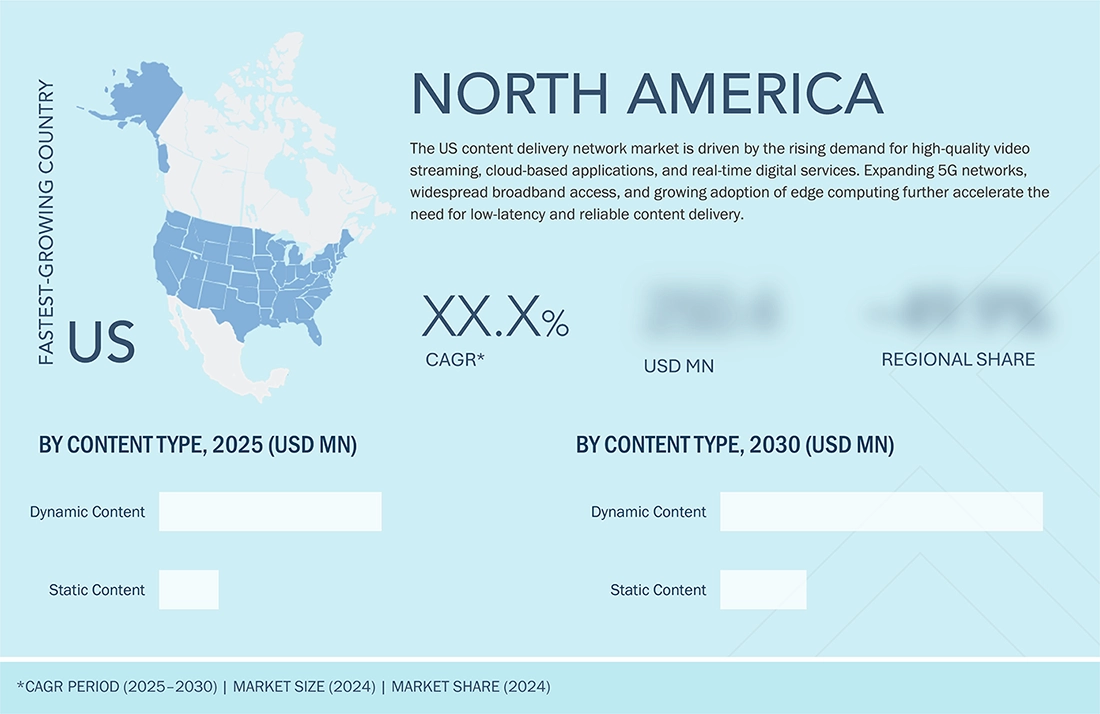
The US content delivery network market is estimated to reach USD 6.91 billion in 2025 and USD 9.77 billion by 2030, registering a CAGR of 7.2% during the forecast period. This market is driven by the mounting adoption of cloud technologies and the focus on digitized customer-facing operations. Broad broadband availability, expanding 5G coverage, and steady demand for real-time digital services continue to reinforce content delivery network (CDN) adoption. Many US digital platforms serve users spread across regions, making consistent performance and low latency operational requirements rather than competitive advantages.
KEY TAKEAWAYS
-
By Content TypeThe dynamic content type segment is expected to register the highest CAGR of 7.6% between 2025 and 2030.
-
By OfferingThe solution segment is expected to register the largest market share of 83.5% in 2025
-
By Provider TypeThe P2P CDN segment is projected to grow at the fastest rate from 2025 to 2030.
-
By Application AreaBy application area, the media and entertainment segment is projected to represent a 28.6% share of the total market.
-
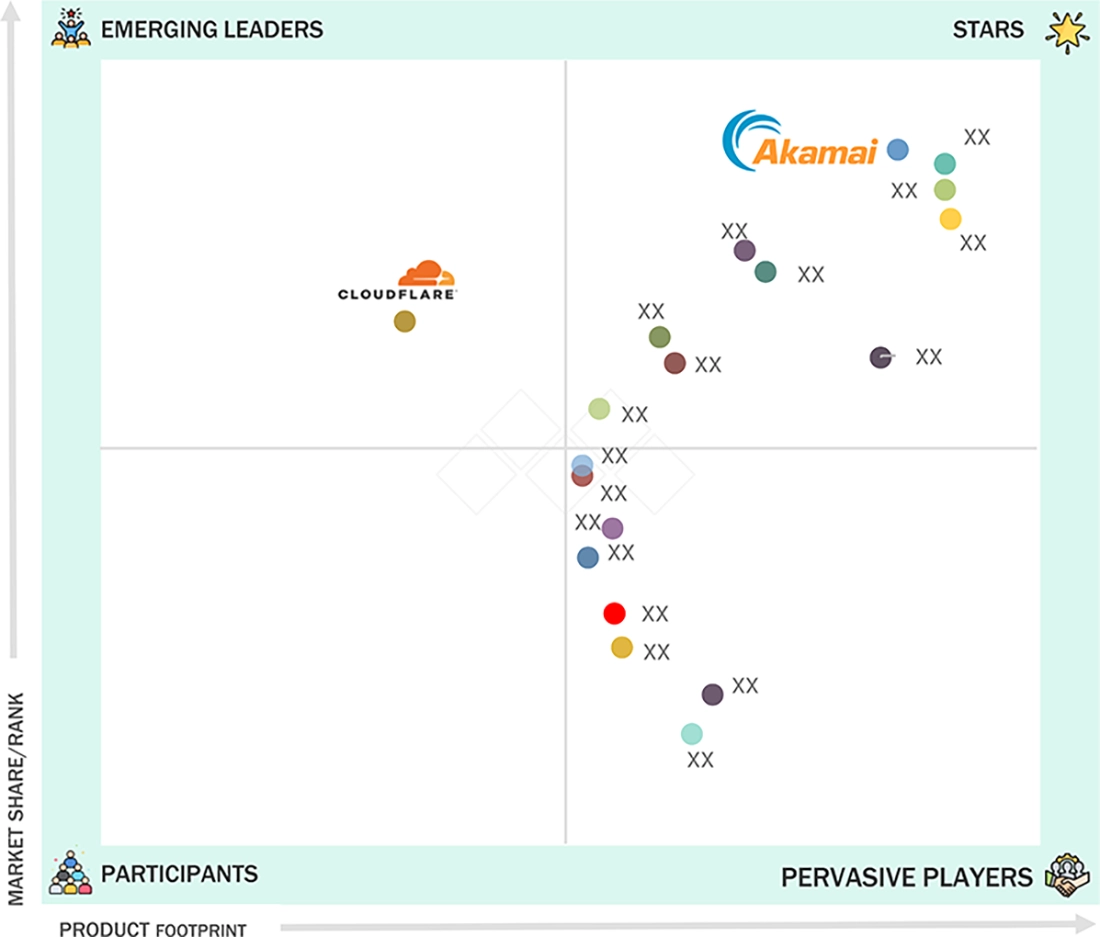
Competitive LandscapeAkamai Technologies, Microsoft, IBM, Google, and AWS were identified as some of the star players in the US content delivery network market, given their strong market share and product footprint.
-
Competitive Landscape Startup/SMEsStackPath, CacheFly, Edgio, Fly.io, and Vultr have distinguished themselves among startups and SMEs in the US content delivery network market.
Content delivery across the US has gradually shifted away from centralized data center models. Distributed cloud infrastructure and edge locations are more commonly used to support modern applications. This change reflects how users access services today, particularly across mobile devices, connected platforms, and enterprise systems. As streaming media, e-commerce activity, and Software-as-a-Service (SaaS) usage increase, performance expectations have become more clearly defined. CDN platforms support these demands by placing content closer to users and adjusting traffic paths based on live network conditions. Their role has expanded to include application acceleration, Application Programming Interface (API) traffic handling, and security at the network edge, positioning CDNs as an integral part of US digital infrastructure planning.
TRENDS & DISRUPTIONS IMPACTING CUSTOMERS' CUSTOMERS
The US content delivery network market is shifting as digital services place greater emphasis on real-time performance and reliability. Content delivery has moved beyond static website acceleration to support interactive applications, live streaming, and cloud-based workloads. Greater emphasis on real-time performance has also introduced higher variability in traffic behavior. Live events, time-bound promotions, and on-demand consumption contribute to uneven load patterns across networks. In response, CDN architectures are being adjusted toward edge-based delivery models that combine routing logic, monitoring, and security controls. These developments are influencing how digital services are structured and how user experience expectations are managed across large and distributed audiences.
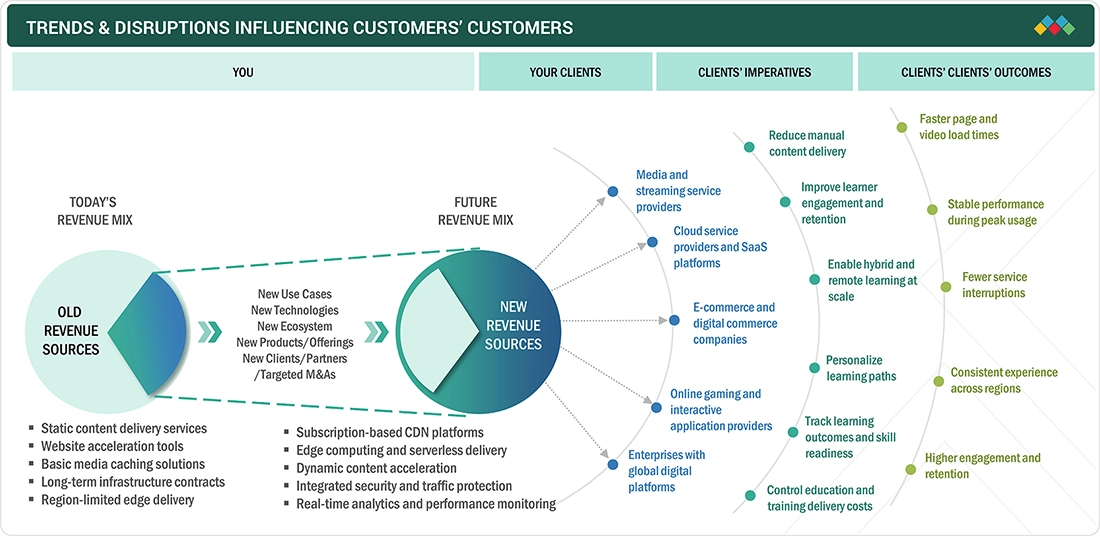
Source: Secondary Research, Interviews with Experts, MarketsandMarkets Analysis
MARKET DYNAMICS

Level
-
Mounting demand for real-time, high-bandwidth digital experiences

-
Rising data volumes from Internet of Things (IoT) deployments


Level
-
Legacy integration complexity

-
Vendor lock-in concerns in fragmented CDN ecosystems


Level
-
Expansion of edge computing

-
Artificial intelligence-driven traffic optimization and caching


Level
-
Margin pressure from intense competition and pricing compression

-
High upfront migration and operational costs

Source: Secondary Research, Interviews with Experts, MarketsandMarkets Analysis
Driver: Mounting demand for real-time, high-bandwidth digital experiences
The ongoing growth of high-definition and real-time digital media consumption is a major factor driving the US content delivery network market. Video streaming platforms, live sports broadcasts, interactive entertainment, and cloud-based applications create large amounts of traffic that need to be delivered reliably and at scale. Events with peak traffic, like live sports and major online promotions, cause sudden spikes in demand that centralized delivery methods struggle to handle effectively. As users expect uninterrupted playback, faster load times, and consistent quality on all devices, CDN infrastructure has become crucial for maintaining performance. This demand is further supported by widespread mobile usage and an increasing dependence on cloud-native applications. As a result, delivering content effectively has become a basic necessity rather than just an improvement.
Restraint: Legacy integration complexity
Many organizations still use hybrid environments that mix on-premises systems with public cloud platforms. Transitioning these setups to support edge-based delivery often needs significant changes to application workflows, routing policies, and security frameworks. Integration can be expensive and time-consuming. It also requires specialized skills, which makes some companies hesitant, especially those with limited technical resources. In regulated industries, extra compliance needs add to the deployment effort and operational costs. Because of this, CDN adoption is often gradual or restricted in scope, especially for mid-sized organizations. This delays complete modernization even though there is a strong long-term demand.
Opportunity: Expansion of edge computing
By processing data closer to end users, CDNs can support real-time analytics, immersive media, and interactive applications that centralized cloud systems find challenging to handle. Use cases, such as augmented reality experiences, cloud gaming, remote healthcare, and industrial automation, benefit from lower latency and localized processing. Edge-enabled CDNs allow providers to go beyond just delivery. They can also offer services like running application logic and managing traffic. As businesses increasingly use distributed applications, CDN platforms that combine delivery with computing and security at the edge can earn additional revenue and expand their important role in digital infrastructure.
Challenge: Margin pressure from intense competition and pricing compression
Established players compete fiercely on performance, coverage, and bundled services. This competition reduces pricing flexibility and squeezes margins. Customers are demanding higher service levels while wanting lower costs, especially as CDN functionality becomes more standard. Meanwhile, providers keep investing in expanding networks, improving security, and enhancing reliability to meet uptime expectations. Even short service disruptions can lead to significant financial and reputational damage, particularly for media and commerce clients. Balancing cost efficiency with ongoing infrastructure investment is a constant challenge in an environment marked by high traffic volatility and little differentiation.
US CONTENT DELIVERY NETWORK MARKET: COMMERCIAL USE CASES ACROSS INDUSTRIES
| COMPANY | USE CASE DESCRIPTION | BENEFITS |
|---|---|---|
 |
Akamai supports global media companies by distributing video-on-demand and live streaming content across its edge network. The CDN is used to handle traffic spikes during major sports and entertainment events while maintaining consistent video quality across regions. | Improved video delivery quality | Reduced buffering and latency | Stable performance during peak traffic |
 |
Cloudflare’s CDN is used by digital publishers and Software-as-a-Service (SaaS) platforms to accelerate dynamic web content and protect applications from distributed denial-of-service (DDoS) attacks. Its edge caching and security services support global user access with minimal configuration effort. | Faster page load times | Enhanced application security | Lower infrastructure management overhead |
 |
Fastly supports real-time digital platforms, including news portals and online marketplaces, by accelerating frequently updated content. Its edge computing capabilities allow rapid content updates and personalization without compromising delivery speed. | Low-latency content updates | Improved site responsiveness | Support for real-time digital experiences |
Logos and trademarks shown above are the property of their respective owners. Their use here is for informational and illustrative purposes only.
MARKET ECOSYSTEM
The US content delivery network ecosystem includes solution providers responsible for delivery infrastructure and traffic routing, along with service providers that support deployment and operational management. In addition, system integrators are involved in implementation and performance tuning across enterprise environments. These roles are typically divided across infrastructure provisioning, configuration, and ongoing optimization. They reflect the layered structure of CDN adoption, where delivery platforms are supported by external services to meet scale and reliability requirements.
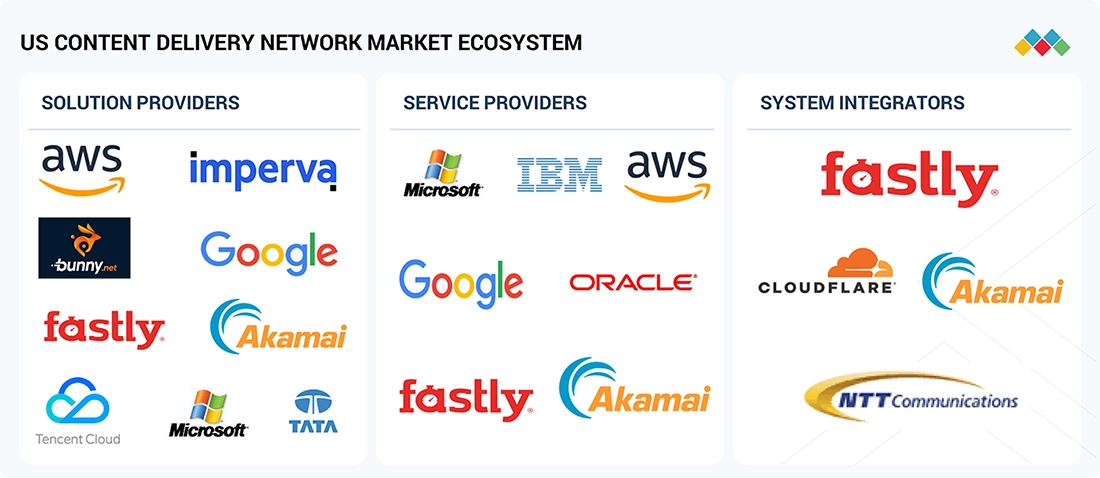
Logos and trademarks shown above are the property of their respective owners. Their use here is for informational and illustrative purposes only.
MARKET SEGMENTS
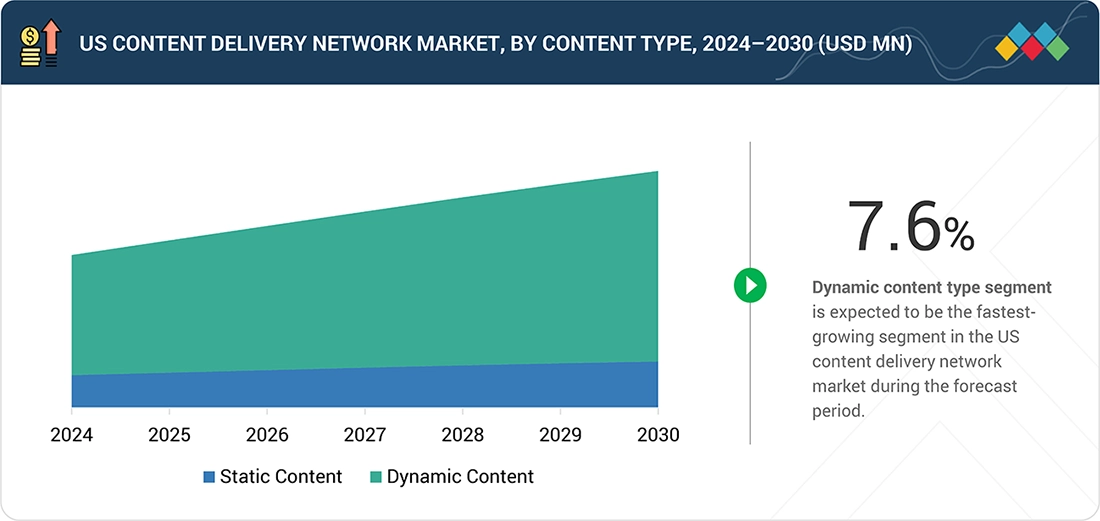
Source: Secondary Research, Interviews with Experts, MarketsandMarkets Analysis
US Content Delivery Network Market, By Solution
Web performance optimization is driven by increasing sensitivity of digital experiences to latency and response time. US enterprises are closely linking application performance metrics with user engagement, conversion rates, and operational efficiency. As applications become more dynamic and reliant on third-party services, traditional network tuning methods are proving insufficient. CDN-enabled optimization tools are therefore being deployed to improve content rendering, reduce page load times, and manage traffic routing more effectively. These solutions increasingly operate at the edge, enabling faster request processing and localized decision-making. Growing adoption of performance monitoring and real-time analytics further supports demand, as organizations seek continuous visibility into user experience. As performance optimization shifts from an optional enhancement to a core delivery requirement, this solution segment continues to expand rapidly across US digital environments.
US Content Delivery Network Market, By Provider Type
Traditional CDN providers continue to hold the largest share of the US content delivery network market, largely due to the scale and maturity of their networks. These providers built their infrastructure early and expanded it steadily, which gives them broad domestic coverage and long-standing relationships with enterprise customers. Their networks are designed to handle varying traffic volumes across regions, allowing content to be delivered consistently even during demand spikes. In practice, these platforms are used for a range of workloads, from basic content delivery to more complex application and media use cases. Over time, many traditional providers have also added traffic control, security capabilities, and performance monitoring to their offerings. This has helped them remain relevant as customer requirements evolve, particularly for organizations that prioritize reliability, scale, and operational familiarity.
REGION
Dynamic content type segment to be fastest-growing in US content delivery network market during forecast period
Dynamic content type segment is expected to be the fastest-growing in US content delivery network market during the forecast period. This growth is fueled by the increasing use of interactive and real-time digital services. Unlike static content, dynamic content includes personalized web pages, live data feeds, online gaming, financial transactions, and e-commerce platforms that need continuous updates and fast delivery. The rise of cloud-based applications, Software-as-a-Service (SaaS) platforms, and mobile services has made the fast and reliable delivery of dynamic content more crucial. Additionally, the growth of live streaming, social media engagement, and digital advertising is leading to higher traffic volumes and greater performance expectations. To meet these needs, CDN providers are investing in edge computing, improved caching, and smart traffic routing. These technologies help reduce response times, enhance user experience, and ensure consistent performance, making dynamic content a major market driver.
US CONTENT DELIVERY NETWORK MARKET: COMPANY EVALUATION MATRIX
In US content delivery network market matrix, Akamai Technologies leads the market with its large global edge footprint and strong capabilities in content delivery, traffic management, and security for enterprise and media workloads. Cloudflare is an emerging leader, gaining traction through its integrated edge platform that combines delivery, security, and developer services, particularly among cloud-native and digital-first organizations.
Source: Secondary Research, Interviews with Experts, MarketsandMarkets Analysis
KEY MARKET PLAYERS
- Akamai Technologies (US)
- Microsoft (US)
- IBM (US)
- Google (US)
- AWS (US)
- Cloudflare (US)
- Lumen Technologies (US)
- Fastly (US)
- Comcast Technologies (US)
- Rackspace Technology (US)
- Imperva (US)
- Quantil (US)
- StackPath (US)
- CacheFly (US)
- Edgio (US)
- Cox Edge (US)
- Fly.io (US)
- Vultr (US)
MARKET SCOPE
| REPORT METRIC | DETAILS |
|---|---|
| Market Size in 2024 (Value) | USD 6.31 Billion |
| Market Forecast in 2030 (Value) | USD 9.77 Billion |
| Growth Rate | CAGR of 7.2% from 2025-2030 |
| Years Considered | 2019-2030 |
| Base Year | 2024 |
| Forecast Period | 2025-2030 |
| Units Considered | Value (USD Million/Billion) |
| Report Coverage | Revenue forecast, company ranking, competitive landscape, growth factors, and trends |
| Segments Covered |
|
WHAT IS IN IT FOR YOU: US CONTENT DELIVERY NETWORK MARKET REPORT CONTENT GUIDE
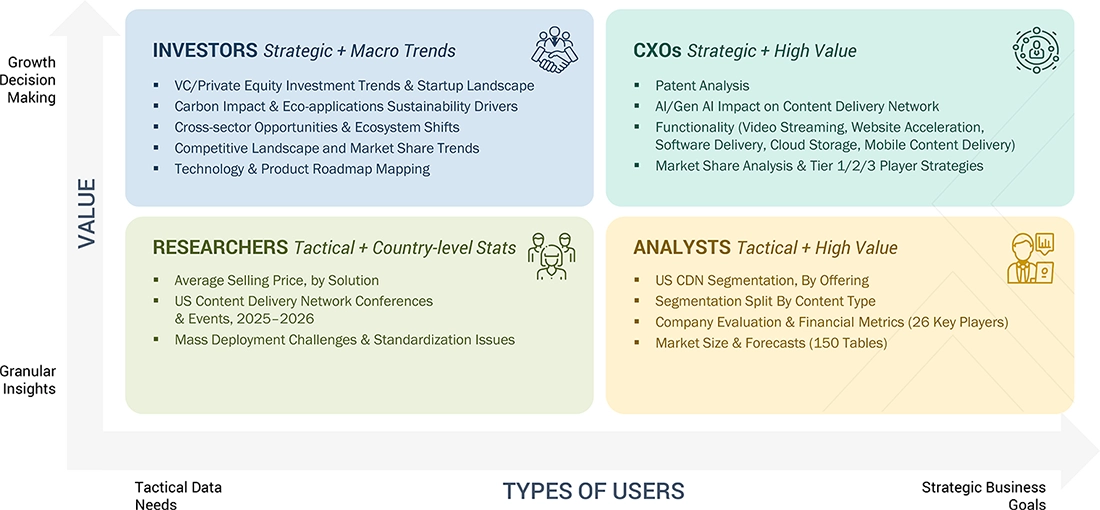
DELIVERED CUSTOMIZATIONS
We have successfully delivered the following deep-dive customizations:
| CLIENT REQUEST | CUSTOMIZATION DELIVERED | VALUE ADDS |
|---|---|---|
| Company Information | Detailed analysis and profiling of additional market players (up to 5) |
|
RECENT DEVELOPMENTS
- September 2025 : OKAST announced a partnership with Akamai Technologies to utilize Akamai’s content delivery network and cloud services for scaling FAST (Free Ad-supported Streaming TV) channel solutions globally. This collaboration supports media distribution platforms with improved content delivery performance.
- February 2025 : Akamai introduced its Gecko initiative to extend cloud computing capabilities directly into its global edge network. The initiative allows workloads to run closer to end users, improving performance for latency-sensitive applications, such as gaming, live streaming, and real-time data processing, while strengthening Akamai’s edge cloud and CDN integration.
- Feb-24 : Vultr launched its CDN service to support edge-based content and media delivery across its global infrastructure. The platform focuses on secure caching and performance optimization, enabling developers to extend web applications and digital content closer to users through Vultr’s distributed network.
Table of Contents
 Exclusive indicates content/data unique to MarketsandMarkets and not available with any competitors.
Methodology
The US content delivery network market research study involves extensive secondary sources, directories, and databases, such as D&B Hoovers and Bloomberg BusinessWeek, to identify and collect information useful for this technical, market-oriented, and commercial market study. The primary sources were mainly several industry experts from core and related industries and preferred suppliers, manufacturers, distributors, Service Providers (SPs), technology developers, alliances, and organizations related to all the segments of this industry’s value chain. In-depth interviews have been conducted with various primary respondents, including key industry participants and subject matter experts, to obtain and verify critical qualitative and quantitative information, and assess growth prospects. These respondents included key industry participants, subject matter experts, C-level executives of key market players, and industry consultants.
Secondary Research
In the secondary research process, various secondary sources were referred to for identifying and collecting information for the study. The secondary sources included annual reports, press releases, investor presentations of companies, white papers, certified publications, and articles from recognized associations and government publishing sources. The data was also collected from secondary sources, such as The Association of International Internet of Things Consortium, Europe Research Cluster on Internet of Things, Bitkom-Germany’s Digital Association, and China Association for Science and Technology. Secondary research was mainly used to obtain key information about industry insights, the market’s monetary chain, the overall pool of key players, market classification, and segmentation according to industry trends to the bottom-most level, regional markets, and key developments.
Primary Research
In the primary research process, various primary sources from both supply and demand sides were interviewed to obtain qualitative and quantitative information for the report. The primary sources from the supply side included industry experts, such as Chief Executive Officers (CEOs), Chief Technology Officers (CTOs), Chief Operating Officers (COOs), Vice Presidents (VPs), marketing directors, technology and innovation directors, and related key executives from various key companies and organizations operating in the US content delivery network. The primary sources from the demand side included Content delivery network end users, network administrators/consultants/specialists, Chief Information Officers (CIOs), and subject-matter experts from enterprises and government associations.
To know about the assumptions considered for the study, download the pdf brochure
Market Size Estimation
Multiple approaches were adopted to estimate and forecast the US Content delivery network market. The first approach estimates market size by summating companies’ revenue generated through Content delivery network solutions. In this approach for market estimation, we identified the key companies offering Content delivery networks by offerings: solutions and services.
Both top-down and bottom-up approaches were used to estimate and validate the total size of the US Content delivery network market. These methods were extensively used to estimate the size of various segments in the market. The research methodology used to estimate the market size includes the following:
- Key players in the market have been identified through extensive secondary research.
- In terms of value, the industry’s supply chain and market size have been determined through primary and secondary research processes.
- All percentage shares, splits, and break-ups have been determined using secondary sources and verified through primary sources.
Data Triangulation
After arriving at the overall market size, the US content delivery network market was divided into several segments and subsegments. The data triangulation procedures were used to complete the overall market engineering process and arrive at the exact statistics for all segments and subsegments. The data was triangulated by studying various factors and trends from the demand and supply sides. Along with data triangulation and market breakdown, the market size was validated by the top-down and bottom-up approaches.
Market Definition
A Content Delivery Network (CDN) is a distributed network of servers located in various geographic locations. Its purpose is to efficiently deliver web content, such as images, videos, and applications, to end-users. By storing and replicating content on these servers, CDNs reduce latency, improve website loading speed, and enhance the overall user experience. They also help manage traffic spikes, improve scalability, and offer additional services like security and performance optimization.
Key Stakeholders
- Content delivery network solution providers
- Independent Software Vendors (ISVs)
- Investors and Venture Capitalists (VCs)
- Support and maintenance service providers
- Value-added Resellers (VARs) and distributors
Report Objectives
- To determine and forecast the US Content delivery network market by offering (solutions, and services), content type, provider type, application area, and region from 2023 to 2028, and analyze the various macroeconomic and microeconomic factors that affect the market growth.
- To provide detailed information about the major factors (drivers, restraints, opportunities, and challenges) influencing the growth of the US Content delivery network market.
- To analyze each submarket with respect to individual growth trends, prospects, and contributions to the overall US Content delivery network market.
- To analyze the market opportunities for stakeholders by identifying the high-growth segments of the US Content delivery network market.
- To profile the key market players; provide a comparative analysis on the basis of business overviews, regional presence, product offerings, business strategies, and key financials; and illustrate the competitive landscape of the US Content delivery network market.
- In the US Content delivery network market, track and analyze competitive developments, such as mergers and acquisitions, product developments, partnerships and collaborations, and Research and Development (R&D) activities.
Available Customizations
With the given market data, MarketsandMarkets offers customizations as per the company’s specific needs. The following customization options are available for the report:
Geographic Analysis
- Further break-up of the Asia Pacific Content delivery network market into countries contributing 75% to the regional market size
- Further break-up of the North American Content delivery network market into countries contributing 75% to the regional market size
- Further break-up of the Latin American Content delivery network market into countries contributing 75% to the regional market size
- Further break-up of the MEA Content delivery network market into countries contributing 75% to the regional market size
- Further break-up of the European Content delivery network market into countries contributing 75% to the regional market size
Company Information
- Detailed analysis and profiling of additional market players (up to 5)
Key Questions Addressed by the Report
What is the current size of the US Content Delivery Network Market?
The US Content Delivery Network (CDN) market is projected to grow from USD 6.91 billion in 2025 to USD 9.77 billion by 2030, registering a CAGR of 7.2% during the forecast period. The market is expanding due to increasing demand for low-latency digital experiences, rising cloud adoption, growth in video streaming, online gaming, and enterprise applications requiring secure and high-performance content delivery.
What factors are driving the growth of the US Content Delivery Network Market?
The market is primarily driven by the rapid growth of OTT platforms, cloud-native applications, e-commerce, and digital transformation initiatives across industries. Increasing internet traffic, demand for real-time content delivery, adoption of edge computing, and the need for stronger cybersecurity capabilities such as DDoS protection and web application security are further accelerating CDN deployment across the United States.
Which industries are the major adopters of Content Delivery Network solutions in the US?
CDN solutions are widely adopted across media and entertainment, online gaming, retail and e-commerce, financial services, healthcare, education, government, and IT & telecommunications. These industries rely on CDN platforms to deliver digital content faster, improve application performance, enhance user experience, and maintain service availability during periods of high traffic.
What are the key trends shaping the US Content Delivery Network Market?
Major trends include the expansion of edge computing infrastructure, increasing integration of AI for intelligent traffic routing, growing adoption of multi-CDN strategies, rising demand for secure edge services, and the deployment of 5G-enabled content delivery. Organizations are also combining CDN services with cloud security capabilities to improve application performance while protecting digital assets from cyber threats.
Who are the leading companies operating in the US Content Delivery Network Market?
The US CDN market includes several leading providers such as Akamai Technologies, Amazon Web Services (CloudFront), Microsoft Azure CDN, Google Cloud CDN, Cloudflare, Fastly, IBM, Lumen Technologies, Rackspace Technology, Comcast Technology Solutions, Imperva, and Verizon. These companies continue to invest in edge infrastructure, security services, and cloud integration to strengthen their competitive position in the market.


Personalize This Research
- Triangulate with your Own Data
- Get Data as per your Format and Definition
- Gain a Deeper Dive on a Specific Application, Geography, Customer or Competitor
- Any level of Personalization
Let Us Help You
- What are the Known and Unknown Adjacencies Impacting the US Content Delivery Network Market
- What will your New Revenue Sources be?
- Who will be your Top Customer; what will make them switch?
- Defend your Market Share or Win Competitors
- Get a Scorecard for Target Partners

Custom Market Research Services
We Will Customise The Research For You, In Case The Report Listed Above Does Not Meet With Your Requirements
Get 10% Free CustomisationTESTIMONIALS






Growth opportunities and latent adjacency in US Content Delivery Network Market