US Humanoid Robot Market Size & Share, Industry Report, 2030

US Humanoid Robot Market by Biped Robot, Wheel Drive Robots, Sensors (Gyroscopes, Accelerometers, Tilt Sensors, Position Sensors, Vision Sensors, Torque Sensors), Actuators (Electrical, Pneumatic, Hydraulic, Piezoelectric) - Forecast to 2030




OVERVIEW
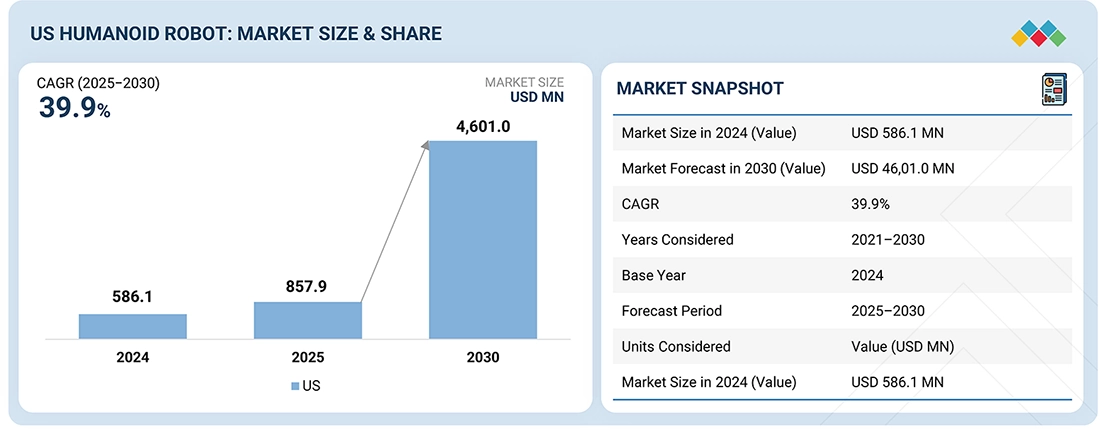
Source: Secondary Research, Interviews with Experts, MarketsandMarkets Analysis
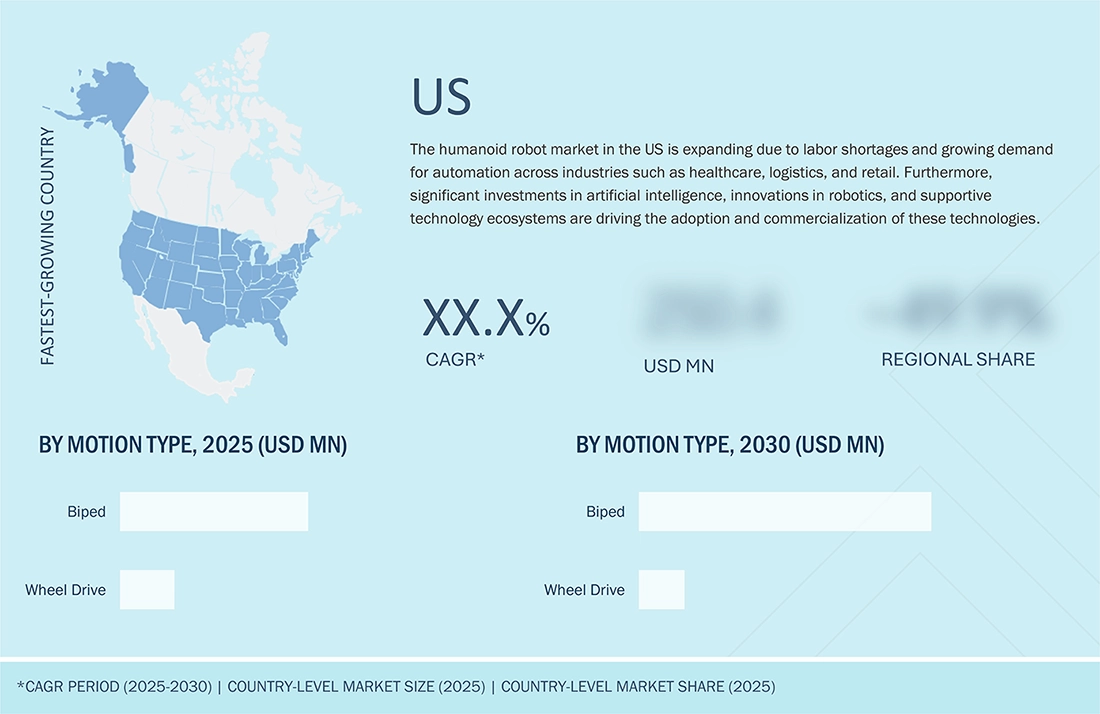
The US humanoid robot market is projected to reach USD 4,601.0 million by 2030, rising from USD 857.9 million in 2025, at a CAGR of 39.9% from 2025 to 2030. Human-like robots are intricate systems designed to mimic human appearance and behaviors, enabling them to communicate naturally and navigate spaces built for humans. These advanced machines employ artificial intelligence and machine learning to perform various tasks across multiple industries. The market's rapid growth is driven by increasing demand for sophisticated robotics in sectors like healthcare, retail, and personal assistance, along with swift progress in artificial intelligence and machine learning that enhance the capabilities and efficiency of humanoid robots. Additionally, improved operational efficiency and the push toward automation in certain areas are further accelerating the market's expansion across the US.
KEY TAKEAWAYS
-
By TypeThe biped robots segment is expected to stay dominant in the market because of their versatility in navigating human-designed environments and their strong ability to perform tasks in spaces built for human interaction.
-
By ApplicationThe personal assistance and caregiving sector is projected to lead the US market starting in 2025, fueled by an aging population and increasing care needs, with humanoid robots being more commonly used to help with daily tasks and provide companionship.
-
By OfferingThe hardware segment is expected to gain the largest market share as it constitutes the core physical infrastructure of humanoid robots, driven by high demand for advanced sensors, actuators, and computing units.
-
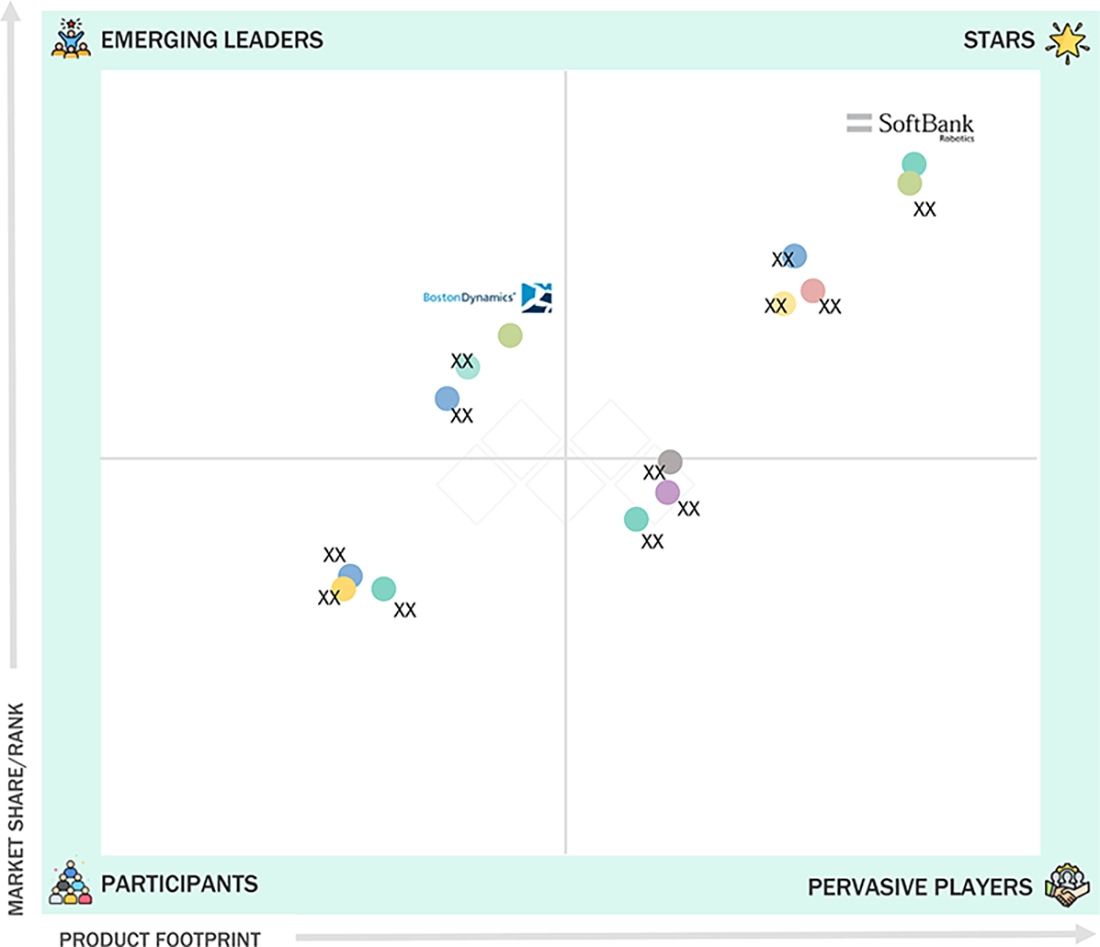
Competitive Landscape - Star PlayersAgility Robotics, and Boston Dynamics were identified as star players in the US humanoid robot market, given their strong market share, innovative product offerings, and extensive geographical presence to maximize market reach.
-
Competitive Landscape - StartupsTesla and UBTECH Robotics have distinguished themselves among emerging players by securing strong footholds in specialized niche areas and demonstrating significant innovation potential, underscoring their emergence as future market leaders.
The US humanoid robot market is poised to stay a major player in the global robotics scene, showing strong growth potential as industries increasingly adopt human-like robotic solutions for various applications, from personal care to industrial automation.
TRENDS & DISRUPTIONS IMPACTING CUSTOMERS' CUSTOMERS
The US humanoid robot industry is currently undergoing rapid innovation and accelerated adoption across various sectors. Healthcare systems, retail chains, educational institutions, and personal care facilities within the United States are experiencing significant advancements in the development and deployment of humanoid robots. This progress corresponds with emerging trends in artificial intelligence integration, improved human-robot interaction capabilities, and the increasing acceptance of robotic assistance in daily life. In the US, the deployment of advanced humanoid robots equipped with sophisticated AI and machine-learning algorithms is on the rise across hospitals, care facilities, retail outlets, and educational establishments. These robots enable human-like interactions, execute complex tasks safely around vulnerable populations, and support more efficient service delivery models that address labor shortages and the demand for consistent quality in customer-facing roles. Government agencies and private-sector leaders are fostering domestic manufacturing, developing specialized humanoid platforms for specific applications, and advancing public-private research and development initiatives. Such efforts serve to expedite commercialization timelines and promote the adoption of ethically designed, functionally validated humanoid robot platforms tailored to the needs of American enterprises and consumers.
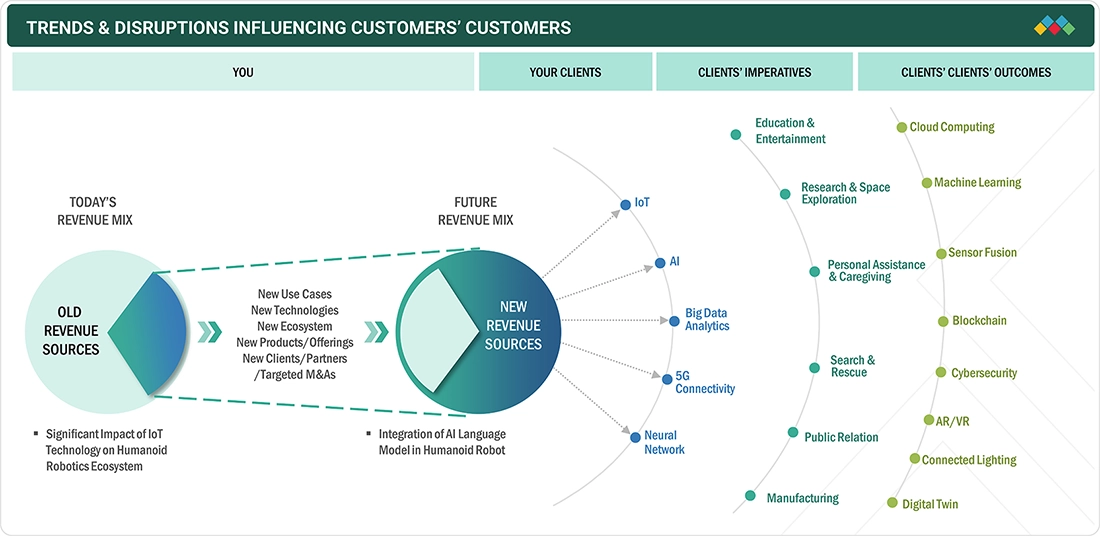
Source: Secondary Research, Interviews with Experts, MarketsandMarkets Analysis
MARKET DYNAMICS

Level
-
Rapid advancements in artificial intelligence and machine learning technologies

-
Growing demand for personal assistance robots driven by aging population demographics


Level
-
High initial investment costs and complexity of human-like robotics development


Level
-
Enhanced government support through incentives for robotics research & development


Level
-
Ethical concerns and technology acceptance challenges among the workforce

Source: Secondary Research, Interviews with Experts, MarketsandMarkets Analysis
Driver: Rapid advancements in artificial intelligence and machine learning technologies
The rapid progress in artificial intelligence and machine learning is fundamentally changing what humanoid robots can do. They are becoming smarter, more interactive, and able to handle increasingly complex tasks. These technological advances allow humanoid robots to understand natural language, recognize faces and emotions, learn from interactions, and adapt their behavior to different situations. The integration of advanced AI algorithms enables robots to process large amounts of sensory data in real time, make independent decisions, and offer personalized experiences in healthcare, retail, and personal assistance. This technological progress is encouraging broader use across industries by clearly showing benefits in efficiency, consistency, and improved user experiences.
Restraint: High initial investment costs and complexity of human-like robotics development
High initial costs and the inherent complexity of developing human-like robotics systems pose significant barriers to market adoption, especially for smaller businesses and organizations with limited budgets. Creating and deploying humanoid robots require major investments in advanced hardware, sophisticated software, ongoing maintenance, and specialized technical skills. The challenge of replicating human movement, dexterity, and cognitive functions in robotic form leads to longer development times and higher production costs. These financial and technical hurdles can discourage potential users, particularly in price-sensitive markets, and slow down the adoption process even though humanoid robots could offer long-term operational benefits.
Opportunity: Enhanced government support through incentives for robotics research and development
Enhanced government support through various incentives for robotics research and development offers significant growth opportunities for the U.S. humanoid robot market. Federal and state initiatives aimed at promoting domestic innovation in robotics, including tax incentives, research grants, public-private partnerships, and favorable regulatory policies, are creating an environment that encourages faster development and commercialization of humanoid robot technologies. Government backing helps lower the financial risks of pioneering robotics projects, fosters collaboration between academic institutions and industry, and supports the development of domestic manufacturing capabilities. These supportive policies are especially important for maintaining the U.S.'s competitiveness in the global robotics industry and ensuring that American companies stay at the forefront of humanoid robot innovation.
Challenge: Ethical concerns and technology acceptance challenges among the workforce
Ensuring widespread acceptance of humanoid robots among the workforce and addressing ethical concerns remain key challenges impacting market growth and deployment rates. Workers across various industries express concerns about job displacement, privacy issues related to robot-collected data, and the proper boundaries for human-robot interaction in both professional and personal settings. Ethical questions about using human-like robots in caregiving roles, especially with vulnerable groups like children and the elderly, require careful consideration and transparent governance structures. Organizations need to invest in change management programs, workforce training, and clear communication strategies to build trust and show that humanoid robots are meant to supplement, not replace, human abilities. Tackling these acceptance and ethical issues is crucial for sustainable market growth and unlocking the full potential of humanoid robotics technology.
US HUMANOID ROBOT MARKET: COMMERCIAL USE CASES ACROSS INDUSTRIES
| COMPANY | USE CASE DESCRIPTION | BENEFITS |
|---|---|---|
 |
Digital humanoid robots deployed in warehouse and logistics operations for package handling, sorting, and material movement tasks in facilities operated by major retailers and logistics providers | Provides consistent operational performance, reduces workplace injuries by handling physically demanding tasks, operates safely alongside human workers, and addresses labor shortage challenges in logistics sector |
 |
Pepper humanoid robots used in retail stores, hotels, and healthcare facilities for customer greeting, information provision, wayfinding assistance, and basic customer service interactions across the US | Enhances customer experience through engaging human-like interactions, provides consistent service quality, collects valuable customer interaction data, and allows human staff to focus on complex customer needs requiring empathy and judgment |
Logos and trademarks shown above are the property of their respective owners. Their use here is for informational and illustrative purposes only.
MARKET ECOSYSTEM
The US humanoid robot market is a collaborative ecosystem where robotics companies, AI developers, component manufacturers, system integrators, research institutions, and end-user organizations work together to develop and implement humanoid robotics solutions across various sectors. Companies in the US offer a wide range of humanoid robot platforms, specialized components like actuators and sensors, and advanced software for perception, navigation, and interaction. Universities, national labs, and private research groups support basic and applied research, leading to breakthroughs in bipedal walking, manipulation skills, and human-robot interaction. System integrators and consultants help customize and deploy humanoid robots for specific industry needs, ensuring smooth integration with existing systems and workflows. Ultimately, healthcare providers, retail stores, schools, factories, and individual consumers across the US use these advanced humanoid robots, supported by innovation-friendly policies and increasing societal acceptance of robotic assistance in daily life.
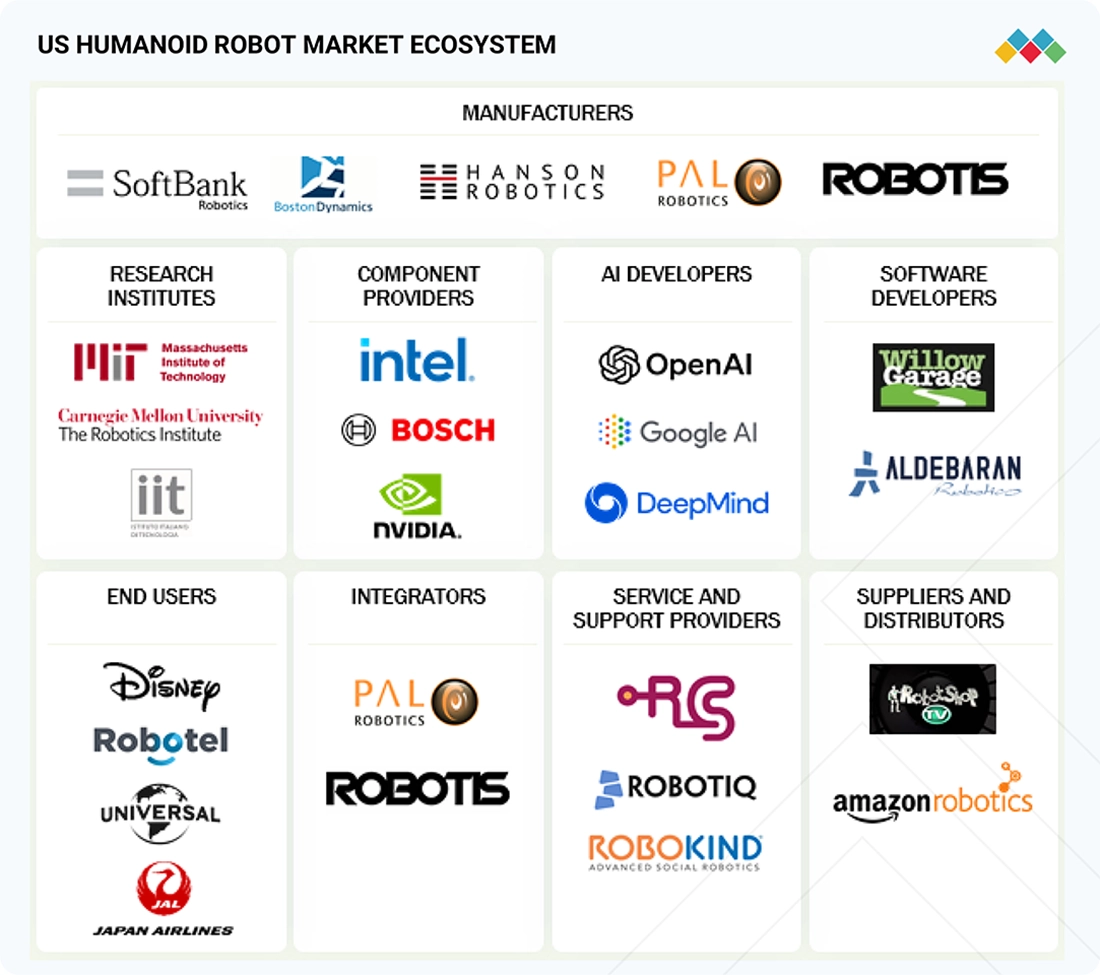
Logos and trademarks shown above are the property of their respective owners. Their use here is for informational and illustrative purposes only.
MARKET SEGMENTS
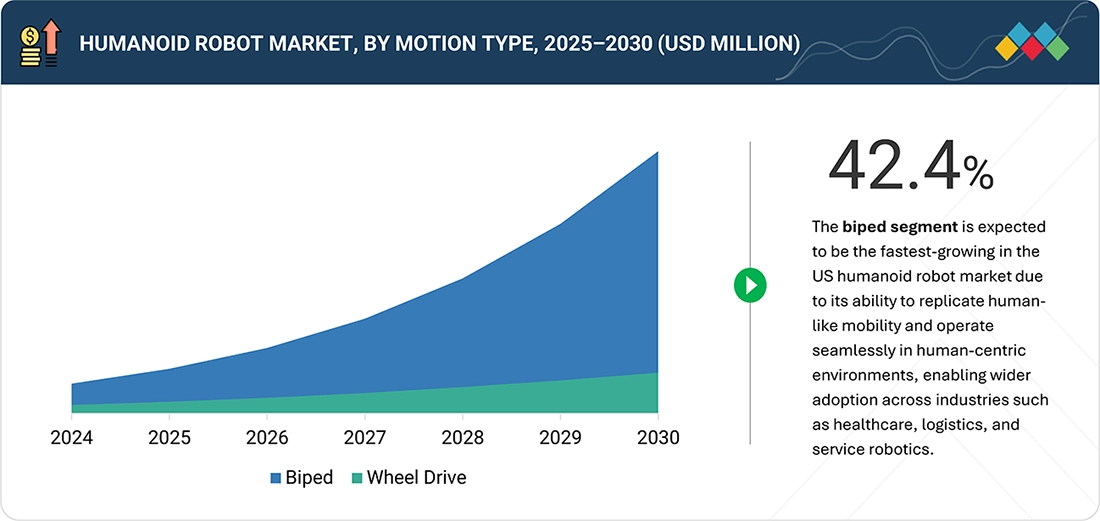
Source: Secondary Research, Interviews with Experts, MarketsandMarkets Analysis
US Humanoid Robot Market, by Type
Biped robots dominated the market in 2024 and are expected to maintain their leadership position throughout the forecast period. This dominance stems from their superior versatility in navigating human-designed environments, including stairs, narrow corridors, and spaces with obstacles that would challenge wheeled platforms. Biped humanoid robots more closely replicate human movement patterns, enabling them to perform tasks in settings specifically designed for human workers without requiring environmental modifications. Their ability to maintain balance, manipulate objects at various heights, and interact naturally with people makes them the preferred choice for applications in personal assistance, healthcare, retail, and educational settings where human-like mobility and presence are valued.
US Humanoid Robot Market, by Application
Personal assistance and caregiving make up the largest and fastest-growing segment of the US humanoid robot market. The rise in an aging population needing daily living help has pushed this segment to the forefront of market growth. Factors such as more elderly people living on their own, higher costs of traditional caregiving, and the desire to maintain dignity through assistance solutions are boosting demand for humanoid robots that can help with daily tasks, offer companionship, monitor health signs, and ensure safety. These robots are increasingly used in private homes, assisted living communities, and specialized care centers, where they remind about medication, detect falls, promote social interaction, and coordinate with human caregivers. The ability of humanoid robots to provide consistent, patient, and non-judgmental support while operating safely around vulnerable groups makes them especially suited for this rapidly growing field.
REGION
North America leads the humanoid robot market during the forecast period
North America, with the US as the main market, leads the humanoid robot industry and is experiencing significant growth driven by several overlapping factors. The region benefits from a strong macroeconomic environment that encourages investment and the adoption of advanced robotic technologies across various sectors. The US shows particularly solid market fundamentals, with the North American humanoid robot market valued at USD 744.7 million in 2024 and expected to grow at a CAGR of 38.7% during the forecast period. This growth is supported by the presence of leading robotics companies, top-tier research institutions, substantial venture capital funding in robotics startups, and early adopters willing to pilot innovative humanoid robot solutions. The region's advanced healthcare system, sophisticated retail industry, and tech-savvy corporate culture create ideal conditions for deploying humanoid robots. Additionally, demographic trends such as an aging population and ongoing labor shortages in key sectors are bolstering the business case for humanoid robot adoption, while government backing for domestic robotics innovation is strengthening the region's leadership in this emerging market.
US HUMANOID ROBOT MARKET: COMPANY EVALUATION MATRIX
SoftBank Robotics, known as a top leader in the humanoid robot industry, offers a wide range of products including the Pepper and NAO humanoid platforms designed for customer service, education, and research use. The company has extensive experience deploying these robots in retail, hospitality, healthcare, and educational settings across the US and works with major companies and institutions to customize humanoid robot solutions for specific needs.
Source: Secondary Research, Interviews with Experts, MarketsandMarkets Analysis
KEY MARKET PLAYERS
- SoftBank Robotics (Japan)
- Agility Robotics (US)
- Boston Dynamics (US)
- Tesla (US)
- Samsung (South Korea)
- UBTECH Robotics (China)
- Pal Robotics (Spain)
- Honda Motor Co. (Japan)
MARKET SCOPE
| REPORT METRIC | DETAILS |
|---|---|
| Market Size in 2024 (Value) | USD 586.1 Million |
| Market Forecast in 2030 (Value) | USD 4,601.0 Million |
| Growth Rate | CAGR of 39.9% from 2025-2030 |
| Years Considered | 2023-2030 |
| Base Year | 2024 |
| Forecast Period | 2025-2030 |
| Units Considered | Value (USD Million) |
| Report Coverage | Revenue Forecast, Company Ranking, Competitive Landscape, Growth Factors, and Trends |
| Segments Covered |
|
| Regions Covered | US |
WHAT IS IN IT FOR YOU: US HUMANOID ROBOT MARKET REPORT CONTENT GUIDE
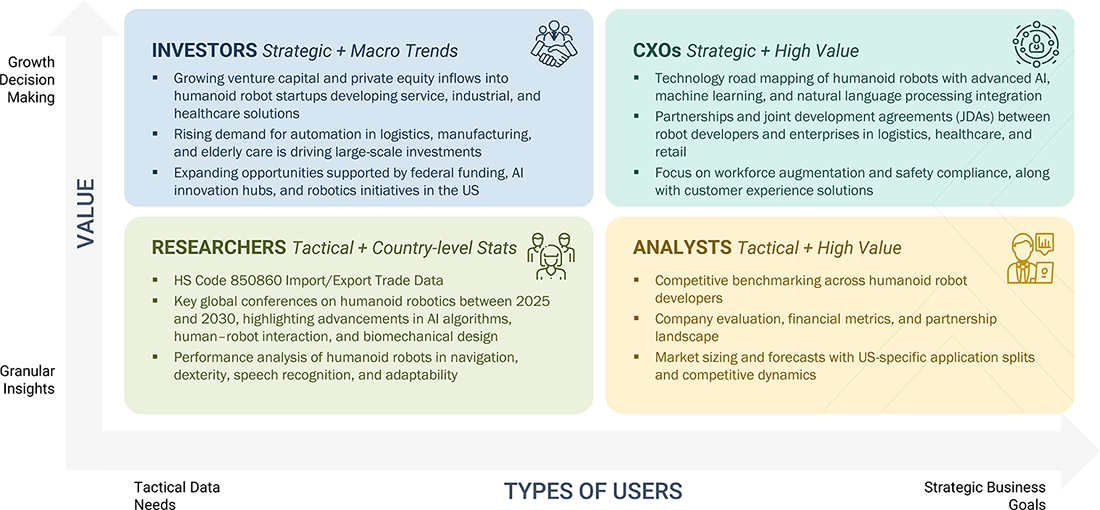
DELIVERED CUSTOMIZATIONS
We have successfully delivered the following deep-dive customizations:
| CLIENT REQUEST | CUSTOMIZATION DELIVERED | VALUE ADDS |
|---|---|---|
| Understanding adoption patterns for humanoid robots across US industry sectors | Assessed humanoid robot deployment trends across key US sectors, including healthcare facilities, retail chains, logistics operations, educational institutions, and hospitality venues, highlighting differences in adoption drivers, use case priorities, and return on investment expectations across personal assistance, customer service, and operational efficiency applications | Helps clients align product development roadmaps with sector-specific requirements, prioritize go-to-market strategies based on adoption readiness, and tailor value propositions to address distinct pain points in each vertical market |
| Identifying technology partnership and integration opportunities | Mapped the ecosystem of AI software providers, sensor manufacturers, actuator suppliers, system integrators, and application developers supporting humanoid robot deployment in the US, with insights into collaboration models, technology licensing arrangements, and co-development opportunities | Supports strategic partnership formation, accelerates time-to-market through leveraging complementary capabilities, reduces development risk, and enables access to specialized expertise in perception, manipulation, and human-robot interaction technologies |
RECENT DEVELOPMENTS
- December 2024 : SAMSUNG announced an increase in its stake in Rainbow Robotics to 35% by exercising a call option, making it a subsidiary. This move aims to speed up the development of advanced robotics, including humanoid robots. Rainbow Robotics, founded in 2011 by researchers from KAIST’s Humanoid Robot Research Center, is known for developing Korea's first two-legged walking robot, “Hubo.”
- September 2023 : Agility Robotics opened RoboFab, a dedicated manufacturing facility in the US aimed at expanding production capabilities for its Digit humanoid robot platform and establishing domestic supply chain advantages to meet growing demand from logistics and warehouse customers.
- March 2023 : Agility Robotics (US) unveiled the next-generation Digit, a human-centric, multi-purpose robot for logistics. It is designed for various tasks in warehouses and distribution centers, enhancing productivity and safety.
Table of Contents
 Exclusive indicates content/data unique to MarketsandMarkets and not available with any competitors.
Methodology
The study involved four major activities in estimating the current size of the US Humanoid Robot Market. Exhaustive secondary research has been done to collect information on the market, peer, and parent markets. The next step is to validate these findings, assumptions, and size with industry experts across the value chain through primary research. Both top-down and bottom-up approaches have been employed to estimate the complete market size. After that, market breakdown and data triangulation methods have been used to estimate the market size of segments and subsegments. Two sources of information—secondary and primary—have been used to identify and collect information for an extensive technical and commercial study of the US Humanoid Robot Market.
Secondary Research
Various secondary sources have been referred to in the secondary research process to identify and collect information important for this study. The secondary sources include annual reports, press releases, and investor presentations of companies; white papers; journals and certified publications; and articles from recognized authors, websites, directories, and databases. Secondary research has been conducted to obtain key information about the industry’s supply chain, the market’s value chain, the total pool of key players, market segmentation according to the industry trends (to the bottom-most level), regional markets, and key developments from market- and technology-oriented perspectives. The secondary data has been collected and analyzed to determine the overall market size, further validated by primary research.
Primary Research
Extensive primary research was conducted after gaining knowledge about the current scenario of the US Humanoid Robot Market through secondary research. Several primary interviews were conducted with experts from the demand and supply sides across four major regions—North America, Europe, Asia Pacific, and RoW. This primary data was collected through questionnaires, emails, and telephonic interviews.
To know about the assumptions considered for the study, download the pdf brochure
Market Size Estimation
Both top-down and bottom-up approaches have been used to estimate and validate the total size of the US Humanoid Robot Market. These methods have also been used extensively to estimate the size of various subsegments in the market. The following research methodology has been used to estimate the market size:
- Major players in the industry and markets have been identified through extensive secondary research.
- The industry’s value chain and market size (in terms of value) have been determined through primary and secondary research processes.
- All percentage shares, splits, and breakdowns have been determined using secondary sources and verified through primary sources.
Data Triangulation
After arriving at the overall size of the US Humanoid Robot Market from the market size estimation process explained above, the total market has been split into several segments and subsegments. Data triangulation and market breakdown procedures have been employed, wherever applicable, to complete the overall market engineering process and arrive at the exact statistics for all segments and subsegments of the market. The data has been triangulated by studying various factors and trends from both the demand and supply sides. Along with this, the market size has been validated using both top-down and bottom-up approaches.
Market Definition
A humanoid robot resembles and imitates a human body structure and behavior. It has a torso, a head, two arms, and two legs; however, some humanoid robots may replicate specific parts of the human body. It is a complex machine equipped with hardware, software, and cutting-edge technologies to perform various tasks in different environments, such as deep-ocean exploration, scientific research, complex medical surgeries, and household chores. Their human-like form and behavior allow them to operate in environments designed for humans, making them more adaptable for tasks that require interaction with people or navigation in human-centric spaces.
Key Stakeholders
- Government bodies and policymakers
- Industry organizations, forums, alliances, and associations
- Raw material suppliers and distributors
- Research institutes and organizations
- Original equipment manufacturers (OEMs)
- Technology, service, and solution providers
- Intellectual property (IP) core and licensing providers
- Market research and consulting firms
Report Objectives
- To describe, segment, and forecast the overall US Humanoid Robot Market, by offering, type, and application, in terms of value.
- To describe and forecast the market for four key regions: North America, Europe, Asia Pacific, and Rest of the World (RoW), along with their respective countries, in terms of value.
- To provide an overview of the recent trends in the market.
- To provide detailed information regarding the drivers, restraints, opportunities, and challenges influencing the growth of the market.
- To analyze the supply chain, trends/disruptions impacting customers’ business, market/ecosystem map, pricing analysis, and regulatory landscape pertaining to the US Humanoid Robot Market.
- To strategically analyze micromarkets with respect to individual growth trends, prospects, and contributions to the overall market size.
- To analyze opportunities in the market for stakeholders and provide a competitive landscape of the market.
- To strategically profile the key players and comprehensively analyze their market positions in terms of their ranking and core competencies, along with detailing the competitive landscape for market leaders,
- To analyze competitive developments, such as product launches, acquisitions, collaborations, agreements, and partnerships, in the US Humanoid Robot Market.
- To provide ecosystem analysis, case study analysis, patent analysis, technology analysis, value chain analysis, trends/disruptions impacting customer business, the impact of AI/Gen AI, key conferences and events, pricing analysis, Porter’s five forces analysis, and regulations pertaining to the market under study.
- To provide a macroeconomic outlook based on all the regions in the region chapter.
Available Customizations
With the given market data, MarketsandMarkets offers customizations according to the company’s specific needs. The following customization options are available for the report:
Company Information:
- Detailed analysis and profiling of additional market players (up to 5)
Key Questions Addressed by the Report
What is the projected market size of the US humanoid robot market?
The US humanoid robot market is projected to grow from USD 857.9 million in 2025 to USD 4,601.0 million by 2030, at a CAGR of 39.9%.
Which region dominates the humanoid robot market?
North America holds a significant share of the humanoid robot market, with the United States leading due to strong investments in robotics and AI technologies.
How is the US humanoid robot market segmented?
The market is segmented by robot type (biped and wheel drive), sensors (such as gyroscopes, accelerometers, and vision sensors), and actuators (including electrical, pneumatic, hydraulic, and piezoelectric).
Who are the key players in the US humanoid robot market?
Key players include Agility Robotics, Boston Dynamics, Tesla, Samsung, UBTECH Robotics, PAL Robotics, and Honda Motor Co., driving innovation and commercialization.
What are the major applications of humanoid robots in this market?
Humanoid robots are widely used in applications such as personal assistance, caregiving, research, industrial operations, and security, supporting diverse end-user industries.


Personalize This Research
- Triangulate with your Own Data
- Get Data as per your Format and Definition
- Gain a Deeper Dive on a Specific Application, Geography, Customer or Competitor
- Any level of Personalization
Let Us Help You
- What are the Known and Unknown Adjacencies Impacting the US Humanoid Robot Market
- What will your New Revenue Sources be?
- Who will be your Top Customer; what will make them switch?
- Defend your Market Share or Win Competitors
- Get a Scorecard for Target Partners

Custom Market Research Services
We Will Customise The Research For You, In Case The Report Listed Above Does Not Meet With Your Requirements
Get 10% Free CustomisationTESTIMONIALS

Tetsuya Ohhira
Business Development Manager-Technology Business
Nikon Corporation,
Leading Japanese MNC specializing in optics and imaging productswww.nikon.com
MarketsandMarkets™ response
is quick. Their attitude is flexible and positive. Analyst Insights are globally considered and
significant. Client Services quickly respond to our inquiry and demand. Their wide range of global
surveys help us make our strategic plan.
We hope Knowledge Store will be easier to search
for a report.
VP - Marketing & Business Development
Leading Provider of Process Control Solutions
We engaged with MarketsandMarkets on a study to perform an analysis and recommend a Go-To-Market strategy for metrology and process control in the semiconductor market. The study was tailored to our targets and needs with well-defined milestones. Our overall experience with the MarketsandMarkets team was very good throughout the project in all aspects including the analysis methodologies used, the quality and depth of primary and secondary data sets, the professionalism and flexibility of the team and the ability to meet the target schedule and milestones. We want to thank MarketsandMarkets team for a job well done.






Growth opportunities and latent adjacency in US Humanoid Robot Market