US IoT Market

US IoT Market by Connectivity (Cellular, LP-WAN, Satellite), Software (IoT Platforms, Application Software, Analytics Software, Security & Safety Software), Focus Area (Smart Manufacturing, Smart Energy & Utilities, Smart Healthcare - Forecast to 2030




OVERVIEW
Source: Secondary Research, Interviews with Experts, MarketsandMarkets Analysis
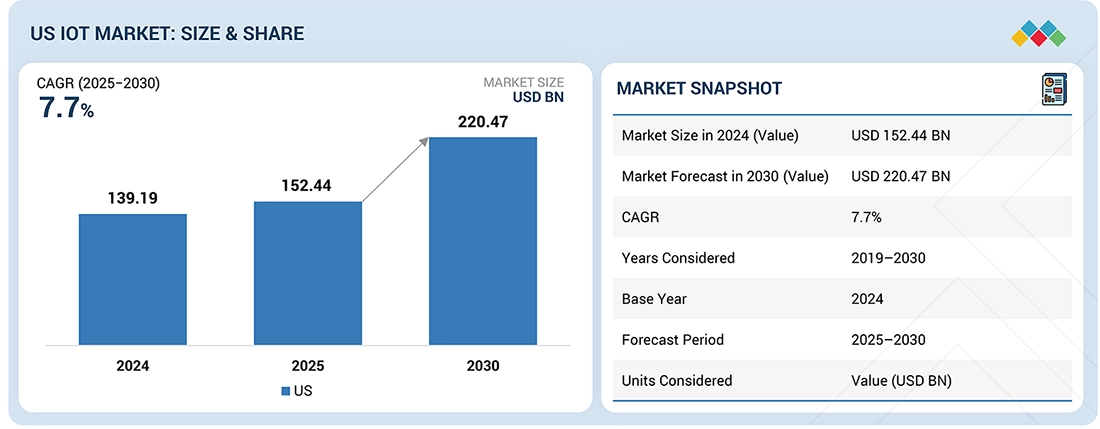
The US IoT market is expected to reach USD 220.47 billion by 2030, growing from USD 152.44 billion in 2025, at a CAGR of 7.7% from 2025 to 2030. The IoT market is expanding as organizations integrate sensors and connected devices into their operations to digitize assets and workflows. End users are seeking scalable device management, secure end-to-end connectivity, low-latency edge computing, and integrated analytics to enable real-time actions based on telemetry data. Companies are offering unified IoT platforms that include device lifecycle management, over-the-air (OTA) updates, zero-trust device security, edge-to-cloud orchestration, and AI-driven analytics and automation. These features facilitate predictive maintenance, enhance operational efficiency, improve safety and customer experience, and create new service-based revenue models.
KEY TAKEAWAYS
-
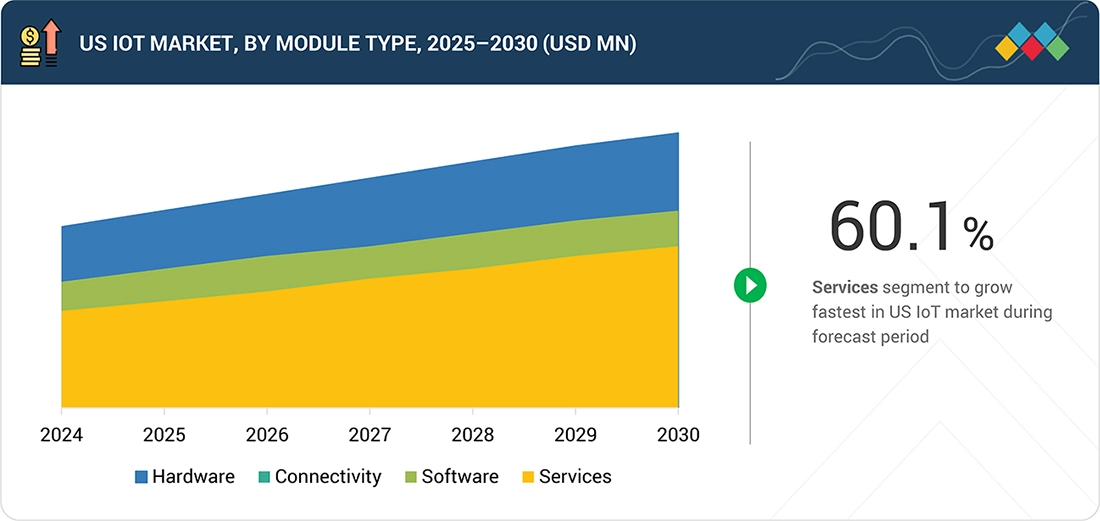
By Module TypeBy module type, the services segment is expected to register the highest CAGR of 8.8%.
-
By HardwareBy hardware, the modules/sensors segment held the largest market size in 2025.
-
By ConnectivityBy connectivity, the satellite segment is expected to be the fastest-growing, at a CAGR of 13.2% during the forecast period.
-
By SoftwareBy software, the IoT platforms segment dominated the market in 2025.
-
By ServiceBy service, the managed services segment is expected to have a CAGR of 9.2% during the forecast period.
-
By Focus AreaBy focus areas, the smart manufacturing segment is projected to hold the largest market size of 34.15 USD billion in 2025.
-
Competitive Landscape - Key PlayersCompanies such as Cisco, AWS, Microsoft, IBM, and Qualcomm were identified as some of the star players in the US IoT market, given their strong market share and product footprint.
-
Competitive Landscape - Startups/SMEsCompanies such as Particle, Clearblade, Telit Cinterion, and Losant, among others, have distinguished themselves among startups and SMEs by securing strong footholds in specialized niche areas, underscoring their potential as emerging market leaders.
The US IoT market is gaining momentum as enterprises push for real-time visibility into assets, people, and workflows to reduce delays and improve operational efficiency. Advances in sensor accuracy, cloud analytics, and AI automation are making indoor positioning an essential backbone for smarter buildings and connected operations.
TRENDS & DISRUPTIONS IMPACTING CUSTOMERS' CUSTOMERS
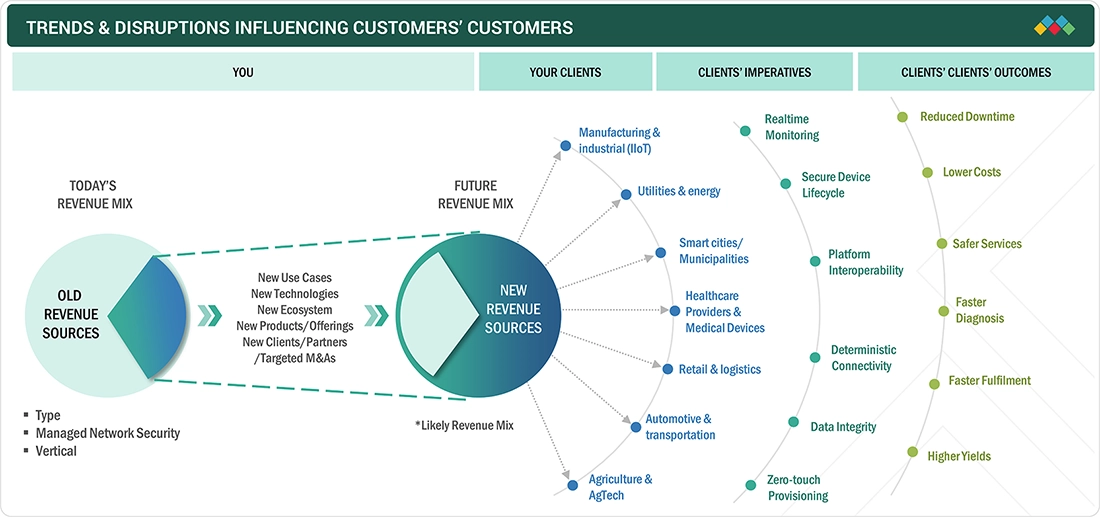
The impact on consumers' business stems from customer trends or disruptions. Hotbets are clients in manufacturing (IIoT), utilities, smart cities, healthcare devices, retail & logistics, automotive/transportation, agriculture, and commercial buildings, all buying managed IoT platforms, connectivity, edge compute, and device-security services. Disruptions include fragmentation of standards and interoperability, rising device security & privacy regulation, supplier & silicon constraints, vendor consolidation, the emergence of vertical-specific platform players, and real-time analytics.
Source: Secondary Research, Interviews with Experts, MarketsandMarkets Analysis
MARKET DYNAMICS

Level
-
Hyper-scale 5G and edge AI integration

-
Expansion of medical-grade IoT (IoMT)


Level
-
High upfront deployment costs at scale

-
Evolving cybersecurity mandates


Level
-
Space-based IoT for remote monitoring

-
Generative AI-driven device management


Level
-
Interoperability in smart home ecosystem

-
Critically specialized talent shortage

Source: Secondary Research, Interviews with Experts, MarketsandMarkets Analysis
Driver: Hyper-Scale 5G and edge AI integration
With the most advanced 5G infrastructure in the world, U.S. companies are rapidly shifting data processing from centralized cloud systems to the network edge. This shift enables near-instant decision-making in areas such as autonomous logistics, smart retail, and high-speed industrial automation, where microsecond delays matter. By processing data locally on devices or at base stations, businesses can significantly reduce bandwidth costs and improve privacy by keeping sensitive information on-site. This combination of fast connectivity and local intelligence is driving a new generation of autonomous applications that were once impossible, solidifying the US as a leader in real-time industrial AI.
Restraint: High upfront deployment costs at scale
Even with clear long-term returns, the upfront investment for broad, enterprise-wide IoT systems remains a major challenge for mid-sized companies. The high cost of specialized industrial hardware, combined with the expense of integrating these modern systems with legacy, fragile IT environments, often halts promising projects in what is known as "pilot purgatory." Moreover, the need for specialized consulting to ensure these systems can scale adds another financial strain. Many organizations recognize that while the technology is available, the path to full deployment is too challenging without significant external financing or government support.
Opportunity: Space-based IoT for remote monitoring
The rise of private Low Earth Orbit (LEO) satellite networks, driven by U.S. firms like SpaceX and Amazon, presents a major opportunity to track assets across large, underserved rural areas. This "Satellite IoT" enables logistics, oil and gas, and energy companies to maintain continuous data streams from remote oil fields and transcontinental shipping routes, where ground-based 5G cannot reach. This capability is transforming supply chain visibility for heavy industries, enabling monitoring of environmental conditions and equipment health in remote locations such as the ocean or desert. As satellite modem prices drop, the ability to connect anything, anywhere, is becoming standard for industrial IoT.
Challenge: Interoperability in smart home ecosystem
Despite the collaborative advancements of the Matter protocol, the US consumer market remains deeply fragmented across competing tech ecosystems offered by Apple, Google, and Amazon. Ensuring that thousands of devices from various manufacturers work together seamlessly without the barriers of walled gardens remains a technical and strategic challenge. Consumers often experience "app fatigue," where managing a smart home requires multiple interfaces that do not share data effectively. Until true plug-and-play interoperability is achieved at the application level, the smart home market will continue to struggle to move beyond early adopters and into mainstream households.
US IOT MARKET: COMMERCIAL USE CASES ACROSS INDUSTRIES
| COMPANY | USE CASE DESCRIPTION | BENEFITS |
|---|---|---|
 |
Smart-city deployments connecting streetlights and municipal sensors to central platforms for remote management, analytics and new city services | Lower energy costs, faster rollouts, platform for additional services |
 |
Real-time fleet and asset tracking using telematics and connected sensors to monitor location, condition, and route adherence for large shippers and logistics providers | Real-time visibility, reduced loss, improved routing and asset utilization |
 |
Industrial IoT solutions that connect factory equipment and plant networks to edge and cloud platforms to enable telemetry, automation, and operations integration | Improved uptime, faster incident resolution, better OT/IT alignment |
 |
Scalable IoT ingestion and platform services that connect medical devices and healthcare equipment for secure data processing and analytics at scale | Secure device connectivity, scalable data processing, accelerated analytics and ML |
 |
Industrial digital twins and predictive maintenance for factory assets | Reduced unplanned downtime, extended asset life, lower maintenance costs |
Logos and trademarks shown above are the property of their respective owners. Their use here is for informational and illustrative purposes only.
MARKET ECOSYSTEM
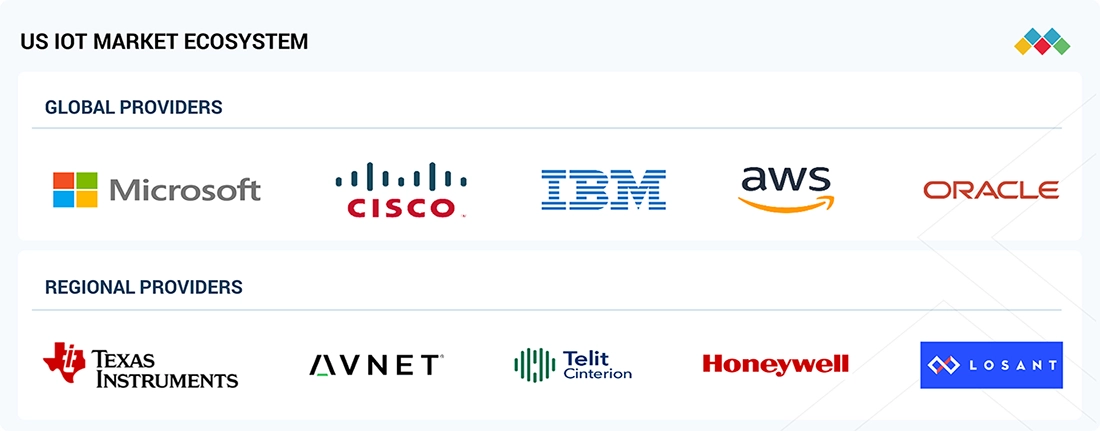
The US IoT ecosystem has two tiers - global providers (Microsoft, Cisco, IBM, AWS, Oracle) supply cloud platforms, edge/cloud orchestration, enterprise-grade connectivity, and analytics, while regional players (Texas Instruments, Avnet, Telit Cinterion, Honeywell, Losant) provide chipsets, connectivity modules, device lifecycle services, verticalized gateways, and local solutions.
Logos and trademarks shown above are the property of their respective owners. Their use here is for informational and illustrative purposes only.
MARKET SEGMENTS
Source: Secondary Research, Interviews with Experts, MarketsandMarkets Analysis
US IoT Market, By Module Type
The hardware segment is driven by 5G RedCap and Wi-Fi 7. These technologies provide a low-latency foundation for industrial and consumer applications. Manufacturers focus on energy efficiency and miniaturization for smart home ecosystems and medical wearables. Adoption of the Matter standard ensures seamless compatibility across platforms. This trend boosts the automotive and smart energy sectors. Hardware remains a major component of the IoT stack due to significant unit shipments.
US IoT Market, By Hardware
The security hardware segment in the US is essential because of complex cyber threats that target infrastructure and connected devices. Companies are investing in hardware-based roots of trust and Trusted Execution Environments (TEEs) to safeguard data at the physical layer. Specialized security chips now provide integrated encryption and tamper detection for industrial endpoints. North American healthcare providers lead this demand, allocating significant budgets to secure interconnected hospital assets.
US IoT Market, By Connectivity
Satellite connectivity in the US is experiencing rapid growth, driven by LEO constellations that provide global coverage and lower latency. This segment is crucial for logistics and precision agriculture, where land-based networks are often unreliable. The adoption of 3GPP standards has made it easier for standard IoT devices to connect directly to satellites. Integrated hybrid models now guarantee continuous data transmission for tracking high-value assets and managing disasters.
US IoT Market, By Software
The US software segment for security & safety is growing through AI-driven real-time threat detection and predictive public safety measures. Organizations are focusing on platforms with strong identity management and automated response systems to tackle advanced ransomware. In the public sector, smart city projects use this software for intelligent surveillance and coordinating emergency responses. There is high demand for complete suites that offer end-to-end transparency and meet regulatory requirements.
US IoT Market, By Service
Professional services are a key part of the US IoT market, as complex multi-layered ecosystems create a need for expert system integration. Organizations depend on third-party specialists to fill gaps in cloud-native architecture and specialized data analytics. These services are crucial for handling device diversity and ensuring smooth integration with legacy ERP systems.
US IoT Market, By Focus Area
Smart healthcare is a major growth area in the US, influenced by the move toward preventive and outcome-based care models. The widespread use of remote patient monitoring (RPM) enables continuous management of chronic diseases and fewer emergency visits. Advances in biosensors allow for early detection of physiological changes, turning devices into proactive diagnostic tools. With supportive reimbursement policies, the integration of IoT is creating a more personalized and data-driven patient experience.
US IOT MARKET: COMPANY EVALUATION MATRIX
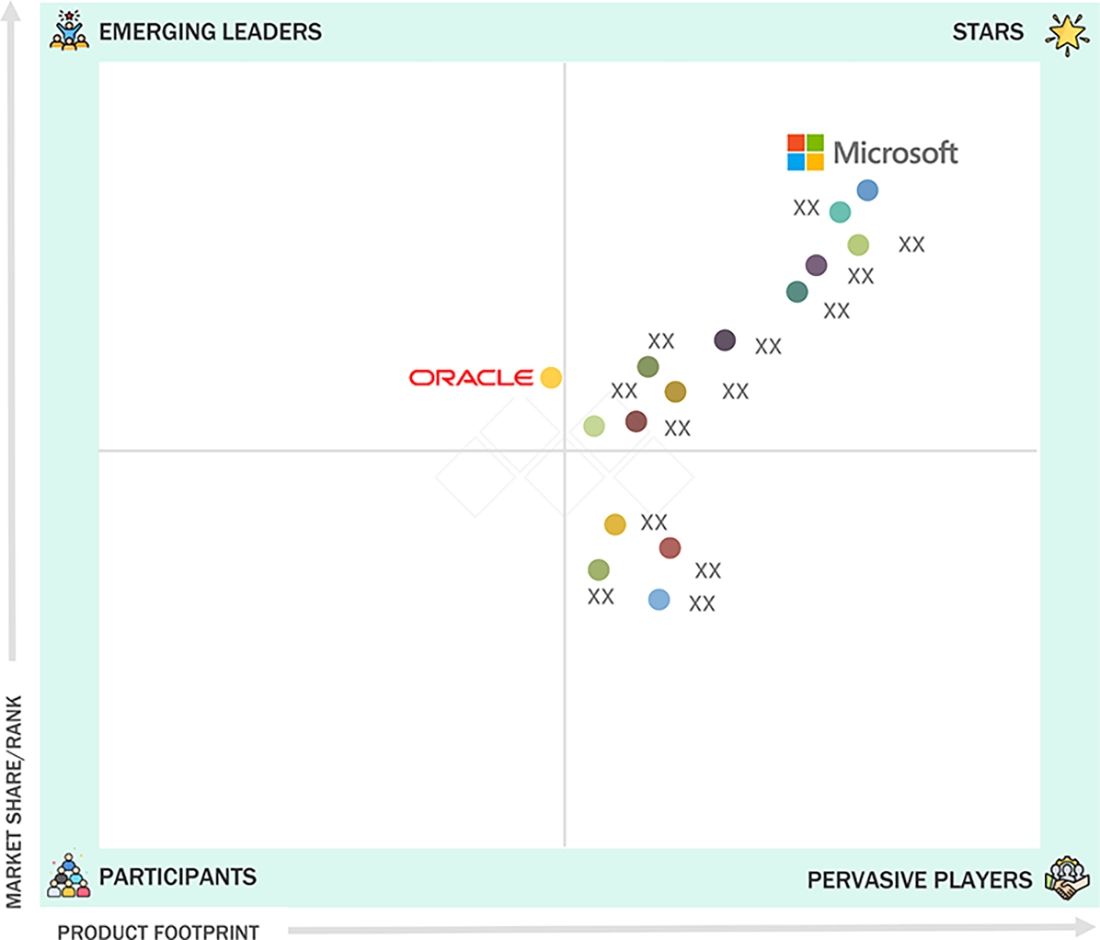
In the IoT market matrix, Microsoft (Star) leads with a strong market share and an extensive product footprint, driven by its customized solutions tailored to customers' requirements and growth strategies that consistently deliver advanced technology. Oracle (Emerging Leader) is gaining visibility with innovative solutions that cater to future IoT demands. While Microsoft dominates through scale and a diverse portfolio, Oracle shows significant potential to move toward the leaders’ quadrant as IoT demand continues to rise.
Source: Secondary Research, Interviews with Experts, MarketsandMarkets Analysis
KEY MARKET PLAYERS
- Microsoft (US)
- AWS (US)
- Cisco (US)
- Intel (US)
- Qualcomm (US)
- Texas Instruments (US)
- IBM (US)
- PTC (US)
- HPE (US)
- Honeywell (US)
- Oracle (US)
- Particle (US)
- Clearblade (US)
- Telit Cinterion (US)
- Losant IoT (US)
MARKET SCOPE
| REPORT METRIC | DETAILS |
|---|---|
| Market Size in 2024 (Value) | USD 152.44 Billion |
| Market Forecast in 2030 (Value) | USD 220.47 Billion |
| Growth Rate | 7.7% from 2025 to 2030 |
| Years Considered | 2019-2030 |
| Base Year | 2024 |
| Forecast Period | 2025-2030 |
| Units Considered | Value (USD Billion) |
| Report Coverage | Revenue forecast, company ranking, competitive landscape, growth factors, and trends |
| Segments Covered |
|
WHAT IS IN IT FOR YOU: US IOT MARKET REPORT CONTENT GUIDE
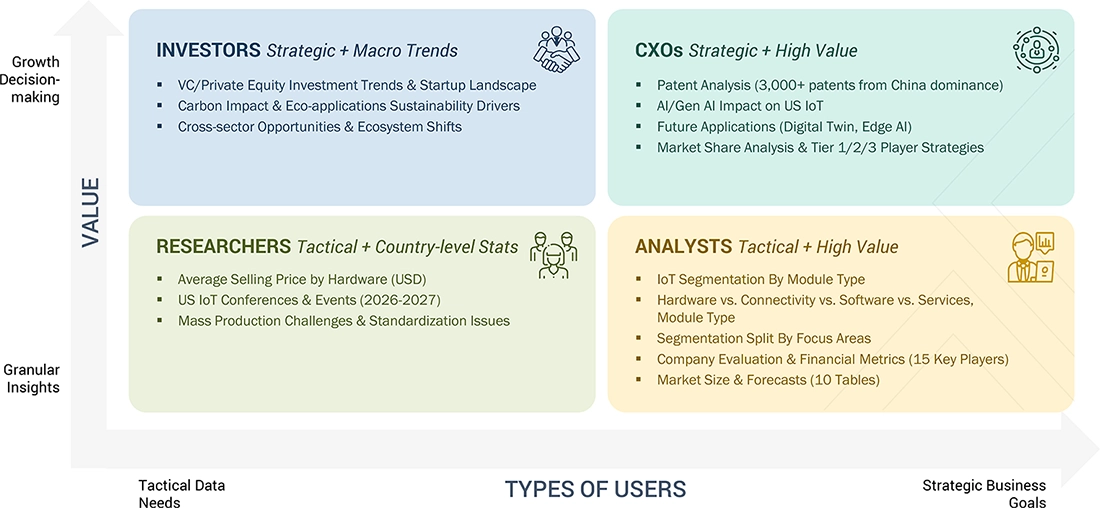
DELIVERED CUSTOMIZATIONS
We have successfully delivered the following deep-dive customizations:
| CLIENT REQUEST | CUSTOMIZATION DELIVERED | VALUE ADDS |
|---|---|---|
| Leading Solution Provider (US) | Product Analysis: Product Matrix, which gives a detailed comparison of the product portfolio of each company | Enhanced understanding of competitive positioning and product offerings |
| Leading Service Provider (US) | Company Information: Detailed analysis and profiling of additional market players (up to 5) | Deeper insights into market dynamics and potential strategic partnerships |
RECENT DEVELOPMENTS
- October 2025 : AT&T and Ericsson launched the AT&T IoT Marketplace, a cloud-based platform on Microsoft Azure that simplifies IoT service management for industries such as transportation and healthcare. Powered by Ericsson’s Digital Experience Platform, it streamlines selling, provisioning, and billing, reducing order times and improving efficiency.
- October 2025 : Tata Communications and Cisco partnered to integrate Tata’s MOVE™ eSIM solution, covering 350+ million eSIM OS across 200+ countries, with Cisco’s IoT Control Center, managing 270 million+ devices for 32,000+ enterprises. The collaboration streamlines device activation, enhances scalability, and reduces integration complexity for industries such as transportation and manufacturing.
- March 2025 : Qualcomm Technologies Inc. acquired Edge Impulse to enhance its AI and Internet of Things (IoT) capabilities. The acquisition aims to combine Qualcomm's hardware with Edge Impulse's software platform for AI development, making it easier for developers to create and deploy AI models on edge devices.
Table of Contents
 Exclusive indicates content/data unique to MarketsandMarkets and not available with any competitors.
Methodology
This research study extensively utilized secondary sources, directories, and databases, including Dun & Bradstreet (D&B), Hoovers, and Bloomberg Businessweek, to identify and collect information relevant to a technical, market-oriented, and commercial study of the US IoT market. The primary sources have primarily consisted of industry experts from core and related industries, as well as preferred suppliers, manufacturers, distributors, service providers, technology developers, alliances, and organizations related to all segments of the value chain of this market. In-depth interviews have been conducted with various primary respondents, including key industry participants, subject matter experts, C-level executives of key market players, and industry consultants, to obtain and verify critical qualitative and quantitative information.
Secondary Research
The market size of companies offering IoT worldwide was arrived at based on secondary data available through paid and unpaid sources. It was also arrived at by analyzing the product portfolio of major companies and rating them based on their performance and quality. In the secondary research process, various secondary sources were referred to identify and collect information for the study. The secondary sources included annual reports, press releases, and investor presentations of companies; white papers, journals, and certified publications; and articles from recognized authors, directories, and databases.
Secondary research was mainly used to obtain key information about the industry’s value chain and supply chain and to identify key players through various solutions and services, market classification and segmentation according to offerings of major players, industry trends related to technologies, applications, and regions, and key developments from both market-oriented and technology-oriented perspectives.
Primary Research
During the primary research process, various primary sources from both the supply and demand sides were interviewed to gather qualitative and quantitative information on the market. The primary sources from the supply side included various industry experts, including Chief Experience Officers (CXOs); Vice Presidents (VPs); directors from business development, marketing, and product development/innovation teams, related key executives from IoT solution vendors, professional service providers, and industry associations, and key opinion leaders.
Primary interviews were conducted to gather insights, including market statistics, revenue data collected from solutions and services, market segmentations, market size estimations, market forecasts, and data triangulation. Primary research also helped in understanding various trends related to technologies, applications, deployments, and regions. Stakeholders from the demand side, such as Chief Information Officers (CIOs), Chief Technology Officers (CTOs), Chief Strategy Officers (CSOs), and end users using IoT solutions, were interviewed to understand the buyer’s perspective on suppliers, products, service providers, and their current usage of IoT solutions, which would impact the overall US IoT market.
Market Size Estimation
Multiple approaches were adopted to estimate and forecast the size of the US IoT market. The first approach involves estimating market size by summing up the revenue generated by companies through the sale of IoT solutions.
Top-down and bottom-up approaches were used to estimate and validate the total size of the US IoT market. These methods were also extensively used to estimate the size of various market segments. The research methodology used to evaluate the market size is listed below.
- Key players in the market have been identified through extensive secondary research.
- In terms of value, the industry’s supply chain and market size have been determined through a combination of primary and secondary research processes.
- All percentage shares, splits, and breakups have been determined using secondary sources and verified through primary sources.
Data Triangulation
After determining the overall market size, the US IoT market was segmented into several categories and subcategories. A data triangulation procedure was employed to complete the overall market engineering process and derive the exact statistics for all segments and subsegments, as applicable. The data was triangulated by studying various factors and trends from the demand and supply sides. In addition to data triangulation and market breakdown, the market size was validated using both top-down and bottom-up approaches.
Market Definition
Internet of Things (IoT), is a network of physical devices embedded with sensors and software that can collect and exchange data over the internet, enabling them to communicate and interact with each other without human intervention; essentially, it encompasses hardware, software, connectivity, and services used to build and operate IoT systems across various focus areas such as smart transportation, smart energy & utilities, smart manufacturing, smart retail, among others.
Stakeholders
- Government agencies
- IoT service providers
- Telecom companies
- System integrators
- Smart device manufacturers
- Healthcare providers and institutions
- Automotive and mobility solution providers
- Energy and utility companies
- Retailers and E-commerce platforms
- Industrial enterprises
- Construction and real estate developers
- Agricultural enterprises
- Financial institutions and banks
- Research and development institutions
- Educational and training organizations
Report Objectives
- To determine and forecast the global US IoT market by module type, hardware, connectivity, software, service, focus area, and region
- To forecast the size of the market segments for North America, Europe, Asia Pacific, Latin America, and the Middle East & Africa
- To provide detailed information about the major factors (drivers, restraints, opportunities, and challenges) influencing the growth of the US IoT market
- To analyze each submarket concerning individual growth trends, prospects, and contributions to the overall US IoT market
- To analyze the opportunities in the market for stakeholders by identifying the high-growth segments of the US IoT market
- To profile the key market players, provide a comparative analysis based on business overviews, regional presence, product offerings, business strategies, and key financials, and illustrate the market’s competitive landscape
- Track and analyze competitive developments in the market, such as mergers and acquisitions, product development, partnerships and collaborations, and research and development (R&D) activities
Available Customizations
With the given market data, MarketsandMarkets offers customizations to meet the company’s specific needs. The following customization options are available for the report:
Geographic Analysis as per Feasibility
- Analysis for additional countries (up to five)
Company Information
- Detailed analysis and profiling of additional market players (up to 5)
Key Questions Addressed by the Report
What is the projected size of the US IoT Market by 2030?
The US IoT market is expected to grow from USD 152.44 billion in 2025 to USD 220.47 billion by 2030, at a CAGR of 7.7% during the forecast period.
Which module type is expected to grow the fastest in the US IoT Market?
The services segment is expected to register the highest CAGR of 8.8% during the forecast period.
Which connectivity technology is projected to witness the highest growth in the US IoT Market?
The satellite connectivity segment is projected to grow at the highest CAGR of 13.2% during the forecast period.
Which software segment holds the largest share of the US IoT Market?
The IoT platforms segment dominated the US IoT market in 2025.
Which focus area accounts for the largest market size in the US IoT Market?
Smart manufacturing is projected to hold the largest market size, reaching USD 34.15 billion in 2025.
What is driving the growth of the US IoT Market?
Growing demand for connected devices, edge computing, AI-driven analytics, secure device management, and real-time operational intelligence is driving the US IoT market.


Personalize This Research
- Triangulate with your Own Data
- Get Data as per your Format and Definition
- Gain a Deeper Dive on a Specific Application, Geography, Customer or Competitor
- Any level of Personalization
Let Us Help You
- What are the Known and Unknown Adjacencies Impacting the US IoT Market
- What will your New Revenue Sources be?
- Who will be your Top Customer; what will make them switch?
- Defend your Market Share or Win Competitors
- Get a Scorecard for Target Partners

Custom Market Research Services
We Will Customise The Research For You, In Case The Report Listed Above Does Not Meet With Your Requirements
Get 10% Free CustomisationTESTIMONIALS






Growth opportunities and latent adjacency in US IoT Market