US Modular Data Center Market Size & Outlook, 2025-2032

US Modular Data Center Market by Solutions (All-in-one and Prefabricated Modules (IT, Power, Cooling)), Form Factor (ISO Containers, Enclosures, Skid-mounted), Deployment Type (Indoor, Outdoor), End User (Enterprises, CSPs, TSPs) - Global Forecast to 2032




OVERVIEW
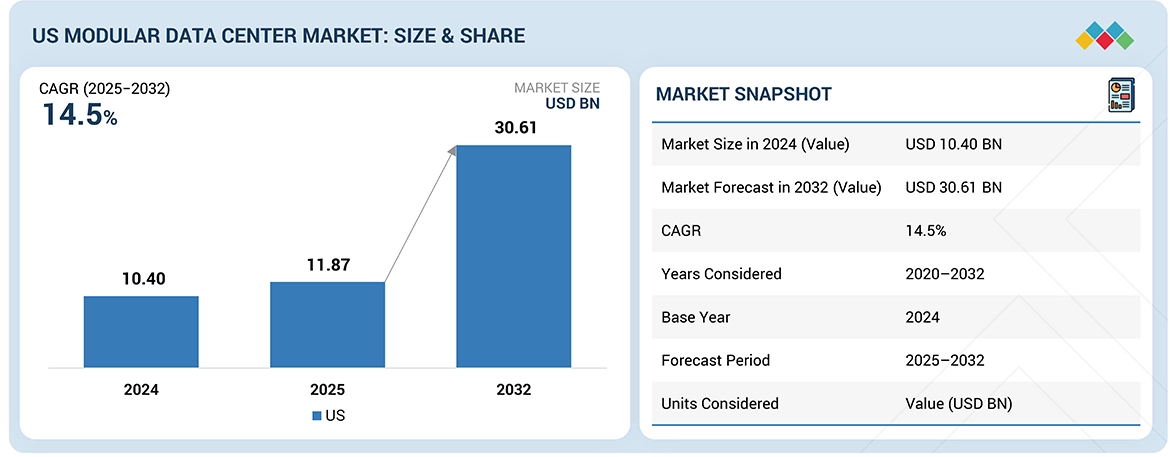
Source: Secondary Research, Interviews with Experts, MarketsandMarkets Analysis
The modular data center market in the US is projected to reach USD 30.61 billion by 2032 from USD 11.87 billion in 2025, at a CAGR of 14.5%. The market growth is attributed to the continued expansion of hyperscale infrastructure in major hubs, including Northern Virginia, Dallas-Fort Worth, Phoenix, Silicon Valley, and Chicago. Increased capacity build-out is driving demand for prefabricated modular data centers, which enable quick installation and support phased expansion. Operators compete to secure the best locations for their facilities, including power, land, and water utilities, while minimizing time-to-market. Factory-manufactured modular infrastructure designed for AI workloads facilitates the growth of the cloud, supports high-density computing environments, and improves operational efficiency, operational resilience, and low-CO2 data center performance in many geographic regions.
KEY TAKEAWAYS
-
BY SOLUTIONBy 2032, prefabricated modules are expected to capture the largest market share, as enterprises prioritize scalable, energy-efficient, and rapidly deployable modular data center infrastructure to support AI, cloud, and edge expansion.
-
BY SERVICESupport and maintenance services will exhibit the fastest growth as operators prioritize lifecycle management, remote monitoring, performance optimization, and uptime assurance across distributed prefabricated and edge deployments.
-
BY FORM FACTORBy form factor, enclosures are expected to hold the largest market share by 2032.
-
BY BUILD TYPEBy build type, fully prefabricated data centers are expected to record the highest CAGR of 16.9% during the forecast period.
-
BY DATA CENTER SIZEMid-sized data centers are expected to capture the largest market share, reaching USD 11.03 billion by 2032.
-
BY DEPLOYMENT TYPEBy deployment type, outdoor modular data centers are expected to witness the fastest growth rate during the forecast period.
-
BY END USEREnterprise data centers are estimated to lead the market, reaching a value of USD 13.78 billion by 2032
-
COMPETITIVE LANDSCAPE - KEY PLAYERSVertiv, Dell Technologies, and Johnson Controls are among the major players in the US modular data center market, collaborating with enterprises and hyperscale operators to deliver prefabricated modular data center solutions, integrated power and cooling infrastructure, scalable containerized deployments, advanced monitoring platforms, and energy-efficient designs that enhance rapid deployment, operational resilience, and sustainable high-density capacity expansion across US data center environments.
-
COMPETITIVE LANDSCAPE - STARTUPS/SMEs365 Data Centers, Coresite, and ScaleMatrix have distinguished themselves among startups and SMEs through robust product portfolios and effective business strategies.
The market for modular data centers in the US is rapidly developing due to the growth of hybrid clouds, AI, and edge deployments, and the resulting need for rapidly expandable and scalable infrastructure. With many organizations focused on reducing construction timelines, controlling capital intensity, and providing greater deployment flexibility, more are turning to prefabricated modular data centers as a solution. Modular data centers, which comprise integrated power, cooling, and rack-ready modules, are enabling standardized builds, additional phased capacity buildouts, and increased energy efficiency. As more and more digital workloads are connected across the US and latency-sensitive applications become more prevalent, modular data center solutions are becoming a core component of infrastructure strategy, strengthening resilience, shortening time-to-market, and supporting sustainable, high-density computing operations nationwide.
TRENDS & DISRUPTIONS IMPACTING CUSTOMERS' CUSTOMERS
The expectations of customers and end users in the market are being shaped by the expansion of hyperscale data centers, the increased demand for higher data densities driven by AI, and tightening energy-efficiency and sustainability regulations. Cloud service providers, telecom operators, and enterprises across IT and manufacturing increasingly expect scalable, resilient, and rapidly deployable infrastructure. These factors are driving the adoption of prefabricated modular and containerized solutions that can accommodate phased capacity expansion, ensure operational reliability, and deliver consistent service across established and emerging data center markets.
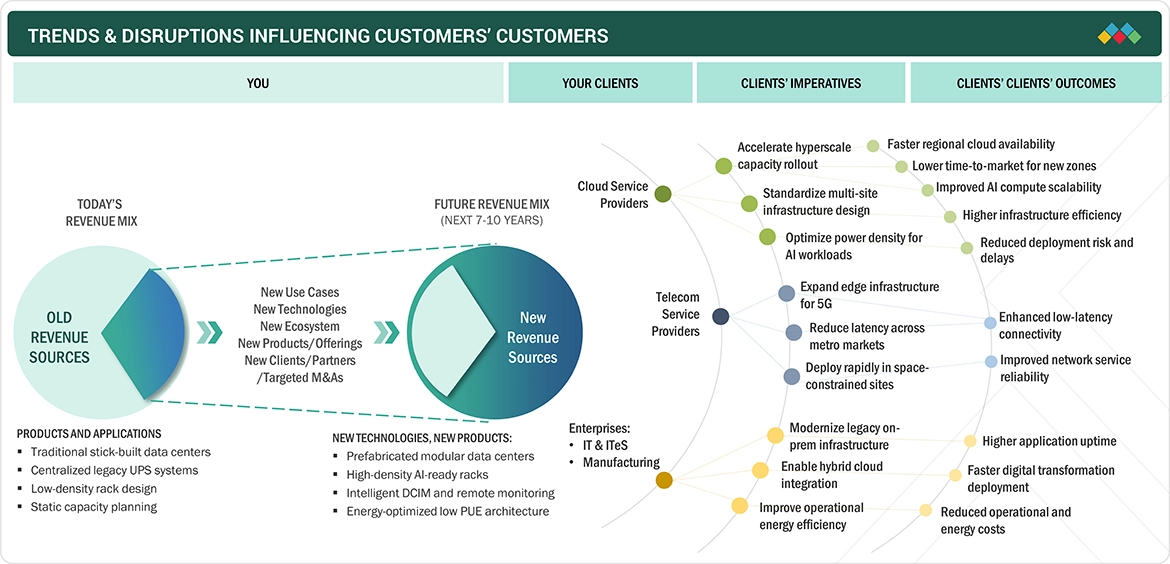
Source: Secondary Research, Interviews with Experts, MarketsandMarkets Analysis
MARKET DYNAMICS

Level
-
Rapid hyperscale expansion and AI-driven capacity growth

-
Enterprise hybrid cloud modernization and disaster recovery decentralization


Level
-
Power availability constraints and permitting complexities in primary US data center markets

-
Environmental scrutiny and local regulatory resistance limiting large-scale infrastructure expansion


Level
-
Expansion into secondary markets and edge locations

-
Renewable-integrated, energy-efficient modular designs


Level
-
Integration with existing site infrastructure and skilled labor shortages

-
Critical equipment lead times and supply chain bottlenecks

Source: Secondary Research, Interviews with Experts, MarketsandMarkets Analysis
Driver: Rapid hyperscale expansion and AI-driven capacity growth
Modular data centers across the US have seen increased adoption due to the rapid expansion of AI infrastructure and hyperscale cloud campuses. There are currently 577 data centers operating across the US with a total capacity of 14,187 MW, and an additional 677 planned projects are expected to add 186,781 MW, according to Cleanview’s project tracker as of February 2026. Due to the high volume of development pipelines, many operators will adopt prefabricated modular data centers to enable quicker construction timelines and facilitate phased capacity deployments from a project perspective. The demand for scalable, factory-built modular infrastructure that delivers improved speed-to-market, power-optimized facilities, and consistent deployments is being supported by AI-driven high-density computing, edge expansion, and the broader rollout of multi-region cloud solutions.
Restraint: Power availability constraints and permitting complexities in primary US data center markets
Despite strong expansion momentum, limited power availability and extended interconnection timelines are constraining modular deployments in key US hubs. High-demand areas are experiencing utility capacity bottlenecks, environmental compliance reviews, and zoning complexities that are delaying project approvals. Modular construction does reduce on-site construction time, but a structurally limited supply of reliable grid power persists. In the primary markets, operators must obtain long-term commitments from utilities or consider alternate locations, which would disrupt their deployment velocity and increase their planning complexity.
Opportunity: Expansion into secondary markets and edge locations
The large pipeline of planned capacity is driving geographic diversification beyond traditional primary hubs. Operators are increasingly targeting Tier 2 and emerging US markets to secure power access and accelerate deployment timelines. The continued development of prefabricated modular data center technologies supports rapid activation of new sites by enabling modular solutions in regions with adequate power. There continues to be a powerful argument for containerized, edge-ready modular solutions for regional expansion to meet an increasing number of requirements, including AI inference, low-latency services, and hybrid cloud connectivity.
Challenge: Integration with existing site infrastructure and skilled labor shortages
To integrate modular systems into site-specific utilities (power, cooling, and networking), coordinated engineering and skilled technical labor are necessary. Most deployment sites will require either electrical upgrades, substation coordination, or advanced cooling integration to accommodate high-density workloads. Deployment delays are occurring due to a lack of skilled labor in the electrical, mechanical, and commissioning fields. Operators are promoting factory-integrated modular designs, standard configurations, and remote monitoring platforms as ways to reduce field complexity and improve execution efficiency.
US MODULAR DATA CENTER MARKET: COMMERCIAL USE CASES ACROSS INDUSTRIES
| COMPANY | USE CASE DESCRIPTION | BENEFITS |
|---|---|---|
 |
Vertiv Enables Retailer Edge Infrastructure Modernization | 0 minutes unplanned downtime | Accelerated modular deployment across 48 distribution centers | Reduced modular data center deployment costs | Standardized prefabricated infrastructure design | Rapid edge compute capacity expansion | Integrated power, cooling, and UPS in single modular system | Improved operational continuity | Scalable micro modular architecture supporting 95% order fulfillment model |
 |
Schneider Electric Enables Rapid Hospital Data Center Expansion | USD 37,500 lower capital cost compared to traditional construction | Operational within 6 months of PO | Preserved revenue-generating hospital bed space | 12 racks with integrated 150 kW UPS and In-Row cooling | Eliminated need for new building construction | Minimal site preparation and reduced disruption | Simplified ROI justification and faster scalable capacity deployment |
 |
Dell and eBay Deliver Ultra-efficient Modular Data Centers | PUE of 1.043 at 115°F and 1.018 in cooler conditions | 50% lower capital cost versus previous builds | 4× higher rack density | Up to 30 kW per rack sustained | Free-air cooling year-round in desert climate | 1,920 servers per modular unit (560 kW load) | Thousands of servers deployed in hours | 12 MW scalable IT capacity within 14,000 sq ft | Reduced cost per transaction through ultra-efficient modular infrastructure |
Logos and trademarks shown above are the property of their respective owners. Their use here is for informational and illustrative purposes only.
MARKET ECOSYSTEM
The US modular data center ecosystem comprises IT module providers that deliver integrated compute and rack-ready systems, supported by power module vendors that offer modular UPS, switchgear, and intelligent power distribution solutions. Cooling module providers enable high-density and liquid-ready thermal management, while component suppliers deliver containment, monitoring, and electrical infrastructure for standardized builds. All-in-one modular solution providers offer fully prefabricated, containerized data center units for rapid deployment. Demand is driven by hyperscale cloud operators and enterprises, reflecting the US market’s focus on scalable, resilient, and energy-efficient modular data center deployments.
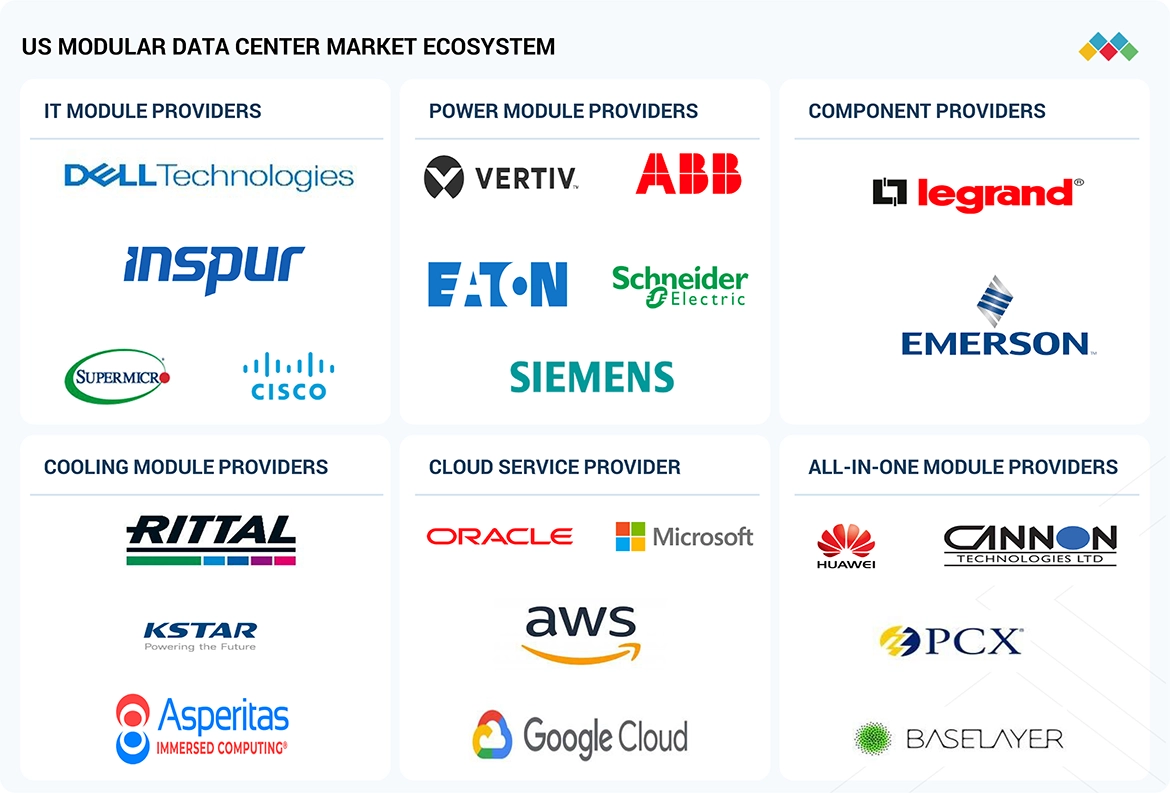
Logos and trademarks shown above are the property of their respective owners. Their use here is for informational and illustrative purposes only.
MARKET SEGMENTS
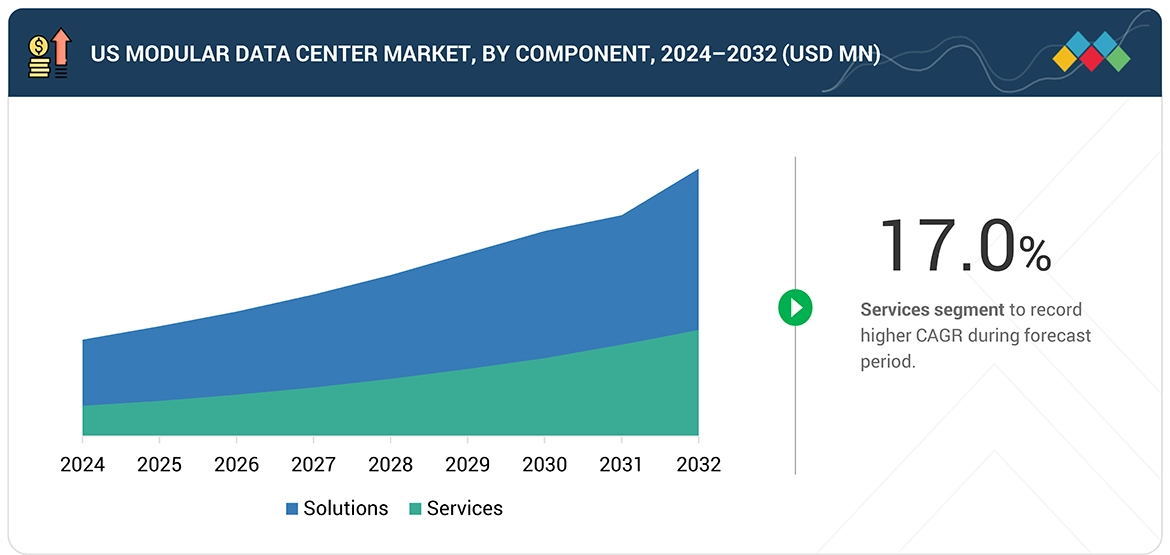
Source: Secondary Research, Interviews with Experts, MarketsandMarkets Analysis
US Modular Data Center Market, By Solution
All-in-one modules will grow the fastest due to the urgent demand for scalable capacity driven by AI growth, GPU-intensive computing, and the need for edge deployments. Standard builds generally take 18-24 months to complete, whereas modular systems utilize prefabrication and allow for deployment in months. All-in-one systems integrate power and cooling, support racks with increased density (greater than 50 kW), and can improve energy efficiency. All-in-one systems use standardized manufacturing designs, which increase supply chain resilience and enable consistent rollout across multiple regions.
US Modular Data Center Market, By Service
By service, integration and deployment will play a significant role in the market as operators prioritize seamless installation of prefabricated modules within existing power, cooling, and network environments. The growing trend of hyperscale expansions, edge deployments, and high-performance AI workloads will require coordinated engineering, rapid commissioning, and a consistent method for site-integrating prefabricated modules. Therefore, specialized integration and deployment services are key to supporting large-scale, low-risk rollouts of modular infrastructure solutions.
US Modular Data Center Market, By Form Factor
By form factor, skid-mounted systems are expected to account for the fastest growth as operators increasingly require compact, transportable infrastructure for constrained urban sites and brownfield expansions. Pre-assembled electrical and mechanical systems will help reduce site installation complexity and speed up the utility interconnection process in areas where utilities are constrained by power capacity. In addition, skid-mounted units allow customers to add capacity incrementally, making them a good option for phased enterprise expansion, disaster recovery, and distributed edge deployment projects that require on-site flexibility and adaptability.
US Modular Data Center Market, By Build Type
By build type, semi-prefabricated data centers are expected to play a significant role in the US modular data center market as operators balance customization needs with accelerated construction timelines. The benefit of a semi-prefabricated configuration is that core power and cooling modules can be built off-site in the factory, with site-specific configuration on-site, thereby ensuring compliance, utility alignment, and regional design criteria. This hybrid approach is beneficial for enterprise retrofits, regulated industry applications, and phased campus expansions, where, although full standardization is not an option, there is an emphasis on speed, cost containment, and the flexibility to integrate the construction process.
US Modular Data Center Market, By Data Center Size
By data center size, small data centers are expected to register the fastest growth, as enterprises and telecom operators expand distributed edge infrastructure to support low-latency applications and localized processing. Small modular units enable organizations to deploy rapidly across vertical markets such as retail & e-commerce, healthcare & life sciences, manufacturing, and remote locations, where hyperscale data centers are not feasible. Their compact size, capital efficiency, and scalability also lend themselves to incremental digital transformations and geospatially distributed IT infrastructures.
US Modular Data Center Market, By Deployment Type
By deployment type, indoor modular data centers are expected to account for the largest market share, as enterprises expand capacity within existing corporate campuses and colocation facilities to avoid prolonged zoning and permitting cycles. Indoor prefabricated modules will benefit operators in electricity-constrained hubs, such as Northern Virginia and segments of Texas, by allowing the use of already-approved utility connections and existing mechanical systems, thereby accelerating the time to activate capacity and compliance with US building and fire code regulations, and enabling high-density controlled deployments without the need for greenfield construction projects.
US Modular Data Center Market, By End User
Telecom service providers will lead the US modular data center market's growth by year's end, as carriers accelerate their deployment of distributed edges to densify 5G, launch up private networks, and support latency-sensitive applications. Modular data centers enable rapid installation at central offices, aggregation hubs, and tower-adjacent sites without extensive civil construction. This approach supports scalable edge capacity, improves network resilience, and aligns with telecom operators’ shift toward software-defined and cloud-native network architectures.
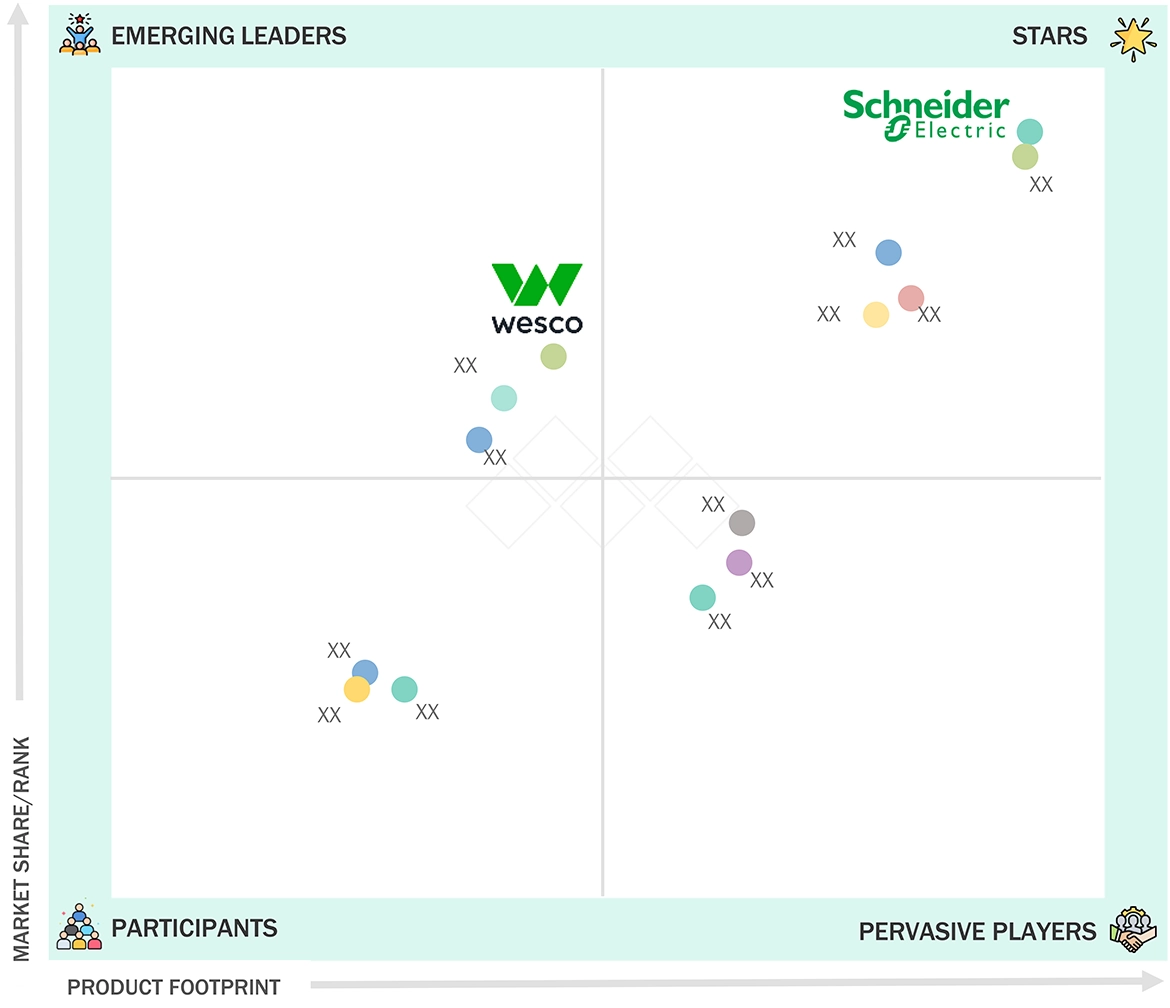
US MODULAR DATA CENTER MARKET: COMPANY EVALUATION MATRIX
Schneider Electric (Star) leads the US modular data center market with its strong prefabricated portfolio, integrated power and cooling systems, and focus on energy-efficient, high-density deployments. WESCO International (Emerging Leader) is evolving its modular integration and turnkey delivery capabilities to enable scalable, rapidly deployable infrastructure.
Source: Secondary Research, Interviews with Experts, MarketsandMarkets Analysis
KEY MARKET PLAYERS
- Dell Technologies (US)
- Vertiv (US)
- Jonhson Controls (US)
- Hubbell (US)
- IE Corp. (US)
- Wescos Internantional (US)
- ScaleMatrix (US)
- Equinix (US)
- 365 Data Centers (US)
- Fibrebond (US)
- TAS (US)
- AWS (US)
- Meta (US)
- Oracle (US)
- CoreSite (US)
MARKET SCOPE
| REPORT METRIC | DETAILS |
|---|---|
| Market Size in 2024 (Value) | USD 10.40 Billion |
| Market Forecast in 2032 (Value) | USD 30.61 Billion |
| Growth Rate | CAGR of 14.5% from 2025 to 2032 |
| Years Considered | 2020-2032 |
| Base Year | 2024 |
| Forecast Period | 2025-2032 |
| Units Considered | Value (USD Million/Billion) |
| Report Coverage | Revenue forecast, company ranking, competitive landscape, growth factors, and trends |
| Segments Covered |
|
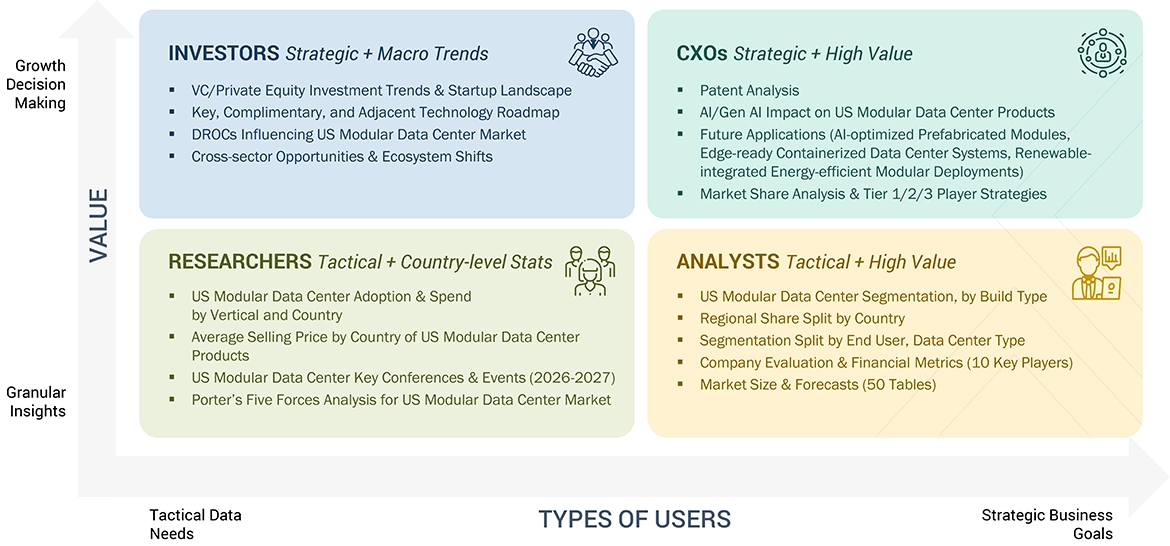
WHAT IS IN IT FOR YOU: US MODULAR DATA CENTER MARKET REPORT CONTENT GUIDE
DELIVERED CUSTOMIZATIONS
We have successfully delivered the following deep-dive customizations:
| CLIENT REQUEST | CUSTOMIZATION DELIVERED | VALUE ADDS |
|---|---|---|
| Cloud Service Provider (US) | Additional Vendor Mapping: Identification and profiling of modular infrastructure vendors across prefabricated modules, high-density power systems, liquid-cooling integration, and turnkey deployment support | Expands qualified supplier base, strengthens procurement leverage, reduces vendor concentration risk, and supports faster, scalable modular capacity expansion across US regions |
| Telecom Operator (US) | Edge Deployment Strategy Assessment: Evaluation of modular data center placement across metro aggregation sites, tower-adjacent locations, and central offices, including power access, latency thresholds, and integration with 5G core infrastructure | Accelerates distributed edge rollout, reduces site execution risk, improves network resilience, and enables scalable low-latency service delivery |
RECENT DEVELOPMENTS
- January 2026 : Eaton partnered with Flexnode to deliver modular rack and power infrastructure for the NX Compute Module. Eaton will supply backup racks, cable management, and UPS systems, supporting 3.5–35MW deployments. Flexnode claims 35% faster deployment, targeting high-density AI, HPC, and quantum workloads.
- January 2026 : Vertiv introduced new configurations of its MegaMod HDX, a prefabricated modular power and liquid cooling infrastructure solution for high-density AI and HPC deployments. The factory-integrated system supports up to 10 MW capacity, combines direct-to-chip liquid and air cooling, and enables scalable, rapid modular data center expansion across North America.
- June 2025 : Eaton partnered with Siemens Energy to accelerate modular data center construction using grid-independent power solutions. Siemens Energy will provide gas turbines and battery storage, while Eaton will supply medium- and high-voltage electrical infrastructure. The collaboration targets scalable, lower-emission facilities to support rising AI and cloud computing workloads.
- September 2024 : Vertiv launched the Vertiv MegaMod CoolChip, a prefabricated modular data center solution engineered for AI compute. The factory-built system integrates direct-to-chip liquid cooling, high-efficiency power protection, and scalable modular enclosures, enabling turnkey AI infrastructure deployment up to 50% faster than traditional onsite construction while supporting multi-megawatt configurations globally.
Table of Contents
 Exclusive indicates content/data unique to MarketsandMarkets and not available with any competitors.
Methodology
The study involved four major activities in estimating the US Modular Data Center market.. We conducted secondary research to gather information on the market, competitors, and parent market. The next stage was to validate these findings and assumptions and size them with industry professionals across the value chain using primary research. Top-down and bottom-up methodologies were used to determine the total market size. We used the market breakup and data triangulation techniques to estimate the market size of the US Modular Data Center market. segments.
Secondary Research
Multiple sources were utilized to find and gather data for this research project in the secondary research phase. Other sources used were annual reports, press releases, investor presentations, white papers, journals, publications, and articles from reputable sources, directories, and databases. Information was also collected from additional secondary sources like academic journals, official government sites, blogs, and online platforms of vendors.
Primary Research
Primary sources included industry experts from the core and associated industries, preferred software suppliers, hardware manufacturers, distributors, service providers, technology developers, alliances, and organizations representing all parts of the industry's value chain. In-depth interviews were conducted with primary respondents, including major industry participants, subject-matter experts, C-level executives of important market companies, and industry consultants, to acquire and verify critical qualitative and quantitative data and analyze the market's potential.
We performed primary interviews to gain insights such as market statistics, the current trends disrupting the industry, new use cases applied, revenue data collected from products and services, market breakdowns, market size projections, market predictions, and data triangulation. Primary research has helped us grasp different technology trends, segmentation types, industry trends, and geographies. Demand-side stakeholders, such as Chief Information Officers (CIOs), Chief Technology Officers (CTOs), and Chief Security Officers (CSOs); installation teams of governments/end users using modular data center solutions and services; and digital initiatives project teams, were interviewed to understand the buyer's perspective on suppliers, products, service providers, and their current use of services, which will affect the overall US Modular Data Center market..
To know about the assumptions considered for the study, download the pdf brochure
Market Size Estimation
We estimated and forecasted the Modular Data Management market. And other related submarkets using top-down and bottom-up methodologies. We used a bottom-up approach to calculate the overall market size by analyzing the revenues and offerings of significant market players. This study used data triangulation methods and validation through primary interviews to determine and confirm the precise worth of the whole parent market. We used the overall market size in the top-down process to estimate the size of other particular markets using percentage splits of market segments.
We used top-down and bottom-up approaches to estimate and validate the US Modular Data Center market. and other dependent subsegments.
The research methodology used to estimate the market size included the following details:
- We identified key players in the market through secondary research. We then determined their revenue contributions in the respective countries through primary and secondary research.
- This procedure included studying top market player’s annual and financial reports and extensive interviews for key insights from industry leaders, such as Chief Executive Officers (CEOs), VPs, directors, and marketing executives.
- All percentage splits and breakups were determined using secondary sources and verified through primary sources.
Using top-down and bottom-up methodologies, we estimated and forecasted the US Modular Data Center market. and related submarkets. We used a bottom-up approach to calculate the overall market size by analyzing the revenues and offerings of significant market players. This study used data triangulation methods and validation through primary interviews to determine and confirm the precise worth of the whole parent market. We used the overall market size in the top-down process to estimate the size of other particular markets using percentage splits of market segments.
Data Triangulation
After determining the overall market size, the market was divided into segments and subsegments using the previously described market size estimating techniques. Where applicable, data triangulation and market breakup methods were used to complete the whole market engineering process and ascertain the exact numbers for each market segment and subsegment. The data was triangulated by evaluating many elements and trends on the demand and supply sides of the US Modular Data Center market..
Market Definition
Considering the views of various sources and associations, MarketsandMarkets defines Modular Data Center as “references a deployment method and engineered solution for assembling a portable data center out of prefabricated modular components (commonly ISO standard container dimensions) that enable scalability and a rapid delivery schedule. Characteristics of modular data centers include standardization, rapid time to market, multiple power and cooling options, ease of deployment, greater reliability, location flexibility, smaller footprint, minimal construction dependencies, ease of scale, reduced stranded capacity and lower cost among others
Stakeholders
- Cloud Service Providers (CSPs)
- Original Equipment Manufacturers (OEMs)
- Data Center Equipment Suppliers
- Colocation Providers
- Technology Services Providers
- Data Center Managed Services Providers
- Government Organizations
- Networking Companies
- Consultants/Consultancies/Advisory Firms
- Support and Maintenance Service Providers
- Telecom Service Providers
- Information Technology (IT) Infrastructure Providers
- System Integrators (SIs)
- Regional Associations
- Independent Software Vendors
- Value-added Resellers and Distributors
Report Objectives
- To define, describe, and forecast the US Modular Data Center market. based on component, form factor, deployment type, build type, data center size, end user, and region
- To forecast the market size of the five major regional segments: North America, Europe, Asia Pacific, Middle East & Africa, and Latin America
- To strategically analyze the market subsegments with respect to individual growth trends, prospects, and contributions to the total market
- To provide detailed information related to the major factors influencing the growth of the market (drivers, restraints, opportunities, and challenges)
- To strategically analyze macro and micro markets with respect to growth trends, prospects, and their contribution to the overall market
- To analyze industry trends, patents and innovations, and pricing data related to the market
- To analyze the opportunities in the market for stakeholders and provide details of the competitive landscape for major players.
- To profile key players in the market and comprehensively analyze their market share/ranking and core competencies.
- To track and analyze competitive developments, such as mergers & acquisitions, product developments, and partnerships & collaborations in the market.
Available Customizations
With the given market data, MarketsandMarkets offers customizations per the company's specific needs. The following customization options are available for the report:
Product Analysis
- The product matrix provides a detailed comparison of each company's product portfolio.
Geographic Analysis as per Feasibility
- Further breakup of the Asia Pacific market into countries contributing 75% to the regional market size
- Further breakup of the North American market into countries contributing 75% to the regional market size
- Further breakup of the Latin American market into countries contributing 75% to the regional market size
- Further breakup of the Middle Eastern & African market into countries contributing 75% to the regional market size
- Further breakup of the European market into countries contributing 75% to the regional market size
Company Information
- Detailed analysis and profiling of additional market players (up to 5)
Key Questions Addressed by the Report
What is driving the growth of the US modular data center market?
The US modular data center market is driven by rapid AI adoption, hyperscale cloud expansion, edge computing demand, and the need for faster, scalable, and energy-efficient infrastructure deployments.
How large is the US modular data center market expected to become by 2032?
According to MarketsandMarkets, the US modular data center market is projected to grow from USD 11.87 billion in 2025 to USD 30.61 billion by 2032, registering a CAGR of 14.5%.
Which modular data center solution is expected to dominate the US market?
Prefabricated modules are expected to account for the largest market share by 2032 due to their rapid deployment, scalability, and ability to support AI, cloud, and edge computing workloads.
What challenges could limit the growth of the US modular data center market?
Power availability constraints, lengthy utility interconnection timelines, environmental compliance requirements, and permitting complexities in major data center hubs remain key barriers to market expansion.
Who are the leading companies in the US modular data center market?
Major players in the US modular data center market include Vertiv, Dell Technologies, and Johnson Controls, offering integrated prefabricated infrastructure, power and cooling systems, and scalable modular deployment solutions.


Personalize This Research
- Triangulate with your Own Data
- Get Data as per your Format and Definition
- Gain a Deeper Dive on a Specific Application, Geography, Customer or Competitor
- Any level of Personalization
Let Us Help You
- What are the Known and Unknown Adjacencies Impacting the US Modular Data Center Market
- What will your New Revenue Sources be?
- Who will be your Top Customer; what will make them switch?
- Defend your Market Share or Win Competitors
- Get a Scorecard for Target Partners

Custom Market Research Services
We Will Customise The Research For You, In Case The Report Listed Above Does Not Meet With Your Requirements
Get 10% Free CustomisationTESTIMONIALS






Growth opportunities and latent adjacency in US Modular Data Center Market