US Smart Cities Market

US Smart Cities Market by Focus Area (Transportation (Roadways, Railways, Airways), Buildings (Residential, Commercial, Industrial), Utilities (Energy, Gas, Water), Citizen Services) - Global Forecast to 2030




OVERVIEW
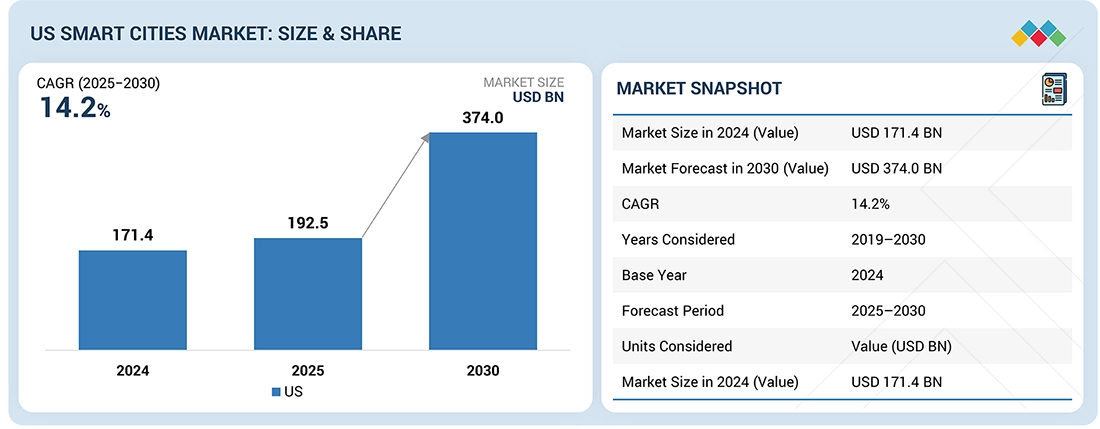
Source: Secondary Research, Interviews with Experts, MarketsandMarkets Analysis
The Smart cities market size in the U.S. is projected to grow from USD 192.5 billion in 2025 to USD 374.0 billion by 2030 at a CAGR of 14.2% during the forecast period. This growth is closely linked to steady investment in digital infrastructure and transportation systems, along with wider use of data to improve how city services are delivered. Cities are increasingly looking for platforms that can connect transportation networks, energy systems, and public infrastructure in a more coordinated way. These efforts are largely aimed at easing congestion, improving sustainability outcomes, and managing aging urban assets more efficiently. As a result, IoT–based monitoring and analytics tools are being used more frequently to manage traffic flows, control energy use, and support infrastructure maintenance
KEY TAKEAWAYS
-
By Focus AreaThe smart citizen services segment accounted for a 45.4% share in 2025.
-
By Smart TransportationBy smart transportation, the connected logistics segment is expected to register the highest CAGR of 18.3%.
-
By Smart BuildingBy smart building, the energy management segment is projected to grow the fastest from 2025 to 2030.
-
Competitive Landscape - Key PlayersCompanies such as Cisco, IBM, and Microsoft were identified as some of the star players in the US smart cities market, given their strong market share and product footprint.
Leading US cities are prioritizing resident needs by focusing on cross-department collaboration and user-friendly digital services. Initiatives like New York City’s CityBridge program replace payphones with smart kiosks that offer free Wi-Fi and public services. These efforts ensure technology benefits all communities, especially underserved areas. Citizen feedback is incorporated into planning, making services more accessible and inclusive. The emphasis on usability increases adoption and satisfaction with smart cities solutions.
TRENDS & DISRUPTIONS IMPACTING CUSTOMERS' CUSTOMERS
The impact on customers' businesses in the US smart cities market is driven by increasing digitalization, smart city initiatives, and growth in smart cities.The adoption of digital technology in traffic management, utilities, and overall municipal services is increasing at a rapid pace in smart cities. The utilities sector is upgrading their energy infrastructure in smart cities in order to support renewable energy and manage demand in real time. At the same time, cities are selectively exploring advanced connectivity and data-led services in areas such as transport coordination and urban healthcare. However, adoption remains uneven due to gaps in infrastructure readiness, cybersecurity concerns, and differences in data governance and technical standards across the region.
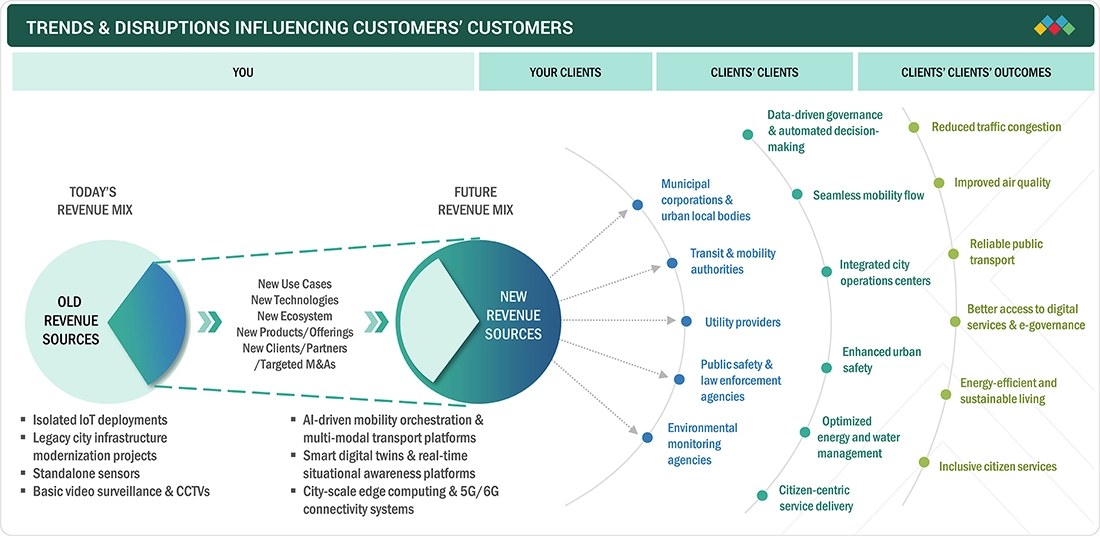
Source: Secondary Research, Interviews with Experts, MarketsandMarkets Analysis
MARKET DYNAMICS

Level
-
Expansion of Federal Smart Infrastructure Funding

-
Rapid Deployment of AI-driven Public Safety Systems


Level
-
Complex Data Privacy Regulations

-
High Initial Infrastructure Costs Limiting Smaller Cities


Level
-
Expansion of 5G and Edge Infrastructure

-
Growing Market for Electric Vehicle Infrastructure and Green Tech


Level
-
Interoperability Gaps Across Fragmented City Systems

-
Managing Citizen Trust and Fostering Community Engagement

Source: Secondary Research, Interviews with Experts, MarketsandMarkets Analysis
Driver: Expansion of Federal Smart Infrastructure Funding
Federal agencies allocate significant funding to modernize urban infrastructure. Under programs such as the Bipartisan Infrastructure Law and the Smart Cities Challenge extensions, cities are expanding intelligent transport systems, EV charging corridors, and integrated command centers. The Department of Transportation’s recent grants for advanced transportation technologies have enabled cities like Phoenix, Chicago, and Columbus to scale AI-enabled mobility solutions. These initiatives push cities toward data-driven governance, predictive traffic management, and advanced public safety systems. As federal funding increasingly prioritizes climate resilience and technology-enabled efficiency, municipalities are accelerating investments in IoT sensors, cloud platforms, and urban analytics driving large-scale modernization across the country.
Restraint: Complex Data-Privacy Regulations
Complex and evolving data privacy regulations have become a major hurdle for smart city deployments in the United States. Cities must comply with frameworks such as the California Consumer Privacy Act (CCPA), the California Privacy Rights Act (CPRA), and other state level data protection laws when they design surveillance, data sharing, and analytics projects. In states such as California and Illinois, public concerns about biometric data, algorithmic decision making, and AI based monitoring have already led to delays or redesigns of several initiatives. City agencies must invest in legal review, consent management, and cybersecurity controls before they can roll out new intelligent systems at scale. These additional requirements increase costs and timelines and can make city leaders more cautious about committing to ambitious, data intensive smart city platforms.
Opportunity: Expansion of 5G and Edge Infrastructure
Rapid rollout of 5G networks by major United States telecom operators such as Verizon, AT&T, and T Mobile is creating new opportunities for smart city projects. Cities including Denver, Dallas, and San Diego are developing multi access edge computing hubs that support real time analytics for traffic signals, connected vehicles, drones, and environmental monitoring. Low latency connectivity makes emergency response, utility monitoring, and public transport operations more responsive and reliable. As 5G coverage and edge infrastructure expand, city agencies can move more workloads from central data centres to the network edge. This shift opens long term opportunities for vendors that provide low latency IoT devices, edge platforms, and AI automation tools tailored to urban operations.
Challenge: Interoperability Gaps Across Fragmented City Systems
Many US cities still operate smart systems as separate projects rather than as a single integrated platform. Traffic management, water metering, streetlighting, and video surveillance often run on vendor specific software with limited ability to share data. When cities attempt to build unified command centres, they face incompatible interfaces, proprietary protocols, and missing application programming interfaces. Examples from cities such as New Orleans and Detroit show how time consuming and costly it can be to connect legacy systems into a common operating picture. Without clearer standards and shared data models, municipalities risk duplicated investments, inconsistent reporting, and limited real time visibility across critical urban services.
US SMART CITIES MARKET: COMMERCIAL USE CASES ACROSS INDUSTRIES
| COMPANY | USE CASE DESCRIPTION | BENEFITS |
|---|---|---|
 |
Delivers integrated smart city architectures, including smart lighting, public Wi-Fi, intelligent traffic systems, and secure IoT networks for urban modernization. | Enhances real-time monitoring, improves citywide connectivity, reduces energy usage, and strengthens cybersecurity across public infrastructure. |
 |
Provides Azure-based digital twins, smart infrastructure analytics, and AI-driven city management systems to optimize operations and predictive planning. | Enables data-driven governance, accelerates decision-making, improves utility performance, and enhances urban resilience. |
 |
Implements cognitive city platforms with AI, analytics, and automation for traffic, water management, and public safety optimization. | Reduces congestion, improves emergency response, enhances resource efficiency, and supports long-term city sustainability. |
Logos and trademarks shown above are the property of their respective owners. Their use here is for informational and illustrative purposes only.
MARKET ECOSYSTEM
The U.S. smart cities ecosystem is supported by a collaborative network of platform providers, system integrators, telecom operators, service providers, government agencies, and research institutions. Technology firms offer platform services and solutions for smart transportation, smart buildings, smart utilities, and smart citizen services. System integrators assist with interoperability and offer software and big data and large data capabilities and deployments. Network and telecom companies offer high-speed links, which are critical for IOT and real-time city operations.
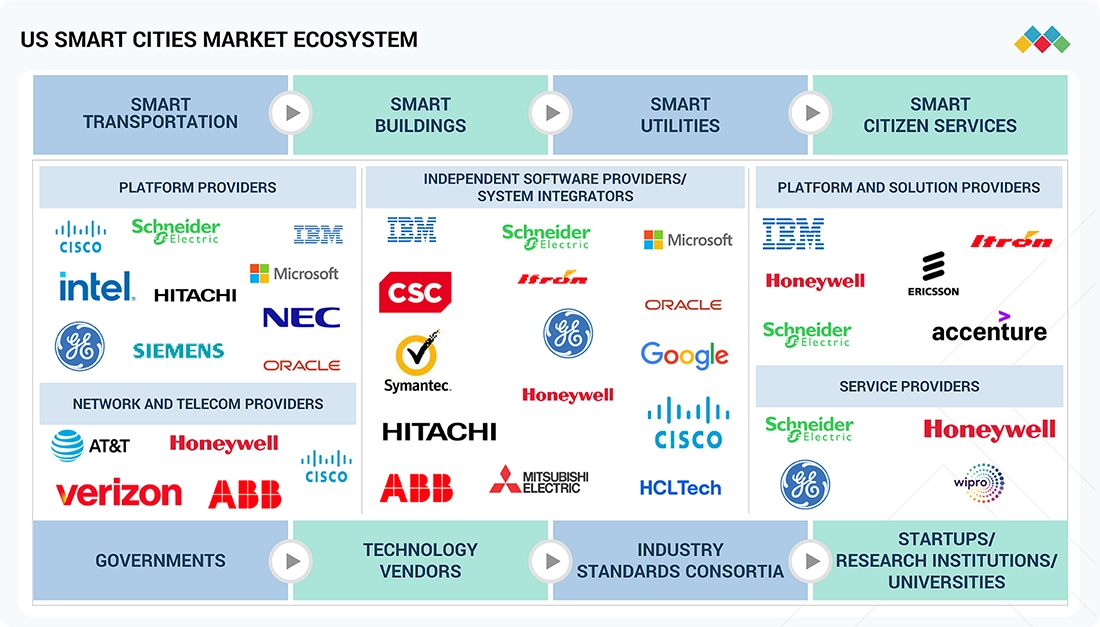
Logos and trademarks shown above are the property of their respective owners. Their use here is for informational and illustrative purposes only.
MARKET SEGMENTS
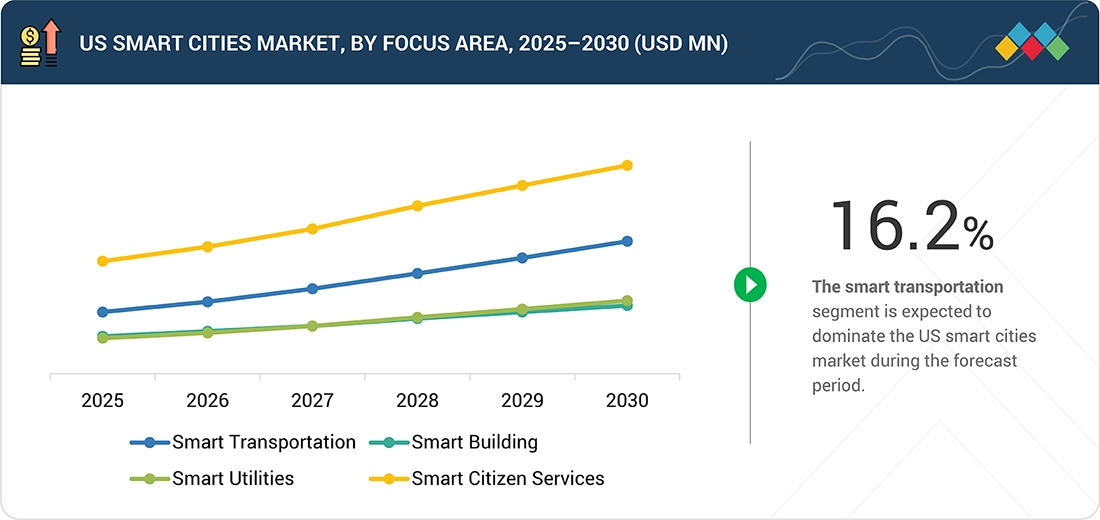
Source: Secondary Research, Interviews with Experts, MarketsandMarkets Analysis
US Smart Cities Market, By Smart Citizen Service
The growing digitalization and connectivity of the modern healthcare environment, along with continuous innovations, hold the key to driving the market. The healthcare sector is experiencing significant growth in the implementation of Internet of Things (IoT) technologies, which are transforming the delivery of patient care. Smart healthcare solutions play a pivotal role in addressing the challenges faced in caregiving and bridging the gap between patients and care professionals. The development of these smart healthcare solutions is transforming the healthcare delivery framework, accelerating efficiency, improving patient outcomes, and maximizing resource utilization. As healthcare organizations adopt these technologies, they are likely to open new avenues of delivering customized and accessible care to patients, hence driving the smart healthcare services.
US Smart Cities Market, By Smart Utilities Solution
Advanced metering infrastructure is expected to account for the largest market share during the forecast period. Enterprises rely on advanced meter data management (MDM) solutions to streamline the management of utility-related information. MDM solutions that integrate with enterprise applications serve as centralized repositories, capable of collecting and processing large amounts of metering data. Centralization of data makes IT integration less complex and also enables the collection of data from disparate systems into a single repository. After processing the data, it becomes usable throughout the organization with numerous applications. The range of these applications encompasses the billing process, as well as revenue assurance, leak detection and management, loss analysis, and capacity planning, driving consumer engagement. Sophisticated metering solutions allow utility companies to leverage the quantities of data provided by the metering systems for utilization as actionable intelligence to improve business efficiency as well as customer satisfaction.
REGION
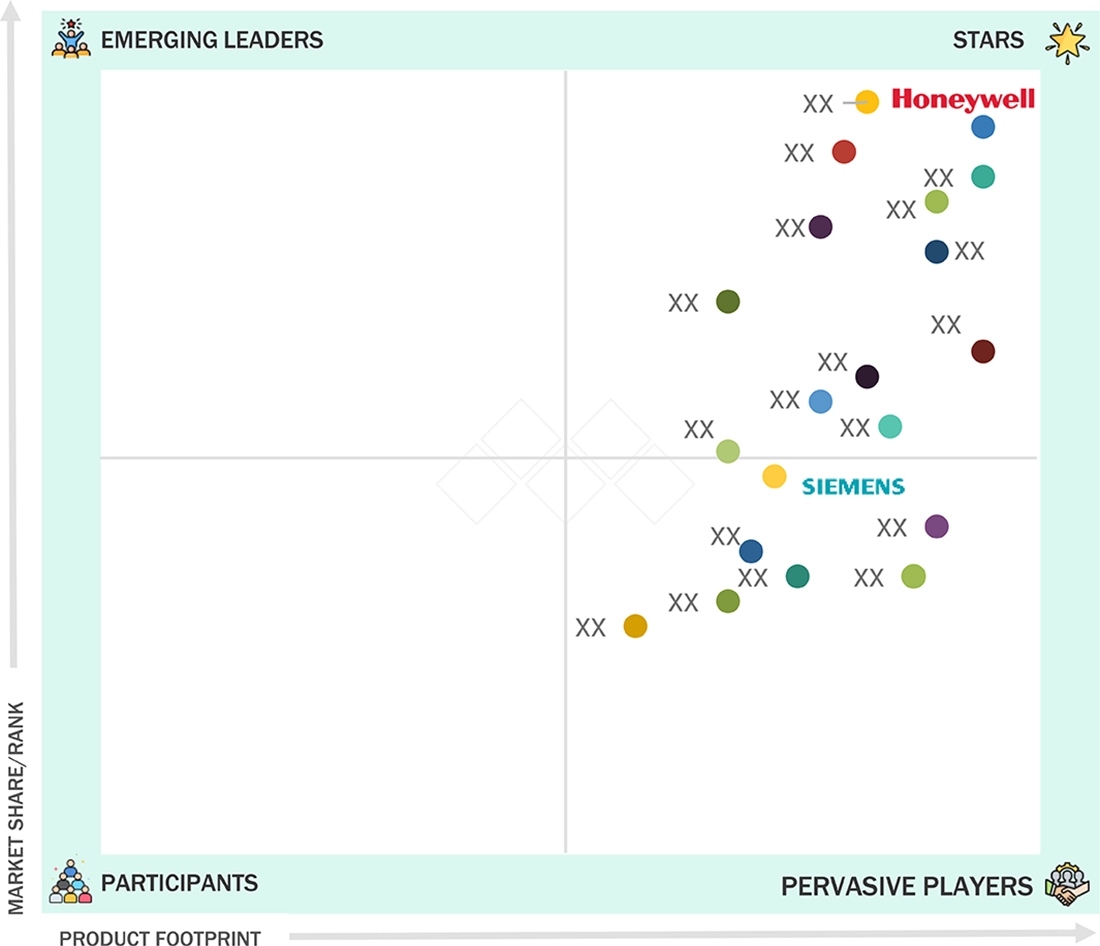
US SMART CITIES MARKET: COMPANY EVALUATION MATRIX
In the smart cities market matrix, Siemens (Star) leads with a strong market share and an extensive product footprint, driven by its advanced IoT platforms and integrated solutions, which are widely adopted in urban infrastructure. Honeywell (Pervasive Player) strengthens its position with specialized smart building technologies and connected control systems, supporting energy optimization and security in cities. While Siemens dominates through scale and a diverse portfolio, Honeywell shows significant potential to expand its footprint as demand for tailored urban solutions continues to rise.
Source: Secondary Research, Interviews with Experts, MarketsandMarkets Analysis
KEY MARKET PLAYERS
- Siemens (Germany)
- Cisco (US)
- Microsoft (US)
- IBM (US)
- Oracle (US)
- Sutherland (US)
- Hitach (Japan)
- Honeywell (US)
- Itron (US)
- AWS (US)
- Motorola (US)
- AT&T (US)
- KETOS (US)
- INRIX (US)
- Ubicquia, Inc (US)
- Schneider Electric (France)
- Quantela Inc. (US)
- Clarity Movement (US)
- Iteris (US)
MARKET SCOPE
| REPORT METRIC | DETAILS |
|---|---|
| Market Size in 2024 (Value) | USD 171.4 Billion |
| Market Forecast in 2025 (Value) | USD 192.5 Billion |
| Market Forecast in 2030 (Value) | USD 374.0 Billion |
| Growth Rate | CAGR of 14.2% during 2025-2030 |
| Years Considered | 2019-2030 |
| Base Year | 2024 |
| Forecast Period | 2025-2030 |
| Units Considered | Value (USD Billion) |
| Report Coverage | Revenue forecast, company ranking, competitive landscape, growth factors, and trends |
| Segments Covered |
|
| Country Covered | United States |
WHAT IS IN IT FOR YOU: US SMART CITIES MARKET REPORT CONTENT GUIDE

DELIVERED CUSTOMIZATIONS
We have successfully delivered the following deep-dive customizations:
| CLIENT REQUEST | CUSTOMIZATION DELIVERED | VALUE ADDS |
|---|---|---|
| Company Information | Detailed analysis and profiling of additional market players (up to 5) |
|
RECENT DEVELOPMENTS
- March 2025 : Cisco and NVIDIA partnered to deliver the Cisco Secure AI Factory, a reference architecture that integrates networking and security for enterprise AI infrastructure. The partnership streamlines deployment, embeds security at every layer, and accelerates the adoption of secure AI for organizations worldwide.
- March 2025 : Itron and Microsoft collaborated to integrate Microsoft's generative AI Copilot into Itron's Intelligent Edge Operating System (IEOS). The solution enables utilities to utilize natural language queries for advanced analytics, enhancing data access, operational efficiency, and informed decision-making in energy and water management. The integrated platform will be globally available in Q2 2025.
- March 2024 : IBM expanded funding and in-kind commitments for the IBM Sustainability Accelerator to support climate-resilient city projects and accelerate tech deployment for vulnerable urban communities. This is targeted funding to help cities deploy analytics, digital twins, and resilience solutions.
Table of Contents
 Exclusive indicates content/data unique to MarketsandMarkets and not available with any competitors.
Methodology
This research study utilized a wide range of secondary sources, including directories and databases such as Dun & Bradstreet (D&B) Hoovers, and Bloomberg BusinessWeek, to gather valuable insights for a technical, market-oriented, and commercial analysis of the US Smart Cities Market. Industry experts from core and related sectors, as well as preferred suppliers, manufacturers, distributors, service providers, technology developers, and organizations connected to all segments of the value chain in this market were interviewed as part of the study. To obtain and verify critical qualitative and quantitative information, in-depth interviews were conducted with key industry participants, subject matter experts, C-level executives from leading market players, and industry consultants.
Secondary Research
In the secondary research process, various sources were consulted to gather information for the study. These sources included annual reports, press releases, investor presentations from companies, white papers, certified publications, and articles from recognized associations and governmental publications. Several journals and conferences, such as the 27th IEEE International Conference on Intelligent Transportation Systems (IEEE ITSC 2024) and the Smart Building Conference at Integrated Systems Europe (ISE) 2024, were also referenced. This secondary research aimed to obtain crucial information about industry insights, the monetary flow within the market, the landscape of key players, market classification and segmentation based on current industry trends, regional markets, and significant developments from both, market and technology-oriented perspectives.
Primary Research
In the primary research process, various sources from both the supply and demand sides were interviewed to gather qualitative and quantitative information for the report. On the supply side, the primary sources included industry experts such as Chief Executive Officers (CEOs), Chief Technology Officers (CTOs), Chief Operating Officers (COOs), Vice Presidents (VPs), marketing directors, technology and innovation directors, and other key executives from significant companies and organizations involved in the US Smart Cities Market. On the demand side, the primary sources consisted of smart cities end users, consultants, specialists, Chief Information Officers (CIOs), and subject-matter experts from enterprises and government associations.
Market Size Estimation
Several methods were used to estimate and forecast the US Smart Cities Market size. The first method involves calculating the market size by adding the revenue generated by companies from the sale of smart city solutions.
Both, the top-down and bottom-up approaches were used to estimate and validate the total size of the US Smart Cities Market. These methods were extensively used to estimate the size of various segments in the market. The research methodology used to estimate the market size includes the following.
- Key players in the market were identified through extensive secondary research.
- In terms of value, the industry’s supply chain and market size were determined through primary and secondary research processes.
- All percentage shares, splits, and breakups were determined using secondary sources and verified through primary sources.
Data Triangulation
Upon determining the overall market size, the US Smart Cities Market was segmented into various segments and subsegments. A data triangulation process was employed to finalize the overall market engineering and achieve precise statistics for each segment and subsegment, as applicable. This triangulation involved analyzing various factors and trends from both, the demand and supply perspectives. Additionally, the market size was validated using both, the top-down and bottom-up approaches, alongside the data triangulation and market breakdown procedures.
Market Definition
The European Union defines a smart city as a place where traditional networks and services are made more efficient with the use of digital solutions for the benefit of its inhabitants and businesses.
A smart city encompasses more than just the application of digital technologies to enhance resource efficiency and reduce emissions. It includes improved urban transport networks, upgraded water supply and waste disposal systems, and more efficient methods for lighting and heating buildings. Additionally, a smart city features a more interactive and responsive administration, safer public spaces, and addresses the needs of an aging population.
Stakeholders
- National/State Governments
- Municipal Authorities
- Real Estate Developers
- Information Technology (IT) Solution Providers
- Platform Providers
- System Integrators
- Telecom Service Providers
- Networking Solution Providers
- Utility Companies
- Transportation Service Providers
- Independent Software Vendors (ISVs)
- Network Equipment Providers
- Communication Service Providers (CSPs)
Report Objectives
- To determine and forecast the US Smart Cities Market size based on focus areas: smart transportation, smart buildings, smart utilities, smart citizen services, and regions from 2025 to 2030, and analyze the various macroeconomic and microeconomic factors that affect market growth
- To provide detailed information about the major factors (drivers, restraints, opportunities, and challenges) influencing the growth of the US Smart Cities Market.
- To analyze each submarket concerning individual growth trends, prospects, and contributions to the overall US Smart Cities Market
- To analyze opportunities in the market for stakeholders by identifying the high-growth segments of the US Smart Cities Market
- To profile key market players, provide a comparative analysis based on business overviews, regional presence, product offerings, business strategies, and key financials, and illustrate the market’s competitive landscape.
- To analyze competitive developments in the market, such as mergers & acquisitions, product developments, partnerships, collaborations, and research & development (R&D) activities
Available Customizations
With the given market data, MarketsandMarkets offers customizations as per the company’s specific needs. The following customization options are available for the report.
Geographic Analysis as per Feasibility
- Analysis for additional countries (up to five)
Company Information
- Detailed analysis and profiling of additional market players (up to 5)
Key Questions Addressed by the Report
What is the projected size of the US Smart Cities Market by 2030?
The US smart cities market is projected to grow from USD 192.5 billion in 2025 to USD 374.0 billion by 2030, at a CAGR of 14.2% during the forecast period.
Which focus area is expected to dominate the US Smart Cities Market?
The smart citizen services segment is expected to dominate the US smart cities market during the forecast period.
Which smart citizen service is projected to grow the fastest?
The smart healthcare segment is expected to register the highest CAGR among smart citizen services during the forecast period.
What technologies are accelerating the growth of the US Smart Cities Market?
IoT, artificial intelligence, and real-time data analytics are accelerating market growth by enabling efficient urban operations and smarter public services.
Why are US cities investing in smart city solutions?
US cities are investing in smart city solutions to improve operational efficiency, enhance public safety, optimize resource management, and deliver better citizen experiences.
Who are the leading companies in the US Smart Cities Market?
Leading companies include Siemens, Cisco, and Hitachi, recognized for their integrated smart city platforms and digital infrastructure capabilities.


Personalize This Research
- Triangulate with your Own Data
- Get Data as per your Format and Definition
- Gain a Deeper Dive on a Specific Application, Geography, Customer or Competitor
- Any level of Personalization
Let Us Help You
- What are the Known and Unknown Adjacencies Impacting the US Smart Cities Market
- What will your New Revenue Sources be?
- Who will be your Top Customer; what will make them switch?
- Defend your Market Share or Win Competitors
- Get a Scorecard for Target Partners

Custom Market Research Services
We Will Customise The Research For You, In Case The Report Listed Above Does Not Meet With Your Requirements
Get 10% Free CustomisationTESTIMONIALS






Growth opportunities and latent adjacency in US Smart Cities Market