



Vehicle Electrification Market
Report Code
AT 2839
Published in
Sep, 2025, By MarketsandMarkets™
Vehicle Electrification Market by Product Type (Start-Stop, EPS, EHPS, Liquid Heater PTC, Electric A/C Compressor, Electric Vacuum Pump, Electric Oil Pump, Electric Water Pump, ISG), Propulsion, DOH, Vehicle Type, and Region - Global Forecast to 2032

USD 83.87 BN
MARKET SIZE, 2032

CAGR 7.1 %
(2025-2032)

320
REPORT PAGES

350
MARKET TABLES
OVERVIEW
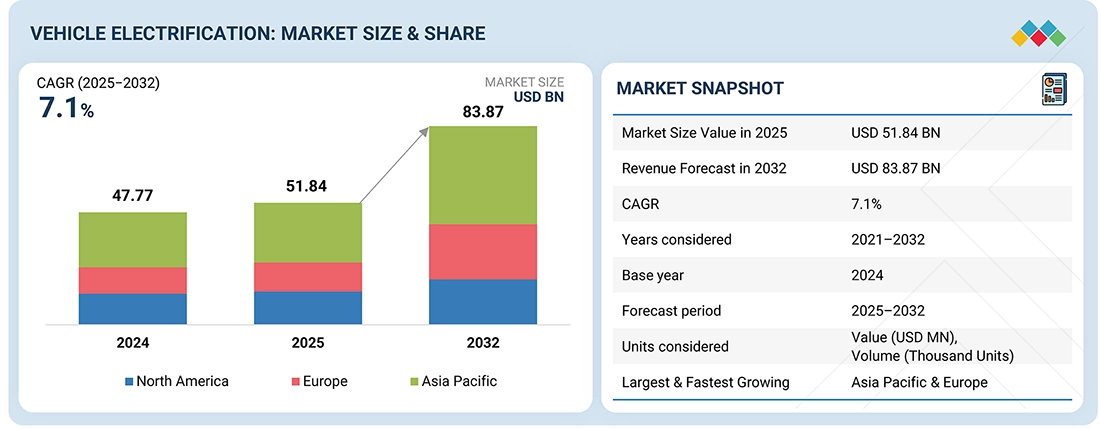
Source: Secondary Research, Interviews with Experts, MarketsandMarkets Analysis
The global vehicle electrification market is projected to grow from USD 51.84 billion in 2025 to USD 83.87 billion by 2032 at a CAGR of 7.1% driven by the accelerating adoption of electric and hybrid vehicles worldwide. In electrified architectures, components can run only when needed, optimize energy use, improve response times, and support advanced thermal and comfort management for hybrid and electric vehicles. lower parasitic losses, allow for modular system design, and facilitate predictive diagnostics and easy integration with smart energy management. Challenges include higher upfront cost, packaging constraints, increased system complexity, and the need for more robust thermal management and software integration, especially as battery voltage, duty cycles, and load profiles vary under real-world operating conditions
Market Size and Forecast:
- Market Size Value in 2025: USD 51.84 Billion
- Revenue Forecast in 2032: USD 83.87 Billion
- Growth Rate: CAGR of 7.1% from 2025 to 2032
- Data available from 2021 to 2032
- Base year: 2024
- Forecast period: 2025–2032
Key Market Trends and Insights
- Market Growth: Growth is driven by increasing adoption of electric and hybrid vehicles, stringent emission regulations, rising demand for fuel-efficient mobility solutions, and the electrification of auxiliary vehicle components.
-
Technology Impact: Advancements in electric power steering (EPS), electric water pumps, electric oil pumps, electric A/C compressors, intelligent thermal management systems, and 48V vehicle architectures are enhancing vehicle efficiency and performance.
- Growing Trends: The market is witnessing increased adoption of electrified auxiliary systems, software-defined vehicle architectures, advanced thermal management technologies, lightweight electrification components, and high-voltage vehicle platforms.
- Growth Opportunities: Opportunities are driven by the rapid expansion of battery electric vehicles (BEVs), plug-in hybrid electric vehicles (PHEVs), growing demand for intelligent thermal management, and increasing investments in next-generation vehicle electrification technologies.
KEY TAKEAWAYS
-
BY NAVIGATION TECHNOLOGYLaser-guided navigation holds a dominant position in the autonomous forklift market owing to its high precision offering millimeter-level accuracy and its ability to function without reliance on physical markers or magnetic tapes. This makes it particularly suitable for high-density and dynamically changing warehouse environments. Its capability to generate and update spatial maps in real time ensures consistent operational performance even under low light or reflective surfaces, where vision or magnetic based systems often struggle. The Asia Pacific region is projected to account for the largest share of this technology, primarily due to its lower implementation cost relative to LiDAR-based systems, making it a preferred choice in cost-sensitive markets.
-
BY APPLICATIONThe material handling segment holds the largest share of the autonomous forklift market, as tasks like stacking and precise load placement require advanced navigation and accurate localization to coordinate with automated storage systems and prevent collisions. In manufacturing, autonomous forklifts are commonly used to store and retrieve materials for production processes. Models below 5 tons are particularly favored by OEMs, incorporating technologies such as barcodes, cameras, and RFID to enable fast and reliable product identification.
-
BY TONNAGE CAPACITYBelow 3-ton autonomous forklifts are used primarily for indoor applications in e-commerce, retail, and 3PL warehouses to handle lighter loads such as pallets and cartons. These forklifts operate efficiently in narrow aisles and can be easily retrofitted into existing warehouse layouts, making them the most practical and scalable platform for automation deployment. Whereas above 5-ton autonomous forklifts are heavy-duty machines used in steel plants, metal factories, and logistics yards. Typically powered by diesel or gasoline engines used mainly for outdoor industrial operations.
-
BY FUEL SOURCEElectric autonomous forklifts are projected to dominate the market in 2025, driven by their ability to integrate seamlessly with automated warehouse systems, improving operational efficiency and reducing overall costs. Meanwhile, hydrogen fuel cell forklifts are gaining traction among companies prioritizing sustainability, as they deliver zero emissions during operation. Leading manufacturers such as Toyota, Hyster-Yale, and Linde are at the forefront of offering a diverse range of hydrogen-powered forklift solution
-
BY TYPECountries such as China, Japan, South Korea, and India are experiencing rapid industrial growth, driving the demand for automation in warehouses and manufacturing facilities. The rise of e-commerce players like Lazada (China), Rakuten (Japan), and Flipkart (India) has also led to a surge in warehouse automation, where indoor autonomous forklifts improve efficiency and throughput.
-
BY FORKLIFT TYPEPallet jack segment holds the largest share of the autonomous forklift market in 2025 due to its cost-effectiveness, compact design, and suitability for handling lighter loads in confined spaces. The versatility and efficiency of pallet jacks make them suitable for industries requiring frequent material movement, especially over short distances. These jacks are widely used in the e-commerce, retail, and food & beverage industries.
-
BY SALES CHANNELLeasing autonomous forklifts offers companies, especially small and medium-sized enterprises (SMEs), a cost-effective way to access advanced material handling equipment without the significant upfront capital expenditure. This makes it attractive to businesses looking to improve operational efficiency without a significant financial burden.
-
BY END-USE INDUSTRYThe food & beverage industry is at the forefront of adopting autonomous forklifts, driven by the need to handle perishable goods and the demand for automated processes. Major production hubs such as China and India are expanding their manufacturing and warehousing capabilities, while government initiatives support automation and infrastructure development.
-
BY REGIONAsia Pacific is expected to dominate the autonomous forklift market by 2032, subject to rapid industrialization, expansion of manufacturing hubs, and the growth of e-commerce in China, India, and Japan. According to the National Bureau of Statistics, China alone added USD 5,524.45 million (39,910.3 billion yuan) to the industrial sector in 2023, up by 4.2% over the previous year. This offers a lucrative opportunity for the autonomous forklift market in the region.
-
COMPETITIVE LANDSCAPEThe autonomous forklift market is led by globally established players such as Toyota Industries Corporation (Japan), KION Group AG (Germany), Jungheinrich AG (Germany), and Hyster-Yale Materials Handling, Inc. (US). These companies adopted product launches/developments, partnerships, agreements, mergers & acquisitions, expansions, and contracts to gain traction in the high-growth autonomous forklift market.
The adoption of Industry 4.0 practices and the demand for seamless data exchange with warehouse management and ERP systems are fueling interest in connected, software-defined forklifts capable of collaborative operation within smart factories. Emerging applications in healthcare logistics supported by partnerships between robotics firms and healthcare providers are also expanding market opportunities. However, the industry continues to face challenges such as high initial investment costs, limited interoperability between autonomous systems and legacy infrastructure, and the need for extensive mapping and integration customization, all of which can constrain large-scale deployment across diverse facilities.
TRENDS & DISRUPTIONS IMPACTING CUSTOMERS' CUSTOMERS
The vehicle electrification market at the component level is being reshaped by the rapid shift from mechanical to electric auxiliary systems such as EPS, e-pumps, and ISG, driven by stringent emission norms and fuel-efficiency regulations. Advancements in 48V mild-hybrid and high-voltage architectures are accelerating adoption across segments. Additionally, trends like thermal management optimization, lightweight integration, and software-driven control of electrified components are disrupting traditional supply chains and creating new opportunities for Tier-1 suppliers and OEM collaborations.
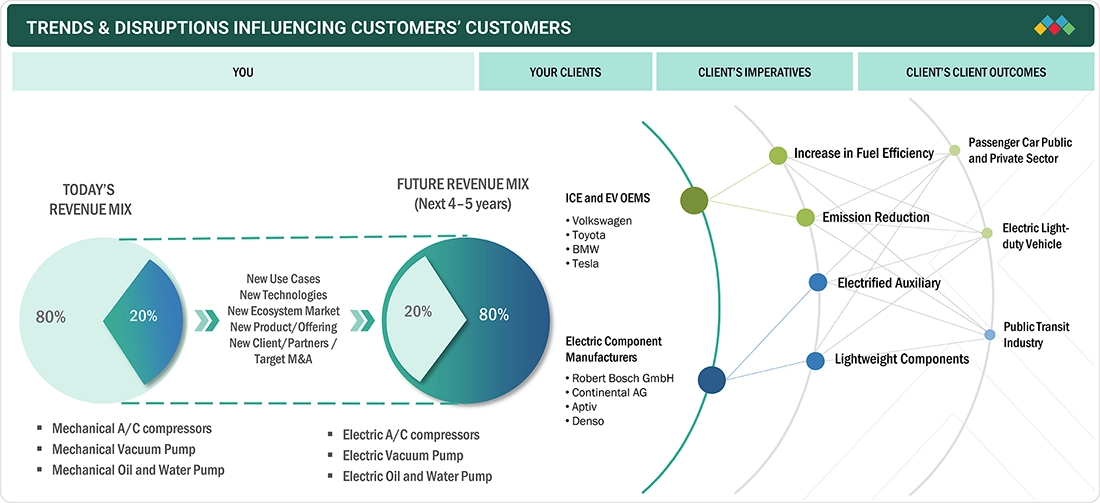
Source: Secondary Research, Interviews with Experts, MarketsandMarkets Analysis
MARKET DYNAMICS

Drivers
Impact
Level
Level
-
•Elevated consumer demand for safety and convenience features

-
•Rise in global adoption of EV


RESTRAINTS
Impact
Level
Level
-
•High cost of electric components


OPPORTUNITIES
Impact
Level
Level
-
•Shift toward software-defined vehicles

-
•Need for intelligent thermal management


CHALLENGES
Impact
Level
Level
-
•Complex integration with ICE platforms

Source: Secondary Research, Interviews with Experts, MarketsandMarkets Analysis
Driver: Electrification of Auxiliary Vehicle Components
Electrification of auxiliary vehicle components is increasing at a rapid pace as it decouples them from the combustion engine, enabling precise on-demand operation, smaller packaging, and easier integration into EVs and hybrids. While full electrification of these systems can raise vehicle bill of materials costs by approximately 5–8%, it typically delivers 10–15% lifecycle energy savings> the savings are owing to lower parasitic losses, faster warm-up/cooling, reduced maintenance, and these also support compliance with fleet CO2/efficiency targets. Strategically, OEMs view this as a cost-to-value trade-up that enhances customer TCO, simplifies platform modularity, and positions them for future zero-emission regulations
Restraint: High Cost and Technical Challenges of Electric Components
The shift from mechanical to electric auxiliary systems such as pumps, compressors, and steering units creates major cost challenges for OEMs and suppliers. Electrified components with brushless motors, sensors, and control electronics are two to four times more expensive than conventional parts, significantly raising the Bill of Materials (BOM). Added software requirements, customization for voltage and packaging, and retrofit difficulties further increase complexity and R&D spending. In cost-sensitive markets like India, these higher expenses outweigh efficiency and noise benefits, making cost and scalability key barriers to wider adoption. Along with cost, there are other key hurdles too. Managing heat under heavy loads (like PTC heaters in cold climates), finding space for extra cooling and power electronics, and balancing electrical loads all add complexity. These issues increase R&D efforts, reduce efficiency if not handled well, and sometimes force redesigns of vehicle systems. Together, they slow down adoption in lower-priced vehicles and cost-sensitive markets
Opportunity: Intelligent Thermal Management
The shift to electrified mobility in BEVs, PHEVs, and advanced ICE platforms has made smart thermal management critical for performance. Unlike fixed-speed mechanical pumps, electric cooling systems adjust flow and pressure in real time, cutting energy use, extending life, and improving efficiency. Integrated with sensors and connectivity, components like electric pumps and compressors enable predictive maintenance and reliability for fleets and premium vehicles. Advanced designs manage batteries, electronics, and cabins under all conditions, with innovations like HIGHLY Group’s lightweight thermal modules and low-temperature heat pump compressors. As 400V–800V architectures grow, intelligent thermal management is becoming essential for durability, efficiency, and sustainability
Challenge: Integration with ICE Platforms
Integrating electrified components into existing ICE platforms poses major engineering and cost challenges. Conventional ICEs depend on belt-driven auxiliaries, while replacing them with electric systems requires redesigning electrical, thermal, and mechanical architectures. Many legacy platforms lack high-voltage wiring, control units, and communication protocols, demanding added ECUs, sensors, and software for effective operation. Retrofitting raises BOM costs, extends development timelines, and often requires custom designs per OEM. In cost-sensitive segments, the efficiency gains may not outweigh the added complexity and expense, slowing adoption
vehicle-electrification-market: COMMERCIAL USE CASES ACROSS INDUSTRIES
| COMPANY | USE CASE DESCRIPTION | BENEFITS |
|---|---|---|
 |
Replace hydraulic steering with a motor-driven, electronically-controlled steering assist (servo/EPS) that integrates with ADAS and steer-by-wire. Used across passenger cars and light commercial vehicles | Eliminates hydraulic pump parasitic losses, improves vehicle electrical efficiency. Enables easy integration with ADAS |
 |
Electrically-driven PTC liquid heaters (or PTC water heaters) provide fast cabin warm-up and local heating for battery thermal management in BEVs / PHEVs where engine waste heat is not available. | Fast cabin heating improves perceived range (less heater draw from HV battery at cold start). Precise thermal control for battery life & charge performance. |
 |
ISG replaces conventional starter & alternator with a single motor/generator that enables smooth start/stop, torque assist (mild hybrid), and regenerative energy capture. Common in 48V and high-voltage mild hybrids. | Improves fuel economy through longer engine-off operation and regenerative recovery. Seamless, fast restarts and added low-end torque for drivability. |
Logos and trademarks shown above are the property of their respective owners. Their use here is for informational and illustrative purposes only.
MARKET ECOSYSTEM
The vehicle electrification market ecosystem connects raw material suppliers, component manufacturers, Tier-1 integrators, OEMs, and end users, with regulatory bodies and R&D, driving compliance and innovation. Raw materials like lithium and copper flow into components such as motors, inverters, and pumps, which Tier-1s assemble into systems for OEMs. Adoption by customers and fleets fuels demand and market growth
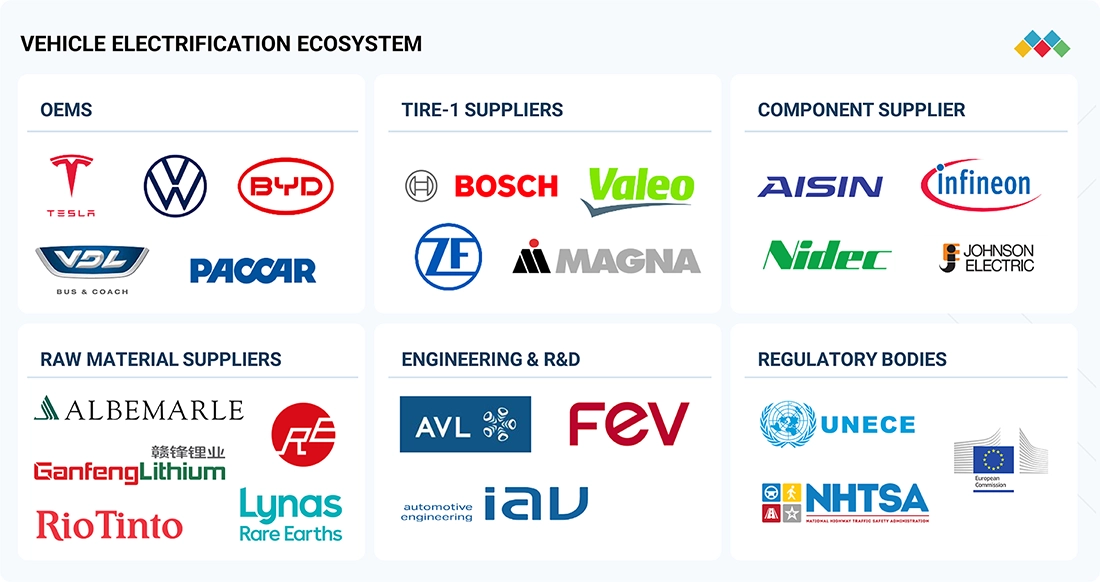
Logos and trademarks shown above are the property of their respective owners. Their use here is for informational and illustrative purposes only.
MARKET SEGMENTS
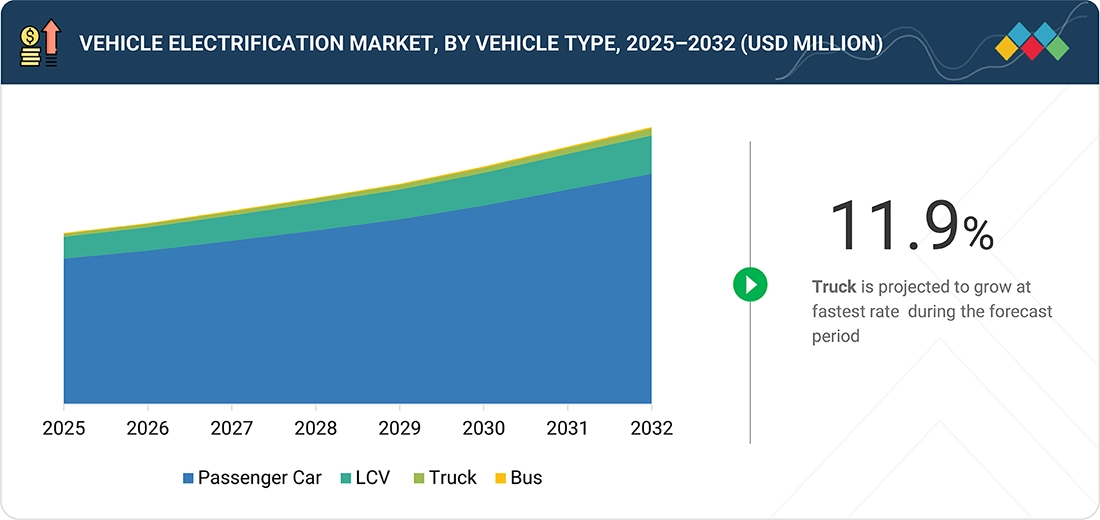
Source: Secondary Research, Interviews with Experts, MarketsandMarkets Analysis
Vehicle Electrification Market, By Vehicle Type
Passenger car holds the largest market of vehicle electrification by vehicle type. ICE passenger cars such as full-size SUVs predominantly adopt EHPS for higher torque demand, whereas sedans, mid-size vehicles, compact SUVs, and hatchbacks are equipped with EPS for better efficiency and lighter packaging. Mild hybrids with 48V batteries help cars use less fuel and produce fewer emissions by powering electric pumps, starters, and power steering. Increasing production volumes of EVs and the growing need for advanced driver assistance systems (ADAS) make EPS modules, electric oil pumps, and electric brake boosters some of the largest and fastest-growing components in PCs. In trucks and buses, demand is shifting toward high-output electric water/oil pumps, liquid heater PTCs, and 24V/48V EPS/EHPS systems, which are critical for thermal management and steering. These components are expanding quickly as OEMs electrify powertrains and adopt stricter emission standards.
Vehicle Electrification Market, By DOH
BEVs are growing at the fastest rate, led by countries in Europe and China. The biggest share comes from large batteries and fast-charging systems, while electric motors and heat pumps are among the fastest-growing parts. In HEVs, small batteries and motors dominate, but electric pumps and A/C compressors are gaining importance as more functions get electrified. PHEVs rely most on medium batteries and charging ports, with Europe leading adoption. Across all types, batteries remain the largest cost driver, while electric pumps, compressors, and heaters are seeing the fastest growth
Vehicle Electrification Market, By Propulsion & Product Type
Electrification is moving at faster rate in auxiliary components like electric compressors, pumps, and PTC heaters, which replace belt-driven parts and support hybrid/EV systems. OEMs focus on 48V and high-voltage platforms to meet fuel-saving and emission goals, while Tier-1 suppliers compete on efficiency and packaging strategies. Batteries remain the cost drivers, but smart electrified auxiliaries are emerging as the key differentiators in the market
REGION
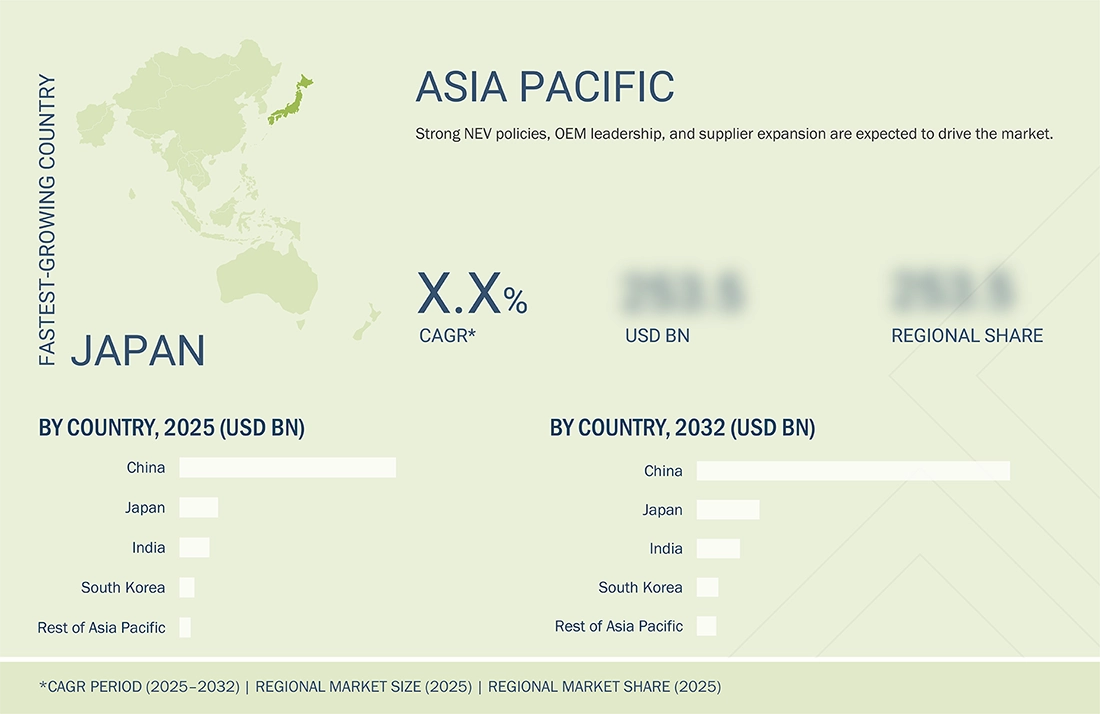
Asia Pacific to be the largest region in the global vehicle electrification market during forecast period
Asia Pacific leads the vehicle electrification market, driven by regulations, local manufacturing, and rapid EV and hybrid adoption. China dominates with NEV mandates and dual-credit policies, boosting demand for EPS, e-compressors, and electric pumps across ICE, HEV, and PHEV platforms. Key technologies driving this growth are electric pumps, efficient battery systems, and e-axles, which support better range and performance.
vehicle-electrification-market: COMPANY EVALUATION MATRIX
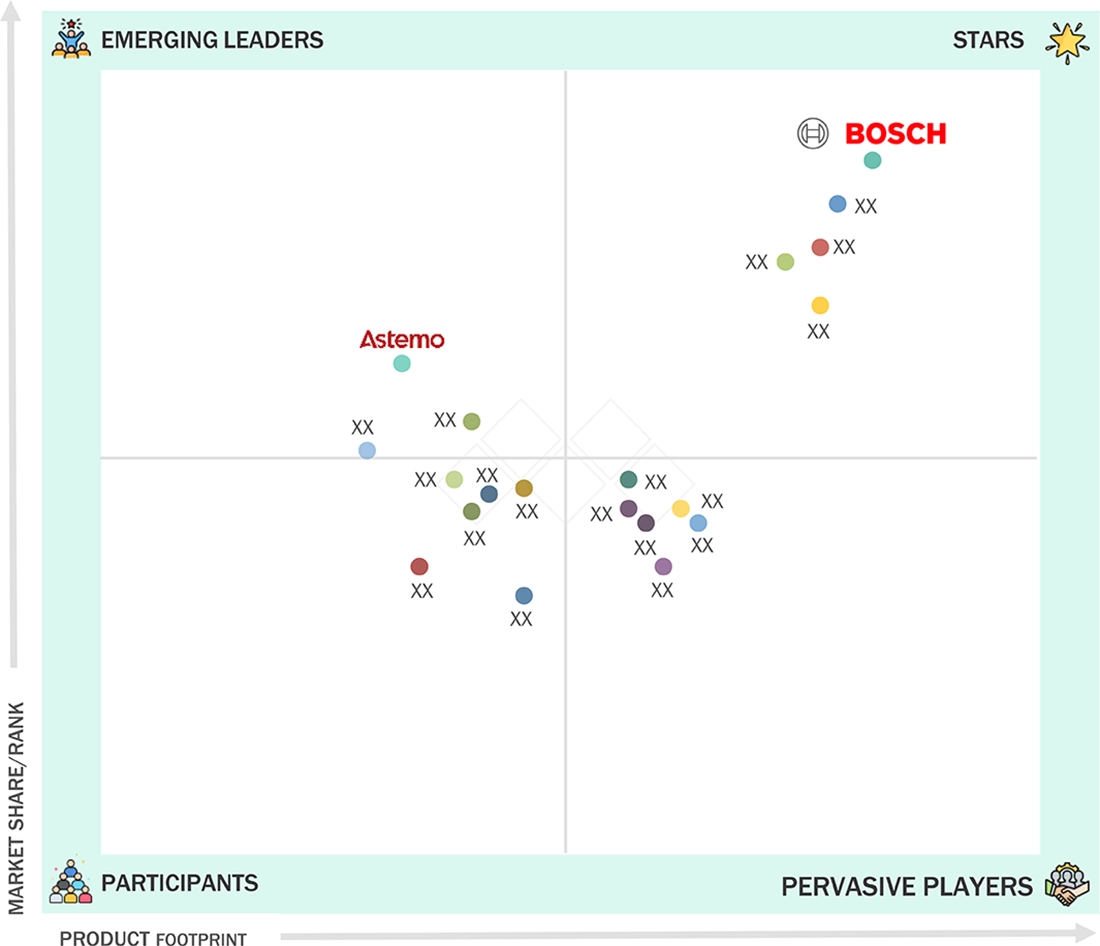
Microquadrant provides information on major players that offer vehicle electrification products and outlines the findings and analysis of how well each vendor performs within the predefined criteria. The company evaluation matrix for the vehicle electrification market positions players based on market share/rank and product footprint. Firms in the Stars quadrant, Robert Bosch GmbH, leads the vehicle electrification market with strong market presence and wide product portfolios
Source: Secondary Research, Interviews with Experts, MarketsandMarkets Analysis
KEY MARKET PLAYERS
- Robert Bosch GmbH
- Continental AG
- Aptiv
- DENSO Corporation
- Borgwarner Inc.
- • Mitsubishi Motor Corporation
- • Magna International Inc
- • Aisin Corporation
- • Nidec Corporation
- • Valeo
MARKET SCOPE
| REPORT METRIC | DETAILS |
|---|---|
| Market Size Value in 2025 | USD 51.84 BILLION |
| Market Size Forecast in 2032 | USD 83.87 BILLION |
| Growth Rate | 7.1% |
| Actual data | 2021 – 2032 |
| Base year | 2024 |
| Forecast period | 2025 - 2032 |
| Units considered | USD BILLION AND THOUSAND UNITS |
| Report Coverage | Revenue forecast, Regional Market Shares, Competitive Landscape, Driving factors, Trends & Disruption, and others |
| Segments Covered |
|
| Regional Scope | Asia Pacific, Europe, North America and Rest of the World |
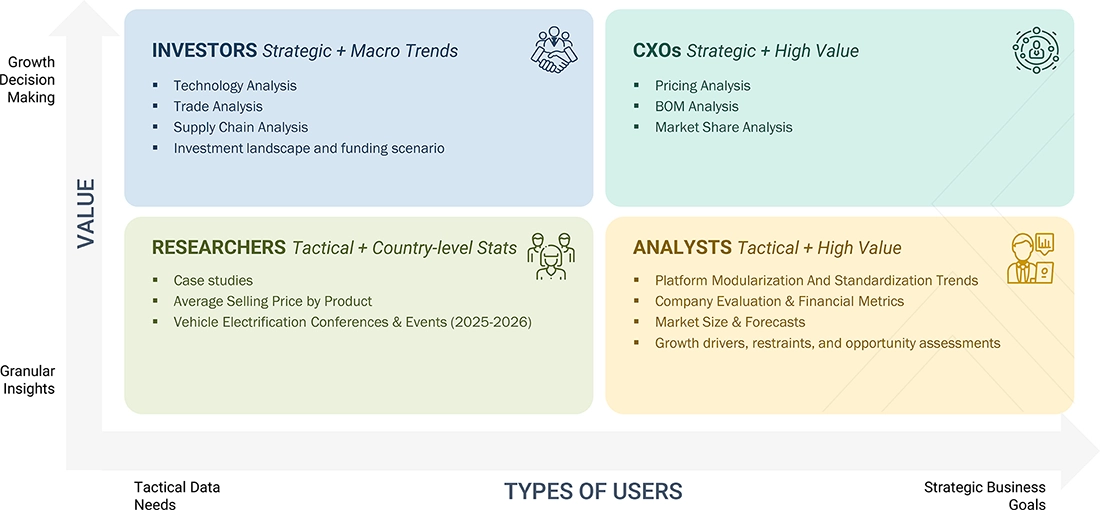
WHAT IS IN IT FOR YOU: vehicle-electrification-market REPORT CONTENT GUIDE
DELIVERED CUSTOMIZATIONS
We have successfully delivered the following deep-dive customizations:
| CLIENT REQUEST | CUSTOMIZATION DELIVERED | VALUE ADDS |
|---|---|---|
| 48V MARKET, BY COMPONENT AND REGION | • Regional level makret for components auch a Start-Stop System, Electric Power Steering (EPS), Liquid Heater PTC, Electric A/C Compressor, Electric Vacuum Pump, Electric Oil Pump, Electric Water Pump, Integrated starter generator is given | • Granular understanding of electrification maturity by region. |
RECENT DEVELOPMENTS
- July 2026: Magna International Inc secured an 800V, 250kW two-speed eDrive program with Chery. The electric drive system uses Magna's modular electrification architecture and is scheduled for production at Magna's new Wuhu facility in China, expanding the company's localized supply of high-voltage electric propulsion systems for battery-electric vehicles.
- May 2026: Robert Bosch GmbH introduced a new generation of permanent-magnet synchronous e-motors for battery-electric and hybrid powertrains, featuring a rare-earth-reduced magnet configuration and series-ready architecture. Bosch states that the motor achieves up to 30% lower losses and up to 93% continuous-to-peak power ratio, with the design aimed at improving efficiency and power density across passenger and commercial vehicle applications.
- August 2025 : DENSO, BluE Nexus Corporation, and AISIN Corporation jointly developed an eAxle system, which is now installed in Isuzu’s inaugural battery-electric pickup truck, the D-MAX EV. The D-MAX EV has recently entered production (April 2025) and is being rolled out across major regions, including Europe, demonstrating the suitability of the eAxle solution for diverse markets.
- May 2025 : DENSO and ROHM partnered to co-develop analog ICs and automotive semiconductors supporting vehicle electrification and vehicle intelligence, deepening their collaboration in semiconductor innovation.
- April 2025 : Mitsubishi Electric Mobility, a division of Mitsubishi Motors Corporation, signed an integration agreement with Stanley Electric to form a new joint venture focused on advanced automotive lamps for next-generation EVs and xEVs. This reinforces their ecosystem expansion around electrified vehicle components and intelligent systems.
Table of Contents
 Exclusive indicates content/data unique to MarketsandMarkets and not available with any competitors.
TITLE
PAGE NO
1
INTRODUCTION
29
2
RESEARCH METHODOLOGY
36
3
EXECUTIVE SUMMARY
47
4
PREMIUM INSIGHTS
50
5
MARKET OVERVIEW
Surging EV adoption reshapes markets, driven by demand for safety, convenience, and tech-savvy solutions.
53
5.1
INTRODUCTION
5.2
MARKET DYNAMICS
5.2.1
DRIVERS
5.2.1.1
Elevated consumer demand for safety and convenience features
5.2.1.2
Rise in global adoption of EVs
5.2.1.3
Technical benefits of electrified components over mechanical systems
5.2.2
RESTRAINTS
5.2.2.1
High cost of electric components
5.2.3
OPPORTUNITIES
5.2.3.1
Shift toward software-defined vehicles
5.2.3.2
Need for intelligent thermal management
5.2.4
CHALLENGES
5.2.4.1
Complex integration with ICE platforms
6
INDUSTRY TRENDS
Discover the transformative shifts redefining automotive supply chains and technology landscapes.
58
6.1
SUPPLY CHAIN ANALYSIS
6.2
ECOSYSTEM ANALYSIS
6.3
PRICING ANALYSIS
6.3.1
AVERAGE SELLING PRICE, BY PRODUCT
6.3.2
AVERAGE SELLING PRICE, BY REGION
6.4
TRADE ANALYSIS
6.4.1
IMPORT SCENARIO (841330)
6.4.2
EXPORT SCENARIO (841330)
6.5
TRENDS AND DISRUPTIONS IMPACTING CUSTOMER BUSINESS
6.6
KEY CONFERENCES AND EVENTS, 2025–2026
6.7
CASE STUDY ANALYSIS
6.7.1
IMPLEMENTATION OF START–STOP SYSTEMS IN DIESEL VEHICLES
6.7.2
SHIFT TOWARD ELECTRIC POWER STEERING
6.7.3
DEVELOPMENT OF ADVANCED HIGH-VOLTAGE COMPONENTS
6.8
INVESTMENT AND FUNDING SCENARIO
6.9
TECHNOLOGY ANALYSIS
6.9.1
KEY TECHNOLOGIES
6.9.1.1
High-voltage integrated e-axle systems
6.9.1.2
Advanced ECUs and software-defined components
6.9.2
COMPLEMENTARY TECHNOLOGIES
6.9.2.1
Electric coolant pumps by non-sealed materials
6.9.3
ADJACENT TECHNOLOGIES
6.9.3.1
Connectivity & IoT-enabled components
6.10
PATENT ANALYSIS
6.11
OVERVIEW OF VEHICLE HYBRIDIZATION STAGES
6.11.1
MICRO HYBRID
6.11.2
MILD HYBRID
6.11.3
FULL HYBRID
6.11.4
PHEV/RANGE-EXTENDED EV (REEV)
6.11.5
BEV/EXTENDED-RANGE EV (EREV)
6.12
PLATFORM MODULARIZATION AND STANDARDIZATION TRENDS
6.13
ELECTRIC COOLANT PUMP CONSUMPTION BY TOP 10 ELECTRIC PASSENGER CAR OEMS
6.14
ELECTRIC COOLANT PUMP CONSUMPTION BY TOP 10 COMMERCIAL VEHICLE OEMS
6.15
TOP 10 SUPPLIER PRICING ANALYSIS
6.16
TOP 10 OEM PRICING ANALYSIS
6.17
ELECTRIC COOLANT PUMP: WHO SUPPLIES TO WHOM
6.18
ELECTRIC COOLANT PUMP: SUPPLIER CONTRACTS
6.19
REGULATORY LANDSCAPE
6.19.1
REGULATORY BODIES, GOVERNMENT AGENCIES, AND OTHER ORGANIZATIONS
6.19.2
EV INCENTIVES, BY COUNTRY
6.19.2.1
Netherlands
6.19.2.2
Germany
6.19.2.3
France
6.19.2.4
UK
6.19.2.5
China
6.19.2.6
US
6.19.3
COMPONENT-LEVEL CARBON FOOTPRINT ANALYSIS
6.20
KEY STAKEHOLDERS AND BUYING CRITERIA
6.20.1
KEY STAKEHOLDERS IN BUYING PROCESS
6.20.2
KEY BUYING CRITERIA
7
VEHICLE ELECTRIFICATION MARKET, BY PROPULSION AND PRODUCT
Market Size & Growth Rate Forecast Analysis to 2032 in USD Million and Units | 113 Data Tables
100
7.1
INTRODUCTION
7.2
START-STOP SYSTEM
7.2.1
RAPID ADOPTION OF MILD-HYBRID VEHICLES AND FOCUS ON BATTERY LONGEVITY
7.2.1.1
ICE Start-Stop System
7.2.1.2
EV Start-Stop System
7.3
ELECTRIC POWER STEERING
7.3.1
ADAS INTEGRATION, REDUCTION OF MECHANICAL LOSSES, AND INCREASING REGULATORY PRESSURE FOR EFFICIENCY
7.3.1.1
ICE Electric Power Steering
7.3.1.2
EV Electric Power Steering
7.4
ELECTRO-HYDRAULIC POWER STEERING
7.4.1
NEED FOR HIGH TORQUE ASSIST WITHOUT CONSTANT ENGINE LOAD
7.4.1.1
ICE Electro-hydraulic Power Steering
7.4.1.2
EV Electro-hydraulic Power Steering
7.5
LIQUID HEATER PTC
7.5.1
NEED FOR EFFICIENT CABIN HEATING
7.5.1.1
ICE Liquid Heater PTC
7.5.1.2
EV Liquid Heater PTC
7.6
ELECTRIC A/C COMPRESSOR
7.6.1
EV ADOPTION REQUIRING ENGINE-INDEPENDENT HVAC
7.6.1.1
ICE Electric A/C Compressor
7.6.1.2
EV Electric A/C Compressor
7.7
ELECTRIC VACUUM PUMP
7.7.1
INCREASING HYBRID/ELECTRIC VEHICLE PENETRATION AND INTEGRATION WITH AUTONOMOUS BRAKING SYSTEMS
7.7.1.1
ICE Electric Vacuum Pump
7.7.1.2
EV Electric Vacuum Pump
7.8
ELECTRIC OIL PUMP
7.8.1
NEED FOR INDEPENDENT THERMAL MANAGEMENT
7.8.1.1
ICE Electric Oil Pump
7.8.1.2
EV Electric Oil Pump
7.9
ELECTRIC WATER PUMP
7.9.1
NEED FOR PRECISE COOLANT FLOW CONTROL FOR BATTERY PACKS
7.9.1.1
ICE Electric Water Pump
7.9.1.2
EV Electric Water Pump
7.10
INTEGRATED STARTER GENERATOR
7.10.1
GROWING ADOPTION OF 48V MILD HYBRID VEHICLES
7.10.1.1
ICE Integrated Starter Generator
7.10.1.2
EV Integrated Starter Generator
7.11
PRIMARY INSIGHTS
8
VEHICLE ELECTRIFICATION MARKET, BY VEHICLE TYPE
Market Size & Growth Rate Forecast Analysis to 2032 in USD Million and Units | 20 Data Tables
138
8.1
INTRODUCTION
8.2
PASSENGER CAR
8.2.1
EXPANSION OF MODULAR, ELECTRIFIED COMPONENTS ACROSS HYBRID AND BEV PLATFORMS
8.3
LIGHT COMMERCIAL VEHICLE
8.3.1
RISING ADOPTION OF HIGH-DUTY ELECTRIC COMPONENTS FOR PAYLOAD OPERATION
8.4
TRUCK
8.4.1
ELEVATED DEMAND FOR HIGH-POWER ELECTRIC PUMPS AND HVAC COMPRESSORS IN CLASS-8 AND MEDIUM-DUTY MODELS
8.5
BUS
8.5.1
INTEGRATION OF ELECTRIFIED AUXILIARIES FOR EFFICIENCY AND RELIABILITY
8.6
PRIMARY INSIGHTS
9
VEHICLE ELECTRIFICATION MARKET, BY DEGREE OF HYBRIDIZATION
Market Size & Growth Rate Forecast Analysis to 2032 in USD Million and Units | 20 Data Tables
148
9.1
INTRODUCTION
9.2
ICE & MICRO HYBRID VEHICLE
9.2.1
LOW-VOLTAGE HYBRIDIZATION IN PASSENGER AND COMMERCIAL VEHICLES
9.3
HEV
9.3.1
RISE IN STRATEGIC SUPPLIER-OEM PARTNERSHIPS
9.4
PHEV
9.4.1
ADVANCEMENTS IN POWER ELECTRONICS, THERMAL MANAGEMENT, AND BATTERY SUPPLY
9.5
BEV
9.5.1
INCREASED CONSUMER DEMAND FOR ZERO-EMISSION MOBILITY
9.6
PRIMARY INSIGHTS
10
VEHICLE ELECTRIFICATION MARKET, BY REGION
Market Size & Growth Rate Forecast Analysis to 2032 in USD Million and Units | 92 Data Tables
158
10.1
INTRODUCTION
10.2
ASIA PACIFIC
10.2.1
MACROECONOMIC OUTLOOK
10.2.2
CHINA
10.2.2.1
Strong NEV policies, OEM leadership, and supplier expansion to drive market
10.2.3
JAPAN
10.2.3.1
Leadership in hybrid and plug-in hybrid technologies to drive market
10.2.4
INDIA
10.2.4.1
OEM momentum and supplier localization to drive market
10.2.5
SOUTH KOREA
10.2.5.1
Strong OEM and supplier ecosystem to drive market
10.2.6
REST OF ASIA PACIFIC
10.3
NORTH AMERICA
10.3.1
MACROECONOMIC OUTLOOK
10.3.2
US
10.3.2.1
Stringent regulatory push to drive market
10.3.3
CANADA
10.3.3.1
ZEV mandates and supplier investments to drive market
10.3.4
MEXICO
10.3.4.1
Strict CO2 standards and localized production to drive market
10.4
EUROPE
10.4.1
MACROECONOMIC OUTLOOK
10.4.2
GERMANY
10.4.2.1
High EV production and elevated domestic demand to drive market
10.4.3
NETHERLANDS
10.4.3.1
Substantial EV adoption and V2G innovation to drive market
10.4.4
FRANCE
10.4.4.1
OEM programs, battery projects, and supplier scale-up to drive market
10.4.5
UK
10.4.5.1
Awareness of clean transport to drive market
10.4.6
SPAIN
10.4.6.1
Increasing demand for e-drives and power electronics to drive market
10.4.7
ITALY
10.4.7.1
Concentrated OEM investment and active supplier deals to drive market
10.4.8
REST OF EUROPE
10.5
REST OF THE WORLD
10.5.1
MACROECONOMIC OUTLOOK
10.5.2
BRAZIL
10.5.2.1
Rising demand for fuel-efficient vehicles to drive market
10.5.3
SOUTH AFRICA
10.5.3.1
Growing demand for cleaner and more fuel-efficient vehicles to drive market
10.5.4
OTHERS
11
COMPETITIVE LANDSCAPE
Discover emerging market leaders and strategic shifts shaping the electric vehicle component landscape.
224
11.1
INTRODUCTION
11.2
KEY PLAYER STRATEGIES/RIGHT TO WIN, 2022–2025
11.3
ELECTRIC COOLANT PUMP MARKET SHARE ANALYSIS, 2024
11.4
ELECTRIC COMPRESSOR MARKET SHARE ANALYSIS, 2024
11.5
E-AXLE MARKET SHARE ANALYSIS, 2024
11.5.1
CHINESE E-AXLE MARKET SHARE ANALYSIS, 2024
11.6
REVENUE ANALYSIS, 2021–2024
11.7
COMPANY EVALUATION MATRIX: KEY PLAYERS, 2024
11.7.1
STARS
11.7.2
EMERGING LEADERS
11.7.3
PERVASIVE PLAYERS
11.7.4
PARTICIPANTS
11.7.5
COMPANY FOOTPRINT
11.7.5.1
Company footprint
11.7.5.2
Region footprint
11.7.5.3
Vehicle type footprint
11.8
COMPANY EVALUATION MATRIX: START-UPS/SMES, 2024
11.8.1
PROGRESSIVE COMPANIES
11.8.2
RESPONSIVE COMPANIES
11.8.3
DYNAMIC COMPANIES
11.8.4
STARTING BLOCKS
11.8.5
COMPETITIVE BENCHMARKING
11.8.5.1
List of start-ups/SMEs
11.8.5.2
Competitive benchmarking of start-ups/SMEs
11.9
COMPANY VALUATION AND FINANCIAL METRICS
11.10
BRAND/PRODUCT COMPARISON
11.11
COMPETITIVE SCENARIO
11.11.1
PRODUCT LAUNCHES/DEVELOPMENTS
11.11.2
DEALS
11.11.3
EXPANSIONS
12
COMPANY PROFILES
In-depth Company Profiles of Leading Market Players with detailed Business Overview, Product and Service Portfolio, Recent Developments, and Unique Analyst Perspective (MnM View)
244
12.1
KEY PLAYERS
12.1.1
ROBERT BOSCH GMBH
12.1.1.1
Business overview
12.1.1.2
Products offered
12.1.1.3
Recent developments
12.1.1.4
MnM view
12.1.2
CONTINENTAL AG
12.1.3
APTIV
12.1.4
DENSO CORPORATION
12.1.5
MITSUBISHI MOTORS CORPORATION
12.1.6
BORGWARNER INC.
12.1.7
JOHNSON ELECTRIC HOLDINGS LIMITED
12.1.8
MAGNA INTERNATIONAL INC.
12.1.9
AISIN CORPORATION
12.1.10
NIDEC CORPORATION
12.1.11
PANASONIC AUTOMOTIVE SYSTEMS CO., LTD.
12.2
OTHER PLAYERS
12.2.1
JTEKT CORPORATION
12.2.2
ASTEMO, LTD.
12.2.3
ZF FRIEDRICHSHAFEN AG
12.2.4
VALEO
12.2.5
GKN AUTOMOTIVE LTD.
12.2.6
SCHAEFFLER AG
12.2.7
MAHLE GMBH
12.2.8
DANA LIMITED
12.2.9
BROSE FAHRZEUGTEILE SE & CO. KG
12.2.10
KEB AUTOMATION
12.2.11
TECO CORPORATION
12.2.12
YASA LIMITED
13
RECOMMENDATIONS
292
13.1
ASIA PACIFIC TO BE LEADING MARKET FOR VEHICLE ELECTRIFICATION
13.2
STEERING SYSTEMS EMERGE AS KEY ENABLER OF VEHICLE ELECTRIFICATION
13.3
PASSENGER CARS TO BE PREVALENT GLOBALLY
13.4
CONCLUSION
14
APPENDIX
294
14.1
INSIGHTS FROM INDUSTRY EXPERTS
14.2
DISCUSSION GUIDE
14.3
KNOWLEDGESTORE: MARKETSANDMARKETS’ SUBSCRIPTION PORTAL
14.4
CUSTOMIZATION OPTIONS
14.4.1
48V MARKET, BY COMPONENT AND REGION
14.4.1.1
Asia Pacific
14.4.1.2
Europe
14.4.1.3
North America
14.4.1.4
Rest of the World
14.5
RELATED REPORTS
14.6
AUTHOR DETAILS
LIST OF TABLES
TABLE 1
MARKET DEFINITION, BY PRODUCT
TABLE 2
USD EXCHANGE RATE, 2021–2024
TABLE 3
TECHNICAL BENEFITS OF ELECTRIFIED COMPONENTS
TABLE 4
ROLE OF COMPANIES IN ECOSYSTEM
TABLE 5
AVERAGE SELLING PRICE, BY PRODUCT, 2024 (USD)
TABLE 6
AVERAGE SELLING PRICE, BY REGION, 2024 (USD)
TABLE 7
GERMANY: IMPORT DATA FOR HS CODE 841330-COMPLIANT PRODUCTS, BY COUNTRY, 2020–2024
TABLE 8
CHINA: IMPORT DATA FOR HS CODE 841330-COMPLIANT PRODUCTS, BY COUNTRY, 2020–2024
TABLE 9
US: IMPORT DATA FOR HS CODE 841330-COMPLIANT PRODUCTS, BY COUNTRY, 2020–2024
TABLE 10
FRANCE: IMPORT DATA FOR HS CODE 841330-COMPLIANT PRODUCTS, BY COUNTRY, 2020–2024
TABLE 11
US: EXPORT DATA FOR HS CODE 841330-COMPLIANT PRODUCTS, BY COUNTRY, 2020–2024
TABLE 12
GERMANY: EXPORT DATA FOR HS CODE 841330-COMPLIANT PRODUCTS, BY COUNTRY, 2020–2024
TABLE 13
MEXICO: EXPORT DATA FOR HS CODE 841330-COMPLIANT PRODUCTS, BY COUNTRY, 2020–2024
TABLE 14
CHINA: EXPORT DATA FOR HS CODE 841330-COMPLIANT PRODUCTS, BY COUNTRY, 2020–2024
TABLE 15
KEY CONFERENCES AND EVENTS, 2025–2026
TABLE 16
LIST OF FUNDINGS, 2022–2024
TABLE 17
RECENT E-AXLE DEVELOPMENTS
TABLE 18
OEM INNOVATIONS AND FOCUS AREAS
TABLE 19
CHARACTERISTICS OF STAINLESS STEEL CLASSIFICATIONS
TABLE 20
PROPERTIES OF SILICON NITRIDE-BASED CERAMIC BALLS
TABLE 21
PATENT ANALYSIS
TABLE 22
HYBRIDIZATION STAGES AND TYPICAL SPECS
TABLE 23
PLATFORM MODULARIZATION AND STANDARDIZATION TRENDS
TABLE 24
ELECTRIC COOLANT PUMP CONSUMPTION BY ELECTRIC PASSENGER CAR OEMS, 2018–2030 (THOUSAND UNITS)
TABLE 25
ELECTRIC COOLANT PUMP CONSUMPTION BY ELECTRIC COMMERCIAL VEHICLE OEMS, 2018–2030 (THOUSAND UNITS)
TABLE 26
TOP 10 SUPPLIER PRICING
TABLE 27
TOP 10 OEM PRICING
TABLE 28
NORTH AMERICA: REGULATORY BODIES, GOVERNMENT AGENCIES, AND OTHER ORGANIZATIONS
TABLE 29
EUROPE: REGULATORY BODIES, GOVERNMENT AGENCIES, AND OTHER ORGANIZATIONS
TABLE 30
ASIA PACIFIC: REGULATORY BODIES, GOVERNMENT AGENCIES, AND OTHER ORGANIZATIONS
TABLE 31
NETHERLANDS: EV INCENTIVES
TABLE 32
NETHERLANDS: EV CHARGING STATION INCENTIVES
TABLE 33
GERMANY: EV INCENTIVES
TABLE 34
GERMANY: EV CHARGING STATION INCENTIVES
TABLE 35
FRANCE: EV INCENTIVES
TABLE 36
FRANCE: EV CHARGING STATION INCENTIVES
TABLE 37
UK: EV INCENTIVES
TABLE 38
UK: EV CHARGING STATION INCENTIVES
TABLE 39
CHINA: EV INCENTIVES
TABLE 40
CHINA: EV CHARGING STATION INCENTIVES
TABLE 41
US: EV INCENTIVES
TABLE 42
US: EV CHARGING STATION INCENTIVES
TABLE 43
COMPONENT-LEVEL CARBON FOOTPRINT ANALYSIS
TABLE 44
INFLUENCE OF STAKEHOLDERS ON BUYING PROCESS, BY VEHICLE TYPE (%)
TABLE 45
KEY BUYING CRITERIA, BY VEHICLE TYPE
TABLE 46
OVERVIEW OF ELECTRIFIED VEHICLE COMPONENTS BY PRODUCT, VOLTAGE, AND APPLICATION
TABLE 47
VEHICLE ELECTRIFICATION MARKET, BY PROPULSION AND PRODUCT, 2021–2024 (THOUSAND UNITS)
TABLE 48
VEHICLE ELECTRIFICATION MARKET, BY PROPULSION AND PRODUCT, 2025–2032 (THOUSAND UNITS)
TABLE 49
VEHICLE ELECTRIFICATION MARKET, BY PROPULSION AND PRODUCT, 2021–2024 (USD MILLION)
TABLE 50
VEHICLE ELECTRIFICATION MARKET, BY PROPULSION AND PRODUCT, 2025–2032 (USD MILLION)
TABLE 51
GLOBAL START-STOP SYSTEM MARKET, BY REGION, 2021–2024 (THOUSAND UNITS)
TABLE 52
GLOBAL START-STOP SYSTEM MARKET, BY REGION, 2025–2032 (THOUSAND UNITS)
TABLE 53
GLOBAL START-STOP SYSTEM MARKET, BY REGION, 2021–2024 (USD MILLION)
TABLE 54
GLOBAL START-STOP SYSTEM MARKET, BY REGION, 2025–2032 (USD MILLION)
TABLE 55
ICE START-STOP SYSTEM MARKET, BY REGION, 2021–2024 (THOUSAND UNITS)
TABLE 56
ICE START-STOP SYSTEM MARKET, BY REGION, 2025–2032 (THOUSAND UNITS)
TABLE 57
ICE START-STOP SYSTEM MARKET, BY REGION, 2021–2024 (USD MILLION)
TABLE 58
ICE START-STOP SYSTEM MARKET, BY REGION, 2025–2032 (USD MILLION)
TABLE 59
EV START-STOP SYSTEM MARKET, BY REGION, 2021–2024 (THOUSAND UNITS)
TABLE 60
EV START-STOP SYSTEM MARKET, BY REGION, 2025–2032 (THOUSAND UNITS)
TABLE 61
EV START-STOP SYSTEM MARKET, BY REGION, 2021–2024 (USD MILLION)
TABLE 62
EV START-STOP SYSTEM MARKET, BY REGION, 2025–2032 (USD MILLION)
TABLE 63
GLOBAL ELECTRIC POWER STEERING MARKET, BY REGION, 2021–2024 (THOUSAND UNITS)
TABLE 64
GLOBAL ELECTRIC POWER STEERING MARKET, BY REGION, 2025–2032 (THOUSAND UNITS)
TABLE 65
GLOBAL ELECTRIC POWER STEERING MARKET, BY REGION, 2021–2024 (USD MILLION)
TABLE 66
GLOBAL ELECTRIC POWER STEERING MARKET, BY REGION, 2025–2032 (USD MILLION)
TABLE 67
ICE ELECTRIC POWER STEERING MARKET, BY REGION, 2021–2024 (THOUSAND UNITS)
TABLE 68
ICE ELECTRIC POWER STEERING MARKET, BY REGION, 2025–2032 (THOUSAND UNITS)
TABLE 69
ICE ELECTRIC POWER STEERING MARKET, BY REGION, 2021–2024 (USD MILLION)
TABLE 70
ICE ELECTRIC POWER STEERING MARKET, BY REGION, 2025–2032 (USD MILLION)
TABLE 71
EV ELECTRIC POWER STEERING MARKET, BY REGION, 2021–2024 (THOUSAND UNITS)
TABLE 72
EV ELECTRIC POWER STEERING MARKET, BY REGION, 2025–2032 (THOUSAND UNITS)
TABLE 73
EV ELECTRIC POWER STEERING MARKET, BY REGION, 2021–2024 (USD MILLION)
TABLE 74
EV ELECTRIC POWER STEERING MARKET, BY REGION, 2025–2032 (USD MILLION)
TABLE 75
GLOBAL ELECTRO-HYDRAULIC POWER STEERING MARKET, BY REGION, 2021–2024 (THOUSAND UNITS)
TABLE 76
GLOBAL ELECTRO-HYDRAULIC POWER STEERING MARKET, BY REGION, 2025–2032 (THOUSAND UNITS)
TABLE 77
GLOBAL ELECTRO-HYDRAULIC POWER STEERING MARKET, BY REGION, 2021–2024 (USD MILLION)
TABLE 78
GLOBAL ELECTRO-HYDRAULIC POWER STEERING MARKET, BY REGION, 2025–2032 (USD MILLION)
TABLE 79
ICE ELECTRO-HYDRAULIC POWER STEERING MARKET, BY REGION, 2021–2024 (THOUSAND UNITS)
TABLE 80
ICE ELECTRO-HYDRAULIC POWER STEERING MARKET, BY REGION, 2025–2032 (THOUSAND UNITS)
TABLE 81
ICE ELECTRO-HYDRAULIC POWER STEERING MARKET, BY REGION, 2021–2024 (USD MILLION)
TABLE 82
ICE ELECTRO-HYDRAULIC POWER STEERING MARKET, BY REGION, 2025–2032 (USD MILLION)
TABLE 83
EV ELECTRO-HYDRAULIC POWER STEERING MARKET, BY REGION, 2021–2024 (THOUSAND UNITS)
TABLE 84
EV ELECTRO-HYDRAULIC POWER STEERING MARKET, BY REGION, 2025–2032 (THOUSAND UNITS)
TABLE 85
EV ELECTRO-HYDRAULIC POWER STEERING MARKET, BY REGION, 2021–2024 (USD MILLION)
TABLE 86
EV ELECTRO-HYDRAULIC POWER STEERING MARKET, BY REGION, 2025–2032 (USD MILLION)
TABLE 87
GLOBAL LIQUID HEATER PTC MARKET, BY REGION, 2021–2024 (THOUSAND UNITS)
TABLE 88
GLOBAL LIQUID HEATER PTC MARKET, BY REGION, 2025–2032 (THOUSAND UNITS)
TABLE 89
GLOBAL LIQUID HEATER PTC MARKET, BY REGION, 2021–2024 (USD MILLION)
TABLE 90
GLOBAL LIQUID HEATER PTC MARKET, BY REGION, 2025–2032 (USD MILLION)
TABLE 91
ICE LIQUID HEATER PTC MARKET, BY REGION, 2021–2024 (THOUSAND UNITS)
TABLE 92
ICE LIQUID HEATER PTC MARKET, BY REGION, 2025–2032 (THOUSAND UNITS)
TABLE 93
ICE LIQUID HEATER PTC MARKET, BY REGION, 2021–2024 (USD MILLION)
TABLE 94
ICE LIQUID HEATER PTC MARKET, BY REGION, 2025–2032 (USD MILLION)
TABLE 95
EV LIQUID HEATER PTC MARKET, BY REGION, 2021–2024 (THOUSAND UNITS)
TABLE 96
EV LIQUID HEATER PTC MARKET, BY REGION, 2025–2032 (THOUSAND UNITS)
TABLE 97
EV LIQUID HEATER PTC MARKET, BY REGION, 2021–2024 (USD MILLION)
TABLE 98
EV LIQUID HEATER PTC MARKET, BY REGION, 2025–2032 (USD MILLION)
TABLE 99
GLOBAL ELECTRIC A/C COMPRESSOR MARKET, BY REGION, 2021–2024 (THOUSAND UNITS)
TABLE 100
GLOBAL ELECTRIC A/C COMPRESSOR MARKET, BY REGION, 2025–2032 (THOUSAND UNITS)
TABLE 101
GLOBAL ELECTRIC A/C COMPRESSOR MARKET, BY REGION, 2021–2024 (USD MILLION)
TABLE 102
GLOBAL ELECTRIC A/C COMPRESSOR MARKET, BY REGION, 2025–2032 (USD MILLION)
TABLE 103
ICE ELECTRIC A/C COMPRESSOR MARKET, BY REGION, 2021–2024 (THOUSAND UNITS)
TABLE 104
ICE ELECTRIC A/C COMPRESSOR MARKET, BY REGION, 2025–2032 (THOUSAND UNITS)
TABLE 105
ICE ELECTRIC A/C COMPRESSOR MARKET, BY REGION, 2021–2024 (USD MILLION)
TABLE 106
ICE ELECTRIC A/C COMPRESSOR MARKET, BY REGION, 2025–2032 (USD MILLION)
TABLE 107
EV ELECTRIC A/C COMPRESSOR MARKET, BY REGION, 2021–2024 (THOUSAND UNITS)
TABLE 108
EV ELECTRIC A/C COMPRESSOR MARKET, BY REGION, 2025–2032 (THOUSAND UNITS)
TABLE 109
EV ELECTRIC A/C COMPRESSOR MARKET, BY REGION, 2021–2024 (USD MILLION)
TABLE 110
EV ELECTRIC A/C COMPRESSOR MARKET, BY REGION, 2025–2032 (USD MILLION)
TABLE 111
GLOBAL ELECTRIC VACUUM PUMP MARKET, BY REGION, 2021–2024 (THOUSAND UNITS)
TABLE 112
GLOBAL ELECTRIC VACUUM PUMP MARKET, BY REGION, 2025–2032 (THOUSAND UNITS)
TABLE 113
GLOBAL ELECTRIC VACUUM PUMP MARKET, BY REGION, 2021–2024 (USD MILLION)
TABLE 114
GLOBAL ELECTRIC VACUUM PUMP MARKET, BY REGION, 2025–2032 (USD MILLION)
TABLE 115
ICE ELECTRIC VACUUM PUMP MARKET, BY REGION, 2021–2024 (THOUSAND UNITS)
TABLE 116
ICE ELECTRIC VACUUM PUMP MARKET, BY REGION, 2025–2032 (THOUSAND UNITS)
TABLE 117
ICE ELECTRIC VACUUM PUMP MARKET, BY REGION, 2021–2024 (USD MILLION)
TABLE 118
ICE ELECTRIC VACUUM PUMP MARKET, BY REGION, 2025–2032 (USD MILLION)
TABLE 119
EV ELECTRIC VACUUM PUMP MARKET, BY REGION, 2021–2024 (THOUSAND UNITS)
TABLE 120
EV ELECTRIC VACUUM PUMP MARKET, BY REGION, 2025–2032 (THOUSAND UNITS)
TABLE 121
EV ELECTRIC VACUUM PUMP MARKET, BY REGION, 2021–2024 (USD MILLION)
TABLE 122
EV ELECTRIC VACUUM PUMP MARKET, BY REGION, 2025–2032 (USD MILLION)
TABLE 123
GLOBAL ELECTRIC OIL PUMP MARKET, BY REGION, 2021–2024 (THOUSAND UNITS)
TABLE 124
GLOBAL ELECTRIC OIL PUMP MARKET, BY REGION, 2025–2032 (THOUSAND UNITS)
TABLE 125
GLOBAL ELECTRIC OIL PUMP MARKET, BY REGION, 2021–2024 (USD MILLION)
TABLE 126
GLOBAL ELECTRIC OIL PUMP MARKET, BY REGION, 2025–2032 (USD MILLION)
TABLE 127
ICE ELECTRIC OIL PUMP MARKET, BY REGION, 2021–2024 (THOUSAND UNITS)
TABLE 128
ICE ELECTRIC OIL PUMP MARKET, BY REGION, 2025–2032 (THOUSAND UNITS)
TABLE 129
ICE ELECTRIC OIL PUMP MARKET, BY REGION, 2021–2024 (USD MILLION)
TABLE 130
ICE ELECTRIC OIL PUMP MARKET, BY REGION, 2025–2032 (USD MILLION)
TABLE 131
EV ELECTRIC OIL PUMP MARKET, BY REGION, 2021–2024 (THOUSAND UNITS)
TABLE 132
EV ELECTRIC OIL PUMP MARKET, BY REGION, 2025–2032 (THOUSAND UNITS)
TABLE 133
EV ELECTRIC OIL PUMP MARKET, BY REGION, 2021–2024 (USD MILLION)
TABLE 134
EV ELECTRIC OIL PUMP MARKET, BY REGION, 2025–2032 (USD MILLION)
TABLE 135
GLOBAL ELECTRIC WATER PUMP MARKET, BY REGION, 2021–2024 (THOUSAND UNITS)
TABLE 136
GLOBAL ELECTRIC WATER PUMP MARKET, BY REGION, 2025–2032 (THOUSAND UNITS)
TABLE 137
GLOBAL ELECTRIC WATER PUMP MARKET, BY REGION, 2021–2024 (USD MILLION)
TABLE 138
GLOBAL ELECTRIC WATER PUMP MARKET, BY REGION, 2025–2032 (USD MILLION)
TABLE 139
ICE ELECTRIC WATER PUMP MARKET, BY REGION, 2021–2024 (THOUSAND UNITS)
TABLE 140
ICE ELECTRIC WATER PUMP MARKET, BY REGION, 2025–2032 (THOUSAND UNITS)
TABLE 141
ICE ELECTRIC WATER PUMP MARKET, BY REGION, 2021–2024 (USD MILLION)
TABLE 142
ICE ELECTRIC WATER PUMP MARKET, BY REGION, 2025–2032 (USD MILLION)
TABLE 143
EV ELECTRIC WATER PUMP MARKET, BY REGION, 2021–2024 (THOUSAND UNITS)
TABLE 144
EV ELECTRIC WATER PUMP MARKET, BY REGION, 2025–2032 (THOUSAND UNITS)
TABLE 145
EV ELECTRIC WATER PUMP MARKET, BY REGION, 2021–2024 (USD MILLION)
TABLE 146
EV ELECTRIC WATER PUMP MARKET, BY REGION, 2025–2032 (USD MILLION)
TABLE 147
GLOBAL INTEGRATED STARTER GENERATOR MARKET, BY REGION, 2021–2024 (THOUSAND UNITS)
TABLE 148
GLOBAL INTEGRATED STARTER GENERATOR MARKET, BY REGION, 2025–2032 (THOUSAND UNITS)
TABLE 149
GLOBAL INTEGRATED STARTER GENERATOR MARKET, BY REGION, 2021–2024 (USD MILLION)
TABLE 150
GLOBAL INTEGRATED STARTER GENERATOR MARKET, BY REGION, 2025–2032 (USD MILLION)
TABLE 151
ICE INTEGRATED STARTER GENERATOR MARKET, BY REGION, 2021–2024 (THOUSAND UNITS)
TABLE 152
ICE INTEGRATED STARTER GENERATOR MARKET, BY REGION, 2025–2032 (THOUSAND UNITS)
TABLE 153
ICE INTEGRATED STARTER GENERATOR MARKET, BY REGION, 2021–2024 (USD MILLION)
TABLE 154
ICE INTEGRATED STARTER GENERATOR MARKET, BY REGION, 2025–2032 (USD MILLION)
TABLE 155
EV INTEGRATED STARTER GENERATOR MARKET, BY REGION, 2021–2024 (THOUSAND UNITS)
TABLE 156
EV INTEGRATED STARTER GENERATOR MARKET, BY REGION, 2025–2032 (THOUSAND UNITS)
TABLE 157
EV INTEGRATED STARTER GENERATOR MARKET, BY REGION, 2021–2024 (USD MILLION)
TABLE 158
EV INTEGRATED STARTER GENERATOR MARKET, BY REGION, 2025–2032 (USD MILLION)
TABLE 159
VEHICLE ELECTRIFICATION MARKET, BY VEHICLE TYPE, 2021–2024 (THOUSAND UNITS)
TABLE 160
VEHICLE ELECTRIFICATION MARKET, BY VEHICLE TYPE, 2025–2032 (THOUSAND UNITS)
TABLE 161
VEHICLE ELECTRIFICATION MARKET, BY VEHICLE TYPE, 2021–2024 (USD MILLION)
TABLE 162
VEHICLE ELECTRIFICATION MARKET, BY VEHICLE TYPE, 2025–2032 (USD MILLION)
TABLE 163
PASSENGER CAR ELECTRIFICATION MARKET, BY REGION, 2021–2024 (THOUSAND UNITS)
TABLE 164
PASSENGER CAR ELECTRIFICATION MARKET, BY REGION, 2025–2032 (THOUSAND UNITS)
TABLE 165
PASSENGER CAR ELECTRIFICATION MARKET, BY REGION, 2021–2024 (USD MILLION)
TABLE 166
PASSENGER CAR ELECTRIFICATION MARKET, BY REGION, 2025–2032 (USD MILLION)
TABLE 167
LIGHT COMMERCIAL VEHICLE ELECTRIFICATION MARKET, BY REGION, 2021–2024 (THOUSAND UNITS)
TABLE 168
LIGHT COMMERCIAL VEHICLE ELECTRIFICATION MARKET, BY REGION, 2025–2032 (THOUSAND UNITS)
TABLE 169
LIGHT COMMERCIAL VEHICLE ELECTRIFICATION MARKET, BY REGION, 2021–2024 (USD MILLION)
TABLE 170
LIGHT COMMERCIAL VEHICLE ELECTRIFICATION MARKET, BY REGION, 2025–2032 (USD MILLION)
TABLE 171
TRUCK ELECTRIFICATION MARKET, BY REGION, 2021–2024 (THOUSAND UNITS)
TABLE 172
TRUCK ELECTRIFICATION MARKET, BY REGION, 2025–2032 (THOUSAND UNITS)
TABLE 173
TRUCK ELECTRIFICATION MARKET, BY REGION, 2021–2024 (USD MILLION)
TABLE 174
TRUCK ELECTRIFICATION MARKET, BY REGION, 2025–2032 (USD MILLION)
TABLE 175
BUS ELECTRIFICATION MARKET, BY REGION, 2021–2024 (THOUSAND UNITS)
TABLE 176
BUS ELECTRIFICATION MARKET, BY REGION, 2025–2032 (THOUSAND UNITS)
TABLE 177
BUS ELECTRIFICATION MARKET, BY REGION, 2021–2024 (USD MILLION)
TABLE 178
BUS ELECTRIFICATION MARKET, BY REGION, 2025–2032 (USD MILLION)
TABLE 179
VEHICLE ELECTRIFICATION MARKET, BY DEGREE OF HYBRIDIZATION, 2021–2024 (THOUSAND UNITS)
TABLE 180
VEHICLE ELECTRIFICATION MARKET, BY DEGREE OF HYBRIDIZATION, 2025–2032 (THOUSAND UNITS)
TABLE 181
VEHICLE ELECTRIFICATION MARKET, BY DEGREE OF HYBRIDIZATION, 2021–2024 (USD MILLION)
TABLE 182
VEHICLE ELECTRIFICATION MARKET, BY DEGREE OF HYBRIDIZATION, 2025–2032 (USD MILLION)
TABLE 183
ICE & MICRO HYBRID VEHICLE ELECTRIFICATION MARKET, BY REGION, 2021–2024 (THOUSAND UNITS)
TABLE 184
ICE & MICRO HYBRID VEHICLE ELECTRIFICATION MARKET, BY REGION, 2025–2032 (THOUSAND UNITS)
TABLE 185
ICE & MICRO HYBRID VEHICLE ELECTRIFICATION MARKET, BY REGION, 2021–2024 (USD MILLION)
TABLE 186
ICE & MICRO HYBRID VEHICLE ELECTRIFICATION MARKET, BY REGION, 2025–2032 (USD MILLION)
TABLE 187
HEV ELECTRIFICATION MARKET, BY REGION, 2021–2024 (THOUSAND UNITS)
TABLE 188
HEV ELECTRIFICATION MARKET, BY REGION, 2025–2032 (THOUSAND UNITS)
TABLE 189
HEV ELECTRIFICATION MARKET, BY REGION, 2021–2024 (USD MILLION)
TABLE 190
HEV ELECTRIFICATION MARKET, BY REGION, 2025–2032 (USD MILLION)
TABLE 191
PHEV ELECTRIFICATION MARKET, BY REGION, 2021–2024 (THOUSAND UNITS)
TABLE 192
PHEV ELECTRIFICATION MARKET, BY REGION, 2025–2032 (THOUSAND UNITS)
TABLE 193
PHEV ELECTRIFICATION MARKET, BY REGION, 2021–2024 (USD MILLION)
TABLE 194
PHEV ELECTRIFICATION MARKET, BY REGION, 2025–2032 (USD MILLION)
TABLE 195
BEV ELECTRIFICATION MARKET, BY REGION, 2021–2024 (THOUSAND UNITS)
TABLE 196
BEV ELECTRIFICATION MARKET, BY REGION, 2025–2032 (THOUSAND UNITS)
TABLE 197
BEV ELECTRIFICATION MARKET, BY REGION, 2021–2024 (USD MILLION)
TABLE 198
BEV ELECTRIFICATION MARKET, BY REGION, 2025–2032 (USD MILLION)
TABLE 199
VEHICLE ELECTRIFICATION MARKET, BY REGION, 2021–2024 (THOUSAND UNITS)
TABLE 200
VEHICLE ELECTRIFICATION MARKET, BY REGION, 2025–2032 (THOUSAND UNITS)
TABLE 201
VEHICLE ELECTRIFICATION MARKET, BY REGION, 2021–2024 (USD MILLION)
TABLE 202
VEHICLE ELECTRIFICATION MARKET, BY REGION, 2025–2032 (USD MILLION)
TABLE 203
ASIA PACIFIC: VEHICLE ELECTRIFICATION MARKET, BY COUNTRY, 2021–2024 (THOUSAND UNITS)
TABLE 204
ASIA PACIFIC: VEHICLE ELECTRIFICATION MARKET, BY COUNTRY, 2025–2032 (THOUSAND UNITS)
TABLE 205
ASIA PACIFIC: VEHICLE ELECTRIFICATION MARKET, BY COUNTRY, 2021–2024 (USD MILLION)
TABLE 206
ASIA PACIFIC: VEHICLE ELECTRIFICATION MARKET, BY COUNTRY, 2025–2032 (USD MILLION)
TABLE 207
CHINA: VEHICLE ELECTRIFICATION MARKET, BY PRODUCT, 2021–2024 (THOUSAND UNITS)
TABLE 208
CHINA: VEHICLE ELECTRIFICATION MARKET, BY PRODUCT, 2025–2032 (THOUSAND UNITS)
TABLE 209
CHINA: VEHICLE ELECTRIFICATION MARKET, BY PRODUCT, 2021–2024 (USD MILLION)
TABLE 210
CHINA: VEHICLE ELECTRIFICATION MARKET, BY PRODUCT, 2025–2032 (USD MILLION)
TABLE 211
JAPAN: VEHICLE ELECTRIFICATION MARKET, BY PRODUCT, 2021–2024 (THOUSAND UNITS)
TABLE 212
JAPAN: VEHICLE ELECTRIFICATION MARKET, BY PRODUCT, 2025–2032 (THOUSAND UNITS)
TABLE 213
JAPAN: VEHICLE ELECTRIFICATION MARKET, BY PRODUCT, 2021–2024 (USD MILLION)
TABLE 214
JAPAN: VEHICLE ELECTRIFICATION MARKET, BY PRODUCT, 2025–2032 (USD MILLION)
TABLE 215
INDIA: VEHICLE ELECTRIFICATION MARKET, BY PRODUCT, 2021–2024 (THOUSAND UNITS)
TABLE 216
INDIA: VEHICLE ELECTRIFICATION MARKET, BY PRODUCT, 2025–2032 (THOUSAND UNITS)
TABLE 217
INDIA: VEHICLE ELECTRIFICATION MARKET, BY PRODUCT, 2021–2024 (USD MILLION)
TABLE 218
INDIA: VEHICLE ELECTRIFICATION MARKET, BY PRODUCT, 2025–2032 (USD MILLION)
TABLE 219
SOUTH KOREA: VEHICLE ELECTRIFICATION MARKET, BY PRODUCT, 2021–2024 (THOUSAND UNITS)
TABLE 220
SOUTH KOREA: VEHICLE ELECTRIFICATION MARKET, BY PRODUCT, 2025–2032 (THOUSAND UNITS)
TABLE 221
SOUTH KOREA: VEHICLE ELECTRIFICATION MARKET, BY PRODUCT, 2021–2024 (USD MILLION)
TABLE 222
SOUTH KOREA: VEHICLE ELECTRIFICATION MARKET, BY PRODUCT, 2025–2032 (USD MILLION)
TABLE 223
REST OF ASIA PACIFIC: VEHICLE ELECTRIFICATION MARKET, BY PRODUCT, 2021–2024 (THOUSAND UNITS)
TABLE 224
REST OF ASIA PACIFIC: VEHICLE ELECTRIFICATION MARKET, BY PRODUCT, 2025–2032 (THOUSAND UNITS)
TABLE 225
REST OF ASIA PACIFIC: VEHICLE ELECTRIFICATION MARKET, BY PRODUCT, 2021–2024 (USD MILLION)
TABLE 226
REST OF ASIA PACIFIC: VEHICLE ELECTRIFICATION MARKET, BY PRODUCT, 2025–2032 (USD MILLION)
TABLE 227
NORTH AMERICA: VEHICLE ELECTRIFICATION MARKET, BY COUNTRY, 2021–2024 (THOUSAND UNITS)
TABLE 228
NORTH AMERICA: VEHICLE ELECTRIFICATION MARKET, BY COUNTRY, 2025–2032 (THOUSAND UNITS)
TABLE 229
NORTH AMERICA: VEHICLE ELECTRIFICATION MARKET, BY COUNTRY, 2021–2024 (USD MILLION)
TABLE 230
NORTH AMERICA: VEHICLE ELECTRIFICATION MARKET, BY COUNTRY, 2025–2032 (USD MILLION)
TABLE 231
US: VEHICLE ELECTRIFICATION MARKET, BY PRODUCT, 2021–2024 (THOUSAND UNITS)
TABLE 232
US: VEHICLE ELECTRIFICATION MARKET, BY PRODUCT, 2025–2032 (THOUSAND UNITS)
TABLE 233
US: VEHICLE ELECTRIFICATION MARKET, BY PRODUCT, 2021–2024 (USD MILLION)
TABLE 234
US: VEHICLE ELECTRIFICATION MARKET, BY PRODUCT, 2025–2032 (USD MILLION)
TABLE 235
CANADA: VEHICLE ELECTRIFICATION MARKET, BY PRODUCT, 2021–2024 (THOUSAND UNITS)
TABLE 236
CANADA: VEHICLE ELECTRIFICATION MARKET, BY PRODUCT, 2025–2032 (THOUSAND UNITS)
TABLE 237
CANADA: VEHICLE ELECTRIFICATION MARKET, BY PRODUCT, 2021–2024 (USD MILLION)
TABLE 238
CANADA: VEHICLE ELECTRIFICATION MARKET, BY PRODUCT, 2025–2032 (USD MILLION)
TABLE 239
MEXICO: VEHICLE ELECTRIFICATION MARKET, BY PRODUCT, 2021–2024 (THOUSAND UNITS)
TABLE 240
MEXICO: VEHICLE ELECTRIFICATION MARKET, BY PRODUCT, 2025–2032 (THOUSAND UNITS)
TABLE 241
MEXICO: VEHICLE ELECTRIFICATION MARKET, BY PRODUCT, 2021–2024 (USD MILLION)
TABLE 242
MEXICO: VEHICLE ELECTRIFICATION MARKET, BY PRODUCT, 2025–2032 (USD MILLION)
TABLE 243
EUROPE: VEHICLE ELECTRIFICATION MARKET, BY COUNTRY, 2021–2024 (THOUSAND UNITS)
TABLE 244
EUROPE: VEHICLE ELECTRIFICATION MARKET, BY COUNTRY, 2025–2032 (THOUSAND UNITS)
TABLE 245
EUROPE: VEHICLE ELECTRIFICATION MARKET, BY COUNTRY, 2021–2024 (USD MILLION)
TABLE 246
EUROPE: VEHICLE ELECTRIFICATION MARKET, BY COUNTRY, 2025–2032 (USD MILLION)
TABLE 247
GERMANY: VEHICLE ELECTRIFICATION MARKET, BY PRODUCT, 2021–2024 (THOUSAND UNITS)
TABLE 248
GERMANY: VEHICLE ELECTRIFICATION MARKET, BY PRODUCT, 2025–2032 (THOUSAND UNITS)
TABLE 249
GERMANY: VEHICLE ELECTRIFICATION MARKET, BY PRODUCT, 2021–2024 (USD MILLION)
TABLE 250
GERMANY: VEHICLE ELECTRIFICATION MARKET, BY PRODUCT, 2025–2032 (USD MILLION)
TABLE 251
NETHERLANDS: VEHICLE ELECTRIFICATION MARKET, BY PRODUCT, 2021–2024 (THOUSAND UNITS)
TABLE 252
NETHERLANDS: VEHICLE ELECTRIFICATION MARKET, BY PRODUCT, 2025–2032 (THOUSAND UNITS)
TABLE 253
NETHERLANDS: VEHICLE ELECTRIFICATION MARKET, BY PRODUCT, 2021–2024 (USD MILLION)
TABLE 254
NETHERLANDS: VEHICLE ELECTRIFICATION MARKET, BY PRODUCT, 2025–2032 (USD MILLION)
TABLE 255
FRANCE: VEHICLE ELECTRIFICATION MARKET, BY PRODUCT, 2021–2024 (THOUSAND UNITS)
TABLE 256
FRANCE: VEHICLE ELECTRIFICATION MARKET, BY PRODUCT, 2025–2032 (THOUSAND UNITS)
TABLE 257
FRANCE: VEHICLE ELECTRIFICATION MARKET, BY PRODUCT, 2021–2024 (USD MILLION)
TABLE 258
FRANCE: VEHICLE ELECTRIFICATION MARKET, BY PRODUCT, 2025–2032 (USD MILLION)
TABLE 259
UK: VEHICLE ELECTRIFICATION MARKET, BY PRODUCT, 2021–2024 (THOUSAND UNITS)
TABLE 260
UK: VEHICLE ELECTRIFICATION MARKET, BY PRODUCT, 2025–2032 (THOUSAND UNITS)
TABLE 261
UK: VEHICLE ELECTRIFICATION MARKET, BY PRODUCT, 2021–2024 (USD MILLION)
TABLE 262
UK: VEHICLE ELECTRIFICATION MARKET, BY PRODUCT, 2025–2032 (USD MILLION)
TABLE 263
SPAIN: VEHICLE ELECTRIFICATION MARKET, BY PRODUCT, 2021–2024 (THOUSAND UNITS)
TABLE 264
SPAIN: VEHICLE ELECTRIFICATION MARKET, BY PRODUCT, 2025–2032 (THOUSAND UNITS)
TABLE 265
SPAIN: VEHICLE ELECTRIFICATION MARKET, BY PRODUCT, 2021–2024 (USD MILLION)
TABLE 266
SPAIN: VEHICLE ELECTRIFICATION MARKET, BY PRODUCT, 2025–2032 (USD MILLION)
TABLE 267
ITALY: VEHICLE ELECTRIFICATION MARKET, BY PRODUCT, 2021–2024 (THOUSAND UNITS)
TABLE 268
ITALY: VEHICLE ELECTRIFICATION MARKET, BY PRODUCT, 2025–2032 (THOUSAND UNITS)
TABLE 269
ITALY: VEHICLE ELECTRIFICATION MARKET, BY PRODUCT, 2021–2024 (USD MILLION)
TABLE 270
ITALY: VEHICLE ELECTRIFICATION MARKET, BY PRODUCT, 2025–2032 (USD MILLION)
TABLE 271
REST OF EUROPE: VEHICLE ELECTRIFICATION MARKET, BY PRODUCT, 2021–2024 (THOUSAND UNITS)
TABLE 272
REST OF EUROPE: VEHICLE ELECTRIFICATION MARKET, BY PRODUCT, 2025–2032 (THOUSAND UNITS)
TABLE 273
REST OF EUROPE: VEHICLE ELECTRIFICATION MARKET, BY PRODUCT, 2021–2024 (USD MILLION)
TABLE 274
REST OF EUROPE: VEHICLE ELECTRIFICATION MARKET, BY PRODUCT, 2025–2032 (USD MILLION)
TABLE 275
REST OF THE WORLD: VEHICLE ELECTRIFICATION MARKET, BY COUNTRY, 2021–2024 (THOUSAND UNITS)
TABLE 276
REST OF THE WORLD: VEHICLE ELECTRIFICATION MARKET, BY COUNTRY, 2025–2032 (THOUSAND UNITS)
TABLE 277
REST OF THE WORLD: VEHICLE ELECTRIFICATION MARKET, BY COUNTRY, 2021–2024 (USD MILLION)
TABLE 278
REST OF THE WORLD: VEHICLE ELECTRIFICATION MARKET, BY COUNTRY, 2025–2032 (USD MILLION)
TABLE 279
BRAZIL: VEHICLE ELECTRIFICATION MARKET, BY PRODUCT, 2021–2024 (THOUSAND UNITS)
TABLE 280
BRAZIL: VEHICLE ELECTRIFICATION MARKET, BY PRODUCT, 2025–2032 (THOUSAND UNITS)
TABLE 281
BRAZIL: VEHICLE ELECTRIFICATION MARKET, BY PRODUCT, 2021–2024 (USD MILLION)
TABLE 282
BRAZIL: VEHICLE ELECTRIFICATION MARKET, BY PRODUCT, 2025–2032 (USD MILLION)
TABLE 283
SOUTH AFRICA: VEHICLE ELECTRIFICATION MARKET, BY PRODUCT, 2021–2024 (THOUSAND UNITS)
TABLE 284
SOUTH AFRICA: VEHICLE ELECTRIFICATION MARKET, BY PRODUCT, 2025–2032 (THOUSAND UNITS)
TABLE 285
SOUTH AFRICA: VEHICLE ELECTRIFICATION MARKET, BY PRODUCT, 2021–2024 (USD MILLION)
TABLE 286
SOUTH AFRICA: VEHICLE ELECTRIFICATION MARKET, BY PRODUCT, 2025–2032 (USD MILLION)
TABLE 287
OTHERS: VEHICLE ELECTRIFICATION MARKET, BY PRODUCT, 2021–2024 (THOUSAND UNITS)
TABLE 288
OTHERS: VEHICLE ELECTRIFICATION MARKET, BY PRODUCT, 2025–2032 (THOUSAND UNITS)
TABLE 289
OTHERS: VEHICLE ELECTRIFICATION MARKET, BY PRODUCT, 2021–2024 (USD MILLION)
TABLE 290
OTHERS: VEHICLE ELECTRIFICATION MARKET, BY PRODUCT, 2025–2032 (USD MILLION)
TABLE 291
KEY PLAYER STRATEGIES/RIGHT TO WIN, 2022–2025
TABLE 292
ELECTRIC COOLANT PUMP MARKET SHARE ANALYSIS, 2024
TABLE 293
ELECTRIC COMPRESSOR MARKET SHARE ANALYSIS, 2024
TABLE 294
E-AXLE MARKET SHARE ANALYSIS, 2024
TABLE 295
CHINESE E-AXLE MARKET SHARE ANALYSIS, 2024
TABLE 296
REGION FOOTPRINT
TABLE 297
VEHICLE TYPE FOOTPRINT
TABLE 298
LIST OF START-UPS/SMES
TABLE 299
COMPETITIVE BENCHMARKING OF START-UPS/SMES
TABLE 300
VEHICLE ELECTRIFICATION MARKET: PRODUCT LAUNCHES/DEVELOPMENTS, 2022−2025
TABLE 301
VEHICLE ELECTRIFICATION MARKET: DEALS, 2022–2025
TABLE 302
VEHICLE ELECTRIFICATION MARKET: EXPANSIONS, 2022–2025
TABLE 303
ROBERT BOSCH GMBH: COMPANY OVERVIEW
TABLE 304
ROBERT BOSCH GMBH: PRODUCTS OFFERED
TABLE 305
ROBERT BOSCH GMBH: DEALS
TABLE 306
ROBERT BOSCH GMBH: EXPANSIONS
TABLE 307
ROBERT BOSCH GMBH: OTHERS
TABLE 308
CONTINENTAL AG: COMPANY OVERVIEW
TABLE 309
CONTINENTAL AG: PRODUCTS OFFERED
TABLE 310
CONTINENTAL AG: EXPANSIONS
TABLE 311
APTIV: COMPANY OVERVIEW
TABLE 312
APTIV: PRODUCTS OFFERED
TABLE 313
APTIV: DEALS
TABLE 314
APTIV: EXPANSIONS
TABLE 315
APTIV: OTHERS
TABLE 316
DENSO CORPORATION: COMPANY OVERVIEW
TABLE 317
DENSO CORPORATION: PRODUCTS OFFERED
TABLE 318
DENSO CORPORATION: PRODUCT LAUNCHES/DEVELOPMENTS
TABLE 319
DENSO CORPORATION: DEALS
TABLE 320
MITSUBISHI MOTORS CORPORATION: COMPANY OVERVIEW
TABLE 321
MITSUBISHI MOTORS CORPORATION: PRODUCTS OFFERED
TABLE 322
MITSUBISHI MOTORS CORPORATION: DEALS
TABLE 323
BORGWARNER INC.: COMPANY OVERVIEW
TABLE 324
BORGWARNER INC.: PRODUCTS OFFERED
TABLE 325
BORGWARNER INC.: EXPANSIONS
TABLE 326
BORGWARNER INC.: OTHERS
TABLE 327
JOHNSON ELECTRIC HOLDINGS LIMITED: COMPANY OVERVIEW
TABLE 328
JOHNSON ELECTRIC HOLDINGS LIMITED: PRODUCTS OFFERED
TABLE 329
JOHNSON ELECTRIC HOLDINGS LIMITED: PRODUCT LAUNCHES/DEVELOPMENTS
TABLE 330
MAGNA INTERNATIONAL INC.: COMPANY OVERVIEW
TABLE 331
MAGNA INTERNATIONAL INC.: PRODUCTS OFFERED
TABLE 332
MAGNA INTERNATIONAL INC.: DEALS
TABLE 333
MAGNA INTERNATIONAL INC.: EXPANSIONS
TABLE 334
AISIN CORPORATION: COMPANY OVERVIEW
TABLE 335
AISIN CORPORATION: PRODUCTS OFFERED
TABLE 336
AISIN CORPORATION: DEALS
TABLE 337
AISIN CORPORATION: OTHERS
TABLE 338
NIDEC CORPORATION: COMPANY OVERVIEW
TABLE 339
NIDEC CORPORATION: PRODUCTS OFFERED
TABLE 340
NIDEC CORPORATION: PRODUCT LAUNCHES/DEVELOPMENTS
TABLE 341
NIDEC CORPORATION: EXPANSIONS
TABLE 342
NIDEC CORPORATION: OTHERS
TABLE 343
PANASONIC AUTOMOTIVE SYSTEMS CO., LTD.: COMPANY OVERVIEW
TABLE 344
PANASONIC AUTOMOTIVE SYSTEMS CO., LTD.: PRODUCTS OFFERED
TABLE 345
JTEKT CORPORATION: COMPANY OVERVIEW
TABLE 346
ASTEMO, LTD.: COMPANY OVERVIEW
TABLE 347
ZF FRIEDRICHSHAFEN AG: COMPANY OVERVIEW
TABLE 348
VALEO: COMPANY OVERVIEW
TABLE 349
GKN AUTOMOTIVE LTD.: COMPANY OVERVIEW
TABLE 350
SCHAEFFLER AG: COMPANY OVERVIEW
TABLE 351
MAHLE GMBH: COMPANY OVERVIEW
TABLE 352
DANA LIMITED: COMPANY OVERVIEW
TABLE 353
BROSE FAHRZEUGTEILE SE & CO. KG: COMPANY OVERVIEW
TABLE 354
KEB AUTOMATION: COMPANY OVERVIEW
TABLE 355
TECO CORPORATION: COMPANY OVERVIEW
TABLE 356
YASA LIMITED: COMPANY OVERVIEW
LIST OF FIGURES
FIGURE 1
VEHICLE ELECTRIFICATION MARKET SEGMENTATION
FIGURE 2
RESEARCH DESIGN
FIGURE 3
RESEARCH DESIGN MODEL
FIGURE 4
RESEARCH METHODOLOGY: HYPOTHESIS BUILDING
FIGURE 5
BOTTOM-UP APPROACH
FIGURE 6
DATA TRIANGULATION
FIGURE 7
FACTOR ANALYSIS FOR MARKET SIZING: DEMAND AND SUPPLY SIDES
FIGURE 8
REPORT SUMMARY
FIGURE 9
VEHICLE ELECTRIFICATION MARKET, BY REGION
FIGURE 10
VEHICLE ELECTRIFICATION MARKET, BY VEHICLE TYPE
FIGURE 11
RISING USE OF ELECTRIFIED COMPONENTS TO REDUCE ENERGY LOSSES TO DRIVE MARKET
FIGURE 12
PASSENGER CAR TO BE LARGEST SEGMENT DURING FORECAST PERIOD
FIGURE 13
BEV TO BE FASTEST-GROWING SEGMENT DURING FORECAST PERIOD
FIGURE 14
LIQUID HEATER PTC TO EXHIBIT FASTEST GROWTH DURING FORECAST PERIOD
FIGURE 15
ASIA PACIFIC TO BE LEADING REGIONAL MARKET IN 2025
FIGURE 16
VEHICLE ELECTRIFICATION MARKET DYNAMICS
FIGURE 17
SUPPLY CHAIN ANALYSIS
FIGURE 18
ECOSYSTEM MAP
FIGURE 19
ECOSYSTEM ANALYSIS
FIGURE 21
TRENDS AND DISRUPTIONS IMPACTING CUSTOMER BUSINESS
FIGURE 22
INVESTMENT AND FUNDING SCENARIO, 2022−2025
FIGURE 23
PATENT ANALYSIS
FIGURE 24
INFLUENCE OF STAKEHOLDERS ON BUYING PROCESS, BY VEHICLE TYPE
FIGURE 25
KEY BUYING CRITERIA, BY VEHICLE TYPE
FIGURE 26
VEHICLE ELECTRIFICATION, BY PROPULSION AND PRODUCT, 2025 VS. 2032 (USD MILLION)
FIGURE 27
VEHICLE ELECTRIFICATION, BY VEHICLE TYPE, 2025 VS. 2032 (USD MILLION)
FIGURE 28
VEHICLE ELECTRIFICATION MARKET, BY DEGREE OF HYBRIDIZATION, 2025 VS. 2032 (USD MILLION)
FIGURE 29
ASIA PACIFIC: REAL GDP GROWTH RATE, BY COUNTRY, 2024–2026
FIGURE 30
ASIA PACIFIC: GDP PER CAPITA, BY COUNTRY, 2024–2026
FIGURE 31
ASIA PACIFIC: INFLATION RATE AVERAGE CONSUMER PRICES, BY COUNTRY, 2024–2026
FIGURE 32
ASIA PACIFIC: MANUFACTURING INDUSTRY CONTRIBUTION TO GDP, BY COUNTRY, 2024
FIGURE 33
ASIA PACIFIC: VEHICLE ELECTRIFICATION MARKET SNAPSHOT
FIGURE 34
NORTH AMERICA: REAL GDP GROWTH RATE, BY COUNTRY, 2024–2026
FIGURE 35
NORTH AMERICA: GDP PER CAPITA, BY COUNTRY, 2024–2026
FIGURE 36
NORTH AMERICA: CPI INFLATION RATE, BY COUNTRY, 2024–2026
FIGURE 37
NORTH AMERICA: MANUFACTURING INDUSTRY CONTRIBUTION TO GDP, BY COUNTRY, 2024
FIGURE 38
NORTH AMERICA: VEHICLE ELECTRIFICATION MARKET SNAPSHOT
FIGURE 39
EUROPE: REAL GDP GROWTH RATE, BY COUNTRY, 2024–2026
FIGURE 40
EUROPE: GDP PER CAPITA, BY COUNTRY, 2024–2026
FIGURE 41
EUROPE: INFLATION RATE AVERAGE CONSUMER PRICES, BY COUNTRY, 2024–2026
FIGURE 42
EUROPE: MANUFACTURING INDUSTRY CONTRIBUTION TO GDP, BY COUNTRY, 2024
FIGURE 43
EUROPE: VEHICLE ELECTRIFICATION MARKET SNAPSHOT
FIGURE 44
REST OF THE WORLD: REAL GDP GROWTH RATE, BY COUNTRY, 2024–2026
FIGURE 45
REST OF THE WORLD: GDP PER CAPITA, BY COUNTRY, 2024–2026
FIGURE 46
REST OF THE WORLD: INFLATION RATE AVERAGE CONSUMER PRICES, BY COUNTRY, 2024–2026
FIGURE 47
REST OF THE WORLD: MANUFACTURING INDUSTRY CONTRIBUTION TO GDP, BY COUNTRY, 2024
FIGURE 48
ELECTRIC COOLANT PUMP MARKET SHARE ANALYSIS, 2024
FIGURE 49
ELECTRIC COMPRESSOR MARKET SHARE ANALYSIS, 2024
FIGURE 50
E-AXLE MARKET SHARE ANALYSIS, 2024
FIGURE 51
CHINESE E-AXLE MARKET SHARE ANALYSIS, 2024
FIGURE 52
REVENUE ANALYSIS OF TOP LISTED/PUBLIC PLAYERS, 2021−2024
FIGURE 53
COMPANY EVALUATION MATRIX (KEY PLAYERS), 2024
FIGURE 54
COMPANY FOOTPRINT
FIGURE 55
COMPANY EVALUATION MATRIX (START-UPS/SMES), 2024
FIGURE 56
COMPANY VALUATION (USD BILLION)
FIGURE 57
FINANCIAL METRICS (EV/EBITDA)
FIGURE 58
BRAND/PRODUCT COMPARISON
FIGURE 59
ROBERT BOSCH GMBH: COMPANY SNAPSHOT
FIGURE 60
CONTINENTAL AG: COMPANY SNAPSHOT
FIGURE 61
APTIV: COMPANY SNAPSHOT
FIGURE 62
DENSO CORPORATION: COMPANY SNAPSHOT
FIGURE 63
MITSUBISHI MOTORS CORPORATION: COMPANY SNAPSHOT
FIGURE 64
BORGWARNER INC.: COMPANY SNAPSHOT
FIGURE 65
JOHNSON ELECTRIC HOLDINGS LIMITED: COMPANY SNAPSHOT
FIGURE 66
MAGNA INTERNATIONAL INC.: COMPANY SNAPSHOT
FIGURE 67
AISIN CORPORATION: COMPANY SNAPSHOT
FIGURE 68
NIDEC CORPORATION: COMPANY SNAPSHOT
Methodology
The research study involved various secondary sources, such as company annual reports/presentations, industry association publications, EV magazine articles, directories, technical handbooks, World Economic Outlook, trade websites, technical articles, and databases, which were used to identify and collect information for an extensive study of the vehicle electrification market. Primary sources—experts from related industries, automobile OEMs, and suppliers—were interviewed to obtain and verify critical information and assess prospects and market estimations.
Secondary Research
Secondary sources for this research study included the vehicle electrification industry association, internal databases, corporate filings (such as annual reports, investor presentations, and financial statements), and data from trade and business. Secondary data was collected and analyzed to determine the overall market size, further validated by primary research.
Primary Research
In the primary research process, several primary interviews were conducted with market experts from the demand and supply sides across major regions: North America, Europe, Asia Pacific, and the RoW. 32%, 40% and 26% of primary interviews were conducted with the OEMs, Tier 1 players, and Tier 2 players, respectively.
Primary data was collected through questionnaires, e-mails, and telephonic interviews. In the canvassing of primaries, various departments within organizations, such as sales, operations, and administration, were covered to provide a holistic viewpoint in the report. After interacting with industry experts, brief sessions were conducted with highly experienced independent consultants to validate the findings from the primaries. This and insights by in-house subject-matter experts led to the conclusions described in the remainder of this report.

Note: Others include sales, marketing, and product managers.
Source: Secondary Research, Primary Interviews, and MarketsandMarkets Analysis
To know about the assumptions considered for the study, download the pdf brochure
Market Size Estimation
- The bottom-up approach derived the market size based on volume and value. This was followed by primary interviews and feature mapping on a regional basis from the MarketsandMarkets repository.
- The market size was validated through in-depth interviews with industry experts—excerpts available in the discussion guide in the appendix—and secondary research. The report-writing phase begins after arriving at the final numbers for the market size.
Market Size Estimation Methodology-Bottom-up approach
The bottom-up approach was used to estimate and validate the size of the vehicle electrification market. In this approach, the country-level sales of each vehicle type (passenger cars, LCVs, trucks, and buses) was identified through country-level associations, paid databases like Marklines, EV Volumes, and non-profit organizations like OICA. The vehicle sales forecast in each country was carried out based on multiple factors, such as country-wise macroeconomic indicators, emission regulations, automotive industry growth, GDP growth, and government initiatives.
Further, determining the vehicle electrification market in terms of volume, country-level penetration/ installation trends for each electrified component in each vehicle type was identified through model mapping for each country. The number of electric components per vehicle type was derived through secondary research and validated by industry experts.
The country-level vehicle type sales was then multiplied by the country-level penetration/ installation trend of each electrified component in each vehicle type, and the number of electric components installed in each vehicle type gave the country-level vehicle electrification market by vehicle type and by product type in terms of volume.
The country-level average selling price of each component installed in each vehicle type was derived through secondary sources and further validated by industry experts. The country-level vehicle electrification market volume, by product type, was multiplied by the average selling price of component, gives the vehicle electrification market in terms of value (USD million) by vehicle type and product type.
Further, the summation of country-level markets provided the regional-level markets in terms of volume (thousand units) and value (USD million). A further summation of regional-level markets provided the global vehicle electrification market in terms of volume (thousand units) and value (USD million) by region and product type.
A similar methodology has been followed for the vehicle electrification market of EVs (BEV, HEV, and PHEV) based on component.
Vehicle Electrification Market : Top-Down and Bottom-Up Approach

Data Triangulation
All percentage shares, splits, and breakdowns were determined using secondary sources and verified through primary sources. All parameters expected to affect the markets covered in this research study were accounted for, viewed in extensive detail, verified through primary research, and analyzed to obtain the final quantitative and qualitative data. This data was consolidated, supplemented with detailed inputs and analysis from MarketsandMarkets, and presented in the report.
Market Definition
The electrification of the conventional mechanically operated systems and components in the vehicle can be referred to as vehicle electrification. Over the last ten years, the automotive sector has shifted its focus to vehicle electrification, owing to certain key influencing factors such as the increasing and volatile oil prices, deteriorating urban air quality, and climate change. The electrification of systems and components improves efficiency and helps reduce weight. Weight reduction further helps improve the fuel economy and reduce emissions.
Stakeholders
- Automotive sector associations, government authorities, and research organizations
- Automobile manufacturers
- Component manufacturers of various electrification products
- Raw material suppliers for electrification product manufacturers
- Traders, distributors, and suppliers of vehicle electrification systems/components
Report Objectives
-
To define, describe, and forecast the size of the global vehicle electrification market in terms of value (USD million) and volume (thousand units)
- By Vehicle Type (Passenger Car, LCV, Truck, Bus)
- By Degree of Hybridization (ICE & Micro Hybrid Vehicle, BEV, PHEV, HEV)
- By Propulsion & Product Type (ICE –[Start-Stop, EPS, EHPS, Liquid heater PTC, Electric A/C Compressor, Electric Vacuum Pump, Electric Oil Pump, Electric Water Pump, Integrated Starter Generator], BEV – [EHPS, Liquid heater PTC, Electric A/C Compressor, Electric Vacuum Pump, Electric Water Pump], PHEV – [Start-Stop, EPS, EHPS, Liquid heater PTC, Electric A/C Compressor, Electric Vacuum Pump, Electric Oil Pump, Electric Water Pump, Integrated Starter Generator], HEV – [Start-Stop, EPS, Liquid heater PTC, Electric A/C Compressor, Electric Vacuum Pump, Electric Oil Pump, Electric Water Pump, Integrated Starter Generator])
- Country-level analysis of product type segments (Asia Pacific, Europe, North America, and RoW)
- To understand the dynamics (drivers, restraints, opportunities, and challenges) of the market
- To strategically analyze the market with trade analysis, pricing analysis, case study analysis, patent analysis, technology analysis, regulatory analysis, key conferences and events, trends/disruptions impacting buyers, investment, and funding case scenario
- To analyze the competitive landscape of the global players in the market, along with their market share/ranking
- To analyze the competitive leadership mapping of the global and regional vehicle electrification product suppliers in the market
- To analyze a detailed listing of mergers & acquisitions, partnerships, collaborations, joint ventures, expansions, and product launches/developments undertaken by critical participants in the market
Available Customizations
Along with the market data, MarketsandMarkets offers customizations per company-specific needs.
The following customization options are available for the report:
Geographic Analysis as per Feasibility
- Vehicle Electrification market, by product type, at the country level
- Vehicle Electrification market, by propulsion type, at the country level
- Vehicle Electrification market, by vehicle type, at the country level
Key Questions Addressed by the Report
What is the current market size of the Vehicle Electrification Market, and how is it expected to grow?
The Vehicle Electrification Market is projected to grow from USD 51.84 billion in 2025 to USD 83.87 billion by 2032, at a CAGR of 7.1% during the forecast period.
What are the key factors driving the growth of the Vehicle Electrification Market?
The market is driven by the increasing adoption of electric and hybrid vehicles, stringent emission regulations, growing demand for energy-efficient vehicle systems, and advancements in electrified automotive components.
Which region is expected to dominate the Vehicle Electrification Market during the forecast period?
Asia Pacific is expected to dominate the Vehicle Electrification Market due to rapid EV adoption, strong automotive manufacturing, supportive government policies, and expanding production of electrified vehicle components.
What are the latest trends shaping the Vehicle Electrification Market?
Key trends include the adoption of 48V architectures, electrified auxiliary components, advanced thermal management systems, electric pumps and compressors, and the increasing integration of vehicle electrification technologies in passenger cars.
Who are the leading companies in the Vehicle Electrification Market, and what strategies are they adopting?
Leading companies are focusing on product innovation, advanced electrification technologies, strategic collaborations, and expanding their portfolios of electric powertrain and thermal management solutions to strengthen their market position.
Fact checked
Personalize This Research
- Triangulate with your Own Data
- Get Data as per your Format and Definition
- Gain a Deeper Dive on a Specific Application, Geography, Customer or Competitor
- Any level of Personalization
Let Us Help You
- What are the Known and Unknown Adjacencies Impacting the Vehicle Electrification Market
- What will your New Revenue Sources be?
- Who will be your Top Customer; what will make them switch?
- Defend your Market Share or Win Competitors
- Get a Scorecard for Target Partners

Custom Market Research Services
We Will Customise The Research For You, In Case The Report Listed Above Does Not Meet With Your Requirements
Get 10% Free CustomisationTESTIMONIALS

JIM NAAS
PRODUCT DIRECTOR, WEASLER
Weasler Engineering, a CentroMotion organization
Global Provider of Industrial Actuation & Control Solutionswww.weasler.com
Our organization was interested in learning more about the attractiveness of a particular market space. We contacted MarketsandMarkets to help us based on previous positive experiences we had with them. The results did not disappoint! We discussed our objectives with them, and the team at MarketsandMarkets developed and executed a proposal that met our needs precisely. We were very impressed by their level of expertise, the quality of the analysis and their insightful recommendations. We would not hesitate in working with them again in the future.

Matt Kardel,
Vice President
Aptiv,
A global technology company that develops safer, greener and more connected solutions.www.aptiv.com
We contracted with
MarketsandMarkets to evaluate the value chain and potential go-to-market partners related to our
interest in the Fleet Management space. The team successfully completed the work on time and at the
pricing agreed. MarketsandMarkets listened and understood our objectives and collaborated well with
us to help us get the visibility we needed to make an investment.
We have subsequently used
MarketsandMarkets again related to Smart Cities to good results.
- China Vehicle Electrification Market
- Japan Vehicle Electrification Market
- India Vehicle Electrification Market
- South Korea Vehicle Electrification Market
- Canada Vehicle Electrification Market
- Mexico Vehicle Electrification Market
- US Vehicle Electrification Market
- Germany Vehicle Electrification Market
- Netherlands Vehicle Electrification Market
- France Vehicle Electrification Market
- UK Vehicle Electrification Market
- Spain Vehicle Electrification Market
- Italy Vehicle Electrification Market
- Brazil Vehicle Electrification Market
- South Africa Vehicle Electrification Market
Growth opportunities and latent adjacency in Vehicle Electrification Market






Athur
Dec, 2022
Interested in knowing more about the Vehicle Electrification Market and competitive landscape.
Ronak
Dec, 2022
What are the growth estimates for the vehicle electrification market till 2025?.
TEDDY
Jun, 2026
Want to introduce electrical automotive parts in the business. .
Enrison
Jun, 2026
Electrification in South America .