

Drone (UAV) Payload Market Analysis (2025–2030): Driving Next-Generation Intelligence and Combat Capabilities
The global market for drone (UAV) payloads is expected to be worth USD 4.15 billion in 2025 and USD 6.69 billion by 2030, rising at a compound annual growth rate (CAGR) of 10% over the next five years. The market is growing quickly because more advanced sensors, electronics, and communication technologies are being added to unmanned aerial platforms for both military and commercial uses. As unmanned aerial vehicles (UAVs) change from reconnaissance tools to self-driving battle and intelligence platforms, new payloads are becoming an important part of their ability, endurance, and mission flexibility.
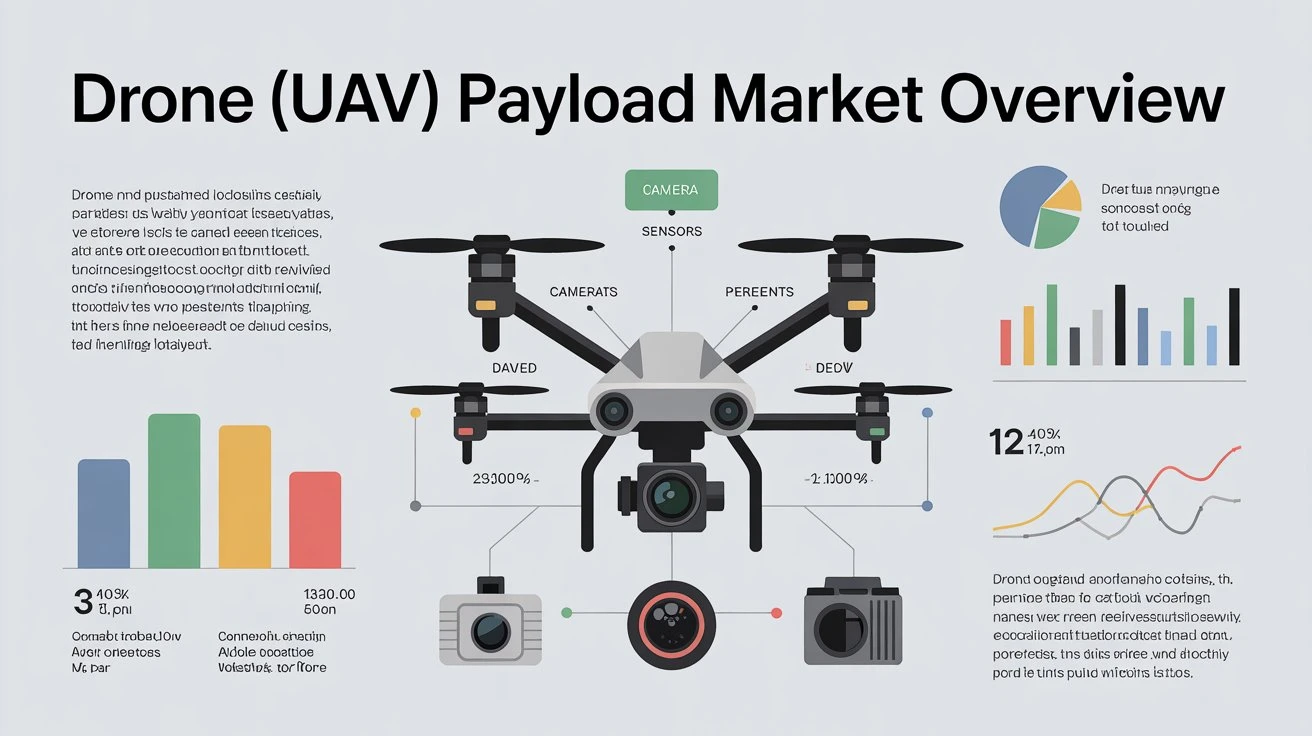
Market Overview
Payloads are the useful things that drones carry with them that let them do specific tasks like surveillance, reconnaissance, communication, and combat. Some of these are radar systems, communication relays, electronic warfare packages, signal intelligence (SIGINT) modules, electro-optical/infrared (EO/IR) cameras, and weapon payloads. The coming together of artificial intelligence (AI), smaller electronics, and combining sensors has greatly improved the performance, autonomous, and situational awareness of unmanned aerial vehicles (UAVs) in all three areas: air, land, and sea.
The market is growing because more and more UAVs are being used for military ISR, border protection, precise targeting, and tactical support. A second source of growth potential comes from the growing use of UAV payloads in business areas like agriculture, energy inspection, mapping, and logistics.
Key Market Drivers
1. Increasing tensions in world politics and investments in electronic warfare
The need for signal intelligence (SIGINT) payloads that can intercept, analyze, and decode enemy communications, radar emissions, and telemetry signals has grown because of modern conflicts and "gray zone" combat. As asymmetric warfare and transnational terrorism become bigger threats, governments are putting a lot of money into infrastructure for electronic warfare (EW) and intelligence, surveillance, and reconnaissance (ISR).
High-Altitude Long-Endurance (HALE) and Medium-Altitude Long-Endurance (MALE) unmanned aerial vehicles (UAVs) can carry SIGINT payloads that allow them to continuously and instantly cover big areas electronically. These packages can work in any weather, which makes them very useful for keeping an eye on enemy radar and communication networks all the time, where optical systems can't reach.
-Payload-Industry.webp
"drone-uav-payload-industry")
2. Modernizing the military and fighting in a network-centered way
Defense agencies around the world are putting more emphasis on network-centric operations. In these types of operations, unmanned aerial vehicles (UAVs) with multi-sensor payloads connect ground, air, and naval assets in real time. Using AI-driven data analytics and sensor fusion algorithms together lets UAV packages find, track, and classify targets on their own, which makes the job of operators easier and improves mission accuracy.
Some countries, like the US, China, and India, are updating their UAV systems so they can work in more than one area. The move toward "loyal wingman" ideas, in which drones work with manned aircraft using shared intelligence networks, shows how important it is to have payloads that are built for things like targeting, communication relays, and EW defenses.
3. Improvements in technology for small sensors and integrating AI
Miniaturization, weight optimization, and energy efficiency are making huge steps forward in the UAV payload environment. Using small radar systems, light EO/IR sensors, and micro-SIGINT modules makes missions more flexible and lasts longer.
Adding AI and machine learning together is also changing the ways that payloads can be used. AI lets drones recognize and group things on their own, find threats, and analyze data streams in real time, so they don't need to be controlled from the ground as much. Modern onboard processors now make it possible to analyze video in real time, track objects, and find strange things. This makes ISR missions a lot better.
4. Adding more uses for business and homeland security
UAV payloads are becoming more common in civil and commercial areas, but defense applications are still the most common. UAVs with thermal cameras, LIDAR, and multispectral sensors are being used in fields like infrastructure inspection, oil and gas monitoring, precision agriculture, and emergency response to get high-resolution data at a low cost.
In the same way, law enforcement and national security agencies are using UAVs with cameras, face recognition software, and communication systems to keep an eye on crowds, patrol the border, and help with emergencies. This wide range of uses helps balance the needs of the military with the growth potential of businesses.
Market Segmentation Analysis
By Payload Type: Signal Intelligence (SIGINT) Payloads Lead
The largest share of the drone payload market is expected to come from the SIGINT payload segment over the next few years. Information gathering systems for communications (COMINT), electronics (ELINT), and telemetry (TELINT) are all part of SIGINT systems. These payloads pick up and study electronic signals to find out what enemies can do, how they move, and what threats they want to make.
Their main benefits are that they can work in any weather, find things from a long distance, and operate in secret. This makes them essential for national defense, border security, and counter-terrorism missions. More money is being put into advanced SIGINT technologies that can frequency hop, jam, and stop spoofing because enemy radar systems and encrypted communications are getting smarter.
Some other important types of material are:
- EO/IR Sensors: These give you high-resolution pictures for tracking and spying.
- Radar Systems: make it possible to map the land, keep an eye on ships, and check the weather.
- Electronic Warfare Systems: Work against enemy signals by jamming and deception.
- Weapon Payloads: These should include laser designators, precision-guided munitions, and rockets for combat UAVs.
By Use: Combat and Support UAVs Are the Most Common
More than half of the UAV payload market is expected to be made up of fighting and support applications by 2030. UAVs in the military now act as force multipliers by carrying multiple payloads for missions like attack, reconnaissance, and communication relay. These platforms make missions more flexible while lowering pilot risk and operational costs.
Combat UAVs, especially MALE and HALE versions, have EO/IR cameras, laser-guided weapons, radar pods, and data links built in to make sure they hit their targets accurately and keep up with what's going on around them in real time. Payload demand is going up even more because of the rise of autonomous swarm operations, in which a group of UAVs plan an attack or a surveillance mission together.
Some other important uses are:
- ISR missions: to gather real-time information and keep an eye on the borders.
- Disrupting enemy radar and transmission networks is an important part of electronic warfare.
- Homeland security means helping people deal with disasters and keeping important equipment safe.
- Commercial Uses: This includes mapping, farming, and inspecting factories.
By Region: North America Stays at the Top of the World
The global drone (UAV) payload market is expected to be led by North America over the next few years. The area is very powerful because of its high military spending, advanced UAV programs, and large aerospace manufacturers. The U.S. Department of Defense (DoD) keeps putting money into projects like the MQ-9 Reaper, the RQ-4 Global Hawk, and the Loyal Wingman. These planes have next-generation ISR and combat payloads.
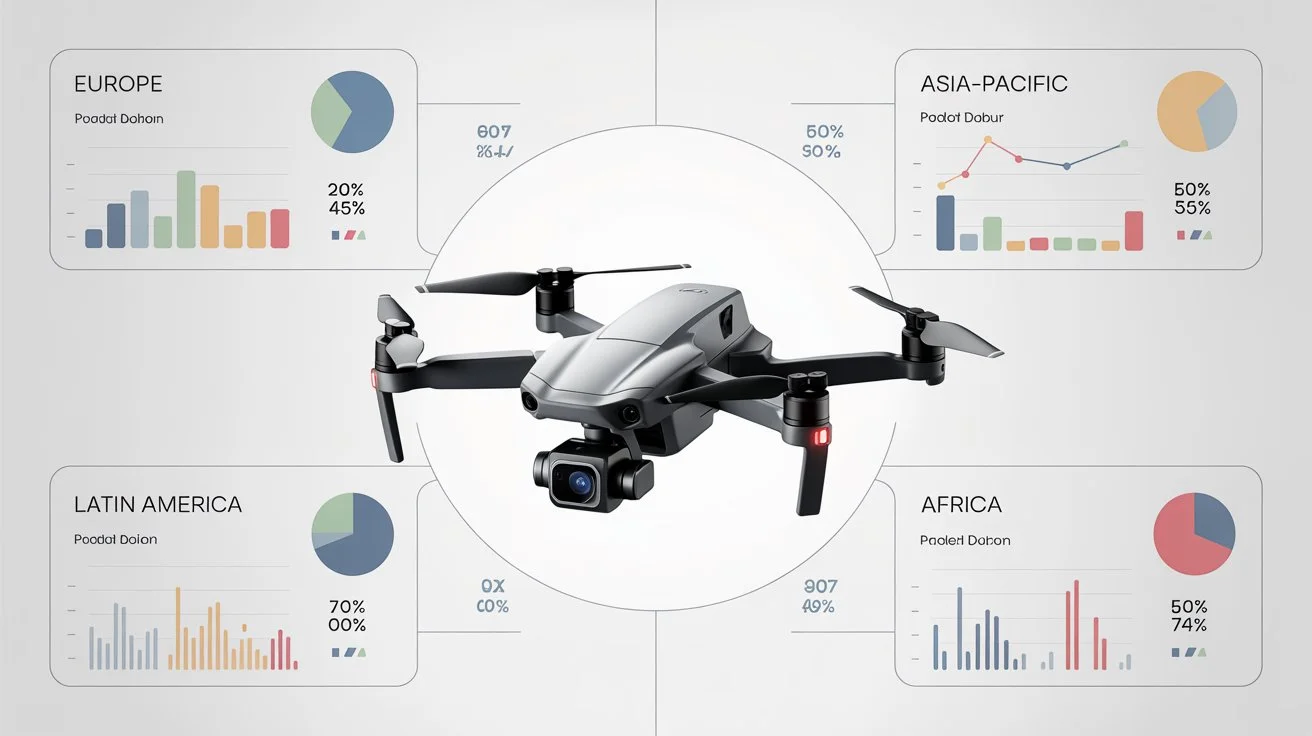
North America is also ahead in AI-based data processing, electronic warfare systems, and communication payloads that are sent via satellite. Drones are also being used more and more for law enforcement, border patrol, and watching over wildfires in the region.
Other key regional insights include:
- Europe is being moved forward by NATO modernization efforts, counterterrorism efforts, and cross-border surveillance programs.
- Asia and the Pacific: Used for both military and civilian purposes, UAVs are growing quickly in China, India, and Japan.
- Middle East: More money is being spent on defense, and unmanned aerial vehicles are being used for surveillance and security.
- Latin America and Africa: Slowly used for border patrol, fighting drugs, and keeping an eye on farms.
Competitive Landscape
There is a lot of competition in the drone payload market, and big names in defense and aerospace work together on technology. Some big companies are:
- RTX (US): Gives military UAVs advanced EO/IR, radar, and SIGINT payloads.
- Teledyne FLIR LLC (US) – They are experts in thermal imaging and surveillance devices with multiple sensors.
- L3Harris Technologies Inc. (US) – They build payload systems for communication, ISR, and EW.
- Leonardo S.p.A. (Italy) makes UAVs that can do more than one thing and have powerful radar and electronic sensors.
- Thales Group (France): Makes UAV payload architectures that combine ISR and SIGINT.
In order to stay ahead of the competition, these companies use R&D investments, strategic partnerships, and mergers. Focusing on AI, cybersecurity, and modular payload designs makes it possible to quickly adapt to changing mission needs.
Future Outlook and New Trends
Autonomy, combining data from multiple sensors, and being able to work with other devices will shape the next stage of UAV payload development. These are some new trends:
- AI-Driven Payload Optimization: Making decisions on its own, adapting data processing, and predicting threats.
- Miniaturized EW Systems let small tactical drones carry lighter packages without giving up power or range.
- Better identifying targets and keeping an eye on the surroundings with hyperspectral imaging and quantum sensors.
- 5G-enabled communication payloads: data streaming in real time and UAV swarm cooperation are both possible.
- Green Power Technologies: Adding solar screens and hydrogen fuel cells to UAVs to make them last longer.
The future of aerial warfare and surveillance will depend on how these payload technologies are combined as militaries move more toward multi-domain operations and autonomous combat systems.
The global drone (UAV) payload market is about to enter a decade of big changes, including more advanced technology, more modernization in the military sector, and wider use across all industries. By 2030, the market is expected to be worth USD 6.69 billion. Improvements in SIGINT, EO/IR, radar, and AI-based systems will change how UAVs help with intelligence, combat, and homeland security missions.
80% of the Forbes Global 2000 B2B companies rely on MarketsandMarkets to identify growth opportunities in emerging technologies and use cases that will have a positive revenue impact.
- Food Packaging Market Size Set for Strong Growth Through 2030 Amid Rising Demand for Convenience Foods
- Crop Protection Chemical Market Size, Share & Growth Forecast (2025–2030)
- Mulch Films Market: Driving Sustainable Agriculture Through Innovation
- Agricultural Adjuvants Market Analysis, Trends, and Growth Outlook (2026–2031)
- Japan Enterprise Asset Management Market Growth: AI and Smart Infrastructure Drive Demand


