

AI, Data Center Infrastructure, Semiconductor, Power & Energy, Sensing, Robotics and Advanced Technology Markets
Introduction
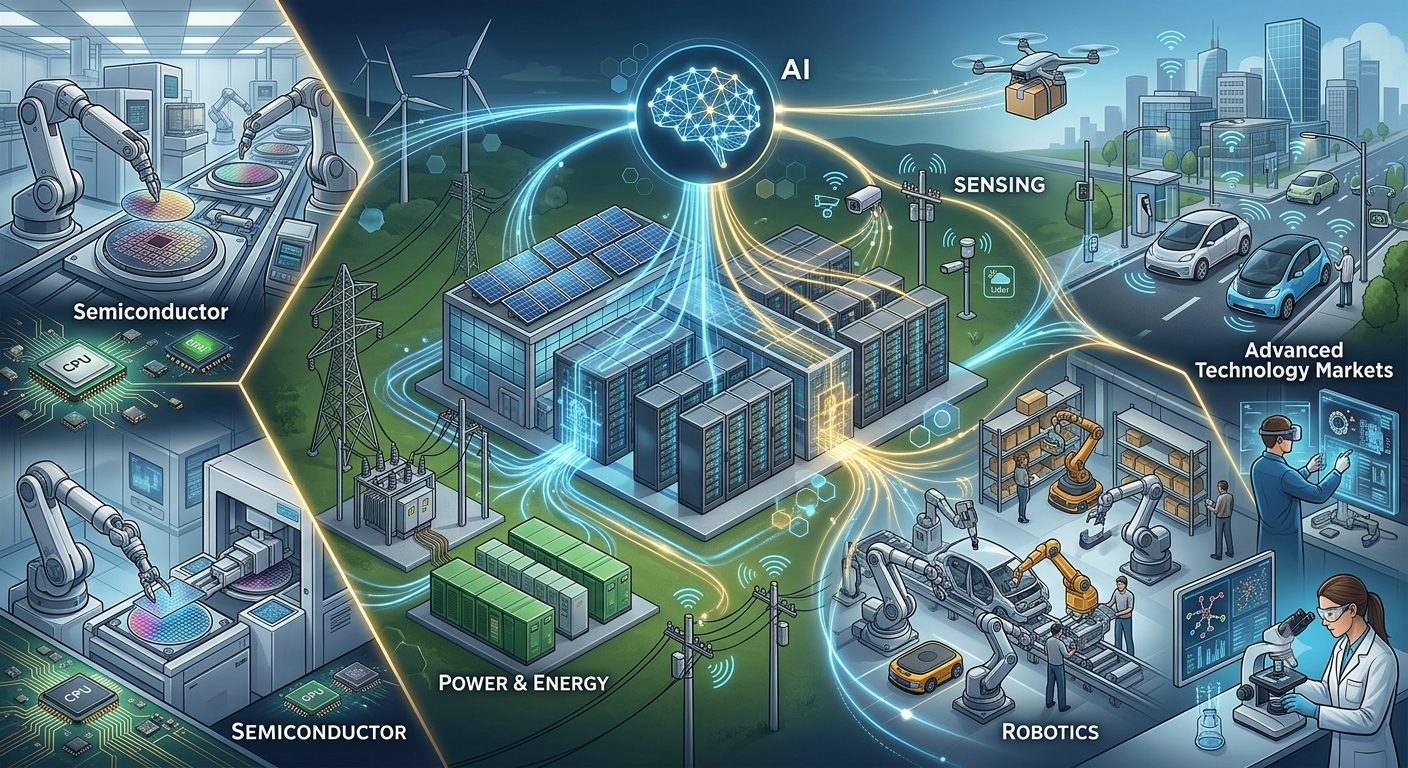
Landscape is entering a period of structural transformation driven by artificial intelligence (AI), accelerated computing, hyperscale data centers, semiconductor innovation, intelligent sensing, robotics, advanced power systems, optical connectivity, thermal management, and the growing adoption of digital technologies across industries. These developments are creating interconnected opportunities across multiple technology markets, from data center infrastructure and AI computing to semiconductor materials, industrial automation, robotics, sensors, photonics, quantum technologies, and intelligent energy systems.
The expansion of AI workloads is one of the most important forces shaping this transformation. Generative AI, machine learning, computer vision, autonomous systems, AI inference, and high-performance computing require increasingly sophisticated computing infrastructure. As organizations deploy AI applications at scale, demand is rising for GPUs, AI inference CPUs, high-speed optical transceivers, liquid-cooled servers, advanced substrates, semiconductor-grade encapsulants, photonic packaging, and efficient power-management technologies.
At the infrastructure level, the rapid construction and modernization of data centers is stimulating demand across a broad ecosystem. Data Center AI Video Surveillance, Data Center Battery, Data Center Digital Twin, Data Center Fire Protection, Data Center Fingerprint Sensor, Data Center Fuel Cell & Alternative Backup Power, Data Center LED Lighting, Data Center Microgrid, Data Center Noise and Vibration Control, Data Center Optical Transceiver, Data Center Painting, Coatings & ESD Flooring, Data Center Power Management, Data Center Power Quality & Harmonic Filter, Data Center Renewable Energy, Data Center Sustainability, Data Center Thermal Management, Data Center Prefab Electrical Room, Data Center Measurement, Data Center Monitoring, HVAC in Data Center, and SCADA in Data Center technologies are increasingly becoming part of a unified digital infrastructure ecosystem.
At the same time, developments outside traditional data center infrastructure are influencing this ecosystem. Sovereign AI initiatives are encouraging countries to establish domestic AI capabilities and computing infrastructure. Semiconductor manufacturing investments are increasing demand for advanced materials and packaging technologies. Robotics is expanding into security, power generation, manufacturing, and infrastructure inspection. Sensors are becoming more intelligent, while quantum computing and cryogenic technologies are creating new requirements for memory, cooling, measurement, and precision optical systems.
These developments are also generating opportunities in specialized markets such as electrochemical sensors, outdoor security robots, hydrostatic sensors, industrial PDA handheld terminals, power plant robots, quantum cryogenics, cryogenic memory, reflective microscope objectives, and automotive power tailgate spindles.
The combined market landscape therefore represents a broad technology ecosystem rather than a single industry. Its common themes include automation, intelligence, electrification, connectivity, computing, energy efficiency, sensing, reliability, and advanced materials.
Data Center Infrastructure Market Transformation
Data centers are becoming the physical foundation of the global digital economy. Cloud computing, AI, enterprise applications, streaming platforms, edge computing, Internet of Things (IoT), and digital services are increasing the volume and complexity of data processed worldwide.
The growth of AI is accelerating this transformation. Traditional data center architectures were primarily designed around general-purpose computing and conventional enterprise workloads. AI workloads, however, place substantially different demands on computing, power, cooling, networking, storage, and monitoring systems.
Modern facilities increasingly require high-density computing environments capable of supporting GPU clusters and other accelerated computing architectures. As rack power densities rise, data center operators must rethink thermal management, power distribution, backup power, cooling systems, monitoring, and physical security.
This creates a multiplier effect across the data center technology ecosystem. Growth in computing capacity generates demand for power infrastructure. Higher power consumption increases demand for cooling. Higher temperatures and greater equipment density increase the importance of monitoring and fire protection. Larger facilities require sophisticated digital twins and SCADA systems. Greater connectivity requirements stimulate demand for optical transceivers and linear pluggable optics.
Consequently, the data center market is evolving from a collection of individual infrastructure systems into an integrated, software-defined and increasingly intelligent infrastructure environment.
Data Center AI Video Surveillance Market
AI video surveillance is becoming increasingly important for protecting critical digital infrastructure. Data centers contain expensive servers, networking equipment, power systems, batteries, generators, cooling systems, and sensitive information. Security breaches, unauthorized access, equipment tampering, and operational incidents can create significant financial and operational risks.
Traditional surveillance systems primarily recorded video for subsequent investigation. AI-enabled systems can analyze video feeds in real time and identify unusual activities, unauthorized personnel, restricted-area access, suspicious movement, and other potential security events.
Computer vision can also support operational monitoring. Cameras equipped with AI analytics may help identify physical hazards, abnormal equipment conditions, or activities that could affect facility operations.
The integration of AI video surveillance with access-control systems, fingerprint sensors, building management platforms, and data center monitoring systems is expected to improve security automation. As facilities become larger and more distributed, automated surveillance can reduce dependence on manual monitoring.
The adoption of AI surveillance is therefore closely linked to the broader trend toward autonomous data center operations.
Data Center Battery and Backup Power Market
Reliable electricity is fundamental to data center operations. Even brief power interruptions can affect critical workloads and result in service disruptions. Battery systems therefore remain an essential part of data center power architecture.
The data center battery market is evolving alongside changes in backup-power requirements. Operators increasingly seek solutions that offer higher energy density, longer operating life, improved safety, faster response, and better integration with intelligent power-management systems.
Battery energy storage can also contribute to energy optimization. Instead of being used exclusively during outages, advanced battery systems can potentially participate in peak shaving, load management, renewable-energy integration, and other energy-management strategies.
The growth of AI data centers is creating additional pressure on backup-power infrastructure because high-performance computing clusters can require substantial and rapidly changing power loads. This makes battery monitoring, power quality, and intelligent energy management increasingly important.
https://www.marketsandmarkets.com/Market-Reports/data-center-battery-market-254269420.html
Data Center Digital Twin Market
Digital twins are becoming an important technology for designing, operating, and optimizing complex infrastructure.
A data center digital twin creates a virtual representation of physical infrastructure, potentially incorporating information about servers, racks, power systems, cooling equipment, environmental conditions, energy consumption, and facility operations.
Operators can use digital twins to simulate changes before implementing them physically. For example, a digital model can help evaluate how installing additional computing equipment could affect power distribution and cooling requirements.
Digital twins can also support predictive maintenance. By combining sensor data, operational information, and analytics, facility operators can identify potential problems before they become major failures.
The technology is particularly relevant to AI-oriented data centers because rapidly changing workloads and high-density computing environments require more sophisticated planning.
https://www.marketsandmarkets.com/Market-Reports/data-center-digital-twin-market-144910450.html
Data Center Fire Protection and Fingerprint Sensor Markets
Fire protection is a critical requirement in data centers because equipment, batteries, electrical systems, and cabling can create different types of fire risks. Modern facilities therefore require increasingly sophisticated detection, suppression, monitoring, and emergency-response systems.
Data center fire protection technologies may include fire detection systems, smoke detection, suppression technologies, alarms, monitoring systems, and integrated safety platforms.
Security is another critical requirement. Fingerprint sensors can support biometric authentication for employees, contractors, and authorized personnel entering restricted areas.
The integration of biometric security with surveillance, access control, and centralized facility management can improve security while generating digital records of access activity.
As data centers become more automated, physical security is increasingly becoming part of the broader digital infrastructure architecture.
https://www.marketsandmarkets.com/Market-Reports/data-center-fire-protection-market-220494707.html
Fuel Cells, Alternative Backup Power and Microgrids
Traditional backup power systems typically rely on batteries and diesel generators. However, concerns regarding emissions, fuel logistics, energy efficiency, and sustainability are encouraging data center operators to explore alternative power technologies.
Fuel cells represent one potential solution for reliable distributed power generation. They can provide electricity with lower local emissions depending on the fuel source and system configuration.
Microgrids are another important technology. A data center microgrid can integrate multiple energy resources, including grid electricity, batteries, renewable generation, fuel cells, and backup generators.
The increasing adoption of renewable energy makes microgrids particularly relevant. Solar and wind power are variable, so energy storage and intelligent power management can help balance supply and demand.
Data center operators are increasingly considering energy infrastructure as a strategic component rather than simply a utility requirement.
Data Center Renewable Energy and Sustainability Market
Sustainability has become a major consideration in data center development.
Data centers consume electricity continuously, and the rapid expansion of AI infrastructure is increasing energy requirements. Operators are therefore seeking ways to reduce carbon emissions, improve energy efficiency, optimize water consumption, and increase the use of renewable energy.
Renewable energy can be integrated through on-site generation, power purchase agreements, renewable-energy certificates, and other approaches.
Sustainability initiatives increasingly extend beyond electricity consumption. Operators are also considering equipment lifecycle management, cooling efficiency, construction materials, water usage, waste reduction, and facility design.
This is creating opportunities across the data center sustainability ecosystem, including energy management, thermal management, renewable energy, efficient lighting, advanced power systems, and digital monitoring.
Data Center Thermal Management and HVAC
Thermal management is one of the most important challenges facing modern data centers.
As computing density increases, servers generate more heat. Traditional air-cooling architectures may become less effective at extremely high rack densities, increasing interest in liquid cooling and other advanced thermal technologies.
Liquid-cooled servers can transfer heat more efficiently than conventional air-based approaches under certain high-density conditions. Technologies such as direct-to-chip liquid cooling, rear-door heat exchangers, immersion cooling, and advanced cooling distribution systems are becoming increasingly relevant.
HVAC systems remain essential for managing facility-level environmental conditions. Intelligent HVAC controls can optimize temperature, humidity, airflow, and energy consumption.
The convergence of thermal sensors, AI analytics, digital twins, monitoring systems, and automated controls is expected to create increasingly intelligent cooling environments.
Data Center Power Management and Power Quality
Power management is becoming more complex as data centers deploy high-performance computing systems.
Power management technologies help distribute electricity efficiently across servers, racks, cooling equipment, storage systems, networking infrastructure, and other loads.
Power quality is equally important. Voltage disturbances, harmonics, transients, and other electrical issues can negatively affect sensitive equipment.
Power quality and harmonic filters can help mitigate certain electrical disturbances and improve the quality of power supplied to equipment.
The growing deployment of power electronics, high-density computing, renewable energy, battery storage, and variable loads makes power management increasingly important.
Data center operators are therefore investing in monitoring systems capable of providing real-time visibility into electrical performance.
Data Center Measurement and Monitoring
Data center measurement systems provide the information required to manage increasingly complex infrastructure.
Measurement may cover electricity consumption, voltage, current, temperature, humidity, airflow, pressure, vibration, water consumption, equipment performance, and environmental conditions.
Data center monitoring platforms can aggregate this information and provide centralized visibility.
AI and machine learning can further improve monitoring by identifying unusual patterns and predicting potential failures.
For example, a monitoring system may detect increasing temperatures in a particular rack, abnormal power consumption, or changes in vibration that could indicate equipment problems.
The transition from reactive monitoring to predictive analytics is one of the most significant developments in data center operations.
https://www.marketsandmarkets.com/Market-Reports/data-center-measurement-market-257805727.html
SCADA in Data Centers
Supervisory Control and Data Acquisition (SCADA) systems are traditionally associated with industrial environments, utilities, manufacturing facilities, and critical infrastructure.
Their application to data centers reflects the increasing complexity of facility operations.
SCADA platforms can provide centralized monitoring and control of power systems, generators, cooling equipment, electrical distribution, environmental systems, and other infrastructure.
The integration of SCADA with building management systems, IoT sensors, digital twins, AI analytics, and energy-management platforms can support more automated facility operations.
As data centers become larger, operators increasingly need unified visibility across thousands of physical assets.
https://www.marketsandmarkets.com/Market-Reports/scada-in-data-center-market-79684683.html
Data Center Optical Transceiver and LPO Markets
AI workloads require enormous volumes of data to move between computing nodes.
High-performance AI clusters therefore depend heavily on high-speed networking technologies.
Optical transceivers convert electrical signals into optical signals and back again, enabling high-speed communication over fiber-optic networks.
Linear pluggable optics (LPO) is gaining attention as data center operators seek high-bandwidth connectivity with lower power consumption and reduced complexity in certain applications.
The growth of AI accelerators, distributed computing, and high-performance networking is expected to stimulate demand for increasingly sophisticated optical interconnect technologies.
This trend also creates opportunities in photonic packaging, optical components, semiconductor manufacturing, and advanced materials.
Photonic Packaging Market
Photonic technologies are increasingly important for high-speed communication, sensing, computing, and other advanced applications.
Photonic packaging involves integrating optical components with electronic systems in a manner that provides reliable performance, thermal management, connectivity, and manufacturability.
As optical data transmission speeds increase, packaging becomes increasingly important.
The growth of AI infrastructure is therefore indirectly supporting the photonic packaging ecosystem by increasing demand for high-bandwidth communication between processors, memory, storage, and networking equipment.
Future developments could involve tighter integration between electronic and photonic components, supporting higher bandwidth and potentially improved energy efficiency.
Semiconductor Grade Encapsulants
Semiconductor-grade encapsulants are specialized materials used to protect electronic and semiconductor components.
As semiconductor devices become smaller, faster, and more complex, materials used for protection and packaging must meet increasingly demanding requirements.
Encapsulants may provide protection against moisture, mechanical stress, contamination, thermal cycling, and environmental factors.
Growth in automotive electronics, power electronics, AI accelerators, advanced computing, telecommunications, and industrial automation is increasing demand for high-performance semiconductor packaging materials.
The market is therefore closely connected to the broader expansion of semiconductor manufacturing.
GPU Substrate Market
GPUs have become fundamental components of modern AI infrastructure.
Training and inference workloads require large numbers of high-performance processors. However, GPU performance depends not only on the processor itself but also on advanced packaging, substrates, memory, interconnects, and thermal solutions.
GPU substrates provide electrical and mechanical interfaces between semiconductor dies and larger system components.
As GPU architectures become more powerful and package complexity increases, advanced substrate technologies are becoming increasingly important.
The GPU substrate market is therefore closely tied to AI accelerator demand, advanced semiconductor packaging, high-bandwidth memory, and data center expansion.
AI Inference CPU Market
AI computing is generally associated with training large models, but inference—the process of running trained models—is becoming equally important.
AI inference occurs across cloud data centers, enterprise servers, edge devices, smartphones, industrial systems, vehicles, security systems, and other platforms.
AI inference CPUs are designed or optimized to efficiently execute AI workloads while balancing performance, energy consumption, cost, and compatibility.
As AI moves from centralized training environments toward widespread real-world deployment, demand for inference-focused computing is expected to expand.
This trend will create opportunities across processors, accelerators, memory, networking, cooling, and power management.
Liquid-Cooled Server Market
The growth of high-density AI computing is changing server cooling requirements.
Conventional air cooling can face limitations when rack densities become extremely high. Liquid cooling can provide more efficient heat transfer and may allow operators to support higher computational densities.
Liquid-cooled servers can incorporate direct-to-chip cooling, cold plates, liquid distribution systems, or other thermal technologies.
The market is closely connected to AI data centers, high-performance computing, GPU servers, and advanced thermal management.
The adoption of liquid cooling may also influence data center facility design, including plumbing, cooling distribution, heat rejection, monitoring, and maintenance requirements.
Data Center Power Semiconductor Market
Power semiconductors play an important role in converting, controlling, and managing electrical energy.
Data centers use power semiconductor devices in power supplies, uninterruptible power systems, voltage regulation, energy storage, cooling systems, and other infrastructure.
The transition toward higher energy efficiency and greater power density is increasing demand for advanced power semiconductor technologies.
Wide-bandgap materials such as silicon carbide and gallium nitride are receiving increasing attention in power electronics because of their potential advantages in efficiency and high-frequency operation.
As AI data centers consume more electricity, improvements in power conversion efficiency can have significant economic and operational implications.
India Semiconductor Industry Outlook
India is becoming increasingly active in the global semiconductor ecosystem.
Government initiatives, private-sector investment, electronics manufacturing, chip design capabilities, and growing domestic demand are contributing to the development of the semiconductor industry.
India's semiconductor opportunity extends beyond wafer fabrication. It includes chip design, packaging, testing, materials, electronics manufacturing, embedded systems, software, and semiconductor equipment.
The country's large technology workforce and expanding electronics ecosystem provide opportunities for long-term growth.
As semiconductor manufacturing becomes increasingly strategic globally, India could play a larger role in diversifying semiconductor supply chains.
Sovereign AI Market
Sovereign AI refers broadly to the development and operation of AI capabilities under a country's or region's control, including infrastructure, data, computing resources, models, talent, and governance.
Growing concerns about data sovereignty, national security, technological independence, and dependence on foreign infrastructure are encouraging governments and organizations to invest in domestic AI capabilities.
Sovereign AI requires substantial infrastructure.
Countries pursuing sovereign AI strategies may need domestic or regionally controlled data centers, GPUs, networking systems, energy infrastructure, AI models, cloud platforms, and cybersecurity capabilities.
This makes sovereign AI a cross-sector opportunity spanning semiconductors, data centers, cloud computing, energy, cybersecurity, software, and telecommunications.
Electrochemical Sensor and Hydrostatic Sensor Markets
Sensors are becoming increasingly important across industrial, environmental, healthcare, automotive, infrastructure, and energy applications.
Electrochemical sensors can detect chemical substances through electrochemical reactions and are used across applications such as environmental monitoring, industrial process control, healthcare, and safety.
Hydrostatic sensors measure pressure associated with fluid columns and can be used in applications involving liquid-level measurement, water systems, industrial equipment, and infrastructure.
The broader sensor market is shifting toward connected and intelligent devices.
Sensors increasingly generate data that can be analyzed using cloud platforms, edge computing, and AI.
Outdoor Security Robots
Robotics is expanding beyond factories into outdoor environments.
Outdoor security robots can potentially support perimeter monitoring, industrial-site surveillance, infrastructure inspection, and security operations.
These systems may combine cameras, sensors, AI algorithms, autonomous navigation, communications, and remote-control capabilities.
The integration of robotics with AI video analytics can enable robots to identify and respond to specific situations more efficiently than conventional surveillance systems alone.
Applications may include data centers, industrial facilities, warehouses, logistics centers, utilities, campuses, and critical infrastructure.
Power Plant Robots Market
Power plants contain large amounts of critical equipment operating under demanding conditions.
Robots can support inspection, monitoring, maintenance, and potentially hazardous operations.
Robotic systems equipped with cameras and sensors can inspect areas that may be difficult or dangerous for humans to access.
AI-enabled robotics can also analyze visual or sensor information to identify equipment abnormalities.
As utilities seek to improve worker safety, reduce maintenance costs, and increase operational efficiency, robotics may become increasingly integrated into power plant environments.
Industrial PDA Handheld Terminal Market
Industrial PDA handheld terminals support mobile data collection and communication in industrial environments.
These devices are commonly associated with logistics, warehousing, manufacturing, field service, inventory management, and industrial operations.
Modern industrial handheld terminals increasingly integrate barcode scanning, RFID, wireless communication, GPS, cameras, ruggedized designs, and enterprise software.
The growth of smart factories and connected supply chains is creating greater demand for mobile computing devices capable of operating in challenging industrial environments.
AI and edge computing may further enhance these devices by enabling intelligent data processing closer to the point of operation.
Cryogenic Memory and Quantum Cryogenics
Quantum computing is creating demand for technologies capable of operating at extremely low temperatures.
Many quantum computing architectures require cryogenic environments to maintain quantum states and reduce thermal noise.
Quantum cryogenics therefore represents an important enabling technology for the development of quantum computing systems.
Cryogenic memory technologies are also being explored in the context of low-temperature computing architectures.
The intersection of quantum computing, cryogenic systems, advanced electronics, memory, measurement technologies, and specialized materials could create new technology markets over the coming decade.
Although quantum technologies remain at an earlier stage of commercialization than mainstream AI, their potential long-term impact is substantial.
Reflective Microscope Objectives Market
Optical technologies remain important across scientific research, semiconductor manufacturing, industrial inspection, microscopy, and advanced manufacturing.
Reflective microscope objectives are designed to use reflective optical elements rather than conventional refractive lenses and can offer advantages for specific wavelengths and applications.
Advanced semiconductor manufacturing and scientific research require increasingly precise optical systems.
The broader photonics ecosystem is therefore benefiting from demand for advanced microscopy, inspection, metrology, and precision measurement.
Automotive Power Tailgate Spindle Market
The automotive sector is undergoing significant technological transformation through electrification, automation, connectivity, and intelligent vehicle systems.
Power tailgate systems provide automated opening and closing of vehicle tailgates and commonly use electric spindle mechanisms.
Consumer expectations for convenience features are increasing, particularly in SUVs and premium vehicles.
The power tailgate spindle market therefore represents a specialized example of how electromechanical technologies are being integrated into modern vehicles.
The broader automotive trend toward electric actuation is creating opportunities for motors, sensors, controllers, actuators, and intelligent mechanical systems.
Data Center LED Lighting and Noise & Vibration Control
Lighting is another important component of data center infrastructure.
LED lighting can provide energy-efficient illumination while supporting operational visibility and facility management.
Modern data centers may also integrate intelligent lighting controls that adjust lighting according to occupancy or operational requirements.
Noise and vibration control is increasingly relevant as facilities deploy large numbers of servers, cooling systems, generators, pumps, compressors, and other mechanical equipment.
Effective vibration management can help protect sensitive equipment, while acoustic control can improve working conditions and address environmental requirements.
Data Center Painting, Coatings and ESD Flooring
Data center construction involves specialized requirements for floors, walls, coatings, and surfaces.
Electrostatic discharge can damage sensitive electronic equipment, making ESD flooring an important consideration in certain environments.
Specialized coatings can also contribute to durability, dust control, chemical resistance, and facility maintenance.
As data centers become larger and more sophisticated, construction materials are increasingly being considered as part of overall facility performance.
This creates opportunities for specialized paints, coatings, flooring systems, and construction technologies.
Prefabricated Electrical Rooms
Prefabrication is emerging as an important strategy for accelerating data center construction.
Prefab electrical rooms can be manufactured and assembled off-site before being transported to the project location.
This approach can potentially reduce on-site construction time, improve quality control, and support standardized deployment.
The trend is particularly relevant as data center operators seek to build capacity rapidly to meet demand from cloud computing and AI.
Modular construction can also improve scalability by enabling repeatable facility designs.
The Convergence of AI and Data Center Technologies
One of the most important themes across these markets is convergence.
AI is not an isolated technology. It requires computing, networking, power, cooling, sensors, software, security, and physical infrastructure.
For example, the expansion of AI accelerators increases electrical demand. Higher electrical demand increases thermal output. Higher thermal output creates demand for liquid cooling. High-density computing increases networking requirements. Faster networking increases demand for optical transceivers and photonic technologies.
Similarly, more complex facilities require better monitoring and digital twins. More connected facilities require stronger physical security. Increased energy consumption increases the importance of renewable energy and sustainability.
Therefore, growth in one technology market can stimulate demand in several adjacent markets.
Role of Advanced Sensors and Measurement
Sensors are becoming the connective tissue of intelligent infrastructure.
Temperature sensors, pressure sensors, vibration sensors, electrical sensors, optical sensors, chemical sensors, biometric sensors, and environmental sensors can continuously collect information from physical systems.
This data can then be analyzed by AI algorithms.
The resulting architecture can be described as:
Physical infrastructure → Sensors → Connectivity → Data platform → AI analytics → Automated decision → Physical action
This model is increasingly applicable to data centers, factories, power plants, vehicles, buildings, and critical infrastructure.
As sensor costs decline and computing capabilities increase, more physical systems can become measurable and intelligent.
Robotics and Autonomous Infrastructure
Robotics represents another major growth theme.
Historically, industrial robots were primarily used for repetitive manufacturing tasks. Today, robotics is expanding into security, inspection, logistics, power generation, infrastructure maintenance, and outdoor environments.
AI is accelerating this development.
Computer vision allows robots to understand their surroundings. Machine learning enables improved object recognition and anomaly detection. Advanced sensors allow robots to navigate complex environments.
This convergence between AI and robotics creates opportunities for autonomous inspection, predictive maintenance, remote operations, and security.
Energy Efficiency as a Strategic Priority
Energy efficiency is becoming a central consideration across nearly every market discussed.
Data centers need efficient power supplies and cooling systems.
Semiconductor manufacturers seek more efficient processes.
Electric vehicles require efficient power electronics.
Robots require efficient motors and batteries.
AI processors need high performance within manageable power budgets.
Quantum computing requires sophisticated cryogenic systems.
Renewable energy systems require power conversion and energy storage.
As energy costs and sustainability requirements become increasingly important, technologies that improve energy efficiency can gain competitive advantages.
Advanced Semiconductor Packaging
Semiconductor performance increasingly depends on packaging technologies.
Traditional scaling of transistor dimensions remains important, but advanced packaging is becoming a critical method of improving system performance.
Technologies such as chiplets, 2.5D packaging, 3D integration, advanced substrates, high-bandwidth memory integration, and photonic-electronic integration are reshaping semiconductor architecture.
These developments connect several markets in this technology ecosystem, including GPU substrates, semiconductor encapsulants, photonic packaging, optical transceivers, AI processors, and power semiconductors.
The result is a more integrated semiconductor value chain.
Cloud, Edge and Distributed Computing
Computing is increasingly distributed across centralized cloud data centers, regional facilities, enterprise infrastructure, and edge locations.
Cloud computing remains critical for large-scale AI training and data processing.
Edge computing enables data to be processed closer to where it is generated, reducing latency and potentially lowering network requirements.
Industrial robots, security systems, autonomous vehicles, smart factories, sensors, and connected infrastructure can all benefit from edge computing.
The combination of edge and cloud computing creates demand for distributed data center infrastructure, compact computing systems, networking, power management, thermal management, and intelligent monitoring.
Smart Factory and Industrial Automation
The industrial sector is moving toward increasingly connected production environments.
Smart factories combine sensors, industrial networks, robots, machine vision, automation controllers, analytics, cloud platforms, and AI.
Industrial PDA terminals provide workers with real-time access to operational information.
Sensors collect information from machines.
Robots automate physical tasks.
AI identifies patterns and predicts failures.
SCADA systems monitor industrial infrastructure.
This creates a highly interconnected industrial ecosystem similar in architecture to modern data center operations.
Market Opportunities Through 2032
The period through 2032 is expected to be characterized by increasing investment in digital infrastructure and intelligent technologies.
Several major themes are likely to influence market development:
- AI infrastructure expansion
- Hyperscale and edge data center growth
- Higher computing density
- Advanced cooling adoption
- Renewable energy integration
- Intelligent power management
- High-speed optical connectivity
- Advanced semiconductor packaging
- Autonomous robotics
- Industrial digitalization
- Sovereign AI investment
- Quantum technology development
- Advanced sensing
- Energy-efficiency requirements
- Data center sustainability
These themes are not independent. Their interaction is likely to be one of the defining characteristics of the technology market through 2032.
Key Challenges
Despite strong growth opportunities, technology markets face several challenges.
High Capital Requirements
Data centers, semiconductor fabs, advanced manufacturing facilities, and quantum computing infrastructure require significant capital investment.
Energy Availability
AI data centers can require large amounts of electricity, making access to reliable and affordable energy an increasingly important consideration.
Supply Chain Constraints
Semiconductors, optical components, advanced substrates, batteries, cooling systems, and specialized materials can face supply constraints.
Skilled Workforce
Advanced infrastructure requires engineers and specialists in AI, semiconductor manufacturing, power electronics, thermal management, robotics, optics, and industrial automation.
Cybersecurity
Greater connectivity increases the potential attack surface across digital infrastructure.
Regulatory Requirements
Environmental, energy, safety, data sovereignty, and infrastructure regulations can influence technology deployment.
Technology Complexity
Integrating multiple systems can create interoperability and maintenance challenges.
Competitive Landscape
The competitive landscape across these markets is highly fragmented because the overall ecosystem includes multiple technology layers.
Large technology companies compete in AI processors, cloud infrastructure, networking, and data center platforms.
Semiconductor companies compete across processors, memory, power devices, substrates, packaging, and optical technologies.
Industrial technology companies participate in automation, SCADA, monitoring, sensors, robotics, and power management.
Specialized companies serve niche markets such as cryogenic technologies, photonic packaging, biometric sensors, industrial handheld terminals, coatings, flooring, and mechanical actuators.
Competition increasingly extends beyond individual products.
Companies are seeking to provide integrated solutions combining hardware, software, analytics, connectivity, and services.
Mergers, Acquisitions and Strategic Partnerships
Strategic partnerships are likely to remain important across these markets.
Technology companies may collaborate to combine complementary capabilities.
For example, AI companies may partner with semiconductor manufacturers and data center operators. Cooling companies may work with server manufacturers. Renewable-energy providers may partner with data center developers. Robotics companies may integrate AI vision platforms.
Mergers and acquisitions can also provide access to specialized technologies, intellectual property, manufacturing capabilities, and customer relationships.
The convergence of industries is likely to encourage cross-sector investment and partnerships.
Regional Outlook
North America
North America is expected to remain an important market for AI infrastructure, hyperscale data centers, semiconductor technologies, robotics, cloud computing, and advanced networking.
Large technology companies and cloud providers are investing heavily in AI infrastructure.
Europe
Europe is emphasizing energy efficiency, sustainability, data sovereignty, industrial automation, and advanced manufacturing.
The region has significant opportunities in sustainable data centers, industrial robotics, semiconductor technologies, and sovereign AI.
Asia Pacific
Asia Pacific is a major center for semiconductor manufacturing, electronics production, data center development, telecommunications, and industrial automation.
Countries across the region are investing in AI infrastructure and semiconductor capabilities.
India
India represents an emerging opportunity across semiconductor manufacturing, AI infrastructure, data centers, electronics, industrial automation, and digital services.
Government policies and private investment are expected to influence the development of the domestic technology ecosystem.
Middle East
The Middle East is increasingly investing in digital infrastructure, AI, smart cities, renewable energy, and large-scale data centers.
The region's focus on economic diversification and digital transformation can create opportunities across multiple technology markets.
Technology Integration Will Define Future Growth
The future market environment will increasingly be defined by technology integration rather than isolated products.
A modern AI data center, for example, may incorporate:
- AI accelerators
- AI inference CPUs
- GPU substrates
- high-bandwidth memory
- optical transceivers
- LPO technology
- liquid-cooled servers
- advanced HVAC
- battery systems
- power semiconductors
- renewable energy
- microgrids
- digital twins
- SCADA
- measurement systems
- monitoring platforms
- AI video surveillance
- biometric security
- fire protection
- ESD flooring
- intelligent lighting
- noise and vibration control
This demonstrates how seemingly separate markets are becoming components of a common technology architecture.
Future of Intelligent Infrastructure
The long-term direction of the industry is toward infrastructure that can monitor itself, predict failures, optimize resources, and automate decisions.
Data centers may increasingly operate using autonomous management platforms.
AI systems could analyze energy consumption, cooling performance, server utilization, security events, and equipment health simultaneously.
Robots could perform physical inspections.
Digital twins could simulate operational changes.
Sensors could provide real-time information.
Power-management systems could dynamically balance loads.
Renewable-energy systems and batteries could help optimize energy consumption.
This creates the concept of an intelligent infrastructure ecosystem in which physical assets and digital intelligence continuously interact.
The global technology landscape through 2032 is expected to be shaped by the convergence of artificial intelligence, data center infrastructure, semiconductors, energy systems, optical technologies, sensing, robotics, industrial automation, and advanced computing.
The rapid development of AI is acting as a major catalyst for this transformation. AI requires powerful processors, advanced semiconductor packaging, high-speed networking, efficient cooling, reliable electricity, sophisticated monitoring, and secure infrastructure. These requirements are stimulating growth across multiple connected technology markets.
Data center infrastructure remains at the center of this ecosystem. Battery systems, alternative backup power, microgrids, renewable energy, power management, power quality, thermal management, HVAC, monitoring, measurement, SCADA, fire protection, biometric security, digital twins, optical transceivers, LPO, lighting, coatings, ESD flooring, prefab electrical rooms, and noise and vibration control all contribute to the performance and reliability of modern facilities.
Beyond data centers, semiconductor technologies are advancing rapidly. GPU substrates, semiconductor-grade encapsulants, power semiconductors, AI inference CPUs, photonic packaging, and optical technologies are supporting the next generation of computing and communications.
At the same time, sovereign AI strategies are encouraging governments to build domestic computing capabilities, while semiconductor investment is reshaping global supply chains. Robotics and intelligent sensors are expanding into power plants, industrial facilities, security applications, logistics, and infrastructure inspection.
Emerging fields such as quantum cryogenics and cryogenic memory represent longer-term opportunities, while specialized markets such as electrochemical sensors, hydrostatic sensors, industrial PDA terminals, reflective microscope objectives, and automotive power tailgate spindles demonstrate the breadth of technology innovation across industries.
Overall, the market opportunity is increasingly defined by intelligence, connectivity, automation, electrification, energy efficiency, advanced materials, and digital infrastructure.
By 2032, successful technology ecosystems are likely to be those that can combine computing power with efficient energy systems, advanced sensing, intelligent software, secure connectivity, and automated physical infrastructure. Companies operating across these interconnected markets will have opportunities to participate in one of the most significant periods of technology investment and infrastructure transformation in the global economy.
The convergence of AI, data centers, semiconductors, power and energy, sensing, robotics, photonics, quantum technologies, and industrial automation is therefore creating a broad and rapidly evolving technology landscape with opportunities extending well beyond any single industry.
80% of the Forbes Global 2000 B2B companies rely on MarketsandMarkets to identify growth opportunities in emerging technologies and use cases that will have a positive revenue impact.
- Food Packaging Market Size Set for Strong Growth Through 2030 Amid Rising Demand for Convenience Foods
- Crop Protection Chemical Market Size, Share & Growth Forecast (2025–2030)
- Mulch Films Market: Driving Sustainable Agriculture Through Innovation
- Agricultural Adjuvants Market Analysis, Trends, and Growth Outlook (2026–2031)
- Japan Enterprise Asset Management Market Growth: AI and Smart Infrastructure Drive Demand

