
European Smart Lighting Market

European Smart Lighting Market by Light and Luminaire, Lighting Control, DALI, Power Over Ethernet (PoE), Power Line Communication (PLC), Wired Hybrid Protocol, Zigbee, Bluetooth Low Energy (BLE), 6LoWPAN, and EnOcean - Forecast to 2030




OVERVIEW
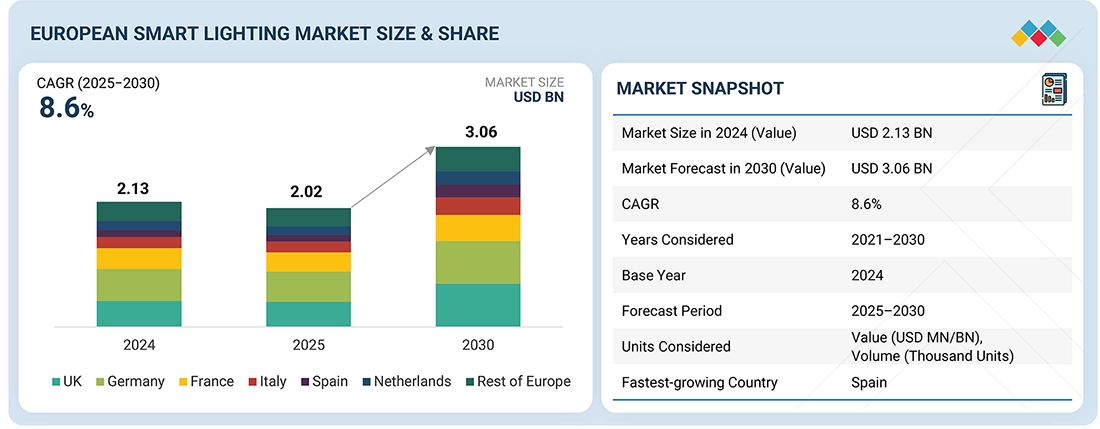
Source: Secondary Research, Interviews with Experts, MarketsandMarkets Analysis
The European smart lighting market is projected to reach USD 3.06 billion by 2030 from USD 2.02 billion in 2025, at a CAGR of 8.6% from 2025 to 2030. The regional market is driven by stringent energy-efficiency regulations and sustainability mandates set by European regulatory bodies, promoting the widespread adoption of smart lighting solutions across commercial, industrial, and municipal sectors.
Market Size & Forecast
KEY TAKEAWAYS
-
By CountryBy country, Germany is expected to dominate the market with a market share of 25.4% in 2025.
-
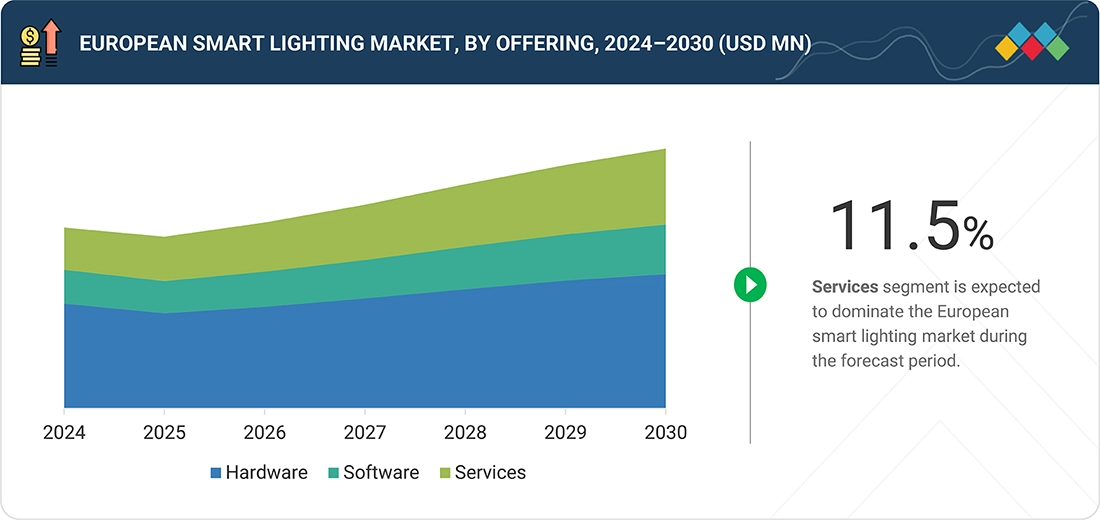
By OfferingBy offering, the services segment is expected to register the highest CAGR of 11.5% during the forecast period.
-
By Communication TechnologyBy communication technology, the wired segment is projected to dominate the market from 2025 to 2030.
-
By End-use ApplicationBy end-use application, the outdoor segment is expected to grow at the highest CAGR of 9.8% during the forecast period.
-
Competitive LandscapeSignify Holdings, ams-OSRAM, and Zumptobel were identified as some of the star players in the European smart lighting market, given their strong market share and product footprint.
-
Competitive LandscapeCasambi Technologies Oy, Gooee, and Ingy, among others, have distinguished themselves among startups and SMEs by securing strong footholds in specialized niche areas, underscoring their potential as emerging market leaders.
The European smart lighting market is witnessing strong and sustained growth, fueled by the focus on energy efficiency, carbon-neutral targets, and digital transformation across buildings and public infrastructure. Demand is rising for connected LED systems, human-centric lighting, and IoT-enabled luminaires that optimize energy use, enhance occupant comfort, and support sustainability reporting. Innovations in wireless controls, DALI-2 and KNX-based automation, PoE lighting, and analytics-driven facility management boost the adoption across offices, retail, industrial sites, transportation hubs, and urban outdoor lighting networks.
TRENDS & DISRUPTIONS IMPACTING CUSTOMERS' CUSTOMERS
The European smart lighting market is rapidly shifting from conventional luminaires to connected LED systems and integrated IoT-based controls. Sustainability mandates, carbon-reduction goals, and smart-city programs are accelerating adoption across commercial buildings and public infrastructure. End users expect lighting to provide real-time monitoring, predictive maintenance, and human-centric lighting benefits rather than simple illumination. Vendors are responding with wireless platforms, PoE lighting, cloud-based management, and interoperable DALI-2/KNX solutions. This transition is redefining revenue models toward outcome-driven value, including ESG improvements, energy savings, and enhanced occupant comfort.
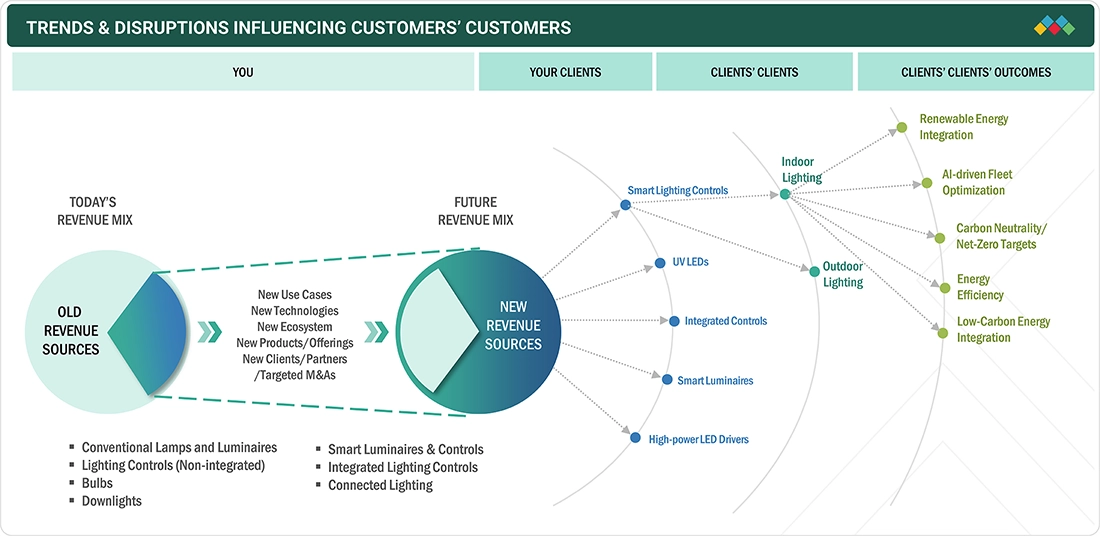
Source: Secondary Research, Interviews with Experts, MarketsandMarkets Analysis
MARKET DYNAMICS

Level
-
EU sustainability mandates and smart-city programs

-
Rising investment in human-centric lighting across European workplaces, healthcare, and education environments


Level
-
High upfront CAPEX for retrofitting legacy buildings and public lighting networks

-
Vendor-specific protocols and fragmented technology ecosystems


Level
-
Street-lighting modernization programs across Europe

-
Smart retail and hospitality redevelopment in European cities


Level
-
Interoperability hurdles across standards and ecosystems

Source: Secondary Research, Interviews with Experts, MarketsandMarkets Analysis
Driver: EU smart-city & sustainability regulations
The European Union’s climate goals, Green Deal roadmap, and city-level net-zero commitments influence public authorities to modernize lighting infrastructure. Municipalities are replacing legacy streetlighting with adaptive LED systems integrated with sensors and remote monitoring platforms. These upgrades reduce energy consumption and help cities improve safety, reduce emissions, and lower maintenance costs. National funding programs and regional digital-infrastructure grants are further accelerating deployments. This regulatory push remains one of the strongest demand catalysts for smart lighting across Europe.
Restraint: High upfront CAPEX for retrofitting legacy buildings and public lighting networks
Despite proven long-term savings, retrofitting aging buildings and outdoor lighting networks to support smart controls requires significant investment. Legacy electrical infrastructure, obsolete drivers, and non-standard wiring increase installation complexity and cost. Many municipalities and mid-sized enterprises postpone modernization due to tight annual budgets, spreading upgrades over long multi-year timelines. Even with financial incentives, the barrier of upfront CAPEX remains a major deterrent. This prevents accelerated transition to connected digital lighting in many parts of Europe.
Opportunity: Street-lighting modernization programs across Europe
Governments and municipalities are increasingly prioritizing smart LED street-lighting projects to lower operating cost and emissions. These projects integrate adaptive dimming, motion sensing, and centralized cloud CMS platforms for data-driven operation. Predictive maintenance and real-time fault detection drastically reduce service costs compared with legacy systems. Many European cities are adopting multi-stage deployment frameworks that guarantee continuous upgrade cycles for vendors. As smart-city budgets expand, this opportunity segment is expected to remain one of the most lucrative for suppliers.
Challenge: Interoperability hurdles across standards and ecosystems
The coexistence of multiple protocols—each optimized for different use cases, forces complex engineering during system integration. Cross-platform compatibility testing and API harmonization add cost and time to deployment cycles. For public tenders and enterprise networks, ensuring future-proof, non-vendor-locked architecture becomes a critical decision factor. These compatibility issues slow procurement and increase reliance on single-vendor ecosystems, reducing competitive momentum. Until standardization matures further, interoperability will remain a defining challenge for the sector.
EUROPEAN SMART LIGHTING MARKET: COMMERCIAL USE CASES ACROSS INDUSTRIES
| COMPANY | USE CASE DESCRIPTION | BENEFITS |
|---|---|---|
 |
Deployment of connected lighting and IoT sensors in European offices, retail chains, and airports using the Interact platform | 30–45% reduction in lighting energy use | Enhanced space-utilization analytics | Improved workplace comfort and productivity |
 |
Smart lighting systems integrated into commercial buildings, universities, museums, and healthcare facilities across EU, UK, and DACH countries | Human-centric lighting for visual comfort | Reduced maintenance costs | Better compliance with European energy-efficiency regulations |
 |
Large-scale lighting automation and DALI-2 control systems for smart offices, hotels, and industrial campuses | Up to 60% reduction in operational expenditure via automated dimming and occupancy-based control | Improved ESG reporting accuracy |
 |
Smart lighting modernization of corporate offices and educational infrastructure using wireless and DALI lighting networks | Healthier indoor environments through circadian lighting and daylight harvesting | Improved compliance with WELL Building and BREEAM certifications |
 |
Deployment of DALI-2 and wireless ActiveAhead systems in hospitals and commercial buildings across Nordic and EU markets | Reduced commissioning time | Seamless scalability during retrofits | 20–40% additional energy savings vs. static LED upgrades |
Logos and trademarks shown above are the property of their respective owners. Their use here is for informational and illustrative purposes only.
MARKET ECOSYSTEM
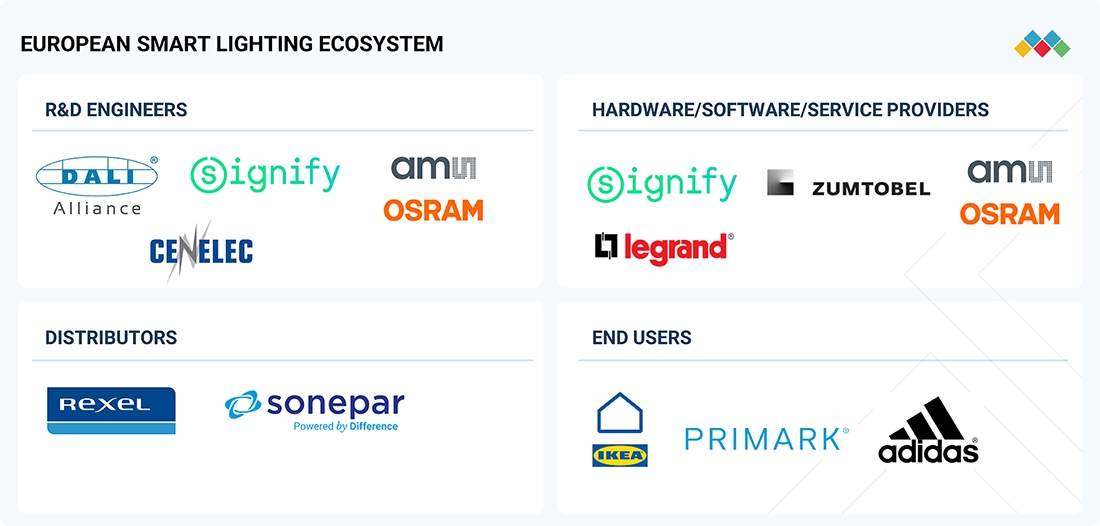
The European smart lighting ecosystem is driven by strong collaboration between standards bodies, manufacturers, distributors, and major end users. R&D engineers, such as the DALI Alliance and CENELEC, enable interoperability and regulatory alignment, while players such as Signify, ams OSRAM, Legrand, and Zumtobel supply connected lighting technologies. Distributors including Rexel and Sonepar ensure deep market reach across commercial and public sectors. End users such as IKEA, Primark, and Adidas accelerate deployment through smart retail and workplace upgrades. Collectively, this ecosystem supports rapid innovation and widespread adoption of smart lighting across Europe.
Logos and trademarks shown above are the property of their respective owners. Their use here is for informational and illustrative purposes only.
MARKET SEGMENTS
Source: Secondary Research, Interviews with Experts, MarketsandMarkets Analysis
European Smart Lighting Market, By Offering
As of 2024, smart lighting hardware held the largest share of the European market, driven by the ongoing shift from conventional lighting to connected LED luminaires, drivers, and sensors. EU sustainability mandates and large-scale retrofit programs across commercial buildings and public infrastructure continue to accelerate hardware deployment. Growing adoption of human-centric and adaptive lighting further boosts the demand for advanced luminaires and control components. As a result, hardware remains the primary revenue contributor within the European smart lighting ecosystem.
European Smart Lighting Market, By Installation Type
Retrofit installations are expected to record the highest CAGR in the European smart lighting market as enterprises and municipalities upgrade legacy lighting systems to comply with energy-efficiency and carbon-reduction goals. The ability to deploy smart controls, wireless solutions, and connected LED luminaires without major structural changes makes retrofitting highly attractive for occupied buildings and public spaces. Large-scale renovation programs across offices, retail stores, logistics hubs, and street-lighting networks further accelerate retrofit demand. As a result, retrofitting is emerging as the fastest-growing pathway for smart lighting adoption across Europe.
European Smart Lighting Market, By Communication Technology
Wired communication continues to dominate the European smart lighting market in 2024, supported by the strong presence of DALI-2, KNX, and BACnet-based systems in commercial buildings and public infrastructure. Enterprises and municipalities prefer wired networks for their reliability, low latency, and long-term interoperability with building management systems. The widespread deployment of smart lighting in offices, hospitals, industrial facilities, and transportation hubs further reinforces the demand for centralized wired control architectures. As a result, wired communication remains the largest and most established technology pathway for smart lighting adoption across Europe.
European Smart Lighting Market, By Distribution Channel
The online distribution channel is expected to grow at the fastest CAGR in the European smart lighting market as customers increasingly shift toward e-commerce platforms for purchasing connected lighting products. Wider product availability, transparent pricing, and bundled smart-home and smart-building solutions are accelerating digital buying preferences among both residential and commercial users. Manufacturers and distributors are also strengthening their direct-to-consumer and B2B online sales channels to reduce dependency on traditional retail networks. This rapid digital transition is making online platforms a key growth catalyst for smart-lighting distribution across Europe.
European Smart Lighting Market, By End-use Application
Indoor applications account for the largest share of the European smart lighting market in 2024, driven by strong adoption across offices, healthcare, education, retail, hospitality, and industrial facilities. The focus on improving energy efficiency, workplace well-being, and space-utilization insights continues to accelerate deployment of connected LED luminaires, sensors, and automation platforms inside buildings. Human-centric lighting, adaptive brightness, and occupancy-based controls are becoming standard expectations across commercial spaces. As a result, indoor environments remain the primary revenue driver for smart lighting adoption across Europe.
REGION
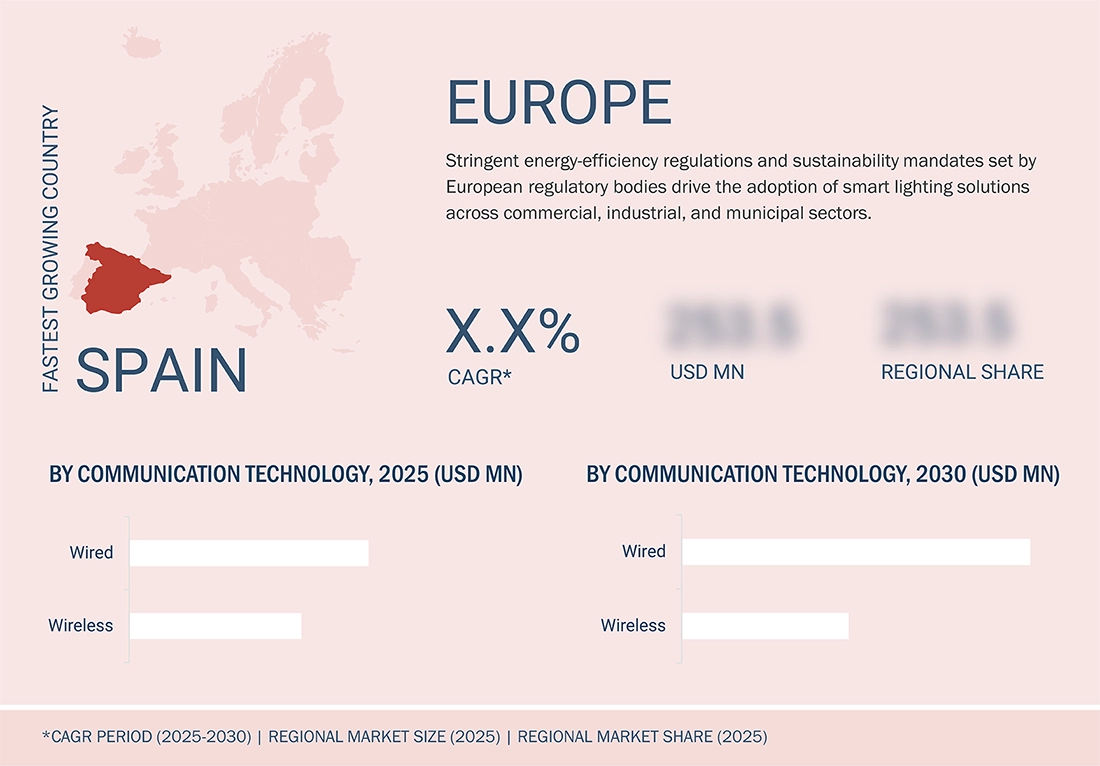
Spain to be fastest-growing country in European smart lighting market during forecast period
Spain is emerging as the fastest-growing smart lighting market in Europe, supported by rapid progress in smart-city and sustainability programs. Major urban centers, such as Barcelona, Madrid, and Valencia, are driving large-scale upgrades to connected LED streetlighting and outdoor lighting networks. Commercial buildings and hospitality facilities boost the adoption of smart luminaires, lighting controls, and wireless automation to improve energy performance and occupant experience. Government incentives for green renovation further boost nationwide deployment momentum.
EUROPEAN SMART LIGHTING MARKET: COMPANY EVALUATION MATRIX
In the European smart lighting market matrix, Signify Holding and ams-OSRAM (Star) lead with strong market presence and extensive product portfolios, driving large-scale adoption across commercial, residential, and public infrastructure segments. Both companies continue to influence market direction through innovations in connected luminaires, LED technologies, and advanced lighting-control ecosystems.
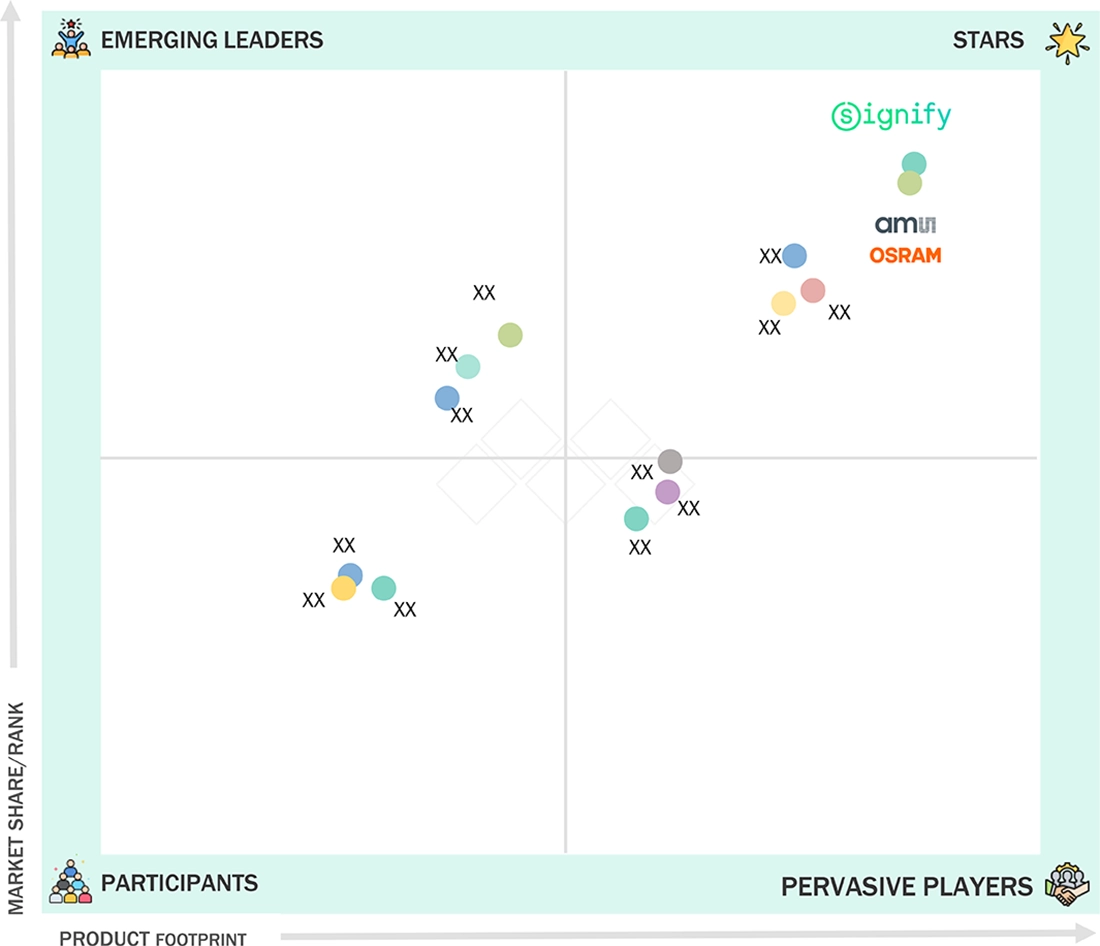
Source: Secondary Research, Interviews with Experts, MarketsandMarkets Analysis
KEY MARKET PLAYERS
- Signify Holding
- ams-OSRAM AG
- Zumtobel Group AG
- Legrand
- Schneider Electric
- LEDVANCE GmbH
- Fagerhults Belysning AB
- Schréder
- Sylvania Group
- TRILUX Lighting Ltd.
- Dialight
- ERCO GmbH
- Helvar
- Lutron Electronics Co., Inc
- BEGA Gantenbrink-Leuchten KG
MARKET SCOPE
| REPORT METRIC | DETAILS |
|---|---|
| Market Size in 2024 (Value) | USD 2.13 Billion |
| Market Forecast in 2030 (Value) | USD 3.06 Billion |
| Growth Rate | CAGR of 8.6% from 2025-2030 |
| Years Considered | 2021-2030 |
| Base Year | 2024 |
| Forecast Period | 2025-2030 |
| Units Considered | Value (USD Million/Billion), Volume (Thousand Units) |
| Report Coverage | Revenue forecast, company ranking, competitive landscape, growth factors, and trends |
| Segments Covered |
|
| Countries Covered | UK, Germany, France, Italy, Spain, Netherlands, and Rest of Europe |
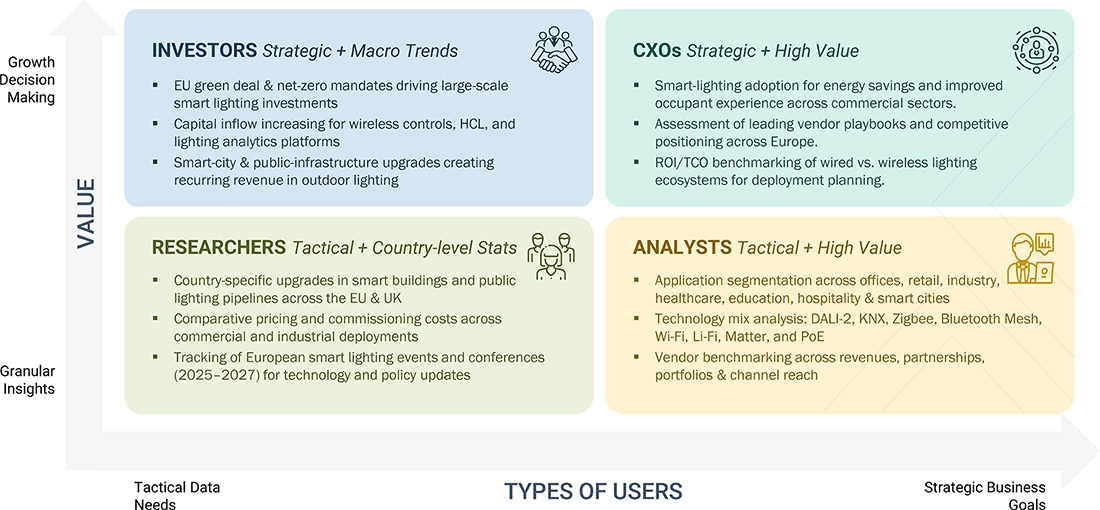
WHAT IS IN IT FOR YOU: EUROPEAN SMART LIGHTING MARKET REPORT CONTENT GUIDE
DELIVERED CUSTOMIZATIONS
We have successfully delivered the following deep-dive customizations:
| CLIENT REQUEST | CUSTOMIZATION DELIVERED | VALUE ADDS |
|---|---|---|
| Leading Smart Lighting OEM |
|
|
| Facility Management Company |
|
|
| Smart-City Program Authority |
|
|
RECENT DEVELOPMENTS
- September 2025 : Signify launched the Philips Hue Essential product line with new strip-light upgrades, aimed at accelerating affordable smart-lighting adoption across Europe through improved accessibility and expanded functionality.
- June 2025 : Signify introduced Matter-over-Thread interoperability across its latest Hue bulbs, enabling seamless cross-compatibility between Zigbee, Bluetooth, and Thread ecosystems, a major step toward reducing fragmentation in European smart-home and smart-building deployments.
- January 2025 : ams OSRAM unveiled its next-generation EVIYOS Shape micro-LED array with 25,600 individually controllable pixels at CES 2025, signaling strong innovation potential for smart-city, retail, and outdoor illumination applications in Europe.
Table of Contents
 Exclusive indicates content/data unique to MarketsandMarkets and not available with any competitors.
Methodology
The research study involved 4 major activities in estimating the size of the European Smart Lighting Market. Exhaustive secondary research has been done to collect important information about the market and peer markets. The validation of these findings, assumptions, and sizing with the help of primary research with industry experts across the supply chain has been the next step. Both top-down and bottom-up approaches have been used to estimate the market size. Post which the market breakdown and data triangulation have been adopted to estimate the market sizes of segments and sub-segments.
Secondary Research
In the secondary research process, various secondary sources have been referred to for identifying and collecting information required for this study. The secondary sources include annual reports, press releases, investor presentations of companies, white papers, and articles from recognized authors. Secondary research has been mainly done to obtain key information about the market’s value chain, the pool of key market players, market segmentation according to industry trends, regional outlook, and developments from both market and technology perspectives.
Primary Research
In primary research, various primary sources from both supply and demand sides have been interviewed to obtain qualitative and quantitative insights required for this report. Primary sources from the supply side include experts such as CEOs, vice presidents, marketing directors, manufacturers, technology and innovation directors, end users, and related executives from multiple key companies and organizations operating in the European Smart Lighting Market ecosystem. After interacting with industry experts, brief sessions were conducted with highly experienced independent consultants to reinforce the findings from our primary. This, along with the in-house subject matter experts’ opinions, has led us to the findings as described in the remainder of this report. The breakdown of primary respondents is as follows:
Market Size Estimation
The bottom-up procedure has been employed to arrive at the overall size of the European Smart Lighting Market.
- Identification of major companies providing smart lighting hardware, software, and services
- Identification of key segments within the European Smart Lighting Market across different geographical regions
- Estimation of the market size in various regions by analyzing the adoption of smart lighting solutions across different industries
- Determination of market share estimates for deployments in different end-use application segments by assessing the demand for smart lighting products and solutions
- Tracking ongoing and upcoming developments in smart lighting products
- Compilation of regional market size data for each segment to derive regional market estimates
- Conducting interviews with multiple key leaders to comprehend the European Smart Lighting Market scope, product demand, future market growth, and potential impact of economic downturns
- Verification and validation of estimates through cross-checking with primary sources, discussions with leaders, and consultation with domain experts at MarketsandMarkets
- Analysis of various paid and unpaid information sources, including annual reports, press releases, white papers, and databases
The top-down approach has been used to estimate and validate the total size of the European Smart Lighting Market.
- Focusing, initially, on the top-line investments and spending in the ecosystems of various industries. Tracking further splits based on product launches, advancements in smart lighting technologies, smart lighting solutions and software used for various industrial applications, and developments in the key market areas
- Representing and developing the information related to market revenue offered by key hardware, software, and service providers
- Carrying out multiple on-field discussions with key opinion leaders across each major company involved in the development of hardware and software components and services pertaining to smart lighting
- Estimating the geographic split using secondary sources based on factors such as the number of players in a specific country and region, types of products, levels of services offered, and types of software implemented.
Data Triangulation
After arriving at the overall market size—using the market size estimation processes as explained above—the market has been split into several segments and subsegments. To complete the entire market engineering process and arrive at the exact statistics of each market segment and subsegment, data triangulation and market breakdown procedures have been employed, wherever applicable. The data has been triangulated by studying various factors and trends from the demand and supply sides of the European Smart Lighting Market.
Market Definition
Smart lighting systems combine automation technologies with connectivity features and intelligent control aspects to deliver enhanced efficiency and improved experience paired with convenience. The system contains LED luminaires, sensors, and wire-based or wireless communication systems to allow remote monitoring and scheduling adjustments based on occupancy status, daylight exposure, and user settings. Users can operate smart lighting systems through mobile applications, voice commands, and centralized automation networks which enable full control of brightness adjustments, color temperature settings, and hue transformation features. These devices play an essential role in residential, commercial, and industrial sectors, helping to reduce energy consumption while aiding sustainability efforts.
Key Stakeholders
- Raw material and component suppliers
- Communication network providers
- Smart lighting device manufacturers
- Original equipment manufacturers
- Semiconductor component suppliers
- Analysts and strategic business planners
- Venture capitalists and start-ups
- Research laboratories and intellectual property (IP) companies
- Technology standards organizations, forums, alliances, and associations
- Hardware vendors
- Software integrators
- Smart lighting solutions-related service providers
- End users
- Government bodies such as regulatory authorities and policymakers
Report Objectives
- To define, estimate, and forecast the European Smart Lighting Market based on hardware, software, and services offerings, wired and wireless communication technologies, indoor and outdoor applications, online and offline sales distribution channels, and new and retrofit installation types
- To estimate and project the market size, in terms of value, for various segments with respect to four regions: Americas, Europe, Asia Pacific, and the Rest of the World (ROW)
- To describe and forecast the European Smart Lighting Market size, in terms of volume, by hardware offering
- To provide detailed insights regarding drivers, restraints, opportunities, and challenges influencing the growth of the market
- To analyse emerging applications and standards in the European Smart Lighting Market
- To examine manufacturers of smart lighting products, their strategies, production plans, and the overall supply chain, including material and component suppliers
- To strategically analyse the micromarkets1 with respect to individual growth trends, prospects, and contributions to the overall market
- To analyse the market opportunities for stakeholders, and provide a comprehensive competitive landscape analysis
- To provide a detailed overview of the smart lighting value chain and ecosystem
- To provide a detailed overview of impact of AI/Gen AI on European Smart Lighting Market
- To provide information about the key technology trends, trade analysis, and patents related to the European Smart Lighting Market
- To benchmark the market players using the proprietary company evaluation matrix framework, which analyses them on various parameters within the broad categories of market ranking/share and product portfolio
- To analyse competitive developments, such as partnership, acquisitions, agreements, collaborations, and product launches
- To strategically profile key players and analyse their market share, ranking, and core competencies
This research report categorizes the European Smart Lighting Market based on offering, communication technology, installation type, distribution channel, end-use application, and region.
Available Customizations
With the given market data, MarketsandMarkets offers customizations according to the specific requirements of companies. The following customization options are available for the report:
- Detailed analysis and profiling of additional market players based on various blocks of the supply chain
Key Questions Addressed by the Report
What is the projected market size of the Europe smart lighting market?
The Europe smart lighting market is projected to grow from approximately USD 4.5 billion in 2023 to USD 8.9 billion by 2028, at a CAGR of around 14.5%.
Which region holds a significant share in the Europe smart lighting market?
Germany holds a significant share due to strong infrastructure development and adoption of energy-efficient lighting systems.
Which segment by offering is driving market growth?
The hardware segment is driving market growth due to increasing demand for smart bulbs, luminaires, and lighting controls.
Which application segment dominates the market?
The commercial segment dominates the market due to the widespread adoption of smart lighting solutions in offices, retail spaces, and public infrastructure.
Who are the key players in the Europe smart lighting market?
Key players include Signify, Osram, Legrand, Schneider Electric, and Zumtobel Group.
Need a Tailored Report?
Customize this report to your needs
Get 10% FREE Customization
Customize This ReportPersonalize This Research
- Triangulate with your Own Data
- Get Data as per your Format and Definition
- Gain a Deeper Dive on a Specific Application, Geography, Customer or Competitor
- Any level of Personalization
Let Us Help You
- What are the Known and Unknown Adjacencies Impacting the European Smart Lighting Market
- What will your New Revenue Sources be?
- Who will be your Top Customer; what will make them switch?
- Defend your Market Share or Win Competitors
- Get a Scorecard for Target Partners

Custom Market Research Services
We Will Customise The Research For You, In Case The Report Listed Above Does Not Meet With Your Requirements
Get 10% Free CustomisationTESTIMONIALS

Tetsuya Ohhira
Business Development Manager-Technology Business
Nikon Corporation,
Leading Japanese MNC specializing in optics and imaging productswww.nikon.com
MarketsandMarkets™ response
is quick. Their attitude is flexible and positive. Analyst Insights are globally considered and
significant. Client Services quickly respond to our inquiry and demand. Their wide range of global
surveys help us make our strategic plan.
We hope Knowledge Store will be easier to search
for a report.
VP - Marketing & Business Development
Leading Provider of Process Control Solutions
We engaged with MarketsandMarkets on a study to perform an analysis and recommend a Go-To-Market strategy for metrology and process control in the semiconductor market. The study was tailored to our targets and needs with well-defined milestones. Our overall experience with the MarketsandMarkets team was very good throughout the project in all aspects including the analysis methodologies used, the quality and depth of primary and secondary data sets, the professionalism and flexibility of the team and the ability to meet the target schedule and milestones. We want to thank MarketsandMarkets team for a job well done.

Still Researching the
European Smart Lighting Ecosystem?
See the competitors, opportunity evaluation, and growth signals shaping it - Instantly!
Generate 15+ consulting-grade strategic intelligence outputs - from competitor analysis to board-ready strategy decks, tailored to your European Smart Lighting growth question.






Growth opportunities and latent adjacency in European Smart Lighting Market