
Edge Computing Market Size, Share, Industry Analysis

Edge Computing Market by Offering (Hardware, Software, Services), Application (Video Analytics, Asset Monitoring, Automation, IoT Monitoring, Content Delivery), Deployment Mode, Organization Size, Vertical, and Region - Global Forecast to 2031




OVERVIEW
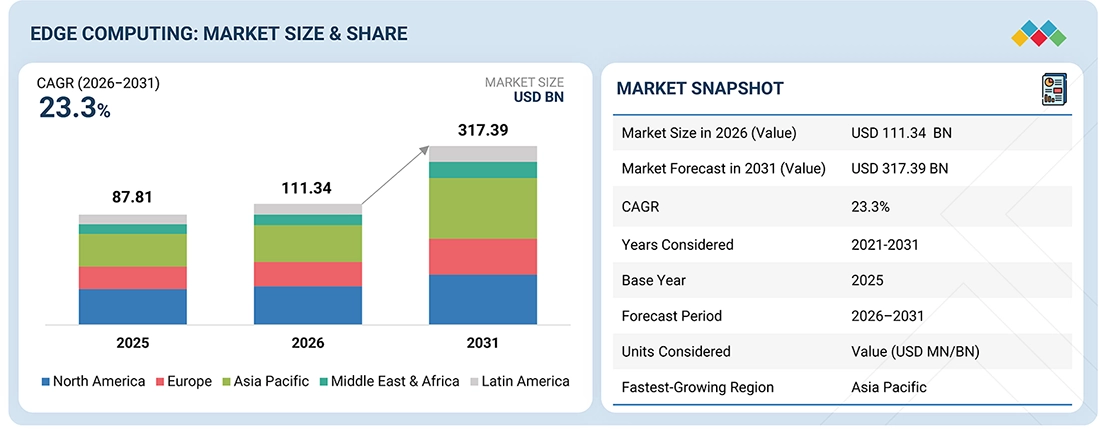
Source: Secondary Research, Interviews with Experts, MarketsandMarkets Analysis
The global edge computing market size is projected to reach USD 317.39 billion by 2031 from USD 111.34 billion in 2026, at a CAGR of 23.3% from 2026 to 2031. The market is expanding as enterprises deploy edge infrastructure to support low-latency data processing, AI-enabled workloads, real-time monitoring, and localized analytics closer to devices and users. Rising adoption of industrial automation, connected vehicles, smart manufacturing, 5G networks, IoT ecosystems, and increasing data sovereignty requirements are further strengthening the demand for edge computing.
KEY TAKEAWAYS
-
BY REGIONAsia Pacific will grow the fastest, driven by its dense urban population, accelerating smart city programs in countries such as China, India, and Singapore, and strong government investment in 5G and digital infrastructure. The region also offers attractive opportunities through its rapidly expanding manufacturing hubs, rising healthcare digitization, and large-scale adoption of IoT-enabled services across transportation and utilities.
-
BY OFFERINGBy offering, services, including managed and professional services, are set to grow fastest in the edge computing market, as enterprises require specialized expertise to deploy edge nodes, manage low-latency networks, and secure distributed infrastructures. These services ensure optimized workload orchestration, seamless integration with artificial intelligence (AI) and Internet of Things (IoT) applications, and reliable operation of mission-critical edge environments.
-
BY APPLICATIONEdge computing enables real-time analytics and decision support by processing data near endpoints, reducing latency, improving response speed, and supporting faster operational decisions across industrial, retail, healthcare, and transportation environments.
-
BY ORGANIZATION SIZEBy organization size, SMEs are expected to grow the fastest in the edge computing market as they adopt localized processing to overcome bandwidth and latency constraints without investing in large-scale data centers. Affordable edge nodes and managed services enable SMEs to deploy AI-driven analytics, IoT applications, and automation cost-effectively, supporting faster decision-making, scalability, and competitiveness against larger enterprises.
-
BY DEPLOYMENT TYPERegional / Cloud Edge is expected to grow the fastest as organizations prioritize distributed, cloud-managed deployment models that combine hyperscale cloud capabilities with localized edge processing. This model reduces latency for time-sensitive workloads, supports data residency and sovereignty requirements in regulated industries, and enables faster scaling across use cases such as smart factories, connected healthcare, retail analytics, media delivery, and autonomous mobility ecosystems.
-
BY VERTICALHealthcare and life sciences are expected to grow the fastest, driven by the need for real-time diagnostics, remote patient monitoring, and AI-enabled imaging at the edge. Edge computing ensures compliance with stringent data privacy rules, supports connected healthcare ecosystems, and strengthens precision medicine and clinical decision-making directly at the point of care.
-
COMPETITIVE LANDSCAPE - KEY PLAYERSMajor players in the edge computing market are Hewlett Packard Enterprise (US), Amazon Web Services (US), Dell Technologies (US), Cisco Systems (US), and Microsoft (US).
-
COMPETITIVE LANDSCAPE - START-UPS/SMEsThe start-ups/SMEs in the edge computing market include ZEDEDA (US), Spectro Cloud (US), Avassa (Sweden), Axelera AI (Netherlands), EdgeCortix (Japan), and Vapor IO (US).
The edge computing market is witnessing strong growth, driven by increasing demand for low-latency data processing, rapid growth of IoT-connected devices, and rising adoption of AI-enabled real-time analytics at the edge. The expansion of autonomous systems, industrial automation, and smart connected environments is further accelerating enterprise investments in decentralized computing architectures. Additionally, increasing focus on operational efficiency, real-time decision-making, data sovereignty, and resilient distributed infrastructure continues to strengthen the adoption of advanced edge computing solutions across enterprise environments.
TRENDS & DISRUPTIONS IMPACTING CUSTOMERS' CUSTOMERS
The impact on businesses emerges from customer trends and disruptions, with telecom, retail, healthcare, and manufacturing representing key clients of edge computing providers, while their customers are the ultimate beneficiaries. Shifts in low-latency services, AI-driven insights, and 5G integration will influence end-user revenues, further driving revenues for edge computing providers.
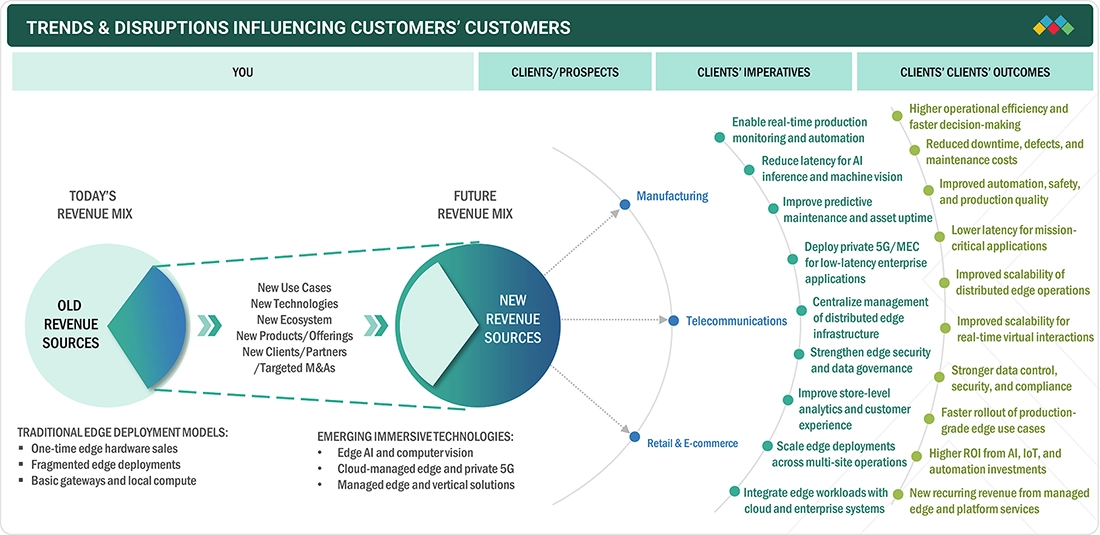
Source: Secondary Research, Interviews with Experts, MarketsandMarkets Analysis
MARKET DYNAMICS

Level
-
Exponential scale of IOT and endpoint intelligence

-
Rising demand for low latency applications


Level
-
Economic & policy constraints in emerging markets

-
Complex nature of edge computing infrastructure


Level
-
Advent of 5G network to provide open avenues for large-scale 5G network deployment

-
Remote & mission-critical edge deployment


Level
-
Increasing data privacy and security concerns

-
Skill gap & operational expertise

Source: Secondary Research, Interviews with Experts, MarketsandMarkets Analysis
Driver: Exponential scale of IOT and endpoint intelligence
The growth of the edge computing market is driven by the rapid expansion of IoT-connected devices and increasing endpoint intelligence across enterprise environments. Rising deployment of AI-enabled sensors, smart devices, industrial automation systems, and connected assets is generating massive volumes of real-time data that require localized processing. Edge computing reduces latency, improves operational efficiency, and enables faster decision-making by processing data closer to the source. The increasing integration of AI and machine learning at the edge is further accelerating demand for scalable and distributed edge computing infrastructure across industries.
Restraint: Economic & policy constraints in emerging markets
Edge computing adoption in emerging markets continues to face restraint due to high infrastructure investment requirements, limited digital readiness, and uneven connectivity ecosystems. Many organizations face difficulties in deploying advanced edge infrastructure because of limited financial resources, inadequate data center capacity, and unreliable power infrastructure. In addition, evolving regulatory frameworks, data localization requirements, and policy uncertainties related to digital infrastructure development create barriers for large-scale deployment. These factors collectively slow enterprise adoption and limit scalability in price-sensitive markets.
Opportunity: Remote & mission-critical edge deployment
Remote and mission-critical environments are creating strong growth opportunities for edge computing deployments by enabling localized processing and uninterrupted operations in low-connectivity environments. Industries such as energy, mining, offshore operations, transportation, defense, and remote healthcare increasingly require real-time data analysis, predictive monitoring, and autonomous decision-making capabilities at distributed locations. Edge computing enables higher operational resilience, reduced dependency on centralized cloud infrastructure, improved situational awareness, and faster response times, making it highly suitable for mission-critical applications.
Challenge: Skill gap & operational expertise
The shortage of skilled professionals capable of managing distributed edge environments remains a major challenge for the market. Organizations require expertise in AI integration, distributed computing architecture, cybersecurity, networking, real-time analytics, and infrastructure orchestration to manage complex edge deployments effectively. Limited availability of specialized talent increases deployment complexity, operational inefficiencies, integration challenges, and security risks. As enterprises scale edge infrastructure, the growing need for workforce training, automation, and managed operational support continues to be a critical challenge across the ecosystem.
EDGE COMPUTING MARKET SIZE, SHARE, INDUSTRY ANALYSIS: COMMERCIAL USE CASES ACROSS INDUSTRIES
| COMPANY | USE CASE DESCRIPTION | BENEFITS |
|---|---|---|
 |
Akamai helped Matrimony.com achieve website optimization and increased user retention | User retention rate increased | Website revisit rate increased | New user attraction and addition witnessed a 10% half-yearly growth | Surge in the number of matches made successfully vis-à-vis paid/premium members |
 |
ESPN adopted Microsoft’s innovative technologies to reshape the future of sports production | 50% reduction in closed-captioning costs | Significant cost savings across multiple other areas | Cloud technology enabled fans even greater access to ESPN’s vast sports insights, statistics, and media files |
 |
VMware helped Northern Beaches Council be a pacesetter to drive and digitalize regional municipal services | Unleashing IoT capabilities and improving reliability | Identify and eliminate outages | Remotely monitor incidents and connection issues in any region | Helped the Northern Beaches Council set the pace for digitizing municipal services across Australia |
 |
Maserati MSG racing automated workflow enablement with Hewlett Packard Enterprise to optimize team performance | Gaining speed and efficiency in the competition | Optimized team performance and energy management | Leveraging AI and edge technologies to accelerate data-driven insights | Speeding up image processing time by 8x (30 min vs. 4 hrs.) | Delivering AI-driven video and audio analytics for real-time insight into competitors’ strategies |
 |
99Bridges helped human habits restore and protect the environment with Cisco’s IoT Operations Dashboard | Enhanced features such as Secure Equipment Access for monitoring and maintenance activities | IoT Operations Dashboard is used to provision and monitor the Cisco routers in parallel while providing visibility of connectivity right through to the connected IoT controllers |
Logos and trademarks shown above are the property of their respective owners. Their use here is for informational and illustrative purposes only.
MARKET ECOSYSTEM
The edge computing ecosystem is a multi-layered framework comprising hardware vendors, software/platform providers, network connectivity providers, and system integrators. Hardware leaders supply edge servers and AI-optimized chips, while platform providers deliver orchestration, analytics, and hybrid cloud capabilities. Network connectivity operators enable low-latency 5G and IoT connectivity, and system integrators drive deployment, customization, and interoperability. Together, they power decentralized processing, real-time intelligence, and scalable innovation across diverse industry applications.
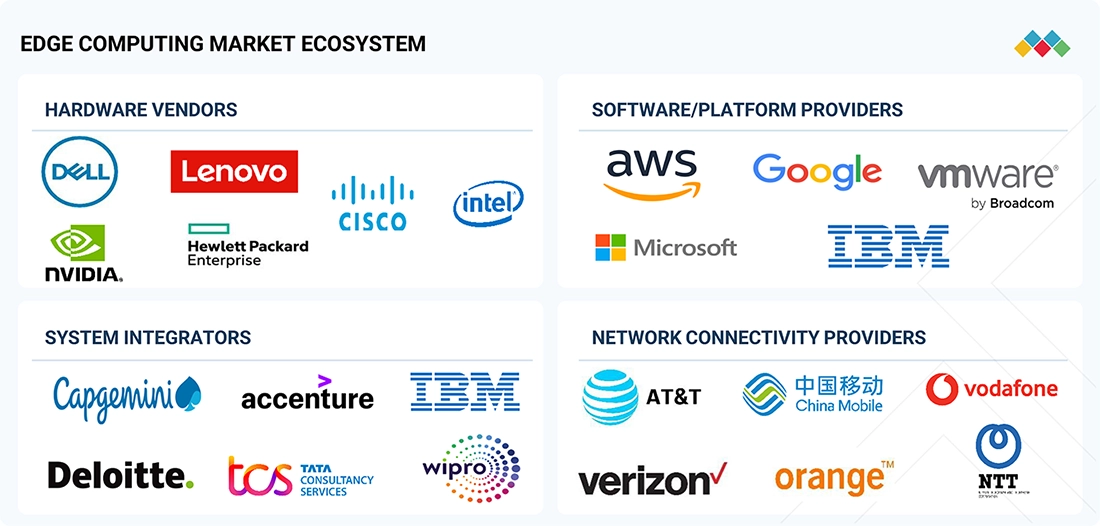
Logos and trademarks shown above are the property of their respective owners. Their use here is for informational and illustrative purposes only.
MARKET SEGMENTS
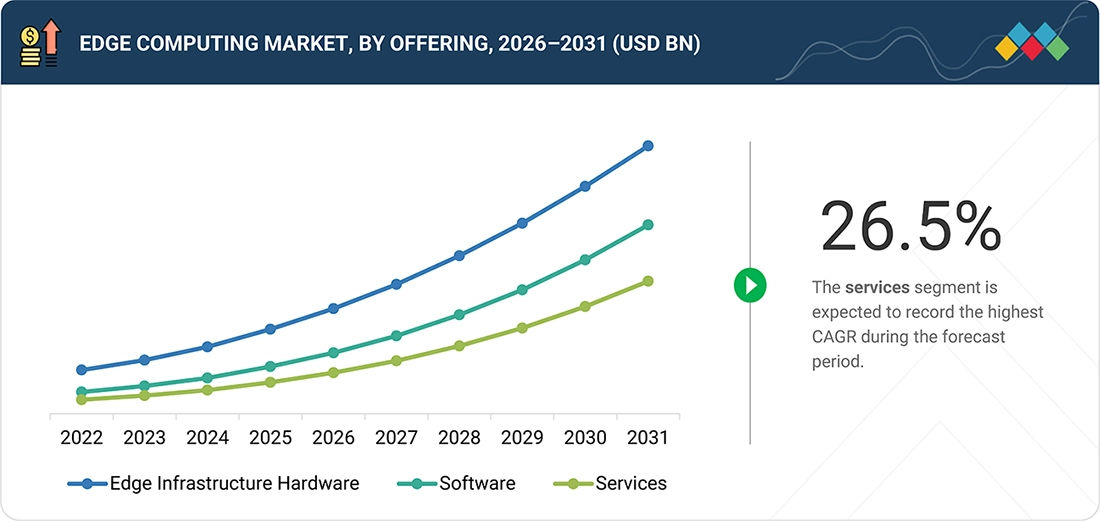
Source: Secondary Research, Interviews with Experts, MarketsandMarkets Analysis
Edge Computing Market, By Offering
Edge hardware is expected to hold the largest market share in the edge computing market due to increasing deployment of rugged, compact, and high-performance systems for real-time data processing closer to endpoints. Enterprises are investing in edge servers, gateways, sensors, and intelligent edge devices to support AI-enabled analytics, industrial automation, and mission-critical operations. These systems reduce latency, improve operational efficiency, minimize cloud dependency, and support reliable performance in distributed environments, further accelerating demand for edge hardware infrastructure.
Edge Computing Market, By Application
Connected asset & IoT monitoring is expected to hold the largest market share in the edge computing market due to rising deployment of connected devices, sensors, machines, vehicles, meters, and distributed assets across industries. Enterprises use edge computing to process asset data locally, enabling real-time visibility, remote diagnostics, condition monitoring, faster alerts, and improved operational efficiency.
Edge Computing Market, By Organization Size
Large Enterprises are expected to hold the largest market share in the edge computing market as organizations continue to invest in distributed digital infrastructure, AI-enabled operations, and real-time analytics platforms. Large enterprises generate massive volumes of operational and customer data that require localized processing and intelligent decision-making. Their higher investment capacity, advanced IT infrastructure, and focus on automation, operational efficiency, and digital transformation continue to accelerate adoption of edge computing solutions across enterprise environments.
Edge Computing Market, By Deployment Type
On-premises edge is expected to hold the largest market share, driven by enterprise demand for localized processing, data control, low-latency analytics, and operational continuity. It supports mission-critical workloads across manufacturing, healthcare, energy, transportation, government, and BFSI environments.
Edge Computing Market, By Vertical
Manufacturing is expected to hold the largest market share in the edge computing market due to increasing adoption of industrial automation, smart factory infrastructure, predictive maintenance, and AI-enabled production systems. Manufacturing environments generate large volumes of real-time operational data that require low-latency processing and continuous monitoring. Edge computing enables faster decision-making, improved production efficiency, reduced downtime, and enhanced operational visibility, making it critical for modern manufacturing operations.
REGION
Asia Pacific to be the fastest-growing region in the global edge computing market during the forecast period
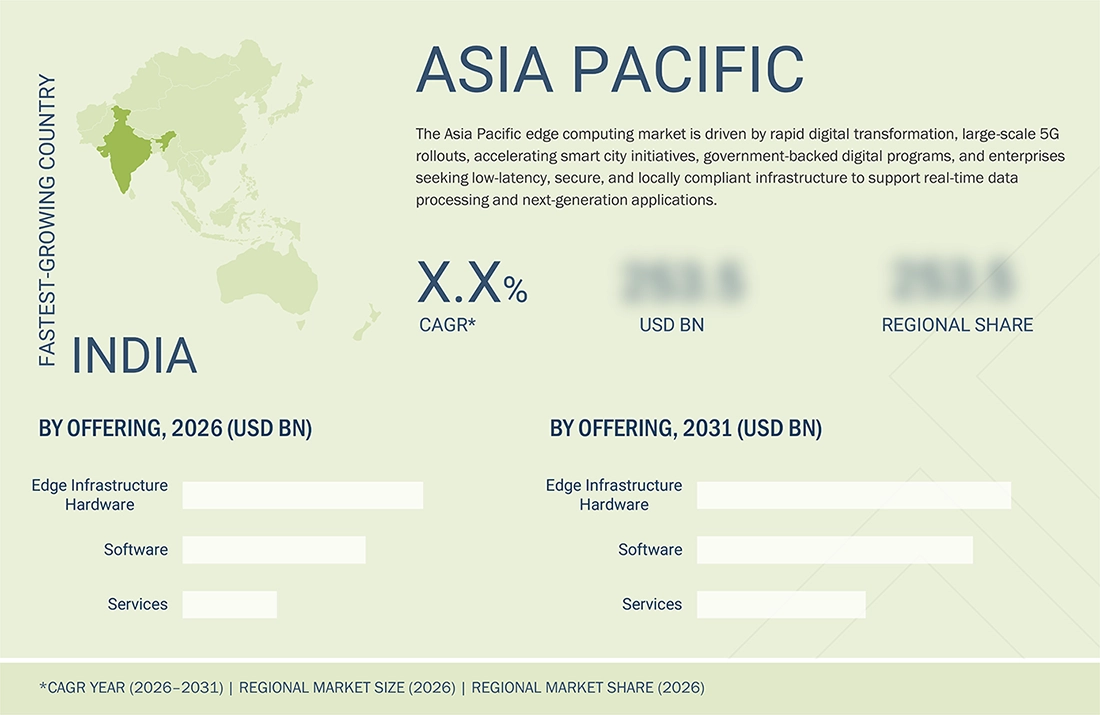
Asia Pacific is expected to be the fastest-growing region in the global edge computing market, driven by digitalization and 5G expansion. China, Japan, India, Australia, and Singapore accelerate edge adoption via smart-city investments and infrastructure. National programs such as Digital India, Smart Nation, and China’s New Infrastructure Plan enable real-time processing and local compliance. In November 2024, Toyota and NTT announced a joint investment of USD 3.3 billion to develop a Mobility AI Platform using edge computing, underscoring vendor opportunities for modular platforms and managed services.
EDGE COMPUTING MARKET SIZE, SHARE, INDUSTRY ANALYSIS: COMPANY EVALUATION MATRIX
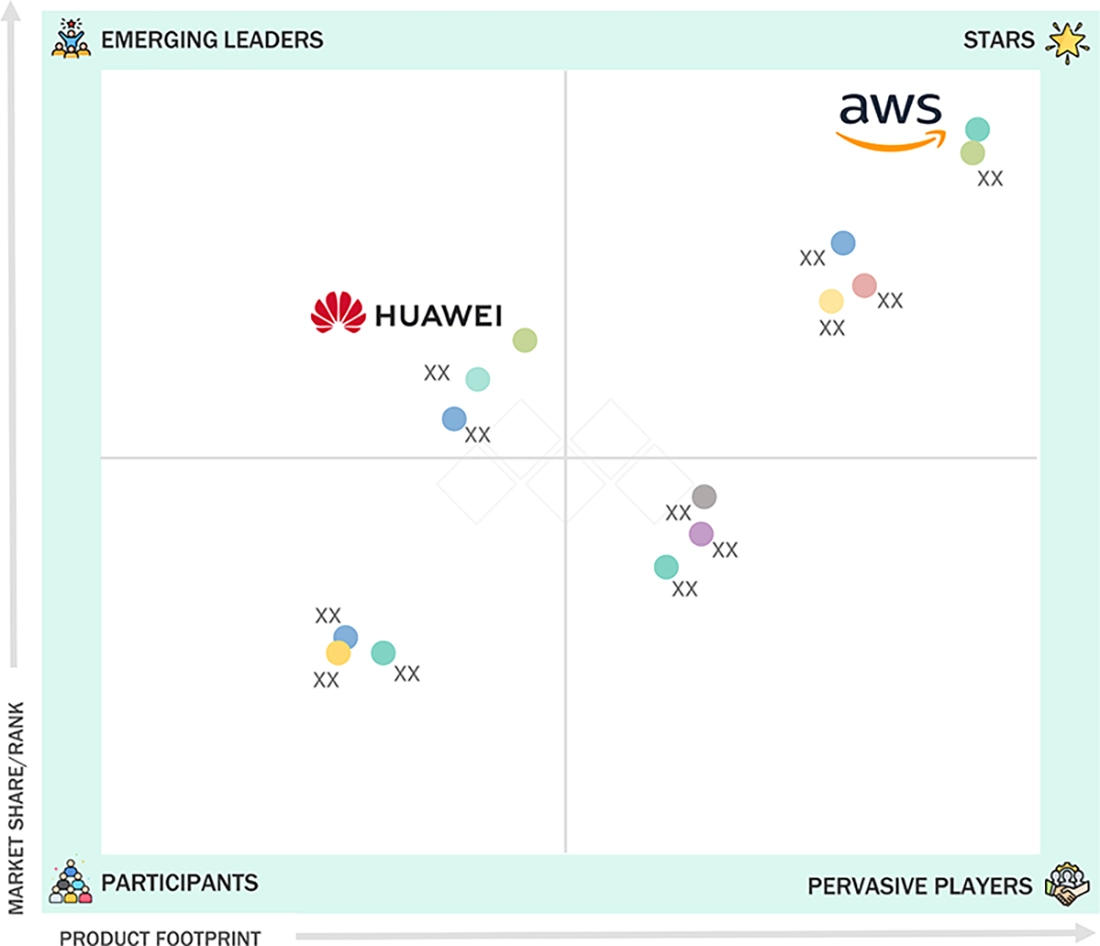
In the edge computing market matrix, AWS (Star) leads with strong market share and a comprehensive cloud-edge portfolio, driven by AWS Outposts, Wavelength, and Local Zones. Huawei (Emerging Leader) is gaining momentum with edge processors, AI accelerators, and developer ecosystem support.
Source: Secondary Research, Interviews with Experts, MarketsandMarkets Analysis
KEY MARKET PLAYERS
- AWS (US)
- Microsoft (US)
- Google (US)
- IBM (US)
- Dell Technologies (US)
- Hewlett Packard Enterprise (HPE) (US)
- Cisco (US)
- NVIDIA (US)
- Intel (US)
- Huawei (China)
- Lenovo (China)
- Supermicro (US)
- Advantech (Taiwan)
- Oracle (US)
- Akamai (US)
- Cloudflare (US)
- Fastly (US)
- Siemens (Germany)
- ZEDEDA (US)
- Belden (US)
- Avassa (Sweden)
- Ericsson (Sweden)
- Nokia (Finland)
- Moxa (Taiwan)
- Edgecortix (Japan)
- Vapor IO (US)
- SiMa.ai (US)
- Kneron (US)
- Hailo (Israel)
- Spectro Cloud (US)
MARKET SCOPE
| REPORT METRIC | DETAILS |
|---|---|
| Market Size in 2025 (Base Value) | USD 87.81 Billion |
| Market Forecast in 2026 (Value) | USD 111.34 Billion |
| Market Forecast in 2031 (Value) | USD 317.39 Billion |
| Growth Rate | CAGR of 23.3% from 2026 to 2031 |
| Years Considered | 2021–2031 |
| Base Year | 2025 |
| Forecast Period | 2026–2031 |
| Units Considered | Value (USD Million/Billion) |
| Report Coverage | Revenue forecast, company ranking, competitive landscape, growth factors, and trends |
| Segments Covered |
|
| Regions Covered | North America, Europe, Asia Pacific, Middle East & Africa, and Latin America |
WHAT IS IN IT FOR YOU: EDGE COMPUTING MARKET SIZE, SHARE, INDUSTRY ANALYSIS REPORT CONTENT GUIDE
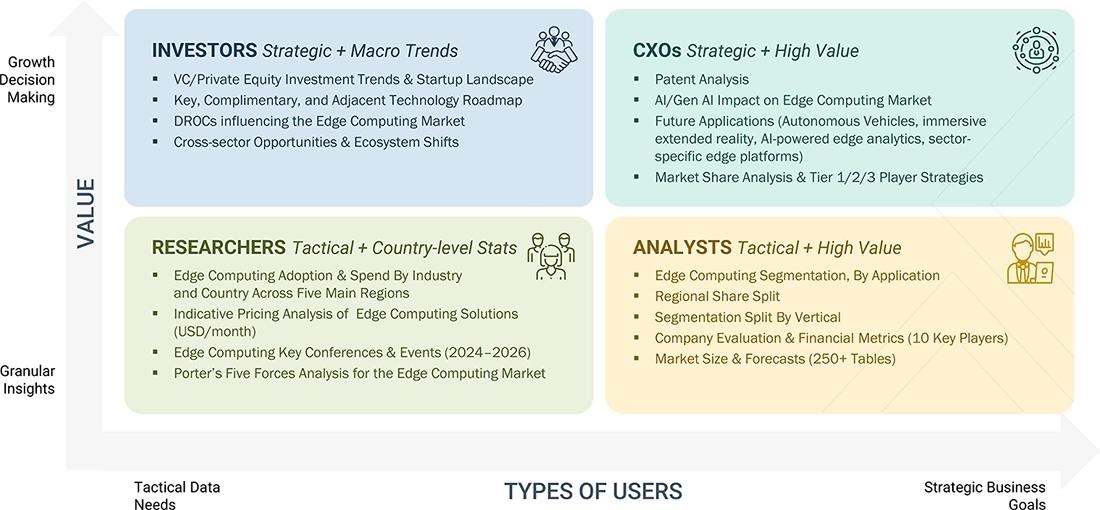
DELIVERED CUSTOMIZATIONS
We have successfully delivered the following deep-dive customizations:
| CLIENT REQUEST | CUSTOMIZATION DELIVERED | VALUE ADDS |
|---|---|---|
| Global Manufacturing Enterprise seeking edge infrastructure strategy | Edge computing market analysis covering edge servers & appliances, gateways, AI accelerators, edge storage, networking equipment, industrial automation, predictive maintenance, and real-time operational control | Identifies high-growth industrial edge opportunities, supports infrastructure investment planning, improves deployment prioritization, and strengthens benchmarking of edge hardware, software, and service providers |
| Telecom Operator / Cloud Service Provider evaluating edge expansion | Vendor mapping of edge computing platforms, telco/network edge solutions, regional/cloud edge deployments, MEC infrastructure, edge orchestration platforms, and managed edge services across key regions | Supports edge partner evaluation, 5G/MEC monetization planning, cloud-edge service expansion, enterprise use-case targeting, and reduces risks in vendor selection and go-to-market planning |
RECENT DEVELOPMENTS
- March 2026 : Dell Technologies announced advancements in its enterprise edge infrastructure portfolio to support AI workloads, distributed computing environments, and intelligent edge operations. The expansion focuses on scalable edge infrastructure, operational resilience, and real-time enterprise analytics capabilities.
- Febuary 2026 : Intel expanded its edge AI and industrial edge computing portfolio with enhanced edge processing solutions designed for smart manufacturing, robotics, and AI-enabled operational environments. The development aims to improve real-time data processing efficiency and support large-scale distributed edge deployments.
- January 2026 : NTT highlighted progress on its Mobility AI Platform collaboration with Toyota to support autonomous driving and intelligent transportation systems through AI-enabled edge infrastructure. The initiative focuses on low-latency processing, real-time analytics, and localized decision-making capabilities for connected mobility ecosystems.
Table of Contents
 Exclusive indicates content/data unique to MarketsandMarkets and not available with any competitors.
Methodology
This research study on the edge computing market involved extensive secondary sources, directories, IEEE Communication-Efficient: Algorithms and Systems, International Journal of Innovation and Technology Management, and paid databases. Primary sources were mainly industry experts from the core and related industries, preferred edge computing providers, third-party service providers, consulting service providers, end users, and other commercial enterprises. In-depth interviews with primary respondents, including key industry participants and subject matter experts, were conducted to obtain and verify critical qualitative and quantitative information and assess the market’s prospects.
Secondary Research
In the secondary research process, various sources were referred to identify and collect information for this study. Secondary sources included annual reports, press releases, and investor presentations of companies; white papers, journals, and certified publications; and articles from recognized authors, directories, and databases. The data was also collected from other secondary sources, such as journals, government websites, blogs, and vendors’ websites. Additionally, the edge computing spending of various countries was extracted from the respective sources.
Primary Research
In the primary research process, various sources from the supply and demand sides were interviewed to obtain qualitative and quantitative information on the market. The primary sources from the supply side included various industry experts, such as Chief Experience Officers (CXOs), Vice Presidents (VPs), and directors specializing in business development, marketing, and edge computing providers. It also included key executives from edge computing vendors, system integrators (SIs), professional service providers, industry associations, and other key opinion leaders.
Breakup of primary profiles:
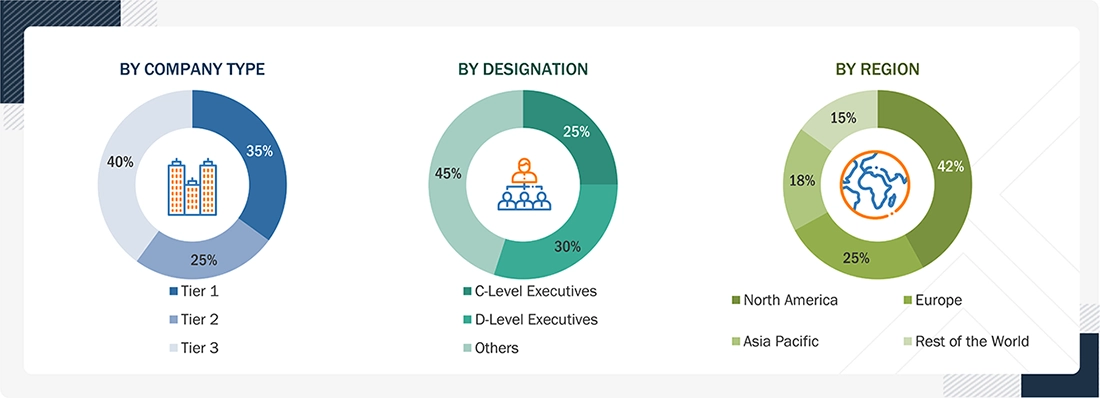
Note: Tier 1 companies’ revenues are more than USD 10 billion; tier 2 companies’ revenues range between USD 1 and 10 billion; and tier 3 companies’ revenues range between USD 500 million and USD 1 billion. Other designations include sales managers, marketing managers, and product managers.
Source: Industry Experts
To know about the assumptions considered for the study, download the pdf brochure
Market Size Estimation
Multiple approaches were adopted to estimate and forecast the edge computing market. The first approach involved estimating the market size by companies’ revenue generated through the sale of edge computing services.
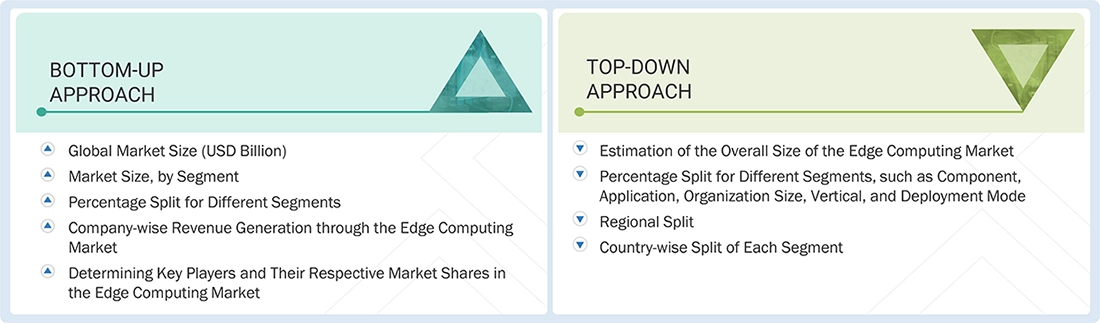
Market Size Estimation Methodology: Top-down Approach
The top-down approach prepared an exhaustive list of all the vendors offering products in the edge computing market. The revenue contribution of the market vendors was estimated through annual reports, press releases, funding, investor presentations, paid databases, and primary interviews. Each vendor’s offerings were evaluated based on platform, degree of customization, type, application, end user, and region. The markets were triangulated through primary and secondary research. The primary procedure included extensive interviews for key insights from industry leaders, such as CIOs, CEOs, VPs, directors, and marketing executives. The market numbers were further triangulated with the existing MarketsandMarkets’ repository for validation.
Market Size Estimation Methodology: Bottom-up Approach
The bottom-up approach identified the adoption rate of edge computing services among different verticals in key countries, considering their regions contributing the most to the market share. For cross-validation, the adoption of edge computing services among enterprises and other use cases for their regions was identified and extrapolated. Use cases identified in different areas were weighed for the market size calculation.
Based on the market numbers, the regional split was determined by primary and secondary sources. The procedure included an analysis of the edge computing market’s regional penetration. Based on secondary research, the regional spending on Information and Communications Technology (ICT), socioeconomic analysis of each country, strategic vendor analysis of major edge computing service providers, and organic and inorganic business development activities of regional and global players were estimated.
Edge Computing Market : Top-Down and Bottom-Up Approach
Data Triangulation
After determining the overall market size using the market size estimation processes as explained above, the market was split into several segments and subsegments. Data triangulation and market breakup procedures were employed, wherever applicable, to complete the overall market engineering process and arrive at the exact statistics of each market segment and subsegment. The overall market size was then used in the top-down procedure to estimate the size of other individual markets via percentage splits of the market segmentation.
Market Definition
Edge computing refers to a distributed computing model in which data processing, storage, analytics, application execution, and decision-making are performed closer to devices, users, machines, and enterprise locations instead of relying only on centralized cloud or data center infrastructure. In this report, the edge computing market includes edge infrastructure hardware such as servers, appliances, gateways, accelerators, storage, and networking equipment; software platforms for orchestration, AI analytics, data management, integration, and security; and professional and managed services required to deploy and operate edge environments. Edge computing enables low-latency processing, real-time monitoring, localized intelligence, reduced bandwidth dependency, improved data control, and reliable operations across manufacturing, telecom, retail, healthcare, transportation, energy, government, BFSI, and media & entertainment applications.
Key Stakeholders
- Training and consulting service providers
- Information Technology (IT) infrastructure providers
- Component providers
- System Integrators (SI)
- Support service providers
- Cloud Service Providers (CSPs)
- Government organizations and standardization bodies
- Datacenter providers
- Regional associations
- Independent hardware and software vendors
- Value-added resellers and distributors
Report Objectives
- To define, describe, and forecast the edge computing market based on offering, including edge infrastructure hardware, software, and services. Edge infrastructure hardware includes edge servers & appliances, edge gateways, AI accelerators & processors, edge storage, and networking equipment. Software includes edge orchestration & management platforms, edge AI & analytics platforms, edge data management & integration software, and edge security software. Services include professional services and managed edge services. The market is also segmented by application, including video analytics & computer vision, asset monitoring & predictive maintenance, industrial automation & operational control, connected asset & IoT monitoring, real-time analytics & decision support, content delivery & network optimization, autonomous systems & immersive applications, and other applications. The market is further analyzed by organization size, including large enterprises and SMEs; by deployment mode, including on-premises edge, telco/network edge, and regional/cloud edge; by vertical, including manufacturing, telecommunications, retail & e-commerce, healthcare & life sciences, transportation & logistics, energy & utilities, government & defense, BFSI, and media & entertainment; and by region.
- To forecast the market size of five major regional segments: North America, Europe, Asia Pacific, the Middle East & Africa, and Latin America
- To strategically analyze the market subsegments with respect to individual growth trends, prospects, and contributions to the total market
- To provide detailed information related to the major factors influencing the growth of the market (drivers, restraints, opportunities, and challenges)
- To analyze industry trends, patents, innovations, and pricing data related to the market
- To analyze the opportunities in the market for stakeholders and provide details of the competitive landscape for major players
- To analyze the impact of AI/generative AI on the market
- To profile key players in the market and comprehensively analyze their market share/ranking and core competencies
- To track and analyze competitive developments such as mergers & acquisitions, product launches, and partnerships & collaborations in the market
Available customizations:
With the given market data, MarketsandMarkets offers customizations as per the company’s specific needs. The following customization options are available for the report:
Product Analysis
- The product matrix provides a detailed comparison of the product portfolio of each company.
Geographic Analysis based on feasibility
- Further breakup of the North American edge computing market
- Further breakup of the European edge computing market
- Further breakup of the Asia Pacific edge computing market
- Further breakup of the Middle East & Africa edge computing market
- Further breakup of the Latin American edge computing market
Company Information
- Detailed analysis and profiling of additional market players (up to five)
Key Questions Addressed by the Report
What is edge computing?
According to the Institute of Electrical and Electronics Engineers (IEEE), edge computing is a distributed model where data processing and storage occur near the point of data generation, such as sensors, devices, or local servers, rather than relying on distant cloud data centers. This approach supports faster response times, reduced latency, and lower bandwidth use by enabling real-time analytics and decision-making at the network’s edge. Edge computing is essential for applications in industrial automation, smart cities, connected vehicles, and real-time monitoring systems, delivering speed, efficiency, and localized intelligence.
What are the different deployment modes for edge computing services?
Edge computing services can be deployed in three primary modes based on data processing needs. Cloud edge places compute resources near users through infrastructure managed by cloud providers, offering low latency with cloud-scale benefits. On-premises edge refers to servers or micro data centers within the organization’s premises, providing greater control and data security. Device edge involves processing directly on endpoints such as sensors or gateways, enabling real-time responsiveness for critical industrial, automotive, and remote applications.
What are the major factors driving the growth of the edge computing industry?
The edge computing industry is expanding rapidly due to the increasing adoption of IoT devices, rising demand for real-time data processing, and the need to minimize latency across critical applications. Integrating AI and ML at the edge enables smarter, more localized decision-making. Growth is further fueled by stricter data security and regulatory requirements, widespread 5G network rollout, and significant investments from governments and enterprises seeking improved operational efficiency, resilience, and compliance across diverse sectors.
What challenges are hindering the widespread adoption of edge computing services?
Edge computing adoption faces key challenges such as rising security risks from data processing done at the edge rather than a centralized data center, a lack of standardized protocols, and complex integration with legacy systems. Ensuring data compliance across different regional regulations adds further difficulty, especially for global enterprises. Limited access to skilled professionals and high infrastructure costs also slow down deployment. Inconsistent network connectivity in remote areas affects reliability, making it harder to scale edge solutions for real-time, mission-critical applications across diverse industries.
Who are the key vendors in the edge computing market?
The key vendors in the global edge computing market include HPE (US), AWS (US), Dell Technologies (US), Cisco (US), Microsoft (US), IBM (US), Google (US), Nvidia (US), Intel (US), and Huawei (China).
Need a Tailored Report?
Customize this report to your needs
Get 10% FREE Customization
Customize This ReportPersonalize This Research
- Triangulate with your Own Data
- Get Data as per your Format and Definition
- Gain a Deeper Dive on a Specific Application, Geography, Customer or Competitor
- Any level of Personalization
Let Us Help You
- What are the Known and Unknown Adjacencies Impacting the Edge Computing Market
- What will your New Revenue Sources be?
- Who will be your Top Customer; what will make them switch?
- Defend your Market Share or Win Competitors
- Get a Scorecard for Target Partners

Custom Market Research Services
We Will Customise The Research For You, In Case The Report Listed Above Does Not Meet With Your Requirements
Get 10% Free CustomisationTESTIMONIALS






Growth opportunities and latent adjacency in Edge Computing Market