



Airport Information System Market Size, Share & Trends
Report Code
AS 2682
Published in
Dec, 2024, By MarketsandMarkets™
Airport Information System Market Size, Share and Trends by Application (Passenger Processing, Flight Operation, Cargo and Baggage Management, Resource Management, Airside Operations), Type, Implementation and Region - Global Forecast to 2030

USD 5.36 BN
MARKET SIZE, 2030

CAGR 4%
(2025-2030)

334
REPORT PAGES

313
MARKET TABLES
AIRPORT INFORMATION SYSTEM MARKET SIZE, SHARE & TRENDS
According to Marketsandmarkets, The global Airport Information Systems Market Size was valued at USD 4.24 billion by 2024 and is projected to reach USD 5.36 billion by 2030, growing at a CAGR of 4.0% from 2025 to 2030. The growth of the Airport Information Systems Market is driven by AI-driven decision support, predictive maintenance, and dynamic flight-scheduling capabilities are increasing demand for Airport Information Systems by improving operational efficiency and reducing downtime, while the adoption of digital-twin–based planning tools enables airports to optimize infrastructure use, streamline passenger movement, and strengthen overall operational management.
MARKET SNAPSHOT TABLE
| REPORT METRIC | DETAILS |
|---|---|
| Market Size in 2024 (Value) | USD 4.24 Billion |
| Market Forecast in 2030 (Value) | USD 5.36 Billion |
| Growth Rate | CAGR of 4.0% from 2024-2030 |
| Years Considered | 2020-2030 |
| Base Year | 2023 |
| Forecast Period | 2024-2030 |
| Units Considered | Value (USD Million/Billion) |
| Report Coverage | Revenue forecast, company ranking, competitive landscape, growth factors, and trends |
| Top Companies |
|
| Growth Driver |
|
| Segments Covered |
|
| Regions Covered | North America, Europe, Asia Pacific, Middle East & Rest of the World |
KEY TAKEAWAYS
-
By RegionThe Asia Pacific Airport Information Systems Market market accounted for a 38.1% revenue share in 2024.
-
By ApplcationBy application, the Cargo and Baggage Management market segment is expected to register the highest CAGR of 4.8%.
-
By TypeBy type, the Airport Operational Support market segment is projected to grow at the fastest rate from 2024 to 2030.
-
By Implementation TypeBy implementation type, the New Installation market segment is expected to dominate the market. This segment is growing fastest as new and expanding airports adopt advanced AIS platforms to handle rising traffic, replace legacy systems, and meet modern operational standards. Strong investment in greenfield projects across emerging markets further accelerates demand.
-
By End-use ApplicationBy end-use application, the Airport Information Systems market segment will grow the fastest during the forecast period.
-
By Distribution ChannelBy distribution channel, the Airport Information Systems market segment is expected to dominate the market, growing at the highest CAGR of X.X%.
-
COMPETITIVE LANDSCAPE - KEY PLAYERSCompany SITA, Amadeus IT Group SA, and Vanderlande Industries B.V were identified as some of the star players in the Airport Information Systems market market (global), given their strong market share and product footprint.
-
COMPETITIVE LANDSCAPE - START UPSCompanies AeroCloud Systems Ltd, Veovo, and Trebide, among others, have distinguished themselves among startups and SMEs by securing strong footholds in specialized niche areas, underscoring their potential as emerging market leaders
The Airport Information Systems Industry is witnessing steady growth, driven by demand for Airport Information Systems is rising due to AI-based operational optimization, predictive maintenance, dynamic scheduling, and the adoption of digital-twin tools that improve infrastructure use and overall airport management. Future demand will be shaped by wider adoption of AI automation, predictive analytics, and digital-twin–driven planning as airports modernize operations and expand capacity.
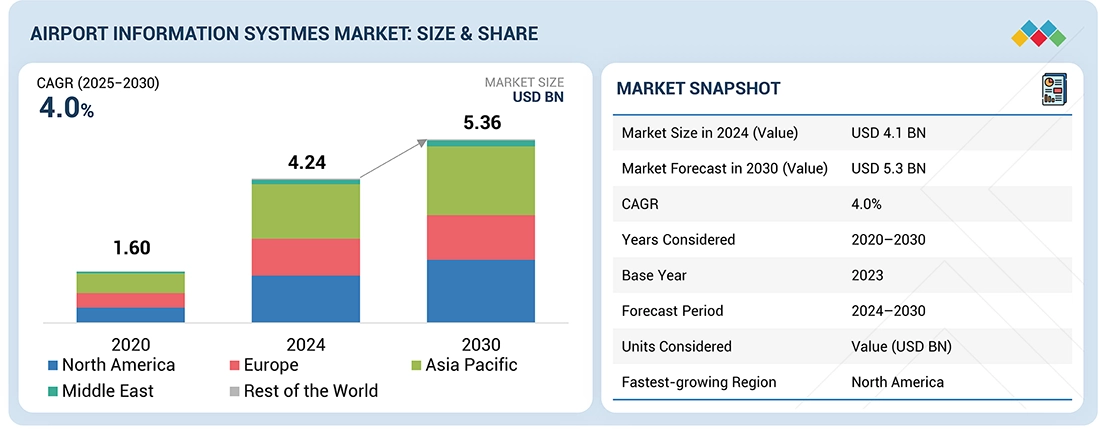
Source: Secondary Research, Interviews with Experts, MarketsandMarkets Analysis
TRENDS & DISRUPTIONS IMPACTING CUSTOMERS' CUSTOMERS
The impact on customers’ business in the Airport Information Systems market stems from shifting passenger expectations and industry disruptions. Airports, airlines, logistics firms, and related service providers increasingly rely on AIS solutions, with operational efficiency and passenger management as key focus areas. Disruptive technologies, regulatory amendments, and advancements in baggage and cargo handling directly influence how these stakeholders operate and generate revenue. These developments, in turn, drive demand for integrated, data-driven AIS platforms, shaping the market’s future growth trajectory.
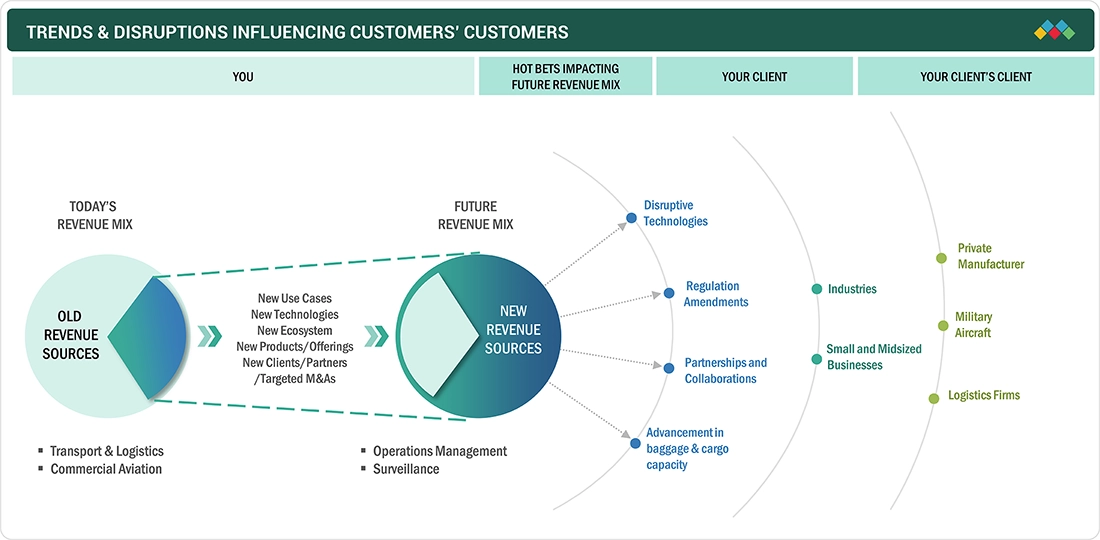
Source: Secondary Research, Interviews with Experts, MarketsandMarkets Analysis
AIRPORT INFORMATION SYSTEM MARKET DYNAMICS

Drivers
Impact
Level
Level
-
Rise in IT spending by airports

-
Increased use of smartphones


RESTRAINTS
Impact
Level
Level
-
Data and privacy concerns

-
High operating costs


OPPORTUNITIES
Impact
Level
Level
-
Increased investments for airport expansion in emerging economies

-
Emergence of smart airports


CHALLENGES
Impact
Level
Level
-
Management of large datasets

-
Complexity in integrating new technologies into legacy systems

Source: Secondary Research, Interviews with Experts, MarketsandMarkets Analysis
Driver: Rise in IT spending by airports
Growing passenger volumes and the need for smoother airport operations are pushing airports worldwide to invest heavily in advanced IT systems. Upgrades focus on automating check-in, baggage handling, and boarding to reduce congestion and improve throughput. Regions such as Asia Pacific are leading investments as airports expand infrastructure and adopt biometric and data-driven systems to enhance operational efficiency and passenger experience.
Restraint: Data and privacy concerns
Data privacy and security concerns remain a key barrier to AIS adoption due to the handling of large volumes of sensitive biometric and travel information. Compliance with regulations such as GDPR and CCPA increases operational complexity, while interconnected systems heighten exposure to cyberattacks. Breaches can lead to financial losses and reputational damage, forcing airports to delay or rethink technology upgrades.
Opportunity:Increased investments for airport expansion in emerging economies
Rapid airport expansion in emerging markets, especially in Asia Pacific, is creating substantial opportunities for AIS deployment. Governments are prioritizing modern, digital-first infrastructure and allowing greater investment to meet rising passenger demand. Large-scale programs in China and India, including hundreds of new or upgraded airports, are driving sustained demand for integrated, future-ready information systems.
Challenge: Management of large datasets
Managing rapidly expanding operational datasets is becoming increasingly difficult as airports record more passenger, cargo, and aircraft movement data. Generating predictive insights requires advanced analytics capabilities, along with robust storage, processing, and visualization tools. Airports must continuously update AIS platforms to handle growing data volumes, creating ongoing operational and technical strain.
AIRPORT INFORMATION SYSTEM MARKET SIZE, SHARE AND TRENDS, 2025 TO 2030: COMMERCIAL USE CASES ACROSS INDUSTRIES
| COMPANY | USE CASE DESCRIPTION | BENEFITS |
|---|---|---|
 |
Deployed biometrics to replace manual ID checks at key touchpoints. | Reduced processing time, improved passenger flow, enhanced security. |
 |
Implemented self-service kiosks, facial recognition, and RFID for passenger and baggage handling. | Lower congestion, faster check-in, improved staff productivity. |
 |
Adopted AI-powered analytics to manage peak-hour congestion and resource allocation. | Reduced wait times, optimized operations, maintained service quality. |
 |
Executed a digital transformation integrating big data, AI, and IoT to modernize operations. | Improved efficiency, better resource management, reduced mishandling and costs. |
 |
Migrated GIS and operational data systems to AWS cloud. | Increased scalability, reduced costs, improved uptime, enhanced operational efficiency. |
Logos and trademarks shown above are the property of their respective owners. Their use here is for informational and illustrative purposes only.
AIRPORT INFORMATION SYSTEM MARKET ECOSYSTEM
The Airport Information Systems market ecosystem comprises two core groups: solution manufacturers and system integrators. Manufacturers such as Siemens, Thales, SITA, Amadeus, RESA, and RTX develop the hardware and software platforms that support airport operations, passenger processing, and data management. System integrators like CGI, ADB Safegate, and TAV Technologies bring these solutions together, customizing and deploying them across complex airport environments. This collaboration enables airports to implement unified, scalable, and operationally efficient information systems.
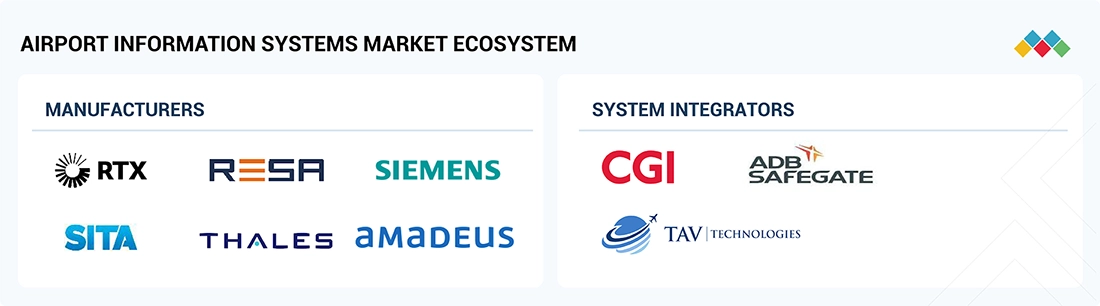
Logos and trademarks shown above are the property of their respective owners. Their use here is for informational and illustrative purposes only.
AIRPORT INFORMATION SYSTEM MARKET SEGMENTS
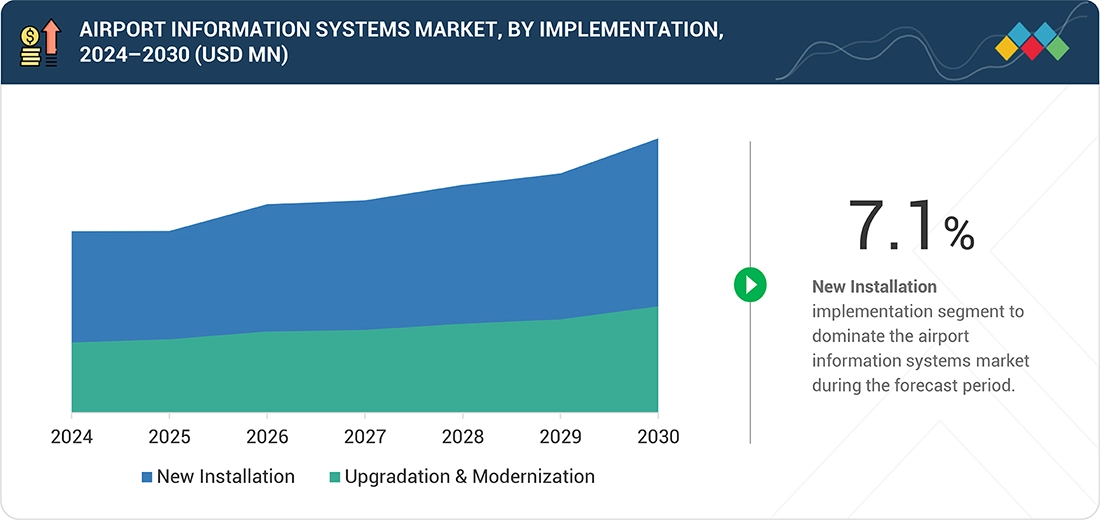
Source: Secondary Research, Interviews with Experts, MarketsandMarkets Analysis
Airport Information Systems Market, By Implementation
New installation is the largest segment because expanding airports and greenfield projects require full-scale deployment of modern AIS platforms. Emerging markets, infrastructure upgrades, and the replacement of legacy systems accelerate demand for new, integrated installations over retrofits.
Airport Information Systems Market, By Type
Passenger-centric systems lead the market as airports focus on enhancing traveler experience, reducing touchpoints, and offering personalized, real-time services. Growing expectations for seamless, contactless, and digitally supported travel drive the dominance of this segment.
Airport Information Systems Market, By Application
Passenger processing dominates because airports prioritize systems that reduce queues, automate identity verification, and streamline check-in, bag drop, and boarding. Rising passenger volumes and the shift toward biometric and self-service journeys make this the most critical operational area for investment.
AIRPORT INFORMATION SYSTEM MARKET REGION
North America to be fastest-growing region in global aerospace materials market during forecast period
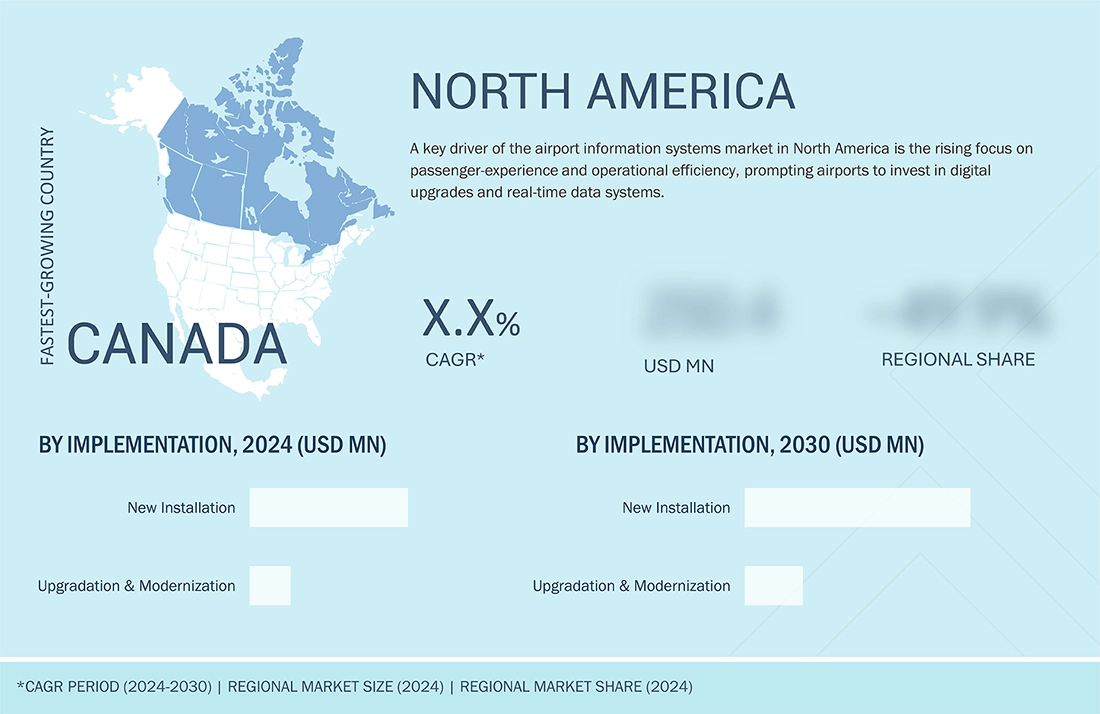
The North American Airport Information Systems market is the fastest-growing region due to sustained investment in airport modernization and the need to manage high passenger volumes with advanced digital systems. Airports are prioritizing upgrades in passenger processing, security, and operational management, driving strong demand for AIS technologies. Major government-led programs, such as TSA’s deployment of next-generation authentication systems, reinforce this momentum. The region’s focus on efficiency, security, and technology integration continues to accelerate market expansion.
AIRPORT INFORMATION SYSTEM MARKET SIZE, SHARE AND TRENDS, 2025 TO 2030: COMPANY EVALUATION MATRIX
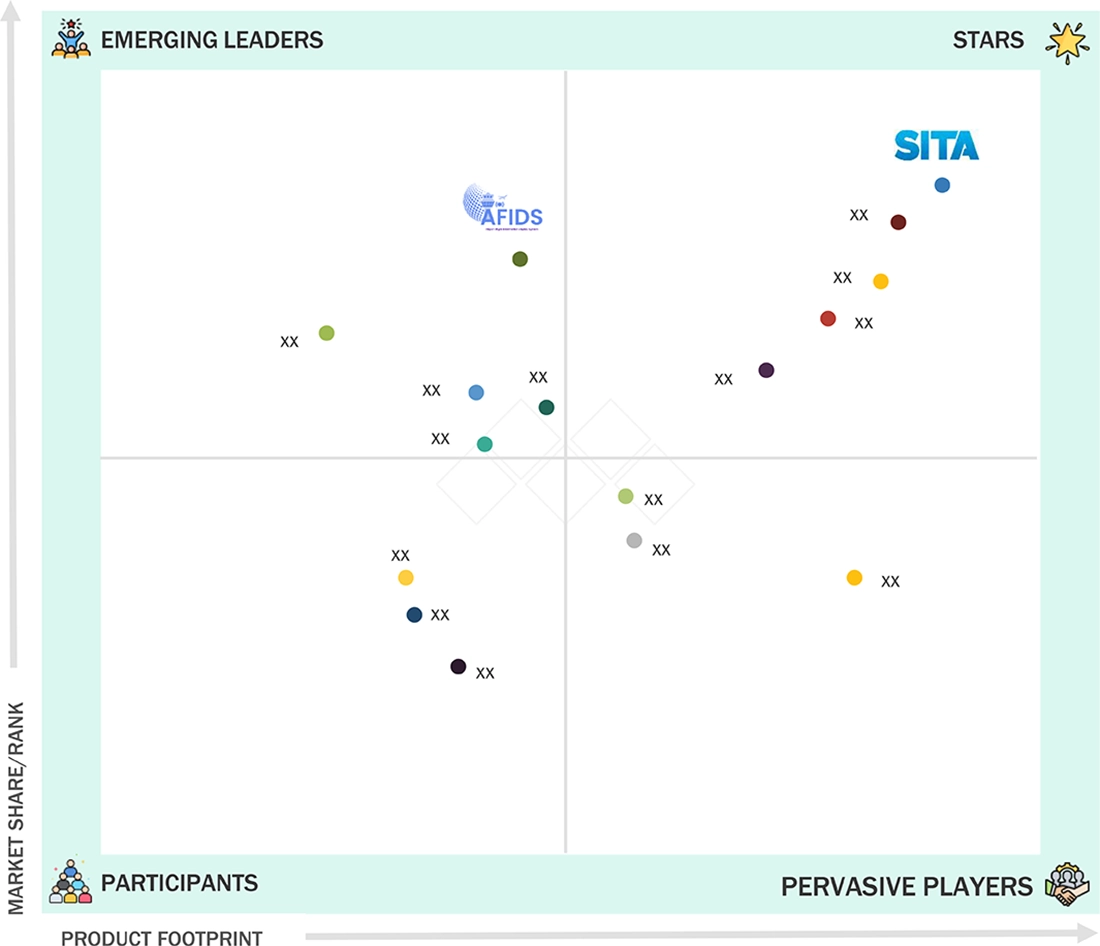
In the airport infromation systems market matrix, SITA (Star) leads with a strong market share and extensive product footprint, driven by its advanced passenger processing and airport operations solutions widely adopted across global aviation. AeroCloud Systems Ltd (Emerging Leader) is strengthening its position with cloud-native airport management solutions that offer scalable, data-driven operational support. As airports increasingly adopt flexible, real-time platforms, the company is well positioned to move toward the leaders’ quadrant.
Source: Secondary Research, Interviews with Experts, MarketsandMarkets Analysis
KEY MARKET PLAYERS -AIRPORT INFORMATION SYSTEM COMPANIES
- SITA (Switzerland)
- Amadeus IT Group SA (Spain)
- Vanderlande Industries B.V. (Netherlands)
- Indra (Spain)
- RTX (US)
- Siemens AG (Germany)
- Thales (France)
- ADB SAFEGATE (Belgium)
- RESA (France)
- TAV Technologies (Turkey)
- Damarel Systems International Ltd (UK)
- CGI Inc. (Canada)
- Airport Information Systems (England)
- NEC Corporation (Japan)
- Honeywell International Inc. (US)
- Deutsche Telekom AG (Germany)
WHAT IS IN IT FOR YOU: AIRPORT INFORMATION SYSTEM MARKET SIZE, SHARE AND TRENDS, 2025 TO 2030 REPORT CONTENT GUIDE
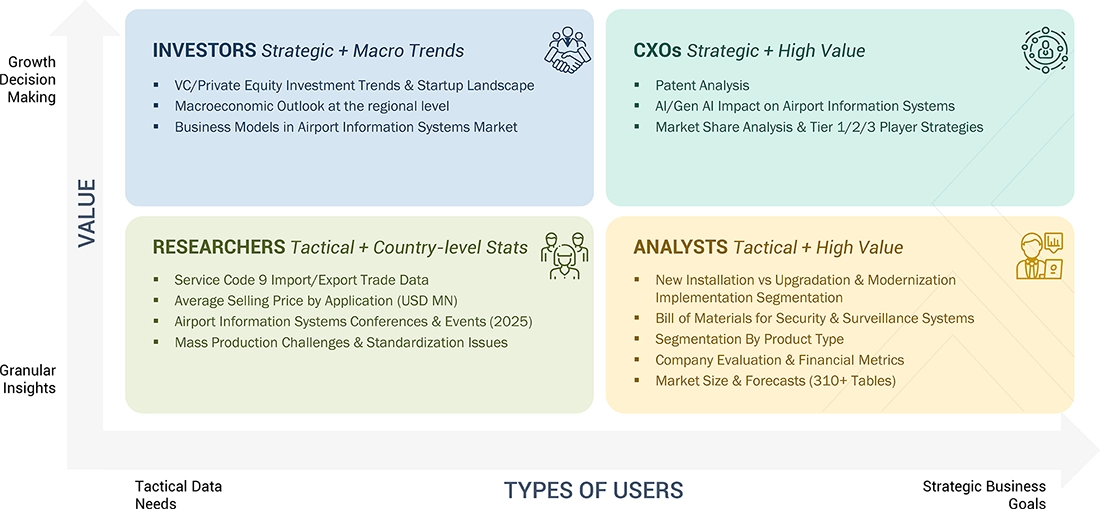
DELIVERED CUSTOMIZATIONS
We have successfully delivered the following deep-dive customizations:
| CLIENT REQUEST | CUSTOMIZATION DELIVERED | VALUE ADDS |
|---|---|---|
| Leading Manufacturer | Additional segment breakdown for countries | Additional country-level market sizing tables for segments/sub-segments covered at the regional/global level to gain an understanding of market potential by each country |
| Emerging Leader | Additional company profiles | Competitive information on targeted players to gain granular insights on direct competition |
| Regional Market Leader | Additional country market estimates | Additional country-level deep dive for a more targeted understanding of the total addressable market |
RECENT DEVELOPMENTS
- November 2024 : SITA partnered with Taoyuan International Airport (TPE) to revolutionize its passenger processing solutions. TPE will install SITA’s game changing check-in kiosk solutions, allowing passengers to fly through the airport and on to their destination faster than ever before.
- February 2024 : NAV CANADA and Indra signed an agreement to contribute to the evolution of Canada’s air traffic management systems. The agreement would support the deployment of a state-of-the-art flight data processing system (FDPS) and an air traffic flow management system (iACM) for complex airspaces within NAV CANADA’s network centre.
- June 2024 : RESA collaborated with Air Djibouti for its billing operations. The Invoice Handling Services software solution is designed for ground agents in charge of services related to a specific flight.
- April 2024 : ADB SAFEGATE entered a new contract for the new Terminal One at JFK Airport. OneControl systems will be added to the new Terminal One at John F. Kennedy International Airport (JFK) will provide the most efficient and safest ramp operation in US.
- November 2024 : Indra was awarded with a contract by VATM (Vietnam Air Traffic Management Corporation) (Vietnam) to overhaul a large part of the country's air traffic management systems. Indra's system will bring together all the air traffic management (ATM) processes occurring during a flight in a single centralized suite and will be equipped with en-route services, approach and control tower management systems.
Table of Contents
 Exclusive indicates content/data unique to MarketsandMarkets and not available with any competitors.
TITLE
PAGE NO
1
INTRODUCTION
30
2
RESEARCH METHODOLOGY
35
3
EXECUTIVE SUMMARY
47
4
PREMIUM INSIGHTS
51
5
MARKET OVERVIEW
Explore how smart technologies and investments are reshaping airport information systems amid rising IT demands.
54
5.1
INTRODUCTION
5.2
MARKET DYNAMICS
5.2.1
DRIVERS
5.2.1.1
RISE IN IT SPENDING BY AIRPORTS
5.2.1.2
INCREASED USE OF SMARTPHONES
5.2.1.3
NEED FOR REAL-TIME INFORMATION
5.2.1.4
INCREASING USE OF SELF-SERVICE TECHNOLOGIES AT AIRPORTS
5.2.2
RESTRAINTS
5.2.2.1
HIGH OPERATING COSTS
5.2.2.2
DATA AND PRIVACY CONCERNS
5.2.3
OPPORTUNITIES
5.2.3.1
INCREASED INVESTMENTS FOR AIRPORT EXPANSION IN EMERGING ECONOMIES
5.2.3.2
EMERGENCE OF SMART AIRPORTS
5.2.4
CHALLENGES
5.2.4.1
MANAGEMENT OF LARGE DATASETS
5.2.4.2
COMPLEXITY IN INTEGRATING NEW TECHNOLOGIES INTO LEGACY SYSTEMS
5.3
VALUE CHAIN ANALYSIS
5.4
TRENDS/DISRUPTIONS IMPACTING CUSTOMER BUSINESS
5.4.1
REVENUE SHIFT AND NEW REVENUE POCKETS FOR OEMS OFFERING AIRPORT INFORMATION SYSTEMS
5.5
ECOSYSTEM ANALYSIS
5.5.1
PROMINENT COMPANIES
5.5.2
PRIVATE AND SMALL ENTERPRISES
5.5.3
END USERS
5.6
PRICING ANALYSIS
5.6.1
INDICATIVE PRICING ANALYSIS OF AIRPORT INFORMATION SYSTEMS, BY IMPLEMENTATION
5.6.1.1
FACTORS AFFECTING PRICING OF NEWLY INSTALLED INFORMATION SYSTEMS AT SMALL AIRPORTS
5.6.1.2
FACTORS AFFECTING PRICING OF NEWLY INSTALLED AIRPORT INFORMATION SYSTEMS AT MID-SIZED AIRPORTS
5.6.1.3
FACTORS AFFECTING PRICING OF NEWLY INSTALLED AIRPORT INFORMATION SYSTEMS AT LARGE AIRPORTS
5.6.1.4
FACTORS AFFECTING PRICING OF UPGRADED/MODERNIZED INFORMATION SYSTEMS AT SMALL AIRPORTS
5.6.1.5
FACTORS AFFECTING PRICING OF UPGRADED/MODERNIZED INFORMATION SYSTEMS AT MID-SIZED AIRPORTS
5.6.1.6
FACTORS AFFECTING PRICING OF UPGRADED/MODERNIZED INFORMATION SYSTEMS AT LARGE AIRPORTS
5.6.1.7
FACTORS AFFECTING PRICING OF MAINTENANCE & REPAIR SERVICES FOR AIRPORT INFORMATION SYSTEMS
5.7
TRADE ANALYSIS
5.7.1
IMPORT SCENARIO (SERVICE CODE 9)
5.7.2
EXPORT SCENARIO (SERVICE CODE 9)
5.8
CASE STUDY ANALYSIS
5.8.1
HEATHROW AIRPORT DEPLOYED BIOMETRICS TO REDUCE PROCESSING TIME AND IMPROVE OVERALL PASSENGER EXPERIENCE
5.8.2
DUBAI INTERNATIONAL AIRPORT DEPLOYED FACIAL RECOGNITION SYSTEMS AND RFID TAGS TO STREAMLINE PASSENGER FLOW
5.8.3
SINGAPORE’S CHANGI AIRPORT ADOPTED AI-POWERED ANALYTICS TO ADDRESS CONGESTION DURING PEAK HOURS
5.8.4
SHENZHEN AIRPORT UNDERTOOK COMPREHENSIVE DIGITAL TRANSFORMATION TO MODERNIZE OPERATIONS
5.8.5
HARTSFIELD-JACKSON ATLANTA INTERNATIONAL AIRPORT (ATL) MIGRATED TO AWS TO TRANSFORM ITS OPERATIONAL CAPABILITIES
5.8.6
HONG KONG INTERNATIONAL AIRPORT (HKIA) IMPLEMENTED AI-POWERED CROWD MANAGEMENT TOOL TO MANAGE CONGESTION DURING PEAK HOURS
5.8.7
PARIS CHARLES DE GAULLE AIRPORT ADOPTED BIG DATA PLATFORM TO MANAGE BAGGAGE HANDLING AND RETAIL ACTIVITIES
5.9
KEY CONFERENCES & EVENTS, 2025
5.10
REGULATORY LANDSCAPE
5.10.1
REGULATORY BODIES, GOVERNMENT AGENCIES, AND OTHER ORGANIZATIONS
5.11
KEY STAKEHOLDERS IN BUYING PROCESS
5.11.1
BUYING CRITERIA
5.12
TECHNOLOGY ANALYSIS
5.12.1
KEY TECHNOLOGIES
5.12.1.1
DATA INTEGRATION PLATFORMS
5.12.1.2
REAL-TIME ANALYTICS
5.12.2
COMPLEMENTARY TECHNOLOGIES
5.12.2.1
RFID AND BARCODE TECHNOLOGY
5.12.2.2
DIGITAL TWIN TECHNOLOGY
5.13
AIRPORT INFORMATION SYSTEMS MARKET: BUSINESS MODELS
5.14
INVESTMENT & FUNDING SCENARIO
5.15
TOTAL COST OF OWNERSHIP (TCO)
5.16
IMPACT OF GENERATIVE AI ON AIRPORT INFORMATION SYSTEMS MARKET
5.16.1
INTRODUCTION
5.16.2
ADOPTION OF GENERATIVE AI IN COMMERCIAL AVIATION
5.17
BILL OF MATERIALS (BOM)
5.18
TECHNOLOGY ROADMAP
5.19
MACROECONOMIC OUTLOOK
5.19.1
NORTH AMERICA
5.19.2
EUROPE
5.19.3
ASIA PACIFIC
5.19.4
MIDDLE EAST
5.19.5
LATIN AMERICA
5.19.6
AFRICA
6
INDUSTRY TRENDS
Cutting-edge airport tech enhances efficiency with smart systems and mobile innovations.
94
6.1
INTRODUCTION
6.2
EMERGING TRENDS
6.2.1
STATE-OF-THE-ART AIRPORT OPERATING SYSTEMS
6.2.2
SMART FLIGHT INFORMATION DISPLAY SOFTWARE (PADS4)
6.2.3
SPIDER A-CDM
6.2.4
SPIDER PAXVALIDATION
6.2.5
DOLPHIN AIRPORT INFORMATION
6.2.5.1
DOLPHIN FLIGHT INFORMATION DISPLAY SYSTEM (FIDS)
6.2.5.2
DOLPHIN ADVERTISING CONTENT MANAGEMENT SYSTEM (ADS)
6.2.5.3
DOLPHIN AUTOMATIC FLIGHT ANNOUNCEMENT SYSTEM (AFAS)
6.3
TECHNOLOGY TRENDS
6.3.1
NEAR-FIELD COMMUNICATION (NFC)
6.3.2
RADIO FREQUENCY IDENTIFICATION (RFID)
6.3.3
ARMADILLO INTEGRATED SECURITY
6.3.4
UNASSISTED BAG-DROP (UBD) FACILITY
6.3.5
MOBILE APPLICATIONS
6.4
PATENT ANALYSIS
7
AIRPORT INFORMATION SYSTEM TECHNOLOGY MARKET
Innovative contactless tech and AI analytics revolutionize airport efficiency and passenger experience.
101
7.1
INTRODUCTION
7.2
CONTACTLESS
7.2.1
NEED FOR ENHANCING SECURITY AND STREAMLINING OPERATIONS TO DRIVE GROWTH OF CONTACTLESS TECHNOLOGIES
7.2.2
FACIAL RECOGNITION ALGORITHM
7.2.3
IRIS SCANNING TECHNOLOGY
7.2.4
NEAR-FIELD COMMUNICATION
7.2.5
RFID AND BARCODE SCANNING
7.3
REAL-TIME MONITORING & ANALYTICS
7.3.1
FOCUS ON FACILITATING REAL-TIME DATA COLLECTION AND ENABLING EFFICIENT AIRPORT OPERATIONS TO BOOST GROWTH
7.3.2
IOT SENSOR
7.3.3
AI ANALYTICS FOR CONGESTION MANAGEMENT
7.3.4
EDGE COMPUTING FOR AIRSIDE MANAGEMENT
7.3.5
BIG DATA ANALYTICS FOR REAL-TIME DECISION-MAKING
7.4
ADVANCED SECURITY & SURVEILLANCE
7.4.1
EMPHASIS ON REAL-TIME MONITORING AND INTELLIGENT DECISION-MAKING ACROSS AIRLINE FUNCTIONS TO BOOST MARKET
7.4.2
AI-POWERED VIDEO ANALYTICS
7.4.3
X-RAY AND MILLIMETER-WAVE SCANNER
7.4.4
BIOMETRIC ACCESS CONTROL SYSTEM
7.4.5
LIDAR (LIGHT DETECTION AND RANGING)
7.4.6
THERMAL IMAGING SENSOR
7.5
SMART DISPLAY & VISUALIZATION
7.5.1
GROWING FOCUS ON ENHANCED PASSENGER EXPERIENCE TO BOOST GROWTH
7.5.2
AUGMENTED REALITY
7.5.3
HAPTIC FEEDBACK TECHNOLOGY
7.6
COLLABORATIVE & DECISION-MAKING
7.6.1
NEED FOR PERSONALIZED TRAVEL EXPERIENCE TO ENCOURAGE USE OF COLLABORATIVE AND DECISION-MAKING TECHNOLOGIES
7.6.2
APPLICATION PROGRAMMING INTERFACE (API)
7.6.3
MACHINE LEARNING ALGORITHM
7.6.4
CLOUD COMPUTING FOR DATA STORAGE AND PROCESSING
7.7
DYNAMIC REVENUE OPTIMIZATION
7.7.1
GROWING DEMAND FOR EFFICIENT REVENUE MANAGEMENT TO DRIVE DYNAMIC OPTIMIZATION SOLUTIONS
7.7.2
AI-POWERED PRICING ALGORITHMS
7.7.3
PREDICTIVE ANALYTICS FOR FINANCIAL PLANNING
7.7.4
IOT-BASED REVENUE TRACKING
8
AIRPORT INFORMATION SYSTEMS MARKET, BY IMPLEMENTATION
Market Size & Growth Rate Forecast Analysis to 2030 in USD Million | 2 Data Tables
112
8.1
INTRODUCTION
8.2
UPGRADES & MODERNIZATION
8.2.1
REDUCED COST OF UPGRADES AND MODERNIZATION TO DRIVE GROWTH
8.3
NEW INSTALLATION
8.3.1
GROWING DEMAND FOR INFRASTRUCTURE EQUIPPED WITH ADVANCED TECHNOLOGIES TO BOOST GROWTH
9
AIRPORT INFORMATION SYSTEMS MARKET, BY TYPE
Market Size & Growth Rate Forecast Analysis to 2030 in USD Million | 2 Data Tables
115
9.1
INTRODUCTION
9.2
PASSENGER-CENTRIC SYSTEMS
9.2.1
NEED FOR IMPROVED PASSENGER EXPERIENCE AND REDUCTION IN WAITING TIME TO DRIVE MARKET
9.2.1.1
USE CASE 1: SITA ADOPTED PASSENGER PROCESSING SOLUTIONS TO ENHANCE AIRPORT OPERATIONS AND STREAMLINE PASSENGER JOURNEY
9.2.1.2
USE CASE 2: CHANGI AIRPORT IMPLEMENTED ADVANCED AUTOMATED IMMIGRATION CHECKPOINT SYSTEM TO STREAMLINE PASSENGER PROCESSING AND IMPROVE OVERALL EFFICIENCY
9.2.1.3
USE CASE 3: DETROIT METROPOLITAN AIRPORT IMPLEMENTED “PARALLEL REALITY” FLIGHT INFORMATION BOARD TO DISPLAY FLIGHT INFORMATION
9.2.1.4
USE CASE 4: HAMAD INTERNATIONAL AIRPORT IMPLEMENTED ADVANCED AIRPORT INFORMATION SYSTEMS THAT USE AI-DRIVEN PREDICTIVE ANALYSIS
9.3
AIRPORT OPERATIONAL SUPPORT SYSTEMS
9.3.1
NEED FOR IMPROVED OPERATIONAL EFFICIENCY TO DRIVE MARKET
9.3.1.1
USE CASE 1: ZURICH AIRPORT GROUP IMPLEMENTED NEW REMOTE OPERATIONAL CENTER OF OPTICAL SENSORS FOR TOWER OPERATIONS
9.3.1.2
USE CASE 2: FRANKFURT AIRPORT TESTS R&S QPS WALK2000 WALK-THROUGH SCANNER TO ENHANCE SECURITY SCREENING
9.3.1.3
USE CASE 3: HEATHROW AIRPORT IMPLEMENTED BEEKEEPER’S MOBILE-FIRST PLATFORM TO STREAMLINE COMMUNICATION
9.3.1.4
USE CASE 4: LONDON STANSTED AIRPORT IMPLEMENTED ADVANCED SURVEILLANCE SYSTEMS TO ENHANCE OPERATIONAL EFFICIENCY
10
AIRPORT INFORMATION SYSTEMS MARKET, BY APPLICATION
Market Size & Growth Rate Forecast Analysis to 2030 in USD Million | 20 Data Tables
121
10.1
INTRODUCTION
10.2
CARGO & BAGGAGE MANAGEMENT
10.2.1
NEED FOR AUTOMATED, REAL-TIME CARGO AND BAGGAGE TRACKING SYSTEMS TO DRIVE MARKET
10.2.2
BAGGAGE RECONCILIATION SOFTWARE
10.2.3
AUTOMATED STORAGE & RETRIEVAL SYSTEM (ASRS)
10.2.4
BAGGAGE & CARGO HANDLING AND TRACKING SOFTWARE
10.3
FLIGHT OPERATIONS
10.3.1
NEED FOR ENHANCED SAFETY AND EFFICIENCY TO DRIVE MARKET
10.3.2
AIRPORT DIGITAL SIGNAGE & DISPLAY SYSTEM
10.3.2.1
FLIGHT INFORMATION DISPLAY SYSTEM
10.3.2.2
DIGITAL SIGNAGE
10.3.3
GATE MANAGEMENT SOFTWARE
10.3.4
AIRPORT OPERATIONAL DATABASE (AODB)
10.4
SECURITY & SURVEILLANCE
10.4.1
INCREASING GLOBAL CONCERNS OVER AVIATION SECURITY TO DRIVE GROWTH
10.4.2
ACCESS CONTROL SYSTEM
10.4.3
CCTV SURVEILLANCE SYSTEM
10.4.4
BIOMETRIC ACCESS SYSTEM
10.4.5
PERIMETER INTRUSION DETECTION SYSTEM
10.4.6
PASSENGER SCREENING SYSTEM
10.5
RESOURCE MANAGEMENT
10.5.1
NEED FOR INCREASED OPERATIONAL EFFICIENCY TO BOOST GROWTH
10.5.2
RESOURCE ALLOCATION SOFTWARE
10.5.3
AIRSIDE VEHICLE TRACKING SOFTWARE
10.5.4
STAFF SCHEDULING SOFTWARE
10.6
AIRSIDE OPERATIONS
10.6.1
GROWING COMPLEXITY OF AIR TRAVEL TO PROPEL MARKET
10.6.2
GROUND HANDLING SOFTWARE
10.6.3
AIRPORT COLLABORATIVE DECISION-MAKING SOFTWARE
10.6.4
AUTOMATIC TERMINAL INFORMATION SYSTEM
10.7
FINANCIAL & REVENUE MANAGEMENT
10.7.1
NEED TO OPTIMIZE AIRPORT OPERATIONS TO DRIVE MARKET
10.7.2
AERONAUTICAL BILLING SOFTWARE
10.7.3
NON-AERONAUTICAL BILLING SOFTWARE
10.7.4
AIRPORT REVENUE ANALYSIS SOFTWARE
10.8
PASSENGER PROCESSING
10.8.1
NEED FOR IMPROVED OPERATIONAL EFFICIENCY AND IMPROVED CUSTOMER EXPERIENCE TO DRIVE MARKET
10.8.2
DEPARTURE CONTROL SYSTEMS
10.8.2.1
COMMON USE PASSENGER PROCESSING SYSTEM (CUPPS)
10.8.2.2
COMMON-USE SELF-SERVICE (CUSS) KIOSK
10.8.3
BIOMETRIC IDENTIFICATION SYSTEM
10.8.4
PASSENGER FLOW MANAGEMENT SOFTWARE
11
AIRPORT INFORMATION SYSTEMS MARKET, BY REGION
Comprehensive coverage of 9 Regions with country-level deep-dive of 16 Countries | 192 Data Tables.
139
11.1
INTRODUCTION
11.2
NORTH AMERICA
11.2.1
PESTLE ANALYSIS
11.2.2
US
11.2.2.1
HIGH AIR TRAFFIC TO NECESSITATE EFFECTIVE AIR INFORMATION SYSTEM MANAGEMENT
11.2.3
CANADA
11.2.3.1
GOVERNMENT INITIATIVES TO MODERNIZE AIRPORT INFRASTRUCTURE TO DRIVE MARKET
11.3
EUROPE
11.3.1
PESTLE ANALYSIS
11.3.2
UK
11.3.2.1
FOCUS ON MODERNIZING AIRPORT INFRASTRUCTURE TO DRIVE MARKET
11.3.3
FRANCE
11.3.3.1
SUSTAINABILITY INITIATIVES TO DRIVE MARKET
11.3.4
GERMANY
11.3.4.1
RISING DEMAND FOR TECHNOLOGICAL INNOVATION TO DRIVE MARKET
11.3.5
NETHERLANDS
11.3.5.1
NEED TO PRIORITIZE SEAMLESS MULTI-MODAL CONNECTIVITY BETWEEN AIR TRAVEL AND PUBLIC TRANSPORTATION SYSTEMS TO DRIVE MARKET
11.3.6
REST OF EUROPE
11.4
ASIA PACIFIC
11.4.1
PESTLE ANALYSIS
11.4.2
CHINA
11.4.2.1
FOCUS ON BUILDING WORLD-CLASS TRANSPORTATION HUBS TO DRIVE MARKET
11.4.3
INDIA
11.4.3.1
GROWING MIDDLE-CLASS POPULATION AND INCREASING AIR TRAVEL TO BOOST GROWTH
11.4.4
JAPAN
11.4.4.1
UNIQUE REGIONAL DYNAMICS AND TECHNOLOGICAL ADVANCEMENTS TO DRIVE MARKET
11.4.5
SINGAPORE
11.4.5.1
INTEGRATION OF ADVANCED AIRPORT INFORMATION SYSTEM TECHNOLOGIES TO DRIVE MARKET
11.4.6
AUSTRALIA
11.4.6.1
NATION’S COMMITMENT TO SUSTAINABILITY TO DRIVE MARKET
11.4.7
REST OF ASIA PACIFIC
11.5
MIDDLE EAST
11.5.1
PESTLE ANALYSIS
11.5.2
GCC
11.5.2.1
UAE
11.5.2.1.1
RISING NEED FOR ADVANCED AIRPORT INFORMATION SYSTEM TYPES TO DRIVE MARKET
11.5.2.2
SAUDI ARABIA
11.5.2.2.1
INITIATIVES, SUCH AS ‘VISION 2030’ TO BOOST GROWTH OF AIRPORT INFORMATION SYSTEMS MARKET
11.5.3
REST OF MIDDLE EAST
11.6
REST OF THE WORLD
11.6.1
BRAZIL
11.6.1.1
FOCUS ON IMPLEMENTING SOPHISTICATED INFORMATION SYSTEMS TO DRIVE MARKET
11.6.2
MEXICO
11.6.2.1
ADOPTION OF AIRPORT INFORMATION SYSTEM TYPES FOR ADVANCED AIR TRAFFIC MANAGEMENT TO DRIVE MARKET
11.6.3
SOUTH AFRICA
11.6.3.1
NEED FOR IMPROVED OPERATIONAL EFFICIENCY TO DRIVE MARKET
11.6.4
OTHERS IN ROW
12
COMPETITIVE LANDSCAPE
Discover dominant market players and emerging leaders shaping competitive trends and strategies.
224
12.1
INTRODUCTION
12.2
KEY PLAYER STRATEGIES/RIGHT TO WIN, 2020–2024
12.3
REVENUE ANALYSIS, 2020–2023
12.4
MARKET SHARE ANALYSIS, 2023
12.5
COMPANY EVALUATION MATRIX: KEY PLAYERS, 2023
12.5.1
STARS
12.5.2
EMERGING LEADERS
12.5.3
PERVASIVE PLAYERS
12.5.4
PARTICIPANTS
12.5.5
COMPANY FOOTPRINT
12.6
COMPANY EVALUATION MATRIX: STARTUPS/SMES, 2023
12.6.1
PROGRESSIVE COMPANIES
12.6.2
RESPONSIVE COMPANIES
12.6.3
DYNAMIC COMPANIES
12.6.4
STARTING BLOCKS
12.6.5
COMPETITIVE BENCHMARKING
12.7
COMPANY VALUATION AND FINANCIAL METRICS
12.8
BRAND/PRODUCT COMPARISON
12.9
COMPETITIVE SCENARIO AND TRENDS
12.9.1
PRODUCT LAUNCHES
12.9.2
DEALS
12.9.3
OTHER DEVELOPMENTS
13
COMPANY PROFILES
In-depth Company Profiles of Leading Market Players with detailed Business Overview, Product and Service Portfolio, Recent Developments, and Unique Analyst Perspective (MnM View)
253
13.1
KEY PLAYERS
13.1.1
SITA
13.1.1.1
BUSINESS OVERVIEW
13.1.1.2
PRODUCTS/SOLUTIONS/SERVICES OFFERED
13.1.1.3
RECENT DEVELOPMENTS
13.1.1.3.1
DEALS
13.1.1.3.2
OTHER DEVELOPMENTS
13.1.1.4
MNM VIEW
13.1.1.4.1
KEY STRENGTHS
13.1.1.4.2
STRATEGIC CHOICES
13.1.1.4.3
WEAKNESSES AND COMPETITIVE THREATS
13.1.2
AMADEUS IT GROUP SA
13.1.3
VANDERLANDE INDUSTRIES B.V.
13.1.4
INDRA
13.1.5
RTX
13.1.6
SIEMENS AG
13.1.7
THALES
13.1.8
ADB SAFEGATE
13.1.9
RESA
13.1.10
TAV TECHNOLOGIES
13.1.11
DAMAREL SYSTEMS INTERNATIONAL LTD.
13.1.12
CGI INC.
13.1.13
AIRPORT INFORMATION SYSTEMS
13.1.14
NEC CORPORATION
13.1.15
HONEYWELL INTERNATIONAL, INC.
13.1.16
DEUTSCHE TELEKOM AG
13.2
OTHER PLAYERS
13.2.1
AEROCLOUD SYSTEMS LTD.
13.2.2
VELOCITY AIRPORT SOLUTIONS
13.2.3
XOVIS AG
13.2.4
VEOVO
13.2.5
TREBIDE
13.2.6
INFORM SOFTWARE
13.2.7
PADS4 & NDS
13.2.8
INFAX, INC.
13.2.9
A-ICE SRL
13.2.10
ASSAIA INTERNATIONAL LTD.
14
APPENDIX
327
14.1
DISCUSSION GUIDE
14.2
KNOWLEDGESTORE: MARKETSANDMARKETS’ SUBSCRIPTION PORTAL
14.3
CUSTOMIZATION OPTIONS
14.4
RELATED REPORTS
14.5
AUTHOR DETAILS
LIST OF TABLES
TABLE 1
USD EXCHANGE RATES, 2020–2023
TABLE 2
ROLE OF PLAYERS IN MARKET ECOSYSTEM
TABLE 3
INDICATIVE PRICING OF NEWLY INSTALLED AIRPORT INFORMATION SYSTEMS, BY AIRPORT SIZE, 2024
TABLE 4
INDICATIVE PRICING OF UPGRADED/MODERNIZED AIRPORT INFORMATION SYSTEMS, BY AIRPORT SIZE, 2024
TABLE 5
IMPORT DATA FOR SERVICE CODE 9-COMPLIANT PRODUCTS, BY COUNTRY, 2020–2023 (USD THOUSAND)
TABLE 6
EXPORT DATA FOR SERVICE CODE 9-COMPLIANT PRODUCTS, BY COUNTRY, 2020–2023 (USD THOUSAND)
TABLE 7
KEY CONFERENCES & EVENTS, 2025
TABLE 8
NORTH AMERICA: REGULATORY BODIES, GOVERNMENT AGENCIES, AND OTHER ORGANIZATIONS
TABLE 9
EUROPE: REGULATORY BODIES, GOVERNMENT AGENCIES, AND OTHER ORGANIZATIONS
TABLE 10
ASIA PACIFIC: REGULATORY BODIES, GOVERNMENT AGENCIES, AND OTHER ORGANIZATIONS
TABLE 11
MIDDLE EAST: REGULATORY BODIES, GOVERNMENT AGENCIES, AND OTHER ORGANIZATIONS
TABLE 12
INFLUENCE OF STAKEHOLDERS ON BUYING PROCESS FOR KEY APPLICATIONS
TABLE 13
KEY BUYING CRITERIA FOR KEY APPLICATIONS
TABLE 14
AIRPORT INFORMATION SYSTEMS MARKET: BUSINESS MODELS
TABLE 15
TCO COMPARISON BETWEEN KEY APPLICATIONS OF AIRPORT INFORMATION SYSTEMS
TABLE 16
PATENTS GRANTED, 2021–2023
TABLE 17
AIRPORT INFORMATION SYSTEMS MARKET, BY IMPLEMENTATION, 2020–2023 (USD MILLION)
TABLE 18
AIRPORT INFORMATION SYSTEMS MARKET, BY IMPLEMENTATION, 2024–2030 (USD MILLION)
TABLE 19
AIRPORT INFORMATION SYSTEMS MARKET, BY TYPE, 2020–2023 (USD MILLION)
TABLE 20
AIRPORT INFORMATION SYSTEMS MARKET, BY TYPE, 2024–2030 (USD MILLION)
TABLE 21
AIRPORT INFORMATION SYSTEMS MARKET, BY APPLICATION, 2020–2023 (USD MILLION)
TABLE 22
AIRPORT INFORMATION SYSTEMS MARKET, BY APPLICATION, 2024–2030 (USD MILLION)
TABLE 23
AIRPORT INFORMATION SYSTEMS MARKET, BY CARGO & BAGGAGE MANAGEMENT, 2020–2023 (USD MILLION)
TABLE 24
AIRPORT INFORMATION SYSTEMS MARKET, BY CARGO & BAGGAGE MANAGEMENT, 2024–2030 (USD MILLION)
TABLE 25
AIRPORT INFORMATION SYSTEMS MARKET, BY FLIGHT OPERATIONS, 2020–2023 (USD MILLION)
TABLE 26
AIRPORT INFORMATION SYSTEMS MARKET, BY FLIGHT OPERATIONS, 2024–2030 (USD MILLION)
TABLE 27
AIRPORT INFORMATION SYSTEMS MARKET, BY AIRPORT DIGITAL SIGNAGE & DISPLAY SYSTEM, 2020–2023 (USD MILLION)
TABLE 28
AIRPORT INFORMATION SYSTEMS MARKET, BY AIRPORT DIGITAL SIGNAGE & DISPLAY SYSTEM, 2024–2030 (USD MILLION)
TABLE 29
AIRPORT INFORMATION SYSTEMS MARKET, BY SECURITY & SURVEILLANCE, 2020–2023 (USD MILLION)
TABLE 30
AIRPORT INFORMATION SYSTEMS MARKET, BY SECURITY & SURVEILLANCE, 2024–2030 (USD MILLION)
TABLE 31
AIRPORT INFORMATION SYSTEMS MARKET, BY RESOURCE MANAGEMENT, 2020–2023 (USD MILLION)
TABLE 32
AIRPORT INFORMATION SYSTEMS MARKET, BY RESOURCE MANAGEMENT, 2024–2030 (USD MILLION)
TABLE 33
AIRPORT INFORMATION SYSTEMS MARKET, BY AIRSIDE OPERATIONS, 2020–2023 (USD MILLION)
TABLE 34
AIRPORT INFORMATION SYSTEMS MARKET, BY AIRSIDE OPERATIONS, 2024–2030 (USD MILLION)
TABLE 35
AIRPORT INFORMATION SYSTEMS MARKET, BY FINANCIAL & REVENUE MANAGEMENT, 2020–2023 (USD MILLION)
TABLE 36
AIRPORT INFORMATION SYSTEMS MARKET, BY FINANCIAL & REVENUE MANAGEMENT, 2024–2030 (USD MILLION)
TABLE 37
AIRPORT INFORMATION SYSTEMS MARKET, BY PASSENGER PROCESSING, 2020–2023 (USD MILLION)
TABLE 38
AIRPORT INFORMATION SYSTEMS MARKET, BY PASSENGER PROCESSING, 2024–2030 (USD MILLION)
TABLE 39
AIRPORT INFORMATION SYSTEMS MARKET, BY DEPARTURE CONTROL SYSTEM, 2020–2023 (USD MILLION)
TABLE 40
AIRPORT INFORMATION SYSTEMS MARKET, BY DEPARTURE CONTROL SYSTEM, 2024–2030 (USD MILLION)
TABLE 41
AIRPORT INFORMATION SYSTEMS MARKET, BY REGION, 2020–2023 (USD MILLION)
TABLE 42
AIRPORT INFORMATION SYSTEMS MARKET, BY REGION, 2024–2030 (USD MILLION)
TABLE 43
NORTH AMERICA: AIRPORT INFORMATION SYSTEMS MARKET, BY COUNTRY, 2020–2023 (USD MILLION)
TABLE 44
NORTH AMERICA: AIRPORT INFORMATION SYSTEMS MARKET, BY COUNTRY, 2024–2030 (USD MILLION)
TABLE 45
NORTH AMERICA: AIRPORT INFORMATION SYSTEMS MARKET, BY APPLICATION, 2020–2023 (USD MILLION)
TABLE 46
NORTH AMERICA: AIRPORT INFORMATION SYSTEMS MARKET, BY APPLICATION, 2024–2030 (USD MILLION)
TABLE 47
NORTH AMERICA: AIRPORT INFORMATION SYSTEMS MARKET, BY PASSENGER PROCESSING, 2020–2023 (USD MILLION)
TABLE 48
NORTH AMERICA: AIRPORT INFORMATION SYSTEMS MARKET, BY PASSENGER PROCESSING, 2024–2030 (USD MILLION)
TABLE 49
NORTH AMERICA: AIRPORT INFORMATION SYSTEMS MARKET, BY FLIGHT OPERATIONS, 2020–2023 (USD MILLION)
TABLE 50
NORTH AMERICA: AIRPORT INFORMATION SYSTEMS MARKET, BY FLIGHT OPERATIONS, 2024–2030 (USD MILLION)
TABLE 51
NORTH AMERICA: AIRPORT INFORMATION SYSTEMS MARKET, BY CARGO & BAGGAGE MANAGEMENT, 2020–2023 (USD MILLION)
TABLE 52
NORTH AMERICA: AIRPORT INFORMATION SYSTEMS MARKET, BY CARGO & BAGGAGE MANAGEMENT, 2024–2030 (USD MILLION)
TABLE 53
NORTH AMERICA: AIRPORT INFORMATION SYSTEMS MARKET, BY RESOURCE MANAGEMENT, 2020–2023 (USD MILLION)
TABLE 54
NORTH AMERICA: AIRPORT INFORMATION SYSTEMS MARKET, BY RESOURCE MANAGEMENT, 2024–2030 (USD MILLION)
TABLE 55
NORTH AMERICA: AIRPORT INFORMATION SYSTEMS MARKET, BY SECURITY & SURVEILLANCE, 2020–2023 (USD MILLION)
TABLE 56
NORTH AMERICA: AIRPORT INFORMATION SYSTEMS MARKET, BY SECURITY & SURVEILLANCE, 2024–2030 (USD MILLION)
TABLE 57
NORTH AMERICA: AIRPORT INFORMATION SYSTEMS MARKET, BY AIRSIDE OPERATIONS, 2020–2023 (USD MILLION)
TABLE 58
NORTH AMERICA: AIRPORT INFORMATION SYSTEMS MARKET, BY AIRSIDE OPERATIONS, 2024–2030 (USD MILLION)
TABLE 59
NORTH AMERICA: AIRPORT INFORMATION SYSTEMS MARKET, BY FINANCIAL & REVENUE MANAGEMENT, 2020–2023 (USD MILLION)
TABLE 60
NORTH AMERICA: AIRPORT INFORMATION SYSTEMS MARKET, BY FINANCIAL & REVENUE MANAGEMENT, 2024–2030 (USD MILLION)
TABLE 61
NORTH AMERICA: AIRPORT INFORMATION SYSTEMS MARKET, BY TYPE, 2020–2023 (USD MILLION)
TABLE 62
NORTH AMERICA: AIRPORT INFORMATION SYSTEMS MARKET, BY TYPE, 2024–2030 (USD MILLION)
TABLE 63
NORTH AMERICA: AIRPORT INFORMATION SYSTEMS MARKET, BY IMPLEMENTATION, 2020–2023 (USD MILLION)
TABLE 64
NORTH AMERICA: AIRPORT INFORMATION SYSTEMS MARKET, BY IMPLEMENTATION, 2024–2030 (USD MILLION)
TABLE 65
US: AIRPORT INFORMATION SYSTEMS MARKET, BY APPLICATION, 2020–2023 (USD MILLION)
TABLE 66
US: AIRPORT INFORMATION SYSTEMS MARKET, BY APPLICATION, 2024–2030 (USD MILLION)
TABLE 67
US: AIRPORT INFORMATION SYSTEMS MARKET, BY TYPE, 2020–2023 (USD MILLION)
TABLE 68
US: AIRPORT INFORMATION SYSTEMS MARKET, BY TYPE, 2024–2030 (USD MILLION)
TABLE 69
CANADA: AIRPORT INFORMATION SYSTEMS MARKET, BY APPLICATION, 2020–2023 (USD MILLION)
TABLE 70
CANADA: AIRPORT INFORMATION SYSTEMS MARKET, BY APPLICATION, 2024–2030 (USD MILLION)
TABLE 71
CANADA: AIRPORT INFORMATION SYSTEMS MARKET, BY TYPE, 2020–2023 (USD MILLION)
TABLE 72
CANADA: AIRPORT INFORMATION SYSTEMS MARKET, BY TYPE, 2024–2030 (USD MILLION)
TABLE 73
EUROPE: AIRPORT INFORMATION SYSTEMS MARKET, BY COUNTRY, 2020–2023 (USD MILLION)
TABLE 74
EUROPE: AIRPORT INFORMATION SYSTEMS MARKET, BY COUNTRY, 2024–2030 (USD MILLION)
TABLE 75
EUROPE: AIRPORT INFORMATION SYSTEMS MARKET, BY APPLICATION, 2020–2023 (USD MILLION)
TABLE 76
EUROPE: AIRPORT INFORMATION SYSTEMS MARKET, BY APPLICATION, 2024–2030 (USD MILLION)
TABLE 77
EUROPE: AIRPORT INFORMATION SYSTEMS MARKET, BY PASSENGER PROCESSING, 2020–2023 (USD MILLION)
TABLE 78
EUROPE: AIRPORT INFORMATION SYSTEMS MARKET, BY PASSENGER PROCESSING, 2024–2030 (USD MILLION)
TABLE 79
EUROPE: AIRPORT INFORMATION SYSTEMS MARKET, BY FLIGHT OPERATIONS, 2020–2023 (USD MILLION)
TABLE 80
EUROPE: AIRPORT INFORMATION SYSTEMS MARKET, BY FLIGHT OPERATIONS, 2024–2030 (USD MILLION)
TABLE 81
EUROPE: AIRPORT INFORMATION SYSTEMS MARKET, BY CARGO & BAGGAGE MANAGEMENT, 2020–2023 (USD MILLION)
TABLE 82
EUROPE: AIRPORT INFORMATION SYSTEMS MARKET, BY CARGO & BAGGAGE MANAGEMENT, 2024–2030 (USD MILLION)
TABLE 83
EUROPE: AIRPORT INFORMATION SYSTEMS MARKET, BY RESOURCE MANAGEMENT, 2020–2023 (USD MILLION)
TABLE 84
EUROPE: AIRPORT INFORMATION SYSTEMS MARKET, BY RESOURCE MANAGEMENT, 2024–2030 (USD MILLION)
TABLE 85
EUROPE: AIRPORT INFORMATION SYSTEMS MARKET, BY SECURITY & SURVEILLANCE, 2020–2023 (USD MILLION)
TABLE 86
EUROPE: AIRPORT INFORMATION SYSTEMS MARKET, BY SECURITY & SURVEILLANCE, 2024–2030 (USD MILLION)
TABLE 87
EUROPE: AIRPORT INFORMATION SYSTEMS MARKET, BY AIRSIDE OPERATIONS, 2020–2023 (USD MILLION)
TABLE 88
EUROPE: AIRPORT INFORMATION SYSTEMS MARKET, BY AIRSIDE OPERATIONS, 2024–2030 (USD MILLION)
TABLE 89
EUROPE: AIRPORT INFORMATION SYSTEMS MARKET, BY FINANCIAL & REVENUE MANAGEMENT, 2020–2023 (USD MILLION)
TABLE 90
EUROPE: AIRPORT INFORMATION SYSTEMS MARKET, BY FINANCIAL & REVENUE MANAGEMENT, 2024–2030 (USD MILLION)
TABLE 91
EUROPE: AIRPORT INFORMATION SYSTEMS MARKET, BY TYPE, 2020–2023 (USD MILLION)
TABLE 92
EUROPE: AIRPORT INFORMATION SYSTEMS MARKET, BY TYPE, 2024–2030 (USD MILLION)
TABLE 93
EUROPE: AIRPORT INFORMATION SYSTEMS MARKET, BY IMPLEMENTATION, 2020–2023 (USD MILLION)
TABLE 94
EUROPE: AIRPORT INFORMATION SYSTEMS MARKET, BY IMPLEMENTATION, 2024–2030 (USD MILLION)
TABLE 95
UK: AIRPORT INFORMATION SYSTEMS MARKET, BY APPLICATION, 2020–2023 (USD MILLION)
TABLE 96
UK: AIRPORT INFORMATION SYSTEMS MARKET, BY APPLICATION, 2024–2030 (USD MILLION)
TABLE 97
UK: AIRPORT INFORMATION SYSTEMS MARKET, BY TYPE, 2020–2023 (USD MILLION)
TABLE 98
UK: AIRPORT INFORMATION SYSTEMS MARKET, BY TYPE, 2024–2030 (USD MILLION)
TABLE 99
FRANCE: AIRPORT INFORMATION SYSTEMS MARKET, BY APPLICATION, 2020–2023 (USD MILLION)
TABLE 100
FRANCE: AIRPORT INFORMATION SYSTEMS MARKET, BY APPLICATION, 2024–2030 (USD MILLION)
TABLE 101
FRANCE: AIRPORT INFORMATION SYSTEMS MARKET, BY TYPE, 2020–2023 (USD MILLION)
TABLE 102
FRANCE: AIRPORT INFORMATION SYSTEMS MARKET, BY TYPE, 2024–2030 (USD MILLION)
TABLE 103
GERMANY: AIRPORT INFORMATION SYSTEMS MARKET, BY APPLICATION, 2020–2023 (USD MILLION)
TABLE 104
GERMANY: AIRPORT INFORMATION SYSTEMS MARKET, BY APPLICATION, 2024–2030 (USD MILLION)
TABLE 105
GERMANY: AIRPORT INFORMATION SYSTEMS MARKET, BY TYPE, 2020–2023 (USD MILLION)
TABLE 106
GERMANY: AIRPORT INFORMATION SYSTEMS MARKET, BY TYPE, 2024–2030 (USD MILLION)
TABLE 107
NETHERLANDS: AIRPORT INFORMATION SYSTEMS MARKET, BY APPLICATION, 2020–2023 (USD MILLION)
TABLE 108
NETHERLANDS: AIRPORT INFORMATION SYSTEMS MARKET, BY APPLICATION, 2024–2030 (USD MILLION)
TABLE 109
NETHERLANDS: AIRPORT INFORMATION SYSTEMS MARKET, BY TYPE, 2020–2023 (USD MILLION)
TABLE 110
NETHERLANDS: AIRPORT INFORMATION SYSTEMS MARKET, BY TYPE, 2024–2030 (USD MILLION)
TABLE 111
REST OF EUROPE: AIRPORT INFORMATION SYSTEMS MARKET, BY APPLICATION, 2020–2023 (USD MILLION)
TABLE 112
REST OF EUROPE: AIRPORT INFORMATION SYSTEMS MARKET, BY APPLICATION, 2024–2030 (USD MILLION)
TABLE 113
REST OF EUROPE: AIRPORT INFORMATION SYSTEMS MARKET, BY TYPE, 2020–2023 (USD MILLION)
TABLE 114
REST OF EUROPE: AIRPORT INFORMATION SYSTEMS MARKET, BY TYPE, 2024–2030 (USD MILLION)
TABLE 115
ASIA PACIFIC: AIRPORT INFORMATION SYSTEMS MARKET, BY COUNTRY, 2020–2023 (USD MILLION)
TABLE 116
ASIA PACIFIC: AIRPORT INFORMATION SYSTEMS MARKET, BY COUNTRY, 2024–2030 (USD MILLION)
TABLE 117
ASIA PACIFIC: AIRPORT INFORMATION SYSTEMS MARKET, BY APPLICATION, 2020–2023 (USD MILLION)
TABLE 118
ASIA PACIFIC: AIRPORT INFORMATION SYSTEMS MARKET, BY APPLICATION, 2024–2030 (USD MILLION)
TABLE 119
ASIA PACIFIC: AIRPORT INFORMATION SYSTEMS MARKET, BY PASSENGER PROCESSING, 2020–2023 (USD MILLION)
TABLE 120
ASIA PACIFIC: AIRPORT INFORMATION SYSTEMS MARKET, BY PASSENGER PROCESSING, 2024–2030 (USD MILLION)
TABLE 121
ASIA PACIFIC: AIRPORT INFORMATION SYSTEMS MARKET, BY FLIGHT OPERATIONS, 2020–2023 (USD MILLION)
TABLE 122
ASIA PACIFIC: AIRPORT INFORMATION SYSTEMS MARKET, BY FLIGHT OPERATIONS, 2024–2030 (USD MILLION)
TABLE 123
ASIA PACIFIC: AIRPORT INFORMATION SYSTEMS MARKET, BY CARGO & BAGGAGE MANAGEMENT, 2020–2023 (USD MILLION)
TABLE 124
ASIA PACIFIC: AIRPORT INFORMATION SYSTEMS MARKET, BY CARGO & BAGGAGE MANAGEMENT, 2024–2030 (USD MILLION)
TABLE 125
ASIA PACIFIC: AIRPORT INFORMATION SYSTEMS MARKET, BY RESOURCE MANAGEMENT, 2020–2023 (USD MILLION)
TABLE 126
ASIA PACIFIC: AIRPORT INFORMATION SYSTEMS MARKET, BY RESOURCE MANAGEMENT, 2024–2030 (USD MILLION)
TABLE 127
ASIA PACIFIC: AIRPORT INFORMATION SYSTEMS MARKET, BY SECURITY & SURVEILLANCE, 2020–2023 (USD MILLION)
TABLE 128
ASIA PACIFIC: AIRPORT INFORMATION SYSTEMS MARKET, BY SECURITY & SURVEILLANCE, 2024–2030 (USD MILLION)
TABLE 129
ASIA PACIFIC: AIRPORT INFORMATION SYSTEMS MARKET, BY AIRSIDE OPERATIONS, 2020–2023 (USD MILLION)
TABLE 130
ASIA PACIFIC: AIRPORT INFORMATION SYSTEMS MARKET, BY AIRSIDE OPERATIONS, 2024–2030 (USD MILLION)
TABLE 131
ASIA PACIFIC: AIRPORT INFORMATION SYSTEMS MARKET, BY FINANCIAL & REVENUE MANAGEMENT, 2020–2023 (USD MILLION)
TABLE 132
ASIA PACIFIC: AIRPORT INFORMATION SYSTEMS MARKET, BY FINANCIAL & REVENUE MANAGEMENT, 2024–2030 (USD MILLION)
TABLE 133
ASIA PACIFIC: AIRPORT INFORMATION SYSTEMS MARKET, BY TYPE, 2020–2023 (USD MILLION)
TABLE 134
ASIA PACIFIC: AIRPORT INFORMATION SYSTEMS MARKET, BY TYPE, 2024–2030 (USD MILLION)
TABLE 135
ASIA PACIFIC: AIRPORT INFORMATION SYSTEMS MARKET, BY IMPLEMENTATION, 2020–2023 (USD MILLION)
TABLE 136
ASIA PACIFIC: AIRPORT INFORMATION SYSTEMS MARKET, BY IMPLEMENTATION, 2024–2030 (USD MILLION)
TABLE 137
CHINA: AIRPORT INFORMATION SYSTEMS MARKET, BY APPLICATION, 2020–2023 (USD MILLION)
TABLE 138
CHINA: AIRPORT INFORMATION SYSTEMS MARKET, BY APPLICATION, 2024–2030 (USD MILLION)
TABLE 139
CHINA: AIRPORT INFORMATION SYSTEMS MARKET, BY TYPE, 2020–2023 (USD MILLION)
TABLE 140
CHINA: AIRPORT INFORMATION SYSTEMS MARKET, BY TYPE, 2024–2030 (USD MILLION)
TABLE 141
INDIA: AIRPORT INFORMATION SYSTEMS MARKET, BY APPLICATION, 2020–2023 (USD MILLION)
TABLE 142
INDIA: AIRPORT INFORMATION SYSTEMS MARKET, BY APPLICATION, 2024–2030 (USD MILLION)
TABLE 143
INDIA: AIRPORT INFORMATION SYSTEMS MARKET, BY TYPE, 2020–2023 (USD MILLION)
TABLE 144
INDIA: AIRPORT INFORMATION SYSTEMS MARKET, BY TYPE, 2024–2030 (USD MILLION)
TABLE 145
JAPAN: AIRPORT INFORMATION SYSTEMS MARKET, BY APPLICATION, 2020–2023 (USD MILLION)
TABLE 146
JAPAN: AIRPORT INFORMATION SYSTEMS MARKET, BY APPLICATION, 2024–2030 (USD MILLION)
TABLE 147
JAPAN: AIRPORT INFORMATION SYSTEMS MARKET, BY TYPE, 2020–2023 (USD MILLION)
TABLE 148
JAPAN: AIRPORT INFORMATION SYSTEMS MARKET, BY TYPE, 2024–2030 (USD MILLION)
TABLE 149
SINGAPORE: AIRPORT INFORMATION SYSTEMS MARKET, BY APPLICATION, 2020–2023 (USD MILLION)
TABLE 150
SINGAPORE: AIRPORT INFORMATION SYSTEMS MARKET, BY APPLICATION, 2024–2030 (USD MILLION)
TABLE 151
SINGAPORE: AIRPORT INFORMATION SYSTEMS MARKET, BY TYPE, 2020–2023 (USD MILLION)
TABLE 152
SINGAPORE: AIRPORT INFORMATION SYSTEMS MARKET, BY TYPE, 2024–2030 (USD MILLION)
TABLE 153
AUSTRALIA: AIRPORT INFORMATION SYSTEMS MARKET, BY APPLICATION, 2020–2023 (USD MILLION)
TABLE 154
AUSTRALIA: AIRPORT INFORMATION SYSTEMS MARKET, BY APPLICATION, 2024–2030 (USD MILLION)
TABLE 155
AUSTRALIA: AIRPORT INFORMATION SYSTEMS MARKET, BY TYPE, 2020–2023 (USD MILLION)
TABLE 156
AUSTRALIA: AIRPORT INFORMATION SYSTEMS MARKET, BY TYPE, 2024–2030 (USD MILLION)
TABLE 157
REST OF ASIA PACIFIC: AIRPORT INFORMATION SYSTEMS MARKET, BY APPLICATION, 2020–2023 (USD MILLION)
TABLE 158
REST OF ASIA PACIFIC: AIRPORT INFORMATION SYSTEMS MARKET, BY APPLICATION, 2024–2030 (USD MILLION)
TABLE 159
REST OF ASIA PACIFIC: AIRPORT INFORMATION SYSTEMS MARKET, BY TYPE, 2020–2023 (USD MILLION)
TABLE 160
REST OF ASIA PACIFIC: AIRPORT INFORMATION SYSTEMS MARKET, BY TYPE, 2024–2030 (USD MILLION)
TABLE 161
MIDDLE EAST: AIRPORT INFORMATION SYSTEMS MARKET, BY REGION, 2020–2023 (USD MILLION)
TABLE 162
MIDDLE EAST: AIRPORT INFORMATION SYSTEMS MARKET, BY REGION, 2024–2030 (USD MILLION)
TABLE 163
MIDDLE EAST: AIRPORT INFORMATION SYSTEMS MARKET, BY APPLICATION, 2020–2023 (USD MILLION)
TABLE 164
MIDDLE EAST: AIRPORT INFORMATION SYSTEMS MARKET, BY APPLICATION, 2024–2030 (USD MILLION)
TABLE 165
MIDDLE EAST: AIRPORT INFORMATION SYSTEMS MARKET, BY PASSENGER PROCESSING, 2020–2023 (USD MILLION)
TABLE 166
MIDDLE EAST: AIRPORT INFORMATION SYSTEMS MARKET, BY PASSENGER PROCESSING, 2024–2030 (USD MILLION)
TABLE 167
MIDDLE EAST: AIRPORT INFORMATION SYSTEMS MARKET, BY FLIGHT OPERATIONS, 2020–2023 (USD MILLION)
TABLE 168
MIDDLE EAST: AIRPORT INFORMATION SYSTEMS MARKET, BY FLIGHT OPERATIONS, 2024–2030 (USD MILLION)
TABLE 169
MIDDLE EAST: AIRPORT INFORMATION SYSTEMS MARKET, BY CARGO & BAGGAGE MANAGEMENT, 2020–2023 (USD MILLION)
TABLE 170
MIDDLE EAST: AIRPORT INFORMATION SYSTEMS MARKET, BY CARGO & BAGGAGE MANAGEMENT, 2024–2030 (USD MILLION)
TABLE 171
MIDDLE EAST: AIRPORT INFORMATION SYSTEMS MARKET, BY RESOURCE MANAGEMENT, 2020–2023 (USD MILLION)
TABLE 172
MIDDLE EAST: AIRPORT INFORMATION SYSTEMS MARKET, BY RESOURCE MANAGEMENT, 2024–2030 (USD MILLION)
TABLE 173
MIDDLE EAST: AIRPORT INFORMATION SYSTEMS MARKET, BY SECURITY & SURVEILLANCE, 2020–2023 (USD MILLION)
TABLE 174
MIDDLE EAST: AIRPORT INFORMATION SYSTEMS MARKET, BY SECURITY & SURVEILLANCE, 2024–2030 (USD MILLION)
TABLE 175
MIDDLE EAST: AIRPORT INFORMATION SYSTEMS MARKET, BY AIRSIDE OPERATIONS, 2020–2023 (USD MILLION)
TABLE 176
MIDDLE EAST: AIRPORT INFORMATION SYSTEMS MARKET, BY AIRSIDE OPERATIONS, 2024–2030 (USD MILLION)
TABLE 177
MIDDLE EAST: AIRPORT INFORMATION SYSTEMS MARKET, BY FINANCIAL & REVENUE MANAGEMENT, 2020–2023 (USD MILLION)
TABLE 178
MIDDLE EAST: AIRPORT INFORMATION SYSTEMS MARKET, BY FINANCIAL & REVENUE MANAGEMENT, 2024–2030 (USD MILLION)
TABLE 179
MIDDLE EAST: AIRPORT INFORMATION SYSTEMS MARKET, BY TYPE, 2020–2023 (USD MILLION)
TABLE 180
MIDDLE EAST: AIRPORT INFORMATION SYSTEMS MARKET, BY TYPE, 2024–2030 (USD MILLION)
TABLE 181
MIDDLE EAST: AIRPORT INFORMATION SYSTEMS MARKET, BY IMPLEMENTATION, 2020–2023 (USD MILLION)
TABLE 182
MIDDLE EAST: AIRPORT INFORMATION SYSTEMS MARKET, BY IMPLEMENTATION, 2024–2030 (USD MILLION)
TABLE 183
UAE: AIRPORT INFORMATION SYSTEMS MARKET, BY APPLICATION, 2020–2023 (USD MILLION)
TABLE 184
UAE: AIRPORT INFORMATION SYSTEMS MARKET, BY APPLICATION, 2024–2030 (USD MILLION)
TABLE 185
UAE: AIRPORT INFORMATION SYSTEMS MARKET, BY TYPE, 2020–2023 (USD MILLION)
TABLE 186
UAE: AIRPORT INFORMATION SYSTEMS MARKET, BY TYPE, 2024–2030 (USD MILLION)
TABLE 187
SAUDI ARABIA: AIRPORT INFORMATION SYSTEMS MARKET, BY APPLICATION, 2020–2023 (USD MILLION)
TABLE 188
SAUDI ARABIA: AIRPORT INFORMATION SYSTEMS MARKET, BY APPLICATION, 2024–2030 (USD MILLION)
TABLE 189
SAUDI ARABIA: AIRPORT INFORMATION SYSTEMS MARKET, BY TYPE, 2020–2023 (USD MILLION)
TABLE 190
SAUDI ARABIA: AIRPORT INFORMATION SYSTEMS MARKET, BY TYPE, 2024–2030 (USD MILLION)
TABLE 191
REST OF MIDDLE EAST: AIRPORT INFORMATION SYSTEMS MARKET, BY APPLICATION, 2020–2023 (USD MILLION)
TABLE 192
REST OF MIDDLE EAST: AIRPORT INFORMATION SYSTEMS MARKET, BY APPLICATION, 2024–2030 (USD MILLION)
TABLE 193
REST OF MIDDLE EAST: AIRPORT INFORMATION SYSTEMS MARKET, BY TYPE, 2020–2023 (USD MILLION)
TABLE 194
REST OF MIDDLE EAST: AIRPORT INFORMATION SYSTEMS MARKET, BY TYPE, 2024–2030 (USD MILLION)
TABLE 195
REST OF THE WORLD: AIRPORT INFORMATION SYSTEMS MARKET, BY COUNTRY/REGION, 2020–2023 (USD MILLION)
TABLE 196
REST OF THE WORLD: AIRPORT INFORMATION SYSTEMS MARKET, BY COUNTRY/REGION, 2024–2030 (USD MILLION)
TABLE 197
REST OF THE WORLD: AIRPORT INFORMATION SYSTEMS MARKET, BY APPLICATION, 2020–2023 (USD MILLION)
TABLE 198
REST OF THE WORLD: AIRPORT INFORMATION SYSTEMS MARKET, BY APPLICATION, 2024–2030 (USD MILLION)
TABLE 199
REST OF THE WORLD: AIRPORT INFORMATION SYSTEMS MARKET, BY PASSENGER PROCESSING, 2020–2023 (USD MILLION)
TABLE 200
REST OF THE WORLD: AIRPORT INFORMATION SYSTEMS MARKET, BY PASSENGER PROCESSING, 2024–2030 (USD MILLION)
TABLE 201
REST OF THE WORLD: AIRPORT INFORMATION SYSTEMS MARKET, BY FLIGHT OPERATIONS, 2020–2023 (USD MILLION)
TABLE 202
REST OF THE WORLD: AIRPORT INFORMATION SYSTEMS MARKET, BY FLIGHT OPERATIONS, 2024–2030 (USD MILLION)
TABLE 203
REST OF THE WORLD: AIRPORT INFORMATION SYSTEMS MARKET, BY CARGO & BAGGAGE MANAGEMENT, 2020–2023 (USD MILLION)
TABLE 204
REST OF THE WORLD: AIRPORT INFORMATION SYSTEMS MARKET, BY CARGO & BAGGAGE MANAGEMENT, 2024–2030 (USD MILLION)
TABLE 205
REST OF THE WORLD: AIRPORT INFORMATION SYSTEMS MARKET, BY RESOURCE MANAGEMENT, 2020–2023 (USD MILLION)
TABLE 206
REST OF THE WORLD: AIRPORT INFORMATION SYSTEMS MARKET, BY RESOURCE MANAGEMENT, 2024–2030 (USD MILLION)
TABLE 207
REST OF THE WORLD: AIRPORT INFORMATION SYSTEMS MARKET, BY SECURITY & SURVEILLANCE, 2020–2023 (USD MILLION)
TABLE 208
REST OF THE WORLD: AIRPORT INFORMATION SYSTEMS MARKET, BY SECURITY & SURVEILLANCE, 2024–2030 (USD MILLION)
TABLE 209
REST OF THE WORLD: AIRPORT INFORMATION SYSTEMS MARKET, BY AIRSIDE OPERATIONS, 2020–2023 (USD MILLION)
TABLE 210
REST OF THE WORLD: AIRPORT INFORMATION SYSTEMS MARKET, BY AIRSIDE OPERATIONS, 2024–2030 (USD MILLION)
TABLE 211
REST OF THE WORLD: AIRPORT INFORMATION SYSTEMS MARKET, BY FINANCIAL & REVENUE MANAGEMENT, 2020–2023 (USD MILLION)
TABLE 212
REST OF THE WORLD: AIRPORT INFORMATION SYSTEMS MARKET, BY FINANCIAL & REVENUE MANAGEMENT, 2024–2030 (USD MILLION)
TABLE 213
REST OF THE WORLD: AIRPORT INFORMATION SYSTEMS MARKET, BY TYPE, 2020–2023 (USD MILLION)
TABLE 214
REST OF THE WORLD: AIRPORT INFORMATION SYSTEMS MARKET, BY TYPE, 2024–2030 (USD MILLION)
TABLE 215
REST OF THE WORLD: AIRPORT INFORMATION SYSTEMS MARKET, BY IMPLEMENTATION, 2020–2023 (USD MILLION)
TABLE 216
REST OF THE WORLD: AIRPORT INFORMATION SYSTEMS MARKET, BY IMPLEMENTATION, 2024–2030 (USD MILLION)
TABLE 217
BRAZIL: AIRPORT INFORMATION SYSTEMS MARKET, BY APPLICATION, 2020–2023 (USD MILLION)
TABLE 218
BRAZIL: AIRPORT INFORMATION SYSTEMS MARKET, BY APPLICATION, 2024–2030 (USD MILLION)
TABLE 219
BRAZIL: AIRPORT INFORMATION SYSTEMS MARKET, BY TYPE, 2020–2023 (USD MILLION)
TABLE 220
BRAZIL: AIRPORT INFORMATION SYSTEMS MARKET, BY TYPE, 2024–2030 (USD MILLION)
TABLE 221
MEXICO: AIRPORT INFORMATION SYSTEMS MARKET, BY APPLICATION, 2020–2023 (USD MILLION)
TABLE 222
MEXICO: AIRPORT INFORMATION SYSTEMS MARKET, BY APPLICATION, 2024–2030 (USD MILLION)
TABLE 223
MEXICO: AIRPORT INFORMATION SYSTEMS MARKET, BY TYPE, 2020–2023 (USD MILLION)
TABLE 224
MEXICO: AIRPORT INFORMATION SYSTEMS MARKET, BY TYPE, 2024–2030 (USD MILLION)
TABLE 225
SOUTH AFRICA: AIRPORT INFORMATION SYSTEMS MARKET, BY APPLICATION, 2020–2023 (USD MILLION)
TABLE 226
SOUTH AFRICA: AIRPORT INFORMATION SYSTEMS MARKET, BY APPLICATION, 2024–2030 (USD MILLION)
TABLE 227
SOUTH AFRICA: AIRPORT INFORMATION SYSTEMS MARKET, BY TYPE, 2020–2023 (USD MILLION)
TABLE 228
SOUTH AFRICA: AIRPORT INFORMATION SYSTEMS MARKET, BY TYPE, 2024–2030 (USD MILLION)
TABLE 229
OTHERS IN ROW: AIRPORT INFORMATION SYSTEMS MARKET, BY APPLICATION, 2020–2023 (USD MILLION)
TABLE 230
OTHERS IN ROW: AIRPORT INFORMATION SYSTEMS MARKET, BY APPLICATION, 2024–2030 (USD MILLION)
TABLE 231
OTHERS IN ROW: AIRPORT INFORMATION SYSTEMS MARKET, BY TYPE, 2020–2023 (USD MILLION)
TABLE 232
OTHERS IN ROW: AIRPORT INFORMATION SYSTEMS MARKET, BY TYPE, 2024–2030 (USD MILLION)
TABLE 233
KEY PLAYER STRATEGIES/RIGHT TO WIN, 2020–2024
TABLE 234
AIRPORT INFORMATION SYSTEMS MARKET: DEGREE OF COMPETITION
TABLE 235
REGION FOOTPRINT
TABLE 236
TYPE FOOTPRINT
TABLE 237
APPLICATION FOOTPRINT
TABLE 238
LIST OF STARTUPS/SMES
TABLE 239
COMPETITIVE BENCHMARKING OF KEY STARTUPS/SMES
TABLE 240
AIRPORT INFORMATION SYSTEMS MARKET: PRODUCT LAUNCHES, JANUARY 2020–NOVEMBER 2024
TABLE 241
AIRPORT INFORMATION SYSTEMS MARKET: DEALS, JANUARY 2020–NOVEMBER 2024
TABLE 242
AIRPORT INFORMATION SYSTEMS MARKET: OTHER DEVELOPMENTS, JANUARY 2020–NOVEMBER 2024
TABLE 243
SITA: COMPANY OVERVIEW
TABLE 244
SITA: PRODUCTS/SOLUTIONS/SERVICES OFFERED
TABLE 245
SITA: DEALS
TABLE 246
SITA: OTHER DEVELOPMENTS
TABLE 247
AMADEUS IT GROUP SA: COMPANY OVERVIEW
TABLE 248
AMADEUS IT GROUP SA: PRODUCTS/SOLUTIONS/SERVICES OFFERED
TABLE 249
AMADEUS IT GROUP SA: DEALS
TABLE 250
AMADEUS IT GROUP SA: OTHER DEVELOPMENTS
TABLE 251
VANDERLANDE INDUSTRIES B.V.: COMPANY OVERVIEW
TABLE 252
VANDERLANDE INDUSTRIES B.V.: PRODUCTS/SOLUTIONS/SERVICES OFFERED
TABLE 253
VANDERLANDE INDUSTRIES B.V.: PRODUCT LAUNCHES
TABLE 254
VANDERLANDE INDUSTRIES B.V.: DEALS
TABLE 255
VANDERLANDE INDUSTRIES B.V.: OTHER DEVELOPMENTS
TABLE 256
INDRA: COMPANY OVERVIEW
TABLE 257
INDRA: PRODUCTS/SOLUTIONS/SERVICES OFFERED
TABLE 258
INDRA: DEALS
TABLE 259
INDRA: OTHER DEVELOPMENTS
TABLE 260
RTX: COMPANY OVERVIEW
TABLE 261
RTX: PRODUCTS/SOLUTIONS/SERVICES OFFERED
TABLE 262
RTX: PRODUCT LAUNCHES
TABLE 263
RTX: OTHER DEVELOPMENTS
TABLE 264
SIEMENS AG: COMPANY OVERVIEW
TABLE 265
SIEMENS AG: PRODUCTS/SOLUTIONS/SERVICES OFFERED
TABLE 266
SIEMENS AG: DEALS
TABLE 267
THALES: COMPANY OVERVIEW
TABLE 268
THALES: PRODUCTS/SOLUTIONS/SERVICES OFFERED
TABLE 269
THALES: DEALS
TABLE 270
THALES: OTHER DEVELOPMENTS
TABLE 271
ADB SAFEGATE: COMPANY OVERVIEW
TABLE 272
ADB SAFEGATE: PRODUCTS/SOLUTIONS/SERVICES OFFERED
TABLE 273
ADB SAFEGATE: DEALS
TABLE 274
ADB SAFEGATE: OTHER DEVELOPMENTS
TABLE 275
RESA: COMPANY OVERVIEW
TABLE 276
RESA: PRODUCTS/SOLUTIONS/SERVICES OFFERED
TABLE 277
RESA: DEALS
TABLE 278
RESA: OTHER DEVELOPMENTS
TABLE 279
TAV TECHNOLOGIES: COMPANY OVERVIEW
TABLE 280
TAV TECHNOLOGIES: PRODUCTS/SOLUTIONS/SERVICES OFFERED
TABLE 281
TAV TECHNOLOGIES: DEALS
TABLE 282
TAV TECHNOLOGIES: OTHER DEVELOPMENTS
TABLE 283
DAMAREL SYSTEMS INTERNATIONAL LTD.: COMPANY OVERVIEW
TABLE 284
DAMAREL SYSTEMS INTERNATIONAL LTD.: PRODUCTS/SOLUTIONS/SERVICES OFFERED
TABLE 285
DAMAREL SYSTEMS INTERNATIONAL LTD.: PRODUCT LAUNCHES
TABLE 286
DAMAREL SYSTEMS INTERNATIONAL LTD.: OTHER DEVELOPMENTS
TABLE 287
CGI INC.: COMPANY OVERVIEW
TABLE 288
CGI INC.: PRODUCTS/SOLUTIONS/SERVICES OFFERED
TABLE 289
CGI INC.: DEALS
TABLE 290
AIRPORT INFORMATION SYSTEMS: COMPANY OVERVIEW
TABLE 291
AIRPORT INFORMATION SYSTEMS: PRODUCTS/SOLUTIONS/SERVICES OFFERED
TABLE 292
AIRPORT INFORMATION SYSTEMS: DEALS
TABLE 293
NEC CORPORATION: COMPANY OVERVIEW
TABLE 294
NEC CORPORATION: PRODUCTS/SOLUTIONS/SERVICES OFFERED
TABLE 295
NEC CORPORATION: PRODUCT LAUNCHES
TABLE 296
NEC CORPORATION: DEALS
TABLE 297
NEC CORPORATION: OTHER DEVELOPMENTS
TABLE 298
HONEYWELL INTERNATIONAL, INC.: COMPANY OVERVIEW
TABLE 299
HONEYWELL INTERNATIONAL, INC.: PRODUCTS/SOLUTIONS/SERVICES OFFERED
TABLE 300
HONEYWELL INTERNATIONAL, INC.: OTHER DEVELOPMENTS
TABLE 301
DEUTSCHE TELEKOM AG: COMPANY OVERVIEW
TABLE 302
DEUTSCHE TELEKOM AG: PRODUCTS/SOLUTIONS/SERVICES OFFERED
TABLE 303
DEUTSCHE TELEKOM AG: DEALS
TABLE 304
AEROCLOUD SYSTEMS LTD.: COMPANY OVERVIEW
TABLE 305
VELOCITY AIRPORT SOLUTIONS: COMPANY OVERVIEW
TABLE 306
XOVIS AG: COMPANY OVERVIEW
TABLE 307
VEOVO: COMPANY OVERVIEW
TABLE 308
TREBIDE: COMPANY OVERVIEW
TABLE 309
INFORM SOFTWARE: COMPANY OVERVIEW
TABLE 310
PADS4 & NDS: COMPANY OVERVIEW
TABLE 311
INFAX, INC.: COMPANY OVERVIEW
TABLE 312
A-ICE SRL: COMPANY OVERVIEW
TABLE 313
ASSAIA INTERNATIONAL LTD.: COMPANY OVERVIEW
LIST OF FIGURES
FIGURE 1
RESEARCH PROCESS FLOW
FIGURE 2
RESEARCH DESIGN
FIGURE 3
BREAKDOWN OF PRIMARIES
FIGURE 4
MARKET SIZE ESTIMATION: BOTTOM-UP APPROACH
FIGURE 5
MARKET SIZE ESTIMATION: TOP-DOWN APPROACH
FIGURE 6
DATA TRIANGULATION
FIGURE 7
UPGRADES & MODERNIZATION SEGMENT TO ACHIEVE SIGNIFICANT GROWTH DURING FORECAST PERIOD
FIGURE 8
AIRPORT OPERATIONAL SUPPORT SYSTEMS SEGMENT TO ACHIEVE HIGHER CAGR THAN PASSENGER-CENTRIC SYSTEMS SEGMENT BY 2030
FIGURE 9
PASSENGER PROCESSING SEGMENT TO ACCOUNT FOR LARGEST SHARE BY 2030
FIGURE 10
NORTH AMERICA TO ACHIEVE HIGHEST GROWTH DURING FORECAST PERIOD
FIGURE 11
RISE IN AIRPORT EXPANSION PROJECTS TO DRIVE GROWTH OF AIRPORT INFORMATION SYSTEMS MARKET
FIGURE 12
NEW INSTALLATION SEGMENT TO LEAD MARKET IN 2024
FIGURE 13
PASSENGER PROCESSING SEGMENT TO LEAD MARKET BY 2030
FIGURE 14
PASSENGER-CENTRIC SYSTEMS SEGMENT TO LEAD MARKET BY 2030
FIGURE 15
SOUTH AFRICA TO ACHIEVE HIGHEST CAGR DURING FORECAST PERIOD
FIGURE 16
AIRPORT INFORMATION SYSTEMS MARKET: DRIVERS, RESTRAINTS, OPPORTUNITIES, AND CHALLENGES
FIGURE 17
IT INVESTMENT BY AIRPORTS, 2020–2023 (USD BILLION)
FIGURE 18
INVESTMENTS BY AIRPORTS IN AIRPORT INFORMATION SYSTEM APPLICATIONS
FIGURE 19
SELF-SERVICE TECHNOLOGIES IMPLEMENTED AT AIRPORTS, 2015–2024
FIGURE 20
TOTAL NUMBER OF CYBERATTACKS AT KEY AIRPORTS BETWEEN 2021 AND 2023
FIGURE 21
AIRPORT INFORMATION SYSTEMS MARKET: VALUE CHAIN ANALYSIS
FIGURE 22
REVENUE SHIFT FOR AIRPORT INFORMATION SYSTEMS MARKET PLAYERS
FIGURE 23
AIRPORT INFORMATION SYSTEMS MARKET: ECOSYSTEM ANALYSIS
FIGURE 24
IMPORT DATA FOR SERVICE CODE 9-COMPLIANT PRODUCTS, BY COUNTRY, 2020–2023 (USD THOUSAND)
FIGURE 25
EXPORT DATA FOR SERVICE CODE 9-COMPLIANT PRODUCTS, BY COUNTRY, 2019–2023 (USD THOUSAND)
FIGURE 26
INFLUENCE OF STAKEHOLDERS ON BUYING PROCESS FOR KEY APPLICATIONS
FIGURE 27
KEY BUYING CRITERIA FOR KEY APPLICATIONS
FIGURE 28
KEY PLAYERS AND BUSINESS MODELS IN AIRPORT INFORMATION SYSTEMS MARKET
FIGURE 29
INVESTMENT & FUNDING SCENARIO, 2020–2023 (USD MILLION)
FIGURE 30
AIRPORT INFORMATION SYSTEMS MARKET: TOTAL COST OF OWNERSHIP
FIGURE 31
GENERATIVE AI LANDSCAPE
FIGURE 32
ADOPTION OF GENERATIVE AI IN COMMERCIAL AVIATION BY KEY COUNTRIES
FIGURE 33
BILL OF MATERIALS FOR SECURITY & SURVEILLANCE SYSTEMS
FIGURE 34
BILL OF MATERIALS FOR CARGO & BAGGAGE MANAGEMENT SYSTEMS
FIGURE 35
EVOLUTION OF AIRPORT INFORMATION SYSTEMS
FIGURE 36
ADOPTION OF AIRPORT INFORMATION SYSTEM TECHNOLOGIES
FIGURE 37
PATENTS GRANTED, 2013–2023
FIGURE 38
AIRPORT INFORMATION SYSTEMS MARKET, BY IMPLEMENTATION, 2024 VS. 2030 (USD MILLION)
FIGURE 39
AIRPORT INFORMATION SYSTEMS MARKET, BY TYPE, 2024 VS. 2030 (USD MILLION)
FIGURE 40
AIRPORT INFORMATION SYSTEMS MARKET, BY APPLICATION, 2024 VS. 2030 (USD MILLION)
FIGURE 41
AIRPORT INFORMATION SYSTEMS MARKET, BY REGION
FIGURE 42
NORTH AMERICA: AIRPORT INFORMATION SYSTEMS MARKET SNAPSHOT
FIGURE 43
EUROPE: AIRPORT INFORMATION SYSTEMS MARKET SNAPSHOT
FIGURE 44
ASIA PACIFIC: AIRPORT INFORMATION SYSTEMS MARKET SNAPSHOT
FIGURE 45
MIDDLE EAST: AIRPORT INFORMATION SYSTEMS MARKET SNAPSHOT
FIGURE 46
REST OF THE WORLD: AIRPORT INFORMATION SYSTEMS MARKET SNAPSHOT
FIGURE 47
REVENUE ANALYSIS OF TOP FIVE PLAYERS, 2020–2023 (USD MILLION)
FIGURE 48
MARKET SHARE ANALYSIS OF KEY PLAYERS, 2023
FIGURE 49
AIRPORT INFORMATION SYSTEMS MARKET: COMPANY EVALUATION MATRIX (KEY PLAYERS), 2023
FIGURE 50
COMPANY FOOTPRINT
FIGURE 51
AIRPORT INFORMATION SYSTEMS MARKET: COMPANY EVALUATION MATRIX (STARTUPS/SMES), 2023
FIGURE 52
COMPANY VALUATION OF KEY MARKET PLAYERS
FIGURE 53
EV/EBIDTA OF KEY MARKET PLAYERS
FIGURE 54
BRAND/PRODUCT COMPARISON
FIGURE 55
AMADEUS IT GROUP SA: COMPANY SNAPSHOT
FIGURE 56
INDRA: COMPANY SNAPSHOT
FIGURE 57
RTX: COMPANY SNAPSHOT
FIGURE 58
SIEMENS AG: COMPANY SNAPSHOT
FIGURE 59
THALES: COMPANY SNAPSHOT
FIGURE 60
TAV TECHNOLOGIES: COMPANY SNAPSHOT
FIGURE 61
CGI INC.: COMPANY SNAPSHOT
FIGURE 62
NEC CORPORATION: COMPANY SNAPSHOT
FIGURE 63
HONEYWELL INTERNATIONAL, INC.: COMPANY SNAPSHOT
FIGURE 64
DEUTSCHE TELEKOM AG: COMPANY SNAPSHOT
Methodology
This research study involved the extensive use of secondary sources, directories, and databases, such as D&B Hoovers, Bloomberg Businessweek, and Factiva, to identify and collect information relevant to the Aircraft Information System market. Primary sources included industry experts from the core and related industries, as well as preferred suppliers, manufacturers, solution providers, technology developers, alliances, and organizations related to all the segments of this industry’s value chain. All primary sources were interviewed to obtain and verify critical qualitative and quantitative information and assess prospects for market growth during the forecast period.
Secondary Research
The share of companies in the Airport information Systems market was determined using secondary data made available through paid and unpaid sources and analyzing product portfolios of major companies in the Airport Information Systems market. These companies were rated based on the performance and quality of their products. These data points were further validated by primary sources.
Secondary sources referred to for this research study on the Airport information Systems market included financial statements of companies offering and developing Airport information Systems and information from various trade, business, and professional associations, among others. Secondary data was collected and analyzed to determine the total size of the Airport Informations Systems market, which primary respondents further validated.
Primary Research
Extensive primary research was conducted after obtaining information about the current scenario of the Airport information Systems market through secondary research. Several primary interviews were conducted with market experts from the demand and supply sides across North America, Europe, Asia Pacific, the Middle East, and Afrca. This primary data was collected through questionnaires, emails, and telephonic interviews. In the primary research process, varied primary sources from the supply and demand sides were interviewed to get qualitative and quantitative information on the market. Primary sources from the supply side include different industry experts like vice presidents, directors, regional managers, technology providers, product development teams, distributors, and end users.
Primary research has been done through interviews to get information that includes market statistics, revenue collection data from the products and services, and market breakups, size estimations, market forecasting, and data triangulation. Through primary research, the trends of technology, application, platform, and region were also understood. Demand-side stakeholders, such as CXOs, production managers, engineers, and installation teams of end users of Airport information Systems, were interviewed to understand the buyer’s perspective on the suppliers, products, service providers, and their current usage and future outlook of their business, which could affect the Airport information Systems market.
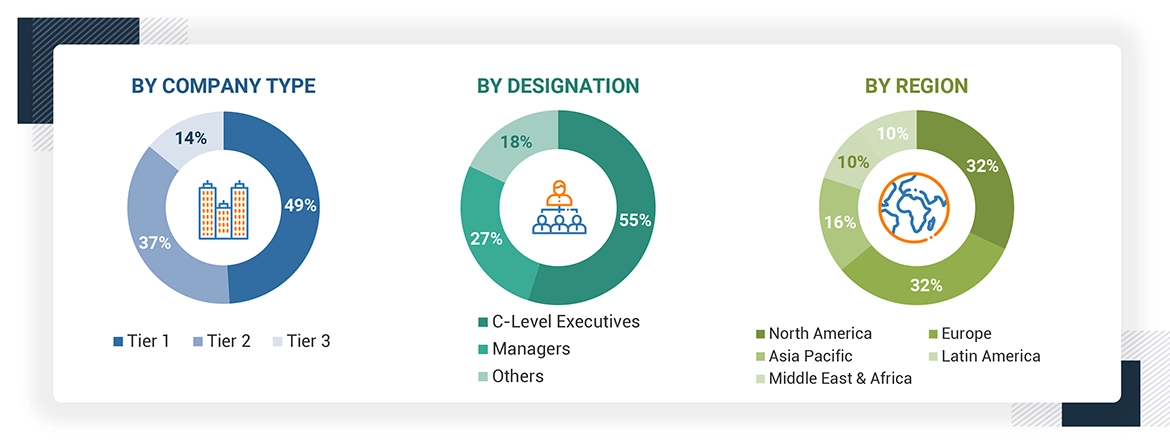
Note: C-level Executives include the CEO, COO, and CTO, among others.
*Others include Sales Managers, Marketing Managers, and Product Managers. The tiers of the companies have been defined based on their total revenue as of 2022. Tier 1 = > USD 1 billion, Tier 2 = USD 100 million to USD 1 billion, and Tier 3 = < USD 100 million
To know about the assumptions considered for the study, download the pdf brochure
Market Size Estimation
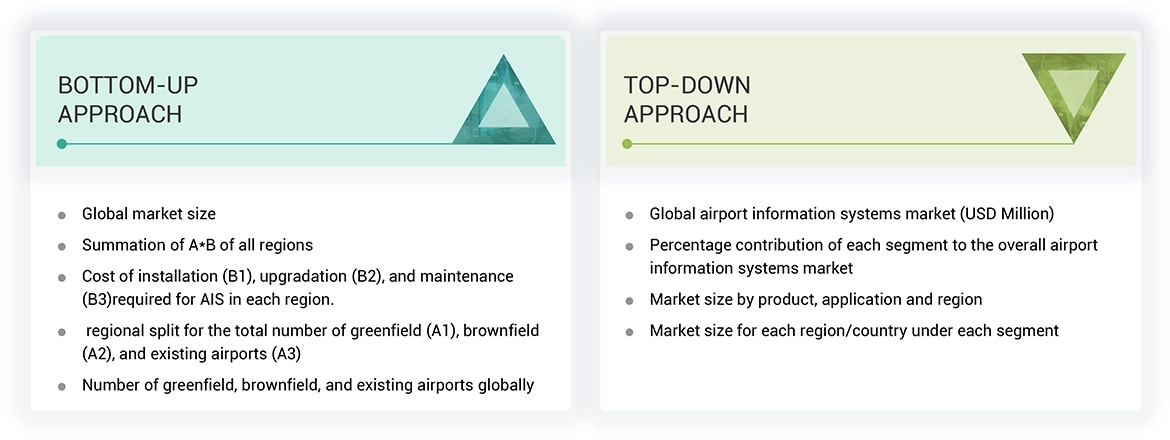
Both top-down and bottom-up approaches were used to estimate and validate the size of the Airport Information Systems market. The research methodology used to estimate the market size includes the following details:
- Key players were identified through secondary research, and their market ranking was determined through primary and secondary research. This included a study of annual and financial reports of the top market players and extensive interviews of leaders, including CEOs, directors, and marketing executives.
- All percentage shares, splits, and breakdowns were determined using secondary sources and verified through primary sources. All possible parameters that affect the markets covered in this research study were accounted for, viewed in extensive detail, verified through primary research, and analyzed to obtain the final quantitative and qualitative data. This data was consolidated, enhanced with detailed inputs, analyzed by MarketsandMarkets, and presented in this report.
Airport Information System Market : Top-Down and Bottom-Up Approach
Data Triangulation
After arriving at the overall size of the Airport information Systems market from the market size estimation process explained above, the total market was split into several segments and subsegments. To complete the overall market engineering process and arrive at the exact statistics for various market segments and sub-segments, the data triangulation and market breakdown procedures explained below were implemented, wherever applicable. The data was triangulated by studying various factors and trends from both the demand and supply sides. The market size was also validated using both the top-down and bottom-up approaches.
Market Definition
The Airport Information Systems (AIS) market focuses on technologies that streamline and optimize airport operations, integrating software, hardware, and real-time data for efficient passenger processing, flight management, resource allocation, and security. Key components like Departure Control Systems (DCS), Airport Operational Databases (AODB), and Flight Information Display Systems (FIDS) enhance decision-making, operational efficiency, and passenger experiences. AIS supports applications in baggage handling, airside management, and dynamic revenue optimization while fostering collaboration among airlines, air traffic control, airport authorities, and ground handlers. AIS solutions are vital for smarter, more connected airport ecosystems by addressing congestion, improving security, and enabling sustainable practices.
Key Stakeholders
Various stakeholders of the market are listed below:
- Systems Manufacturers
- Software Developers of Airport Information Systems
- Service providers
- Airport Authorities
- Airport Staff
- Regulatory Bodies
Report Objectives
- To define, describe, and forecast the airport information systems market based on technology, application, type, implementation, and region.
- To forecast sizes of various segments of the market with respect to major regions, namely, North America, Europe, Asia Pacific, Middle East and Rest of the World along with key countries in each of these regions.
- To identify and analyze the drivers, restraints, opportunities, and challenges influencing the growth of the airport information systems market.
- To identify industry trends, market trends, and technology trends currently prevailing in the airport information systems market
- To provide an overview of the regulatory landscape with respect to airport information systems regulations across regions.
- To analyze micromarkets with respect to individual growth trends, prospects, and their contribution to the overall market
- To analyze opportunities in the market for stakeholders by identifying key market trends
- To profile key market players and comprehensively analyze their market shares and core competencies
- To analyze the degree of competition in the airport information systems market by analyzing recent developments such as contracts, agreements, expansions, and new product launches adopted by leading market players
- To identify detailed financial positions, key products, and unique selling points of leading companies in the market
- To provide a detailed competitive landscape of the market, along with market ranking analysis, market share analysis, and revenue analysis of key players
Available Customizations
Along with the market data, MarketsandMarkets offers customizations according to the specific requirements of companies. The following customization options are available for the report:
Product Analysis
- Product matrix, which gives a detailed comparison of the product portfolio of each company.
Regional Analysis
- Further breakdown of the market segments at the country level
Company Information
- Detailed analysis and profiling of additional market players (up to 5)
Key Questions Addressed by the Report
What is the projected size of the Airport Information Systems Market by 2030?
The global Airport Information Systems Market is projected to grow from USD 4.24 billion in 2024 to USD 5.36 billion by 2030, registering a CAGR of 4.0% during the forecast period.
What are the major factors driving the growth of the Airport Information Systems Market?
Key growth factors include rising passenger volumes, increasing airport IT spending, airport modernization, automated check-in and boarding, baggage automation, facial recognition, self-service technologies, and the growing need for real-time airport information and operational efficiency.
Which application segment is expected to grow at the highest CAGR in the Airport Information Systems Market?
The Cargo and Baggage Management segment is expected to register the highest CAGR of 4.8% during the forecast period. Increasing passenger traffic and the need for efficient baggage and cargo handling are supporting growth in this segment.
Which type of Airport Information System is expected to grow fastest?
The Airport Operational Support Systems segment is projected to grow at the fastest rate. These systems help airports improve operational coordination, resource utilization, flight management, and overall airport efficiency.
Which implementation segment is expected to dominate the Airport Information Systems Market?
The New Installation segment is expected to dominate the market. Greenfield airport projects, airport expansions, replacement of legacy systems, and investments in modern integrated platforms are driving demand for new AIS installations.
Which region accounted for the largest share of the Airport Information Systems Market?
Asia Pacific accounted for the largest regional share, representing approximately 38.1% of the market revenue in 2024. Increasing airport construction, passenger traffic, digital transformation, and infrastructure investment are supporting regional demand.
What are the major challenges facing the Airport Information Systems Market?
Major challenges include management of large datasets, high operating costs, data privacy and security concerns, and the complexity of integrating new technologies with legacy airport systems.
What opportunities exist in the Airport Information Systems Market?
Significant opportunities are emerging from smart airport development, airport expansion in emerging economies, AI-based decision support, predictive maintenance, digital twins, cloud computing, IoT, biometrics, and real-time data analytics.
Who are the key companies operating in the Airport Information Systems Market?
Major companies include SITA, Amadeus IT Group, Vanderlande Industries, Indra, RTX, Siemens, Thales, ADB SAFEGATE, RESA, TAV Technologies, Damarel Systems International, CGI, NEC Corporation, and Honeywell International, among others.
What are the key trends shaping the Airport Information Systems Market?
Key trends include the adoption of AI, predictive analytics, digital twins, cloud-based platforms, biometrics, self-service technologies, IoT, automated passenger processing, real-time operational data, and smart airport solutions. These technologies are helping airports improve passenger flow, resource utilization, security, and operational decision-making.
Fact checked
Personalize This Research
- Triangulate with your Own Data
- Get Data as per your Format and Definition
- Gain a Deeper Dive on a Specific Application, Geography, Customer or Competitor
- Any level of Personalization
Let Us Help You
- What are the Known and Unknown Adjacencies Impacting the Airport Information System Market
- What will your New Revenue Sources be?
- Who will be your Top Customer; what will make them switch?
- Defend your Market Share or Win Competitors
- Get a Scorecard for Target Partners

Custom Market Research Services
We Will Customise The Research For You, In Case The Report Listed Above Does Not Meet With Your Requirements
Get 10% Free CustomisationTESTIMONIALS
- Canada Airport Information System Market
- US Airport Information System Market
- UK Airport Information System Market
- France Airport Information System Market
- Germany Airport Information System Market
- Netherlands Airport Information System Market
- China Airport Information System Market
- India Airport Information System Market
- Japan Airport Information System Market
- Singapore Airport Information System Market
- Australia Airport Information System Market
- UAE Airport Information System Market
- Saudi Arabia Airport Information System Market
- Brazil Airport Information System Market
- Mexico Airport Information System Market
- South Africa Airport Information System Market
- Middle East Airport Information System Market
- Rest Of Europe Airport Information System Market
- Rest Of Asia Pacific Airport Information System Market
- Rest Of World Airport Information System Market
Growth opportunities and latent adjacency in Airport Information System Market






Gabriel
Apr, 2026
Can I get a detailed breakdown of airport information system adoption across passenger processing, security, and operational systems by region?.
Austin
Apr, 2026
Can I explore pricing benchmarks for new installations vs upgrades across small, mid sized, and large airports?.