Asia Pacific Acoustic Insulation Market

Asia Pacific Acoustic Insulation Market by Material (Glass Wool, Rock Wool, Foamed Plastic, Elastomeric Foam, Other Materials), End-Use Industry (Building & Construction, Transportation, Oil & Gas and Petrochemical, Energy & Utilities, Industrial & OEM), and Country - Forecast to 2030




OVERVIEW
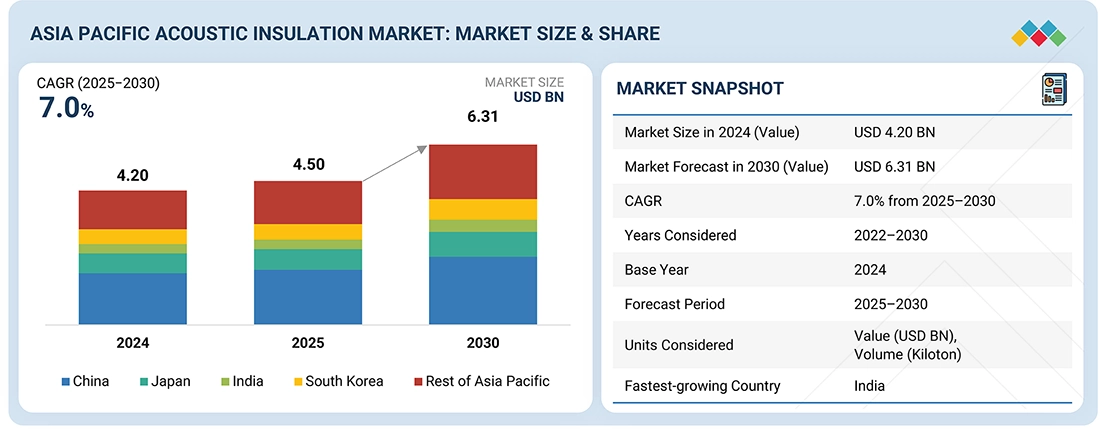
Source: Secondary Research, Interviews with Experts, MarketsandMarkets Analysis
The Asia Pacific acoustic insulation market is projected to reach USD 6.31 billion by 2030, growing from USD 4.50 billion in 2025, at a CAGR of 7.0% during the forecast period. The market is driven by progressive urbanization, increased construction, and the enforcement of building regulations that aim at reducing noise pollution as well as saving energy. Additionally, the demand for quieter living, working, and even industrial spaces in crowded cities is further driving the use of insulation materials. People are becoming more aware of the effects of noise and are demanding workplace comfort. Moreover, due to the rising disposable income of people, there is a continuous increase in the production of automobiles, which is also driving the demand for high-tech insulation materials across the region.
KEY TAKEAWAYS
-
By CountryChina is estimated to account for the largest share (36%) of the Asia Pacific acoustic insulation market in 2025.
-
By MaterialBy material, the foamed plastic segment accounted for the largest market share (27.5%) of the Asia Pacific acoustic insulation market in 2024.
-
By End-Use IndustryBy end-use industry, the energy & utilities segment is projected to achieve the highest growth rate of 6.6% during forecast period.
-
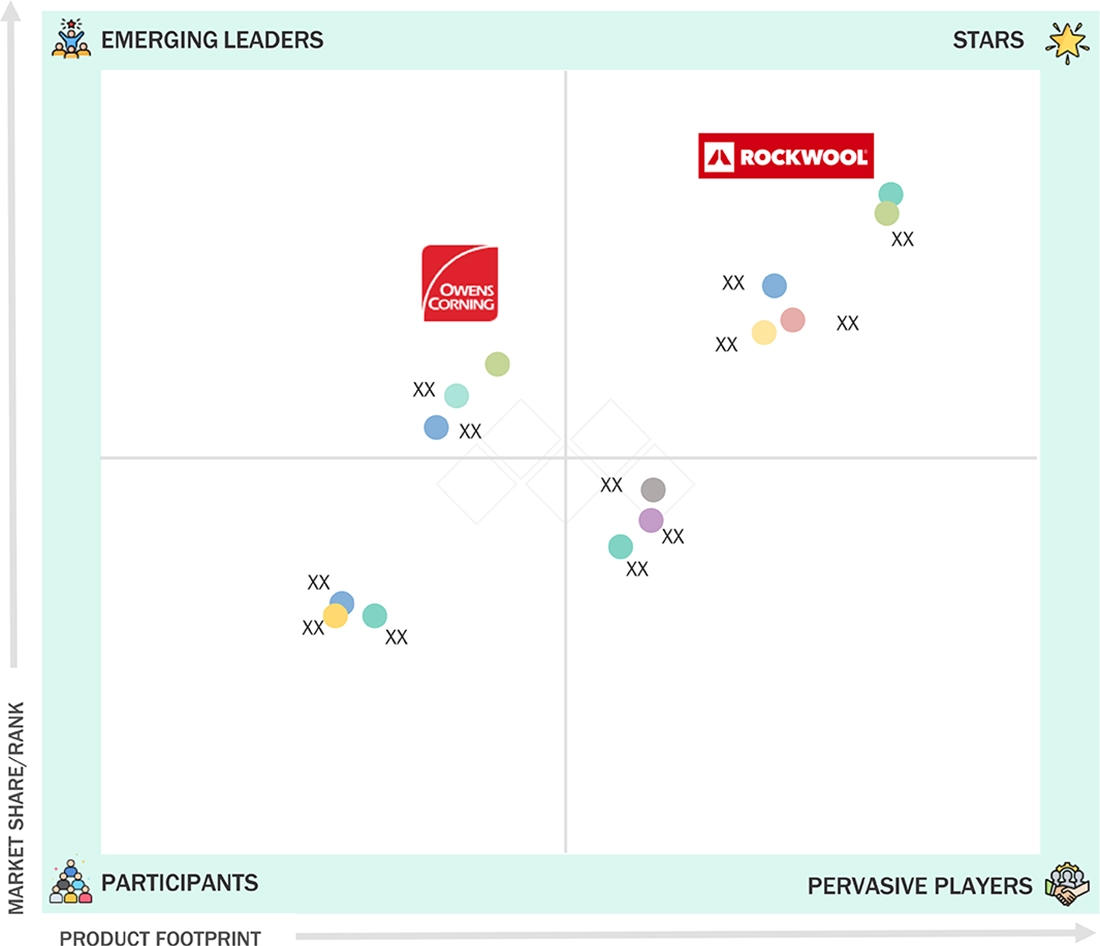
Competitive Landscape - Key PlayersCompany Rockwool A/S (Denmark), Saint-Gobain (France), and Armacell (Germany) were identified as some of the star players in the Asia Pacific acoustic insulation market, given their strong market share and product footprint.
-
Competitive Landscape - StartupsWedge India, Shenzhen Vinco Soundproofing Materials Co.,Ltd, Guangzhou Hui Acoustics Building Materials Co., Ltd., among others, have distinguished themselves among startups and SMEs by securing strong footholds in specialized niche areas.
The Asia Pacific acoustic insulation market is growing at a fast pace because of urbanization, construction activity, and implementation of strict noise-control regulations in major economies. The demand for insulation materials is high in crowded cities where people crave for quiet residential and commercial spaces. This is spurring the demand for acoustic insulation materials. Additionally, increased development of infrastructure in the transport and industrial sectors is further boosting the demand for these materials because of the benefits they provide. Moreover, concerns around the health and productivity impact of noise pollution are driving governments to impose guidelines mandating the use of insulation materials. This is another factor boosting the demand for new high-performance insulation materials.
TRENDS & DISRUPTIONS IMPACTING CUSTOMERS' CUSTOMERS
The impact of customer business on the Asia Pacific acoustic insulation market is largely determined by the evolving market demand toward energy-efficient, eco-friendly, and law-compliant buildings. Leading companies like LARSEN & TOUBRO LIMITED, TOYOTA MOTOR CORPORATION, and CSCEC are insisting on top-notch acoustic and thermal solutions, speedy and skilled installation, and using green materials to meet the local requirements of low operational costs, better indoor comfort, healthy living and working environments, and high long-term property value. This is driving the need for periodical innovations, sophisticated material technologies, and strict quality assurance to satisfy the demands of users. These factors are boosting the growth of construction solutions that are sustainable, regulation-compliant, and have a high value in Asia Pacific acoustic insulation market.
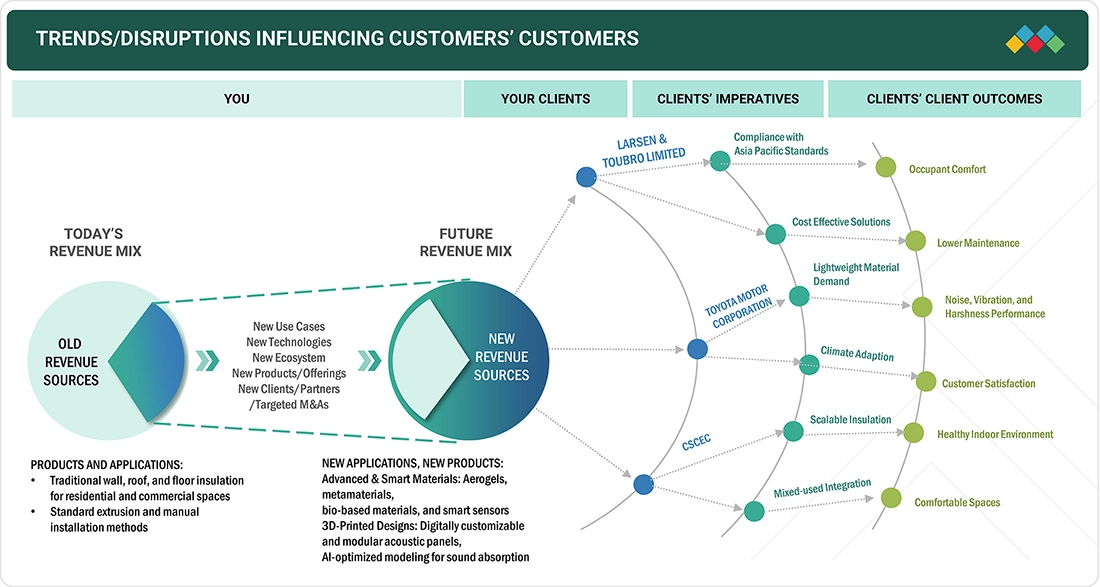
Source: Secondary Research, Interviews with Experts, MarketsandMarkets Analysis
MARKET DYNAMICS

Level
-
Rapid urbanization and growth in construction industry

-
Stringent regulations


Level
-
High upfront material and installation costs

-
Raw-material price volatility and supply constraints


Level
-
Growth in retrofit and renovation markets

-
Adoption of aerogel and metamaterial technology


Level
-
Limited awareness and technical expertise

-
Fluctuations in raw material prices

Source: Secondary Research, Interviews with Experts, MarketsandMarkets Analysis
Driver: Rapid urbanization and growth in construction industry
The Asia Pacific acoustic insulation market is driven by rapid urbanization and a significant increase in construction activities. High-density residential complexes, commercial buildings, transport hubs, and industrial facilities are the main sources of noise and help the demand for materials that not only provide acoustic comfort but also comply with strict building regulations. Governments and developers are increasingly considering soundproofing materials to enhance living standards, boost energy efficiency, and improve overall building performance.
Restraint: High upfront material and installation costs
The major factor restraining the growth of the Asia Pacific acoustic insulation market are high upfront material and installation costs, as most construction projects in the region are done under tight budgets. Additionally, the use of premium acoustic materials, specialized labor, and complex installation processes push the overall building costs upward especially in less-developed countries. As a result, small contractors and residential builders restrict the usage of advanced soundproofing materials. Moreover, the lack of knowledge about the life cycle benefits makes it difficult for consumers to invest in quality insulation. These cost barriers slow down market growth, even though urbanization and noise control needs are on the rise.
Opportunity: Growth in retrofit and renovation markets
The expanding retrofitting and renovation market in the Asia Pacific region presents a significant opportunity for the acoustic insulation industry. Many older buildings lack proper soundproofing and energy-efficient materials. Upgrading these buildings to reduce noise, improve comfort, and comply with current building codes is essential, especially with the growing urban population. Additionally, governments and property owners are increasingly investing in modernization projects that enhance real estate value and promote environmental sustainability. As a result, there is an increasing demand for easy-to-install acoustic insulation solutions that are suitable for occupied spaces.
Challenge: Limited awareness and technical expertise
The Asia Pacific acoustic insulation market is greatly hindered by limited awareness and a lack of technical expertise. Builders, developers, and end-users are not fully aware of the advantages of acoustic insulation, such as noise reduction, energy saving, and meeting building codes. Moreover, the proper choice and installation of soundproofing materials require not only professional skills but also technical skills, which are often not available in the area. Consequently, this ignorance leads to poor practice, improper installations, and the use of cheaper alternatives with limited effectiveness in the market's suboptimal adoption. Therefore, the market growth is restricted as the potential users still hesitate to place their investments in soundproofing solutions that have high efficacy.
ASIA PACIFIC ACOUSTIC INSULATION MARKET: COMMERCIAL USE CASES ACROSS INDUSTRIES
| COMPANY | USE CASE DESCRIPTION | BENEFITS |
|---|---|---|
 |
Stone wool slabs and boards for walls, floors, ceilings, HVAC, and industrial/marine applications | Excellent thermal, acoustic, and fire performance |
 |
Glass wool/Mineral wool insulation and acoustic ceiling/wall panels for commercial and residential buildings | High sound absorption and thermal efficiency |
 |
Flexible elastomeric foam for HVAC ducting, industrial piping, and soundproofing in automotive | Reduces impact and airborne noise |
 |
Rock wool and ceramic fiber products for sound and heat insulation | Provides thermal and acoustic comfort with fire resistance |
 |
Glasswool batts, blankets, and thermal/acoustic wraps for residential and commercial building applications | Strong performance in industrial noise control |
Logos and trademarks shown above are the property of their respective owners. Their use here is for informational and illustrative purposes only.
MARKET ECOSYSTEM
The ecosystem of the Asia Pacific acoustic insulation market comprises raw material suppliers (NICHIAS Corporation, BNBM, Shanghai ABM Rock Wool Co., Ltd.), manufacturers (Saint-Gobain, ROCKWOOL, Armacell), distributors (Foster Asia Pacific Pte Ltd., Incorporated, Kingspan Group, Knauf Insulation), and end users (LARSEN & TOUBRO LIMITED, TOYOTA MOTOR CORPORATION, CSCEC). Raw material suppliers supply fibers, minerals, and polymers for the production of effective insulation materials. Manufacturers process these raw materials into acoustic insulation. Distributors manage the storage, transportation, and delivery to contractors. End users, including real estate developers and construction companies, use these materials to enhance the sound quality and comply with local noise control regulations.
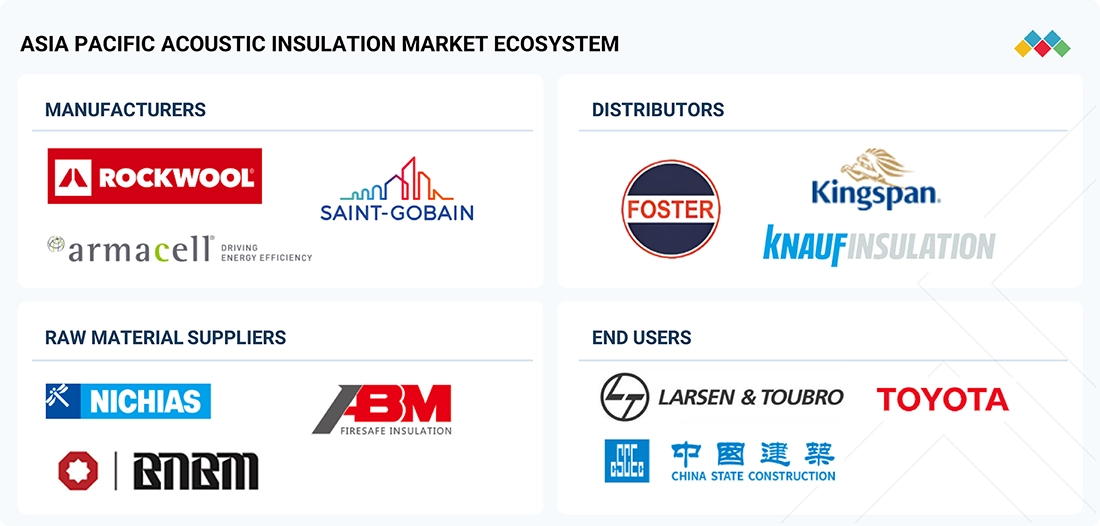
Logos and trademarks shown above are the property of their respective owners. Their use here is for informational and illustrative purposes only.
MARKET SEGMENTS
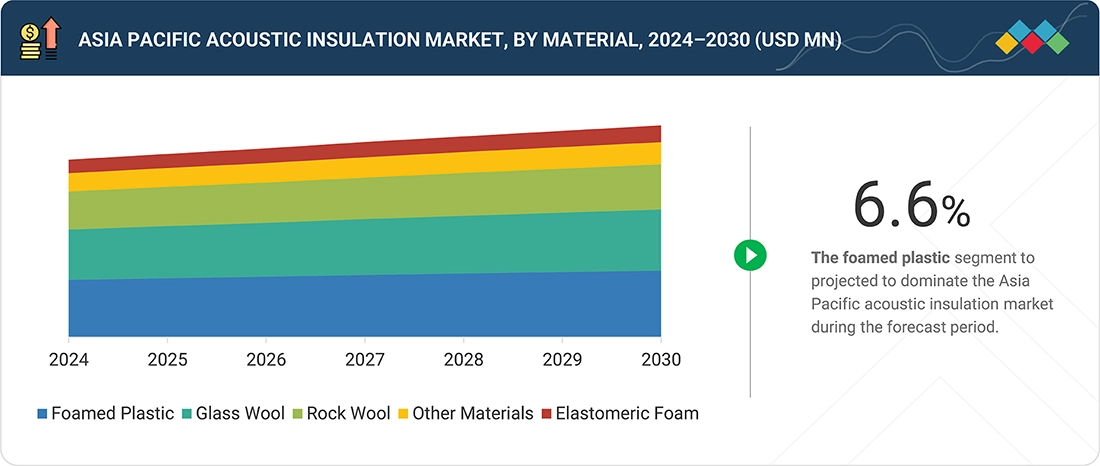
Source: Secondary Research, Interviews with Experts, MarketsandMarkets Analysis
Asia Pacific Acoustic Insulation Market, by Material
In the Asia Pacific region, the foamed plastic segment is estimated to be the leading market during the forecast period. This growth is due to the excellent sound absorption properties, lightweight nature, and affordability of foam plastic. Among these materials, polyurethane and polystyrene stand out for their high thermal and acoustic performance. The issue of noise pollution is exacerbated by rapid urbanization and the expansion of construction areas in countries such as China, India, and Southeast Asia, which increases the demand for versatile and easy-to-install insulation solutions. Foamed plastic offers several advantages over other materials. Some of these qualities are durability, resistance to moisture, and design versatility. These qualities help meet new building regulations and urgent sound control requirements in the region.
Asia Pacific Acoustic Insulation Market, by End-Use Industry
The building & construction segment is projected to be the largest segment during the forecast period. This is primarily due to rapid urbanization, infrastructural development, and the increasing number of residential and commercial projects in the region. Urbanization in countries like China, India, and Southeast Asia is creating a demand for improved living and working environments, leading to a greater use of acoustic insulation for noise reduction and comfort. Additionally, stricter building codes and noise control regulations are encouraging developers to opt for high-performance insulation materials. The construction of multi-layered housing complexes, offices, hotels, and public facilities further drives the demand for acoustic insulation, solidifying its place as the largest end-use industry.
REGION
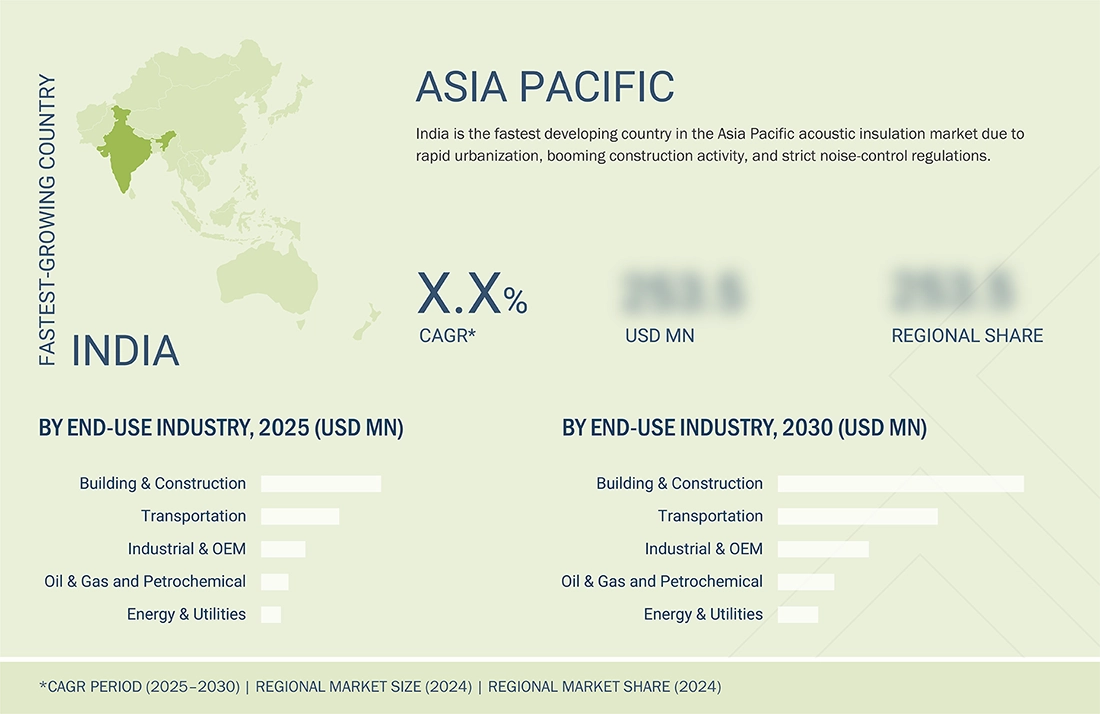
India to be fastest-growing country in the Asia Pacific acoustic insulation market during the forecast period
India is the fastest-growing country in the Asia Pacific acoustic insulation market, driven by a high demand for acoustic insulation solutions. This demand is fueled by several factors, including rapid urbanization, growth in the construction industry, and increased investments in residential, commercial, and industrial infrastructure. Concerns about noise pollution and the desire for indoor acoustic comfort are also contributing to the need for advanced insulation solutions. Government policies that promote the development of smart cities, sustainable buildings, and stricter building codes are further supporting market growth. Additionally, rising middle-class incomes, a booming real estate sector, and the establishment of new factories are making the use of acoustic insulation common across various sectors. As a result, India is becoming the primary driver of growth for the acoustic insulation market in the region.
ASIA PACIFIC ACOUSTIC INSULATION MARKET: COMPANY EVALUATION MATRIX
In the Asia Pacific acoustic insulation market, ROCKWOOL (Star) is recognized for its extensive range of stone wool products, strong brand presence, and advanced insulation technologies suitable for residential, commercial, and industrial applications. Additionally, its commitment to sustainability and robust distribution network reinforces its leading position in the market. On the other hand, Owens Corning (Emerging Leader) capitalizes on its innovative acoustic solutions made from polymers and fiberglass, focusing on noise and vibration control. The company's growing involvement in high-performance building, industrial applications, and transportation makes it a competitor to watch in this sector.
Source: Secondary Research, Interviews with Experts, MarketsandMarkets Analysis
KEY MARKET PLAYERS
- Saint-Gobain (France)
- Armacell (Germany)
- Rockwool (Denmark)
- BASF (Germany)
- Owens Corning (US)
- Johns Manville (US)
- Knauf Insulation (US)
- Huntsman International (US)
- 3M (US)
- Dow (US)
MARKET SCOPE
| REPORT METRIC | DETAILS |
|---|---|
| Market Size in 2024 (Value) | USD 4.20 Billion |
| Market Forecast in 2030 (Value) | USD 6.31 Billion |
| Growth Rate | CAGR of 7.0% from 2025–2030 |
| Years Considered | 2022–2030 |
| Base Year | 2024 |
| Forecast Period | 2025–2030 |
| Units Considered | Value (USD Billion), Volume (Kiloton) |
| Report Coverage | Revenue Forecast, Company Ranking, Competitive Landscape, Growth Factors, and Trends |
| Segments Covered |
|
| Countries Covered | China, Japan, India, South Korea, Rest of Asia Pacific |
WHAT IS IN IT FOR YOU: ASIA PACIFIC ACOUSTIC INSULATION MARKET REPORT CONTENT GUIDE
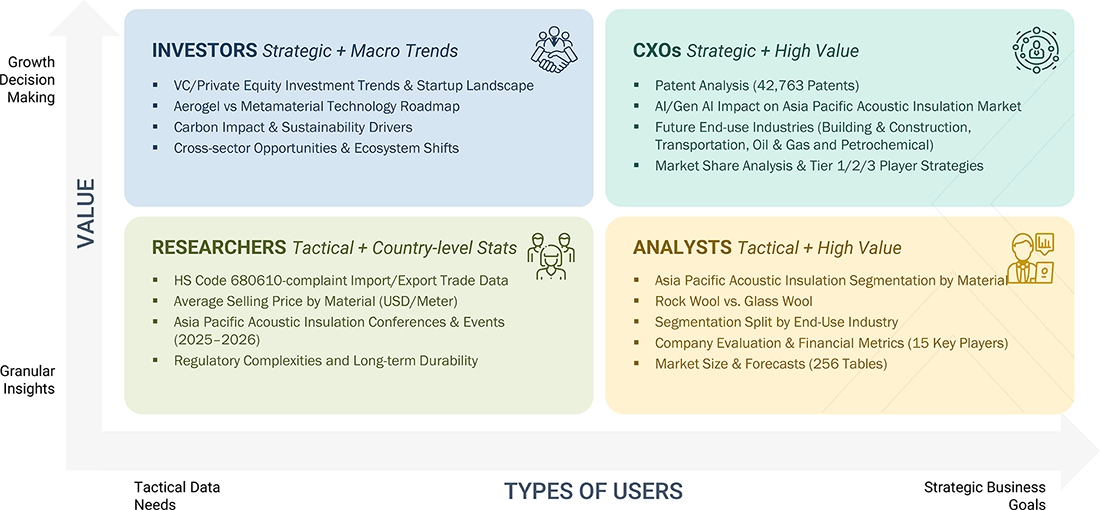
DELIVERED CUSTOMIZATIONS
We have successfully delivered the following deep-dive customizations:
| CLIENT REQUEST | CUSTOMIZATION DELIVERED | VALUE ADDS |
|---|---|---|
| Construction & Infrastructure Developer | Profile Asia Pacific insulation suppliers, certifications, fire-safety compliance, and logistics performance across major regional markets | Improve supplier selection, long-term sourcing decisions, and regional project planning |
| Acoustic Insulation Manufacturer | Benchmark materials on STC/NRC performance, humidity resistance, sustainability, and Asia Pacific green-building standards | Support product innovation aligned with regional climate and regulatory needs |
| Raw Material Supplier | Map demand for fibers, polymers, and recycled materials across China, India, ASEAN, and Australia. | Guide capacity planning and expansion into high-growth Asia Pacific markets |
RECENT DEVELOPMENTS
- February 2023 : Armacell opened the ArmaLive Training Centre in Singapore. With the help of this center, installers, contractors, and engineers will not only understand insulation properly but also know the best practices in installation that will eventually lead to waste reduction, time-saving, and professionally installed systems with reliable performance.
- February 2022 : Saint-Gobain signed the deal with the Alghanim Group to take over its fully owned subsidiary, Rockwool India Pvt Ltd. Leading stone wool producer in India, Rockwool India, provides a complete variety of insulation items for thermal, acoustic, and fire safety applications. Rockwool India runs two manufacturing plants in India, situated in Hyderabad and Silvassa. The company has an extensive marketing network all over the country.
- September 2021 : KPX Chemical and Huntsman made an announcement about the formation of a joint venture called KPX Huntsman Polyurethanes Automotive Co., Ltd. This step will enable the production and offering of novel polyurethane system solutions by creating a specialty polyurethanes manufacturing facility at KPX Chemical's Ulsan plant, which will directly serve Korean automakers.
Table of Contents
 Exclusive indicates content/data unique to MarketsandMarkets and not available with any competitors.
Methodology
The study involved four major activities in estimating the market size of the Asia Pacific acoustic insulation market. Exhaustive secondary research was done to collect information on the market, the peer market, and the grandparent market. The next step was to validate these findings, assumptions, and sizing with industry experts across the value chain through primary research. Both top-down and bottom-up approaches were employed to estimate the complete market size. Thereafter, the market breakdown and data triangulation procedures were used to estimate the market size of the segments and subsegments.
Secondary Research
In the secondary research process, various secondary sources have been referred to for identifying and collecting information for this study. These secondary sources include annual reports, press releases, investor presentations of companies, white papers, certified publications, trade directories, articles from recognized authors, gold standard and silver standard websites, and databases. Secondary research has been used to obtain key information about the value chain of the industry, monetary chain of the market, the total pool of key players, market classification and segmentation according to industry trends to the bottom-most level, and regional markets. It was also used to obtain information about the key developments from a market-oriented perspective.
Primary Research
The Asia Pacific acoustic insulation market comprises several stakeholders in the value chain, which include manufacturers, and end users. Various primary sources from the supply and demand sides of the Asia Pacific acoustic insulation market have been interviewed to obtain qualitative and quantitative information. The primary interviewees from the demand side include key opinion leaders in construction sector. The primary sources from the supply side include manufacturers, associations, and institutions involved in the Asia Pacific acoustic insulation industry. Primary interviews were conducted to gather insights such as market statistics, data of revenue collected from the products and services, market breakdowns, market size estimations, market forecasting, and data triangulation. Primary research also helped in understanding the various trends related to material, end-use industry, and region. Stakeholders from the demand side, such as CIOs, CTOs, and CSOs were interviewed to understand the buyer’s perspective on the suppliers, products, component providers, and their current usage of Asia Pacific acoustic insulation and outlook of their business, which will affect the overall market.
To know about the assumptions considered for the study, download the pdf brochure
Market Size Estimation
The top-down and bottom-up approaches have been used to estimate and validate the size of the Asia Pacific acoustic insulation market.
- The key players in the industry have been identified through extensive secondary research.
- The supply chain of the industry has been determined through primary and secondary research.
- All percentage shares, splits, and breakdowns have been determined using secondary sources and verified through primary sources.
- All possible parameters that affect the markets covered in this research study have been accounted for, viewed in extensive detail, verified through primary research, and analyzed to obtain the final quantitative and qualitative data.
- The research includes the study of reports, reviews, and newsletters of the key market players, along with extensive interviews for opinions with leaders such as directors and marketing executives.
Data Triangulation
After arriving at the total market size from the estimation process, the overall market has been split into several segments and sub-segments. To complete the overall market engineering process and arrive at the exact statistics for all the segments and sub-segments, the data triangulation and market breakdown procedures have been employed, wherever applicable. The data has been triangulated by studying various factors and trends from both the demand and supply sides. Along with this, the market size has been validated by using both the top-down and bottom-up approaches and primary interviews. Hence, for every data segment, there have been three sources—top-down approach, bottom-up approach, and expert interviews. The data was assumed correct when the values arrived from the three sources matched.
Market Definition
Accoustic insulation is a lightweight bulky material that absorbs sound wave and enhance work environment. Acoustic insulation absorbs sound when it enters buildings through the walls and ceilings, reducing echo in homes, workplaces, and other spaces. It's also utilized in automobiles and aircraft to lessen engine noise that enters the passenger cabin. It lessens reverberation across the room, which aids in sound absorption in auditoriums and concert halls.
Key Stakeholders
- Senior Management
- End User
- Finance/Procurement Department
- R&D Department
- Manufacturers
- Raw Material Suppliers
Report Objectives
- To define, describe, and forecast the size of the Asia Pacific acoustic insulation market, in terms of value and volume.
- To provide detailed information regarding the major factors (drivers, opportunities, restraints, and challenges) influencing the growth of the market
- To estimate and forecast the market size based on type, end-use industry, and region.
- To strategically analyze micromarkets with respect to individual growth trends, prospects, and their contribution to the overall market
- To analyze opportunities in the market for stakeholders and provide a competitive landscape of market leaders.
- To track and analyze recent developments such as expansions, new product launches, partnerships & agreements, and acquisitions in the market.
- To strategically profile key market players and comprehensively analyze their core competencies.
Available Customizations
Along with the given market data, MarketsandMarkets offers customizations according to the company’s specific needs. The following customization options are available for the report:
Regional Analysis
- Further breakdown of a region with respect to a particular country or additional application
Company Information
- Detailed analysis and profiles of additional market players
Tariff & Regulations
- Regulations and Impact on Asia Pacific acoustic insulation market


Personalize This Research
- Triangulate with your Own Data
- Get Data as per your Format and Definition
- Gain a Deeper Dive on a Specific Application, Geography, Customer or Competitor
- Any level of Personalization
Let Us Help You
- What are the Known and Unknown Adjacencies Impacting the Asia Pacific Acoustic Insulation Market
- What will your New Revenue Sources be?
- Who will be your Top Customer; what will make them switch?
- Defend your Market Share or Win Competitors
- Get a Scorecard for Target Partners

Custom Market Research Services
We Will Customise The Research For You, In Case The Report Listed Above Does Not Meet With Your Requirements
Get 10% Free CustomisationTESTIMONIALS

We at Nissan Chemicals Corporation have been clients of MarketsandMarkets for more than a year now. We recently consulted MarketsandMarkets for a study, the team at MarketsandMarkets was extremely professional and organized. The business insights were very detailed and aligned well with our expectations that really helped us formulate the Business Plans and device new strategies for development themes. MarketsandMarkets offers a unique combination of expertise and dedicated engagement model. Their research findings have helped us in designing our Pricing Strategy which will make it easier for us to predict the future sales and profits for the next ten years. We look forward to working with MarketsandMarkets in the future.
VP of Strategy & New Business Development
Leading Specialty Chemical Company
The MarketsandMarkets Engagement Model, composed of both the Knowledge Store and advisory custom research, has greatly helped us in understanding our markets and making strategic decisions. The Knowledge Store is a fast way to allow everyone in our organization to understand more about most any market they are interested in. The ability to then get custom research done and get answers to specific strategic questions and market insight has been spectacular. The Markets and Markets team feel more like colleagues than vendors and their services have helped us change our culture where statements of things like growth opportunities and competitive position are always backed by industry research.

Rich Gibson,
Director, Corporate Strategy
Milliken & Company,
Leading Industrial Manufacturer of specialty chemical, floor covering, performance and protective textile materials, and healthcaremilliken.com
MarketsandMarkets is a trusted resource that helps us to better understand markets that are near-adjacencies-whether its technology, value chain or geography. Their Knowledge Store platform provides a dashboard of markets and their characteristics which is easy to use and saves us time.
Adam Shaw,
Market Development and Strategy Manager
AdvanSix Inc. USA,
An American Leader in Chemicalswww.advansix.com
The Knowledge Store from MarketsandMarkets is a valuable tool which has helped my team acquire greater insight in to the end markets that our business serves. This has enabled us to help our company build stronger strategies throughout our planning process.
TOSHIO KINOSHITA
Senior Chif Consultion Research & Consulting Division
Mitsubishi Chemical Research Corporation,
Leading Manufacturer of Chemical Productswww.mitsubishichem-res.co.jp/en/

We recently engaged with MarketsandMarkets for a study, the team not only clearly understood our business objectives but was also extremely professional in the way they handled the entire project. The study was efficiently conducted in a phase-wise manner, and the engagement model furnished us with high-quality business insights that far exceeded our expectations at each phase. We were especially happy that MarketsandMarkets could provide us with both, an English as well as a Japanese version of the study. A special thanks to the Analyst Team and Client Services Team, whose fluency in Japanese enhanced our comfort level, as we could converse with them in our preferred language.
Independent entrepreneurs
Arrow Precision
We approached MarketsandMarkets for study on Proppants Market, and their work exceeded our expectations. The study conducted was comprehensive and enabled us to view the market through the various dimensions. In addition, the team was extraordinarily responsive throughout the process and resolved our queries on time. I strongly recommend MarketsandMarkets and will certainly consider them for additional market assessments we will need in the future.
Global engineering company, Japan
Deputy Manager,
Strategic Planning OfficeThe high-quality insights shared by the MarketsandMarkets team helped us understand the pharmaceutical plant designers in a specific geography. It also captured the risks that we may likely face in communicating with our potential partners. The study would enable us identify partners, which would impact our future growth.






Growth opportunities and latent adjacency in Asia Pacific Acoustic Insulation Market