Asia Pacific Healthcare Analytics Market Size, Growth, Share & Trends Analysis

Asia Pacific Healthcare Analytics Market by Type (Predictive, Diagnostic), Application (Claim, RCM, Fraud, Precision Health, RWE, Imaging, Supply Chain, Population Health), End User (Payer, Hospital, ASC), Trend, Market Share, Growth - Forecast to 2030




OVERVIEW
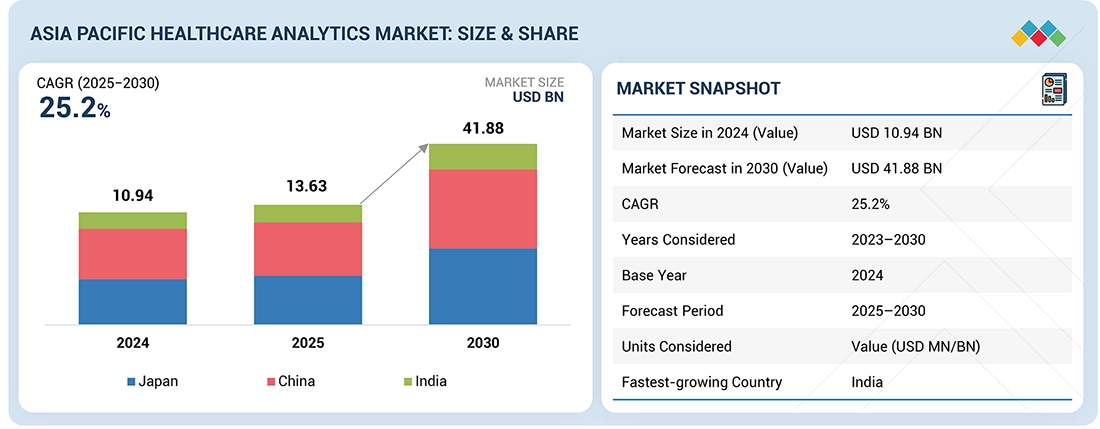
Source: Secondary Research, Interviews with Experts, MarketsandMarkets Analysis
The Asia Pacific healthcare analytics market, valued at US$10.94 billion in 2024, stood at US$13.63 billion in 2025 and is projected to advance at a resilient CAGR of 25.2% from 2024 to 2030, culminating in a forecasted valuation of US$41.88 billion by the end of the period. The growth of the Asia Pacific healthcare analytics market is driven by the increase in government-led digital health strategies and regional action frameworks.
KEY TAKEAWAYS
-
By CountryThe Asia Pacific healthcare analytics market for China accounted for a 38.2% revenue share in 2024.
-
By ComponentBy component, the services segment is expected to register the highest CAGR of 25.7%.
-
By TypeBy type, the prescriptive analytics segment is projected to grow at the fastest rate from 2025 to 2030.
-
By ApplicationBy application, the clinical analytics segment is expected to dominate the market.
-
By End UseBy end use, the providers segment accounted for the largest share, with a 44.4% revenue share in 2024.
-
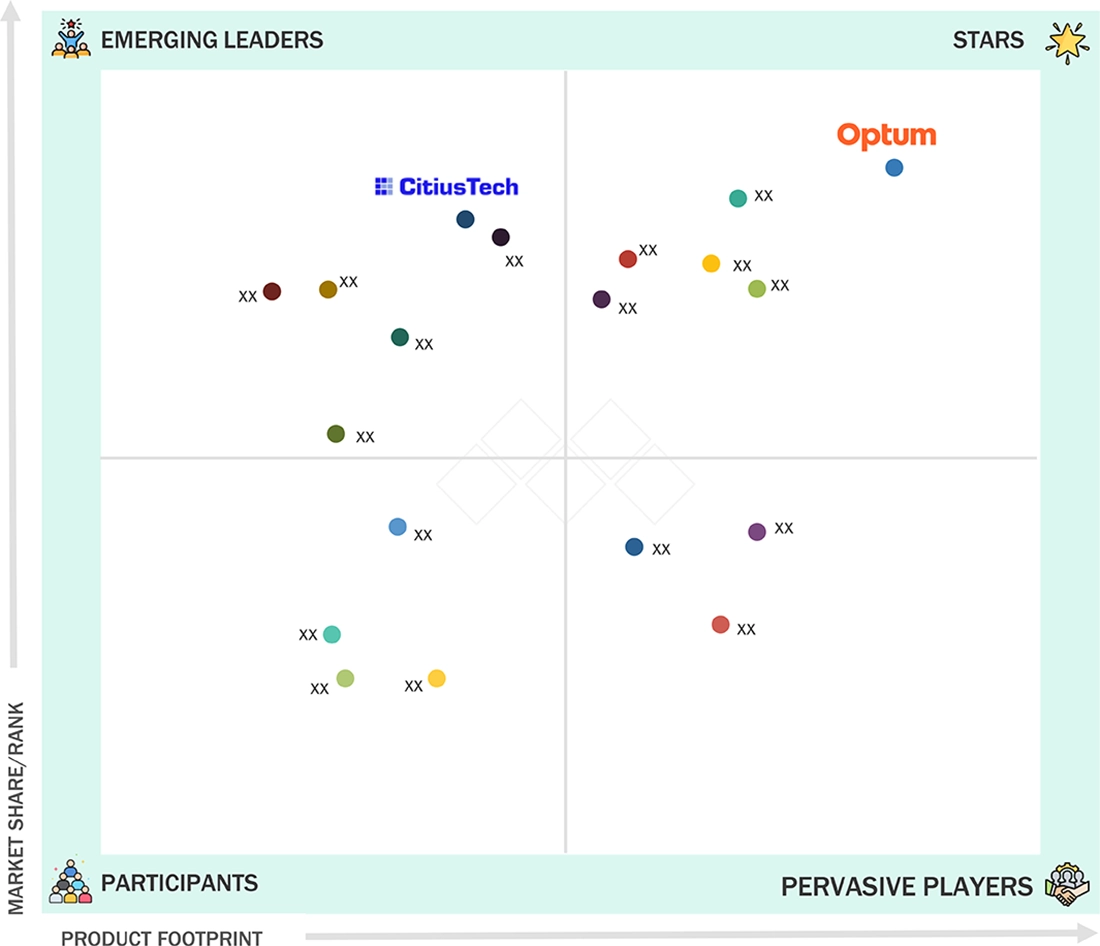
Competitive LandscapeMerative, SAS Institute Inc., and Optum, Inc. were identified as some of the star players in the Asia Pacific healthcare analytics market, given their strong market share and product footprint.
-
Competitive LandscapeTredence Inc, Heaps Health Solutions India Private Limited, and Myhealthcare Technologies Private Limited, among others, have distinguished themselves among startups and SMEs by securing strong footholds in specialized niche areas, underscoring their potential as emerging market leaders
The healthcare analytics market in Asia Pacific is a growing segment, driven by the need for information-driven healthcare decisions, including the development and utilization of AI-powered clinical insights and predictive capabilities to enhance patient outcomes at reduced expenditures. Some recent breakthroughs include strategic partnerships with healthcare systems and vendors of analytics solutions, investments in cloud-based analytics platform infrastructure, and innovations in real-world evidence (RWE), population health analytics, and interoperability solutions, which are leading to a revolution in this industry landscape and accelerating digital health maturity.
TRENDS & DISRUPTIONS IMPACTING CUSTOMERS' CUSTOMERS
The Asia Pacific healthcare analytics market is seeing drastic changes due to various key trends and disruptions. These are changing the way industries deploy healthcare analytics solutions across various sectors and have also indicated a gradual shift from conventional models to advanced, data-driven solutions. AI-driven predictive analytics, value-based care models, interoperability, and increased data integration are emerging as vital levers for future revenue pools. Additionally, regulatory compliance, data security, and new technologies such as machine learning, artificial intelligence, IoT, cloud computing, and blockchain are gaining traction among clients, including private insurance firms, government agencies, hospitals, and post-acute care organizations. All these trends will drive the evolution in customer business models, leading to better decision-making, improved patient care, and higher operational efficiencies.
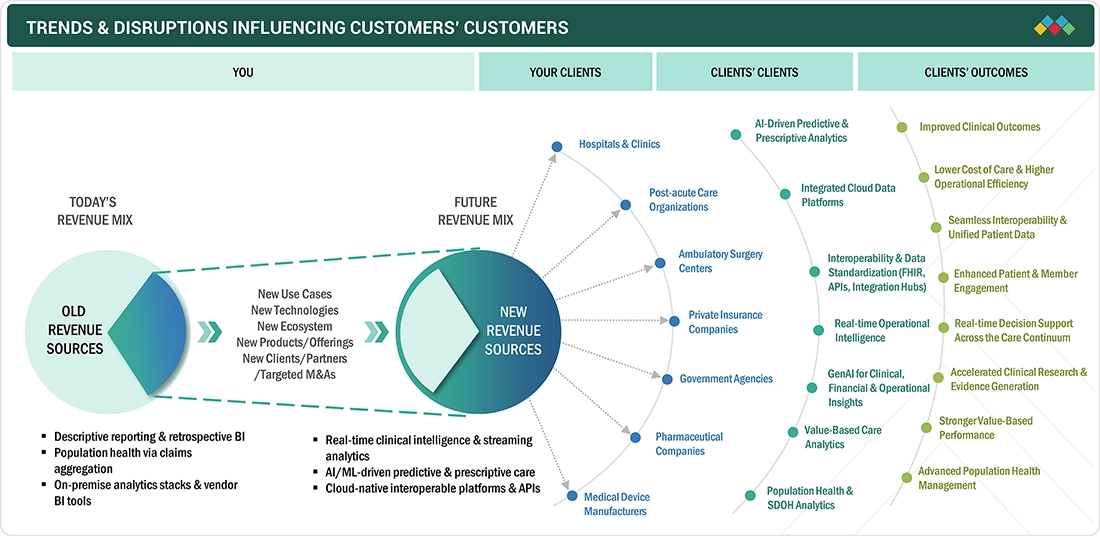
Source: Secondary Research, Interviews with Experts, MarketsandMarkets Analysis
MARKET DYNAMICS

Level
-
Government-led digital health strategies and regional action frameworks

-
Increase in digital health funding in AI and analytics


Level
-
High cost of healthcare analytics solutions

-
Cybersecurity & patient-data breach risk


Level
-
Shift toward value-based care and outcome-driven medicines

-
Growing penetration of digital health platforms, mobile health apps, and social media data


Level
-
Reluctance to adopt healthcare analytics solutions in developing countries

-
Data quality, accuracy, and standardization issues across care settings

Source: Secondary Research, Interviews with Experts, MarketsandMarkets Analysis
Driver: Government-led digital health strategies and regional action frameworks
The presence of government-led digital healthcare strategies and regional action plans is a major driver in the Asia Pacific healthcare analytics market. India, Singapore, Australia, China, and Japan have established country-wide digital healthcare strategies with an emphasis on setting standards for health information and developing regional healthcare analytics tools with higher interoperability. Programs such as the National Digital Health Mission in India, Healthier SG in Singapore, and Healthy China 2030 in China are creating awareness among medical institutions and bodies in this region about future healthcare solutions, including EHR integration, real-time information exchange, and AI-enabled analytics solutions.
Restraint: High cost of healthcare analytics solutions
A major factor restricting the Asia Pacific healthcare analytics market is the high cost of healthcare analytics solutions. Sophisticated analytics solutions, AL-enabled predictive solutions, and cloud architectures tend to have a higher setup and maintenance cost and need specialized manpower. Moreover, small and medium-sized medical institutions in the Asia Pacific may have budget limitations for investing in advanced analytics solutions. A major setback in adopting advanced healthcare analytics solutions in the Asia Pacific countries is the cost of integrating these solutions with existing electronic medical record systems. The cost of integration with less advanced digital infrastructure in developing economies might be a major hurdle in the Asia Pacific healthcare analytics market.
Opportunity: Shift toward value-based care and outcome-driven medicines
The emerging focus on value-based healthcare and outcomes-oriented medicine has emerged as a key opportunity for the healthcare analytics market in the Asia Pacific. With a growing urge to derive better patient outcomes, optimization of resources, and strategic preventive measures, healthcare providers and buyers have increasingly turned to healthcare analytics. AI-powered predictive modeling, real-time analytical solutions, and evidence-driven healthcare pathways can help in performance tracking and population healthcare management. Analytics solutions were part of nationally launched programs in countries such as India, Singapore, Australia, and Japan, promoting outcome-based payment in these regions.
Challenge: Reluctance to adopt healthcare analytics solutions in developing countries
In developing countries, there is a lack of developed infrastructure in terms of digital development, a shortage of skilled professionals, and basic privacy concerns, which makes it difficult for many of these nations to adopt analytics solutions in their hospitals. In many of these countries, a traditional method of handling patients’ data and decision-making is followed, which delays many countries in adopting AI-powered analytics solutions in cloud platforms.
ASIA PACIFIC HEALTHCARE ANALYTICS MARKET: COMMERCIAL USE CASES ACROSS INDUSTRIES
| COMPANY | USE CASE DESCRIPTION | BENEFITS |
|---|---|---|
 |
Claims-based healthcare analytics using Truven’s extensive MarketScan claims databases to identify cost drivers, utilization patterns, and treatment effectiveness across large populations | Enables payers, providers, and life sciences organizations to optimize care pathways| Reduce unnecessary costs through data-backed insights on real-world utilization and outcomes |
 |
Fraud, Waste & Abuse (FWA) analytics using advanced machine learning and anomaly detection on claims data | Reduces payer financial losses by accurately identifying inappropriate or fraudulent claims |
 |
Population health and risk management analytics using integrated clinical + claims datasets through Optum’s analytics platform | Improves chronic disease management| Lowers medical cost by identifying high-risk members earlier |
 |
EHR-integrated clinical analytics powered by Oracle Cloud, providing real-time dashboards for hospital operations, quality, and clinical risk indicators | Enhances clinical efficiency and operational performance through real-time, cloud-scalable insights |
 |
Real-world data analytics using Veradigm’s EHR network to support life sciences in drug safety, effectiveness, and market access studies | Accelerates RWE generation for pharma| Reduces the time needed for regulatory and commercial decision support. |
Logos and trademarks shown above are the property of their respective owners. Their use here is for informational and illustrative purposes only.
MARKET ECOSYSTEM
The Asia Pacific healthcare analytics market ecosystem comprises a chain of software companies, service companies, system integrators, and various organizations in the Asia Pacific region that combine efforts to deliver analytics-driven patient care. Software companies develop analytics platforms, including clinical decision support, predictive analytics, population health management, and analytics-driven optimization, whereas service companies assist with implementation, training, and managed analytics services. The task of system integrators is to interface the analytics platforms and offerings from the other components of the ecosystem, including electronic health record, imaging, laboratory information, and hospital information infrastructure in Asia Pacific hospitals, clinics, and public health organizations, who are the key consumers in the Asia Pacific healthcare analytics market ecosystem.
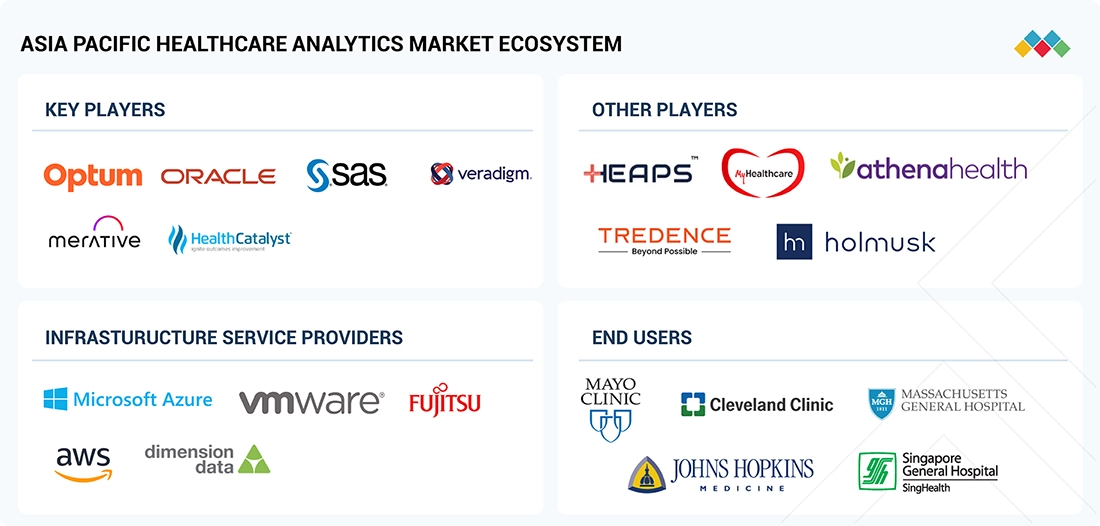
Logos and trademarks shown above are the property of their respective owners. Their use here is for informational and illustrative purposes only.
MARKET SEGMENTS
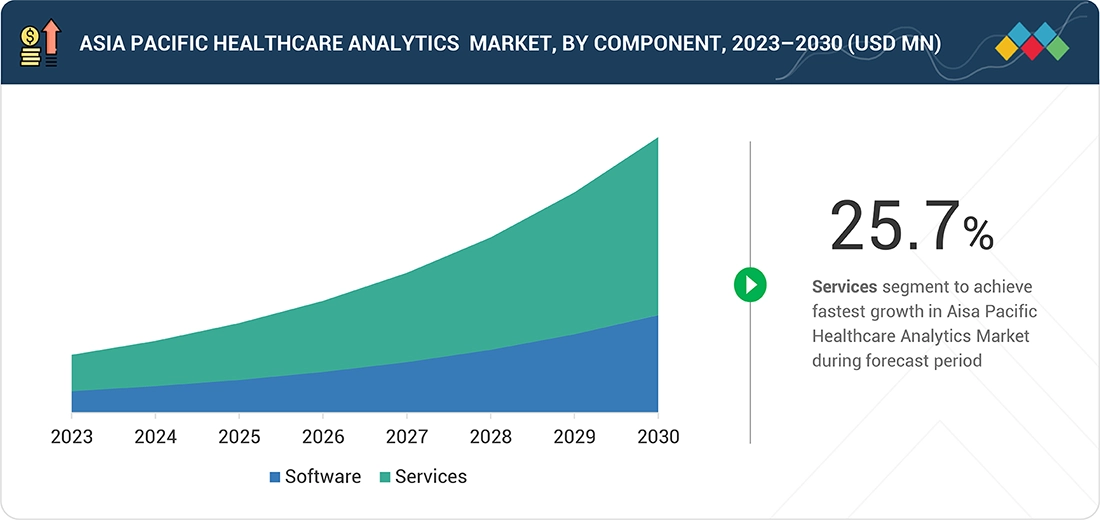
Source: Secondary Research, Interviews with Experts, MarketsandMarkets Analysis
Asia Pacific Healthcare Analytics Market, By Component
As of 2024, the health care analytics market in the Asia Pacific is led by the services sector and will continue the trend till 2025. This can largely be attributed to the fact that the requirement for data integration, implementation, and analytics consulting support is on the rise due to the increase in the adoption of advanced digital technologies by the healthcare sector. This also helps organizations leverage analytics platforms and make them operational and compatible with healthcare EHRs. There is a requirement for customized prediction models, which contributes to the importance of the healthcare analytics services sector.
Asia Pacific Healthcare Analytics Market, By Type
In 2024, descriptive analytics led the Asia Pacific market for healthcare analytics due to an increasing demand for basic reporting, analysis, and visualization capabilities among hospitals, payers, and government agencies. Healthcare organizations and payers utilize descriptive analytics to analyze retrospective data related to patients’ health, finances, and operational outcomes. Additionally, they utilize it for tracking key indicators of these operational aspects. It acts as an entry level for quality reporting, claims analysis, or population health analysis before using more advanced analytics such as predictive or prescriptive analytics. With the increasing digitization of health organizations, transparency remains an essential component for organizations related to compliance and data-driven decision-making processes.
Asia Pacific Healthcare Analytics Market, By Application
The clinical analytics segment has the largest share in the Asia Pacific healthcare analytics market as it offers the most direct benefit to the patients. The major drivers for the clinical analytics segment in this market are the increasing adoption of analytics for early intervention, the adoption of EHR-based analytics, and the advancement in analytical technologies. The segment has witnessed the most growth due to the increasing importance of patient outcomes and the optimization of patient care processes. The segment will grow in the future due to the increasing importance of patient outcomes in the Asia Pacific region.
Asia Pacific Healthcare Analytics Market, By End User
The providers segment is expected to have the largest share in the Asia Pacific market for healthcare analytics, by end user. This is because the healthcare provider sector produces the highest amount of data related to healthcare and operations. Providers are among the most active users of analytics, primarily working to increase positive healthcare outcomes and optimize workflow efficiency, thereby reducing readmissions and adopting a value-based approach in healthcare delivery. The rise of electronic health records, clinical decision support solutions, and population health platforms has further fueled this adoption.
REGION
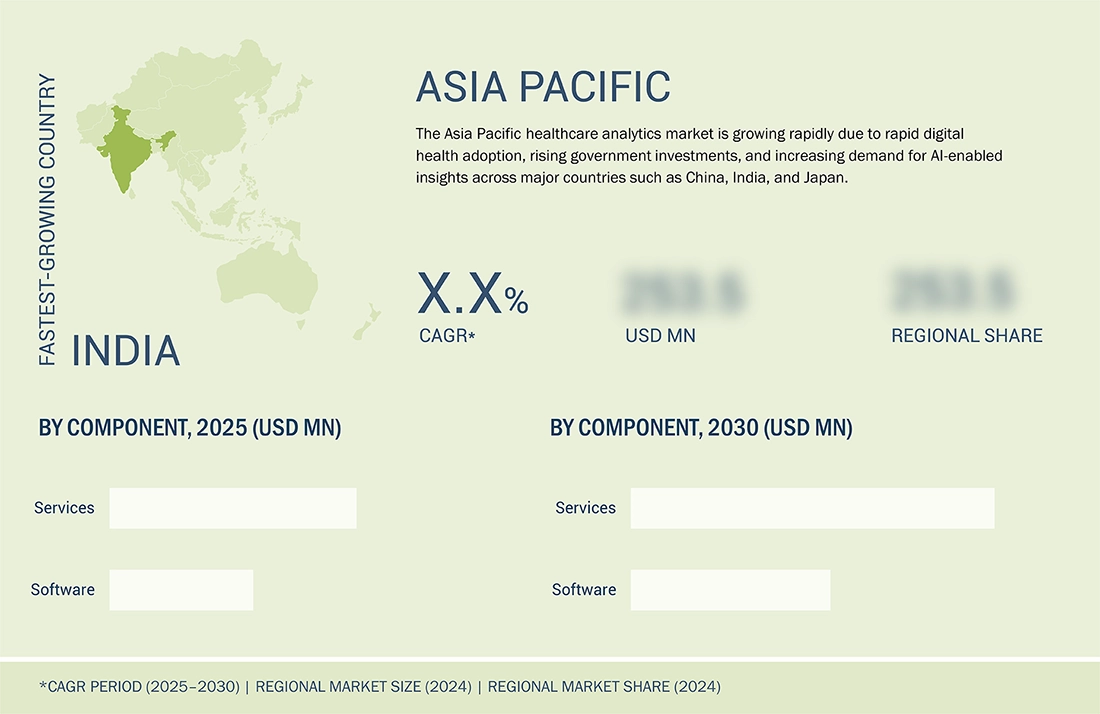
India to be fastest-growing country in Asia Pacific healthcare analytics market during forecast period
With the encouragement of the government in the form of the National Digital Health Mission and the adoption of electronic health record systems, India is the fastest-growing country in the Asia Pacific healthcare analytics market. The spending on AI-enabled clinical decision support solutions, population health platforms, and cloud infrastructure solutions in the medical industry is leading to the adoption of these solutions. India is going to become the most dynamic market in the Asia Pacific region in the medical industry.
ASIA PACIFIC HEALTHCARE ANALYTICS MARKET: COMPANY EVALUATION MATRIX
In the Asia Pacific healthcare analytics market matrix, Optum, Inc. (Star) has a strong market presence with a considerable market share due to its massive data assets and AI-driven platforms. CitiusTech Inc. (Emerging Leader) is slowly emerging with a focus on healthcare analytics, its interoperability advantages, and a focus on developing healthcare-specific platforms. Optum has a significant potential to retain its position due to its extensive data assets and AI-driven healthcare analytics platforms. On the other hand, CitiusTech has a massive potential to move into the leading position due to the acceleration in the use of AI-driven healthcare analytics.
Source: Secondary Research, Interviews with Experts, MarketsandMarkets Analysis
KEY MARKET PLAYERS
- Merative (US)
- SAS Institute Inc. (US)
- Optum, Inc. (US)
- Oracle (US)
- Veradigm LLC (US)
- ExlService Holdings, Inc. (US)
- CitiusTech Inc. (US)
- Health Catalyst (US)
- CVS Health (US)
- Inovalon (US)
- McKesson Corporation (US)
- Cotiviti, Inc. (US)
- Apixio, Inc. (US)
- Enlitic (US)
- Komodo Health, Inc. (US)
- HealthEC, LLC (US)
- IQVIA (US)
- Wipro (India)
- InterSystems Corporation (US)
- Koninklijke Philips N.V. (Netherland)
- Infor(US)
MARKET SCOPE
| REPORT METRIC | DETAILS |
|---|---|
| Market Size in 2024 (Value) | USD 10.94 Billion |
| Market Forecast in 2030 (Value) | USD 41.88 Billion |
| Growth Rate | CAGR of 25.2% from 2025–2030 |
| Years Considered | 2023–2030 |
| Base Year | 2024 |
| Forecast Period | 2025–2030 |
| Units Considered | Value (USD Million/Billion) |
| Report Coverage | Revenue forecast, company ranking, competitive landscape, growth factors, and trends |
| Segments Covered |
|
| Regions/Countries Covered | China, Japan, India, Rest of Asia Pacific |
| Parent & Related Segment Reports |
Healthcare Analytics Market US Healthcare Analytics Market Europe Healthcare Analytics Market |
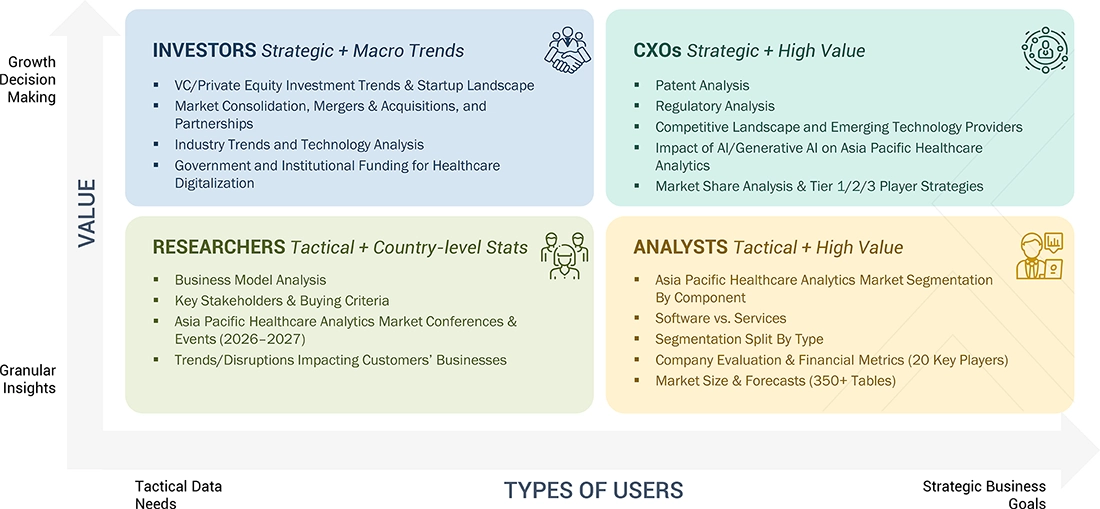
WHAT IS IN IT FOR YOU: ASIA PACIFIC HEALTHCARE ANALYTICS MARKET REPORT CONTENT GUIDE
DELIVERED CUSTOMIZATIONS
We have successfully delivered the following deep-dive customizations:
| CLIENT REQUEST | CUSTOMIZATION DELIVERED | VALUE ADDS |
|---|---|---|
| Large Healthcare Provider (Hospital/IDN) |
|
|
| Health Insurance Payer |
|
|
| Healthcare Analytics Platform Vendor |
|
|
| Pharma & Life Sciences Company |
|
|
| Healthcare Data Aggregator / Raw Data Supplier |
|
|
RECENT DEVELOPMENTS
- July 2025 : InterSystems and MyCLNQ Health have partnered to offer the IRIS for Health solution, which will be integrated into the white-label mobile healthcare/patient engagement apps developed by MyCLNQ. This collaboration goes a long way in enabling hospitals in several countries within the Asia Pacific region to offer analytics-enabled patient engagement applications without having to build them.
- April 2025 : InterSystems formed a strategic partnership with an Indonesian cloud services firm, GenAl/cybersecurity services provider, and ICS Compute to accelerate the adoption of its data platform, IRIS for Health, within hospitals and clinics across Indonesia. ICS Compute will assist in data interoperability, data exchange through FHIR, analytics, and connections to Indonesia's national health data systems.
- August 2024 : Singtel’s Digital InfraCo and the Japan-based technology firm, Hitachi, agreed with an MoU regarding the collaborative development of next-generation data centers and GPU cloud services in Japan and the APAC area. Such infrastructure development helps drive the growth of scalable AI, cloud analytics, and healthcare applications in the Asia Pacific region, serving as a backbone enabler of healthcare analytics growth.
Table of Contents
 Exclusive indicates content/data unique to MarketsandMarkets and not available with any competitors.
Methodology
The study involved five major activities to estimate the current size of the Asia Pacific Healthcare Analytics Market . Exhaustive secondary research was done to collect information on the market and its different subsegments. The next step was to validate these findings, assumptions, and sizing with industry experts across the value chain through primary research. Both top-down and bottom-up approaches were employed to estimate the complete market size. Thereafter, market breakdown and data triangulation procedures were used to estimate the market size of the segments and subsegments.
Secondary Research
In the secondary research process, various secondary sources such as annual reports, press releases & investor presentations of companies, white papers, certified publications, articles by recognized authors, gold-standard & silver-standard websites, regulatory bodies, and databases (such as D&B Hoovers, Bloomberg Business, and Factiva) were referred to in order to identify and collect information for the study of Asia Pacific Healthcare Analytics Market . It was also used to obtain important information about the top players, market classification, and segmentation according to industry trends to the bottom-most level, geographic markets, and key developments related to the market. A database of the key industry leaders was also prepared using secondary research.
Primary Research
Extensive primary research was conducted after acquiring basic knowledge about the Asia Pacific Healthcare Analytics Market scenario through secondary research. This primary data was collected through questionnaires, e-mails, online surveys, personal interviews, and telephonic interviews
Market Size Estimation
Both top-down and bottom-up approaches were used to estimate and validate the total size of the Asia Pacific Healthcare Analytics Market . These methods were also used extensively to estimate the size of various subsegments in the market.
Data Triangulation
After arriving at the overall market size—using the market size estimation processes—the market was split into several segments and subsegments. To complete the overall market engineering process and arrive at the exact statistics of each market segment and sub-segment, the data triangulation and market breakdown procedures were employed, wherever applicable. The data was triangulated by studying various factors and trends from both the demand and supply sides in the Asia Pacific Healthcare Analytics Market .
Market Definition
Healthcare analytics is the efficient use of data and related business insights developed through statistical, quantitative, predictive, comparative, diagnostics, and other emerging applied analytical models. These tools help reveal and understand historical data patterns, predict future outcomes, and provide actionable insights to drive fact-based decision-making for the improved clinical, financial, and operational performance of healthcare organizations.
Stakeholders
- Stakeholders
- Healthcare IT firms
- Healthcare Analytics Vendors
- Health Insurance Exchanges
- Healthcare Payers
- Healthcare Providers
- Venture Capitalists
- Research and Consulting Firms
- Accountable Care Organizations (ACOs)
Report Objectives
- To define, describe, and forecast the Asia Pacific Healthcare Analytics Market based on component, type, application, end-user, and region.
- To provide detailed information regarding the major factors (such as drivers, restraints, opportunities, and challenges) influencing the market growth
- To strategically analyze micro-markets with respect to individual growth trends, prospects, and contributions to the overall Asia Pacific Healthcare Analytics Market
- To analyze opportunities in the market for stakeholders and provide details of the competitive landscape for market leaders.
- To strategically analyze the market structure profile the key players of the Asia Pacific Healthcare Analytics Market and comprehensively analyze their core competencies.
- To track and analyze competitive developments such as product launches and enhancements and investments, partnerships, collaborations, acquisitions, expansions, agreements, sales contracts, and alliances in the Asia Pacific Healthcare Analytics Market during the forecast period.


Personalize This Research
- Triangulate with your Own Data
- Get Data as per your Format and Definition
- Gain a Deeper Dive on a Specific Application, Geography, Customer or Competitor
- Any level of Personalization
Let Us Help You
- What are the Known and Unknown Adjacencies Impacting the Asia Pacific Healthcare Analytics Market
- What will your New Revenue Sources be?
- Who will be your Top Customer; what will make them switch?
- Defend your Market Share or Win Competitors
- Get a Scorecard for Target Partners

Custom Market Research Services
We Will Customise The Research For You, In Case The Report Listed Above Does Not Meet With Your Requirements
Get 10% Free CustomisationTESTIMONIALS

JAYANT RAJPUROHIT
Director of Market Insights, Data and Analytics
SFI Health,
Leading Pharmaceutical Companywww.sfihealth.com/

We at SFI Health approached MarketsandMarkets for an Opportunity Assessment on "Incidence and Prevalence of Focus Indications" as we wanted to know the most attractive HCPs like Physician, Functional MD, Naturopath and Pharmacist. The project was critical for us to ensure our focus on the right target which would enable sustainable growth and profitability for SFI Health. The business insights provided exceeded our expectations and we were extremely impressed. The team at MarketsandMarkets is highly professional and detail oriented and very well understood our business needs. MarketsandMarkets offers a unique combination of expertise and dedicated engagement model. We identified 2 new products to be launched in coming months, based on the research findings provided by MarketsandMarkets. We are happy with the services and would strongly recommend MarketsandMarkets to my peers in the industry.

BEATRIZ DE LA CALLE
Head of Commercial Analytics
Qualicaps,
Leading Pharmaceutical Companywww.qualicaps.com/

We partnered with MarketsandMarkets for an assessment study on hard empty capsules. The team was extremely professional in understanding our business requirements and we received timely responses to all our queries. The market intelligence and the recommendations has met our business requirements. We were extremely impressed to see the final study results; it really exceeded our expectations. The market intelligence offered by MarketsandMarkets, and clarity on next steps will help us achieve our business objective for the Year 2021. We are happy with the services and would strongly recommend MarketsandMarkets to my peers in the industry.

Bob Williams,
Senior Director Business Development & Innovation
Bracco Diagnostics Inc.,
Italian Multinational in life sciences sector and a World Leader in imaging diagnosticsimaging.bracco.com/us-en
We were pleased with targeted insights that MarketsandMarkets identified from a custom study on the 'Radiation Dose Management Solutions Market'. Your team identified and characterized the market participants as well as underlying trends accurately. This study was useful to Bracco in formulating business strategies for our dose monitoring product lines and we thank MarketsandMarkets for the job well done.
Cody Coonradt,
Market Development and Strategy Manager
3M Health Information Systems,
Leader in Health care Coding, Payment & Analytics Solutions.www.3m.com/3M/en_US/health-information-systems-us
The value for our organization comes from three things: depth of research, specificity of segments and being easy to work with. As important as the first two are, the third can't be underestimated. MarketsandMarkets, maybe more than any other research vendor, wants to know what is top of mind for our team and what big questions we are grappling to answer.
Their customer first approach and high value engagement model, have given us great analysis and excellent value for money






Growth opportunities and latent adjacency in Asia Pacific Healthcare Analytics Market