Asia Pacific LiDAR Market Size, Share & Analysis, 2030

Asia Pacific LiDAR Market by Installation (Airborne, Ground-based), Type (Mechanical, Solid-state), Range (Short, Medium, Long), Service (Aerial Surveying, Asset Management, GIS Services, Ground-based Surveying, and Others), and Region - Forecast to 2030




OVERVIEW
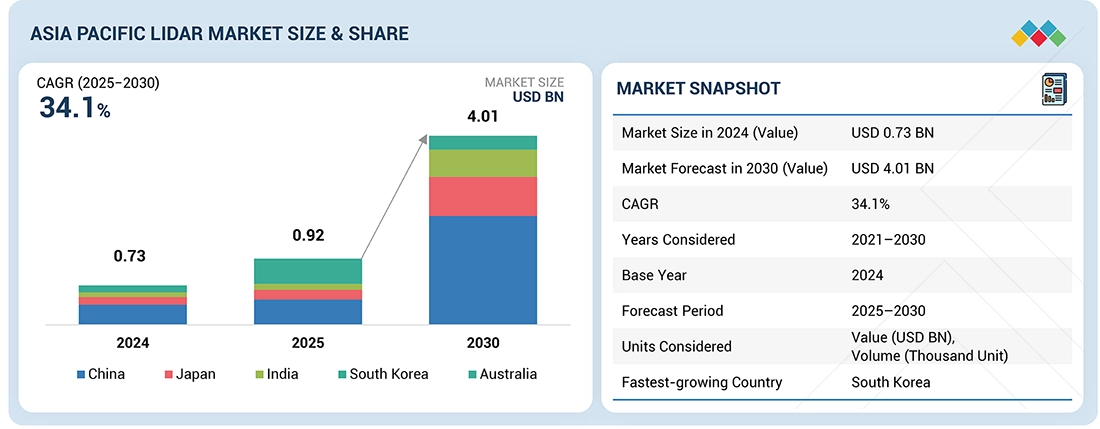
Source: Secondary Research, Interviews with Experts, MarketsandMarkets Analysis
The Asia Pacific LiDAR market is projected to reach USD 4.01 billion by 2030 from USD 0.92 billion in 2025, at a CAGR of 34.1% from 2025 to 2030. Segments, such as automotive (ADAS), corridor mapping, and urban planning, positively influence the market expansion. Growth is further supported by rising investments in autonomous and electric vehicles, large-scale smart city and infrastructure development programs across China, Japan, and Southeast Asia, and increasing adoption of LiDAR in industrial automation, robotics, and drone-based surveying applications across the region.
Market Size & Forecast
KEY TAKEAWAYS
-
By CountryThe LiDAR market in China accounted for a 44.7% market share in 2024.
-
By InstallationBy installation, the ground-based segment is expected to register the highest CAGR during the forecast period.
-
By RangeBy range, the medium range segment is projected to grow at the fastest rate from 2025 to 2030.
-
By ServiceBy service, the ariel surveying segment is expected to dominate the market during the forecast period.
-
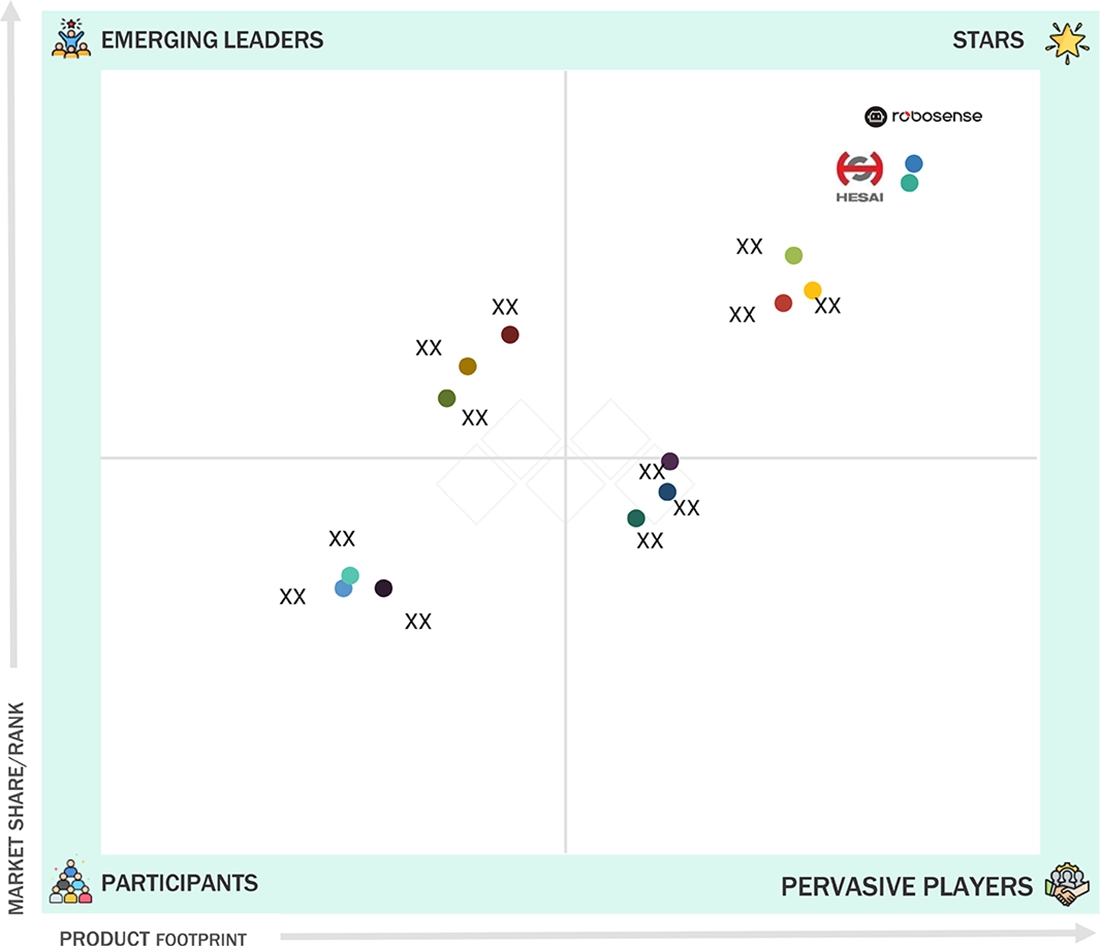
Competitive LandscapeHesai and Robosense were identified as some of the star players in the Asia Pacific LiDAR market, given their strong market share and product footprint.
-
Competitive LandscapeCompanies such as Geokno, Livix among others, have distinguished themselves among startups and SMEs by securing strong footholds in specialized niche areas, underscoring their potential as emerging market leaders.
The Asia Pacific LiDAR market is gaining significant traction, driven by the rapid adoption across autonomous vehicles, smart mobility programs, industrial automation, UAVs, and large-scale infrastructure development. The demand for high-precision 3D sensing is rising as regional industries focus on safety, automation, environmental monitoring, and intelligent transportation systems. The competitive landscape is reshaped by major advancements, including collaborations between LiDAR manufacturers and leading automakers, technology partnerships in smart-city and traffic-management initiatives, and product launches featuring automotive-grade solid-state and hybrid LiDAR platforms. Strategic developments, such as Hesai’s multi-year supply agreements with Li Auto and Jidu Auto, RoboSense’s deployments with BYD and SAIC, and DJI’s LiDAR innovations for drone-based mapping, underscore the shift toward scalable, cost-efficient, and high-performance sensing solutions.
TRENDS & DISRUPTIONS IMPACTING CUSTOMERS' CUSTOMERS
The visual highlights how disruptive trends are reshaping customer business models, shifting revenue from traditional to emerging sources. Adopting mechanical LiDAR solutions in autonomous vehicles is expected to disrupt the LiDAR market over the coming years. LiDAR is incorporated into advanced driver assistance systems to enhance the safety features of semi-autonomous cars. Apart from this, the emergence of LiDAR technology has offered huge growth potential to enterprises engaged in R&D and working toward introducing innovative solutions in the LiDAR market in Asia Pacific.
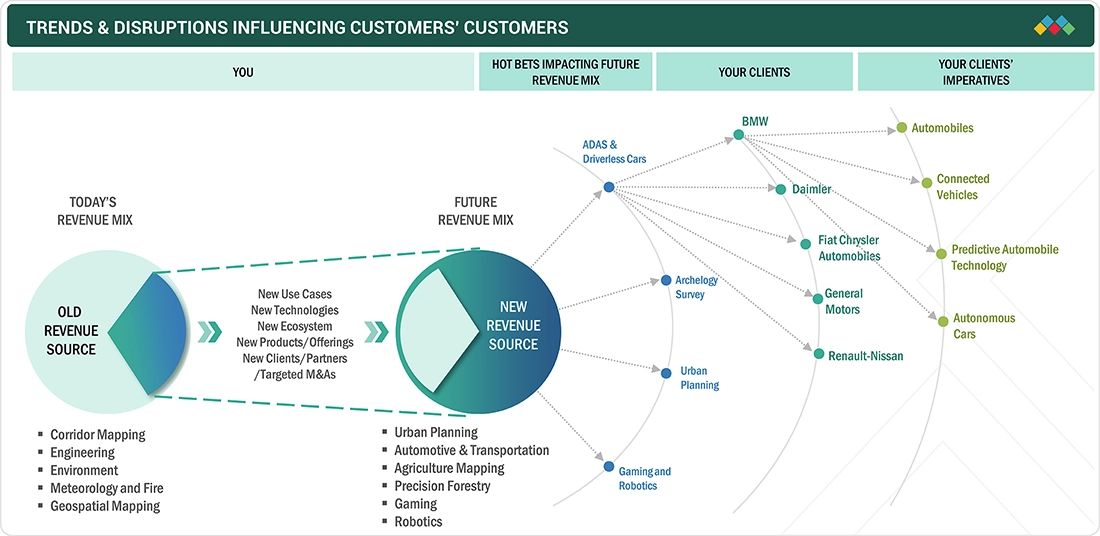
Source: Secondary Research, Interviews with Experts, MarketsandMarkets Analysis
MARKET DYNAMICS

Level
-
Rising adoption of UAV LiDAR systems to capture accurate evaluation data

-
Surging demand for 3D imaging solutions


Level
-
Availability of low-cost and lightweight alternatives


Level
-
Increasing investment in ADAS systems by automotive giants

-
Rising development of quantum dot detectors


Level
-
High cost of post-processing LiDAR software

-
Complexities related to miniaturized LiDAR sensing

Source: Secondary Research, Interviews with Experts, MarketsandMarkets Analysis
Driver: Rising adoption of UAV LiDAR systems to capture accurate evaluation data
The adoption of UAV-mounted LiDAR systems in Asia Pacific is increasing as governments and private enterprises increasingly rely on high-precision aerial data for large-scale infrastructure development, land surveying, agriculture, mining, and environmental monitoring. China, Japan, India, and Australia deploy UAV LiDAR to map urban corridors, monitor forest resources, and support disaster management initiatives. The ability of UAV LiDAR to deliver fast, accurate, and cost-effective 3D point clouds—especially in remote, densely forested, or hard-to-access areas—continues to drive the demand among engineering firms, construction companies, and geospatial service providers across the region.
Restraint: Availability of low-cost and lightweight alternatives
The growth of the Asia Pacific LiDAR market is moderated by the availability of inexpensive alternative technologies, such as photogrammetry, radar, and advanced camera-based vision systems. These lower-cost options are widely used in cost-sensitive markets across Southeast Asia and India, where budget constraints often limit adoption of high-end LiDAR systems. Ongoing improvements in computer vision, AI-based imaging, and mobile mapping further enhance the capabilities of these alternatives, making them attractive for applications where ultra-high accuracy is not critical. As a result, LiDAR adoption in lower-budget segments—especially small businesses and local municipal projects—may face slower penetration.
Opportunity: Increasing investment in ADAS systems by automotive giants
Major Asia Pacific automotive manufacturers, including BYD, SAIC, Hyundai, Toyota, Honda, and Tata Motors, are rapidly increasing investments in advanced driver-assistance systems (ADAS), creating substantial opportunities for LiDAR vendors. As automakers accelerate development of L2+ and L3 autonomous driving capabilities, the demand for high-resolution, automotive-grade LiDAR systems continues to surge. Strategic partnerships between LiDAR suppliers and Asia Pacific OEMs, along with regulatory pushes toward vehicle safety and smart mobility, expand commercialization pathways. This growing ADAS ecosystem enables large-scale LiDAR integration in next-generation electric and autonomous vehicle platforms across the Asia Pacific market.
Challenge: High cost of post-processing LiDAR software
A key challenge for the Asia Pacific LiDAR market is the high cost of post-processing and interpretation software needed to convert raw LiDAR data into usable 3D models and analytics. Many countries, especially in Southeast Asia and India, face budget constraints, making advanced software licenses, specialized hardware, cloud storage, and skilled data engineers challenging to afford. Industries such as construction, agriculture, forestry, and public-sector mapping encounter additional cost burdens due to large datasets, long processing cycles, and frequent software updates. These factors raise overall project expenditure and hinder broader LiDAR adoption among small- to mid-sized enterprises and government agencies.
ASIA PACIFIC LIDAR MARKET: COMMERCIAL USE CASES ACROSS INDUSTRIES
| COMPANY | USE CASE DESCRIPTION | BENEFITS |
|---|---|---|
 |
Deployment of MEMS-based LiDAR sensors (RS-LiDAR-M series) in autonomous vehicles and smart city traffic management solutions; recent developments: Launch of RS-LiDAR-M1 for mass production; partnership with BYD, SAIC, and XPeng for ADAS programs | High-resolution perception for L2–L4 autonomy | Reduced cost per unit for large-scale automotive integration | Enhanced real-time detection accuracy |
 |
Use of hybrid solid-state LiDAR (AT128) in autonomous driving platforms, robotaxi fleets, and industrial robotics; recent developments: Multi-year supply agreements with Li Auto, Jidu, and Aurora Mobile Robotics | Long-range detection (200m+) | Improved reliability for harsh environments | Scalable manufacturing for OEM-level deployment |
Logos and trademarks shown above are the property of their respective owners. Their use here is for informational and illustrative purposes only.
MARKET ECOSYSTEM
The Asia Pacific LiDAR market ecosystem consists of manufacturers, LiDAR system providers, software providers, and end users. The region is characterized by close collaboration between sensor manufacturers, automotive OEMs, and technology firms to support large-scale deployment of LiDAR across mobility, smart infrastructure, and industrial automation. Several Asia Pacific players are strengthening their presence through new product launches, supply agreements, and partnerships with regional automakers, robotics companies, and government bodies.
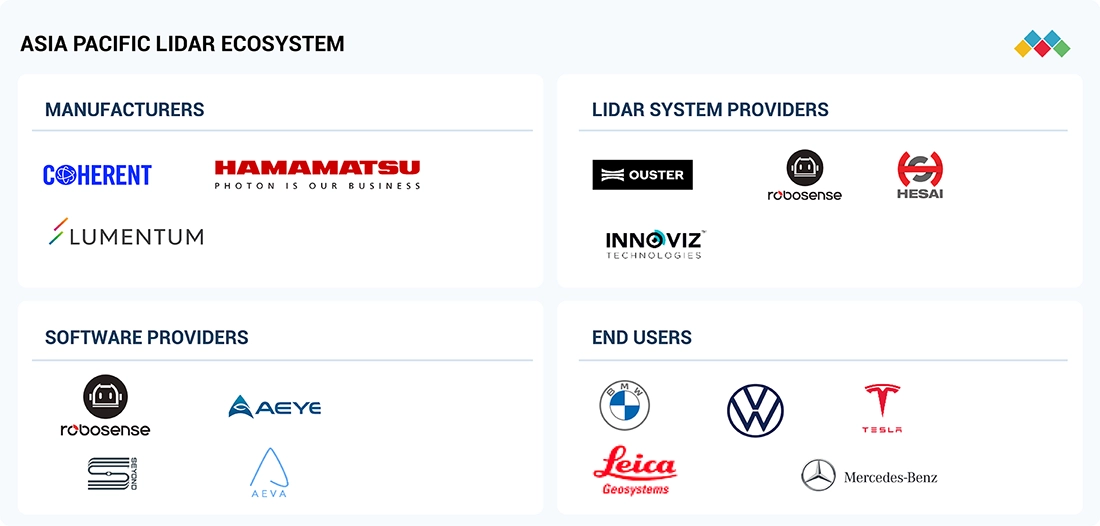
Logos and trademarks shown above are the property of their respective owners. Their use here is for informational and illustrative purposes only.
MARKET SEGMENTS
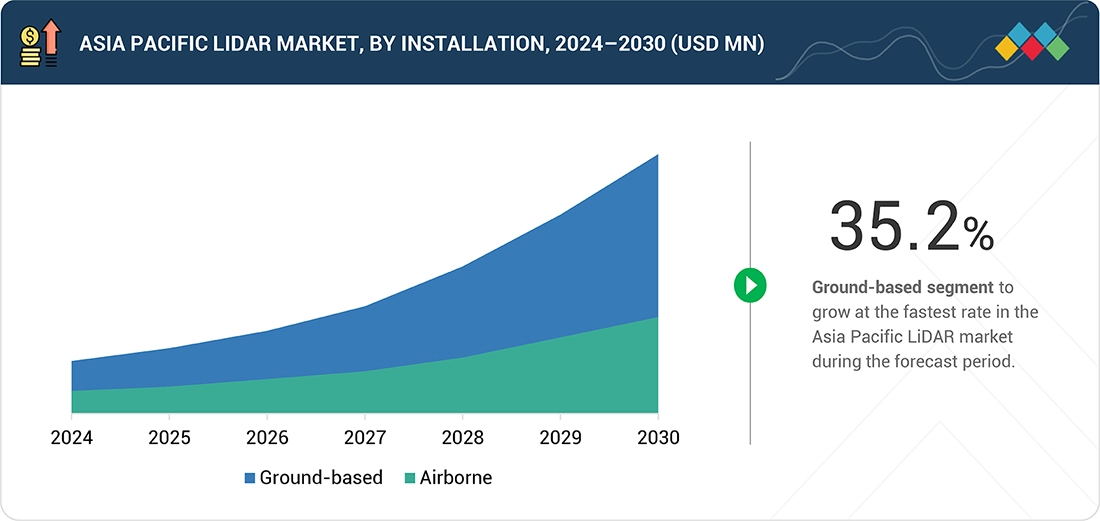
Source: Secondary Research, Interviews with Experts, MarketsandMarkets Analysis
Asia Pacific LiDAR Market, By Installation
In Asia Pacific, ground-based LiDAR systems are experiencing strong uptake due to their suitability for infrastructure development, smart-city projects, mining operations, and utility corridor assessments—key priorities across China, India, Japan, and Southeast Asia. Their lower deployment cost and ease of operation make them widely preferred for urban planning, construction monitoring, and environmental studies. Meanwhile, airborne LiDAR is gaining momentum in large-scale applications, such as national mapping programs, forestry management, coastal monitoring, and disaster-response planning. However, its growth is comparatively slower due to higher operational costs, stringent aviation regulations, and limited availability of specialized service providers across emerging Asia Pacific markets.
Asia Pacific LiDAR Market, By Type
In Asia Pacific, mechanical LiDAR continues to hold a significant share, owing to its established use in automotive testing, robotics, surveying, and industrial automation. Its ability to provide long-range, high-accuracy data makes it suitable for applications such as transportation planning, mining surveys, and autonomous vehicle trials across China, Japan, and South Korea. At the same time, solid-state LiDAR is emerging as the fastest-growing segment, driven by expanding adoption in ADAS-equipped electric vehicles from regional OEMs including BYD, SAIC, Hyundai, and Honda. Its compact design, improved reliability, and cost efficiency accelerate the integration into next-generation autonomous mobility platforms across the region.
Asia Pacific LiDAR Market, By Range
Short-range LiDAR systems hold notable share in Asia Pacific due to their increasing use in robotics, warehouse automation, factory automation, and automotive safety functions, especially across China, Japan, and South Korea. Their ability to provide precise object detection in compact environments supports collision avoidance and navigation in densely populated urban areas. Medium-range LiDAR is projected to grow rapidly as adoption rises in engineering surveys, construction monitoring, mining applications, and smart-city infrastructure projects across India, Southeast Asia, and Australia. Long-range LiDAR continues to be essential for airborne mapping, autonomous highway driving, and large-scale terrain modeling—applications that are expanding alongside national mapping programs and major transportation development across the region.
Asia Pacific LiDAR Market, By Service
Aerial LiDAR services hold a significant share of the Asia Pacific market due to their crucial role in regional infrastructure planning, environmental assessments, forestry management, and disaster-response operations. China, Japan, Australia, and India increasingly deploy manned aircraft and UAV-based LiDAR to generate high-resolution topographic and structural data across large and varied terrains. Government agencies, survey organizations, and engineering firms rely on aerial LiDAR for flood modeling, forest inventory, coastline monitoring, and urban development planning. Growing investment in geospatial intelligence, coupled with supportive policies for drone operations, further boos the segmental growth across the Asia Pacific region.
Asia Pacific LiDAR Market, By End-use Application
The automotive and ADAS segment is one of the fastest-growing LiDAR applications in Asia Pacific, supported by major regional OEMs, such as BYD, SAIC, Hyundai, Toyota, and Honda, accelerating investments in L2+ and L3 autonomous driving technologies. Automakers across China, Japan, and South Korea are increasingly integrating solid-state and long-range LiDAR into electric and next-generation vehicle platforms to enhance safety, perception accuracy, and navigation reliability. Beyond automotive, industries including construction, mining, utilities, agriculture, and smart-city infrastructure are rapidly adopting LiDAR for 3D mapping, asset inspection, environmental monitoring, and automation. As awareness of LiDAR’s operational advantages increases, the technology is transitioning from niche applications to broader mainstream deployment across the region.
REGION
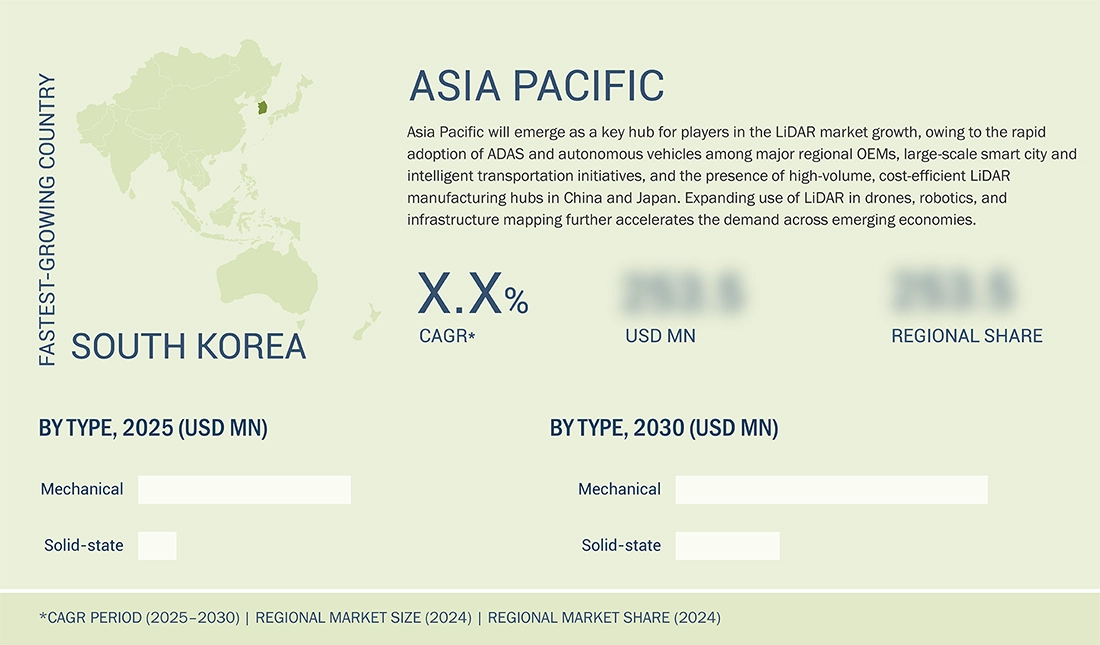
South Korea to be fastest-growing country in Asia Pacific LiDAR market during forecast period
South Korea is set to grow the fastest in the Asia Pacific LiDAR market during the forecast period due to strong government support for autonomous driving, rapid LiDAR integration by major OEMs, including Hyundai and Kia, and increasing deployment of LiDAR in robotics, smart-city projects, and infrastructure modernization. The advanced technology ecosystem and high R&D investment further accelerate the large-scale adoption across industries
The Europe LiDAR market is projected to reach USD 3.16 billion by 2030 from USD 0.87 billion in 2025, at a CAGR of 29.6% during the period from 2025 to 2030. The proliferation of LiDAR technology in Europe is attributable to the robust adoption of autonomous driving, smart mobility solutions, and advanced mapping initiatives endorsed by European Union regulations. Furthermore, the expanding range of applications in environmental monitoring, agriculture, and infrastructure planning is fostering increased deployment throughout the region.
The LiDAR market in North America is projected to reach USD 4.8 billion by 2030 from USD 1.25 billion in 2025, growing at a CAGR of 30.9% from 2025 to 2030. The regional market is primarily driven by the rising deployment of autonomous and ADAS-enabled vehicles, as automotive OEMs and technology companies increasingly integrate LiDAR through supply agreements and partnerships. For instance, Luminar’s production contracts with global automakers and Ouster’s collaborations with robotics and mobility players play a major role in market expansion in the region.
ASIA PACIFIC LIDAR MARKET: COMPANY EVALUATION MATRIX
In the Asia Pacific LiDAR market matrix, RoboSense and Hesai (Stars) lead with strong regional dominance, driven by their advanced solid-state and hybrid LiDAR platforms, large-scale manufacturing capabilities, and deep integrations with major automotive OEMs, such as BYD, SAIC, XPeng, and Li Auto. Their scalable, cost-efficient sensor portfolios support widespread adoption across ADAS, autonomous mobility, robotics, and smart-infrastructure applications. Alongside these leaders, the growing cohort of regional companies and startups gains momentum by introducing innovative, application-specific LiDAR solutions for robotics, logistics, smart cities, and industrial automation. This reflects the rising technological maturity and signaling potential movement toward higher market influence over the coming years.
Source: Secondary Research, Interviews with Experts, MarketsandMarkets Analysis
KEY MARKET PLAYERS
- Hesai Group (China)
- RoboSense Technology Co., Ltd. (China)
- Sick AG (Germany)
- Ouster, Inc. (US)
- Luminar Technologies (US)
- Leica Geosystems AG (Sweden)
- Trimble Inc. (US)
- Teledyne Optech (Canada)
- FARO Technologies, Inc. (US)
- RIEGL Laser Measurement Systems GmbH(Austria)
- NV5 Geospatial (US)
- Beijing SureStar Technology Co., Ltd. (China)
- YellowScan (France)
MARKET SCOPE
| REPORT METRIC | DETAILS |
|---|---|
| Market Size in 2024 (Value) | USD 0.73 Billion |
| Market Forecast in 2030 (Value) | USD 4.01 Billion |
| Growth Rate | CAGR of 34.1% from 2025-2030 |
| Years Considered | 2021-2030 |
| Base Year | 2024 |
| Forecast Period | 2025-2030 |
| Units Considered | Value (USD Billion), Volume (Thousand Unit) |
| Report Coverage | Revenue forecast, company ranking, competitive landscape, growth factors, and trends |
| Segments Covered |
|
| Countries Covered | China, Japan, India, South Korea, Australia |
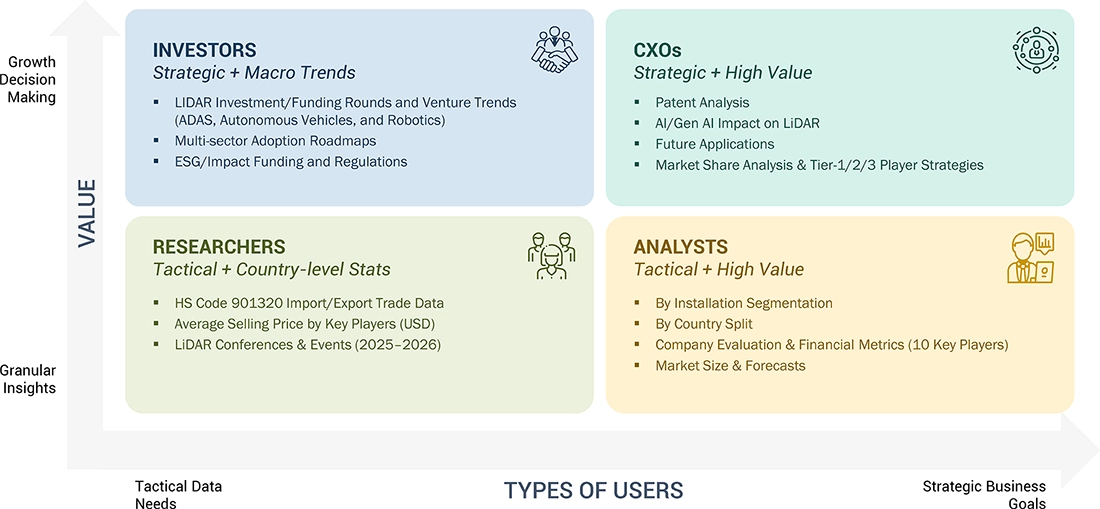
WHAT IS IN IT FOR YOU: ASIA PACIFIC LIDAR MARKET REPORT CONTENT GUIDE
DELIVERED CUSTOMIZATIONS
We have successfully delivered the following deep-dive customizations:
| CLIENT REQUEST | CUSTOMIZATION DELIVERED | VALUE ADDS |
|---|---|---|
| Automotive OEM (ADAS & Autonomous Vehicles) |
|
|
| Robotics & Automation Company |
|
|
| Smart City / Infrastructure Authority |
|
|
| Drone / UAV Manufacturer |
|
|
| LiDAR Component Supplier (Lasers, Detectors, ASICs) |
|
|
| Technology Startup / Sensor Innovator |
|
|
RECENT DEVELOPMENTS
- June 2025 : Hesai Technology announced a multi-year supply agreement with Li Auto to deliver its AT128 hybrid solid-state LiDAR for integration into Li Auto’s next-generation L2+ and L3 autonomous vehicle platforms, strengthening Hesai’s leadership in automotive-grade LiDAR in Asia Pacific.
- February 2025 : RoboSense introduced its upgraded RS-LiDAR-M2 smart solid-state LiDAR, designed for mass production EV platforms across China and Southeast Asia. The launch includes new OEM partnerships with SAIC Motor and Great Wall Motors for ADAS and autonomous driving programs.
- January 2025 : SICK AG expanded its LiDAR portfolio for industrial automation by introducing new digital twin–enabled 2D and 3D LiDAR sensor models, allowing customers to simulate sensor performance in virtual environments prior to deployment. The development supports faster system integration and optimization for robotics, logistics, and factory automation applications, and is aligned with SICK’s collaborations with ecosystem partners such as NVIDIA for simulation-driven industrial solutions.
Table of Contents
 Exclusive indicates content/data unique to MarketsandMarkets and not available with any competitors.
Methodology
The study involved four major activities in estimating the size of the Asia Pacific LiDAR market. Exhaustive secondary research was done to collect information on the market, peer market, and parent market. The next step was to validate these findings, assumptions, and sizing with industry experts across value chains through primary research. The bottom-up approach was employed to estimate the overall market size. After that, market breakdown and data triangulation were used to estimate the market size of segments and subsegments.
Secondary Research
In the secondary research process, various sources were used to identify and collect information important for this study. These include annual reports, press releases & investor presentations of companies, white papers, technology journals, and certified publications, articles by recognized authors, directories, and databases.
Secondary research was mainly used to obtain key information about the supply chain of the industry, the total pool of market players, classification of the market according to industry trends to the bottom-most level, regional markets, and key developments from the market and technology-oriented perspectives.
Primary research was also conducted to identify the segmentation types, key players, competitive landscape, and key market dynamics such as drivers, restraints, opportunities, challenges, and industry trends, along with key strategies adopted by players operating in the Asia Pacific LiDAR market. Extensive qualitative and quantitative analyses were performed on the complete market engineering process to list key information and insights throughout the report.
Primary Research
Extensive primary research has been conducted after acquiring knowledge about the Asia Pacific LiDAR market scenario through secondary research. Several primary interviews have been conducted with experts from both the demand (end users) and supply (LiDAR solution providers) sides across Asia Pacific. Approximately 80% and 20% of the primary interviews have been conducted from the supply and demand sides, respectively. These primary data have been collected through questionnaires, emails, and telephone interviews.
To know about the assumptions considered for the study, download the pdf brochure
Market Size Estimation
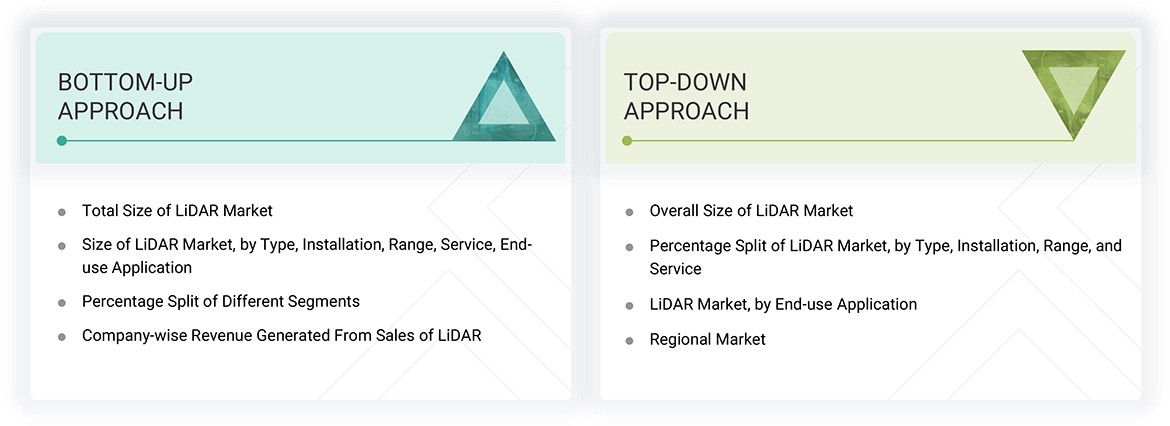
In the complete market engineering process, both the top-down and bottom-up approaches were implemented, along with several data triangulation methods, to estimate and validate the size of the Asia Pacific LiDAR market and various other dependent submarkets. Key players in the market were identified through secondary research, and their market share in the respective regions was determined through primary and secondary research. This entire research methodology included the study of annual and financial reports of the top players, as well as interviews with experts (such as CEOs, VPs, directors, and marketing executives) for key insights (quantitative and qualitative).
All percentage shares, splits, and breakdowns were determined using secondary sources and verified through primary sources. All the possible parameters that affect the markets covered in this research study were accounted for, viewed in detail, verified through primary research, and analyzed to obtain the final quantitative and qualitative data. This data was consolidated and supplemented with detailed inputs and analysis from MarketsandMarkets and presented in this report.
Asia Pacific LiDAR Market : Top-Down and Bottom-Up Approach
Data Triangulation
After arriving at the overall market size from the market size estimation process as explained above, the total market has been split into several segments and subsegments. To complete the overall market engineering process and arrive at the exact statistics for all segments and subsegments, market breakdown and data triangulation procedures have been employed, wherever applicable. The data has been triangulated by studying various factors and trends from both demand and supply sides. Along with this, the market has been validated using top-down and bottom-up approaches.
Market Definition
LiDAR, or light detection and ranging, works on the time of flight principle. The system uses light waves or a light source as a pulsed laser to measure the distance between objects. Measuring distances helps create 3D maps of terrains or earth surfaces that are not visible to the human eye or cannot be created through photogrammetry. The light waves are combined with other data recorded by the system (airborne or ground-based) to generate precise 3D information about the shape and characteristics of the targeted object.
Key Stakeholders
- Senior Management
- End User
- Finance/Procurement Department
- R&D Department
Report Objectives
- To describe, segment, and forecast the overall size of the Asia Pacific LiDAR market by type, installation, range, service, end-use application, and region, in terms of value
- To provide detailed information regarding major factors, such as drivers, restraints, opportunities, and challenges influencing the market growth
- To analyze the supply chain, trends/disruptions impacting customer business, market/ecosystem map, pricing analysis, and regulatory landscape pertaining to the Asia Pacific LiDAR market
- To analyze opportunities in the market for stakeholders by identifying the high-growth segments of the market
- To briefly describe the value chain of light detection and ranging (LiDAR) solutions
- To strategically analyze micromarkets1 with respect to individual growth trends, prospects, and contributions to the overall market
- To profile key players and comprehensively analyze their market position in terms of their ranking and core competencies, along with the detailed competitive landscape of the market
- To analyze competitive developments, such as product launches and developments, partnerships, agreements, expansions, acquisitions, contracts, alliances, and research & development (R&D)undertaken in the Asia Pacific LiDAR market
- To benchmark market players using the proprietary ‘Company Evaluation Matrix,’ which analyzes market players on various parameters within the broad categories of business strategy excellence and strength of product portfolio
- To analyze the probable impact of the recession on the market
Key Questions Addressed by the Report
What is the projected value of the Asia Pacific LiDAR market by 2030?
The Asia Pacific LiDAR market is projected to reach USD 4.01 billion by 2030, growing from USD 0.92 billion in 2025 at a CAGR of 34.1% due to rising adoption across autonomous vehicles, smart cities, and industrial applications.
Which country holds the largest share in the Asia Pacific LiDAR market?
China held approximately 44.7% market share in the Asia Pacific LiDAR market in 2024 and remains a dominant regional contributor due to heavy investments in infrastructure and automotive LiDAR deployments.
How is the Asia Pacific LiDAR market segmented by installation type?
The Asia Pacific LiDAR market is segmented by installation into airborne and ground-based systems, with the ground-based LiDAR segment expected to register the highest CAGR during the forecast period due to its use in infrastructure and urban planning projects.
Which LiDAR type is gaining traction in the Asia Pacific region?
Both mechanical and solid-state LiDAR are used in the region, but solid-state LiDAR is emerging as the fastest-growing segment driven by expanding adoption in automotive ADAS and autonomous driving platforms.
Who are some of the key players in the Asia Pacific LiDAR market?
Key players in the Asia Pacific LiDAR market include Hesai Group (China), RoboSense Technology Co., Ltd. (China), Sick AG (Germany), Ouster, Inc. (US), and Luminar Technologies (US), alongside other global and regional vendors expanding product portfolios in sensing solutions


Personalize This Research
- Triangulate with your Own Data
- Get Data as per your Format and Definition
- Gain a Deeper Dive on a Specific Application, Geography, Customer or Competitor
- Any level of Personalization
Let Us Help You
- What are the Known and Unknown Adjacencies Impacting the Asia Pacific LiDAR Market
- What will your New Revenue Sources be?
- Who will be your Top Customer; what will make them switch?
- Defend your Market Share or Win Competitors
- Get a Scorecard for Target Partners

Custom Market Research Services
We Will Customise The Research For You, In Case The Report Listed Above Does Not Meet With Your Requirements
Get 10% Free CustomisationTESTIMONIALS

Tetsuya Ohhira
Business Development Manager-Technology Business
Nikon Corporation,
Leading Japanese MNC specializing in optics and imaging productswww.nikon.com
MarketsandMarkets™ response
is quick. Their attitude is flexible and positive. Analyst Insights are globally considered and
significant. Client Services quickly respond to our inquiry and demand. Their wide range of global
surveys help us make our strategic plan.
We hope Knowledge Store will be easier to search
for a report.
VP - Marketing & Business Development
Leading Provider of Process Control Solutions
We engaged with MarketsandMarkets on a study to perform an analysis and recommend a Go-To-Market strategy for metrology and process control in the semiconductor market. The study was tailored to our targets and needs with well-defined milestones. Our overall experience with the MarketsandMarkets team was very good throughout the project in all aspects including the analysis methodologies used, the quality and depth of primary and secondary data sets, the professionalism and flexibility of the team and the ability to meet the target schedule and milestones. We want to thank MarketsandMarkets team for a job well done.






Growth opportunities and latent adjacency in Asia Pacific LiDAR Market