Asia Pacific Unmanned Underwater Vehicle Market by AUV (Shallow, Medium, Large), ROV (Observation Class, Medium/Small, Work Class), Application (Military, Oil & Gas, Oceanography, Search & Salvage), Propulsion, System, Speed, Shape, Country - Forecast to 2030

icon1
USD 2.48 BN
MARKET SIZE, 2030
icon2
CAGR 8.8%
(2025-2030)
icon3
150
REPORT PAGES
icon4
120
MARKET TABLES

OVERVIEW

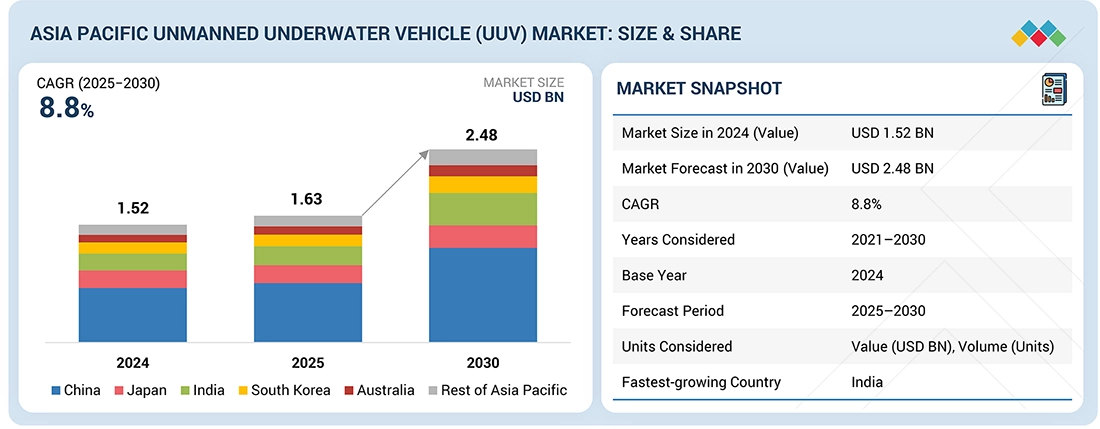
Asia Pacific Unmanned Underwater Vehicle Market Overview

Source: Secondary Research, Interviews with Experts, MarketsandMarkets Analysis

The unmanned underwater vehicle market in the Asia Pacific is projected to grow from USD 1.63 billion in 2025 to USD 2.48 billion by 2030 at a CAGR of 8.8% during the forecast period. In terms of volume, the market is projected to reach 11,349 units by 2030 from 6,244 units in 2025. The market is supported by the rising demand for subsea inspection and monitoring across expanding offshore energy fields, subsea cable routes, and coastal infrastructure projects in the region.

KEY TAKEAWAYS

  • By Country
    The UUV market in China accounted for a 46.8% market share in 2025.
  • By Type
    By type, the autonomous underwater vehicle (AUV) segment is projected to register the highest CAGR (9.0%) during the forecast period.
  • By Application
    The military & defense segment is projected to be the leading application during the forecast period.
  • Competitive Landscape - Key Players
    COOEC, Mitsubishi Heavy Industries, Ltd., and JOHNAN Corporation were identified as star players in the unmanned underwater vehicle (UUV) market in the Asia Pacific, given their strong market share and product footprint.
  • Competitive Landscape - SMEs
    Xera Robotics Pvt. Ltd., Coratia Technologies Pvt. Ltd., and Hitachi, Ltd., among others, have distinguished themselves among startups and SMEs by securing strong footholds in specialized niche areas, underscoring their potential as emerging market leaders.

The unmanned underwater vehicle (UUV) market in the Asia Pacific is witnessing steady growth, driven by the region’s increasing need to monitor and maintain rapidly expanding offshore energy sites and subsea infrastructure that span large and environmentally dynamic coastal zones.

TRENDS & DISRUPTIONS IMPACTING CUSTOMERS' CUSTOMERS

The impact on customers’ business in the unmanned underwater vehicle (UUV) market is driven by shifting operational needs and advancing underwater mission requirements across the Asia Pacific. Offshore energy operators, subsea cable developers, aquaculture companies, and hydrographic agencies in the region rely on UUVs for deepwater inspection, coastal infrastructure monitoring, and large-scale environmental observation. The move toward autonomous long-endurance missions, advanced sensing, hybrid UUV–ROV capabilities, and data-rich underwater surveys is reshaping how operators plan and execute underwater tasks. These shifts are increasing demand for dependable UUV platforms, integrated payloads, and analytics-driven underwater systems that can support broader and more complex mission profiles across diverse marine environments in the Asia Pacific.
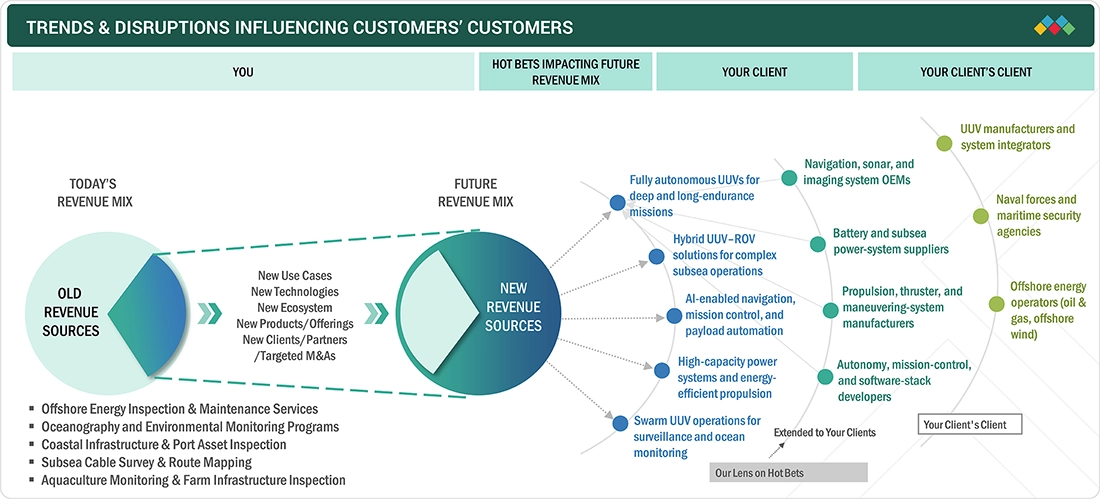
Asia Pacific Unmanned Underwater Vehicle Market Disruptions

Source: Secondary Research, Interviews with Experts, MarketsandMarkets Analysis

MARKET DYNAMICS

Drivers
Impact
Level
  • Increasing deepwater inspection and survey requirements from offshore energy and subsea infrastructure expansion
  • Growing adoption of autonomous systems for large-area ocean monitoring under national blue economy programs
RESTRAINTS
Impact
Level
  • Limited availability of skilled UUV operators and technical maintenance
  • High operational costs for deepwater-capable platforms
OPPORTUNITIES
Impact
Level
  • Rising demand for AUVs in marine research, climate studies, and long-range environmental monitoring
  • Expansion of offshore wind and subsea cable projects
CHALLENGES
Impact
Level
  • Monsoon and frequent typhoon disruptions
  • Diverse regulatory frameworks increase complexity in cross-border UUV deployments

Source: Secondary Research, Interviews with Experts, MarketsandMarkets Analysis

Driver: Increasing deepwater inspection and survey requirements from offshore energy and subsea infrastructure expansion

The Asia Pacific is rapidly expanding its offshore LNG fields, subsea pipelines, and telecom cable networks, creating a constant need for reliable underwater inspection and monitoring. As these assets grow in size and complexity, operators increasingly depend on UUVs to perform routine surveys, identify early faults, and reduce manual intervention in deepwater environments.

Restraint: Limited availability of skilled UUV operators and technical maintenance

Despite growing demand, many parts of the Asia Pacific region face a shortage of trained pilots, technicians, and maintenance specialists. This skill gap can slow down deployment timelines and increase dependence on external service providers, which makes it harder for operators to scale UUV operations quickly.

Opportunity: Rising demand for AUVs in marine research, climate studies, and long-range environmental monitoring

National ocean missions and research programs across the Asia Pacific region are putting more funding into long-endurance AUVs to study climate patterns, map deep-sea ecosystems, and track overall marine health. This support is driving the development of autonomous technologies that can operate on their own across large ocean areas.

Challenge: Monsoon and frequent typhoon disruptions

Severe monsoon seasons and frequent typhoons across the Asia Pacific often disrupt underwater operations, shorten survey windows, and increase overall mission risk. These unpredictable weather patterns mean UUV systems need to handle harsh conditions and allow operators to adjust quickly to changing marine environments.

Asia Pacific Unmanned Underwater Vehicle Market: COMMERCIAL USE CASES ACROSS INDUSTRIES

COMPANY USE CASE DESCRIPTION BENEFITS
Uses work-class ROVs to support regular maintenance and anomaly detection in offshore LNG fields through subsea inspection and flowline monitoring Enhances asset dependability, lowers the need for divers, and permits effective maintenance scheduling for deepwater facilities
Uses compact ROVs for inspection of berths, jetties, and submerged port structures, capturing visual and thickness data for condition assessment Shortens inspection cycles, enhances diagnostic accuracy, and minimizes downtime for commercial port operations
Enables routine inspections and underwater stock monitoring by providing portable ROVs for aquaculture cage and net inspections Reduces the need for divers, encourages ongoing farm monitoring, and enhances early infrastructure problem detection

Logos and trademarks shown above are the property of their respective owners. Their use here is for informational and illustrative purposes only.

MARKET ECOSYSTEM

The unmanned underwater vehicle (UUV) ecosystem operates through a defined value chain that includes platform manufacturers, subsystem suppliers, and multi-sector end users. AUV and ROV manufacturers provide the core vehicles used for offshore inspection, aquaculture monitoring, subsea construction support, and marine research missions, while system and mission payload suppliers deliver the sensing, navigation, and communication technologies that shape overall performance. End users across Asia Pacific’s offshore energy sector, subsea cable operators, port authorities, and environmental agencies rely on these systems for underwater inspection, infrastructure monitoring, and scientific data collection. This structure enables coordinated development of platforms and mission payloads to meet the region’s diverse operational needs across deepwater, coastal, and nearshore environments.
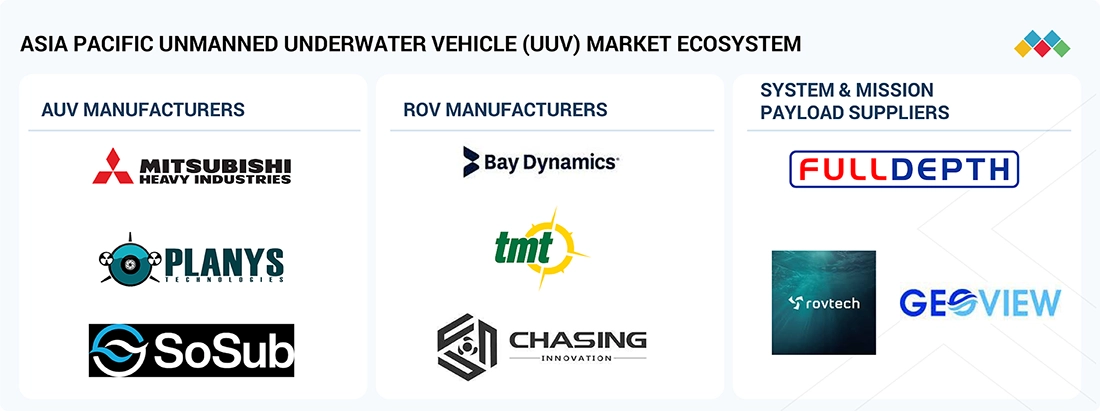
Asia Pacific Unmanned Underwater Vehicle Market Ecosystem

Logos and trademarks shown above are the property of their respective owners. Their use here is for informational and illustrative purposes only.

MARKET SEGMENTS
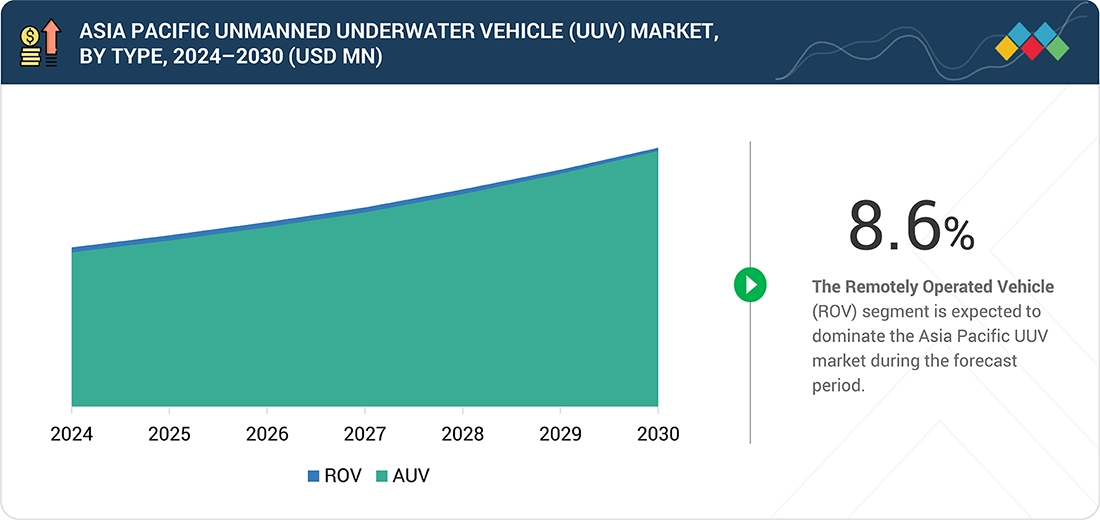
Asia Pacific Unmanned Underwater Vehicle Market Segments

Source: Secondary Research, Interviews with Experts, MarketsandMarkets Analysis

Unmanned Underwater Vehicle (UUV) Market, By Type

The ROV is projected to be the most dominant UUV type in the Asia Pacific region, as offshore LNG fields, subsea pipelines, and coastal infrastructure projects depend heavily on real-time visual inspection and intervention work. Many operators favor ROVs because they allow direct control in difficult underwater conditions and can handle a wide range of routine maintenance tasks.

Autonomous Underwater Vehicle (AUV) Market, By Type

Large AUVs are becoming dominant in the Asia Pacific region as countries invest more in deep-sea exploration, seabed mapping, and long-range environmental monitoring. These high-endurance platforms are used to study ocean basins, support offshore resource assessments, and collect climate-related data over large marine areas. National programs such as deep ocean missions and marine observatories increasingly need AUVs that can operate at greater depths for a long period of time.

Remotely Operated Vehicle (ROV) Market, By Size

Work-class ROVs dominate the regional market because they are critical for heavy-duty subsea work linked to LNG production, offshore construction, and deepwater maintenance. These vehicles are able to handle complex tasks like valve operations, structural inspections, and pipeline intervention in deep and demanding environments. Growing offshore activity across the Asia Pacific, particularly in Australia, Southeast Asia, and China, continues to underscore the need for robust and stable work-class systems. Their ability to operate for a long period in tough conditions keeps them as the preferred option for industrial subsea operations.

REGION

India to be the fastest-growing region in Asia Pacific unmanned underwater vehicle (UUV) market during forecast period

India is projected to be the fastest-growing market during the forecast period, driven by its expanding need for underwater inspections and seabed surveys linked to large-scale port upgrades, coastal infrastructure expansion, and national deep-ocean research initiatives.
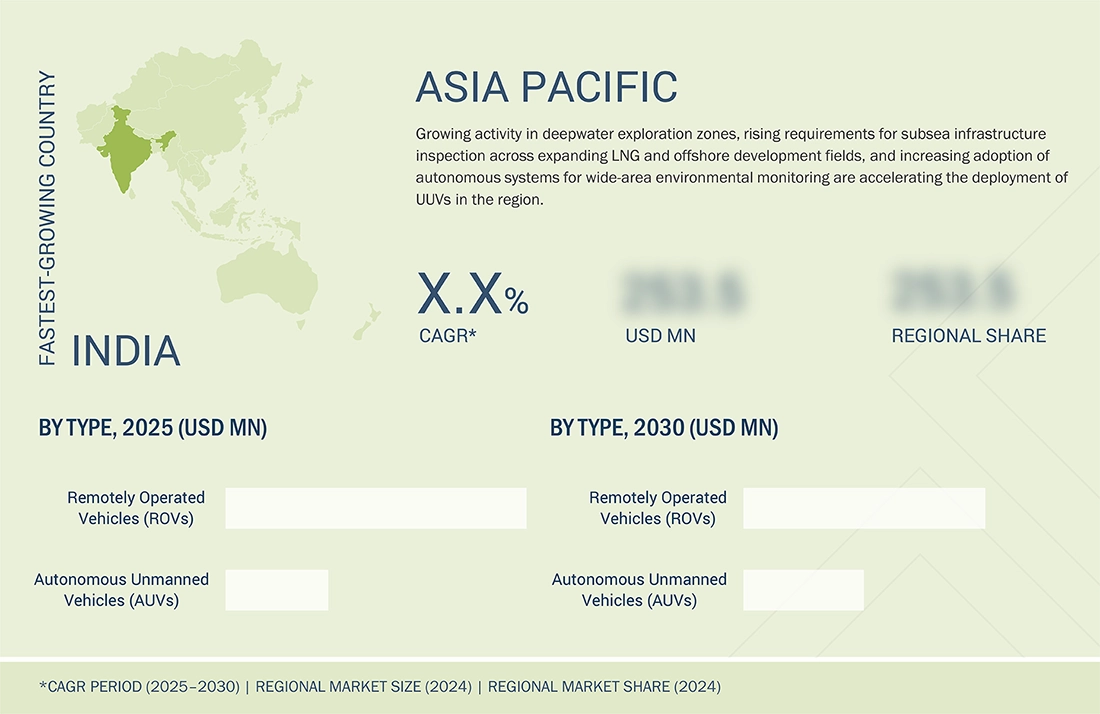
Asia Pacific Unmanned Underwater Vehicle Market Region

Asia Pacific Unmanned Underwater Vehicle Market: COMPANY EVALUATION MATRIX

In the unmanned underwater vehicle market matrix, COOEC (Star) has a strong competitive position supported by its wide range of work-class ROV capabilities and a large operational presence across offshore energy and subsea infrastructure projects in the Asia Pacific region. Its systems are commonly used for pipeline inspection, deepwater maintenance, and survey work, which helps reinforce its leadership across key industrial and commercial areas. On the other hand, Planys Technologies (Emerging Leader) is gradually strengthening its position through compact inspection-class ROV platforms and tailored solutions for ports, coastal infrastructure, and industrial underwater inspections. Its focus on modular designs and mission-specific inspection tools puts the company in a good position to move closer to the leaders' quadrant as the demand for efficient and fast deployment survey systems continues to grow across the region.
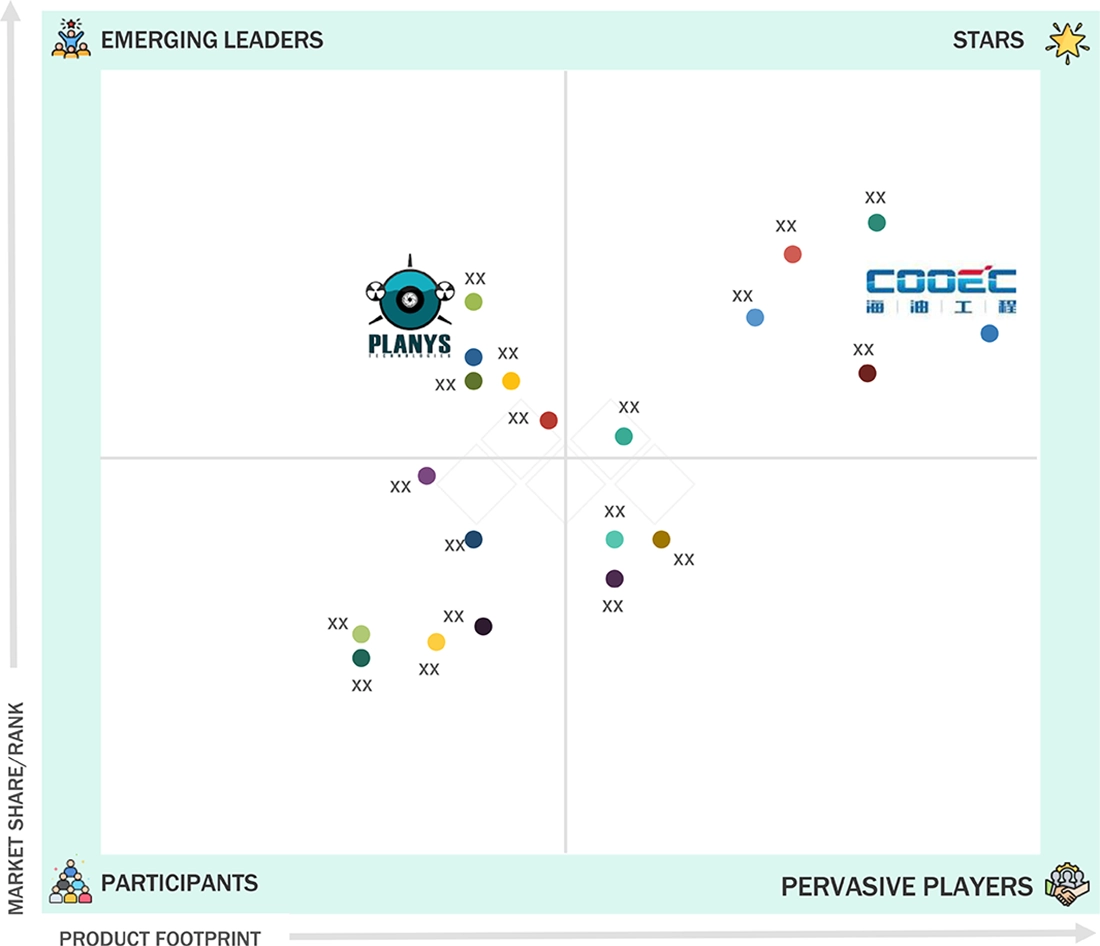
Asia Pacific Unmanned Underwater Vehicle Market Evaluation Metrics

Source: Secondary Research, Interviews with Experts, MarketsandMarkets Analysis

KEY MARKET PLAYERS

  • COOEC (China)
  • Mitsubishi Heavy Industries Ltd. (Japan)
  • JOHNAN Corporation (Japan)
  • CHASING Innovation (China)
  • Total Marine Technology (Australia)
  • Boxfish Robotics Ltd. (New Zealand)
  • QYSEA (China)
  • Southern Ocean Subsea (Australia)
  • S2 Robotics Co., Ltd. (Thailand)
  • Bay Dynamics Ltd. (New Zealand)
  • Planys Technologies Pvt. Ltd. (India)
  • PT Robo Marine Indonesia (Indonesia)
  • EyeROV / IROV Technologies Pvt. Ltd. (India)
  • IXAR Robotics Solutions Pvt. Ltd. (India)
  • Xera Robotics Pvt. Ltd. (India)
  • Coratia Technologies Pvt. Ltd. (India)
  • Shenzhen FullDepth Technology (China)
  • CHARPIE Intelligence Technology (China)
  • ROVMAKER / ROV Maker (China)
  • FullDepth Co., Ltd. (Japan)
  • KOWA Corporation (Japan)
  • Mitsui Engineering & Shipbuilding Co., Ltd. (Japan)
  • Hitachi Ltd. (Japan)
  • ROVOSTECH Co., Ltd. (South Korea)

MARKET SCOPE

REPORT METRIC DETAILS
Market Size in 2024 (Value) USD 1.52 Billion
Market Forecast in 2030 (Value) USD 2.48 Billion
Growth Rate CAGR of 8.8% from 2025–2030
Years Considered 2021–2030
Base Year 2024
Forecast Period 2025–2030
Units Considered Value (USD Billion), Volume (Units)
Report Coverage Revenue forecast, company ranking, competitive landscape, growth factors, and trends
Segments Covered
  • By Type:
    • AUV [Shallow AUV (Up to 100 Meters)
    • Medium AUV (100–1
    • 000 Meters)
    • and Large AUV (> 1
    • 000 Meters)]
    • UUV (Remotely Operated Vehicle (ROV)
    • Autonomous Underwater Vehicle (AUV)
  • By Shape:
    • Torpedo
    • Laminar Flow Body
    • Streamlined Rectangular Style
    • Multi-hull Vehicle
  • By Speed:
    • Less than 5 knots
    • More than 5 Knots
  • By Propulsion:
    • Electric AUV
    • Mechanical AUV
    • Hybrid AUV
  • By Propulsion:
    • Electric ROV
    • Mechanical ROV
    • Hybrid ROV
  • By Application:
    • Military & Defense
    • Oil & Gas
    • Environment Protection & Monitoring
    • Oceanography
    • Archaeology & Exploration
    • Search & Salvage Operations
  • By System:
    • Collision Avoidance
    • Communication & Networking
    • Navigation & Guidance
    • Propulsion & Mobility
    • Payload & Sensor Systems
    • Chassis
    • Power & Energy System
    • Others
  • By Size:
    • OCROV - Observation Class Remotely Operated Vehicle (Up to 91 KG)
    • MSROV - Medium/Small Remotely Operated Vehicle (91–907 KG)
    • WCROV - Work Class Remotely Operated Vehicle (> 907 KG)
Countries Covered China, Japan, India, South Korea, Australia, and Rest of Asia Pacific

WHAT IS IN IT FOR YOU: Asia Pacific Unmanned Underwater Vehicle Market REPORT CONTENT GUIDE
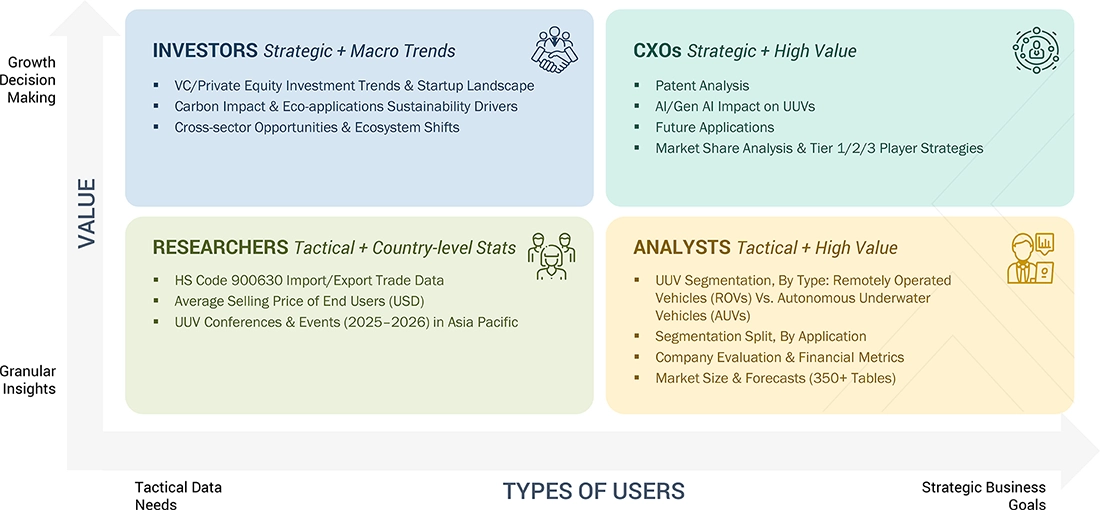
Asia Pacific Unmanned Underwater Vehicle Market Content Guide

DELIVERED CUSTOMIZATIONS

We have successfully delivered the following deep-dive customizations:

CLIENT REQUEST CUSTOMIZATION DELIVERED VALUE ADDS
Leading Manufacturer Additional segment breakdown for countries
  • Additional country-level market sizing tables for segments/sub-segments covered at regional/global level
  • To gain an understanding of market potential by each country
Emerging Leader Additional company profiles Competitive information on targeted players to gain granular insights on direct competition
Regional Market Leader Additional country market estimates Additional country-level deep dive for more targeted understanding of total addressable market

RECENT DEVELOPMENTS

  • September 2025 : The Indian Navy signed a USD 5.6 million contract with EyeROV to procure advanced indigenously developed underwater drones (ROVs). The systems will enhance underwater inspection, surveillance, and reconnaissance capabilities, supporting India’s defence indigenization efforts.
  • August 2025 : Australia’s Department of Defence signed a major agreement with Anduril Australia to start the production of the Ghost Shark extra-large autonomous underwater vehicle fleet. The deal covers long-term development, manufacturing, and sustainment, helping expand Australia’s local UUV capability for deepwater operations and maritime security roles.
  • August 2025 : Planys Technologies raised around USD 12 million to boost the production of its inspection-class UUVs and expand its work with maritime infrastructure agencies in India. The funding supports the increasing use of autonomous inspection platforms for ports, dams, and offshore assets and helps the company strengthen its commercial presence across the region.

Table of Contents

Exclusive indicates content/data unique to MarketsandMarkets and not available with any competitors.

TITLE
PAGE NO
1
INTRODUCTION


15
2
EXECUTIVE SUMMARY


3
PREMIUM INSIGHTS


4
MARKET OVERVIEW
Maps the market evolution with focus on trend catalysts, risk factors, and growth opportunities across segments.


4.1
INTRODUCTION


4.2
MARKET DYNAMICS


4.2.1
DRIVERS


4.2.1.1
INCREASING DEEPWATER INSPECTION AND SURVEY REQUIREMENTS FROM OFFSHORE ENERGY AND SUBSEA INFRASTRUCTURE EXPANSION


4.2.1.2
GROWING ADOPTION OF AUTONOMOUS SYSTEMS FOR LARGE-AREA OCEAN MONITORING UNDER NATIONAL BLUE ECONOMY PROGRAMS


4.2.2
RESTRAINTS


4.2.2.1
LIMITED AVAILABILITY OF SKILLED UUV OPERATORS AND TECHNICAL MAINTENANCE


4.2.2.2
HIGH OPERATIONAL COSTS FOR DEEPWATER-CAPABLE PLATFORMS


4.2.3
OPPORTUNITIES


4.2.3.1
RISING DEMAND FOR AUVS IN MARINE RESEARCH, CLIMATE STUDIES, AND LONG-RANGE ENVIRONMENTAL MONITORING


4.2.3.2
EXPANSION OF OFFSHORE WIND AND SUBSEA CABLE PROJECTS


4.2.4
CHALLENGES


4.2.4.1
MONSOON AND FREQUENT TYPHOON DISRUPTIONS


4.2.4.2
DIVERSE REGULATORY FRAMEWORKS INCREASE COMPLEXITY IN CROSS-BORDER UUV DEPLOYMENTS
 
 
4.3
UNMET NEEDS AND WHITE SPACES


4.4
INTERCONNECTED MARKETS AND CROSS-SECTOR OPPORTUNITIES


4.5
STRATEGIC MOVES BY TIER 1/2/3 PLAYERS


5
INDUSTRY TRENDS
Summarizes the competitive environment, macro signals, and segment-level movements driving market outcomes.


5.1
ECOSYSTEM ANALYSIS


5.1.1
PROMINENT COMPANIES


5.1.2
PRIVATE AND SMALL ENTERPRISES


5.1.3
END USERS


5.2
VALUE CHAIN ANALYSIS


5.3
SUPPLY CHAIN ANALYSIS


5.4
PRICING ANALYSIS


5.4.1
AVERAGE SELLING PRICE OF UUV TYPES, BY KEY PLAYERS,


5.4.2
AVERAGE SELLING PRICE TREND, BY REGION, 2019-2025


5.5
IMPACT OF 2025 US TARIFFS ON UNMANNED UNDERWATER VEHICLE (UUV) MARKET


5.5.1
INTRODUCTION


5.5.2
KEY TARIFF RATES


5.5.3
PRICE IMPACT ANALYSIS


5.5.4
IMPACT ON COUNTRY/REGION


5.5.4.1
ASIA PACIFIC


5.5.5
IMPACT ON END-USE INDUSTRIES


5.6
TRADE ANALYSIS


5.6.1
IMPORT SCENARIO (HS CODE: 9015.80.90)


5.6.2
EXPORT SCENARIO (HS CODE: 9015.80.90)


5.7
CASE STUDY ANALYSIS


5.8
KEY CONFERENCES & EVENTS 2025-2026


5.9
INVESTMENT AND FUNDING SCENARIO


5.10
TRENDS/DISRUPTION IMPACTING CUSTOMER BUSINESS


5.11
OPERATIONAL DATA


5.12
TOTAL COST OF OWNERSHIP (TCO)


5.13
MACROECONOMIC OUTLOOK


5.13.1
INTRODUCTION


5.13.2
GDP TRENDS AND FORECAST


5.13.3
TRENDS IN ASIA PACIFIC UNDERWATER MARITIME VEHICLES INDUSTRY


5.13.4
TRENDS IN ASIA PACIFIC MARINE INDUSTRY


5.14
KEY STAKEHOLDERS & BUYING CRITERIA


5.14.1
KEY STAKEHOLDERS IN BUYING PROCESS


5.14.2
BUYING CRITERIA


5.15
VOLUME DATA


5.16
BILL OF MATERIALS


5.17
BUSINESS MODEL


6
TECHNOLOGICAL ADVANCEMENTS, AI-DRIVEN IMPACT, PATENTS, INNOVATIONS, AND FUTURE APPLICATIONS


6.1
KEY EMERGING TECHNOLOGIES


6.2
COMPLEMENTARY TECHNOLOGIES


6.3
TECHNOLOGY ROADMAP


6.3.1
ADVANCED COMMUNICATION ECOSYSTEM IN UUV


6.3.1.1
ARCHITECTURE OVERVIEW


6.3.1.2
PERFORMANCE MATRIX


6.3.1.3
INNOVATION ROADMAP (2025-2030)


6.3.1.4
CHALLENGES & GAPS


6.3.2
ENERGY & BATTERY TECHNOLOGIES FOR UUV ENDURANCE


6.3.2.1
BATTERY CHEMISTRY COMPARISON TABLE


6.3.2.2
DESIGN TRADE-OFF MATRIX


6.3.2.3
INNOVATION ROADMAP (2025-2030)


6.3.2.4
CHALLENGES & GAPS


6.3.2
OTHER EVOLVING TECHNOLOGIES FOR UUV


6.4
PATENT ANALYSIS


6.5
FUTURE APPLICATIONS


6.6
IMPACT OF AI/GEN AI ON UUV MARKET


6.6.1
TOP USE CASES AND MARKET POTENTIAL


6.6.2
BEST PRACTICES IN UUV SYSTEMS


6.6.3
CASE STUDIES OF AI IMPLEMENTATION IN UUV MARKET


6.6.4
INTERCONNECTED ADJACENT ECOSYSTEM AND IMPACT ON MARKET PLAYERS


6.6.5
CLIENTS’ READINESS TO ADOPT GENERATIVE AI IN UUV MARKET


6.7
IMPACT OF MEGATRENDS


7
SUSTAINABILITY AND REGULATORY LANDSCAPE


7.1
REGIONAL REGULATIONS AND COMPLIANCE


7.1.1
REGULATORY BODIES, GOVERNMENT AGENCIES, AND OTHER ORGANIZATIONS


7.1.2
INDUSTRY STANDARDS


7.2
SUSTAINABILITY INITIATIVES


7.2.1
CARBON IMPACT AND ECO-APPLICATIONS OF UUV


7.3
SUSTAINABILITY IMPACT AND REGULATORY POLICY INITIATIVES


7.4
CERTIFICATIONS, LABELING, AND ECO-STANDARDS


8
CUSTOMER LANDSCAPE & BUYER BEHAVIOR


8.1
DECISION-MAKING PROCESS


8.2
BUYER STAKEHOLDERS AND BUYING EVALUATION CRITERIA


8.3
ADOPTION BARRIERS & INTERNAL CHALLENGES


8.4
UNMET NEEDS FROM VARIOUS END-USE INDUSTRIES


9
ASIA PACIFIC UNMANNED UNDERWATER VEHICLE (UUV) MARKET, BY TYPE (MARKET SIZE & FORECAST TO 2030 – IN VALUE (USD MILLION) & VOLUME (UNITS))


TYPE-SPECIFIC ADOPTION DRIVERS, DEMAND DYNAMICS, AND MARKET POTENTIAL ACROSS EACH END-USE INDUSTRY


9.1
INTRODUCTION


9.2
REMOTELY OPERATED VEHICLE (ROV)


9.2.1
USE CASE: REMUS-100 EXPLICITLY FIELDED FOR VERY SHALLOW WATER MCM MISSIONS


9.3
AUTONOMOUS UNDERWATER VEHICLE (AUV)


9.3.1
USE CASE: MBARI’S SEAFLOOR MAPPING DEEP-RATED SURVEY VEHICLES LAUNCHED ON FULLY AUTONOMOUS MISSIONS TO 6,000 M
 
 
10
ASIA PACIFIC REMOTELY OPERATED VEHICLE (ROV) MARKET, BY SIZE
Market Size, Volume & Forecast – USD Million


(MARKET SIZE & FORECAST TO 2030 – IN VALUE (USD MILLION) & VOLUME (UNITS))


SIZE-WISE DEMAND POTENTIAL AND GROWTH PATHWAYS SHAPING ROV ADOPTION IN DIVERSE INDUSTRIES


10.1
INTRODUCTION


10.2
OBSERVATION CLASS REMOTELY OPERATED VEHICLE (OCROV) (UP TO 91 KG)


10.2.1
MICRO (SMALL) OCROVS (<4.5 KG)


10.2.2
MINI OCROVS (4.5 – 32 KG)


10.2.3
LARGE OCROVS (32 – 91 KG)


10.3
MEDIUM/SMALL REMOTELY OPERATED VEHICLE (MSROV) (91-907 KG)


10.3.1
SHALLOW MSROVS (< 1,000 METERS)


10.3.2
DEEPWATER MSROV (1,000 – 2,0000 METERS)


10.3.3
HEAVY MSROV/LIGHT WORK CLASS ROV (>2,000 METERS)


10.4
WORK CLASS REMOTELY OPERATED VEHICLE (WCROV) (> 907 KG)


10.4.1
STANDARD WORK CLASS ROV (100 – 200 HP)


10.4.2
HEAVY WORK CLASS ROV (>200 HP)
 
 
11
ASIA PACIFIC REMOTELY OPERATED VEHICLE (ROV) MARKET, BY SPEED
Market Size, Volume & Forecast – USD Million


(MARKET SIZE & FORECAST TO 2030 – IN VALUE (USD MILLION))


SPEED-WISE DEMAND POTENTIAL AND GROWTH PATHWAYS SHAPING UUV ADOPTION IN DIVERSE INDUSTRIES


11.1
INTRODUCTION


11.2
LESS THAN 5 KNOTS


11.3
MORE THAN 5 KNOTS


12
ASIA PACIFIC REMOTELY OPERATED VEHICLE (ROV) MARKET, BY PROPULSION
Market Size, Volume & Forecast – USD Million


(MARKET SIZE & FORECAST TO 2030 – IN VALUE (USD MILLION))


PROPULSION-WISE DEMAND POTENTIAL AND GROWTH PATHWAYS SHAPING UUV ADOPTION IN DIVERSE INDUSTRIES


12.1
INTRODUCTION


12.2
ELECTRIC ROV


12.2.1
USE CASE: REMUS SERIES LI-ION BATTERY SYSTEMS DEVELOPED WITH SAFT/MATHEWS, FROM 1–16 KWH PACKS FOR LONGER MISSIONS


12.3
MECHANICAL ROV


12.3.1
USE CASE: SLOCUM G3 GLIDER – OPTIMIZED FOR LONG ENDURANCE WITH A BUOYANCY ENGINE AND WINGS FOR COASTAL PROGRAMS


12.3
HYBRID ROV


12.4.1
USE CASE: EARLY PEM FUEL-CELL UUV PROTOTYPES DELIVERING ~4 KW FOR PROPULSION WITH HYDROGEN STORED IN METAL HYDRIDE TANKS
 
 
13
ASIA PACIFIC REMOTELY OPERATED VEHICLE (ROV) MARKET, BY APPLICATION
Market Size, Volume & Forecast – USD Million


(MARKET SIZE & FORECAST TO 2030 – IN VALUE (USD MILLION))


COMPARATIVE ASSESSMENT OF KEY APPLICATIONS, THEIR MARKET POTENTIAL, AND DEMAND PATTERNS BY VARIOUS SUPPLIER COMPANIES
Market Size, Volume & Forecast – USD Million


13.1
INTRODUCTION


13.2
MILITARY & DEFENSE


13.2.1
BORDER SECURITY & SURVEILLANCE


13.2.2
ANTISUBMARINE WARFARE


13.2.3
ANTI-TRAFFICKING & CONTRABAND MONITORING


13.2.4
ENVIRONMENTAL ASSESSMENT


13.2.5
MINE COUNTERMEASURE IDENTIFICATION


13.3
OIL & GAS


13.3.1
PIPELINE SURVEYS


13.3.2
GEOPHYSICAL SURVEYS


13.3.3
DEBRIS/CLEARANCE SURVEYS


13.3.4
BASELINE ENVIRONMENTAL ASSESSMENT


13.4
ENVIRONMENT PROTECTION & MONITORING


13.4.1
HABITAT RESEARCH


13.4.2
WATER SAMPLING


13.4.3
FISHERY STUDY


13.4.4
EMERGENCY RESPONSE


13.5
OCEANOGRAPHY


13.6
ARCHAEOLOGY & EXPLORATION


13.7
SEARCH & SALVAGE OPERATIONS


14
ASIA PACIFIC REMOTELY OPERATED VEHICLE (ROV) MARKET, BY SYSTEM
Market Size, Volume & Forecast – USD Million


(MARKET SIZE & FORECAST TO 2030 – IN VALUE (USD MILLION))


SYSTEM-WISE DEMAND POTENTIAL AND GROWTH PATHWAYS SHAPING ROV ADOPTION IN DIVERSE INDUSTRIES


14.1
INTRODUCTION


14.2
COLLISION AVOIDANCE


14.2.1
FORWARD-LOOKING SONAR (FLS)


14.2.2
OTHERS (PROXIMITY & OBSTACLE SENSING SYSTEMS, PILOT ASSIST & VISUALIZATION)


14.3
COMMUNICATION & NETWORKING


14.3.1
TETHER-BASED COMMUNICATION SYSTEMS


14.3.2
ACOUSTIC COMMUNICATION SYSTEMS


14.3.3
SURFACE & BACKHAUL COMMUNICATION SYSTEMS


14.3.5
OTHERS (ONBOARD DATA NETWORKING SYSTEMS)


14.4
NAVIGATION & GUIDANCE


14.4.1
INERTIAL & DEAD-RECKONING SYSTEMS


14.4.1.1
INERTIAL NAVIGATION SYSTEM (INS)


14.4.1.2
COMPASS-BASED NAVIGATION


14.4.1.3
OTHERS (DVL, PRESSURE/DEPTH ALTIMETER)


14.4.2
ACOUSTIC NAVIGATION SYSTEMS


14.4.3
OTHERS (VELOCITY & MOTION SENSING SYSTEMS, TMS & UMBILICAL POSITION FEEDBACK SYSTEMS, SURFACE / VESSEL REFERENCE POSITIONING)


14.5
PROPULSION & MOBILITY SYSTEMS


14.5.1
THRUST GENERATION SUBSYSTEM


14.5.1.1
PROPULSION MOTORS


14.5.1.2
THRUSTERS


14.5.1.3
OTHERS (PROPELLERS)


14.5.2
HYDRAULIC POWER & ACTUATION SYSTEMS


14.5.2.1
HYDRAULIC POWER UNIT (HPU)


14.5.2.1
HYDRAULIC MANIFOLDS & VALVE BLOCKS


14.5.2.1
OTHERS (HYDRAULIC HOSE INTERFACES, TOOLS/MANIPULATORS)


14.5.3
BUOYANCY & VERTICAL MOTION SUBSYSTEM


14.5.3.1
PUMP MOTORS


14.5.3.1
VARIABLE BUOYANCY DEVICES


14.5.3.1
OTHERS (BALLAST TANKS)


14.5.4
OTHERS (FRAME & STRUCTURAL MOBILITY INTERFACES)


14.6
PAYLOAD & SENSOR SYSTEMS


14.6.1
ACOUSTIC IMAGING & MAPPING PAYLOADS


14.6.1.1
SIDE-SCAN SONAR IMAGERS


14.6.1.2
MULTIBEAM ECHO SOUNDERS


14.6.1.3
SYNTHETIC APERTURE SONAR (SAS)


14.6.1.4
SUB-BOTTOM PROFILERS


14.6.1.5
OTHERS (SINGLE, SPLIT BEAM ECHO SOUNDERS)


14.6.2
OPTICAL IMAGING PAYLOADS


14.6.2.1
HIGH-RESOLUTION DIGITAL STILL CAMERA


14.6.2.2
DUAL-EYE CAMERA


14.6.2.3
OTHERS (LED LIGHTING, STROBES, LASERS FOR ILLUMINATION)


14.6.3
ENVIRONMENTAL & OCEANOGRAPHIC SENSOR PAYLOADS


14.6.3.1
CONDUCTIVITY, TEMPERATURE, AND DEPTH (CTD) SENSORS


14.6.3.2
BIOGEOCHEMICAL SENSORS


14.6.3.3
ACOUSTIC DOPPLER CURRENT PROFILERS (ADCP)


14.6.4
OTHERS (MANIPULATION & INTERVENTION SYSTEMS, MAINTENANCE & CONSTRUCTION TOOLING SYSTEMS, NDT & SPECIAL APPLICATION PAYLOADS)


14.7
CHASSIS


14.7.1
METAL ALLOYS


14.7.2
FIBER-REINFORCED COMPOSITES


14.7.3
OTHERS (ENGINEERING PLASTICS, SYNTACTIC FOAMS)


14.8
POWER & ENERGY SYSTEM


14.8.1
ENERGY STORAGE


14.8.1.1
BATTERY MODULES (LITHIUM-ION / LITHIUM-POLYMER BATTERY MODULES)


14.8.1.2
PRESSURE-TOLERANT SUBSEA BATTERY SYSTEM


14.8.1.3
SUPERCAPACITORS


14.8.2
POWER MANAGEMENT & DISTRIBUTION


14.8.2.1
BATTERY MANAGEMENT SYSTEMS


14.8.2.2
DC/DC CONVERTERS


14.8.2.3
BUSBARS


14.8.2.4
OTHERS (BREAKERS, CONTACTORS, HARNESSES)


14.8.3
OTHERS (SURFACE POWER SUPPLY SYSTEMS, POWER TRANSMISSION SYSTEMS)


14.9
OTHERS (CONTROL, AUTONOMY & MISSION MANAGEMENT SYSTEM, SAFETY, RECOVERY & HEALTH MONITORING SYSTEM, LAUNCH, RECOVERY & TETHER MANAGEMENT SYSTEMS)


15
ASIA PACIFIC AUTONOMOUS UNDERWATER VEHICLE (AUV) MARKET, BY TYPE (MARKET SIZE & FORECAST TO 2030 – IN VALUE (USD MILLION) & VOLUME, (UNITS))


TYPE-SPECIFIC ADOPTION DRIVERS, DEMAND DYNAMICS, AND MARKET POTENTIAL ACROSS EACH END-USE INDUSTRY


15.1
INTRODUCTION


15.2
SHALLOW AUVS (UP TO 100 METERS)


15.2.1
USE CASE: REMUS-100 HAS BEEN EXPLICITLY FIELDED FOR VERY SHALLOW WATER MCM MISSIONS


15.2.2
MICRO/SMALL AUV (UP TO 20 KG)


15.2.3
MINI AUV (20 – 100 KG)


15.3
MEDIUM AUVS (100 – 1,000 METERS)


15.3.1
USE CASE: MBARI’S SEAFLOOR MAPPING DEEP-RATED SURVEY VEHICLES LAUNCHED ON FULLY AUTONOMOUS MISSIONS


15.4
LARGE AUVS (>1,000 METERS)


15.4.1
USE CASE: ORCA’S 8-TON PAYLOAD BAY AND 6,500 NM RANGE ARE ENABLED FOR MODULAR MISSION PACKAGES


15.4.3
DEEP WATER AUTONOMOUS UNDERWATER VEHICLE (1,000 – 3,000 METERS)


15.4.3
LARGE DISPLACEMENT AUTONOMOUS UNDERWATER VEHICLE (3,000 – 6,000 METERS)


15.4.4
EXTRA LARGE AUTONOMOUS UNDERWATER VEHICLE (>6,000 METERS)
 
 
16
ASIA PACIFIC AUTONOMOUS UNDERWATER VEHICLE (AUV) MARKET, BY SHAPE
Market Size, Volume & Forecast – USD Million


(MARKET SIZE & FORECAST TO 2030 – IN VALUE, (USD MILLION) & VOLUME, (UNITS))


COMPARATIVE ASSESSMENT OF KEY AUV SHAPES, THEIR MARKET POTENTIAL, AND DEMAND PATTERNS BY VARIOUS SUPPLIER COMPANIES
Market Size, Volume & Forecast – USD Million


16.1
INTRODUCTION


16.2
TORPEDO


16.3
LAMINAR FLOW BODY


16.4
STREAMLINED RECTANGULAR STYLE


16.5
MULTI-HULL VEHICLE


17
ASIA PACIFIC AUTONOMOUS UNDERWATER VEHICLE (AUV) MARKET, BY SPEED
Market Size, Volume & Forecast – USD Million


(MARKET SIZE & FORECAST TO 2030 – IN VALUE (USD MILLION))


SPEED-WISE DEMAND POTENTIAL AND GROWTH PATHWAYS SHAPING AUV ADOPTION IN DIVERSE INDUSTRIES


17.1
INTRODUCTION


17.2
LESS THAN 5 KNOTS


17.3
MORE THAN 5 KNOTS


18
ASIA PACIFIC AUTONOMOUS UNDERWATER VEHICLE (AUV) MARKET, BY PROPULSION
Market Size, Volume & Forecast – USD Million


(MARKET SIZE & FORECAST TO 2030 – IN VALUE (USD MILLION))


PROPULSION-WISE DEMAND POTENTIAL AND GROWTH PATHWAYS SHAPING AUV ADOPTION IN DIVERSE INDUSTRIES


18.1
INTRODUCTION


18.2
ELECTRIC AUV


18.2.1
USE CASE: REMUS SERIES LI-ION BATTERY SYSTEMS DEVELOPED WITH SAFT/MATHEWS, FROM 1–16 KWH PACKS FOR LONGER MISSIONS


18.3
MECHANICAL AUV


18.3.1
USE CASE: SLOCUM G3 GLIDER – OPTIMIZED FOR LONG ENDURANCE WITH A BUOYANCY ENGINE AND WINGS FOR COASTAL PROGRAMS


18.3
HYBRID AUV


18.4.1
USE CASE: EARLY PEM FUEL-CELL AUV PROTOTYPES DELIVERING ~4 KW FOR PROPULSION WITH HYDROGEN STORED IN METAL HYDRIDE TANKS
 
 
19
ASIA PACIFIC AUTONOMOUS UNDERWATER VEHICLE (AUV) MARKET, BY APPLICATION
Market Size, Volume & Forecast – USD Million


(MARKET SIZE & FORECAST TO 2030 – IN VALUE (USD MILLION))


COMPARATIVE ASSESSMENT OF KEY APPLICATIONS, THEIR MARKET POTENTIAL, AND DEMAND PATTERNS BY VARIOUS SUPPLIER COMPANIES


19.1
INTRODUCTION


19.2
MILITARY & DEFENSE


19.2.1
BORDER SECURITY & SURVEILLANCE


19.2.2
ANTISUBMARINE WARFARE


19.2.3
ANTI-TRAFFICKING & CONTRABAND MONITORING


19.2.4
ENVIRONMENTAL ASSESSMENT


19.2.5
MINE COUNTERMEASURE IDENTIFICATION


19.3
OIL & GAS


19.3.1
PIPELINE SURVEYS


19.3.2
GEOPHYSICAL SURVEYS


19.3.3
DEBRIS/CLEARANCE SURVEYS


19.3.4
BASELINE ENVIRONMENTAL ASSESSMENT


19.4
ENVIRONMENT PROTECTION & MONITORING


19.4.1
HABITAT RESEARCH


19.4.2
WATER SAMPLING


19.4.3
FISHERY STUDY


19.4.4
EMERGENCY RESPONSE


19.5
OCEANOGRAPHY


19.6
ARCHAEOLOGY & EXPLORATION


19.7
SEARCH & SALVAGE OPERATIONS


20
ASIA PACIFIC AUTONOMOUS UNDERWATER VEHICLE (AUV) MARKET, BY SYSTEM
Market Size, Volume & Forecast – USD Million


(MARKET SIZE & FORECAST TO 2030 – IN VALUE (USD MILLION))


SYSTEM-WISE DEMAND POTENTIAL AND GROWTH PATHWAYS SHAPING AUV ADOPTION IN DIVERSE INDUSTRIES


20.1
INTRODUCTION


20.2
COLLISION AVOIDANCE


20.2.1
FORWARD-LOOKING SONAR (FLS)


20.2.2
OTHERS (BLOW-BALLAST/EMERGENCY BUOYANCY ACTIVATION)


20.3
COMMUNICATION & NETWORKING


20.3.1
UNDERWATER ACOUSTIC COMMUNICATION SYSTEMS


20.3.2
SUBSEA WIRELESS OPTICAL COMMUNICATION SYSTEMS


20.3.3
SURFACE RADIO-FREQUENCY (RF) & WI-FI COMMUNICATION SYSTEMS


20.3.4
SATELLITE COMMUNICATION INTERFACES


20.3.5
OTHERS (ADVANCED COMMUNICATION GATEWAY SYSTEMS)


20.4
NAVIGATION & GUIDANCE


20.4.1
INERTIAL & DEAD-RECKONING SYSTEMS


20.4.1.1
INERTIAL NAVIGATION SYSTEM (INS)


20.4.1.2
COMPASS-BASED NAVIGATION


20.4.1.3
OTHERS (DVL, PRESSURE/DEPTH ALTIMETER)


20.4.2
ACOUSTIC NAVIGATION SYSTEMS


20.4.3
OTHERS (TERRAIN, HYBRID, ADAPTIVE MISSION CONTROL & SENSOR FUSION SYSTEM, INTEGRATED / HYBRID NAVIGATION SYSTEMS)


20.5
PROPULSION & MOBILITY


20.5.1
THRUST GENERATION SUBSYSTEM


20.5.1.1
PROPULSION MOTORS


20.5.1.2
THRUSTERS


20.5.1.3
OTHERS (PROPELLERS)


20.5.2
MOTION & CONTROL ACTUATION SUBSYSTEM


20.5.2.1
FIN CONTROL ACTUATORS


20.5.2.1
SERVO/LINEAR ELECTROMECHANICAL ACTUATORS


20.5.3
BUOYANCY & VERTICAL MOTION SUBSYSTEM


20.5.3.1
PUMP MOTORS


20.5.3.1
VARIABLE BUOYANCY DEVICES


20.5.3.1
OTHERS (BALLAST TANKS)


20.5.4
OTHERS (SHAFTS, SEALS, DRIVES)


20.6
PAYLOAD & SENSOR SYSTEMS


20.6.1
ACOUSTIC IMAGING & MAPPING PAYLOADS


20.6.1.1
SIDE-SCAN SONAR IMAGERS


20.6.1.2
MULTIBEAM ECHO SOUNDERS


20.6.1.3
SYNTHETIC APERTURE SONAR (SAS)


20.6.1.4
SUB-BOTTOM PROFILERS


20.6.1.5
OTHERS (SINGLE, SPLIT BEAM ECHO SOUNDERS)


20.6.2
OPTICAL IMAGING PAYLOADS


20.6.2.1
HIGH-RESOLUTION DIGITAL STILL CAMERA


20.6.2.2
DUAL-EYE CAMERA


20.6.2.3
OTHERS (LED LIGHTING, STROBES, LASERS FOR ILLUMINATION)


20.6.3
ENVIRONMENTAL & OCEANOGRAPHIC SENSOR PAYLOADS


20.6.3.1
CONDUCTIVITY, TEMPERATURE, AND DEPTH (CTD) SENSORS


20.6.3.2
BIOGEOCHEMICAL SENSORS


20.6.3.3
ACOUSTIC DOPPLER CURRENT PROFILERS (ADCP)


20.6.4
OTHERS (SPECIALIZED / MISSION-SPECIFIC PAYLOADS- MAGNETOMETER, HYDROPHONES, SAMPLERS, SENSOR FUSION & AI-DRIVEN PAYLOAD SUITES)


20.7
CHASSIS


20.7.1
METAL ALLOYS


20.7.2
FIBER-REINFORCED COMPOSITES


20.7.3
OTHERS (ENGINEERING PLASTICS, SYNTACTIC FOAMS)


20.8
POWER & ENERGY SYSTEM


20.8.1
ENERGY STORAGE


20.8.1.1
BATTERY MODULES (LITHIUM-ION / LITHIUM-POLYMER BATTERY MODULES)


20.8.1.2
PRESSURE-TOLERANT SUBSEA BATTERY SYSTEM


20.8.1.3
SUPERCAPACITORS


20.8.2
POWER MANAGEMENT & DISTRIBUTION


20.8.2.1
BATTERY MANAGEMENT SYSTEMS


20.8.2.2
DC/DC CONVERTERS


20.8.2.3
BUSBARS


20.8.2.4
OTHERS (BREAKERS, CONTACTORS, HARNESSES)


20.8.3
OTHERS (DOCKING & CHARGING SYSTEMS)


20.9
OTHERS (CONTROL, AUTONOMY & MISSION MANAGEMENT SYSTEM, SAFETY & RECOVERY SYSTEM, DATA STORAGE & HANDLING)


21
ASIA PACIFIC UNMANNED UNDERWATER VEHICLE (UUV) MARKET, COUNTRY ANALYSIS


(MARKET SIZE & FORECAST TO 2030 – IN VALUE (USD MILLION))


ASSESSING GROWTH PATTERNS, INDUSTRY FORCES, REGULATORY LANDSCAPE, AND MARKET POTENTIAL ACROSS KEY GEOGRAPHIES AND COUNTRIES


21.1
INTRODUCTION


21.4.2
CHINA


21.4.3
JAPAN


21.4.4
INDIA


21.4.5
SOUTH KOREA


21.4.6
AUSTRALIA


21.4.7
INDONESIA


21.4.8
MALAYSIA


21.4.9
THAILAND


21.4.10
VIETNAM


21.4.11
PHILIPPINES
 
 
22
COMPETITIVE LANDSCAPE


STRATEGIC ASSESSMENT OF LEADING PLAYERS, MARKET SHARE, REVENUE ANALYSIS, COMPANY POSITIONING, AND COMPETITIVE BENCHMARKS INFLUENCING MARKET POTENTIAL


22.1
OVERVIEW


22.2
KEY PLAYER STRATEGIES/RIGHT TO WIN


22.3
MARKET SHARE ANALYSIS,


22.4
REVENUE ANALYSIS, 2020-2024


22.5
COMPANY EVALUATION MATRIX: KEY PLAYERS,


22.5.1
STARS


22.5.2
EMERGING LEADERS


22.5.3
PERVASIVE PLAYERS


22.5.4
PARTICIPANTS


22.5.5
COMPANY FOOTPRINT: KEY PLAYERS,


22.5.5.1
COMPANY FOOTPRINT


22.5.5.2
REGION FOOTPRINT


22.5.5.3
TYPE FOOTPRINT


22.5.5.4
APPLICATION FOOTPRINT


22.5.5.5
SPEED FOOTPRINT
 
 
22.6
COMPANY VALUATION AND FINANCIAL METRICS


22.7
COMPANY EVALUATION MATRIX: START-UPS/SME,


22.7.1
PROGRESSIVE COMPANIES


22.7.2
RESPONSIVE COMPANIES


22.7.3
DYNAMIC COMPANIES


22.7.4
STARTING BLOCKS


22.7.5
COMPETITIVE BENCHMARKING: STARTUPS/SMES,


22.7.5.1
LIST OF STARTUPS/SMES


22.7.5.2
COMPETITIVE BENCHMARKING OF KEY STARTUPS/SMES
 
 
22.8
TECHNOLOGY COMPARISON


22.9
COMPETITIVE SCENARIO


22.9.1
PRODUCT LAUNCHES


22.9.2
DEALS


22.9.3
EXPANSIONS
 
 
23
COMPANY PROFILES


IN-DEPTH REVIEW OF COMPANIES, PRODUCTS, SERVICES, RECENT INITIATIVES, AND POSITIONING STRATEGIES IN ASIA PACIFIC UUV MARKET LANDSCAPE


23.1
KEY PLAYERS


23.1.1
COOEC


23.1.2
MITSUBISHI HEAVY INDUSTRIES LTD.


23.1.3
JOHNAN CORPORATION


23.1.4
CHASING INNOVATION


23.1.5
TOTAL MARINE TECHNOLOGY


23.1.6
BOXFISH ROBOTICS LTD.


23.1.7
QYSEA


23.1.8
SOUTHERN OCEAN SUBSEA


23.1.9
S2 ROBOTICS CO., LTD.


23.1.10
BAY DYNAMICS LTD.


23.1.11
PLANYS TECHNOLOGIES PVT. LTD.


23.1.12
PT ROBO MARINE INDONESIA


23.1.13
EYEROV / IROV TECHNOLOGIES PVT. LTD.


23.1.14
IXAR ROBOTICS SOLUTIONS PVT. LTD.


23.1.15
XERA ROBOTICS PVT. LTD.


23.2
OTHER PLAYERS


23.2.1
CORATIA TECHNOLOGIES PVT. LTD.


23.2.2
SHENZHEN FULLDEPTH TECHNOLOGY


23.2.3
CHARPIE INTELLIGENCE TECHNOLOGY


23.2.4
ROVMAKER / ROV MAKER


23.2.5
FULLDEPTH CO., LTD.


23.2.6
KOWA CORPORATION


23.2.7
MITSUI ENGINEERING & SHIPBUILDING CO., LTD.


23.2.8
HITACHI LTD.


23.2.9
ROVOSTECH CO., LTD.
 
 
24
RESEARCH METHODOLOGY


24.1
RESEARCH DATA


24.1.1
SECONDARY DATA


24.1.1.1
KEY DATA FROM SECONDARY SOURCES


24.1.2
PRIMARY DATA


24.1.2.1
KEY DATA FROM PRIMARY SOURCES


24.1.2.2
KEY PRIMARY PARTICIPANTS


24.1.2.3
BREAKDOWN OF PRIMARY INTERVIEWS


24.1.2.4
KEY INDUSTRY INSIGHTS
 
 
24.2
MARKET SIZE ESTIMATION


24.2.1
BOTTOM-UP APPROACH


24.2.2
TOP-DOWN APPROACH


24.2.3
BASE NUMBER CALCULATION


24.3
MARKET FORECAST APPROACH


24.3.1
SUPPLY SIDE


24.3.2
DEMAND SIDE


24.4
DATA TRIANGULATION


24.5
FACTOR ANALYSIS


24.6
RESEARCH ASSUMPTIONS


24.7
RESEARCH LIMITATIONS AND RISK ASSESSMENT


25
APPENDIX


25.1
DISCUSSION GUIDE


25.2
KNOWLEDGESTORE: MARKETSANDMARKETS’ SUBSCRIPTION PORTAL


25.3
CUSTOMIZATION OPTIONS


25.4
RELATED REPORTS


25.5
AUTHOR DETAILS


Methodology

The study involved four major activities in estimating the current size of the asia pacific unmanned underwater vehicle (UUV) market. Exhaustive secondary research was done to collect information on the Asia Pacific UUV market, its adjacent markets, and its parent market. The next step was to validate these findings, assumptions, and sizing with industry experts across the value chain through primary research. Demand-side analysis was conducted to estimate the overall market size. After that, market breakdown and data triangulation procedures were employed to estimate the sizes of various segments and subsegments within the market.

Secondary Research

During the secondary research process, various sources were consulted to identify and collect information for this study. The secondary sources included government sources, such as SIPRI; corporate filings, including annual reports, press releases, and investor presentations from companies; white papers, journals, and certified publications; and articles from recognized authors, directories, and databases.

Primary Research

Extensive primary research was conducted after acquiring information regarding the Asia Pacific UUV market scenario through secondary research. Several primary interviews were conducted with market experts from the demand and supply sides across major countries of North America, Europe, the Asia Pacific, the Middle East, and the Rest of the world. Primary data was collected through questionnaires, emails, and telephonic interviews.

To know about the assumptions considered for the study, download the pdf brochure


Market Size Estimation

The top-down and bottom-up approaches were used to estimate and validate the size of the Asia Pacific UUV market. The research methodology used to estimate the size of the market included the following details:

  • Key players in the Asia Pacific UUV market were identified through secondary research, and their market shares were determined through a combination of primary and secondary research. This included a study of the annual and financial reports of the top market players, as well as extensive interviews with leaders, including directors, engineers, marketing executives, and other key stakeholders of leading companies operating in the market.
  • All percentage shares, splits, and breakdowns were determined using secondary sources and verified through primary sources.
  • All possible parameters that affect the markets covered in this research study were accounted for, viewed in extensive detail, verified through primary research, and analyzed to obtain the final quantitative and qualitative data on the Asia Pacific UUV market. This data was consolidated, enhanced with detailed inputs, analyzed by MarketsandMarkets, and presented in this report.

Asia Pacific Unmanned Underwater Vehicle Market : Top-Down and Bottom-Up Approach
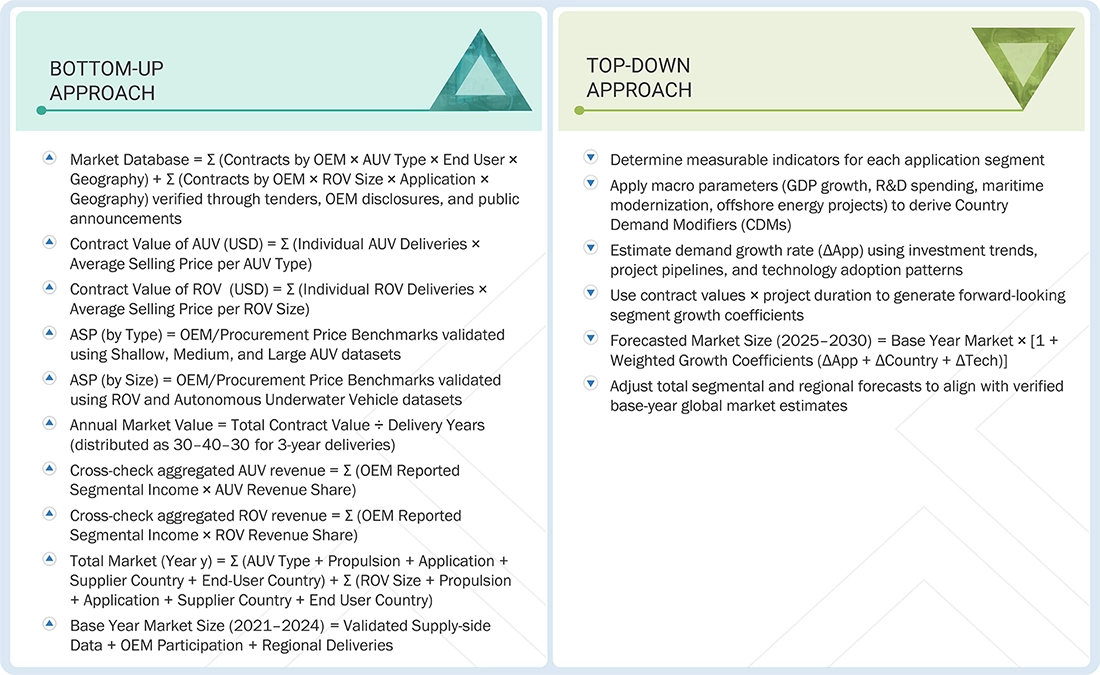
Asia Pacific Unmanned Underwater Vehicle Market Top Down and Bottom Up Approach

Data Triangulation

After determining the overall market size, the total market was divided into several segments and subsegments. The data triangulation and market breakdown procedures explained below were implemented, wherever applicable, to complete the overall market engineering process and arrive at the estimated market numbers for the market segments and subsegments. The data was triangulated by studying various factors and trends from the demand and supply sides. Additionally, the market size was validated using top-down and bottom-up approaches.

Market Definition

The asia pacific unmanned underwater vehicle (UUV) is a self-propelled underwater robotic system used for autonomous or remotely supervised operations across defense, commercial, and research activities. It supports missions such as seafloor mapping, inspection, surveillance, and data collection, enabling efficient underwater tasks without exposing personnel to operational risks.

Key Stakeholders

  • Manufacturers and OEMs
  • Component and Subsystem Suppliers
  • System Integrators
  • End Users
  • Service Providers
  • Regulatory and Certification Bodies
  • Research & Technology Institutions
  • Investors and Funding Agencies

Report Objectives

  • To define, describe, and forecast the asia pacific unmanned underwater vehicle (UUV) market based on type, shape, speed, propulsion, application, system, and cost
  • To forecast the size of different segments of the market with respect to North America, Europe, Asia Pacific, the Middle East, and the Rest of the World
  • To identify and analyze the drivers, restraints, opportunities, and challenges influencing the growth of the market
  • To identify industry trends, market trends, and technology trends currently prevailing in the market
  • To analyze micro markets with respect to individual growth trends, prospects, and their contribution to the overall market
  • To analyze the degree of competition in the market by analyzing recent developments adopted by leading market players
  • To provide a detailed competitive landscape of the market, along with a ranking analysis of key players, and an analysis of startup companies in the market
  • To strategically profile the key market players and comprehensively analyze their core competencies
  • To provide a detailed competitive landscape of the market, along with a market share analysis and revenue analysis of key players

Available Customizations:

MarketsandMarkets offers the following customizations for this market report:

  • Additional country-level analysis of the asia pacific unmanned underwater vehicle (UUV) market
  • Profiling of other market players (up to 5)

Product Analysis

  • Product matrix, which provides a detailed comparison of the product portfolio of each company in the asia pacific unmanned underwater vehicle (UUV) market


Personalize This Research

  • Triangulate with your Own Data
  • Get Data as per your Format and Definition
  • Gain a Deeper Dive on a Specific Application, Geography, Customer or Competitor
  • Any level of Personalization
Request A Free Customisation

Let Us Help You

  • What are the Known and Unknown Adjacencies Impacting the Asia Pacific Unmanned Underwater Vehicle Market
  • What will your New Revenue Sources be?
  • Who will be your Top Customer; what will make them switch?
  • Defend your Market Share or Win Competitors
  • Get a Scorecard for Target Partners
Customized Workshop Request

Custom Market Research Services

We Will Customise The Research For You, In Case The Report Listed Above Does Not Meet With Your Requirements

Get 10% Free Customisation

Growth opportunities and latent adjacency in Asia Pacific Unmanned Underwater Vehicle Market

DMCA.com Protection Status