Over the Air Updates Market Size, Share & Analysis

Over the Air Updates Market for Automotive by Technology (FOTA, SOTA), Application (Infotainment & Telematics, ADAS, Safety & Security, Drivetrain & Body Control, Others), Vehicle (PC, LCV), EV (BEV, PHEV), Communication & Region - Global Forecast to 2033




OVERVIEW
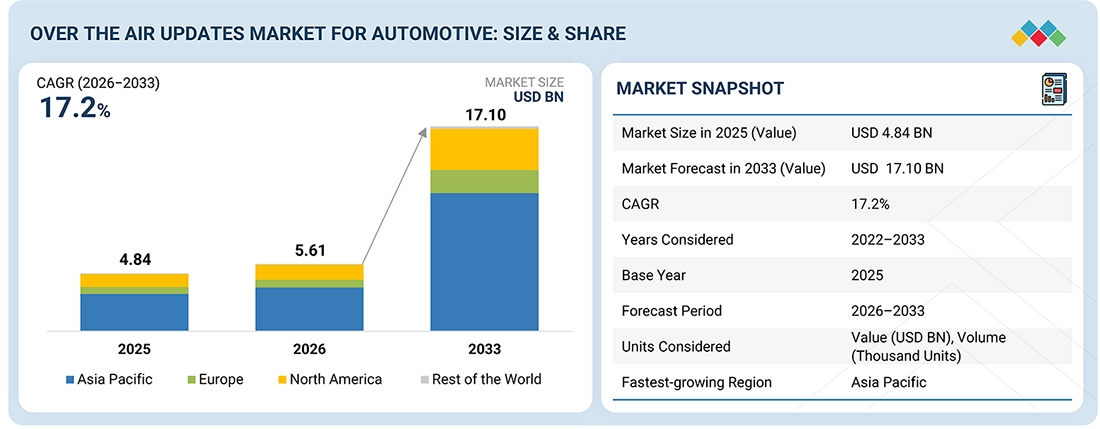
Source: Secondary Research, Interviews with Experts, MarketsandMarkets Analysis
The over the air updates market for automotive is projected to grow from USD 5.61 billion in 2026 to USD 17.10 billion by 2033, at a CAGR of 17.2%. The market is expected to witness strong growth during the forecast period, driven by the rapid adoption of software-defined vehicles, centralized and zonal E/E architectures, and increasing software content per vehicle. OEMs are using OTA platforms to remotely deploy firmware updates, cybersecurity patches, ADAS improvements, battery management enhancements, and feature-on-demand services, reducing recall costs and enabling continuous vehicle improvement. Growth is further supported by expanding connected vehicle production, 5G-enabled telematics, cloud native vehicle platforms, and regulations such as UNECE WP.29 R155 and R156, which require secure software update management and cybersecurity throughout the vehicle lifecycle. China, the United States, Germany, South Korea, and Japan continue to lead OTA deployment through investments in connected mobility and software-defined vehicle ecosystems.
KEY TAKEAWAYS
-
MARKET SNAPSHOT:
Market Size (2025): USD 4.84 Billion
Current Market Size (2026): USD 5.61 Billion
Projected Market Size (2033): USD 17.10 Billion
CAGR (2026–2033): 17.2% -
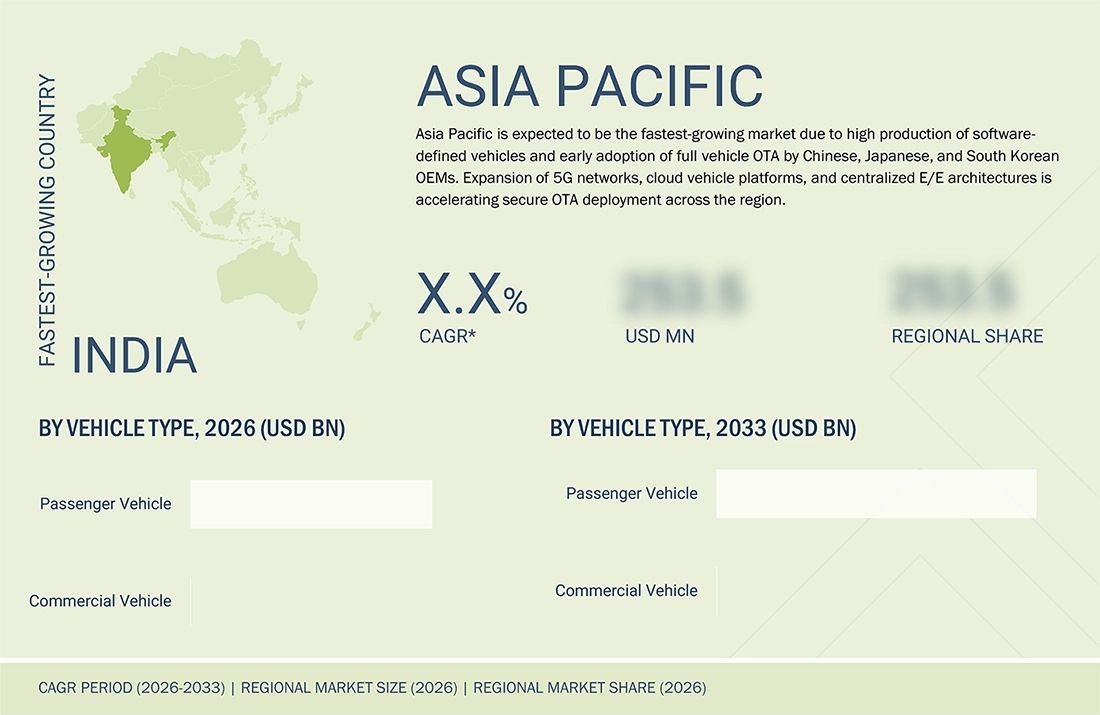
By RegionAsia Pacific is projected to lead the over the air updates market for automotive during the forecast period. This segment is projected to grow from USD 3.65 billion in 2026 to USD 11.54 billion in 2033, at a CAGR of 17.9%
-
By Vehicle TypeThe passenger vehicle segment, by vehicle type, is projected to lead the market throughout the forecast period. The market for this segment is projected to grow from USD 5.40 billion in 2026 to USD 16.47 billion by 2033, at a CAGR of 17.3%.
-
By Application TypeThe infotainment and telematics application is projected to lead the market and is projected to grow from USD 1.18 billion in 2026 to USD 3.69 billion in 2033, at a CAGR of 17.8%.
-
By Technology TypeFirmware over the air (FOTA) technology is projected to be the fastest-growing technology from 2026 to 2033.
-
By Communication TypeThe cellular (3G, 4G, 5G) communication type is likely to lead the market during the forecast period.
-
By Electric Vehicle (EV) TypeThe BEV segment of the EV type is projected to dominate the market during the forecast period.
-
Competitive Landscape (Key Players)The Over the air updates market for automotive is dominated mainly by key players, such as Tesla (United States), Volkswagen AG (Germany), Hyundai Motor Company (South Korea), General Motors Company (United States), Mercedes-Benz Group AG (Germany), among others, due to large connected vehicle fleets, proprietary software platforms, advanced OTA infrastructure, and ability to deploy secure FOTA and SOTA updates at scale.
-
Competitive Landscape (Startups/SMEs)The over the air updates market for automotive comprises SMEs and startups such as Li Auto (China), Xiaomi (China), Zeekr (China), Xpeng (China), Rivian (China), and Polestar (China) owing to their software-centric vehicle platforms, advanced OTA capabilities, rapid software iteration, and strong focus on software-defined vehicle (SDV) innovation.
The over the air updates market for automotive is being driven by the increasing adoption of software-defined vehicles, growing demand for remote software lifecycle management, rising cybersecurity requirements, and the need to reduce recall and service costs. The transition toward centralized and zonal E/E architectures, connected vehicles, and cloud native platforms is accelerating OTA deployment across passenger and commercial vehicles. In the coming years, the market presents opportunities through feature-on-demand services, AI-driven software updates, predictive maintenance, and recurring software revenue models, enabling OEMs to monetize vehicle software throughout its lifecycle.
TRENDS & DISRUPTIONS IMPACTING CUSTOMERS' CUSTOMERS
The over the air updates market for automotive is transitioning from basic remote software updates to lifecycle software management across software-defined vehicles. Current revenues are primarily driven by firmware and infotainment updates, cybersecurity patches, and telematics software. Future growth is expected to come from AI-enabled software deployment, feature-on-demand services, predictive diagnostics, ADAS and autonomous driving software updates, and cloud-native vehicle platforms. OEMs are leveraging OTA to reduce recall costs, accelerate software releases, improve cybersecurity compliance, and generate recurring software revenue throughout the vehicle lifecycle.
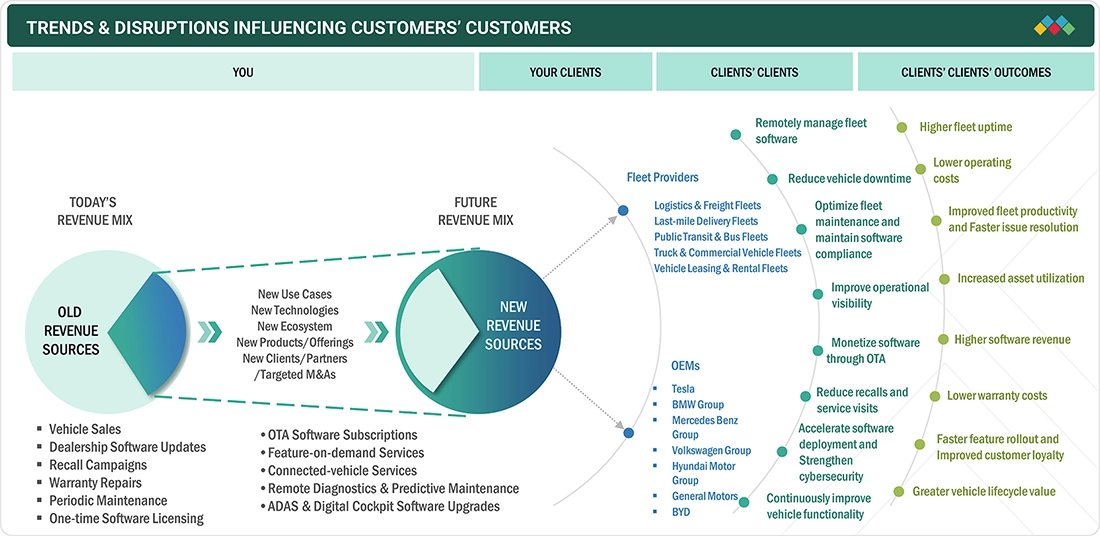
Source: Secondary Research, Interviews with Experts, MarketsandMarkets Analysis
MARKET DYNAMICS

Level
-
Increasing adoption of 5G and satellite connectivity for reliable OTA delivery

-
Rising demand for continuous cybersecurity patch management


Level
-
Lengthy software validation and certification cycles

-
Requirement for high investment to secure end-to-end OTA infrastructure


Level
-
OTA-enabled predictive maintenance using AI

-
Integration of digital twin technology for remote diagnostics


Level
-
Coordinating software updates across multi-supplier vehicle architectures

-
Ensuring functional safety during critical vehicle software updates

Source: Secondary Research, Interviews with Experts, MarketsandMarkets Analysis
Driver: Increasing adoption of 5G and satellite connectivity for reliable OTA delivery
Continuous expansion of 5G networks and satellite connectivity is improving the reliability, speed, and coverage of automotive OTA deployments across passenger and commercial vehicles. High-bandwidth, low-latency communication enables faster delivery of firmware updates, ADAS software, digital cockpit enhancements, and cybersecurity patches, while satellite connectivity extends OTA capabilities to remote highways, mining sites, rural regions, and cross-border freight routes where cellular coverage is limited. At the same time, OEMs and connectivity providers are integrating hybrid terrestrial and satellite communication architectures, intelligent network switching, and edge cloud platforms to ensure uninterrupted software delivery, higher update success rates, and secure lifecycle management for increasingly connected and software-defined vehicles.
Restraint: Lengthy software validation and certification cycles
Lengthy software validation and certification cycles continue to limit the pace of automotive OTA deployment as every update affecting safety critical domains must be verified across thousands of hardware and software combinations before release. Unlike consumer devices, vehicle software updates require validation for functional safety, cybersecurity, homologation, and interoperability with ECUs, domain controllers, sensors, and vehicle operating systems. Even minor modifications to ADAS algorithms, battery management logic, or powertrain software can trigger full regression testing to ensure that existing vehicle functions remain unaffected. This significantly extends release timelines, delays deployment of new features, increases engineering costs, and reduces the frequency of OTA rollouts, particularly for global OEMs managing multiple vehicle platforms and regional regulatory requirements.
Opportunity: OTA-enabled predictive maintenance using AI
AI-driven predictive maintenance delivered through automotive OTA presents a significant opportunity for OEMs to transition from reactive servicing to condition-based vehicle maintenance. By continuously analyzing real-time data from battery systems, powertrain components, braking systems, thermal management, and connected sensors, AI models can identify early signs of component degradation and deploy optimized software updates before failures occur. OTA enables OEMs to remotely recalibrate control algorithms, refine battery management strategies, optimize energy consumption, and improve system performance without requiring workshop visits. This reduces unplanned downtime, extends component life, lowers warranty costs, and improves fleet availability.
Challenge: Coordinating software updates across multi-supplier vehicle architectures
Coordinating OTA updates across multi-supplier vehicle architectures remains a major challenge as modern vehicles integrate software from OEMs, Tier 1 suppliers, semiconductor vendors, and operating system providers. A single OTA release often spans multiple interconnected ECUs, domain controllers, middleware, and cloud services, where software dependencies vary across vehicle platforms and model years. Any mismatch in software versions, communication protocols, or interface compatibility can lead to update failures, degraded functionality, or system conflicts. OEMs must, therefore, synchronize software releases, validate cross-supplier dependencies, and maintain configuration consistency across thousands of vehicle variants, increasing development effort, deployment complexity, and time to market.
OVER THE AIR UPDATES MARKET: COMMERCIAL USE CASES ACROSS INDUSTRIES
| COMPANY | USE CASE DESCRIPTION | BENEFITS |
|---|---|---|
 |
Uses full vehicle OTA to deploy battery, ADAS, and system software updates remotely | Faster software deployment, lower recall costs, improved vehicle performance. |
 |
Delivers OTA updates across infotainment and vehicle control systems on connected vehicle platforms | Reduced service visits, enhanced cybersecurity, improved software quality. |
 |
Expands OTA across SDV platforms for vehicle functions and feature upgrades | Continuous feature delivery, reduced maintenance effort, improved user experience. |
 |
Uses the Ultifi platform for remote software updates and digital feature activation | Recurring software revenue, lower warranty costs, faster update cycles. |
 |
Deploys OTA updates through MB.OS for ADAS, infotainment, and vehicle systems | Improved software reliability, secure updates, reduced dealership dependency. |
Logos and trademarks shown above are the property of their respective owners. Their use here is for informational and illustrative purposes only.
MARKET ECOSYSTEM
The over the air updates market for automotive ecosystem is built around collaboration between semiconductor companies, OTA platform providers, cybersecurity vendors, cloud and connectivity providers, Tier 1 suppliers, and OEMs to enable secure software delivery throughout the vehicle lifecycle. ECU and SoC providers such as Qualcomm, NXP, Renesas, Infineon, and QNX provide the computing platforms that support OTA capable vehicle architectures. OTA platform providers develop software orchestration, update management, and campaign deployment solutions, while cybersecurity companies secure software packages, authenticate updates, and ensure compliance with vehicle cybersecurity regulations. Cloud and connectivity providers deliver scalable infrastructure and high speed communication for reliable software distribution across connected vehicles. Tier 1 suppliers integrate OTA functionality into vehicle ECUs, domain controllers, ADAS, infotainment, and body electronics. OEMs combine these technologies to remotely deploy firmware updates, cybersecurity patches, feature upgrades, and vehicle performance improvements, reducing service costs while enabling continuous software innovation.
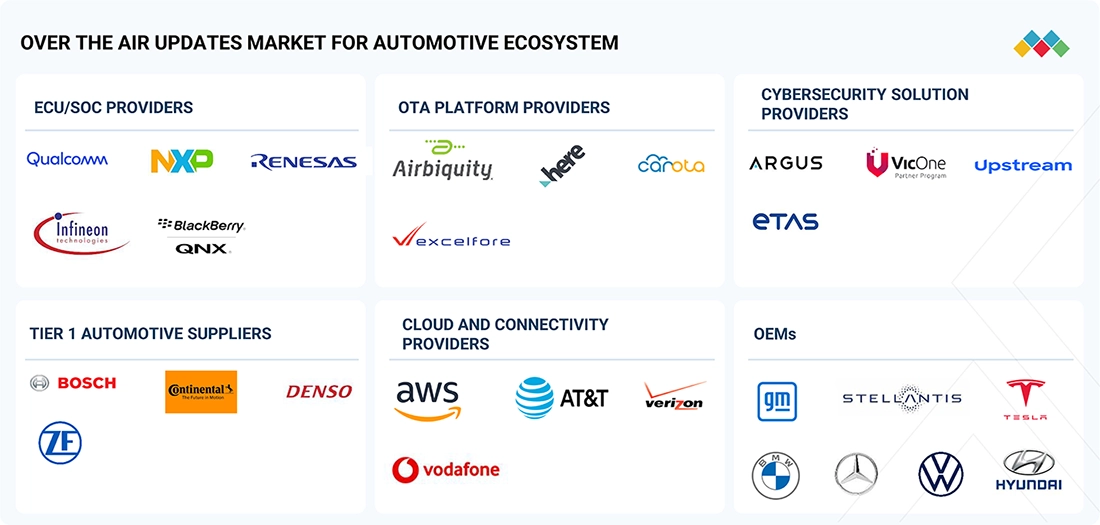
Logos and trademarks shown above are the property of their respective owners. Their use here is for informational and illustrative purposes only.
MARKET SEGMENTS
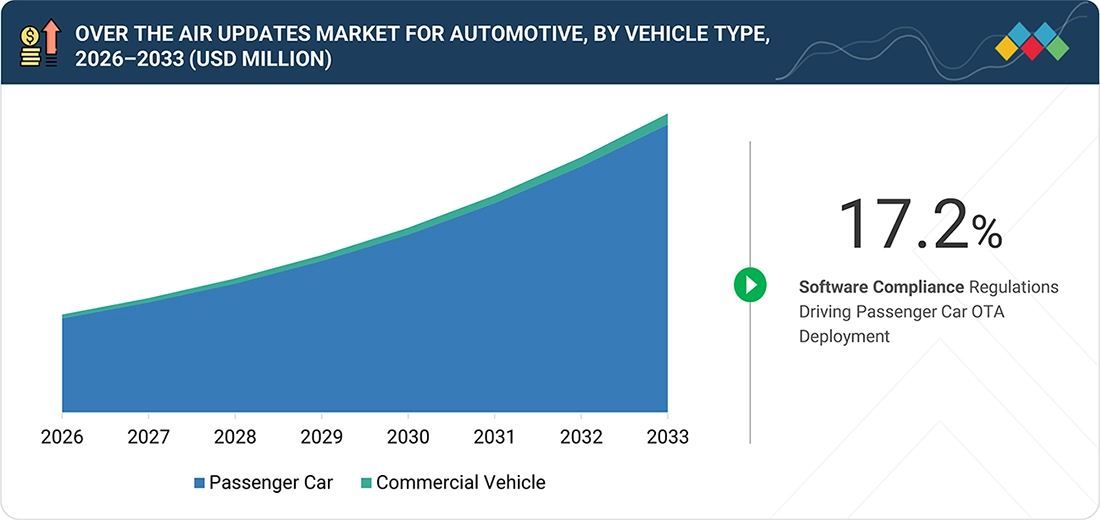
Source: Secondary Research, Interviews with Experts, MarketsandMarkets Analysis
Over the air updates market for automotive, by Application
Infotainment & telematics accounts for the largest share as it is the primary software domain for frequent OTA deployments. OEMs continuously deliver navigation updates, digital cockpit enhancements, connectivity improvements, voice assistant upgrades, and cybersecurity patches to improve user experience without dealership intervention.
Over the air updates market for automotive, by Vehicle Type
Passenger cars account for the largest share due to rapid deployment of centralized and zonal E/E architectures that consolidate multiple vehicle functions into high-performance domain controllers. OEMs are increasingly delivering OTA updates for ADAS perception algorithms, digital cockpit software, vehicle operating systems, battery management, and body control modules, enabling continuous software evolution and reducing dealership based service interventions.
Over the air updates market for automotive, by Technology Type
Firmware over the air (FOTA) technology holds the largest share of the over the air updates market for automotive as it enables secure remote updates of bootloaders, microcontroller firmware, domain and zonal controllers, battery management systems, and other safety critical ECUs without hardware replacement. Growing deployment of centralized computing architectures, AUTOSAR Adaptive platforms, and hardware abstraction layers is increasing demand for FOTA to support firmware integrity verification, rollback protection, secure boot compliance, cybersecurity vulnerability mitigation, and continuous optimization of vehicle hardware throughout its operational life.
Over the air updates market for automotive, by Electric Vehicle Type
Battery electric vehicles (BEVs) dominate the segment as they require frequent OTA updates for battery management software, charging algorithms, inverter calibration, thermal management, and energy optimization. OEMs use OTA to improve state of charge estimation, charging curves, regenerative braking calibration, and battery diagnostics, extending battery life while enhancing driving efficiency.
Over the air updates market for automotive, by Communication Type
Cellular (3G/4G/5G) communication type holds the largest market share due to its wide-area coverage and secure, high-bandwidth connectivity for remote software delivery. Growing adoption of 5G, embedded eSIMs, and cloud-connected vehicles is enabling faster firmware updates, real-time diagnostics, and cybersecurity patch deployment across vehicle fleets.
REGION
Asia Pacific is likely to be the fastest-growing over the air updates market for automotive
Asia Pacific is likely to record the highest CAGR and account for the largest market share in the over the air updates market for automotive due to high connected vehicle production, rapid commercialization of software-defined vehicles, and strong OEM investments in cloud native software platforms. China leads OTA deployment through high-volume EV production and full vehicle software updates, while Japan and South Korea are expanding OTA across ADAS, battery management, digital cockpit, and vehicle control systems. Mature 5G infrastructure, a robust semiconductor supply chain, and increasing adoption of centralized and zonal E/E architectures are accelerating secure, large-scale OTA deployment across the region.
OVER THE AIR UPDATES MARKET: COMPANY EVALUATION MATRIX
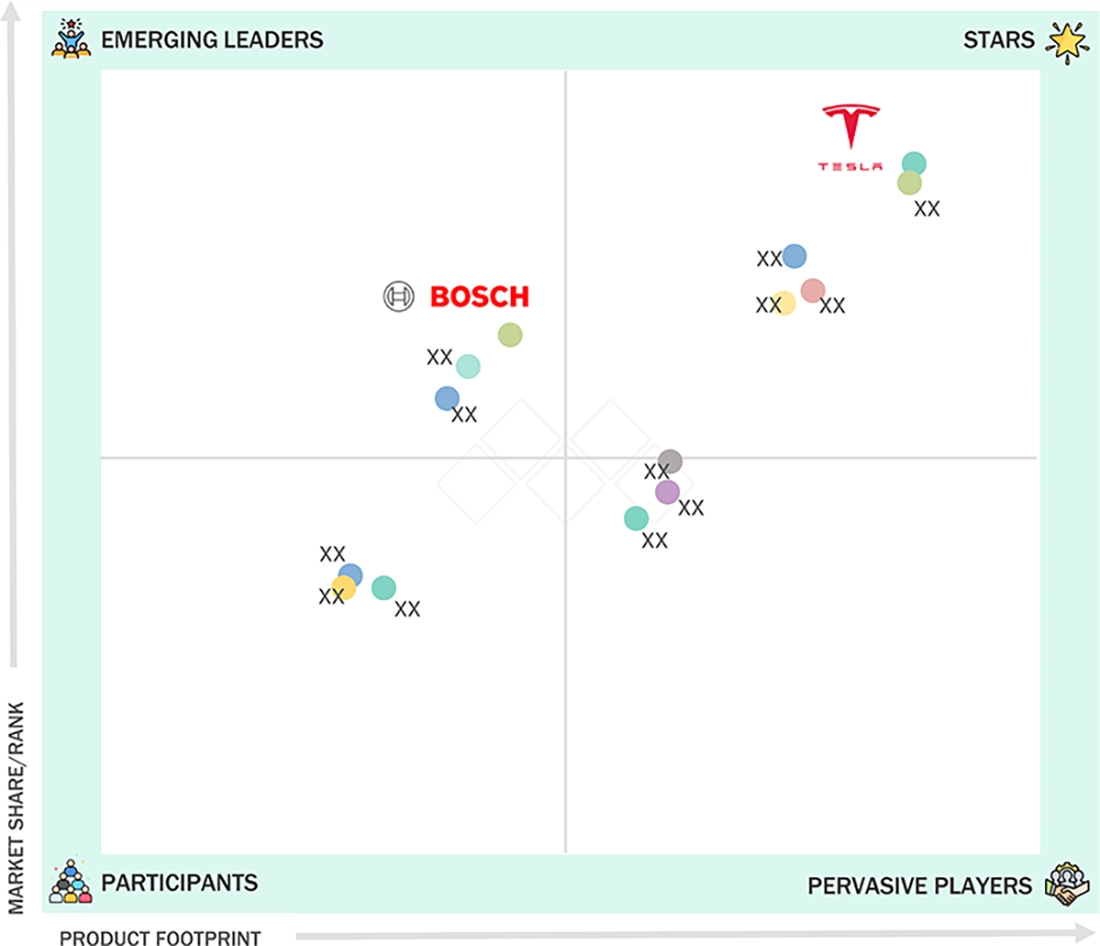
Tesla is categorized as a Star Player in the Over the air updates market for automotive, makes own software and OTA updates. As the company has established industry leadership through full vehicle OTA capabilities that support firmware, battery management, ADAS, infotainment, and vehicle performance updates. Its vertically integrated software architecture enables rapid feature deployment, continuous vehicle optimization, and recurring software revenue across its global vehicle fleet. Robert Bosch is recognized as a Key Emerging Player, as the company is expanding its OTA portfolio through software-defined vehicle platforms, secure update management solutions, vehicle middleware, and cloud-connected software services. Its collaborations with global OEMs and investments in centralized vehicle computing are strengthening its position in the evolving automotive OTA ecosystem.
Source: Secondary Research, Interviews with Experts, MarketsandMarkets Analysis
KEY MARKET PLAYERS
- Tesla (United States)
- Volkswagen AG (United States)
- Hyundai Motors Company (South Korea)
- General Motors (United States)
- Mercedes Benz(Germany)
- BYD (China)
- Robert Bosch (Germany)
- Aumovio (Germany)
- ZF Friedrichshafen AG (Germany)
- Denso Corporation (Japan)
- Aptiv (Switzerland)
- Karma Automotive (United States)
- Sibros (United States)
- Sonatus (United States)
- Here Technologies (Netherlands)
- Excelfore (United States)
MARKET SCOPE
| REPORT METRIC | DETAILS |
|---|---|
| Market Size in 2025 (Value) | USD 4.84 Billion |
| Market Size in 2026 (Value) | USD 5.61 Billion |
| Market Forecast in 2033 (Value) | USD 17.10 Billion |
| Growth Rate | CAGR of 17.2% from 2026–2033 |
| Years Considered | 2022–2033 |
| Base Year | 2025 |
| Forecast Period | 2026-2033 |
| Units Considered | Volume (Thousand Units), Value (USD Million) |
| Report Coverage | Revenue Forecast, Competitive Landscape, Company Share, Growth Factors and Trends |
| Segments Covered | By Application (Infotainment & Telematics; ADAS, Safety and Security; Drivetrain & Body Control; Other Applications), By Vehicle Type (Passenger Car, Commercial Vehicle), By Electric Vehicle Type (BEV, PHEV), By Communication Type (Cellular (3G, 4G LTE, 5G), WI-FI, Satellite, Dedicated Short Range Communication (DSRC), Vehicle to Everything), By Technology (FOTA, SOTA), By Region (Asia Pacific, North America, Europe and Rest of the World) |
| Regional Scope | Asia Pacific, North America, Europe, and Rest of the World |
WHAT IS IN IT FOR YOU: OVER THE AIR UPDATES MARKET REPORT CONTENT GUIDE
DELIVERED CUSTOMIZATIONS
We have successfully delivered the following deep-dive customizations:
| CLIENT REQUEST | CUSTOMIZATION DELIVERED | VALUE ADDS |
|---|---|---|
| OTA Deployment Segmentation | Developed separate analysis for FOTA, SOTA, ECU, ADAS, infotainment, telematics, and digital cockpit OTA deployments. | Helps prioritize high growth OTA segments and product investments. |
| Identification of OTA Adoption Drivers | Mapped demand drivers including SDV adoption, connected vehicles, cybersecurity regulations, and cloud native architectures. | Supports long term technology and investment planning. |
| OEM and Platform Benchmarking | Benchmarked OEM OTA maturity, software platforms, update capabilities, and deployment strategies. | Enables competitive benchmarking and partnership evaluation. |
| Software Architecture Analysis | Assessed centralized and zonal E/E architectures, HPC adoption, middleware, and vehicle OS integration. | Helps understand future OTA readiness across vehicle platforms. |
| Application Level Insights | Analyzed OTA adoption across powertrain, battery management, ADAS, infotainment, body electronics, and telematics. | Supports targeted product development and market positioning. |
| Regional Market Deep Dive | Delivered country level analysis covering connected vehicle penetration, OTA regulations, and SDV adoption across major automotive markets. | Assists regional expansion and localization strategies. |
| Cybersecurity and Regulatory Assessment | Evaluated UNECE R155/R156 compliance, cybersecurity frameworks, SUMS implementation, and software governance. | Reduces compliance risk and supports secure OTA deployment. |
| OTA Ecosystem Mapping | Identified OTA platform providers, cloud vendors, semiconductor companies, cybersecurity firms, Tier 1 suppliers, and OEM collaborations. | Improves ecosystem visibility and partnership planning. |
| Software Monetization Analysis | Evaluated feature on demand, subscription services, digital upgrades, and recurring software revenue models. | Supports revenue diversification and software business strategy. |
| Strategic Recommendations | Provided recommendations on OTA deployment roadmap, platform selection, cybersecurity, and software monetization. | Enables informed technology decisions and sustainable market growth. |
RECENT DEVELOPMENTS
- February 2026 : Mercedes-Benz has developed the s-class with a clear focus on software. MB.OS, over-the-air updates and ai-based functions are intended to modernize the flagship.
- January 2026 : Tesla introduced enhancements to FSD software, improving AI-driven autonomous driving capabilities and real-world performance.
- January 2026 : Tesla collaborated with Samsung Electronics for advanced semiconductor manufacturing focused on AI semiconductor supply for vehicle compute platforms supporting OTA deployment of FSD models, ADAS features, and onboard neural network execution with higher processing efficiency.
- January 2026 : Volkswagen partnered with Qualcomm Technologies to develop next-generation digital cockpit and centralized compute platforms for software-defined vehicles (SDVs). The collaboration strengthens OTA-enabled infotainment, cockpit software updates, and high-performance in-vehicle computing architectures.
- January 2026 : Hyundai Motor Company launched Pleos software as a unified SDV solution, enabling centralized architecture, OTA updates, and scalable software deployment.
- January 2026 : General Motors introduced advancements to its SDV software architecture, focusing on seamless software experiences and continuous feature delivery.
- December 2025 : Tesla collaborated with Samsung Electronics for advanced semiconductor manufacturing focused on AI semiconductor supply for vehicle compute platforms supporting OTA deployment of FSD models, ADAS features, and onboard neural network execution with higher processing efficiency.
- November 2025 : Hyundai Motor Company participated in the SDV Standard Forum to drive standardization and interoperability across software-defined vehicle ecosystems. The collaboration focuses on enabling consistent OTA software frameworks, cross-OEM software compatibility, and unified vehicle software architecture standards.
- November 2025 : General Motors formed a joint venture with Magna International to develop a software-defined vehicle ecosystem and automotive software marketplace. The collaboration strengthens SDV software distribution frameworks and supports OTA-enabled application deployment, in-vehicle software updates, and lifecycle digital services.
- February 2025 : Mercedes-Benz collaborated with Tata Elxsi to strengthen software engineering for MB.OS and connected vehicle platforms, supporting faster development, validation, and deployment of OTA updates across infotainment, ADAS, and vehicle software systems.
Table of Contents
 Exclusive indicates content/data unique to MarketsandMarkets and not available with any competitors.
Methodology
Various secondary sources, directories, and databases have been used to identify and collect information for an extensive over the air updates market for automotive study. The study involved four main activities in estimating the current size of the market: secondary research, validation through primary research, assumptions, and market analysis. The research study involved various secondary sources, such as company annual reports/presentations, industry association publications, automotive wiring harness magazine articles, directories, technical handbooks, World Economic Outlook, trade websites, technical articles, and databases, which have been used to identify and collect information for an extensive study of the over the air updates market for automotive. Primary experts from related industries, automobile OEMs, and suppliers have been interviewed to obtain and verify critical information and assess prospects and market estimations.
Secondary Research
Secondary sources referred to for this research study included automotive OTA industry organizations; corporate filings such as annual reports, investor presentations, and financial statements; trade and business whitepapers and databases; and articles from recognized associations and government publishing sources. The secondary data has been collected and analyzed to arrive at the overall market size, which has been further validated by primary research.
Primary Research
Extensive primary research has been conducted after acquiring an understanding of this market scenario through secondary research. Several primary interviews have been conducted with market experts from the demand- and supply-side OEMs (in terms of component supply, country-level government associations, and trade associations) and component manufacturers across four major regions, namely, Asia Pacific - 40%, Europe - 25%, North America - 20% and Rest of the World - 15%. Approximately 60% and 40% of primary interviews have been conducted from the demand and supply side, respectively. Primary data has been collected through questionnaires, emails, LinkedIn, and telephonic interviews. In the canvassing of primaries, we have strived to cover various departments within organizations, such as sales, operations, and administration, to provide a holistic viewpoint in our report.
Brief sessions with highly experienced independent consultants have been conducted to reinforce findings from primaries after interacting with industry experts. This, along with the in-house subject matter experts’ opinions, led to the findings, as described in the remainder of this report.
In the primary research process, various primary sources from the supply and demand sides have been interviewed to obtain qualitative and quantitative information for the report. The primary sources from the supply side included industry experts, such as vice presidents (VPs), marketing directors, technology and innovation directors, and related key executives from various key companies and organizations. The primary sources from the demand side included end users, such as chief information officers (CIOs), consultants, service professionals, technicians and technologists, and managers at public and investor-owned utilities.
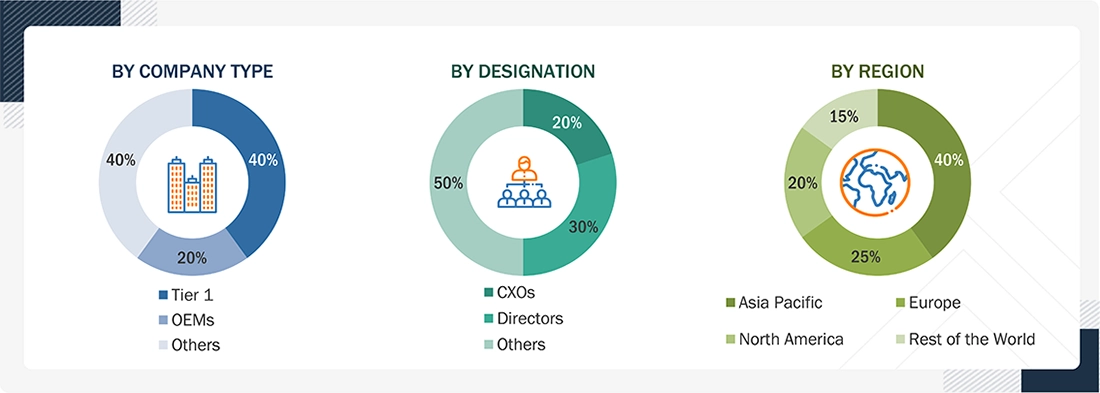
Note: Others include purchase and sales managers, marketing managers, and product managers.
To know about the assumptions considered for the study, download the pdf brochure
Market Size Estimation
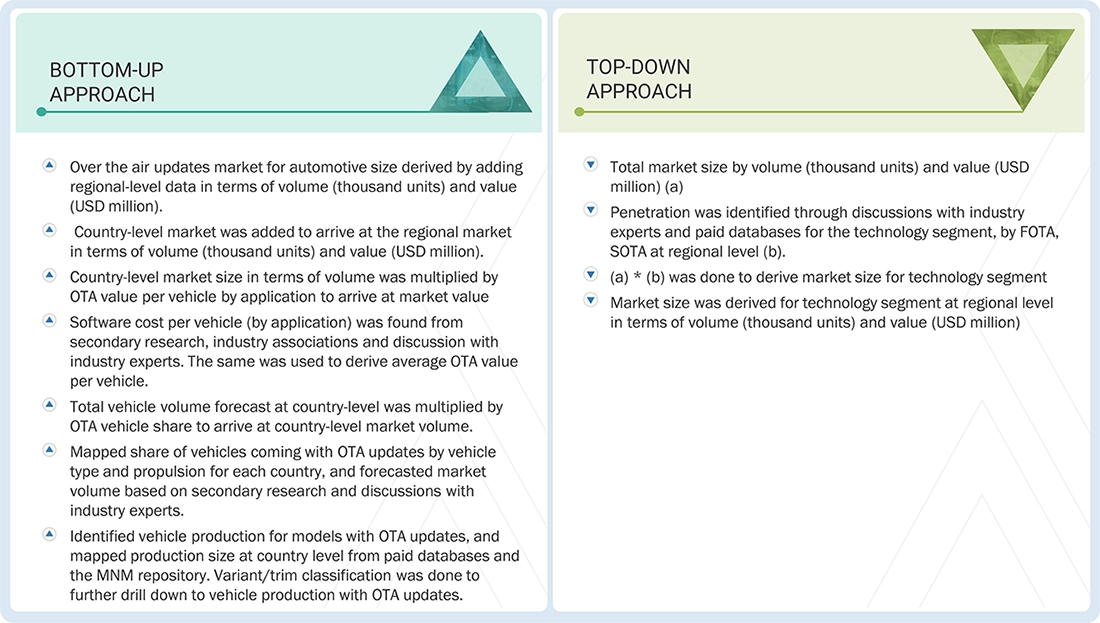
The over the air updates market for automotive is estimated using a bottom-up methodology, where the market size is calculated and validated through country-level vehicle production, OTA feature availability, and industry verification. Under this approach, vehicle production data is mapped at the model and variant level across passenger cars and light commercial vehicles. OTA-enabled vehicles are identified by assessing OEM-specific OTA availability, trim level differentiation, and feature deployment using public databases, OEM websites, industry publications, and expert validation. Country-level OTA-enabled vehicle volumes are then aggregated to derive regional market volumes. To estimate market value, the software value attributable to OTA functionality is mapped based on OEM architecture, ECU software content, and regional pricing assumptions. The resulting country-level market values are consolidated at the regional level and further aggregated to determine the global over the air updates market for automotive size in terms of both volume and value.
The technology segment of the studied market is estimated using a top-down methodology, where the total OTA-enabled vehicle market is calculated and validated in terms of both volume and value. The top-down assessment evaluates regional penetration of OTA-enabled vehicles, followed by technology-wise allocation across Firmware Over the Air (FOTA) and Software Over the Air (SOTA) updates based on OEM deployment strategies, E/E architecture evolution, software-defined vehicle adoption, and expert validation.
Bottom-up & Top-down Approach
Data Triangulation
After arriving at the overall market size using the market size estimation processes as explained above, the market has been split into several segments and subsegments. To complete the overall market engineering process and arrive at the exact statistics of each market segment and subsegment, data triangulation and market breakdown procedures have been employed, wherever applicable. The data has been triangulated by studying various factors and trends from both the demand and supply sides.
Market Definition
The over the air updates market for automotive comprises technologies, platforms, and services that enable OEMs to securely deliver firmware and software updates to connected vehicles through wireless communication networks. OTA supports remote updates for ECUs, domain controllers, infotainment, ADAS, telematics, battery management, powertrain, and body control systems, enabling continuous software maintenance, cybersecurity updates, feature deployment, and vehicle performance optimization throughout the vehicle lifecycle without requiring dealership intervention.
Key Stakeholders
- Associations, Standards Organizations, and Automotive Alliances
- Automobile Manufacturers (OEMs)
- Electric Vehicle Manufacturers
- Commercial Vehicle Manufacturers
- Automotive Software Developers
- Automotive Component Manufacturers
- Electronic Control Unit (ECU) Manufacturers
- Semiconductor and Connectivity Providers
- Telematics Service Providers
- Cloud Platform Providers
- Cybersecurity Solution Providers
- OTA Software Platform Providers
- Autonomous Driving Technology Providers
- Vehicle Connectivity Solution Providers
- 5G, Cellular, and Communication Network Providers
- Automotive Data Management Companies
- Digital Twin and Remote Diagnostics Providers
- Fleet Management Solution Providers
- Automotive Investors and Technology Investors
- Government Agencies and Policymakers
- Research Institutes and Testing Organizations
Report Objectives
- To segment and forecast the over the air updates market for automotive in terms of volume (Thousand Units) and value (USD million) from 2022 to 2033
- To define, describe, and forecast the market for automotive based on vehicle type, application, technology type, electric vehicle type, communication type, and region
- To segment and forecast the market size by volume and value at the regional level based on vehicle type (passenger car, commercial vehicle)
- To segment and forecast the market size by volume based on application (infotainment & telematics; ADAS, safety and security; drivetrain & body control; other applications)
- To segment and forecast the market size by volume based on electric vehicle type (battery electric vehicle (BEV), plug-in hybrid electric vehicle (PHEV))
- To segment the market based on technology [firmware over the air (FOTA), software over the air (SOTA)]
- To forecast the market size with respect to key regions, namely, Asia Pacific, Europe, North America, and Rest of the World
- To analyze regional markets for growth trends, prospects, and their contribution to the overall market
- To define, describe, and forecast the size of the over the air updates market for automotive with respect to growth trends and prospects, and determine the contribution of the segments to the total market
- To provide detailed information regarding the major factors (drivers, challenges, restraints, and opportunities) influencing market growth
- To strategically analyze markets with respect to individual growth trends, prospects, and contribution to the total market
- To analyze opportunities for stakeholders and the competitive landscape for market leaders
- To study the following with respect to the market -
- Value Chain Analysis
- Ecosystem Analysis
- Pricing Analysis
- Technology Analysis
- Trade Analysis
- Case Study Analysis
- OEM and Supplier Analysis
- Patent Analysis
- Regulatory Landscape
- Key Stakeholders and Buying Criteria
- Funding, by Application
- Key Conferences & Events
- To strategically profile key players and comprehensively analyze their market share and core competencies
- To analyze competitive developments such as deals (mergers & acquisitions, partnerships, collaborations), product developments, and other activities carried out by key industry participants.
Available customizations:
With the given market data, MarketsandMarkets offers customizations in line with company-specific needs.
- Over the Air Updates Market for Automotive, by Application, at the Country Level (For Regions Covered in the Report)
- Over the Air Updates Market for Automotive, by Technology at the Country Level (For Countries Addition up to 3 in the Report)
Company Information
- Profiling of Additional Market Players (Up to 5)


Personalize This Research
- Triangulate with your Own Data
- Get Data as per your Format and Definition
- Gain a Deeper Dive on a Specific Application, Geography, Customer or Competitor
- Any level of Personalization
Let Us Help You
- What are the Known and Unknown Adjacencies Impacting the Over the Air Updates Market
- What will your New Revenue Sources be?
- Who will be your Top Customer; what will make them switch?
- Defend your Market Share or Win Competitors
- Get a Scorecard for Target Partners

Custom Market Research Services
We Will Customise The Research For You, In Case The Report Listed Above Does Not Meet With Your Requirements
Get 10% Free CustomisationTESTIMONIALS

JIM NAAS
PRODUCT DIRECTOR, WEASLER
Weasler Engineering, a CentroMotion organization
Global Provider of Industrial Actuation & Control Solutionswww.weasler.com
Our organization was interested in learning more about the attractiveness of a particular market space. We contacted MarketsandMarkets to help us based on previous positive experiences we had with them. The results did not disappoint! We discussed our objectives with them, and the team at MarketsandMarkets developed and executed a proposal that met our needs precisely. We were very impressed by their level of expertise, the quality of the analysis and their insightful recommendations. We would not hesitate in working with them again in the future.

Matt Kardel,
Vice President
Aptiv,
A global technology company that develops safer, greener and more connected solutions.www.aptiv.com
We contracted with
MarketsandMarkets to evaluate the value chain and potential go-to-market partners related to our
interest in the Fleet Management space. The team successfully completed the work on time and at the
pricing agreed. MarketsandMarkets listened and understood our objectives and collaborated well with
us to help us get the visibility we needed to make an investment.
We have subsequently used
MarketsandMarkets again related to Smart Cities to good results.
- Canada Over the Air Updates Market
- Mexico Over the Air Updates Market
- U.S. Over the Air Updates Market
- France Over the Air Updates Market
- Germany Over the Air Updates Market
- Italy Over the Air Updates Market
- Spain Over the Air Updates Market
- U.K. Over the Air Updates Market
- China Over the Air Updates Market
- India Over the Air Updates Market
- Japan Over the Air Updates Market
- S. Korea Over the Air Updates Market
- Brazil Over the Air Updates Market
- Russia Over the Air Updates Market
- South Korea Over the Air Updates Market






Growth opportunities and latent adjacency in Over the Air Updates Market