Cargo Drones Market by Solution (Platform, Software, Infrastructure, Service), Type (Fixed, Rotary), Payload (10-49, 50-149, 150-249, 250-499, 500-999, 1000 Kg and More), End User (Commercial, Government & Defense), Application, Range, and Region - Global Forecast to 2031

icon1
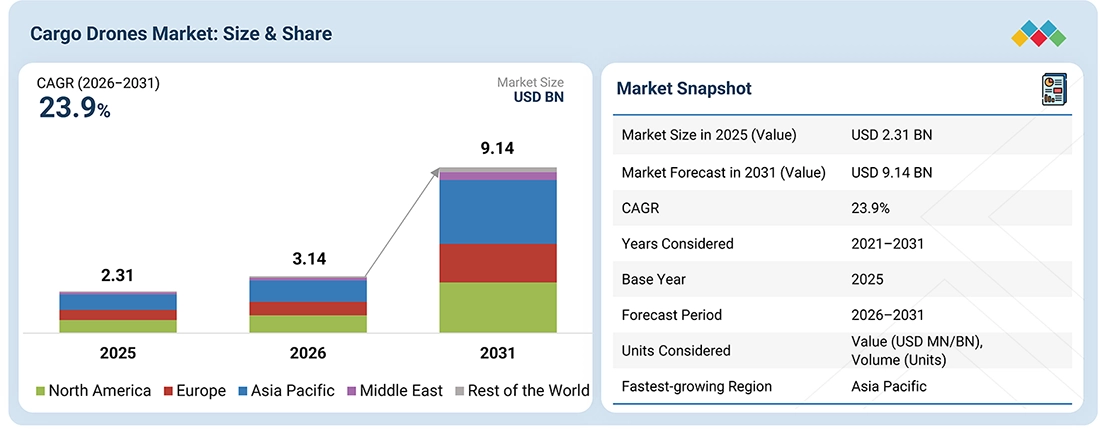
USD 9.14 BN
MARKET SIZE, 2031
icon2
CAGR 23.9%
(2026-2031)
icon3
420
REPORT PAGES
icon4
360
MARKET TABLES

CARGO DRONES MARKET OVERVIEW

According to Marketsandmarkets, the Global Cargo Drones Market Size is projected to grow from USD 3.14 billion in 2026 to USD 9.14 billion by 2031, growing at a CAGR of 23.9% from 2026-2031. The cargo drones market is growing as demand increases for faster and more efficient transportation of goods across logistics, e-commerce, healthcare, and industrial applications. Advances in autonomous flight systems, battery technology, and propulsion systems are enabling cargo drones to carry heavier loads over longer distances. The need for reliable deliveries to remote locations, reduced transportation delays, and improved supply chain efficiency is further supporting market growth.

REPORT SCOPE

REPORT METRIC DETAILS
Market Size in 2025 (Value) USD 2.31 Billion
Market Forecast in 2026 (Value) USD 3.14 Billion
Market Forecast in 2031 (Value) USD 9.14 Billion
Growth Rate CAGR of 23.9% from 2026–2031
Years Considered 2021–2031
Base Year 2025
Forecast Period 2026–2031
Units Considered Value (USD Million/Billion), Volume (Units)
Report Coverage Revenue Forecast, Company Ranking, Competitive Landscape, Growth Factors, and Trends
Top Companies
  • DJI (China)
  • Windracers Ltd (UK)
  • BAE Systems (UK)
  • Yates Electrospace Corporation (US)
  • FlyingBasket S.r.l. (Italy)
Growth Drivers
  • Rising Demand for Faster and Time Critical Shipments Accelerates Cargo Drone Adoption
  • Expansion of E-commerce and On-Demand Delivery Networks Increases Demand for Last Mile Logistics
  • Increasing Adoption of Cargo Drones for Military Tactical Resupply and Contested Logistics
  • Expansion of Medical, Humanitarian, and Emergency Logistics Creates New Delivery Applications
  • Advancements in Autonomous Flight, Battery Technology, and Payload Capacity Improve Operational Efficiency
Segments Covered
  • By Platform:
    • Platforms
    • Software
    • Infrastructure
    • Services
  • By Type:
    • Fixed-Wing
    • Rotary-Wing
  • By Payload Capacity:
    • 10–49 Kg
    • 50–149 Kg
    • 150–249 Kg
    • 250–499 Kg
    • 500–999 Kg
    • 1
    • 000 Kg & Above
  • By Range:
    • Close Range (650 Km)
    • Short Range (50–149 Km)
    • Mid Range (150–650 Km)
    • Long Range (>650 Km)
  • By Application:
    • Retail & Consumer Goods
    • Healthcare & Medical
    • Industrial & Manufacturing
    • Energy & Utility
    • Mining & Construction
    • Agriculture & Forestry
    • Humanitarian & Disaster Management
    • Tactical Resupply & Mission Support
  • By End User:
    • Commercial
    • Government & Defense
Regions Covered North America, Europe, Asia Pacific, Middle East, Rest of the World

KEY TAKEAWAYS

  • BY REGION
    By region, the Asia Pacific dominated the cargo drones market, with a market share of 37.0% in 2025.
  • BY SOLUTION
    By solution, the services segment is expected to grow at the highest CAGR of 26.2% from 2026 to 2031.
  • BY APPLICATION
    By application, the retail & consumer goods segment is projected to grow at the highest CAGR of 35.7% from 2026 to 2031.
  • COMPETITIVE LANDSCAPE - KEY PLAYERS
    BAE Systems, DJI, FlyingBasket S.r.l., Windracers Ltd., and Yates Electrospace Corporation are key players in the cargo drones market. These companies hold strong positions because of their established product portfolios and broad operational presence. Consistent investment in product development supports their market standing.
  • COMPETITIVE LANDSCAPE - STARTUPS/SMES
    Grid Aero, Inc. and BonV Aero are considered progressive companies that have distinguished themselves in the cargo drones market through strong product innovation and technological advancements.

The Cargo Drones Industry is gaining traction as logistics providers seek faster transportation between warehouses, distribution centers, and remote locations. Companies such as Dronamics are developing long-range cargo drones to support time-sensitive shipments, including medicines, parcels, and essential goods. Improvements in autonomous flight systems, payload handling, and navigation are helping cargo drones serve routes where conventional transport is slow or hard to access. These developments are creating opportunities for cargo drone adoption across commercial logistics, healthcare delivery, and industrial supply chains.

cargo-drones-market Overview

Source: Secondary Research, Interviews with Experts, MarketsandMarkets Analysis

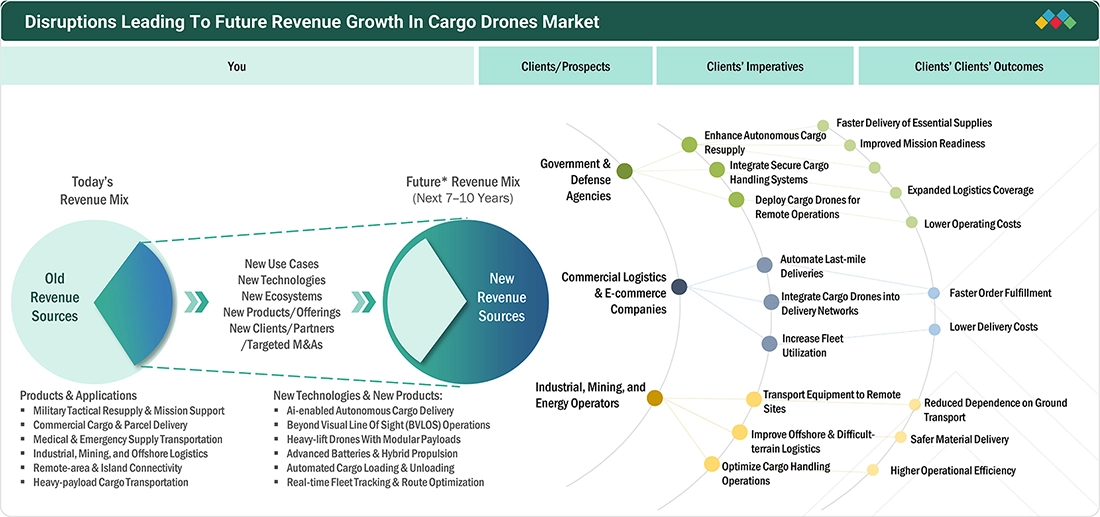
TRENDS & DISRUPTIONS IMPACTING CUSTOMERS' CUSTOMERS

The cargo drones market is evolving as manufacturers develop platforms with higher payload capacity, longer flight ranges, and improved operational efficiency. Companies are focusing on autonomous flight systems, advanced navigation, and battery technology to support cargo transport over longer distances. The growing use of cargo drones for last-mile delivery, regional freight, and remote-area logistics is encouraging the development of more capable platforms. These developments are improving delivery reliability, reducing transportation delays, and expanding cargo drone applications across commercial and industrial sectors.

cargo-drones-market Disruptions

Source: Secondary Research, Interviews with Experts, MarketsandMarkets Analysis

CARGO DRONES MARKET DYNAMICS

Drivers
Impact
Level
  • Rising demand for faster and time-critical movement of shipments
  • Expansion of e-commerce, on-demand delivery, and rapid fulfillment networks
RESTRAINTS
Impact
Level
  • Fragmented and evolving regulations for beyond visual line of sight (BVLOS) operations
  • High initial costs and uncertain unit economics for large-scale cargo drone networks
OPPORTUNITIES
Impact
Level
  • Increasing adoption of cargo drones for military tactical resupply and contested logistics
  • Expansion of medical, humanitarian, and emergency logistics
CHALLENGES
Impact
Level
  • Development and integration of ground infrastructure for scaled cargo drone operations
  • Maintaining reliable operations under adverse weather conditions

Source: Secondary Research, Interviews with Experts, MarketsandMarkets Analysis

Driver: Rising demand for faster and time-critical movement of shipments

The growing need for faster transportation is supporting cargo drone adoption across logistics, e-commerce, and healthcare. Cargo drones can transport urgent shipments to remote locations while reducing dependence on road infrastructure. Increasing demand for time-sensitive deliveries is encouraging companies to integrate cargo drones into their logistics networks.

Restraint: Fragmented and evolving regulations for beyond visual line of sight (BVLOS) operations

Different aviation regulations and approval requirements across countries can delay commercial cargo drone deployment. Beyond Visual Line of Sight (BVLOS) operations often require specific permissions, safety assessments, and compliance with airspace rules. These requirements can increase operating costs and slow the expansion of large-scale cargo drone networks.

Opportunity: Increasing adoption of cargo drones for military tactical resupply and contested logistics

Defense organizations are exploring cargo drones to transport essential supplies, medical equipment, and other materials to remote or high-risk locations. These systems can support resupply missions where conventional ground transportation faces access or security challenges. Growing demand for flexible military logistics is creating opportunities for manufacturers developing cargo drones with higher payload capacity and longer flight ranges.

Challenge: Development and integration of ground infrastructure for scaled cargo drone operations

Large-scale cargo drone operations require suitable landing areas, cargo handling facilities, charging stations, and maintenance support. Integrating these facilities with warehouses, distribution centers, and existing logistics networks can involve significant investment. Limited infrastructure in remote areas may also affect operational efficiency and restrict the expansion of cargo drone delivery networks.

CARGO DRONES MARKET: COMMERCIAL USE CASES ACROSS INDUSTRIES

COMPANY USE CASE DESCRIPTION BENEFITS
company logo
Develops cargo drones such as the FlyCart 30 for transporting goods to remote areas, construction sites, and mountainous regions | The platform supports cargo-box and winch-based delivery. Enables direct delivery to locations with limited road access | Its payload capacity and automated flight features support the transportation of equipment and essential supplies.
company logo
Develops the ULTRA uncrewed aircraft for long-range cargo transportation, humanitarian aid, and military resupply | It is designed to operate from locations with limited infrastructure. Supports the delivery of larger shipments over long distances | Its high payload capacity and short take-off and landing capability make it suitable for remote logistics operations.
company logo
Through Malloy Aeronautics, develops heavy-lift uncrewed aircraft for military resupply and ship-to-shore transportation | Its platforms are designed to move essential supplies in challenging environments. Reduces reliance on conventional transport for selected resupply missions | Autonomous flight and electric propulsion support logistics operations while limiting personnel exposure to hazardous locations.
company logo
Develops the Silent Arrow family of autonomous cargo delivery aircraft for military resupply and humanitarian missions | These systems are designed to deliver supplies to remote locations with limited landing infrastructure. Supports flexible aerial resupply without requiring a conventional runway at the delivery point | Its cargo delivery approach can help transport essential supplies to difficult-to-access areas.
company logo
Develops heavy-lift cargo drones for transporting equipment and materials to industrial sites, construction areas, offshore facilities, and remote locations | Its platforms are designed for demanding logistics tasks. Enables direct transportation of heavy materials to locations that are difficult to reach by road | Cargo drones can reduce dependence on cranes and helicopters for selected industrial delivery operations.

Logos and trademarks shown above are the property of their respective owners. Their use here is for informational and illustrative purposes only.

CARGO DRONES MARKET ECOSYSTEM

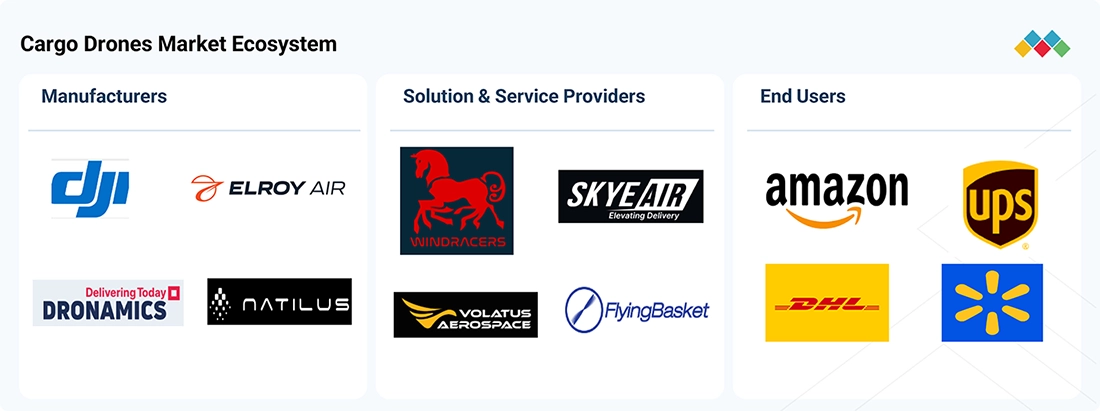
The cargo drones market ecosystem includes manufacturers, solution & service providers, and end users. DJI, Dronamics, Windracers, and Elroy Air develop cargo drone platforms for short-range delivery, regional freight transportation, and long-distance logistics. Volatus Aerospace, Skyports, and FlyingBasket provide cargo drone services and specialized transportation solutions for commercial, industrial, and remote-area operations. Amazon, DHL, UPS, and Walmart represent potential end users exploring drone-based delivery and logistics solutions. Growing demand for faster deliveries, access to remote locations, military resupply, and automated freight transportation is strengthening collaboration across the cargo drones market ecosystem.

cargo-drones-market Ecosystem

Logos and trademarks shown above are the property of their respective owners. Their use here is for informational and illustrative purposes only.

CARGO DRONES MARKET SEGMENTS

cargo-drones-market Segments

Source: Secondary Research, Interviews with Experts, MarketsandMarkets Analysis

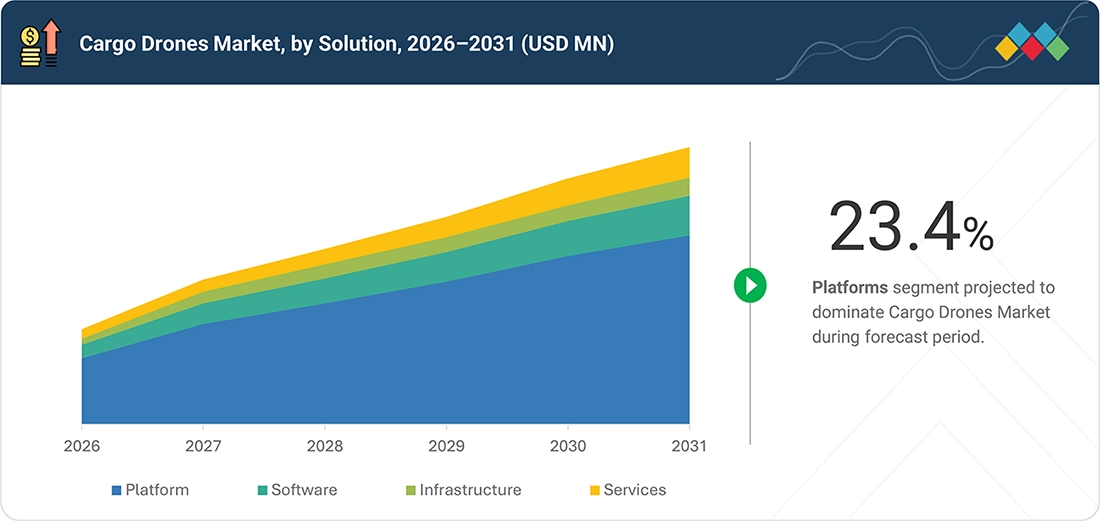
Cargo Drones Market, By Solution

By solution, platforms lead the cargo drones market as demand grows for dedicated cargo drone systems across logistics, industrial transportation, and defense applications. Improvements in payload handling, flight control, and autonomous navigation are supporting the development of platforms for different cargo requirements. Growing adoption of drone-based transportation is further driving demand for specialized cargo drone platforms.

Cargo Drones Market, By Type

By type, the rotary-wing segment dominates the cargo drones market because it can take off and land vertically without a runway. These capabilities make rotary-wing drones suitable for last-mile delivery, medical supply transportation, and cargo movement in confined or remote locations. Their operational flexibility is supporting adoption across commercial logistics and specialized delivery applications.

Cargo Drones Market, By Payload Capacity

By payload capacity, the 10–49 kg segment leads the cargo drones market as demand grows for drones that can transport medium-sized shipments. These platforms can carry medical supplies, parcels, spare parts, and essential goods while maintaining flexibility for short-distance delivery operations. Growing use across commercial logistics and remote-area transportation is supporting demand for cargo drones in this payload category.

Cargo Drones Market, By Range

By range, the close-range segment dominates the cargo drones market because of demand for short-distance cargo transport and last-mile delivery. Cargo drones operating over distances of less than 50 kilometers can support deliveries between nearby facilities and serve locations with limited road connectivity. Their suitability for frequent shipments and time-sensitive deliveries is encouraging adoption among logistics operators.

Cargo Drones Market, By Application

By application, the tactical resupply & mission support segment leads the cargo drones market as defense organizations seek flexible ways to transport supplies to operational areas. Cargo drones can deliver food, medical equipment, spare parts, and other essential materials to locations where ground transportation is difficult or risky. The need to maintain supply continuity during military missions is supporting demand for these platforms.

Cargo Drones Market, By End User

By end user, the government & defense segment dominates the cargo drones market due to demand for cargo transportation in military logistics, emergency response, and government operations. Defense agencies are exploring cargo drones to move essential supplies to remote bases and challenging terrain. Their ability to support resupply missions while reducing reliance on conventional transport is driving adoption across government and defense applications.

CARGO DRONES MARKET REGION

Asia Pacific to be fastest-growing region in global cargo drones market during forecast period

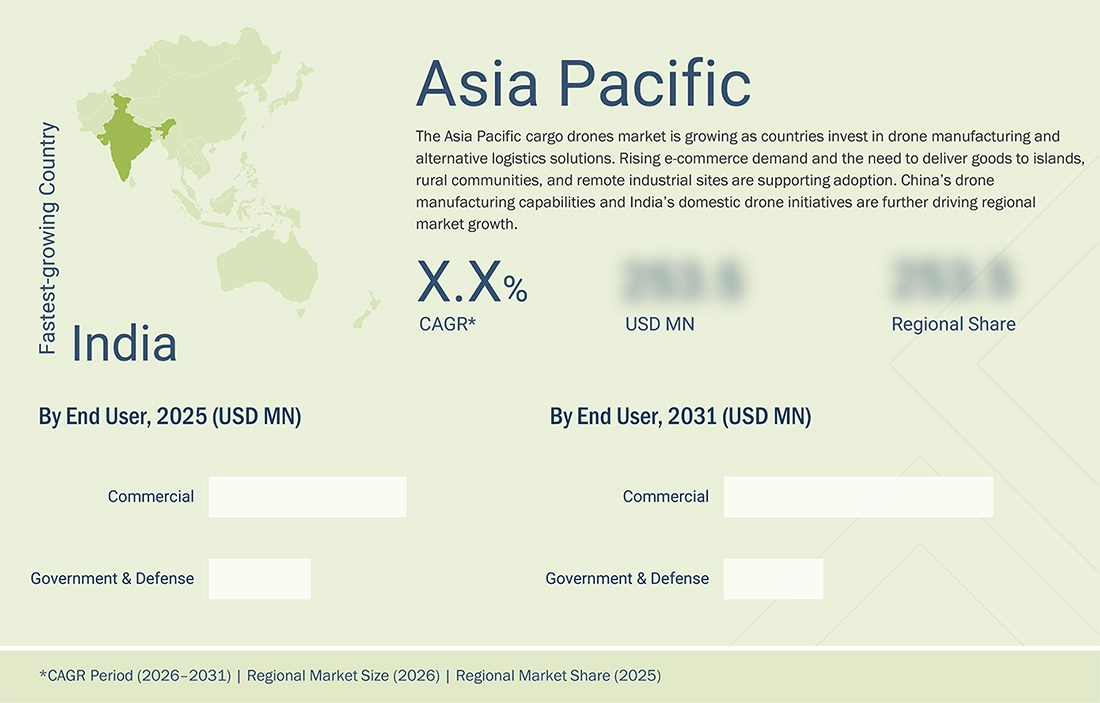
Asia Pacific is seeing growing demand for cargo drones because of the rapid expansion of e-commerce and the need for faster last-mile delivery. Countries such as China, Japan, India and South Korea are adopting drone-based logistics to improve connectivity across remote areas and reduce delivery times. Government initiatives supporting unmanned aerial vehicle operations, along with investments in autonomous delivery networks, are expected to drive the regional cargo drones market.

cargo-drones-market Region

CARGO DRONES MARKET: COMPANY EVALUATION MATRIX

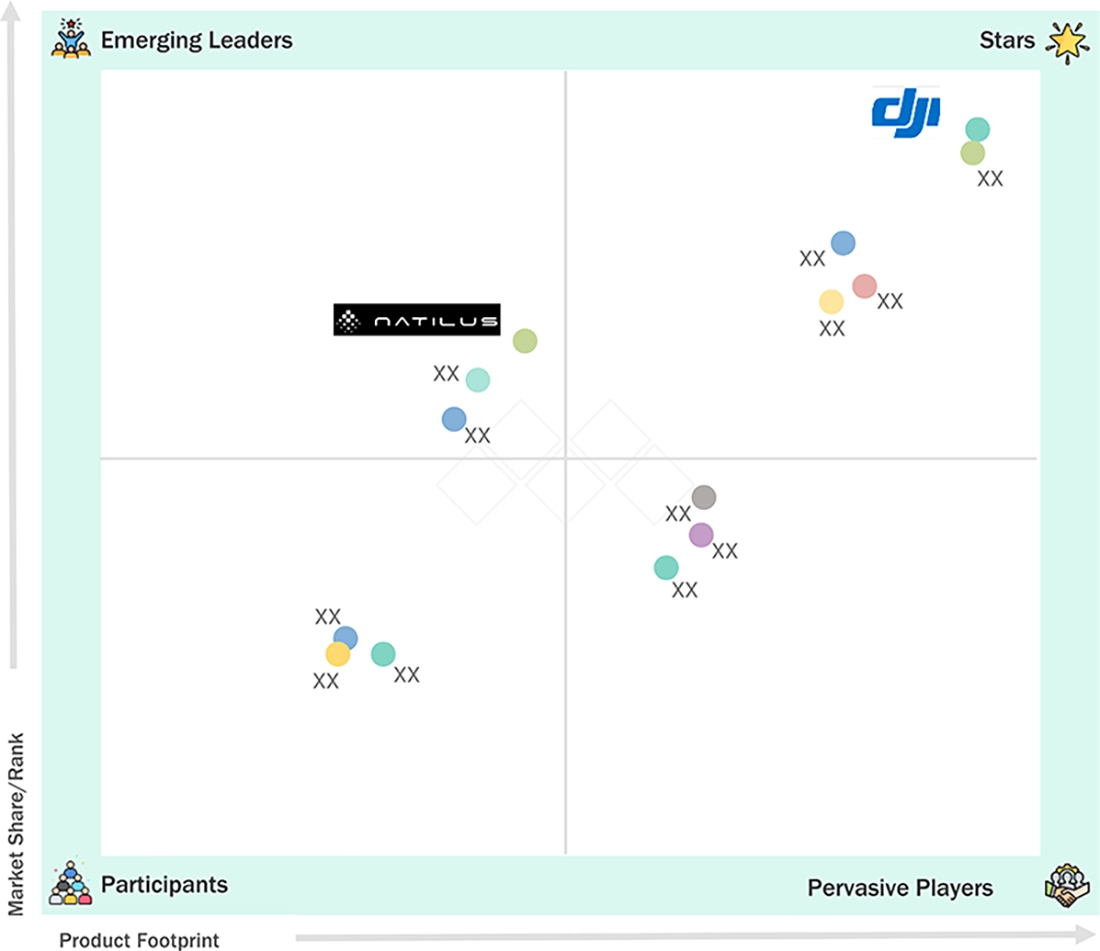
BAE Systems is a leading player in the cargo drones market with a strong focus on commercial drone platforms and aerial logistics solutions. Its cargo-capable drone systems support material transportation and delivery operations across industrial, agricultural and commercial applications. Natilus, Inc. is an emerging player in the cargo drones market, focusing on autonomous cargo aircraft designed to improve freight transportation. The company is developing unmanned aircraft platforms to increase cargo capacity and support more efficient air cargo operations.

cargo-drones-market Evaluation Metrics

Source: Secondary Research, Interviews with Experts, MarketsandMarkets Analysis

KEY CARGO DRONES MARKET PLAYERS

List of Top Cargo Drones Market Companies

WHAT IS IN IT FOR YOU: CARGO DRONES MARKET REPORT CONTENT GUIDE

cargo-drones-market Content Guide

DELIVERED CUSTOMIZATIONS

We have successfully delivered the following deep-dive customizations:

CLIENT REQUEST CUSTOMIZATION DELIVERED VALUE ADDS
Leading Manufacturer Additional segment breakdown for countries Additional country-level market sizing tables for segments/subsegments covered at the regional/global level to gain an understanding of market potential by each country
Emerging Leader Additional company profiles Competitive information on targeted players to gain granular insights on direct competition
Regional Market Leader Additional country market estimates Additional country-level deep dive for a more targeted understanding of the total addressable market

RECENT DEVELOPMENTS

  • 9/1/2026 12:00:00 AM : Elroy Air completed autonomous, uncrewed cargo drone flights under the United States Department of Transportation’s Integration Pilot Program. Its Chaparral aircraft transported parcels, medical supplies, spare parts and other cargo in Louisiana. The trials were conducted with Bristow Group and other partners to advance commercial cargo operations.
  • 9/1/2026 12:00:00 AM : Windracers ULTRA completed a 1,000-kilometer flight in Alaska carrying anti-doping blood test samples. The mission demonstrated the aircraft’s potential for long-distance cargo transportation in remote regions where conventional logistics can be difficult.
  • 12/1/2025 12:00:00 AM : Elroy Air completed its first autonomous point-to-point cargo delivery using its hybrid-electric Chaparral aircraft. The drone carried a 213-pound payload over 2.6 miles in California. This milestone supported the company’s plans to expand autonomous cargo operations.


Table of Contents

checkmarkExclusive indicates content/data unique to MarketsandMarkets and not available with any competitors.

TITLE
PAGE NO
1
INTRODUCTION


15
2
EXECUTIVE SUMMARY


3
PREMIUM INSIGHTS


4
MARKET OVERVIEW
Summarizes the competitive environment, macro signals, and segment-level movements driving market outcomes.


4.1
INTRODUCTION


4.2
MARKET DYNAMICS


4.2.1
DRIVERS


4.2.1.1
RISING DEMAND FOR FASTER AND TIME-CRITICAL MOVEMENT OF SHIPMENTS


4.2.1.2
EXPANSION OF E-COMMERCE, ON-DEMAND DELIVERY, AND RAPID FULFILLMENT NETWORKS


4.2.1.3
ADVANCEMENTS IN AUTONOMOUS FLIGHT, DETECT-AND-AVOID, BATTERY, AND PROPULSION TECHNOLOGIES


4.2.1.4
INCREASING NEED FOR LOGISTICS ACCESS TO REMOTE AND HARD-TO-REACH LOCATIONS


4.2.2
RESTRAINTS


4.2.2.1
FRAGMENTED AND EVOLVING REGULATIONS FOR BVLOS AND COMMERCIAL CARGO DRONE OPERATIONS


4.2.2.2
PAYLOAD, RANGE, AND ENDURANCE LIMITATIONS OF ELECTRIC CARGO DRONES


4.2.2.3
HIGH INITIAL COSTS AND UNCERTAIN UNIT ECONOMICS FOR LARGE-SCALE CARGO DRONE NETWORKS


4.2.3
OPPORTUNITIES


4.2.3.1
INCREASING ADOPTION OF CARGO DRONES FOR MILITARY TACTICAL RESUPPLY AND CONTESTED LOGISTICS


4.2.3.2
EXPANSION OF MEDICAL, HUMANITARIAN, AND EMERGENCY LOGISTICS


4.2.3.3
GROWING USE IN INDUSTRIAL, MINING, ENERGY, OFFSHORE, AND REMOTE-SITE LOGISTICS


4.2.3.4
SCALING OF AUTONOMOUS LAST-MILE RETAIL AND PARCEL DELIVERY NETWORKS


4.2.4
CHALLENGES


4.2.4.1
DEVELOPMENT AND INTEGRATION OF GROUND INFRASTRUCTURE FOR SCALED CARGO DRONE OPERATIONS


4.2.4.2
MAINTAINING RELIABLE OPERATIONS UNDER ADVERSE WEATHER CONDITIONS


4.2.4.3
CYBERSECURITY, COMMUNICATION-LINK, GNSS, AND OPERATIONAL SAFETY RISKS
 
 
4.3
UNMET NEEDS & WHITE SPACES


4.4
INTERCONNECTED MARKETS & CROSS-SECTOR OPPORTUNITIES


4.5
STRATEGIC MOVES BY TIER-1/2/3 PLAYERS


5
INDUSTRY TRENDS
Highlights the market structure, growth drivers, restraints, and near-term inflection points influencing performance.


5.1
ECOSYSTEM ANALYSIS


5.2
VALUE CHAIN ANALYSIS


5.3
PRICING ANALYSIS


5.3.1
INDICATIVE PRICING ANALYSIS OF KEY PLAYERS, BY PAYLOAD


5.3.2
INDICATIVE PRICING ANALYSIS, BY REGION


5.4
TRADE ANALYSIS


5.4.1
IMPORT SCENARIO


5.4.2
EXPORT SCENARIO


5.5
IMPACT OF 2025 US TARIFFS ON CARGO DRONES MARKET


5.5.1
INTRODUCTION


5.5.2
KEY TARIFF RATES


5.5.3
PRICE IMPACT ANALYSIS


5.5.4
IMPACT ON COUNTRY/REGION


5.5.4.1
US


5.5.4.2
EUROPE


5.5.4.3
ASIA PACIFIC


5.5.5
IMPACT ON END-USE INDUSTRY


5.6
CASE STUDY ANALYSIS


5.7
KEY CONFERENCES & EVENTS, 2026–2027


5.8
INVESTMENT & FUNDING SCENARIO


5.9
TRENDS/DISRUPTION IMPACTING CUSTOMERS’ BUSINESSES


5.10
MACROECONOMIC OUTLOOK


5.10.1
INTRODUCTION


5.10.2
GDP TRENDS & FORECAST


5.10.3
TRENDS IN GLOBAL CARGO DRONES INDUSTRY


5.10.4
TRENDS IN GLOBAL DEFENSE INDUSTRY


5.11
BUSINESS MODELS


5.12
BILL OF MATERIALS


5.13
TOTAL COST OF OWNERSHIP


5.14
VOLUME DATA


5.15
IMPACT OF MEGATRENDS


6
TECHNOLOGICAL ADVANCEMENTS, AI-DRIVEN IMPACT, PATENTS, INNOVATIONS, AND FUTURE APPLICATIONS


6.1
KEY EMERGING TECHNOLOGIES


6.1.1
AI-ENABLED AUTONOMOUS FLIGHT, DETECT-AND-AVOID, AND OBSTACLE-AVOIDANCE SYSTEMS


6.1.2
ADVANCED BATTERY, HYBRID-ELECTRIC, AND HYDROGEN-ELECTRIC PROPULSION SYSTEMS


6.1.3
MODULAR CARGO PODS, AUTOMATED LOADING/UNLOADING, AND PRECISION DELIVERY MECHANISMS


6.2
COMPLEMENTARY TECHNOLOGIES


6.2.1
HIGH-PRECISION GNSS/INS, VISION-BASED NAVIGATION, AND ALTERNATIVE PNT SYSTEMS


6.2.2
REDUNDANT COMMAND-AND-CONTROL, 5G/SATCOM, AND MULTI-LINK COMMUNICATION SYSTEMS


6.2.3
SMART BATTERY MANAGEMENT, POWER ELECTRONICS, AND THERMAL MANAGEMENT SYSTEMS


6.3
ADJACENT TECHNOLOGIES


6.3.1
DISTRIBUTED ELECTRIC PROPULSION AND TILT-ROTOR/TILT-WING TECHNOLOGIES FROM EVTOL PLATFORMS


6.3.2
AUTONOMOUS GROUND ROBOTICS FOR CARGO TRANSFER, DOCKING, AND PAYLOAD HANDLING


6.3.3
IOT-ENABLED SMART CARGO PODS AND REAL-TIME PAYLOAD CONDITION MONITORING SYSTEMS


6.4
TECHNOLOGY ROADMAP


6.5
PATENT ANALYSIS


6.6
FUTURE APPLICATIONS


6.7
IMPACT OF AI/GEN AI ON CARGO DRONES MARKET


7
REGULATORY LANDSCAPE


7.1
REGIONAL REGULATIONS & COMPLIANCE


7.1.1
REGULATORY BODIES, GOVERNMENT AGENCIES, AND OTHER ORGANIZATIONS


7.1.2
INDUSTRY STANDARDS


7.2
SUSTAINABILITY INITIATIVES


7.3
SUSTAINABILITY IMPACT & REGULATORY POLICY INITIATIVES


7.4
CERTIFICATIONS, LABELING, AND ECO-STANDARDS


8
CUSTOMER LANDSCAPE & BUYER BEHAVIOR


8.1
DECISION-MAKING PROCESS


8.2
KEY STAKEHOLDERS IN BUYING PROCESS & THEIR EVALUATION CRITERIA


8.2.1
KEY STAKEHOLDERS IN BUYING PROCESS


8.2.2
BUYING CRITERIA


8.3
ADOPTION BARRIERS & INTERNAL CHALLENGES


8.4
UNMET NEEDS FROM VARIOUS END-USE INDUSTRIES


9
CARGO DRONES MARKET, BY SOLUTION (MARKET SIZE & FORECAST TO 2031-USD MILLION)


9.1
INTRODUCTION


9.2
PLATFORMS


9.2.1
AIRFRAMES & STRUCTURES


9.2.2
AVIONICS, NAVIGATION, AND COMMUNICATION SYSTEMS


9.2.3
PROPULSION & POWER SYSTEMS


9.2.4
CARGO & PAYLOAD SYSTEMS


9.2.5
EMBEDDED/ONBOARD SOFTWARE


9.3
SOFTWARE


9.3.1
MISSION PLANNING & ROUTE OPTIMIZATION


9.3.2
GROUND CONTROL & REMOTE OPERATIONS


9.3.3
FLEET MANAGEMENT


9.3.4
PAYLOAD MANAGEMENT & TRACKING


9.3.5
VEHICLE HEALTH MONITORING & DIAGNOSTICS


9.4
INFRASTRUCTURE


9.4.1
GROUND CONTROL STATIONS


9.4.2
CHARGING, REFUELING, AND BATTERY-SWAPPING SYSTEMS


9.4.3
LANDING & DOCKING SYSTEMS


9.4.4
CHARGING STATIONS


9.4.5
CARGO LOADING & TRANSFER SYSTEMS


9.5
SERVICE


9.5.1
MAINTENANCE, REPAIR, AND OVERHAUL (MRO)


9.5.2
SYSTEM INTEGRATION & COMMISSIONING


9.5.3
TRAINING & TECHNICAL SUPPORT


9.5.4
SOFTWARE/FIRMWARE UPGRADE & SUPPORT


NOTE: BREAKDOWN OF SERVICE SEGMENT PROVIDED FOR DEFINITION PURPOSES ONLY


10
CARGO DRONES MARKET, BY TYPE (MARKET SIZE & FORECAST TO 2031-USD MILLION)


10.1
INTRODUCTION


10.2
FIXED-WING


10.2.1
CTOL


10.2.2
STOL


10.2.3
VTOL


10.3
ROTARY-WING


11
CARGO DRONES MARKET, BY PAYLOAD CAPACITY (MARKET SIZE & FORECAST TO 2031-USD MILLION)


11.1
INTRODUCTION


11.2
10–49 KG


11.3
50–149 KG


11.4
150–249 KG


11.5
250–499 KG


11.6
500–999 KG


11.7
1,000 KG & ABOVE


12
CARGO DRONES MARKET, BY RANGE (MARKET SIZE & FORECAST TO 2031-USD MILLION)


12.1
INTRODUCTION


12.2
CLOSE RANGE (<50 KM)


12.3
SHORT RANGE (50–149 KM)


12.4
MID RANGE (150–650 KM)


12.5
LONG RANGE (>650 KM)


13
CARGO DRONES MARKET, BY APPLICATION (MARKET SIZE & FORECAST TO 2031-USD MILLION)


13.1
INTRODUCTION


13.2
RETAIL & CONSUMER GOODS


13.3
HEALTHCARE & MEDICAL


13.4
INDUSTRIAL & MANUFACTURING


13.5
ENERGY & UTILITY


13.6
MINING & CONSTRUCTION


13.7
AGRICULTURE & FORESTRY


13.8
HUMANITARIAN & DISASTER MANAGEMENT


13.9
TACTICAL RESUPPLY & MISSION SUPPORT


14
CARGO DRONES MARKET, BY END USER (MARKET SIZE & FORECAST TO 2031-USD MILLION)


14.1
INTRODUCTION


14.2
COMMERCIAL


14.3
GOVERNMENT & DEFENSE


15
CARGO DRONES MARKET, BY REGION (MARKET SIZE & FORECAST TO 2031-USD MILLION)


15.1
INTRODUCTION


15.2
NORTH AMERICA


15.2.1
US


15.2.2
CANADA


15.3
EUROPE


15.3.1
UK


15.3.2
GERMANY


15.3.3
FRANCE


15.3.4
ITALY


15.3.5
SPAIN


15.3.6
REST OF EUROPE


15.4
ASIA PACIFIC


15.4.1
CHINA


15.4.2
INDIA


15.4.3
JAPAN


15.4.4
AUSTRALIA


15.4.5
SOUTH KOREA


15.4.6
REST OF ASIA PACIFIC


15.5
MIDDLE EAST


15.5.1
GCC COUNTRIES


15.5.1.1
UAE


15.5.1.2
SAUDI ARABIA


15.5.2
ISRAEL


15.5.3
TURKEY


15.6
REST OF THE WORLD


15.6.1
LATIN AMERICA


15.6.2
AFRICA
 
 
16
COMPETITIVE LANDSCAPE


16.1
OVERVIEW


16.2
KEY PLAYER COMPETITIVE STRATEGIES/RIGHT TO WIN


16.3
MARKET SHARE ANALYSIS,


16.4
REVENUE ANALYSIS, 2021–2025


16.5
COMPANY EVALUATION MATRIX: KEY PLAYERS,


16.5.1
STARS


16.5.2
EMERGING LEADERS


16.5.3
PERVASIVE PLAYERS


16.5.4
PARTICIPANTS


16.5.5
COMPANY FOOTPRINT: KEY PLAYERS,


16.5.5.1
COMPANY FOOTPRINT


16.5.5.2
REGION FOOTPRINT


16.5.5.3
TYPE FOOTPRINT


16.5.5.4
APPLICATION FOOTPRINT


16.5.5.5
END-USER FOOTPRINT
 
 
16.6
COMPANY VALUATION & FINANCIAL METRICS


16.7
COMPANY EVALUATION MATRIX: STARTUPS/SMES,


16.7.1
PROGRESSIVE COMPANIES


16.7.2
RESPONSIVE COMPANIES


16.7.3
DYNAMIC COMPANIES


16.7.4
STARTING BLOCKS


16.8
COMPETITIVE BENCHMARKING: STARTUPS/SMES,


16.8.1
DETAILED LIST OF STARTUPS/SMES


16.8.2
COMPETITIVE BENCHMARKING OF KEY STARTUPS/SMES


16.9
TECHNOLOGY COMPARISON


16.10
COMPETITIVE SCENARIO


16.10.1
PRODUCT/SOLUTION LAUNCHES


16.10.2
DEALS


16.10.3
EXPANSIONS
 
 
17
COMPANY PROFILES


17.1
KEY PLAYERS


17.1.1
SZ DJI TECHNOLOGY CO., LTD.


17.1.1.1
BUSINESS OVERVIEW


17.1.1.2
PRODUCTS/SOLUTIONS/SERVICES OFFERED


17.1.1.3
RECENT DEVELOPMENTS


17.1.2
AUTOFLIGHT AVIATION TECHNOLOGY CO., LTD.


17.1.3
EHANG HOLDINGS LIMITED


17.1.4
BAE SYSTEMS PLC (MALLOY AERONAUTICS LIMITED)


17.1.5
KAMAN CORPORATION


17.1.6
DRONAMICS GLOBAL LIMITED


17.1.7
WINDRACERS LIMITED


17.1.8
PYKA INC.


17.1.9
ELROY AIR, INC.


17.1.10
PIPISTREL D.O.O.


17.1.11
FLYINGBASKET S.R.L.


17.1.12
VOLATUS AEROSPACE INC.


17.1.13
NATILUS, INC.


17.1.14
DUFOUR AEROSPACE AG


17.1.15
YATES ELECTROSPACE CORPORATION (SILENT ARROW)


17.2
OTHER PLAYERS


17.2.1
BONV TECHNOLOGY PRIVATE LIMITED


17.2.2
NEX AERO GMBH


17.2.3
OVERWRITE ROBOTICS PRIVATE LIMITED


17.2.4
TRAVERSE AERO CORPORATION


17.2.5
BLUJ AEROSPACE PRIVATE LIMITED


17.2.6
SCANDRON PRIVATE LIMITED


17.2.7
GRASSHOPPER AIR MOBILITY S.L.


17.2.8
BAJRANG UAV PRIVATE LIMITED


17.2.9
GRID AERO, INC.


17.2.10
AIRVOLVE, UAB
 
 
18
RESEARCH METHODOLOGY


18.1
RESEARCH DATA


18.1.1
SECONDARY DATA


18.1.1.1
KEY DATA FROM SECONDARY SOURCES


18.1.1.2
LIST OF KEY SECONDARY SOURCES


18.1.2
PRIMARY DATA


18.1.2.1
KEY DATA FROM PRIMARY SOURCES


18.1.2.2
KEY PRIMARY PARTICIPANTS


18.1.2.3
BREAKDOWN OF PRIMARY INTERVIEWS


18.1.2.4
KEY INDUSTRY INSIGHTS
 
 
18.2
MARKET SIZE ESTIMATION


18.2.1
BOTTOM-UP APPROACH


18.2.2
TOP-DOWN APPROACH


18.2.3
MARKET SIZE CALCULATION FOR BASE YEAR


18.3
MARKET FORECAST APPROACH


18.3.1
SUPPLY SIDE


18.3.2
DEMAND SIDE


18.4
DATA TRIANGULATION


18.5
FACTOR ANALYSIS


18.6
RESEARCH ASSUMPTIONS


18.7
RESEARCH LIMITATIONS & RISK ASSESSMENT


19
APPENDIX


19.1
DISCUSSION GUIDE


19.2
KNOWLEDGESTORE: MARKETSANDMARKETS’ SUBSCRIPTION PORTAL


19.3
CUSTOMIZATION OPTIONS


19.4
RELATED REPORTS


19.5
AUTHOR DETAILS


Methodology

The study followed four main steps to estimate the cargo drones market size. Secondary research was conducted to collect data on cargo drone technologies, platforms, payload capabilities, production trends, industry developments, and market dynamics across key regions. These findings were validated through primary interviews with cargo drone manufacturers, component suppliers, system integrators, logistics providers, end users, and industry experts. The research analyzed cargo drone adoption, technological developments, delivery requirements, operational capabilities, and industry demand to assess market opportunities. Market estimates were then segmented by solution, type, payload capacity, range, application, and end user. Data triangulation was applied to validate the final market estimates for each segment and subsegment.

Secondary Research

Secondary research was conducted to establish the foundation for the cargo drones market study. Data was collected from industry reports, cargo drone manufacturers, aviation authorities, logistics companies, regulatory bodies, and technology providers. Company information was reviewed through annual reports, product documents, press releases, investor presentations, and official company websites. The study also examined industry articles, white papers, and research publications covering cargo drone platforms, propulsion systems, battery technologies, payload capacity, autonomous flight systems, and cargo delivery applications. The study also gathered additional insights from industry associations and market databases to analyze market trends, technological developments, cargo drone adoption, production activities, and demand across key regions.

Primary Research

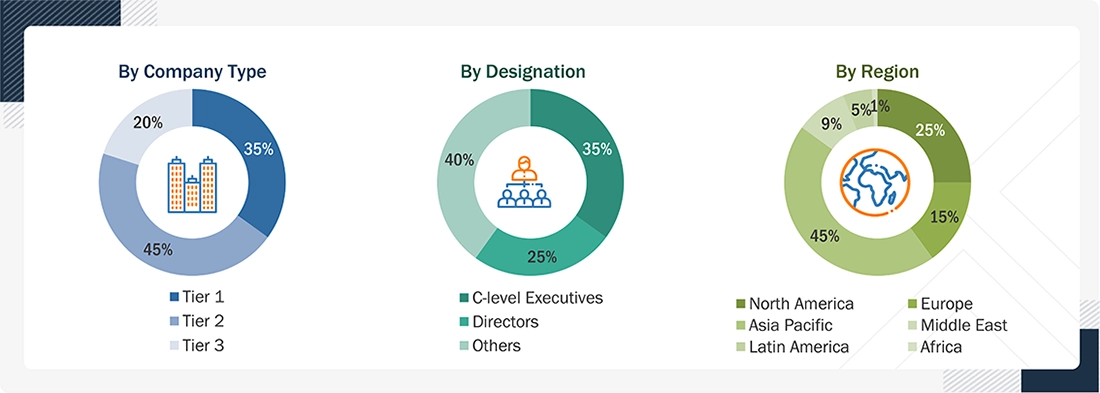
Primary research was conducted after key insights were identified through secondary analysis. The study team engaged executives from cargo drone manufacturers, component suppliers, system integrators, technology providers, logistics companies, end users, and industry experts in the cargo drones market. Discussions covered cargo drone platforms, propulsion systems, battery technologies, payload capacity, autonomous flight systems, and cargo delivery operations. Interviews were conducted through calls and written correspondence to validate market size estimates, production trends, customer requirements, technology adoption, and product developments. These inputs helped refine perspectives on competition, product development, supply chain activities, investment trends, and emerging cargo delivery applications while improving overall data accuracy.

Cargo Drones Market Size, and Share

To know about the assumptions considered for the study, download the pdf brochure

Market Size Estimation

The top-down and bottom-up methods were used to estimate and validate the size of the cargo drones market. The research process involved several steps to ensure accuracy.

  • Key companies active in the cargo drones market were identified through secondary research. Their market presence was evaluated using primary inputs and published data. This included reviewing annual reports, financial disclosures, product launches, contracts, company developments, and public filings. Interviews were also conducted with company executives, technology providers, system integrators, logistics operators, and industry experts. These inputs were used to validate assumptions and refine regional market size estimates.
  • All percentage shares, segment splits, and market breakdowns were first developed using secondary information. These values were then verified through primary discussions with industry participants.
  • The analysis evaluated key factors shaping the cargo drones market, including logistics demand, e-commerce growth, cargo drone procurement, payload capacity, flight range, battery technology, and autonomous flight capabilities. Demand across commercial logistics, healthcare, industrial transportation, and government applications was also assessed. These factors were examined through primary research and used to develop quantitative and qualitative market estimates for the report.

    Cargo Drones Market: Top-Down and Bottom-Up Approach

    Cargo Drones Market Top Down and Bottom Up Approach

    Data Triangulation

    After determining the overall cargo drones market size, the market was divided into multiple segments and subsegments. Data triangulation and market breakdown procedures were applied to complete the market analysis and estimate market values for each segment and subsegment. The data was triangulated by examining demand-side and supply-side factors, including cargo drone production, manufacturer revenues, deployment trends, payload capacity, delivery requirements, and end-user demand. Additionally, the market size estimates were validated using top-down and bottom-up approaches to improve consistency and accuracy across the overall market and its individual segments.

    Market Definition

    A cargo drone is an unmanned aircraft that can transport a load to a location while being ecologically beneficial. Cargo drones come in small, medium, and large sizes, each with different performance capabilities. They come with cutting-edge software and strong sensors. Cargo drones support first-mile, middle-mile, and last-mile delivery.

    Key Stakeholders

    • Cargo drone manufacturers developing fixed-wing, multirotor, and hybrid cargo drones for logistics, industrial transportation, medical delivery, and government applications
    • Cargo drone component manufacturers supplying airframes, motors, flight controllers, avionics, landing systems, and structural components used in cargo drone production
    • Payload system manufacturers developing cargo compartments, payload release mechanisms, loading systems, and specialized equipment for transporting different types of goods
    • Battery & energy system manufacturers developing lithium-ion batteries, high-capacity battery packs, and advanced energy systems to improve flight endurance and payload capacity
    • Electric motor & propulsion system providers supplying electric motors, propellers, electronic speed controllers, and propulsion systems for cargo drone platforms
    • Flight control & navigation system providers developing autopilot systems, navigation modules, flight controllers, and autonomous flight technologies for cargo transportation
    • Software & artificial intelligence technology providers developing flight management software, route optimization tools, fleet management platforms, and autonomous cargo delivery solutions
    • Communication & connectivity providers supplying radio communication, satellite connectivity, data links, and command-and-control systems for cargo drone operations
    • Ground control station manufacturers developing systems for flight planning, remote monitoring, cargo mission management, and operational control
    • Logistics & cargo delivery companies deploying cargo drones for last-mile delivery, warehouse transfers, regional freight transportation, and time-sensitive shipments
    • E-commerce & retail companies exploring cargo drone delivery to improve order fulfillment, reduce delivery times, and expand access to customers in remote locations
    • Healthcare & medical supply providers using cargo drones to transport medicines, vaccines, blood samples, and emergency medical supplies
    • Government & defense organizations procuring cargo drones for tactical resupply, military logistics, disaster relief, and transportation of essential equipment

    Report Objectives

    • To define, describe, and forecast the size of the cargo drones market by solution, type, payload capacity, range, application, and end user
    • To forecast the size of market segments by key countries in the following regions: North America, Europe, Asia Pacific, Middle East, and the Rest of the World
    • To identify and analyze drivers, restraints, opportunities, and challenges influencing the growth of the market
    • To identify industry trends, market trends, and technology trends currently prevailing in the market
    • To provide an overview of the regulatory landscape for the global cargo drones market
    • To analyze micromarkets with respect to individual growth trends, prospects, and their contribution to the overall market
    • To analyze opportunities in the market for stakeholders by identifying key market trends
    • To profile key market players and comprehensively analyze their market share and core competencies
    • To analyze the degree of competition in the market by identifying growth strategies, such as agreements, acquisitions, partnerships, collaborations, and product launches, adopted by leading market players
    • To identify detailed financial positions, key products, and unique selling points of leading market players

    Available customizations:

    MarketsandMarkets offers the following customizations for this market report:

    • Additional country-level analysis of the cargo drones market
    • Profiling of other market players (up to 5)

    Product Analysis

    • Product matrix, which provides a detailed comparison of the product portfolio of each company in the cargo drones market
     

Key Questions Addressed by the Report

What is the projected size and growth rate of the cargo drones market?

The cargo drones market is projected to grow from USD 3.14 billion in 2026 to USD 9.14 billion by 2031, registering a CAGR of 23.9%. Increasing demand for faster transportation, autonomous flight systems, improved battery technology, and efficient logistics operations is supporting market growth.

What are the major factors driving growth in the cargo drones market?

Rising demand for faster and time-critical shipment transportation and the expansion of e-commerce, on-demand delivery, and rapid fulfillment networks are key growth drivers. Increasing requirements for remote-area deliveries and improved supply chain efficiency are also supporting adoption.

Which region dominates the cargo drones market?

Asia Pacific dominated the cargo drones market, accounting for a 37.0% market share in 2025. Growing e-commerce activity, demand for faster last-mile delivery, government initiatives supporting UAV operations, and investment in autonomous delivery networks are driving regional adoption.

Which solution segment is expected to grow the fastest in the cargo drones market?

The services segment is expected to register the highest CAGR of 26.2% from 2026 to 2031. Increasing demand for specialized cargo transportation, remote-area logistics, and drone-based delivery operations is supporting the expansion of cargo drone services.

Which application segment is expected to grow the fastest?

The retail and consumer goods segment is projected to grow at the highest CAGR of 35.7% from 2026 to 2031. Growing demand for faster deliveries, e-commerce fulfillment, and efficient transportation of consumer goods is supporting this segment.

What are the key technology trends shaping the cargo drones market?

Key trends include improvements in autonomous flight systems, advanced navigation, battery technology, propulsion systems, payload handling, and higher-capacity platforms. These developments are enabling longer flight ranges, heavier payload transportation, and improved operational efficiency.

What opportunities are emerging in the cargo drones market?

Military tactical resupply and contested logistics, along with medical, humanitarian, and emergency logistics, are major opportunities. Cargo drones can transport essential supplies, medical equipment, and other materials to remote or high-risk locations where conventional ground transportation faces access or security challenges.

What are the major restraints and challenges in the cargo drones market?

Fragmented and evolving regulations for beyond visual line of sight (BVLOS) operations and high initial costs are major restraints. Other challenges include developing ground infrastructure, integrating cargo handling and charging facilities, and maintaining reliable operations under adverse weather conditions.

Which type, payload capacity, and application segments dominate the cargo drones market?

Rotary-wing drones dominate by type because of their vertical takeoff and landing capabilities. The 10–49 kg payload capacity segment leads the market, while tactical resupply and mission support is the leading application segment. Government and defense is the dominant end-user segment.

Who are the key players in the cargo drones market?

Key players include DJI, Windracers, BAE Systems, Yates Electrospace Corporation, FlyingBasket, Natilus, Autoflight, EHang, Kaman Corporation, Dronamics, Pyka, Elroy Air, Pipistrel, and Volatus Aerospace. Grid Aero and BonV Aero are identified as progressive companies based on product innovation and technological advancements.

Personalize This Research

  • Triangulate with your Own Data
  • Get Data as per your Format and Definition
  • Gain a Deeper Dive on a Specific Application, Geography, Customer or Competitor
  • Any level of Personalization
Request A Free Customisation

Let Us Help You

  • What are the Known and Unknown Adjacencies Impacting the Cargo Drones Market
  • What will your New Revenue Sources be?
  • Who will be your Top Customer; what will make them switch?
  • Defend your Market Share or Win Competitors
  • Get a Scorecard for Target Partners
Customized Workshop Request

Custom Market Research Services

We Will Customise The Research For You, In Case The Report Listed Above Does Not Meet With Your Requirements

Get 10% Free Customisation

TESTIMONIALS

Growth opportunities and latent adjacency in Cargo Drones Market

THIS REPORT TELLS YOU

How big the Cargo Drones market is, and who leads it.

GROWTHIQ TELLS YOU NEW

Where your company should play next, and who is taking your share.

Get your company's view of this market. Free snapshot.

DMCA.com Protection Status
popup img