CNG Vehicles Market Size, Share & Analysis

CNG Vehicles Market by Fuel Type (CNG, LNG), Type (Type 1, Type 2, Type 3, Type 4), Engine Type (Dedicated & Bi-Fuel system), Tank Fitting Type (OE, Aftermarket), Vehicle Type (PC, LCV), LNG Trucks, Kit Type, and Region - Global Forecast to 2033




OVERVIEW
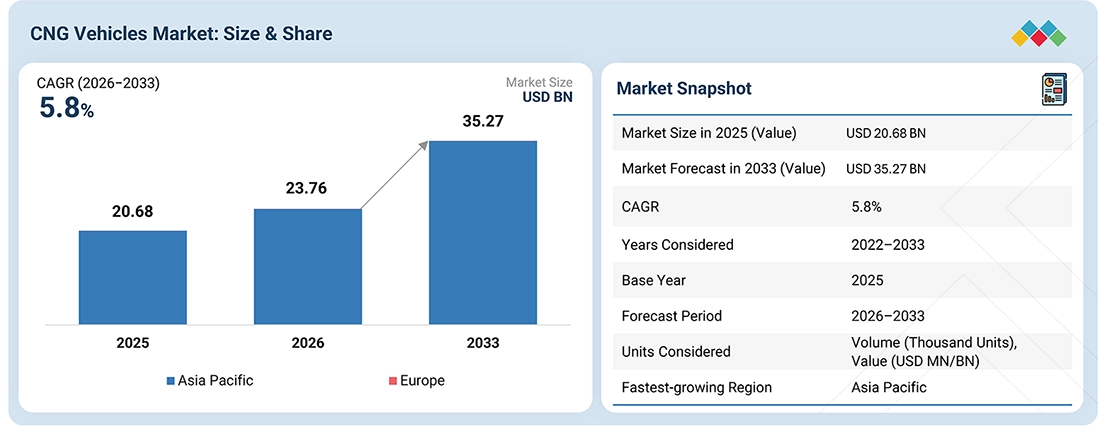
Source: Secondary Research, Interviews with Experts, MarketsandMarkets Analysis
The CNG vehicles market size is projected to grow from USD 23.76 billion in 2026 to USD 35.27 billion by 2033, at a CAGR of 5.8%. The CNG vehicles market is moving toward higher-pressure fuel systems and better integration of fuel storage, injection, pressure regulation, and engine control systems. The strategic focus is shifting toward platform-level CNG integration, where OEMs such as Maruti Suzuki, Tata Motors, IVECO, and Hyundai are optimizing tank packaging, gas injection, combustion calibration, and electronic controls to extend CNG and LNG applications across passenger and high-utilization commercial vehicles. Connected fuel management and biomethane compatibility are also enabling OEMs and fleet operators to optimize operating costs and extend CNG platforms beyond conventional natural gas applications.
KEY TAKEAWAYS
-
MARKET SNAPSHOT:
Market Size (2025): USD 20.68 Billion
Current Market Size (2026): USD 23.76 Billion
Projected Market Size (2033): USD 35.27 Billion
CAGR (2026–2033): 5.8% -
BY REGIONBy region, Asia Pacific is expected to be the largest market during the forecast period.
-
BY ENGINE TYPEBy engine type, the bi-Fuel segment is expected to dominate the CNG vehicles market, with an 83.0% share in 2026.
-
BY FITTING TYPEBy fitting type, OEMs are projected to experience the highest growth rate during the forecast period.
-
BY FUEL TYPEBy fuel type, CNG is the fastest-growing segment in the CNG vehicles market, with a CAGR of 7.7% from 2026 to 2033.
-
BY TANK TYPEBy tank type, the Type 2 segment is expected to be the fastest-growing in the CNG vehicles market, with a CAGR of 17.4% from 2026 to 2033.
-
BY VEHICLE TYPEBy vehicle type, passenger cars are the fastest-growing segment in the CNG vehicles market, with a CAGR of 9.2% from 2026 to 2033.
-
COMPETITIVE LANDSCAPE - KEY PLAYERSLeading CNG vehicle OEMs, including MARUTI SUZUKI INDIA LIMITED (India), Tata Motors Limited (India), and Hyundai Motor Company (South Korea), are expanding their CNG vehicle portfolios across passenger and light commercial vehicle segments, with a focus on factory-fitted CNG powertrains, fuel efficiency, and application-specific vehicle platforms.
-
COMPETITIVE LANDSCAPE - STARTUPS/SMESAB Volvo (Sweden) and Sinotruk (China) have distinguished themselves among startups and SMEs by establishing strong footholds in specialized niches, underscoring their potential as emerging market leaders.
The CNG vehicles market is being shaped by the need to optimize the entire gas-handling system rather than individual components. OEMs and Tier 1 suppliers are focusing on coordinated calibration of gas injectors, pressure regulators, engine control units, and oxygen sensing to maintain stable air-fuel ratios across varying tank pressure and operating conditions. In commercial vehicles, this is driving development of higher capacity fuel storage and pressure management systems that can support longer duty cycles without excessive packaging penalties. At the same time, engineers are optimizing cylinder material selection, valve architecture, and mounting design to reduce system mass while meeting pressure and crash safety requirements.
TRENDS & DISRUPTIONS IMPACTING CUSTOMERS' CUSTOMERS
The CNG vehicles landscape is shifting from conventional natural-gas applications toward advanced, integrated, lower-emission powertrain solutions, supported by the growing use of biomethane and Bio-LNG. Future opportunities are linked to lightweight and high-capacity gas storage systems, advanced fuel injection, improved engine technologies, and expanding CNG/LNG fueling infrastructure. These developments enable OEMs and fleet operators to meet the operating requirements of high-utilization commercial vehicles, public transport fleets, and long-haul trucks. End users benefit from lower fuel costs, longer driving range, improved fuel efficiency, reduced emissions, and lower operating costs.
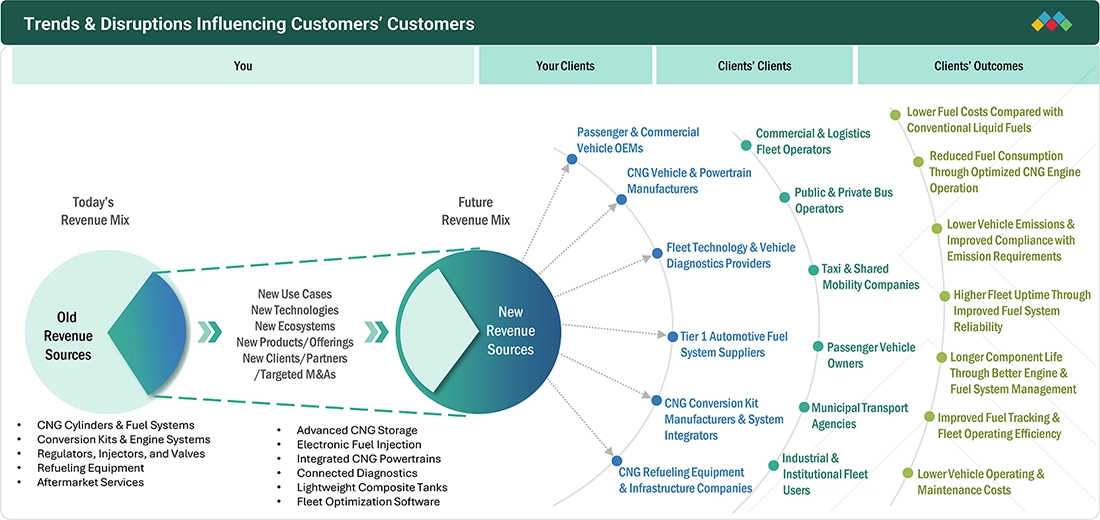
Source: Secondary Research, Interviews with Experts, MarketsandMarkets Analysis
MARKET DYNAMICS

Level
-
Fleet TCO advantage accelerating diesel-to-gas substitution

-
Diesel-comparable powertrains expanding natural-gas viability into heavy-duty & long-haul applications


Level
-
Uneven refueling infrastructure constraining cross-regional gas vehicle deployment


Level
-
Biomethane integration extending commercial viability of gas powertrains

-
Development of dedicated gas-fueling corridors for commercial mobility


Level
-
Regulatory divergence increasing investment risk across gas mobility markets

Source: Secondary Research, Interviews with Experts, MarketsandMarkets Analysis
Driver: Fleet TCO advantage accelerating diesel-to-gas substitution
CNG is becoming more attractive for passenger cars and LCVs where lower fuel costs can reduce daily operating expenses, particularly for high-mileage users and commercial fleets. LNG is gaining relevance in heavy trucks because its higher energy density supports longer driving ranges and reduces the need for frequent refueling. OEMs are improving CNG and LNG powertrains through optimized engine calibration, higher torque output, improved fuel efficiency, and larger onboard fuel storage. These improvements support wider use of CNG passenger cars and LCVs and LNG heavy trucks in high-mileage applications.
Restraint: Uneven refueling infrastructure constraining cross-regional gas vehicle deployment
CNG passenger cars and LCVs depend on convenient station coverage for daily and intercity operations, while LNG heavy trucks require strategically located stations along major freight corridors. Uneven distribution of CNG and LNG infrastructure can increase route-planning requirements, limit vehicle utilization, and discourage fleet expansion in areas with insufficient fueling access. The availability and geographic coverage of refueling stations therefore remain important factors influencing CNG adoption in passenger cars and LCVs and LNG adoption in heavy trucks.
Opportunity: Biomethane integration extending commercial viability of gas powertrains
Biomethane can be used in existing CNG passenger cars and LCVs with compatible powertrains and fueling infrastructure, while Bio-LNG provides a renewable fuel pathway for LNG-powered heavy trucks. Increasing renewable gas production and distribution can help fleet operators reduce lifecycle emissions without requiring a fundamental change in vehicle architecture, supporting continued adoption of CNG and LNG vehicles.
Challenge: Regulatory divergence increasing investment risk across gas mobility markets
Differences in emission requirements, vehicle homologation, cylinder and LNG tank certification, fuel-quality specifications, and refueling standards across countries increase engineering and compliance requirements for CNG and LNG vehicle platforms. OEMs and suppliers may therefore need to adapt engine calibration, fuel-system components, storage configurations, and certification processes for individual markets, increasing development complexity and investment requirements when scaling gas-powered vehicles across regions.
CNG VEHICLES MARKET: COMMERCIAL USE CASES ACROSS INDUSTRIES
| COMPANY | USE CASE DESCRIPTION | BENEFITS |
|---|---|---|
 |
Offers factory-fitted CNG passenger cars and LCVs for urban commuting, small-business mobility, and commercial fleet applications. | Reduces fuel expenditure, lowers operating costs, and provides an alternative to gasoline-powered mobility. |
 |
Deploys CNG-powered passenger and light commercial vehicles for urban transportation, last-mile delivery, and small commercial fleets. | Reduces fuel costs, supports lower-emission urban transport, and improves fleet operating economics. |
 |
Uses CNG powertrains in commercial and fleet-oriented vehicle applications, particularly where operating economics and lower emissions are priorities. | Provides fuel-cost savings and supports transition from conventional gasoline/diesel vehicles. |
 |
Manufactures CNG buses and trucks for urban public transportation, staff transportation, and commercial freight applications. | Reduces fuel costs and tailpipe emissions while supporting high-utilization fleet operations. |
 |
Provides CNG-powered buses and trucks for urban distribution, passenger transportation, and regional logistics. | Lowers operating expenditure and provides an alternative to diesel for suitable routes. |
Logos and trademarks shown above are the property of their respective owners. Their use here is for informational and illustrative purposes only.
MARKET ECOSYSTEM
The CNG vehicles market ecosystem is shifting from a fuel supply chain to an integrated gas mobility ecosystem. Natural gas producers and suppliers provide CNG and LNG feedstock, while biomethane producers add renewable gas that can run compatible natural gas vehicle platforms. Gas transmission and distribution companies connect production and import sources with fueling infrastructure, while station operators develop compression, storage, dispensing, and fleet refueling systems. Engine and powertrain suppliers provide natural gas engines, fuel injection, gas delivery, and electronic control technologies, which vehicle OEMs integrate into trucks, buses, and other platforms. Coordination between fuel suppliers, infrastructure operators, powertrain companies, and OEMs is improving fuel availability, vehicle compatibility, and system integration across different operating applications. This ecosystem is also creating opportunities for suppliers to participate beyond individual components through integrated fuel, powertrain, and fleet solutions.
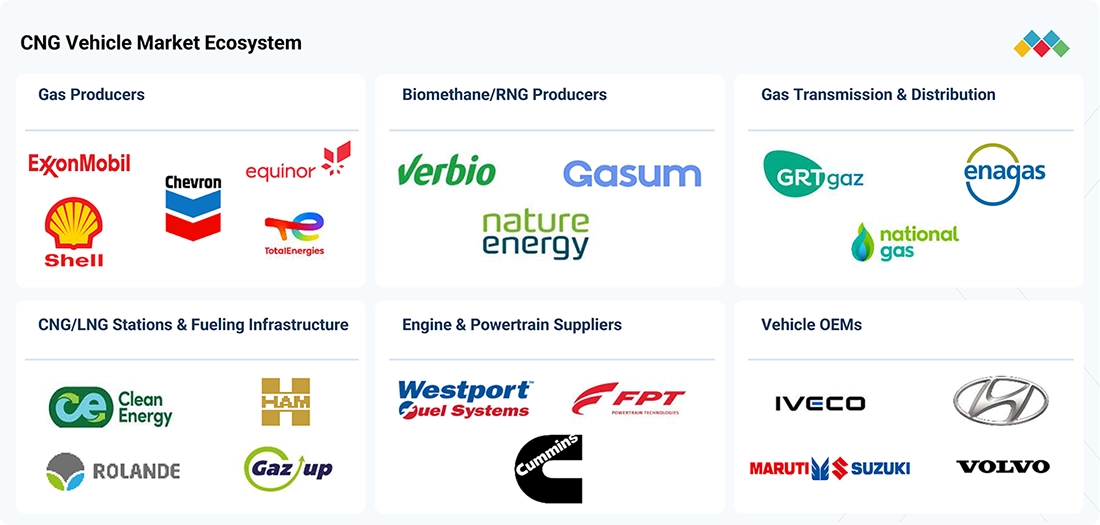
Logos and trademarks shown above are the property of their respective owners. Their use here is for informational and illustrative purposes only.
MARKET SEGMENTS
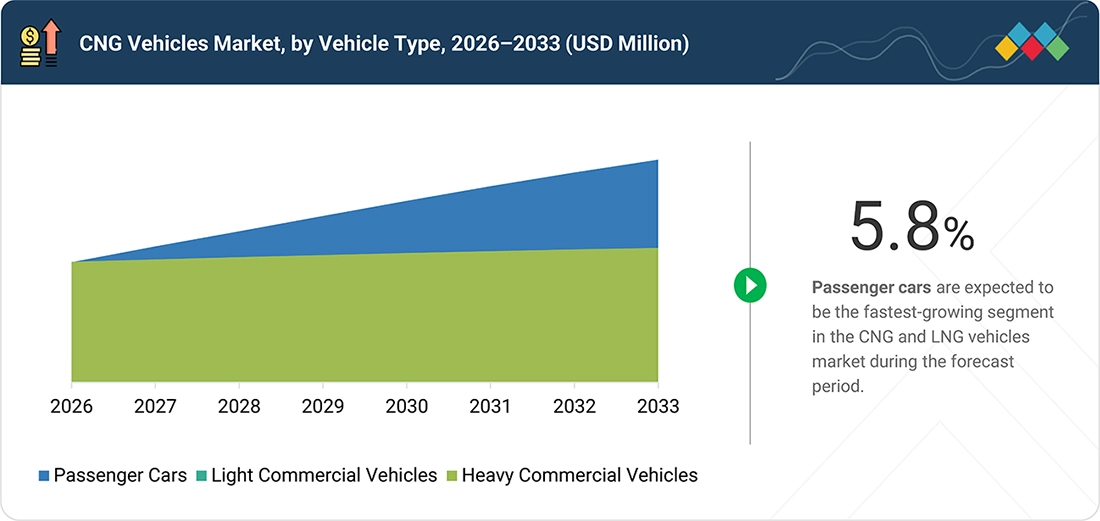
Source: Secondary Research, Interviews with Experts, MarketsandMarkets Analysis
CNG Vehicles Market, By Kit Type
Sequential injection systems are expected to capture the largest market share as OEMs increasingly adopt electronically controlled gas injection to achieve more precise fuel metering and maintain stable air-fuel ratios across varying engine loads.
CNG Vehicles Market, By Fitting Type
OEM-fitted CNG systems are expected to witness the fastest growth as automakers increasingly integrate fuel tanks, injectors, pressure regulators, engine control units, and safety systems during vehicle development.
CNG Vehicles Market, By Engine Type
Bi-fuel vehicles are expected to capture the largest market share as passenger and commercial vehicle OEMs continue to blend CNG with gasoline to provide operating flexibility while keeping CNG as the primary fuel for regular operation.
CNG Vehicles Market, By Fuel Type
CNG is expected to lead the CNG vehicles market, supported by broader adoption of factory-fitted CNG passenger cars and LCVs, particularly in price-sensitive, high-mileage applications. Lower fuel costs and the ability to use existing CNG refueling networks also support faster adoption.
CNG Vehicles Market, By Tank Type
Type 4 cylinders are expected to see the fastest growth, as their polymer liner and composite construction reduce cylinder weight, allowing OEMs to increase vehicle payload and optimize CNG tank packaging.
CNG Vehicles Market, By Vehicle Type
Passenger cars are expected to see the fastest growth as OEMs expand factory-fitted CNG portfolios with compact tank configurations and integrated fuel systems that preserve cabin and luggage space.
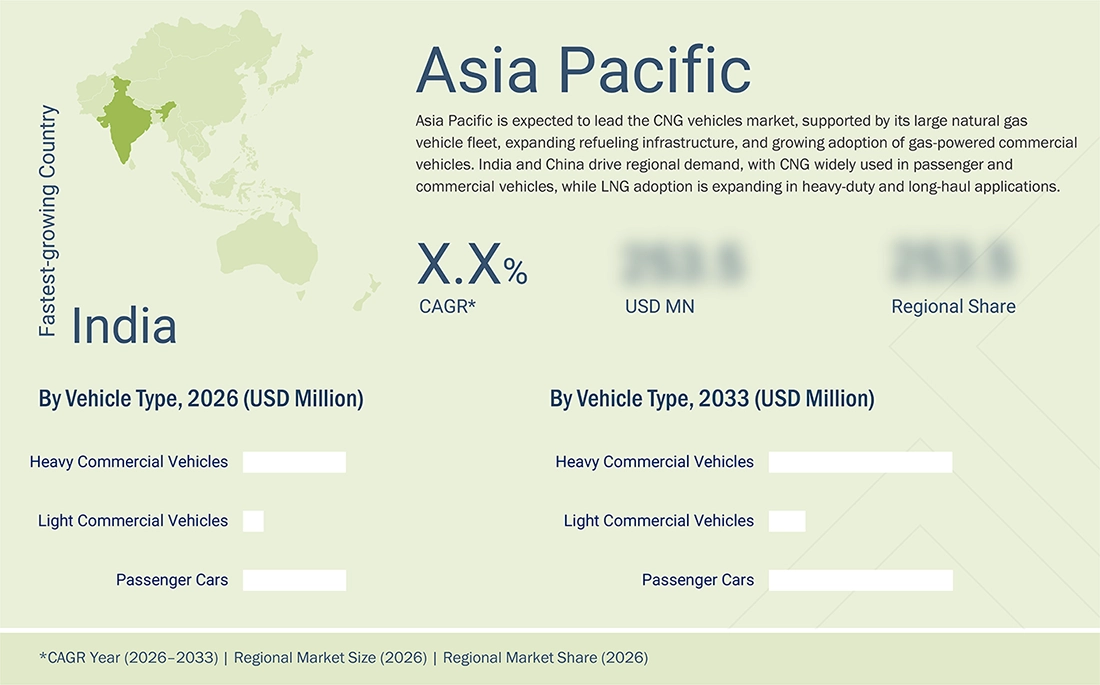
REGION
Asia Pacific to be largest and fastest-growing market for CNG vehicles
Asia Pacific is expected to lead the CNG vehicles market because it combines strong demand for factory-fitted CNG passenger cars with rapid expansion of LNG heavy-truck infrastructure. India continues to expand CNG adoption through new OEM model launches, increasing CNG station coverage, and Bio-CNG production, supporting passenger cars and light commercial vehicles. China is strengthening LNG adoption by expanding highway refueling corridors and promoting LNG trucks for long-distance freight transport. The region also benefits from supportive government policies, growing renewable gas integration, and a large commercial vehicle base, creating sustained demand for CNG and LNG vehicles across both urban and freight applications.
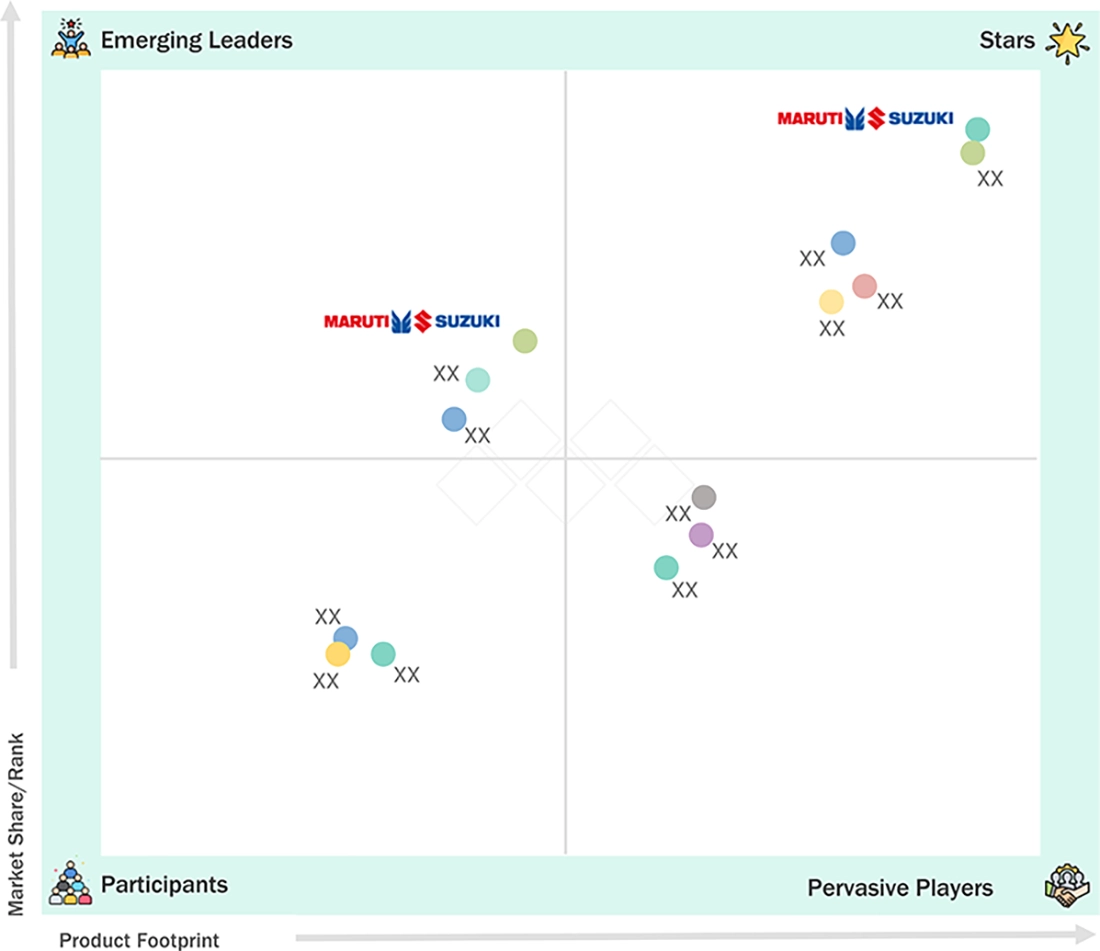
CNG VEHICLES MARKET: COMPANY EVALUATION MATRIX
In the CNG vehicles market matrix, Maruti Suzuki India Limited (Star) leads with a strong presence in the CNG passenger-car segment, supported by a broad factory-fitted S-CNG portfolio covering hatchbacks, sedans, SUVs, and MPVs, along with its established sales and service network. Eicher (Emerging Leader) is strengthening its position through LNG heavy-truck platforms such as the Pro 6055 LNG and Pro 8055 LNG, supported by long-haul applications, connected fleet solutions, and partnerships to develop LNG fueling corridors.
Source: Secondary Research, Interviews with Experts, MarketsandMarkets Analysis
KEY MARKET PLAYERS
- Maruti Suzuki India Limited (India)
- Tata Motors Limited (India)
- Hyundai Motor Company (South Korea)
- Toyota Motor Corporation (Japan)
- Ashok Leyland (India)
- Mahindra & Mahindra Limited (India)
- Eicher Motors Limited (India)
- IVECO S.p.A (Italy)
- Foton International (China)
- Scania (Sweden)
- FAW Motors (China)
- Isuzu Motors Limited (Japan)
MARKET SCOPE
| REPORT METRIC | DETAILS |
|---|---|
| Market Size in 2025 (Value) | USD 20.68 Billion |
| Market Forecast in 2026 (Value) | USD 23.76 Billion |
| Market Forecast in 2033 (Value) | USD 35.27 Billion |
| Growth Rate | CAGR of 5.8% from 2026–2033 |
| Years Considered | 2022–2033 |
| Base Year | 2025 |
| Forecast Period | 2026–2033 |
| Units Considered | Volume (Thousand Units), Value (USD Million/Billion) |
| Report Coverage | Revenue Forecast, Company Share, Competitive Landscape, Growth Factors, and Trends |
| Segments Covered |
|
| Regions Covered | Asia Pacific, Europe, North America, Rest of the World |
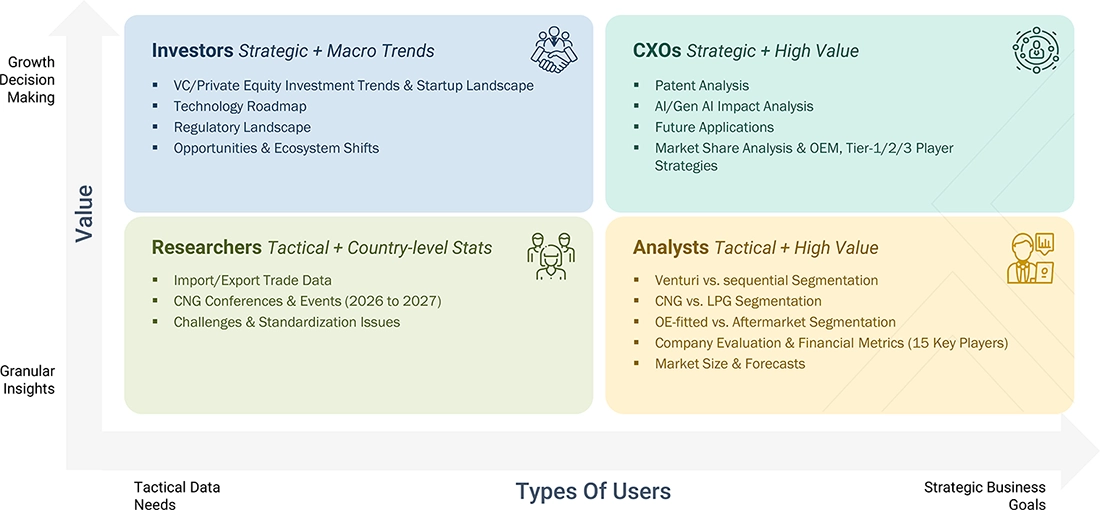
WHAT IS IN IT FOR YOU: CNG VEHICLES MARKET REPORT CONTENT GUIDE
DELIVERED CUSTOMIZATIONS
We have successfully delivered the following deep-dive customizations:
| CLIENT REQUEST | CUSTOMIZATION DELIVERED | VALUE ADDS |
|---|---|---|
| Global Natural Gas Vehicle OEM (Europe) |
|
|
| CNG Vehicle OEM (India) |
|
|
| LNG Truck Manufacturer (China) |
|
|
| Gas Infrastructure Provider (Europe) |
|
|
| Automotive Component Supplier (Asia Pacific) |
|
|
RECENT DEVELOPMENTS
- September 2026 : Mahindra launched the Veero 1.1 XXL CNG with a 1.1-tonne payload, a 2,900 mm cargo deck, cruise control and connected-vehicle features.
- September 2026 : Agrale Argentina and Hexagon Agility signed an agreement to supply more than 400 additional CNG buses in Argentina, following the deployment of 108 CNG buses earlier in 2026.
- May 2026 : Eicher and Cityflo signed an MoU covering 2,000 Eicher buses over three years. The portfolio includes CNG and electric buses, with about 500 buses planned for FY27.
- May 2026 : Nissan launched a government-approved CNG retrofitment kit for the Gravite, developed and quality-assured by Motozen. The system uses two 25-liter cylinders and retains seven-seater functionality.
- May 2026 : TDB and NTF Energy Solutions entered into an agreement to establish a manufacturing facility for Type IV composite CNG cylinders. The cylinders are designed for lower-weight and high-pressure applications.
- April 2026 : Ashok Leyland launched Twin Fuel variants of the DOST and DOST+ XL, allowing operation on both CNG and petrol. The DOST offers up to 400 km range, while the DOST+ XL offers up to 500 km.
- January 2026 : AVG Logistics, Nestlé India, and Ashok Leyland launched a CNG green logistics corridor using 50 Ashok Leyland CNG trucks for Nestlé India's supply chain. The fleet is expected to cover about 275,000 km per month.
Table of Contents
 Exclusive indicates content/data unique to MarketsandMarkets and not available with any competitors.
Methodology
The study involved four major activities to estimate the current size of the CNG vehicles market. We conducted exhaustive secondary research to collect information on the market, peer, and child markets. Next, we validated these findings and assumptions and sized them with industry experts across value chains through primary research. The team used top-down and bottom-up approaches to estimate the total market size. Thereafter, the team used market breakdown and data triangulation to estimate the market size of segments and subsegments.
Secondary Research
In the secondary research process, various sources such as company annual reports, investor presentations, press releases, industry association publications (for example, International Organization of Motor Vehicle Manufacturers (OICA), European Automobile Manufacturers’ Association (ACEA), National Highway Traffic Safety Administration (NHTSA), European Commission, Society of Automotive Engineers (SAE International), United Nations Economic Commission for Europe (UNECE), International Energy Agency (IEA)), government publications, technical articles, white papers, journals, trade websites, company product brochures, technical handbooks, and databases (for example, MarkLines and Factiva) have been used to identify and collect information for an extensive commercial study of the global CNG and LNG vehicles landscape. The research covers CNG passenger cars and light commercial vehicles (LCVs), and LNG heavy commercial trucks, including vehicle sales, OEM portfolios, powertrain technologies, fueling infrastructure, regulations, and market developments.
Primary Research
We conducted extensive primary research after understanding the CNG vehicle landscape through secondary research. Several primary interviews were conducted with market experts from both demand (automotive OEMs, passenger-car and LCV manufacturers, heavy commercial vehicle manufacturers, fleet operators, and logistics companies) and supply (gas engine and fuel-system manufacturers, Tier-1 automotive suppliers, CNG/LNG storage-system manufacturers, fuel injector and ECU suppliers, refueling infrastructure providers, and gas companies) sides across Asia Pacific, Europe, North America, and the Rest of the World. We conducted approximately 74% and 26% of primary interviews from the demand and supply sides, respectively. We collected primary data through questionnaires, emails, and telephonic interviews. The interviews focused on CNG and LNG vehicle adoption by vehicle type, fuel-system configuration, engine technology, fuel storage capacity, vehicle range, pricing, fuel efficiency, refueling infrastructure, regulatory requirements, technology adoption, OEM strategies, and supplier strategies.
In the canvassing of primary data, various departments within organizations, such as sales, marketing, operations, engineering, product development, fleet management, and administration, were covered to provide a holistic viewpoint in this report. After interacting with industry experts, we also conducted brief sessions with highly experienced independent consultants to reinforce the findings from primary data. These, along with in-house subject-matter experts’ opinions, led to the findings described in the remainder of this report.
Breakdown of Primaries
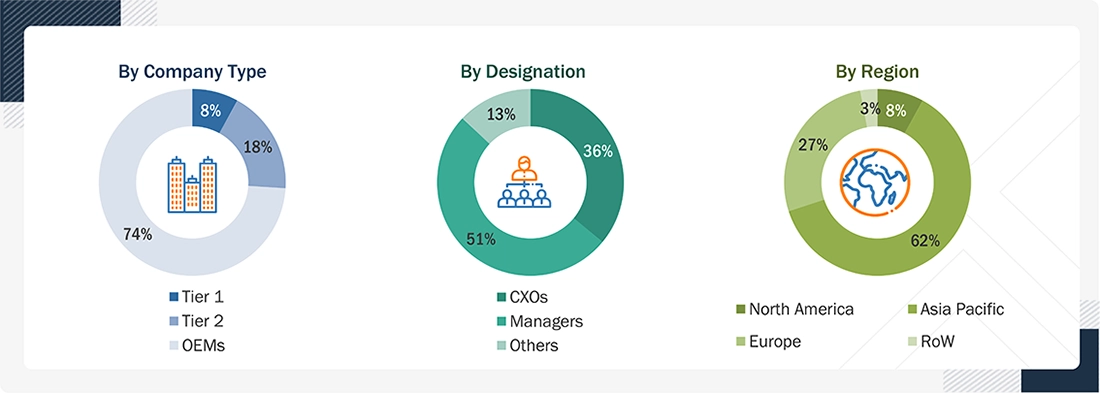
Note 1: Others include subject-matter experts (SMEs), engineers, consultants, and business development professionals.
Note 2: Company tiers are based on the value chain; company revenues are not considered.
To know about the assumptions considered for the study, download the pdf brochure
Market Size Estimation
We used both top-down and bottom-up approaches to estimate and validate the total size of the CNG vehicles market. We also used these methods extensively to estimate the size of various subsegments in the market. The research methodology used to estimate the market size includes the following:
CNG Vehicles Market: Top-Down and Bottom-Up Approach

Data Triangulation
After arriving at the overall market size using the market size estimation processes explained above, we split the market into several segments and subsegments. To complete the overall market engineering process and arrive at the exact statistics for each market segment and subsegment, we employed data triangulation and market breakdown procedures, where applicable. We triangulated the data by examining factors and trends from both the demand and supply sides.
Market Definition
A CNG or LNG vehicle is a road vehicle powered by compressed natural gas (CNG) or liquefied natural gas (LNG). CNG vehicles use natural gas stored in high-pressure cylinders and are primarily used in passenger cars and light commercial vehicles, while LNG vehicles use cryogenically stored natural gas and are mainly used in heavy commercial trucks requiring longer driving ranges. The vehicle system includes the gas storage tank, fuel lines, pressure regulator or vaporizer, fuel injectors, engine, electronic control unit (ECU), and associated safety components that deliver and control the fuel. The market includes factory-fitted CNG passenger cars and LCVs and factory-fitted LNG heavy commercial trucks, including vehicles compatible with renewable fuels such as Bio-CNG and Bio-LNG.
Key Stakeholders
- Automotive Industry Associations and Standardization Bodies
- CNG and LNG Engine and Powertrain Manufacturers
- CNG and LNG Vehicle Original Equipment Manufacturers (OEMs)
- CNG Cylinder and LNG Tank Manufacturers
- CNG Fuel System and Component Manufacturers
- CNG/LNG Refueling Infrastructure Providers
- Commercial Vehicle and Fleet Operators
- Fuel Injector, Pressure Regulator, and Valve Manufacturers
- Government, Vehicle Safety, and Regulatory Authorities
- Natural Gas, LNG, and Biomethane Suppliers
Report Objectives
-
To define, segment, and forecast the size of the CNG vehicles market in terms of volume (thousand units) based on the following categories:
- Engine type (dedicated fuel systems and bi-fuel systems)
- Fuel type (CNG and LNG)
- Fitting type (OEM and aftermarket)
- Tank type (Type 1, Type 2, Type 3, and Type 4)
- Region (Europe and Asia Pacific)
-
To segment and forecast the size of the CNG vehicles market by volume (thousand units) and value (USD million) based on:
- Vehicle type (passenger cars, light commercial vehicles, and heavy commercial vehicles)
- To discuss various kit types (sequential), engine types (dual-fuel systems), and regions [North America and Rest of the World (ROW)] in detail
- To evaluate the key market dynamics influencing the CNG vehicles market, including strategic drivers, restraints, opportunities, challenges, and emerging technology trends shaping future market growth across CNG and LNG vehicles
-
To study the following with respect to the market:
- Supply Chain Analysis
- Ecosystem Analysis
- Technology Analysis
- Trade Analysis
- Investment & Funding Scenario
- Pricing Analysis
- Case Study Analysis
- Patent Analysis
- Regulatory Landscape
- Key Stakeholders & Buying Criteria
- OEM & Fleet Strategy Analysis
- Total Cost of Ownership & Payback Analysis
- Three-wheeler Powertrain Transition & CNG Market Opportunity
- Europe-India Trade Deals: Impact Analysis
- Israel-US War Impact on CNG Vehicles Market
- Powertrain Architecture
- Impact of AI on CNG Vehicles Market
- To benchmark the competitive positioning of key players in the CNG vehicles market through a comprehensive analysis of market share, revenue performance, strategic initiatives, innovation capabilities, product differentiation, and competitive strengths across the CNG and LNG vehicle value chain
- To map the competitive ecosystem of CNG vehicles by categorizing market participants into Stars, Emerging Leaders, Pervasive Players, and Participants using a robust evaluation framework based on the strength of their CNG and LNG vehicle portfolio, business strategy, innovation capability, geographic footprint, and market presence
- To assess the competitive landscape of CNG vehicles by profiling leading global manufacturers based on their business overview, CNG and LNG vehicle product portfolio, geographic presence, financial performance, and recent strategic developments such as product launches, partnerships, acquisitions, capacity expansions, and technological advancements
Available customizations:
With the given market data, MarketsandMarkets offers customizations to meet company-specific needs.
- CNG vehicles market, by fuel type at vehicle-type level
- CNG vehicles market, by vehicle type at country level
Company Information
- Profiling of additional market players (up to 5)


Personalize This Research
- Triangulate with your Own Data
- Get Data as per your Format and Definition
- Gain a Deeper Dive on a Specific Application, Geography, Customer or Competitor
- Any level of Personalization
Let Us Help You
- What are the Known and Unknown Adjacencies Impacting the CNG Vehicles Market
- What will your New Revenue Sources be?
- Who will be your Top Customer; what will make them switch?
- Defend your Market Share or Win Competitors
- Get a Scorecard for Target Partners

Custom Market Research Services
We Will Customise The Research For You, In Case The Report Listed Above Does Not Meet With Your Requirements
Get 10% Free CustomisationTESTIMONIALS

JIM NAAS
PRODUCT DIRECTOR, WEASLER
Weasler Engineering, a CentroMotion organization
Global Provider of Industrial Actuation & Control Solutionswww.weasler.com
Our organization was interested in learning more about the attractiveness of a particular market space. We contacted MarketsandMarkets to help us based on previous positive experiences we had with them. The results did not disappoint! We discussed our objectives with them, and the team at MarketsandMarkets developed and executed a proposal that met our needs precisely. We were very impressed by their level of expertise, the quality of the analysis and their insightful recommendations. We would not hesitate in working with them again in the future.

Matt Kardel,
Vice President
Aptiv,
A global technology company that develops safer, greener and more connected solutions.www.aptiv.com
We contracted with
MarketsandMarkets to evaluate the value chain and potential go-to-market partners related to our
interest in the Fleet Management space. The team successfully completed the work on time and at the
pricing agreed. MarketsandMarkets listened and understood our objectives and collaborated well with
us to help us get the visibility we needed to make an investment.
We have subsequently used
MarketsandMarkets again related to Smart Cities to good results.






Growth opportunities and latent adjacency in CNG Vehicles Market