
Conveyor System Market Size & Growth

Conveyor System Market by Industry (Retail & Distribution, Food & Beverage, Automotive, Electronic, Mining, & Airport), Type (Belt, Roller, Overhead, Floor, Pallet, Crescent, Cable, Bucket) Component, Operation, & Region - Global Forecast to 2033




OVERVIEW
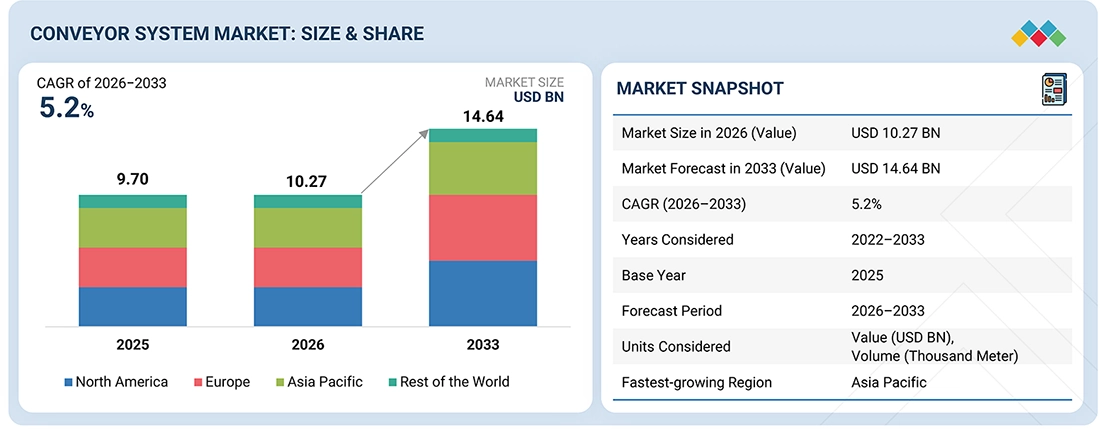
Source: Secondary Research, Interviews with Experts, MarketsandMarkets Analysis
The conveyor system market is projected to grow from USD 10.27 billion in 2026 to USD 14.64 billion by 2033, at a CAGR of 5.2%, driven by rising adoption of intelligent material handling systems across manufacturing, logistics, mining, and processing industries. Demand is increasing for AI-enabled routing, predictive maintenance, sensor-integrated conveyors, and energy-efficient drive systems to improve throughput and reduce downtime. Growth is also supported by rising integration of robotics, warehouse automation platforms, and digital monitoring solutions across high-volume facilities. Manufacturers are focusing on modular, scalable, and flexible conveyor architectures that support faster fulfillment, automated operations, and changing production requirements across the ecommerce, automotive, airport baggage handling, and retail distribution sectors.
KEY TAKEAWAYS
-
BY REGIONAsia Pacific is expected to register the highest CAGR of 5.6% during the forecast period.
-
BY TYPEFloor conveyors are expected to grow at the fastest rate of 10.3% during the forecast period.
-
BY COMPONENTDriving units are expected to grow at a CAGR of 4.0% from 2026 to 2033.
-
BY OPERATIONSemi-automatic conveyors hold the largest market share of 53% due to the rising adoption of warehouse and factory automation.
-
FOR AIRPORT INDUSTRY, BY TYPEBelt conveyors account for the largest share due to their wide use in airport baggage handling systems.
-
FOR RETAIL & DISTRIBUTION INDUSTRY, BY TYPEPallet conveyors are expected to grow at the fastest rate, driven by expansion of ecommerce fulfillment centers and automated warehouses.
-
FOR MINING INDUSTRY, BY TYPEBucket conveyors are expected to register the fastest growth due to increasing demand for vertical bulk material transport.
-
FOR MINING INDUSTRY, BY APPLICATIONUnderground mining is expected to grow at the fastest rate, supported by rising deep mining activities and safer material handling requirements.
-
FOR MINING INDUSTRY, BY TECHNOLOGYGearless conveyor systems are expected to register the fastest growth due to higher efficiency and lower maintenance requirements.
-
FOR AUTOMOTIVE INDUSTRY, BY TYPEOverhead conveyors hold the largest share due to their wide use in automotive assembly and paint shop operations.
-
FOR ELECTRONICS INDUSTRY, BY TYPERoller conveyors are expected to grow at the fastest rate, supported by increasing automation in electronics manufacturing facilities.
-
FOR FOOD & BEVERAGE INDUSTRY, BY SUBINDUSTRYMeat and poultry are expected to register the fastest growth due to rising demand for hygienic and automated processing systems.
-
COMPETITIVE LANDSCAPE (KEY PLAYERS)The conveyor system market is led by key players such as Daifuku Co., Ltd. (Japan), Continental AG (Germany), KION Group AG (Germany), Vanderlande Industries B.V. (Netherlands), and Interroll Holding AG (Switzerland). These companies are focused on strengthening their conveyor system capabilities through automation integration, warehouse modernization, product developments, strategic partnerships, expansions, and acquisitions across logistics, manufacturing, airport, automotive, and industrial applications.
-
COMPETITIVE LANDSCAPE (STARTUPS/SMES)The conveyor system market also includes companies such as TGW Logistics Group (Austria), Metso Outotec (Finland), Taikisha Ltd. (Japan), Semperit AG Holding (Austria), and KNAPP AG (Austria). These companies are focusing on warehouse automation, bulk material handling, conveyor belt technologies, industrial system integration, and logistics modernization through product developments, engineering expansion, technology integration, and strategic partnerships across industrial and distribution applications.
The conveyor system market is growing steadily, driven by rising automation across manufacturing, warehousing, ecommerce, airports, and industrial operations. Increasing focus on faster material movement, labor optimization, and operational efficiency is supporting wider conveyor adoption across industries. At the same time, integration with robotics, warehouse software, sensors, and monitoring systems is improving system connectivity and process control. Manufacturers are also focusing on modular conveyor layouts and energy-efficient systems to support flexible production and distribution requirements. Conveyor systems are expected to remain important for enabling efficient and scalable material handling operations across industrial and logistics facilities.
TRENDS & DISRUPTIONS IMPACTING CUSTOMERS' CUSTOMERS
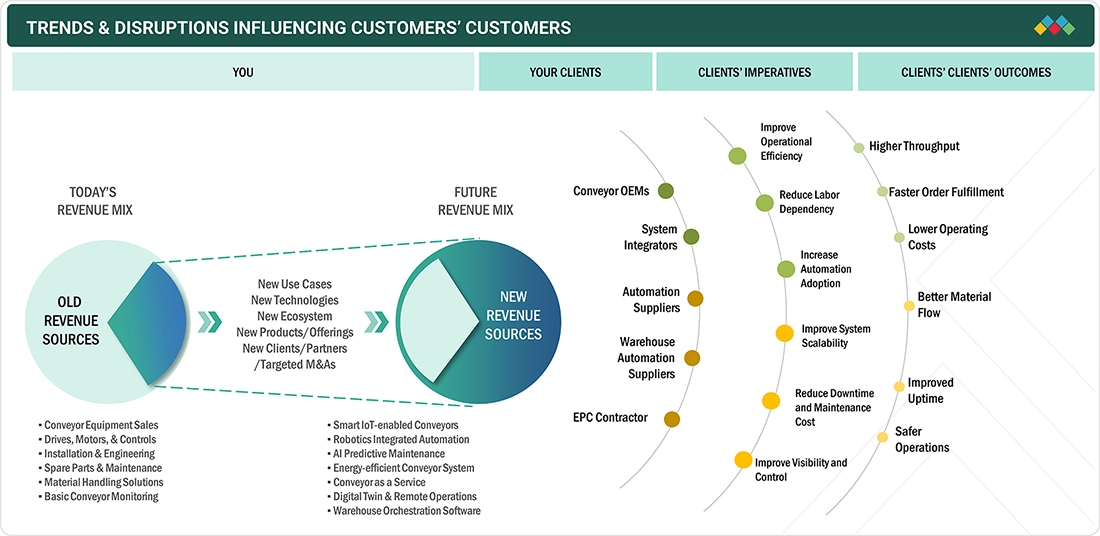
The conveyor system market is evolving from traditional material transport equipment toward intelligent and connected material handling solutions. Current revenues are primarily generated through equipment sales, installation, and aftermarket services, while future growth is expected from automation software, predictive maintenance, and digital operations platforms. Increasing adoption of warehouse automation and smart manufacturing is strengthening collaboration between equipment suppliers, integrators, and industrial operators. This transition enables faster material movement, improved operational efficiency, lower maintenance requirements, and greater production flexibility.
Source: Secondary Research, Interviews with Experts, MarketsandMarkets Analysis
MARKET DYNAMICS

Level
-
Growing adoption of automation across industries

-
Rising need for fulfillment throughput stability and flow orchestration


Level
-
High installation and system integration cost

-
Operational inflexibility in dynamic fulfillment environments


Level
-
Integration of smart conveyor controls and connected sortation systems

-
Conveyor-software convergence


Level
-
Conveyor performance issues caused by belt wear and component failure

-
Integration complexity across heterogeneous automation ecosystems

Source: Secondary Research, Interviews with Experts, MarketsandMarkets Analysis
Driver: Growing adoption of automation across industries
Industries such as warehousing, ecommerce, automotive, food processing, and manufacturing are increasing the use of automation to improve productivity and reduce manual handling. Conveyor systems help maintain continuous material flow, faster processing, and better coordination across production and distribution operations. This is increasing their adoption as a core part of automated industrial infrastructure.
Restraint: Operational inflexibility in dynamic fulfillment environments
Conveyor systems are often designed for fixed material flow patterns and predefined facility layouts. In fast changing fulfillment environments with fluctuating order volumes, changing SKU mixes, and evolving warehouse configurations, modifying conveyor layouts can be time consuming and costly. This can reduce operational flexibility for companies managing dynamic distribution and fulfillment operations.
Opportunity: Integration of smart conveyor controls and connected sortation systems
Conveyor systems are increasingly integrated with sensors, AI-based controls, warehouse software, and connected sortation technologies to improve operational visibility and the accuracy of material flow. These systems support real-time tracking, automated routing, and predictive maintenance across facilities. This creates strong opportunities for advanced conveyor deployment in high-throughput industrial and logistics environments.
Challenge: Integration complexity across heterogeneous automation ecosystems
Modern facilities often operate with multiple automation platforms, robotics systems, warehouse software, and legacy equipment from different suppliers. Integrating conveyor systems across these environments can create compatibility and synchronization challenges. This increases deployment complexity and requires higher engineering support for smooth system operation.
CONVEYOR SYSTEM MARKET SIZE & GROWTH: COMMERCIAL USE CASES ACROSS INDUSTRIES
| COMPANY | USE CASE DESCRIPTION | BENEFITS |
|---|---|---|
 |
Automated conveyor and material handling systems for warehouses, automotive plants, airports, and cleanrooms | Higher throughput, reduced manual handling, continuous material flow, and integrated facility automation |
 |
Conveyor belt systems for mining, industrial processing, and bulk material handling operations | Efficient bulk transport, lower downtime, longer belt life, and improved operational reliability |
 |
Conveyor and sortation systems integrated with warehouse automation and fulfillment operations | Faster order processing, improved warehouse efficiency, and scalable fulfillment operations |
 |
Conveyor based baggage handling, parcel sorting, and warehouse automation systems | High throughput handling, accurate sorting, and reliable baggage and parcel movement |
 |
Modular conveyor platforms, rollers, drives, and pallet handling systems for intralogistics applications | Flexible system integration, efficient material movement, and easier warehouse scalability |
Logos and trademarks shown above are the property of their respective owners. Their use here is for informational and illustrative purposes only.
MARKET ECOSYSTEM
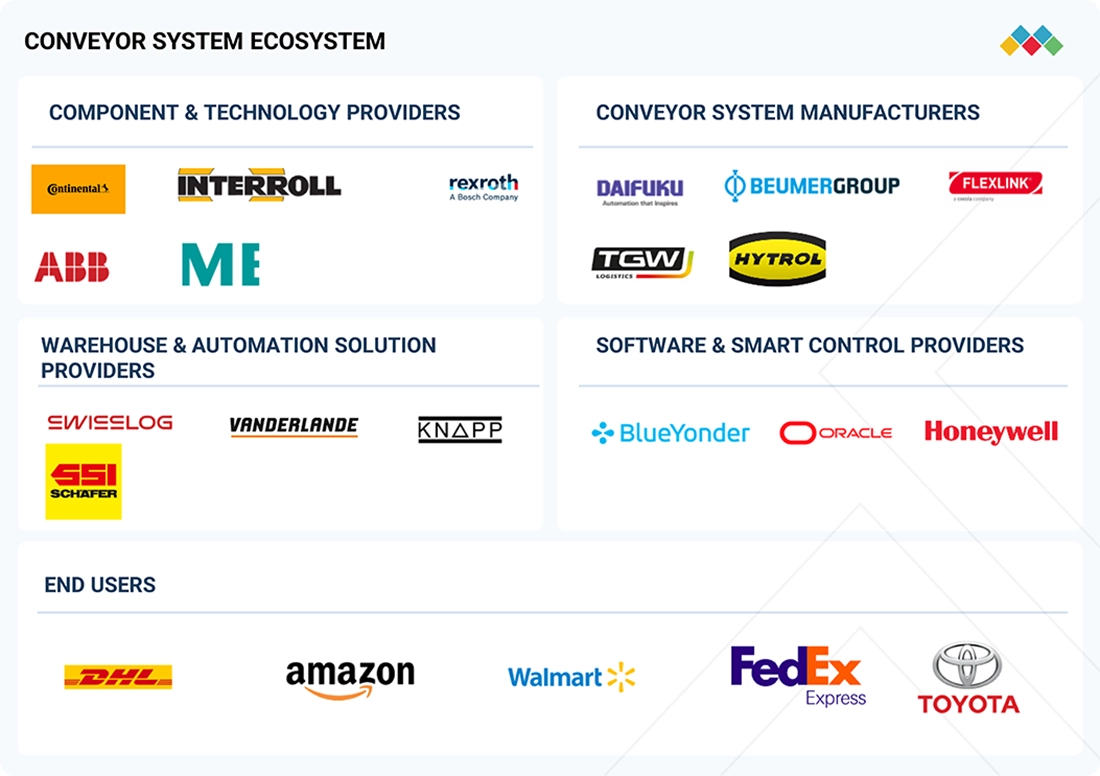
The ecosystem analysis highlights the key stakeholders involved in the conveyor system market and shows how they interact across the material handling and automation value chain. It includes component and technology providers supplying belts, drives, motors, rollers, and controls that form the core of conveyor operations. Conveyor system manufacturers develop belt, roller, pallet, overhead, and sortation systems used across industrial and logistics applications. Warehouse and automation solution providers integrate conveyors with ASRS, robotics, and intralogistics software to support automated warehouse and fulfillment operations. Software and smart control providers enable warehouse management, conveyor monitoring, predictive maintenance, and AI-based operational control. End users such as e-commerce warehouses, manufacturing facilities, airports, logistics hubs, and bulk material handling industries drive demand for conveyor automation, higher throughput, operational efficiency, and connected material flow systems.
Logos and trademarks shown above are the property of their respective owners. Their use here is for informational and illustrative purposes only.
MARKET SEGMENTS
Source: Secondary Research, Interviews with Experts, MarketsandMarkets Analysis
Conveyor System Market, by Type
The conveyor system market by type includes floor conveyors, overhead conveyors, belt conveyors, roller conveyors, pallet conveyors, bucket conveyors, and other conveyor systems used across industrial and logistics applications. Floor conveyors are gaining strong adoption due to their flexibility in automotive, warehousing, and manufacturing operations, while overhead conveyors remain widely used in automotive assembly and paint shop environments. Belt and roller conveyors continue to support high volume material movement across airports, electronics, retail, and food processing facilities.
Conveyor System Market, by Component
The conveyor system market by component includes aluminum profile, driving units, and extremity units. Driving units are gaining importance due to rising demand for automated, energy efficient, and high performance conveyor operations. Manufacturers are increasingly focusing on connected controls, efficient motor systems, and condition monitoring technologies to improve conveyor reliability and reduce operating costs.
Conveyor System Market, by Operation
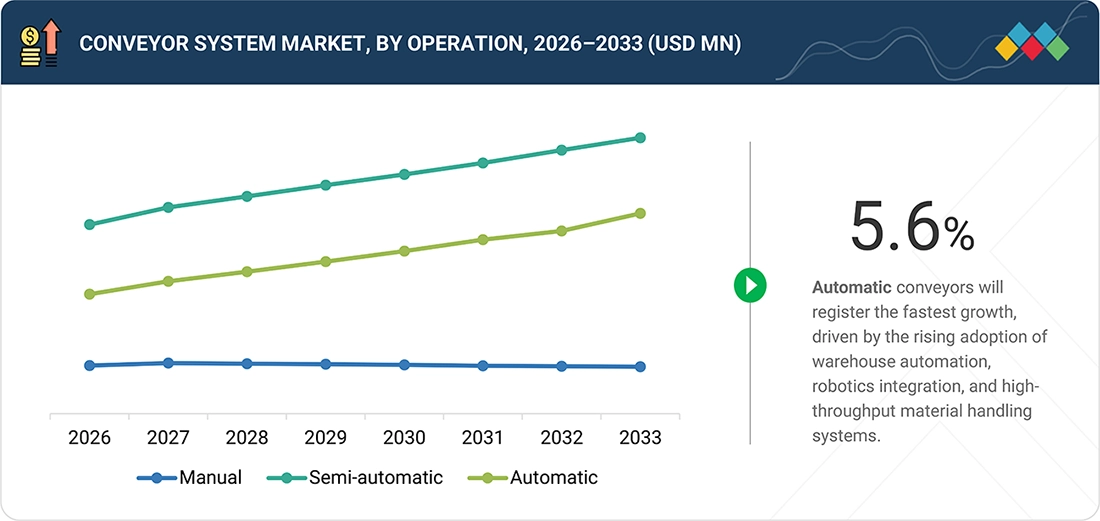
Conveyor systems are categorized into automatic, semi automatic, and manual operations. Automatic conveyors account for the largest share due to increasing use of warehouse automation, robotics integration, and software controlled material handling systems. Industries are adopting automatic conveyor operations to improve throughput, reduce labor dependency, and support connected facility management across production and distribution environments.
Conveyor System Market for Airport Industry, by Type
Airport conveyor systems include belt conveyors, roller conveyors, and other baggage-handling systems used throughout check-in, screening, sorting, transfer, and arrival operations. Belt conveyor systems remain the most widely used type due to their ability to support continuous baggage movement across large terminal networks. Airports are increasingly integrating conveyor systems with automated screening, tracking, and sorting technologies to improve baggage handling efficiency.
Conveyor System Market for Retail & Distribution Industry, by Type
Retail and distribution conveyor systems include pallet conveyors, belt conveyors, roller conveyors, and sortation systems used across warehouses and fulfillment centers. Pallet conveyors are witnessing strong adoption due to increasing movement of heavy goods and bulk inventory across automated distribution operations. Ecommerce growth and fulfillment center expansion are also increasing demand for conveyor systems that support high volume and coordinated warehouse flow.
Conveyor System Market for Mining Industry, by Type
Mining conveyor systems include bucket conveyors, belt conveyors, screw conveyors, and other bulk material handling systems used across mining and mineral processing operations. Bucket conveyors are gaining attention for vertical transport applications in deep mining and processing environments. Conveyor adoption in mining is also increasing as operators focus on continuous material flow, lower fuel dependency, and safer transport across harsh operating conditions.
Mining Conveyor System Market, by Application
Mining conveyor systems are used across underground mining, surface mining, and mineral processing applications. Underground mining is witnessing faster adoption of conveyor systems due to increasing deep mining activities and the need for safer and more controlled material movement. Operators are increasingly replacing truck haulage with conveyor systems to improve operational continuity and reduce ventilation and fuel related costs.
Mining Conveyor System Market, by Technology
Mining conveyor technologies include gearless conveyor systems, geared systems, and automated monitoring solutions. Gearless conveyor systems are gaining traction due to higher efficiency, lower maintenance requirements, and suitability for long distance and high capacity mining operations. Mining companies are also adopting connected monitoring systems to improve conveyor reliability and reduce unplanned downtime.
Conveyor System Market for Automotive Industry, by Type
Automotive conveyor systems include overhead conveyors, floor conveyors, skid conveyors, and power and free conveyor systems used across vehicle manufacturing operations. Overhead conveyors continue to hold a major share due to their wide use in assembly lines, paint shops, and body movement applications. Increasing EV production and flexible manufacturing layouts are also encouraging investments in automated automotive conveyor operations.
Conveyor System Market for Electronics Industry, by Type
Electronics conveyor systems include roller conveyors, belt conveyors, precision handling systems, and modular conveyor layouts used across semiconductor and electronics manufacturing facilities. Roller conveyors are gaining strong adoption due to increasing automation in electronics production and component handling operations. Manufacturers are focusing on conveyor systems that support controlled movement, compact layouts, and higher process accuracy across assembly and inspection stages.
Conveyor System Market for Food & Beverage Industry, by Subindustry
Food and beverage conveyor systems are used across meat and poultry, dairy, bakery, beverages, packaged foods, and frozen food processing operations. Meat and poultry processing is witnessing strong conveyor adoption due to rising demand for hygienic, automated, and high speed production environments. Food manufacturers are increasingly investing in conveyor systems that support sanitation, controlled handling, and efficient processing across packaging and inspection operations.
REGION
Asia Pacific to be fastest-growing region for conveyor system market
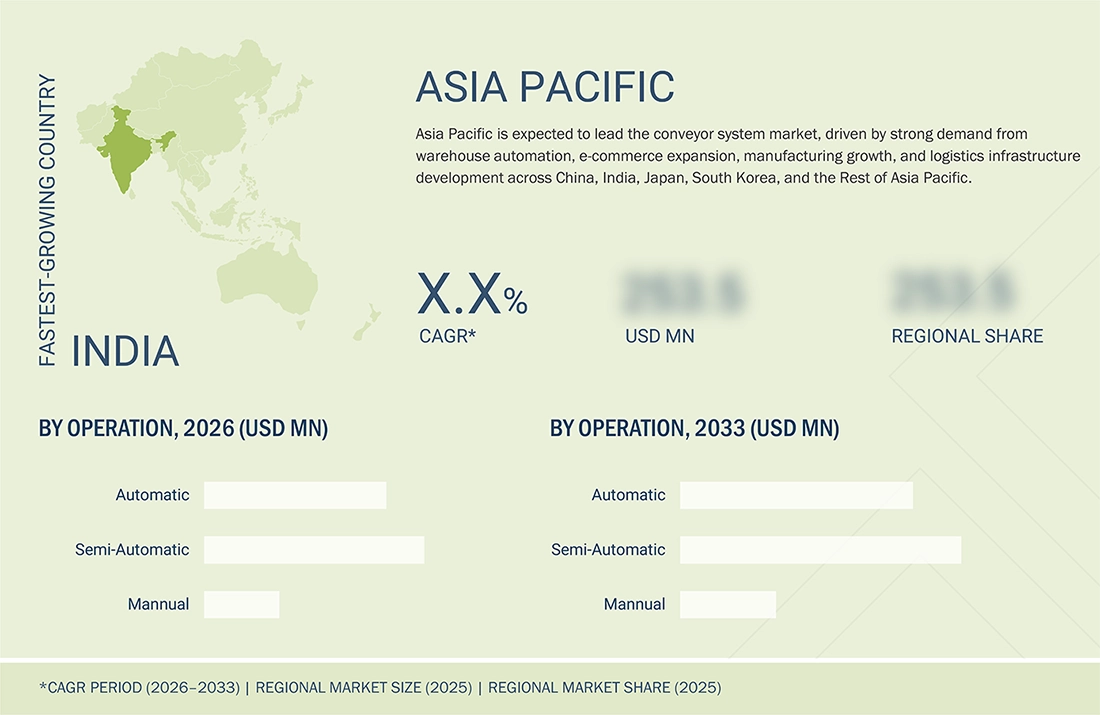
Asia Pacific is projected to be the fastest-growing market for conveyor systems during the forecast period. Rapid expansion of manufacturing, ecommerce warehousing, mining activities, and airport infrastructure across China, India, Japan, South Korea, and the Rest of Asia Pacific is supporting market growth in the region. Rising investments in factory automation, logistics modernization, and high-volume production facilities are increasing the demand for conveyor systems across industrial and distribution operations. The presence of large manufacturing hubs, growing export activities, and increasing adoption of automated material handling solutions are also expected to support conveyor system deployment across the Asia Pacific.
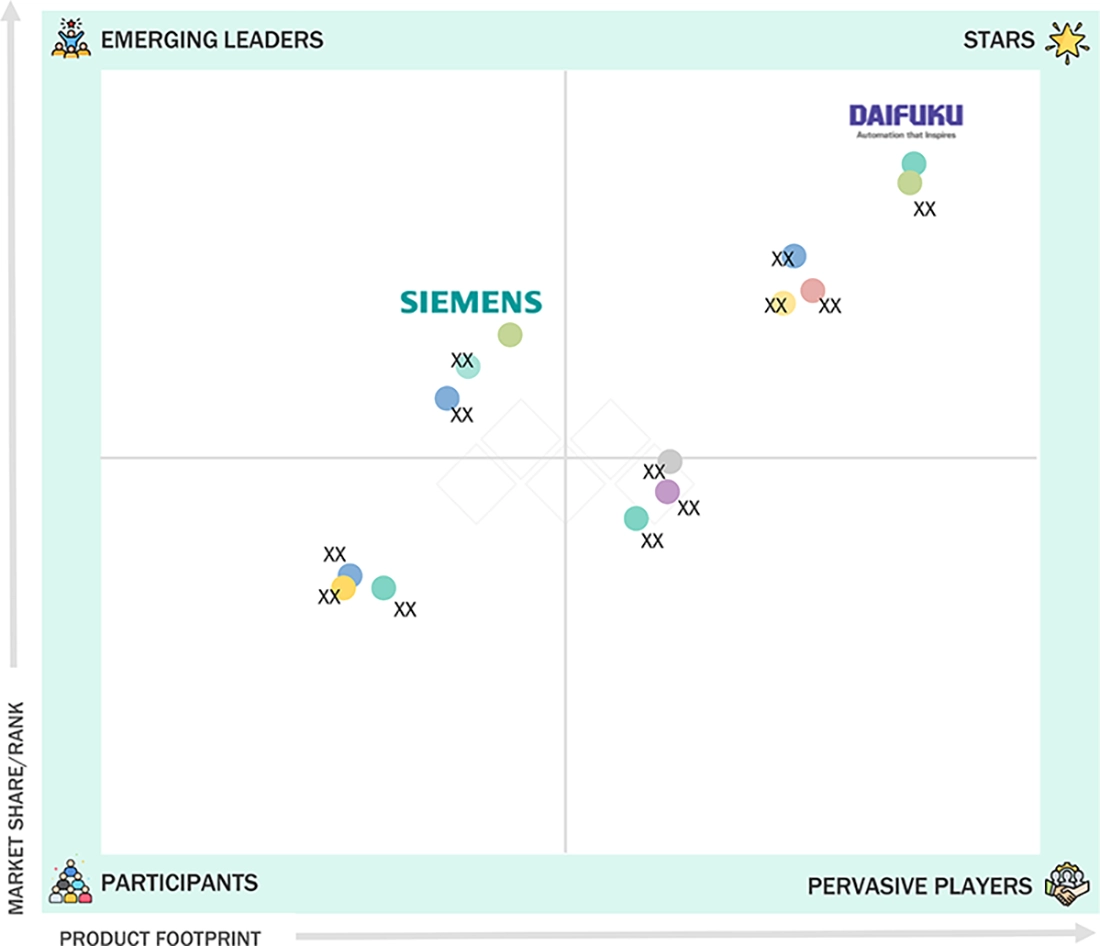
CONVEYOR SYSTEM MARKET SIZE & GROWTH: COMPANY EVALUATION MATRIX
Daifuku Co., Ltd., positioned as a market leader, leverages strong capabilities in warehouse automation, airport baggage handling, automotive production systems, and integrated material handling solutions to strengthen its global market presence. The company continues to expand through automation-focused developments, acquisitions, and large-scale logistics and manufacturing projects. Siemens AG, positioned as an emerging leader, is strengthening its presence through industrial automation, digital conveyor monitoring, smart control systems, and integrated material flow technologies. Its focus on connected industrial operations and software-driven automation is supporting the wider adoption of conveyor solutions across manufacturing, mining, and logistics environments.
Source: Secondary Research, Interviews with Experts, MarketsandMarkets Analysis
KEY MARKET PLAYERS
- Daifuku Co., Ltd. (Japan)
- Continental AG (Germany)
- Dematic (US)
- Vanderlande Industries B.V. (Netherlands)
- Interroll Holding AG (Switzerland)
- Fives Group (France)
- Siemens AG (Germany)
- Bosch Rexroth KFT (Hungary)
- Durr Group (Germany)
- Honeywell International Inc. (US)
- Murata Machinery, Ltd. (Japan)
- Swisslog Holding AG (Switzerland)
MARKET SCOPE
| REPORT METRIC | DETAILS |
|---|---|
| Market Size in 2025 (Value) | USD 9.70 Billion |
| Market Size in 2026 (Value) | USD 10.27 Billion |
| Market Forecast in 2033 (Value) | USD 14.64 Billion |
| Growth Rate | CAGR of 5.2% from 2026-2033 |
| Years Considered | 2022-2033 |
| Base Year | 2025 |
| Forecast Period | 2026-2033 |
| Units Considered | Volume (Thousand Meters), Value (USD Million) |
| Report Coverage | Revenue Forecast, Company Ranking, Competitive Landscape, Growth Factors, and Trends |
| Segments Covered |
|
| Regional Scope | Asia Pacific, Europe, North America, Rest of the World |
WHAT IS IN IT FOR YOU: CONVEYOR SYSTEM MARKET SIZE & GROWTH REPORT CONTENT GUIDE
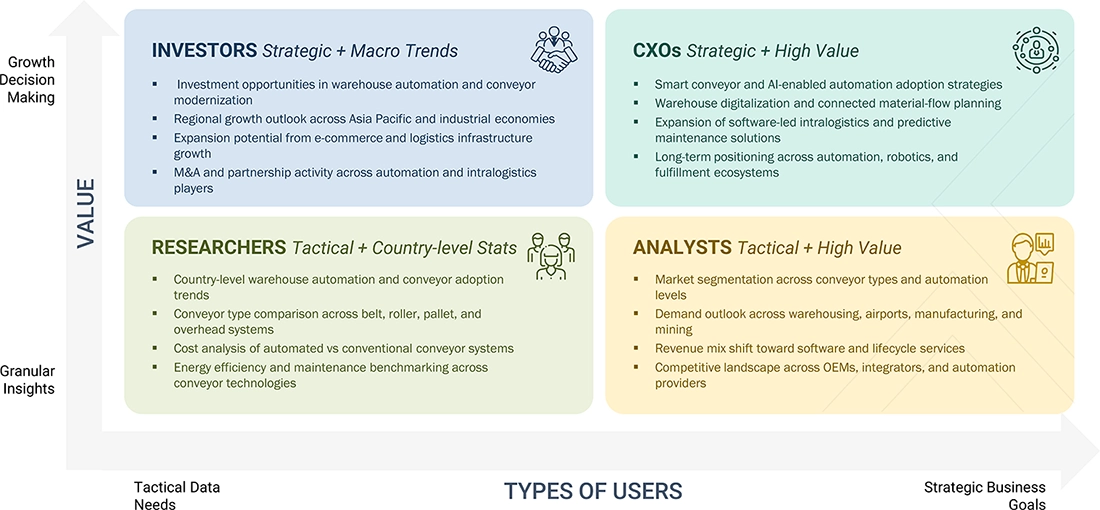
DELIVERED CUSTOMIZATIONS
We have successfully delivered the following deep-dive customizations:
| CLIENT REQUEST | CUSTOMIZATION DELIVERED | VALUE ADDS |
|---|---|---|
| Global E-commerce & Retail Company | Competitive benchmarking of warehouse conveyor and sortation systems, along with assessment of automation upgrades, robotics integration, and fulfillment center expansion strategies | Identify high-speed fulfillment opportunities, improve warehouse throughput, reduce operating costs, and support scalable e-commerce operations |
| Airport & Aviation Infrastructure Operator | Evaluation of baggage handling conveyor systems, airport automation technologies, and modernization requirements for passenger baggage movement operations | Improve baggage flow efficiency, reduce transfer delays, support airport capacity expansion, and increase operational reliability |
| Automotive OEM & Tier-1 Supplier | Assessment of production-line conveyor systems, overhead transport solutions, AGV integration, and smart factory material-flow requirements | Support flexible manufacturing operations, improve production efficiency, reduce manual handling, and strengthen factory automation capabilities |
| Mining & Bulk Material Handling Company | Technical review of heavy-duty conveyor belts, bulk material transport systems, and predictive conveyor maintenance technologies | Reduce conveyor downtime, improve bulk material movement efficiency, lower maintenance costs, and improve operational performance across mining sites |
| Third-party Logistics (3PL) Provider | Analysis of parcel sorting conveyors, warehouse transport systems, and conveyor modernization requirements for distribution and fulfillment centers | Increase parcel handling speed, improve inventory visibility, support distribution center expansion, and improve warehouse productivity |
RECENT DEVELOPMENTS
- April 2026 : Continental launched EcoFlex and EcoFlex Plus conveyor belts in South America. The new belts are designed to reduce conveyor energy consumption, improve operational flexibility, support lower rolling resistance, and increase efficiency in mining and bulk material handling operations.
- April 2026 : Daifuku completed a new factory building at Shiga Works, Japan, for semiconductor transport and storage systems. The expansion is expected to increase production capacity for cleanroom automation systems, wafer transport systems, and semiconductor material handling equipment.
- March 2026 : Dematic launched Command Center warehouse intelligence platform. The platform provides centralized monitoring, real-time operational visibility, analytics, and AI-supported decision-making for automated warehouse and conveyor operations.
- March 2026 : Vanderlande showcased an expanded airport automation portfolio at PTE World 2026. The company highlighted baggage handling automation, digital monitoring, passenger flow optimization, and lifecycle support technologies for airport operations.
- March 2026 : Interroll presented integrated material-flow ecosystem and MCP PLAY at LogiMAT 2026. The solution improves conveyor control, system connectivity, decentralized operation, and flexible material-flow management across warehouse environments.
- February 2026 : TGW promoted BFT2000 conveyor modernization services. The modernization program is designed to improve conveyor reliability, operational safety, maintenance efficiency, and long-term system availability.
- January 2026 : FlexLink launched its Online Store for conveyor and automation components. The platform allows faster product selection, ordering, spare-part management, and digital access to conveyor system components.
- December 2025 : Omnia Technologies inaugurated new headquarters with a EUR 22 Million investment. The facility supports engineering collaboration, innovation activities, operational coordination, and global management for processing and packaging equipment businesses.
- November 2025 : FlexLink introduced GENIUS 1-LV PCB Laser Marking System. The system supports high-speed PCB traceability, automated electronics handling, and integration with conveyor-linked production lines.
- October 2025 : Vanderlande secured baggage handling system contract for the new CPK Airport in Warsaw. The project includes automated baggage transport, high-capacity conveyor systems, and intelligent baggage flow management technologies.
- September 2025 : Vanderlande marked its 75th MECHZB contract with DHL Group. The project further strengthens Vanderlande’s position in parcel automation and conveyor-based warehouse logistics systems.
- September 2025 : TGW highlighted mixed-SKU conveyor automation systems. The systems are designed to efficiently transport products of different sizes, weights, and packaging types across warehouse fulfillment operations.
Table of Contents
 Exclusive indicates content/data unique to MarketsandMarkets and not available with any competitors.
Methodology
Various secondary sources, directories, and databases have been used to identify and collect information for the extensive study on the conveyor system market. The study involved four main activities in estimating the current size of the conveyor system market: secondary research, validation through primary research, assumptions, and market analysis. The research study used various secondary sources, including company annual reports/presentations, industry association publications, magazine articles, directories, technical handbooks, the World Economic Outlook, trade websites, technical articles, and databases, to identify and collect information for an extensive study of the conveyor system market. Primary sources from related industries, OEMs, and suppliers were interviewed to obtain and verify critical information and assess prospects and market estimations.
Secondary Research
Secondary sources for this research study include corporate filings, such as annual reports, investor presentations, and financial statements; trade, business, and professional associations; whitepapers; certified publications; articles by recognized authors; directories; and databases. Secondary data was collected and analyzed to determine the overall market size, further validated by primary research.
Primary Research
Extensive primary research was conducted after understanding the conveyor system market scenario through secondary research. Several primary interviews were conducted with market experts from the demand side (vehicle manufacturers, country-level government associations, and trade associations) and the supply side (conveyor system and bus manufacturers, component providers, and system integrators). The regions considered for the research include North America, Europe, Asia Pacific, and the Rest of the World. Primary data was collected through questionnaires, emails, and telephonic interviews.
After interacting with industry experts, brief sessions were conducted with highly experienced independent consultants to reinforce the findings from the primaries. This, along with the in-house subject matter experts’ opinions, led to the findings described in this report.
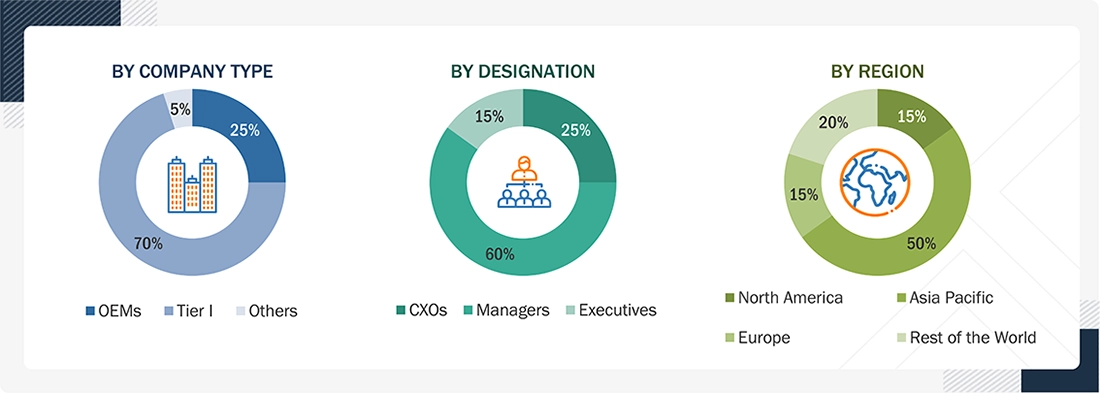
Note: Tiers of companies are based on the value chain of the conveyor system market; companies’ revenues were not considered.
To know about the assumptions considered for the study, download the pdf brochure
Market Size Estimation
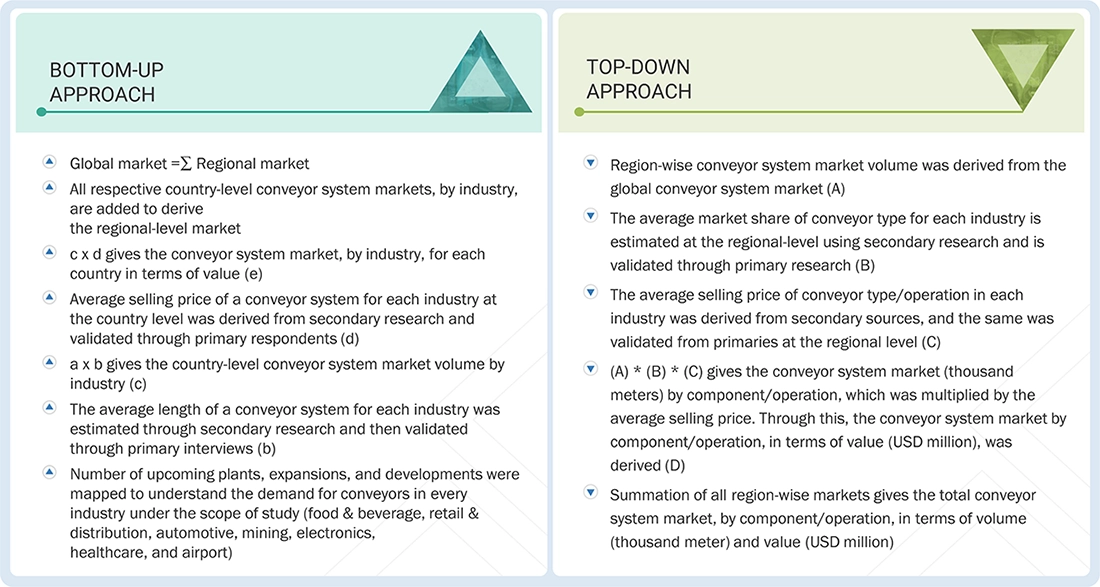
Both top-down and bottom-up approaches were used to estimate and validate the total size of the conveyor system market. These methods were also used extensively to estimate the size of various subsegments in the market. Secondary research was done to identify key players in the conveyor system market. Their global market share was determined through primary and secondary research.
Conveyor System Market : Top-Down and Bottom-Up Approach
Data Triangulation
After arriving at the overall market size through the bottom-up approach, the conveyor system market was split into several segments and subsegments. Where applicable, the data triangulation procedure was employed to complete the overall market engineering process and arrive at the exact market value for key segments and subsegments. The extrapolated market data was triangulated by studying various macroindicators and regional trends from both demand- and supply-side participants.
Market Definition
Britannica defines a conveyor as any device that provides mechanized movement of material, such as in a factory; it is used principally in industrial applications and on large farms, as well as in warehousing and freight handling for moving raw materials. Conveyors may be only a few inches in length, or they may be integrated systems several miles long.
Key Stakeholders
- Automation System Manufacturers
- Automotive Ancillary Players
- Automotive OEMs
- Conveyor OEMs
- Conveyor System Component Manufacturers
- Conveyor System Cybersecurity Providers
- Electronics Companies
- Food & Beverage Companies
- Industrial Machinery Insurance Providers
- Legal and Regulatory Authorities
- Mining Companies
- Raw Material Suppliers
- Sensor Manufacturers
- Software Providers
- Traders, Distributors, and Suppliers
Report Objectives
-
To define, segment, analyze, and forecast the conveyor system market, in terms of volume (thousand meter) and value (USD million) between 2026 and 2033 based on:
- To segment and forecast the market size, by type (roller, pallet, overhead, tri-planar, bucket, floor, cable, crescent, and other types)
- To segment and forecast the market size, by operation (manual, automatic, and semi-automatic)
- To segment and forecast the market size, by component (aluminum profile, driving unit, extremity unit, and other components)
- To segment and forecast the market size for the airport industry, by type (belt, tri-planar, crescent, and other types)
- To segment and forecast the market size for the retail & distribution industry, by type (belt, roller, pallet, and other types)
- To segment and forecast the market size for the automotive industry, by type (overhead, floor, roller, and other types)
- To segment and forecast the market size for the mining industry, by type (belt, cable, bucket, and other types)
- To segment and forecast the market size for the electronics industry, by type (belt, roller, and other types)
- To segment and forecast the market size for the food & beverage industry, by subindustry (meat & poultry, dairy, and other types)
- To segment and forecast the mining conveyor system market size, by application (open-pit mining and underground mining)
- To segment and forecast the mining conveyor system market size, by technology (drive, gearless, and automated)
- To segment and forecast the market size by region (Asia Pacific, Europe, North America, and the Rest of the World)
- To provide detailed information about the factors influencing market growth (drivers, challenges, restraints, and opportunities)
- To strategically analyze the market, considering individual growth trends, prospects, and contributions to the total market
-
To study the following factors with respect to the market:
- Value Chain Analysis
- Ecosystem Analysis
- Technology Analysis
- Pricing Analysis
- Trade Data
- Case Study Analysis
- Patent Analysis
- Impact of Generative AI
- Regulatory Landscape
- Key Stakeholders and Buying Criteria
- Key Conferences and Events
- Impact of Israel-Iran War
- Europe-India Trade Deals Impact Analysis
- ROI Benchmarking
- Future Monetization Outlook
-
To determine the following with respect to the market:
- Market Share Analysis
- To analyze the competitive landscape and prepare a competitive leadership mapping/market quadrant for the global players operating in the conveyor system market
- To analyze recent developments, alliances, joint ventures, mergers & acquisitions, product launches, and other activities carried out by key participants in the conveyor system market
Customization Options
With the given market data, MarketsandMarkets offers customizations tailored to a company’s specific needs.
Need a Tailored Report?
Customize this report to your needs
Get 10% FREE Customization
Customize This ReportPersonalize This Research
- Triangulate with your Own Data
- Get Data as per your Format and Definition
- Gain a Deeper Dive on a Specific Application, Geography, Customer or Competitor
- Any level of Personalization
Let Us Help You
- What are the Known and Unknown Adjacencies Impacting the Conveyor System Market
- What will your New Revenue Sources be?
- Who will be your Top Customer; what will make them switch?
- Defend your Market Share or Win Competitors
- Get a Scorecard for Target Partners

Custom Market Research Services
We Will Customise The Research For You, In Case The Report Listed Above Does Not Meet With Your Requirements
Get 10% Free CustomisationTESTIMONIALS

JIM NAAS
PRODUCT DIRECTOR, WEASLER
Weasler Engineering, a CentroMotion organization
Global Provider of Industrial Actuation & Control Solutionswww.weasler.com
Our organization was interested in learning more about the attractiveness of a particular market space. We contacted MarketsandMarkets to help us based on previous positive experiences we had with them. The results did not disappoint! We discussed our objectives with them, and the team at MarketsandMarkets developed and executed a proposal that met our needs precisely. We were very impressed by their level of expertise, the quality of the analysis and their insightful recommendations. We would not hesitate in working with them again in the future.

Matt Kardel,
Vice President
Aptiv,
A global technology company that develops safer, greener and more connected solutions.www.aptiv.com
We contracted with
MarketsandMarkets to evaluate the value chain and potential go-to-market partners related to our
interest in the Fleet Management space. The team successfully completed the work on time and at the
pricing agreed. MarketsandMarkets listened and understood our objectives and collaborated well with
us to help us get the visibility we needed to make an investment.
We have subsequently used
MarketsandMarkets again related to Smart Cities to good results.
Growth opportunities and latent adjacency in Conveyor System Market






Amey
Nov, 2019
I am tryin to understand our market and specifically a maintenance and services market around conveyor belts..
Amey
Nov, 2019
I found the TOC to be exhaustive enough, however I would like to know Few more points, -Can you customize the reports and what will be the cost of customization. - What will be the turnaround time for complete ready report and customized report - Do you provide cost driver analysis as the TOC does not specifically mention about the same - Supplier profiling in this industry - Would need a sample report .
Amey
Nov, 2019
We are interested in fire resistant conveyer belts. Best known for mining. We are looking for trends in this area. Also what are FR requirements of other conveyer belt types.
Amey
Nov, 2019
Hi, I work for a strategy consultancy based in London that works heavily in the industrial space. I would like to purchase the report on the conveying systems, and would like to see a sample before making the decision to buy. .
Amey
Nov, 2019
Looking for Australia specific info ONLY. Also, what is the full list of industries covered? We are most interested in mining, materials handling and heavy industry. Based on this can you advise if report can be customised..
Amey
Nov, 2019
I am interested in the total market share of the companies listed in the report. Also interested in the market size of each conveyor type (i.e., Roller, Belt, Pallet, etc.) automation, mobile robotic, robotic, material handling, logistic, conveyors, automotive, production equipment, AGV, etc..
Amey
Nov, 2019
I want to see the contents on Global forecast, US market forecast and the competition section from your report. I would appreciate your help. Certainly we may ended up buying the complete report if it is satisfactory .
Amey
Nov, 2019
Interested in belt conveyors for mining and industry at large. Would like to have an idea of the installed base and owners or contacts if possible. .
Amey
Nov, 2019
I have a client researching conveyor market technology and sizing the market for vacuum conveyors in particular. Thank you very much. John.
Amey
Nov, 2019
I am only interested in the conveyor belts market in Brazil. I need to understand which information on this specific market you can provide us with (market size per industry segment, competitive landscape, products etc.). Lastly, is there any possibility to purchase the Brazilian portion only?.
Amey
Nov, 2019
I just wanted to ask if there are production units available in this report or only market data in Sales/ Revenues. Specific interest would also be the share of conveyors which is driven electrically, for example, electric motors. Thanks a lot for a short feedback..
Amey
Nov, 2019
I would like to know if the report contains anything specifically about the categories of conveyor systems used by the mining industry, as well as if there is any specific information on the Brazilian market within the "Americas" section of the report..