



Electric Two Wheeler Market Size, Share & Analysis
Report Code
AT 7219
Published in
Nov, 2025, By MarketsandMarkets™
Electric Two-Wheeler Market by Vehicle Type (E-Scooters/Mopeds, E-Motorcycles), Voltage, Motor Type (Hub, Mid-drive), Battery (Li-ion, Lead-acid), Motor Power, Technology (Battery, Plug-in), Vehicle Class, Usage, and Region - Global Forecast to 2035

USD 5.31 BN
MARKET SIZE, 2026
USD 10.29 BN
MARKET SIZE, 2035

CAGR 7.6%
(2026-2035)

2026-2035
FORECAST PERIOD
OVERVIEW
Source: Secondary Research, Interviews with Experts, MarketsandMarkets Analysis
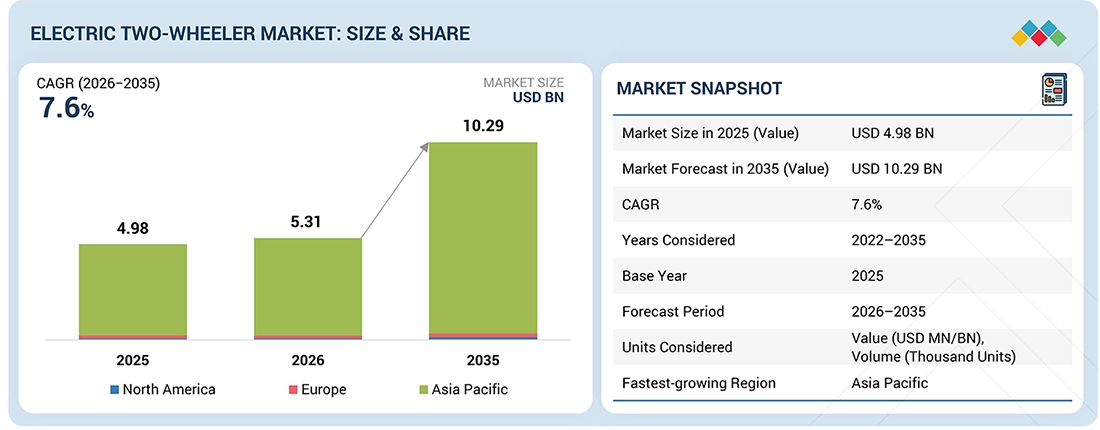
The electric two-wheeler market size is projected to grow from USD 5.31 billion in 2026 to USD 10.29 billion by 2035 at a CAGR of 7.6%. Last-mile delivery and shared mobility fleets now account for a significant share of urban electric two-wheeler demand, prompting OEMs to prioritize fleet-ready platforms, extended battery life, and integrated telematics. Manufacturers are improving cost efficiency by adopting subscription-based or battery-as-a-service (BaaS) models, offering flexible and affordable options for commercial operators. They are also using higher energy-density cells to increase range and enhance performance. To improve flexibility and reduce supply chain risks, OEMs now dual-source battery chemistries using LFP for affordable mass-market models and NMC for premium variants and design packs that can support both chemistries to simplify production and sourcing.
KEY TAKEAWAYS
-
MARKET SNAPSHOT:
Market Size (2025): USD 4.98 Billion
Current Market Size (2026): USD 5.31 Billion
Projected Market Size (2035): USD 10.29 Billion
CAGR (2026–2033): 7.6% -
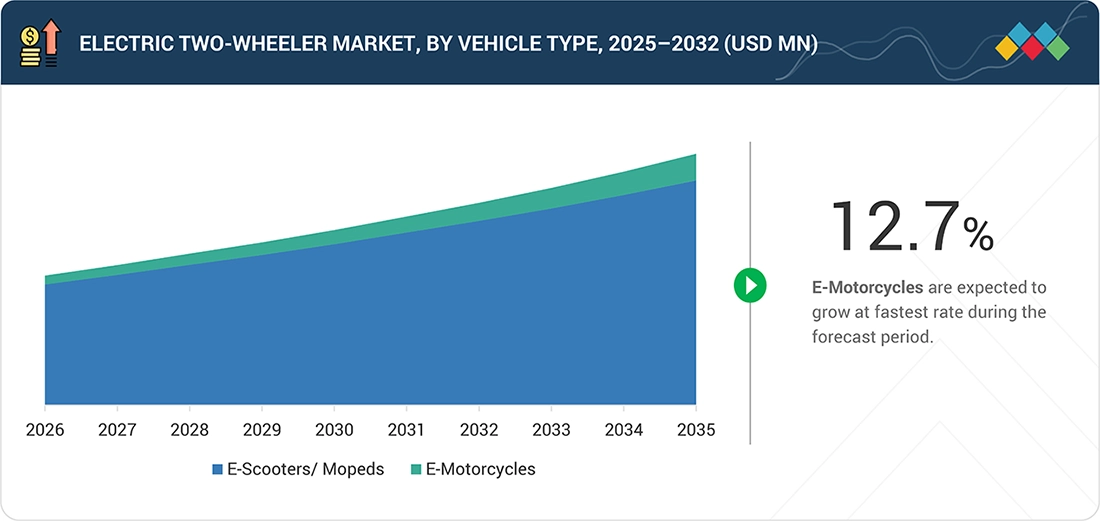
By Vehicle TypeBy Battery Type, the E-Scooters/ Mopeds segment is expected to lead the Electric 2 wheeler market during the forecast period. It is projected to grow from USD 4.94 billion in 2026 to USD 9.20 billion by 2035, at a CAGR of 7.2% from 2026 to 2035.
-
By Distance CoveredBy Distance Covered, the above 100 miles segment is the fastest growing market at a CAGR of 8.9% from 2026 to 2035.
-
By Technology TypeBy Technology Type, plug-in segment is expected to have the largest market in Electric 2 wheeler market during the forecast period. It is projected to grow from USD 5.03 billion in 2026 to USD 8.58 billion by 2035.
-
By Vehicle ClassBy Vehicle Class, the economy segment is projected to grow from USD 4.25 billion in 2026 to USD 7.91 billion by 2035, at a CAGR of 7.1% from 2026 to 2035.
-
By Battery TypeBy Battery Type, the Lithium ion segment is expected to lead the Electric 2 wheeler market during the forecast period. It is projected to grow from USD 5.29 billion in 2026 to USD 10.29 billion by 2035, at a CAGR of 7.7% from 2026 to 2035.
-
By Voltage TypeBy Voltage Type, the above above 72 V segment is the fastest growing market at a CAGR of 13.2% from 2026 to 2035.
-
By UsageThe private segment is projected to grow from USD 4.97 billion in 2026 to USD 8.48 billion by 2035, at a CAGR of 6.1% .
-
By Motor TypeThe hub motor segment is projected to grow from USD 4.49 billion in 2026 to USD 7.33 billion by 2035 at a CAGR of 5.6%.
-
By Motor PowerThe above 3 kW segment is estimated at USD 2.67 billion in 2026 and is projected to reach USD 5.46 billion by 2035 at a CAGR of 8.3% during the forecast period.
-
BY RegionAsia Pacific is projected to be the fastest and largest region during the forecast period. It is projected to grow from USD 5.07 billion to USD 9.94 billion, registering a CAGR of 7.8%.
-
Competitive LandscapeThe electric two-wheeler market is dominated by global players including VinFast (Vietnam), Bajaj Auto Ltd. (India), TVS Motor Company (India), Ather Energy (India), and Ola Electric (India).
Manufacturers are localizing key components such as motors, battery management systems, and pack assembly to cut production costs and comply with local-content requirements, opening new opportunities for Tier 1 suppliers. OEMs are also expanding their business models beyond one-time vehicle sales by introducing financing solutions, battery-as-a-service offerings, over-the-air updates, and connected services to generate recurring revenue streams. Furthermore, stricter safety and type-approval regulations, along with emerging rules on battery recycling and second-life usage, are driving product design changes and spurring the development of reverse logistics and recycling service networks.
TRENDS & DISRUPTIONS IMPACTING CUSTOMERS' CUSTOMERS
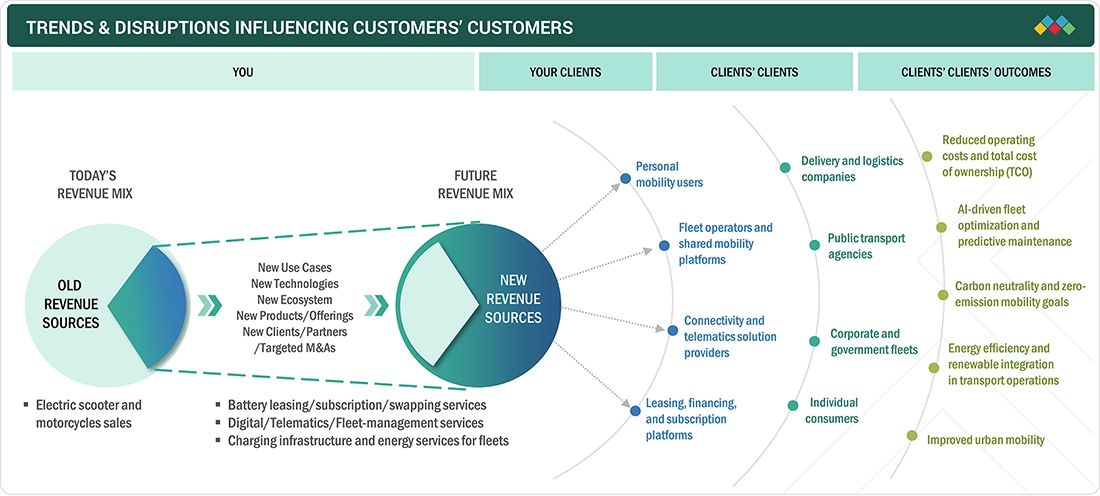
The electric two-wheeler market is undergoing rapid transformation as technological innovation, regulatory shifts, and changing mobility behaviors reshape customer business models. Electrification, digitalization, and new energy ecosystems are disrupting traditional value chains, influencing how vehicles are designed, manufactured, sold, and operated. Customers across personal mobility, shared transportation, and commercial delivery segments are adapting to evolving cost structures, software-driven vehicles, and emerging service-based models. These trends are redefining competitive dynamics and creating both challenges and opportunities for businesses operating in the global E2W ecosystem.
Source: Secondary Research, Interviews with Experts, MarketsandMarkets Analysis
MARKET DYNAMICS

Drivers
Impact
Level
Level
-
Fleet Electrification for Urban and Commercial Mobility

-
Technological Evolution in Battery Systems


RESTRAINTS
Impact
Level
Level
-
Charging Infrastructure Gaps and Range Performance Constraints

-
Battery Heating Problems and Long Charging Times


OPPORTUNITIES
Impact
Level
Level
-
Transition to Modular and Swappable Energy Platforms

-
Software Ecosystem Development and Digital Value Chain Expansion


CHALLENGES
Impact
Level
Level
-
Reliability of Thermal and Power Electronics in Urban Operating Conditions

-
Lack of Standardization in Battery Communication and Swapping Protocols

Source: Secondary Research, Interviews with Experts, MarketsandMarkets Analysis
Driver: Fleet Electrification for Urban and Commercial Mobility
Fleet electrification is emerging as a major driver for the electric two-wheeler market, particularly in urban logistics, last-mile delivery, and shared mobility applications. E-commerce platforms, food delivery aggregators, and hyperlocal service providers are increasingly shifting from ICE two-wheelers to electric models to lower operating costs, meet corporate sustainability targets, and comply with tightening urban emission norms. Electric two-wheelers offer clear advantages for fleet operators, including lower total cost of ownership, reduced maintenance, predictable energy costs, and high suitability for short, high frequency urban routes. Cities with growing low emission and congestion control measures are further accelerating the transition, making electric mopeds and motorcycles a practical solution for dense urban mobility.
Restraint: Charging Infrastructure Gaps and Range Performance Constraints
Limited availability of charging infrastructure remains a key restraint for electric two-wheelers in many emerging economies, affecting both consumer confidence and adoption rates. In countries such as India, Indonesia, Malaysia, and Mexico, public charging networks are still fragmented and unevenly distributed, particularly beyond major urban centers. Compared to developed markets like the US and Western Europe where structured EV policies, strong public and private investments, and widespread home charging access support reliable charging ecosystems many emerging regions face constraints related to grid readiness, space availability, and slow deployment of standardized charging points.
Opportunity: Software Ecosystem Development and Digital Value Chain Expansion
The focus of competition is shifting from hardware features to software-driven mobility. As electric two-wheelers become more connected, embedded software now controls key vehicle functions such as battery management, regenerative braking, predictive maintenance, and fleet telematics. These advanced software systems allow manufacturers to collect and analyze real-time data from vehicles, batteries, and riders creating new digital revenue streams beyond the initial vehicle sale.
Challenge: Reliability of Thermal and Power Electronics in Urban Operating Conditions
Unlike passenger electric vehicles, electric two-wheelers often operate in crowded urban areas that experience extreme heat, dust, humidity, and frequent stop-and-go traffic. These conditions put significant thermal stress on power electronic components. Key systems such as the motor controller, onboard charger, DC-DC converter, and BMS are especially sensitive to temperature changes. In countries like India and those in Southeast Asia, where temperatures regularly exceed 104°F (40°C), poor thermal management can cause voltage drops, lower motor efficiency, and faster wear of components. Some OEMs have reported that high heat cycles and weak cooling in compact scooter designs can reduce the lifespan of critical components by as much as 20–25% during continuous urban use.
ELECTRIC TWO WHEELER MARKET: COMMERCIAL USE CASES ACROSS INDUSTRIES
| COMPANY | USE CASE DESCRIPTION | BENEFITS |
|---|---|---|
 |
Offers connected electric scooters with digital sales platforms and battery flexibility for urban users. | Expands EV access, improves ownership convenience, and supports lower urban emissions. |
 |
Provides connected electric scooters with advanced battery management and regenerative systems. | Enhances range efficiency, enables remote diagnostics, and supports fleet monitoring. |
 |
Develops urban focused electric scooters with integrated lithium ion battery and motor control systems. | Reduces operating cost, ensures consistent city performance, and supports ICE replacement. |
 |
Offers connected smart scooters for individual and commercial users, integrated with telematics, navigation, and performance analytics | Enhances user experience through data-driven insights, improves vehicle efficiency, and enables predictive maintenance |
 |
Provides electric scooters for personal mobility and fleet operations in urban areas through app-based rentals and ownership models | Reduces carbon emissions, lowers per km travel cost, and supports shared mobility infrastructure |
Logos and trademarks shown above are the property of their respective owners. Their use here is for informational and illustrative purposes only.
MARKET ECOSYSTEM
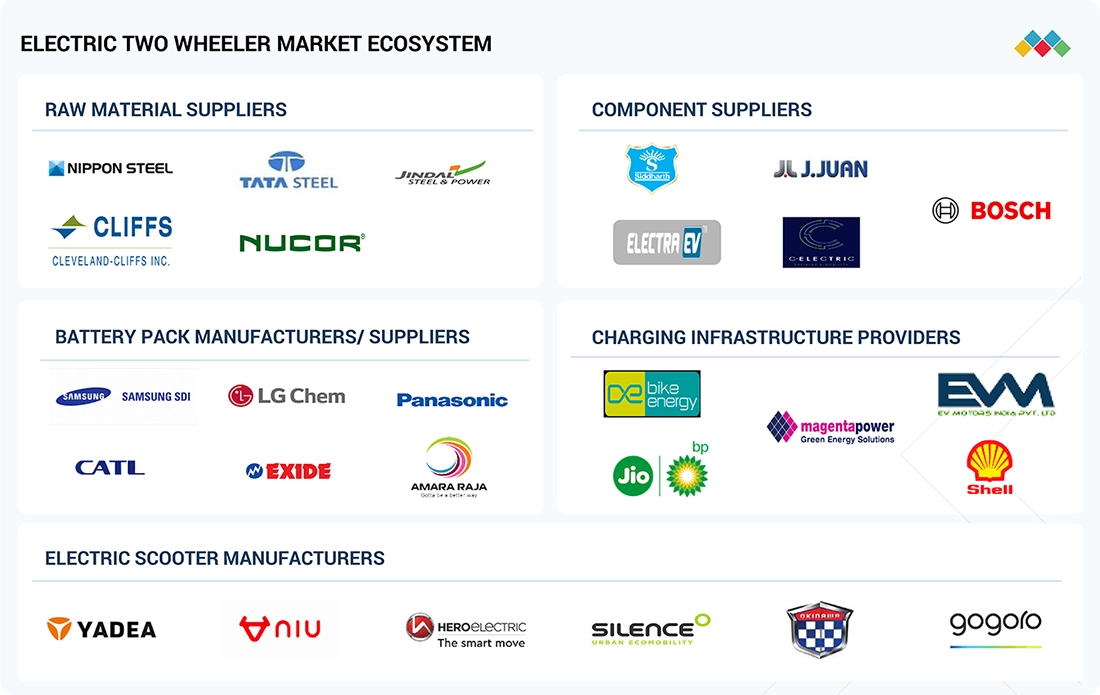
The electric two-wheeler ecosystem consists of interconnected participants spanning materials, components, batteries, charging, and vehicle manufacturing. Steel suppliers such as Tata Steel and Nippon Steel are supporting lightweight and durable vehicle structures. Technology providers including Robert Bosch GmbH and Electra EV are enabling efficient drivetrain and control systems. Battery leaders such as CATL and LG Chem are advancing cell chemistry and localized pack assembly. Charging network operators including Shell and Jio-bp are expanding public infrastructure, while manufacturers such as Yadea and Gogoro are integrating these elements into competitive electric scooter platforms.
Logos and trademarks shown above are the property of their respective owners. Their use here is for informational and illustrative purposes only.
MARKET SEGMENTS
Source: Secondary Research, Interviews with Experts, MarketsandMarkets Analysis
Electic Two Wheeler Market, By Battery Type
The lithium-ion battery segment is expected to dominate the electric two-wheeler market during the forecast period, driven by its clear advantages over traditional lead-acid batteries. Lithium-ion batteries offer higher energy density in a lighter and more compact form, enabling longer driving range, improved performance, and sleeker vehicle designs. They also support faster charging, longer service life, and a higher number of charge cycles, reducing vehicle downtime and lowering total cost of ownership over time. Manufacturers are increasingly focusing on launching electric scooters equipped with cutting-edge lithium-ion batteries.
Electic Two Wheeler Market, By Distance Covered
The 75-100 miles segment is projected to show significant growth in the electric two-wheeler market during the forecast period. Many models within this range are popular in the Asia Pacific region. Keeness, Fierider by Yadea Technology Group Co., Ltd., and VS1, CPX by Vmoto are offered in the range of 75–100 miles. Also, manufacturers are expected to develop battery technology with a higher vehicle range due to ongoing R&D in battery technology.
Electic Two Wheeler Market, By Voltage Type
The 72 V battery segment is expected to account for the largest share of the electric two-wheeler market as it offers the optimal balance between performance, range, and cost across both premium scooters and electric motorcycles. A 72 V architecture supports higher motor output, faster acceleration, and sustained cruising speeds without the complexity and cost of ultra-high-voltage systems. It is increasingly adopted by OEMs as a standard platform for performance-oriented mass-market models, enabling longer range and improved thermal efficiency while remaining suitable for urban and highway use. Models such as Zero SR, Zero SR/F, Zero FXE, Energica EsseEsse9, Ultraviolette F77, NIU NQi GTS, Ola S1 Pro, Ather 450X, Vmoto CPx and among others comes under 72 V battery segment.
Electic Two Wheeler Market, By Technology Type
The plug-in charging segment is expected to lead the electric two-wheeler market during the forecast period, driven by the widespread adoption of lithium-ion batteries and the convenience of home and workplace charging. Plug-in charging is particularly well suited for private users, as it allows vehicles to be charged overnight using standard electrical outlets without dependence on dedicated swapping infrastructure. The extensive availability of electricity networks makes plug-in charging easier and more cost-effective to deploy than battery-swapping systems, supporting faster scalability across urban and semi-urban regions. As a result, many OEMs continue to prioritize plug-in architectures for both scooters and motorcycles across global markets.
Electic Two Wheeler Market, By Vehicle Class
The economy segment is expected to lead the global electric two-wheeler market by vehicle class due to its affordability and mass-market relevance, particularly in emerging economies where price sensitivity is high. Most daily-use electric scooters and motorcycles are positioned below USD 1,600, making them accessible to first-time EV buyers and urban commuters. Lower battery capacity, simpler powertrains, and limited top-speed requirements significantly reduce upfront and operating costs, supporting faster adoption. Additionally, strong demand from Asia Pacific markets, fleet operators, and last-mile delivery services reinforces the dominance of economy-class E2Ws.
Electic Two Wheeler Market, By Vehicle Type
The e-scooter/moped segment is expected to lead the global electric two-wheeler market as it best addresses daily urban mobility needs through low upfront cost, easy maneuverability, and low operating expenses. These vehicles are well-suited for short-distance commuting and last-mile usage, driving higher adoption across private users and delivery fleets. OEMs are accelerating innovation with higher-capacity batteries, improved range, and feature-rich designs, strengthening consumer appeal. For instance, in January 2026 Bajaj Auto launched the Chetak CS501 with a 2.5 kWh battery and 113 km range, while Ola Electric introduced the S1 Pro Sport in August 2025 with up to a 5.2 kWh battery, highlighting continued momentum in the e-scooter space
Electic Two Wheeler Market, By Usage
The private segment is projected to lead the electric two-wheeler (E2W) market during the forecast period, driven by rising adoption of electric scooters and motorcycles for daily personal commuting. Lower operating and maintenance costs, ease of home charging, and growing availability of feature-rich models are encouraging individual consumers to shift from ICE two-wheelers. Additionally, increasing awareness of emission-free mobility and the convenience of electric two-wheelers in urban traffic further support the dominance of the private segment.
Electic Two Wheeler Market, By Motor Type
Hub motors are expected to lead the electric two-wheeler market during the forecast period. Ola Electric (India), Hero Electric (India), Okinawa Autotech Internationall Private Limited (India), and other OEMs are using hub motors as a source of electric scooters. The mid-drive motor for electric scooters and motorcycles is expected to grow at a significant rate during the forecast period, as it provides better weight distribution and gear ratios. Several electric two-wheeler manufacturers have partnered with motor manufacturers to ensure a continuous supply of motors, meeting the rising demand for electric two-wheelers.
Electic Two Wheeler Market, By Motor Power
The above-3 kW electric two-wheeler segment is expected to lead the market due to rising consumer demand for higher performance, faster acceleration, and longer range, making them closer substitutes for ICE two-wheelers. Advances in battery technology and falling Li-ion costs have made high-power models more affordable and efficient. OEMs are also focusing on this segment to capture better margins and meet the growing preference for premium multi-purpose vehicles suited for urban and commercial use. This shift reflects a broader trend toward performance-driven electrification rather than purely low-cost mobility. Manufacturers have introduced electric two-wheelers with high motor power.
REGION
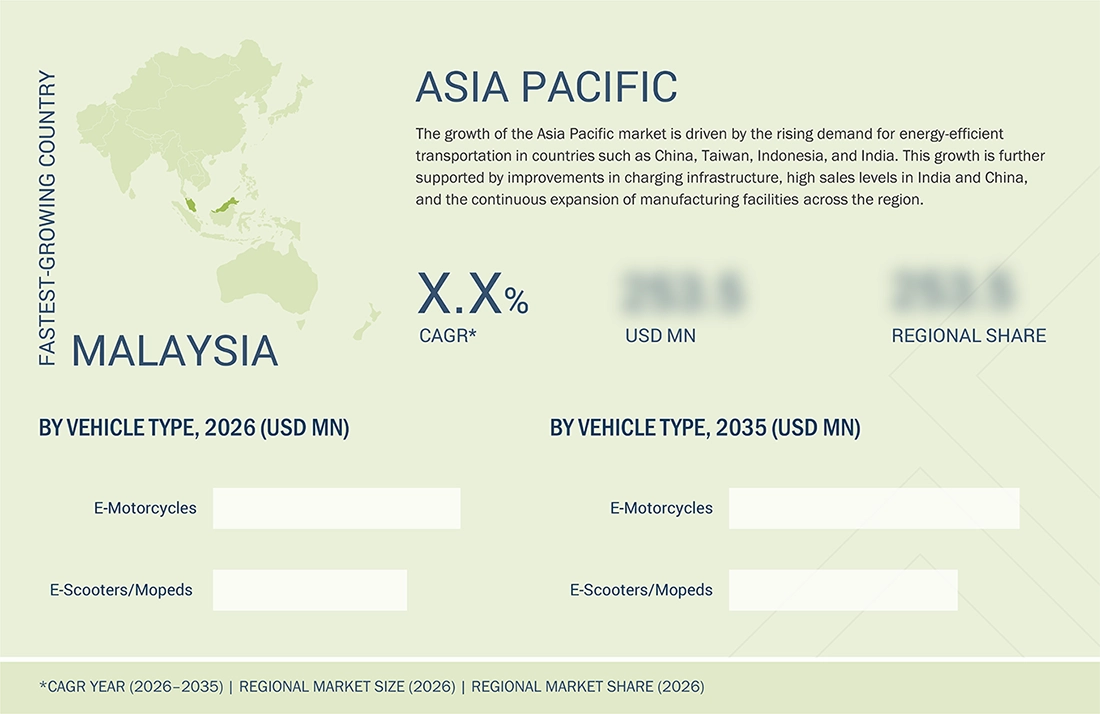
Asia Pacific to grow at fastest rate in global electric two-wheeler market during forecast period
The Asia Pacific region is expected to lead the electric two-wheeler market during the forecast period. Large automobile production and sales volumes in China and India, growing demand for affordable electric scooters for short-distance commuting, and governments promoting electric two-wheelers are expected to drive the Asia Pacific market during the forecast period. Additionally, Vietnam is phasing out ICE two-wheelers, starting with a ban in central Hanoi districts by July 2026, to combat severe air pollution.VinFast (Vietnam), Bajaj Auto Ltd. (India), Ola Electric (India), Ather Energy (India), and Gogoro (Taiwan) are the key players in the region. For instance, in January 2026, Bajaj Auto launched the Chetak CS501 electric scooter with 2.5 kWh battery, 113 km certified range, compact urban-focused design with metal body, hill hold assist and 25 L boot.
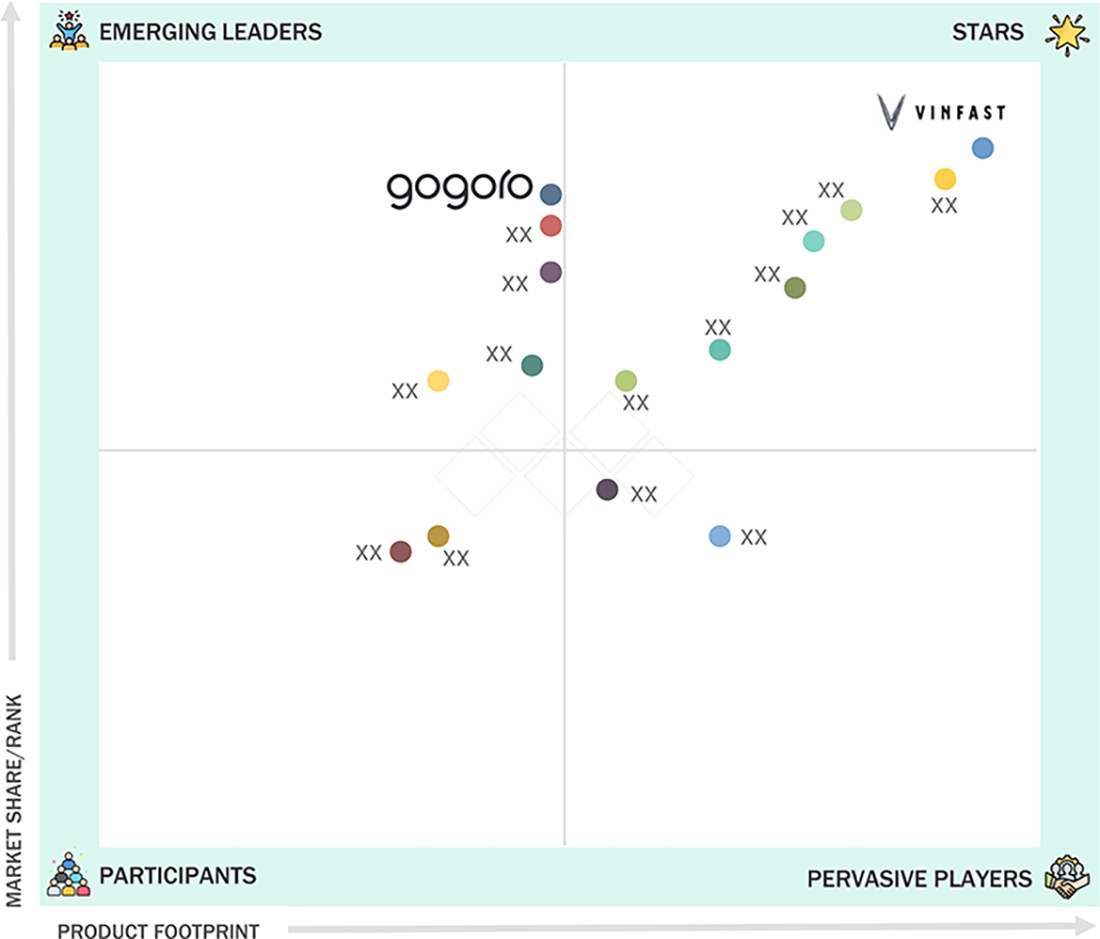
ELECTRIC TWO WHEELER MARKET: COMPANY EVALUATION MATRIX
In the electric two-wheeler market matrix, VinFast (Star) leads with a strong global presence and comprehensive electric two-wheeler offerings, driving market expansion and revenue growth through strategic partnerships and product launches. Gogoro (Emerging Leader) is gaining traction with its large-scale battery-swapping network, strategic collaborations with local OEMs, and technology licensing partnerships across Asia. The company shows strong growth potential to advance toward the leaders' quadrant.
Source: Secondary Research, Interviews with Experts, MarketsandMarkets Analysis
KEY MARKET PLAYERS
- VinFast (Vietnam)
- TVS Motor Company (India)
- Bajaj Auto Ltd. (India)
- Ather Energy (India)
- OLA Electric (India)
- Yadea Technology Group Co.,Ltd. (China)
- GOGORO (Taiwan)
- HERO ELECTRIC (India)
- Vmoto Limited (Australia)
- Niu International (China)
- Jiangsu Xinri E-Vehicle Co., Ltd. (China)
- Ultraviolette Automotive
- Askoll EVA S.p.A. (Italy)
MARKET SCOPE
| REPORT METRIC | DETAILS |
|---|---|
| Market Size Value in 2026 | USD 5.31 Billion |
| Revenue Forecast in 2035 | USD 10.29 Billion |
| Growth Rate | CAGR of 7.6% from 2026 to 2035 |
| Actual Data | 2022-2035 |
| Base Year | 2024 |
| Forecast Period | 2026-2035 |
| Units Considered | Volume (Thousand Units) and Value (USD Million) |
| Report Coverage | Revenue forecast, company ranking, competitive landscape, growth factors, and trends |
| Segments Covered |
|
| Regional Scope | Asia Pacific, Europe, and North America |
WHAT IS IN IT FOR YOU: ELECTRIC TWO WHEELER MARKET REPORT CONTENT GUIDE
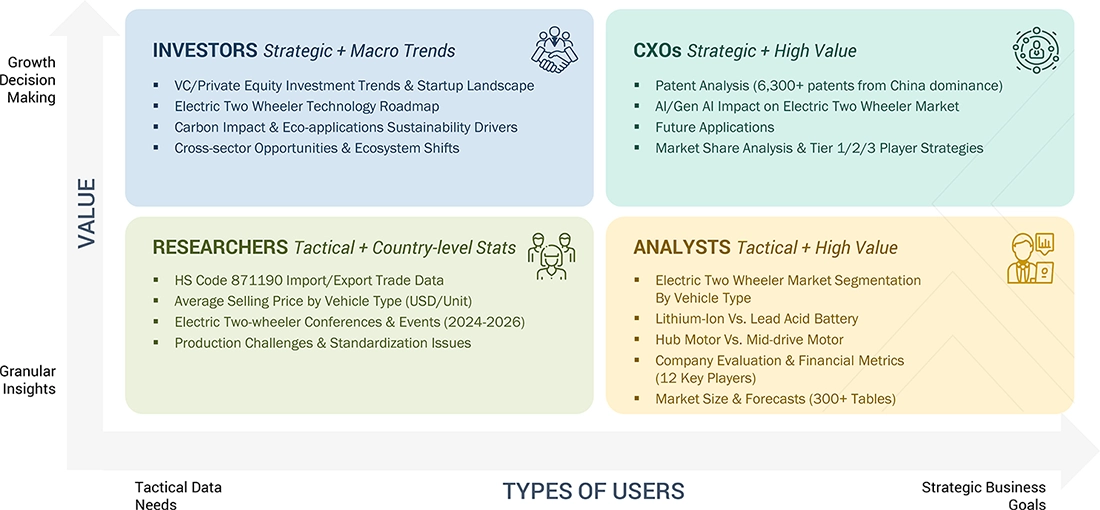
DELIVERED CUSTOMIZATIONS
We have successfully delivered the following deep-dive customizations:
| CLIENT REQUEST | CUSTOMIZATION DELIVERED | VALUE ADDS |
|---|---|---|
| Two Wheeler OEM, India | Competitive benchmarking of leading EV models including Ola Electric, Ather, Hero MotoCorp, and TVS. Detailed feature mapping covering battery capacity, motor power, and driving range. | Identified product gaps and pricing opportunities. Guided portfolio expansion strategies for mid range electric scooters. |
| Battery Manufacturer, Japan | Assessment of battery chemistry adoption including LFP and NMC across vehicle categories. Forecast of battery demand by voltage segments such as 48V, 72V, and 96V. | Enabled capacity planning for upcoming EV partnerships. Supported long term procurement and localization strategies. |
| Fleet Operator, Southeast Asia | Cost benefit evaluation of EV adoption for delivery fleets. Total cost of ownership comparison between ICE and electric two-wheelers. | Reduced operating expenses through optimized fleet configuration. Improved return on investment through structured charging and battery swap strategies. |
| Charging Infrastructure Provider, Europe | Market potential assessment for fast charging and battery swapping networks. City level mapping of high demand mobility corridors. | Supported deployment targeting in high traffic urban zones. Strengthened partnerships with OEMs and fleet aggregators. |
| Component Supplier, Germany | Demand forecast for traction motors and controllers. Technology trend assessment comparing hub motor and mid drive systems. | Enabled entry into high growth EV component segments. Prioritized research and development investments aligned with OEM adoption patterns. |
| Investment Firm, United States | Identification of emerging EV startups across Asia and Europe. Financial benchmarking and growth projection analysis of leading players. | Facilitated data driven early stage investment decisions. Highlighted scalable business models in shared mobility. |
RECENT DEVELOPMENTS
- January 2026 : Bajaj Auto launched the Chetak CS501 electric scooter featuring 2.5 kWh battery, and IDC range 113 km rang, charging time of approximately 2.25 hours, and has hub Motor. It also has compact urban-focused design with metal body, and good hill hold assist.
- December 2025 : VinFast launched its online electric motorcycle purchasing platform through its official website, vinfastauto.com. This app showcases its commitment to provide modern, green transportation solutions while simplifying the process of buying an electric motorcycle.
- December 2025 : VinFast and the Government of Tamil Nadu signed a Memorandum of Understanding (MOU) to allocate approximately 200 hectares of land in the SIPCOT Industrial Park in Thoothukudi to support the development of the Company’s existing facility, which accelerates the production of electric cars to electric buses, e-scooters and charging infrastructure
- November 2025 : VinFast launched Flazz, an electric scooter under its general segment having LFP battery and in-hub electric motor of 1100 W, having top speed 39 km/h, and IDC range 70 km.
- October 2025 : TVS entered a strategic MoU with Tata Power to collaborate on electric two-wheeler charging ecosystem in India.
- October 2025 : TVS Motors signed an MoU with Swiggy to pilot the use of TVS electric scooters in Swiggy’s delivery fleet to test EV adoption in food delivery.
- June 2025 : Ola Electric started rolling out its MoveOS 5 software update for the S1 scooter series and Roadster X motorcycles. The update brings several enhancements in performance, safety, and convenience across all Ola vehicle models. It upgrades the in-house Motor Control Unit (MCU) and introduces advanced battery management, improved regenerative braking, and better energy efficiency. Key new features include a DIY Mode that lets riders customize settings such as top speed, throttle response, and regenerative braking, along with additional modes like Road-Trip Mode and Easy Park for added flexibility.
Table of Contents
 Exclusive indicates content/data unique to MarketsandMarkets and not available with any competitors.
TITLE
PAGE NO
1
INTRODUCTION
41
2
EXECUTIVE SUMMARY
50
3
PREMIUM INSIGHTS
55
4
MARKET OVERVIEW
Fleet electrification and battery innovations reshape urban mobility, despite infrastructure and standardization challenges.
61
4.1
INTRODUCTION
4.2
MARKET DYNAMICS
4.2.1
DRIVERS
4.2.1.1
FLEET ELECTRIFICATION DRIVING URBAN AND COMMERCIAL MOBILITY
4.2.1.2
ADVANCEMENTS IN BATTERY SYSTEMS FOR ELECTRIC TWO-WHEELERS
4.2.1.3
PARTNERSHIPS BETWEEN OEMS AND FLEET OPERATORS
4.2.2
RESTRAINTS
4.2.2.1
CHARGING INFRASTRUCTURE GAPS AND RANGE LIMITATIONS
4.2.2.2
BATTERY HEATING PROBLEMS AND LONG CHARGING TIMES
4.2.3
OPPORTUNITIES
4.2.3.1
LIGHTWEIGHT DESIGN AND SHARED VEHICLE ARCHITECTURE INNOVATION
4.2.3.2
TRANSITION TO MODULAR AND SWAPPABLE ENERGY PLATFORMS
4.2.3.3
SOFTWARE ECOSYSTEM DEVELOPMENT AND DIGITAL VALUE CHAIN EXPANSION
4.2.4
CHALLENGES
4.2.4.1
RELIABILITY OF THERMAL AND POWER ELECTRONICS IN URBAN OPERATING CONDITIONS
4.2.4.2
LACK OF STANDARDIZATION IN BATTERY COMMUNICATION AND SWAPPING PROTOCOLS
4.3
UNMET NEEDS AND WHITE SPACES
4.3.1
UNMET NEEDS IN ELECTRIC TWO-WHEELER MARKET
4.3.2
WHITE SPACE OPPORTUNITIES
4.4
INTERCONNECTED MARKETS AND CROSS-SECTOR OPPORTUNITIES
4.4.1
INTERCONNECTED MARKETS
4.4.2
CROSS-SECTOR OPPORTUNITIES
4.5
STRATEGIC MOVES BY TIER 1/2/3 PLAYERS
4.5.1
STRATEGIC MOVES BY TIER 1/2/3 PLAYERS
5
INDUSTRY TRENDS
Navigate evolving electric two-wheeler market dynamics with strategic insights on pricing, supply chain, and policies.
76
5.1
MACROECONOMIC OUTLOOK
5.1.1
INTRODUCTION
5.1.2
GDP TRENDS AND FORECAST
5.1.3
TRENDS IN GLOBAL TWO-WHEELER VEHICLE INDUSTRY
5.1.4
TRENDS IN GLOBAL AUTOMOTIVE & TRANSPORTATION INDUSTRY
5.2
ECOSYSTEM ANALYSIS
5.2.1
RAW MATERIAL SUPPLIERS
5.2.2
COMPONENT SUPPLIERS
5.2.3
BATTERY PACK MANUFACTURERS/SUPPLIERS
5.2.4
CHARGING INFRASTRUCTURE PROVIDERS
5.2.5
ELECTRIC SCOOTER AND MOTORCYCLE MANUFACTURERS
5.3
SUPPLY CHAIN ANALYSIS
5.3.1
CHARGING INFRASTRUCTURE PROVIDERS:
5.3.2
BATTERY PACK SUPPLIERS
5.3.3
OEMS
5.3.4
END USERS
5.4
PRICING ANALYSIS
5.4.1
AVERAGE SELLING PRICE TREND OF ELECTRIC TWO-WHEELERS, BY TYPE, 2023-2025
5.4.2
AVERAGE SELLING PRICE OF ELECTRIC TWO-WHEELERS, BY KEY PLAYER, 2025
5.4.3
AVERAGE SELLING PRICE TREND OF ELECTRIC TWO-WHEELERS, BY REGION, 2023-2025
5.5
TRADE ANALYSIS
5.5.1
IMPORT SCENARIO (HS CODE 871190)
5.5.2
EXPORT SCENARIO (HS CODE 871190)
5.6
TRENDS/DISRUPTIONS IMPACTING CUSTOMER BUSINESS
5.7
INVESTMENT AND FUNDING SCENARIO
5.8
KEY CONFERENCES & EVENTS, 2026–2027
5.9
ASIA PACIFIC POLICY, TRADE, AND LOCALIZATION FRAMEWORK: ELECTRIC TWO-WHEELER MARKET
5.9.1
INTRODUCTION
5.9.2
OVERVIEW OF ASIA PACIFIC POLICY LANDSCAPE
5.9.3
IMPORT DUTIES & THEIR STRUCTURE
5.10
CASE STUDY ANALYSIS
5.10.1
SPIRO (BATTERY SWAPPING & SCALING IN AFRICA)
5.10.2
GENZE PARTNERED WITH LEEWAYHERTZ FOR INTEGRATION OF ELECTRIC SCOOTER WITH MOBILE APP
5.10.3
HERO ELECTRIC PARTNERED WITH EBIKEGO TO TRANSFORM LAST-MILE DELIVERIES
5.10.4
ZYPP ELECTRIC TO USE HERO ELECTRIC BIKES TO ELECTRIFY 100% LAST-MILE DELIVERY BY 2025
5.11
EUROPE-INDIA TRADE DEALS: IMPACT ANALYSIS
5.11.1
INTRODUCTION
5.11.2
EU TARIFFS
5.11.3
IMPORTS TO INDIA
5.11.4
EXPORTS FROM INDIA
6
TECHNOLOGICAL ADVANCEMENTS, AI-DRIVEN IMPACT, PATENTS, INNOVATIONS, AND FUTURE APPLICATIONS
AI-driven innovations redefine electric mobility with intelligent safety systems and next-gen battery technologies.
96
6.1
INTRODUCTION
6.2
KEY EMERGING TECHNOLOGIES
6.2.1
INTEGRATED POWERTRAIN MODULES
6.2.2
SOLID-STATE BATTERIES (SSB)
6.2.3
SMART CHARGING SYSTEMS
6.3
COMPLEMENTARY TECHNOLOGIES
6.3.1
BATTERY SWAPPING IN ELECTRIC SCOOTERS
6.3.2
INTERNET OF THINGS IN ELECTRIC TWO-WHEELERS
6.3.3
SHARED MOBILITY
6.3.4
BATTERY-RELATED SERVICES
6.3.5
VEHICLE INTELLIGENCE & CONNECTIVITY STACK
6.4
TECHNOLOGY/PRODUCT ROADMAP
6.4.1
SHORT-TERM (2025–2027) | FOUNDATION AND EARLY COMMERCIALIZATION
6.4.2
MID-TERM (2028–2030) | EXPANSION AND STANDARDIZATION
6.4.3
LONG-TERM (2031–2035+) | MASS COMMERCIALIZATION & DISRUPTION
6.5
PATENT ANALYSIS
6.6
FUTURE APPLICATIONS
6.6.1
BATTERY INNOVATIONS AND ENERGY STORAGE SYSTEMS
6.6.1.1
SOLID-STATE AND SEMI-SOLID BATTERIES
6.6.1.2
FAST CHARGING AND SMART CHARGING INFRASTRUCTURE
6.6.1.3
BATTERY MANAGEMENT SYSTEMS
6.6.1.4
SECOND LIFE & RECYCLING
6.6.2
SMART/ADAPTIVE RIDE MODES AND AI
6.6.2.1
PERSONALIZED RIDE MODES
6.6.2.2
TERRAIN AND TRAFFIC ADAPTATION
6.6.3
ADVANCED RIDER/VEHICLE SAFETY SYSTEMS
6.6.3.1
AI-BASED COLLISION AVOIDANCE
6.6.3.2
CONNECTED HELMETS & WEARABLES
6.6.3.3
BLIND-SPOT MONITORING & ALERTS
6.6.4
ADVANCED RIDER/VEHICLE SAFETY SYSTEMS
6.6.4.1
VALET PARKING & REMOTE SUMMON
6.6.4.2
SELF-BALANCING & SELF-RIGHTING CONCEPTS
6.6.4.3
CONVOY/RIDE-FOLLOWING MODES
6.7
IMPACT OF AI/GEN AI ON ELECTRIC TWO-WHEELER MARKET
6.7.1
PRODUCT DESIGN AND DEVELOPMENT OPTIMIZATION
6.7.2
INTELLIGENT MANUFACTURING AND SUPPLY CHAIN EFFICIENCY
6.7.3
PERSONALIZATION AND USER EXPERIENCE ENHANCEMENT
6.7.4
ADVANCED BATTERY MANAGEMENT AND ENERGY OPTIMIZATION
6.7.5
TOP USE CASES AND MARKET POTENTIAL
6.7.5.1
USE CASES
6.7.5.2
MARKET POTENTIAL
6.7.6
BEST PRACTICES FOLLOWED BY MANUFACTURERS/OEMS IN ELECTRIC TWO-WHEELER MARKET
6.7.7
CASE STUDIES RELATED TO AI IMPLEMENTATION IN ELECTRIC TWO-WHEELER MARKET
6.7.7.1
AI-DRIVEN BATTERY INTELLIGENCE IN URBAN E2WS
6.7.7.2
AI-POWERED FLEET & RIDER ANALYTICS FOR SHARED MOBILITY
6.8
ACOUSTIC VEHICLE ALERTING SYSTEM (AVAS) IN ELECTRIC 2-WHEELERS
6.8.1
REGULATORY FRAMEWORK AND MANDATES
6.8.2
AVAS INTEGRATION IN ELECTRIC TWO-WHEELERS
6.8.3
COMPONENT ARCHITECTURE AND DESIGN TRENDS
6.8.3.1
TYPICAL SETUP
6.8.3.2
DESIGN TRENDS
6.8.4
FUTURE ADVANCEMENTS IN SOUND SIGNATURE AND SMART AVAS
6.8.4.1
DYNAMIC SOUND PROFILES
6.8.4.2
PSYCHOACOUSTIC TUNING
6.9
HIGH-PERFORMANCE ELECTRIC TWO-WHEELERS
6.10
INDIA’S STRATEGIC FOCUS ON TWO-WHEELERS
6.11
FUNCTIONAL SAFETY FOR TWO WHEELERS
7
REGULATORY LANDSCAPE AND SUSTAINABILITY INITIATIVES
Navigate evolving regulations and leverage sustainability for competitive advantage in electric two-wheeler markets.
118
7.1
REGIONAL REGULATIONS AND COMPLIANCE
7.1.1
REGULATORY BODIES, GOVERNMENT AGENCIES, AND OTHER ORGANIZATIONS
7.1.2
INDUSTRY STANDARDS
7.1.2.1
INDIA
7.1.2.2
THAILAND
7.1.2.3
VIETNAM
7.2
SUSTAINABILITY INITIATIVES
7.2.1
CARBON FOOTPRINT REDUCTION THROUGH GREEN MANUFACTURING
7.2.1.1
RENEWABLE ENERGY IN FACTORIES
7.2.1.2
MATERIALS AND EFFICIENCY
7.2.1.3
CERTIFICATIONS AND TARGETS
7.2.2
ECO-APPLICATIONS AND ENVIRONMENTAL BENEFITS OF ELECTRIFICATION
7.2.3
LIFE-CYCLE ASSESSMENT (LCA) OF ELECTRIC TWO-WHEELERS
7.2.3.1
ENERGY AND EMISSIONS BY PHASE
7.2.3.2
BATTERY PRODUCTION IMPACT
7.3
CERTIFICATION, LABELING, AND ECO-STANDARDS
7.3.1
CERTIFICATION, LABELING, AND ENVIRONMENTAL STANDARDS RELEVANT TO ELECTRIC TWO-WHEELERS
8
CUSTOMER LANDSCAPE AND BUYER BEHAVIOR
Unlock hidden revenue by understanding stakeholder influence and unmet needs in electric two-wheeler purchases.
128
8.1
DECISION-MAKING PROCESS
8.2
KEY STAKEHOLDERS INVOLVED IN BUYING PROCESS AND THEIR EVALUATION CRITERIA
8.2.1
KEY STAKEHOLDERS IN BUYING PROCESS
8.2.2
BUYING CRITERIA
8.3
ADOPTION BARRIERS & INTERNAL CHALLENGES
8.4
UNMET NEEDS OF VARIOUS END USERS
8.5
MARKET PROFITABILITY
8.5.1
REVENUE POTENTIAL
8.5.2
COST DYNAMICS
8.5.3
MARGIN OPPORTUNITIES, BY APPLICATION
9
OEM ANALYSIS
Uncover cost dynamics and strategic shifts in electric vs. ICE two-wheeler OEM strategies.
134
9.1
INTRODUCTION
9.1.1
BILL OF MATERIALS
9.1.1.1
BILL OF MATERIALS FOR ELECTRIC SCOOTERS, 2025
9.1.1.2
BILL OF MATERIALS FOR ICE SCOOTERS, 2025
9.1.1.3
BILL OF MATERIALS FOR ELECTRIC MOTORCYCLES, 2025
9.1.1.4
BILL OF MATERIALS FOR ICE MOTORCYCLES, 2025
9.2
TOTAL COST OF OWNERSHIP
9.3
OEM-WISE ANALYSIS
9.3.1
PRODUCTION CAPACITY OF KEY PLAYERS
9.3.2
COMPARATIVE ANALYSIS OF MOTOR POWER AND VEHICLE RANGE ACROSS VOLTAGE LEVELS
9.3.3
TECHNOLOGICAL DEVELOPMENTS
9.3.3.1
HONDA
9.3.3.2
YAMAHA
9.3.3.3
BMW MOTORRAD
9.3.3.4
PIAGGIO GROUP (VESPA/PIAGGIO)
9.3.3.5
ATHER ENERGY
9.3.3.6
OLA ELECTRIC
9.3.3.7
NIU (CHINA/GLOBAL)
9.4
EMERGING BUSINESS MODELS IN ELECTRIC TWO-WHEELER MARKET
9.4.1
SUBSCRIPTION-BASED AND LEASING MODELS
9.4.2
BATTERY SWAPPING AND ENERGY-AS-A-SERVICE (EAAS)
9.4.3
SHARED MOBILITY AND FLEET ELECTRIFICATION
9.4.4
BATTERY-AS-A-SERVICE (BAAS)
9.4.5
DIGITAL SERVICE MONETIZATION
10
ELECTRIC TWO-WHEELER MARKET, BY VEHICLE TYPE
Market Size & Growth Rate Forecast Analysis to 2035 in USD Million and Units | 20 Data Tables
147
10.1
INTRODUCTION
10.1.1
POPULAR ELECTRIC TWO-WHEELER ACROSS THE GLOBE
10.2
E-SCOOTER/MOPED
10.2.1
SHIFT TOWARD LOW-EMISSION URBAN MOBILITY TO DRIVE MARKET
10.3
E-MOTORCYCLE
10.3.1
ADVANCEMENTS IN ELECTRIC MOTORCYCLES AND POLICY SUPPORT TO PROPEL MARKET GROWTH
10.4
PRIMARY INSIGHTS
11
ELECTRIC TWO-WHEELER MARKET, BY VEHICLE CLASS
Market Size & Growth Rate Forecast Analysis to 2035 in USD Million and Units | 19 Data Tables
158
11.1
INTRODUCTION
11.1.1
POPULAR ELECTRIC TWO-WHEELER BY VEHICLE CLASS
11.2
ECONOMY
11.2.1
EASY CREDIT AND LEASING SOLUTIONS SUPPORTING MARKET GROWTH
11.3
LUXURY
11.3.1
PREMIUM FEATURES AND HIGH-PERFORMANCE DESIGNS WILL SUPPORT MARKET GROWTH
11.4
PRIMARY INSIGHTS
12
ELECTRIC TWO-WHEELER MARKET, BY VOLTAGE TYPE
Market Size & Growth Rate Forecast Analysis to 2035 in USD Million and Units | 38 Data Tables
168
12.1
INTRODUCTION
12.1.1
POPULAR ELECTRIC TWO-WHEELER MODELS, BY VOLTAGE TYPE
12.2
36 V
12.2.1
RISING DEMAND FOR LOW-SPEED URBAN MOBILITY SUPPORTING 36 V BATTERY ADOPTION
12.3
48 V
12.3.1
BALANCED PERFORMANCE AND COST TO SUPPORT GROWTH
12.4
60 V
12.4.1
RISING DEMAND FOR MID-TO-HIGH PERFORMANCE BOOSTING 60 V SEGMENT GROWTH
12.5
72 V
12.5.1
IMPROVED BATTERY TECHNOLOGY AND CHARGING INFRASTRUCTURE TO DRIVE GROWTH
12.6
ABOVE 72 V
12.6.1
ULTRA-HIGH-VOLTAGE ARCHITECTURES SUPPORTING PERFORMANCE ELECTRIC MOTORCYCLES
12.7
PRIMARY INSIGHTS
13
ELECTRIC TWO-WHEELER MARKET, BY BATTERY TYPE
Market Size & Growth Rate Forecast Analysis to 2035 in USD Million and Units | 21 Data Tables
186
13.1
INTRODUCTION
13.1.1
POPULAR ELECTRIC SCOOTER MODEL BY BATTERY TYPE
13.2
SEALED LEAD-ACID
13.2.1
PERFORMANCE LIMITATIONS RESTRICTING ADOPTION OF SEALED LEAD-ACID BATTERIES
13.3
LITHIUM-ION
13.3.1
IMPROVED ENERGY DENSITY AND SAFETY INNOVATIONS DRIVING LITHIUM-ION GROWTH
13.4
NICKEL-METAL HYDRIDE
13.5
SODIUM-ION
13.6
PRIMARY INSIGHTS
14
ELECTRIC TWO-WHEELER MARKET, BY RANGE
Market Size & Growth Rate Forecast Analysis to 2035 in USD Million and Units | 25 Data Tables
197
14.1
INTRODUCTION
14.1.1
POPULAR ELECTRIC TWO-WHEELER MODELS BY RANGE
14.2
BELOW 75 MILES
14.2.1
CITY-FOCUSED MOBILITY DRIVES MARKET DEMAND
14.3
75–100 MILES
14.3.1
BALANCED RANGE AND VERSATILITY DRIVING MARKET
14.4
ABOVE 100 MILES
14.4.1
EXTENDED-RANGE HIGH-ENERGY BATTERY INNOVATIONS TO DRIVE MARKET
14.5
PRIMARY INSIGHTS
15
ELECTRIC TWO-WHEELER MARKET, BY USAGE
Market Size & Growth Rate Forecast Analysis to 2035 in USD Million and Units | 19 Data Tables
209
15.1
INTRODUCTION
15.1.1
POPULAR ELECTRIC TWO-WHEELER MODELS BY USAGE
15.2
PRIVATE
15.2.1
LOWER PRICES AND IMPROVED INFRASTRUCTURE TO DRIVE MARKET
15.3
COMMERCIAL
15.3.1
LOWER OPERATING AND MAINTENANCE COSTS TO DRIVE MARKET
15.4
PRIMARY INSIGHTS
16
ELECTRIC TWO-WHEELER MARKET, BY TECHNOLOGY TYPE
Market Size & Growth Rate Forecast Analysis to 2035 in USD Million and Units | 20 Data Tables
218
16.1
INTRODUCTION
16.1.1
POPULAR ELECTRIC TWO-WHEELER MODELS BY TECHNOLOGY TYPE
16.2
PLUG-IN
16.2.1
EXPANSION OF PUBLIC FAST-CHARGING NETWORKS TO DRIVE MARKET
16.3
BATTERY
16.3.1
ENABLES QUICK REFUELING BY EXCHANGING DEPLETED BATTERIES FOR FULLY CHARGED ONES AT DESIGNATED STATIONS
16.4
PRIMARY INSIGHTS
17
ELECTRIC SCOOTER MARKET, BY MOTOR TYPE
Market Size & Growth Rate Forecast Analysis to 2035 in USD Million and Units | 19 Data Tables
228
17.1
INTRODUCTION
17.1.1
POPULAR ELECTRIC TWO-WHEELER MODELS BY MOTOR TYPE
17.2
MID-DRIVE MOTOR
17.2.1
HIGH-TORQUE AND IMPROVED HANDLING ADVANTAGES TO SUPPORT MARKET GROWTH
17.3
HUB MOTOR
17.3.1
SIMPLIFIED DRIVETRAIN AND LOWER MAINTENANCE BENEFITS TO DRIVE MARKET
17.4
OTHERS
17.5
PRIMARY INSIGHTS
18
ELECTRIC TWO-WHEELER MARKET, BY MOTOR POWER
Market Size & Growth Rate Forecast Analysis to 2035 in USD Million and Units | 25 Data Tables
237
18.1
INTRODUCTION
18.1.1
POPULAR ELECTRIC TWO-WHEELER MODELS BY MOTOR POWER
18.2
LESS THAN 1.5 KW
18.2.1
AFFORDABILITY AND URBAN USABILITY ADVANTAGES TO DRIVE MARKET
18.3
1.5–3 KW
18.3.1
IMPROVED ACCELERATION AND LOWER-POWERED MODELS TO DRIVE MARKET
18.4
ABOVE 3 KW
18.4.1
PERFORMANCE-ORIENTED RIDING AND LONG-DISTANCE CAPABILITY TO SUPPORT MARKET GROWTH
18.5
PRIMARY INSIGHTS
19
ELECTRIC TWO-WHEELER MARKET, BY REGION
Comprehensive coverage of 3 Regions with country-level deep-dive of 17 Countries | 155 Data Tables.
248
19.1
INTRODUCTION
19.2
ASIA PACIFIC
19.2.1
CHINA
19.2.1.1
ACCELERATING SHIFT TOWARD ELECTRIC SCOOTERS IN METROPOLITAN CITIES TO FUEL MARKET GROWTH
19.2.2
JAPAN
19.2.2.1
STRENGTHENING CHARGING ECOSYSTEM AND BATTERY SWAPPING SOLUTIONS TO DRIVE MARKET
19.2.3
INDIA
19.2.3.1
INCREASING LAUNCH OF HIGH-PERFORMANCE ELECTRIC SCOOTERS WITH EXTENDED RANGE CAPABILITIES TO FUEL MARKET GROWTH
19.2.4
SOUTH KOREA
19.2.4.1
INTRODUCTION OF ADVANCED ELECTRIC VEHICLE MODELS BY DOMESTIC AND GLOBAL OEMS TO DRIVE MARKET
19.2.5
TAIWAN
19.2.5.1
ADVANCING LOW-EMISSION AND HIGH-EFFICIENCY ELECTRIC TWO-WHEELER TECHNOLOGIES TO SUPPORT GROWTH
19.2.6
THAILAND
19.2.6.1
INCREASING GOVERNMENT INITIATIVES FOR ELECTRIC VEHICLE ADOPTION TO FUEL MARKET
19.2.7
INDONESIA
19.2.7.1
STRENGTHENING REGULATORY SUPPORT AND SUBSIDY FRAMEWORKS TO DRIVE THE MARKET
19.2.8
MALAYSIA
19.2.8.1
EXPANSION OF BATTERY SWAPPING INFRASTRUCTURE TO DRIVE THE MARKET
19.2.9
PHILIPPINES
19.2.9.1
EXPANSION OF THE EV ECOSYSTEM TO PROPEL MARKET GROWTH
19.2.10
VIETNAM
19.2.10.1
EXPANDING FOCUS ON SUSTAINABLE MOBILITY OPTIONS TO DRIVE MARKET GROWTH
19.3
EUROPE
19.3.1
FRANCE
19.3.1.1
EXPANSION OF GOVERNMENT INCENTIVE PROGRAMS TO FUEL MARKET GROWTH
19.3.2
GERMANY
19.3.2.1
GROWING FOCUS ON ENERGY-EFFICIENT COMMUTING MODES TO DRIVE THE MARKET
19.3.3
SPAIN
19.3.3.1
NECP’S PLAN FOR FIVE MILLION ELECTRIC VEHICLES ON ROAD BY 2030 TO DRIVE MARKET
19.3.4
AUSTRIA
19.3.4.1
GOVERNMENT-BACKED SUBSIDY SCHEMES AND TAX INCENTIVES FOR ELECTRIC TWO-WHEELERS TO DRIVE THE MARKET
19.3.5
UK
19.3.5.1
GROWING FOCUS ON REDUCING CARBON FOOTPRINT FROM TWO-WHEELERS TO DRIVE THE MARKET
19.3.6
ITALY
19.3.6.1
INCREASING PRODUCT LAUNCHES AND GOVERNMENT INITIATIVES BY MAJOR MARKET PLAYERS TO DRIVE THE MARKET
19.3.7
BELGIUM
19.3.7.1
EXPANSION OF PUBLIC SECTOR PROGRAMS TO PROMOTE ELECTRIC TWO-WHEELER INFRASTRUCTURE TO DRIVE THE MARKET
19.3.8
NETHERLANDS
19.3.8.1
STRENGTHENING FAST CHARGING NETWORK DEPLOYMENT TO DRIVE THE MARKET
19.3.9
POLAND
19.3.9.1
GROWING FOCUS ON EMISSION REDUCTION TO DRIVE THE MARKET
19.3.10
DENMARK
19.3.10.1
GOVERNMENT INITIATIVES TO DEVELOP CHARGING INFRASTRUCTURE TO DRIVE MARKET
19.4
NORTH AMERICA
19.4.1
US
19.4.1.1
GOVERNMENT INTEGRATION OF EVS INTO PUBLIC SERVICE FLEETS TO DRIVE THE MARKET
19.4.2
CANADA
19.4.2.1
INCREASING ADOPTION OF ELECTRIC SCOOTERS BY YOUTH COMMUTERS TO DRIVE THE MARKET
20
COMPETITIVE LANDSCAPE
Uncover strategic insights and market shares shaping the electric two-wheeler industry's competitive edge.
301
20.1
OVERVIEW
20.2
KEY PLAYER STRATEGIES/RIGHT TO WIN, 2022–2025
20.3
MARKET SHARE ANALYSIS OF ELECTRIC TWO-WHEELER PROVIDERS, 2025
20.4
REVENUE ANALYSIS, 2020–2024
20.5
BRAND/PRODUCT COMPARISON
20.6
COMPANY VALUATION AND FINANCIAL METRICS
20.6.1
COMPANY VALUATION
20.6.2
FINANCIAL METRICS
20.7
COMPANY EVALUATION MATRIX: KEY PLAYERS, 2026
20.7.1
STARS
20.7.2
EMERGING LEADERS
20.7.3
PERVASIVE PLAYERS
20.7.4
PARTICIPANTS
20.7.5
COMPANY FOOTPRINT: KEY PLAYERS
20.7.5.1
COMPANY FOOTPRINT
20.7.5.2
REGION FOOTPRINT
20.7.5.3
VEHICLE TYPE FOOTPRINT
20.7.5.4
BATTERY TYPE FOOTPRINT
20.7.5.5
TECHNOLOGY TYPE FOOTPRINT
20.8
COMPANY EVALUATION MATRIX: START-UPS/SMES, 2026
20.8.1
PROGRESSIVE COMPANIES
20.8.2
RESPONSIVE COMPANIES
20.8.3
DYNAMIC COMPANIES
20.8.4
STARTING BLOCKS
20.8.5
COMPETITIVE BENCHMARKING
20.8.5.1
DETAILED LIST OF KEY STARTUPS/SMES
20.8.5.2
COMPETITIVE BENCHMARKING OF KEY STARTUPS/SMES
20.9
COMPETITIVE SCENARIO
20.9.1
PRODUCT LAUNCHES
20.9.2
DEALS
20.9.3
EXPANSIONS
20.9.4
OTHER DEVELOPMENTS
21
COMPANY PROFILES
In-depth Company Profiles of Leading Market Players with detailed Business Overview, Product and Service Portfolio, Recent Developments, and Unique Analyst Perspective (MnM View)
320
21.1
KEY PLAYERS
21.1.1
VINFAST
21.1.1.1
BUSINESS OVERVIEW
21.1.1.2
PRODUCTS OFFERED
21.1.1.3
RECENT DEVELOPMENTS
21.1.1.3.1
PRODUCT LAUNCHES/UPGRADES
21.1.1.3.2
DEALS
21.1.1.3.3
EXPANSIONS
21.1.1.3.4
OTHER DEVELOPMENTS
21.1.1.4
MNM VIEW
21.1.1.4.1
KEY STRENGTHS
21.1.1.4.2
STRATEGIC CHOICES
21.1.1.4.3
WEAKNESSES AND COMPETITIVE THREATS
21.1.2
TVS MOTOR COMPANY
21.1.3
BAJAJ AUTO LTD.
21.1.4
ATHER ENERGY
21.1.5
OLA ELECTRIC
21.1.6
YADEA TECHNOLOGY GROUP CO., LTD.
21.1.7
GOGORO
21.1.8
HERO MOTOCORP LTD.
21.1.9
VMOTO LIMITED
21.1.10
NIU INTERNATIONAL
21.1.11
JIANGSU XINRI E-VEHICLE CO., LTD.
21.1.12
ULTRAVIOLETTE AUTOMOTIVE
21.1.13
ASKOLL EVA S.P.A.
21.2
OTHER PLAYERS
21.2.1
REVOLT INTELLICORP PRIVATE LIMITED (REVOLT MOTORS)
21.2.2
Z ELECTRIC VEHICLE
21.2.3
CAKE
21.2.4
LIGHTNING MOTORCYCLES
21.2.5
PIAGGIO GROUP
21.2.6
KTM AG
21.2.7
HARLEY DAVIDSON
21.2.8
BMW GROUP
21.2.9
AIMA TECHNOLOGY GROUP CO., LTD.
21.2.10
HONDA MOTOR CO., LTD.
21.2.11
GREAVES ELECTRIC MOBILITY PRIVATE LIMITED (AMPERE VEHICLES)
21.2.12
DONGGUAN TAILING ELECTRIC VEHICLE CO., LTD.
21.2.13
NEXZU MOBILITY LTD. (AVAN MOTORS INDIA)
21.2.14
DAMON MOTORS INC.
21.2.15
VIAR MOTOR INDONESIA
21.2.16
SELIS
21.2.17
GESITS
21.2.18
UNITED E-MOTOR
21.2.19
SMOOT ELEKTRIK
21.2.20
PT VOLTA INDONESIA SEMESTA (VOLTA)
21.2.21
ALVA
21.2.22
BF GOODRICH
22
RESEARCH METHODOLOGY
387
22.1
RESEARCH DATA
22.1.1
SECONDARY DATA
22.1.1.1
LIST OF SECONDARY SOURCES
22.1.1.2
KEY DATA FROM SECONDARY SOURCES
22.1.2
PRIMARY DATA
22.1.2.1
PRIMARY PARTICIPANTS
22.1.2.2
KEY INDUSTRY INSIGHTS AND BREAKDOWN OF PRIMARY INTERVIEWS
22.1.2.3
BREAKDOWN OF PRIMARY INTERVIEWS
22.1.2.4
LIST OF PRIMARY INTERVIEW PARTICIPANTS
22.2
MARKET SIZE ESTIMATION
22.2.1
BOTTOM-UP APPROACH
22.2.2
TOP-DOWN APPROACH
22.3
DATA TRIANGULATION
22.4
FACTOR ANALYSIS
22.5
RESEARCH ASSUMPTIONS
22.6
RESEARCH LIMITATIONS
22.7
RISK ASSESSMENT
23
APPENDIX
400
23.1
DISCUSSION GUIDE
23.2
KNOWLEDGESTORE: MARKETSANDMARKETS’ SUBSCRIPTION PORTAL
23.3
CUSTOMIZATION OPTIONS
23.3.1
ELECTRIC SCOOTER MARKET, BY BATTERY TYPE AT COUNTRY LEVEL (FOR COUNTRIES COVERED IN THE REPORT)
23.3.2
ELECTRIC SCOOTER MARKET, BY VOLTAGE TYPE AT COUNTRY LEVEL (FOR COUNTRIES COVERED IN THE REPORT)
23.3.3
PROFILING OF ADDITIONAL MARKET PLAYERS (UP TO 5)
23.4
RELATED REPORTS
23.5
AUTHOR DETAILS
LIST OF TABLES
TABLE 1
ELECTRIC TWO-WHEELER MARKET DEFINITION, BY VEHICLE TYPE
TABLE 2
ELECTRIC TWO-WHEELER MARKET DEFINITION, BY BATTERY TYPE
TABLE 3
ELECTRIC TWO-WHEELER MARKET DEFINITION, BY TECHNOLOGY TYPE
TABLE 4
ELECTRIC TWO-WHEELER MARKET DEFINITION, BY VEHICLE CLASS
TABLE 5
ELECTRIC TWO-WHEELER MARKET DEFINITION, BY USAGE
TABLE 6
ELECTRIC TWO-WHEELER MARKET DEFINITION, BY MOTOR TYPE
TABLE 7
ELECTRIC TWO-WHEELER MARKET DEFINITION, BY MOTOR POWER
TABLE 8
ELECTRIC TWO-WHEELER MARKET DEFINITION, BY RANGE
TABLE 9
ELECTRIC TWO-WHEELER MARKET DEFINITION, BY VOLTAGE TYPE
TABLE 10
ELECTRIC TWO-WHEELER MARKET: INCLUSIONS AND EXCLUSIONS
TABLE 11
USD EXCHANGE RATES
TABLE 12
ELECTRIFICATION TARGETS OF KEY COUNTRIES IN ASIA PACIFIC
TABLE 13
MODEL-WISE DRIVING RANGE OF ELECTRIC SCOOTERS AND MOTORCYCLES
TABLE 14
TIME REQUIRED TO CHARGE ELECTRIC SCOOTERS AND MOTORCYCLES
TABLE 15
IMPACT OF MARKET DYNAMICS
TABLE 16
GDP PERCENTAGE CHANGE, BY KEY COUNTRY, 2021–2030
TABLE 17
AVERAGE SELLING PRICE TREND OF ELECTRIC TWO-WHEELERS, BY TYPE, 2023–2025 (USD)
TABLE 18
AVERAGE SELLING PRICE OF ELECTRIC SCOOTERS, BY KEY PLAYER, 2025 (USD)
TABLE 19
AVERAGE SELLING PRICE OF ELECTRIC MOTORCYCLES BY KEY PLAYER, 2025 (USD)
TABLE 20
AVERAGE SELLING PRICE TREND OF ELECTRIC SCOOTERS, BY REGION, 2023-2025 (USD/UNIT)
TABLE 21
AVERAGE SELLING PRICE TREND OF ELECTRIC MOTORCYCLES, BY REGION, 2023-2025 (USD/UNIT)
TABLE 22
IMPORT DATA FOR HS CODE 871190, BY COUNTRY, 2021–2024 (USD THOUSAND)
TABLE 23
EXPORT DATA FOR HS CODE 871190, BY COUNTRY, 2021–2024 (USD THOUSAND)
TABLE 24
KEY CONFERENCES & EVENTS, 2026–2027
TABLE 25
ASIA PACIFIC: ELECTRIC TWO-WHEELER POLICY LANDSCAPE, BY KEY COUNTRY
TABLE 26
ASIA PACIFIC BATTERY CELLS VS BATTERY PACK DUTIES FOR ELECTRIC TWO-WHEELER BY KEY COUNTRY
TABLE 27
CBU VS CKD DUTY STRUCTURE BY KEY COUNTRY
TABLE 28
IMPORT TARIFFS ON ELECTRIC TWO-WHEELER VEHICLES AND KEY COMPONENTS IN INDIA
TABLE 29
IMPACT OF TRADE LIBERALIZATION ON ELECTRIC TWO-WHEELER IMPORTS INTO INDIA
TABLE 30
IMPACT OF TRADE LIBERALIZATION ON ELECTRIC TWO-WHEELER EXPORTS FROM INDIA
TABLE 31
ELECTRIC TWO-WHEELER MARKET: PATENT ANALYSIS
TABLE 32
HIGH-PERFORMANCE ELECTRIC TWO-WHEELERS
TABLE 33
INDIA’S FOCUS ON TWO-WHEELERS: INITIATIVES BY KEY PLAYERS
TABLE 34
INDIA’S FOCUS ON TWO-WHEELERS: GOVERNMENT INITIATIVES & OEM ALIGNMENT
TABLE 35
FUNCTIONAL SAFETY FOR TWO-WHEELERS
TABLE 36
NORTH AMERICA: REGULATORY BODIES, GOVERNMENT AGENCIES, AND OTHER ORGANIZATIONS
TABLE 37
EUROPE: REGULATORY BODIES, GOVERNMENT AGENCIES, AND OTHER ORGANIZATIONS
TABLE 38
ASIA PACIFIC: REGULATORY BODIES, GOVERNMENT AGENCIES, AND OTHER ORGANIZATIONS
TABLE 39
SUBSIDIES UNDER FAME II, BY VEHICLE TYPE
TABLE 40
CENTRAL AND STATE TAXES AND FEES FOR SELECT VEHICLES IN INDIA
TABLE 41
INDIA: GOVERNMENT INCENTIVES, BY STATE
TABLE 42
STRATEGIC GREEN MANUFACTURING ACTIONS BY OEMS
TABLE 43
GLOBAL: CERTIFICATION, LABELING, AND ENVIRONMENTAL STANDARDS
TABLE 44
INFLUENCE OF STAKEHOLDERS ON BUYING PROCESS FOR ELECTRIC TWO-WHEELERS, BY TYPE (%)
TABLE 45
KEY BUYING CRITERIA FOR ELECTRIC TWO-WHEELERS, BY TYPE
TABLE 46
BILL OF MATERIALS FOR ELECTRIC SCOOTERS IN 2025
TABLE 47
BILL OF MATERIALS FOR ICE SCOOTERS IN 2025
TABLE 48
BILL OF MATERIALS FOR ELECTRIC MOTORCYCLES IN 2025
TABLE 49
BILL OF MATERIALS FOR ICE MOTORCYCLES IN 2025
TABLE 50
TCO COMPARISON: ELECTRIC VS. ICE SCOOTERS
TABLE 51
PRODUCTION CAPACITY OF KEY PLAYERS
TABLE 52
ANALYSIS OF MOTOR POWER AND VEHICLE RANGE ACROSS VOLTAGE LEVELS
TABLE 53
OEMS WITH SUBSCRIPTION-BASED AND LEASING MODELS
TABLE 54
OEMS ADOPTING BATTERY SWAPPING AND ENERGY-AS-A-SERVICE BUSINESS MODELS
TABLE 55
COMPANIES ADOPTING SHARED MOBILITY AND FLEET ELECTRIFICATION BUSINESS MODELS
TABLE 56
OEMS OFFERING BAAS IN ELECTRIC TWO-WHEELERS
TABLE 57
CONVENTIONAL VS. BATTERY ELECTRIC SCOOTERS/MOPEDS AND MOTORCYCLES
TABLE 58
ELECTRIC TWO-WHEELER MARKET, BY VEHICLE TYPE, 2022–2025 (THOUSAND UNITS)
TABLE 59
ELECTRIC TWO-WHEELER MARKET, BY VEHICLE TYPE, 2026–2030 (THOUSAND UNITS)
TABLE 60
ELECTRIC TWO-WHEELER MARKET, BY VEHICLE TYPE, 2031–2035 (THOUSAND UNITS)
TABLE 61
ELECTRIC TWO-WHEELER MARKET, BY VEHICLE TYPE, 2022–2025 (USD MILLION)
TABLE 62
ELECTRIC TWO-WHEELER MARKET, BY VEHICLE TYPE, 2026–2030 (USD MILLION)
TABLE 63
ELECTRIC TWO-WHEELER MARKET, BY VEHICLE TYPE, 2031–2035 (USD MILLION)
TABLE 64
POPULAR E-SCOOTER/MOPED AND E-MOTORCYCLE MODELS WORLDWIDE
TABLE 65
E-SCOOTER/MOPED: ELECTRIC TWO-WHEELER MARKET, BY REGION, 2022–2025 (THOUSAND UNITS)
TABLE 66
E-SCOOTER/MOPED: ELECTRIC TWO-WHEELER MARKET, BY REGION, 2026–2030 (THOUSAND UNITS)
TABLE 67
E-SCOOTER/MOPED: ELECTRIC TWO-WHEELER MARKET, BY REGION, 2031–2035 (THOUSAND UNITS)
TABLE 68
E-SCOOTER/MOPED: ELECTRIC TWO-WHEELER MARKET, BY REGION, 2022–2025 (USD MILLION)
TABLE 69
E-SCOOTER/MOPED: ELECTRIC TWO-WHEELER MARKET, BY REGION, 2026–2030 (USD MILLION)
TABLE 70
E-SCOOTER/MOPED: ELECTRIC TWO-WHEELER MARKET, BY REGION, 2031–2035 (USD MILLION)
TABLE 71
E-MOTORCYCLE: ELECTRIC TWO-WHEELER MARKET, BY REGION, 2022–2025 (THOUSAND UNITS)
TABLE 72
E-MOTORCYCLE: ELECTRIC TWO-WHEELER MARKET, BY REGION, 2026–2030 (THOUSAND UNITS)
TABLE 73
E-MOTORCYCLE: ELECTRIC TWO-WHEELER MARKET, BY REGION, 2031–2035 (THOUSAND UNITS)
TABLE 74
E-MOTORCYCLE: ELECTRIC TWO-WHEELER MARKET, BY REGION, 2022–2025 (USD MILLION)
TABLE 75
E-MOTORCYCLE: ELECTRIC TWO-WHEELER MARKET, BY REGION, 2026–2030 (USD MILLION)
TABLE 76
E-MOTORCYCLE: ELECTRIC TWO-WHEELER MARKET, BY REGION, 2031–2035 (USD MILLION)
TABLE 77
ELECTRIC TWO-WHEELER MARKET, BY VEHICLE CLASS, 2022–2025 (THOUSAND UNITS)
TABLE 78
ELECTRIC TWO-WHEELER MARKET, BY VEHICLE CLASS, 2026–2030 (THOUSAND UNITS)
TABLE 79
ELECTRIC TWO-WHEELER MARKET, BY VEHICLE CLASS, 2031–2035 (THOUSAND UNITS)
TABLE 80
ELECTRIC TWO-WHEELER MARKET, BY VEHICLE CLASS, 2022–2025 (USD MILLION)
TABLE 81
ELECTRIC TWO-WHEELER MARKET, BY VEHICLE CLASS, 2026–2030 (USD MILLION)
TABLE 82
ELECTRIC TWO-WHEELER MARKET, BY VEHICLE CLASS, 2031–2035 (USD MILLION)
TABLE 83
E-SCOOTER/MOPED AND E-MOTORCYCLE MODELS WORLDWIDE
TABLE 84
ECONOMY: ELECTRIC TWO-WHEELER MARKET, BY REGION, 2022–2025 (THOUSAND UNITS)
TABLE 85
ECONOMY: ELECTRIC TWO-WHEELER MARKET, BY REGION, 2026–2030 (THOUSAND UNITS)
TABLE 86
ECONOMY: ELECTRIC TWO-WHEELER MARKET, BY REGION, 2031–2035 (THOUSAND UNITS)
TABLE 87
ECONOMY: ELECTRIC TWO-WHEELER MARKET, BY REGION, 2022–2025 (USD MILLION)
TABLE 88
ECONOMY: ELECTRIC TWO-WHEELER MARKET, BY REGION, 2026–2030 (USD MILLION)
TABLE 89
ECONOMY: ELECTRIC TWO-WHEELER MARKET, BY REGION, 2031–2035 (USD MILLION)
TABLE 90
LUXURY: ELECTRIC TWO-WHEELER MARKET, BY REGION, 2022–2025 (THOUSAND UNITS)
TABLE 91
LUXURY: ELECTRIC TWO-WHEELER MARKET, BY REGION, 2026–2030 (THOUSAND UNITS)
TABLE 92
LUXURY: ELECTRIC TWO-WHEELER MARKET, BY REGION, 2031–2035 (THOUSAND UNITS)
TABLE 93
LUXURY: ELECTRIC TWO-WHEELER MARKET, BY REGION, 2022–2025 (USD MILLION)
TABLE 94
LUXURY: ELECTRIC TWO-WHEELER MARKET, BY REGION, 2026–2030 (USD MILLION)
TABLE 95
LUXURY: ELECTRIC TWO-WHEELER MARKET, BY REGION, 2031–2035 (USD MILLION)
TABLE 96
ELECTRIC SCOOTERS OFFERED BY OEMS, BY VOLTAGE TYPE
TABLE 97
ELECTRIC TWO-WHEELER MARKET, BY VOLTAGE TYPE, 2022–2025 (THOUSAND UNITS)
TABLE 98
ELECTRIC TWO-WHEELER MARKET, BY VOLTAGE TYPE, 2026–2030 (THOUSAND UNITS)
TABLE 99
ELECTRIC TWO-WHEELER MARKET, BY VOLTAGE TYPE, 2031–2035 (THOUSAND UNITS)
TABLE 100
ELECTRIC TWO-WHEELER MARKET, BY VOLTAGE TYPE, 2022–2025 (USD MILLION)
TABLE 101
ELECTRIC TWO-WHEELER MARKET, BY VOLTAGE TYPE, 2026–2030 (USD MILLION)
TABLE 102
ELECTRIC TWO-WHEELER MARKET, BY VOLTAGE TYPE, 2031–2035 (USD MILLION)
TABLE 103
POPULAR E-SCOOTER/MOPED AND E-MOTORCYCLE MODELS AND THEIR BATTERY VOLTAGE
TABLE 104
36 V: ELECTRIC TWO-WHEELER MARKET, BY REGION, 2022–2025 (THOUSAND UNITS)
TABLE 105
36 V: ELECTRIC TWO-WHEELER MARKET, BY REGION, 2026–2030 (THOUSAND UNITS)
TABLE 106
36 V: ELECTRIC TWO-WHEELER MARKET, BY REGION, 2031–2035 (THOUSAND UNITS)
TABLE 107
36 V: ELECTRIC TWO-WHEELER MARKET, BY REGION, 2022–2025 (USD MILLION)
TABLE 108
36 V: ELECTRIC TWO-WHEELER MARKET, BY REGION, 2026–2030 (USD MILLION)
TABLE 109
36 V: ELECTRIC TWO-WHEELER MARKET, BY REGION, 2031–2035 (USD MILLION)
TABLE 110
48 V: ELECTRIC TWO-WHEELER MARKET, BY REGION, 2022–2025 (THOUSAND UNITS)
TABLE 111
48 V: ELECTRIC TWO-WHEELER MARKET, BY REGION, 2026–2030 (THOUSAND UNITS)
TABLE 112
48 V: ELECTRIC TWO-WHEELER MARKET, BY REGION, 2031–2035 (THOUSAND UNITS)
TABLE 113
48 V: ELECTRIC TWO-WHEELER MARKET, BY REGION, 2022–2025 (USD MILLION)
TABLE 114
48 V: ELECTRIC TWO-WHEELER MARKET, BY REGION, 2026–2030 (USD MILLION)
TABLE 115
48 V: ELECTRIC TWO-WHEELER MARKET, BY REGION, 2031–2035 (USD MILLION)
TABLE 116
60 V: ELECTRIC TWO-WHEELER MARKET, BY REGION, 2022–2025 (THOUSAND UNITS)
TABLE 117
60 V: ELECTRIC TWO-WHEELER MARKET, BY REGION, 2026–2030 (THOUSAND UNITS)
TABLE 118
60 V: ELECTRIC TWO-WHEELER MARKET, BY REGION, 2031–2035 (THOUSAND UNITS)
TABLE 119
60 V: ELECTRIC TWO-WHEELER MARKET, BY REGION, 2022–2025 (USD MILLION)
TABLE 120
60 V: ELECTRIC TWO-WHEELER MARKET, BY REGION, 2026–2030 (USD MILLION)
TABLE 121
60 V: ELECTRIC TWO-WHEELER MARKET, BY REGION, 2031–2035 (USD MILLION)
TABLE 122
72 V: ELECTRIC TWO-WHEELER MARKET, BY REGION, 2022–2025 (THOUSAND UNITS)
TABLE 123
72 V: ELECTRIC TWO-WHEELER MARKET, BY REGION, 2026–2030 (THOUSAND UNITS)
TABLE 124
72 V: ELECTRIC TWO-WHEELER MARKET, BY REGION, 2031–2035 (THOUSAND UNITS)
TABLE 125
72 V: ELECTRIC TWO-WHEELER MARKET, BY REGION, 2022–2025 (USD MILLION)
TABLE 126
72 V: ELECTRIC TWO-WHEELER MARKET, BY REGION, 2026–2030 (USD MILLION)
TABLE 127
72 V: ELECTRIC TWO-WHEELER MARKET, BY REGION, 2031–2035 (USD MILLION)
TABLE 128
ABOVE 72 V: ELECTRIC TWO-WHEELER MARKET, BY REGION, 2022–2025 (THOUSAND UNITS)
TABLE 129
ABOVE 72 V: ELECTRIC TWO-WHEELER MARKET, BY REGION, 2026–2030 (THOUSAND UNITS)
TABLE 130
ABOVE 72 V: ELECTRIC TWO-WHEELER MARKET, BY REGION, 2031–2035 (THOUSAND UNITS)
TABLE 131
ABOVE 72 V: ELECTRIC TWO-WHEELER MARKET, BY REGION, 2022–2025 (USD MILLION)
TABLE 132
ABOVE 72 V: ELECTRIC TWO-WHEELER MARKET, BY REGION, 2026–2030 (USD MILLION)
TABLE 133
ABOVE 72 V: ELECTRIC TWO-WHEELER MARKET, BY REGION, 2031–2035 (USD MILLION)
TABLE 134
LITHIUM-ION VS. LEAD-ACID BATTERIES
TABLE 135
ELECTRIC TWO-WHEELER MARKET, BY BATTERY TYPE, 2022–2025 (THOUSAND UNITS)
TABLE 136
ELECTRIC TWO-WHEELER MARKET, BY BATTERY TYPE, 2026–2030 (THOUSAND UNITS)
TABLE 137
ELECTRIC TWO-WHEELER MARKET, BY BATTERY TYPE, 2031–2035 (THOUSAND UNITS)
TABLE 138
ELECTRIC TWO-WHEELER MARKET, BY BATTERY TYPE, 2022–2025 (USD MILLION)
TABLE 139
ELECTRIC TWO-WHEELER MARKET, BY BATTERY TYPE, 2026–2030 (USD MILLION)
TABLE 140
ELECTRIC TWO-WHEELER MARKET, BY BATTERY TYPE, 2031–2035 (USD MILLION)
TABLE 141
POPULAR ELECTRIC SCOOTERS, BY BATTERY TYPE
TABLE 142
SEALED LEAD-ACID: ELECTRIC TWO-WHEELER MARKET, BY REGION, 2022–2025 (THOUSAND UNITS)
TABLE 143
SEALED LEAD-ACID: ELECTRIC TWO-WHEELER MARKET, BY REGION, 2026–2030 (THOUSAND UNITS)
TABLE 144
SEALED LEAD-ACID: ELECTRIC TWO-WHEELER MARKET, BY REGION, 2031–2035 (THOUSAND UNITS)
TABLE 145
SEALED LEAD-ACID: ELECTRIC TWO-WHEELER MARKET, BY REGION, 2022–2025 (USD MILLION)
TABLE 146
SEALED LEAD-ACID: ELECTRIC TWO-WHEELER MARKET, BY REGION, 2026–2030 (USD MILLION)
TABLE 147
SEALED LEAD-ACID: ELECTRIC TWO-WHEELER MARKET, BY REGION, 2031–2035 (USD MILLION)
TABLE 148
COMPARATIVE EVALUATION OF ELECTRIC VEHICLES USING LITHIUM-ION BATTERIES
TABLE 149
LITHIUM-ION: ELECTRIC TWO-WHEELER MARKET, BY REGION, 2022–2025 (THOUSAND UNITS)
TABLE 150
LITHIUM-ION: ELECTRIC TWO-WHEELER MARKET, BY REGION, 2026–2030 (THOUSAND UNITS)
TABLE 151
LITHIUM-ION: ELECTRIC TWO-WHEELER MARKET, BY REGION, 2031–2035 (THOUSAND UNITS)
TABLE 152
LITHIUM-ION: ELECTRIC TWO-WHEELER MARKET, BY REGION, 2022–2025 (USD MILLION)
TABLE 153
LITHIUM-ION: ELECTRIC TWO-WHEELER MARKET, BY REGION, 2026–2030 (USD MILLION)
TABLE 154
LITHIUM-ION: ELECTRIC TWO-WHEELER MARKET, BY REGION, 2031–2035 (USD MILLION)
TABLE 155
ELECTRIC TWO-WHEELER MARKET, BY RANGE, 2022–2025 (THOUSAND UNITS)
TABLE 156
ELECTRIC TWO-WHEELER MARKET, BY RANGE, 2026–2030 (THOUSAND UNITS)
TABLE 157
ELECTRIC TWO-WHEELER MARKET, BY RANGE, 2031–2035 (THOUSAND UNITS)
TABLE 158
ELECTRIC TWO-WHEELER MARKET, BY RANGE, 2022–2025 (USD MILLION)
TABLE 159
ELECTRIC TWO-WHEELER MARKET, BY RANGE, 2026–2030 (USD MILLION)
TABLE 160
ELECTRIC TWO-WHEELER MARKET, BY RANGE, 2031–2035 (USD MILLION)
TABLE 161
POPULAR ELECTRIC SCOOTERS/MOPEDS AND MOTORCYCLES WITH RANGE
TABLE 162
BELOW 75 MILES: ELECTRIC TWO-WHEELER MARKET, BY REGION, 2022–2025 (THOUSAND UNITS)
TABLE 163
BELOW 75 MILES: ELECTRIC TWO-WHEELER MARKET, BY REGION, 2026–2030 (THOUSAND UNITS)
TABLE 164
BELOW 75 MILES: ELECTRIC TWO-WHEELER MARKET, BY REGION, 2031–2035 (THOUSAND UNITS)
TABLE 165
BELOW 75 MILES: ELECTRIC TWO-WHEELER MARKET, BY REGION, 2022–2025 (USD MILLION)
TABLE 166
BELOW 75 MILES: ELECTRIC TWO-WHEELER MARKET, BY REGION, 2026–2030 (USD MILLION)
TABLE 167
BELOW 75 MILES: ELECTRIC TWO-WHEELER MARKET, BY REGION, 2031–2035 (USD MILLION)
TABLE 168
75–100 MILES: ELECTRIC TWO-WHEELER MARKET, BY REGION, 2022–2025 (THOUSAND UNITS)
TABLE 169
75–100 MILES: ELECTRIC TWO-WHEELER MARKET, BY REGION, 2026–2030 (THOUSAND UNITS)
TABLE 170
75–100 MILES: ELECTRIC TWO-WHEELER MARKET, BY REGION, 2031–2035 (THOUSAND UNITS)
TABLE 171
75–100 MILES: ELECTRIC TWO-WHEELER MARKET, BY REGION, 2022–2025 (USD MILLION)
TABLE 172
75–100 MILES: ELECTRIC TWO-WHEELER MARKET, BY REGION, 2026–2030 (USD MILLION)
TABLE 173
75–100 MILES: ELECTRIC TWO-WHEELER MARKET, BY REGION, 2031–2035 (USD MILLION)
TABLE 174
ABOVE 100 MILES: ELECTRIC TWO-WHEELER MARKET, BY REGION, 2022–2025 (THOUSAND UNITS)
TABLE 175
ABOVE 100 MILES: ELECTRIC TWO-WHEELER MARKET, BY REGION, 2026–2030 (THOUSAND UNITS)
TABLE 176
ABOVE 100 MILES: ELECTRIC TWO-WHEELER MARKET, BY REGION, 2031–2035 (THOUSAND UNITS)
TABLE 177
ABOVE 100 MILES: ELECTRIC TWO-WHEELER MARKET, BY REGION, 2022–2025 (USD MILLION)
TABLE 178
ABOVE 100 MILES: ELECTRIC TWO-WHEELER MARKET, BY REGION, 2026–2030 (USD MILLION)
TABLE 179
ABOVE 100 MILES: ELECTRIC TWO-WHEELER MARKET, BY REGION, 2031–2035 (USD MILLION)
TABLE 180
ELECTRIC TWO-WHEELER MARKET, BY USAGE, 2022–2025 (THOUSAND UNITS)
TABLE 181
ELECTRIC TWO-WHEELER MARKET, BY USAGE, 2026–2030 (THOUSAND UNITS)
TABLE 182
ELECTRIC TWO-WHEELER MARKET, BY USAGE, 2031–2035 (THOUSAND UNITS)
TABLE 183
ELECTRIC TWO-WHEELER MARKET, BY USAGE, 2022–2025 (USD MILLION)
TABLE 184
ELECTRIC TWO-WHEELER MARKET, BY USAGE, 2026–2030 (USD MILLION)
TABLE 185
ELECTRIC TWO-WHEELER MARKET, BY USAGE, 2031–2035 (USD MILLION)
TABLE 186
E-SCOOTER/MOPED AND E-MOTORCYCLE MODELS BY USAGE
TABLE 187
PRIVATE: ELECTRIC TWO-WHEELER MARKET, BY REGION, 2022–2025 (THOUSAND UNITS)
TABLE 188
PRIVATE: ELECTRIC TWO-WHEELER MARKET, BY REGION, 2026–2030 (THOUSAND UNITS)
TABLE 189
PRIVATE: ELECTRIC TWO-WHEELER MARKET, BY REGION, 2031–2035 (THOUSAND UNITS)
TABLE 190
PRIVATE: ELECTRIC TWO-WHEELER MARKET, BY REGION, 2022–2025 (USD MILLION)
TABLE 191
PRIVATE: ELECTRIC TWO-WHEELER MARKET, BY REGION, 2026–2030 (USD MILLION)
TABLE 192
PRIVATE: ELECTRIC TWO-WHEELER MARKET, BY REGION, 2031–2035 (USD MILLION)
TABLE 193
COMMERCIAL: ELECTRIC TWO-WHEELER MARKET, BY REGION, 2022–2025 (THOUSAND UNITS)
TABLE 194
COMMERCIAL: ELECTRIC TWO-WHEELER MARKET, BY REGION, 2026–2030 (THOUSAND UNITS)
TABLE 195
COMMERCIAL: ELECTRIC TWO-WHEELER MARKET, BY REGION, 2031–2035 (THOUSAND UNITS)
TABLE 196
COMMERCIAL: ELECTRIC TWO-WHEELER MARKET, BY REGION, 2022–2025 (USD MILLION)
TABLE 197
COMMERCIAL: ELECTRIC TWO-WHEELER MARKET, BY REGION, 2026–2030 (USD MILLION)
TABLE 198
COMMERCIAL: ELECTRIC TWO-WHEELER MARKET, BY REGION, 2031–2035 (USD MILLION)
TABLE 199
ELECTRIC TWO-WHEELER MARKET, BY TECHNOLOGY TYPE, 2022–2025 (THOUSAND UNITS)
TABLE 200
ELECTRIC TWO-WHEELER MARKET, BY TECHNOLOGY TYPE, 2026–2030 (THOUSAND UNITS)
TABLE 201
ELECTRIC TWO-WHEELER MARKET, BY TECHNOLOGY TYPE, 2031–2035 (THOUSAND UNITS)
TABLE 202
ELECTRIC TWO-WHEELER MARKET, BY TECHNOLOGY TYPE, 2022–2025 (USD MILLION)
TABLE 203
ELECTRIC TWO-WHEELER MARKET, BY TECHNOLOGY TYPE, 2026–2030 (USD MILLION)
TABLE 204
ELECTRIC TWO-WHEELER MARKET, BY TECHNOLOGY TYPE, 2031–2035 (USD MILLION)
TABLE 205
E-SCOOTER/MOPED AND E-MOTORCYCLE MODELS WITH DIFFERENT CHARGING TECHNOLOGIES
TABLE 206
PLUG-IN CHARGING VS. BATTERY CHARGING
TABLE 207
PLUG-IN: ELECTRIC TWO-WHEELER MARKET, BY REGION, 2022–2025 (THOUSAND UNITS)
TABLE 208
PLUG-IN: ELECTRIC TWO-WHEELER MARKET, BY REGION, 2026–2030 (THOUSAND UNITS)
TABLE 209
PLUG-IN: ELECTRIC TWO-WHEELER MARKET, BY REGION, 2031–2035 (THOUSAND UNITS)
TABLE 210
PLUG-IN: ELECTRIC TWO-WHEELER MARKET, BY REGION, 2022–2025 (USD MILLION)
TABLE 211
PLUG-IN: ELECTRIC TWO-WHEELER MARKET, BY REGION, 2026–2030 (USD MILLION)
TABLE 212
PLUG-IN: ELECTRIC TWO-WHEELER MARKET, BY REGION, 2031–2035 (USD MILLION)
TABLE 213
BATTERY: ELECTRIC TWO-WHEELER MARKET, BY REGION, 2022–2025 (THOUSAND UNITS)
TABLE 214
BATTERY: ELECTRIC TWO-WHEELER MARKET, BY REGION, 2026–2030 (THOUSAND UNITS)
TABLE 215
BATTERY: ELECTRIC TWO-WHEELER MARKET, BY REGION, 2031–2035 (THOUSAND UNITS)
TABLE 216
BATTERY: ELECTRIC TWO-WHEELER MARKET, BY REGION, 2022–2025 (USD MILLION)
TABLE 217
BATTERY: ELECTRIC TWO-WHEELER MARKET, BY REGION, 2026–2030 (USD MILLION)
TABLE 218
BATTERY: ELECTRIC TWO-WHEELER MARKET, BY REGION, 2031–2035 (USD MILLION)
TABLE 219
ELECTRIC TWO-WHEELER MARKET, BY MOTOR TYPE, 2022–2025 (THOUSAND UNITS)
TABLE 220
ELECTRIC TWO-WHEELER MARKET, BY MOTOR TYPE, 2026–2030 (THOUSAND UNITS)
TABLE 221
ELECTRIC TWO-WHEELER MARKET, BY MOTOR TYPE, 2031–2035 (THOUSAND UNITS)
TABLE 222
ELECTRIC TWO-WHEELER MARKET, BY MOTOR TYPE, 2022–2025 (USD MILLION)
TABLE 223
ELECTRIC TWO-WHEELER MARKET, BY MOTOR TYPE, 2026–2030 (USD MILLION)
TABLE 224
ELECTRIC TWO-WHEELER MARKET, BY MOTOR TYPE, 2031–2035 (USD MILLION)
TABLE 225
POPULAR E-SCOOTER/MOPED AND E-MOTORCYCLE MODELS, BY MOTOR TYPE
TABLE 226
MID-DRIVE MOTOR: ELECTRIC TWO-WHEELER MARKET, BY REGION, 2022–2025 (THOUSAND UNITS)
TABLE 227
MID-DRIVE MOTOR: ELECTRIC TWO-WHEELER MARKET, BY REGION, 2026–2030 (THOUSAND UNITS)
TABLE 228
MID-DRIVE MOTOR: ELECTRIC TWO-WHEELER MARKET, BY REGION, 2031–2035 (THOUSAND UNITS)
TABLE 229
MID-DRIVE MOTOR: ELECTRIC TWO-WHEELER MARKET, BY REGION, 2022–2025 (USD MILLION)
TABLE 230
MID-DRIVE MOTOR: ELECTRIC TWO-WHEELER MARKET, BY REGION, 2026–2030 (USD MILLION)
TABLE 231
MID-DRIVE MOTOR: ELECTRIC TWO-WHEELER MARKET, BY REGION, 2031–2035 (USD MILLION)
TABLE 232
HUB MOTOR: ELECTRIC TWO-WHEELER MARKET, BY REGION, 2022–2025 (THOUSAND UNITS)
TABLE 233
HUB MOTOR: ELECTRIC TWO-WHEELER MARKET, BY REGION, 2026–2030 (THOUSAND UNITS)
TABLE 234
HUB MOTOR: ELECTRIC TWO-WHEELER MARKET, BY REGION, 2031–2035 (THOUSAND UNITS)
TABLE 235
HUB MOTOR: ELECTRIC TWO-WHEELER MARKET, BY REGION, 2022–2025 (USD MILLION)
TABLE 236
HUB MOTOR: ELECTRIC TWO-WHEELER MARKET, BY REGION, 2026–2030 (USD MILLION)
TABLE 237
HUB MOTOR: ELECTRIC TWO-WHEELER MARKET, BY REGION, 2031–2035 (USD MILLION)
TABLE 238
ELECTRIC TWO-WHEELER MARKET, BY MOTOR POWER, 2022–2025 (THOUSAND UNITS)
TABLE 239
ELECTRIC TWO-WHEELER MARKET, BY MOTOR POWER, 2026–2030 (THOUSAND UNITS)
TABLE 240
ELECTRIC TWO-WHEELER MARKET, BY MOTOR POWER, 2031–2035 (THOUSAND UNITS)
TABLE 241
ELECTRIC TWO-WHEELER MARKET, BY MOTOR POWER, 2022–2025 (USD MILLION)
TABLE 242
ELECTRIC TWO-WHEELER MARKET, BY MOTOR POWER, 2026–2030 (USD MILLION)
TABLE 243
ELECTRIC TWO-WHEELER MARKET, BY MOTOR POWER, 2031–2035 (USD MILLION)
TABLE 244
POPULAR E-SCOOTER/MOPED AND E-MOTORCYCLE MODELS, BY MOTOR POWER
TABLE 245
LESS THAN 1.5 KW: ELECTRIC TWO-WHEELER MARKET, BY REGION, 2022–2025 (THOUSAND UNITS)
TABLE 246
LESS THAN 1.5 KW: ELECTRIC TWO-WHEELER MARKET, BY REGION, 2026–2030 (THOUSAND UNITS)
TABLE 247
LESS THAN 1.5 KW: ELECTRIC TWO-WHEELER MARKET, BY REGION, 2031–2035 (THOUSAND UNITS)
TABLE 248
LESS THAN 1.5 KW: ELECTRIC TWO-WHEELER MARKET, BY REGION, 2022–2025 (USD MILLION)
TABLE 249
LESS THAN 1.5 KW: ELECTRIC TWO-WHEELER MARKET, BY REGION, 2026–2030 (USD MILLION)
TABLE 250
LESS THAN 1.5 KW: ELECTRIC TWO-WHEELER MARKET, BY REGION, 2031–2035 (USD MILLION)
TABLE 251
1.5–3 KW: ELECTRIC TWO-WHEELER MARKET, BY REGION, 2022–2025 (THOUSAND UNITS)
TABLE 252
1.5–3 KW: ELECTRIC TWO-WHEELER MARKET, BY REGION, 2026–2030 (THOUSAND UNITS)
TABLE 253
1.5–3 KW: ELECTRIC TWO-WHEELER MARKET, BY REGION, 2031–2035 (THOUSAND UNITS)
TABLE 254
1.5–3 KW: ELECTRIC TWO-WHEELER MARKET, BY REGION, 2022–2025 (USD MILLION)
TABLE 255
1.5–3 KW: ELECTRIC TWO-WHEELER MARKET, BY REGION, 2026–2030 (USD MILLION)
TABLE 256
1.5–3 KW: ELECTRIC TWO-WHEELER MARKET, BY REGION, 2031–2035 (USD MILLION)
TABLE 257
ABOVE 3 KW: ELECTRIC TWO-WHEELER MARKET, BY REGION, 2022–2025 (THOUSAND UNITS)
TABLE 258
ABOVE 3 KW: ELECTRIC TWO-WHEELER MARKET, BY REGION, 2026–2030 (THOUSAND UNITS)
TABLE 259
ABOVE 3 KW: ELECTRIC TWO-WHEELER MARKET, BY REGION, 2031–2035 (THOUSAND UNITS)
TABLE 260
ABOVE 3 KW: ELECTRIC TWO-WHEELER MARKET, BY REGION, 2022–2025 (USD MILLION)
TABLE 261
ABOVE 3 KW: ELECTRIC TWO-WHEELER MARKET, BY REGION, 2026–2030 (USD MILLION)
TABLE 262
ABOVE 3 KW: ELECTRIC TWO-WHEELER MARKET, BY REGION, 2031–2035 (USD MILLION)
TABLE 263
ELECTRIC TWO-WHEELER MARKET, BY REGION, 2022–2025 (THOUSAND UNITS)
TABLE 264
ELECTRIC TWO-WHEELER MARKET, BY REGION, 2026–2030 (THOUSAND UNITS)
TABLE 265
ELECTRIC TWO-WHEELER MARKET, BY REGION, 2031–2035 (THOUSAND UNITS)
TABLE 266
ELECTRIC TWO-WHEELER MARKET, BY REGION, 2022–2025 (USD MILLION)
TABLE 267
ELECTRIC TWO-WHEELER MARKET, BY REGION, 2026–2030 (USD MILLION)
TABLE 268
ELECTRIC TWO-WHEELER MARKET, BY REGION, 2031–2035 (USD MILLION)
TABLE 269
ASIA PACIFIC: ELECTRIC TWO-WHEELER MARKET, BY COUNTRY, 2022–2025 (THOUSAND UNITS)
TABLE 270
ASIA PACIFIC: ELECTRIC TWO-WHEELER MARKET, BY COUNTRY, 2026–2030 (THOUSAND UNITS)
TABLE 271
ASIA PACIFIC: ELECTRIC TWO-WHEELER MARKET, BY COUNTRY, 2031–2035 (THOUSAND UNITS)
TABLE 272
ASIA PACIFIC: ELECTRIC TWO-WHEELER MARKET, BY COUNTRY, 2022–2025 (USD MILLION)
TABLE 273
ASIA PACIFIC: ELECTRIC TWO-WHEELER MARKET, BY COUNTRY, 2026–2030 (USD MILLION)
TABLE 274
ASIA PACIFIC: ELECTRIC TWO-WHEELER MARKET, BY COUNTRY, 2031–2035 (USD MILLION)
TABLE 275
CHINA: ELECTRIC TWO-WHEELER MARKET, BY VEHICLE TYPE, 2022–2025 (UNITS)
TABLE 276
CHINA: ELECTRIC TWO-WHEELER MARKET, BY VEHICLE TYPE, 2026–2030 (UNITS)
TABLE 277
CHINA: ELECTRIC TWO-WHEELER MARKET, BY VEHICLE TYPE, 2022–2025 (USD MILLION)
TABLE 278
CHINA: ELECTRIC TWO-WHEELER MARKET, BY VEHICLE TYPE, 2026–2030 (USD MILLION)
TABLE 279
CHINA: ELECTRIC TWO-WHEELER MARKET, BY VEHICLE TYPE, 2031–2035 (USD MILLION)
TABLE 280
JAPAN: ELECTRIC TWO-WHEELER MARKET, BY VEHICLE TYPE, 2022–2025 (UNITS)
TABLE 281
JAPAN: ELECTRIC TWO-WHEELER MARKET, BY VEHICLE TYPE, 2026–2030 (UNITS)
TABLE 282
JAPAN: ELECTRIC TWO-WHEELER MARKET, BY VEHICLE TYPE, 2031–2035 (UNITS)
TABLE 283
JAPAN: ELECTRIC TWO-WHEELER MARKET, BY VEHICLE TYPE, 2022–2025 (USD MILLION)
TABLE 284
JAPAN: ELECTRIC TWO-WHEELER MARKET, BY VEHICLE TYPE, 2026–2030 (USD MILLION)
TABLE 285
JAPAN: ELECTRIC TWO-WHEELER MARKET, BY VEHICLE TYPE, 2031–2035 (USD MILLION)
TABLE 286
INDIA: ELECTRIC TWO-WHEELER MARKET, BY VEHICLE TYPE, 2022–2025 (UNITS)
TABLE 287
INDIA: ELECTRIC TWO-WHEELER MARKET, BY VEHICLE TYPE, 2026–2030 (UNITS)
TABLE 288
INDIA: ELECTRIC TWO-WHEELER MARKET, BY VEHICLE TYPE, 2031–2035 (UNITS)
TABLE 289
INDIA: ELECTRIC TWO-WHEELER MARKET, BY VEHICLE TYPE, 2022–2025 (USD MILLION)
TABLE 290
INDIA: ELECTRIC TWO-WHEELER MARKET, BY VEHICLE TYPE, 2026–2030 (USD MILLION)
TABLE 291
INDIA: ELECTRIC TWO-WHEELER MARKET, BY VEHICLE TYPE, 2031–2035 (USD MILLION)
TABLE 292
SOUTH KOREA: ELECTRIC TWO-WHEELER MARKET, BY VEHICLE TYPE, 2022–2025 (UNITS)
TABLE 293
SOUTH KOREA: ELECTRIC TWO-WHEELER MARKET, BY VEHICLE TYPE, 2026–2030 (UNITS)
TABLE 294
SOUTH KOREA: ELECTRIC TWO-WHEELER MARKET, BY VEHICLE TYPE, 2031–2035 (UNITS)
TABLE 295
SOUTH KOREA: ELECTRIC TWO-WHEELER MARKET, BY VEHICLE TYPE, 2022–2025 (USD MILLION)
TABLE 296
SOUTH KOREA: ELECTRIC TWO-WHEELER MARKET, BY VEHICLE TYPE, 2026–2030 (USD MILLION)
TABLE 297
SOUTH KOREA: ELECTRIC TWO-WHEELER MARKET, BY VEHICLE TYPE, 2031–2035 (USD MILLION)
TABLE 298
TAIWAN: ELECTRIC TWO-WHEELER MARKET, BY VEHICLE TYPE, 2022–2025 (UNITS)
TABLE 299
TAIWAN: ELECTRIC TWO-WHEELER MARKET, BY VEHICLE TYPE, 2026–2030 (UNITS)
TABLE 300
TAIWAN: ELECTRIC TWO-WHEELER MARKET, BY VEHICLE TYPE, 2031–2035 (UNITS)
TABLE 301
TAIWAN: ELECTRIC TWO-WHEELER MARKET, BY VEHICLE TYPE, 2022–2025 (USD MILLION)
TABLE 302
TAIWAN: ELECTRIC TWO-WHEELER MARKET, BY VEHICLE TYPE, 2026–2030 (USD MILLION)
TABLE 303
TAIWAN: ELECTRIC TWO-WHEELER MARKET, BY VEHICLE TYPE, 2031–2035 (USD MILLION)
TABLE 304
THAILAND: ELECTRIC TWO-WHEELER MARKET, BY VEHICLE TYPE, 2022–2025 (UNITS)
TABLE 305
THAILAND: ELECTRIC TWO-WHEELER MARKET, BY VEHICLE TYPE, 2026–2030 (UNITS)
TABLE 306
THAILAND: ELECTRIC TWO-WHEELER MARKET, BY VEHICLE TYPE, 2031–2035 (UNITS)
TABLE 307
THAILAND: ELECTRIC TWO-WHEELER MARKET, BY VEHICLE TYPE, 2022–2025 (USD MILLION)
TABLE 308
THAILAND: ELECTRIC TWO-WHEELER MARKET, BY VEHICLE TYPE, 2026–2030 (USD MILLION)
TABLE 309
THAILAND: ELECTRIC TWO-WHEELER MARKET, BY VEHICLE TYPE, 2031–2035 (USD MILLION)
TABLE 310
INDONESIA: ELECTRIC TWO-WHEELER MARKET, BY VEHICLE TYPE, 2022–2025 (UNITS)
TABLE 311
INDONESIA: ELECTRIC TWO-WHEELER MARKET, BY VEHICLE TYPE, 2026–2030 (UNITS)
TABLE 312
INDONESIA: ELECTRIC TWO-WHEELER MARKET, BY VEHICLE TYPE, 2031–2035 (UNITS)
TABLE 313
INDONESIA: ELECTRIC TWO-WHEELER MARKET, BY VEHICLE TYPE, 2022–2025 (USD MILLION)
TABLE 314
INDONESIA: ELECTRIC TWO-WHEELER MARKET, BY VEHICLE TYPE, 2026–2030 (USD MILLION)
TABLE 315
INDONESIA: ELECTRIC TWO-WHEELER MARKET, BY VEHICLE TYPE, 2031–2035 (USD MILLION)
TABLE 316
MALAYSIA: ELECTRIC TWO-WHEELER MARKET, BY VEHICLE TYPE, 2022–2025 (UNITS)
TABLE 317
MALAYSIA: ELECTRIC TWO-WHEELER MARKET, BY VEHICLE TYPE, 2026–2030 (UNITS)
TABLE 318
MALAYSIA: ELECTRIC TWO-WHEELER MARKET, BY VEHICLE TYPE, 2031–2035 (UNITS)
TABLE 319
MALAYSIA: ELECTRIC TWO-WHEELER MARKET, BY VEHICLE TYPE, 2022–2025 (USD MILLION)
TABLE 320
MALAYSIA: ELECTRIC TWO-WHEELER MARKET, BY VEHICLE TYPE, 2026–2030 (USD MILLION)
TABLE 321
MALAYSIA: ELECTRIC TWO-WHEELER MARKET, BY VEHICLE TYPE, 2031–2035 (USD MILLION)
TABLE 322
PHILIPPINES: ELECTRIC TWO-WHEELER MARKET, BY VEHICLE TYPE, 2022–2025 (UNITS)
TABLE 323
PHILIPPINES: ELECTRIC TWO-WHEELER MARKET, BY VEHICLE TYPE, 2026–2030 (UNITS)
TABLE 324
PHILIPPINES: ELECTRIC TWO-WHEELER MARKET, BY VEHICLE TYPE, 2031–2035 (UNITS)
TABLE 325
PHILIPPINES: ELECTRIC TWO-WHEELER MARKET, BY VEHICLE TYPE, 2022–2025 (USD MILLION)
TABLE 326
PHILIPPINES: ELECTRIC TWO-WHEELER MARKET, BY VEHICLE TYPE, 2026–2030 (USD MILLION)
TABLE 327
PHILIPPINES: ELECTRIC TWO-WHEELER MARKET, BY VEHICLE TYPE, 2031–2035 (USD MILLION)
TABLE 328
VIETNAM: ELECTRIC TWO-WHEELER MARKET, BY VEHICLE TYPE, 2022–2025 (UNITS)
TABLE 329
VIETNAM: ELECTRIC TWO-WHEELER MARKET, BY VEHICLE TYPE, 2026–2030 (UNITS)
TABLE 330
VIETNAM: ELECTRIC TWO-WHEELER MARKET, BY VEHICLE TYPE, 2031–2035 (UNITS)
TABLE 331
VIETNAM: ELECTRIC TWO-WHEELER MARKET, BY VEHICLE TYPE, 2022–2025 (USD MILLION)
TABLE 332
VIETNAM: ELECTRIC TWO-WHEELER MARKET, BY VEHICLE TYPE, 2026–2030 (USD MILLION)
TABLE 333
VIETNAM: ELECTRIC TWO-WHEELER MARKET, BY VEHICLE TYPE, 2031–2035 (USD MILLION)
TABLE 334
EUROPE: ELECTRIC TWO-WHEELER MARKET, BY COUNTRY, 2022–2025 (THOUSAND UNITS)
TABLE 335
EUROPE: ELECTRIC TWO-WHEELER MARKET, BY COUNTRY, 2026–2030 (THOUSAND UNITS)
TABLE 336
EUROPE: ELECTRIC TWO-WHEELER MARKET, BY COUNTRY, 2031–2035 (THOUSAND UNITS)
TABLE 337
EUROPE: ELECTRIC TWO-WHEELER MARKET, BY COUNTRY, 2022–2025 (USD MILLION)
TABLE 338
EUROPE: ELECTRIC TWO-WHEELER MARKET, BY COUNTRY, 2026–2030 (USD MILLION)
TABLE 339
EUROPE: ELECTRIC TWO-WHEELER MARKET, BY COUNTRY, 2031–2035 (USD MILLION)
TABLE 340
FRANCE: ELECTRIC TWO-WHEELER MARKET, BY VEHICLE TYPE, 2022–2025 (UNITS)
TABLE 341
FRANCE: ELECTRIC TWO-WHEELER MARKET, BY VEHICLE TYPE, 2026–2030 (UNITS)
TABLE 342
FRANCE: ELECTRIC TWO-WHEELER MARKET, BY VEHICLE TYPE, 2031–2035 (UNITS)
TABLE 343
FRANCE: ELECTRIC TWO-WHEELER MARKET, BY VEHICLE TYPE, 2022–2025 (USD MILLION)
TABLE 344
FRANCE: ELECTRIC TWO-WHEELER MARKET, BY VEHICLE TYPE, 2026–2030 (USD MILLION)
TABLE 345
FRANCE: ELECTRIC TWO-WHEELER MARKET, BY VEHICLE TYPE, 2031–2035 (USD MILLION)
TABLE 346
GERMANY: ELECTRIC TWO-WHEELER MARKET, BY VEHICLE TYPE, 2022–2025 (UNITS)
TABLE 347
GERMANY: ELECTRIC TWO-WHEELER MARKET, BY VEHICLE TYPE, 2026–2030 (UNITS)
TABLE 348
GERMANY: ELECTRIC TWO-WHEELER MARKET, BY VEHICLE TYPE, 2031–2035 (UNITS)
TABLE 349
GERMANY: ELECTRIC TWO-WHEELER MARKET, BY VEHICLE TYPE, 2022–2025 (USD MILLION)
TABLE 350
GERMANY: ELECTRIC TWO-WHEELER MARKET, BY VEHICLE TYPE, 2026–2030 (USD MILLION)
TABLE 351
GERMANY: ELECTRIC TWO-WHEELER MARKET, BY VEHICLE TYPE, 2031–2035 (USD MILLION)
TABLE 352
SPAIN: ELECTRIC TWO-WHEELER MARKET, BY VEHICLE TYPE, 2022–2025 (UNITS)
TABLE 353
SPAIN: ELECTRIC TWO-WHEELER MARKET, BY VEHICLE TYPE, 2026–2030 (UNITS)
TABLE 354
SPAIN: ELECTRIC TWO-WHEELER MARKET, BY VEHICLE TYPE, 2031–2035 (UNITS)
TABLE 355
SPAIN: ELECTRIC TWO-WHEELER MARKET, BY VEHICLE TYPE, 2022–2025 (USD MILLION)
TABLE 356
SPAIN: ELECTRIC TWO-WHEELER MARKET, BY VEHICLE TYPE, 2026–2030 (USD MILLION)
TABLE 357
SPAIN: ELECTRIC TWO-WHEELER MARKET, BY VEHICLE TYPE, 2031–2035 (USD MILLION)
TABLE 358
AUSTRIA: ELECTRIC TWO-WHEELER MARKET, BY VEHICLE TYPE, 2022–2025 (UNITS)
TABLE 359
AUSTRIA: ELECTRIC TWO-WHEELER MARKET, BY VEHICLE TYPE, 2026–2030 (UNITS)
TABLE 360
AUSTRIA: ELECTRIC TWO-WHEELER MARKET, BY VEHICLE TYPE, 2031–2035 (UNITS)
TABLE 361
AUSTRIA: ELECTRIC TWO-WHEELER MARKET, BY VEHICLE TYPE, 2022–2025 (USD MILLION)
TABLE 362
AUSTRIA: ELECTRIC TWO-WHEELER MARKET, BY VEHICLE TYPE, 2026–2030 (USD MILLION)
TABLE 363
AUSTRIA: ELECTRIC TWO-WHEELER MARKET, BY VEHICLE TYPE, 2031–2035 (USD MILLION)
TABLE 364
UK: ELECTRIC TWO-WHEELER MARKET, BY VEHICLE TYPE, 2022–2025 (UNITS)
TABLE 365
UK: ELECTRIC TWO-WHEELER MARKET, BY VEHICLE TYPE, 2026–2030 (UNITS)
TABLE 366
UK: ELECTRIC TWO-WHEELER MARKET, BY VEHICLE TYPE, 2031–2035 (UNITS)
TABLE 367
UK: ELECTRIC TWO-WHEELER MARKET, BY VEHICLE TYPE, 2022–2025 (USD MILLION)
TABLE 368
UK: ELECTRIC TWO-WHEELER MARKET, BY VEHICLE TYPE, 2026–2030 (USD MILLION)
TABLE 369
UK: ELECTRIC TWO-WHEELER MARKET, BY VEHICLE TYPE, 2031–2035 (USD MILLION)
TABLE 370
ITALY: ELECTRIC TWO-WHEELER MARKET, BY VEHICLE TYPE, 2022–2025 (UNITS)
TABLE 371
ITALY: ELECTRIC TWO-WHEELER MARKET, BY VEHICLE TYPE, 2026–2030 (UNITS)
TABLE 372
ITALY: ELECTRIC TWO-WHEELER MARKET, BY VEHICLE TYPE, 2031–2035 (UNITS)
TABLE 373
ITALY: ELECTRIC TWO-WHEELER MARKET, BY VEHICLE TYPE, 2022–2025 (USD MILLION)
TABLE 374
ITALY: ELECTRIC TWO-WHEELER MARKET, BY VEHICLE TYPE, 2026–2030 (USD MILLION)
TABLE 375
ITALY: ELECTRIC TWO-WHEELER MARKET, BY VEHICLE TYPE, 2031–2035 (USD MILLION)
TABLE 376
BELGIUM: ELECTRIC TWO-WHEELER MARKET, BY VEHICLE TYPE, 2022–2025 (UNITS)
TABLE 377
BELGIUM: ELECTRIC TWO-WHEELER MARKET, BY VEHICLE TYPE, 2026–2030 (UNITS)
TABLE 378
BELGIUM: ELECTRIC TWO-WHEELER MARKET, BY VEHICLE TYPE, 2031–2035 (UNITS)
TABLE 379
BELGIUM: ELECTRIC TWO-WHEELER MARKET, BY VEHICLE TYPE, 2022–2025 (USD MILLION)
TABLE 380
BELGIUM: ELECTRIC TWO-WHEELER MARKET, BY VEHICLE TYPE, 2026–2030 (USD MILLION)
TABLE 381
BELGIUM: ELECTRIC TWO-WHEELER MARKET, BY VEHICLE TYPE, 2031–2035 (USD MILLION)
TABLE 382
NETHERLANDS: ELECTRIC TWO-WHEELER MARKET, BY VEHICLE TYPE, 2022–2025 (UNITS)
TABLE 383
NETHERLANDS: ELECTRIC TWO-WHEELER MARKET, BY VEHICLE TYPE, 2026–2030 (UNITS)
TABLE 384
NETHERLANDS: ELECTRIC TWO-WHEELER MARKET, BY VEHICLE TYPE, 2031–2035 (UNITS)
TABLE 385
NETHERLANDS: ELECTRIC TWO-WHEELER MARKET, BY VEHICLE TYPE, 2022–2025 (USD MILLION)
TABLE 386
NETHERLANDS: ELECTRIC TWO-WHEELER MARKET, BY VEHICLE TYPE, 2026–2030 (USD MILLION)
TABLE 387
NETHERLANDS: ELECTRIC TWO-WHEELER MARKET, BY VEHICLE TYPE, 2031–2035 (USD MILLION)
TABLE 388
POLAND: ELECTRIC TWO-WHEELER MARKET, BY VEHICLE TYPE, 2022–2025 (UNITS)
TABLE 389
POLAND: ELECTRIC TWO-WHEELER MARKET, BY VEHICLE TYPE, 2026–2030 (UNITS)
TABLE 390
POLAND: ELECTRIC TWO-WHEELER MARKET, BY VEHICLE TYPE, 2031–2035 (UNITS)
TABLE 391
POLAND: ELECTRIC TWO-WHEELER MARKET, BY VEHICLE TYPE, 2022–2025 (USD MILLION)
TABLE 392
POLAND: ELECTRIC TWO-WHEELER MARKET, BY VEHICLE TYPE, 2026–2030 (USD MILLION)
TABLE 393
POLAND: ELECTRIC TWO-WHEELER MARKET, BY VEHICLE TYPE, 2031–2035 (USD MILLION)
TABLE 394
DENMARK: ELECTRIC TWO-WHEELER MARKET, BY VEHICLE TYPE, 2022–2025 (UNITS)
TABLE 395
DENMARK: ELECTRIC TWO-WHEELER MARKET, BY VEHICLE TYPE, 2026–2030 (UNITS)
TABLE 396
DENMARK: ELECTRIC TWO-WHEELER MARKET, BY VEHICLE TYPE, 2031–2035 (UNITS)
TABLE 397
DENMARK: ELECTRIC TWO-WHEELER MARKET, BY VEHICLE TYPE, 2022–2025 (USD MILLION)
TABLE 398
DENMARK: ELECTRIC TWO-WHEELER MARKET, BY VEHICLE TYPE, 2026–2030 (USD MILLION)
TABLE 399
DENMARK: ELECTRIC TWO-WHEELER MARKET, BY VEHICLE TYPE, 2031–2035 (USD MILLION)
TABLE 400
NORTH AMERICA: ELECTRIC TWO-WHEELER MARKET, BY COUNTRY, 2022–2025 (THOUSAND UNITS)
TABLE 401
NORTH AMERICA: ELECTRIC TWO-WHEELER MARKET, BY COUNTRY, 2026–2030 (THOUSAND UNITS)
TABLE 402
NORTH AMERICA: ELECTRIC TWO-WHEELER MARKET, BY COUNTRY, 2031–2035 (THOUSAND UNITS)
TABLE 403
NORTH AMERICA: ELECTRIC TWO-WHEELER MARKET, BY COUNTRY, 2022–2025 (USD MILLION)
TABLE 404
NORTH AMERICA: ELECTRIC TWO-WHEELER MARKET, BY COUNTRY, 2026–2030 (USD MILLION)
TABLE 405
NORTH AMERICA: ELECTRIC TWO-WHEELER MARKET, BY COUNTRY, 2031–2035 (USD MILLION)
TABLE 406
US: ELECTRIC TWO-WHEELER MARKET, BY COUNTRY, 2022–2025 (THOUSAND UNITS)
TABLE 407
US: ELECTRIC TWO-WHEELER MARKET, BY COUNTRY, 2026–2030 (THOUSAND UNITS)
TABLE 408
US: ELECTRIC TWO-WHEELER MARKET, BY COUNTRY, 2031–2035 (THOUSAND UNITS)
TABLE 409
US: ELECTRIC TWO-WHEELER MARKET, BY COUNTRY, 2022–2025 (USD MILLION)
TABLE 410
US: ELECTRIC TWO-WHEELER MARKET, BY COUNTRY, 2026–2030 (USD MILLION)
TABLE 411
US: ELECTRIC TWO-WHEELER MARKET, BY COUNTRY, 2031–2035 (USD MILLION)
TABLE 412
CANADA: ELECTRIC TWO-WHEELER MARKET, BY COUNTRY, 2022–2025 (THOUSAND UNITS)
TABLE 413
CANADA: ELECTRIC TWO-WHEELER MARKET, BY COUNTRY, 2026–2030 (THOUSAND UNITS)
TABLE 414
CANADA: ELECTRIC TWO-WHEELER MARKET, BY COUNTRY, 2031–2035 (THOUSAND UNITS)
TABLE 415
CANADA: ELECTRIC TWO-WHEELER MARKET, BY COUNTRY, 2022–2025 (USD MILLION)
TABLE 416
CANADA: ELECTRIC TWO-WHEELER MARKET, BY COUNTRY, 2026–2030 (USD MILLION)
TABLE 417
CANADA: ELECTRIC TWO-WHEELER MARKET, BY COUNTRY, 2031–2035 (USD MILLION)
TABLE 418
KEY PLAYER STRATEGIES/RIGHT TO WIN, 2022–2026
TABLE 419
DEGREE OF COMPETITION, 2025
TABLE 420
ELECTRIC TWO-WHEELER MARKET: PRODUCT COMPARISON (KEY SCOOTER MODELS)
TABLE 421
ELECTRIC TWO-WHEELER MARKET: PRODUCT COMPARISON (KEY MOTORCYCLE MODELS)
TABLE 422
ELECTRIC TWO-WHEELER MARKET: REGION FOOTPRINT
TABLE 423
ELECTRIC TWO-WHEELER MARKET: VEHICLE TYPE FOOTPRINT
TABLE 424
ELECTRIC TWO-WHEELER MARKET: BATTERY TYPE FOOTPRINT
TABLE 425
ELECTRIC TWO-WHEELER MARKET, TECHNOLOGY TYPE FOOTPRINT
TABLE 426
ELECTRIC TWO-WHEELER MARKET: KEY STARTUPS/SMES
TABLE 427
ELECTRIC TWO-WHEELER MARKET: COMPETITIVE BENCHMARKING OF KEY STARTUPS/SMES
TABLE 428
ELECTRIC TWO-WHEELER MARKET: PRODUCT LAUNCHES, JANUARY 2022– FEBRUARY 2026
TABLE 429
ELECTRIC TWO-WHEELER MARKET: DEALS, JANUARY 2022–FEBRUARY 2026
TABLE 430
ELECTRIC TWO-WHEELER MARKET: EXPANSIONS, JANUARY 2022–FEBRUARY 2026
TABLE 431
ELECTRIC TWO-WHEELER MARKET: OTHER DEVELOPMENTS, JANUARY 2022–FEBRUARY 2026
TABLE 432
VINFAST: COMPANY OVERVIEW
TABLE 433
VINFAST: PRODUCTS OFFERED
TABLE 434
VINFAST: PRODUCT LAUNCHES/UPGRADES
TABLE 435
VINFAST: DEALS
TABLE 436
VINFAST: EXPANSIONS
TABLE 437
VINFAST: OTHER DEVELOPMENTS
TABLE 438
TVS MOTOR COMPANY: COMPANY OVERVIEW
TABLE 439
TVS MOTOR COMPANY: PRODUCTS OFFERED
TABLE 440
TVS MOTOR COMPANY: PRODUCT LAUNCHES AND UPGRADES
TABLE 441
TVS MOTOR COMPANY: DEALS
TABLE 442
TVS MOTOR COMPANY: OTHER DEVELOPMENTS
TABLE 443
BAJAJ AUTO LTD.: COMPANY OVERVIEW
TABLE 444
BAJAJ AUTO LTD.: PRODUCTS OFFERED
TABLE 445
BAJAJ AUTO LTD.: PRODUCT LAUNCHES/DEVELOPMENTS
TABLE 446
BAJAJ AUTO LTD.: DEALS
TABLE 447
BAJAJ AUTO LTD.: OTHER DEVELOPMENTS
TABLE 448
ATHER ENERGY: COMPANY OVERVIEW
TABLE 449
ATHER ENERGY: PRODUCTS OFFERED
TABLE 450
ATHER ENERGY: PRODUCT LAUNCHES/DEVELOPMENTS
TABLE 451
ATHER ENERGY: DEALS
TABLE 452
ATHER ENERGY: EXPANSIONS
TABLE 453
ATHER ENERGY: OTHER DEVELOPMENTS
TABLE 454
OLA ELECTRIC: COMPANY OVERVIEW
TABLE 455
OLA ELECTRIC: PRODUCTS OFFERED
TABLE 456
OLA ELECTRIC: PRODUCT LAUNCHES/DEVELOPMENTS
TABLE 457
OLA ELECTRICS: OTHER DEVELOPMENTS
TABLE 458
OLA ELECTRIC: EXPANSIONS
TABLE 459
OLA ELECTRIC: OTHER DEVELOPMENTS
TABLE 460
YADEA TECHNOLOGY GROUP CO., LTD.: COMPANY OVERVIEW
TABLE 461
YADEA TECHNOLOGY GROUP CO., LTD.: PRODUCTS OFFERED
TABLE 462
YADEA TECHNOLOGY GROUP CO., LTD.: PRODUCT LAUNCHES/DEVELOPMENTS
TABLE 463
YADEA TECHNOLOGY GROUP CO., LTD.: DEALS
TABLE 464
YADEA TECHNOLOGY GROUP CO., LTD.: EXPANSIONS
TABLE 465
YADEA TECHNOLOGY GROUP CO., LTD.: OTHER DEVELOPMENTS
TABLE 466
GOGORO: COMPANY OVERVIEW
TABLE 467
GOGORO: PRODUCTS OFFERED
TABLE 468
GOGORO: PRODUCT/TECHNOLOGY LAUNCHES
TABLE 469
GOGORO: EXPANSIONS
TABLE 470
GOGORO: DEALS
TABLE 471
HERO MOTOCORP LTD.: COMPANY OVERVIEW
TABLE 472
HERO MOTOCORP LTD.: PRODUCTS OFFERED
TABLE 473
HERO MOTOCORP LTD.: PRODUCT LAUNCHES/DEVELOPMENTS
TABLE 474
HERO MOTOCORP LTD.: DEALS
TABLE 475
HERO MOTOCORP LTD.: EXPANSIONS
TABLE 476
HERO MOTOCORP LTD.: OTHER DEVELOPMENTS
TABLE 477
VMOTO LIMITED: COMPANY OVERVIEW
TABLE 478
VMOTO LIMITED: PRODUCTS OFFERED
TABLE 479
VMOTO LIMITED: PRODUCT LAUNCHES/DEVELOPMENTS
TABLE 480
VMOTO LIMITED: DEALS
TABLE 481
VMOTO LIMITED: EXPANSIONS
TABLE 482
VMOTO LIMITED: OTHER DEVELOPMENTS
TABLE 483
NIU INTERNATIONAL: COMPANY OVERVIEW
TABLE 484
NIU INTERNATIONAL: PRODUCTS OFFERED
TABLE 485
NIU INTERNATIONAL: PRODUCT LAUNCHES
TABLE 486
NIU INTERNATIONAL: DEALS
TABLE 487
NIU INTERNATIONAL: OTHER DEVELOPMENTS
TABLE 488
JIANGSU XINRI E-VEHICLE CO., LTD.: COMPANY OVERVIEW
TABLE 489
JIANGSU XINRI E-VEHICLE CO., LTD.: PRODUCTS OFFERED
TABLE 490
JIANGSU XINRI E-VEHICLE CO., LTD.: PRODUCT LAUNCHES
TABLE 491
JIANGSU XINRI E-VEHICLE CO., LTD.: DEALS
TABLE 492
JIANGSU XINRI E-VEHICLE CO., LTD.: EXPANSIONS
TABLE 493
JIANGSU XINRI E-VEHICLE CO., LTD.: OTHER DEVELOPMENTS
TABLE 494
ULTRAVIOLET AUTOMOTIVE: COMPANY OVERVIEW
TABLE 495
ULTRAVIOLET AUTOMOTIVE: PRODUCTS OFFERED
TABLE 496
ULTRAVIOLET AUTOMOTIVE: PRODUCT LAUNCHES
TABLE 497
ULTRAVIOLETTE AUTOMOTIVE: DEALS
TABLE 498
ULTRAVIOLET AUTOMOTIVE: EXPANSIONS
TABLE 499
ULTRAVIOLET AUTOMOTIVE: OTHER DEVELOPMENTS
TABLE 500
ASKOLL EVA S.P.A.: COMPANY OVERVIEW
TABLE 501
ASKOLL EVA S.P.A.: PRODUCTS OFFERED
TABLE 502
ASKOLL EVA S.P.A.: DEALS
TABLE 503
ASKOLL EVA S.P.A.: OTHER DEVELOPMENTS
TABLE 504
REVOLT INTELLICORP PRIVATE LIMITED (REVOLT MOTORS): COMPANY OVERVIEW
TABLE 505
Z ELECTRIC VEHICLE: COMPANY OVERVIEW
TABLE 506
CAKE: COMPANY OVERVIEW
TABLE 507
LIGHTNING MOTORCYCLES: COMPANY OVERVIEW
TABLE 508
PIAGGIO GROUP: COMPANY OVERVIEW
TABLE 509
KTM AG: COMPANY OVERVIEW
TABLE 510
HARLEY-DAVIDSON: COMPANY OVERVIEW
TABLE 511
BMW GROUP: COMPANY OVERVIEW
TABLE 512
AIMA TECHNOLOGY GROUP CO., LTD.: COMPANY OVERVIEW
TABLE 513
HONDA MOTOR CO., LTD.: COMPANY OVERVIEW
TABLE 514
GREAVES ELECTRIC MOBILITY PRIVATE LIMITED (AMPERE VEHICLES): COMPANY OVERVIEW
TABLE 515
DONGGUAN TAILING ELECTRIC VEHICLE CO., LTD.: COMPANY OVERVIEW
TABLE 516
NEXZU MOBILITY LTD. (AVAN MOTORS INDIA): COMPANY OVERVIEW
TABLE 517
DAMON MOTORS INC.: COMPANY OVERVIEW
TABLE 518
VIAR MOTOR INDONESIA: COMPANY OVERVIEW
TABLE 519
SELIS: COMPANY OVERVIEW
TABLE 520
GESITS: COMPANY OVERVIEW
TABLE 521
UNITED E-MOTOR: COMPANY OVERVIEW
TABLE 522
SMOOT ELEKTRIK: COMPANY OVERVIEW
TABLE 523
PT VOLTA INDONESIA SEMESTA (VOLTA): COMPANY OVERVIEW
TABLE 524
ALVA: COMPANY OVERVIEW
TABLE 525
BF GOODRICH: COMPANY OVERVIEW
LIST OF FIGURES
FIGURE 1
ELECTRIC TWO-WHEELER MARKET SEGMENTATION & REGIONAL SCOPE
FIGURE 2
KEY INSIGHTS AND MARKET HIGHLIGHTS
FIGURE 3
STRATEGIES ADOPTED BY KEY PLAYERS IN ELECTRIC TWO-WHEELER MARKET
FIGURE 4
TRENDS AND DISRUPTIONS IMPACTING GROWTH OF ELECTRIC TWO-WHEELER MARKET
FIGURE 5
E-SCOOTER/MOPED SEGMENT TO HOLD LARGEST SHARE IN 2026
FIGURE 6
ASIA PACIFIC TO BE LEADING REGIONAL MARKET DURING FORECAST PERIOD
FIGURE 7
ADVANCEMENTS IN BATTERY TECHNOLOGY TO DRIVE MARKET
FIGURE 8
ASIA PACIFIC TO ACCOUNT FOR DOMINANT MARKET SHARE IN 2025
FIGURE 9
E-SCOOTER/MOPED SEGMENT TO DOMINATE MARKET DURING FORECAST PERIOD
FIGURE 10
LITHIUM-ION SEGMENT TO DOMINATE MARKET DURING FORECAST PERIOD
FIGURE 11
BELOW 75 MILES TO LEAD MARKET DURING FORECAST PERIOD
FIGURE 12
HUB MOTOR SEGMENT TO LEAD MARKET DURING FORECAST PERIOD
FIGURE 13
COMMERCIAL SEGMENT TO REGISTER HIGHER CAGR DURING FORECAST PERIOD
FIGURE 14
ECONOMY SEGMENT TO HOLD LARGER MARKET SIZE TILL 2035
FIGURE 15
PLUG-IN SEGMENT TO DOMINATE MARKET DURING FORECAST PERIOD
FIGURE 16
ABOVE 3 KW SEGMENT TO LEAD MARKET DURING FORECAST PERIOD
FIGURE 17
72 V SEGMENT TO LEAD MARKET DURING FORECAST PERIOD
FIGURE 18
ELECTRIC TWO-WHEELER MARKET: DRIVERS, RESTRAINTS, OPPORTUNITIES, AND CHALLENGES
FIGURE 19
EVOLUTION OF BATTERY TECHNOLOGIES
FIGURE 20
TECHNOLOGICAL BARRIERS FOR ELECTRIC TWO-WHEELERS
FIGURE 21
UNMET NEEDS AND WHITE SPACES
FIGURE 22
ELECTRIC TWO-WHEELER MARKET: ECOSYSTEM ANALYSIS
FIGURE 23
ELECTRIC TWO-WHEELER MARKET: SUPPLY CHAIN ANALYSIS
FIGURE 24
AVERAGE SELLING PRICE TREND OF ELECTRIC TWO-WHEELERS, BY TYPE, 2023-2025 (USD)
FIGURE 25
AVERAGE SELLING PRICE TREND OF ELECTRIC SCOOTERS, BY REGION, 2023-2025
FIGURE 26
AVERAGE SELLING PRICE TREND OF ELECTRIC MOTORCYCLES, BY REGION, 2023-2025
FIGURE 27
IMPORT DATA FOR HS CODE 871190, BY COUNTRY, 2021–2024 (USD THOUSAND)
FIGURE 28
EXPORT DATA FOR HS CODE 871190, BY COUNTRY, 2021–2024 (USD THOUSAND)
FIGURE 29
ELECTRIC TWO-WHEELER MARKET: TRENDS/DISRUPTIONS IMPACTING CUSTOMER BUSINESS
FIGURE 30
INVESTMENT AND FUNDING SCENARIO, 2021–2026
FIGURE 31
SMART EV CHARGING SYSTEM
FIGURE 32
SMART IOT SOLUTIONS FOR ELECTRIC TWO-WHEELER MANUFACTURERS
FIGURE 33
ELECTRIC TWO-WHEELER MARKET: PATENT ANALYSIS, JANUARY 2015–OCTOBER 2025
FIGURE 34
INFLUENCE OF STAKEHOLDERS ON BUYING PROCESS FOR ELECTRIC TWO-WHEELERS, BY TYPE
FIGURE 35
KEY BUYING CRITERIA FOR ELECTRIC TWO-WHEELERS, BY TYPE
FIGURE 36
TOTAL COST OF OWNERSHIP OF ELECTRIC VS. ICE SCOOTERS
FIGURE 37
TOTAL COST OF OWNERSHIP OF ELECTRIC VS. ICE MOTORCYCLES
FIGURE 38
ELECTRIC TWO-WHEELER MARKET, BY VEHICLE TYPE, 2026 VS. 2035 (USD MILLION)
FIGURE 39
ELECTRIC TWO-WHEELER MARKET, BY VEHICLE CLASS, 2026 VS. 2035 (USD MILLION)
FIGURE 40
ELECTRIC TWO-WHEELER MARKET, BY VOLTAGE TYPE, 2026–2035 (USD MILLION)
FIGURE 41
ELECTRIC TWO-WHEELER MARKET, BY BATTERY TYPE, 2026–2036 (USD MILLION)
FIGURE 42
ELECTRIC TWO-WHEELER MARKET, BY RANGE, 2026 VS. 2035 (USD MILLION)
FIGURE 43
ELECTRIC TWO-WHEELER MARKET, BY USAGE, 2026 VS. 2035 (USD MILLION)
FIGURE 44
ELECTRIC TWO-WHEELER MARKET, BY TECHNOLOGY TYPE, 2026 VS. 2035 (USD MILLION)
FIGURE 45
ELECTRIC TWO-WHEELER MARKET, BY MOTOR TYPE, 2026 VS. 2035 (USD MILLION)
FIGURE 46
ELECTRIC TWO-WHEELER MARKET, BY MOTOR POWER, 2026 VS. 2035 (USD MILLION)
FIGURE 47
ELECTRIC TWO-WHEELER MARKET, BY REGION, 2026 VS. 2035
FIGURE 48
ASIA PACIFIC: ELECTRIC TWO-WHEELER MARKET SNAPSHOT
FIGURE 49
INDONESIA: ROADMAP FOR ELECTRIC MOTORCYCLE CHARGING INFRASTRUCTURE
FIGURE 50
EUROPE: ELECTRIC TWO-WHEELER MARKET, BY COUNTRY, 2026 VS. 2036 (USD MILLION)
FIGURE 51
NORTH AMERICA: ELECTRIC TWO-WHEELER MARKET SNAPSHOT
FIGURE 52
MARKET SHARE ANALYSIS OF ELECTRIC TWO-WHEELER PROVIDERS, 2025
FIGURE 53
REVENUE ANALYSIS OF KEY PLAYERS IN ELECTRIC TWO-WHEELER MARKET, 2020–2024
FIGURE 54
ELECTRIC TWO-WHEELER MARKET: BRAND/PRODUCT COMPARISON
FIGURE 55
COMPANY VALUATION OF KEY PLAYERS, 2025
FIGURE 56
FINANCIAL METRICS OF KEY PLAYERS, 2025
FIGURE 57
ELECTRIC TWO-WHEELER MARKET: COMPANY EVALUATION MATRIX (KEY PLAYERS), 2026
FIGURE 58
ELECTRIC TWO-WHEELER MARKET: COMPANY FOOTPRINT
FIGURE 59
ELECTRIC TWO-WHEELER MARKET: COMPANY EVALUATION MATRIX (STARTUPS/SMES), 2026
FIGURE 60
VINFAST: COMPANY SNAPSHOT
FIGURE 61
TVS MOTOR COMPANY: COMPANY SNAPSHOT
FIGURE 62
BAJAJ AUTO LTD.: COMPANY SNAPSHOT
FIGURE 63
ATHER ENERGY: COMPANY SNAPSHOT
FIGURE 64
OLA ELECTRIC: COMPANY SNAPSHOT
FIGURE 65
YADEA TECHNOLOGY GROUP CO., LTD.: COMPANY SNAPSHOT
FIGURE 66
GOGORO: COMPANY SNAPSHOT
FIGURE 67
HERO MOTOCORP LTD.: COMPANY SNAPSHOT
FIGURE 68
VMOTO LIMITED: COMPANY SNAPSHOT
FIGURE 69
NIU INTERNATIONAL: COMPANY SNAPSHOT
FIGURE 70
JIANGSU XINRI E-VEHICLE CO., LTD.: COMPANY SNAPSHOT
FIGURE 71
ASKOLL EVA S.P.A.: COMPANY SNAPSHOT
FIGURE 72
ELECTRIC TWO-WHEELER MARKET: RESEARCH DESIGN
FIGURE 73
RESEARCH DESIGN MODEL
FIGURE 74
KEY INSIGHTS FROM INDUSTRY EXPERTS
FIGURE 75
RESEARCH METHODOLOGY: HYPOTHESIS BUILDING
FIGURE 76
ELECTRIC TWO-WHEELER MARKET: BOTTOM-UP APPROACH
FIGURE 77
ELECTRIC TWO-WHEELER MARKET: TOP-DOWN APPROACH
FIGURE 78
DATA TRIANGULATION
FIGURE 79
GROWTH PROJECTIONS FROM DEMAND-SIDE DRIVERS
FIGURE 80
DEMAND- AND SUPPLY-SIDE FACTOR ANALYSIS
Methodology
This research study involved the extensive use of secondary sources, such as company annual reports/presentations, industry association publications, automotive magazine articles, directories, technical handbooks, the World Economic Outlook, trade websites, technical articles, and databases, to identify and collect information on the electric two-wheeler market. In-depth interviews were conducted with various primary respondents, including key industry participants, subject-matter experts, C-level executives of key market players, and industry consultants, among other experts, to obtain and verify critical qualitative and quantitative information and assess market prospects.
Secondary Research
In the secondary research process, various secondary sources were referred to identify and collect information on the electric two-wheeler market for this study. Secondary sources included annual reports, press releases, and investor presentations of companies; whitepapers, certified publications, and articles from recognized authors; directories; databases; and articles from recognized associations and government publishing sources.
Primary Research
Extensive primary research was conducted after understanding the electric two-wheeler market scenario through secondary research. Several primary interviews were conducted with market experts from both demand (vehicle manufacturers, country-level government associations, and trade associations) and supply (OEMs and component manufacturers) sides across three regions: North America, Europe, and Asia Pacific. Approximately 30% and 70% of primary interviews were conducted from the demand and supply sides, respectively. Primary data was collected through questionnaires, emails, and telephonic interviews. In the canvassing of primaries, various departments within organizations, such as sales, operations, and administration, were covered to provide a holistic viewpoint in the report.
Breakdown of Primary Respondents:
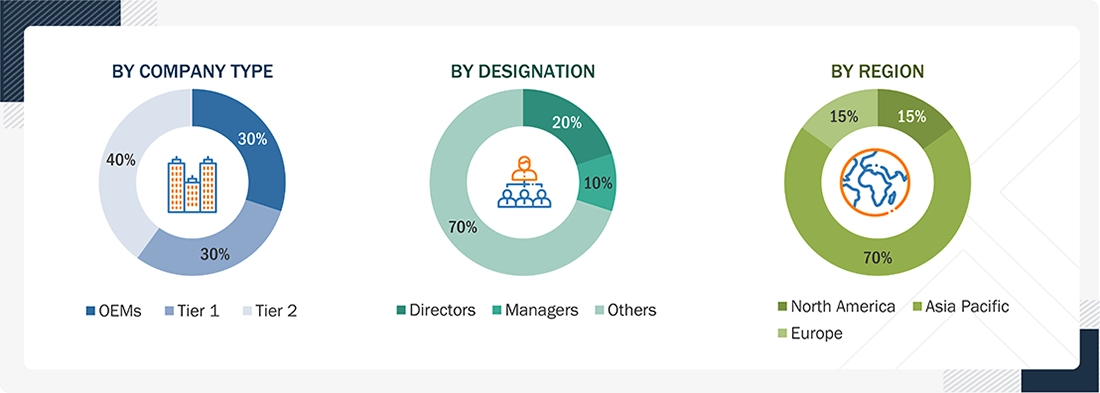
Note: The tiers of companies are based on the supply chain of the electric two-wheeler market.
Other designations include design engineers, manufacturing engineers, and sales executives.
To know about the assumptions considered for the study, download the pdf brochure
Market Size Estimation
Bottom-up Approach
The bottom-up approach was used to estimate and validate the size of the electric two-wheeler market by vehicle type. In this approach, the vehicle sales statistics for each vehicle type (e-scooters/mopeds, e-motorcycles) have been considered at the country level. To determine the market size in terms of volume and value, a mapping of electric two-wheelers has been conducted for each country and vehicle type (e-scooters/mopeds, e-motorcycles). Following this, the market has been categorized for these vehicle types. The number of electric models varies from country to country. The country-level data has been summed up to arrive at the regional-level data in terms of volume. The summation of the country-level market size gives the regional market size, and further summation of the regional market size provides the global electric two-wheeler market size. Further, the volume numbers have been multiplied by the average selling price of electric scooters and motorcycles by vehicle type, which gives the global electric two-wheeler market in terms of value.
Top-Down Approach
The top-down approach has been used to estimate and validate the size of the electric two-wheeler market at the global level and by battery type, vehicle class, distance covered, technology type, usage, motor type, motor power, and voltage type in terms of volume and value. In this approach, battery type, vehicle class, distance covered, technology, usage, motor type, motor power, and voltage segments of the electric two-wheeler market have been identified at the regional level. The penetration identified for each battery type, vehicle class, distance covered, technology type, usage, and voltage type for each vehicle type has been multiplied by the volume of each scooter and motorcycle at the regional level to derive the segmental market size by volume. All regional-level data have been summed up to derive the global electric two-wheeler market by battery type, vehicle class, distance covered, technology, usage, and voltage.
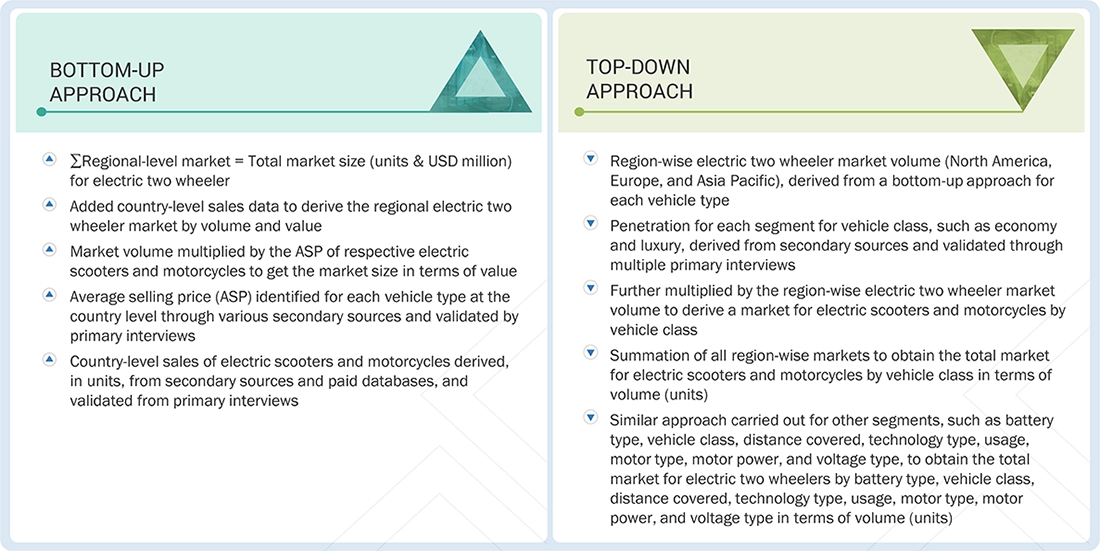
Data Triangulation
After arriving at the overall market size using the market size estimation process explained above, the market was split into several segments and subsegments. To complete the overall market engineering process and arrive at the exact statistics of each market segment and subsegment, data triangulation and market breakdown procedures were employed, wherever applicable. The data was triangulated by studying various factors and trends from both the demand and supply sides.
Market Definition
Electric two-wheelers are plug-in vehicles powered by electric motors. They store electricity in rechargeable batteries, which drive the motors. These vehicles produce zero emissions and are considered electric motor-driven. The operating and top speeds of electric two-wheelers depend on battery technology. Scooters and mopeds are simple-to-operate two-wheelers with a step-through frame and a foot platform. They are budget-friendly, lightweight, and easy to commute with. Motorcycles are heavier, faster, and larger than scooters and mopeds. Depending on the needs, they feature different body designs and frames compared to scooters and mopeds. The electric versions of scooters and motorcycles are powered by electricity stored in their batteries.
Stakeholders
- Electric Two-wheeler Associations, Forums, and Alliances
- Automobile Manufacturers
- Automotive Component Manufacturers
- Automotive Investors
- Battery Distributors
- Battery Manufacturers
- Charging Infrastructure Providers
- Charging Service Providers
- Electric Two-wheeler Distributors and Retailers
- Electric Two-wheeler Charging Station Service Providers
- Electric Two-wheeler Cable Manufacturers
- Government Agencies and Policymakers
- Electric Two-wheeler Manufacturers
- Electric Two-wheeler Charging Pole Manufacturers
- Electric Two-wheeler Component Manufacturers
- Raw Material Providers
Report Objectives
- To segment and forecast the size of the electric two-wheeler market in terms of value and volume based on vehicle type, battery type, voltage, vehicle class, technology, distance covered, usage, motor type, motor power, and region
- To forecast the size of market segments with respect to the following regions: North America, Europe, and Asia Pacific
- To identify and analyze key drivers, restraints, opportunities, and challenges influencing market growth
- To analyze market opportunities for stakeholders
- To analyze micro markets with respect to individual growth trends, prospects, and contributions to the total market
- To strategically profile key players and comprehensively analyze their market share and core competencies
-
To study the following with respect to the market:
- Supply Chain Analysis
- Ecosystem Analysis
- Technology Analysis
- Trade Analysis
- Case Study Analysis
- Patent Analysis
- Regulatory Landscape
- Key Conferences and Events
- Pricing Analysis
- Buying Criteria
- To track and analyze competitive developments, such as product launches/developments and deals, undertaken by key market players
Key Questions Addressed by the Report
What is the current market size of the Electric Two-Wheeler Market?
The global Electric Two-Wheeler Market is valued at USD 5.31 billion in 2026 and is projected to reach USD 10.29 billion by 2035, growing at a CAGR of 7.6%.
What are the key factors driving the growth of the Electric Two-Wheeler Market?
The market is driven by increasing adoption of electric mobility, rising demand for last-mile delivery and shared mobility solutions, advancements in battery technology, expanding battery-as-a-service (BaaS) models, and supportive government policies promoting zero-emission transportation.
Which vehicle type is expected to hold the largest share of the Electric Two-Wheeler Market?
The E-scooters/Mopeds segment is expected to hold the largest market share due to their affordability, ease of use, suitability for urban commuting, and widespread adoption for personal mobility and commercial delivery applications.
Which battery type is expected to dominate the Electric Two-Wheeler Market?
Lithium-ion (Li-ion) batteries are expected to dominate the market owing to their high energy density, longer lifespan, faster charging capabilities, lower maintenance requirements, and declining battery costs.
Which region is expected to lead the Electric Two-Wheeler Market?
Asia Pacific is expected to lead the Electric Two-Wheeler Market throughout the forecast period, driven by high adoption in China and India, strong government incentives, expanding charging infrastructure, and the presence of major electric two-wheeler manufacturers.
Fact checked
Personalize This Research
- Triangulate with your Own Data
- Get Data as per your Format and Definition
- Gain a Deeper Dive on a Specific Application, Geography, Customer or Competitor
- Any level of Personalization
Let Us Help You
- What are the Known and Unknown Adjacencies Impacting the Electric Two-Wheeler Market
- What will your New Revenue Sources be?
- Who will be your Top Customer; what will make them switch?
- Defend your Market Share or Win Competitors
- Get a Scorecard for Target Partners

Custom Market Research Services
We Will Customise The Research For You, In Case The Report Listed Above Does Not Meet With Your Requirements
Get 10% Free CustomisationTESTIMONIALS

JIM NAAS
PRODUCT DIRECTOR, WEASLER
Weasler Engineering, a CentroMotion organization
Global Provider of Industrial Actuation & Control Solutionswww.weasler.com
Our organization was interested in learning more about the attractiveness of a particular market space. We contacted MarketsandMarkets to help us based on previous positive experiences we had with them. The results did not disappoint! We discussed our objectives with them, and the team at MarketsandMarkets developed and executed a proposal that met our needs precisely. We were very impressed by their level of expertise, the quality of the analysis and their insightful recommendations. We would not hesitate in working with them again in the future.

Matt Kardel,
Vice President
Aptiv,
A global technology company that develops safer, greener and more connected solutions.www.aptiv.com
We contracted with
MarketsandMarkets to evaluate the value chain and potential go-to-market partners related to our
interest in the Fleet Management space. The team successfully completed the work on time and at the
pricing agreed. MarketsandMarkets listened and understood our objectives and collaborated well with
us to help us get the visibility we needed to make an investment.
We have subsequently used
MarketsandMarkets again related to Smart Cities to good results.
- China Electric Two-Wheeler Market
- Japan Electric Two-Wheeler Market
- India Electric Two-Wheeler Market
- South Korea Electric Two-Wheeler Market
- Taiwan Electric Two-Wheeler Market
- Thailand Electric Two-Wheeler Market
- Indonesia Electric Two-Wheeler Market
- Malaysia Electric Two-Wheeler Market
- Philippines Electric Two-Wheeler Market
- Vietnam Electric Two-Wheeler Market
- France Electric Two-Wheeler Market
- Germany Electric Two-Wheeler Market
- Spain Electric Two-Wheeler Market
- Austria Electric Two-Wheeler Market
- UK Electric Two-Wheeler Market
- Italy Electric Two-Wheeler Market
- Belgium Electric Two-Wheeler Market
- Netherlands Electric Two-Wheeler Market
- Poland Electric Two-Wheeler Market
- Denmark Electric Two-Wheeler Market
Growth opportunities and latent adjacency in Electric Two-Wheeler Market






John
May, 2022
What are Electric Scooter and Motorcycle Market Newer business models like sustainable and profitable revenue streams in the future?.
Hans
Jun, 2026
is there safety regulations of the two-wheeler mentioned in report? .
Jaimin
Jun, 2026
Keen to know more about OEM , market share, business trends, etc.. .
Shubha
Jun, 2026
Need market analysis .