Range Extended Electric Vehicle Market

Range Extended Electric Vehicle Market by Region (US, Europe, and China), Technology Trends, Competitive Analysis, and Future Strategies - Global Forecast to 2030




OVERVIEW
Source: Secondary Research, Interviews with Experts, MarketsandMarkets Analysis
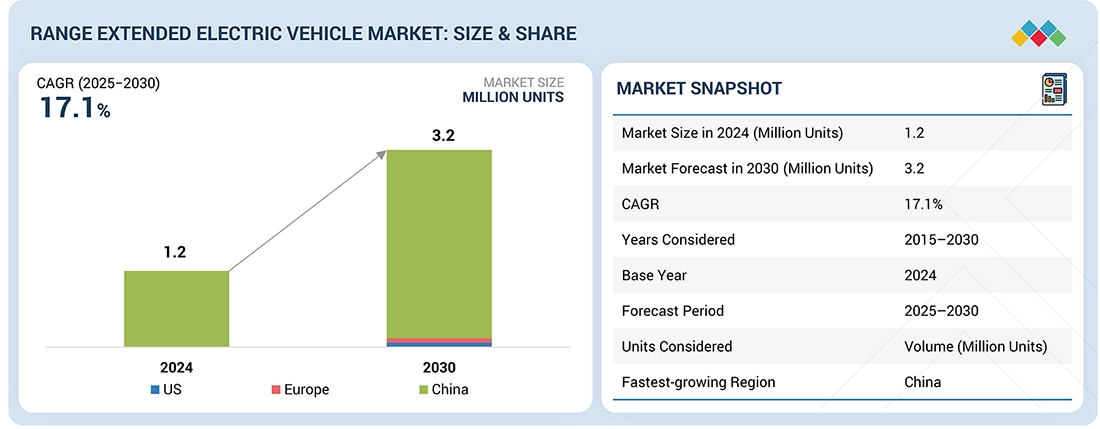
The range extended electric vehicles market is projected to reach 3.2 million units by 2030 from 1.2 million units in 2024, at a CAGR of 17.1% from 2025 to 2030. The growth of the REEV market is driven by the rising demand for long-range driving electric vehicles.
Range Extended Electric Vehicle Market Size and Forecast:
- Market Size Value in 2024: USD 1.2 Billion
- Revenue Forecast in 2030: USD 3.2 Billion
- Growth Rate: CAGR of 17.1% from 2025 to 2030
- Data available from 2015 to 2030
- Base year: 2024
- Forecast period: 2025–2030
Key Market Trends and Insights
- Market Growth: Growth is driven by increasing demand for long-range electric vehicles and reduced range anxiety.
-
IoT Impact: IoT enables real-time battery monitoring, vehicle diagnostics, and energy management in range-extended electric vehicles.
- Growing Trends: The market is witnessing increased adoption of REEVs driven by stringent emission regulations and the transition from ICEs to BEVs..
- Growth Opportunities: Opportunities are driven by REEV adoption in regions with limited EV charging infrastructure.
KEY TAKEAWAYS
-
BY REGIONThe market covers the US, Europe, and China. China is the largest market for REEV and is home to several prominent range-extended electric vehicle companies. The country has seen several new models being launched and shows a rising adoption of REEVs.
-
COMPETITIVE LANDSCAPEMajor market players have adopted both organic and inorganic strategies, including partnerships and investments. For instance, Renault (France), Geely (China), AITO (China), Li Auto (China), Leapmotor (China), and BYD (China) have partnered with suppliers like Mahle (Germany), Magna (Austria), Horse Powertrain (UK) and ZF (Germany) to cater to the growing demand for REEVs across innovative applications.
The REEV market is witnessing steady growth, driven by the rising demand for long-range EVs. New deals and developments, including strategic partnerships between OEMs and suppliers, investments in technologies, and innovations in technology, are reshaping the automotive industry landscape.
TRENDS & DISRUPTIONS IMPACTING CUSTOMERS' CUSTOMERS
The extended range electric vehicle market is growing due to emissions targets set by European countries and the Chinese government. Moreover, EU7 has strict emission regulations, which have boosted the sales of REEV in the region and will continue to be the primary reason for the growth. Moreover, this helps smooth the transition from ICEs to BEVs. The REEV product portfolio of OEMs is built to redefine the future of transportation solutions.
Source: Secondary Research, Interviews with Experts, MarketsandMarkets Analysis
MARKET DYNAMICS

Level
-
Relief from range anxiety


Level
-
Technological complexity


Level
-
Bridge ICE to BEV adoption in low-infrastructure markets


Level
-
Meeting emissions standards

Source: Secondary Research, Interviews with Experts, MarketsandMarkets Analysis
Driver: Relief from range anxiety
Range extenders provide a backup power source, offering a longer driving range with limited charging infrastructure around the world. The driving range of all new REEV variants currently operating in the market is approximately twice the range of BEV variants.
Restraint: Technological complexity
REEVs face design challenges related to system complexity. Integrating electric, generator, and motor components requires advanced engineering solutions. These additional mechanical components lead to increased maintenance requirements.
Opportunity: Bridge ICE to BEV adoption in low-infrastructure markets
REEVs have opportunities in regions where fast-charging stations are unpopular or not cost-effective.
Challenge: Meeting emissions standards
Range extenders face challenges related to environmental perceptions, especially when these vehicles use internal combustion engines, which can compromise the zero-emission objectives.
MARKET ECOSYSTEM
The REEV market ecosystem consists of OEMs such as Renault (France), Geely (China), AITO (China), Li Auto (China), Leapmotor (China), and BYD (China), and suppliers such as Mahle (Germany), Magna (Austria), Horse Powertrain (UK), and ZF (Germany). Consumers drive demand for specific models, while manufacturers deliver precision-engineered parts. Collaboration across the entire value chain is crucial for innovation and market growth.
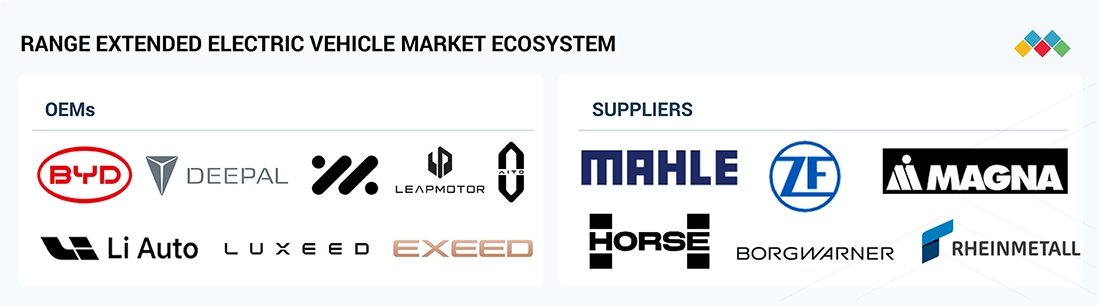
Logos and trademarks shown above are the property of their respective owners. Their use here is for informational and illustrative purposes only.
KEY MARKET PLAYERS
MARKET SCOPE
| REPORT METRIC | DETAILS |
|---|---|
| Market Size in 2024 (Million Units) | 1.4 million units |
| Market Forecast in 2030 (Million Units) | 3.2 million units |
| Growth Rate | CAGR of 17.1% from 2025-2030 |
| Years Considered | 2015-2030 |
| Base Year | 2024 |
| Forecast Period | 2025-2030 |
| Units Considered | Volume (Million Units) |
| Report Coverage | Sales forecast, competitive landscape, growth factors, and trends |
| Regions Covered | US, Europe, China |
WHAT IS IN IT FOR YOU: electric-vehicle-range-extender-market REPORT CONTENT GUIDE
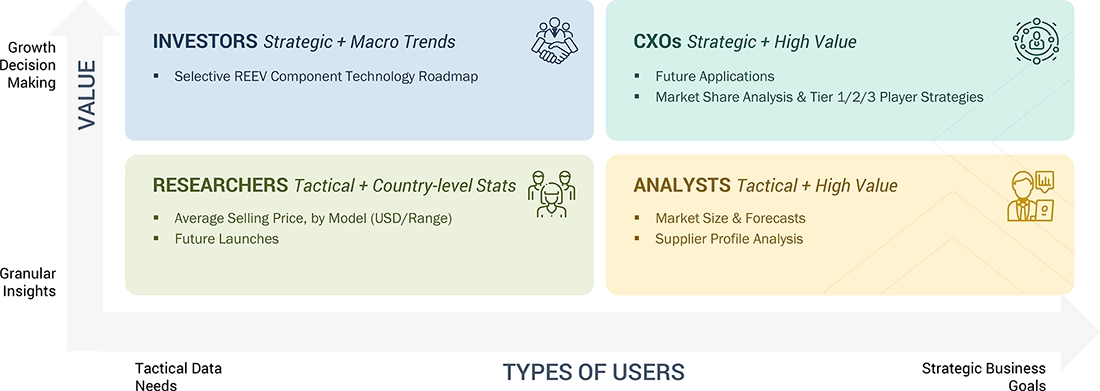
Table of Contents
 Exclusive indicates content/data unique to MarketsandMarkets and not available with any competitors.
- 2.1 STUDY SCOPE
- 2.2 STUDY OBJECTIVES, METHODOLOGY, KEY INFORMATION AREAS
- 3.1 GLOBAL RANGE EXTENDER ELECTRIC VEHICLE MARKET SCENARIO
- 3.2 REGIONAL RANGE EXTENDER ELECTRIC VEHICLE MARKET SCENARIO
- 3.3 RANGE EXTENDER ELECTRIC VEHICLE MARKET DEMAND DRIVERS
- 3.4 RANGE EXTENDER ELECTRIC VEHICLE HISTORICAL, CURRENT AND FUTURE MODELS TIMELINE
- 3.5 RANGE EXTENDER ELECTRIC VEHICLE MODEL BATTERY, RANGE & PRICE ANALYSIS
- 3.6 RANGE EXTENDER ELECTRIC VEHICLE TECHNOLOGY SUPPLIER DETAILS
- 3.7 RANGE EXTENDER ELECTRIC VEHICLE OEMS TECHNOLOGICAL DETAILS
- 3.8 SUPPLIER PROFILING
Methodology
The study involved four main tasks to assess the current and future scope of the range extended electric vehicle (REEV) market. First, extensive secondary research was conducted to gather data on the market, related sectors, and broader industries. Next, primary research with industry experts across the value chain confirmed and validated these findings and assumptions. The total market size was estimated using a bottom-up approach. Then, a market breakdown and data triangulation method were applied to determine the size of specific segments and subsegments within the market.
Secondary Research
The secondary sources included the company's annual reports and presentations, industry association publications, directories, technical handbooks, World Economic Outlook, technical articles, and databases, which were used to gather information for an in-depth study of the OEMs market for hybrid products. The sources used for market sizing estimation also included the automotive sales database, corporate filings (such as annual reports, investor presentations, and financial statements), and passenger vehicle associations. Secondary data was collected and analyzed to determine the overall market size, which was further validated through primary research. Primary sources—experts from related industries, OEMs, and component suppliers—were interviewed to obtain and verify key information and to assess prospects and market estimates. Historical sales data was collected and analyzed, with industry trends considered to develop the forecast, which was also validated through primary research.
Primary Research
In the primary research process, various primary sources from both the supply and demand sides were interviewed to gather qualitative and quantitative information about the market. The supply-side sources included industry experts such as CXOs, vice presidents, directors from business development, marketing, and product development/innovation teams, along with other key executives from various companies. Additionally, system integrators, industry associations, independent consultants, industry veterans, and influential opinion leaders were also interviewed.
Primary interviews have been conducted to gather insights, such as sizing estimates of the hybrid market and forecasts, future technology trends, and upcoming innovations in the hybrid automotive market. Data triangulation was performed using information obtained from secondary research and model mapping. Stakeholders from both demand and supply sides have been interviewed to understand their perspectives on the points above.

Note: Other designations include sales, marketing, and product managers.
Source: Secondary Research, Primary Interviews, and MarketsandMarkets Analysis
To know about the assumptions considered for the study, download the pdf brochure
Market Size Estimation
As mentioned below, a detailed market estimation approach was followed to estimate and validate the value of the range extended electric vehicle market and other dependent submarkets.
- The bottom-up approach was used to estimate and validate the range extended electric vehicle market size. The range-extended EV market size, by country, was derived by mapping the historical sales of range-extended EVs at the country level. These data points were largely fetched from country-level associations, vehicle sales databases, and OEM data experts. The total volume of each country/region is then summed up to reveal the total volume of the global range-extended electric vehicle market. The data was validated through primary interviews with industry experts. The penetration of different segments was derived from secondary research and primary interviews.
- The gathered market data was consolidated, enhanced with detailed inputs, analyzed, and presented in this report.
Range Extended Electric Vehicle Market : Top-Down and Bottom-Up Approach

Market Definition
Range-extended EVs utilize fuel to power a generator and a motor that recharge the vehicle’s battery, thereby extending the vehicle’s driving range. This arrangement is also commonly known as a series hybrid drivetrain. The battery size in these vehicles is smaller compared to that of fully electric cars.
These EVs can be deployed using different technologies, including internal combustion engine extenders, turbine-based extenders, and fuel-cell extenders. However, the internal combustion engine extender is the most commonly used type of extender.
Stakeholders
- Automobile Organizations/Associations
- Automotive Component Manufacturers
- Automotive Component Suppliers
- Automotive OEMs
- Automotive System Manufacturers
- Automotive Electronics Manufacturers
- Country-specific Automotive Associations
- European Automobile Manufacturers Association (ACEA)
- EV Manufacturers
- EV Component Manufacturers
- Government & Research Organizations
- Raw Material Suppliers for the Automotive Industry
- Software Providers
- Traders, Distributors, and Suppliers of Automotive Components
Report Objectives
-
To define, describe, and forecast the REEV market in terms of volume:
- By Region (Europe, US, and China)
- To understand the dynamics (drivers, restraints, opportunities, and challenges) of the market
- To analyze the market share of leading players operating in the market
- To strategically analyze key player strategies and company analysis
- To study the following with respect to the market
-
Trends and Disruptions Impacting Customers' Businesses
- Market Ecosystem
- Investment and Funding Scenario
- Pricing Analysis
- Range Analysis
- OEM Analysis
- OEM Strategies
- To analyze recent developments, including new product launches by key industry participants
- To analyze the opportunities in the market for stakeholders and provide details of the competitive landscape for market leaders
Available Customizations
Along with the provided market data, MarketsandMarkets offers customizations tailored to the company's specific needs.
The study segments the range extended electric vehicle market into the following segments:
By Region
- US
- Europe
- China


Personalize This Research
- Triangulate with your Own Data
- Get Data as per your Format and Definition
- Gain a Deeper Dive on a Specific Application, Geography, Customer or Competitor
- Any level of Personalization
Let Us Help You
- What are the Known and Unknown Adjacencies Impacting the Range Extended Electric Vehicle Market
- What will your New Revenue Sources be?
- Who will be your Top Customer; what will make them switch?
- Defend your Market Share or Win Competitors
- Get a Scorecard for Target Partners

Custom Market Research Services
We Will Customise The Research For You, In Case The Report Listed Above Does Not Meet With Your Requirements
Get 10% Free CustomisationTESTIMONIALS

JIM NAAS
PRODUCT DIRECTOR, WEASLER
Weasler Engineering, a CentroMotion organization
Global Provider of Industrial Actuation & Control Solutionswww.weasler.com
Our organization was interested in learning more about the attractiveness of a particular market space. We contacted MarketsandMarkets to help us based on previous positive experiences we had with them. The results did not disappoint! We discussed our objectives with them, and the team at MarketsandMarkets developed and executed a proposal that met our needs precisely. We were very impressed by their level of expertise, the quality of the analysis and their insightful recommendations. We would not hesitate in working with them again in the future.

Matt Kardel,
Vice President
Aptiv,
A global technology company that develops safer, greener and more connected solutions.www.aptiv.com
We contracted with
MarketsandMarkets to evaluate the value chain and potential go-to-market partners related to our
interest in the Fleet Management space. The team successfully completed the work on time and at the
pricing agreed. MarketsandMarkets listened and understood our objectives and collaborated well with
us to help us get the visibility we needed to make an investment.
We have subsequently used
MarketsandMarkets again related to Smart Cities to good results.






Growth opportunities and latent adjacency in Range Extended Electric Vehicle Market