Electronics Manufacturing Services Market Size, Share & Trends

Electronics Manufacturing Services Market by Service (Electronic Manufacturing, Design & Engineering Services), Application (Consumer Electronics, IT & Telecommunication, Automotive, Healthcare, Aerospace & Defense) - Global Forecast to 2030




OVERVIEW
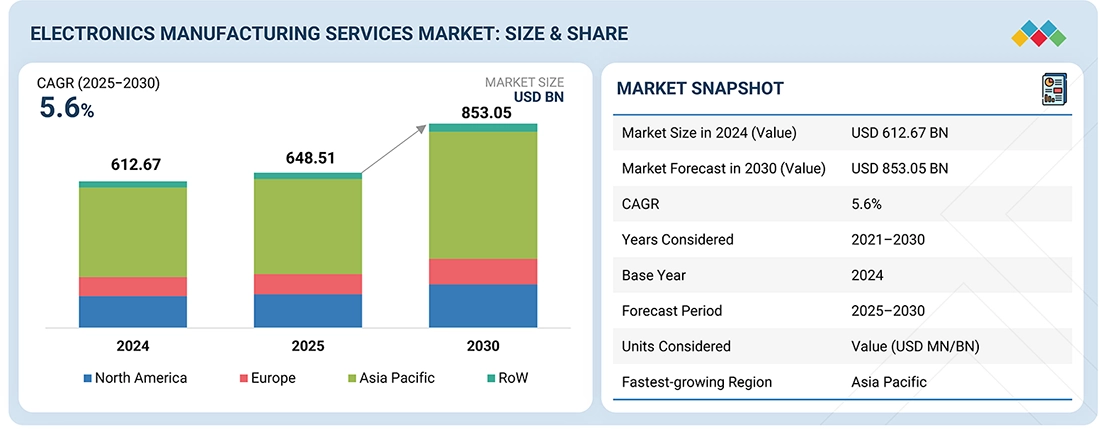
Source: Secondary Research, Interviews with Experts, MarketsandMarkets Analysis
The electronics manufacturing services market is projected to grow from USD 648.51 billion in 2025 to USD 853.05 billion by 2030, at a CAGR of 5.6% from 2025 to 2030. Rising demand for cost-efficient, scalable, and technologically advanced electronics production is driving the market's growth.
KEY TAKEAWAYS
-
By RegionNorth America accounted for 21.7% of the global market in 2024.
-
By ServiceBy dimension, the design & engineering services segment is projected to grow at the fastest rate from 2025 to 2030.
-
By ApplicationBy application, the consumer electronics segment is expected to dominate the market.
-
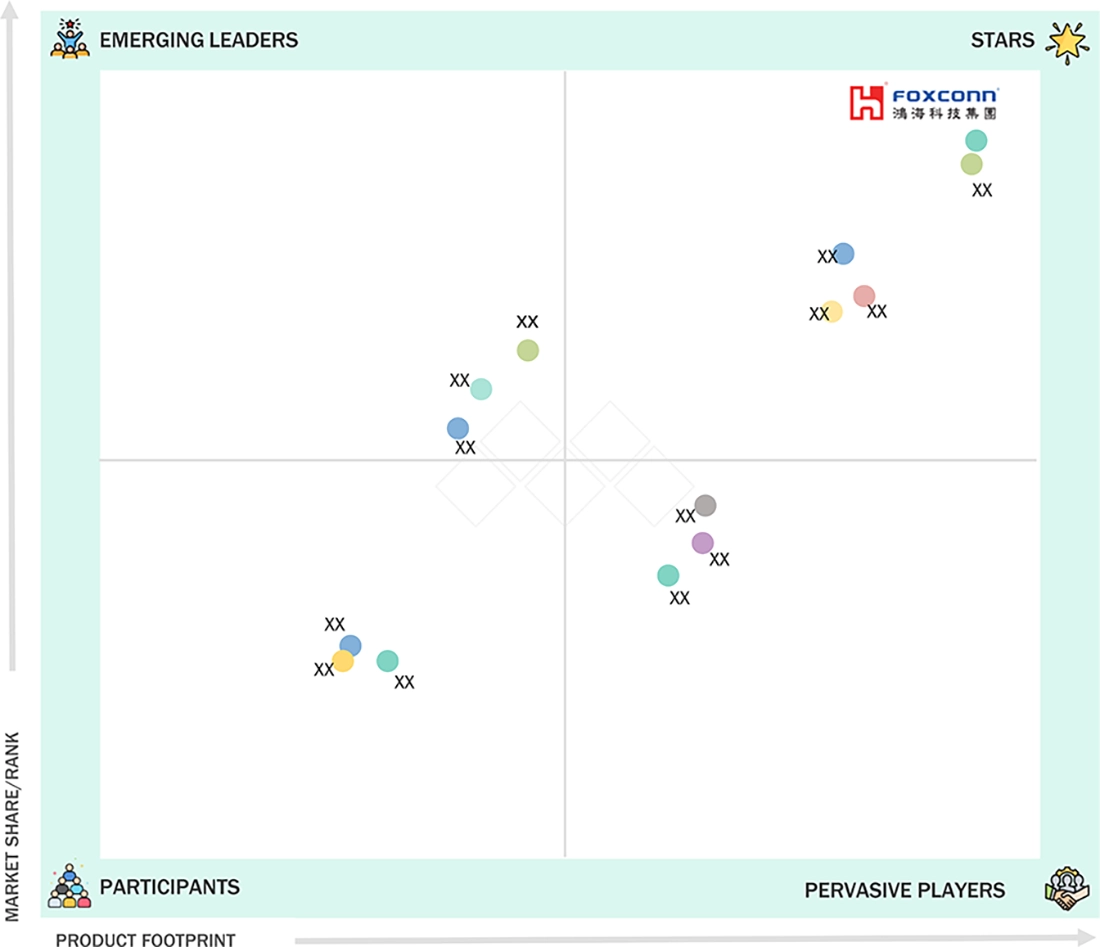
Competitive LandscapeFlex Ltd., Hon Hai Precision Industry Co., Ltd., Jabil Inc., Pegatron Corporation, and Wistron Corporation were identified as some of the star players in the market (global), given their strong market share and product footprint.
-
Competitive LandscapeCreation Technologies and SMTC Corporation, among others, have distinguished themselves among startups and SMEs by securing strong footholds in specialized niche areas, underscoring their potential as emerging market leaders.
Outsourcing to electronic manufacturing service providers enables companies to achieve cost-efficient, sustainable production by minimizing material waste, optimizing resource utilization, and enhancing supply chain efficiency, thereby aligning with the growing global demand for environmentally responsible and scalable manufacturing.
TRENDS & DISRUPTIONS IMPACTING CUSTOMERS' CUSTOMERS
The impact on consumers' business in the electronics manufacturing services industry stems from evolving customer needs and industry disruptions. Consumer electronics, IT & telecommunication, automotive, industrial, healthcare, and aerospace & defense are the primary users of electronics manufacturing services. Shifts toward engineering & design services and system integration, from PCB assembly, directly influence the operational performance and revenues of end users. These impacts, in turn, drive the demand for the electronics manufacturing services market, shaping the market's growth trajectory.
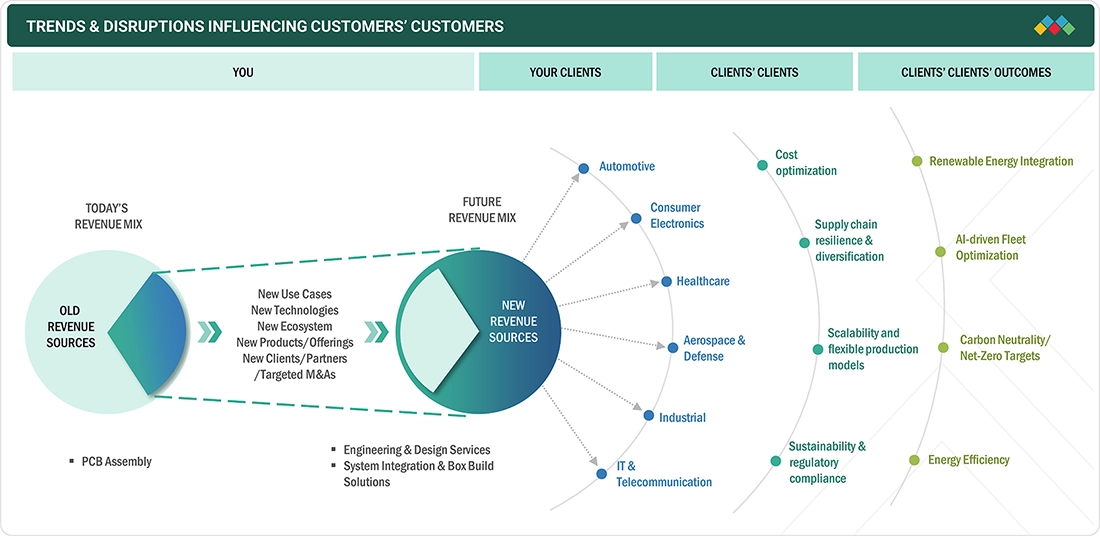
Source: Secondary Research, Interviews with Experts, MarketsandMarkets Analysis
MARKET DYNAMICS

Level
-
Rising Focus on EMS and Value-Added Services

-
Increase in Demand for Electric Vehicles


Level
-
IP Security Concerns

-
Intense Competition and Price Pressure


Level
-
Increasing Vertical Integration by EMS Providers

-
Increasing Demand for AI Servers


Level
-
Technological Obsolescence

-
Quality Control Complexity

Source: Secondary Research, Interviews with Experts, MarketsandMarkets Analysis
Driver: Rising Focus on EMS and Value-Added Services
The increasing outsourcing of manufacturing by OEMs to service (EMS) providers is driving demand for end-to-end solutions, including design, engineering, testing, and supply chain management. This shift enables EMS companies to move up the value chain, enhance margins, and improve competitiveness by offering integrated, high-value services that accelerate time-to-market.
Restraint: IP Security Concerns
Intellectual property (IP) security concerns act as a key restraint in the EMS market, as providers handle sensitive designs, software, and product data across multiple clients and geographies, increasing the risk of data breaches and IP leakage. Additionally, stringent regulatory requirements and the need for advanced security systems add operational complexity and costs, limiting seamless collaboration and scalability.
Opportunity: Increasing Vertical Integration by EMS Providers
The expansion toward end-to-end supply chain integration presents a significant opportunity for EMS providers, enabling them to offer comprehensive solutions spanning design, manufacturing, and after-sales services. This approach enhances operational efficiency, reduces dependency on multiple vendors, and allows EMS companies to increase revenue streams while delivering greater value to OEMs.
Challenge: Technological Obsolescence
Technological obsolescence poses a major challenge for EMS providers, as rapid advancements in electronics require continuous upgrades in equipment, processes, and workforce skills, increasing operational costs. Additionally, the risk of outdated components and evolving OEM requirements pressures EMS companies to invest in advanced technologies to remain competitive and minimize financial losses.
ELECTRONICS MANUFACTURING SERVICES MARKET: COMMERCIAL USE CASES ACROSS INDUSTRIES
| COMPANY | USE CASE DESCRIPTION | BENEFITS |
|---|---|---|
 |
Flex Ltd. (Singapore) provided EMS solutions to a smart meter OEM (energy sector), enabling design optimization, supply chain integration, and large-scale production. | Faster time-to-market (6x), 500% production scale-up, ~40% cost reduction, significant defect reduction |
 |
Flexible Circuit Technologies (US) provided EMS and design support to a European automotive OEM (EV segment), redesigning circuit architecture and enabling integrated manufacturing | Improved product reliability, enhanced quality, reduced development time, faster delivery cycles |
Logos and trademarks shown above are the property of their respective owners. Their use here is for informational and illustrative purposes only.
MARKET ECOSYSTEM
The electronics manufacturing services comapnies ecosystem consists of component & equipment suppliers (Intel Corporation, SAMSUNG, Texas Instruments Incorporated, ASML), EMS providers (Hon Hai Precision Industry Co., Ltd., Flex Inc., Jabil Inc., Celestica LLC), OEMs (Apple Inc., Dell Inc., Cisco Systems, Inc., Tesla), and end users (Amazon.com, Inc., Siemens, GE HealthCare). Component suppliers provide key electronic inputs, EMS providers handle manufacturing and integration, OEMs outsource production to focus on innovation, and end users drive demand across industries, enabling efficient, scalable, and cost-effective electronics production.
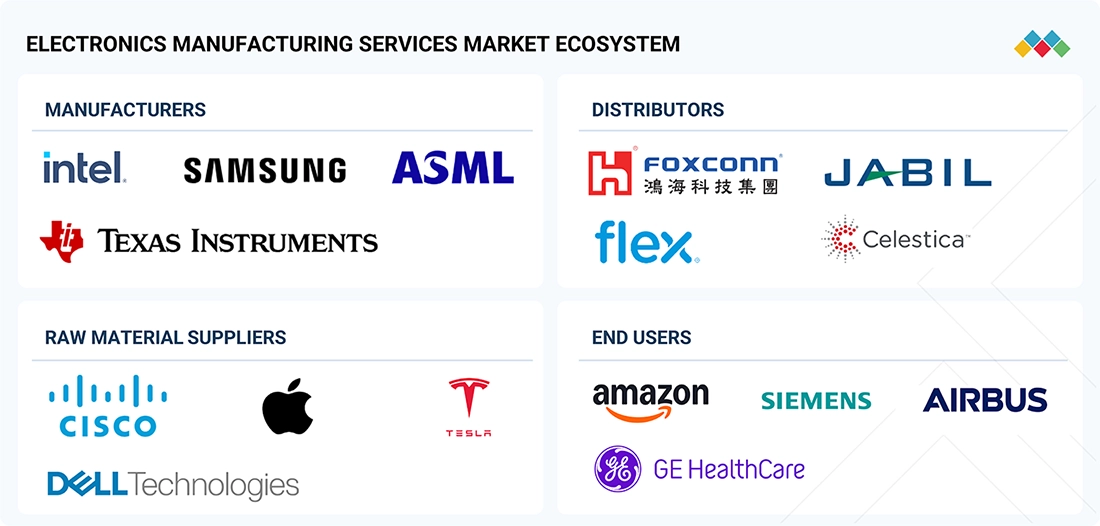
Logos and trademarks shown above are the property of their respective owners. Their use here is for informational and illustrative purposes only.
MARKET SEGMENTS
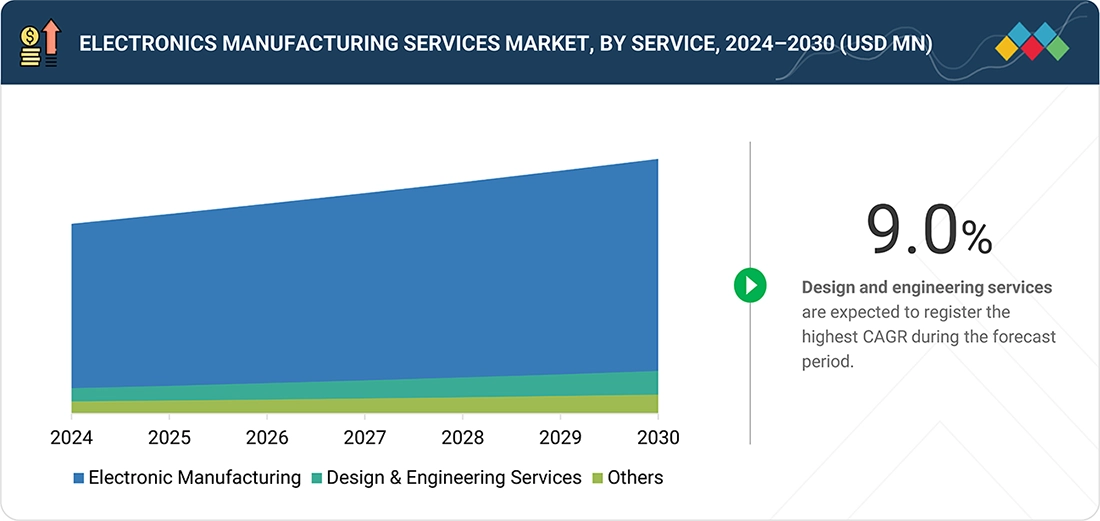
Source: Secondary Research, Interviews with Experts, MarketsandMarkets Analysis
Electronics Manufacturing Services Market, By Service
Electronic manufacturing holds the largest market share because it represents the core, high-volume activity of assembling and producing electronic products at scale, which OEMs consistently outsource to reduce capital expenditure and operational complexity. Its dominance is driven by sustained demand across multiple industries, standardized processes, and EMS providers' ability to deliver cost-efficient, large-scale production through established supply chain networks.
Electronics Manufacturing Services Market, By Application
Consumer electronics hold the largest share of the applications market due to the high-volume, fast product lifecycle nature of devices such as smartphones, laptops, and wearables, which require continuous large-scale production and frequent upgrades. OEMs in this segment heavily rely on EMS providers to achieve cost efficiency, rapid time-to-market, and flexible manufacturing, making it the most dominant and recurring demand segment.
REGION
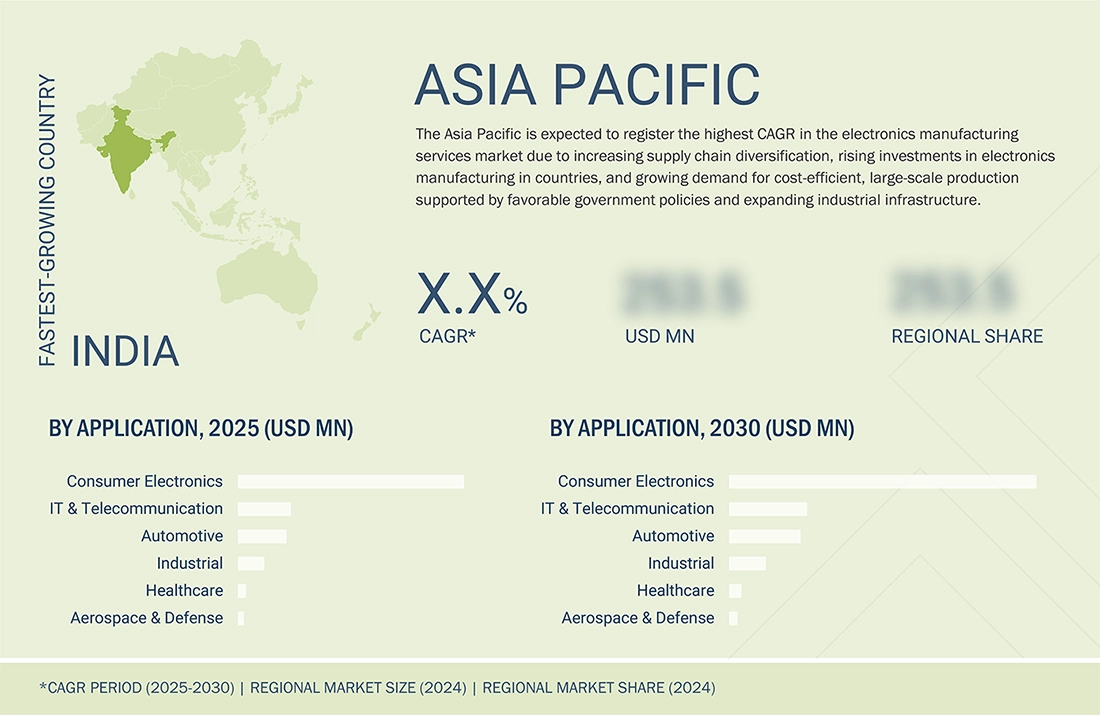
Asia Pacific to be the fastest-growing region during the forecast period
The Asia Pacific region holds the largest market share due to its strong manufacturing ecosystem, cost-effective labor, and well-established electronics supply chains across countries. Additionally, the presence of major electronic manufacturing services providers and increasing investments driven by supply chain diversification strategies further strengthen the region’s dominance in high-volume electronics production.
ELECTRONICS MANUFACTURING SERVICES MARKET: COMPANY EVALUATION MATRIX
Hon Hai Precision Industry Co., Ltd. (Star) leads the market with a strong market share and extensive global manufacturing footprint, supported by large-scale production capabilities and strong relationships with leading OEMs. Its leadership is driven by cost efficiency, vertically integrated operations, and the ability to deliver high-volume, complex manufacturing solutions across consumer electronics, computing, and data center infrastructure.
Source: Secondary Research, Interviews with Experts, MarketsandMarkets Analysis
KEY MARKET PLAYERS
- Flex Ltd. (Singapore)
- Hon Hai Precision Industry Co., Ltd. (Taiwan)
- Jabil Inc. (US)
- Pegatron Corporation (Taiwan)
- Wistron Corporation (Taiwan)
- Sanmina Corporation (US)
- Kinpo Group (Taiwan)
- Universal Scientific Industrial (USI) (China)
- Plexus Corp (US)
- Celestica Inc. (Canada)
MARKET SCOPE
| REPORT METRIC | DETAILS |
|---|---|
| Market Size in 2024 (Value) | USD 612.67 Billion |
| Market Forecast in 2030 (Value) | USD 853.05 Billion |
| Growth Rate | CAGR of 5.6% from 2025-2030 |
| Years Considered | 2021-2030 |
| Base Year | 2024 |
| Forecast Period | 2025-2030 |
| Units Considered | Value (USD Million/Billion) |
| Report Coverage | Revenue forecast, company ranking, competitive landscape, growth factors, and trends |
| Segments Covered |
|
| Regions Covered | Asia Pacific, North America, Europe, RoW |
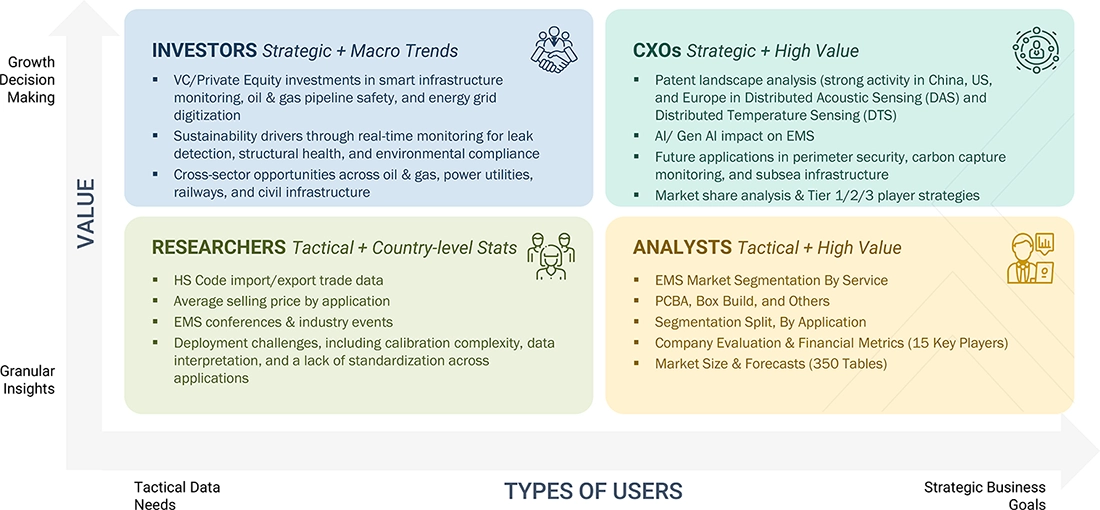
WHAT IS IN IT FOR YOU: ELECTRONICS MANUFACTURING SERVICES MARKET REPORT CONTENT GUIDE
DELIVERED CUSTOMIZATIONS
We have successfully delivered the following deep-dive customizations:
| CLIENT REQUEST | CUSTOMIZATION DELIVERED | VALUE ADDS |
|---|---|---|
| Oil & Gas Companies | Competitive benchmarking of distributed fiber optic sensing solution providers (DAS, DTS, DSS) across pipeline monitoring and leak detection applications | Identify reliable sensing solution providers to enhance pipeline safety and minimize leak-related losses |
| Power & Utility Providers | Analysis of DFOS deployment across power cables, grid monitoring, and renewable energy infrastructure | Detect inefficiencies and enable predictive maintenance to reduce downtime and improve grid reliability |
| Infrastructure Developers & Smart City Planners | Market adoption benchmarking across tunnels, railways, bridges, and smart infrastructure projects | Identify opportunities for real-time structural health monitoring and improve public safety |
| Transportation & Railway Operators | Evaluation of DFOS use cases in rail track monitoring, intrusion detection, and asset protection | Enhance operational efficiency, reduce accidents, and enable continuous infrastructure monitoring |
| Defense & Security Agencies | Ecosystem and vendor analysis for perimeter security, border monitoring, and surveillance applications | Strengthen situational awareness and enable real-time threat detection using distributed sensing |
| Environmental Monitoring Agencies | Assessment of DFOS applications in environmental sensing, seismic monitoring, and carbon capture infrastructure | Support sustainability goals through accurate environmental monitoring and early hazard detection |
RECENT DEVELOPMENTS
- August 2026 : Wistron Corporation approved additional capital expenditures of NT$2 billion for its Hsinchu facility and NT$8.5 billion for its Kaohsiung facility, primarily for machinery and equipment to support future capacity expansion. The company also approved US$23 million and US$30 million of additional capital expenditure for its US subsidiaries to support future AI business expansion. As Wistron provides electronics design and manufacturing services, these investments directly expand its electronics manufacturing capacity and support additional production capabilities.
- June 2026 : Jabil Inc. partnered with Adani Enterprises to develop an integrated AI and data-center infrastructure manufacturing platform in India. The platform is intended to serve hyperscalers, colocation facilities and enterprise data centers, with Jabil contributing its electronics manufacturing capabilities to the planned manufacturing ecosystem. The partnership directly expands Jabil’s electronics manufacturing services activities into AI and data-center infrastructure manufacturing in India.
- August 2026 : Hon Hai Precision Industry Co., Ltd. continued expanding its electronics manufacturing operations, with the company preparing for mass production of NVIDIA’s Vera Rubin AI server racks in the third quarter and shipments expected to begin in the fourth quarter. Foxconn also said its 2026 capital expenditure is expected to increase by 30% year over year, while it continues building manufacturing facilities in Mexico and Texas for AI servers. The development directly concerns electronics manufacturing services through Foxconn’s contract manufacturing and assembly activities for major technology customers.
- April 2026 : Flex Ltd. expanded its partnership with Teradyne Robotics to scale intelligent automation across global manufacturing. Under the expanded relationship, Flex manufactures key robotics components for Teradyne while also deploying Universal Robots and Mobile Industrial Robots solutions across its own production facilities. The development builds on Flex’s existing advanced manufacturing, systems integration and supply-chain services and directly represents an expansion of its electronics manufacturing services
- January 2026 : Pegatron Corporation advanced the construction of its first US manufacturing facility in Texas, with completion expected by the end of March and trial production scheduled for late March or April. The facility is planned to manufacture AI server products, including systems using NVIDIA chips, expanding Pegatron’s US production footprint. As Pegatron is an electronics contract manufacturer, the facility represents a direct expansion of its electronics manufacturing services capacity.
Table of Contents
 Exclusive indicates content/data unique to MarketsandMarkets and not available with any competitors.
Methodology
The research process for this technical, market-oriented, and commercial study of the electronics manufacturing services market included the systematic collection, recording, and analysis of data on companies operating in the market. It involved the extensive use of secondary sources, directories, and databases (Factiva, OANDA) to identify and collect relevant information. In-depth interviews were conducted with various primary respondents, including experts from core and related industries and preferred manufacturers, to obtain and verify critical qualitative and quantitative information as well as to assess the growth prospects of the market. Key players in the electronics manufacturing services market were identified through secondary research, and their market rankings were determined through primary and secondary research. This included studying annual reports of top players and interviewing key industry experts, such as CEOs, directors, and marketing executives.
Secondary Research
In the secondary research process, various sources have been consulted to identify and collect information relevant to this study. Secondary sources include annual reports, press releases, and investor presentations of companies; white papers, certified publications, and articles from recognized authors; directories; and databases. Secondary research has mainly been conducted to obtain key information on the industry's supply; a comprehensive list of key players; and market segmentation by industry trends, geographic markets, and key developments from market- and technology-oriented perspectives.
Primary Research
In the primary research process, primary sources from the supply and demand sides have been interviewed to obtain qualitative and quantitative information for this report. Primary sources from the supply side include experts, such as CEOs, vice presidents, marketing directors, technology and innovation directors, subject-matter experts, consultants, and related key executives from major companies and organizations operating in the electronics manufacturing services market.
After the complete market engineering process (market statistics calculations, market breakdown, market size estimations, market forecasting, and data triangulation), extensive primary research has been conducted to gather information and verify and validate the critical market numbers.
Several primary interviews have been conducted with experts from the demand and supply sides across four major regions—North America, Europe, Asia Pacific, and RoW. Approximately 25% of the primary interviews were conducted with the demand side and 75% with the supply side. This primary data has been collected through questionnaires, emails, and telephonic interviews.
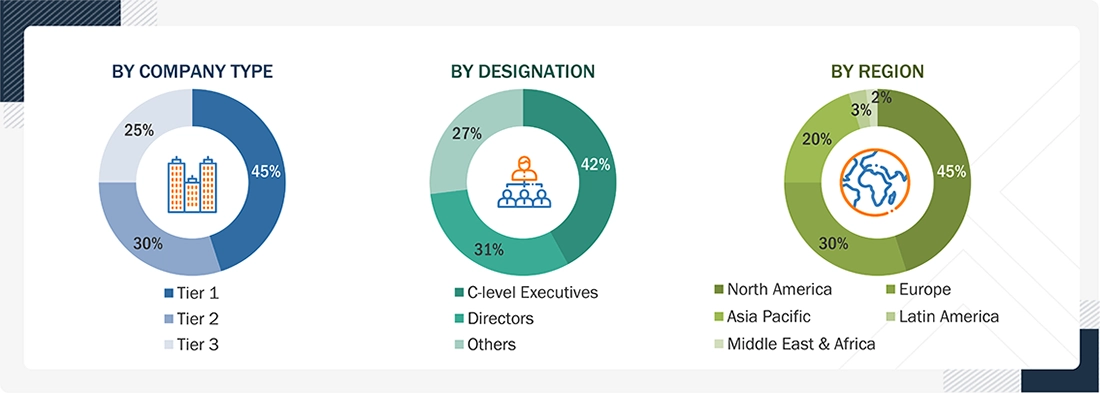
Notes: Tier 1 companies include market players with revenues above USD 500 million; tier 2 companies earn revenues between USD 100 million and USD 500 million; and tier 3 companies earn revenues up to USD 100 million.
To know about the assumptions considered for the study, download the pdf brochure
Market Size Estimation
In the complete market estimation process, the top-down and bottom-up approaches, along with several data triangulation methods, have been used to estimate and forecast the size of the market and its segments and subsegments as listed in the report. Extensive qualitative and quantitative analyses have been conducted across the complete market engineering process to identify key information and insights for the electronics manufacturing services market.
Key players in the electronics manufacturing services market have been identified through secondary research, and their rankings across regions have been determined through both primary and secondary research. This entire procedure involved analyzing the annual and financial reports of top players and conducting interviews with industry experts, such as chief executive officers, vice presidents, directors, and marketing executives, to gather quantitative and qualitative insights. All percentage shares, splits, and breakdowns have been determined using secondary sources and verified through primary sources. All parameters that affect the markets covered in this research study have been accounted for, viewed in extensive detail, verified through primary research, and analyzed to obtain the final quantitative and qualitative data. This data has been consolidated and enhanced with detailed inputs and analysis from MarketsandMarkets and presented in this report.
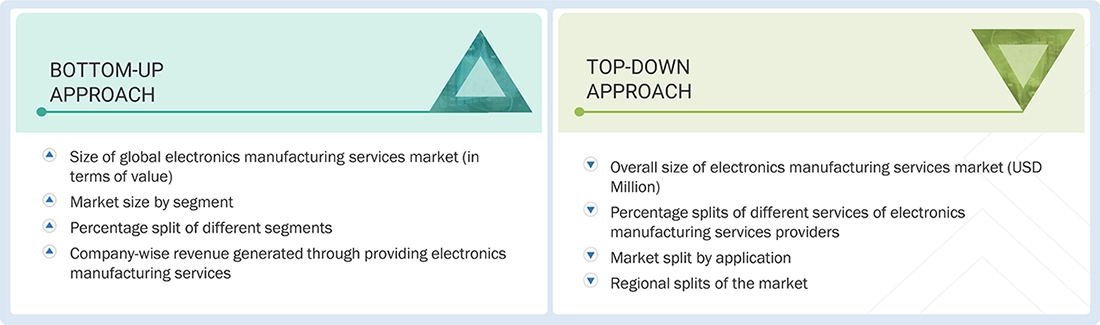
BOTTOM-UP APPROACH
- More than 20 companies in the electronics manufacturing services market were identified, and their offerings were mapped based on their services, applications, and regions.
- The global electronics manufacturing services market size was derived through the data sanity method. The revenues of electronics manufacturing services providers were analyzed through annual reports and press releases and summed up to derive the overall market size.
- For each company, a percentage was assigned to the overall revenue to derive the revenues from the electronics manufacturing services segment.
- Each company’s percentage was assigned after analyzing various factors, including its product offerings, geographical presence, R&D expenditures and initiatives, and recent developments/strategies adopted for growth in the electronics manufacturing services market.
- For the CAGR, the market trend analysis of electronics manufacturing services was carried out by understanding the industry penetration rate and the demand and supply of electronics manufacturing services in different sectors.
- Estimates at every level were verified and cross-checked by discussing them with key opinion leaders, including sales heads, directors, operation managers, and market domain experts of MarketsandMarkets.
- Various paid and unpaid information sources, such as annual reports, press releases, white papers, and databases, were studied
TOP-DOWN APPROACH
- Focusing initially on the top-line investments and expenditures being made in the ecosystem of electronics manufacturing services.
- Splitting the market based on services, and application, and listing key developments in key market areas.
- Identifying all major players in the electronics manufacturing services market by services and application, and their penetration in various end user segments through secondary research and verifying the information with industry experts
- Analyzing revenues, product mix, geographic presence, and key applications for which all identified players offer electronics manufacturing services to estimate and arrive at the percentage splits for all key segments
- Discussing these splits with the industry experts to validate the information and identify key growth pockets across all key segments
- Breaking down the global market based on verified splits and key growth pockets across all segments
Data Triangulation
After arriving at the overall market size from the market size estimation process explained above, the total market has been split into several segments and subsegments. To complete the overall market engineering process and arrive at the exact statistics for all segments and subsegments, the market breakdown and data triangulation procedures have been employed, wherever applicable. The data has been triangulated by studying various factors and trends from both the demand and supply sides. Additionally, the market size has been validated using both top-down and bottom-up approaches.
Market Definition
The electronics manufacturing services market comprises companies that provide outsourced manufacturing and related services for electronic products on behalf of OEMs. These services include product design and engineering, PCB assembly, system integration, testing, supply chain management, and after-sales support. Electronics manufacturing services providers enable companies to reduce capital expenditure, improve operational efficiency, and accelerate time-to-market by leveraging specialized manufacturing capabilities and global production networks across industries.
Key Stakeholders
- OEMs (Original Equipment Manufacturers)
- EMS Providers (Contract Manufacturers)
- Component Suppliers
- Original Design Manufacturers (ODMs)
- Distributors and Supply Chain Partners
- Technology Providers
- Government and Regulatory Bodies
- Investors and Financial Institutions
- Testing and Certification Bodies
Report Objectives
- To define, describe, and forecast the electronics manufacturing services market size, in terms of value, by service, application, and region
- To describe and forecast the market size across four key regions, namely, North America, Europe, Asia Pacific, and the Rest of the World (RoW), along with their respective country-level market size, in terms of value
- To provide detailed information regarding the drivers, restraints, opportunities, and challenges in the electronics manufacturing services market
- To strategically analyze the micromarkets concerning the individual growth trends, prospects, and their contribution to the electronics manufacturing services market
- To map competitive intelligence based on company profiles, key player strategies, and key developments
- To analyze trends/disruptions impacting customer business; interconnected markets and cross-sector opportunities; strategic moves by tier-1/2/3 players; pricing analysis; patents analysis; trade analysis (export and import scenario); Porter's five forces analysis; macroeconomic indicators; case studies; investment and funding scenario; decision-making process; buyer stakeholders and buying evaluation criteria; adoption barriers & internal challenges; unmet needs from various industries; technology analysis; technology roadmap; ecosystem analysis; regional regulations and compliance; impact of 2025 US tariff; and key conferences and events related to the electronics manufacturing services market.
- To benchmark the market players using the proprietary company evaluation matrix framework, which analyzes them on various parameters within the broad categories of market ranking/share and product portfolio
- To analyze competitive developments such as contracts, acquisitions, product launches & developments, collaborations, and partnerships, along with research & development (R&D), in the electronics manufacturing services market
Available customizations:
With the given market data, MarketsandMarkets offers customizations according to the company’s specific needs. The following customization options are available for the report:
COMPANY INFORMATION
- Detailed analysis and profiling of additional market players (up to 7)


Personalize This Research
- Triangulate with your Own Data
- Get Data as per your Format and Definition
- Gain a Deeper Dive on a Specific Application, Geography, Customer or Competitor
- Any level of Personalization
Let Us Help You
- What are the Known and Unknown Adjacencies Impacting the Electronics Manufacturing Services Market
- What will your New Revenue Sources be?
- Who will be your Top Customer; what will make them switch?
- Defend your Market Share or Win Competitors
- Get a Scorecard for Target Partners

Custom Market Research Services
We Will Customise The Research For You, In Case The Report Listed Above Does Not Meet With Your Requirements
Get 10% Free CustomisationTESTIMONIALS

Tetsuya Ohhira
Business Development Manager-Technology Business
Nikon Corporation,
Leading Japanese MNC specializing in optics and imaging productswww.nikon.com
MarketsandMarkets™ response
is quick. Their attitude is flexible and positive. Analyst Insights are globally considered and
significant. Client Services quickly respond to our inquiry and demand. Their wide range of global
surveys help us make our strategic plan.
We hope Knowledge Store will be easier to search
for a report.
VP - Marketing & Business Development
Leading Provider of Process Control Solutions
We engaged with MarketsandMarkets on a study to perform an analysis and recommend a Go-To-Market strategy for metrology and process control in the semiconductor market. The study was tailored to our targets and needs with well-defined milestones. Our overall experience with the MarketsandMarkets team was very good throughout the project in all aspects including the analysis methodologies used, the quality and depth of primary and secondary data sets, the professionalism and flexibility of the team and the ability to meet the target schedule and milestones. We want to thank MarketsandMarkets team for a job well done.






Growth opportunities and latent adjacency in Electronics Manufacturing Services Market