Employee Performance Management Market Size, Share, Latest Trends & Industry Report

Employee Performance Management Market by Platform (Performance Appraisal Systems, 360-Degree Feedback, Goal Setting & Tracking, Continuous Feedback and Learning, Other Types (Employee Recognition, Engagement & Pulse Survey Tools)) - Global Forecast to 2030




OVERVIEW
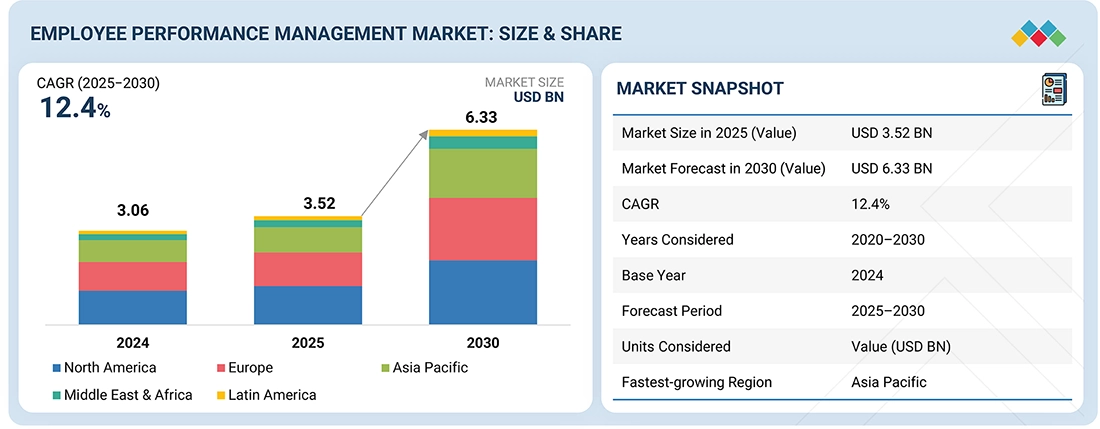
Source: Secondary Research, Interviews with Experts, MarketsandMarkets Analysis
The employee performance management market size is projected to grow from USD 3.52 billion in 2025 to USD 6.33 billion by 2030 at a CAGR of 12.4% during the forecast period. Continuous digitalization of workforce processes is propelling the market as organizations increasingly adopt AI-enabled platforms, real-time feedback systems, and data-driven performance analytics. The urgent need to improve employee productivity, enhance engagement, and enable transparent goal management is further accelerating platform adoption. Growing integration of learning, development, and analytics capabilities within performance ecosystems is reshaping how organizations evaluate and develop talent. As a result, the market is becoming more innovation-led, driven by cloud migration, continuous feedback culture, and demand for unified performance solutions.
Market Size and Forecast:
- 2024 Market Size: USD 3.06 Billion
- 2025 Projected Market Size: USD 3.52 Billion
- 2030 Forecasted Market Size: USD 6.33 Billion
- Growth Rate (2025-2030): CAGR of 12.4%
- Large Enterprises segment is register the highest CAGR of 69.0%
- Forecast period: 2025–2030
Key Market Trends and Insights
- Growth Drivers: shift to continuous feedback, AI talent analytics, and cloud HCM migration
-
Emerging Opportunities: digital HR adoption in SMEs and emerging markets
- Latest Trends: continuous data-driven appraisals, AI/GenAI insights, and cloud migration
- Leading Region: North America
KEY TAKEAWAYS
-
By RegionNorth America remains the largest market for employee performance management solutions, while Asia Pacific is expanding at the fastest pace.
-
By OfferingEPM platforms, particularly performance appraisal systems, account for the largest share of the overall offering landscape.
-
By Organization SizeLarge enterprises contribute the largest market share, whereas SMEs are emerging as the fastest-growing adopters.
-
By VerticalThe BFSI sector leads the market, accounting for the largest share in terms of vertical.
-
Competitive LandscapeCompanies such as SAP SE (Germany), Oracle (US), Microsoft (US), and Workday (US) were identified as some of the star players in the employee performance management market (global), given their strong market share and product footprint.
The primary driver of the global employee performance management market is the shift from annual reviews to continuous, analytics-driven performance cycles, as organizations strive for greater agility and employee retention. Companies like Adobe, Accenture, Deloitte, and Microsoft have already replaced traditional reviews with continuous feedback models, proving faster development and improved engagement. This change is accelerated by the rise of AI-enabled EPM platforms, such as Workday, SAP SuccessFactors, BetterWorks, Lattice, and Culture Amp, which utilize predictive analytics to identify development needs, enhance goal alignment, and mitigate bias in evaluations. Adoption is also boosted by enterprise-wide HR Digital Transformation, with large companies like Bank of America and Adobe deploying unified cloud HCM suites that integrate performance, goals, engagement, and learning. As organizations move toward skills-based talent strategies, the need to link performance data with learning and internal mobility further strengthens demand. Together, continuous feedback culture, AI-driven insights, cloud migration, and skills-focused workforce planning are the core forces propelling global EPM market growth.
TRENDS & DISRUPTIONS IMPACTING CUSTOMERS' CUSTOMERS
The shift from traditional, annual performance reviews to continuous, data-driven employee performance management is reshaping the value chain for customers and their end users. As organizations adopt cloud-based platforms, AI-enabled analytics, and integrated HR systems, demand is rising for ongoing feedback, goal alignment, and talent optimization. Large enterprises, SMEs, BFSI, IT/ITeS, healthcare, and consulting firms are increasingly investing in solutions that streamline appraisal cycles, improve workforce engagement, and provide real-time performance insights. These advancements enable clients to deliver clearer goals, continuous skill development, enhanced motivation, and seamless HR integrations, resulting in improved employee experience, productivity, and organizational alignment.
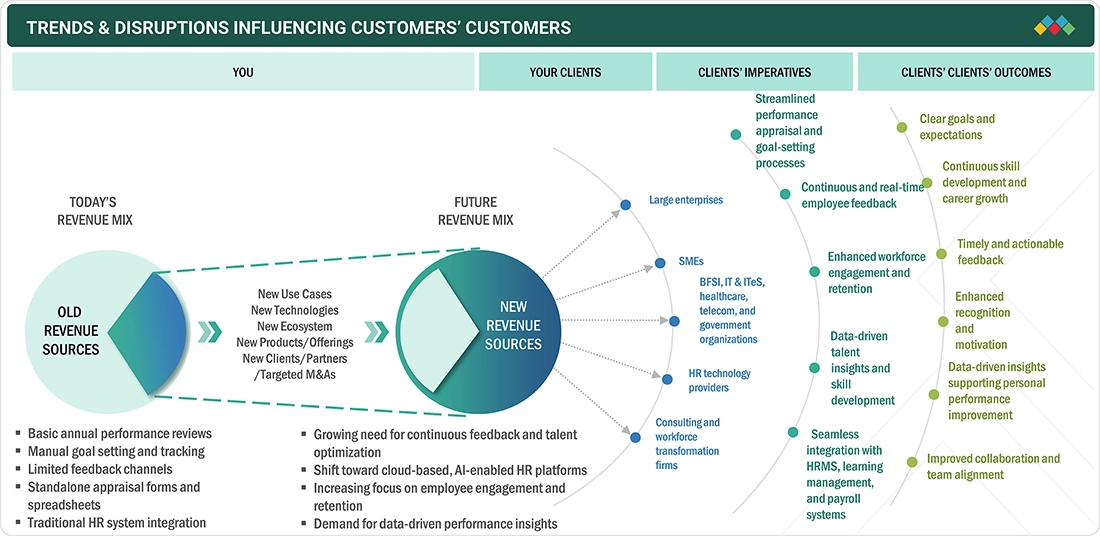
Source: Secondary Research, Interviews with Experts, MarketsandMarkets Analysis
MARKET DYNAMICS

Level
-
Adoption of cloud- and AI-enabled performance management

-
Focus on employee engagement and data-driven decisions


Level
-
High implementation costs

-
Integration with legacy HR systems


Level
-
Growth in SMEs and emerging markets

-
Combining learning and analytics with performance management


Level
-
Employee and manager resistance to change

-
Ensuring data security and compliance

Source: Secondary Research, Interviews with Experts, MarketsandMarkets Analysis
Driver: Adoption of cloud- and AI enabled performance management
The market is expanding rapidly as organizations adopt cloud-based and AI-driven performance management platforms that replace traditional annual reviews with automated, real-time, and insight-rich processes. Cloud deployment offers scalability, lower upfront costs, remote accessibility, and seamless updates, making it ideal for hybrid and distributed teams. At the same time, AI enhances performance cycles through predictive analytics, intelligent goal alignment, automated feedback suggestions, and personalized development recommendations. Together, these technologies modernize performance workflows and deliver deeper workforce intelligence, becoming one of the strongest growth catalysts for the EPM market.
Restraint: High implementation costs
A major restraint for the employee performance management market is the high cost of implementing advanced platforms, particularly for organizations that require customization, workflow redesign, data migration, or multi-system integration. Beyond software licensing, companies often incur additional expenses for consulting, onboarding, training, and change management. These factors significantly increase the total cost of ownership, making sophisticated EPM systems less accessible for budget-constrained businesses and slowing adoption in cost-sensitive industries.
Opportunity: Growth in SMEs and emerging markets
A significant market opportunity lies in the rising adoption of performance tools among SMEs and organizations in emerging economies, where digital HR adoption is accelerating. Cloud-based subscription models, low upfront investment, and easy deployment make EPM platforms highly attractive for smaller businesses aiming to modernize their HR processes. Fast-growing markets in the Asia Pacific, Latin America, and the Middle East are embracing digital talent tools, creating strong expansion potential for vendors offering lightweight, scalable, and cost-effective solutions.
Challenge: Employee and manager resistance to change
One of the most persistent challenges in EPM adoption is resistance to change, especially when shifting from traditional annual appraisals to continuous feedback and transparent evaluation models. Employees may feel scrutinized by increased data tracking, while managers may struggle to adjust to new workflows or expectations for more frequent check-ins. Overcoming this resistance requires strong communication, user training, and cultural alignment, making change management a critical component of successful system adoption.
Employee Performance Management Market: COMMERCIAL USE CASES ACROSS INDUSTRIES
| COMPANY | USE CASE DESCRIPTION | BENEFITS |
|---|---|---|
 |
SAP SuccessFactors uses real-time analytics, continuous feedback loops, and competency mapping to help enterprises track employee productivity, identify high-potential talent, and streamline performance review cycles. Its AI-backed workflows enable automated goal setting, skill assessments, and personalized learning recommendations. | Organizations gain a unified view of performance, reduced manual appraisal workloads, improved employee engagement, and data-driven talent decisions. Managers can proactively address skill gaps and drive better alignment of their workforce with business priorities. |
 |
Oracle Fusion HCM leverages AI-powered insights, sentiment analysis, and automated performance evaluations to modernize employee performance management. It centralizes goal tracking, behavioral assessments, and career development planning across large distributed teams. | Companies benefit from more accurate performance measurements, reduced bias in evaluations, enhanced transparency, and quicker performance interventions. This leads to stronger productivity, better retention outcomes, and a more responsive workforce planning approach. |
 |
Microsoft Viva integrates with Teams to deliver continuous performance insights, OKR alignment, employee well-being analytics, and personalized productivity recommendations. It captures real-time collaboration patterns to help managers assess engagement and coach employees more effectively. | Enterprises experience improved team collaboration, proactive burnout detection, and stronger alignment between employee goals and organizational outcomes. The platform boosts overall performance by fostering a culture of ongoing feedback and data-backed development. |
Logos and trademarks shown above are the property of their respective owners. Their use here is for informational and illustrative purposes only.
MARKET ECOSYSTEM
The employee performance management (EPM) market ecosystem is driven by a mix of platform providers, service providers, and regulatory bodies that shape technology adoption and compliance standards. Leading platform providers such as Microsoft, Oracle, and SAP offer integrated performance management solutions that support goal setting, continuous feedback, and analytics. Service providers, including Lattice, Workday, and ADP, deliver implementation, support, and advanced performance enablement tools for organizations of all sizes. Regulatory bodies such as SHRM, ISO, and WorldatWork play a crucial role in establishing global HR standards, certification frameworks, and best practices, ensuring that EPM platforms align with workforce compliance, fairness, and performance measurement guidelines. This ecosystem collectively enables organizations to adopt structured, technology-driven performance management practices.
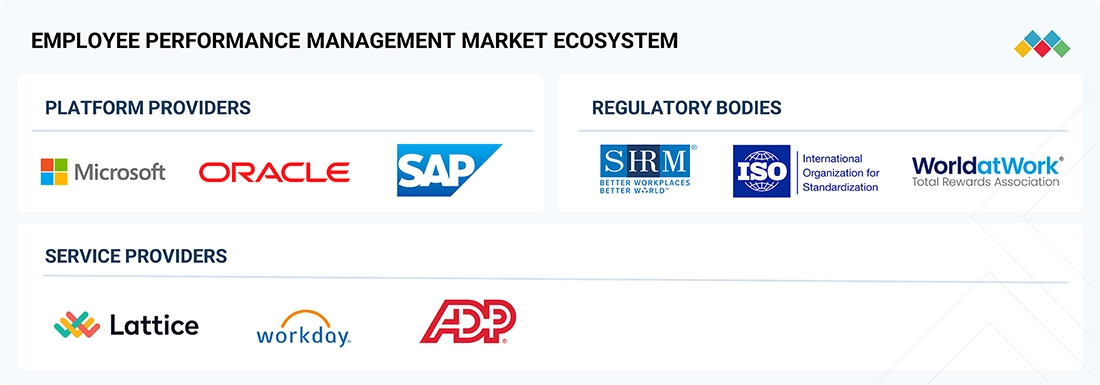
Logos and trademarks shown above are the property of their respective owners. Their use here is for informational and illustrative purposes only.
MARKET SEGMENTS
Source: Secondary Research, Interviews with Experts, MarketsandMarkets Analysis
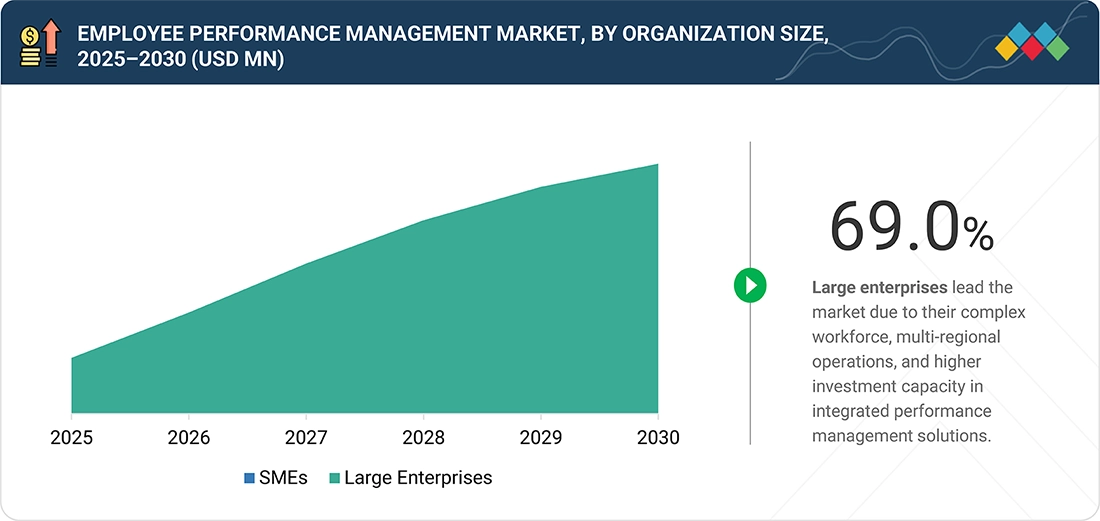
Employee Performance Management Market, By Organization Size
Large enterprises are expected to hold approximately 69% of the employee performance management market by 2030, driven by their complex, multi-regional workforces and stronger investment capacity in integrated performance management solutions, which will keep them ahead of SMEs in overall adoption.
REGION
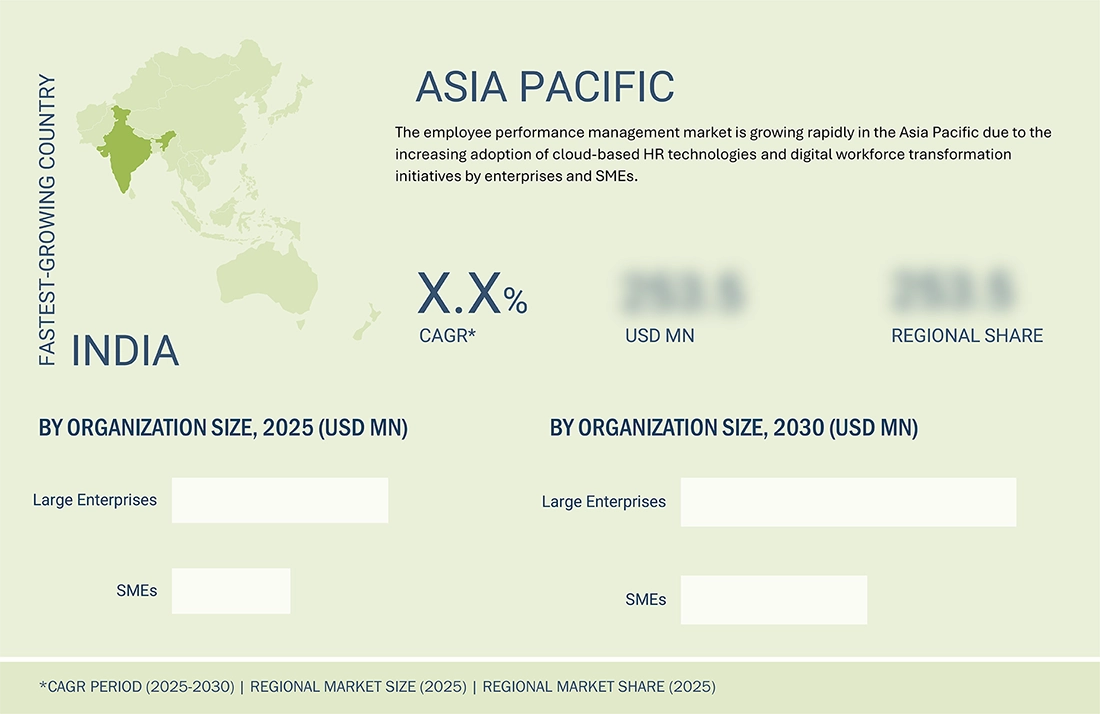
Asia Pacific to be the fastest-growing region in the global employee performance management market during the forecast period
Asia Pacific is the fastest-growing region in the employee performance management market as organizations are aggressively modernizing HR operations to keep pace with rapid economic expansion, rising workforce mobility, and increasing competition for skilled talent. The region’s strong push toward cloud adoption, supportive government digitalization initiatives, and high employee acceptance of new technologies further accelerate the uptake of advanced, AI-enabled performance management platforms.
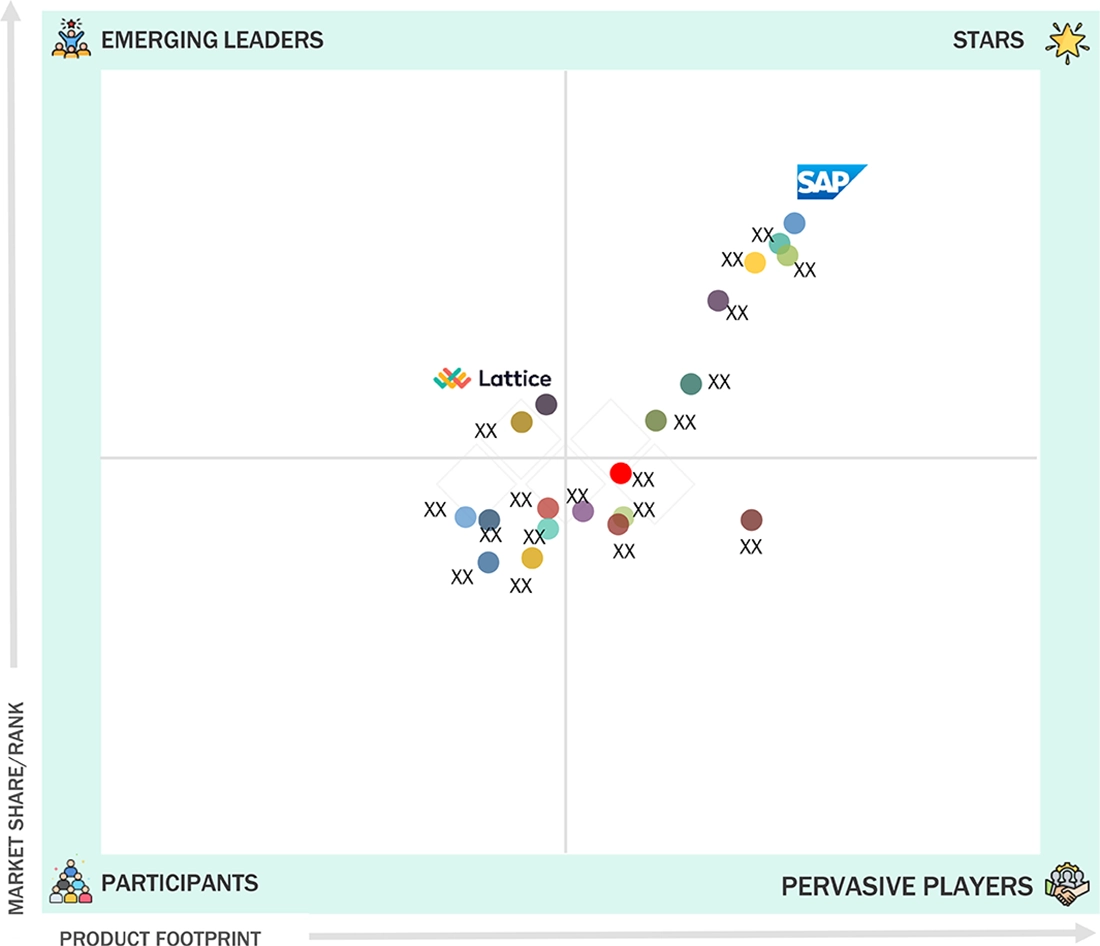
Employee Performance Management Market: COMPANY EVALUATION MATRIX
SAP appears as the strongest performer with high market traction and a wide product footprint, placing it among the top leaders. Lattice and a few others demonstrate solid upward movement, driven by growing customer adoption and expanding capabilities, positioning them as emerging leaders. Several mid-tier vendors cluster in the center, indicating steady but moderate performance and narrower product depth. A few companies sit on the lower end of both axes, reflecting limited market reach and smaller solution portfolios compared to the frontrunners.
Source: Secondary Research, Interviews with Experts, MarketsandMarkets Analysis
KEY MARKET PLAYERS
- SAP SE (Germany)
- Oracle (US)
- Microsoft (US)
- Workday (US)
- ADP (US)
- Qualtrics (US)
- Cornerstone OnDemand (US)
- Zoho Corporation (India)
- TriNet (US)
- BambooHR (US)
- Lattice (US)
- 15Five (US)
- Namely (US)
- Culture AMP (Australia)
- BetterWorks (US)
- Quantum Workplace (US)
- Workleap (Canada)
- ClearCompany (US)
- Performly (US)
- Trakstar (US)
- BreatheHR (UK)
- Actus (US)
- FactorHR (India)
- Awardco (US)
- Vantage Circle (India)
- SurveySparrow (India)
- Insperity (US)
MARKET SCOPE
| REPORT METRIC | DETAILS |
|---|---|
| Market Size in 2025 (Value) | USD 3.52 billion |
| Market Forecast in 2030 (Value) | USD 6.33 billion |
| Growth Rate | CAGR of 12.4% during 2025-2030 |
| Years Considered | 2020-2030 |
| Base Year | 2024 |
| Forecast Period | 2025-2030 |
| Units Considered | Value (USD Million) |
| Report Coverage | Revenue forecast, company ranking, competitive landscape, growth factors, and trends |
| Segments Covered |
|
| Regions Covered | North America, Asia Pacific, Europe, Latin America, Middle East & Africa |
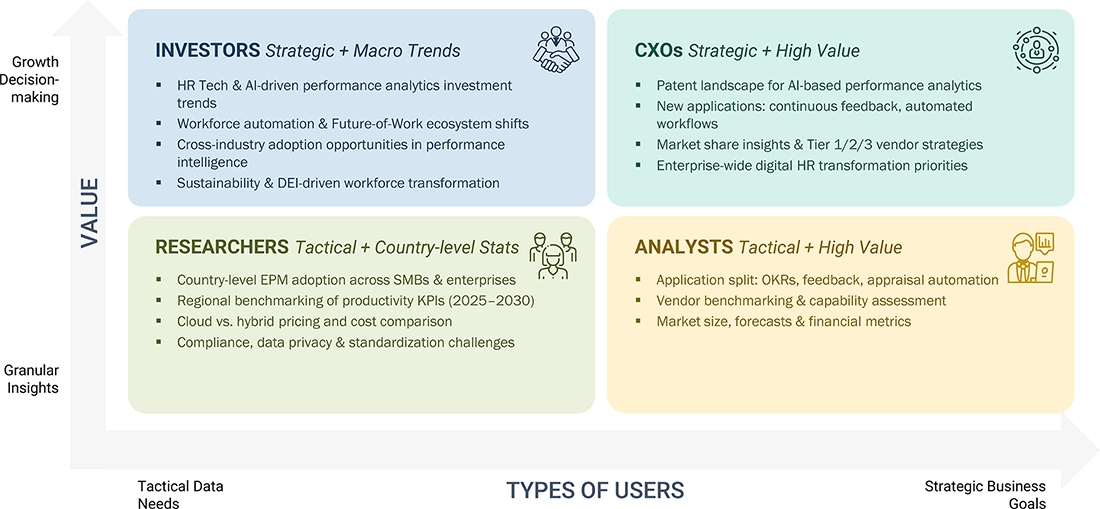
WHAT IS IN IT FOR YOU: Employee Performance Management Market REPORT CONTENT GUIDE
DELIVERED CUSTOMIZATIONS
We have successfully delivered the following deep-dive customizations:
| CLIENT REQUEST | CUSTOMIZATION DELIVERED | VALUE ADDS |
|---|---|---|
| Leading Service Provider (US) |
|
|
| Company Information | Detailed analysis and profiling of additional market players (up to 5) |
|
RECENT DEVELOPMENTS
- October 2025 : SAP rolled out its 2H 2025 release for SuccessFactors HCM, introducing its new “People Intelligence” capability, an AI-powered module unifying workforce data and skills across HR, payroll, performance, learning and talent workflows to enable unified people analytics, skills-gap detection, succession planning and predictive workforce insights.
- April 2025 : In the 1H 2025 release of SuccessFactors, SAP introduced enhanced performance management features, including a redesigned performance form experience with AI-assisted comment suggestions and manager insight dashboards that help streamline appraisal workflows and promote data-driven feedback and performance evaluation.
- November 2024 : During its 2024 HR-tech event, SAP announced over 30 new AI use cases embedded across its HCM suite, including generative AI support for 360-degree reviews, onboarding, skills-based talent matching, and employee career development tools, underscoring a significant push toward AI-first performance and talent management.
- October 2024 : The 2H 2024 product release of SuccessFactors introduced more than 250 new features and enhancements, including AI-driven recruitment, skills matching during hiring, generative AI-powered goal creation, and improved HR-lifecycle integrations, expanding the scope beyond performance to full talent lifecycle management.
- July 2024 : Oracle Cloud HCM launched role-specific “Activity Centers” for employees, managers, recruiters, and payroll specialists. These AI-driven hubs consolidate tasks, KPIs, communications, and HR workflows tailored to each role, improving productivity, streamlining HR processes, and enhancing the user experience.
Table of Contents
 Exclusive indicates content/data unique to MarketsandMarkets and not available with any competitors.
Methodology
This research study extensively utilized secondary sources, directories, and databases, including Dun & Bradstreet (D&B), Hoovers, and Bloomberg Businessweek, to identify and collect information relevant to a technical, market-oriented, and commercial study of the employee performance management market. The primary sources have primarily consisted of industry experts from core and related industries, as well as preferred suppliers, manufacturers, distributors, service providers, technology developers, alliances, and organizations related to all segments of the value chain of this market. In-depth interviews have been conducted with various primary respondents, including key industry participants, subject matter experts, C-level executives of key market players, and industry consultants, to obtain and verify critical qualitative and quantitative information.
Secondary Research
The market size of companies offering employee performance management worldwide was arrived at based on secondary data available through paid and unpaid sources. It was also arrived at by analyzing the product portfolio of major companies and rating them based on their performance and quality. In the secondary research process, various secondary sources were referred to identify and collect information for the study. The secondary sources included annual reports, press releases, investor presentations of companies, white papers, certified publications, and articles from recognized associations and government publishing sources. Several journals and associations, such as the International Journal of Human Resource Management, HR Magazine (SHRM), were also referenced. Secondary research was employed to gather key information on industry insights, the market’s monetary chain, the overall pool of key players, market classification, and segmentation according to industry trends, regional markets, and key developments from both market- and technology-oriented perspectives.
Secondary research was mainly used to obtain key information about the industry’s value chain and supply chain and to identify key players through various solutions and services, market classification and segmentation according to offerings of major players, industry trends related to technologies, applications, and regions, and key developments from both market-oriented and technology-oriented perspectives.
Primary Research
During the primary research process, various primary sources from both the supply and demand sides were interviewed to gather qualitative and quantitative information on the market. The primary sources from the supply side included various industry experts, including Chief Experience Officers (CXOs), Vice Presidents (VPs), directors from business development, marketing, and product development/innovation teams, related key executives from employee performance management solution vendors, professional service providers, and industry associations, and key opinion leaders.
Market Size Estimation
Multiple approaches were adopted to estimate and forecast the size of the employee performance management market. The first approach involves estimating market size by summing up the revenue generated by companies through the sale of employee performance management solutions.
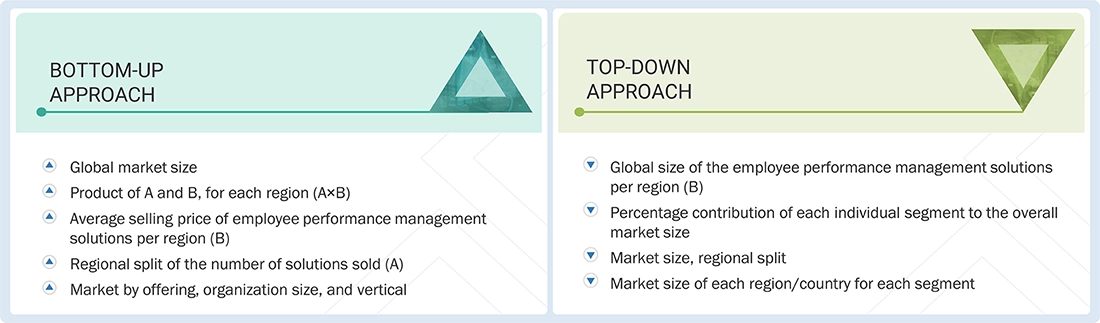
Top-down and bottom-up approaches were employed to estimate and validate the total market size. These methods were also extensively used to estimate the size of various market segments. The research methodology used to evaluate the market size is listed below.
- Key players in the market have been identified through extensive secondary research.
- In terms of value, the industry’s supply chain and market size have been determined through a combination of primary and secondary research processes.
- All percentage shares, splits, and breakups have been determined using secondary sources and verified through primary sources.
Data Triangulation
After determining the overall market size, the employee performance management market was segmented into several categories and subcategories. A data triangulation procedure was employed to complete the overall market engineering process and derive the precise statistics for all segments and subsegments, as applicable. The data was triangulated by studying various factors and trends from the demand and supply sides. In addition to data triangulation and market breakdown, the market size was validated using both top-down and bottom-up approaches.
Market Definition
According to Qualtrics, employee performance management is a continuous process that balances the relationship between employees and the value they deliver to a business through clear communication and ongoing support from their managers. It encompasses setting business objectives, evaluating and reviewing performance, and creating a system of behaviors and processes that promote high performance, accountability, and organizational success.
The scope of employee performance management, as per the defined segmentation, delivers four core capabilities across platforms and services for both large enterprises and SMEs: Performance Appraisal Systems enabling standardized evaluation frameworks, competency mapping, and role-based assessment cycles; 360-Degree Feedback Tools capturing multi-source insights to drive transparency, self-awareness, and developmental alignment; Goal Setting & Tracking Systems integrating OKRs and KPIs with real-time progress visualization, alignment to business outcomes, and data-driven performance analytics; and Continuous Feedback and Learning Platforms fostering a culture of coaching and agility through automated feedback loops, pulse surveys, and recognition workflows, complemented by Services encompassing deployment, customization, training, and ongoing performance optimization.
Stakeholders
- Software Providers
- Service Providers
- System Integrators
- HR Technology Vendors
- Cloud Service Providers
- Consulting Firms
- Enterprises (Large and SMEs)
- HR Departments and Managers
- IT Departments
- End Users (Employees)
- Government and Regulatory Bodies
- Industry Associations
- Investors and Venture Capitalists
Report Objectives
- To determine, segment, and forecast the employee performance management market based on offering, organization size, vertical, and region in terms of value
- To forecast the size of the market segments with respect to five main regions: North America, Europe, Asia Pacific, the Middle East & Africa, and Latin America
- To provide detailed information about the major factors (drivers, restraints, opportunities, and challenges) influencing the growth of the market
- To study the complete value chain and related industry segments, and perform a value chain analysis of the market landscape
- To strategically analyze the macro and micromarkets with respect to individual growth trends, prospects, and contributions to the total market
- To analyze the industry trends, pricing data, patents, and innovations related to the market
- To analyze the opportunities for stakeholders by identifying the high-growth segments of the market
- To profile the key players in the market and comprehensively analyze their market share/ranking and core competencies
- To track and analyze competitive developments, such as mergers & acquisitions, product launches & developments, partnerships, agreements, collaborations, business expansions, and research & development (R&D) activities
Key Questions Addressed by the Report
What is the current size of the Employee Performance Management Market?
The Employee Performance Management Market is estimated at USD 3.52 billion in 2025 and is projected to reach USD 6.33 billion by 2030, growing at a CAGR of 12.4% during the forecast period. This growth reflects increasing enterprise demand for continuous performance evaluation and AI-enabled talent analytics.
What factors are driving growth in the Employee Performance Management Market?
Market growth is primarily driven by the transition from traditional annual appraisals to continuous feedback systems, increased adoption of AI-powered workforce analytics, rising remote and hybrid work models, and growing integration of performance tools with broader HR ecosystems.
Which platform segment holds the largest market share?
The performance appraisal systems segment accounts for the largest market share, as enterprises continue to rely on structured employee evaluations, KPI tracking, and goal alignment frameworks to improve organizational efficiency.
Which industry vertical leads the Employee Performance Management Market?
The BFSI (Banking, Financial Services, and Insurance) sector holds the largest market share due to its high emphasis on compliance, employee productivity monitoring, and performance-linked strategic objectives.
Which region dominates the Employee Performance Management Market?
North America holds the largest market share due to early adoption of HR technology, mature enterprise infrastructure, and strong presence of leading vendors like SAP, Oracle, Microsoft, and Workday.
What are the biggest opportunities for vendors in this market?
High-growth opportunities exist in AI-powered performance coaching, employee engagement and pulse survey tools, goal-setting and OKR platforms, learning-performance integration systems, and analytics dashboards for retention and workforce optimization—helping organizations improve workforce productivity, engagement, and talent retention.


Personalize This Research
- Triangulate with your Own Data
- Get Data as per your Format and Definition
- Gain a Deeper Dive on a Specific Application, Geography, Customer or Competitor
- Any level of Personalization
Let Us Help You
- What are the Known and Unknown Adjacencies Impacting the Employee Performance Management Market
- What will your New Revenue Sources be?
- Who will be your Top Customer; what will make them switch?
- Defend your Market Share or Win Competitors
- Get a Scorecard for Target Partners

Custom Market Research Services
We Will Customise The Research For You, In Case The Report Listed Above Does Not Meet With Your Requirements
Get 10% Free CustomisationTESTIMONIALS
- US Employee Performance Management Market
- Canada Employee Performance Management Market
- UK Employee Performance Management Market
- Germany Employee Performance Management Market
- France Employee Performance Management Market
- China Employee Performance Management Market
- Japan Employee Performance Management Market
- India Employee Performance Management Market
- UAE Employee Performance Management Market
- South Africa Employee Performance Management Market
- Brazil Employee Performance Management Market
- Mexico Employee Performance Management Market
- Rest Of Europe Employee Performance Management Market
- Rest Of Asia Pacific Employee Performance Management Market






Growth opportunities and latent adjacency in Employee Performance Management Market