Enterprise Compliance Management (ECM) Market

Enterprise Compliance Management (ECM) Market by Compliance Type (Regulatory & Legal, Policy, Internal Controls & Audit, Data Privacy & Security Compliance), Services (Consulting & Advisory, Training, Managed), Vertical -Global Forecast to 2030




OVERVIEW
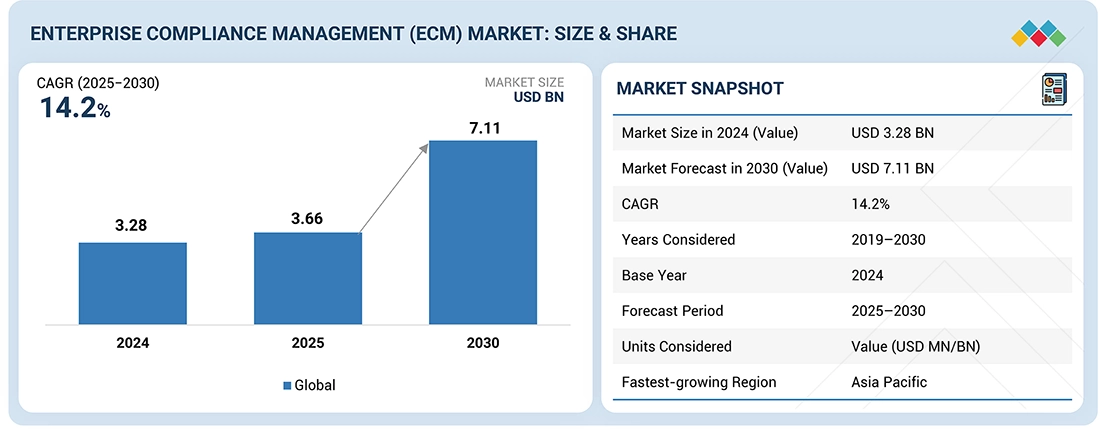
Source: Secondary Research, Interviews with Experts, MarketsandMarkets Analysis
The enterprise compliance management (ECM) market is expected to reach USD 7.11 billion by 2030, up from USD 3.66 billion in 2025, growing at a CAGR of 14.2% from 2025 to 2030. The growth of the ECM market is driven by factors like complex regulations, digital transformation, and stricter enforcement of compliance and data protection rules across all industries. Additionally, organizations are increasingly adopting ECM solutions to gain real-time visibility into compliance, automate regulatory and audit processes, and ensure that every part of the company, regardless of location or changing standards, consistently follows correct practices. Furthermore, issues related to data privacy, cybersecurity, and financial reporting are significant challenges for companies, speeding up their adoption of ECM. Moreover, the integration of AI/ML-powered compliance analytics, ongoing compliance checks, automatic policy management, and unified governance frameworks is convincing more organizations to choose ECM solutions and services.
KEY TAKEAWAYS
-
BY REGIONThe North America ECM market accounted for a 35.61% revenue share in 2025.
-
BY OFFERINGBy offering, the services segment is expected to register the highest CAGR of 14.2%.
-
BY COMPLIANCE TYPEBy compliance type, the data privacy & security compliance segment is projected to grow at the fastest rate from 2025 to 2030.
-
BY DEPLOYMENT MODEBy deployment mode, the cloud segment is projected to grow at the highest CAGR of 15.0% from 2025 to 2030.
-
BY ORGANIZATION SIZEBy organization size, the large enterprises segment is expected to dominate the market.
-
BY VERTICALBy vertical, the healthcare segment will grow the fastest during the forecast period.
-
COMPETITIVE LANDSCAPE - KEY PLAYERSLeading ECM vendors such as IBM, Microsoft, Oracle, SAS Institute, ServiceNow, Thomson Reuters, and FIS are recognized as dominant players in the global ECM market due to their broad, integrated compliance platforms, deep domain expertise across risk categories, and large enterprise customer bases.
-
COMPETITIVE LANDSCAPE - KEY PLAYERSEmerging and fast-growing ECM providers, including Riskonnect, LogicManager, Diligent Corporation, SureCloud, and Onspring are gaining traction by offering configurable platforms, strong analytics, and focused capabilities across enterprise risk, compliance, audit, and third-party risk management.
ECM platform integration with cloud, mobile, and enterprise systems makes compliance practices more scalable and visible in real-time. To address digital transformation, regulatory adherence, and complex compliance areas such as data privacy, cybersecurity, financial reporting, and third-party compliance, businesses are building unified ECM ecosystems. Additionally, the combination of AI, automation, and data analytics is enabling continuous compliance monitoring, automatic policy enforcement, and providing predictive regulatory insights, thereby strengthening transparency, efficiency, and governance across the entire organization.
TRENDS & DISRUPTIONS IMPACTING CUSTOMERS' CUSTOMERS
This graphic illustrates the evolution of the Enterprise Compliance Management (ECM) industry, shifting from manual, siloed, and audit-focused methods to integrated, AI-powered, and cloud-native solutions for compliant renewal. While the current ECM market revenue mainly includes manual document tools and traditional audit cycles, future growth will stem from continuous compliance, automation of regulatory changes, and advanced analytics. Adoption of ECM solutions has been observed in BFSI, Information Technology & ITeS, healthcare, manufacturing, telecommunications, energy, and the public sector, as organizations face growing complexities in data privacy, cybersecurity, ESG, and third-party compliance. As a result, this transition enables real-time compliance visibility, improves audit readiness, reduces regulatory risk, and positions ECM as a crucial driver of governance.
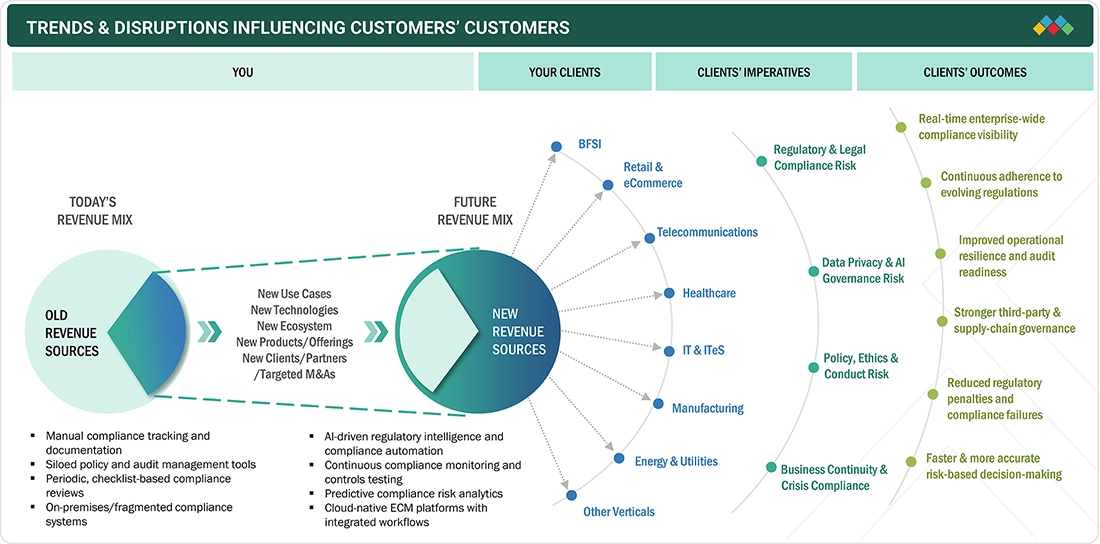
Source: Secondary Research, Interviews with Experts, MarketsandMarkets Analysis
MARKET DYNAMICS

Level
-
Escalation of Enforcement Actions and Monetary Penalties

-
Shift from Periodic Audits to Always-On Compliance Models


Level
-
High Cost of Customization for Industry-Specific Regulations

-
Resistance to Process Standardization Across Business Units


Level
-
Compliance-by-Design in Digital Products and Services

-
SME Adoption through Cloud-Based and Subscription ECM Models


Level
-
Keeping Pace with Rapidly Changing and Overlapping Regulations

-
Proving Quantifiable ROI Beyond Audit Readiness

Source: Secondary Research, Interviews with Experts, MarketsandMarkets Analysis
Driver: Escalation of Enforcement Actions and Monetary Penalties
Regulatory authorities are increasingly imposing strict enforcement measures, higher fines, and frequent audits across industries. Non-compliance now results in significant financial losses, legal consequences, and reputational damage. This has elevated compliance from a periodic activity to a continuous business priority. Organizations are investing in ECM platforms to ensure structured compliance tracking and audit readiness. Automated evidence management and reporting help reduce exposure to penalties.As enforcement intensifies, proactive compliance management is becoming essential.
Restraint: High Cost of Customization for Industry-Specific Regulations
Different industries are subject to highly specialized compliance requirements, increasing the need for customized controls and workflows. Adapting ECM platforms to meet sector-specific regulations raises implementation and maintenance costs. Frequent regulatory updates further increase customization complexity. Smaller organizations may find these costs prohibitive. This limits rapid and standardized ECM adoption. Cost concerns remain a key restraint, especially in highly regulated verticals.
Opportunity: Compliance-by-Design in Digital Products and Services
Organizations are increasingly embedding compliance requirements directly into digital products, applications, and business workflows. Compliance-by-design reduces the risk of violations by ensuring regulatory adherence from the outset. ECM platforms enable integration of compliance controls into development and operational processes. This supports faster product launches without compromising regulatory requirements. Demand is rising in digital banking, SaaS, and platform-based businesses. This trend creates strong growth opportunities for ECM vendors.
Challenge: Keeping Pace with Rapidly Changing and Overlapping Regulations
Regulations are evolving rapidly across regions, often with overlapping or conflicting requirements. Interpreting and implementing frequent regulatory changes places a heavy burden on compliance teams. Manual tracking methods struggle to keep up with regulatory velocity. ECM platforms help by automating regulatory updates and impact assessments. However, ensuring timely and accurate compliance remains challenging. Regulatory complexity continues to test ECM effectiveness.
ENTERPRISE COMPLIANCE MANAGEMENT (ECM) MARKET: COMMERCIAL USE CASES ACROSS INDUSTRIES
| COMPANY | USE CASE DESCRIPTION | BENEFITS |
|---|---|---|
 |
A global enterprise used IBM’s compliance and GRC solutions to centralize regulatory obligations, automate policy controls, and manage audit evidence across multiple regions and business units facing frequent regulatory changes. | Centralized compliance visibility, automated audit evidence collection, improved regulatory consistency across geographies. |
 |
An enterprise adopted Microsoft compliance solutions to manage data privacy, information governance, and regulatory requirements across Microsoft 365, Azure, and hybrid cloud environments. | Unified compliance management across cloud workloads, improved data protection, simplified regulatory reporting. |
 |
A multinational organization implemented Oracle’s compliance and controls management tools to automate internal controls, regulatory reporting, and audit workflows tightly integrated with ERP systems. | Strong ERP-aligned compliance, reduced manual control testing, improved financial and operational compliance accuracy. |
Logos and trademarks shown above are the property of their respective owners. Their use here is for informational and illustrative purposes only.
MARKET ECOSYSTEM
The enterprise compliance management (ECM) market comprises software and service vendors, as well as compliance specialists, that provide solutions for regulatory, policy, audit, and data privacy compliance. It assists the industries such as BFSI, healthcare, IT & ITeS, and government in complying with regulatory demands, enhancing governance & reducing compliance and data risks.
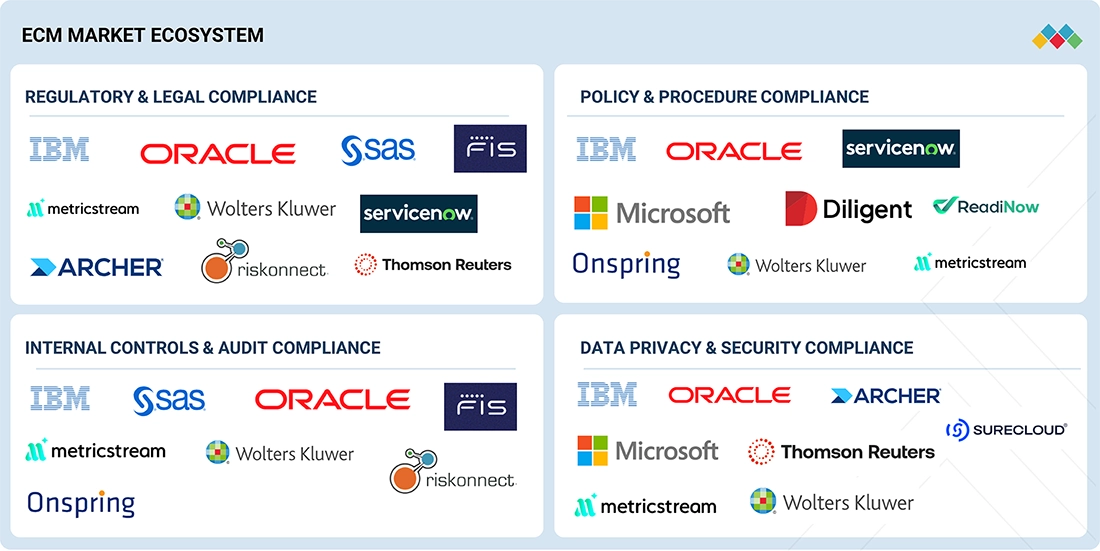
Logos and trademarks shown above are the property of their respective owners. Their use here is for informational and illustrative purposes only.
MARKET SEGMENTS
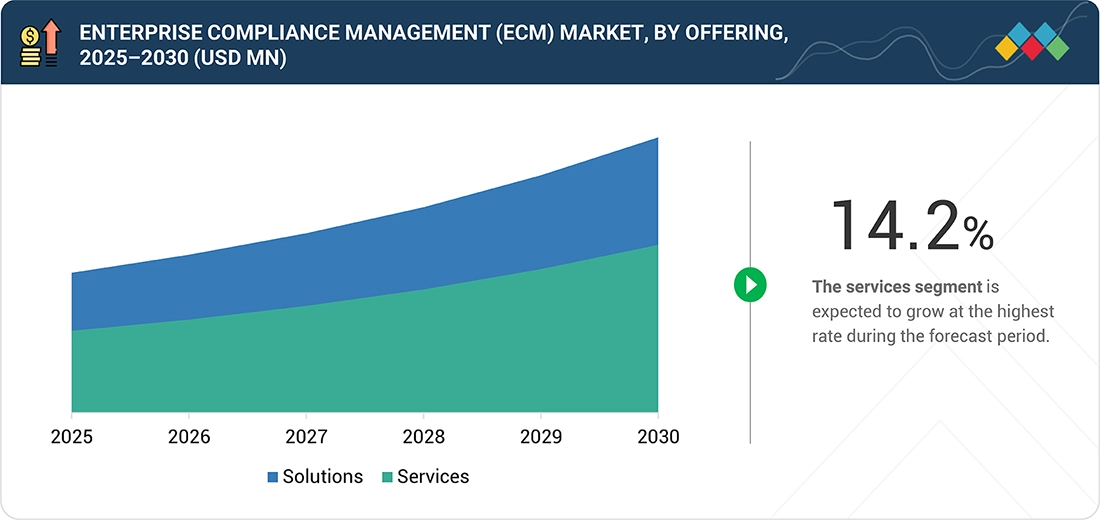
Source: Secondary Research, Interviews with Experts, MarketsandMarkets Analysis
ECM Market, By Offering
The software segment dominates the ECM market due to its ability to automate compliance workflows, centralize policy management, and provide real-time monitoring and reporting. Enterprises prefer configurable ECM platforms to address complex, multi-jurisdictional compliance needs while reducing manual effort and audit risks. Advanced analytics, dashboards, and AI-enabled risk assessments further enhance decision-making. Continuous updates and scalability make software solutions more cost-effective over time.
ECM Market, By Compliance Type
Regulatory/legal compliance tops the market as organizations become more and more subject to regulatory review, more frequent policy changes, and more severe enforcement measures. ECM solutions help maintain compliance with laws, standards, and mandates across regions and reduce penalties and legal liability. Increasing trans-border activities underscore the need for integrated compliance strategies. Audit readiness and transparency are also enhanced by automated regulatory mapping and reporting.
ERM Market, By Deployment Mode
The on-premises segment prevails because of the data sovereignty issues, high-security levels, and the necessity to have higher control over sensitive compliance information. On-premises ECM is popular with highly regulated industries as it allows them to be customized, integrated with older systems, and governed internally. Lower reliance on external cloud providers is also important to organizations. This model promotes more stringent internal access policies and compliance policies.
ERM Market, By Organization Size
The proportion of large enterprises is the highest since they operate in various geographies and legislative environments. They have complex organizational structures, greater risk exposure, and larger compliance budgets, which drive their extensive use of enterprise-grade ECM platforms. Such organizations require sophisticated reporting, role-based access, and workflow customization. ECM also helps standardize compliance processes across the entire enterprise.
ERM Market, By Vertical
Strict regulatory requirements, regular audits, and vulnerability to financial, operational and reputational risks make the BFSI segment the best-off in the ECM market. Banks and other financial institutions turn to the ECM solutions to deal with regulatory reporting, internal controls and risk mitigation at the scale. Further adoption is facilitated by an increasing attention to anti-money laundering (AML) and data protection.
REGION
Asia Pacific to be fastest-growing region in global ERM market during forecast period
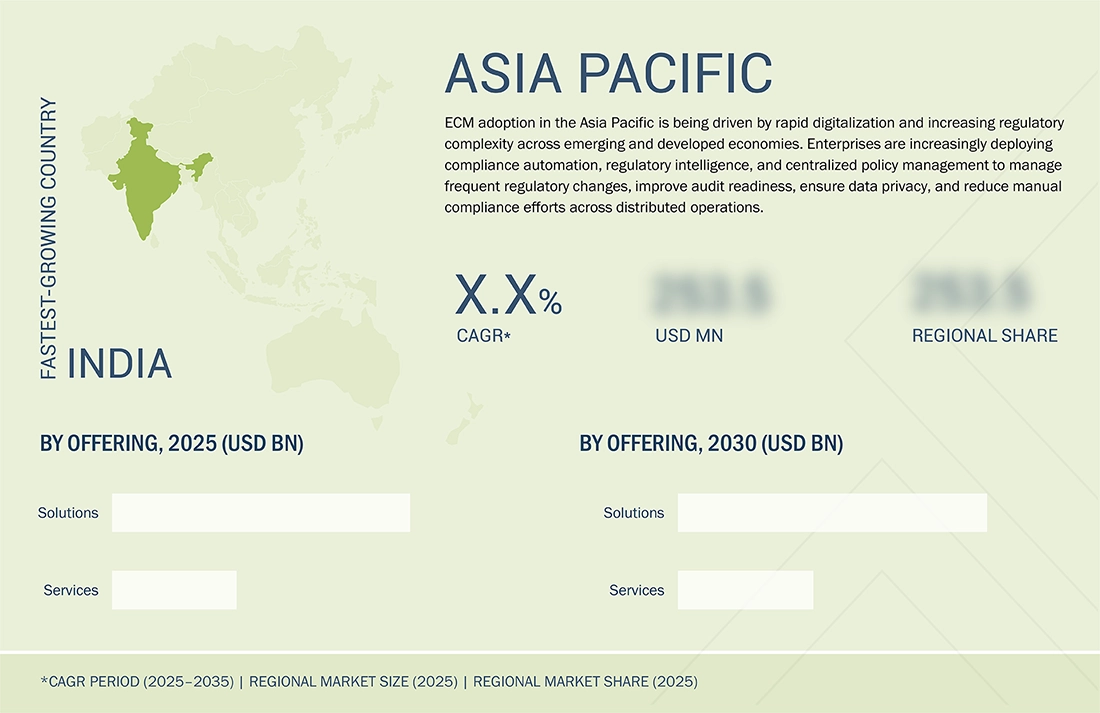
The regulatory environment is increasingly tougher in countries like China, Japan, India, and Australia, and organizations are now implementing formal Enterprise Compliance Management (ECM) frameworks in order to solidify a stronger level of governance, risk management, and audit preparedness. The rapid digitalization of BFSI, manufacturing, and public sector organizations, as well as the growth of cross-border operations, is making compliance more complex. Additionally, rising adoption of cloud technologies, growth of fintech ecosystems, and government-led regulatory reforms are accelerating demand for scalable and automated ECM solutions across the Asia Pacific region.
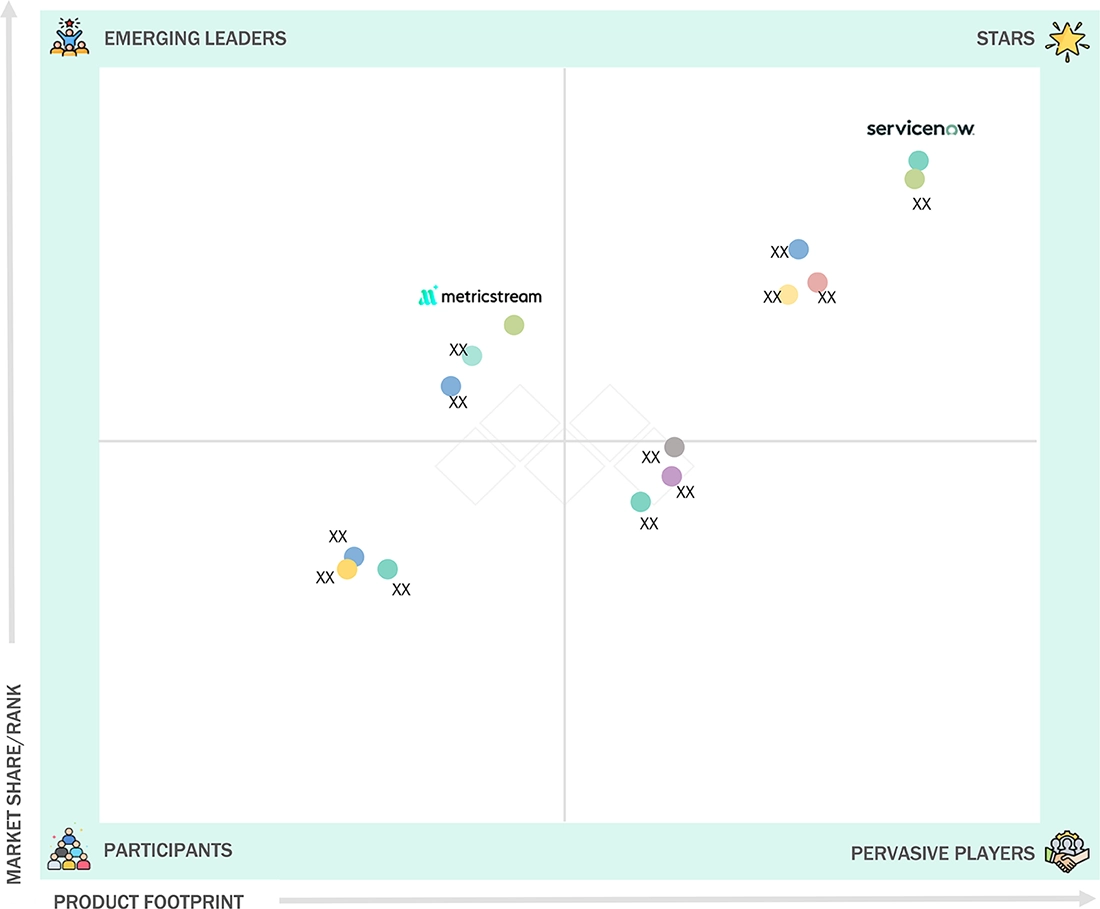
ENTERPRISE COMPLIANCE MANAGEMENT (ECM) MARKET: COMPANY EVALUATION MATRIX
In the ECM segment, ServiceNow has made an impression as one of the Stars in the space, having developed an excellent platform for unifying compliance processes on a highly scalable basis with significant workflow automation capabilities, real-time monitoring, and integration with other business systems. This combination has made ServiceNow an exceptional option for larger organizations looking to deliver centralized, continuous compliance management practices. On the other hand, MetricStream has become an Emerging Leader and is building momentum via its strengths in audit automation, policy management, and regulatory compliance within a configurable workflow framework supported by a cloud-enabled architecture, which makes it easy for mid-sized and highly regulated enterprises to transition away from fragmented and manually operated compliance processes.
Source: Secondary Research, Interviews with Experts, MarketsandMarkets Analysis
KEY MARKET PLAYERS
- IBM (US)
- Microsoft (US)
- Oracle (US)
- SAS Institute (US)
- ServiceNow (US)
- Thomson Reuters (Canada)
- FIS (US)
- Wolters Kluwer (Netherlands)
- MetricStream (US)
- Riskonnect (US)
- LogicManager (US)
- SureCloud (UK)
- Onspring (US)
- Archer Technologies (US)
- Diligent Corporation (US)
- ProGreC (India)
- Onspring (US)
- StandardFusion (Canada)
- Comensure (US)
- VComply (US)
- ReadiNow (Australia)
- ProGrec (India)
MARKET SCOPE
| REPORT METRIC | DETAILS |
|---|---|
| Market Size in 2024 (Value) | USD 3.28 Billion |
| Market Forecast in 2030 (Value) | USD 7.11 Billion |
| Growth Rate | CAGR of 14.2% from 2025-2030 |
| Years Considered | 2019-2030 |
| Base Year | 2024 |
| Forecast Period | 2025-2030 |
| Units Considered | Value (USD Million/Billion) |
| Report Coverage | Revenue forecast, company ranking, competitive landscape, growth factors, and trends |
| Segments Covered |
|
| Regions Covered | North America, Asia Pacific, Europe, Middle East & Africa, Latin America |
WHAT IS IN IT FOR YOU: ENTERPRISE COMPLIANCE MANAGEMENT (ECM) MARKET REPORT CONTENT GUIDE
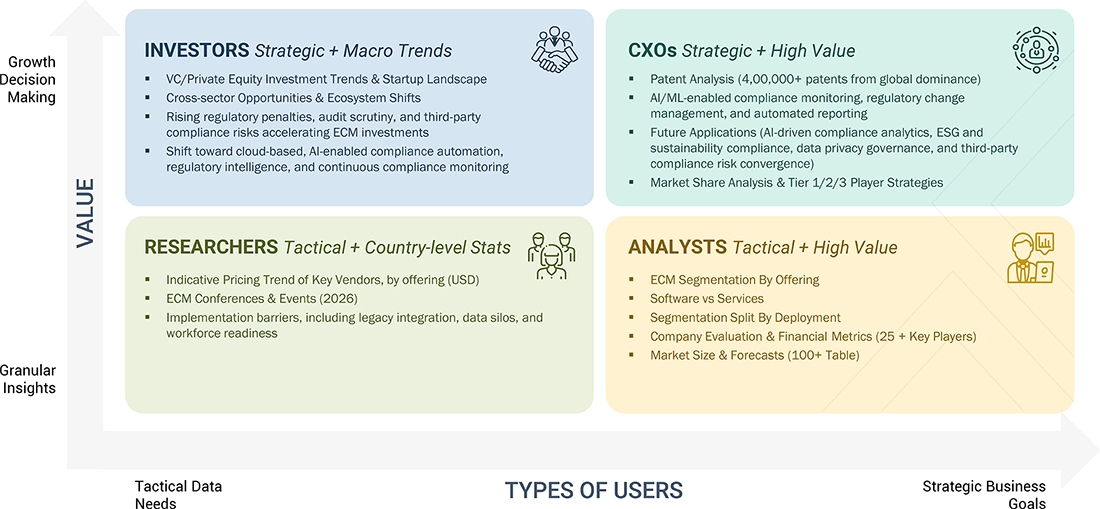
DELIVERED CUSTOMIZATIONS
We have successfully delivered the following deep-dive customizations:
| CLIENT REQUEST | CUSTOMIZATION DELIVERED | VALUE ADDS |
|---|---|---|
| Leading Solution Provider (US) | Product Analysis: Product Matrix, which gives a detailed comparison of the product portfolio of each company | Improved clarity on competitive positioning and product strengths to drive informed decision-making |
| Leading Service Provider (EU) | Company Information: Detailed analysis and profiling of additional market players (up to 5) | Comprehensive insights into market landscape and opportunities for strategic collaborations |
RECENT DEVELOPMENTS
- December 2025 : Thomson Reuters announced strategic partnerships with audit innovators, including Trullion, Audit Sight, Crunchafi, Fieldguide, Validis, and Valid8 Financial, to enhance its Cloud Audit Suite and Audit Intelligence solutions with advanced audit capabilities.
- October 2025 : Onspring introduced Onspring AI, an AI-enabled GRC platform that is designed to reduce repetitive manual work, such as writing and summarizing documents, entering data, or searching for related controls, and help compliance and risk teams to focus more on strategic, higher-value enterprise tasks
- October 2025 : Archer Technologies and Deloitte partner to modernize their compliance and risk management solution with AI-integrated capabilities. The partnership aimed to improve operational and integrated reporting across their enterprise clients.
- September 2024 : Oracle announced its Oracle Financial Crime and Compliance Management (FCCM) Monitor Cloud Service aimed at financial institutions. This solution provides a centralized compliance and risk monitoring interface that enhances the detection of potential financial crime risks and streamlines proactive risk mitigation efforts.
Table of Contents
 Exclusive indicates content/data unique to MarketsandMarkets and not available with any competitors.
Methodology
The study comprised four main activities to estimate the enterprise content management market size. We conducted significant secondary research to gather data on the market, the competing market, and the parent market. The following stage involved conducting primary research to confirm these conclusions and hypotheses and sizing with industry experts throughout the value chain. The overall market size was evaluated using a blend of top-down and bottom-up approach methodologies. After that, we estimated the market sizes of the various enterprise content management market segments using the market breakup and data triangulation techniques.
Secondary Research
The size of companies offering enterprise content management markets and services was determined based on secondary data from paid and unpaid sources. It was also arrived at by analyzing the product portfolios of major companies and rating the companies based on their performance and quality.
In the secondary research process, various sources were referred to identify and collect information for this study. Secondary sources included annual reports, press releases, and investor presentations of companies; white papers, journals, and certified publications; and articles from recognized authors, directories, and databases. The data was also collected from other secondary sources, such as journals, government websites, blogs, and vendors' websites. Additionally, the spending of various countries on the ECM market was extracted from the respective sources. Secondary research was mainly used to obtain the critical information related to the industry's value chain and supply chain to identify the key players based on solutions, services, market classification, and segmentation according to components of the major players, industry trends related to components, users, and regions, and the key developments from both market- and technology-oriented perspectives.
Primary Research
In the primary research process, various primary sources from both the supply and demand sides of the enterprise content management market were interviewed to obtain qualitative and quantitative information for this study. The primary sources from the supply side included industry experts, such as Chief Executive Officers (CEOs), Vice Presidents (VPs), marketing directors, technology and innovation directors, and related key executives from vendors providing enterprise content management offerings; associated service providers; and is operating in the targeted countries. all possible parameters that affect the market covered in this research study have been accounted for, viewed in extensive detail, verified through primary research, and analyzed to arrive at the final quantitative and qualitative data.
After the complete market engineering process (including calculations for market statistics, market breakup, market size estimations, market forecasting, and data triangulation), extensive primary research was conducted to gather information and verify and validate the critical numbers arrived at. The primary research also helped identify and validate the segmentation, industry trends, key players, competitive landscape, and market dynamics, such as drivers, restraints, opportunities, challenges, and key strategies. In the complete market engineering process, the bottom-up approach and several data triangulation methods were extensively used to perform market estimation and market forecasting for the overall market segments and subsegments listed in this report. An extensive qualitative and quantitative analysis of the complete market engineering process was performed to list the key information/insights throughout the report.
Market Size Estimation
The enterprise content management market and related submarkets were estimated and forecasted using top-down and bottom-up methodologies. The bottom-up method was used to determine the market's overall size, using the revenues and product offerings of the major market players. This research ascertained and validated the precise value of the total parent market size through data triangulation techniques and primary interview validation. Next, using percentage splits of the market segments, the overall market size was utilized in the top-down approach to estimate the size of other individual markets.
The research methodology used to estimate the market size included the following:
- Primary and secondary research was utilized to determine the revenue contributions of the major market participants in each country after secondary research helped identify them.
- Throughout the process, critical insights were obtained by conducting in-depth interviews with industry professionals, including directors, CEOs, VPs, and marketing executives, and by reading the annual and financial reports of the top firms in the market.
- Primary sources were used to verify all percentage splits and breakups, which were calculated using secondary sources.
Data Triangulation
The market was divided into several segments and subsegments using the previously described market size estimation procedures once the overall market size was determined. When required, market breakdown and data triangulation procedures were employed to complete the market engineering process and specify the exact figures for every market segment and subsegment. The data was triangulated by examining several variables and patterns from government entities' supply and demand sides.
Market Definition
MarketsandMarkets defines Enterprise Content Management (ECM) as a systematic approach to managing an organization's entire information lifecycle. It involves capturing, storing, managing, and delivering content and documents related to organizational processes. ECM aims to organize, categorize, and secure content, making it easily accessible to authorized users. It encompasses document management, web content management, records management, digital asset management, and workflow management. ECM improves an organization's collaboration, efficiency, and compliance by centralizing content management.
Key Stakeholders
- Training and consulting service providers
- Information Technology (IT) infrastructure providers
- ECM solutions providers
- ECM service providers
- Government organizations and standardization bodies
- Regional associations
- ECM vendors
- Value-added resellers and distributors
Report Objectives
- To define, describe, and forecast the enterprise content management (ECM) market based on offering, business function, deployment mode, organization size, vertical, and region.
- To provide detailed information about the significant factors, such as drivers, opportunities, restraints, and challenges, influencing the growth of the market
- To analyze the opportunities in the market for stakeholders by identifying the high-growth segments of the market
- To forecast the market size concerning five main regions — North America, Europe, Asia Pacific, the Middle East & Africa, and Latin America
- To analyze the subsegments of the market concerning individual growth trends, prospects, and contributions to the overall market
- To profile the market's key players and analyze their size and core competencies comprehensively.
- To track and analyze the competitive developments, such as product enhancements, product launches, acquisitions, partnerships, and collaborations, in the enterprise content management market globally
Available Customizations
MarketsandMarkets provides customizations based on the company's unique requirements using market data. The following customization options are available for the report:
Product Analysis
- The product matrix provides a detailed comparison of each company's product portfolio.
Geographic Analysis
- Further breakup of the enterprise content management market
Company Information
- Detailed analysis and profiling of five additional market players
Key Questions Addressed by the Report
What is the projected size of the Enterprise Compliance Management (ECM) Market by 2030?
According to MarketsandMarkets, the ECM market is projected to grow from USD 3.66 billion in 2025 to USD 7.11 billion by 2030, at a 14.2% CAGR.
What factors are driving growth in the Enterprise Compliance Management (ECM) Market?
Market growth is driven by increasing regulatory complexity, digital transformation, stricter data privacy laws, AI-powered compliance automation, and demand for continuous compliance monitoring.
Which compliance segment is expected to grow the fastest in the ECM Market?
The Data Privacy & Security Compliance segment is projected to register the fastest growth during the forecast period due to rising cybersecurity and regulatory requirements.
Which region leads the Enterprise Compliance Management Market?
North America held the largest market share of 35.61% in 2025, supported by mature regulatory frameworks and widespread enterprise adoption.
Which region is expected to witness the fastest growth in the ECM Market?
The Asia Pacific region is forecast to grow the fastest due to rapid digitalization, evolving regulations, and increasing cloud adoption across enterprises.
Who are the leading players in the Enterprise Compliance Management Market?
Key vendors include IBM, Microsoft, Oracle, SAS Institute, ServiceNow, Thomson Reuters, FIS, Riskonnect, LogicManager, Diligent Corporation, SureCloud, and Onspring.


Personalize This Research
- Triangulate with your Own Data
- Get Data as per your Format and Definition
- Gain a Deeper Dive on a Specific Application, Geography, Customer or Competitor
- Any level of Personalization
Let Us Help You
- What are the Known and Unknown Adjacencies Impacting the Enterprise Compliance Management (ECM) Market
- What will your New Revenue Sources be?
- Who will be your Top Customer; what will make them switch?
- Defend your Market Share or Win Competitors
- Get a Scorecard for Target Partners

Custom Market Research Services
We Will Customise The Research For You, In Case The Report Listed Above Does Not Meet With Your Requirements
Get 10% Free CustomisationTESTIMONIALS






Growth opportunities and latent adjacency in Enterprise Compliance Management (ECM) Market