Europe Acoustic Insulation Market

Europe Acoustic Insulation Market by Material (Glass Wool, Rock Wool, Foamed Plastics, Elastomeric Foam), End-use Industry (Building & Construction, Transportation, Oil & Gas, Energy & Utilities, Industrial & OEM), and Country - Forecast to 2030




OVERVIEW
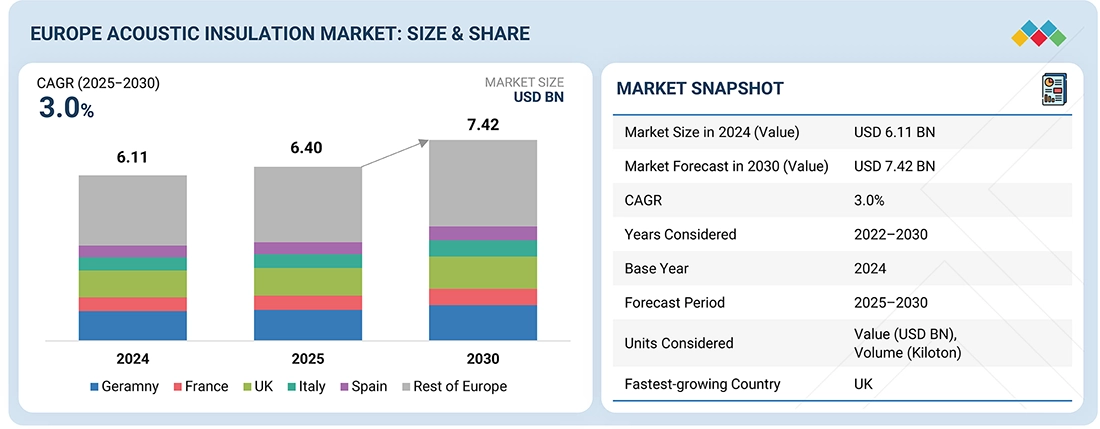
Source: Secondary Research, Interviews with Experts, MarketsandMarkets Analysis
The Europe acoustic insulation market is projected to reach USD 7.42 billion by 2030, up from USD 6.40 billion in 2025, at a CAGR of 3.0% over the forecast period. Key growth drivers include stringent regulatory frameworks, such as the EU’s Environmental Noise Directive, and rising public awareness of the health risks associated with noise pollution. As urbanization intensifies, demand for effective soundproofing in residential and commercial construction has surged to ensure occupant comfort and privacy. This growth is further sustained by the region's focus on energy efficiency and sustainability, which promotes the adoption of advanced materials that provide both thermal and acoustic benefits in new builds and renovation projects.
KEY TAKEAWAYS
-
By CountryGermany held the largest share (18.0%) in the Europe acoustic insulation market.
-
By MaterialRock wool dominated the market, with a share of 32.3% in 2024.
-
By End-use IndustryEnergy & utilities is projected to be the fastest growing end-use industry segment, at a CAGR of 4.2% during the forecast period.
-
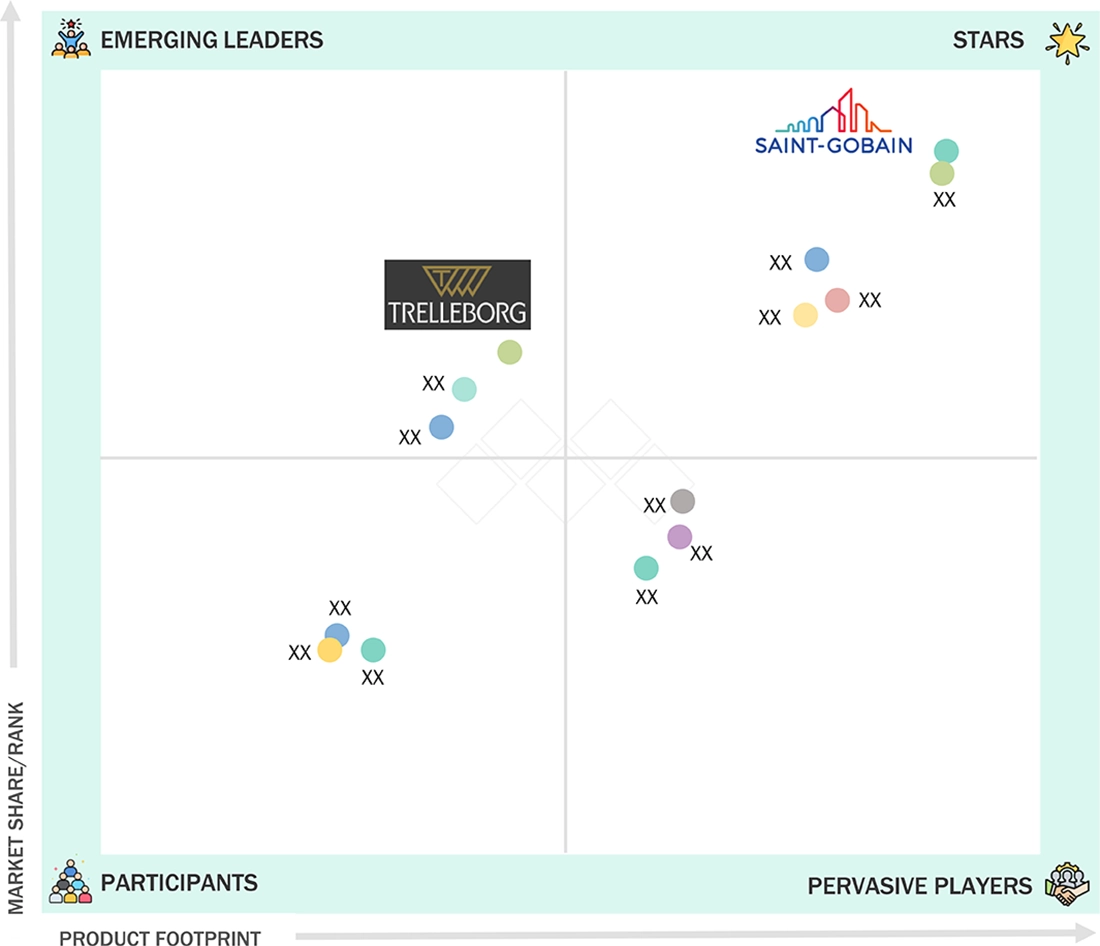
Competitive Landscape - Key PlayersRockwool A/S, Saint-Gobain, and Armacell, were identified as some of the star players in the Europe acoustic insulation, given their strong market share and product footprint.
-
Competitive Landscape - StartupsGetzner Werkstoffe GmbH, Siderise, REGUPOL Germany GmbH & Co. KG, among others, have distinguished themselves among startups and SMEs by securing strong footholds in specialized niche areas.
The Europe acoustic insulation market is primarily driven by strict building regulations, growing awareness of noise pollution, and the need for energy-efficient construction. Rising urbanization and infrastructure development are the main factors driving demand for high-quality insulation materials across residential, commercial, and industrial construction. Moreover, the renovation of old buildings, the adoption of green building methods, and innovation in acoustic solutions are among the factors contributing to the market's expansion in the region.
TRENDS & DISRUPTIONS IMPACTING CUSTOMERS' CUSTOMERS
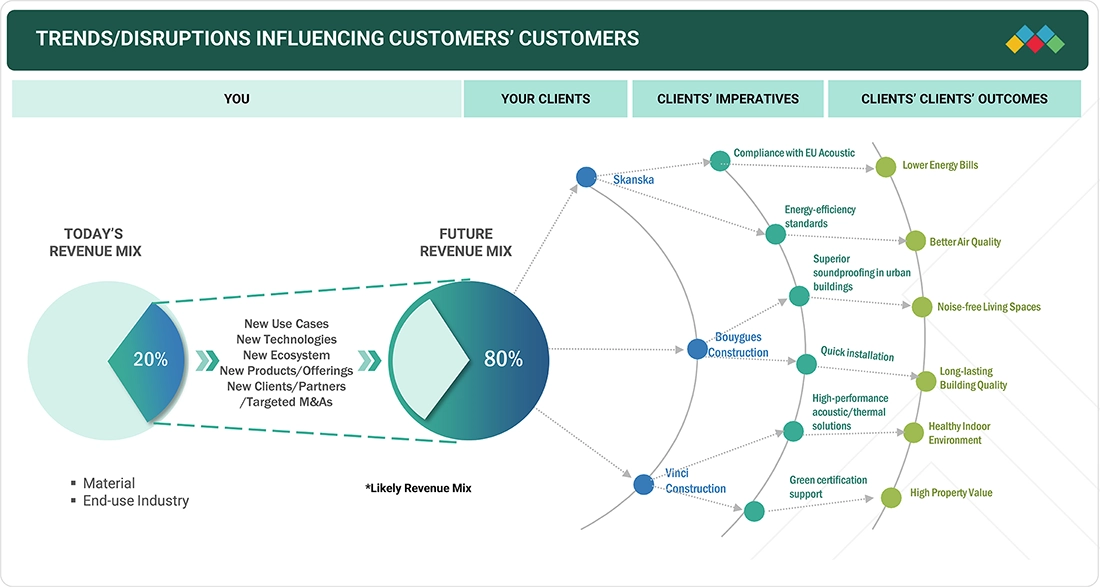
The impact on clients' businesses in Europe's acoustic insulation market stems from rapidly evolving requirements focused on building performance, sustainability, and regulatory compliance. Major clients such as Skanska, Bouygues Construction, and Vinci Construction are placing strong emphasis on developing high-quality acoustic and thermal solutions, fast installation, and the use of eco-friendly materials to meet EU standards while increasing customer satisfaction. As these factors intensify, the benefits will include lower operating costs, greater indoor comfort, healthier living spaces, and higher long-term property value, among others. This scenario underscores the need for continuous innovation, cutting-edge material technologies, and quality control to not only meet the requirements of today's occupants but also deliver sustainable, compliant, and high-value construction solutions throughout Europe.
Source: Secondary Research, Interviews with Experts, MarketsandMarkets Analysis
MARKET DYNAMICS

Level
-
Stringent building regulations

-
Growing urbanization and infrastructure development


Level
-
High installation and material costs

-
Volatility in raw material prices


Level
-
Growth of green and sustainable construction

-
Technological advancements and smart insulation materials


Level
-
Competition from low-cost alternatives

-
Supply chain disruptions and logistics constraints

Source: Secondary Research, Interviews with Experts, MarketsandMarkets Analysis
Driver: Stringent building regulations
The Europe acoustic insulation market is driven by strict building regulations, noise pollution awareness, and energy-efficient needs. Urbanization and infrastructure development boost demand across residential, commercial, and industrial sectors. Renovations, green building methods, and acoustic innovation also expand the market. The goals are to reduce noise, improve living conditions, and save energy. As compliance becomes mandatory, construction companies are adopting better insulation materials, ensuring steady demand in the region.
Restraint: High installation and material costs
High installation and material costs are a major barrier to the broader adoption of premium acoustic insulation solutions. Advanced materials, such as mineral wool, acoustic foams, and multilayer composites, often carry a higher price tag, making them less favorable for cost-sensitive projects. The need for experienced labor further increases the total installation cost. Although premium sound insulation offers long-term benefits, the upfront investment remains a barrier that keeps small residential projects and low-budget construction segments from adopting these solutions. This cost issue results in slow market penetration and leads builders to opt for less expensive alternatives, especially in areas where awareness is low or regulatory enforcement is weak.
Opportunity: Growth of green and sustainable construction
The expansion of green and sustainable construction is creating tremendous opportunities in Europe, as it leads the world in low-carbon and eco-safe building techniques. Green certifications such as BREEAM and LEED are placing greater emphasis on acoustic performance, resulting in increased demand for sustainable insulation materials made from natural or recycled fibers. To meet their climate targets, governments and developers are prioritizing eco-friendly construction. Manufacturers that supply low-emission, recyclable, and/or bio-based products will have a competitive advantage.
Challenge: Competition from low-cost alternatives
Competition from low-cost alternatives is a challenge for the insulation industry, as lower-priced products lure builders who are very conscious of their budgets, even though they offer little acoustic performance. The use of cheap materials may satisfy minimum standards but will not deliver the necessary long-term advantages such as comfort, health protection, and noise reduction. Price-based competition restricts the use of high-quality acoustic solutions and compels manufacturers to strategize meticulously between cost and performance. In areas where standards are not strictly enforced or consumers are unaware, low-cost materials rule the market, making it that much more difficult for top-quality materials to gain any market share.
EUROPE ACOUSTIC INSULATION MARKET: COMMERCIAL USE CASES ACROSS INDUSTRIES
| COMPANY | USE CASE DESCRIPTION | BENEFITS |
|---|---|---|
 |
Mineral wool and acoustic panels for building soundproofing | Strong sound absorption, energy efficient, fire resistant |
 |
Elastomeric foam for HVAC and industrial acoustic insulation | Lightweight, fiber-free, reduces impact & airborne noise, anti-corrosion |
 |
Viscoelastic membranes & panels for walls, floors, metal roofs | Thin profile, strong vibration damping, easy install, fire-protective |
 |
Stone wool slabs for walls, floors, ceilings, facades | Excellent sound blocking to 52 dB, non-combustible, moisture-resistant |
 |
Polyurethane-based acoustic materials for construction and industry | Lightweight, customizable damping, improved efficiency |
Logos and trademarks shown above are the property of their respective owners. Their use here is for informational and illustrative purposes only.
MARKET ECOSYSTEM
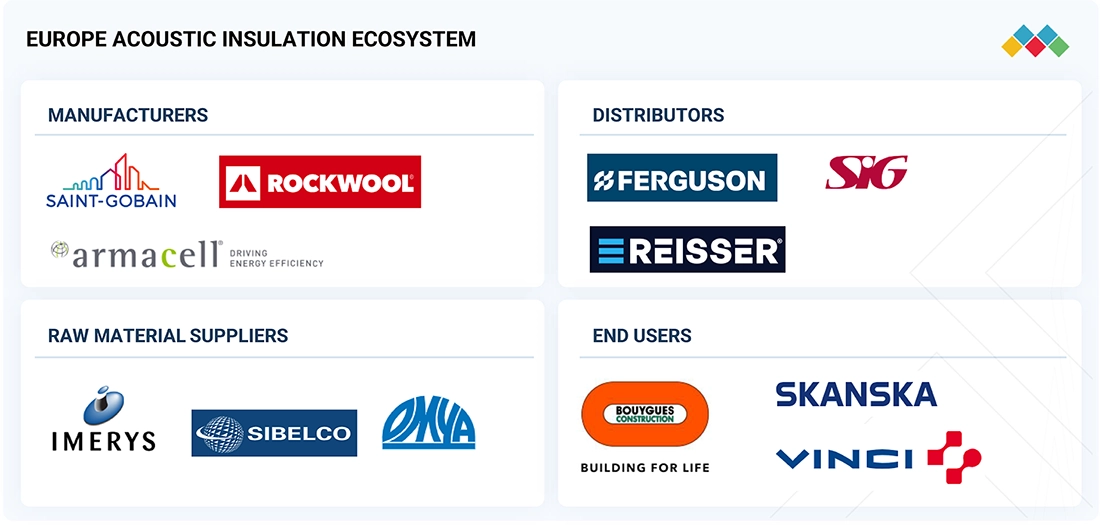
The ecosystem of the Europe acoustic insulation market comprises raw materials suppliers (Imerys S.A., Sibelco, Omya International AG), manufacturers (Saint-Gobain, ROCKWOOL A/S, Armacell), distributors (Ferguson, REISSER Schraubentechnik GmbH, SIG plc), and end users (VINCI, Bouygues Construction, Skanska). The raw materials suppliers provide the minerals, fibers, and specialty polymers necessary for producing high-performance acoustic insulation. The manufacturers process these materials and produce insulation products suitable for residential, commercial, and industrial applications. Meanwhile, the distributors handle storage, logistics, and transportation of products to contractors and builders. The end users, property developers, real estate firms, and construction companies, use acoustic insulation in their building projects to enhance indoor comfort and meet local noise control regulations.
Logos and trademarks shown above are the property of their respective owners. Their use here is for informational and illustrative purposes only.
MARKET SEGMENTS
Source: Secondary Research, Interviews with Experts, MarketsandMarkets Analysis
Europe acoustic insulation market, by Material
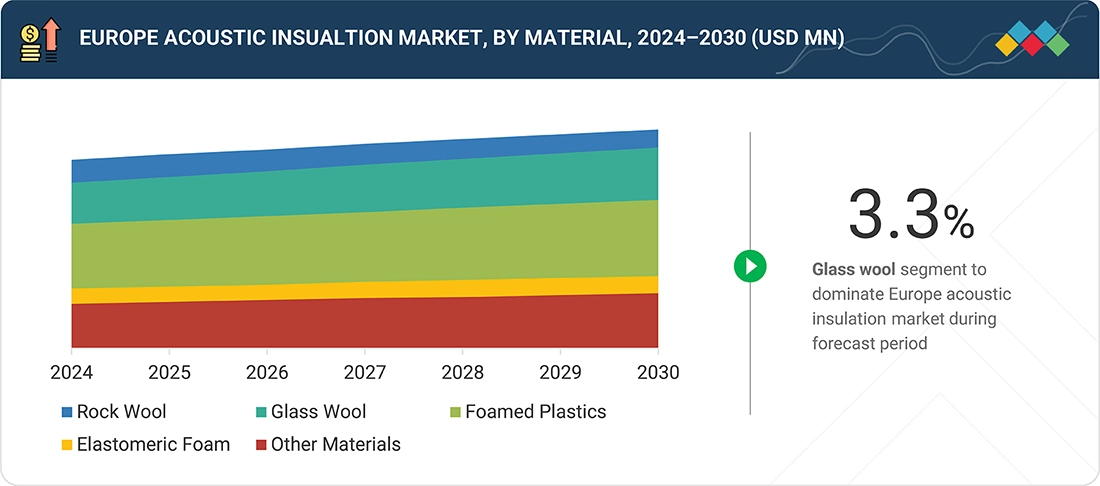
In Europe, rock wool dominates the acoustic insulation market due to its superior sound absorption and fire resistance, meeting strict building standards. Its non-flammability benefits construction in high-safety buildings like houses, offices, and factories. Its thermal resistance supports use in heating and cooling, aligning with energy efficiency goals. Europe’s advanced stone wool industry ensures availability, competitive pricing, and quality, driving rock wool’s popularity in new and renovated buildings.
Europe acoustic insulation market, by end-use industry
The Europe acoustic insulation market mainly serves the building and construction sector, driven by strict noise laws and consumer demand for quiet environments. Acoustic solutions are used in residential, commercial, and institutional buildings to meet European standards for comfort, safety, and energy efficiency. Rapid urbanization and dense city areas increase the need for noise control in multi-story residential, office, hospital, and school settings. Additionally, renovation projects across Europe continually demand soundproofing materials. Legal requirements, city growth, and comfort standards sustain this segment's dominance.
REGION
UK to be fastest-growing country in Europe acoustic insulation market during forecast period
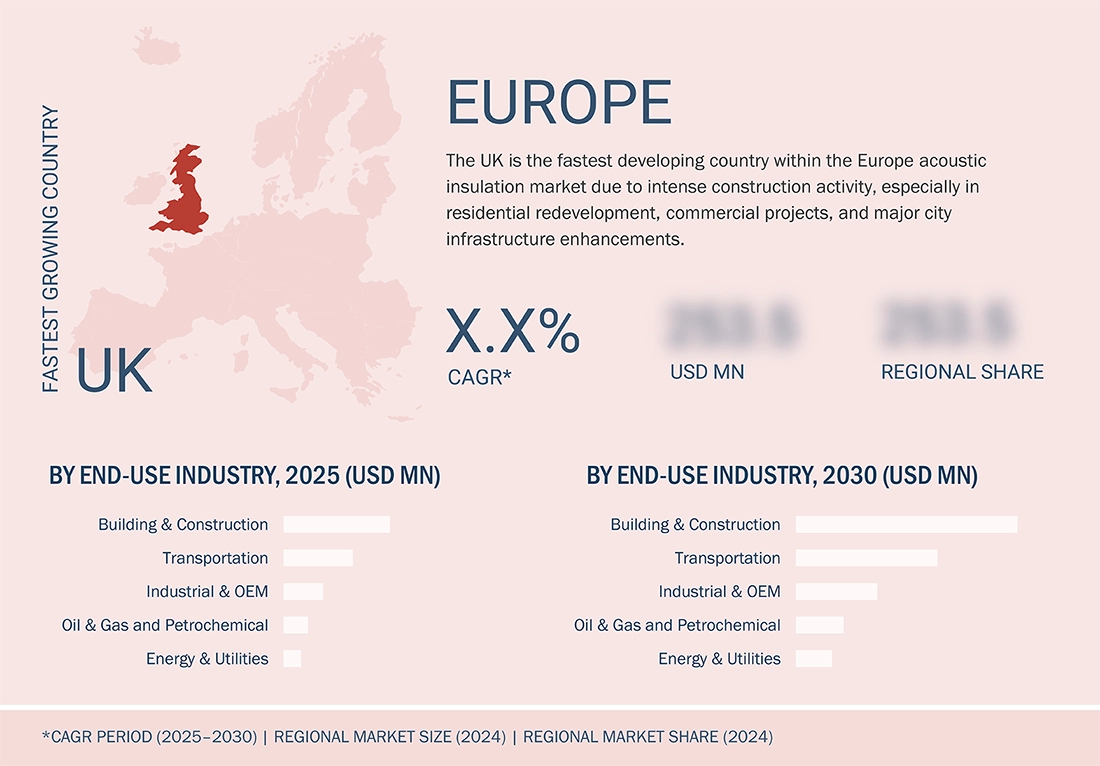
The UK has become Europe’s leading country in the acoustic insulation market, driven by high levels of construction activity, particularly in housing, commercial buildings, and infrastructure improvements in major cities. Increasingly strict regulations on noise and energy requirements are making the use of high-performance acoustic materials more common in both new construction and the renovation of existing buildings. Rapid urbanization in cities such as London and Manchester has made effective noise insulation in buildings increasingly important. Moreover, government-backed renovation initiatives and eco-friendly programs promote the use of high-quality insulation. Together, these factors are driving faster market growth in the UK than in the rest of Europe.
EUROPE ACOUSTIC INSULATION MARKET: COMPANY EVALUATION MATRIX
Saint-Gobain is a leading player in Europe's acoustic insulation market, primarily due to its broad product range, strong brand image, and advanced technologies, including mineral wool and acoustic systems, used in residential, commercial, and industrial projects. The company's extensive distribution network, together with continuous innovation, maintains its leadership in the market. On the other hand, Trelleborg is an emerging leader with advanced polymer-based acoustic solutions, further strengthening the company's focus on vibration and noise control and rapidly expanding into high-performance industrial and transportation segments, positioning it as a competitor to watch in the region.
Source: Secondary Research, Interviews with Experts, MarketsandMarkets Analysis
KEY MARKET PLAYERS
- Saint-Gobain (France)
- Armacell (Germany)
- Soprema (France)
- Rockwool A/S (Denmark)
- Kingspan Group (Ireland)
- BASF SE (Germany)
- Trelleborg (Sweden)
- L'ISOLANTE K-FLEX S.p.A. (Italy)
- REGUPOL Germany GmbH & Co. KG (Germany)
- Siderise (UK)
MARKET SCOPE
| REPORT METRIC | DETAILS |
|---|---|
| Market Size in 2024 (Value) | USD 6.11 Billion |
| Market Forecast in 2030 (Value) | USD 7.42 Billion |
| Growth Rate | CAGR of 3.0% from 2025–2030 |
| Years Considered | 2022–2030 |
| Base Year | 2024 |
| Forecast Period | 2025–2030 |
| Units Considered | Value (USD Million/Billion), Volume (Kiloton) |
| Report Coverage | Revenue Forecast, Company Ranking, Competitive Landscape, Growth Factors, and Trends |
| Segments Covered |
|
| Countries Covered | Germany, France, UK, Italy, Spain, Rest of Europe |
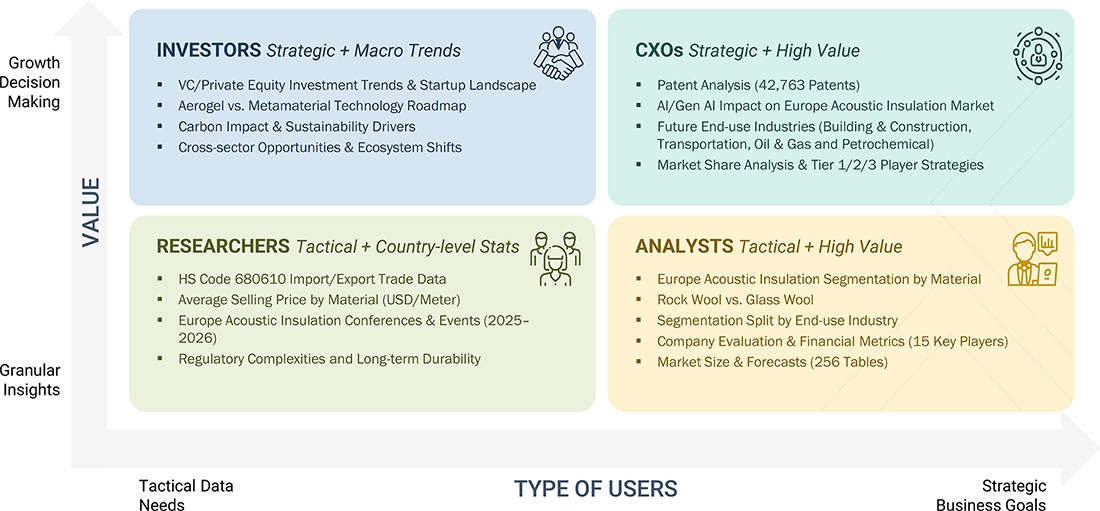
WHAT IS IN IT FOR YOU: EUROPE ACOUSTIC INSULATION MARKET REPORT CONTENT GUIDE
DELIVERED CUSTOMIZATIONS
We have successfully delivered the following deep-dive customizations:
| CLIENT REQUEST | CUSTOMIZATION DELIVERED | VALUE ADDS |
|---|---|---|
| Construction Contractor | Supplier profiling of acoustic insulation manufacturers (mineral wool, fiberglass, foams, recycled materials) based on certifications, production capacity, fire safety ratings, and compliance with EU building acoustics standards | Benchmark supplier reliability and identify opportunities for long-term sourcing partnerships and supply chain optimization |
| Acoustic Insulation Manufacturer | Technical and performance comparison of insulation materials (NRC, STC ratings) and sustainability assessment across mineral, fiber, and polymer-based solutions | Support product development, material innovation, and sustainability strategies to meet evolving building codes and customer requirements |
| Raw Material Supplier | Regional mapping of demand for mineral fibers, polymers, and recyclable acoustic materials across key European construction markets | Identify high-growth regions and emerging demand clusters, enabling strategic capacity planning and market expansion |
RECENT DEVELOPMENTS
- June 2022 : Armacell acquired the closed-down plant in Münster, Germany, from Knauf Ceiling Solutions GmbH & Co. KG. This acquisition facilitated the expansion of its production and storage facilities and simultaneously enhanced its research & development capacity for the development of next-generation insulation products.
- March 2022 : Saint-Gobain, through its insulation branch ISOVER, invested a whopping USD 126 million to increase insulation production capacity in France. The funds will be used not only to expand the operations of current ISOVER manufacturing lines but also to create a new manufacturing line.
- January 2021 : Armacell and smartMELAMINE, a collaborative initiative of the German TITK Group and the Slovenian company Melamine d.d., entered into a partnership agreement under which Armacell would define and promote smartMELAMINE's non-woven melamine resin products. These products, which possess excellent thermal and acoustic insulation properties, will enable Armacell to further strengthen its foothold in the automotive sector and are therefore mainly targeted at this industry.
Table of Contents
 Exclusive indicates content/data unique to MarketsandMarkets and not available with any competitors.
Methodology
The study involved four major activities in estimating the market size of the Europe acoustic insulation market. Exhaustive secondary research was done to collect information on the market, the peer market, and the grandparent market. The next step was to validate these findings, assumptions, and sizing with industry experts across the value chain through primary research. Both top-down and bottom-up approaches were employed to estimate the complete market size. Thereafter, the market breakdown and data triangulation procedures were used to estimate the market size of the segments and subsegments.
Secondary Research
In the secondary research process, various secondary sources have been referred to for identifying and collecting information for this study. These secondary sources include annual reports, press releases, investor presentations of companies, white papers, certified publications, trade directories, articles from recognized authors, gold standard and silver standard websites, and databases. Secondary research has been used to obtain key information about the value chain of the industry, monetary chain of the market, the total pool of key players, market classification and segmentation according to industry trends to the bottom-most level, and regional markets. It was also used to obtain information about the key developments from a market-oriented perspective.
Primary Research
The Europe acoustic insulation market comprises several stakeholders in the value chain, which include manufacturers, and end users. Various primary sources from the supply and demand sides of the Europe acoustic insulation market have been interviewed to obtain qualitative and quantitative information. The primary interviewees from the demand side include key opinion leaders in construction sector. The primary sources from the supply side include manufacturers, associations, and institutions involved in the europe acoustic insulation industry. Primary interviews were conducted to gather insights such as market statistics, data of revenue collected from the products and services, market breakdowns, market size estimations, market forecasting, and data triangulation. Primary research also helped in understanding the various trends related to material, end-use industry, and region. Stakeholders from the demand side, such as CIOs, CTOs, and CSOs were interviewed to understand the buyer’s perspective on the suppliers, products, component providers, and their current usage of europe acoustic insulation and outlook of their business, which will affect the overall market.
To know about the assumptions considered for the study, download the pdf brochure
Market Size Estimation
The top-down and bottom-up approaches have been used to estimate and validate the size of the Europe acoustic insulation market.
- The key players in the industry have been identified through extensive secondary research.
- The supply chain of the industry has been determined through primary and secondary research.
- All percentage shares, splits, and breakdowns have been determined using secondary sources and verified through primary sources.
- All possible parameters that affect the markets covered in this research study have been accounted for, viewed in extensive detail, verified through primary research, and analyzed to obtain the final quantitative and qualitative data.
- The research includes the study of reports, reviews, and newsletters of the key market players, along with extensive interviews for opinions with leaders such as directors and marketing executives.
Data Triangulation
After arriving at the total market size from the estimation process, the overall market has been split into several segments and sub-segments. To complete the overall market engineering process and arrive at the exact statistics for all the segments and sub-segments, the data triangulation and market breakdown procedures have been employed, wherever applicable. The data has been triangulated by studying various factors and trends from both the demand and supply sides. Along with this, the market size has been validated by using both the top-down and bottom-up approaches and primary interviews. Hence, for every data segment, there have been three sources—top-down approach, bottom-up approach, and expert interviews. The data was assumed correct when the values arrived from the three sources matched.
Market Definition
Acoustic insulation is a lightweight bulky material that absorbs sound wave and enhance work environment. Acoustic insulation absorbs sound when it enters buildings through the walls and ceilings, reducing echo in homes, workplaces, and other spaces. It's also utilized in automobiles and aircraft to lessen engine noise that enters the passenger cabin. It lessens reverberation across the room, which aids in sound absorption in auditoriums and concert halls.
Key Stakeholders
- Senior Management
- End User
- Finance/Procurement Department
- R&D Department
- Manufacturers
- Raw Material Suppliers
Report Objectives
- To define, describe, and forecast the size of the Europe acoustic insulation market, in terms of value and volume.
- To provide detailed information regarding the major factors (drivers, opportunities, restraints, and challenges) influencing the growth of the market
- To estimate and forecast the market size based on type, end-use industry, and region.
- To strategically analyze micromarkets with respect to individual growth trends, prospects, and their contribution to the overall market
- To analyze opportunities in the market for stakeholders and provide a competitive landscape of market leaders.
- To track and analyze recent developments such as expansions, new product launches, partnerships & agreements, and acquisitions in the market.
- To strategically profile key market players and comprehensively analyze their core competencies.
Available Customizations
Along with the given market data, MarketsandMarkets offers customizations according to the company’s specific needs. The following customization options are available for the report:
Regional Analysis
- Further breakdown of a region with respect to a particular country or additional application
Company Information
- Detailed analysis and profiles of additional market players
Tariff & Regulations
- Regulations and Impact on europe acoustic insulation market


Personalize This Research
- Triangulate with your Own Data
- Get Data as per your Format and Definition
- Gain a Deeper Dive on a Specific Application, Geography, Customer or Competitor
- Any level of Personalization
Let Us Help You
- What are the Known and Unknown Adjacencies Impacting the Europe Acoustic Insulation Market
- What will your New Revenue Sources be?
- Who will be your Top Customer; what will make them switch?
- Defend your Market Share or Win Competitors
- Get a Scorecard for Target Partners

Custom Market Research Services
We Will Customise The Research For You, In Case The Report Listed Above Does Not Meet With Your Requirements
Get 10% Free Customisation





Growth opportunities and latent adjacency in Europe Acoustic Insulation Market