Europe Augmented and Virtual Reality Market

Europe Augmented and Virtual Reality Market by Enterprise, Technology (Augmented Reality, Virtual Reality), Offering (Hardware, Software), Device Type (HMDS, HUDs, Gesture Tracking Devices), Application, and Country - Forecast to 2032




OVERVIEW
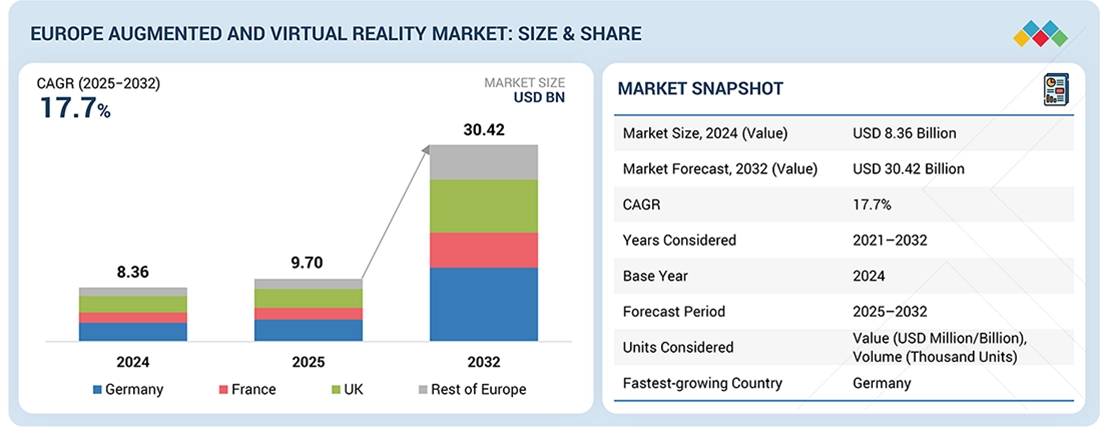
Source: Secondary Research, Interviews with Experts, MarketsandMarkets Analysis
The Europe augmented and virtual reality market is projected to grow from USD 9.70 billion in 2025 to USD 30.42 billion by 2032, registering a CAGR of 17.7% during the forecast period. The rapid adoption of AR and VR across gaming, entertainment, and immersive media is a key growth driver in the European region. This expansion is supported by AR’s ability to enhance user interaction with digital content and by ongoing advancements in VR that improve performance, ergonomics, and user comfort. The increasing traction of advanced devices such as Apple Vision Pro and Meta Quest 3 across European markets is further accelerating adoption and market growth.
Market Size & Forecast
• 2025 Market Size: USD 9.70 Billion
• 2032 Projected Market Size: USD 30.42 Billion
• CAGR (2025-2032): 17.7%
• AR Head-mounted Displays: Highest CAGR
• Germany: Largest Market Share
KEY TAKEAWAYS
-
By RegionGermany accounted for the largest market share of 34.6% in 2024.
-
By TechnologyBy technology, virtual reality recorded a dominant market share of 50.2% in 2024.
-
By OfferingBy offering, the virtual reality software segment is estimated to grow at a CAGR of 14.3% from 2025 to 2032.
-
By Device TypeAR head-mounted displays (HMDs) and VR gesture tracking devices are projected to witness the highest CAGR in the augmented and virtual reality market during the forecast period.
-
By ApplicationBy application, enterprise and consumer applications accounted for largest market size in 2024.
-
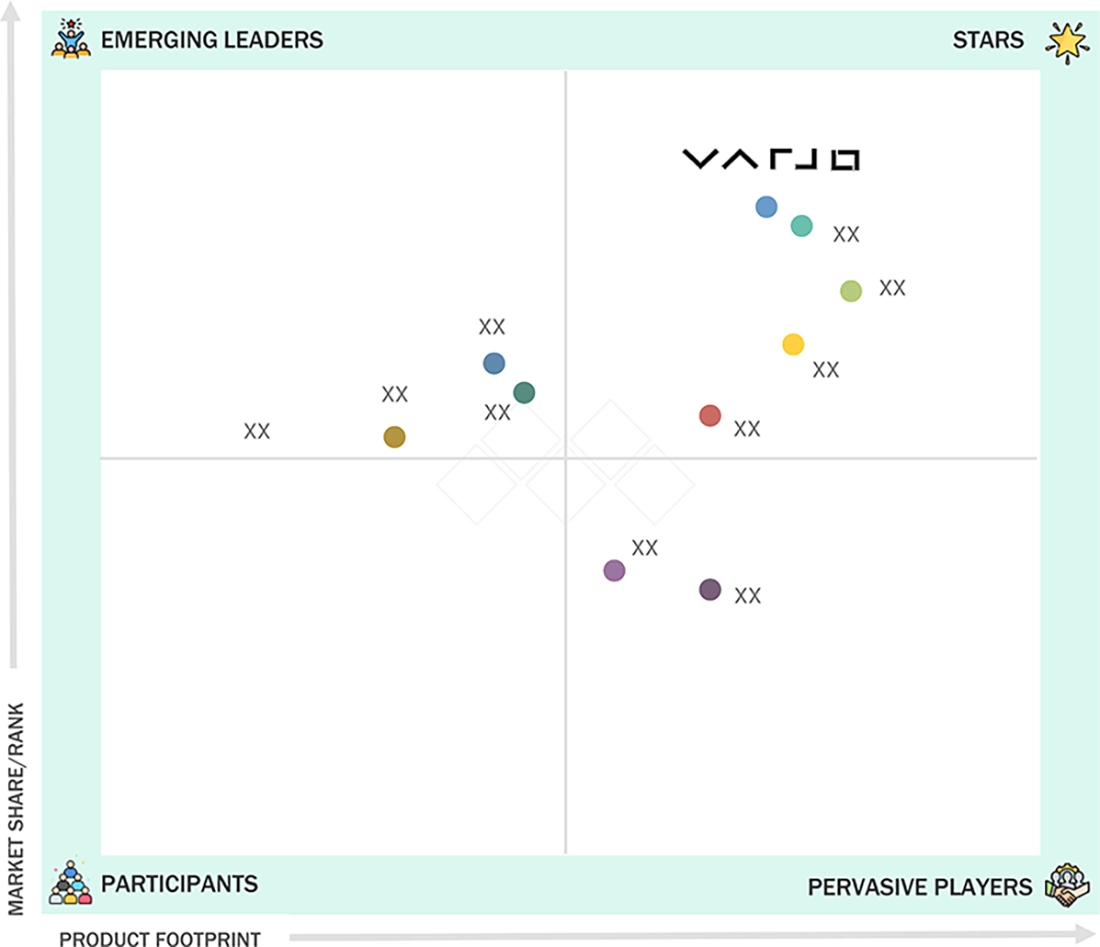
Competitive Landscape - Key PlayersScape Technologies (UK) and Varjo (Finland) are identified as the star players in the Europe augmented and virtual reality market, given their strong market share and product footprint.
-
Competitive Landscape - StartupsGemba (UK) is categorized among startups and SMEs by securing strong footholds in specialized niche areas, underscoring their potential as emerging market leaders.
Governments across the world are inducing the development of the AR market with their support in terms of AR funding, R&D support, startup grants, and partnerships with academic institutes. In September 2023, a UK-based holographic company, Envisics, which manufactures in-car technology that projects navigation and safety alerts onto the windscreen, raised USD 100 million in its Series C round and is projected to commercialize AR head-up displays during the forecast period.
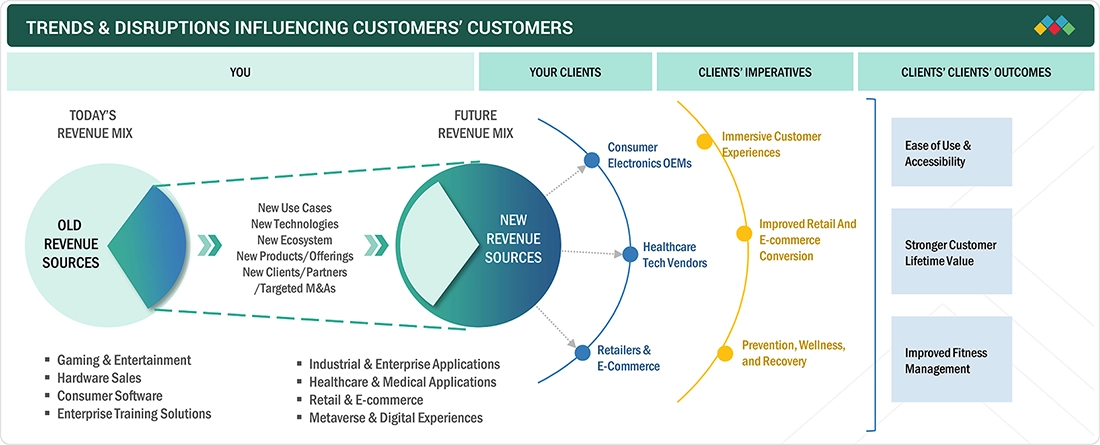
TRENDS & DISRUPTIONS IMPACTING CUSTOMERS' CUSTOMERS
In Europe, revenue in the AR and VR market is primarily driven by hardware components such as sensors, displays, semiconductor devices, cameras, and head-mounted systems, along with a rapidly expanding software ecosystem. While VR initially gained momentum through hardware adoption in gaming and entertainment, it has increasingly penetrated enterprise applications across industries. AR, on the other hand, has seen strong consumer and business interest, particularly in applications such as smart glasses, mobile AR, and near-eye displays for training, industrial operations, and remote assistance. Continuous innovation in AR-powered displays, microdisplays, and immersive visualization technologies is expected to create significant growth opportunities for AR and VR vendors in Europe over the next five years.
Source: Secondary Research, Interviews with Experts, MarketsandMarkets Analysis
MARKET DYNAMICS

Level
-
Enterprise digital transformation

-
Strong government and EU-level funding for immersive technologi


Level
-
High cost of hardware and deployment

-
Strict data privacy and compliance requirements (GDPR)


Level
-
Expansion of industrial and healthcare use cases

-
Rising adoption of AR/VR for workforce training and upskilling


Level
-
Fragmented ecosystem and interoperability issues

-
Limited availability of localized AR/VR content and language support

Source: Secondary Research, Interviews with Experts, MarketsandMarkets Analysis
Driver: Enterprise digital transformation
The growing adoption of AR and VR across enterprise sectors such as manufacturing, healthcare, automotive, and aerospace is a key driver in Europe. Companies are using immersive technologies for training, remote assistance, design visualization, and simulation to improve productivity and reduce operational costs. Strong momentum around Industry 4.0 and smart manufacturing further supports adoption.
Restraint: High cost of hardware and deployment
The high cost of advanced AR/VR hardware, software integration, and content development acts as a major restraint in the European market. Small and mid-sized enterprises often face budget constraints that limit large-scale deployment. Additionally, ongoing maintenance and upgrade costs can slow adoption in cost-sensitive industries.
Opportunity: Expansion of industrial and healthcare use cases
Expanding use cases in industrial training, predictive maintenance, digital twins, and medical simulation present strong growth opportunities in Europe. Increasing investments in healthcare digitization and workforce upskilling are driving demand for immersive solutions. Advancements in 5G, edge computing, and AI further enhance the potential for scalable AR/VR deployments across the region.
Challenge: Fragmented ecosystem and interoperability issues
The European AR/VR market faces challenges due to a fragmented ecosystem with multiple platforms, standards, and devices. Lack of interoperability between hardware, software, and enterprise IT systems complicates deployment and scalability. This fragmentation increases development complexity and slows time-to-market for solutions.
EUROPE AUGMENTED AND VIRTUAL REALITY MARKET: COMMERCIAL USE CASES ACROSS INDUSTRIES
| COMPANY | USE CASE DESCRIPTION | BENEFITS |
|---|---|---|
 |
Apple Vision Pro is used for spatial computing applications in enterprise collaboration, medical visualization, immersive media consumption, and advanced design workflows. | Enhanced productivity, realistic 3D visualization, improved user experience, and acceleration of spatial computing adoption across industries in North America |
 |
Meta Quest headsets are deployed for gaming, social VR, enterprise training, and virtual collaboration through Horizon Workrooms. | Cost-effective immersive experiences, scalable enterprise training, reduced training time, and strong ecosystem support for developers and content creators |
Logos and trademarks shown above are the property of their respective owners. Their use here is for informational and illustrative purposes only.
MARKET ECOSYSTEM
This illustrates the ecosystem of the AR and VR market, spanning the entire value chain from research and development to end users. Academic and research institutions drive core innovation, while component providers enable software platforms and processing capabilities. Device manufacturers translate these technologies into commercial AR/VR hardware, supported by distributors that ensure large-scale market reach. End users across industries such as aerospace, automotive, tourism, and healthcare ultimately drive demand and real-world adoption of AR and VR solutions.
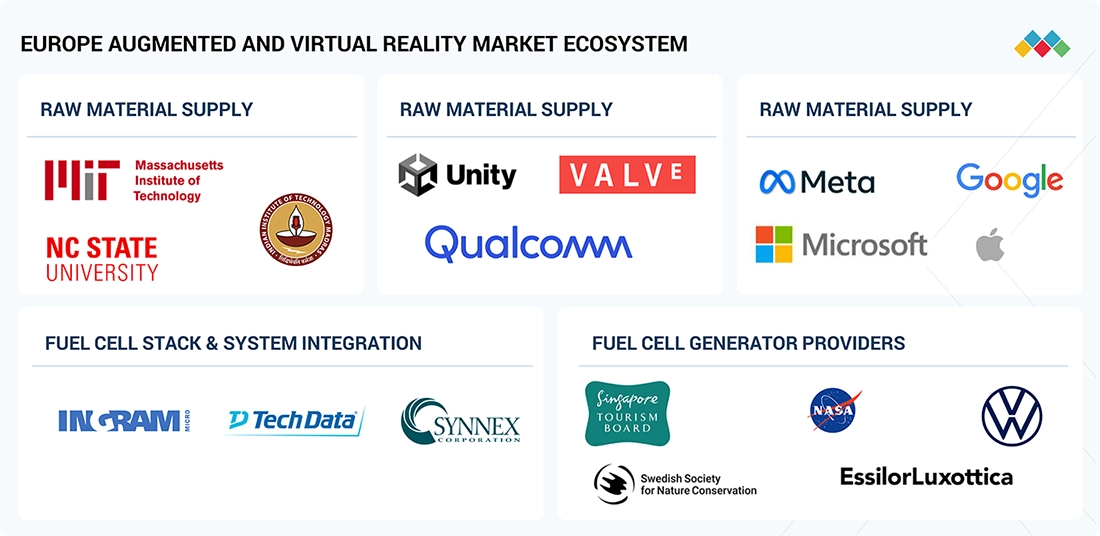
Logos and trademarks shown above are the property of their respective owners. Their use here is for informational and illustrative purposes only.
MARKET SEGMENTS
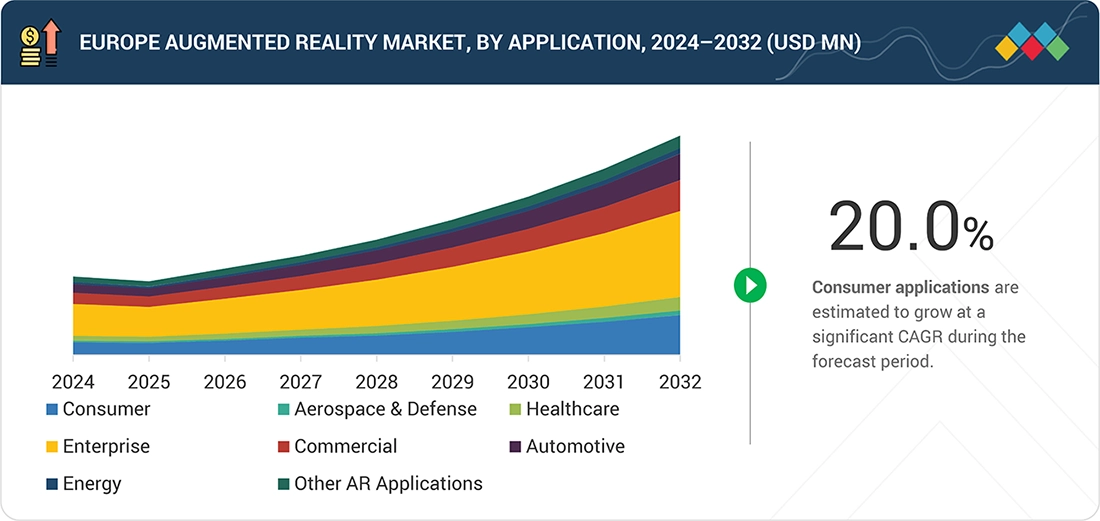
Source: Secondary Research, Interviews with Experts, MarketsandMarkets Analysis
Europe Augmented (AR) and Virtual Reality (VR) Market, by Application
In Europe, the enterprise application segment is projected to dominate the AR market during the forecast period in terms of market size. This growth is driven by the rising demand to enhance workforce training, minimize operational errors, and improve efficiency across key industries such as manufacturing, healthcare, automotive, and logistics. The adoption of AR for training, maintenance, and workflow optimization closely aligns with Industry 4.0 and smart factory initiatives across European countries, enabling real-time guidance and improved process visibility for enterprises.
Europe Augmented (AR) and Virtual Reality (VR) Market, by Technology
Augmented reality is projected to register the highest growth rate among immersive technologies in Europe due to its broad applicability across both enterprise and consumer use cases. Increasing adoption of mobile AR, smart glasses, and spatial computing solutions is accelerating deployment across industries such as manufacturing, healthcare, retail, and logistics. Ongoing advancements in computer vision, AI, and expanding 5G connectivity across European markets are further enhancing AR performance, scalability, and real-time capabilities.
Europe Augmented (AR) and Virtual Reality (VR) Market, by Offering
Software is set to account for the largest share of the AR and VR market in Europe due to the rising demand for content platforms, development tools, and enterprise application software. The increasing adoption of AR/VR across gaming, industrial training, simulation, and remote collaboration is generating strong recurring revenue from software licenses and subscription models. Widespread use of development engines and platforms such as Unity, Unreal Engine, and enterprise AR solutions further supports software dominance. Moreover, continuous software upgrades, customization requirements, and integration with AI and cloud services reinforce software’s leading position in the European market.
REGION
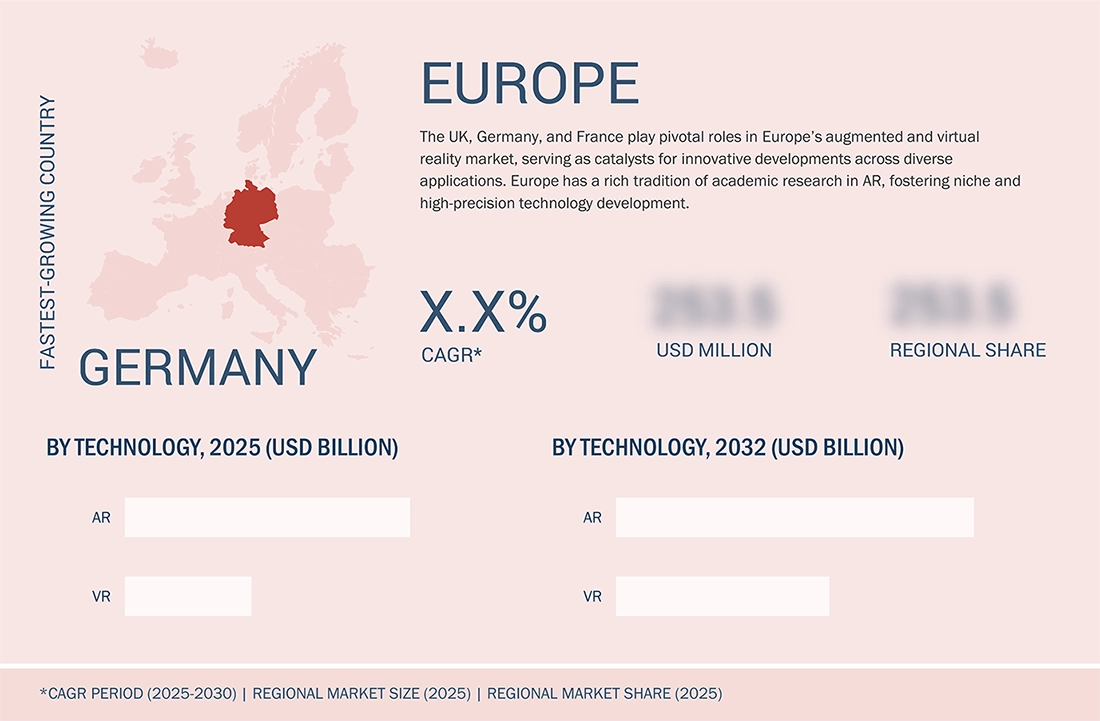
Germany to be fastest-growing region in AR and VR market during forecast period
Germany’s strong base of global automotive OEMs and industrial equipment manufacturers is driving large-scale adoption of AR/VR for design validation, predictive maintenance, and digital twin applications. The rapid rollout of private 5G networks and edge computing across industrial zones is further enabling low-latency immersive solutions. Growing collaboration between enterprises, research institutes, and AR/VR startups is also accelerating innovation and market expansion in the country.
North America augmented and virtual reality market is projected to reach USD 39.96 billion by 2030 from USD 10.25 billion in 2025, at a CAGR of 31.3% from 2025 to 2030. The rapid adoption of AR and VR applications across the gaming and entertainment industry is a key driver for the North America augmented and virtual reality market. Furthermore, the regional market is driven by AR’s ability to transform how users interact with digital content, along with advancements in VR that improve performance, form factor, and user comfort through devices such as Apple Vision Pro and Meta Quest 3, which have seen strong traction in the region.
EUROPE AUGMENTED AND VIRTUAL REALITY MARKET: COMPANY EVALUATION MATRIX
Stars are the leading market players in new developments, such as product launches, innovative technologies, and the adoption of growth strategies. These players have a broad portfolio, innovative product offerings, and a global presence. They have well-established channels throughout the value chain. Scape Technologies (UK) and Varjo (Finland) fall under this category.
Source: Secondary Research, Interviews with Experts, MarketsandMarkets Analysis
KEY MARKET PLAYERS
- Scape Technologies (UK)
- Varjo (Finland)
- WaveOptics (UK)
- Improbable (UK)
- Blippar Group Limited (UK)
- Psico Smart Apps S.L. (Spain)
- Continental AG (Germany)
- Virtually Live (Switzerland)
- Craftars (Romania)
- WayRay AG (Switzerland)
MARKET SCOPE
| REPORT METRIC | DETAILS |
|---|---|
| Market Size, 2024 (Value) | USD 8.36 Billion |
| Market Forecast, 2032 (Value) | USD 30.42 Billion |
| Growth Rate | CAGR of 17.7% from 2025 to 2032 |
| Years Considered | 2021–2032 |
| Base Year | 2024 |
| Forecast Period | 2025–2032 |
| Units Considered | Value (USD Million/Billion), Volume (Thousand Units) |
| Report Coverage | Revenue Forecast, Company Ranking, Competitive Landscape, Growth Factors, and Trends |
| Segments Covered |
|
| Regions Covered | Germany, France, UK, Rest of the Europe |
WHAT IS IN IT FOR YOU: EUROPE AUGMENTED AND VIRTUAL REALITY MARKET REPORT CONTENT GUIDE
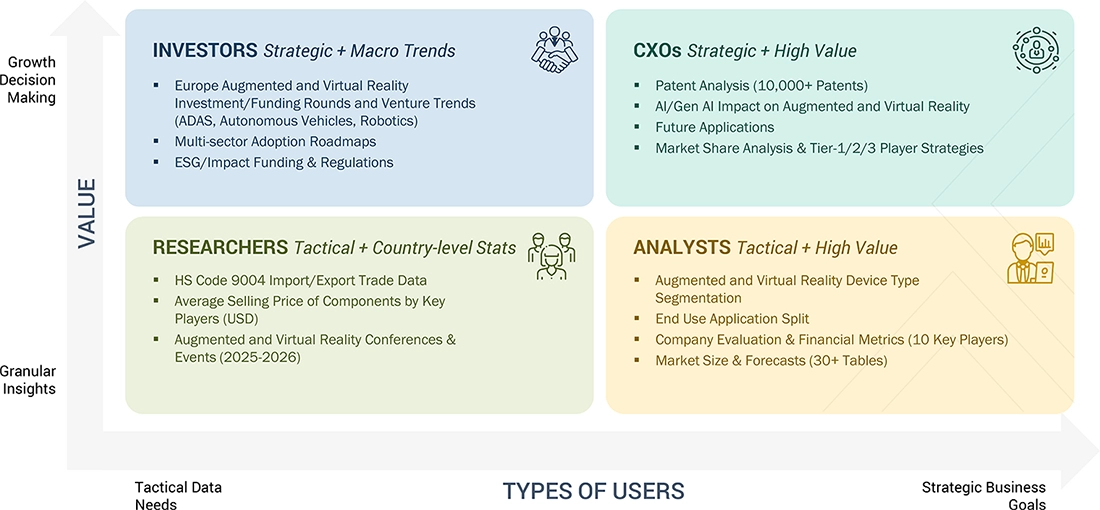
DELIVERED CUSTOMIZATIONS
We have successfully delivered the following deep-dive customizations:
| CLIENT REQUEST | CUSTOMIZATION DELIVERED | VALUE ADDS |
|---|---|---|
| Enterprise & Industrial Clients | Competitive benchmarking of AR/VR hardware and software providers (headsets, smart glasses, platforms), assessment of use-case feasibility for training, remote assistance, digital twins, and Industry 4.0 adoption across Europe | Enables enterprises to select cost-effective and scalable AR/VR solutions, reduce training errors, improve operational efficiency, and accelerate digital transformation initiatives |
RECENT DEVELOPMENTS
- June 2024 : Apple Inc. launched VisionOS 2, which provided Vision Pro with new spatial computing experiences. Through this, the user can turn their photos into spatial photos, gestures for navigating visionOS, and many more ways to take advantage of spatial computing.
- May 2024 : Alo Moves and Meta entered a partnership deal that will feature 3D classes for a new level of immersion. Under this partnership, Alo Moves will utilize Meta Quest 3 in the same rooms as the instructors for yoga, Pilates, and meditation classes.
- April 2024 : Meta and EssilorLuxottica partnered to produce second-generation smart glasses, which expanded the Ray-Ban Meta smart glasses collection. It includes additional features, such as updates to Meta Al, that will make the glasses more useful.
- June 2023 : Apple Inc. launched Vision Pro, a revolutionary spatial computer that allows users to stay present and connected to Other Hardware Components. It creates an infinite canvas for apps that scales beyond the boundaries of a traditional display and introduces a fully three-dimensional user interface controlled by the user's eyes, hands, and voice.
Table of Contents
 Exclusive indicates content/data unique to MarketsandMarkets and not available with any competitors.
Methodology
The research study involved 4 major activities in estimating the size of the augmented and virtual reality market. Exhaustive secondary research has been done to collect important information about the market and peer markets. The validation of these findings, assumptions, and sizing with the help of primary research with industry experts across the supply chain has been the next step. Both top-down and bottom-up approaches have been used to estimate the market size. Post which the market breakdown and data triangulation have been adopted to estimate the market sizes of segments and sub-segments.
Secondary Research
In the secondary research process, various secondary sources have been referred to for identifying and collecting information required for this study. The secondary sources include annual reports, press releases, and investor presentations of companies, white papers, and articles from recognized authors. Secondary research has been mainly done to obtain key information about the market’s value chain, the pool of key market players, market segmentation according to industry trends, regional outlook and developments from both market and technology perspectives.
Primary Research
In primary research, various primary sources from both supply and demand sides have been interviewed to obtain qualitative and quantitative insights required for this report. Primary sources from supply side include experts such as CEOs, vice presidents, marketing directors, manufacturers, technology and innovation directors, end users and related executives from multiple key companies and organizations operating in the augmented and virtual reality market ecosystem.
Market Size Estimation
Top-down and bottom-up approaches have been used to estimate and validate the size of the augmented and virtual reality market. The key players in the market have been identified through secondary research, and their market shares in respective regions have been determined through primary and secondary research. This entire research methodology includes the study of key insights by top players, as well as interviews with experts (such as CXOs, vice presidents, directors, and marketing executives) for quantitative and qualitative key insights. All percentage shares, splits, and breakdowns have been determined using secondary sources and verified through primary sources. All parameters that affect markets covered in this research study were accounted for, viewed in detail, verified through primary research, and analyzed to obtain the final quantitative and qualitative data. This data has been competitive and supplemented with detailed inputs and analysis from the MarketsandMarkets data repository and presented in this report.
In the market engineering process, both top-down and bottom-up approaches have been used along with data triangulation methods to estimate and validate the size of the augmented and virtual reality market and other dependent submarkets. The research methodology used to estimate the market sizes includes the following:
- Analyzing the size of the global augmented and virtual reality market by identifying segment and subsegment revenue related to the market
- Identifying the total number of augmented and virtual reality HMDs shipped globally
- Estimating the ASP of augmented and virtual reality HMDs
- Estimating the size of the augmented and virtual reality HMDs market (augmented and virtual reality HMDs shipment * ASP of augmented and virtual reality HMDs)
- Estimating the market size of other augmented and virtual reality display types
- Estimating the market size of augmented and virtual reality hardware market size (summation of augmented and virtual reality HMDs market and market of other augmented and virtual reality display types)
- Estimating the market size of augmented and virtual reality’s new software by determining its percentage increase with respect to augmented and virtual reality hardware market size
- Estimating the market size of augmented and virtual reality’s retrofitted software by determining its percentage increase with respect to augmented and virtual reality new software market size
- Estimating the augmented and virtual reality software market size (summation of augmented and virtual reality’s new software market and market of augmented and virtual reality’s retrofitted software)
- Estimating the global augmented and virtual reality market size (summation of augmented and virtual reality software market size and augmented and virtual reality hardware market size)
- Identifying the upcoming projects related to augmented and virtual reality by various companies in different regions and forecasting the market size based on these developments and other important parameters.
Data Triangulation
After arriving at the overall market size by the market size estimation process explained in the earlier section, the overall augmented and virtual reality market has been divided into several segments and subsegments. To complete the overall market engineering process and arrive at the exact statistics for all segments, the data triangulation and market breakdown procedures have been used, wherever applicable. The data has been triangulated by studying various factors and trends from both the demand and supply side perspectives. Along with data triangulation and market breakdown, the market has been validated by top-down and bottom-up approaches.
Market Definition
AR improves the natural environment by overlaying potential digital information which includes images, text, or 3D objects. This augmentation can be actualized in many devices such as AR head-mounted displays (HMDs), smartphones, tablets, AR smart glasses, and heads-up displays (HUDs). On top of a user's view of the actual world, the technology lays computer-generated elements—thus making it interactive and enriched. One of the common examples of AR is the Pokémon GO game, whereby digital creatures seem to exist within an actual world when viewed through the camera of a smartphone.
On the other hand, VR blacks out users into a completely computer-created environment and replace the real world with a simulated one physically. Users usually put on and wear VR head-mounted displays, which, covering the field of vision, often incorporate motion tracking sensors. This sort of head mounted displays, that give users a feeling of existing in a virtual world, is called a feeling of presence in frontier interact in and navigate this digital space as if it were real. Common uses of VR include gaming, training simulations, virtual tours, and immersive storytelling experiences.
Stakeholders
- Raw material and manufacturing equipment suppliers
- Semiconductor foundries
- Original Equipment Manufacturers (OEMs)
- Augmented and virtual reality device manufacturers
- Original design manufacturers (ODMs) and OEM technology solution providers
- Software, and Technology Providers
- Standardization and Testing Firms
- Government Bodies such as Regulatory Authorities and Policymakers
- Research Institutes and Organizations
- Market Research and Consulting Firms
- Technology investors
The main objectives of this study are as follows:
- To define, analyze and forecast the augmented and virtual reality market size, by virtual reality technology, offering, device type, and application in terms of value
- To define, analyze and forecast the augmented reality market size, by device type, in terms of volume.
- To provide detailed information regarding the major drivers, restraints, opportunities, and challenges influencing the growth of the augmented and virtual reality market
- To study the complete supply chain and related industry segments for the ar and vr market
- To strategically analyze the micromarkets1 with respect to individual growth trends, prospects, and contributions to the total market
- To analyze the supply chain, market ecosystem; trends/disruptions impacting customer’s business; technology analysis; pricing analysis; Porter’s five forces model; key stakeholders & buying criteria; case study analysis; trade analysis; patent analysis; key conferences & events, 2024–2025; regulations related to the augmented and virtual reality market; and investment and funding scenario.
- To analyze opportunities in the market for various stakeholders by identifying the high-growth segments of the market.
- To strategically profile the key players and comprehensively analyze their market position in terms of ranking, core competencies2, company valuation and financial metrics and product/brand comparison; along with detailing the competitive landscape for the market leaders.
- To analyze competitive developments such as product launches, product developments, partnerships, collaborations, acquisitions, joint investments, strategic supplier relations, contracts, acquisitions, expansions and research and development (R&D) activities carried out by players in the augmented and virtual reality market.
Customizations Options:
With the given market data, MarketsandMarkets offers customizations according to the company’s specific needs. The following customization options are available for the report:
Company Information
- Detailed analysis and profiling of additional market players (up to 5)
Geographic Information
- Detailed analysis of additional countries (up to 5)
Key Questions Addressed by the Report
What is the projected market value of the Europe Augmented Reality and Virtual Reality market?
The Europe Augmented Reality and Virtual Reality market is projected to reach a significant market value by the forecast period, driven by increasing adoption across gaming, healthcare, retail, and industrial applications.
Which region is expected to dominate the Europe Augmented Reality and Virtual Reality market?
Germany is expected to dominate the Europe Augmented Reality and Virtual Reality market due to strong technological advancements and growing investments in immersive technologies.
What are the key segments of the Europe Augmented Reality and Virtual Reality market?
The market is segmented by technology, component, device type, application, and country, with augmented reality, hardware devices, and enterprise and gaming applications accounting for a major share.
Who are the major key players in the Europe Augmented Reality and Virtual Reality market?
Major key players in the Europe Augmented Reality and Virtual Reality market include Microsoft Corporation, Meta Platforms, Inc., Sony Group Corporation, Google LLC, and HTC Corporation.
What factors are driving the growth of the Europe Augmented Reality and Virtual Reality market?
The growth of the Europe Augmented Reality and Virtual Reality market is driven by rising demand for immersive experiences, increasing investments in digital transformation, advancements in AR and VR technologies, and expanding applications across multiple industries.


Personalize This Research
- Triangulate with your Own Data
- Get Data as per your Format and Definition
- Gain a Deeper Dive on a Specific Application, Geography, Customer or Competitor
- Any level of Personalization
Let Us Help You
- What are the Known and Unknown Adjacencies Impacting the Europe Augmented and Virtual Reality Market
- What will your New Revenue Sources be?
- Who will be your Top Customer; what will make them switch?
- Defend your Market Share or Win Competitors
- Get a Scorecard for Target Partners

Custom Market Research Services
We Will Customise The Research For You, In Case The Report Listed Above Does Not Meet With Your Requirements
Get 10% Free CustomisationTESTIMONIALS

Tetsuya Ohhira
Business Development Manager-Technology Business
Nikon Corporation,
Leading Japanese MNC specializing in optics and imaging productswww.nikon.com
MarketsandMarkets™ response
is quick. Their attitude is flexible and positive. Analyst Insights are globally considered and
significant. Client Services quickly respond to our inquiry and demand. Their wide range of global
surveys help us make our strategic plan.
We hope Knowledge Store will be easier to search
for a report.
VP - Marketing & Business Development
Leading Provider of Process Control Solutions
We engaged with MarketsandMarkets on a study to perform an analysis and recommend a Go-To-Market strategy for metrology and process control in the semiconductor market. The study was tailored to our targets and needs with well-defined milestones. Our overall experience with the MarketsandMarkets team was very good throughout the project in all aspects including the analysis methodologies used, the quality and depth of primary and secondary data sets, the professionalism and flexibility of the team and the ability to meet the target schedule and milestones. We want to thank MarketsandMarkets team for a job well done.






Growth opportunities and latent adjacency in Europe Augmented and Virtual Reality Market