Europe IoT Technology Market Size, Share & Growth, 2030

Europe IoT Technology Market by Node Component (Sensor, Memory Device, Connectivity IC, Processor, Logic Devices), Software Solution (Remote Monitoring, Data Management), Platform, Service, End-Use Application, and Country - Forecast to 2030




OVERVIEW
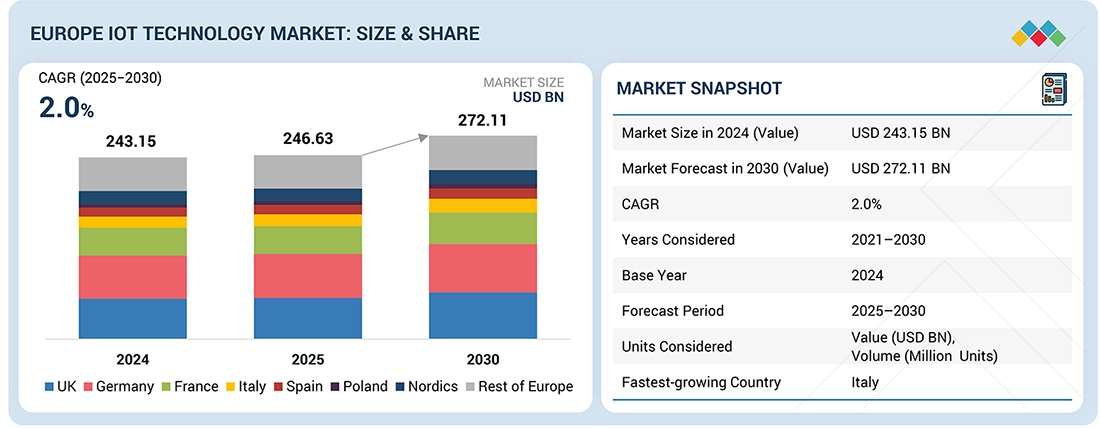
Source: Secondary Research, Interviews with Experts, MarketsandMarkets Analysis
The Europe IoT Technology market is projected to reach USD 272.11 billion by 2030 from the estimated USD 246.63 billion in 2025, at a CAGR of 2.0% from 2025 to 2030. The IoT technology market in Europe is experiencing strong growth due to increased adoption of smart devices, the rollout of 5G, and the deployment of smart cities.
Market Size & Forecast
KEY TAKEAWAYS
-
By RegionGermany is the largest market for IoT technology in Europe with a share of 23.9% in 2024.
-
By IoT Software SolutionBy IoT software solution, the remote monitoring segment is expected to have a growth rate of 5.4% from 2025 to 2030.
-
By IoT PlatformBy IoT platform, the network management segment accounted for a market share of 48.1% in 2024.
-
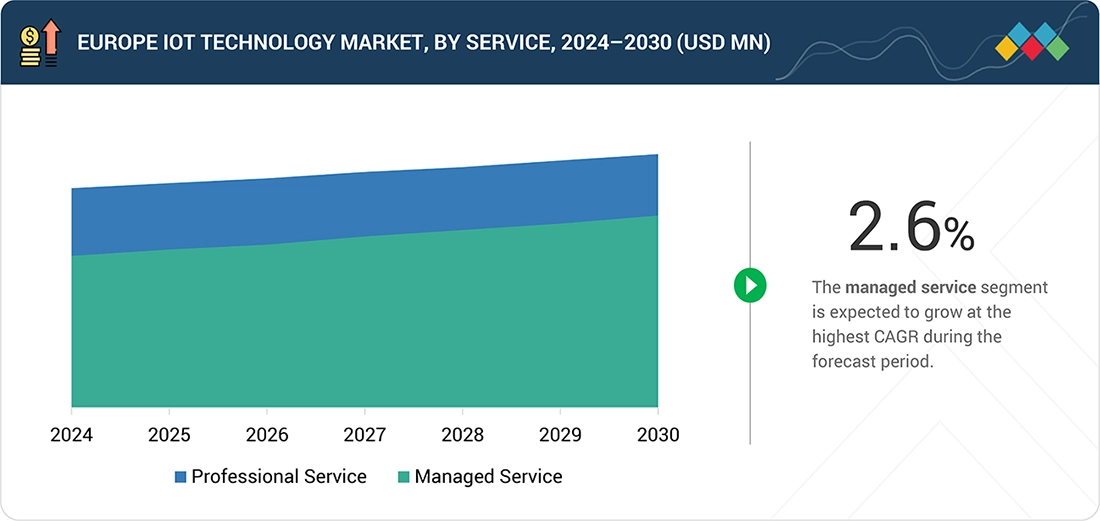
By IoT ServiceBy IoT service, the managed service segment is projected to register the highest CAGR during the forecast period.
-
By IoT Node ComponentBy IoT node component, the processor segment is estimated to account for the largest market share in 2024.
-
By End Use ApplicationBy end-use application, the consumer application segment is estimated to account for the largest market share in 2024.
-
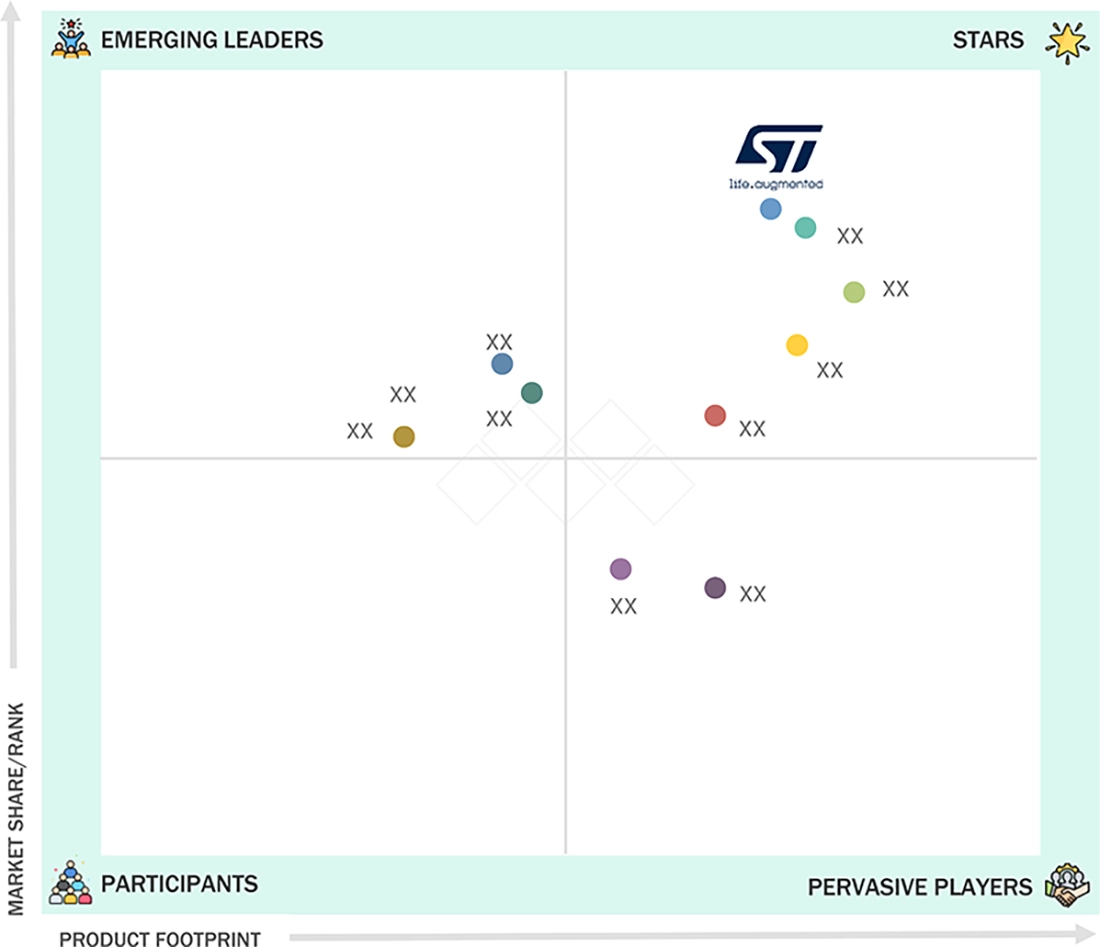
Competitive LandscapeSTMicroelectronics (Switzerland) and Siemens (Germany) are identified as the star players in the IoT technology market Europe, given their strong market share and product footprint.
-
Competitive LandscapeKONUX GmbH (Germany) and Nextome (Italy) have distinguished themselves among startups and SMEs by securing strong footholds in specialised niche areas, underscoring their potential as emerging market leaders.
The IoT technology market is experiencing rapid growth due to the increasing adoption of connected devices across industries. Advancements in cloud computing, AI, and 5G networks are enabling real-time data analytics and scalable IoT deployments. Growing use cases in smart homes, industrial automation, healthcare, and transportation continue to drive market expansion in Europe.
TRENDS & DISRUPTIONS IMPACTING CUSTOMERS' CUSTOMERS
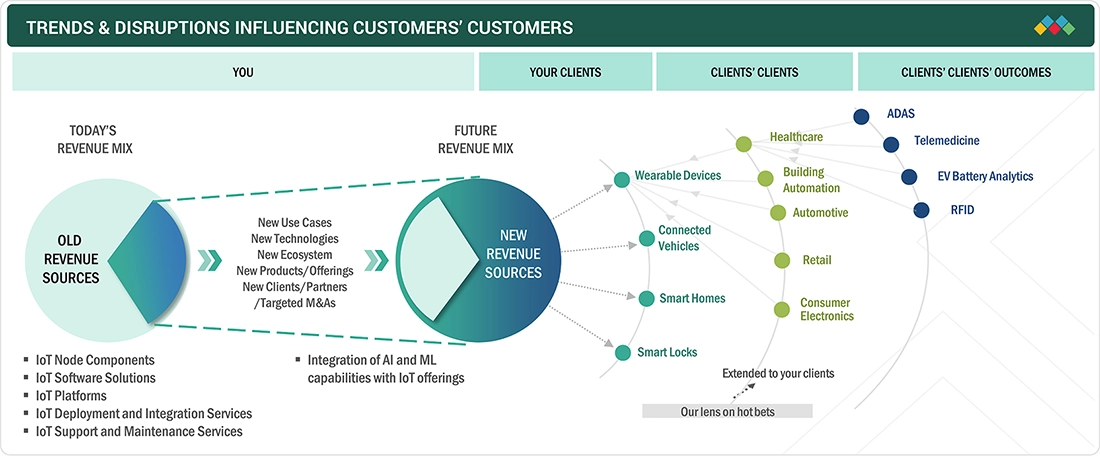
The visual highlights how disruptive trends are reshaping customer business models in Europe. While the current revenue mix remains largely anchored in established IoT components, platforms, and services, future growth in the region is expected to come from areas such as wearable devices, smart homes, and connected vehicles. These “hot bets” are prompting enterprises to adapt to evolving priorities across key European industries, including healthcare, automotive, building automation, and retail. As this transition accelerates, revenue will increasingly be driven by advanced applications such as ADAS, telemedicine, EV battery analytics, and RFID, underscoring the need for alignment with future-ready technologies to capture new value streams.
Source: Secondary Research, Interviews with Experts, MarketsandMarkets Analysis
MARKET DYNAMICS

Level
-
Strong industrial digitalization


Level
-
Data privacy and regulatory complexity


Level
-
Smart cities and sustainability initiatives


Level
-
Interoperability and legacy infrastructure

Source: Secondary Research, Interviews with Experts, MarketsandMarkets Analysis
Strong industrial digitalization
Europe’s advanced manufacturing base is rapidly adopting Industry 4.0, driving demand for IoT-enabled automation, predictive maintenance, and real-time monitoring. Strong government support for digital transformation and smart factories further accelerates IoT deployment. The presence of established automotive and industrial players boosts large-scale IoT adoption.
Data privacy and regulatory complexity
Strict data protection regulations, such as GDPR, increase compliance costs and complexity for IoT deployments. Companies must invest heavily in data security, consent management, and governance frameworks. This slows down implementation, especially for startups and cross-border IoT projects.
Smart cities and sustainability initiatives
Europe’s focus on sustainability and carbon reduction is creating strong opportunities for IoT in smart cities, energy management, and smart grids. IoT solutions enable efficient traffic management, waste reduction, and optimized energy consumption. EU-funded green and digital initiatives further support market growth.
Interoperability and legacy infrastructure
The Europe IoT market faces challenges due to fragmented standards and lack of interoperability across devices and platforms. Integrating IoT solutions with existing legacy systems increases technical complexity and costs. This can delay ROI realization for enterprises and public-sector projects.
EUROPE IOT TECHNOLOGY MARKET: COMMERCIAL USE CASES ACROSS INDUSTRIES
| COMPANY | USE CASE DESCRIPTION | BENEFITS |
|---|---|---|
 |
Siemens’ IoT solutions (MindSphere) are deployed in smart manufacturing, energy management, and industrial automation to connect machines, production lines, and sensors with cloud-based analytics and digital twins. | Improved operational efficiency, predictive maintenance, reduced unplanned downtime, optimized energy consumption, and enhanced decision-making through real-time insights |
 |
Bosch IoT Suite is used across smart factories, mobility, smart homes, and connected infrastructure to manage devices, collect sensor data, and enable AI-driven automation. | Enhanced asset visibility, increased productivity, lower operational costs, improved safety, and faster innovation cycles through scalable IoT platforms |
Logos and trademarks shown above are the property of their respective owners. Their use here is for informational and illustrative purposes only.
MARKET ECOSYSTEM
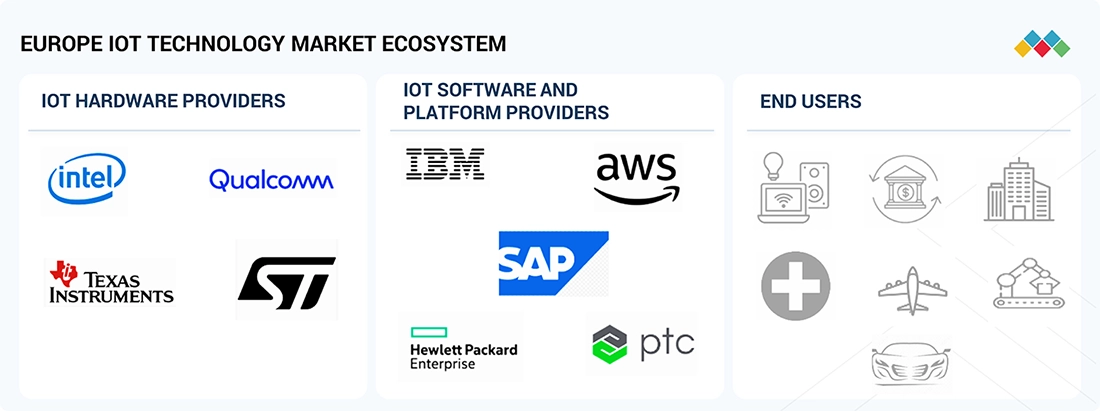
The IoT technology ecosystem comprises key hardware providers, including Intel, Qualcomm, Texas Instruments, and STMicroelectronics, which supply the essential semiconductor components and devices that enable connectivity and sensing. On the software and platform side, major players like IBM, AWS, SAP, Hewlett Packard Enterprise, and PTC offer cloud services, data analytics, and IoT management platforms critical for device orchestration and data processing. This ecosystem supports a diverse range of end users across various sectors, including smart homes, banking, commercial buildings, aviation, industrial manufacturing, agriculture, and automotive. The integration of hardware, software, and diverse applications illustrates the interconnected and multi-layered nature of the IoT industry, driving innovation and adoption across industries.
Logos and trademarks shown above are the property of their respective owners. Their use here is for informational and illustrative purposes only.
MARKET SEGMENTS
Source: Secondary Research, Interviews with Experts, MarketsandMarkets Analysis
Europe IoT Technology Market, By Region
Germany accounts for the largest share in the Europe IoT technology market due to its well-established tech ecosystem, high levels of digital infrastructure investment, and strong adoption of 5G networks across industries. Its supportive regulatory environment and robust startup and enterprise landscape drive accelerated deployment of IoT solutions in smart cities, healthcare, and industrial sectors.
Europe IoT Technology Market, By Node Component
In the Europe IoT technology market, the processor segment within node components is expected to account for the largest share over the forecast period. IoT deployments are expanding across smart manufacturing, smart homes, healthcare, energy management, and smart city initiatives, with each connected device requiring a processor to manage local data processing, connectivity, and core functions. As Europe IoT applications increasingly focus on Industry 4.0, sustainability, and data security, demand is rising for advanced processors capable of supporting edge analytics, enhanced cybersecurity, and real-time decision-making.
Europe IoT Technology Market, By Software Solution
In the Europe IoT technology market, the data management software segment accounts for the largest share. Software platforms are designed to address interoperability challenges arising from diverse and fragmented IoT ecosystems, while efficiently managing the large volumes of data generated by connected devices and ensuring compliance with strict data security and privacy regulations. As IoT adoption expands across industries, the volume of unstructured data continues to grow rapidly, driving strong demand for solutions that can organize, secure, and govern data. By enabling organizations to store, process, and analyze IoT data for actionable insights, data management software has become a critical foundation of IoT deployments across Europe.
Europe IoT Technology Market, By Platform
By platform, the network management segment accounts for the largest share of the Europe IoT technology market. Network management platforms deliver essential functions, such as device authentication, provisioning, configuration, monitoring, routing, and remote firmware and security updates, ensuring reliable performance across large and diverse IoT deployments. These solutions are typically device-agnostic, enabling European enterprises to integrate multi-vendor hardware, protocols, and data models through a unified and simplified management interface.
Europe IoT Technology Market, By Service
In the Europe IoT technology market, professional services account for the larger share of the overall services segment, both during deployment and across the post-implementation lifecycle. These services include planning, architecture design, consulting, system integration, and ongoing upgrades, which are becoming increasingly critical as IoT deployments grow more complex and involve multiple vendors and regulatory requirements.
Europe IoT Technology Market, By End-use Application
In the Europe IoT technology market, the industrial segment is projected to be the fastest-growing end-use application as enterprises accelerate the adoption of connected solutions for automation, predictive maintenance, and end-to-end process optimization. Growth is driven by strong Industry 4.0 initiatives and digital transformation across manufacturing, logistics, and energy sectors, resulting in large-scale deployment of connected equipment and smart infrastructure. The increasing integration of IoT with AI, robotics, and advanced analytics is enabling significant efficiency improvements and cost savings, further accelerating industrial IoT adoption across Europe.
REGION
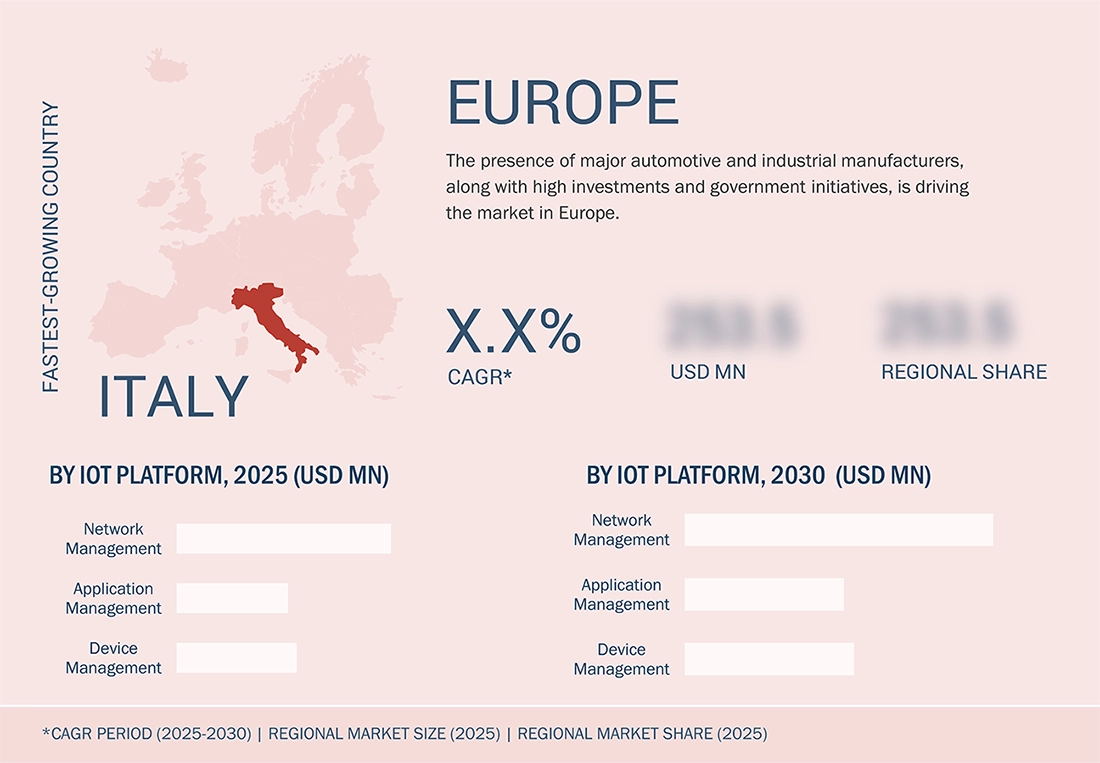
Italy to be fastest-growing region in Europe IoT Technology market during forecast period
Italy is projected to register the highest growth rate in the Europe IoT technology market due to rapid digitalization across sectors such as manufacturing, smart cities, and utilities. Strong government initiatives supporting Industry 4.0 and increasing investments in connectivity infrastructure are accelerating IoT adoption nationwide. Additionally, a growing ecosystem of startups and technology integrators is driving innovation and deployment of IoT solutions across the country
The Asia Pacific IoT technology market is projected to reach USD 351.03 billion by 2030 from USD 260.76 billion in 2025, at a CAGR of 6.1%. The market in the Asia Pacific region is witnessing robust growth, driven by the rising adoption of smart devices, the accelerated rollout of 5G networks, and the large-scale implementation of smart city and digital infrastructure projects across the region
The North America IoT Technology market is projected to reach USD 314.75 billion by 2030 from USD 279.90 billion in 2025, at a CAGR of 2.4% from 2025 to 2030. The market is experiencing strong growth, driven by the early adoption of advanced digital technologies across various industries. Increased investments in smart manufacturing, smart cities, healthcare IoT, and connected vehicles are accelerating market expansion. Additionally, the widespread deployment of 5G and the development of strong cloud and AI ecosystems are further supporting IoT adoption in the region.
EUROPE IOT TECHNOLOGY MARKET: COMPANY EVALUATION MATRIX
Stars are the leading market players in the Europe IoT Technology comapnies . They implement product launches, innovative technologies, and growth strategies. These players have a broad portfolio, innovative product offerings, and a global presence. They have well-established channels throughout the value chain. These companies are well-known in the market. STMicroelectronics (Switzerland) and Siemens (Germany) come under this category.
Source: Secondary Research, Interviews with Experts, MarketsandMarkets Analysis
KEY MARKET PLAYERS
- STMicroelectronics (Switzerland)
- Siemens (Germany)
- SAP SE (Germany)
- Robert Bosch GmbH (Germany)
- Schnider Electric (France)
- NXP Semiconductors N.V. (Netherlands)
- TE Connectivity (Switzerland)
- Software AG (Germany)
- Arm Limited (UK)
- Cellhire PLC (UK)
MARKET SCOPE
| REPORT METRIC | DETAILS |
|---|---|
| Market Size in 2024 (Value) | USD 243.15 Billion |
| Market Forecast in 2030 (Value) | USD 272.11 Billion |
| Growth Rate | CAGR of 2.0% from 2025-2030 |
| Years Considered | 2021-2030 |
| Base Year | 2024 |
| Forecast Period | 2025-2030 |
| Units Considered | Value (USD Million/Billion), Volume (Million Units) |
| Report Coverage | Revenue forecast, company ranking, competitive landscape, growth factors, and trends |
| Segments Covered |
|
| Regions Covered | Europe (UK, Germany, France, Italy, Spain, Poland, the Nordics, and Rest of Europe) |
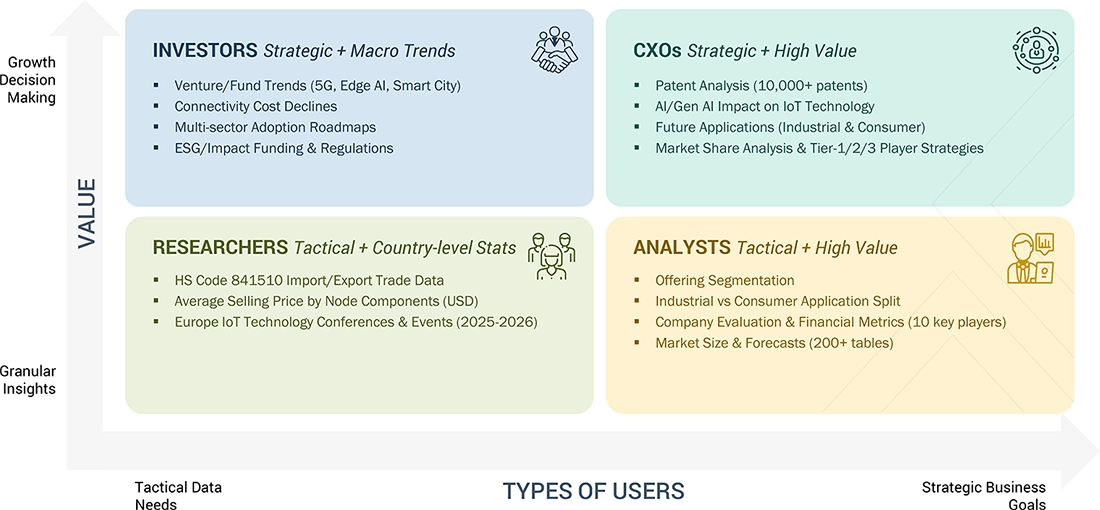
WHAT IS IN IT FOR YOU: EUROPE IOT TECHNOLOGY MARKET REPORT CONTENT GUIDE
DELIVERED CUSTOMIZATIONS
We have successfully delivered the following deep-dive customizations:
| CLIENT REQUEST | CUSTOMIZATION DELIVERED | VALUE ADDS |
|---|---|---|
| Enterprise & Industrial Clients |
|
Enables enterprises to select cost-effective and scalable IoT solutions, improve asset reliability through predictive maintenance, enhance energy efficiency and sustainability, ensure regulatory compliance, and accelerate Industry 4.0 and digital transformation initiatives across European operations |
RECENT DEVELOPMENTS
- December 2025 : Comau, an Italian firm headquartered in Turin, signed a USD 58.99 million finance contract with the European Investment Bank. The investment supports R&D in robotics, advanced automation, and digital technologies for sectors such as batteries, aerospace, and logistics.
- December 2024 : Sensorfact, based in Utrecht, Netherlands, develops IoT platforms for energy monitoring and machine maintenance. The company raised USD 28 million in Series B funding to expand its smart systems for industrial applications.
Table of Contents
 Exclusive indicates content/data unique to MarketsandMarkets and not available with any competitors.
Methodology
The research process for this study included systematic gathering, recording, and analysis of data about customers and companies operating in the Europe IoT technology market. This process involved the extensive use of secondary sources, directories, and databases (Factiva, Oanda, and OneSource) for identifying and collecting valuable information for the comprehensive, technical, market-oriented, and commercial study of the Europe IoT technology market. In-depth interviews were conducted with primary respondents, including experts from core and related industries and preferred manufacturers, to obtain and verify critical qualitative and quantitative information as well as to assess growth prospects. Key players in the Europe IoT technology market were identified through secondary research, and their market rankings were determined through primary and secondary research. This research included studying annual reports of top players and interviewing key industry experts such as CEOs, directors, and marketing executives.
Secondary Research
In the secondary research process, various secondary sources were referred to to identify and collect information important for this study. Secondary sources included corporate filings, such as annual reports, investor presentations, and financial statements; trade, business, and professional associations; white papers; Europe IoT technology products-related journals; certified publications; articles by recognized authors; directories; and databases.
Secondary research was conducted to obtain key information about the industry supply chain, market value chain, key players, market classification, and segmentation as per industry trends to the bottom-most level, geographic markets, and key developments from both market- and technology-oriented perspectives. Data from secondary research was collected and analyzed to determine the overall market size, which was further validated by primary research.
Primary Research
In the primary research process, various primary sources from the supply and demand sides were interviewed to obtain qualitative and quantitative information for this report. Primary sources from the supply side included industry experts such as CEOs, VPs, marketing directors, technology & innovation directors, and key executives from major companies in the Europe IoT technology market.
After going through market engineering (which includes calculations for market statistics, market breakdown, market size estimations, market forecasting, and data triangulation), extensive primary research was conducted to gather information and verify and validate the critical numbers obtained. Primary research was conducted to identify segmentation types, industry trends, key players, competitive landscape, and key market dynamics such as drivers, restraints, opportunities, and challenges, along with the key strategies adopted by players operating in the market.
To know about the assumptions considered for the study, download the pdf brochure
Market Size Estimation
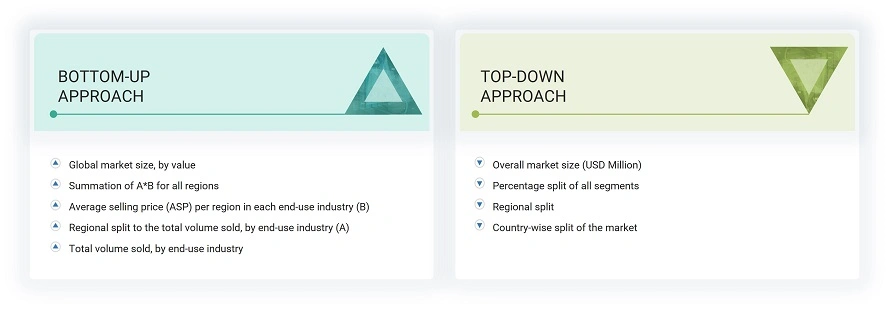
In the complete market engineering process, both top-down and bottom-up approaches were used, along with several data triangulation methods, to estimate and forecast the size of the market and its segments and subsegments listed in the report. Extensive qualitative and quantitative analyses were carried out on the complete market engineering process to list the key information/insights pertaining to the Europe IoT technology market.
The key players in the market were identified through secondary research, and their rankings in the respective regions were determined through primary and secondary research. This entire procedure involved the study of the annual and financial reports of top players, as well as interviews with industry experts such as chief executive officers, vice presidents, directors, and marketing executives for quantitative and qualitative key insights. All percentage shares, splits, and breakdowns were determined using secondary sources and verified through primary sources. All parameters that affect the markets covered in this research study were accounted for, viewed in extensive detail, verified through primary research, and analyzed to obtain the final quantitative and qualitative data. This data was consolidated and enhanced with detailed inputs and analysis from MarketsandMarkets and presented in this report.
Europe IoT Technology Market: Top-Down and Bottom-Up Approach
Data Triangulation
After arriving at the overall size of the Europe IoT technology market from the market size estimation process explained above, the total market was split into several segments and subsegments. Where applicable, the market breakdown and data triangulation procedures were employed to complete the overall market engineering process and arrive at the exact statistics for all segments and subsegments. The data was triangulated by studying various factors and trends from both the demand and supply sides. Along with this, the market size was validated using top-down and bottom-up approaches.
Market Definition
IoT is a key digital transformation technology, enabling businesses to increase their operational efficiency. Other technologies, such as edge computing, digital twin, Wi-Fi, and big data analytics, are spurring the demand for the digital transformation of businesses. Various application areas, such as retail, manufacturing, transportation, and healthcare, are undergoing digital transformation. Hence, the growing demand for IoT-based digital transformation of businesses is expected to provide growth opportunities for the IoT technology market during the forecast period.
Key Stakeholders
- Original Technology Designers and Suppliers
- System Integrators
- Electronic Hardware Equipment Manufacturers
- Technical Universities
- Government Research Agencies and Private Research Organizations
- Research Institutes and Organizations
- Market Research and Consulting Firms
- Sensor Manufacturers
- Technology Standard Organizations, Forums, Alliances, and Associations
- Raw Material and Manufacturing Equipment Suppliers
- Semiconductor Wafer Vendors
- Fabless Players
- EDA and IP Core Vendors
- Foundry Players
- Original Equipment Manufacturers (OEMs)
- Original Design Manufacturers (ODM) and OEM Technology Solution Providers
- Distributors and Retailers
- Technology Investors
- Operating System (OS) Vendors
- Content Providers
- Software Providers
Report Objectives
- To define and forecast the Europe IoT technology market size, by node component, software solution, platform, service, and end-use application, in terms of value.
- To describe and forecast the Europe IoT technology market, by node components, in terms of volume.
- To provide detailed information regarding major factors, such as drivers, restraints, opportunities, and challenges influencing the market growth
- To analyze the supply chain, trends/disruptions impacting customer business, market/ecosystem map, pricing analysis, and regulatory landscape pertaining to the Europe IoT technology market.
- To analyze opportunities in the market for stakeholders by identifying the high-growth segments of the market
- To describe in brief the value chain of Europe IoT technology solutions
- To strategically analyze micromarkets with respect to individual growth trends, prospects, and contributions to the overall market
- To profile key players and comprehensively analyze their market position in terms of their ranking and core competencies, along with the detailed competitive landscape of the market.
- To analyze competitive developments, such as product launches and developments, partnerships, agreements, expansions, acquisitions, contracts, alliances, and research & development (R&D), undertaken in the Europe IoT technology market.
- To benchmark market players using the proprietary ‘Company Evaluation Matrix,’ which analyzes market players on various parameters within the broad categories of business strategy excellence and strength of product portfolio.
- To analyze the probable impact of the recession on the market.
Available Customizations
With the given market data, MarketsandMarkets offers customizations according to the specific requirements of companies.
Product analysis
- Detailed analysis and profiling of additional market players
The following customization options are available for the report:
- Market sizing and forecast for additional countries
- Additional five companies profiling
Key Questions Addressed by the Report
What is the projected value of the Europe IoT technology market by 2030?
The Europe IoT technology market is projected to reach USD 272.11 billion by 2030, growing from an estimated USD 246.63 billion in 2025 at a CAGR of 2.0% due to expanding smart device deployments and digital transformation initiatives.
Which country holds the largest share in the Europe IoT technology market?
Germany is the largest market in Europe for IoT technology, capturing the highest regional share in 2024 thanks to strong digital infrastructure investment and broad adoption of connected solutions.
How is the Europe IoT technology market segmented by node component?
By node component, the market is segmented into processors, connectivity ICs, sensors, memory devices, and logic devices, with the processor segment accounting for the largest share due to its critical role in edge computing and connected device performance.
Which software solution dominates the Europe IoT technology market?
The data management software segment holds the largest share in the Europe IoT technology market as enterprises increasingly deploy solutions to organize, secure, and analyze the vast volumes of data generated by connected devices.
Who are some key players in the Europe IoT technology market?
Key players operating in the Europe IoT technology market include STMicroelectronics (Switzerland), Siemens (Germany), SAP SE (Germany), Robert Bosch GmbH (Germany), Schneider Electric (France), NXP Semiconductors (Netherlands), TE Connectivity (Switzerland), Software AG (Germany), Arm Limited (UK), and Cellhire PLC (UK).


Personalize This Research
- Triangulate with your Own Data
- Get Data as per your Format and Definition
- Gain a Deeper Dive on a Specific Application, Geography, Customer or Competitor
- Any level of Personalization
Let Us Help You
- What are the Known and Unknown Adjacencies Impacting the Europe IoT Technology Market
- What will your New Revenue Sources be?
- Who will be your Top Customer; what will make them switch?
- Defend your Market Share or Win Competitors
- Get a Scorecard for Target Partners

Custom Market Research Services
We Will Customise The Research For You, In Case The Report Listed Above Does Not Meet With Your Requirements
Get 10% Free CustomisationTESTIMONIALS

Tetsuya Ohhira
Business Development Manager-Technology Business
Nikon Corporation,
Leading Japanese MNC specializing in optics and imaging productswww.nikon.com
MarketsandMarkets™ response
is quick. Their attitude is flexible and positive. Analyst Insights are globally considered and
significant. Client Services quickly respond to our inquiry and demand. Their wide range of global
surveys help us make our strategic plan.
We hope Knowledge Store will be easier to search
for a report.
VP - Marketing & Business Development
Leading Provider of Process Control Solutions
We engaged with MarketsandMarkets on a study to perform an analysis and recommend a Go-To-Market strategy for metrology and process control in the semiconductor market. The study was tailored to our targets and needs with well-defined milestones. Our overall experience with the MarketsandMarkets team was very good throughout the project in all aspects including the analysis methodologies used, the quality and depth of primary and secondary data sets, the professionalism and flexibility of the team and the ability to meet the target schedule and milestones. We want to thank MarketsandMarkets team for a job well done.






Growth opportunities and latent adjacency in Europe IoT Technology Market