Europe Wireless Audio Device Market Size, Share & Analysis,2032

Europe Wireless Audio Device Market by Product (Headphones, Speakers, True Wireless Hearables/Earbuds), Functionality (Smart Devices, Non-smart Devices), Technology (Bluetooth, Wi-Fi, Radio Frequency), Application - Forecast to 2032




OVERVIEW
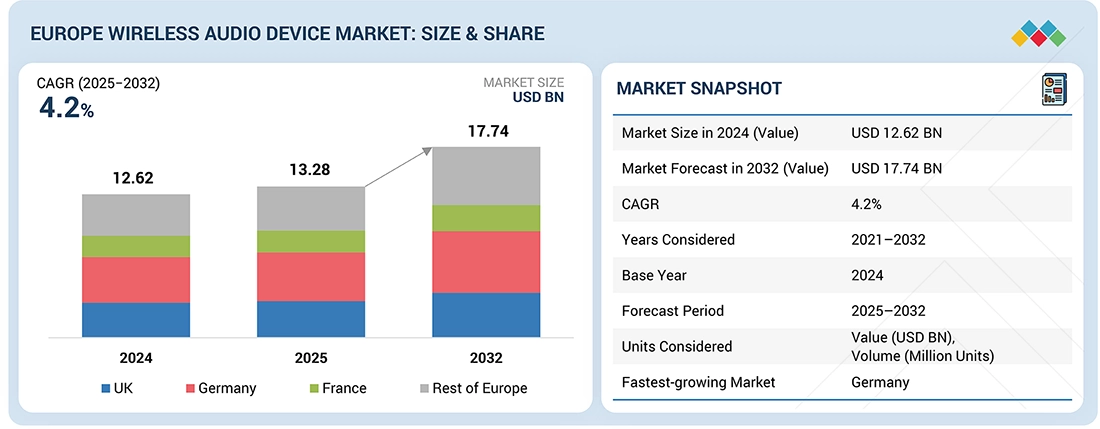
Source: Secondary Research, Interviews with Experts, MarketsandMarkets Analysis
The Europe wireless audio device market is projected to reach USD 17.74 billion by 2032 from USD 13.28 billion in 2025, at a CAGR of 4.2%. It is growing due to rising demand for cordless use, widespread adoption of smartphones and smart devices, expanding remote work and fitness lifestyles, and ongoing advances in wireless audio and connectivity technologies.
Market Size & Forecast
• 2025 Market Size: USD 13.28 Billion
• 2032 Projected Market Size: USD 17.74 Billion
• CAGR (2025-2032): 4.2%
• Consumer Segment: Largest Market Share
• Germany: Highest CAGR
KEY TAKEAWAYS
-
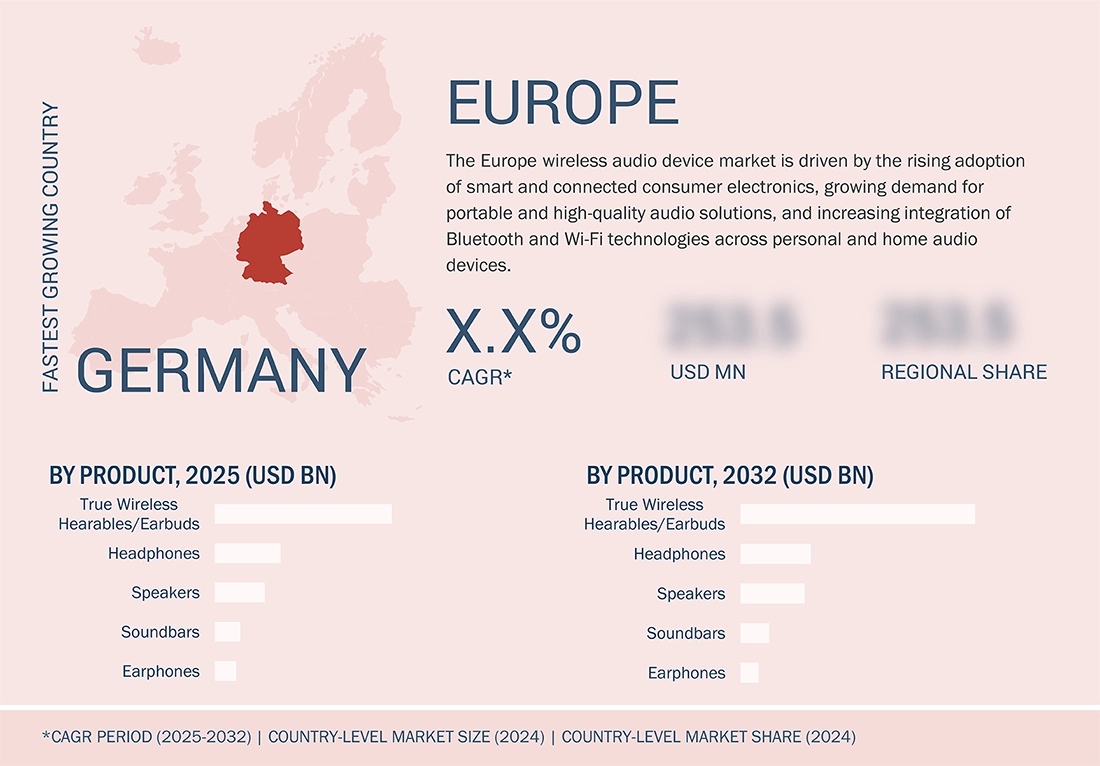
BY COUNTRYGermany is expected to dominate the market in 2032, growing at a CAGR of 4.3% during the forecast period.
-
BY PRODUCTBy product, the true wireless hearables/earbuds segment is expected to register the highest CAGR of 5.4% from 2025 to 2032.
-
BY TECHNOLOGYBy technology, the Bluetooth segment is expected to dominate the market in 2032.
-
By FUNCTIONALITYBy functionality, the smart devices segment is expected to dominate the market in 2032.
-
BY APPLICATIONBy application, the consumer segment is projected to hold the largest market share in 2032.
-
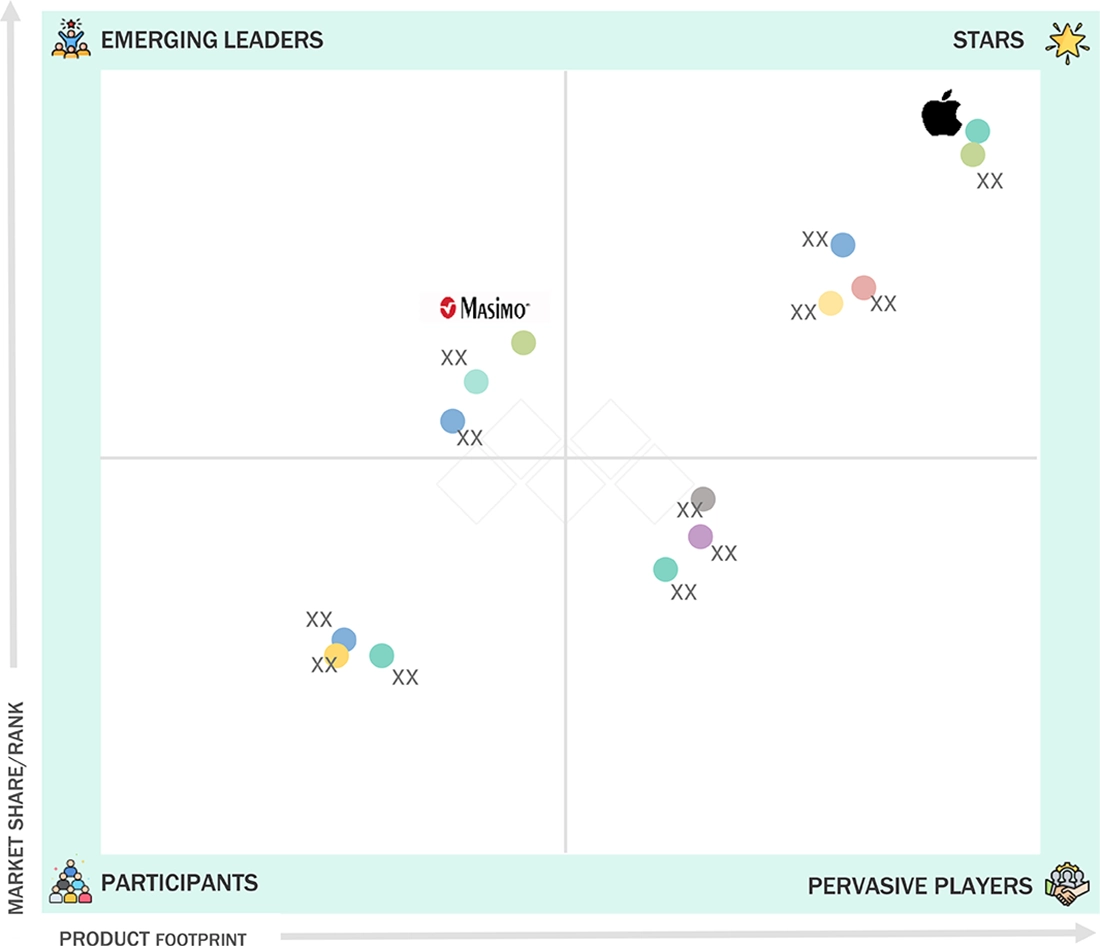
COMPETITIVE LANDSCAPEApple Inc. (US), HARMAN International (US), and Sony Corporation(Japan) are identified as some of the star players in the Europe wireless audio device market (global), given their strong market share and product footprint.
-
COMPETITIVE LANDSCAPEEdifier (China) and Anker Innovations (China) have distinguished themselves among startups and SMEs by securing strong footholds in specialized niche areas, underscoring their potential as emerging market leaders.
Countries such as the UK, Germany, and France are key contributors to the Europe wireless audio device market, supported by high penetration of smartphones and smart home devices, strong consumer demand for premium and branded audio products, and widespread adoption of Bluetooth- and Wi-Fi-enabled devices across residential and commercial applications.
TRENDS & DISRUPTIONS IMPACTING CUSTOMERS' CUSTOMERS
The trends and disruptions in the Europe wireless audio device market highlight a clear shift from traditional revenue sources such as headphones, earphones, headsets, speaker systems, and soundbars toward new revenue streams driven by evolving use cases and ecosystems. Advancements like true wireless hearables/earbuds, Bluetooth Low Energy (LE) audio-based devices, and AI-enabled audio solutions are enabling deeper integration across consumer, education, home audio, automotive, professional, and entertainment segments. These innovations align with clients’ imperatives such as health and wellness integration, smart home ecosystems, in-car entertainment, AR/VR, and e-learning tools, ultimately delivering outcomes including seamless connectivity, enhanced audio quality, improved safety and personalization in automotive applications, higher digital engagement, and increased productivity and collaboration in professional and wellness-focused settings.
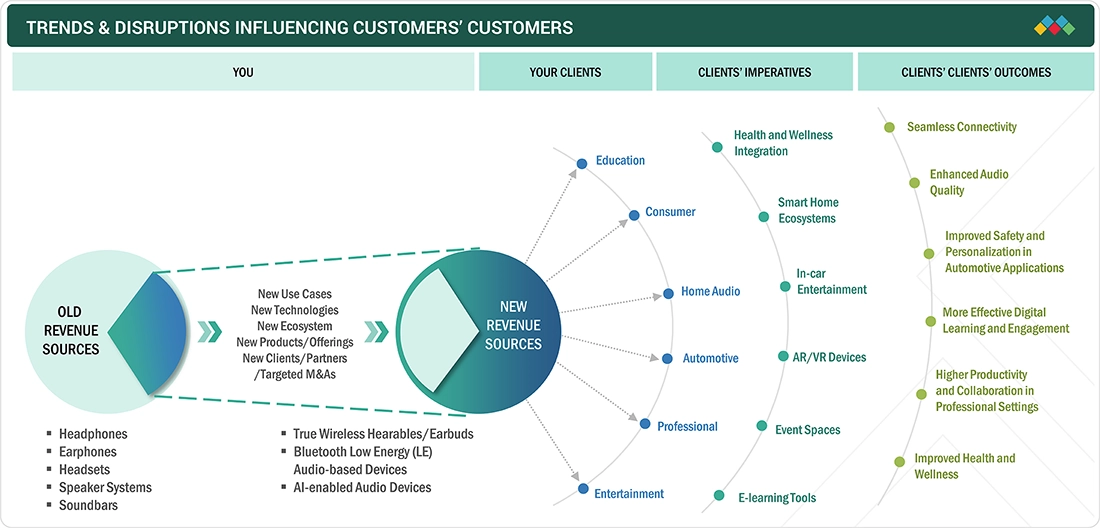
Source: Secondary Research, Interviews with Experts, MarketsandMarkets Analysis
MARKET DYNAMICS

Level
-
Elevating demand for true wireless earbuds and headphones

-
Rising adoption of wireless audio devices in commercial sector


Level
-
Restrictive radio frequency spectrum in audio equipment

-
Hearing impairment from prolonged use of headphones and earbuds


Level
-
Popularity of wireless audio devices in health and fitness sector

-
Advent of Bluetooth LE Audio


Level
-
Compromised audio quality due to bandwidth constraints, and coding delays and errors

Source: Secondary Research, Interviews with Experts, MarketsandMarkets Analysis
Driver: Elevating demand for true wireless earbuds and headphones
The Europe wireless audio device market is fueled by strong consumer preference for true wireless earbuds and headphones offering portability, extended battery life, and advanced features such as active noise cancellation and voice assistant integration. Widespread smartphone penetration and adoption of wireless standards such as Bluetooth, Wi-Fi, and AirPlay enable seamless multi-device connectivity, driving growth across consumer, professional, and commercial applications.
Restraint: Restrictive radio frequency spectrum in audio equipment
Wireless audio devices in Europe are subject to stringent radio frequency regulations and compliance standards set by authorities such as the European Telecommunications Standards Institute (ETSI). Meeting certification and equipment authorization requirements increases product development complexity, time to market, and costs for manufacturers, acting as a restraint despite rising demand across consumer, healthcare, and enterprise sectors.
Opportunity: Popularity of wireless audio devices in health and fitness sector
The rising focus on health, wellness, and active lifestyles in Europe presents opportunities for wireless audio device vendors. Demand for smart, cord-free solutions with features such as biometric tracking, voice-enabled coaching, customizable sound profiles, and real-time feedback is growing across gyms, outdoor activities, and home fitness settings, supporting market expansion.
Challenge: Compromised audio quality due to bandwidth constraints, coding delays and errors
Delivering high-quality, low-latency wireless audio remains a challenge in Europe due to bandwidth limitations, codec constraints, and transmission delays. Despite widespread Bluetooth and Wi-Fi adoption, issues such as A2DP bandwidth caps and audio-video synchronization continue to impact performance, increasing design complexity for manufacturers targeting premium audio experiences.
EUROPE WIRELESS AUDIO DEVICE MARKET: COMMERCIAL USE CASES ACROSS INDUSTRIES
| COMPANY | USE CASE DESCRIPTION | BENEFITS |
|---|---|---|
 |
Deployment of AirPods and AirPods Pro across consumer electronics, enterprise mobility programs, education, and hybrid work environments across Western and Northern Europe, tightly integrated with iOS, macOS, and spatial audio features | Seamless cross-device compatibility | strong ecosystem lock-in | premium user experience | enhanced remote work collaboration | superior audio quality with advanced active noise cancellation |
 |
Use of wireless noise-cancelling headphones (WH-1000XM series) and true wireless earbuds across consumer entertainment, frequent business travel, and professional audio applications in major European markets such as Germany, the UK, and France | Market-leading noise cancellation | high-fidelity sound performance | long battery life | strong brand positioning in the premium wireless audio segment |
 |
Adoption of wireless headphones and earbuds in corporate offices, aviation, travel retail, and premium consumer segments across Europe, including strong presence in airports and business travel hubs | Advanced acoustic engineering | effective noise reduction in professional and travel environments | improved productivity | and strong brand loyalty in premium audio categories |
 |
Integration of Galaxy Buds within the Galaxy smartphone and wearable ecosystem, targeting mass-market consumers and enterprise users across Europe, particularly in Android-dominant countries such as Germany, the UK, and France. | Enhanced device interoperability | large-scale manufacturing efficiency | competitive pricing| seamless connectivity within the Android ecosystem |
Logos and trademarks shown above are the property of their respective owners. Their use here is for informational and illustrative purposes only.
MARKET ECOSYSTEM
The Europe wireless audio device market ecosystem consists of R&D engineers, raw material suppliers, device manufacturers, technology providers, system integrators, distributors, and service providers working together to deliver end-to-end audio solutions. This interconnected ecosystem enables innovation in sound quality, connectivity, manufacturing efficiency, distribution reach, and content integration across consumer and enterprise applications.
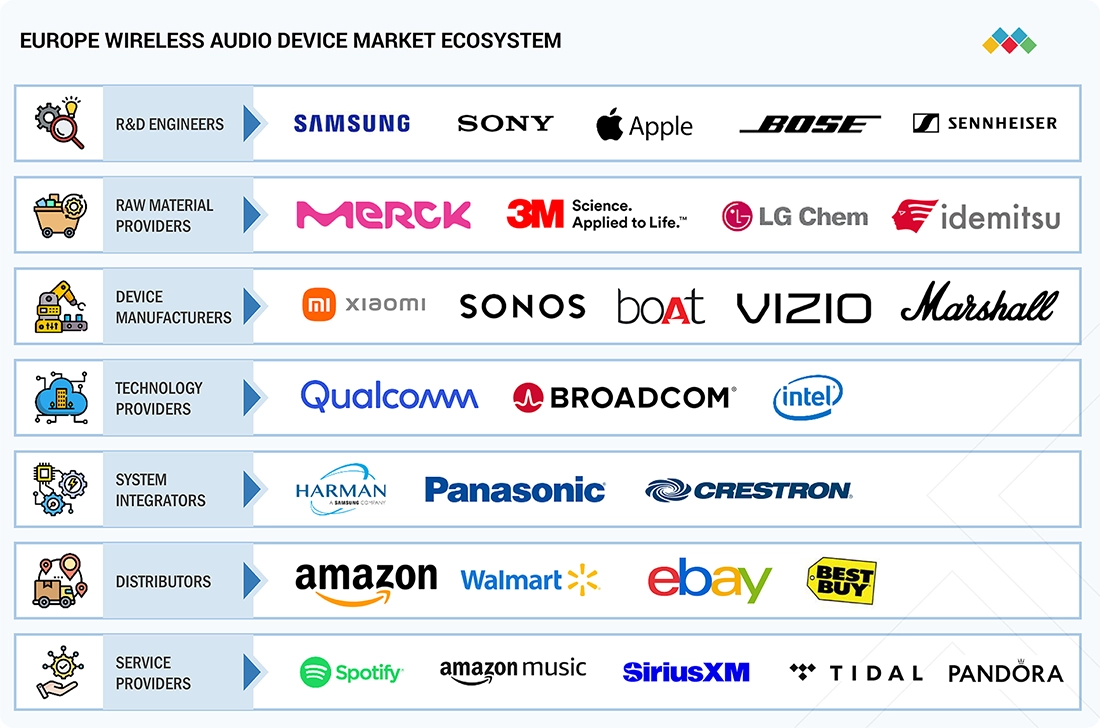
Logos and trademarks shown above are the property of their respective owners. Their use here is for informational and illustrative purposes only.
MARKET SEGMENTS
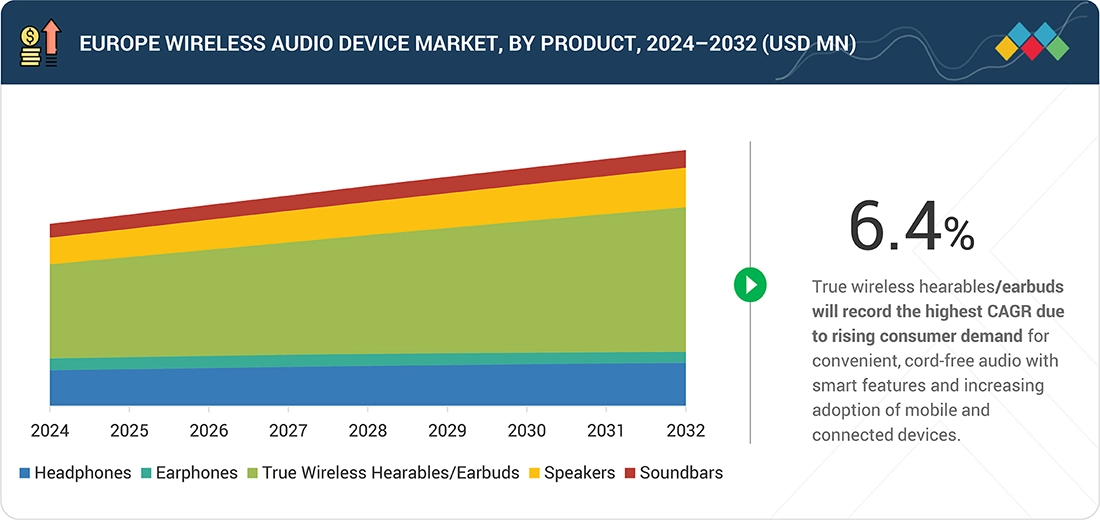
Source: Secondary Research, Interviews with Experts, MarketsandMarkets Analysis
Europe Wireless Audio Devic Market, by Product
The true wireless hearables/earbuds segment is expected to dominate the Europe wireless audio device market due to strong demand from smartphone users, commuters, fitness enthusiasts, and remote workers. Widespread adoption of smartphones without headphone jacks, growth in streaming and gaming, and features such as ANC, voice assistants, and integration with Apple, Samsung, and Google ecosystems are driving sustained adoption across Western and Central Europe.
Europe Wireless Audio Devic Market, by Technology
Bluetooth technology is projected to hold the largest share of the Europe wireless audio device market in 2032, driven by its broad compatibility with smartphones and consumer electronics, low power consumption, ease of integration, and strong adoption across headphones, true wireless earbuds, speakers, automotive, and smart home audio applications.
Europe Wireless Audio Devic Market, by Application
The consumer application segment is projected to hold the largest share of the Europe wireless audio device market in 2032, supported by rising disposable income; increasing demand for personal entertainment; widespread use of smartphones and smart home devices; and growing adoption of wireless headphones, true wireless earbuds, speakers, and soundbars for everyday use.
REGION
Germany is expected to be largest country across Europe wireless audio device market in 2032
Germany will dominate the Europe wireless audio device market due to strong consumer base with high purchasing power and the growing inclination toward premium and smart audio products. Rising adoption of smart homes and connected devices, coupled with the popularity of wireless speakers and true wireless earbuds, is driving demand. Additionally, a strong consumer presence of leading audio brands such as Bose, Sony, JBL, Apple, Samsung in the region and continuous product innovations further contribute to Germany’s robust market growth
The North America wireless audio device market is projected to reach USD 22.11 billion by 2030 from USD 18.39 billion in 2025, at a CAGR of 3.8%. Its growth is driven by increasing demand for cordless convenience, widespread adoption of smartphones and smart devices, the rise of remote work and fitness-focused lifestyles, and ongoing advances in wireless audio and connectivity technologies.
EUROPE WIRELESS AUDIO DEVICE MARKET: COMPANY EVALUATION MATRIX
In the Europe wireless audio device market matrix, Apple Inc. (Star Player) leads with a strong market share and broad product ecosystem, driven by the widespread adoption of AirPods and seamless integration across its devices, supported by advanced features such as spatial audio and active noise cancellation. Masimo (Emerging Leader) is gaining traction through its differentiated audio offerings that integrate advanced health-monitoring and sensing technologies, strengthening its position via innovation and medically oriented use cases.
Source: Secondary Research, Interviews with Experts, MarketsandMarkets Analysis
KEY MARKET PLAYERS
- Apple Inc. (US)
- HARMAN International (US)
- Sony Group Corporation (Japan)
- Sonos, Inc. (US)
- Masimo (US)
- Bose Corporation (US)
- Sennheiser electronic SE & Co. KG (Germany)
- Marshall Group AB (Swedan)
- Yamaha Corporation. (japan)
- LG Electronics (South Korea)
MARKET SCOPE
| REPORT METRIC | DETAILS |
|---|---|
| Market Size in 2024 (Value) | USD 12.62 BN |
| Market Forecast in 2032 (Value) | USD 17.74 BN |
| Growth Rate | CAGR of 4.2% from 2025–2032 |
| Years Considered | 2021–2032 |
| Base Year | 2024 |
| Forecast Period | 2025–2032 |
| Units Considered | Value (USD Billion), Volume (Million Units) |
| Report Coverage | Revenue Forecast, Company Ranking, Competitive Landscape, Growth Factors, and Trends |
| Segments Covered |
|
| Regional Scope | Europe (UK, Germany, France, Rest of Europe) |
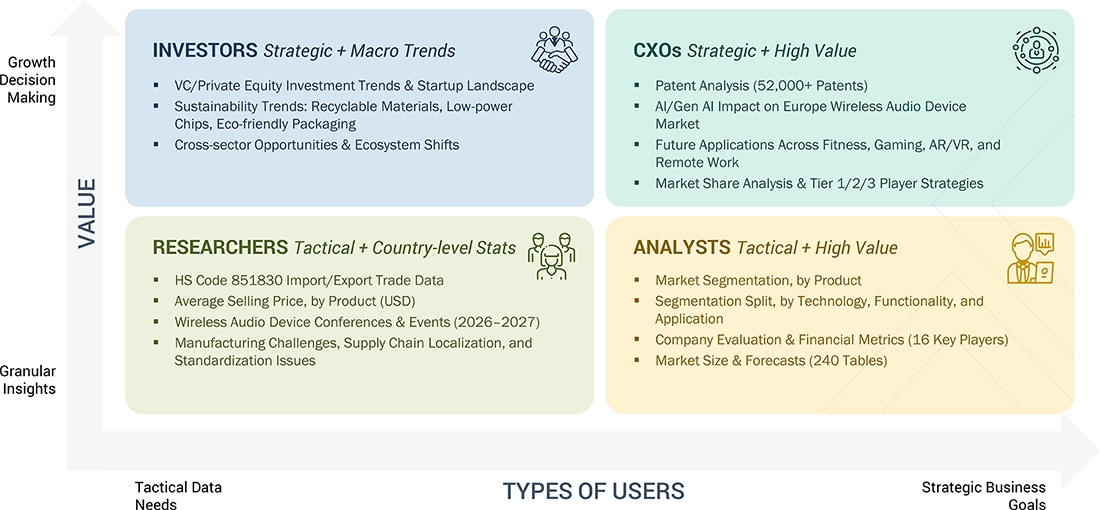
WHAT IS IN IT FOR YOU: EUROPE WIRELESS AUDIO DEVICE MARKET REPORT CONTENT GUIDE
DELIVERED CUSTOMIZATIONS
We have successfully delivered the following deep-dive customizations:
| CLIENT REQUEST | CUSTOMIZATION DELIVERED | VALUE ADDS |
|---|---|---|
| Consumer Electronics OEM | Competitive benchmarking of wireless audio portfolios (earbuds, headphones, speakers, soundbars) across key European markets including Germany, the UK, France, Italy, and Spain | Identify product gaps versus leading European and global brands; support portfolio optimization and country-level positioning |
| True Wireless/ Hearables Manufacturer | Product adoption and segment growth analysis for TWS earbuds, headphones, and speakers across Europe | Identify fastest-growing product categories and price tiers tailored to European consumer preferences |
| Bluetooth/Connectivity Chip Supplier | Technology adoption mapping across Bluetooth Classic, Bluetooth LE Audio, Wi-Fi, and AirPlay in Europe, including roadmap assessment | Identify opportunities in LE Audio, multi-stream audio, low-latency codecs, and next-generation connectivity standards |
| Smart Home/IoT Platform Provider | Integration analysis of wireless audio devices with voice assistants (Alexa, Google Assistant, Siri) and smart home ecosystems in Europe | Highlight key adoption drivers for smart speakers, soundbars, and voice-enabled audio devices in residential and commercial settings |
RECENT DEVELOPMENTS
- June 2024 : HARMAN International launched the JBL Professional Pro SoundBar PSB-2, an upgraded addition to its PSB soundbar portfolio, now equipped with HDMI and Bluetooth digital input capabilities. The PSB-2 is engineered to deliver clear, targeted audio while minimizing sound spillover into neighboring spaces. Its design makes it well suited for applications such as hotel guestrooms, cruise ship cabins, meeting rooms, classrooms, and other comparable environments.
- September 2023 : Apple introduced the AirPods Pro (2nd generation) with MagSafe Charging (USB-C), representing an enhanced version of its widely adopted wireless earbuds. The latest model offers superior audio performance, up to twice the Active Noise Cancellation compared with the prior generation, an improved Transparency mode, a more immersive Spatial Audio experience, and an expanded selection of ear tip sizes to ensure a more comfortable and secure fit.
Table of Contents
 Exclusive indicates content/data unique to MarketsandMarkets and not available with any competitors.
Methodology
The study involved four major activities in estimating the size of the Europe Wireless Audio Device Market. Exhaustive secondary research has been conducted to collect information on the market, the peer markets, and the parent market. Both top-down and bottom-up approaches have been employed to estimate the total market size. Market breakdown and data triangulation methods have also been used to estimate the market for segments and subsegments.
Secondary Research
Revenues of companies offering wireless audio devices have been obtained from the secondary data available through paid and unpaid sources. The revenues have also been derived by analyzing the product portfolio of key companies, and these companies have been rated according to the performance and quality of their products.
Various secondary sources have been referred to in the secondary research process for identifying and collecting information important for this study. Secondary sources include corporate filings (such as annual reports, investor presentations, and financial statements); trade, business, and professional associations; white papers; IoT technologies journals and certified publications; articles by recognized authors; gold-standard and silver-standard websites; directories; and databases.
Secondary research has been conducted mainly to obtain critical information about the market’s value chain, the total pool of key players, market classification and segmentation according to the industry trends to the bottom-most level, geographic markets, and key developments from both demand- and technology-oriented perspectives. Secondary data has been collected and analyzed to determine the overall market size, further validated by primary research.
Primary Research
Extensive primary research has been conducted after understanding and analyzing the current scenario of the Europe Wireless Audio Device Market through secondary research. Several primary interviews have been conducted with key opinion leaders from both demand and supply sides across Europe. Approximately 25% of the primary interviews have been conducted with the demand side, while 75% have been conducted with the supply side. Primary data has been collected mainly through telephonic interviews, which consist of 80% of the total primary interviews. questionnaires and e-mails have also been used to collect data.
After interacting with industry experts, brief sessions were conducted with highly experienced independent consultants to reinforce the findings from our primary. This along with the in-house subject matter experts’ opinions, has led us to the findings as described in the remainder of this report. The breakdown of primary respondents is as follows:
Market Size Estimation
The bottom-up procedure has been employed to arrive at the overall size of the Europe Wireless Audio Device Market.
- Identifying end users that are either using or are expected to use wireless audio devices
- Analyzing major providers of wireless audio devices and original equipment manufacturers (OEMs), as well as studying their portfolios and understanding different technologies used
- Analyzing historical and current data pertaining to the market, in terms of volume, for each product segment of the wireless audio devices market
- Analyzing the average selling price of wireless audio devices based on different technologies used in different products
- Arriving at the market estimates by analyzing the revenue of companies and then combining these figures to arrive at the market size
- Studying various paid and unpaid sources, such as annual reports, press releases, white papers, and databases, to gather the required information
- Tracking the ongoing developments and identifying the upcoming ones in the market that include investments, research and development activities, product launches, collaborations, and partnerships undertaken, as well as forecasting the market based on these developments and other critical parameters
- Carrying out multiple discussions with the key opinion leaders to understand the wireless audio device technologies and related raw materials, as well as products designed and developed to analyze the break-up of the scope of work carried out by the key companies manufacturing panels
-
Verifying and cross-checking the estimate at every level through discussions with key opinion leaders such as chief executives (CXOs), directors, and operation managers, and finally with the domain experts in MarketsandMarkets
Data Triangulation
After arriving at the overall size of the Europe Wireless Audio Device Market through the process explained, the total market has been split into several segments and subsegments. Market breakdown and data triangulation procedures have been employed, wherever applicable, to complete the overall market engineering process and arrive at the exact statistics for all segments and subsegments. The data has been triangulated by studying various factors and trends from the demand and supply sides. The market has also been validated using the top-down and bottom-up approaches.
Market Definition
A wireless audio device refers to an instrument or a device that uses wireless technology to transmit or receive audio signals through wireless technologies such as Bluetooth, radiofrequency, and Wi-Fi. Wireless audio devices such as wireless speakers, soundbars, headphones, earphones, microphones, and headsets in the consumer electronics sector implement these technologies.
Key Stakeholders
- Brand Product Manufacturers/Original Equipment Manufacturers (OEMs)/Original Device Manufacturers (ODMs)
- Wireless Audio Device System Manufacturers
- Semiconductor Component Suppliers/Foundries
- Wireless Audio Device Material and Component Suppliers
- Manufacturing Equipment Suppliers
- System Integrators
- Technology/IP Developers
- Consulting and Market Research Service Providers
- Wireless Audio Device- and Material-related Associations, Organizations, Forums, and Alliances
- Venture Capitalists and Startups
- Research and Educational Institutes
- Distributors and Resellers
- End Users
Report Objectives
- To define, describe, and forecast the Europe Wireless Audio Device Market, by technology, functionality, application, and region, in terms of value
- To describe and forecast the Europe Wireless Audio Device Market, by product, in terms of value and volume
- To provide detailed information regarding major factors such as drivers, restraints, opportunities, and challenges influencing the growth of the market
- To provide a detailed overview of the value chain pertaining to the wireless audio device ecosystem, along with the average selling prices of different types of wireless audio devices
- To provide information pertaining to the ecosystem, Porter’s five forces, technologies, tariffs and regulations, patents, trade landscape, key conferences and events, and case studies pertaining to the market under study
- To analyze the micromarkets1 with respect to industry trends, prospects, and contribution to the total market
- To analyze opportunities in the market for stakeholders by identifying high-growth segments of the market and provide a detailed competitive landscape for market leaders
- To profile key players and comprehensively analyze their market position in terms of ranking and core competencies2
- To analyze strategic developments such as product launches, collaborations, contracts, expansions, and partnerships undertaken by the leading players in the Europe Wireless Audio Device Market
Available customizations:
With the given market data, MarketsandMarkets offers customizations according to the specific requirements of companies. The following customization options are available for the report:
- Detailed analysis and profiling of additional market players based on various blocks of the supply chain


Personalize This Research
- Triangulate with your Own Data
- Get Data as per your Format and Definition
- Gain a Deeper Dive on a Specific Application, Geography, Customer or Competitor
- Any level of Personalization
Let Us Help You
- What are the Known and Unknown Adjacencies Impacting the Europe Wireless Audio Device Market
- What will your New Revenue Sources be?
- Who will be your Top Customer; what will make them switch?
- Defend your Market Share or Win Competitors
- Get a Scorecard for Target Partners

Custom Market Research Services
We Will Customise The Research For You, In Case The Report Listed Above Does Not Meet With Your Requirements
Get 10% Free CustomisationTESTIMONIALS

Tetsuya Ohhira
Business Development Manager-Technology Business
Nikon Corporation,
Leading Japanese MNC specializing in optics and imaging productswww.nikon.com
MarketsandMarkets™ response
is quick. Their attitude is flexible and positive. Analyst Insights are globally considered and
significant. Client Services quickly respond to our inquiry and demand. Their wide range of global
surveys help us make our strategic plan.
We hope Knowledge Store will be easier to search
for a report.
VP - Marketing & Business Development
Leading Provider of Process Control Solutions
We engaged with MarketsandMarkets on a study to perform an analysis and recommend a Go-To-Market strategy for metrology and process control in the semiconductor market. The study was tailored to our targets and needs with well-defined milestones. Our overall experience with the MarketsandMarkets team was very good throughout the project in all aspects including the analysis methodologies used, the quality and depth of primary and secondary data sets, the professionalism and flexibility of the team and the ability to meet the target schedule and milestones. We want to thank MarketsandMarkets team for a job well done.






Growth opportunities and latent adjacency in Europe Wireless Audio Device Market