Fertilizers Market

Fertilizers Market by Type (Chemical Fertilizers and Biofertilizers), Crop Type (Cereals & Grains, Oilseeds & Pulses, Fruits & Vegetables), Mode of Application (Soil, Foliar, Fertigation), and Region - Global Forecast to 2030




OVERVIEW
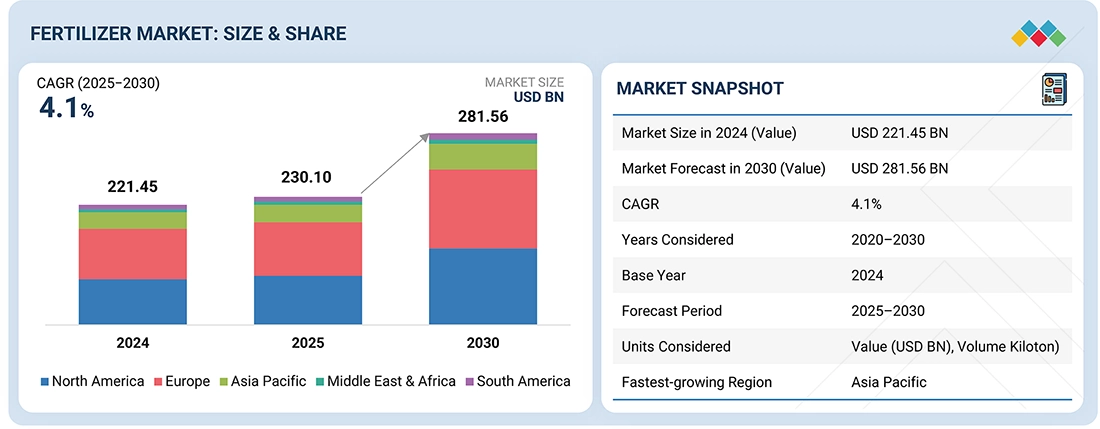
Source: Secondary Research, Interviews with Experts, MarketsandMarkets Analysis
The global fertilizers market is projected to expand from USD 230.10 billion in 2025 to reach USD 281.56 billion by 2030, at a CAGR of 4.1% during the forecast period. The global fertilizers market supports crop productivity through essential nutrients like nitrogen, phosphorus, and potassium. Growth is driven by rising food demand and sustainable farming practices, with trends toward bio-based and specialty fertilizers. However, challenges include volatile raw material costs, environmental regulations, and the need for efficient nutrient management.
Market Size and Forecast:
- Market Size Value in 2024: USD 221.45 Billion
- Market Size Value in 2025: USD 230.10 Billion
- Revenue Forecast in 2030: USD 281.56 Billion
- Growth Rate: CAGR of 4.1% from 2025 to 2030
- Base year: 2024
- Forecast period: 2025–2030
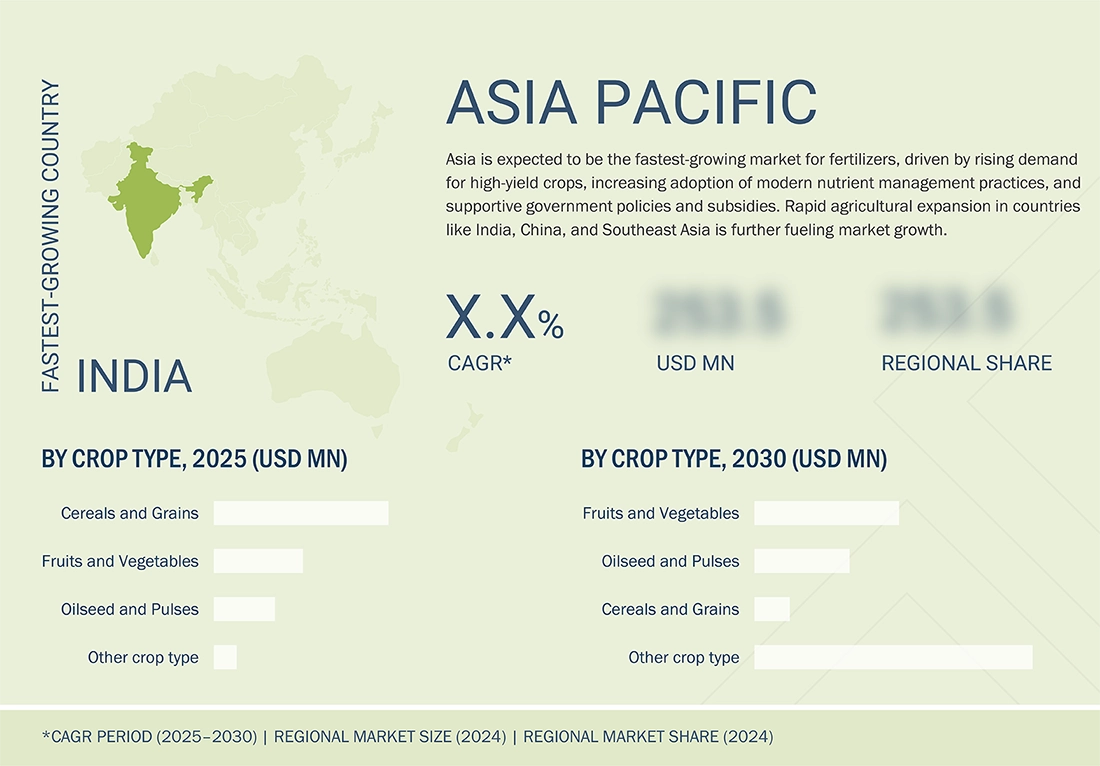
- Asia Pacific is the fastest growing region in the fertilizers market
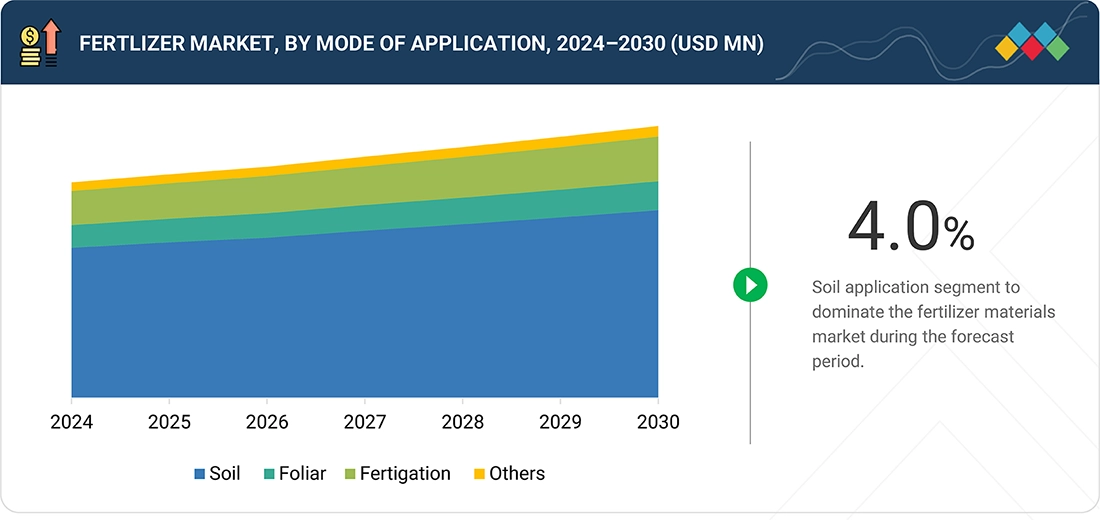
- The soil application segment is projected to dominate the fertilizer market during the forecast period, growing at a CAGR of 4.0%
Key Market Trends and Insights
- By Type: Chemical fertilizers continue to account for a significant share of the fertilizers market, supported by their widespread use in enhancing crop productivity, improving nutrient availability, and meeting the growing global demand for food production.
- Industry Evolution: Fertilizer manufacturers are increasingly investing in advanced nutrient formulations, efficiency-enhancing technologies, and sustainable production processes to improve agricultural outcomes.
- Growth Drivers: Rising food demand, declining arable land availability, increasing focus on crop yield optimization, and growing adoption of modern farming practices are supporting market expansion.
- Future Potential: Emerging opportunities lie in specialty fertilizers, precision nutrient management, bio-based fertilizer solutions, and digital agriculture technologies that enable efficient fertilizer application.
KEY TAKEAWAYS
-
BY TYPEThe fertilizer market is segmented into chemical fertilizers and biofertilizers. Chemical fertilizers provide rapid nutrient availability and high concentration, driving demand from large-scale farms, while overuse and environmental concerns act as restraints. Biofertilizers offer a sustainable alternative that enhances soil health and supports organic farming, though adoption is limited by awareness in developing regions.
-
BY CROP TYPEFertilizers are used across cereals, oilseeds & pulses, fruits & vegetables, and other crops. Cereals dominate demand due to extensive cultivation and high nutrient requirements, while high-value crops like fruits and vegetables drive adoption of precision application methods. Variability in crop nutrient needs can challenge uniform usage.
-
BY MODE OF APPLICATIONFertilizers are applied via soil application, foliar sprays, fertigation, and other methods such as seed coating or controlled-release formulations. Soil application is simple and cost-effective, foliar sprays provide rapid nutrient correction, and fertigation enhances efficiency in precision farming, though high infrastructure costs may limit adoption.
-
BY REGIONGlobally, fertilizer application is dominated by soil application, which remains the most common method across most regions. Fertigation and foliar sprays are increasingly adopted in North America, Europe, and parts of Asia due to advanced irrigation systems and precision farming practices. In contrast, Southern Europe and the Rest of the World primarily rely on traditional soil application, with limited use of modern methods except for high-value or irrigated crops.
-
COMPETITIVE LANDSCAPEThe competitive landscape includes the market share analysis of key players in the fertilizers market. The analysis of the key industry players is based on their recent developments, products offered, and company revenues. a few key players like ICL, Yara, and K+S Aktiengesellschaft, are each adopting distinct strategies to grow their businesses in the fertilizers industry. ICL is expanding its product offerings through strategic agreements and expansions, allowing the introduction of new technologies and innovations.
The global fertilizer market is a cornerstone of agricultural productivity, supplying essential nutrients such as nitrogen, phosphorus, and potassium. Market growth is driven by rising food demand and the transition toward sustainable farming practices, including greater use of specialty and bio-based fertilizers. However, the industry faces challenges related to raw material volatility, environmental compliance, and optimizing nutrient efficiency.
TRENDS & DISRUPTIONS IMPACTING CUSTOMERS' CUSTOMERS
The emergence of the fertilizer market, driven by both chemical and biofertilizers, is significantly impacting the consumer business landscape. Growing demand for high-yield crops and sustainable farming solutions is encouraging agri-input companies to expand product offerings and invest in precision application technologies like fertigation and foliar sprays. This shift not only boosts farm productivity and efficiency but also creates opportunities for value-added services, brand differentiation, and direct-to-farmer engagement, ultimately strengthening the link between fertilizer manufacturers and the end consumer.
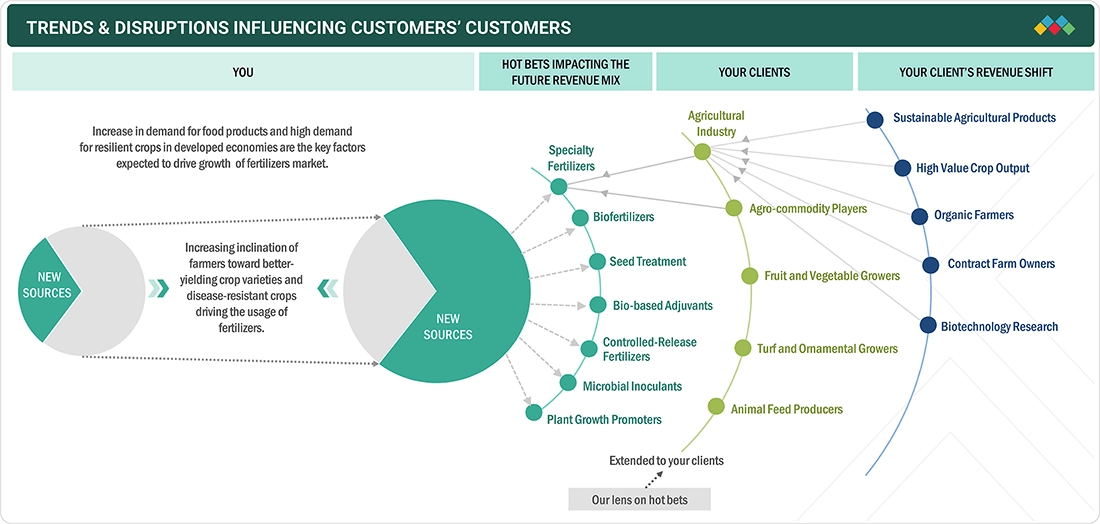
Source: Secondary Research, Interviews with Experts, MarketsandMarkets Analysis
MARKET DYNAMICS

Level
-
Government subsidies and policies

-
Rising Food Demand


Level
-
High cost of raw material

-
Environmental Regulation


Level
-
Technological advancements to propel the market growth.

-
Rising demand for organic and sustainable farming


Level
-
Regulatory barriers

-
High capital and operational costs

Source: Secondary Research, Interviews with Experts, MarketsandMarkets Analysis
Driver: Government subsidies and policies
Government subsidies and policies are key drivers in the fertilizer market, as they reduce input costs for farmers and encourage the adoption of both chemical and biofertilizers. Subsidies on fertilizers, incentives for organic or sustainable farming, and policies promoting precision agriculture help increase accessibility and affordability, especially for smallholder farmers. Such support not only boosts fertilizer consumption and crop yields but also drives market growth, innovation, and the adoption of advanced application technologies across regions.
Restraint: High cost of raw material
A major restraint in the fertilizer market is the high cost of raw materials, including nitrogen, phosphorus, potash, and microbial cultures for biofertilizers. Price volatility of these inputs, driven by global supply-demand imbalances, energy costs, and import dependencies, increases production costs for manufacturers. This often translates to higher prices for farmers, limiting adoption, particularly among smallholders, and can constrain market growth, especially in price-sensitive regions.
Opportunity: Technologcal advacement to propel the market growth
Technological advancements present significant opportunities to propel growth in the fertilizer market. Innovations such as precision application systems, controlled-release formulations, fertigation technologies, and biofertilizer enhancements improve nutrient efficiency, reduce waste, and support sustainable farming practices. Adoption of digital agriculture tools, IoT-enabled sensors, and data-driven crop management further enables farmers to optimize fertilizer use, increase yields, and lower costs, creating growth potential for manufacturers and service providers across both developed and emerging markets.
Challenge: Regulatory barriers
Regulatory barriers are a key challenge in the fertilizer market, as strict government regulations govern the production, distribution, and use of both chemical and biofertilizers. Compliance with quality standards, environmental norms, and import-export restrictions can increase operational costs and delay product launches. These regulations, while ensuring safety and sustainability, may limit market entry for new players, constrain innovation, and slow the adoption of advanced fertilizers and application technologies in certain regions.
Fertilizers Market: COMMERCIAL USE CASES ACROSS INDUSTRIES
| COMPANY | USE CASE DESCRIPTION | BENEFITS |
|---|---|---|
 |
Use of controlled-release nitrogen fertilizers in cereals and row crops | Enhances nutrient use efficiency, reduces leaching, and improves yield |
 |
Application of specialty fertilizers and micronutrients for high-value fruits and vegetables | Optimizes crop quality, ensures balanced nutrition, and supports premium market pricing |
 |
Integration of phosphate and potassium fertilizers in oilseed and pulse crops | Promotes strong root development, increases resistance to stress, and boosts productivity |
 |
Deployment of precision fertilization solutions via soil testing and variable-rate application technology | Reduces input costs, improves nutrient management, and minimizes environmental impact |
 |
Bio-based and organic fertilizer formulations for sustainable agriculture | Supports eco-friendly practices, improves soil health, and aligns with regulatory and consumer sustainability goals |
Logos and trademarks shown above are the property of their respective owners. Their use here is for informational and illustrative purposes only.
MARKET ECOSYSTEM
The fertilizer market ecosystem includes upstream raw material suppliers, midstream manufacturers and technology providers, and downstream distributors, retailers, and farmers, supported by regulatory bodies and research institutions. It integrates chemical and biofertilizers, precision application technologies, and digital services, creating a connected system that drives productivity, efficiency, and sustainable farming practices.
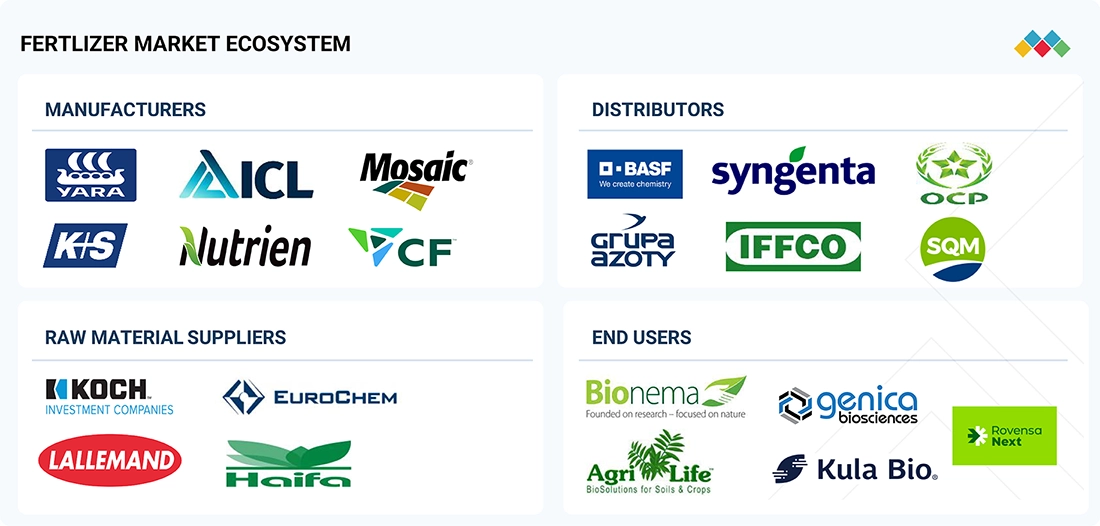
Logos and trademarks shown above are the property of their respective owners. Their use here is for informational and illustrative purposes only.
MARKET SEGMENTS
Source: Secondary Research, Interviews with Experts, MarketsandMarkets Analysis
Fertilizer Market, By Type
As of 2024, The fertilizer market by type is segmented into chemical fertilizers and biofertilizers, catering to diverse agricultural needs. Chemical fertilizers provide essential nutrients such as nitrogen, phosphorus, potash, secondary nutrients, and micronutrients, offering rapid nutrient availability and high concentration to enhance crop productivity, particularly in large-scale farming. However, overuse can cause soil degradation and environmental issues. Biofertilizers are microbial-based solutions like Rhizobium, Azotobacter, phosphate-solubilizing bacteria, and mycorrhizal fungi that naturally improve soil fertility and nutrient uptake, supporting sustainable and organic farming. The market reflects a growing balance between efficient chemical inputs and eco-friendly biological alternatives.
Fertilizer Market, By Crop Type
In 2024, The fertilizer market by crop type is categorized based on the crops that utilize fertilizers, reflecting their nutrient requirements and cultivation scale. Major segments include cereals and grains, oilseeds and pulses, fruits and vegetables, and other crops. Cereals and grains dominate demand due to their extensive cultivation and high nutrient needs, making them a key driver for chemical fertilizer consumption. Oilseeds and pulses benefit from both chemical and biofertilizers to enhance protein content and yield. Fruits and vegetables, being high-value crops, increasingly adopt precision application methods like foliar sprays and fertigation. Other crops, including commercial and specialty crops, contribute to niche growth opportunities, emphasizing crop-specific nutrient management and efficiency.
Fertilizer Market, By Mode of Application
The fertilizer market by mode of application refers to the methods through which fertilizers are delivered to crops to optimize nutrient uptake and efficiency. Key application methods include soil application, foliar sprays, fertigation, and other innovative techniques such as seed coating or controlled-release formulations. Soil application is the most widely used method, offering simplicity and cost-effectiveness, particularly in regions with limited irrigation infrastructure. Foliar sprays provide rapid nutrient correction and are often used for micronutrients. Fertigation, which delivers fertilizers through irrigation systems, enhances precision and efficiency, while other specialized methods target high-value crops and support sustainable nutrient management.
REGION
Asia Pacific to be fastest-growing region in fertilizer market during forecast period
Asia Pacific is the fastest growing region in the fertilizers market. Government initiatives like fertilizer subsidies, soil health programs, and agricultural modernization schemes have also fueled demand. In addition, the cultivation of the region with high-value crops such as rice, wheat, and oilseeds has seen increased use of fertilizers to increase productivity and replenish soil nutrients. Government policies like India's Nutrient-Based Subsidy (NBS) program and China's soil fertility enhancement initiatives help farmers greatly, reducing the cost and accessibility of fertilizers. Nations are also increasingly encouraging balanced fertilization methods and sustainable agricultural practices to sustain soil health and enhance long-term agricultural output.
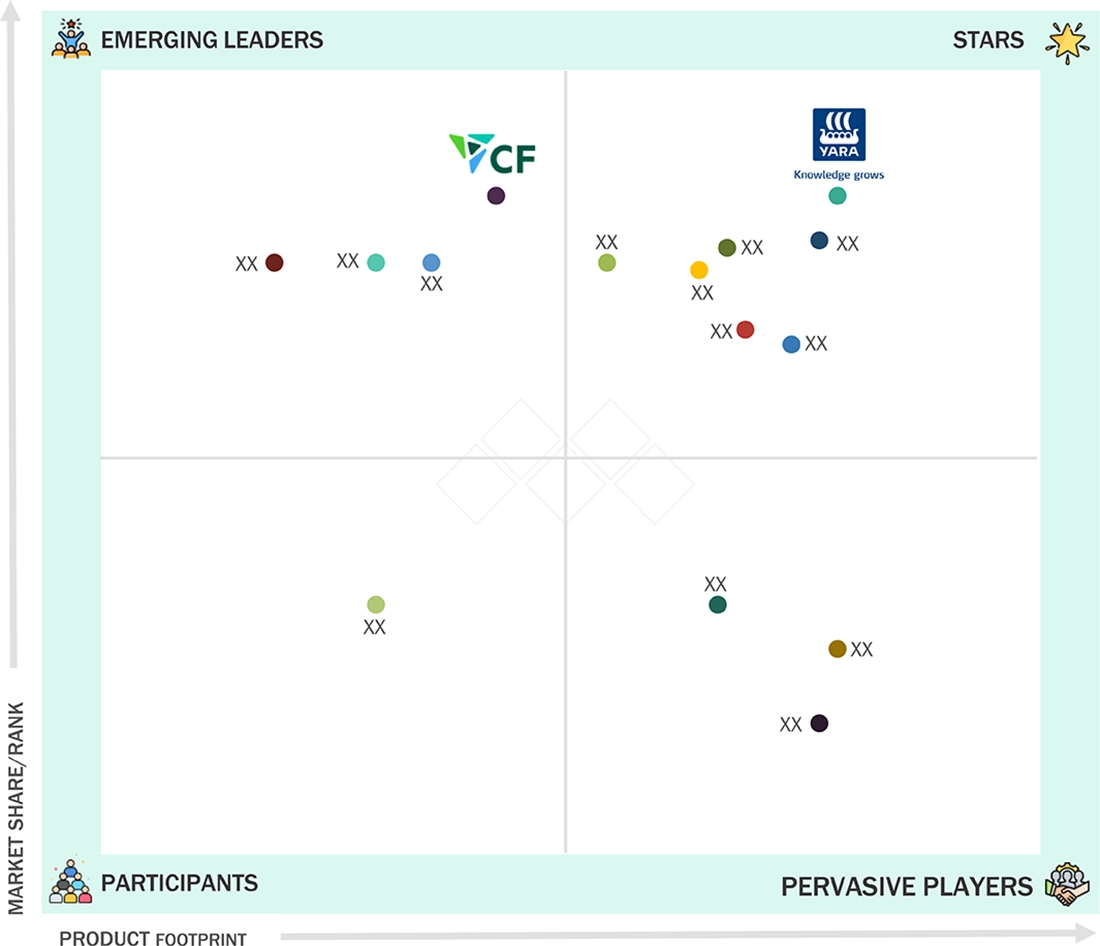
Fertilizers Market: COMPANY EVALUATION MATRIX
Company evaluation in the fertilizer market involves assessing key players based on factors such as product portfolio, market presence, technological capabilities, financial performance, and strategic initiatives. Nutrien, (star) a global leader, is recognized for its extensive range of chemical and specialty fertilizers, advanced application technologies like fertigation systems, and strong global distribution network, reflecting its dominant market position. In contrast, an emerging player like BioSeed Technologies focuses on innovative biofertilizers and sustainable solutions, targeting niche segments and organic farming markets. Evaluating both established and emerging companies provides insights into market dynamics, competitive positioning, and growth opportunities within the global fertilizer ecosystem.
Source: Secondary Research, Interviews with Experts, MarketsandMarkets Analysis
KEY MARKET PLAYERS
MARKET SCOPE
| REPORT METRIC | DETAILS |
|---|---|
| Market Size in 2024 (Value) | USD 221.45 Billion |
| Market Forecast in 2030 (Value) | USD 281.56 Billion |
| Growth Rate | CAGR of 4.1% from 2025-2030 |
| Years Considered | 2020-2030 |
| Base Year | 2024 |
| Forecast Period | 2025-2030 |
| Units Considered | Value (USD Million/Billion), Volume (Kiloton) |
| Report Coverage | Revenue forecast, company ranking, competitive landscape, growth factors, and trends |
| Segments Covered |
|
| Regions Covered | North America, Asia Pacific, Europe, South America, Middle East & Africa |
WHAT IS IN IT FOR YOU: Fertilizers Market REPORT CONTENT GUIDE
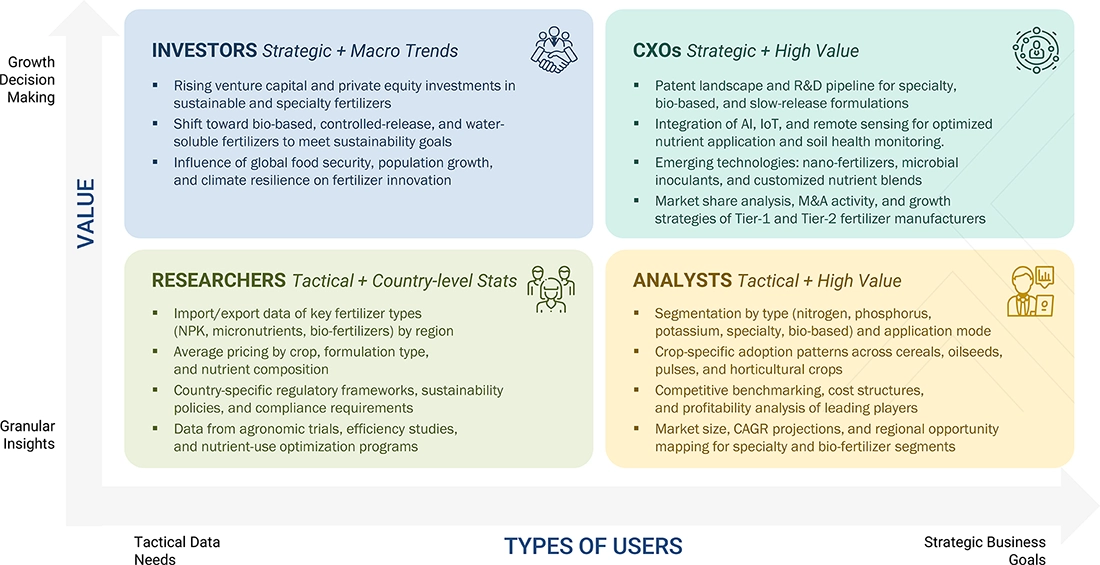
DELIVERED CUSTOMIZATIONS
We have successfully delivered the following deep-dive customizations:
| CLIENT REQUEST | CUSTOMIZATION DELIVERED | VALUE ADDS |
|---|---|---|
| North America–based Fertilizer Manufacturer |
|
|
| European Agrochemical Company |
|
|
| APAC-based Agritech Firm |
|
|
| Global Fertilizer Distributor |
|
|
| Investor / Private Equity Firm |
|
|
RECENT DEVELOPMENTS
- February 2025 : Grupa Azoty announced the launch of its new multi-component fertilizer, POLIFOSKA Multi S, which will be produced at its Police facilities. This advanced product contains 23% Sulphur.
- January 2025 : Nutrien Ag Solutions launched N-FINITY, a nitrogen management solution designed to enhance nitrogen efficiency in crops. It is a biofertilizer which promotes plant health and improve crop productivity
- January 2025 : Haifa Group launched its 18th international subsidiary in India, further expanding its global presence.
- December 2024 : Grupa Azoty expanded its product portfolio with the launch of eNpluS, a granular nitrogen fertilizer with sulfur and calcium. This product aligns with the company’s strategy to meet market demands.
- September 2024 : EuroChem expanded its production capabilities with the launch of a new potassium nitrate (NOP) production facility at the Nevinnomysskiy Azot site in Russia. This increases the production of water soluble fertilizer like NOP.
Table of Contents
 Exclusive indicates content/data unique to MarketsandMarkets and not available with any competitors.
Methodology
The study involved two major approaches in estimating the current size of the fertilizers market. Exhaustive secondary research was done to collect information on the market, peer, and parent markets. The next step was to validate these findings, assumptions, and sizing with industry experts across the value chain through primary research. Both top-down and bottom-up approaches were employed to estimate the complete market size. After that, market breakdown and data triangulation were used to estimate the market size of segments and subsegments.
Secondary Research
This research study involved the extensive use of secondary sources—directories and databases such as Bloomberg Businessweek and Factiva—to identify and collect information useful for a technical, market-oriented, and commercial study of the market.
In the secondary research process, various sources such as annual reports, press releases & investor presentations of companies, white papers, food journals, certified publications, articles from recognized authors, directories, and databases were referred to identify and collect information.
Secondary research was mainly used to obtain key information about the industry’s supply chain, the total pool of key players, and market classification and segmentation as per the industry trends to the bottom-most level, regional markets, and key developments from both market- and technology-oriented perspectives.
Primary Research
Extensive primary research was conducted after obtaining information regarding the fertilizers market scenario through secondary research. Several primary interviews were conducted with market experts from both the demand and supply sides across major countries of North America, Europe, Asia Pacific, South America, and the Rest of the World. Primary data was collected through questionnaires, emails, and telephonic interviews. The primary sources from the supply side included various industry experts, such as Chief X Officers (CXOs), Vice Presidents (VPs), Directors from business development, marketing, research, and development teams, and related key executives from distributors and key opinion leaders. Primary interviews were conducted to gather insights such as market statistics, data on revenue collected from the products and services, market breakdowns, market size estimations, market forecasting, and data triangulation. Primary research also helped in understanding the various trends related to fertilizers type, crop type, mode of application, and region. Stakeholders from the demand side, such as research institutions and universities agrochemical distributors and retailers, and food processing companies were interviewed to understand the buyer’s perspective on the suppliers, products, and their current usage of fertilizers and the outlook of their business, which will affect the overall market.
Breakdown of Primary Interviews
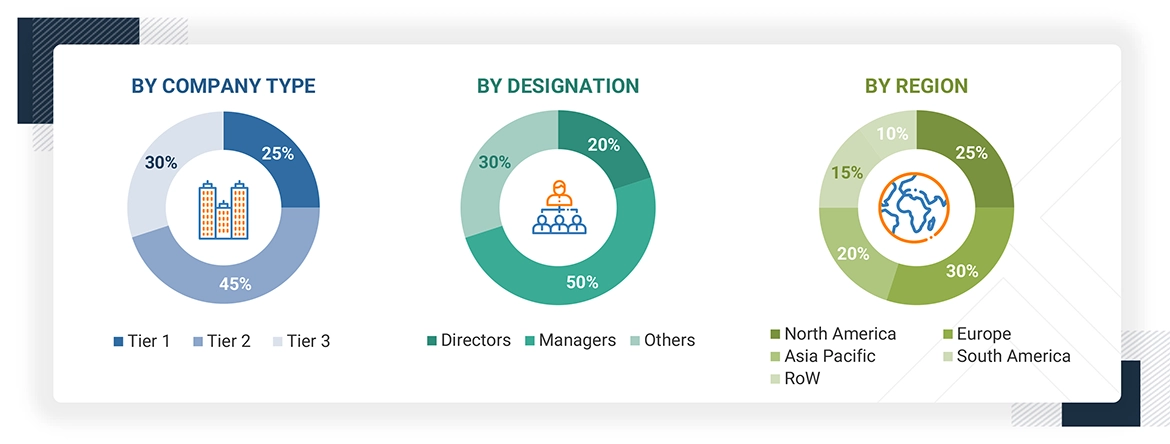
Note: The three tiers of the companies are defined based on their total revenues in 2022 or 2023, as per the availability of financial data: Tier 1: Revenue > USD 1 billion; Tier 2: USD 100 million ≤ Revenue ≤ USD 1 billion; Tier 3: Revenue < USD 100 million.
To know about the assumptions considered for the study, download the pdf brochure
| COMPANY NAME | DESIGNATION | |
|---|---|---|
| Yara (Norway) | General Manager | |
| Nutrien (US) | Sales Manager | |
| Mosaic (US) | Manager | |
| K+S Aktiengesellschaft (Germany) | Sales Manager | |
| IPL Biologicals (India) | Marketing Manager | |
Market Size Estimation
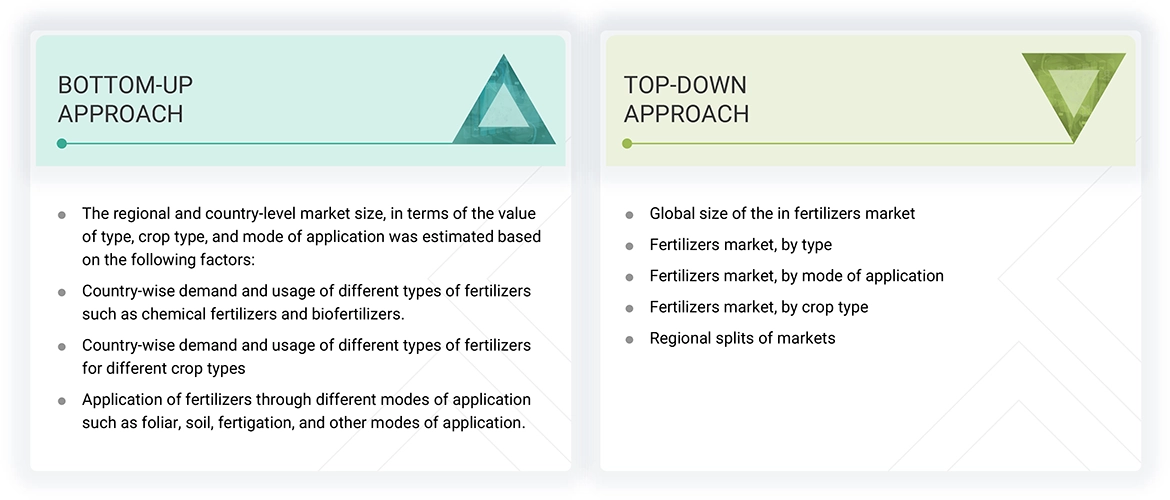
Both the top-down and bottom-up approaches were used to estimate and validate the total size of the fertilizers market. These approaches were also used extensively to determine the size of various subsegments in the market. The research methodology used to estimate the market size includes the following details:
- The key players in the industry and the overall markets were identified through extensive secondary research.
- All shares, splits, and breakdowns were determined using secondary sources and verified through primary sources.
- All possible parameters that affect the market covered in this research study were accounted for, viewed in extensive detail, verified through primary research, and analyzed to obtain final quantitative and qualitative data.
- The research included the study of reports, reviews, and newsletters of top market players, along with extensive interviews for opinions from leaders, such as CEOs, directors, and marketing executives.
Global fertilizers market: Bottom Up & Top Down Approach.
Data Triangulation
After arriving at the overall market size from the estimation process explained above, the total market was split into several segments and subsegments. The data triangulation and market breakdown procedures were employed, wherever applicable, to estimate the overall fertilizers market and arrive at the exact statistics for all segments and subsegments. The data was triangulated by studying various factors and trends from the demand and supply sides. The market size was also validated using both the top-down and bottom-up approaches.
Market Definition
Chemical fertilizers, as defined by International Standard ISO 7851, are fertilizers containing declared nutrients in the form of inorganic salts obtained through extraction or industrial physical and chemical processes. These fertilizers primarily supply the three essential plant nutrients: nitrogen (N), phosphorus (P), and potassium (K), which are crucial for plant growth and crop productivity.
Biofertilizers are substances that contain living microorganisms or latent cells. Biofertilizers are made from biological wastes and do not contain any chemicals. The National Center of Organic Farming (NCOF) defines biofertilizers as “products containing carrier-based (solid or liquid) living microorganisms that are agriculturally useful in terms of nitrogen fixation, phosphorus solubilization or nutrient mobilization, to increase the productivity of the soil and/or crop.
Stakeholders
- Key manufacturers of chemical fertilizers and biofertilizers
- Key companies in the fertilizers market
- Traders, distributors, and suppliers in the fertilizers market
- Technology providers to fertilizers companies
- Farmer organizations and crop protection product manufacturers
- Associations and industry bodies such as the Food and Agriculture Organization (FAO), International Fertilizer Association (IFA), and International Fertilizer Development Center (IFDC)
- Concerned government authorities, commercial R&D institutions, and other regulatory bodies
Report Objectives
- To determine and project the size of the fertilizers market with respect to the type, mode of application, crop type, and regions in terms of value over five years, ranging from 2025 to 2030.
- To identify the attractive opportunities in the market by determining the largest and fastest-growing segments across regions
- To provide detailed information about the key factors influencing market growth (drivers, restraints, opportunities, and challenges)
- To analyze the opportunities in the market for stakeholders and provide details of the competitive landscape for market leaders.
- To analyze the micro-markets with respect to individual growth trends, prospects, and their contribution to the total market.
- To identify and profile the key players in the fertilizers market.
- To understand the competitive landscape and identify the major growth strategies adopted by players across the key regions.
Key Questions Addressed by the Report


Personalize This Research
- Triangulate with your Own Data
- Get Data as per your Format and Definition
- Gain a Deeper Dive on a Specific Application, Geography, Customer or Competitor
- Any level of Personalization
Let Us Help You
- What are the Known and Unknown Adjacencies Impacting the Fertilizers Market
- What will your New Revenue Sources be?
- Who will be your Top Customer; what will make them switch?
- Defend your Market Share or Win Competitors
- Get a Scorecard for Target Partners

Custom Market Research Services
We Will Customise The Research For You, In Case The Report Listed Above Does Not Meet With Your Requirements
Get 10% Free CustomisationTESTIMONIALS

Business Innovation Director
US Based Leading Agribusiness,
Food and Ingredients ManufacturerI highly appreciate the team's efficiency for a well conducted study that helped us clarify some blind spots in food and agricultural niche markets. Although compiling information for B2B markets is very difficult, the MnM team pulled out the task successfully. The quality of research, level of insights, and responsiveness of team were commendable.






Growth opportunities and latent adjacency in Fertilizers Market