Fiber Laser Market Size, Share, Trends

Fiber Laser Market Size, Share, Trends by Type (Infrared, Ultrafast, Ultraviolet, Visible), Operation Mode (Continuous wave, Pulsed), Output Power (Low Power, Medium Power, High Power), Industry (Telecommunications, Automotive, Medical) and Region - Global Forecast to 2029




OVERVIEW
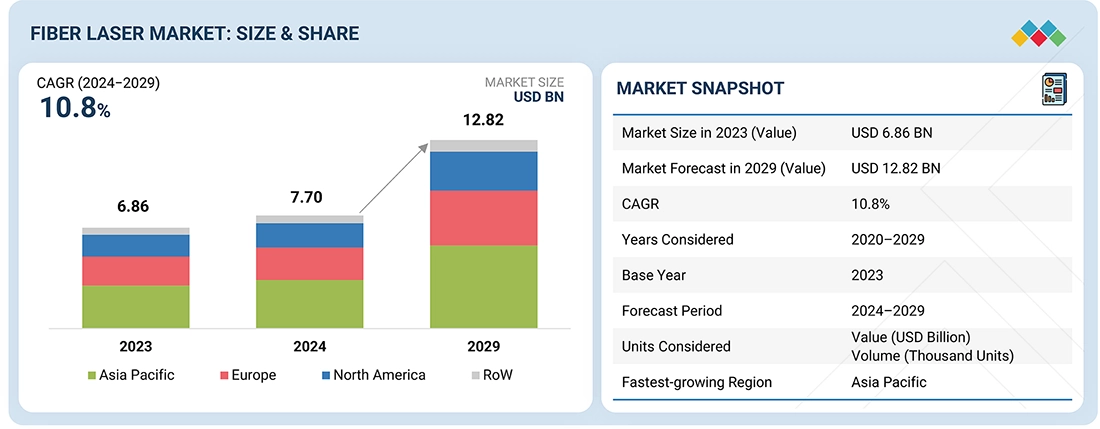
Source: Secondary Research, Interviews with Experts, MarketsandMarkets Analysis
The global Fiber Laser Market is projected to grow from USD 7.70 billion in 2024 to USD 12.82 billion by 2029, at a CAGR of 10.8% during the forecast period. This growth is primarily driven by the increasing automation in manufacturing and material processing industries, the rising adoption of fiber lasers in consumer electronics, and the expanding applications in the medical & healthcare industry. Additionally, fiber lasers' high energy efficiency, low maintenance, and long lifespan make them an attractive choice for various industrial applications. The integration of artificial intelligence (AI) in fiber laser systems further enhances their capabilities by optimizing operational parameters and ensuring high precision and reliability.
KEY TAKEAWAYS
-
BY REGIONAsia Pacific is expected to dominate the fiber laser market, with a share of 42.9% in 2023.
-
BY END-USE INDUSTRYBy End-use industry, the medical segment is expected to register the highest CAGR of 13.4% during the forecast period.
-
BY TYPEInfrared segment is expected to dominate the fiber laser market, with a share of 43.3% in 2023.
-
BY OUTPUT POWERHigh power laser segment is expected to dominate the fiber laser market, with a share of 45.4% in 2023.
-
BY OPERATION MODEContinuous wave segment is expected to register the highest CAGR of 11.2% during the forecast period.
-
COMPETITIVE LANDSCAPE (KEY PLAYERS)IPG Photonics Corporation and TRUMPF among others identified as star players in the fiber laser market due to their strong market share and extensive product footprint.
-
COMPETITIVE LANDSCAPE (STARTUPS/SMES)Toptica Photonics AG and Laguna Tools among others, have distinguished themselves among startups and SMEs by securing strong footholds in specialized niche areas, underscoring their potential as emerging market leaders in the fiber laser market.
The fiber laser industry is positioned for sustained growth as manufacturers increase adoption of high efficiency laser systems across cutting, welding, marking, and micromachining operations. Rising demand for precision metal processing, faster production cycles, and lower operating costs is driving replacement of conventional laser technologies with fiber-based solutions. Advances in beam quality, output power scalability, and energy efficiency are improving performance across automotive, electronics, semiconductor, and industrial manufacturing sectors. Integration of fiber lasers with automated production lines and digital manufacturing platforms is further strengthening adoption. As factories focus on productivity, quality consistency, and cost optimization, fiber lasers are becoming a standard tool in modern industrial processing environments.
TRENDS & DISRUPTIONS IMPACTING CUSTOMERS' CUSTOMERS
The figure highlights the revenue mix shift in the fiber laser market, where growth is moving from traditional industrial applications toward higher value and technology intensive use cases. Future revenue is increasingly driven by infrared, ultrafast, ultraviolet, and visible fiber lasers as adoption expands into microelectronics, medical and life sciences, aerospace, automotive, and architectural applications. This transition is supported by greater integration of fiber lasers with smart machine tools, industrial IoT platforms, and data driven manufacturing systems. As manufacturers prioritize precision, automation, and digital connectivity, fiber lasers are emerging as a core enabler of next generation industrial production strategies.
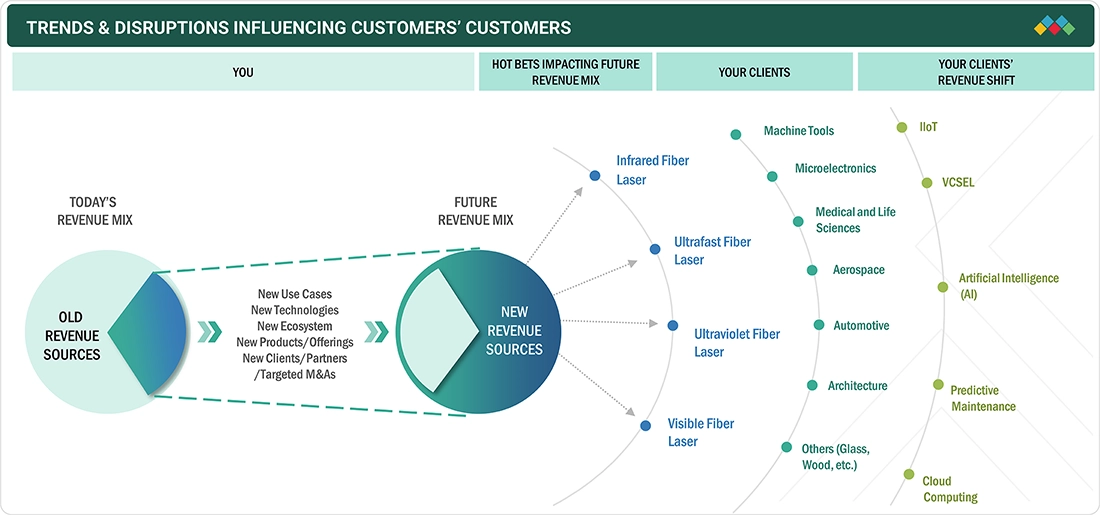
Source: Secondary Research, Interviews with Experts, MarketsandMarkets Analysis
MARKET DYNAMICS

Level
-
Increasing automation in manufacturing and material processing industries

-
High energy efficiency, low maintenance, and long lifespan of fiber lasers


Level
-
High deployment cost


Level
-
Growing use of advanced ultraviolet fiber lasers

-
Increasing use in thin sheet cutting and micro machining


Level
-
Competition from alternative technologies

Source: Secondary Research, Interviews with Experts, MarketsandMarkets Analysis
Driver: Increasing automation in manufacturing and material processing industries
Rising focus on productivity, precision, and cost efficiency is driving adoption of fiber lasers across automotive, electronics, semiconductor, and industrial manufacturing. Fiber lasers are replacing conventional processing methods to support high speed cutting, welding, and micromachining in automated production lines.
Restraint: High deployment cost
Initial investment for fiber laser systems, including laser sources, integration, and safety infrastructure, remains high for small and mid sized manufacturers. System customization and integration with existing equipment can slow adoption in cost sensitive environments.
Opportunity: Growing use of advanced ultraviolet fiber lasers
Rising demand for precision processing in microelectronics, medical devices, batteries, and semiconductors is increasing adoption of ultraviolet and ultrafast fiber lasers due to minimal thermal impact and high accuracy.
Challenge: Competition from alternative technologies
In certain applications, CO2 lasers, solid state lasers, and emerging hybrid solutions continue to compete with fiber lasers on cost or process familiarity. This can delay switching decisions in industries where existing laser infrastructure remains operational and economically viable.
FIBER LASER MARKET SIZE, SHARE, TRENDS: COMMERCIAL USE CASES ACROSS INDUSTRIES
| COMPANY | USE CASE DESCRIPTION | BENEFITS |
|---|---|---|
 |
Supplies high power fiber laser sources for metal cutting, welding, and additive manufacturing in automotive and industrial facilities. | Higher processing speed and cut quality, lower energy use, automation ready production, reduced ownership cost. |
 |
Provides fiber laser-based machine tools for cutting, welding, and marking in automotive, aerospace, and industrial plants. | High accuracy, improved uptime, connected manufacturing support, stable process control. |
 |
Delivers fiber laser systems for electronics, battery, and automotive component manufacturing. | Higher throughput, support for miniaturization, consistent output in high volume production. |
 |
Uses fiber lasers in optical fiber processing, cable manufacturing, and precision component fabrication. | High precision processing, improved yields, reliable telecom grade performance. |
 |
Offers fiber laser solutions for semiconductors, medical devices, and industrial micromachining. | High precision and repeatability, compliance with strict quality needs, efficient processing of advanced materials. |
Logos and trademarks shown above are the property of their respective owners. Their use here is for informational and illustrative purposes only.
MARKET ECOSYSTEM
Fiber laser is a large ecosystem that comprises input suppliers, OEMs, distributors, and end-use industries. The fiber laser designers and manufacturers develop and innovate lasers and laser systems with certain specifications to be distributed and supplied to different verticals. Major companies offering fiber laser include Coherent Corp. (US), IPG Photonics Corporation (US), Han's Laser Technology Co., Ltd. (China), Fujikura (Japan), and TRUMPF (Germany). Manufacturers or specialized fiber laser suppliers manufacture the products.
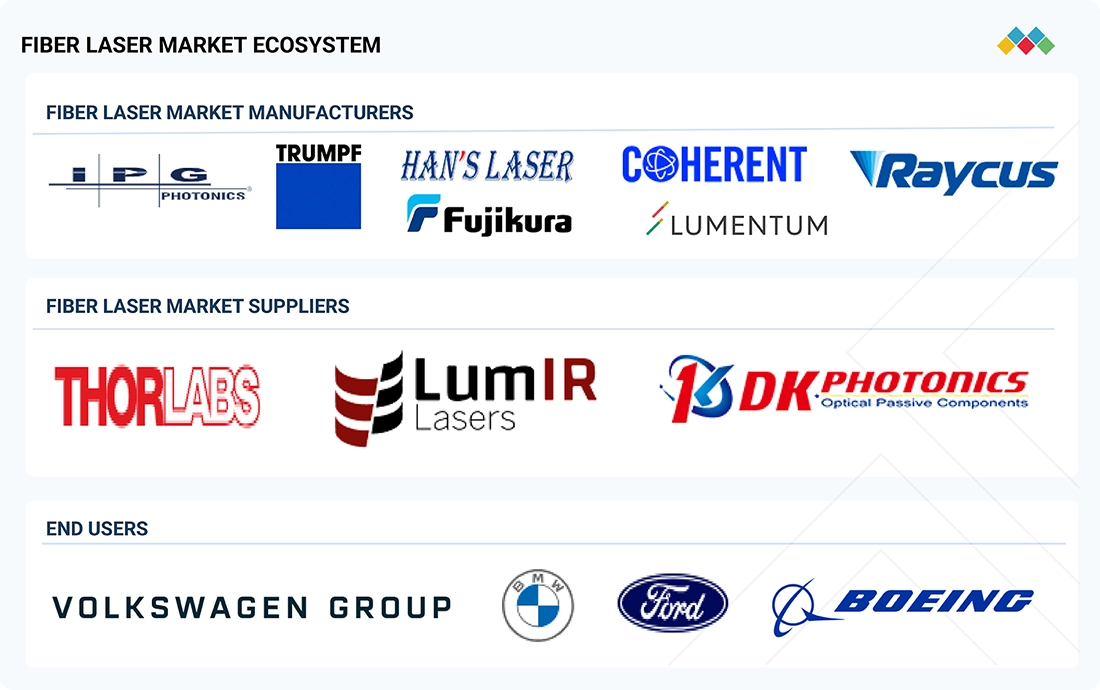
Logos and trademarks shown above are the property of their respective owners. Their use here is for informational and illustrative purposes only.
MARKET SEGMENTS
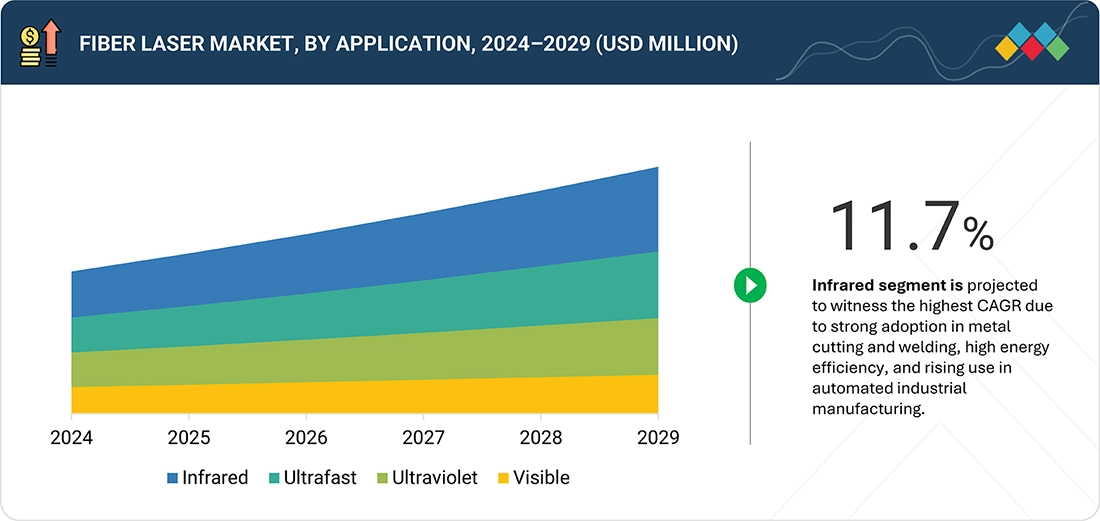
Source: Secondary Research, Interviews with Experts, MarketsandMarkets Analysis
Fiber Laser Market, by Type
Infrared fiber lasers are expected to hold the largest share due to broad adoption in metal cutting, welding, and surface treatment applications. Their high efficiency, scalability across power ranges, and compatibility with automated production lines support strong demand from automotive, electronics, and industrial manufacturing. Ultrafast and ultraviolet fiber lasers are gaining traction in precision driven applications such as microelectronics and medical device manufacturing.
Fiber Laser Market, by End Use Industry
Telecommunications holds the largest share of the fiber laser market due to widespread use in optical fiber manufacturing, component processing, and network infrastructure deployment. Fiber lasers are extensively used for fiber splicing, cable processing, and precision manufacturing of optical components,
Fiber Laser Market, by Operation Mode
Continuous wave fiber lasers account for the largest share of the market due to their extensive use in high speed cutting and deep penetration welding applications. Their stable beam output, high efficiency, and suitability for continuous industrial operations make them the preferred choice across automotive, heavy machinery, and general metal fabrication industries.
Fiber Laser Market, by Output Power
High power fiber lasers hold the largest share of the market due to their extensive use in thick metal cutting, deep penetration welding, and heavy industrial processing. Strong adoption across automotive body manufacturing, heavy machinery, shipbuilding, and structural fabrication is driving demand for high power systems that deliver high throughput, precision, and operational efficiency.
REGION
Asia Pacific to be fastest-growing region in fiber laser market during forecast period
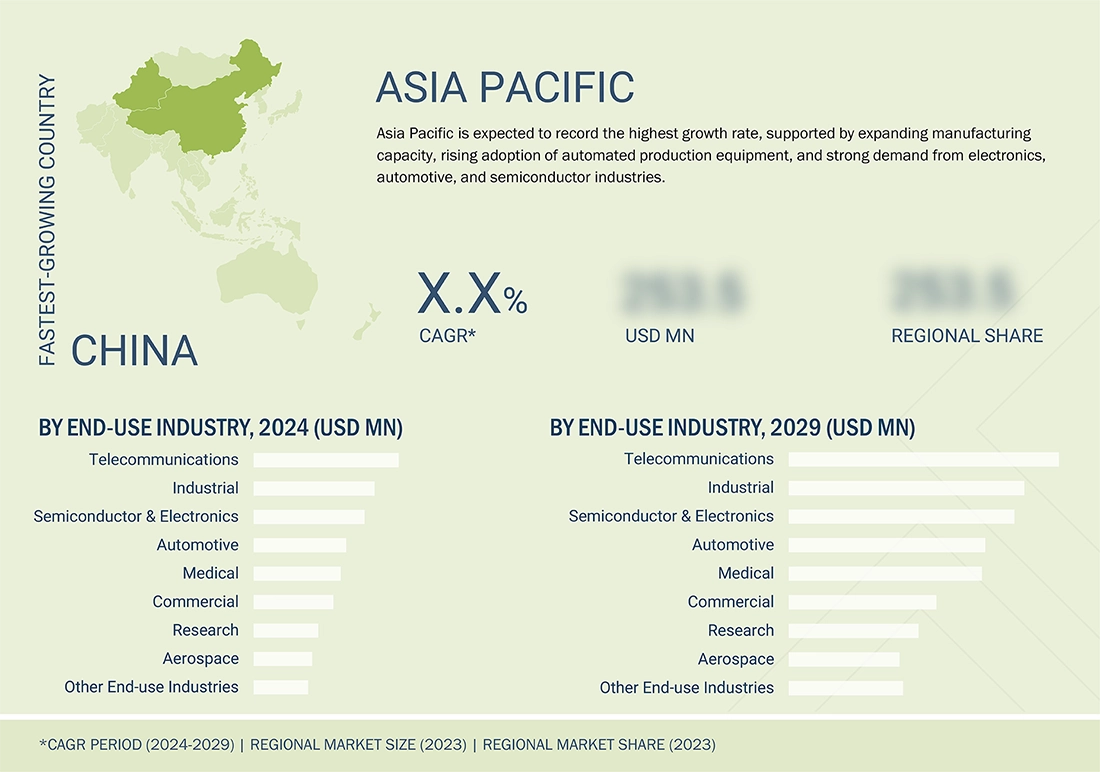
Asia Pacific is expected to be the fastest growing region in the fiber laser market due to rapid industrialization, expanding manufacturing capacity, and strong growth in electronics, automotive, and semiconductor production across China, Japan, South Korea, and India. Rising adoption of automated and precision based manufacturing, coupled with increasing investment in advanced laser processing, is accelerating demand. The presence of major regional manufacturers, along with government support for high-tech manufacturing and localization initiatives, is further strengthening market growth across the region.
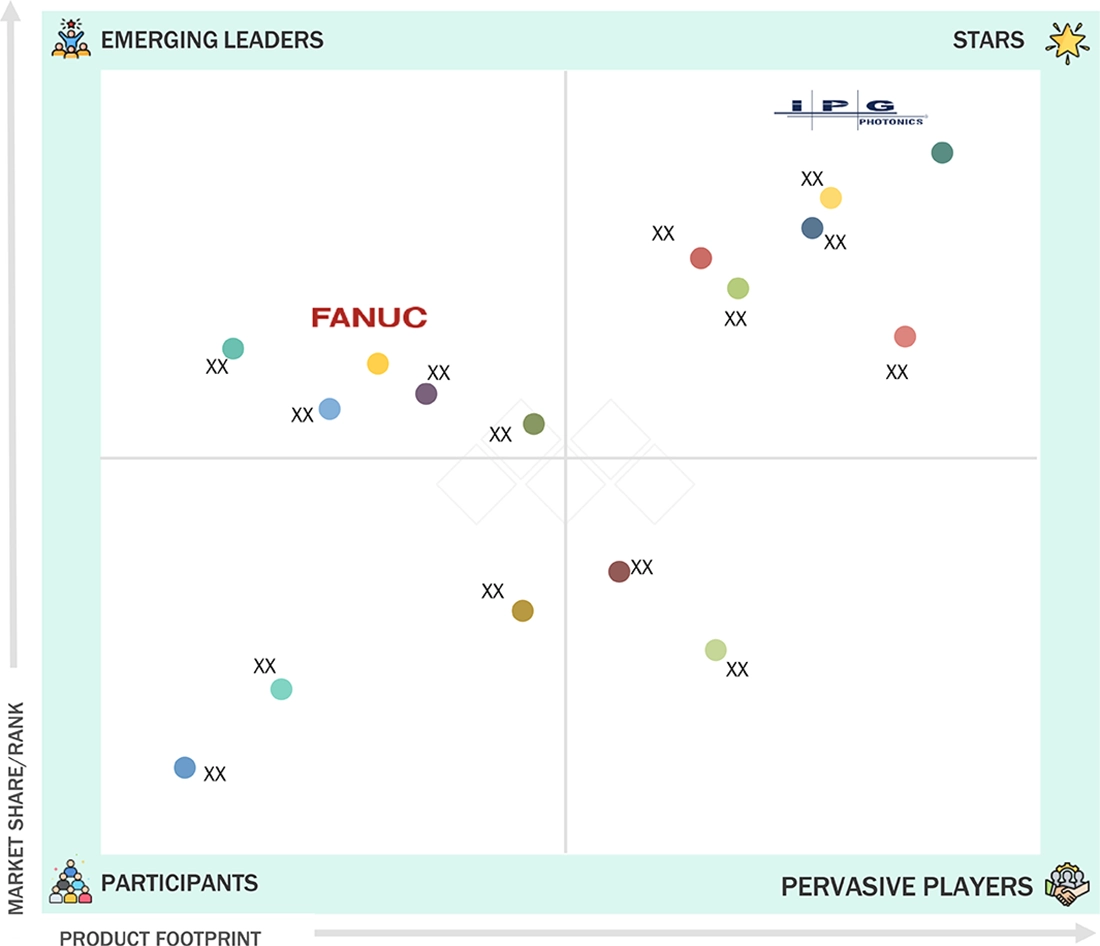
FIBER LASER MARKET SIZE, SHARE, TRENDS: COMPANY EVALUATION MATRIX
In the fiber laser companies matrix, IPG Photonics Corporation positioned as a Star leads with a vertically integrated fiber laser ecosystem that combines in house laser source manufacturing, broad wavelength coverage, and scalable high power platforms for industrial and precision processing applications. Its strength lies in delivering highly reliable, energy efficient fiber lasers with strong adoption across automotive, electronics, semiconductor, and general manufacturing environments. FANUC positioned as an Emerging Leader is gaining momentum by expanding its fiber laser portfolio and leveraging deep expertise in factory automation and CNC systems. Continued focus on integration with automation platforms, application specific system development, and global manufacturing customers is supporting FANUC’s upward movement toward the leaders’ quadrant.
Source: Secondary Research, Interviews with Experts, MarketsandMarkets Analysis
KEY MARKET PLAYERS
- IPG Photonics Corporation
- TRUMPF
- Han's Laser Technology Industry Group Co., Ltd.
- Fujikura Ltd.
- Coherent Corp.
- Wuhan Raycus Fiber Laser Technologies Co., Ltd.
- Maxphotonics Co., Ltd.
- NKT Photonics A/S
- Bystronic Laser AG
- Lumentum Holdings Inc.
MARKET SCOPE
| REPORT METRIC | DETAILS |
|---|---|
| Market Size in 2023 (Value) | USD 6.86 Billion |
| Market Forecast in 2029 (Value) | USD 12.82 Billion |
| Growth Rate | CAGR of 10.8% from 2024–2029 |
| Years Considered | 2020–2029 |
| Base Year | 2025 |
| Forecast Period | 2024–2029 |
| Units Considered | Value (USD Billion), Volume (Thousand Units) |
| Report Coverage | Revenue Forecast, Company Ranking, Competitive Landscape, Growth Factors, and Trends |
| Segments Covered |
|
| Regions Covered | North America, Europe, Asia Pacific and RoW |
WHAT IS IN IT FOR YOU: FIBER LASER MARKET SIZE, SHARE, TRENDS REPORT CONTENT GUIDE
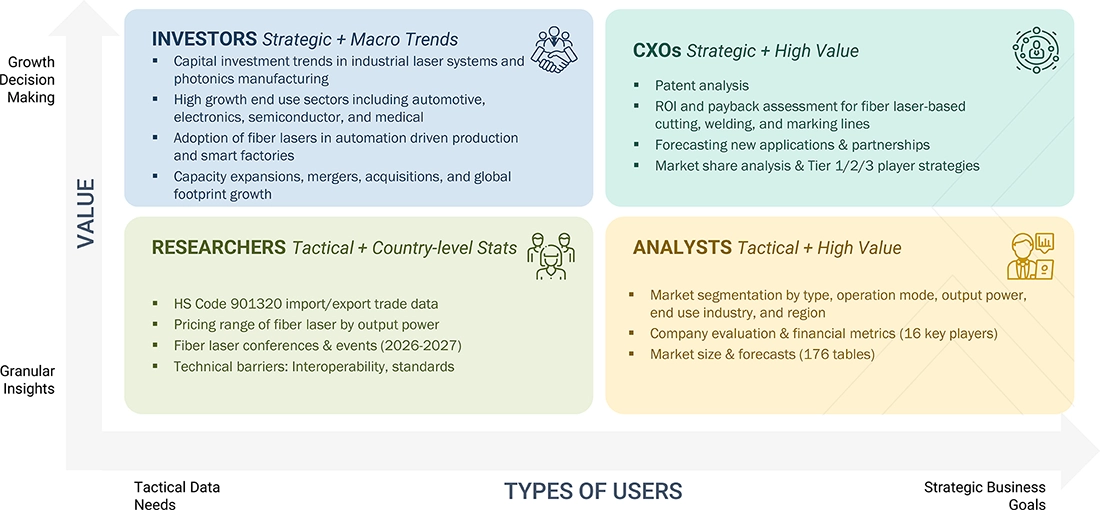
DELIVERED CUSTOMIZATIONS
We have successfully delivered the following deep-dive customizations:
| CLIENT REQUEST | CUSTOMIZATION DELIVERED | VALUE ADDS |
|---|---|---|
| Automotive & EV Manufacturers |
|
|
| Electronics & Semiconductor Manufacturers |
|
|
| Machine Tool OEMs & System Integrators |
|
|
RECENT DEVELOPMENTS
- May 2024 : IPG Photonics launched the LightWELD 2000 XR, a 2 kW handheld laser welding and cleaning system that increases processing speeds and handles thicker materials. It enhances fabrication productivity and efficiency with improved presets and compatibility with the LightWELD Cobot System.
- November 2023 : IPG Photonics Corporation, a global leader in fiber laser technology, collaborated with Miller Electronics Mfg. LLC, a leading worldwide manufacturer of arc welding products. The alliance would advance laser technologies for the handheld welding market and reshape the landscape of welding tools to provide welders with powerful, efficient, and precise solutions that meet the demands of modern welding applications. This collaboration would deliver dependable solutions that welders can rely on for their critical tasks.
Table of Contents
 Exclusive indicates content/data unique to MarketsandMarkets and not available with any competitors.
Methodology
The study involved four major activities in estimating the size of the Fiber laser market . Exhaustive secondary research has been done to collect information on the market, peer market, and parent market. Validation of these findings, assumptions, and sizing with industry experts across the value chain through primary research has been the next step. Both top-down and bottom-up approaches have been employed to estimate the global market size. After that, market breakdown and data triangulation have been used to estimate the market sizes of segments and subsegments.
Secondary Research
Various secondary sources were referred to in the secondary research process to identify and collect information pertinent to this study. The secondary sources include annual reports, press releases, and investor presentations of companies; white papers, certified publications, and articles by recognized authors; directories; and databases. Secondary research has been mainly carried out to obtain key information about the supply chain of the fiber laser industry, the value chain of the market, the total pool of the key players, market classification, and segmentation according to the industry trends to the bottom-most level, geographic markets, and key developments from both market- and technology oriented perspectives.
Primary Research
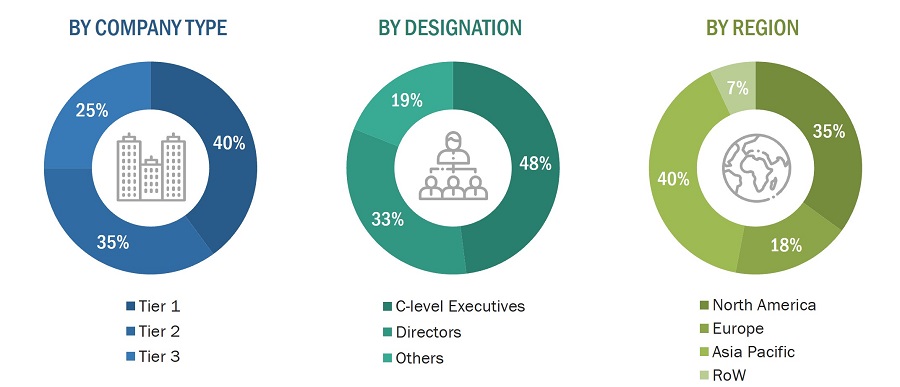
In the primary research process, various primary sources, from both supply and demand sides, were interviewed to obtain qualitative and quantitative information for this report. Primary sources from the supply side included experts such as chief executive officers (CEOs), vice presidents, marketing directors, technology and innovation directors, SMEs, consultants, and related key executives from the major companies and organizations operating in the fiber laser market share .
After the complete market engineering process (which includes market statistics calculations, market breakdown, market size estimations, market forecasting, and data triangulation), extensive primary research was conducted to gather information and verify and validate the critical market numbers.
Several primary interviews were conducted with experts from both the demand and supply sides across four major regions—North America, Europe, Asia Pacific, and RoW. This primary data was collected through questionnaires, emails, and telephonic interviews.
To know about the assumptions considered for the study, download the pdf brochure
Market Size Estimation
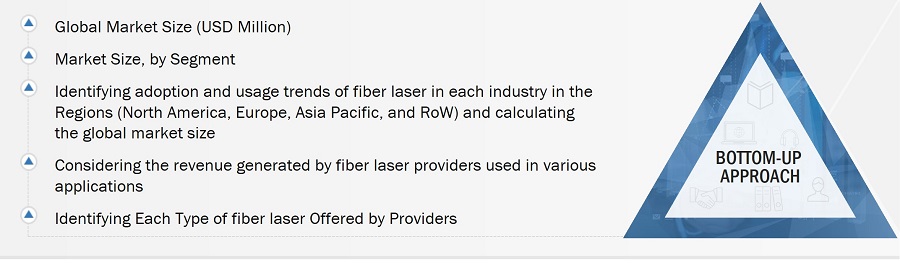
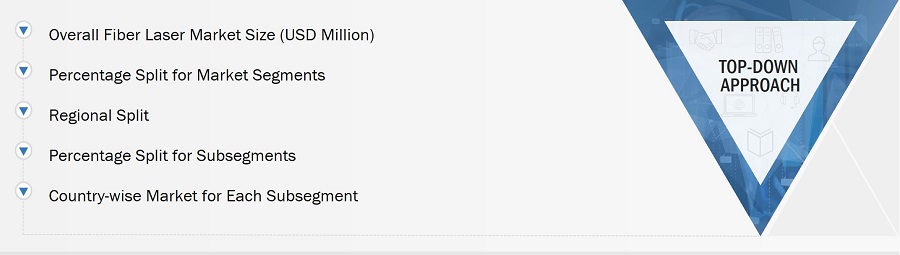
Both top-down and bottom-up approaches have been used to estimate and validate the total size of the fiber laser market. These methods have also been extensively used to estimate the sizes of various market subsegments. The research methodology used to estimate the market sizes includes the following:
- Information related to the revenue of key manufacturers and providers of fiber laser type was studied and analyzed to estimate the global size of the fiber laser market
- Multiple discussions were conducted with key opinion leaders to understand the demand for fiber laser products and analyze the break-up of the scope of work carried out by each major company
- Revenue, geographic presence, key industries served, and the diverse offerings of all identified players in the fiber laser market size were studied to estimate and arrive at the percentage split of different market segments
- All major players in the fiber laser market size were identified through secondary research and verified through brief discussions with industry experts
- Multiple discussions were conducted with key opinion leaders of all major companies involved in developing fiber laser solutions to validate the market split based on operation mode, type, output power, industry, and region
- Geographic splits were estimated using secondary sources on the basis of factors such as the number of players offering fiber laser in a specific country or region and the industries for which these players offer the solutions.
Market Size Estimation Methodology-Bottom-up Approach
Market Size Estimation Methodology-Top-Down Approach
Data Triangulation
The total market was split into several segments after arriving at the overall market size from the market size estimation process explained in the sections above. Market breakdown and data triangulation procedures were employed to complete the overall market engineering process and arrive at the exact statistics for all segments, wherever applicable. The data was triangulated by studying several factors and trends from both the demand and supply sides. The market size was also validated using both the top-down and bottom-up approaches.
Market Definition
Fiber lasers are a type of solid-state laser which uses optical fiber, doped with rare earth elements which acts as the active gain medium. Optical fiber converts light from pump laser diodes into a laser beam with specific wavelengths. Neodymium, ytterbium, praseodymium, erbium, thulium, holmium, and dysprosium are used as doping elements. Due to this wide range of produced wavelengths, fiber lasers are ideal for a variety of applications such as laser cutting, texturing, cleaning, engraving, drilling, marking, and welding. The industries that use fiber laser technology include commercial, telecommunications, research, aerospace, healthcare, automotive, semiconductor & electronics, industrial, and others (oil & gas, iron & steel, tobacco, glass, wood, retail, and plastics).
Stakeholders
- End users
- Government bodies, venture capitalists, and private equity firms
- Fiber laser manufacturers
- Fiber laser distributors
- Fiber laser industry associations
- Professional service/solution providers
- Research institutions and organizations
- Standards organizations and regulatory authorities related to the fiber Laser market
- System integrators
- Technology consultants
Research Objectives
- To define, describe, and project the size of the global fiber laser market, in terms of value, segmented based on type, industry, operation mode, output power and region
- To project the market size of fiber lasers in terms of volume
- To forecast the market size for various segments with respect to four main regions—North America, Europe, Asia Pacific, and RoW
- To provide detailed information regarding the major factors (drivers, restraints, opportunities, and industry-specific challenges) influencing the growth of the market
- To analyze the micro markets with respect to individual growth trends, prospects, and contributions to the total market
- To profile the key market players and comprehensively analyze their market ranking and core competencies.
- To analyze competitive developments, such as joint ventures, mergers & acquisitions, product launches, and research & development (R&D) activities, in the fiber laser market
- To provide leadership mapping based on company profiles and key player strategies such as product launches and development, collaborations, expansions, and acquisitions
- To analyze the opportunities in the market for stakeholders and provide a detailed competitive landscape of the market
- To provide ecosystem analysis, case study analysis, patent analysis, pricing analysis, Porter’s five forces analysis, key stakeholders & buying criteria, key conferences and events, and regulatory bodies, government agencies, and regulations pertaining to the market under study
Available Customizations:
MarketsandMarkets offers the following customizations for this market report:
- Further breakdown of the market in different regions to the country level
- Detailed analysis and profiling of additional market players (up to 5)


Personalize This Research
- Triangulate with your Own Data
- Get Data as per your Format and Definition
- Gain a Deeper Dive on a Specific Application, Geography, Customer or Competitor
- Any level of Personalization
Let Us Help You
- What are the Known and Unknown Adjacencies Impacting the Fiber Laser Market
- What will your New Revenue Sources be?
- Who will be your Top Customer; what will make them switch?
- Defend your Market Share or Win Competitors
- Get a Scorecard for Target Partners

Custom Market Research Services
We Will Customise The Research For You, In Case The Report Listed Above Does Not Meet With Your Requirements
Get 10% Free CustomisationTESTIMONIALS

Tetsuya Ohhira
Business Development Manager-Technology Business
Nikon Corporation,
Leading Japanese MNC specializing in optics and imaging productswww.nikon.com
MarketsandMarkets™ response
is quick. Their attitude is flexible and positive. Analyst Insights are globally considered and
significant. Client Services quickly respond to our inquiry and demand. Their wide range of global
surveys help us make our strategic plan.
We hope Knowledge Store will be easier to search
for a report.
VP - Marketing & Business Development
Leading Provider of Process Control Solutions
We engaged with MarketsandMarkets on a study to perform an analysis and recommend a Go-To-Market strategy for metrology and process control in the semiconductor market. The study was tailored to our targets and needs with well-defined milestones. Our overall experience with the MarketsandMarkets team was very good throughout the project in all aspects including the analysis methodologies used, the quality and depth of primary and secondary data sets, the professionalism and flexibility of the team and the ability to meet the target schedule and milestones. We want to thank MarketsandMarkets team for a job well done.
- US Fiber Laser Market
- Canada Fiber Laser Market
- Mexico Fiber Laser Market
- Germany Fiber Laser Market
- UK Fiber Laser Market
- France Fiber Laser Market
- Rest Of Europe Fiber Laser Market
- China Fiber Laser Market
- Japan Fiber Laser Market
- South Korea Fiber Laser Market
- India Fiber Laser Market
- Rest Of Asia Pacific Fiber Laser Market
Growth opportunities and latent adjacency in Fiber Laser Market






Austin
Apr, 2026
How will the increasing automation in manufacturing and material processing industries drive long-term capital allocation toward fiber laser technologies?.
Carl
Apr, 2026
How are advancements in adjustable mode beam lasers and beam control technologies reshaping product differentiation and competitive positioning?.