



Field Service Management Market Size, Share, Growth Drivers & Opportunities
Report Code
TC 3048
Published in
Nov, 2025, By MarketsandMarkets™
Field Service Management Market by Solutions (Scheduling, Dispatch & Route Optimization, Work Order Management, Reporting & Analytics, Inventory Management, Customer Management, Service Contract Management, and Other Solutions) - Global Forecast to 2030

USD 9.17 BN
MARKET SIZE, 2030

CAGR 12.5%
(2025-2030)

372
REPORT PAGES

374
MARKET TABLES
OVERVIEW
Source: Secondary Research, Interviews with Experts, MarketsandMarkets Analysis
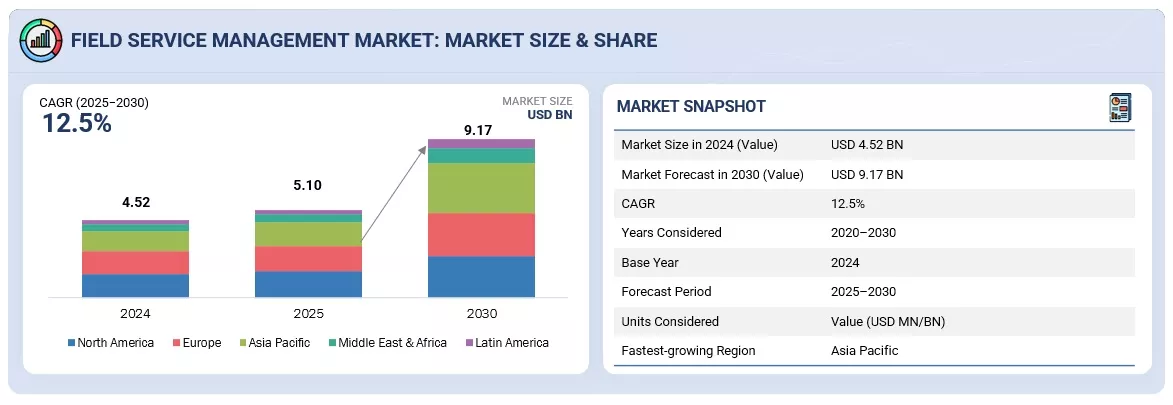
The global field service management (FSM) market is witnessing significant growth from USD 5.10 billion in 2025 to USD 9.17 billion by 2030, reflecting a CAGR of 12.5% driven by rapid digital transformation, increased cloud adoption, and the integration of advanced technologies such as AI, IoT, and analytics. Organizations across the manufacturing, utilities, telecom, and healthcare industries are adopting FSM solutions to optimize workforce management, enhance real-time visibility, and improve service delivery. The demand for automated scheduling, predictive maintenance, and mobile-enabled platforms continues to rise, enabling businesses to enhance operational efficiency and customer satisfaction. As enterprises focus on connected and data-driven operations, the FSM market is expected to expand further, supporting scalability, agility, and productivity across field operations.
Market Size and Forecast:
- 2024 Market Size: USD 4.52 Billion
- 2025 Projected Market Size: USD 5.10 Billion
- 2030 Forecasted Market Size: USD 9.17 Billion
- Growth Rate (2025-2030): CAGR of 12.5%
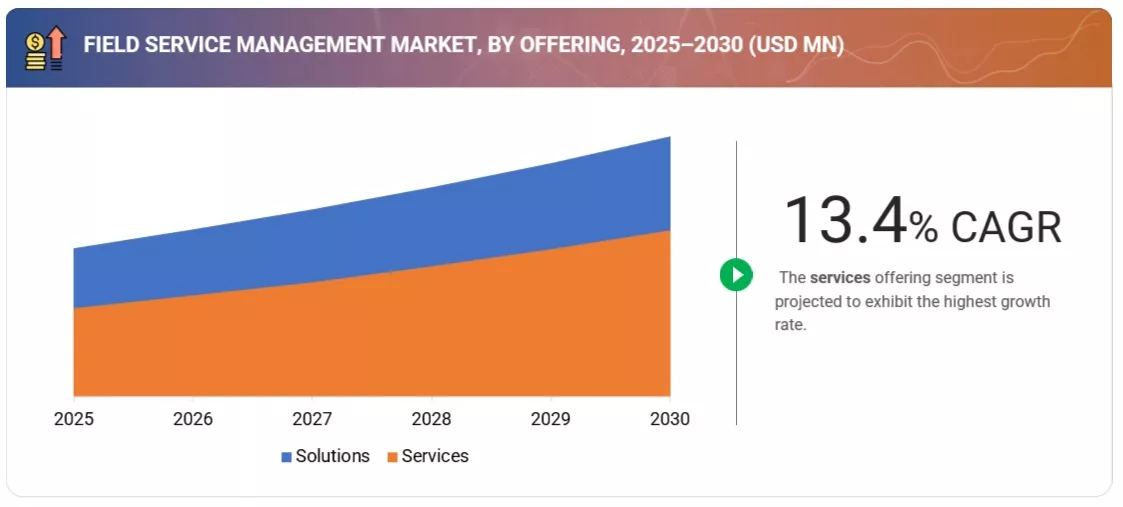
- Services offering segment is register the highest CAGR of 13.4%
- Forecast period: 2025–2030
Key Market Trends and Insights
- Leading Companies: Oracle, Microsoft, Salesforce, IFS, and SAP
-
Growth Drivers: cloud adoption, digital transformation, and AI-IoT integration
- Latest Trends: AI-autonomous operations, predictive maintenance, and AR remote support.
- Emerging Opportunities: ERP/CRM system integration and AR remote assistance.
KEY TAKEAWAYS
-
BY SOLUTION TYPECloud-based FSM solutions lead adoption, offering scalability, cost efficiency, and seamless CRM and ERP integration. They support real-time updates and remote access, ideal for large enterprises. On-premises solutions remain relevant in data-sensitive sectors requiring high customization, control, and security.
-
BY ORGANIZATION SIZELarge enterprises dominate the FSM market, utilizing advanced platforms for efficient workforce management and enhanced customer service. SMEs increasingly adopt cloud-based FSM solutions for affordability, rapid deployment, and streamlined digital field operations, helping them stay competitive with larger organizations.
-
BY VERTICALManufacturing and utilities drive FSM adoption for asset uptime and predictive maintenance. Telecom and IT sectors rapidly expand usage through IoT and analytics integration. Healthcare and BFSI are emerging users, focusing on compliance, asset tracking, and efficient service management.
-
BY REGIONNorth America leads the FSM market with advanced digital infrastructure and strong vendor presence. Europe follows with a focus on service quality and compliance. Asia Pacific is the fastest-growing region, driven by industrialization, Smart City initiatives, and field automation investments.
-
COMPETITIVE LANDSCAPEKey players such as Salesforce, Microsoft, IFS, Oracle, and ServiceMax enhance their FSM offerings through AI, mobile platforms, and predictive analytics. Collaborations with IoT and AR/VR providers improve remote services, while emerging vendors focus on vertical-specific and subscription-based FSM solutions.
The FSM market is expanding due to the rising demand for operational efficiency, real-time visibility, and connected workforce management. Enterprises are adopting automation, AI-driven scheduling, and IoT-integrated solutions to enhance field productivity, service quality, and customer satisfaction across diverse industries.
TRENDS & DISRUPTIONS IMPACTING CUSTOMERS' CUSTOMERS
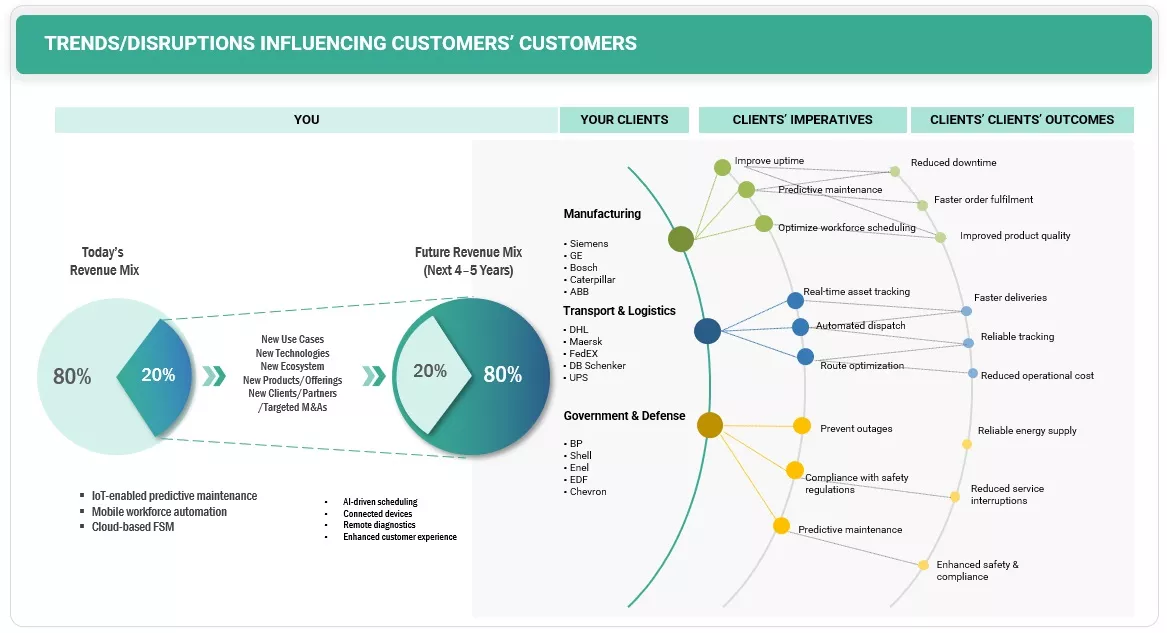
The field service management (FSM) market is undergoing a significant transformation driven by technology and evolving customer expectations. Businesses are increasingly adopting IoT-enabled devices for real-time monitoring and remote diagnostics, allowing issues to be identified and resolved before they cause downtime. AI-powered scheduling and route optimization improve workforce efficiency by ensuring technicians are deployed effectively, while mobile workforce management tools provide field staff with instant access to job details, manuals, and updates. Augmented reality and remote assistance solutions enable experts to guide technicians on-site without being physically present, reducing travel time and operational costs. Companies are also leveraging data analytics and workflow automation to enforce service-level agreements, track performance, and make proactive decisions. These trends are shifting FSM from traditional, reactive services toward digital, predictive, and proactive models, helping organizations across manufacturing, transport & logistics, and energy & utilities deliver better customer experiences, reduce operational costs, and improve asset reliability.
Source: Secondary Research, Interviews with Experts, MarketsandMarkets Analysis
MARKET DYNAMICS

Drivers
Impact
Level
Level
-
Acceleration of cloud-based deployment models

-
Increasing focus on customer experience and satisfaction


RESTRAINTS
Impact
Level
Level
-
Talent shortage and workforce skill gaps

-
Resistance from field technicians to adopt new digital tools


OPPORTUNITIES
Impact
Level
Level
-
Integration with ERP and CRM Systems

-
Use of augmented reality and remote assistance in field service


CHALLENGES
Impact
Level
Level
-
Complexity of managing multi-vendor and multi-system environments

-
Integration challenges with legacy IT systems

Source: Secondary Research, Interviews with Experts, MarketsandMarkets Analysis
Driver: Acceleration of cloud-based deployment models
The growing adoption of cloud technology is accelerating the field service management (FSM) market by enabling real-time scheduling, workforce optimization, and IoT integration. Cloud-based FSM solutions offer scalability, flexibility, and cost-efficiency, enhancing operational performance and customer satisfaction. Vendors are focusing on AI-driven analytics and mobile-first solutions to stay competitive in the evolving digital landscape.
Restraint: Talent shortage and workforce skill gaps
The FSM market faces restraints due to a global talent shortage and IT skill gaps, limiting the adoption of advanced digital tools like AI and IoT. This shortage hampers technology integration, increases operational costs, and delays Digital Transformation, ultimately affecting service quality, competitiveness, and overall market growth.
Opportunities: Integration with ERP and CRM systems
Integration of FSM solutions with ERP and CRM systems presents significant growth opportunities. Such integration enables seamless data sharing across operations, finance, and customer service, improving efficiency and decision-making. It enhances real-time visibility, streamlines billing and resource planning, and strengthens customer relationships, ultimately boosting productivity and service quality in the FSM market.
Challenge: Complexity of managing multi-vendor and multi-system environments
Managing multi-vendor and multi-system environments poses a major challenge in the FSM market. Diverse proprietary systems hinder integration, causing inefficiencies in scheduling, data inconsistency, and limited operational visibility. These complexities increase maintenance costs and reduce service quality, emphasizing the need for unified, interoperable FSM solutions to streamline operations and enhance efficiency.
Field Service Management Market: COMMERCIAL USE CASES ACROSS INDUSTRIES
| COMPANY | USE CASE DESCRIPTION | BENEFITS |
|---|---|---|
 |
Netline, a Chilean telecom provider, deployed Zinier’s field-service automation platform to unify five systems and streamline installations, repairs, and maintenance. | Installation completion within 24 hours increased from 67% to 92%, NPS rose by 32 points, and real-time visibility improved operational efficiency. |
 |
Westmor Industries replaced manual, paper-based field operations with ServiceMax’s mobile field service and intelligent scheduling tools to digitize workflows and enhance real-time data access. | Technician utilization improved by 20%, first-time fix rates rose 20–30%, and each technician processed ten more work orders weekly, boosting productivity and operational efficiency. |
 |
Spencer Technologies, a global retail service provider, adopted IFS Field Service Management to streamline logistics, repairs, and service operations across North America and Europe. | Improved customer service, enhanced client portal experience, and greater efficiency in managing reverse logistics and repair processes. |
 |
Enersense, operating in energy, manufacturing, and telecom sectors, implemented Oracle Field Service to modernize mobile workforce management and scheduling across 40 countries. | Reduced average response time to 20 minutes, optimized task scheduling, and improved communication and customer satisfaction. |
 |
Weir Minerals digitalized its field-service operations by integrating SAP Field Service Management with SAP ERP to eliminate manual and paper-based processes. | Achieved 70% faster service reporting, 50% time savings in data entry, and a 40% boost in customer satisfaction through real-time, mobile-enabled workflows. |
Logos and trademarks shown above are the property of their respective owners. Their use here is for informational and illustrative purposes only.
MARKET ECOSYSTEM
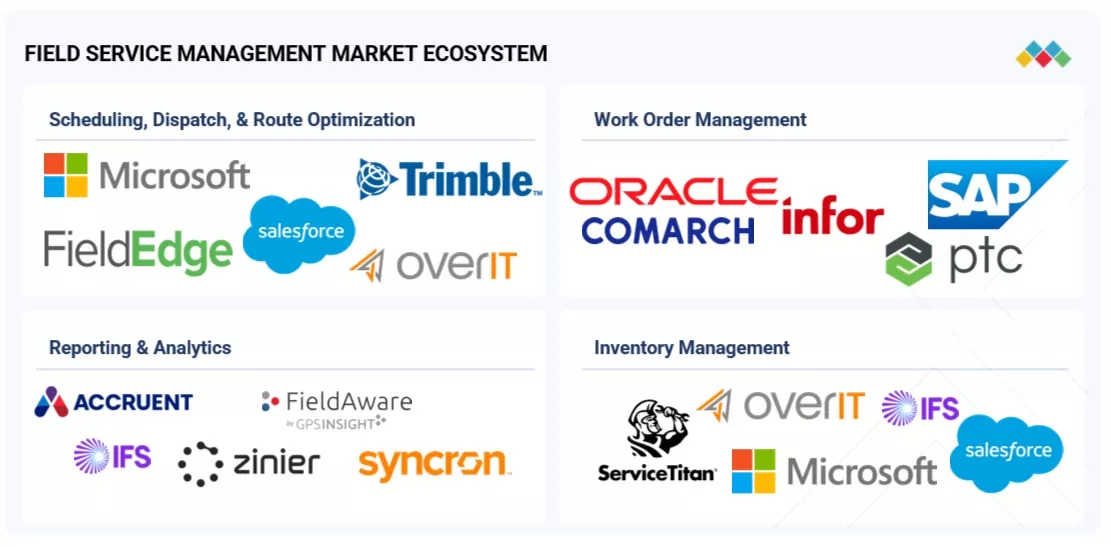
The field service management (FSM) ecosystem comprises interconnected solutions that optimize field operations across multiple industries. Core components include scheduling, dispatch, and route optimization, which enable efficient allocation of field technicians and reduce operational downtime; work order management, facilitating seamless creation, assignment, and tracking of tasks; reporting and analytics, providing real-time insights, predictive maintenance, and performance monitoring; and inventory management, ensuring availability of parts and resources for on-site service. The ecosystem integrates offerings from enterprise players, such as Oracle, Microsoft, Salesforce, SAP, IFS, and PTC, delivering end-to-end solutions, alongside mid-market and SMB vendors, such as FieldAware, Jobber, and ServiceTitan, which focus on agility and user-friendly interfaces. Collectively, these components enhance operational efficiency, reduce costs, improve first-time fix rates, and support data-driven decision-making in field operations.
Logos and trademarks shown above are the property of their respective owners. Their use here is for informational and illustrative purposes only.
MARKET SEGMENTS
Source: Secondary Research, Interviews with Experts, MarketsandMarkets Analysis
Field Service Management Market, By Offering
The services segment is projected to dominate the field service management market throughout the forecast period. Enterprises are increasingly adopting these services for their seamless connectivity across legacy, cloud, and hybrid systems, real-time data synchronization, and workflow automation. These offerings provide scalable and secure IT architectures, enabling streamlined multi-application integration. As a result, organizations benefit from enhanced operational efficiency, reduced errors, and accelerated digital transformation across distributed enterprise environments. This growing reliance on service-based solutions highlights their critical role in ensuring business agility, improved service delivery, and optimized field operations.
Field Service Management Market, By Solution Type
Reporting and analytics are expected to grow at the highest CAGR in the field service management market as organizations increasingly rely on data-driven insights to enhance operational efficiency and decision-making. Advanced analytics enable real-time monitoring of field operations, workforce productivity, and asset performance. These solutions help identify patterns, optimize resource allocation, and predict maintenance needs, reducing downtime and costs. The integration of AI and machine learning further enhances predictive analytics, driving proactive service delivery and improving customer satisfaction.
Field Service Management Market, By Service Type
Training and support services are expected to dominate the field service management market as organizations prioritize effective user adoption and system optimization. These services ensure that technicians and administrators can fully leverage FSM tools for scheduling, dispatching, and analytics. Continuous training helps teams adapt to software upgrades and new technologies such as AI and IoT. Ongoing support minimizes downtime, enhances performance, and ensures seamless integration with other enterprise systems, driving long-term operational efficiency.
Field Service Management Market, By Deployment Type
The on-premises deployment is expected to hold the largest market share in the field service management market due to its strong control, security, and customization capabilities. Many large enterprises, especially in regulated industries such as utilities, manufacturing, and defense, prefer on-premises solutions to safeguard sensitive operational data. This deployment allows seamless integration with legacy IT systems and offers better performance reliability in remote or low-connectivity areas. Additionally, organizations with established IT infrastructure continue to favor on-premises models for compliance and data sovereignty requirements.
Field Service Management Market, By Organization
The SMEs segment is projected to dominate the field service management market throughout the forecast period. Small and medium-sized enterprises are increasingly adopting FSM solutions to enhance operational efficiency, optimize workforce management, and improve customer service delivery. These organizations leverage cost-effective, cloud-based platforms that provide real-time visibility, automated scheduling, and streamlined communication between field technicians and management. The scalability and flexibility of FSM solutions enable SMEs to efficiently manage expanding service operations without significant infrastructure investments. As digital transformation accelerates, SMEs are prioritizing intelligent, data-driven tools to reduce operational costs, minimize downtime, and enhance overall service quality across diverse business environments.
Field Service Management Market, By Vertical
The IT & ITeS segment is projected to dominate the field service management market throughout the forecast period. Organizations in this sector are increasingly implementing FSM solutions to manage complex service operations, enhance technician productivity, and ensure timely service delivery. The adoption of AI-driven scheduling, predictive maintenance, and cloud-based service platforms enables IT & ITeS enterprises to achieve higher efficiency, reduced downtime, and improved customer satisfaction. Additionally, the growing emphasis on automation and data-driven decision-making supports seamless coordination between on-site and remote teams. As digital infrastructure expands and service demands become more sophisticated, IT & ITeS companies continue to rely on FSM solutions to streamline workflows, optimize resource utilization, and maintain consistent service quality across global operations.
REGION
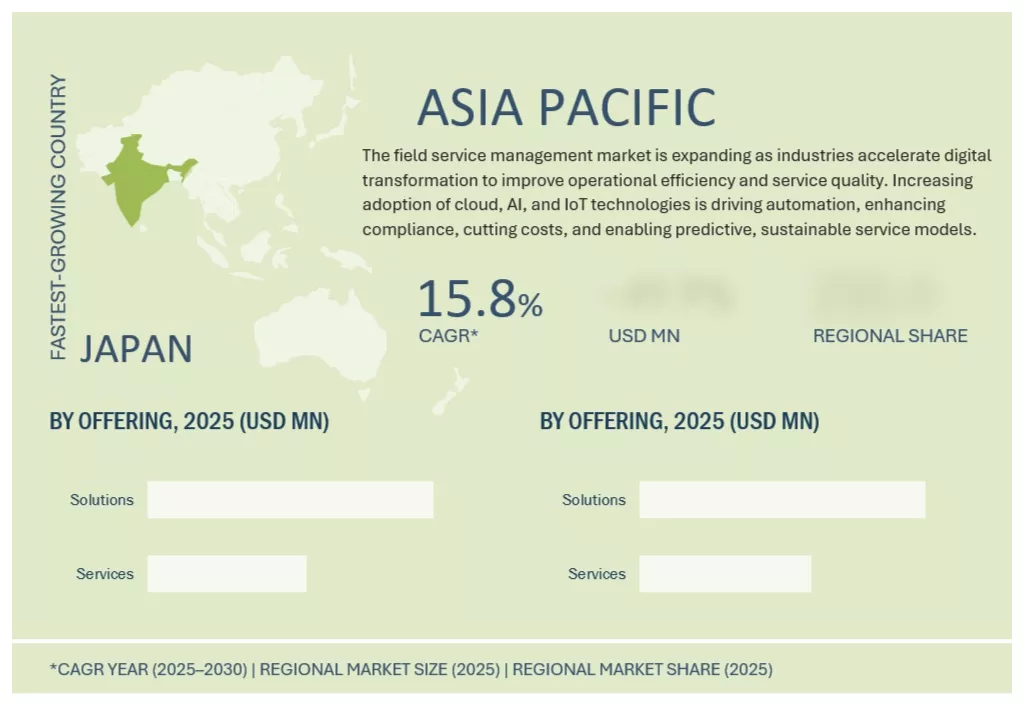
Asia Pacific is expected to grow at highest CAGR of 15.8% in the field service management market during the forecast period
The Asia Pacific (APAC) region is expected to record the highest CAGR in the field service management (FSM) market due to rapid industrialization, growing small and medium enterprises, and strong adoption of mobile and cloud-based technologies. China, India, Japan, and those in Southeast Asia are investing heavily in digital transformation to manage large, distributed field workforces more efficiently. Additionally, lower labor costs and increasing demand for real-time service delivery are encouraging faster FSM adoption. These factors collectively position APAC as the fastest-growing region in the global FSM market.
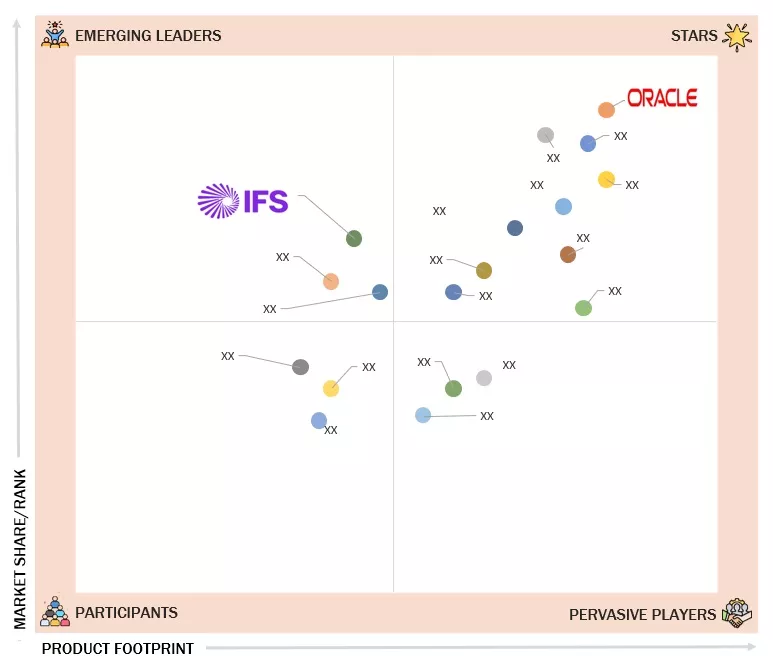
Field Service Management Market: COMPANY EVALUATION MATRIX
Oracle (Star) leads the field service management market with its comprehensive, AI-enabled, and cloud-based solutions that enhance scheduling efficiency, workforce productivity, and real-time operational visibility. Leveraging deep integration with Oracle Cloud Infrastructure and advanced analytics, it supports enterprises in driving seamless digital service experiences across industries. Meanwhile, IFS (Emerging Leader) is steadily expanding its market presence through specialized field service offerings tailored for asset-intensive sectors. Its strengths in predictive maintenance, mobile workforce management, and IoT integration position it as a preferred partner for organizations seeking agility and industry-specific innovation.
Source: Secondary Research, Interviews with Experts, MarketsandMarkets Analysis
KEY MARKET PLAYERS
MARKET SCOPE
| REPORT METRIC | DETAILS |
|---|---|
| Market Size in 2024 (Value) | USD 4.52 BN |
| Market Forecast in 2030 (Value) | USD 9.17 BN |
| Growth Rate | CAGR of 12.5% from 2025 to 2030 |
| Years Considered | 2020–2030 |
| Base Year | 2024 |
| Forecast Period | 2025–2030 |
| Units Considered | Value (USD Billion) |
| Report Coverage | Revenue Forecast, Company Ranking, Competitive Landscape, Growth Factors, and Trends |
| Segments Covered |
|
| Regional Scope | North America, Asia Pacific, Europe, Middle East & Africa, and Latin America |
WHAT IS IN IT FOR YOU: Field Service Management Market REPORT CONTENT GUIDE
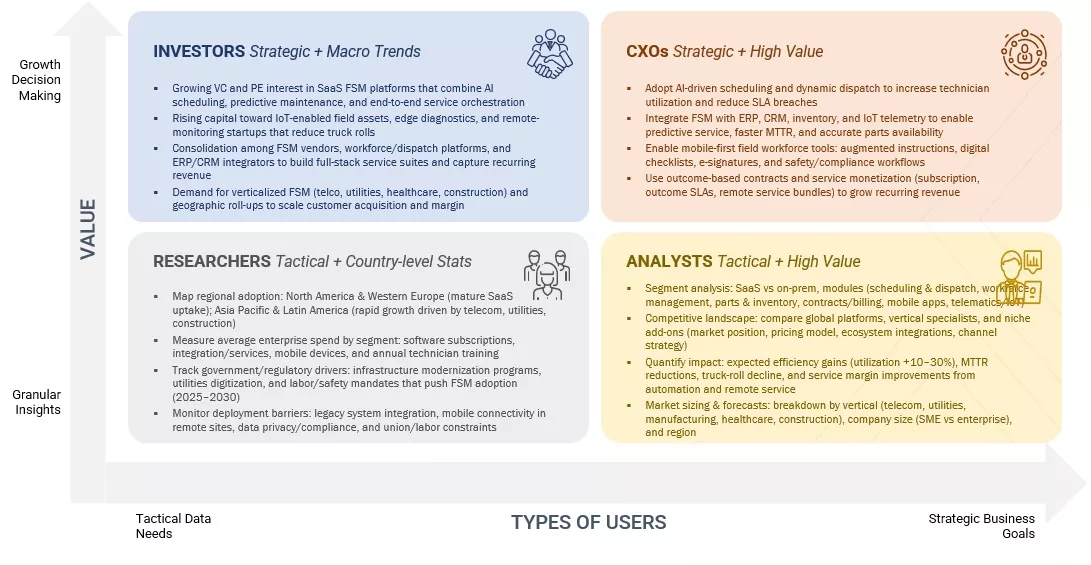
DELIVERED CUSTOMIZATIONS
We have successfully delivered the following deep-dive customizations:
| CLIENT REQUEST | CUSTOMIZATION DELIVERED | VALUE ADDS |
|---|---|---|
| Leading Solution Provider (US) | In-depth segmentation of the North American field service managment market with extended regional breakdowns for: Europe Asia Pacific Middle East & Africa Latin America | Identifies high-growth opportunities across digital transformation, cloud adoption, and enterprise modernization Enables tailored integration strategies aligning applications, infrastructure, and data systems Supports optimized technology investments and resource alignment to enhance interoperability, scalability, and operational efficiency across connected business environments |
| Leading Solution Provider (EU) | Detailed profiling of additional market players (up to 5 vendors), including product portfolios, strategic initiatives, and regional presence | Enhances competitive intelligence for strategic planning and go-to-market execution Reveals market gaps and white spaces for differentiation and innovation Supports targeted growth initiatives by aligning product development and sales strategies with unmet customer needs and emerging demand clusters |
RECENT DEVELOPMENTS
- September 2025 : Microsoft announced the deprecation of several Dynamics 365 Field Service integrations with Microsoft 365 applications. These include the Outlook Add-in, Teams app, Viva Connections, and Planner integrations, which will no longer be available after October 30, 2025. These integrations previously enabled the display of FSM work orders and schedules within Outlook, Teams, and Planner. Moving forward, Microsoft aims to streamline operations through a more unified and integrated Field Service experience within Microsoft 365, replacing the need for separate add-ins. Organizations should prepare for this transition before the October deadline to ensure continued workflow efficiency.
- June 2025 : Salesforce partnered with Jaquar to accelerate the company’s digital transformation. Under this collaboration, Jaquar implemented Salesforce solutions including Field Service, Consumer Goods Cloud, Partner Community Cloud, and Tableau to enhance operational efficiency, data agility, and mobile responsiveness. The partnership aims to embed intelligence across customer interactions and internal operations, supporting Jaquar’s goal of future-ready, agile, and intelligent business processes across its manufacturing units in India and South Korea.
- August 2025 : IFS acquired London-based 7bridges to enhance its AI-driven supply chain and field service management capabilities. By integrating 7bridges’ advanced AI simulation and analytics platform, IFS aims to optimize logistics, transportation, and service delivery networks. This acquisition supports IFS’s strategy to strengthen Industrial AI across its core solutions, including Field Service Management (FSM), enabling improved scheduling, resource allocation, and service efficiency. As part of IFS Cloud, the combined technologies will help the asset- and service-centric industries such as manufacturing, aerospace, and defense enhance operational agility, reduce costs, and ensure smarter, data-driven service execution.
- March 2025 : Azizi Developments partnered with SAP to drive end-to-end digital transformation across its operations in the UAE. The company adopted RISE with SAP Private Cloud, including SAP S/4HANA, SAP Field Service Management, and SuccessFactors, to streamline operations, enhance workforce management, and improve service delivery. SAP field service management specifically supports operational responsiveness by optimizing maintenance, resource allocation, and timely service execution. This initiative aligns with Azizi’s ambitious growth plans, which include the development of 150,000 units and an AED 1 billion investment in new factories, providing real-time insights and AI-driven efficiency across its expanding portfolio.
- October 2025 : Comarch formed a strategic partnership with Systems Limited - Middle East & Africa (Techvista Systems) to enhance IT solution delivery across the Middle East. The collaboration leverages Comarch’s global BSS and OSS portfolio, along with Techvista’s regional expertise, to provide end-to-end solutions for large enterprises and telecom operators. The partnership also focuses on AI-driven initiatives, strengthening Comarch’s regional presence and service capabilities.
Table of Contents
 Exclusive indicates content/data unique to MarketsandMarkets and not available with any competitors.
TITLE
PAGE NO
1
INTRODUCTION
28
2
EXECUTIVE SUMMARY
33
3
PREMIUM INSIGHTS
38
4
MARKET OVERVIEW AND INDUSTRY TRENDS
Discover strategic market shifts shaping field service management amid evolving economic and competitive dynamics.
41
5
STRATEGIC DISRUPTIONS: PATENTS, DIGITAL, AND AI ADOPTION
Leverage AI and digital integration for strategic market disruption and competitive advantage.
69
5.1
KEY EMERGING TECHNOLOGIES
5.1.1
ARTIFICIAL INTELLIGENCE & MACHINE LEARNING (AI/ML)
5.1.2
MOBILE COMPUTING & APPLICATION PLATFORMS
5.1.3
CLOUD COMPUTING AND SAAS PLATFORM
5.2
COMPLEMENTARY TECHNOLOGIES
5.2.1
IOT AND TELEMATICS
5.2.2
GIS & LOCATING INTELLIGENCE
5.2.3
CRM & ERP INTEGRATIONS
5.3
TECHNOLOGY/PRODUCT ROADMAP
5.3.1
SHORT-TERM (2025–2027) | FOUNDATIONAL DIGITIZATION
5.3.2
MID-TERM (2027–2030) | INTELLIGENT INTEGRATION
5.3.3
LONG-TERM (2030–2035+) | AUTONOMOUS OPERATIONS
5.4
PATENT ANALYSIS
5.4.1
LIST OF MAJOR PATENTS
5.5
IMPACT OF AI/GEN AI ON FIELD SERVICE MANAGEMENT MARKET
5.5.1
CASE STUDY
5.5.1.1
USE CASE 1: WATERS DELIVERS TRUSTED PARTNERSHIPS THROUGH QUALITY FIELD SERVICE OUTCOMES
5.5.2
VENDOR INITIATIVES
5.5.2.1
SALESFORCE
5.5.2.2
PTC (SERVICEMAX)
5.5.3
BEST PRACTICES
5.5.4
INTERCONNECTED ADJACENT ECOSYSTEM AND IMPACT ON MARKET PLAYERS
5.5.5
CLIENT READINESS
6
REGULATORY LANDSCAPE
Navigate complex global regulations with regional insights and compliance standards for strategic alignment.
78
6.1
INTRODUCTION
6.2
REGIONAL REGULATIONS AND COMPLIANCE
6.2.1
REGULATORY BODIES, GOVERNMENT AGENCIES, AND OTHER ORGANIZATIONS
6.2.2
REGULATIONS BY REGION
6.2.2.1
NORTH AMERICA
6.2.2.2
EUROPE
6.2.2.3
ASIA PACIFIC
6.2.2.4
MIDDLE EAST & SOUTH AFRICA
6.2.2.5
LATIN AMERICA
6.2.3
INDUSTRY STANDARDS
6.2.3.1
GENERAL DATA PROTECTION REGULATION
6.2.3.2
SEC RULE 17A-4
6.2.3.3
ISO/IEC 27001
6.2.3.4
SYSTEM AND ORGANIZATION CONTROLS 2 TYPE II
6.2.3.5
FINANCIAL INDUSTRY REGULATORY AUTHORITY
6.2.3.6
HEALTH INSURANCE PORTABILITY AND ACCOUNTABILITY ACT
7
CUSTOMER LANDSCAPE & BUYING BEHAVIOR
Unlock hidden opportunities by understanding stakeholder influence and unmet needs in key industries.
85
7.1
DECISION-MAKING PROCESS
7.2
BUYER STAKEHOLDERS AND BUYING EVALUATION CRITERIA
7.3
BUYING CRITERIA
7.4
ADOPTION BARRIERS & INTERNAL CHALLENGES
7.5
UNMET NEEDS IN VARIOUS END-USE INDUSTRIES
8
FIELD SERVICE MANAGEMENT MARKET, BY OFFERING
Market Size & Growth Rate Forecast Analysis to 2030 in USD Million | 30 Data Tables
90
8.1
INTRODUCTION
8.1.1
OFFERING: FIELD SERVICE MANAGEMENT MARKET DRIVERS
8.2
SOLUTIONS
8.2.1
SCHEDULING, DISPATCH, & ROUTE OPTIMIZATION
8.2.1.1
ENHANCING WORKFORCE EFFICIENCY THROUGH INTELLIGENT SCHEDULING
8.2.1.2
AUTOMATED SCHEDULING & WORKFORCE PLANNING
8.2.1.3
FIELD RESOURCE OPTIMIZATION
8.2.1.4
PREDICTIVE SCHEDULING
8.2.2
WORK ORDER MANAGEMENT
8.2.2.1
STREAMLINING OPERATIONS WITH AUTOMATED WORKFLOWS TO ENSURE ACCURATE SERVICE EXECUTION
8.2.2.2
WORK ORDER CREATION & TRACKING
8.2.2.3
JOB ASSIGNMENT & WORKFLOW AUTOMATION
8.2.3
CUSTOMER MANAGEMENT
8.2.3.1
ELEVATING CUSTOMER EXPERIENCE THROUGH CONNECTED ENGAGEMENT
8.2.3.2
PROACTIVE CUSTOMER COMMUNICATION AND APPOINTMENT MANAGEMENT
8.2.3.3
PERSONALIZED SERVICE HISTORY AND PREDICTIVE MAINTENANCE
8.2.4
REPORTING & ANALYTICS
8.2.4.1
DRIVING DATA-BACKED DECISIONS WITH REAL-TIME INSIGHTS
8.2.4.2
DATA VISUALIZATION & BI INTEGRATION
8.2.4.3
PERFORMANCE DASHBOARDS
8.2.5
INVENTORY MANAGEMENT
8.2.5.1
OPTIMIZING SPARE PARTS AND ASSET AVAILABILITY FOR SERVICE DELIVERY OF CONSUMABLES
8.2.5.2
STOCK RECONCILIATION & AUDIT
8.2.5.3
INTEGRATION WITH PROCUREMENT SYSTEMS
8.2.6
SERVICE CONTRACT MANAGEMENT
8.2.6.1
MAXIMIZING SERVICE VALUE THROUGH CONTRACT AUTOMATION SYSTEMATIC HANDLING OF CUSTOMER AGREEMENTS
8.2.6.2
FIELD TECHNICIAN INVENTORY TRACKING
8.2.6.3
AUTOMATIC REORDERING AND ALERTS
8.2.7
OTHERS
8.3
SERVICES
8.3.1
CONSULTING
8.3.1.1
GUIDING STRATEGIC TRANSFORMATION THROUGH EXPERT CONSULTING
8.3.2
INTEGRATION & IMPLEMENTATION
8.3.2.1
ACCELERATING DEPLOYMENT WITH SEAMLESS SYSTEM INTEGRATION
8.3.3
TRAINING & SUPPORT
8.3.3.1
EMPOWERING USERS THROUGH CONTINUOUS TRAINING AND SUPPORT
9
FIELD SERVICE MANAGEMENT MARKET, BY DEPLOYMENT MODE
Market Size & Growth Rate Forecast Analysis to 2030 in USD Million | 6 Data Tables
109
9.1
INTRODUCTION
9.1.1
DEPLOYMENT MODE: FIELD SERVICE MANAGEMENT MARKET DRIVERS
9.2
ON PREMISES
9.2.1
STRENGTHENING CONTROL WITH SECURE ON-PREMISE DEPLOYMENT
9.3
CLOUD
9.3.1
DRIVING AGILITY AND SCALABILITY THROUGH CLOUD-BASED DEPLOYMENT
10
FIELD SERVICE MANAGEMENT MARKET, BY ORGANIZATION SIZE
Market Size & Growth Rate Forecast Analysis to 2030 in USD Million | 6 Data Tables
114
10.1
INTRODUCTION
10.1.1
ORGANIZATION SIZE: FIELD SERVICE MANAGEMENT MARKET DRIVERS
10.2
LARGE ENTERPRISES
10.2.1
ENHANCING OPERATIONAL EXCELLENCE IN LARGE-SCALE ENTERPRISES
10.3
SMES
10.3.1
ENABLING GROWTH AND EFFICIENCY FOR SMALL AND MEDIUM ENTERPRISES
11
FIELD SERVICE MANAGEMENT MARKET, BY VERTICAL
Market Size & Growth Rate Forecast Analysis to 2030 in USD Million | 20 Data Tables
119
11.1
INTRODUCTION
11.1.1
VERTICAL: FIELD SERVICE MANAGEMENT MARKET DRIVERS
11.2
MANUFACTURING
11.2.1
OPTIMIZING PRODUCTION UPTIME THROUGH INTELLIGENT FIELD OPERATIONS
11.2.2
MANUFACTURING: APPLICATION AREAS
11.2.2.1
ASSET TRACKING
11.2.2.2
INVENTORY MANAGEMENT
11.2.2.3
WORKFORCE MANAGEMENT
11.2.2.4
OTHERS (QUALITY CONTROL AND FIELD SERVICE OPERATIONS)
11.3
TRANSPORTATION & LOGISTICS
11.3.1
STREAMLINING FLEET AND DELIVERY EFFICIENCY WITH FSM SOLUTIONS
11.3.2
TRANSPORTATION & LOGISTICS: APPLICATION AREAS
11.3.2.1
FLEET MANAGEMENT
11.3.2.2
ROUTE OPTIMIZATION
11.3.2.3
WORKFORCE MANAGEMENT
11.3.2.4
INVENTORY & WAREHOUSE MANAGEMENT
11.4
CONSTRUCTION & REAL ESTATE
11.4.1
DRIVING PROJECT EFFICIENCY WITH CONNECTED FIELD OPERATIONS TO IMPROVE WORKFORCE PRODUCTIVITY
11.4.2
CONSTRUCTION & REAL ESTATE: APPLICATION AREAS
11.4.2.1
WORK ORDER MANAGEMENT
11.4.2.2
JOB SCHEDULING & DISPATCH
11.4.2.3
PROJECT SCHEDULING & PLANNING
11.4.2.4
EQUIPMENT & ASSET MANAGEMENT
11.5
HEALTHCARE & LIFE SCIENCES
11.5.1
ENSURING EQUIPMENT UPTIME AND COMPLIANCE IN CRITICAL ENVIRONMENTS
11.5.2
HEALTHCARE & LIFE SCIENCES: APPLICATION AREAS
11.5.2.1
MEDICAL EQUIPMENT MAINTENANCE
11.5.2.2
PATIENT CARE SERVICES
11.5.2.3
REMOTE PATIENT MONITORING
11.5.2.4
PHARMACEUTICAL LOGISTICS
11.6
ENERGY & UTILITIES
11.6.1
EMPOWERING RELIABLE SERVICE DELIVERY THROUGH SMART FIELD MANAGEMENT
11.6.2
ENERGY & UTILITIES: APPLICATION AREAS
11.6.2.1
ASSET MAINTENANCE & MANAGEMENT
11.6.2.2
FIELD WORKFORCE MANAGEMENT
11.6.2.3
COMPLIANCE & AUDITS
11.6.2.4
GRID MAINTENANCE & OPERATIONS
11.7
TELECOMMUNICATION
11.7.1
IMPROVING NETWORK MAINTENANCE THROUGH AUTOMATED FIELD COORDINATION
11.7.2
TELECOMMUNICATIONS: APPLICATION AREAS
11.7.2.1
EQUIPMENT CONFIGURATION & OPTIMIZATION
11.7.2.2
WORKFORCE SCHEDULING & DISPATCH
11.7.2.3
INVENTORY MANAGEMENT
11.7.2.4
CUSTOMER SERVICE & ON-SITE SUPPORT
11.7.2.5
COMPLIANCE & REGULATORY MANAGEMENT
11.8
IT & ITES
11.8.1
DELIVERING SEAMLESS TECH SUPPORT THROUGH INTELLIGENT SERVICE AUTOMATION
11.8.2
IT & ITES: APPLICATION AREAS
11.8.2.1
ASSET TRACKING & INVENTORY MANAGEMENT
11.8.2.2
SOFTWARE DEPLOYMENT & UPDATES
11.8.2.3
EMERGENCY RESPONSE & DISASTER RECOVERY
11.8.2.4
DATA CENTER SUPPORT
11.9
OIL & GAS
11.9.1
ENHANCING ASSET RELIABILITY THROUGH PREDICTIVE FIELD SERVICE MANAGEMENT
11.9.2
OIL & GAS: APPLICATION AREAS
11.9.2.1
ASSET MAINTENANCE & MANAGEMENT
11.9.2.2
FIELD INSPECTION & AUDITS
11.9.2.3
HEALTH, SAFETY, & ENVIRONMENTAL COMPLIANCE
11.10
OTHER VERTICALS
12
FIELD SERVICE MANAGEMENT MARKET, BY REGION
Comprehensive coverage of 8 Regions with country-level deep-dive of 14 Countries | 114 Data Tables.
137
12.1
INTRODUCTION
12.2
NORTH AMERICA
12.2.1
US
12.2.1.1
ADOPTION OF IOT CONNECTIVITY TO BOOST DEMAND FOR FIELD SERVICE MANAGEMENT
12.2.2
CANADA
12.2.2.1
GOVERNMENT-DRIVEN DIGITAL MODERNIZATION TO ACCELERATE FSM ADOPTION
12.3
EUROPE
12.3.1
UK
12.3.1.1
ADOPTION OF 5G CONNECTIVITY TO ACCELERATE DIGITAL TRANSFORMATION AND OPERATIONAL EFFICIENCY IN FIELD SERVICE MANAGEMENT
12.3.2
GERMANY
12.3.2.1
RISING ELECTRIC VEHICLE PRODUCTION TO FUEL DEMAND FOR ADVANCED FIELD SERVICE MANAGEMENT SOLUTIONS
12.3.3
FRANCE
12.3.3.1
RENEWABLE ENERGY EXPANSION TO ACCELERATE ADOPTION OF SERVICE MANAGEMENT SOLUTIONS
12.3.4
ITALY
12.3.4.1
EXPANSION OF HYDROPOWER INFRASTRUCTURE TO DRIVE DEMAND FOR ADVANCED FIELD SERVICE MANAGEMENT SOLUTIONS
12.3.5
REST OF EUROPE
12.4
ASIA PACIFIC
12.4.1
CHINA
12.4.1.1
DRIVING FSM GROWTH THROUGH EXPANDING INDUSTRIAL AUTOMATION LANDSCAPE TO BOOST DEMAND
12.4.2
JAPAN
12.4.2.1
ADOPTION OF INDUSTRIAL AUTOMATION AND ROBOTICS TO ACCELERATE FSM DEPLOYMENT
12.4.3
INDIA
12.4.3.1
DATA PRIVACY REGULATIONS TO PROPEL DEMAND FOR SECURE FIELD SERVICE MANAGEMENT
12.4.4
REST OF ASIA PACIFIC
12.5
MIDDLE EAST & AFRICA
12.5.1
GULF COOPERATION COUNCIL
12.5.1.1
UAE
12.5.1.2
KINGDOM OF SAUDI ARABIA
12.5.1.3
REST OF GULF COOPERATION COUNCIL (GCC) COUNTRIES
12.5.2
SOUTH AFRICA
12.5.2.1
ENHANCING GROWTH THROUGH RISING INTERNET PENETRATION TO DRIVE MARKET
12.5.3
REST OF MIDDLE EAST & AFRICA
12.6
LATIN AMERICA
12.6.1
BRAZIL
12.6.1.1
EXPANDING MOBILE INTERNET CONNECTIVITY TO FUEL TECHNOLOGY-DRIVEN EFFICIENCY
12.6.2
MEXICO
12.6.2.1
EXPANDING INTERNET CONNECTIVITY TO ACCELERATE DIGITAL TRANSFORMATION AND IOT-DRIVEN FIELD SERVICE MANAGEMENT
12.6.3
REST OF LATIN AMERICA
13
COMPETITIVE LANDSCAPE
Uncover strategic shifts and market dominance insights of tech giants and startups through 2024.
179
13.1
INTRODUCTION
13.2
KEY PLAYER STRATEGIES/RIGHT TO WIN, 2023–2025
13.3
REVENUE ANALYSIS, 2020–2024
13.4
MARKET SHARE ANALYSIS, 2024
13.5
PRODUCT COMPARISON
13.5.1
SAP
13.5.2
ORACLE
13.5.3
MICROSOFT
13.5.4
IFS
13.5.5
SALESFORCE
13.6
COMPANY EVALUATION MATRIX: KEY PLAYERS, 2024
13.6.1
STARS
13.6.2
EMERGING LEADERS
13.6.3
PERVASIVE PLAYERS
13.6.4
PARTICIPANTS
13.6.5
COMPANY FOOTPRINT: KEY PLAYERS, 2024
13.6.5.1
COMPANY FOOTPRINT
13.6.5.2
REGION FOOTPRINT
13.6.5.3
OFFERING FOOTPRINT
13.6.5.4
VERTICAL FOOTPRINT
13.7
COMPANY EVALUATION MATRIX: STARTUPS/SMES, 2024
13.7.1
PROGRESSIVE COMPANIES
13.7.2
RESPONSIVE COMPANIES
13.7.3
DYNAMIC COMPANIES
13.7.4
STARTING BLOCKS
13.7.5
COMPETITIVE BENCHMARKING: STARTUP/SMES, 2024
13.7.5.1
DETAILED LIST OF KEY STARTUPS/SMES
13.7.5.2
COMPETITIVE BENCHMARKING OF KEY STARTUPS/SMES
13.8
COMPANY VALUATION AND FINANCIAL METRICS
13.8.1
COMPANY VALUATION OF KEY VENDORS
13.8.2
FINANCIAL METRICS OF KEY VENDORS
13.9
COMPETITIVE SCENARIO
13.9.1
PRODUCT LAUNCHES
13.9.2
DEALS
14
COMPANY PROFILES
In-depth Company Profiles of Leading Market Players with detailed Business Overview, Product and Service Portfolio, Recent Developments, and Unique Analyst Perspective (MnM View)
204
14.1
INTRODUCTION
14.2
KEY PLAYERS
14.2.1
ORACLE
14.2.1.1
BUSINESS OVERVIEW
14.2.1.2
PRODUCTS/SOLUTIONS/SERVICES OFFERED
14.2.1.3
RECENT DEVELOPMENTS
14.2.1.4
MNM VIEW
14.2.2
MICROSOFT
14.2.3
SALESFORCE
14.2.4
IFS
14.2.5
SAP
14.2.6
INFOR
14.2.7
TRIMBLE
14.2.8
COMARCH
14.2.9
OVERIT
14.2.10
PTC
14.3
OTHER PLAYERS
14.3.1
SERVICEPOWER
14.3.2
SYNCRON
14.3.3
FIELDAWARE
14.3.4
ZINIER
14.3.5
ACCRUENT
14.3.6
PRAXEDO
14.3.7
FIELDEZ
14.3.8
FIELDEDGE
14.3.9
JOBBER
14.3.10
SERVICETITAN
14.3.11
PEGASYSTEMS
14.3.12
SKEDULO
14.3.13
SERVICE FUSION
14.3.14
HUSKY INTELLIGENCE
14.3.15
FIELDPULSE
14.3.16
WORKIZ
14.3.17
KICKSERV
14.3.18
DASSAULT SYSTEMS
15
RESEARCH METHODOLOGY
256
15.1
RESEARCH APPROACH
15.1.1
SECONDARY DATA
15.1.1.1
KEY DATA FROM SECONDARY SOURCES
15.1.2
PRIMARY DATA
15.1.2.1
KEY DATA FROM PRIMARY SOURCES
15.1.2.2
BREAKUP OF PRIMARY PROFILES
15.1.2.3
KEY INDUSTRY INSIGHTS
15.2
MARKET BREAKUP AND DATA TRIANGULATION
15.3
MARKET SIZE ESTIMATION
15.3.1
TOP-DOWN APPROACH
15.3.2
BOTTOM-UP APPROACH
15.3.3
MARKET ESTIMATION APPROACHES
15.4
MARKET FORECAST
15.5
RESEARCH ASSUMPTIONS
15.6
RESEARCH LIMITATIONS
16
ADJACENT AND RELATED MARKETS
269
16.1
INTRODUCTION
16.1.1
RELATED MARKETS
16.1.2
LIMITATIONS
16.2
WORK FORCE MANAGEMENT MARKET
16.3
WORK ORDER MANAGEMENT SYSTEMS MARKET
17
APPENDIX
271
17.1
DISCUSSION GUIDE
17.2
KNOWLEDGESTORE: MARKETSANDMARKETS’ SUBSCRIPTION PORTAL
17.3
CUSTOMIZATION OPTIONS
17.4
RELATED REPORTS
17.5
AUTHOR DETAILS
LIST OF TABLES
TABLE 1
USD EXCHANGE RATES, 2019–2024
TABLE 2
PORTER’S FIVE FORCES ANALYSIS: FIELD SERVICE MANAGEMENT MARKET
TABLE 3
GDP PERCENTAGE CHANGE, BY KEY COUNTRIES, 2021–2029
TABLE 4
ROLES OF COMPANIES IN ECOSYSTEM
TABLE 5
INDICATIVE PRICING OF KEY PLAYERS, BY SOLUTION, 2025
TABLE 6
FIELD SERVICE MANAGEMENT MARKET: KEY CONFERENCES AND EVENTS, 2025–2026
TABLE 7
US ADJUSTED RECIPROCAL TARIFF RATES
TABLE 8
EXPECTED CHANGE IN PRICES AND LIKELY IMPACT ON END END-USER MARKET DUE TO TARIFF IMPACT
TABLE 9
LIST OF MAJOR PATENTS
TABLE 10
INTERCONNECTED ADJACENT ECOSYSTEM AND IMPACT ON MARKET PLAYERS
TABLE 11
NORTH AMERICA: REGULATORY BODIES, GOVERNMENT AGENCIES, AND OTHER ORGANIZATIONS
TABLE 12
EUROPE: REGULATORY BODIES, GOVERNMENT AGENCIES, AND OTHER ORGANIZATIONS
TABLE 13
ASIA PACIFIC: REGULATORY BODIES, GOVERNMENT AGENCIES, AND OTHER ORGANIZATIONS
TABLE 14
REST OF WORLD: REGULATORY BODIES, GOVERNMENT AGENCIES, AND OTHER ORGANIZATIONS
TABLE 15
INFLUENCE OF STAKEHOLDERS ON BUYING PROCESS FOR KEY VERTICALS
TABLE 16
KEY BUYING CRITERIA FOR TOP THREE VERTICALS
TABLE 17
FIELD SERVICE MANAGEMENT MARKET: UNMET NEEDS IN KEY END-USE INDUSTRIES
TABLE 18
FIELD SERVICE MANAGEMENT MARKET, BY OFFERING, 2020–2024 (USD MILLION)
TABLE 19
FIELD SERVICE MANAGEMENT MARKET, BY OFFERING, 2025–2030 (USD MILLION)
TABLE 20
FIELD SERVICE MANAGEMENT MARKET, BY SOLUTION, 2020–2024 (USD MILLION)
TABLE 21
FIELD SERVICE MANAGEMENT MARKET, BY SOLUTION, 2025–2030 (USD MILLION)
TABLE 22
SOLUTIONS: FIELD SERVICE MANAGEMENT MARKET, BY REGION, 2020–2024 (USD MILLION)
TABLE 23
SOLUTIONS: FIELD SERVICE MANAGEMENT MARKET, BY REGION, 2025–2030 (USD MILLION)
TABLE 24
SCHEDULING, DISPATCH, & ROUTE OPTIMIZATION: FIELD SERVICE MANAGEMENT MARKET, BY REGION, 2020–2024 (USD MILLION)
TABLE 25
SCHEDULING, DISPATCH, & ROUTE OPTIMIZATION: FIELD SERVICE MANAGEMENT MARKET, BY REGION, 2025–2030 (USD MILLION)
TABLE 26
WORK ORDER MANAGEMENT: FIELD SERVICE MANAGEMENT MARKET, BY REGION, 2020–2024 (USD MILLION)
TABLE 27
WORK ORDER MANAGEMENT: FIELD SERVICE MANAGEMENT MARKET, BY REGION, 2025–2030 (USD MILLION)
TABLE 28
CUSTOMER MANAGEMENT: FIELD SERVICE MANAGEMENT MARKET, BY REGION, 2020–2024 (USD MILLION)
TABLE 29
CUSTOMER MANAGEMENT: FIELD SERVICE MANAGEMENT MARKET, BY REGION, 2025–2030 (USD MILLION)
TABLE 30
REPORTING & ANALYTICS: FIELD SERVICE MANAGEMENT MARKET, BY REGION, 2020–2024 (USD MILLION)
TABLE 31
REPORTING & ANALYTICS: FIELD SERVICE MANAGEMENT MARKET, BY REGION, 2025–2030 (USD MILLION)
TABLE 32
INVENTORY MANAGEMENT: FIELD SERVICE MANAGEMENT MARKET, BY REGION, 2020–2024 (USD MILLION)
TABLE 33
INVENTORY MANAGEMENT: FIELD SERVICE MANAGEMENT MARKET, BY REGION, 2025–2030 (USD MILLION)
TABLE 34
SERVICE CONTRACT MANAGEMENT: FIELD SERVICE MANAGEMENT MARKET, BY REGION, 2020–2024 (USD MILLION)
TABLE 35
SERVICE CONTRACT MANAGEMENT: FIELD SERVICE MANAGEMENT MARKET, BY REGION, 2025–2030 (USD MILLION)
TABLE 36
OTHERS: FIELD SERVICE MANAGEMENT MARKET, BY REGION, 2020–2024 (USD MILLION)
TABLE 37
OTHERS: FIELD SERVICE MANAGEMENT MARKET, BY REGION, 2025–2030 (USD MILLION)
TABLE 38
FIELD SERVICE MANAGEMENT MARKET, BY SERVICES, 2020–2024 (USD MILLION)
TABLE 39
FIELD SERVICE MANAGEMENT MARKET, BY SERVICES, 2025–2030 (USD MILLION)
TABLE 40
SERVICES: FIELD SERVICE MANAGEMENT MARKET, BY REGION, 2020–2024 (USD MILLION)
TABLE 41
SERVICES: FIELD SERVICE MANAGEMENT MARKET, BY REGION, 2025–2030 (USD MILLION)
TABLE 42
CONSULTING: FIELD SERVICE MANAGEMENT MARKET, BY REGION, 2020–2024 (USD MILLION)
TABLE 43
CONSULTING: FIELD SERVICE MANAGEMENT MARKET, BY REGION, 2025–2030 (USD MILLION)
TABLE 44
INTEGRATION & IMPLEMENTATION: FIELD SERVICE MANAGEMENT MARKET, BY REGION, 2020–2024 (USD MILLION)
TABLE 45
INTEGRATION & IMPLEMENTATION: FIELD SERVICE MANAGEMENT MARKET, BY REGION, 2025–2030 (USD MILLION)
TABLE 46
TRAINING & SUPPORT: FIELD SERVICE MANAGEMENT MARKET, BY REGION, 2020–2024 (USD MILLION)
TABLE 47
TRAINING & SUPPORT: FIELD SERVICE MANAGEMENT MARKET, BY REGION, 2025–2030 (USD MILLION)
TABLE 48
FIELD SERVICE MANAGEMENT MARKET, BY DEPLOYMENT MODE, 2020–2024 (USD MILLION)
TABLE 49
FIELD SERVICE MANAGEMENT MARKET, BY DEPLOYMENT MODE, 2025–2030 (USD MILLION)
TABLE 50
ON-PREMISES: FIELD SERVICE MANAGEMENT MARKET, BY REGION, 2020–2024 (USD MILLION)
TABLE 51
ON-PREMISES: FIELD SERVICE MANAGEMENT MARKET, BY REGION, 2025–2030 (USD MILLION)
TABLE 52
CLOUD: FIELD SERVICE MANAGEMENT MARKET, BY REGION, 2020–2024 (USD MILLION)
TABLE 53
CLOUD: FIELD SERVICE MANAGEMENT MARKET, BY REGION, 2025–2030 (USD MILLION)
TABLE 54
FIELD SERVICE MANAGEMENT MARKET, BY ORGANIZATION SIZE, 2020–2024 (USD MILLION)
TABLE 55
FIELD SERVICE MANAGEMENT MARKET, BY ORGANIZATION SIZE, 2025–2030 (USD MILLION)
TABLE 56
LARGE ENTERPRISES: FIELD SERVICE MANAGEMENT MARKET, BY REGION, 2020–2024 (USD MILLION)
TABLE 57
LARGE ENTERPRISES: FIELD SERVICE MANAGEMENT MARKET, BY REGION, 2025–2030 (USD MILLION)
TABLE 58
SMES: FIELD SERVICE MANAGEMENT MARKET, BY REGION, 2020–2024 (USD MILLION)
TABLE 59
SMES: FIELD SERVICE MANAGEMENT MARKET, BY REGION, 2025–2030 (USD MILLION)
TABLE 60
FIELD SERVICE MANAGEMENT MARKET, BY VERTICAL, 2020–2024 (USD MILLION)
TABLE 61
FIELD SERVICE MANAGEMENT MARKET, BY VERTICAL, 2025–2030 (USD MILLION)
TABLE 62
MANUFACTURING: FIELD SERVICE MANAGEMENT MARKET, BY REGION, 2020–2024 (USD MILLION)
TABLE 63
MANUFACTURING: FIELD SERVICE MANAGEMENT MARKET, BY REGION, 2025–2030 (USD MILLION)
TABLE 64
TRANSPORTATION & LOGISTICS: FIELD SERVICE MANAGEMENT MARKET, BY REGION, 2020–2024 (USD MILLION)
TABLE 65
TRANSPORTATION & LOGISTICS: FIELD SERVICE MANAGEMENT MARKET, BY REGION, 2025–2030 (USD MILLION)
TABLE 66
CONSTRUCTION & REAL ESTATE: FIELD SERVICE MANAGEMENT MARKET, BY REGION, 2020–2024 (USD MILLION)
TABLE 67
CONSTRUCTION & REAL ESTATE: FIELD SERVICE MANAGEMENT MARKET, BY REGION, 2025–2030 (USD MILLION)
TABLE 68
HEALTHCARE & LIFE SCIENCES: FIELD SERVICE MANAGEMENT MARKET, BY REGION, 2020–2024 (USD MILLION)
TABLE 69
HEALTHCARE & LIFE SCIENCES: FIELD SERVICE MANAGEMENT MARKET, BY REGION, 2025–2030 (USD MILLION)
TABLE 70
ENERGY & UTILITIES: FIELD SERVICE MANAGEMENT MARKET, BY REGION, 2020–2024 (USD MILLION)
TABLE 71
ENERGY & UTILITIES: FIELD SERVICE MANAGEMENT MARKET, BY REGION, 2025–2030 (USD MILLION)
TABLE 72
TELECOMMUNICATIONS: FIELD SERVICE MANAGEMENT MARKET, BY REGION, 2020–2024 (USD MILLION)
TABLE 73
TELECOMMUNICATIONS: FIELD SERVICE MANAGEMENT MARKET, BY REGION, 2025–2030 (USD MILLION)
TABLE 74
IT & ITES: FIELD SERVICE MANAGEMENT MARKET, BY REGION, 2020–2024 (USD MILLION)
TABLE 75
IT & ITES: FIELD SERVICE MANAGEMENT MARKET, BY REGION, 2025–2030 (USD MILLION)
TABLE 76
OIL & GAS: FIELD SERVICE MANAGEMENT MARKET, BY REGION, 2020–2024 (USD MILLION)
TABLE 77
OIL & GAS: FIELD SERVICE MANAGEMENT MARKET, BY REGION, 2025–2030 (USD MILLION)
TABLE 78
OTHERS: FIELD SERVICE MANAGEMENT MARKET, BY REGION, 2020–2024 (USD MILLION)
TABLE 79
OTHERS: FIELD SERVICE MANAGEMENT MARKET, BY REGION, 2025–2030 (USD MILLION)
TABLE 80
FIELD SERVICE MANAGEMENT MARKET, BY REGION, 2020–2024 (USD MILLION)
TABLE 81
FIELD SERVICE MANAGEMENT MARKET, BY REGION, 2025–2030 (USD MILLION)
TABLE 82
NORTH AMERICA: FIELD SERVICE MANAGEMENT MARKET, BY OFFERING, 2020–2024 (USD MILLION)
TABLE 83
NORTH AMERICA: FIELD SERVICE MANAGEMENT MARKET, BY OFFERING, 2025–2030 (USD MILLION)
TABLE 84
NORTH AMERICA: FIELD SERVICE MANAGEMENT MARKET, BY SOLUTION, 2020–2024 (USD MILLION)
TABLE 85
NORTH AMERICA: FIELD SERVICE MANAGEMENT MARKET, BY SOLUTION, 2025–2030 (USD MILLION)
TABLE 86
NORTH AMERICA: FIELD SERVICE MANAGEMENT MARKET, BY SERVICE TYPE, 2020–2024 (USD MILLION)
TABLE 87
NORTH AMERICA: FIELD SERVICE MANAGEMENT MARKET, BY SERVICE TYPE, 2025–2030 (USD MILLION)
TABLE 88
NORTH AMERICA: FIELD SERVICE MANAGEMENT MARKET, BY DEPLOYMENT MODE, 2020–2024 (USD MILLION)
TABLE 89
NORTH AMERICA: FIELD SERVICE MANAGEMENT MARKET, BY DEPLOYMENT MODE, 2025–2030 (USD MILLION)
TABLE 90
NORTH AMERICA: FIELD SERVICE MANAGEMENT MARKET, BY ORGANIZATION SIZE, 2020–2024 (USD MILLION)
TABLE 91
NORTH AMERICA: FIELD SERVICE MANAGEMENT MARKET, BY ORGANIZATION SIZE, 2025–2030 (USD MILLION)
TABLE 92
NORTH AMERICA: FIELD SERVICE MANAGEMENT MARKET, BY VERTICAL, 2020–2024 (USD MILLION)
TABLE 93
NORTH AMERICA: FIELD SERVICE MANAGEMENT MARKET, BY VERTICAL, 2025–2030 (USD MILLION)
TABLE 94
NORTH AMERICA: FIELD SERVICE MANAGEMENT MARKET, BY COUNTRY, 2020–2024 (USD MILLION)
TABLE 95
NORTH AMERICA: FIELD SERVICE MANAGEMENT MARKET, BY COUNTRY, 2025–2030 (USD MILLION)
TABLE 96
US: FIELD SERVICE MANAGEMENT MARKET, BY ORGANIZATION SIZE, 2020–2024 (USD MILLION)
TABLE 97
US: FIELD SERVICE MANAGEMENT MARKET, BY ORGANIZATION SIZE, 2025–2030 (USD MILLION)
TABLE 98
CANADA: FIELD SERVICE MANAGEMENT MARKET, BY ORGANIZATION SIZE, 2020–2024 (USD MILLION)
TABLE 99
CANADA: FIELD SERVICE MANAGEMENT MARKET, BY ORGANIZATION SIZE, 2025–2030 (USD MILLION)
TABLE 100
EUROPE: FIELD SERVICE MANAGEMENT MARKET, BY OFFERING, 2020–2024 (USD MILLION)
TABLE 101
EUROPE: FIELD SERVICE MANAGEMENT MARKET, BY OFFERING, 2025–2030 (USD MILLION)
TABLE 102
EUROPE: FIELD SERVICE MANAGEMENT MARKET, BY SOLUTIONS, 2020–2024 (USD MILLION)
TABLE 103
EUROPE: FIELD SERVICE MANAGEMENT MARKET, BY SOLUTIONS, 2025–2030 (USD MILLION)
TABLE 104
EUROPE: FIELD SERVICE MANAGEMENT MARKET, BY SERVICE TYPE, 2020–2024 (USD MILLION)
TABLE 105
EUROPE: FIELD SERVICE MANAGEMENT MARKET, BY SERVICES TYPE, 2025–2030 (USD MILLION)
TABLE 106
EUROPE: FIELD SERVICE MANAGEMENT MARKET, BY DEPLOYMENT MODE, 2020–2024 (USD MILLION)
TABLE 107
EUROPE: FIELD SERVICE MANAGEMENT MARKET, BY DEPLOYMENT MODE, 2025–2030 (USD MILLION)
TABLE 108
EUROPE: FIELD SERVICE MANAGEMENT MARKET, BY ORGANIZATION SIZE, 2020–2024 (USD MILLION)
TABLE 109
EUROPE: FIELD SERVICE MANAGEMENT MARKET, BY ORGANIZATION SIZE, 2025–2030 (USD MILLION)
TABLE 110
EUROPE: FIELD SERVICE MANAGEMENT MARKET, BY VERTICAL, 2020–2024 (USD MILLION)
TABLE 111
EUROPE: FIELD SERVICE MANAGEMENT MARKET, BY VERTICAL, 2025–2030 (USD MILLION)
TABLE 112
EUROPE: FIELD SERVICE MANAGEMENT MARKET, BY COUNTRY, 2020–2024 (USD MILLION)
TABLE 113
EUROPE: FIELD SERVICE MANAGEMENT MARKET, BY COUNTRY, 2025–2030 (USD MILLION)
TABLE 114
UK: FIELD SERVICE MANAGEMENT MARKET, BY ORGANIZATION SIZE, 2020–2024 (USD MILLION)
TABLE 115
UK: FIELD SERVICE MANAGEMENT MARKET, BY ORGANIZATION SIZE, 2025–2030 (USD MILLION)
TABLE 116
GERMANY: FIELD SERVICE MANAGEMENT MARKET, BY ORGANIZATION SIZE, 2020–2024 (USD MILLION)
TABLE 117
GERMANY: FIELD SERVICE MANAGEMENT MARKET, BY ORGANIZATION SIZE, 2025–2030 (USD MILLION)
TABLE 118
FRANCE: FIELD SERVICE MANAGEMENT MARKET, BY ORGANIZATION SIZE, 2020–2024 (USD MILLION)
TABLE 119
FRANCE: FIELD SERVICE MANAGEMENT MARKET, BY ORGANIZATION SIZE, 2025–2030 (USD MILLION)
TABLE 120
ITALY: FIELD SERVICE MANAGEMENT MARKET, BY ORGANIZATION SIZE, 2020–2024 (USD MILLION)
TABLE 121
ITALY: FIELD SERVICE MANAGEMENT MARKET, BY ORGANIZATION SIZE, 2025–2030 (USD MILLION)
TABLE 122
REST OF EUROPE: FIELD SERVICE MANAGEMENT MARKET, BY ORGANIZATION SIZE, 2020–2024 (USD MILLION)
TABLE 123
REST OF EUROPE: FIELD SERVICE MANAGEMENT MARKET, BY ORGANIZATION SIZE, 2025–2030 (USD MILLION)
TABLE 124
ASIA PACIFIC: FIELD SERVICE MANAGEMENT MARKET, BY OFFERING, 2020–2024 (USD MILLION)
TABLE 125
ASIA PACIFIC: FIELD SERVICE MANAGEMENT MARKET, BY OFFERING, 2025–2030 (USD MILLION)
TABLE 126
ASIA PACIFIC: FIELD SERVICE MANAGEMENT MARKET, BY SOLUTION, 2020–2024 (USD MILLION)
TABLE 127
ASIA PACIFIC: FIELD SERVICE MANAGEMENT MARKET, BY SOLUTION, 2025–2030 (USD MILLION)
TABLE 128
ASIA PACIFIC: FIELD SERVICE MANAGEMENT MARKET, BY SERVICE TYPE, 2020–2024 (USD MILLION)
TABLE 129
ASIA PACIFIC: FIELD SERVICE MANAGEMENT MARKET, BY SERVICE TYPE, 2025–2030 (USD MILLION)
TABLE 130
ASIA PACIFIC: FIELD SERVICE MANAGEMENT MARKET, BY DEPLOYMENT MODE, 2020–2024 (USD MILLION)
TABLE 131
ASIA PACIFIC: FIELD SERVICE MANAGEMENT MARKET, BY DEPLOYMENT MODE, 2025–2030 (USD MILLION)
TABLE 132
ASIA PACIFIC: FIELD SERVICE MANAGEMENT MARKET, BY ORGANIZATION SIZE, 2020–2024 (USD MILLION)
TABLE 133
ASIA PACIFIC: FIELD SERVICE MANAGEMENT MARKET, BY ORGANIZATION SIZE, 2025–2030 (USD MILLION)
TABLE 134
ASIA PACIFIC: FIELD SERVICE MANAGEMENT MARKET, BY VERTICAL, 2020–2024 (USD MILLION)
TABLE 135
ASIA PACIFIC: FIELD SERVICE MANAGEMENT MARKET, BY VERTICAL, 2025–2030 (USD MILLION)
TABLE 136
ASIA PACIFIC: FIELD SERVICE MANAGEMENT MARKET, BY COUNTRY, 2020–2024 (USD MILLION)
TABLE 137
ASIA PACIFIC: FIELD SERVICE MANAGEMENT MARKET, BY COUNTRY, 2025–2030 (USD MILLION)
TABLE 138
CHINA: FIELD SERVICE MANAGEMENT MARKET, BY ORGANIZATION SIZE, 2020–2024 (USD MILLION)
TABLE 139
CHINA: FIELD SERVICE MANAGEMENT MARKET, BY ORGANIZATION SIZE, 2025–2030 (USD MILLION)
TABLE 140
JAPAN: FIELD SERVICE MANAGEMENT MARKET, BY ORGANIZATION SIZE, 2020–2024 (USD MILLION)
TABLE 141
JAPAN: FIELD SERVICE MANAGEMENT MARKET, BY ORGANIZATION SIZE, 2025–2030 (USD MILLION)
TABLE 142
INDIA: FIELD SERVICE MANAGEMENT MARKET, BY ORGANIZATION SIZE, 2020–2024 (USD MILLION)
TABLE 143
INDIA: FIELD SERVICE MANAGEMENT MARKET, BY ORGANIZATION SIZE, 2025–2030 (USD MILLION)
TABLE 144
REST OF ASIA PACIFIC: FIELD SERVICE MANAGEMENT MARKET, BY ORGANIZATION SIZE, 2020–2024 (USD MILLION)
TABLE 145
REST OF ASIA PACIFIC: FIELD SERVICE MANAGEMENT MARKET, BY ORGANIZATION SIZE, 2025–2030 (USD MILLION)
TABLE 146
MIDDLE EAST & AFRICA: FIELD SERVICE MANAGEMENT MARKET, BY OFFERING, 2020–2024 (USD MILLION)
TABLE 147
MIDDLE EAST & AFRICA: FIELD SERVICE MANAGEMENT MARKET, BY OFFERING, 2025–2030 (USD MILLION)
TABLE 148
MIDDLE EAST & AFRICA: FIELD SERVICE MANAGEMENT MARKET, BY SOLUTIONS, 2020–2024 (USD MILLION)
TABLE 149
MIDDLE EAST & AFRICA: FIELD SERVICE MANAGEMENT MARKET, BY SOLUTIONS, 2025–2030 (USD MILLION)
TABLE 150
MIDDLE EAST & AFRICA: FIELD SERVICE MANAGEMENT MARKET, BY SERVICE TYPE, 2020–2024 (USD MILLION)
TABLE 151
MIDDLE EAST & AFRICA: FIELD SERVICE MANAGEMENT MARKET, BY SERVICE TYPE, 2025–2030 (USD MILLION)
TABLE 152
MIDDLE EAST & AFRICA: FIELD SERVICE MANAGEMENT MARKET, BY DEPLOYMENT MODE, 2020–2024 (USD MILLION)
TABLE 153
MIDDLE EAST & AFRICA: FIELD SERVICE MANAGEMENT MARKET, BY DEPLOYMENT MODE, 2025–2030 (USD MILLION)
TABLE 154
MIDDLE EAST & AFRICA: FIELD SERVICE MANAGEMENT MARKET, BY ORGANIZATION SIZE, 2020–2024 (USD MILLION)
TABLE 155
MIDDLE EAST & AFRICA: FIELD SERVICE MANAGEMENT MARKET, BY ORGANIZATION SIZE, 2025–2030 (USD MILLION)
TABLE 156
MIDDLE EAST & AFRICA: FIELD SERVICE MANAGEMENT MARKET, BY VERTICAL, 2020–2024 (USD MILLION)
TABLE 157
MIDDLE EAST & AFRICA: FIELD SERVICE MANAGEMENT MARKET, BY VERTICAL, 2025–2030 (USD MILLION)
TABLE 158
MIDDLE EAST & AFRICA: FIELD SERVICE MANAGEMENT MARKET, BY COUNTRY, 2020–2024 (USD MILLION)
TABLE 159
MIDDLE EAST & AFRICA: FIELD SERVICE MANAGEMENT MARKET, BY COUNTRY, 2025–2030 (USD MILLION)
TABLE 160
GULF COOPERATION COUNCIL: FIELD SERVICE MANAGEMENT MARKET, BY ORGANIZATION SIZE, 2020–2024 (USD MILLION)
TABLE 161
GULF COOPERATION COUNCIL: FIELD SERVICE MANAGEMENT MARKET, BY ORGANIZATION SIZE, 2025–2030 (USD MILLION)
TABLE 162
GULF COOPERATION COUNCIL: FIELD SERVICE MANAGEMENT MARKET, BY COUNTRY, 2020–2024 (USD MILLION)
TABLE 163
GULF COOPERATION COUNCIL: FIELD SERVICE MANAGEMENT MARKET, BY COUNTRY, 2025–2030 (USD MILLION)
TABLE 164
UAE: FIELD SERVICE MANAGEMENT MARKET, BY ORGANIZATION SIZE, 2020–2024 (USD MILLION)
TABLE 165
UAE: FIELD SERVICE MANAGEMENT MARKET, BY ORGANIZATION SIZE, 2025–2030 (USD MILLION)
TABLE 166
KINGDOM OF SAUDI ARABIA: FIELD SERVICE MANAGEMENT MARKET, BY ORGANIZATION SIZE, 2020–2024 (USD MILLION)
TABLE 167
KINGDOM OF SAUDI ARABIA: FIELD SERVICE MANAGEMENT MARKET, BY ORGANIZATION SIZE, 2025–2030 (USD MILLION)
TABLE 168
REST OF GCC: FIELD SERVICE MANAGEMENT MARKET, BY ORGANIZATION SIZE, 2020–2024 (USD MILLION)
TABLE 169
REST OF GCC: FIELD SERVICE MANAGEMENT MARKET, BY ORGANIZATION SIZE, 2025–2030 (USD MILLION)
TABLE 170
SOUTH AFRICA: FIELD SERVICE MANAGEMENT MARKET, BY ORGANIZATION SIZE, 2020–2024 (USD MILLION)
TABLE 171
SOUTH AFRICA: FIELD SERVICE MANAGEMENT MARKET, BY ORGANIZATION SIZE, 2025–2030 (USD MILLION)
TABLE 172
REST OF MIDDLE EAST & AFRICA: FIELD SERVICE MANAGEMENT MARKET, BY ORGANIZATION SIZE, 2020–2024 (USD MILLION)
TABLE 173
REST OF MIDDLE EAST & AFRICA: FIELD SERVICE MANAGEMENT MARKET, BY ORGANIZATION SIZE, 2025–2030 (USD MILLION)
TABLE 174
LATIN AMERICA: FIELD SERVICE MANAGEMENT MARKET, BY OFFERING, 2020–2024 (USD MILLION)
TABLE 175
LATIN AMERICA: FIELD SERVICE MANAGEMENT MARKET, BY OFFERING, 2025–2030 (USD MILLION)
TABLE 176
LATIN AMERICA: FIELD SERVICE MANAGEMENT MARKET, BY SOLUTIONS, 2020–2024 (USD MILLION)
TABLE 177
LATIN AMERICA: FIELD SERVICE MANAGEMENT MARKET, BY SOLUTIONS, 2025–2030 (USD MILLION)
TABLE 178
LATIN AMERICA: FIELD SERVICE MANAGEMENT MARKET, BY SERVICE TYPE, 2020–2024 (USD MILLION)
TABLE 179
LATIN AMERICA: FIELD SERVICE MANAGEMENT MARKET, BY SERVICE TYPE, 2025–2030 (USD MILLION)
TABLE 180
LATIN AMERICA: FIELD SERVICE MANAGEMENT MARKET, BY DEPLOYMENT MODE, 2020–2024 (USD MILLION)
TABLE 181
LATIN AMERICA: FIELD SERVICE MANAGEMENT MARKET, BY DEPLOYMENT MODE, 2025–2030 (USD MILLION)
TABLE 182
LATIN AMERICA: FIELD SERVICE MANAGEMENT MARKET, BY ORGANIZATION SIZE, 2020–2024 (USD MILLION)
TABLE 183
LATIN AMERICA: FIELD SERVICE MANAGEMENT MARKET, BY ORGANIZATION SIZE, 2025–2030 (USD MILLION)
TABLE 184
LATIN AMERICA: FIELD SERVICE MANAGEMENT MARKET, BY VERTICAL, 2020–2024 (USD MILLION)
TABLE 185
LATIN AMERICA: FIELD SERVICE MANAGEMENT MARKET, BY VERTICAL, 2025–2030 (USD MILLION)
TABLE 186
LATIN AMERICA: FIELD SERVICE MANAGEMENT MARKET, BY COUNTRY, 2020–2024 (USD MILLION)
TABLE 187
LATIN AMERICA: FIELD SERVICE MANAGEMENT MARKET, BY COUNTRY, 2025–2030 (USD MILLION)
TABLE 188
BRAZIL: FIELD SERVICE MANAGEMENT MARKET, BY ORGANIZATION SIZE, 2020–2024 (USD MILLION)
TABLE 189
BRAZIL: FIELD SERVICE MANAGEMENT MARKET, BY ORGANIZATION SIZE, 2025–2030 (USD MILLION)
TABLE 190
MEXICO: FIELD SERVICE MANAGEMENT MARKET, BY ORGANIZATION SIZE, 2020–2024 (USD MILLION)
TABLE 191
MEXICO: FIELD SERVICE MANAGEMENT MARKET, BY ORGANIZATION SIZE, 2025–2030 (USD MILLION)
TABLE 192
REST OF LATIN AMERICA: FIELD SERVICE MANAGEMENT MARKET, BY ORGANIZATION SIZE, 2020–2024 (USD MILLION)
TABLE 193
REST OF LATIN AMERICA: FIELD SERVICE MANAGEMENT MARKET, BY ORGANIZATION SIZE, 2025–2030 (USD MILLION)
TABLE 194
FIELD SERVICE MANAGEMENT MARKET: OVERVIEW OF STRATEGIES ADOPTED BY KEY PLAYERS, 2023–2025
TABLE 195
MARKET SHARE OF KEY VENDORS, 2024
TABLE 196
FIELD SERVICE MANAGEMENT MARKET: REGION FOOTPRINT
TABLE 197
FIELD SERVICE MANAGEMENT MARKET: OFFERING FOOTPRINT
TABLE 198
FIELD SERVICE MANAGEMENT MARKET: VERTICAL FOOTPRINT
TABLE 199
FIELD SERVICE MANAGEMENT MARKET: LIST OF KEY STARTUPS/SMES
TABLE 200
FIELD SERVICE MANAGEMENT MARKET: COMPETITIVE BENCHMARKING OF KEY STARTUPS/SMES
TABLE 201
FIELD SERVICE MANAGEMENT MARKET: PRODUCT LAUNCHES, MARCH 2023–OCTOBER 2025
TABLE 202
FIELD SERVICE MANAGEMENT MARKET: DEALS, OCTOBER 2023–OCTOBER 2025
TABLE 203
ORACLE: COMPANY OVERVIEW
TABLE 204
ORACLE: PRODUCTS/SOLUTIONS/SERVICES OFFERED
TABLE 205
ORACLE: PRODUCT LAUNCHES AND ENHANCEMENTS
TABLE 206
ORACLE: DEALS
TABLE 207
MICROSOFT: COMPANY OVERVIEW
TABLE 208
MICROSOFT: PRODUCTS/SOLUTIONS/SERVICES OFFERED
TABLE 209
MICROSOFT: PRODUCT LAUNCHES AND ENHANCEMENTS
TABLE 210
SALESFORCE: COMPANY OVERVIEW
TABLE 211
SALESFORCE: PRODUCTS/SOLUTIONS/SERVICES OFFERED
TABLE 212
SALESFORCE: PRODUCT LAUNCHES AND ENHANCEMENTS
TABLE 213
SALESFORCE: DEALS
TABLE 214
IFS: COMPANY OVERVIEW
TABLE 215
IFS: PRODUCTS/SOLUTIONS/SERVICES OFFERED
TABLE 216
IFS: DEALS
TABLE 217
SAP: COMPANY OVERVIEW
TABLE 218
SAP: PRODUCTS/SOLUTIONS/SERVICES OFFERED
TABLE 219
SAP: PRODUCT LAUNCHES AND ENHANCEMENTS
TABLE 220
SAP: DEALS
TABLE 221
INFOR: COMPANY OVERVIEW
TABLE 222
INFOR: PRODUCTS/SOLUTIONS/SERVICES OFFERED
TABLE 223
TRIMBLE: COMPANY OVERVIEW
TABLE 224
TRIMBLE: PRODUCTS/SOLUTIONS/SERVICES OFFERED
TABLE 225
TRIMBLE: PRODUCT LAUNCHES AND ENHANCEMENTS
TABLE 226
COMARCH: COMPANY OVERVIEW
TABLE 227
COMARCH: PRODUCTS/SOLUTIONS/SERVICES OFFERED
TABLE 228
COMARCH: DEALS
TABLE 229
OVERIT: COMPANY OVERVIEW
TABLE 230
OVERIT: PRODUCTS/SOLUTIONS/SERVICES OFFERED
TABLE 231
OVERIT: DEALS
TABLE 232
PTC: COMPANY OVERVIEW
TABLE 233
PTC: PRODUCTS/SOLUTIONS/SERVICES OFFERED
TABLE 234
PTC: PRODUCT LAUNCHES AND ENHANCEMENTS
TABLE 235
PTC: DEALS
TABLE 236
FACTOR ANALYSIS
TABLE 237
WORKFORCE MANAGEMENT MARKET, BY COMPONENT, 2018–2025 (USD MILLION)
TABLE 238
WORKFORCE MANAGEMENT MARKET, BY SERVICE, 2018–2025 (USD MILLION)
TABLE 239
WORK ORDER MANAGEMENT SYSTEMS MARKET, BY COMPONENT, 2016–2023 (USD MILLION)
TABLE 240
WORK ORDER MANAGEMENT SYSTEMS MARKET, BY DEPLOYMENT TYPE, 2016–2023 (USD MILLION)
LIST OF FIGURES
FIGURE 1
KEY INSIGHTS AND MARKET HIGHLIGHTS
FIGURE 2
FIELD SERVICE MANAGEMENT MARKET, 2025–2030
FIGURE 3
MAJOR STRATEGIES ADOPTED BY KEY PLAYERS IN FIELD SERVICE MANAGEMENT MARKET (2020–2025)
FIGURE 4
DISRUPTIVE TRENDS IMPACTING GROWTH OF FIELD SERVICE MANAGEMENT MARKET
FIGURE 5
HIGH-GROWTH SEGMENTS AND EMERGING FRONTIERS IN FIELD SERVICE MANAGEMENT MARKET, 2025
FIGURE 6
ASIA PACIFIC TO REGISTER HIGHEST GROWTH DURING FORECAST PERIOD
FIGURE 7
SMALL AND MEDIUM ENTERPRISES TO INVEST IN AFFORDABLE FSM SOFTWARE TO STREAMLINE FIELD OPERATIONS AND ENHANCE CUSTOMER SERVICE
FIGURE 8
SOLUTIONS SEGMENT TO ACCOUNT FOR LARGEST MARKET SHARE THROUGHOUT FORECAST PERIOD
FIGURE 9
LARGE ENTERPRISES SEGMENT TO HOLD LARGER MARKET SHARE DURING FORECAST PERIOD
FIGURE 10
MANUFACTURING SEGMENT TO ACCOUNT FOR LARGEST MARKET SHARE BY 2030
FIGURE 11
ASIA PACIFIC TO EMERGE AS BEST MARKET FOR INVESTMENT IN NEXT FIVE YEARS
FIGURE 12
FIELD SERVICE MANAGEMENT MARKET: DRIVERS, RESTRAINTS, OPPORTUNITIES, AND CHALLENGES
FIGURE 13
PORTER’S FIVE FORCES ANALYSIS: FIELD SERVICES MANAGEMENT MARKET
FIGURE 14
INTERNATIONAL INVESTMENT IN DIGITAL ECONOMY
FIGURE 15
FIELD SERVICE MANAGEMENT MARKET: SUPPLY CHAIN ANALYSIS
FIGURE 16
FIELD SERVICE MANAGEMENT ECOSYSTEM
FIGURE 17
AVERAGE SELLING PRICE TREND OF FIELD SERVICE MANAGEMENT, BY REGION, 2022–2024
FIGURE 18
FIELD SERVICE MANAGEMENT MARKET: TRENDS/DISRUPTIONS IMPACTING BUYERS
FIGURE 19
LEADING FIELD SERVICE MANAGEMENT VENDORS, BY NUMBER OF INVESTORS AND FUNDING ROUNDS, 2024
FIGURE 20
NUMBER OF PATENTS PUBLISHED, 2014–2024
FIGURE 21
IMPACT OF AI/GEN AI ON FIELD SERVICE MANAGEMENT MARKET
FIGURE 22
FIELD SERVICE MANAGEMENT MARKET: DECISION-MAKING FACTORS
FIGURE 23
INFLUENCE OF STAKEHOLDERS ON BUYING PROCESS FOR TOP THREE VERTICALS
FIGURE 24
KEY BUYING CRITERIA FOR TOP THREE VERTICALS
FIGURE 25
FIELD SERVICE MANAGEMENT MARKET: ADOPTION BARRIERS & INTERNAL CHALLENGES
FIGURE 26
SOLUTIONS SEGMENT TO DOMINATE MARKET DURING FORECAST PERIOD
FIGURE 27
ON-PREMISES SEGMENT TO DOMINATE MARKET DURING FORECAST PERIOD
FIGURE 28
LARGE ENTERPRISES SEGMENT TO LEAD MARKET DURING FORECAST PERIOD
FIGURE 29
MANUFACTURING SEGMENT TO DOMINATE MARKET DURING FORECAST PERIOD
FIGURE 30
ASIA PACIFIC TO HOLD LARGEST MARKET DURING FORECAST PERIOD
FIGURE 31
NORTH AMERICA: FIELD SERVICE MANAGEMENT MARKET SNAPSHOT
FIGURE 32
ASIA PACIFIC: FIELD SERVICE MANAGEMENT MARKET SNAPSHOT
FIGURE 33
REVENUE ANALYSIS OF KEY VENDORS, 2020–2024
FIGURE 34
FIELD SERVICE MANAGEMENT MARKET: MARKET SHARE ANALYSIS, 2024
FIGURE 35
FIELD SERVICE MANAGEMENT MARKET: COMPARATIVE ANALYSIS OS VENDOR PRODUCTS
FIGURE 36
COMPANY EVALUATION MATRIX FOR KEY PLAYERS: CRITERIA WEIGHTAGE
FIGURE 37
FIELD SERVICE MANAGEMENT MARKET: COMPANY EVALUATION MATRIX (KEY PLAYERS), 2024
FIGURE 38
FIELD SERVICE MANAGEMENT MARKET: COMPANY FOOTPRINT
FIGURE 39
EVALUATION MATRIX FOR STARTUPS/SMES: CRITERIA WEIGHTAGE
FIGURE 40
FIELD SERVICE MANAGEMENT MARKET: COMPANY EVALUATION MATRIX (STARTUPS/SMES), 2024
FIGURE 41
COMPANY VALUATION OF KEY VENDORS
FIGURE 42
FINANCIAL METRICS OF KEY VENDORS
FIGURE 43
YEAR-TO-DATE (YTD) PRICE TOTAL RETURN AND 5-YEAR STOCK BETA OF KEY VENDORS
FIGURE 44
ORACLE: COMPANY SNAPSHOT
FIGURE 45
MICROSOFT: COMPANY SNAPSHOT
FIGURE 46
SALESFORCE: COMPANY SNAPSHOT
FIGURE 47
SAP: COMPANY SNAPSHOT
FIGURE 48
TRIMBLE: COMPANY SNAPSHOT
FIGURE 49
PTC: COMPANY SNAPSHOT
FIGURE 50
FIELD SERVICES MANAGEMENT MARKET: RESEARCH DESIGN
FIGURE 51
BREAKUP OF PRIMARY INTERVIEWS, BY COMPANY TYPE, DESIGNATION, AND REGION
FIGURE 52
FIELD SERVICE MANAGEMENT MARKET: TOP-DOWN AND BOTTOM-UP APPROACHES
FIGURE 53
MARKET SIZE ESTIMATION METHODOLOGY: TOP-DOWN APPROACH
FIGURE 54
MARKET SIZE ESTIMATION METHODOLOGY: BOTTOM-UP APPROACH
FIGURE 55
FIELD SERVICE MANAGEMENT MARKET: RESEARCH FLOW
FIGURE 56
MARKET SIZE ESTIMATION METHODOLOGY: SUPPLY-SIDE ANALYSIS
FIGURE 57
MARKET SIZE ESTIMATION METHODOLOGY: BOTTOM-UP APPROACH FROM SUPPLY SIDE – COLLECTIVE REVENUE OF VENDORS
FIGURE 58
FIELD SERVICE MANAGEMENT MARKET: DEMAND-SIDE APPROACH
Methodology
This research study on the field service management market involved extensive secondary sources, directories, IEEE Communication-Efficient: Algorithms and Systems, International Journal of Innovation and Technology Management, and paid databases. Primary sources were mainly industry experts from the core and related industries, third-party service providers, consulting service providers, end users, and other commercial enterprises. In-depth interviews with primary respondents, including key industry participants and subject matter experts, were conducted to obtain and verify critical qualitative and quantitative information and assess the market’s prospects.
Secondary Research
In the secondary research process, various sources were referred to identify and collect information for this study. Secondary sources included annual reports, press releases, and investor presentations of companies; white papers, journals, and certified publications; and articles from recognized authors, directories, and databases. The data was also collected from other secondary sources, such as journals, government websites, blogs, and vendors’ websites.
Primary Research
During the primary research process, various sources from both the supply and demand sides were interviewed to gather qualitative and quantitative information on the market. The primary sources from the supply side included various industry experts, such as chief experience officers (CXOs), vice presidents (VPs), and directors specializing in business development, marketing, and field service management providers. It also included key executives from system integrators (SIs), professional service providers, industry associations, and other key opinion leaders.
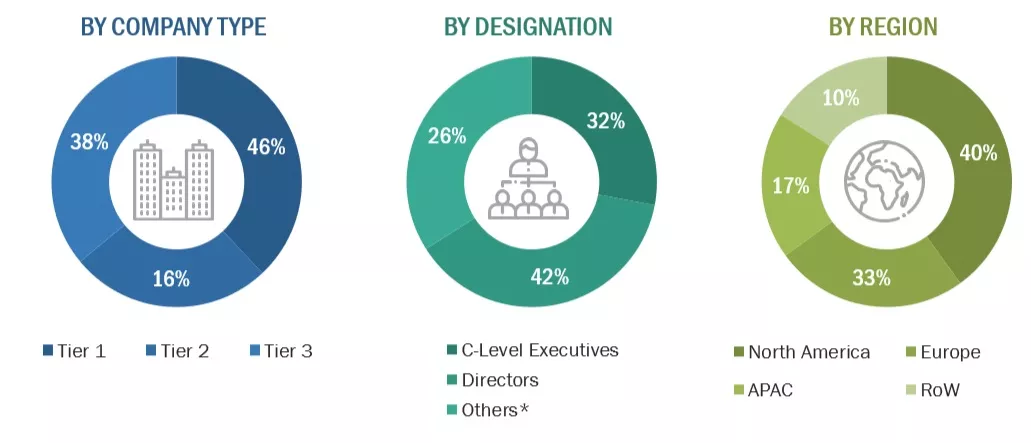
Note: Tier 1 companies’ revenues are more than USD 10 billion; tier 2 companies’ revenues range between USD 1
and 10 billion; and tier 3 companies’ revenues range between USD 500 million and USD 1 billion. Other designations include sales managers, marketing managers, and product managers.
Source: Industry Experts
To know about the assumptions considered for the study, download the pdf brochure
Market Size Estimation
Multiple approaches were adopted to estimate and forecast the field service management market. The first approach involved estimating the market size by the companies’ revenue generated through the sales of the field service management market.
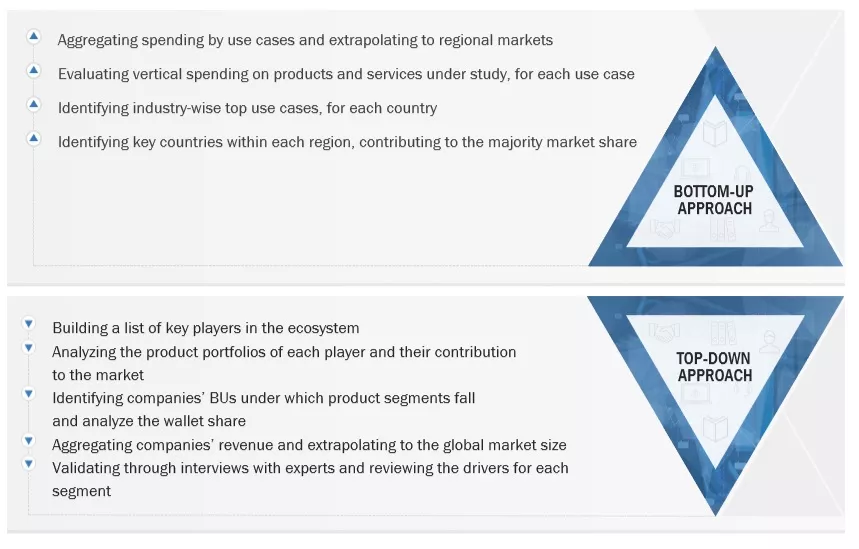
Market Size Estimation Methodology- Top-down approach
The top-down approach estimates the overall field service management market size by starting with a macro-level view, such as total IT spending or expenditures related to digital transformation. High-level industry or market values are divided and allocated into segments based on identified proportions by solution type, deployment model, organization size, or geography using researched splits. This approach uses broad market trends, industry reports, and expert insights to proportionately distribute the total value among various sub-markets, regions, and countries. It ensures that the overall estimation remains aligned with recognized industry benchmarks, enabling accurate segmentation and a holistic market perspective.
Market Size Estimation Methodology-Bottom-up approach
The bottom-up approach for estimating the field service management market size involves aggregating data at the most granular level, such as company revenues, to build up to the global figure. This process begins by collecting company-wise revenue data directly related to field service management solutions and services. By analyzing the market share and revenue of key players and integrating percentage splits for different segments, such as by service line or industry, the total market size is calculated. Additional segmentation is performed by region or vertical, ensuring comprehensive coverage. The method then validates market estimates by comparing and consolidating segment results, providing a robust and detailed market size assessment derived from concrete, ground-level business activity.
Field Service Management Market : Top-Down and Bottom-Up Approach
Data Triangulation
After determining the overall market size using the market size estimation processes as explained above, the market was split into several segments and subsegments. Data triangulation and market breakup procedures were employed, wherever applicable, to complete the overall market engineering process and determine the exact statistics of each market segment and subsegment. The overall market size was then used in the top-down approach to estimate the size of other individual markets by applying percentage splits to the market segmentation.
Market Definition
Considering the views of various associations and sources, MarketsandMarkets defines a field service management market as purpose-built software platforms and integration services for planning, dispatching, tracking, and analyzing mobile technicians tasked with on-site work such as installation, maintenance, and repairs. These solutions optimize scheduling, route management, inventory control, and real-time operational analytics for a mobile workforce across various sectors. The market focus is on streamlining field operations, improving resource utilization, and enabling efficient service delivery through digital, cloud-based platforms and advanced technologies such as artificial intelligence and IoT.
Stakeholders
- FSM Solution Vendors
- Managed Service Providers
- Hardware & IoT Device Vendors
- Telecom & Connectivity Providers
- Cloud Service Providers
- Logistics and Supply Chain Partners
- Field Technicians & Mobile Workforce
- Operations & Service Managers
- Regulatory Authorities & Standards Bodies
- Consulting & Advisory Firms
- Industry Associations & Research Organizations
- Investors & Financial Stakeholders
Report Objectives
- To define, describe, and forecast the field service management market based on offering, deployment mode, organization size, and vertical
- To forecast the market size of five major regional segments: North America, Europe, Asia Pacific, the Middle East & Africa, and Latin America
- To strategically analyze the market subsegments concerning individual growth trends, prospects, and contributions to the total market
- To provide detailed information related to the major factors influencing the growth of the market (drivers, restraints, opportunities, and challenges)
- To strategically analyze macro and micro markets with respect to growth trends, prospects, and their contributions to the overall market
- To analyze industry trends, patents and innovations, and pricing data related to the market
- To analyze the opportunities in the market for stakeholders and provide details of the competitive landscape for major players
- To analyze the impact of AI/generative AI on the market
- To profile key players in the market and comprehensively analyze their market share/ranking and core competencies
- To track and analyze competitive developments such as mergers & acquisitions, product launches, and partnerships & collaborations in the market
Available Customizations
With the given market data, MarketsandMarkets offers customizations as per the company’s specific needs. The following customization options are available for the report:
Product Analysis
- The product matrix provides a detailed comparison of the product portfolio of each company.
Geographic Analysis as per Feasibility
- Further breakup of the North American field service management market
- Further breakup of the European field service management market
- Further breakup of the Asia Pacific field service management market
- Further breakup of the Middle East & Africa field service management market
- Further breakup of the Latin American field service management market
Company Information
- Detailed analysis and profiling of additional market players (up to five)
Key Questions Addressed by the Report
What is the current size of the Field Service Management market?
The global Field Service Management market is projected to grow from USD 5.10 billion in 2025 to USD 9.17 billion by 2030, at a CAGR of 12.5%. This growth is fueled by increasing demand for workforce automation, predictive maintenance, and cloud-based service solutions.
What factors are driving growth in the FSM market?
Key drivers include the rapid digitalization of field operations, rising demand for real-time technician visibility, increasing mobile workforce adoption, and integration of AI and IoT into service workflows. Enterprises are prioritizing operational efficiency and customer satisfaction, which accelerates FSM deployment.
Which industries are investing the most in FSM solutions?
Industries such as manufacturing, telecom, utilities, healthcare, and construction are major adopters. These sectors rely heavily on field technicians and benefit from optimized scheduling, inventory management, and predictive servicing capabilities.
What are the top investment opportunities in the FSM market?
Investment opportunities are expanding in AI-driven scheduling and dispatch, predictive maintenance platforms, AR-assisted remote support, mobile workforce management, and IoT-integrated service analytics—driving higher first-time fix rates and lower operational costs.
What are the latest trends shaping the FSM market?
Major trends include the integration of Artificial Intelligence (AI) for intelligent scheduling, adoption of Internet of Things (IoT) for asset monitoring, use of Augmented Reality (AR) for remote assistance, and the expansion of mobile-first field service management (FSM) applications—enhancing field productivity and improving customer experience.
Which region is expected to witness the highest growth in FSM?
The Asia Pacific Asia Pacific region is expected to see the fastest growth due to industrial expansion, increasing digitization, and rising adoption of cloud technologies in emerging economies such as India and China.
Who are the major players in the Field Service Management market?
Key vendors include Oracle, Microsoft, Salesforce, IFS, and SAP. These companies are focusing on AI-powered service automation, cloud-native FSM platforms, and integrated customer service ecosystems.
Fact checked
Personalize This Research
- Triangulate with your Own Data
- Get Data as per your Format and Definition
- Gain a Deeper Dive on a Specific Application, Geography, Customer or Competitor
- Any level of Personalization
Let Us Help You
- What are the Known and Unknown Adjacencies Impacting the Field Service Management Market
- What will your New Revenue Sources be?
- Who will be your Top Customer; what will make them switch?
- Defend your Market Share or Win Competitors
- Get a Scorecard for Target Partners

Custom Market Research Services
We Will Customise The Research For You, In Case The Report Listed Above Does Not Meet With Your Requirements
Get 10% Free CustomisationTESTIMONIALS
- India Field Service Management Market
- UAE Field Service Management Market
- South Africa Field Service Management Market
- Brazil Field Service Management Market
- Mexico Field Service Management Market
- Rest Of Europe Field Service Management Market
- US Field Service Management Market
- Canada Field Service Management Market
- UK Field Service Management Market
- Germany Field Service Management Market
- France Field Service Management Market
- Italy Field Service Management Market
- China Field Service Management Market
- Japan Field Service Management Market
Growth opportunities and latent adjacency in Field Service Management Market






George
Jul, 2026
Why are businesses moving away from spreadsheets toward Field Service Management (FSM) platforms.
Skinny
Jul, 2026
Why is mobile-first field service software becoming critical for operational success?.
Greek
Jul, 2026
How does AI improve Field Service Management operations?.
Cameroon
Jul, 2026
Why are cloud-based FSM platforms becoming the preferred choice ?.