
Europe 3D Printed Satellite Market (2024-2029)

The Europe 3D Printed Satellite Market was valued at $14.6 Million in 2024 and projected to reach to $99.1 Million by 2029, representing a compound annual growth rate of 37.5%. Europe's 3D printed satellite market is poised for transformative growth through 2029, driven by increasing demand for cost-effective satellite manufacturing and the region's commitment to space autonomy.


| Market Size in | USD 26.32 MN |
| Market Forecast in | |
| CAGR | |
| Forecast Period | |
| Units Considered | Value (USD MN) |
Europe 3D Printed Satellite Market Trends and Insights
- This represents a compound annual growth rate of 37.5%, significantly outpacing global trends.
- Europe is positioning itself as a critical hub for advanced satellite manufacturing, driven by substantial investments in space technology infrastructure and regulatory support from the European Space Agency and national governments. The region's leadership in additive manufacturing innovation and aerospace engineering capabilities is accelerating adoption of 3D printing technologies for satellite production.
- Europe's commitment to space autonomy, coupled with growing demand for small satellites and constellation deployments, is fueling market expansion between 2024 and 2029.
- Key European nations are leveraging 3D printing to reduce production costs, accelerate time-to-market, and enhance design flexibility in satellite manufacturing..
Key Market Statistics
- CAGR (2024-2029) 37.5% CAGR
- Market Size, 2024 ~USD 14.6 Million
- Forecast, 2029 ~USD 99.1 Million
- Geography Europe
Europe 3D Printed Satellite Market Overview
Exceptional Growth Trajectory :
Europe's 3D printed satellite market is expanding at 37.5% CAGR, significantly outpacing the global rate of 27.7%, positioning the region as a high-growth hub for advanced satellite manufacturing technologies.
Substantial Market Expansion :
The European market is projected to grow from $14.6 million in 2024 to $99.1 million by 2029, representing a nearly 580% increase over five years, driven by strategic investments in space infrastructure.
Regional Innovation Leadership :
Europe is establishing itself as a critical hub for advanced satellite manufacturing, leveraging strong aerospace capabilities, regulatory frameworks, and collaborative space initiatives across member states.
Strategic Space Technology Investment :
Substantial government and private sector investments in European space technology infrastructure are accelerating the adoption of 3D printing for satellite production, reducing costs and manufacturing timelines.
Europe 3D Printed Satellite Market Dynamics
- European space agencies and private manufacturers are leveraging additive manufacturing to reduce production costs, accelerate time-to-market, and enhance design flexibility for next-generation satellite systems. The convergence of regulatory support, collaborative European space initiatives, and technological advancements in 3D printing materials and processes will continue to fuel market expansion.
- Strategic partnerships between aerospace companies, research institutions, and government bodies are expected to strengthen Europe's competitive position in the global 3D printed satellite market, supporting both commercial and institutional space missions..
Market Ecosystem
Related Ecosystem
Space
- C-Band
- Small Satellite
- Antennas
- Ka-Band
- Microsatellite
- AIRBUS
- L3Harris Technologies, Inc.
- Thales group
- Northrop Grumman Corporation
- LOCKHEED MARTIN CORPORATION
Key Takeaways
- Europe's 3D printed satellite market will grow from $14.6M (2024) to $99.1M (2029) at a 37.5% CAGR, outpacing global growth rates.
- Europe's advanced aerospace ecosystem and ESA support are driving rapid adoption of additive manufacturing in satellite production.
- Small satellite constellations and space autonomy initiatives are primary growth catalysts for 3D printing technology in Europe.
- Cost reduction and accelerated manufacturing timelines position Europe as a competitive leader in next-generation satellite production.
3D Printed Satellite Market Report Scope
| Report Metric | Details |
|---|---|
| Base Year | 2024 |
| Fastest Growing Segment | BRACKET (Component) |
| Forecast Period | 2024-2029 |
| Growth Rate | CAGR of 27.7% from 2024 to 2029 |
| Largest Segment | COMMUNICATION (Application) |
| Market Size Base Year (Billions) | ~USD 0.11 (2024) |
| Revenue Forecast (Billions) | ~USD 0.38 (2029) |
| Segments Covered | Satellite Mass, Component, Application |
Europe 3D Printed Satellite Market Report Segmentation
3 segment dimensions are covered across the global market.
By Satellite Mass
- Medium & Large Satellites
- Nano & Micro Satellites
- Small Satellites
By Component
- Antenna
- Bracket
- Housing
- Propulsion
- Shield
By Application
- Communication
- Earth Observation & Remote Sensing
- Navigation
- Technology Development
Target Audience
- Aerospace & Defense Manufacturers : European satellite and aerospace companies need detailed market intelligence to assess growth opportunities, competitive positioning, and technology investment priorities within the 3D printing satellite segment.
- Investment & Private Equity Firms : Investors targeting the European space technology sector require comprehensive market data to identify high-growth opportunities, evaluate portfolio companies, and assess market valuations and exit potential.
- Government & Space Agencies : European space agencies and government bodies need market insights to inform policy decisions, funding allocations, and strategic initiatives supporting the region's space manufacturing capabilities.
- Technology & Materials Suppliers : 3D printing equipment, materials, and software providers need Europe-specific demand forecasts and application insights to develop targeted solutions and expand market presence in the region.
- Strategic Consultants & Analysts : Business consultants and research analysts require detailed European market data to support client advisory services, competitive benchmarking, and strategic planning in the aerospace and space sectors.
Countries within Europe - compare and drill down
| Country | 2025 size (native) |
|---|
Country market size visualization
Reasons to Buy this Report
- Regional Market Sizing & Forecasts : Obtain precise market valuations specific to Europe, including detailed 2024-2029 projections and growth rates that differentiate this region from global trends and other geographic segments.
- Competitive Landscape Intelligence : Identify key European manufacturers, suppliers, and innovators in 3D printed satellite technology, understanding their market positioning, capabilities, and strategic initiatives within the region.
- Investment & Growth Opportunity Analysis : Discover high-potential investment opportunities and market entry strategies tailored to Europe's regulatory environment, funding landscape, and technological infrastructure development.
- Technology & Application Insights : Understand which 3D printing technologies, materials, and satellite applications are gaining traction in Europe, including use cases for commercial, institutional, and defense sectors.
- Strategic Decision Support : Make informed business decisions regarding market expansion, partnerships, and product development strategies based on Europe-specific market dynamics and emerging trends.
Frequently asked questions
What is the current market size of 3D printed satellites in Europe?
Europe's 3D printed satellite market was valued at $14.6 million in 2024 and is projected to reach $99.1 million by 2029.
What is the growth rate for 3D printed satellites in Europe?
Europe's 3D printed satellite market is growing at a compound annual growth rate (CAGR) of 37.5% from 2024 to 2029.
Why is Europe leading in 3D printed satellite technology?
Europe's leadership stems from advanced aerospace engineering capabilities, strong ESA support, significant R&D investments, and a commitment to space autonomy and small satellite constellation development.
Which European countries are driving 3D printed satellite adoption?
Key European nations including Germany, France, Italy, and the UK are leveraging 3D printing to enhance satellite manufacturing capabilities and reduce production costs.
What are the main applications of 3D printing in European satellite manufacturing?
Europe is using 3D printing for structural components, thermal management systems, antenna brackets, and propulsion subsystems to reduce weight, cost, and manufacturing time.
RESEARCH METHODOLOGY
This research study on the 3D printed satellite market involved the extensive use of secondary sources, directories, and databases, such as D&B Hoovers, Bloomberg BusinessWeek, and Factiva, to identify and collect information relevant to the market. Primary sources considered included industry experts, as well as component manufacturers, system providers, technology developers, alliances, and organizations related to all segments of the value chain of the 3D printed satellite market. In-depth interviews with various primary respondents, including key industry participants, subject-matter experts, industry consultants, and C-level executives, were conducted to obtain and verify critical qualitative and quantitative information pertaining to the market, as well as assess its growth prospects.
Secondary Research
The ranking analysis of companies in the 3D printed satellite market was determined using secondary data from paid and unpaid sources and by analyzing major companies’ product portfolios and service offerings. These companies were rated based on the performance and quality of their 3d printed components. These data points were further validated by primary sources.
Secondary sources referred for this research study on the 3D printed satellite market included financial statements of companies offering 3D printed satellite components, along with various trade, business, and professional associations, among others. The secondary data was collected and analyzed to arrive at the overall size of the 3D-printed satellite market, which was validated by primary respondents.
In addition, the secondary research was used to obtain key information about the industry’s value chain and supply chain to identify key players operating in the market; market classifications and segmentation according to offerings of major players; and industry trends related to the components, application, manufacturing technique, satellite mass, and regions as well as key developments in the market.
Primary Research
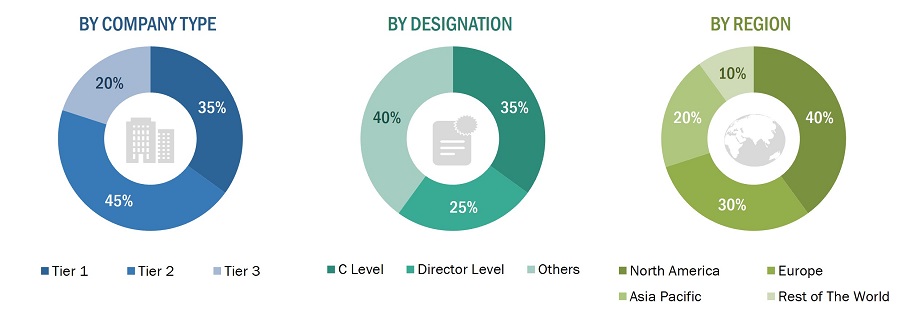
Extensive primary research was conducted after obtaining information about the current scenario of the 3D printed satellite market through secondary research. Several primary interviews were conducted with market experts from both the demand and supply sides across four regions: North America, Europe, Asia Pacific, the rest of the world. This primary data was collected through questionnaires, emails, and telephonic interviews.
These interviews were conducted to gather insights such as market statistics, data on revenue collected from the products and services, market breakdowns, market size estimations, market size forecasting, and data triangulation. It also helped analyze the components, application, manufacturing technique, satellite mass segments of the market for four key regions.
To know about the assumptions considered for the study, download the pdf brochure
Market Size Estimation
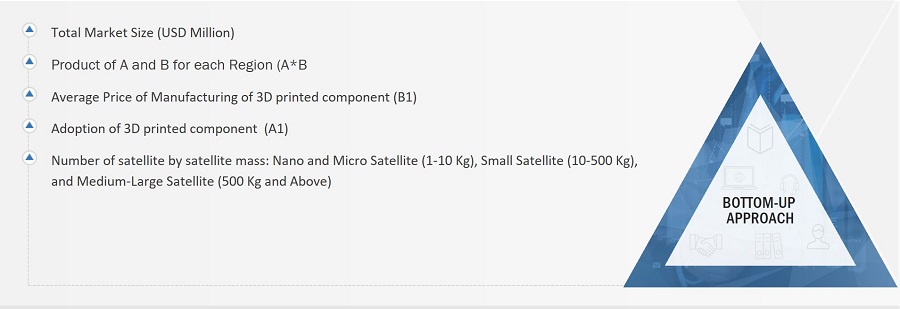
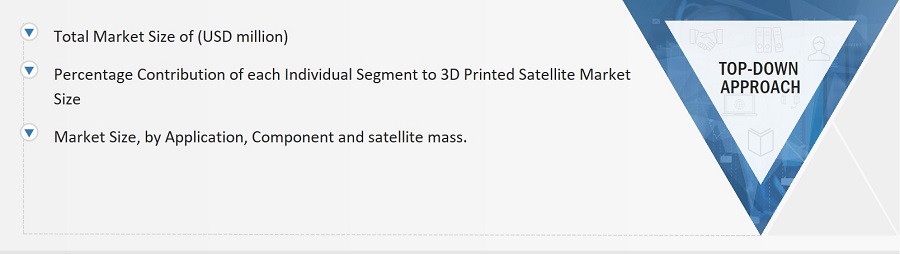
Both the top-down and bottom-up approaches have been used to estimate and validate the size of the market. The research methodology used to estimate the market size also includes the following details:
The key players were identified through secondary research, and their market ranking was determined through primary and secondary research. This included a study of the annual and financial reports of the top market players and extensive interviews of leaders, including chief executive officers (CEO), directors, and marketing executives.
All percentage shares, splits, and breakdowns were determined using secondary sources and verified through primary sources. All possible parameters that affect the markets covered in this research study were accounted for, viewed in extensive detail, verified through primary research, and analyzed to obtain the final quantitative and qualitative data. This data was consolidated, enhanced with detailed inputs, analyzed by MarketsandMarkets, and presented in this report.
Market size estimation methodology: Bottom-up Approach
Market size estimation methodology: Top- Down Approach
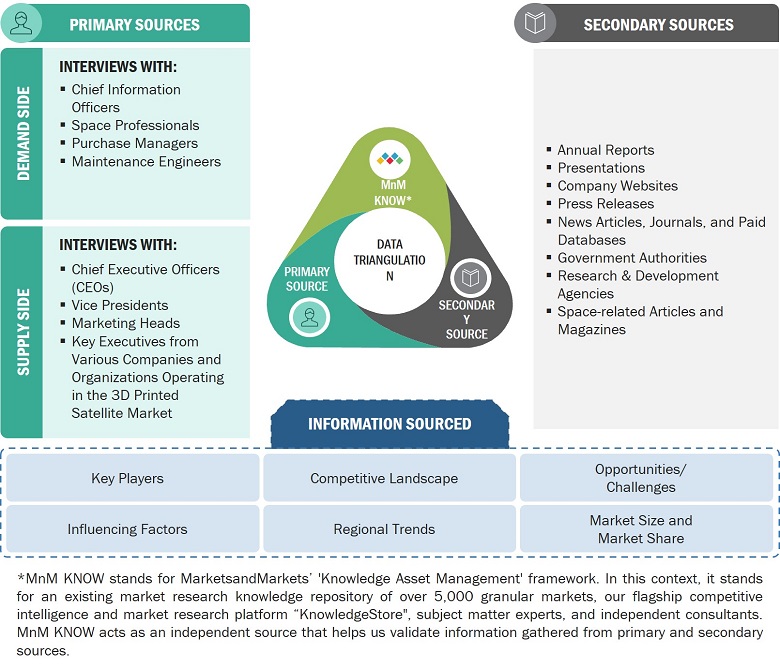
Data Triangulation
After arriving at the overall size of the 3D printed satellite market from the market size estimation process explained above, the total market was split into several segments and subsegments. To complete the overall market engineering process and arrive at the exact statistics for various market segments and subsegments, data triangulation and market breakdown procedures explained below were implemented, wherever applicable. The data was triangulated by studying various factors and trends from both the demand and supply sides. Along with this, the market size was validated using both top-down and bottom-up approaches.
Market Definition
3D printing, also known as additive manufacturing, is a process used to manufacture components in a layer-by-layer process using 3D design data stored in a digital file. The technology aids designers in developing superior-quality parts without facing restrictions, such as production feasibility, cost, or complexity. 3D Printed Satellites Market is a rapidly growing market dedicated to prolonging the operational life of orbiting satellites. 3D printing technology enables the production of intricate components without the necessity for conventional soldering and welding processes, thereby mitigating structural concerns associated with these traditional methods.
The 3D printed satellite market has the potential to make space exploration more accessible and affordable. By reducing the cost and complexity of satellite manufacturing, 3D printing could enable more countries and companies to participate in the space industry. Satellites that have less physical weight are also given higher preference in space missions as their weight directly affects the costs involved in the manufacturing of components used in satellites.
Stakeholders
- 3D printed satellite manufacturers
- Component Manufacturers
- Space Contractors
- Government and Defence organizations related to the market
- Research Organizations
- Investors and Venture Capitalists
- Ministries of Defense
- R&D Companies
Report Objectives
- To define, describe, and forecast the size of the 3D printed satellite market based on satellite mass, application, components, manufacturing technique, and region.
- To forecast the size of the various segments of the 3D printed satellite market based on four regions: North America, Europe, Asia Pacific, and the Rest of the World, along with key countries in each of these regions.
- To identify and analyze key drivers, restraints, opportunities, and challenges influencing the growth of the market
- To identify industry trends, market trends, and technology trends prevailing in the market
- To analyze micromarkets with respect to individual technological trends, prospects, and their contribution to the overall market
- To provide a detailed competitive landscape of the market and analyze competitive growth strategies such as new product developments, contracts, partnerships, joint ventures, agreements, and collaborations adopted by key players in the market
- To identify the detailed financial position, key products, unique selling points, and key developments of leading companies in the market
- To strategically profile key market players and comprehensively analyze their market rank analysis and core competencies.
Available customizations
Along with the market data, MarketsandMarkets offers customizations as per the specific needs of companies. The following customization options are available for the report:
Product Analysis
- Product matrix, which gives a detailed comparison of the product portfolio of each company
Regional Analysis
- Further breakdown of the market segments at country-level
Company Information
- Detailed analysis and profiling of additional market players (up to 5)
Get the Full 3D Printed Satellite Market Report
Full forecast, segment splits, and company analysis for all 3D Printed Satellite Market.
Need a Tailored Report?
Customize this report to your needs
Get 10% FREE Customization
Customize This Report
